Food Photography Cost & Pricing 2026: $0.40–$500+ Per Image
 Ali Tanis17 min read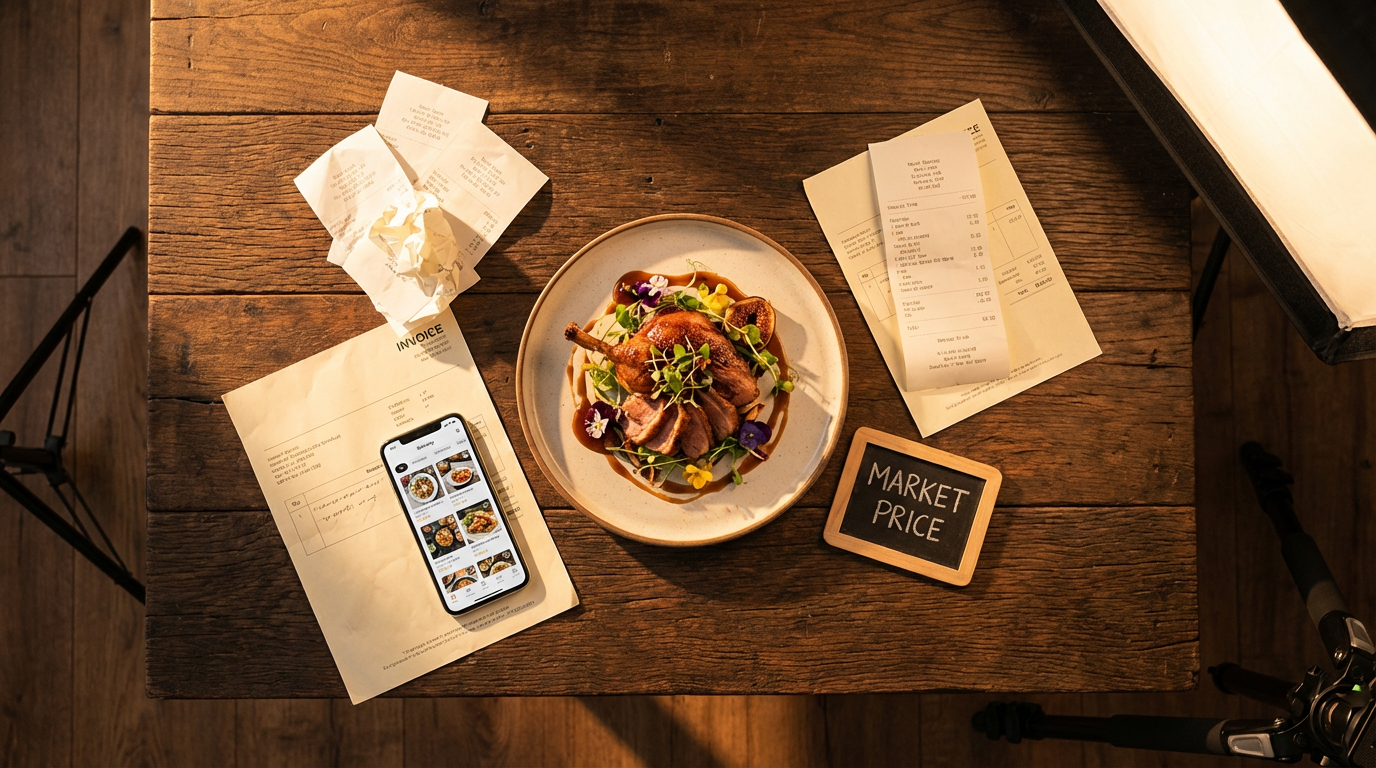
The average food photography cost for restaurants in 2026 ranges from $0.40 to $500+ per image, depending on how you get the work done. That's a 1,000x price difference — and most restaurant owners don't realize all their options before committing to the expensive one.
Whether you're updating 20 menu items for DoorDash or shooting a full brand campaign, this food photography pricing guide breaks down exactly what each method costs, what you actually get for the money, and which approach delivers the best return on your investment.
Quick Summary: Professional food photographers charge $500–$2,500 per session (often $2,500–$7,500 all-in with hidden costs like food stylists and studio rental). Freelance photo editors on Fiverr run $5–$100 per image. Stock photos cost $2–$20 per image but aren't your actual food. AI tools like FoodShot start at $15/month ($0.60/image) using your real dishes. For most restaurants, AI handles 80–90% of daily photo needs at 95% less cost than traditional food photography.
What Food Photography Really Costs in 2026
Restaurants have four main options for getting professional-looking food images, and the food photography cost gap between them is enormous:
- Hire a professional food photographer — $500–$7,500+ per session
- Outsource photo editing to freelancers — $5–$100 per image
- Buy stock food photography — $2–$20 per image
- Use AI food photography tools — $0.40–$0.60 per image
Each method has real trade-offs beyond just the price per image. A $5,000 photographer session might be worth every penny for a brand launch — but it's massive overkill for updating your Tuesday special on Uber Eats. Let's dig into what you actually get at each price point.
Option 1: Hiring a Professional Food Photographer
Professional food photography is the gold standard for a reason. A skilled photographer brings expert lighting, composition knowledge, and the creative ability to make a $12 pasta dish look like it belongs in a Michelin guide.
Here's what food photographers charge in 2026:
| Experience Level | Session Rate | Per Image | What You Get |
|---|---|---|---|
| Entry-level | $250–$600 | $50–$150 | 3–5 hours, 15–25 edited images, basic retouching |
| Mid-range | $750–$2,500 | $100–$300 | Full day, 25–40 images, professional retouching |
| Premium (major cities) | $1,200–$2,500+ | $200–$500+ | Full production, 40+ images, extended licensing |
These rates come from industry data compiled by Format.com and photographer pricing surveys. They vary significantly by market. Los Angeles and New York food photographers charge roughly 45% above the national average, while restaurants in mid-size cities like Nashville or Denver pay more moderate rates.
Important: Session fees cover only the photographer's time and basic editing work. The real food photography cost is usually much higher once you factor in the full production team.
The Hidden Costs That Double Your Bill
The photographer's session fee is the number on the brochure. The invoice tells a very different story.
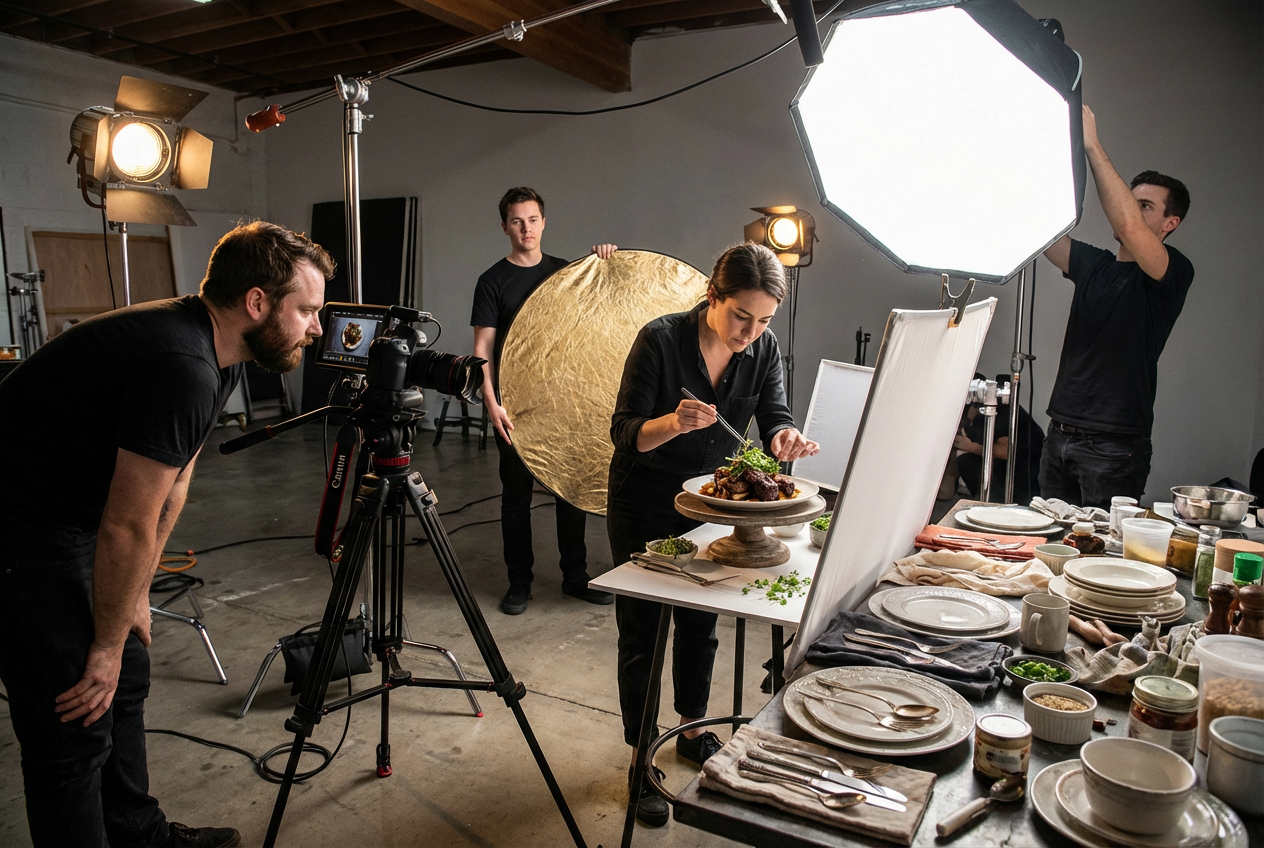 Professional food photography studio session with photographer, food stylist, and expensive equipment showing hidden production costs
Food Stylist: $500–$1,200/day Professional food photographers typically don't style the food themselves. A dedicated food stylist preps, plates, and keeps each dish camera-ready throughout the shoot — and bills separately. According to The Bite Shot, the standard rate for a food stylist is around $650/day, with advertising shoots running $850–$1,200/day.
Studio Rental: $750–$2,500/day If you're not shooting on-location in your restaurant (and many photographers prefer a controlled studio environment), you'll need a rental studio with a full kitchen. In major cities, that runs $750 to $2,500 per day, per Food Photography Blog's pricing guide.
Props, Materials, and Groceries: $150–$400 Backgrounds, plates, utensils, napkins, garnishes — plus duplicate ingredients because food deteriorates quickly under studio lights. Ice cream melts in 5 minutes. Salads wilt in 20. Hot dishes lose their steam and visual appeal in under 10 minutes. Time is literally money on a food photography set.
Assistant and Crew: $350–$500/day Photo assistants and lighting techs add up fast. Per A Photo Editor, assistant day rates typically run $500/day, with campaign productions often budgeting $1,000+ for crew over a two-day shoot.
Post-Production Editing: $10–$25/image Basic retouching is usually included in the session fee, but advanced editing work — compositing, extensive color grading, background replacement — adds $10–$25 per image on top of the base rate.
The Real Total Food Photography Cost Per Session:
| Cost Component | Price Range |
|---|---|
| Photographer session fee | $500–$2,500 |
| Food stylist | $500–$1,200 |
| Studio rental | $750–$2,500 |
| Props, groceries, materials | $150–$400 |
| Assistant/crew | $350–$500 |
| Travel and setup time | $80–$300 |
| Total per session | $2,330–$7,400 |
For restaurants that update food photos quarterly for seasonal menus and new specials, that's $9,300–$29,600 per year on food photography alone. That's a significant line item for any food business.
When Hiring a Photographer Makes Sense
Despite the high food photographer cost, professional food photography still wins for specific, high-impact situations:
- Brand launches — when you need a unique creative direction for your restaurant
- Print advertising — billboards, magazines, and other high-resolution needs
- Cookbook projects — complex lifestyle scenes with styled environments
- Grand openings — hero shots that define your restaurant's identity and brand
For a deeper breakdown of the quality differences, see our traditional vs AI food photography comparison.
But for the other 90% of a restaurant's daily photo needs — menu updates, delivery platform listings, social media posts, daily specials — there are faster and much cheaper options that deliver professional results.
Option 2: Freelance Photo Editing (Fiverr & Upwork)
If you already have decent source photos (even smartphone shots), outsourcing the editing work to freelancers on platforms like Fiverr or Upwork is a popular middle-ground approach. Many small restaurants and food businesses try this first.
Current rates for food photo editing on Fiverr (2026):
| Service Level | Price Per Image | What You Get | Turnaround Time |
|---|---|---|---|
| Basic color correction | $5–$10 | Lightroom adjustments, white balance, brightness | 1 day |
| Professional retouching | $20–$50 | Blemish removal, color grading, light enhancement | 1–2 days |
| Advanced manipulation | $50–$100 | Background changes, compositing, heavy styling | 2–3 days |
Most sellers offer batch pricing for 10+ images, which brings per-image costs down 20–30%. Upwork freelancers tend to charge slightly higher rates but often provide more consistent, ongoing client relationships.
The Catch: Editing Can't Fix a Bad Photo
Here's what freelance editors won't tell you upfront: editing can polish a decent photo, but it can't rescue a bad one.
What editing can fix: Color temperature, brightness, minor blemishes, cropping, and light background cleanup.
What editing can't fix: Poor lighting, bad composition, unappealing food presentation, wrong camera angle, and cluttered backgrounds.
If your source photo has harsh overhead fluorescent lighting and a cluttered table, even a $50 Fiverr edit will just produce a slightly better-looking bad photo. You still need a reasonable starting point — which is why solid iPhone food photography skills matter so much.
Other limitations worth knowing:
- Inconsistent quality — different freelancers deliver different quality results, even at the same price point
- Communication overhead — revision cycles eat your time, especially for food-specific needs
- No composition changes — you can't change the camera angle or food arrangement after the shot
- Days, not minutes — not practical when you need images tonight for tomorrow's special
Freelance editing works best as a supplement when you already take good source photos and just need that final professional polish before publishing.
Option 3: Stock Food Photography
Stock photo subscriptions seem budget-friendly on paper:
| Platform | Subscription Cost | Per Image Cost |
|---|---|---|
| Shutterstock (10 images/month) | $29–$49/month | $2.90–$4.90 |
| Adobe Stock (10 images/month) | $29.99/month | $3.00 |
| iStock (10 images/month) | $29–$40/month | $2.90–$4.00 |
| On-demand purchases | — | $1–$20/image |
Extended licenses for wider commercial use run $50–$150 per image, and premium stock imagery (like Shutterstock's Offset collection) can cost $250–$500 per image.
Why Stock Photos Hurt More Than Help
Stock food photography has a fundamental problem for restaurants: those aren't your dishes.
A customer scrolls through DoorDash, sees your gorgeous stock photo of chicken tikka masala, then gets delivered something that looks completely different. That's a one-star review waiting to happen.
More problems with stock images for your food business:
- No differentiation — the same burger photo might appear on three competing restaurants in your area
- Customer trust erosion — 73% of delivery app users say photos influence their order decisions. Misleading photos destroy that trust fast
- Platform compliance issues — Uber Eats and DoorDash increasingly encourage original food photos. Stock images can get flagged or rejected by the platforms
- Zero brand value — stock photos build absolutely no visual identity for your restaurant
Stock images might work for a food blog illustration or generic social media filler. For your actual restaurant menu and delivery app listings? They're a liability, not an asset.
Option 4: AI Food Photography
AI food photography tools have fundamentally changed the cost equation for restaurants. Instead of hiring a production crew or buying generic stock images, you upload a photo of your actual dish and the AI transforms it into a professional-quality image in about 2 minutes.
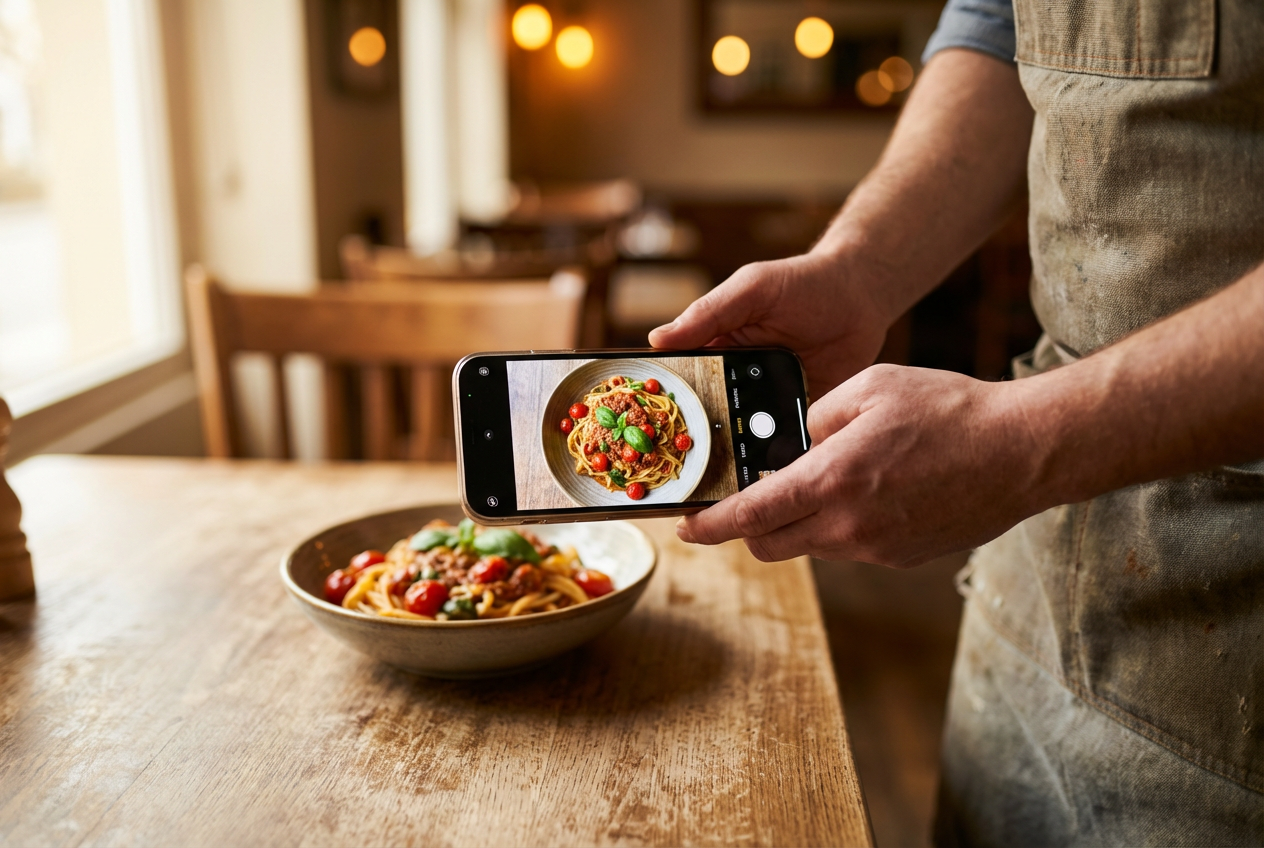 Restaurant owner photographing a pasta dish with smartphone for affordable AI food photography enhancement
FoodShot AI is purpose-built for exactly this use case. Here's the current pricing:
| Plan | Monthly Price | Images/Month | Cost Per Image |
|---|---|---|---|
| Starter | $15/month | 25 | $0.60 |
| Business | $45/month | 100 | $0.45 |
| Scale | $99/month | 250 | $0.40 |
| Enterprise | Custom | Custom | Volume pricing |
All plans include a commercial license, watermark removal, 30+ style presets (Delivery, Restaurant, Fine Dining, Instagram), background replacement, and reference image uploads. Annual billing saves 40%. See full pricing details.
What $15–$99/month actually gets you:
- Upload a smartphone photo → get a studio-quality result in about 2 minutes
- Replace backgrounds with professional settings (luxury restaurant, beach cafe, marble countertop, and dozens more)
- Adjust lighting styles and camera angles automatically
- Create images optimized specifically for Uber Eats, DoorDash, and Grubhub
- Generate social media posters and templates directly from your food photos
- Clone the style of any Pinterest reference image for consistent branding across your menu
The Starter plan at $15/month covers 25 transformations — enough for a small restaurant to photograph its entire menu. The Business plan at $45/month handles 100 images per month, covering regular social media content plus complete menu updates.
What AI Can and Can't Do
AI food photography excels at the everyday work that drives most of a restaurant's image needs:
- ✅ Menu photos for websites, apps, and printed menus
- ✅ Social media content for Instagram, Facebook, and Pinterest
- ✅ Delivery platform listings (Uber Eats, DoorDash, Grubhub)
- ✅ Cafe menu refreshes and seasonal updates
- ✅ Promotional posters, banners, and marketing materials
It's not the right tool for every single situation:
- ❌ Brand campaigns requiring models or lifestyle scenes with people
- ❌ Ultra-high-resolution print advertising like billboards
- ❌ Projects requiring a specific photographer's unique artistic vision
- ❌ Non-food photography (FoodShot is built specifically for food images only)
One important detail: AI food photography requires you to upload an actual photo of your dish as input. It transforms and enhances real food — it doesn't generate fictional dishes from text descriptions. That's actually a feature, because the result shows your actual menu items, which maintains customer trust.
For the best source photos to start with, check our iPhone food photography tips. Even a basic well-lit smartphone shot gives AI more than enough to work with.
Side-by-Side Food Photography Cost Comparison
Here's what each method costs to photograph 50 and 100 menu items — the typical range for a full restaurant menu:
| Method | Cost Per Image | 50 Images | 100 Images | Annual Cost (quarterly updates) |
|---|---|---|---|---|
| Professional Photographer (all-in) | $50–$150 | $2,500–$7,500 | $5,000–$15,000 | $10,000–$30,000 |
| Freelance Editing (Fiverr/Upwork) | $5–$60 | $250–$3,000 | $500–$6,000 | $1,000–$12,000 |
| Stock Photography | $2–$20 | $100–$1,000 | $200–$2,000 | $400–$4,000 |
| AI Photography (FoodShot) | $0.40–$0.60 | $20–$30 | $40–$60 | $180–$1,188 |
The numbers speak clearly. A restaurant using AI food photography tools instead of traditional sessions saves $9,800–$28,800 per year — money that goes straight back into the business.
But food photography cost savings only matter if the results actually drive revenue. Do professional-quality food photos make a measurable difference in orders?
Do Better Photos Actually Pay for Themselves?
Short answer: yes, and the data isn't even close.
Platform-specific research on food photo impact:
- GrubHub reports that restaurants with food photos receive 30–70% more online orders than text-only listings
- Deliveroo data shows restaurants using more photos capture the majority of online orders on the platform, with a reported 24% sales boost
- DoorDash merchants with professional food photos see 15% higher delivery volume
- Just Eat reports 4x more basket additions for menu items with photos versus text-only listings
Consumer behavior research:
- A Snappr/Google survey of 600 US consumers found that viewing food photos is 1.44x more important than reading menu descriptions and 1.38x more important than reading online reviews
- Professional food photos increase delivery app orders by 35% and boost menu conversion rates by 25%
- 73% of consumers won't order food from a restaurant without first seeing photos of the dishes
The global food delivery market hit $288 billion in 2024 and is projected to exceed $500 billion by 2030, according to Grand View Research. In this rapidly growing market, restaurants without quality food images are essentially invisible to customers browsing delivery apps.
ROI Calculation: A Real-World Example
Let's run the numbers for a typical restaurant doing $8,000/month in delivery revenue through platforms like Uber Eats and DoorDash:
Conservative estimate: 25% increase in delivery orders after adding professional food photos
- Monthly revenue increase: $8,000 × 25% = $2,000/month
- Annual revenue increase: $24,000/year
| Investment Method | Annual Cost | Net Revenue Gain | ROI | Payback Period |
|---|---|---|---|---|
| Professional photographer | $10,000–$20,000 | $4,000–$14,000 | 20–140% | 5–10 months |
| Freelance editing | $1,000–$6,000 | $18,000–$23,000 | 300–2,300% | 1–3 months |
| AI photography (FoodShot) | $180–$1,188 | $22,812–$23,820 | 1,920–13,233% | 1–6 days |
Every option pays for itself within a year. But the AI column is where the math gets remarkable — a FoodShot Business plan at $45/month ($540/year) could generate $23,460 in additional annual delivery revenue. That's a 4,344% return on investment.
The payback period is measured in days, not months. Even if you conservatively cut the order increase estimate in half (to 12.5%), AI food photography still pays for itself within two weeks.
Which Option Is Right for Your Restaurant?
Your budget, business type, and content volume needs determine the best approach. Here's a practical decision framework:
Budget under $500/year → AI food photography The clear choice for small restaurants, food trucks, and independent cafes. At $15–$45/month, AI tools cover all your menu and delivery app photo needs with professional results. Start with FoodShot's AI food photography platform and use your smartphone as the camera.
Budget $500–$2,000/year → AI + occasional freelance editing Use AI for 90% of daily content — menu updates, delivery platforms, social media posts. Bring in a Fiverr freelancer for special occasions where you need extra creative work on a hero shot or want a particular editing style applied.
Budget $2,000–$10,000/year → AI + one professional shoot annually Commission one professional food photography session per year for brand images and high-impact marketing materials. Use AI for all operational photography — seasonal menus, weekly specials, platform listings, and social media content. This is the sweet spot for established restaurants that want brand-quality hero shots but can't justify the cost of monthly professional shoots.
Budget $10,000+/year → Professional shoots + AI for daily operations Full professional photography for major campaigns, brand updates, and print materials. AI tools handle the volume work: daily specials, new menu additions, delivery app updates, and content for multiple locations. This hybrid approach is increasingly popular among restaurant groups and fine dining establishments looking to balance quality with efficiency.
Most independent restaurants land in the first two tiers. A $45/month FoodShot Business plan handles 100 image transformations per month — enough for a full menu refresh plus regular social media content — and costs less per month than a single hour with most professional food photographers.
Frequently Asked Questions
How much does a food photographer charge per hour?
Most food photographers don't charge hourly — they prefer half-day ($400–$1,200) or full-day ($750–$2,500) rates. When photographers do bill per hour, expect $50–$500 depending on experience and market. Hourly billing is risky for clients because food photography sessions almost always run longer than initially estimated, and you'll still face additional production costs for styling, studio time, and post-production editing.
How many menu photos does a restaurant need?
A typical restaurant needs 30–80 food photos to fully cover their menu, plus additional images for seasonal updates and social media content. Delivery platforms like Uber Eats and DoorDash work best when every single menu item has a photo — restaurants with complete photo coverage get significantly more orders than those with missing images.
Can I use iPhone photos for my restaurant menu?
A well-shot iPhone photo is a solid starting point, especially with the cameras on iPhone 14 and newer models. But raw smartphone photos rarely look professional enough for menus or delivery apps without some form of editing or enhancement. The most cost-effective approach: capture decent iPhone shots with good natural lighting and a clean background, then enhance them with AI tools. Check our guide to iPhone food photography tips for specific techniques that work.
Is AI food photography good enough for Uber Eats and DoorDash?
Yes. AI-enhanced food photos meet and often exceed the quality guidelines for major delivery platforms. The key advantage is consistency — every single image maintains the same professional quality, building a polished brand presence across your entire menu. Many restaurants and cafes now use AI food photography as their primary method for creating delivery app listings.
How often should restaurants update their food photos?
At minimum, quarterly for seasonal menu changes. Ideally, update food photos whenever you add new items, run specials, or notice delivery listings underperforming. Platforms like DoorDash and Uber Eats tend to surface active, frequently-updated restaurant listings more prominently in search results. This is where AI food photography tools have a decisive advantage — you can update photos the same day a new dish hits the menu, rather than scheduling a photographer weeks in advance and then waiting days for edited images.
What's the cheapest way to get professional food photos?
AI food photography tools offer the lowest cost per image at $0.40–$0.60 each. For perspective, photographing your entire 50-item menu costs about $20–$30 with AI, compared to $2,500–$7,500 for a traditional food photography session. The trade-off is creative control — AI works within preset styles rather than offering the unlimited creative flexibility of a human photographer directing a full production. For everyday restaurant operations and delivery app listings, that trade-off is well worth the massive cost savings.