AI Food Image Generator: How AI Creates Restaurant Photos
 Ali Tanis13 min read
Search for "ai food generator" and you'll find dozens of tools promising to create stunning food images online. But there's a critical distinction most people miss: some AI tools generate fictional food pictures from text prompts, while others enhance real photos of your actual dishes.
If you're a restaurant owner, food blogger, or delivery business, choosing the wrong type could cost you customer trust — or even get your listing flagged on platforms like Uber Eats or DoorDash.
Quick Summary: AI food generators (Midjourney, DALL-E, Recraft) create imaginary food from text prompts — great for creative projects, risky for menus. AI food photo enhancers (like FoodShot) transform your real dish photos into professional-quality images — keeping your food authentic while making it look its best. For restaurants, the enhancer approach is almost always the smarter choice.
Two Types of AI Food Image Tools (And Why the Difference Matters)
The term "ai food generator" covers two fundamentally different technologies that create food images in opposite ways:
1. AI Food Image Generators (Text-to-Image) You type a text prompt — "grilled salmon with lemon butter sauce on a white plate" — and the AI creates a realistic image from scratch. The food in the photo never existed. Tools like Midjourney, DALL-E 3, Recraft, and Stable Diffusion fall into this category. Many offer free tiers or free trials, making them easy to experiment with online.
2. AI Food Photo Enhancers (Photo-to-Photo) You upload a real photo of your actual dish, and the AI transforms it with professional lighting, better backgrounds, and refined styling. The food in the output is your food. FoodShot AI works this way, using AI specifically trained on food photography to generate professional results from smartphone photos.
This distinction matters enormously for anyone in the food business. A customer ordering your pad thai from a delivery app expects the dish to look like the photo. If you used a generator, they're ordering a dish that literally doesn't exist. If you used an enhancer, they're ordering your actual pad thai — just photographed professionally.
How AI Food Generators Create Images From Scratch
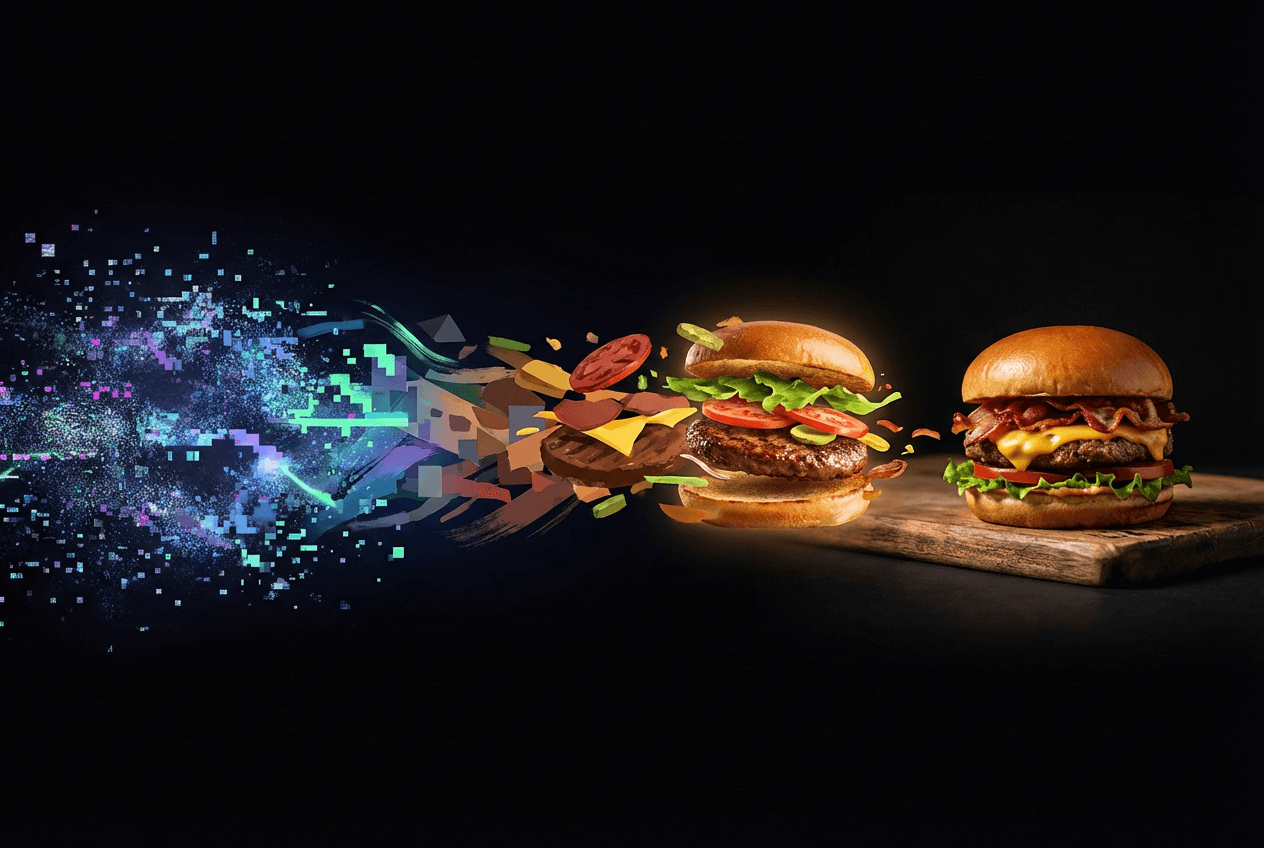 How AI food generators work by creating food images from digital noise through diffusion models
Modern AI food generators run on something called diffusion models — and understanding the basics helps explain both their power and their limitations.
Here's the simplified version: during training, the AI studies millions of food photos from across the internet. It learns patterns — what a burger "typically" looks like, how lighting usually falls on a bowl of ramen, common plating styles for sushi. Then it learns to gradually build images from pure visual noise, step by step, guided by your text prompt.
Think of it like dreaming. The AI doesn't remember a specific burger it saw. Instead, it constructs a statistically plausible burger based on everything it's ever learned about burgers. The result can look incredibly realistic, but it's entirely fictional.
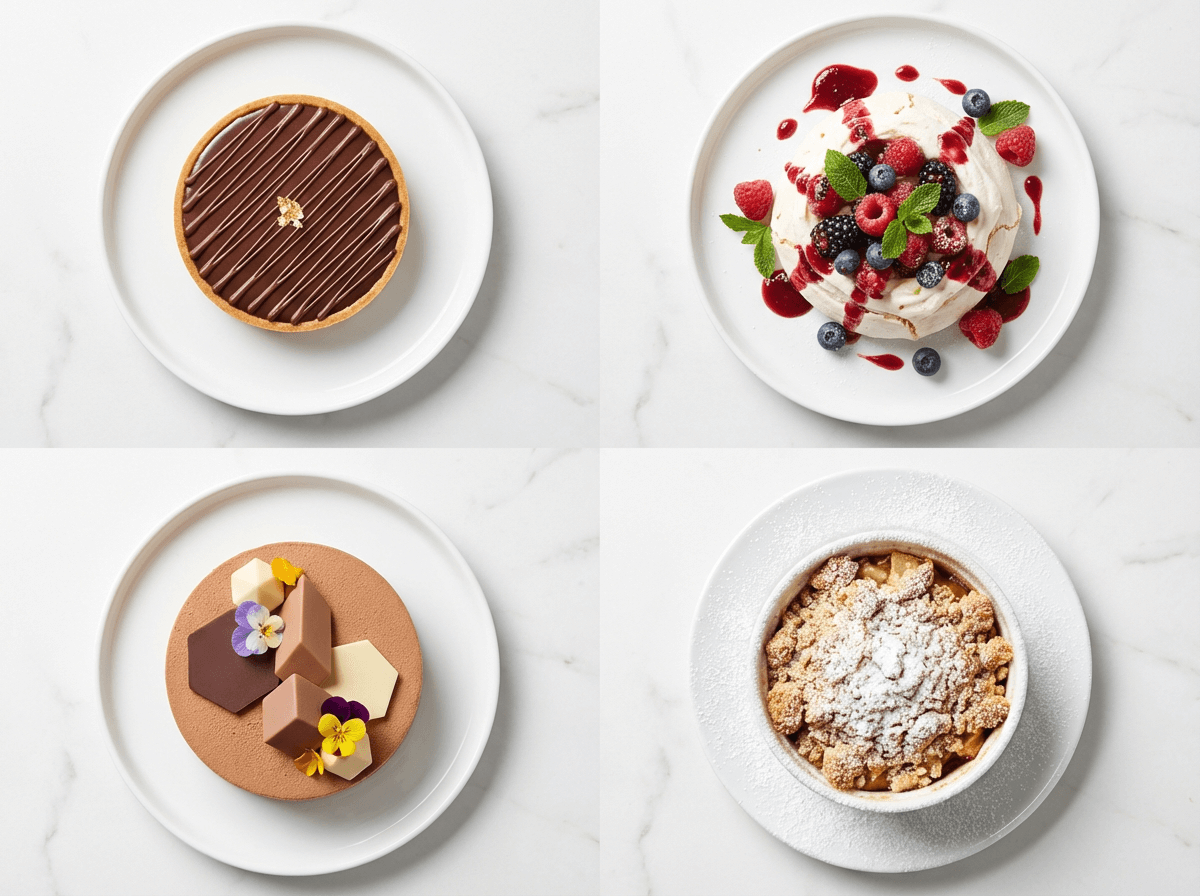 Comparison of AI-generated food images showing different plating styles and visual quality for restaurant menus
What generators are good at
- Visual variety. Type "a rustic pasta dish on a wooden table with candlelight" and you'll get something beautiful — free tools like Recraft and NightCafe can generate these in seconds.
- Creative exploration. Want to visualize a dish concept or explore recipe ideas visually before making them? Generators are useful for brainstorming new menu items.
- Speed. Most generate a food image in under 30 seconds.
- Cost. Many AI food image generators are free to use or have generous free tiers for personal projects and experimentation.
Where generators fall short
- Accuracy. The AI decides what your "grilled chicken" looks like. It might add garnishes you don't use or create plating styles that don't match your restaurant's actual dishes.
- Consistency. Run the same text prompt twice and you'll get two different dishes. Maintaining a cohesive visual design across your menu is nearly impossible.
- Fine details. AI-generated food pictures sometimes have subtle tells — odd textures, impossible reflections, slightly melted-looking cheese where it shouldn't be.
- Truthfulness. The food doesn't exist. For restaurants and food businesses, this is the deal-breaker.
How AI Photo Enhancers Transform Real Food
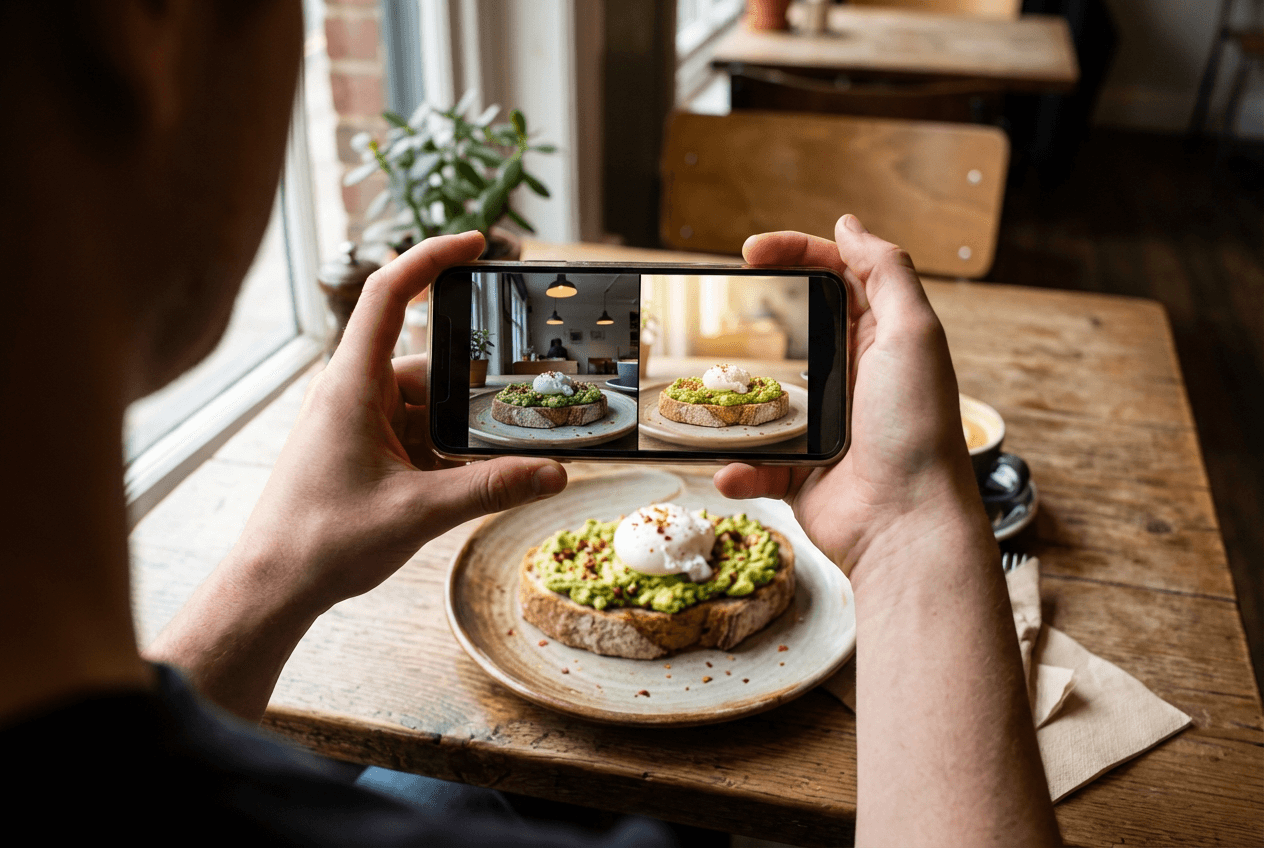 AI food photo enhancer transforming a smartphone food photo into professional restaurant photography
AI food photo enhancers take the opposite approach. Instead of imagining food from a text description, they start with an actual photograph of a real dish — your dish, your recipes, your kitchen's output.
 Chef preparing real food dish for AI food photography enhancement showing authentic ingredients and preparation
Here's how FoodShot's AI food photography process works:
- Upload a photo of your dish — even a quick iPhone snap works.
- Choose a style from 30+ presets (Delivery, Restaurant, Fine Dining, Instagram, and more).
- Get results in about 2 minutes — a realistic, professional-quality image ready to use.
The AI handles what would normally require a professional photographer and a full studio setup: correcting lighting, replacing cluttered backgrounds with clean surfaces, adjusting camera angles, and refining the overall composition. You can also add garnishes, swap plates, remove imperfections, or change the background entirely — to a luxury restaurant setting, a beachfront café, or a clean flat-lay surface.
The critical difference? Your actual food remains at the center of the image. The AI enhances the photography, not the food itself. Your customers see your real dish, presented professionally.
This is the same philosophy behind traditional food photography — food stylists don't replace your dish with a fake one. They make your real food look its best under ideal conditions. AI enhancers automate that process at a fraction of the food photography cost.
Generated vs. Enhanced: A Side-by-Side Comparison
Here's how these two approaches to AI food images stack up across the factors that matter most:
| Factor | AI Food Generators | AI Food Photo Enhancers |
|---|---|---|
| Input | Text prompt description | Real photo of your dish |
| Output | Fictional food image | Your real food, professionally styled |
| Accuracy to your menu | Low — AI decides appearance | High — it's literally your food |
| Delivery platform compliance | Risky — may be flagged | Safe — represents actual dishes |
| Consistency | Varies per generation | Consistent with real menu items |
| Best for | Creative concepts, art, recipes brainstorming | Menus, delivery apps, online marketing |
| Cost | Free to ~$30/mo | $15–$99/mo (see plans) |
| Speed | 10–30 seconds | ~2 minutes |
| Customer trust | Lower (food may look different) | Higher (food matches expectations) |
For any situation where a customer will order food based on the photo, enhancers win. For creative or conceptual work where accuracy to a real dish doesn't matter, generators have their place.
The Authenticity Problem With AI-Generated Food Photos
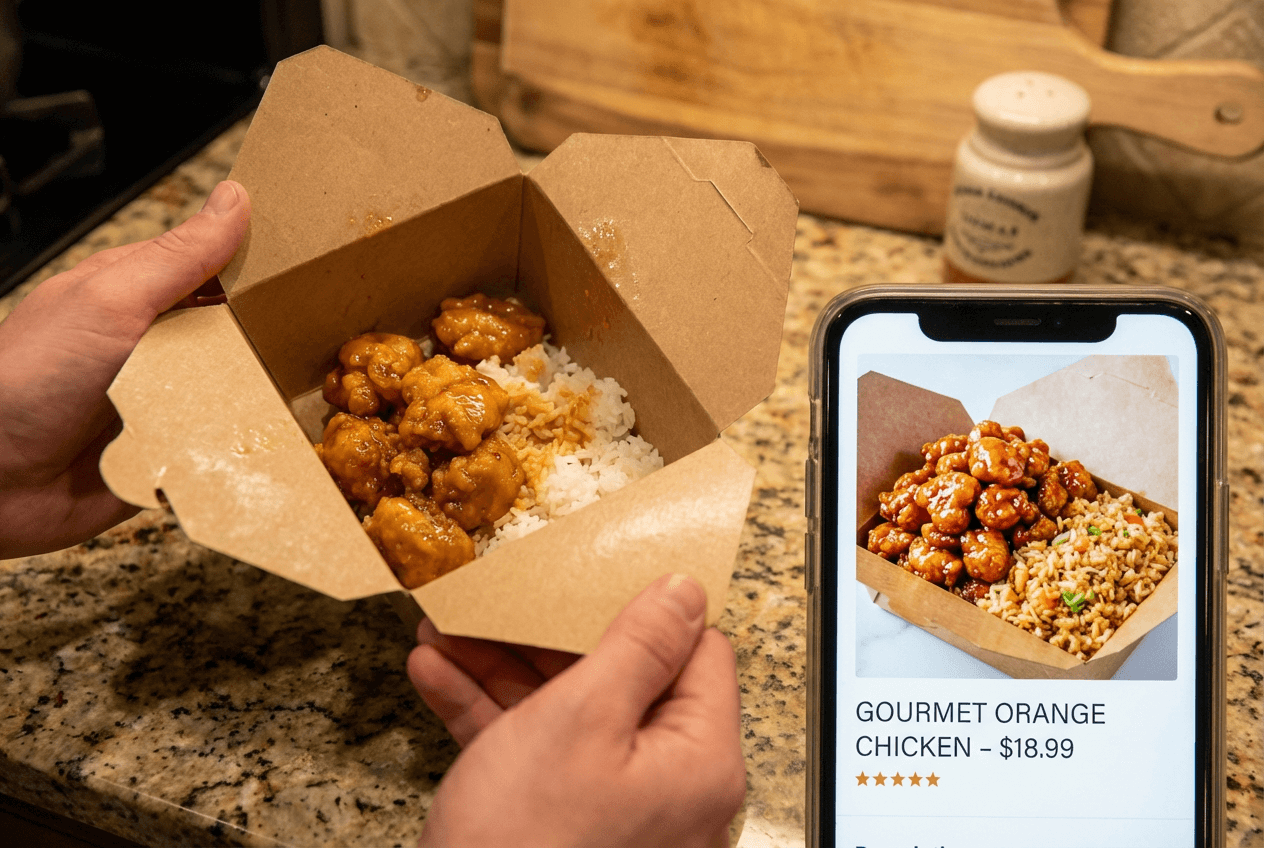 Customer comparing delivered food to an AI-generated listing photo showing the trust gap in food delivery
Here's where things get serious for restaurant owners who want to create professional food images for their menus and online delivery listings.
The science: AI food looks too good
A 2024 study from the University of Oxford, published in Food Quality and Preference, found that consumers rated AI-generated food images as significantly more appetizing than real food photos — when they didn't know the images were AI-generated.
The researchers (led by Giovanbattista Califano and Professor Charles Spence) found that AI-generated food pictures leveraged enhanced symmetry, glossiness, lighting, and color to make dishes look better than reality. The AI also tended to make portions appear more abundant — more fries in the basket, more cream on the dessert.
That sounds great until a customer orders your basket of fries expecting the overflowing AI version and gets a normal serving.
Delivery platforms are paying attention
Food delivery platforms are investing heavily in detecting AI-generated imagery. In late 2025, DoorDash permanently removed a driver's account after they submitted an AI-generated proof-of-delivery photo. Companies like GetReal have developed forensic detection tools that identify AI-generated images with 92% precision.
While current enforcement focuses primarily on driver fraud rather than restaurant menu photos, the direction is clear: platforms want authenticity. Using fully AI-generated food images for your delivery listings carries real risk — and that risk is growing.
If you're already selling on these platforms, avoid the food photography mistakes that kill your online orders by keeping your photos honest and high-quality. Our guide to menu photos for Uber Eats and DoorDash covers exactly what the platforms expect.
The trust gap
The core problem is simple: generated food photos create expectations your kitchen can't meet.
Research consistently shows food photos drive purchasing decisions. 56% of people are more likely to choose a restaurant after seeing food photos online, and 40% will try a new restaurant based on food images alone. But that influence works both ways — when reality doesn't match the photo, you lose trust quickly.
An enhanced photo of your actual dish sets an expectation you can meet. A generated image of a fantasy dish doesn't.
When to Use an AI Food Generator (Text-to-Image)
AI food generators aren't useless — they're just the wrong tool for most restaurant needs. Here's where these free and low-cost text-to-image tools genuinely make sense:
- Recipe concept art. Visualizing a dish before developing it in the kitchen — great for chefs brainstorming new recipes and plating designs.
- Social media filler. Generic food-themed posts where the specific dish doesn't matter (think "Happy Taco Tuesday" graphics or seasonal food content).
- Blog and content illustrations. If you're writing about food trends online and need a visual that doesn't represent a specific menu item.
- Mood boards. Exploring plating ideas, color schemes, or restaurant aesthetics before a redesign.
- Personal and creative projects. Art, creative writing, or anything non-commercial where realistic accuracy to a real product is irrelevant.
When to avoid generators: Any context where someone might order food based on the image. That includes menus, delivery app listings, marketing materials that feature specific dishes, and promotional content tied to real menu items.
When to Use an AI Food Photo Enhancer
 Food delivery order matching professional menu photos showing authentic AI-enhanced food photography results
For the vast majority of restaurant and food business needs, a photo enhancer is what you actually want:
- Digital and print menus. Upgrade every dish photo without hiring a photographer each time you update your menu or add new recipes.
- Delivery app listings. Create professional food delivery app photography for Uber Eats and DoorDash, made from photos of your own dishes (check each platform's photo rules before you upload).
- Social media marketing. Turn quick smartphone shots into scroll-stopping content for Instagram, Facebook, and Pinterest in minutes.
- Seasonal menu updates. Photograph new dishes with your phone and let AI handle the professional styling — no need to book a full shoot each season.
- Website and Google Business Profile. Make a consistent first impression everywhere your restaurant appears online.
- Marketing posters and promotions. FoodShot offers 50+ ready-made poster templates and design tools for Instagram posts, Pinterest pins, and delivery app banners — all using your real food photos.
The practical advantage is speed and cost. Traditional vs AI food photography isn't even close: professional shoots typically cost $300–$1,500+ per session, while AI enhancement starts at just $15/month for 25 images with a commercial license included.
How to Choose the Right AI Food Tool for Your Needs
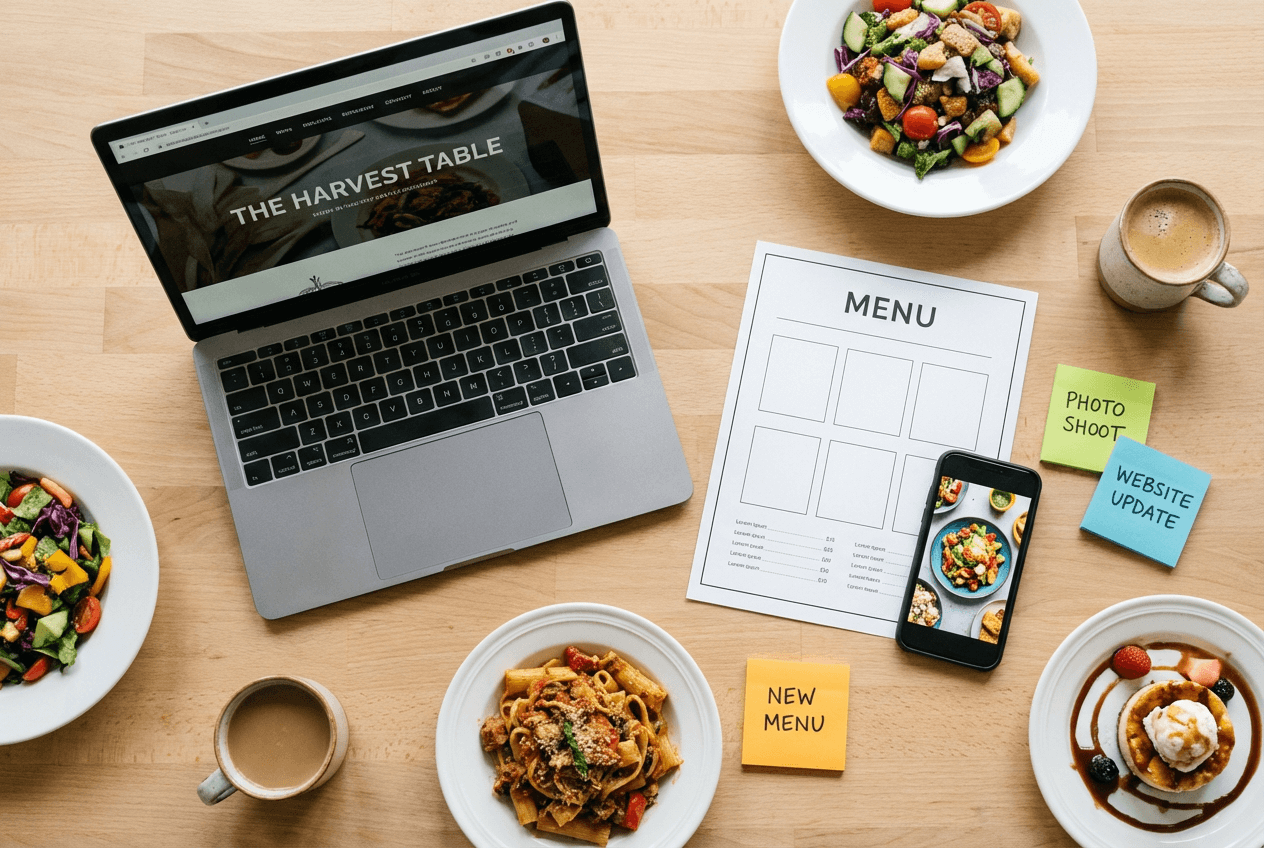 Restaurant owner choosing the right AI food photography tool for menu photos and marketing materials
Ask yourself three questions:
1. Does the photo need to represent real food someone can order? If yes → Use an enhancer. If no (it's for art, concepts, or generic content) → A free generator is fine.
2. Will customers make purchasing decisions based on this image? If yes → Use an enhancer. Your food photos are a promise to your customers. Don't promise something your kitchen doesn't make.
3. Do you need consistency across your menu? If yes → Use an enhancer. Generators produce different results every time you run the same text prompt. Enhancers work from your actual dishes, so your visual design and brand identity stays grounded in reality.
For most restaurants, cafés, food trucks, and delivery businesses, the answer is clear: you need professional photos of your food — not AI-generated pictures of imaginary dishes. That's exactly what AI food photo enhancement does.
If you're ready to transform your existing food photos into professional visuals, FoodShot's plans start at $15/month — roughly the cost of two coffees for 25 professional-quality food images.
Frequently Asked Questions
Can AI food generators create photos of my actual menu items?
No. AI food generators like Midjourney and DALL-E create food images from text prompts — the output is fictional. Even if you describe your dish in detail, the AI will generate its own interpretation based on its training data, not an accurate representation of what your kitchen produces. For photos of your real food and actual recipes, you need an AI food photo enhancer like FoodShot that starts with a real photograph of your dish.
Are AI-generated food photos allowed on Uber Eats and DoorDash?
Delivery platforms increasingly require that menu photos accurately represent the food customers will receive. While policies are still evolving, fully AI-generated images (which depict food that doesn't exist) carry a risk of being flagged or removed. Enhanced photos of real dishes are the safer approach because they accurately represent your actual menu items — just with professional-quality lighting and styling.
What's the difference between an AI food generator and an AI food photo editor?
An AI food generator creates images from scratch based on text prompts — the food is fictional and the AI imagines what the dish should look like. An AI food photo editor (like FoodShot) takes a real photo you upload and enhances the lighting, background, and presentation while keeping your actual food as the subject. Think of it this way: generators invent food, editors enhance real food.
How much do AI food image tools cost?
AI food generators range from free (with limited features and quality) to around $30/month for premium access. AI food photo enhancers like FoodShot start at $15/month for 25 image generations, with plans up to $99/month for 250 images and bulk processing. Both are dramatically cheaper than traditional food photography, which typically runs $300–$1,500+ per session.
Can customers tell if a food photo is AI-generated?
Increasingly, yes. Research from the University of Oxford found that people can identify AI-generated food images when told to look for signs like too-perfect symmetry, unusual textures, or impossible reflections. Detection technology is also improving — forensic AI tools can now identify generated images with over 90% accuracy. Enhanced photos of real food avoid this problem entirely because they depict your actual dishes, just with better lighting and professional presentation.