AI-Enhanced Food Images Uber Eats Allows: 6 Edits, 6 Bans
 Ali Tanis8 min read
Yes — with one condition. The AI-enhanced food images Uber Eats accepts, and the ones DoorDash accepts, all began as a real photo of a dish you actually serve and still show what turns up at the door. Uber Eats' merchant photo rules never mention AI at all. DoorDash's do, and they ban "evidently AI-generated" images. The editing method is not the test. Accuracy is.
Quick Summary: Uber Eats requires item photos to "accurately represent a single item from your Uber Eats Menu" and says nothing about AI. DoorDash prohibits "evidently AI-generated images, heavily altered images, or images that create a misleading representation." Enhancing a real photo is defensible on both; generating a dish you do not cook is what gets listings flagged.
AI-enhanced food images Uber Eats actually allows
Uber's published merchant menu photo guidelines, live as of September 2026, put one rule above all: item images must "accurately represent a single item from your Uber Eats Menu." The rest is mechanical: one centred dish per frame, a 5:4 to 6:4 ratio, rights you own, no people except hands, no blur, no harsh shadows, no dirty surfaces or used cutlery, no logos, watermarks or text. JPG, PNG or GIF, under 10 MB, minimum 550 × 440 pixels.
Notice what is missing: no clause on generative editing, no disclosure requirement, no ban on retouching. The AI-enhanced food images Uber Eats reviewers approve are judged on the result, not the tool. We checked the live page on 1 September 2026: the words "AI", "generated" and "synthetic" do not appear. Full specs in our Uber Eats photo requirements guide.
Two caveats. Diner uploads are stricter — Uber's user-submitted photo guidelines require "an original photo taken of the actual menu item as you received it." And uploading sub-licenses Uber the right to modify your photos without asking.
Which Uber already does. In its 2025 Merchant Impact Report, Uber's newsroom described "using AI to detect and enhance low-quality food images — improving lighting, resolution, framing, and plating." The Verge noted the re-plating examples appear to generatively fill gaps in the food. Uber frames it as lifting the ordering experience for customers browsing dishes across its restaurants. That is no licence to misrepresent yours, but it settles whether enhancement is disqualifying. It is not.
What DoorDash actually requires
DoorDash is the only major platform with explicit published language. Its Virtual Brand Quality Requirements state:
"Submitted photos must be real, clear, and representative of the actual menu item. Evidently AI-generated images, heavily altered images, or images that create a misleading representation of the item are not permitted. This includes images with unrealistic textures, distorted food shapes, inaccurate ingredients, artificial-looking plating, or other visual indicators that the image does not reflect an actual photographed item."
Scope matters, because most coverage gets it wrong. That clause sits on the virtual brand page — the rules for ghost kitchens and delivery-only brands. DoorDash's general photo pages state the accuracy requirement without the AI sentence. For a standard storefront the binding rule is still accuracy; prudence says assume the stricter text applies.
Two more rules bite. DoorDash's POS guidance says you "should be able to see at least 80% of the item, and the photo should reflect the portion size." And every item needs its own distinct image, so recycling one shot fails on its own terms — see our DoorDash photo requirements guide. DoorDash enhances images itself too, telling TODAY it "provides background enhanced updates to select user-generated photos by adjusting lighting, re-plating, or modifying the background."
Grubhub: no published policy to cite
We have to be honest here. Grubhub publishes no merchant photo-content policy comparable to Uber's or DoorDash's. Every "Grubhub photo requirements" page in search is a vendor's summary, not Grubhub. Grubhub for Restaurants reviews images before they go live, and its help centre covers menu basics, but we could not verify a public rule on AI tools, so we will not invent one. Meet the Uber Eats and DoorDash standard and you are almost certainly fine.
Where the line falls: 6 edits that pass, 6 that don't
Defensible, because the dish is real and unchanged:
- Relighting a photo shot under kitchen fluorescents
- Correcting the yellow-green colour cast that lighting causes
- Replacing a cluttered prep-bench background with a clean surface
- Straightening, cropping and sharpening
- Removing a sauce smudge on the rim or a stray crumb
- Re-plating onto a clean version of the vessel you genuinely serve in
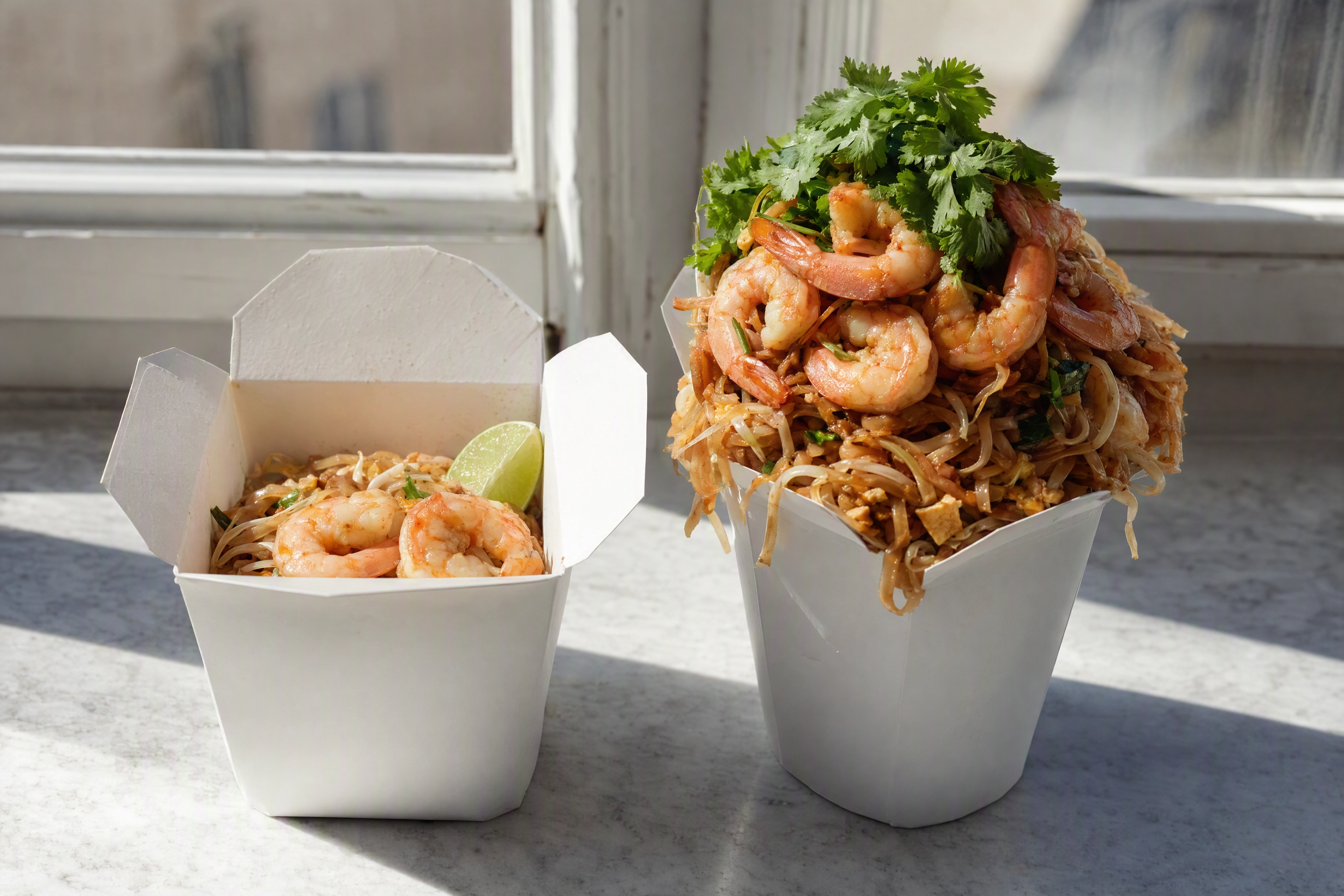 Two identical takeaway containers, one honest portion and one inflated, showing menu photo misrepresentation
Not defensible, because the customer receives something else:
- Generating a dish you have never cooked
- Adding garnishes, sides or sauces the order does not include
- Inflating portion size, patty count or topping density
- Swapping in packaging or a bowl you do not use
- Reusing one image across several different menu items
- Any image for an item you have never actually photographed
One test settles nearly every case: open the photo beside the real order. If they feel misled, it fails — on Uber Eats, DoorDash and Grubhub alike. That is why FoodShot AI restyles the photo you took of your own dish instead of generating food from a text prompt. Your burger, pizza or pasta shot stays your dish, and the delivery experience matches the content customers tapped.
What getting it wrong costs you
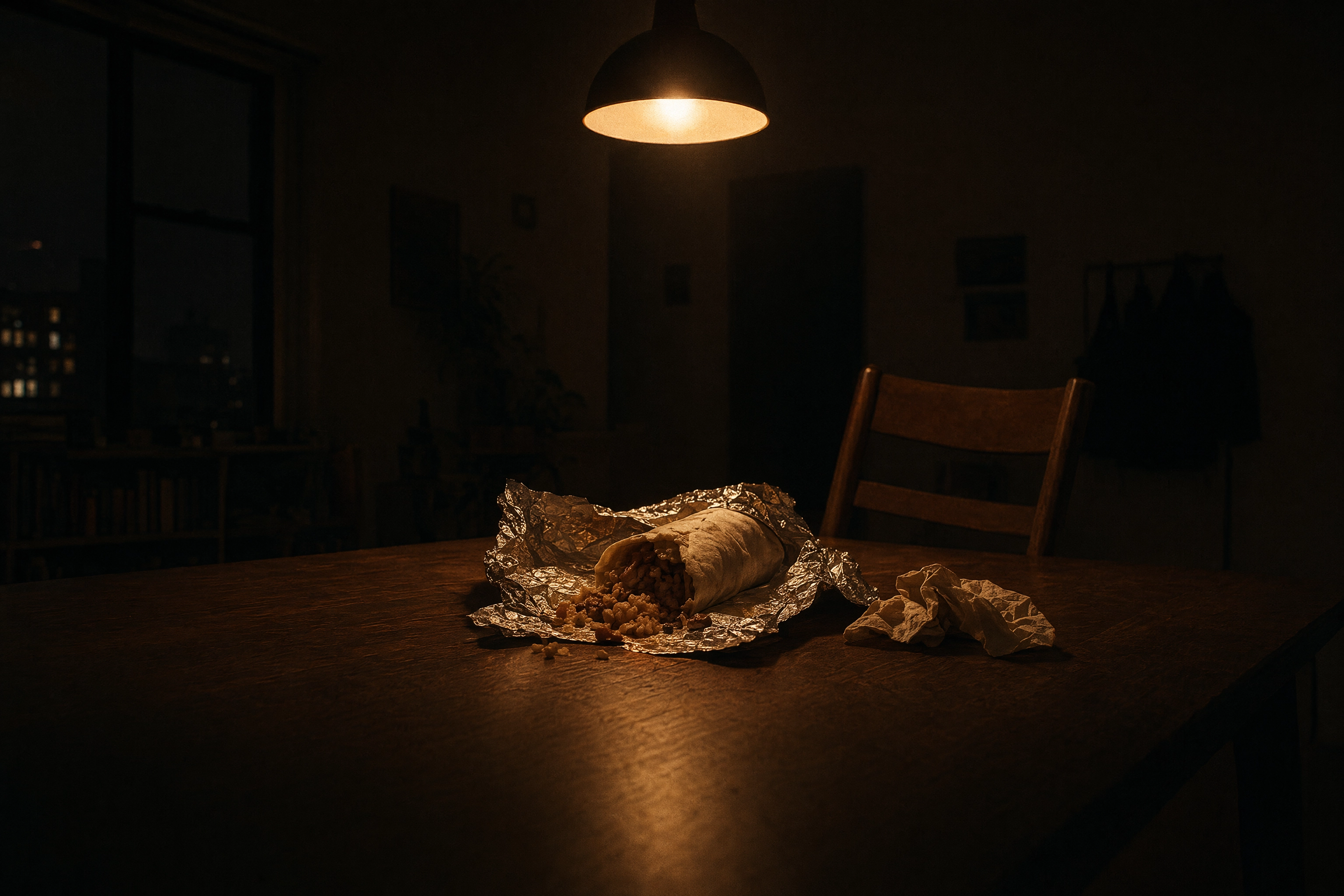 Cold half-unwrapped burrito abandoned on a dark table, the refund cost of an over-promising menu photo
More than a rejected upload. An "item not as described" refund is charged back to you, so an over-promising photo turns a won delivery order into a refund, a bad review and a dented quality score. Customers who feel misled once rarely reorder, and many report the listing. Worse is the reputational cost: r/UberEATS threads calling out obviously AI menu pictures pull hundreds of votes and comment replies, and that news travels fast in 2026. In December 2025 DoorDash confirmed it permanently banned a driver who uploaded an AI-generated delivery-proof photo — a different offence, but it shows how fast platforms act on synthetic imagery.
Some cases suit no AI imagery at all: anything with a legal accuracy burden — allergen claims, alcohol, weight and count promises — and any dish you have not cooked and photographed. No source photo? Take one first.
Your pre-upload compliance checklist
- Start from a real photo of the actual dish, shot this cycle
- Compare edit to original: ingredients, portion, garnish, vessel identical?
- One item per frame, centred, at least 80% visible
- No added text, logos, watermarks or borders
- Correct ratio: roughly 5:4 for Uber Eats, landscape for DoorDash
- A unique image for every item, never a reused hero
- Re-shoot whenever the recipe, portion or packaging changes
- Confirm you own the source photo and everything in it
- If unsure, would you show it to a customer holding the order?
The standard is identical for every food business — whether you run restaurants, cafes, food trucks, bars, catering, fine dining, hotels or a food brand — and it applies to coffee, desserts, chicken, breakfast and cocktails alike. See how it works for delivery apps, where most businesses start, browse the style library, or check pricing.
Frequently Asked Questions
Do AI-enhanced food images Uber Eats reviews ever get rejected?
Not for the enhancement itself. In our experience Uber Eats photo guidelines contain no AI clause; rejections come from inaccuracy, multiple items, blur, text or watermarks.
Does DoorDash ban AI food photos outright?
No. It bans "evidently AI-generated images, heavily altered images, or images that create a misleading representation." A cleaned-up photo of your real dish is neither. A fabricated dish is both.
Do I have to disclose that a menu photo was AI-enhanced?
Neither publishes a disclosure requirement for merchant menu images as of September 2026 — and both platforms now enhance images with AI themselves.
What happens if customers report my photo as misleading?
A report triggers refunds charged to you, possible image removal, and pressure on quality metrics. Repeat complaints get a listing flagged far faster than any automated detector.
Can I use one AI image for several menu items?
No. DoorDash requires a distinct photo per item; Uber Eats requires each image to represent a single menu item.
Is AI-enhanced photography allowed on Grubhub?
Grubhub publishes no public policy either way, so we cannot say definitively. Meet the Uber Eats and DoorDash accuracy bar and your restaurants will satisfy any review.