Food Photography Equipment: The Essential Gear Guide (2026)
 Ali Tanis16 min read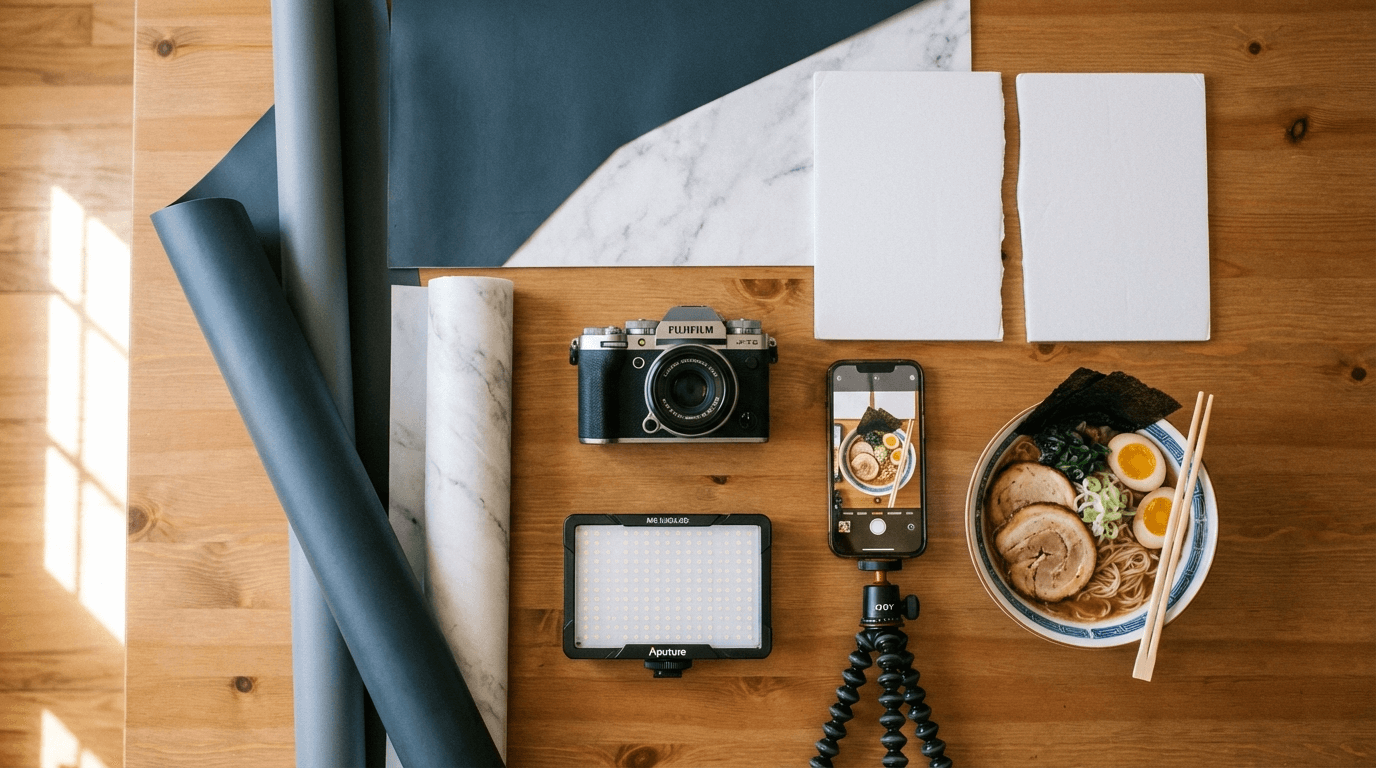
You don't need $5,000 in food photography equipment to shoot food photos that make people hungry. You might not even need $500.
The food photography equipment landscape has shifted dramatically. Smartphone cameras now rival entry-level DSLRs, LED panels cost less than a nice dinner, and AI tools can transform a quick phone snap into a professional-looking food photo in about 2 minutes.
This gear guide breaks down exactly what food photography equipment you need at three budget levels — with specific products and real prices — so you can stop researching and start shooting.
Quick Summary: A beginner can start food photography for under $50 using a smartphone, natural window light, and foam boards. An intermediate setup with a mirrorless camera, a 50mm lens, and basic lighting runs $500–$1,000. Professional rigs with full-frame bodies, multiple lenses, and studio strobes start at $2,000+. Or skip most of the gear entirely: a smartphone paired with AI food photography tools like FoodShot AI can produce professional-quality food photos for $15–$99/month.
What Food Photography Equipment You Actually Need (and What You Don't)
Every food photography gear guide wants to sell you a camera body, three lenses, a C-stand, studio strobes, and a dozen backdrops. That's great for affiliate commissions. Not so great for your wallet.
Here's what actually impacts food photo quality, ranked by how much each piece of equipment matters:
- Lighting — This is 60% of the game. A $3 foam board positioned correctly beats a $1,500 lens in bad light. Every time.
- Lens quality — A sharp lens with a wide aperture (f/1.8–f/2.8) creates that depth-of-field blur that separates amateur food photos from professional-looking images.
- Composition and styling — No piece of equipment fixes a poorly plated dish or a cluttered frame. This is a skill, not a purchase.
- Camera body — Honestly? This matters least. A recent smartphone sensor outperforms DSLRs from five years ago for shooting food.
The gear recommendations below support these fundamentals. Buy what helps your weakest area first.
Beginner Food Photography Equipment: $0–$200
You can produce surprisingly good food photos without spending much. The key is understanding how to work with light and making the most of what you already own.
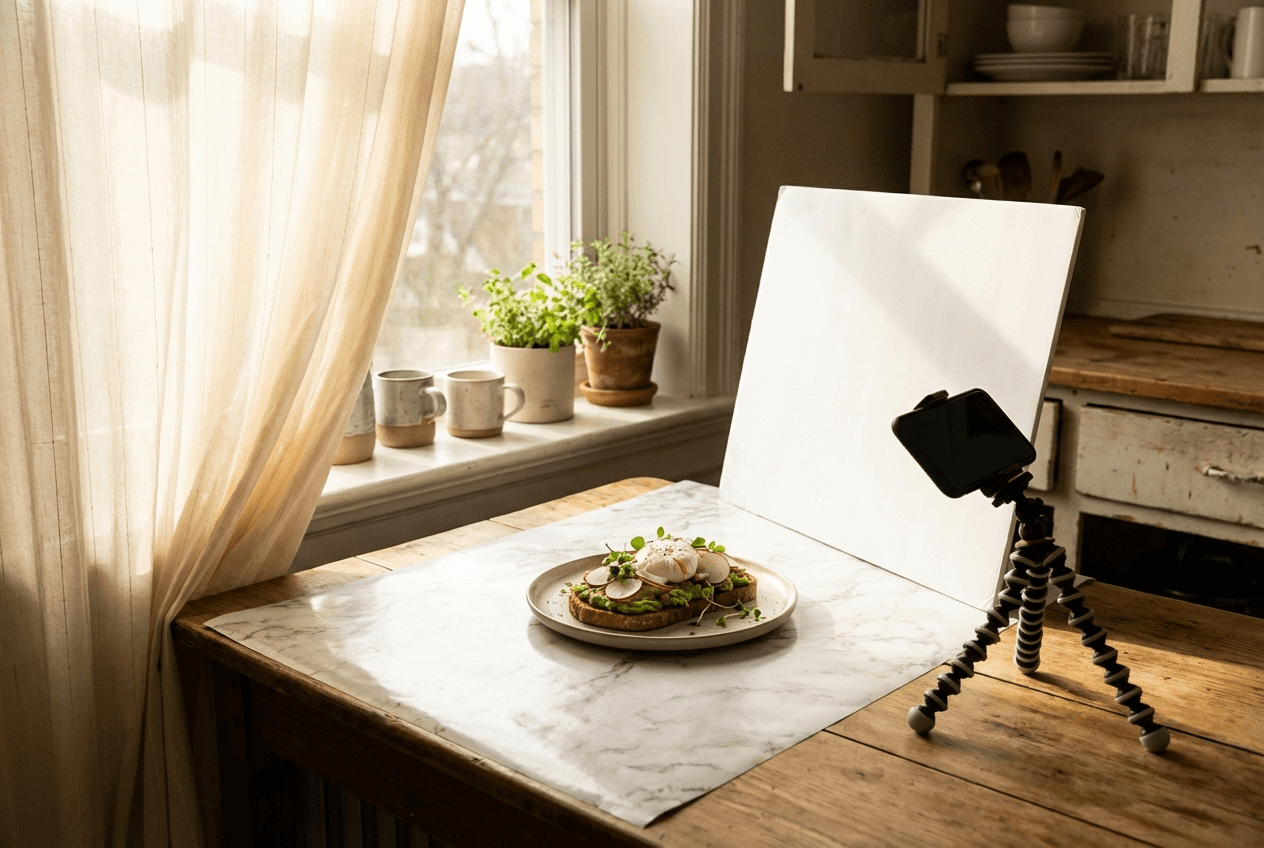 Beginner food photography setup with smartphone tripod, foam board reflector, and natural window light illuminating avocado toast
Camera: Your Smartphone (or a Used DSLR)
If you bought a phone in the last three years, you already own a capable food photography camera with a decent sensor and computational photography smarts.
Best smartphones for shooting food in 2026:
- iPhone 17 Pro / 16 Pro — 48MP main sensor, excellent color accuracy, ProRAW support for post-processing flexibility. The macro mode is surprisingly useful for food detail shots. See Apple's camera specs for the full breakdown.
- Samsung Galaxy S25 Ultra — 200MP sensor with vibrant color processing that boosts food tones — helpful on delivery platforms where images need to pop.
- Google Pixel 10 Pro — Best computational photography available. Natural-looking food photos with minimal editing effort.
Any of these outperform an entry-level DSLR for casual food photography — especially paired with good natural light and some post-processing work.
Prefer a dedicated camera? Look for a used Canon EOS Rebel T7 or Nikon D3500 with kit lens on quality marketplaces like MPB or KEH. Expect $150–$300 and you'll get full manual exposure control that smartphones still lack.
Budget: $0 (existing phone) to $300 (used DSLR + kit lens)
Lighting: Windows and $15 in Foam Board
Natural light from a window is the single best light source for shooting food. It's soft, directional, and free.
Your beginner food photography lighting kit:
- Position near a large window — side lighting (light hitting the food from left or right) creates dimension and texture. Avoid direct sunlight unless you diffuse it through a curtain or diffuser panel.
- White foam boards (2 pack, $5–$8) — Place opposite the window to bounce light and fill shadows. This is the cheapest food photography equipment upgrade that makes the biggest visible difference.
- Black foam boards (2 pack, $5–$8) — Place these to deepen shadows for moody, dramatic food photos. Photographers call these "flags."
- 5-in-1 collapsible reflector/diffuser ($15–$25) — Softens harsh midday sun coming through the window. A sheer curtain works too, but the dedicated diffuser gives you far more control over light quality.
Total lighting spend: $10–$35
For light positioning, angles, and common mistakes, see our full guide on food photography lighting.
Backgrounds: DIY and Budget Vinyl Backdrops
What's behind and under your food matters more than you'd think. A clean, textured surface makes even simple dishes look like a professional food photo.
Budget-friendly backdrop options:
- Marble-look contact paper ($8–$15 at any hardware store) — The most popular beginner food photography backdrop. Peel, stick to a flat board, shoot.
- Vinyl photography backdrops ($15–$30 each) — Bessie Bakes and Captured by Lucy make food-specific surfaces. Start with one dark (slate or dark wood) and one light (marble or light wood).
- Fabric and linen ($5–$15) — A linen napkin or dark fabric from a craft store works as a base layer or texture element in your food photos.
- Cutting boards and baking sheets — You already own these. Wooden cutting boards are a classic food photography surface at zero extra cost.
Budget: $8–$50
More styling and prop ideas in our food photography props guide.
Tripod: Basic Phone Mount
For overhead flat lay shots — essential in food photography — you need your camera pointing straight down. Holding a phone one-handed produces shaky, blurry results.
- Flexible phone tripod ($15–$25) — Joby GorillaPod style. Great for angled shots and can wrap around objects for improvised overhead rigs.
- Overhead phone mount ($20–$40) — A desk-mount arm with phone holder. Neewer and SmallRig make affordable options perfect for flat lay food photos.
Not ready to invest? A stack of cookbooks with your phone propped against a jar works for 45-degree angle shots. Get creative before you spend.
Budget: $0–$40 | Total Beginner Equipment: $18–$125 (using your phone)
Intermediate Food Photography Equipment: $200–$1,000
This is where dedicated camera gear starts making a real difference for your food photos. A bigger sensor, interchangeable lenses, and manual controls give you creative freedom smartphones can't match — essential for print, portfolios, or commercial food photography work.
Golden rule: Spend more on your lens than your camera body. Great glass on a mediocre body produces better food photos than mediocre glass on a great body.
Camera: Entry-Level Mirrorless
Mirrorless cameras are the standard food photography equipment in 2026. They're lighter, have faster autofocus, and offer real-time exposure preview through electronic viewfinders. Skip buying a new DSLR — the industry has moved on, as Digital Camera World's buying guides confirm.
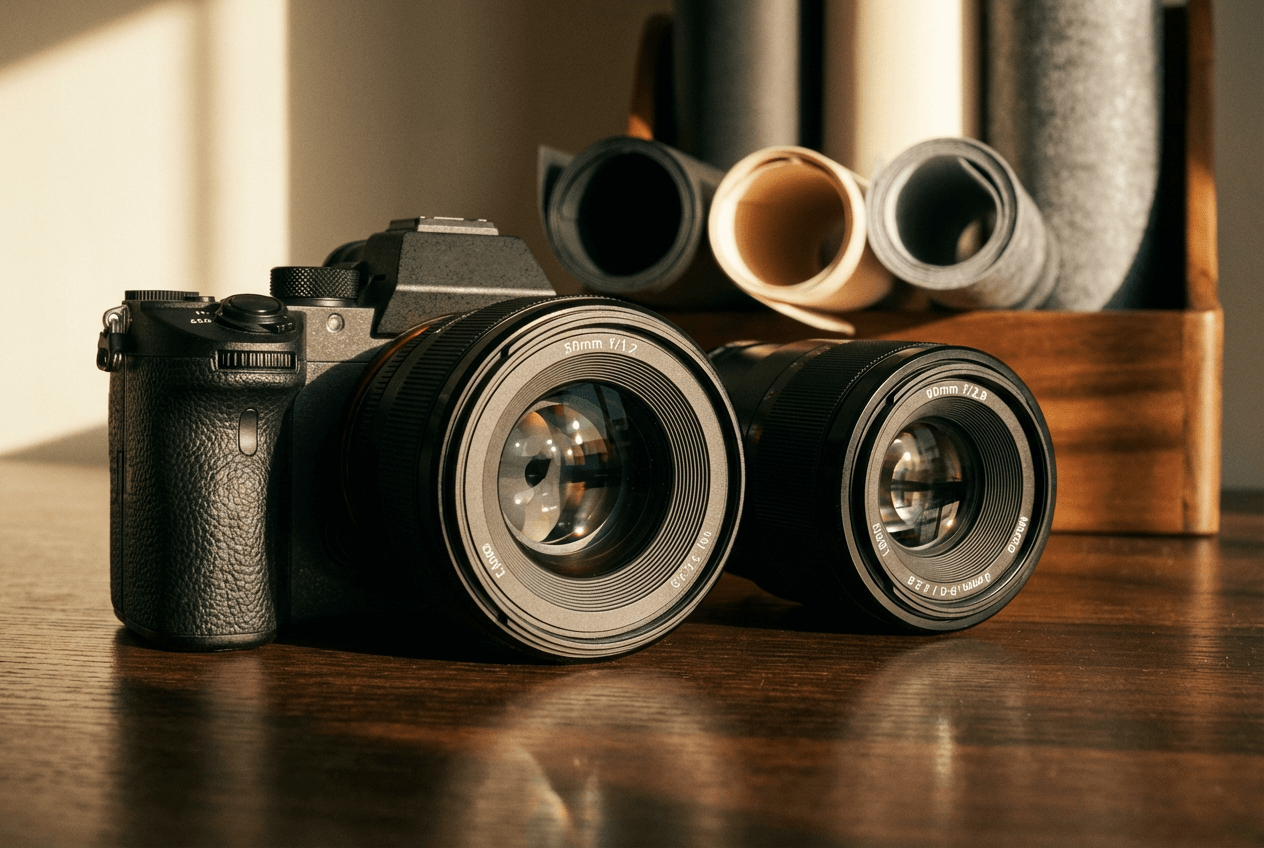 Mirrorless camera body with 50mm prime lens and 100mm macro lens essential food photography equipment
Best camera picks under $800 for food photography:
| Camera | Price | Sensor | Key Strength |
|---|---|---|---|
| Canon EOS R50 | ~$600 | APS-C | Lightweight, intuitive for beginners |
| Sony a6400 | ~$700 | APS-C | Best autofocus in class |
| Fujifilm X-T30 II | ~$700 | APS-C | Beautiful color science for food tones |
| Nikon Z fc | ~$750 | APS-C | Retro design, excellent image quality |
Budget tip: A used Sony a7 II (full-frame) runs $450–$600 on MPB or KEH. Full-frame sensor quality at crop-sensor prices — one of the best deals in photography gear today.
Don't stress crop sensor vs. full frame at this level. Crop sensors are perfectly capable for food photography, and the savings go further invested in quality glass.
Lenses: The Two That Matter Most
Two lenses cover virtually all food photography needs:
1. 50mm f/1.8 "Nifty Fifty" — $100–$200
The workhorse lens of food photography. The 50mm focal length on a full-frame body (or 35mm on crop sensor) gives a natural perspective — neither too wide nor too tight. The f/1.8 aperture creates beautiful bokeh (background blur) that isolates your subject and screams "professional." Canon RF 50mm ($150), Nikon Z 50mm ($200), Sony FE 50mm (~$200).
Best for: Flat lays, 3/4 angle shots, and 80% of everyday food photography.
2. 100mm Macro — $400–$600
Delivers stunning close-up detail shots — sugar crystals on crème brûlée, moisture beading on berries, flaky croissant layers. A macro lens focuses much closer than standard lenses, revealing food textures invisible to the naked eye. Sigma 105mm f/2.8 Macro ($600), Tokina 100mm f/2.8 ($400).
Best for: Food detail and texture shots, close-up hero images for social media.
Only one lens? Get the 50mm. It handles the vast majority of food photography situations.
Lighting: Your First LED Panel
Natural light is excellent but limited to daytime hours. A continuous LED panel is essential food photography equipment for evening shoots or spaces without good window light — and it gives you consistent, repeatable lighting for every session.
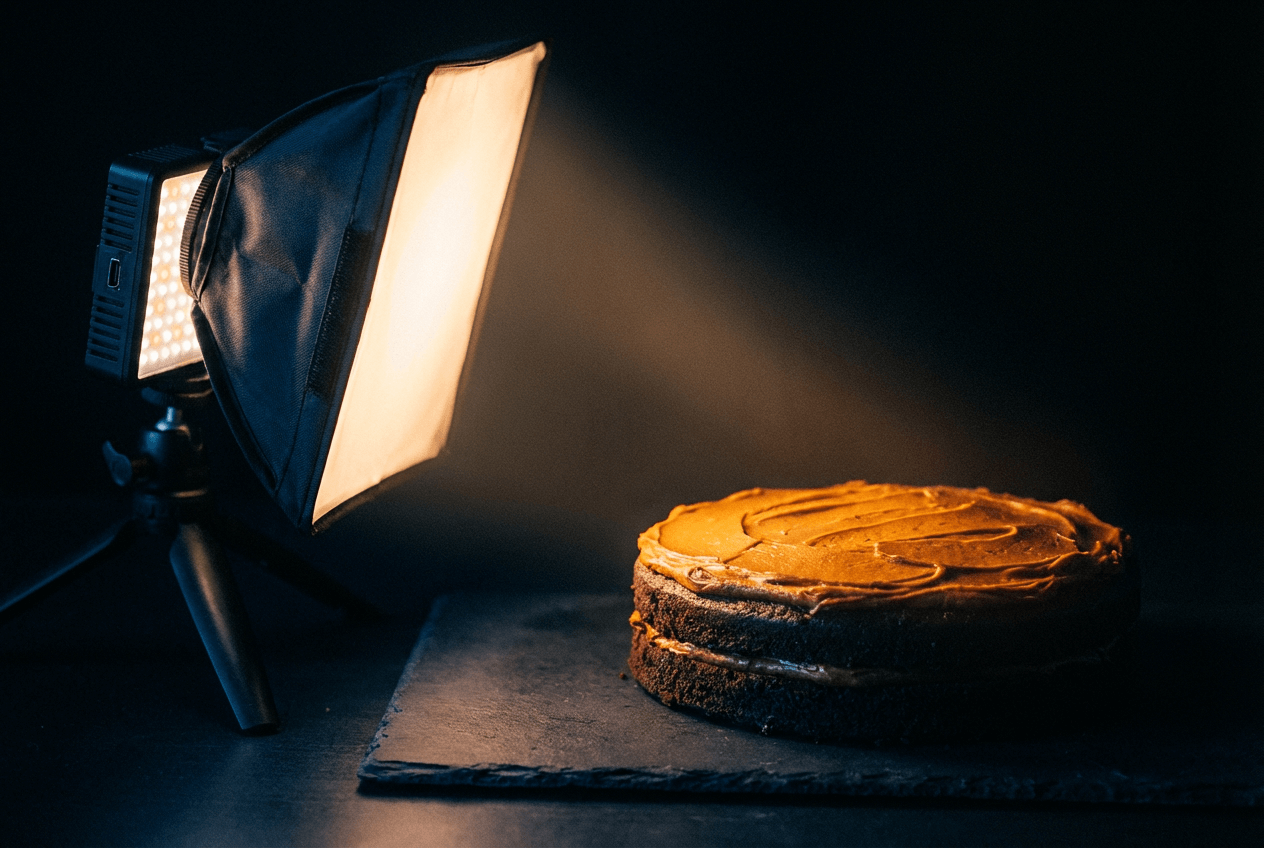 LED panel with softbox diffuser lighting a chocolate cake on dark backdrop showing artificial food photography lighting technique
Starter lighting gear for food photography:
- Neewer 660 LED Panel ($70–$90) — Bi-color temperature adjustment (warm to cool), dimmable, bright enough for food setups. Pair with a softbox for softer, more diffused light.
- Godox SL60W ($120–$150) — More power and better color accuracy. Bowens-mount compatible for professional softboxes and modifiers.
- MOUNTDOG Softbox Kit ($30–$50) — Budget all-in-one: continuous light + softbox + light stand. Solid starting point for learning artificial lighting.
Add a 24" × 24" softbox ($25–$40) to diffuse the light source and soften harsh shadows. Directional, diffused light is what makes food look appetizing in photos.
Budget: $30–$150
Tripod: Sturdy with Overhead Capability
A quality tripod is non-negotiable intermediate food photography equipment. It keeps your camera stable for sharp images and lets you shoot consistent angles — critical when photographing multiple dishes for a menu or food blog.
- K&F Concept 78" Tripod ($60–$80) — Budget-friendly, extends tall, ball head for quick angle adjustments.
- Manfrotto BeFree Advanced ($150–$200) — Carbon fiber options, solid build, trusted brand among food photographers.
- Vanguard Alta Pro 2+ ($150–$200) — Center column pivots horizontal for overhead flat lay shots without a separate rig. Wirecutter rates this a top pick for versatile tripods.
For dedicated overhead work, a C-stand with boom arm ($80–$150) from Impact or Avenger provides rock-solid overhead positioning.
Budget: $60–$200 | Total Intermediate Equipment: $700–$1,000 (sweet spot)
Professional Food Photography Equipment: $1,000+
Pro food photography gear is about total control and repeatable consistency. When clients pay for commercial work — menu photography, ad campaigns, cookbooks — you need equipment that delivers in any lighting situation.
The jump from $200 to $1,000 in gear produces a dramatic quality improvement in your food photos. The jump from $1,000 to $3,000? More subtle. Know what you're buying and why.
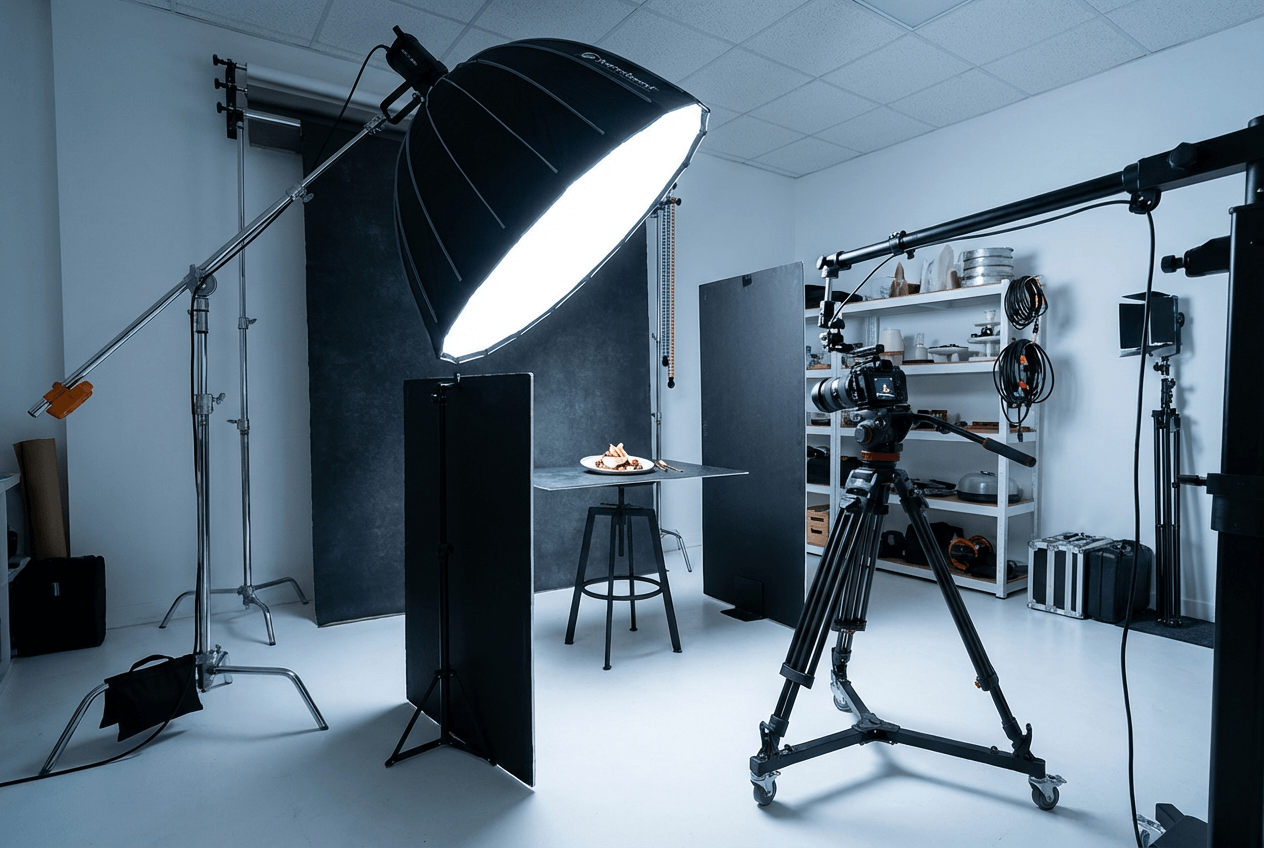 Professional food photography studio with softbox on C-stand, overhead tripod rig, and V-flat lighting modifier
Camera and Lenses
Camera bodies ($1,200–$2,500):
- Sony a7 IV ($1,500) — 33MP full-frame sensor, excellent dynamic range for flexible post-processing of food images.
- Canon EOS R6 Mark II ($1,700) — Superb low-light performance, Canon's legendary color science for natural food tones.
- Fujifilm X-T5 ($1,400) — 40MP APS-C rivaling full-frame detail. Fuji's film simulation modes produce gorgeous food colors straight out of camera.
Pro lens kit:
- 24-70mm f/2.8 zoom ($800–$1,800) — Wide table scenes to tight dish compositions. The do-everything food photography lens.
- 100mm f/2.8 macro with IS ($600–$1,100) — Image-stabilized macro for handheld food detail work.
- Tilt-shift 90mm ($900–$1,400) — Specialty selective focus plane. Stunning editorial food photography results, but niche.
Lighting and Modifiers
Professional food photography lighting means strobes — brighter, more color-accurate than LED, and they freeze motion (pouring sauces, sprinkling sugar, drizzling honey mid-air).
- Godox AD300 Pro ($350) — Portable battery strobe for studio or location food shoots.
- Godox AD200 Pro ($250) — Compact strobe for two-light setups in tight spaces.
- Large octagonal softbox, 120cm+ with honeycomb grid ($80–$200) — Soft, directional, controlled light for food photography.
- C-stand with boom arm and sandbag ($100–$180) — Overhead lighting positioning for flat lay food photography.
- V-flat 4' × 8' bounce board ($80–$120) — Large surface for filling or flagging light in food photography setups.
Pro lighting total: $500–$1,000
Backgrounds and Props
Professional food photographers own 10–20 backdrop surfaces and a curated styling prop collection for different aesthetics.
- Professional backdrop boards (Replica Surfaces, Bessie Bakes) — $40–$80 each. Budget $400–$800 for 8–12 surfaces covering wood, marble, concrete, and linen textures.
- Styling props — Vintage cutlery, ceramic plates in neutral tones, linen napkins, small bowls, wooden utensils from antique shops and thrift stores. Budget $200–$500.
- Plexiglass (clear and black) — $20–$40 each for reflective surfaces under drinks and desserts.
Total Professional Equipment: $2,500–$6,000+
For total professional food photography costs including hidden expenses, see our food photography cost breakdown.
The Smartphone-Only Setup: When AI Replaces $2,000 in Food Photography Gear
Here's what most food photography equipment guides won't tell you: for many real-world use cases, you don't need traditional gear at all.
Restaurant owners updating menu photos, delivery businesses optimizing Uber Eats listings, cafes refreshing social content — expensive equipment isn't the bottleneck. Time and post-processing are.
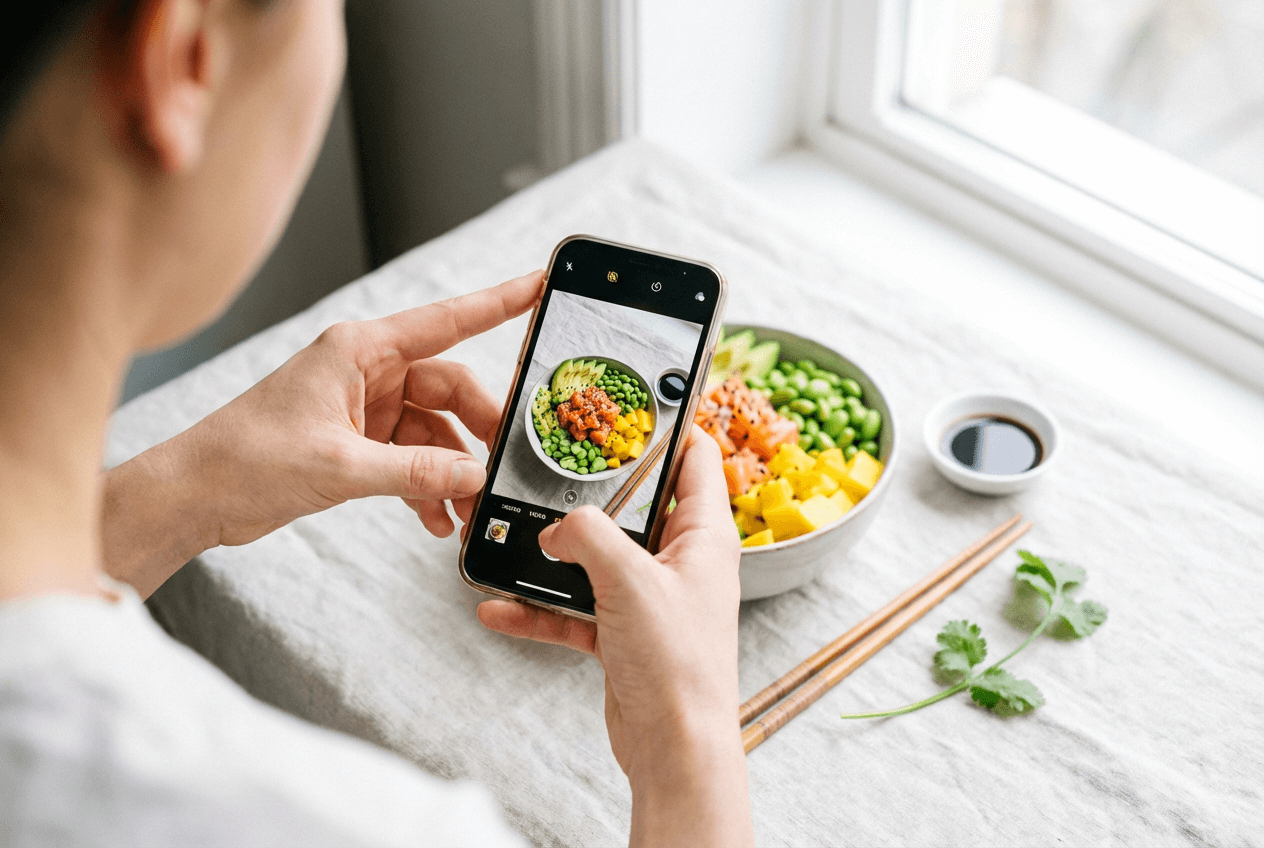 Hands photographing a colorful poke bowl with smartphone near window light showing simple phone food photography workflow
The smartphone + AI food photography workflow:
- Shoot with your phone near a window using our iPhone food photography tips.
- Upload to FoodShot AI — choose from 30+ style presets (Delivery, Restaurant, Fine Dining, Instagram).
- In about 2 minutes, AI adjusts the lighting, enhances colors, removes or replaces backgrounds, fixes plating imperfections, and outputs a platform-ready food photo.
What this replaces in traditional food photography equipment:
| Traditional Equipment | FoodShot AI Equivalent |
|---|---|
| Studio lighting setup ($150–$1,000) | AI lighting adjustments |
| Backdrops and surfaces ($200–$800) | Background removal/replacement |
| Props and styling ($100–$500) | Add garnishes, fix plating |
| Photo editing software ($10–$55/mo) | Built-in processing |
| Years of photography skills | 30+ one-click presets |
Cost: $15–$99/month ($0.40–$0.60 per food photo). Details at FoodShot AI pricing.
This isn't for everyone — building a photography portfolio or shooting for print publication still needs traditional camera equipment. But for the 90% of food businesses that need great food photos fast? The math is hard to argue with. See our traditional vs AI food photography comparison for the full breakdown.
Full Equipment vs. Smartphone + AI: The Honest Comparison
| Factor | Beginner ($100–$200) | Intermediate ($500–$1K) | Pro ($2,500+) | Phone + AI ($15–$99/mo) |
|---|---|---|---|---|
| Upfront cost | $100–$200 | $500–$1,000 | $2,500–$6,000 | $0 |
| Monthly cost | $0 | $10–$20 | $10–$55 | $15–$99 |
| Time per photo | 15–30 min | 10–20 min | 5–15 min | ~2 minutes |
| Learning curve | Moderate | Steep | Very steep | Minimal |
| Image quality | Good | Very good | Excellent | Very good |
| Consistency | Variable | Good | Excellent | Consistent |
| Creative control | Limited | High | Complete | Moderate |
| Best for | Bloggers, hobbyists | Studios, portfolios | Agencies, ads | Restaurants, delivery |
Bottom line: Professional food photography equipment produces images AI can't fully replicate — yet. But most food businesses don't need that level. They need "really good, really fast."
Smart approach: use AI food photography for daily content (delivery app photos, social media, daily specials) and hire a pro photographer for brand campaigns and hero shots. For delivery-specific optimization, see food delivery app photography.
5 Food Photography Equipment Mistakes That Waste Money
Common food photography gear mistakes, based on advice from professionals and Reddit's r/foodphotography community:
1. Buying camera body first, lens second. The lens impacts image quality far more than the body. A $200 prime lens on a $600 body beats a kit lens on a $1,200 body for food photography.
2. Ignoring lighting equipment. The biggest beginner mistake. A $15 foam board reflector and diffuser improve food photos more than a $500 camera body upgrade.
3. Skipping the tripod. Flat lay shots need stable, straight-down shooting. Handheld overhead food photos = tilted, blurry images.
4. Buying too many backdrops too early. Start with two surfaces (one light, one dark). Most food photographers use 3–4 backdrop surfaces for 80% of their work.
5. Forgetting post-processing. Great food photography equipment still produces RAW files that need editing. Use Lightroom ($10/mo) or FoodShot AI for automated food photo processing. For delivery platforms, see our guide on food photography mistakes that kill online orders.
Frequently Asked Questions
What camera do most food photographers use?
In 2026, most professional food photographers shoot on mirrorless cameras — Sony a7 series, Canon EOS R series, and Fujifilm X-T series dominate the market. A growing number of restaurant owners and food content creators use smartphones (iPhone 17 Pro, Google Pixel 10 Pro) with AI editing tools instead. Print publication needs dedicated camera equipment; social media and delivery app food photos look great from modern phones.
Can I do food photography with just my phone?
Yes — millions of people do. Modern smartphones produce excellent food images when paired with good natural lighting and basic composition skills. For business use (restaurant menus, delivery apps, social media), a phone combined with AI post-processing through FoodShot AI delivers food photo results comparable to mid-range camera equipment at a fraction of the cost. Our iPhone food photography tips guide covers exactly how.
What is the best lens for food photography?
The 50mm f/1.8 (35mm on crop sensor) is the best all-around food photography lens — affordable ($100–$200), sharp, with beautiful bokeh. A 100mm macro lens is the second essential for close-up food texture shots. For maximum flexibility, a 24-70mm f/2.8 zoom covers every food photography scenario but costs more ($800–$1,800).
Do I need artificial lighting for food photography?
Not initially. Natural window light shaped with foam board reflectors produces beautiful food photos — it's how most photographers learn. Artificial lighting equipment like LED panels ($50–$100) or strobes becomes valuable for evening food photography, large photo sessions, or spaces without good window light.
How much does a full food photography setup cost?
Beginner: $20–$50 (phone, foam boards, one backdrop). Intermediate: $500–$1,000 (mirrorless camera, 50mm lens, LED panel, tripod). Professional: $2,500–$6,000+ (full-frame body, multiple lenses, strobes, backdrops, props). AI alternative: $15–$99/month with FoodShot AI and zero upfront equipment cost. Full comparison in our food photography cost breakdown.