Japanese Food Photography: Sushi, Ramen & Bento
 Ali Tanis17 min read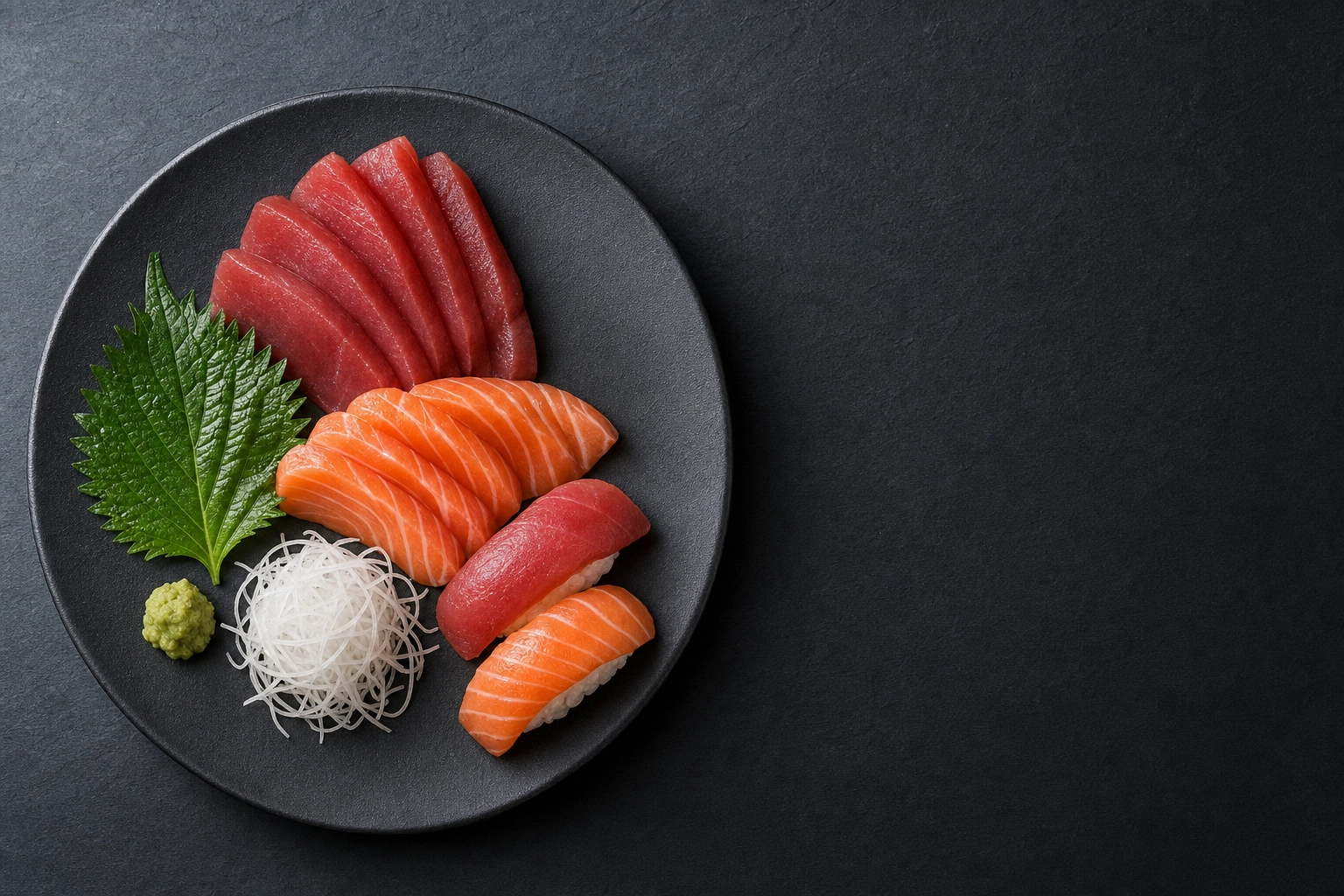
Search "Japanese food pictures" and you'll drown in stock photos — glistening salmon and generic ramen images that have nothing to do with your kitchen. Open a delivery app and the problem flips. Half the Japanese restaurants near you use those same tired stock photos. The other half posted a phone snap so flat and grey it makes fresh otoro look like cafeteria fish. Either way, the picture is lying about the food, and hungry diners can tell.
Japanese food deserves better, and it photographs differently from almost everything else on that app. Where a plate of chili-oil noodles or a loaded burger wins by overwhelming you, a piece of nigiri sushi or a bowl of clear shoyu ramen wins by restraint — precision, freshness, and the confidence to leave space empty. And the stakes are real: restaurants serving Japanese food now make up 28% of all Asian restaurants in the U.S. — the second-most common Asian cuisine, according to Pew Research — so the fight for that hungry scroll is crowded.
This guide is for the people behind the counter: sushi-ya owners, ramen shop operators, and izakaya and Japanese restaurant teams who want their own Japanese food pictures to look as good on screen as the dishes look on the pass. We'll cover the Japanese look and why it breaks the usual rules, how to light fish versus broth, the five shots that handle your entire menu, and how to rescue a phone photo when the steam's already gone.
Quick Summary: Great Japanese food photography comes down to restraint and the right light — cool, soft, directional light with a cool white balance to keep raw fish looking fresh, and backlit steam over a dark background for ramen. Five shots cover almost any Japanese menu: an overhead sushi and sashimi platter, a ramen noodle pull, a top-down bento grid, a 45° donburi, and a moody izakaya spread. Shoot clean, leave negative space, and finish in seconds with an AI food photo editor.
Why Japanese food photography breaks the "Asian food" rules
The Japanese menu runs from raw to fried and hot to cold — sushi and sashimi, steaming bowls of ramen and udon noodles, crisp tempura, simmered donburi, miso soup, and a whole table of izakaya small plates. The most popular Japanese dishes look wildly different on the plate, yet they share one visual rule: restraint. That's why great Japanese food pictures look so different from the rest of the app.
Most of Asian cooking photographs as abundance. A Sichuan table, an Indian thali, a Thai curry slick with coconut and chili — the appeal is everything happening at once, and the broader Asian food photography playbook is built around taming that controlled chaos.
Japanese cuisine asks the opposite of your camera. Its whole aesthetic is subtraction. A fine-dining kaiseki course might be three perfect bites on a hand-thrown ceramic dish with two-thirds of the plate left deliberately bare. That emptiness isn't laziness — it's ma (間), the meaningful negative space that lets the eye rest and the food feel intentional. Crowd the frame and you don't just lose elegance, you lose the entire point.
Three more ideas run underneath the look, and they're worth knowing because they tell you what to shoot:
- Shun (旬) — peak seasonality. Japanese cooking obsesses over ingredients at their seasonal best, and the garnish often announces the season: a maple leaf in autumn, a sprig of cherry blossom in spring. Those cues photograph as freshness and care.
- Goshiki — the five colors. Traditional meals in Japan balance white, black, red, yellow, and green across the table. That built-in palette is a gift to a photographer: the color story is already composed for you, especially in a bento.
- Freshness above all. So much of the menu is raw or barely cooked that the food can't hide behind sauce or char. The photo has to say this fish was cut twenty minutes ago.
This isn't a modern marketing idea, either. When UNESCO added washoku — traditional Japanese cuisine — to its list of Intangible Cultural Heritage in December 2013, it specifically cited the "presentation that capitalizes on the beauty of nature." Your menu photos are the modern version of that presentation. The bar is high, but the rules are clear.
Light is the whole game: cool for fish, backlit for broth
If you change one thing about your photos, change the light. It does more for a Japanese dish than any plate, prop, or new phone. The twist is that the right light flips depending on what's in the bowl.
Cool, soft light for raw fish. Sushi, sashimi, and chirashi want soft, directional light — a north-facing window or a diffused panel off to one side — and a cool-to-neutral white balance, closer to daylight than to warm tungsten. This matters more than it sounds. Warm light turns akami tuna brown and makes salmon look oily and old. Cool light keeps tuna red, salmon vivid, and white fish like hirame translucent and alive. A dark slate or pale blonde-wood surface underneath does the rest, throwing the fish forward and leaving room for ma.
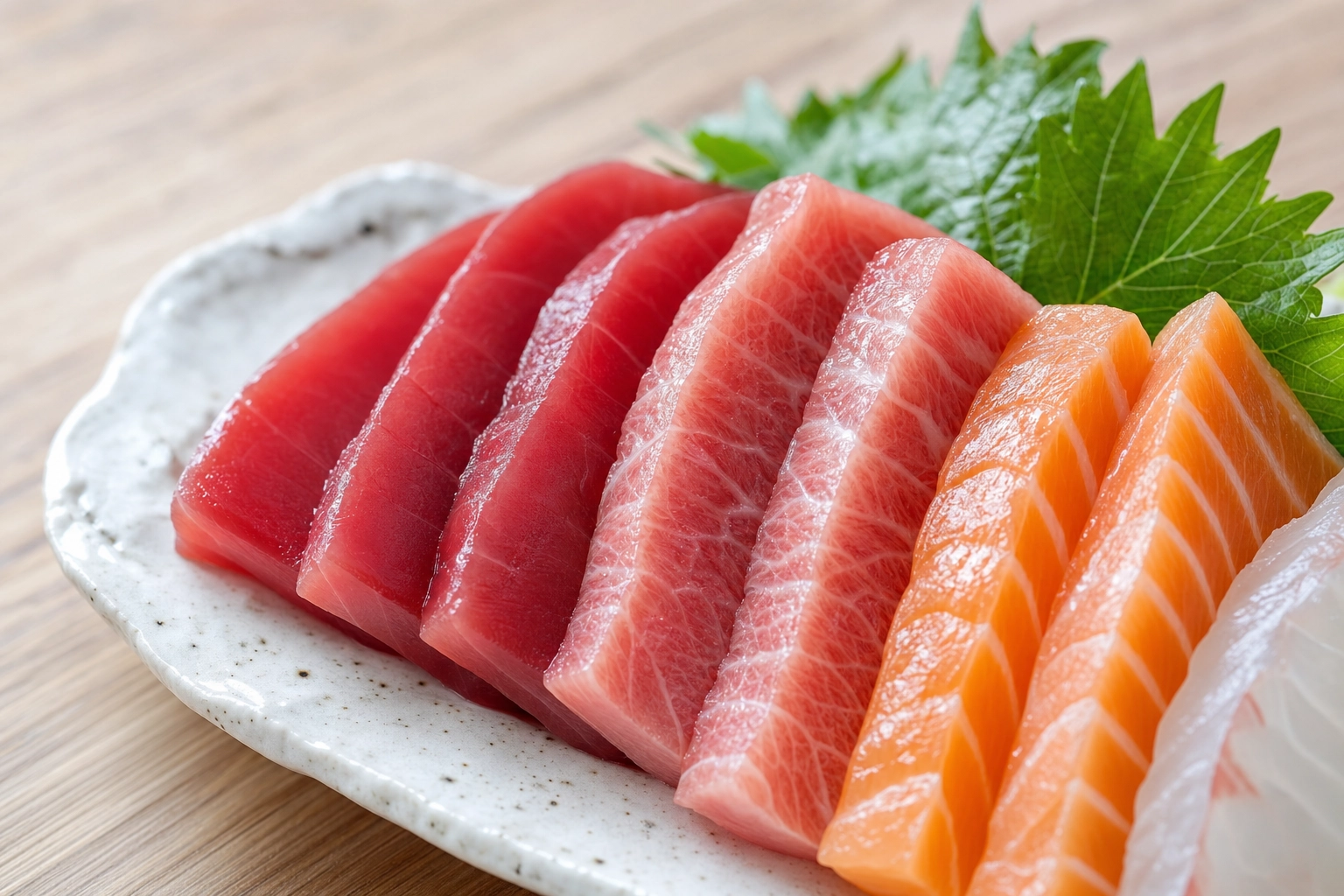 Close-up of fresh tuna and salmon sashimi under cool soft side light showing the freshness sheen
Backlight broth and steam for ramen. A bowl of ramen lives or dies on two things the camera struggles to capture: broth color and steam. Put your light behind the bowl, over a dark background, and the broth glows from within while the steam reads as legible wisps instead of vanishing into nothing. Then add a little side light to bring texture back to the chashu and the egg. The same logic works for any hot bowl — udon, soba, nabe, or miso soup.
Two rules cut across both. First, kill the on-camera flash. A direct phone flash flattens everything, browns proteins, and blasts an ugly white hotspot across every wet, glossy surface — exactly the worst thing for raw fish and lacquered tare. Second, watch your white balance like a hawk. It's the difference between a tonkotsu that reads as rich pork-bone cream and one that looks like dishwater. If color accuracy is where your phone keeps letting you down, that's the single biggest thing a good editor fixes after the shot.
The 5 shots behind great Japanese food pictures
You don't need fifty setups to cover a Japanese restaurant. Five reliable shots handle nigiri to noodles to the late-night izakaya plate, and each one has a specific angle and a specific job — on the menu, on the delivery thumbnail, and in the feed.
1. The sushi & sashimi platter, shot overhead
Sushi is the flagship of almost every Japanese menu, and a sushi platter is flat, geometric, and all about the knife-work — which is exactly why it belongs straight overhead at 90°. A true top-down turns a sashimi moriawase or a row of nigiri sushi into a clean graphic composition: the fan of slices, the diagonal of a maki roll cut into six, the deliberate gap of negative space beside them. That's the shot at the very top of this guide, and it's the single best way to make your sashimi and sushi images look intentional rather than accidental.
Light it cool and soft so the fish glistens without hotspots, keep the white balance neutral, and let the rice read — each grain of sushi rice should be visible and faintly glossy with vinegar, not a white blob, even at thumbnail size. The rice is half of every piece of sushi, so don't let it disappear into the plate. A single shiso leaf, a tidy mound of real grated wasabi, and a little pickled ginger are all the garnish a sushi plate needs. For the full breakdown of nigiri angles, maki cross-sections, and omakase boards, our sushi photography guide goes deep, and the raw fish and seafood handling carries straight over to sashimi.
2. The ramen bowl: noodle pull + backlit steam
The noodle pull is the most kinetic shot in Japanese food, and it's worth the chaos. Chopsticks lift a tangle of noodles ten or fifteen centimeters above the bowl, steam billowing around them, broth dripping back down — it implies taste in a way a still bowl never can. The catch is timing. The pull looks good for about four seconds, and the steam is mostly gone within ninety. Shoot in burst mode at 1/200s or faster, get the lift on the first try, and take twenty frames.
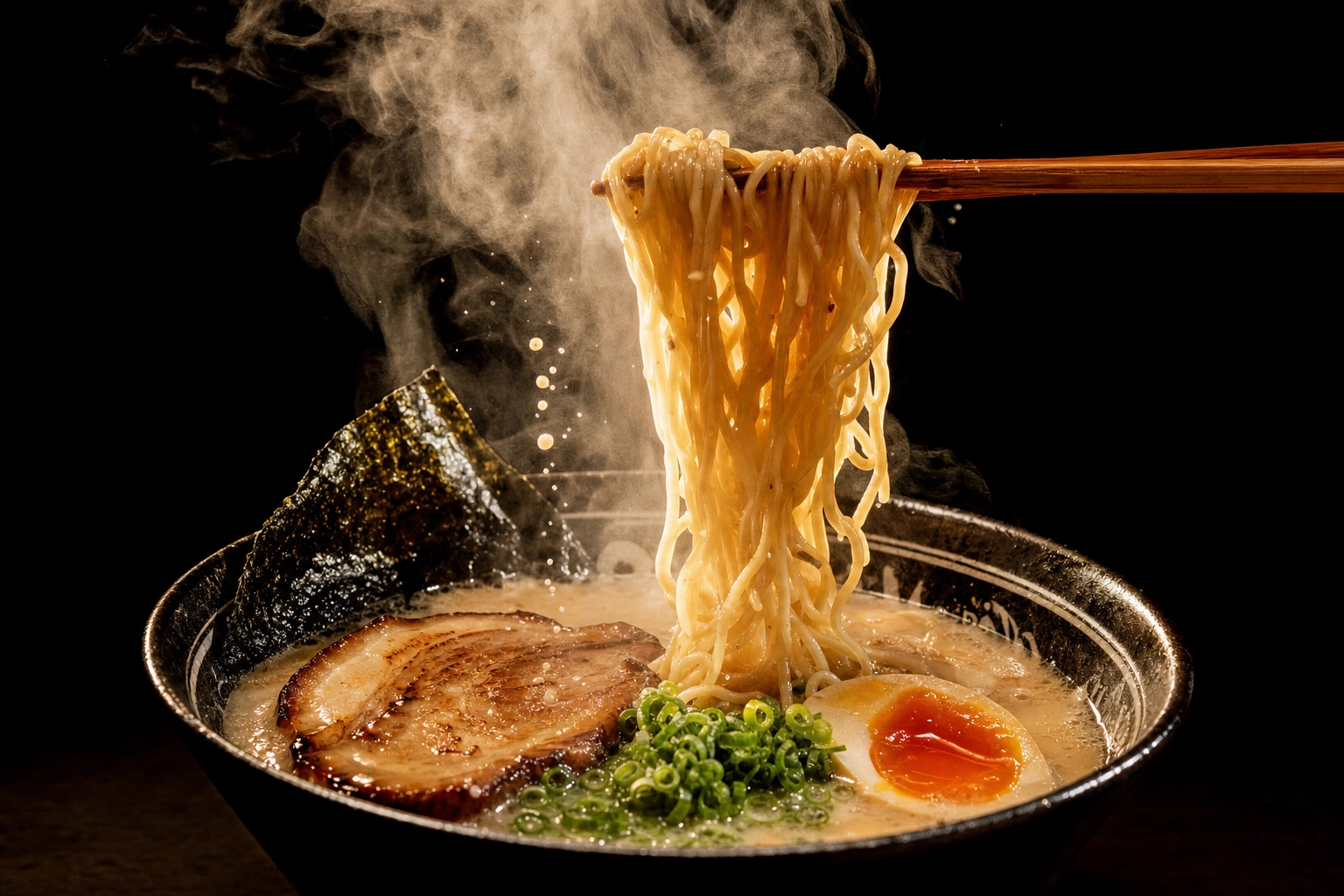 Chopsticks lifting ramen noodles above a tonkotsu bowl with backlit steam against a dark background
Everything else is lighting and color. Backlight the broth and steam over a dark background, side-light the toppings, and protect the broth color above all — it's the technical signature of the bowl. Tonkotsu should read as cloudy pearl-cream, shoyu as translucent amber, miso as a hearty orange-brown, shio as a pale clear gold. Nearly every region of Japan has its own version, so the color is doing real menu work. Stack the toppings so the chashu, a halved ajitama with a jammy yolk, the menma, nori, and negi each read as deliberate composition, not a random pile. The full ramen photography playbook covers every broth style and topping in detail.
3. The bento grid
A Japanese bento box does half the composition for you. Those compartments are a literal grid, so shoot it dead overhead at 90° and let the geometry carry the frame. The styling trick is that old five-colors rule: aim for white (rice), black (nori or black sesame), red (salmon, umeboshi), yellow (tamagoyaki, the rolled omelet), and green (edamame, shiso, broccoli) — then arrange them so no two same-toned items sit side by side. Odd numbers of items beat even ones, and a little breathing room between compartments keeps it from looking packed.
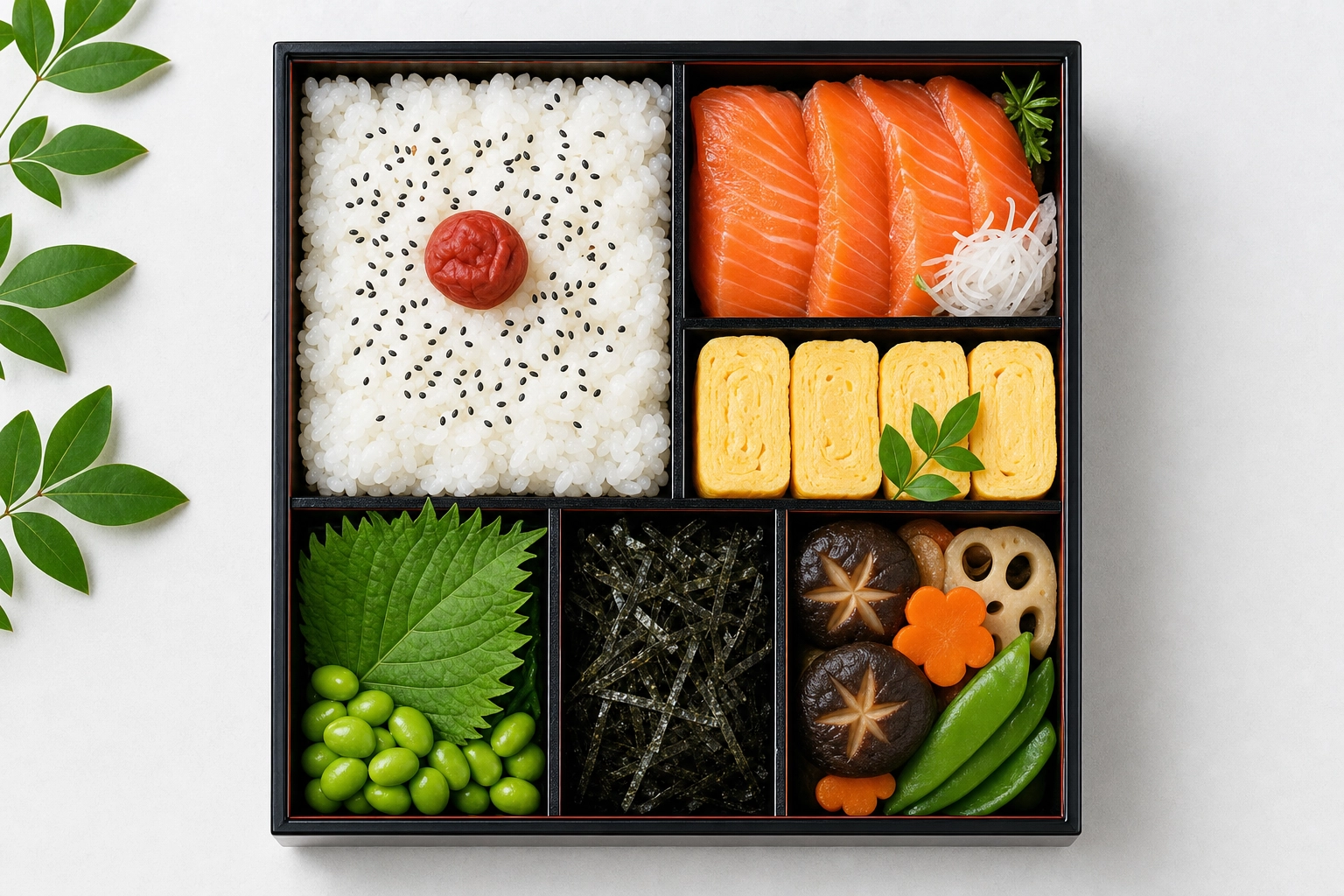 Overhead lacquer bento box with color-blocked compartments showing the five Japanese colors
A lacquered jūbako box reads as craft; a sectioned slate or pale-wood tray reads modern. Light it bright, soft, and even so every compartment is legible — this is the one Japanese shot where flat, shadowless light is the goal. One honest note for menus: a Japanese bento or donburi is not the same as a Korean bibimbap, even though both are rice-based bowls. If your kitchen serves Korean dishes too, photograph them by their own rules and start from our photography by cuisine hub.
4. The donburi bowl at 45°
Donburi — a bowl of rice crowned with something good — is the one Japanese dish that does not want to be shot from overhead. The whole appeal is the domed topping standing proud of the rice, and you only see that height at 45°, roughly the eye line of someone leaning in for a bite. Gyudon shows simmered beef and onion. Katsudon shows a fried pork cutlet bound in just-set egg. Tendon shows the craggy crunch of deep-fried tempura — usually seafood or seasonal vegetables — unadon shows lacquered grilled eel, and a chirashi bowl shows scattered sashimi like jewels over seasoned rice.
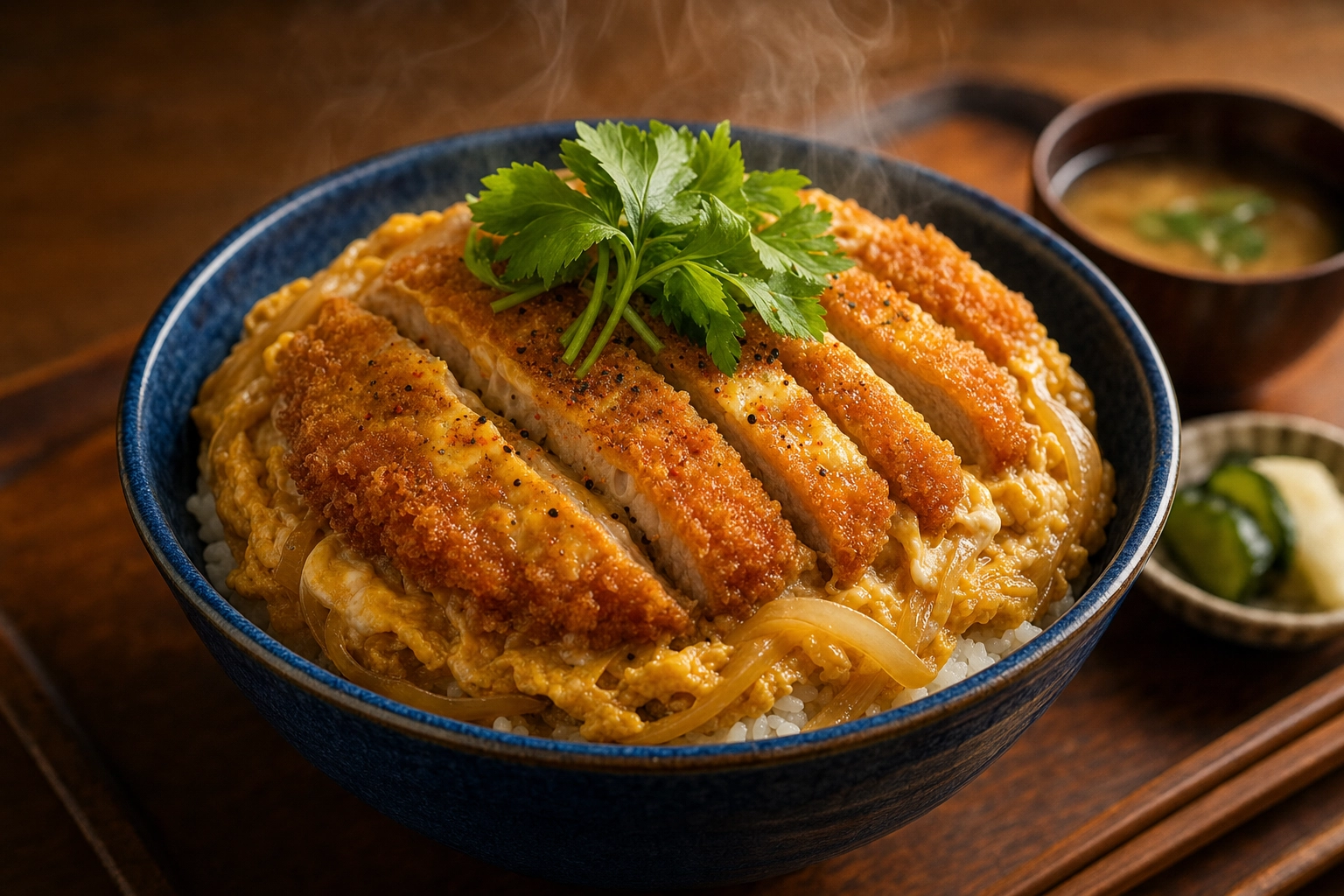 Katsudon donburi rice bowl shot at 45 degrees showing the fried cutlet and glossy egg over rice
Shoot the angle that reveals the topping, let any steam rise if it's served hot, wipe the rim clean, and turn the glossiest, most colorful piece toward the lens. A drizzle of tare or a barely-runny yolk catches the light beautifully at 45° — the same drizzle disappears from straight above. This is also the most forgiving shot on the menu, which makes it a great place to start if photography isn't your thing.
5. The izakaya spread
Not every Japanese photo is clean and cool. The izakaya — the Japanese pub — is loud, warm, and social, and the photo should feel that way. This is where the small plates live: yakitori skewers shining with tare, a pile of edamame, golden karaage (fried chicken), pan-fried gyoza, lightly fried agedashi tofu, and a flask of sake with a couple of ochoko cups. Japan does fried food brilliantly, and the izakaya is where it shows. Group several plates on dark wood, light it with warm tungsten, let the background fall into shadow, and add a hand reaching in for a skewer to bring it to life.
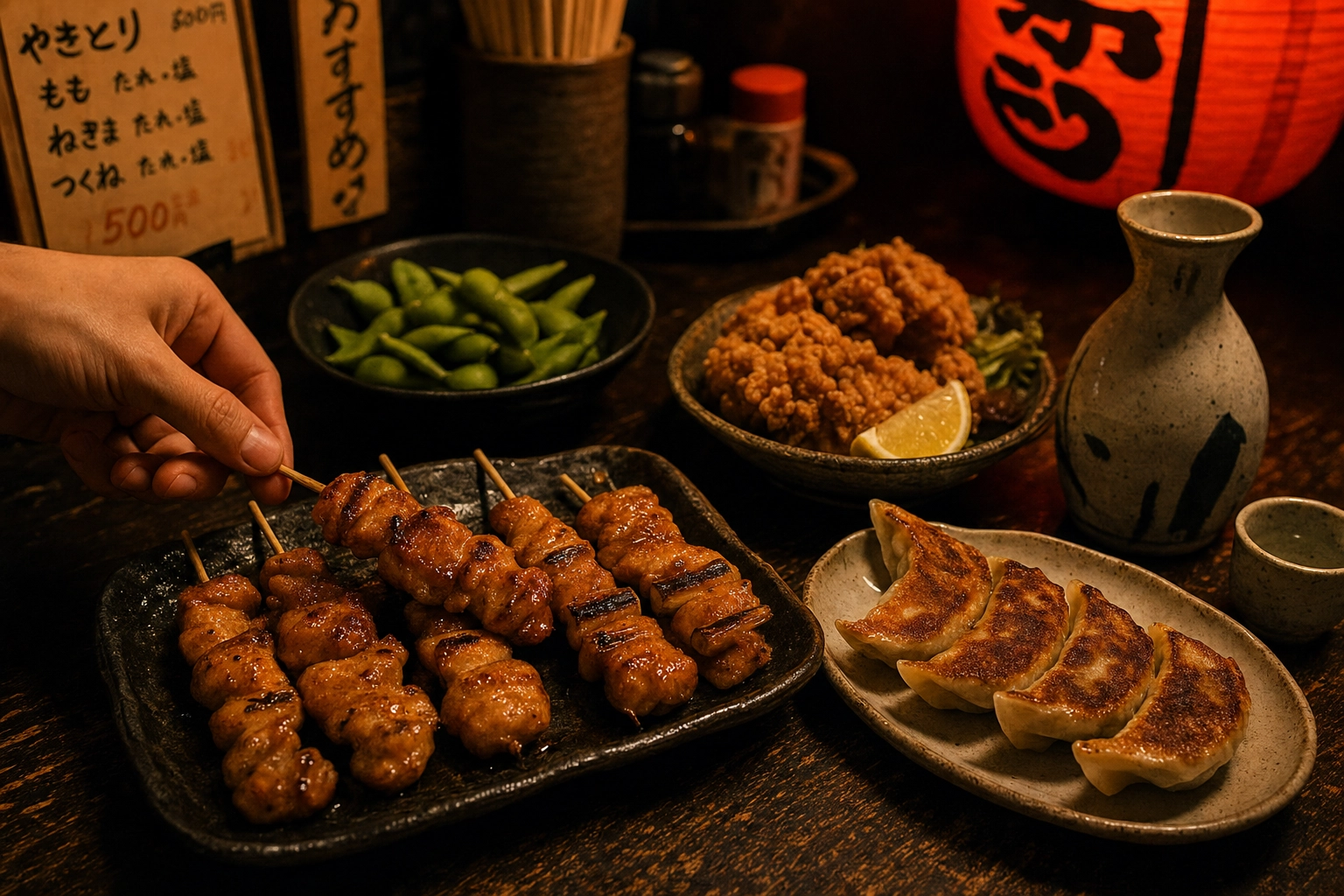 Moody izakaya spread with yakitori, karaage, gyoza and sake under warm tungsten light on dark wood
This is the one place warm light belongs in Japanese food photography, and the contrast is the point: the cool, precise sushi shot says craft; the warm, crowded izakaya shot says come hang out. A menu that shows both tells a fuller story than either one alone.
Styling the Japanese way: vessels, props and negative space
In Japanese food photography the vessel isn't a prop — it's half the dish. The tradition deliberately matches the bowl to the food and the season, and the right one signals authenticity and price register before the food says a word. Reach for handmade, slightly asymmetric ceramics (that wabi-sabi imperfection is a feature, not a flaw), hinoki cedar boards for sushi, dark slate for drama, blonde wood for daytime freshness, lacquerware for refinement, and a bamboo makisu mat when you want texture. A donburi looks right in a deep ceramic bowl; a sushi or sashimi plate looks right when it's long, simple, and left with room to spare.
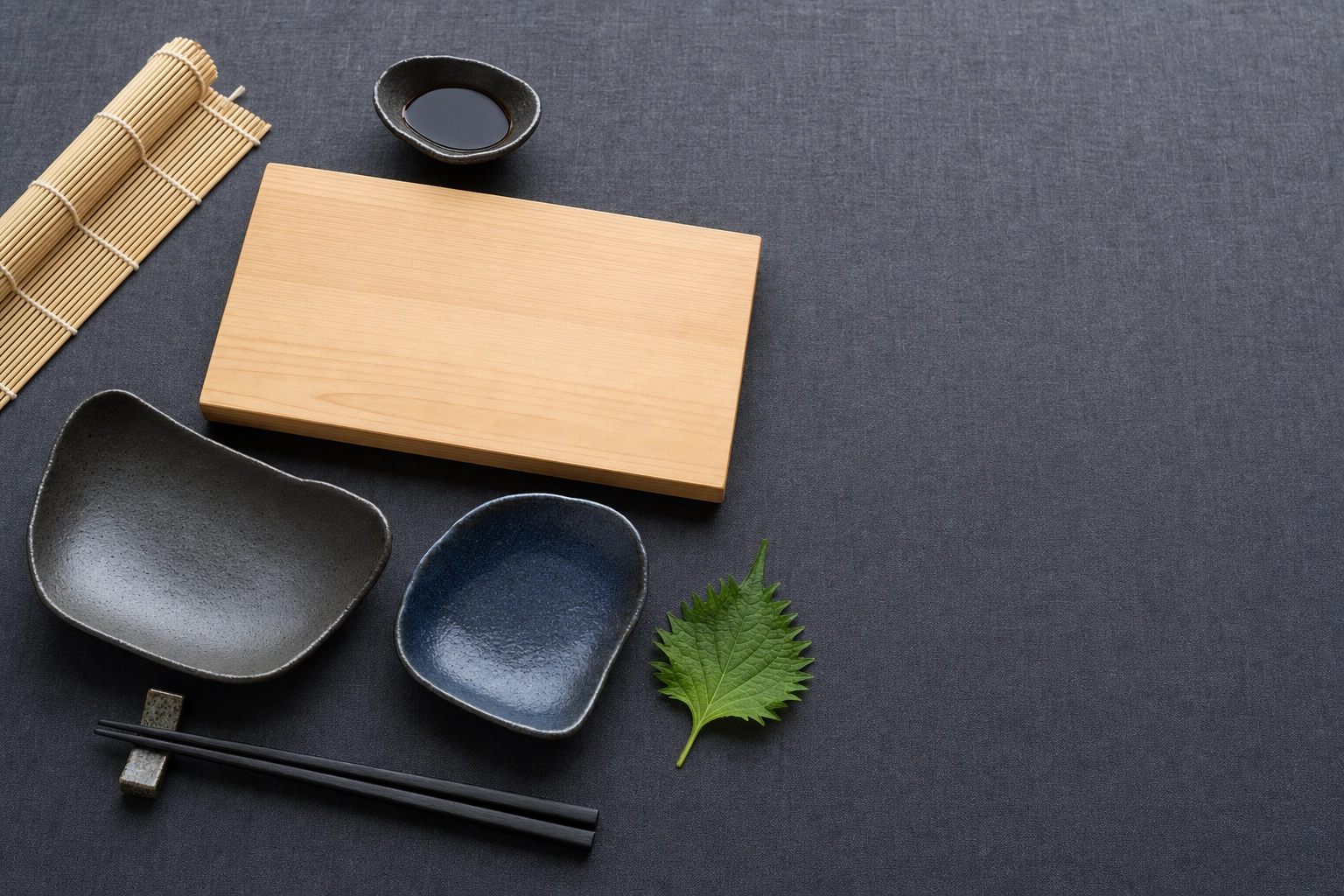 Japanese tableware styling flat-lay with hinoki board, ceramic dishes, tapered chopsticks and shiso on dark linen
Chopsticks earn a special mention because they're both a cultural cue and a compositional tool. Japanese chopsticks are short and tapered to a fine point — visibly different from long, blunt Chinese chopsticks or flat metal Korean ones — so they read as Japanese on camera. Lay a pair diagonally across the frame and they become a leading line straight to the hero. Rest them on a small ceramic hashioki and you've added a detail that quietly says this place knows what it's doing.
Garnish does real work, and most of it wilts fast, so add it last. Shiso leaves, a nest of daikon tsuma (those fine radish threads under sashimi), real grated wasabi instead of the toothpaste-green paste, a careful pour of soy sauce, a scatter of toasted sesame, a single edible flower — each one earns its place. Lean into shun by matching the garnish to the season. And above all, protect the ma: the hardest discipline in Japanese food photography is leaving space empty when every instinct screams fill it. One hero, room to breathe, nothing competing. Nail these and your Japanese food pictures will look composed, not cluttered — and they'll look nothing like the busy, generous frames that suit the rest of an Asian menu.
Before & after: rescuing a phone photo of ramen
Here's the situation every ramen shop knows. The bowl comes up perfect and you grab your phone. By the time you've framed the shot, the broth has gone muddy grey-brown under the kitchen lights, the noodles have sunk and gone slack, and the steam is long gone. Worse, the overhead fluorescents have thrown your own shadow across the whole thing. The photo makes a bowl you're proud of look like leftovers — the opposite of the appetizing Japanese food images you were hoping for.
The fixable problems are all the ones we've covered. The white balance is warm and wrong, so the tonkotsu looks beige instead of creamy. There's no backlight, so the steam never showed. The background is a cluttered stainless pass instead of clean dark wood, and the toppings are flat because nothing is side-lighting them. Correct those and the same bowl transforms — broth color accurate to the style, a clean noodle pull, steam reading as real wisps, chashu and ajitama with texture and gloss, all of it sitting on a moody izakaya background.
This is exactly where an AI food photo editor earns its keep. You shoot the cleanest real photo you can — good food, decent light, no flash — and it restyles the lighting, background, and mood to match the look you're after in seconds. One thing to be clear about, because it matters for raw fish especially: a tool like this enhances and restyles the real food you actually served. It is not for fabricating dishes you never made — the freshness in the photo has to be real freshness on the plate. The same rescue works on a washed-out sushi or sashimi platter or a bento shot under bad light.
From phone photo to menu-ready in 90 seconds
You don't need a studio day or a $1,500 photographer to put great Japanese food pictures on your menu. The workflow is genuinely this short: snap a clean phone photo of the dish, upload it, pick a style, and you have a menu-ready image in about ninety seconds — at roughly 95% less than a traditional shoot.
For Japanese menus specifically, the useful parts are the clean, minimal styles for sushi and sashimi and the dark-izakaya styles for ramen and small plates. Builder Mode lets you compose the scene one decision at a time — a slate, hinoki, or lacquer donburi surface; the vessel; props like shiso and gari; the light — so the whole menu speaks one visual language. And once you've nailed your sushi-ya's look, My Styles can lock that exact aesthetic across every new dish, every seasonal special, every delivery thumbnail, so your nigiri set and your new ramen bowl read as the same restaurant. Everything exports at up to 4K, print-ready for menus, posters, and packaging.
Want to go deeper on a specific dish? Browse the styles for dim sum if your menu wanders into dumplings, or see how the approach adapts for every kind of Japanese restaurant, from a counter sushi bar to a multi-location noodle chain. Your kitchen can be photo-ready before the next ticket fires — start with the food photo editor and put mouthwatering plates on your menu today.
Frequently Asked Questions
How do you make raw fish look fresh in photos?
Use soft, cool, directional light and a cool-to-neutral white balance — never warm tungsten, which turns tuna brown and makes salmon look oily. Skip the on-camera flash entirely, since it blows out the natural glisten and flattens the slice. Then shoot fast: the sheen on freshly cut sashimi starts to dull within minutes, so style the plate first and photograph the moment it hits the surface.
What's the best angle for sushi and sashimi pictures?
Shoot flat platters, nigiri rows, and sashimi fans straight overhead at 90° — raw fish is geometric, and a top-down frame shows off the knife-work and the negative space around it. Switch to a 45° angle for anything with height, like a tall donburi or a chirashi bowl, where you need the topping to stand proud of the rice.
How do you photograph ramen steam so it actually shows?
Backlight it over a dark background. Steam is pale and semi-transparent, so it disappears against a bright backdrop but reads as clear wisps when light passes through it from behind with darkness beyond. Work fast — most of the steam is gone within about ninety seconds — and side-light the toppings separately so they don't fall into shadow.
Do I need a professional camera for Japanese food pictures?
No. A modern smartphone has more than enough resolution for menus, delivery apps, and social — the limiting factor is almost always light and styling, not the camera. Get the dish near a window, kill the flash, leave some negative space, and you're most of the way there. An AI food photo editor then closes the gap to studio quality without the gear.
How do I keep my Japanese menu photos consistent?
Consistency comes from locking your variables: the same surface, the same vessel style, the same light direction, and the same white balance for every dish. The faster route is to train one reusable style on a few reference shots so every new plate — the nigiri set, the ramen bowl, the next seasonal special — automatically reads as the same restaurant across your whole menu.