Asian Food Photography: Style Bold Plates for Restaurant Menus
 Ali Tanis20 min read
A plate of Asian food is built to overwhelm the senses — which is exactly what makes it so hard to photograph. The crimson slick of chili oil, a tangle of noodles half-hidden under cloudy broth, a lazy Susan groaning with eight shared dishes, the saffron-streaked layers of a biryani. Every cue that makes the food irresistible at the table can collapse into visual noise through a camera. Asian food photography asks more of you than a burger or a bowl of salad ever will: more color discipline, more angles, and a lot more speed.
It's worth getting right. About 12% of all U.S. restaurants serve Asian food, and 71% of those serve Chinese, Japanese, or Thai, according to Pew Research. That's a staggering number of menus, delivery thumbnails, and Instagram grids fighting for the same hungry scroll — and the photo usually decides who wins the order.
This is the hub guide for shooting all of it: the four shots every Asian menu needs, how to light bold plates and steaming soups, how to handle chopsticks, steamers and fragile garnish, and a cuisine-by-cuisine field guide from dim sum to biryani. Where a dish has earned its own playbook — sushi and ramen — we'll point you to the deep dive.
Quick Summary: Asian food photography comes down to four shots — a 45° hero dish, a top-down family spread, an action shot, and a garnish macro — and matching the light to the dish: warm side light for bold curries and BBQ, soft top-down light for shared spreads, and backlight for steaming soups. Shoot fast before herbs wilt and steam fades, or snap a clean phone photo and finish it with an AI food photo editor in about 90 seconds.
Why Asian food photography is different
Western plating tends to give you one hero on a wide white plate with room to breathe. Most Asian cuisines do the opposite — they pack color, sauce, garnish and several dishes into one frame on purpose. That generosity is the whole appeal, and it's also why the same camera habits that flatter a steak fall apart here. Six things make Asian food photography its own discipline:
- Color hierarchy. Bold, saturated reds, oranges and greens — gochujang, chili oil, turmeric, curry, fresh herbs — all shout at once. Let every color run at full volume and you get what stylists call "a dog's breakfast": a frame so busy the eye has nowhere to land. Pick one hero color, let the rest support it, and watch your white balance, because it shifts how every one of those colors reads, not just the whites.
- Sauce and gloss coverage. Soy, hoisin, curry gravy, sweet-and-sour and chili oil coat the whole dish in a reflective layer that throws harsh hotspots under direct light. The fix is softer, lower light and matte plates instead of shiny ones.
- Multi-dish family service. Banchan, a Cantonese lazy-Susan spread, an Indian thali, a tower of dim sum baskets — the meal is the table, not a single plate. Frame one dish and you've told a fraction of the story.
- Garnish complexity. Scallion, cilantro, Thai basil, fried shallots, sesame, chili threads and microgreens are doing real work, and most of them wilt or dull within minutes under lights.
- Steam as the headline. Dumplings, soups, hot pot and a screaming-hot wok all sell themselves on steam — a cue that vanishes in about 90 seconds and is invisible unless you light it.
- Register. Light a premium dish like a fast-casual one and it reads cheap. Lighting quietly tells the diner what the food is worth, and for a restaurant that gap shows up in orders.
The 4 shots every Asian menu needs
You don't need fifty setups. Four reliable shots cover almost any Asian menu across print, delivery and social — and each one has a specific job and a specific angle.
1. The single hero dish
Your workhorse. Shoot tall, three-dimensional dishes — a domed biryani, a loaded bibimbap bowl, a glossy curry — at a 45° angle, roughly the eye line of someone leaning in for a bite. That angle gives you height, depth and a clear read on the topping. Fill the frame, leave a sliver of negative space so the eye knows where to land, wipe the rim, and turn the best-looking garnish toward the lens. This is the shot that has to survive at postage-stamp size on a delivery app, so make it unmistakable.
2. The family-style spread, shot top-down
When the dish is the table — a Korean banchan setup, a Sichuan lazy Susan, a steel thali ringed with little bowls, a stack of bamboo steamers — get directly overhead at 90°. A true top-down turns the whole spread into a clean, graphic pattern that reads instantly on a phone. Arrange by color so no two same-toned dishes sit side by side, lean on the rule of odds (three or five elements beat four), and build a little height with bowls and steamers so the frame doesn't go flat. This is the signature "Asian feast" image, and single-dish framing simply can't tell it.
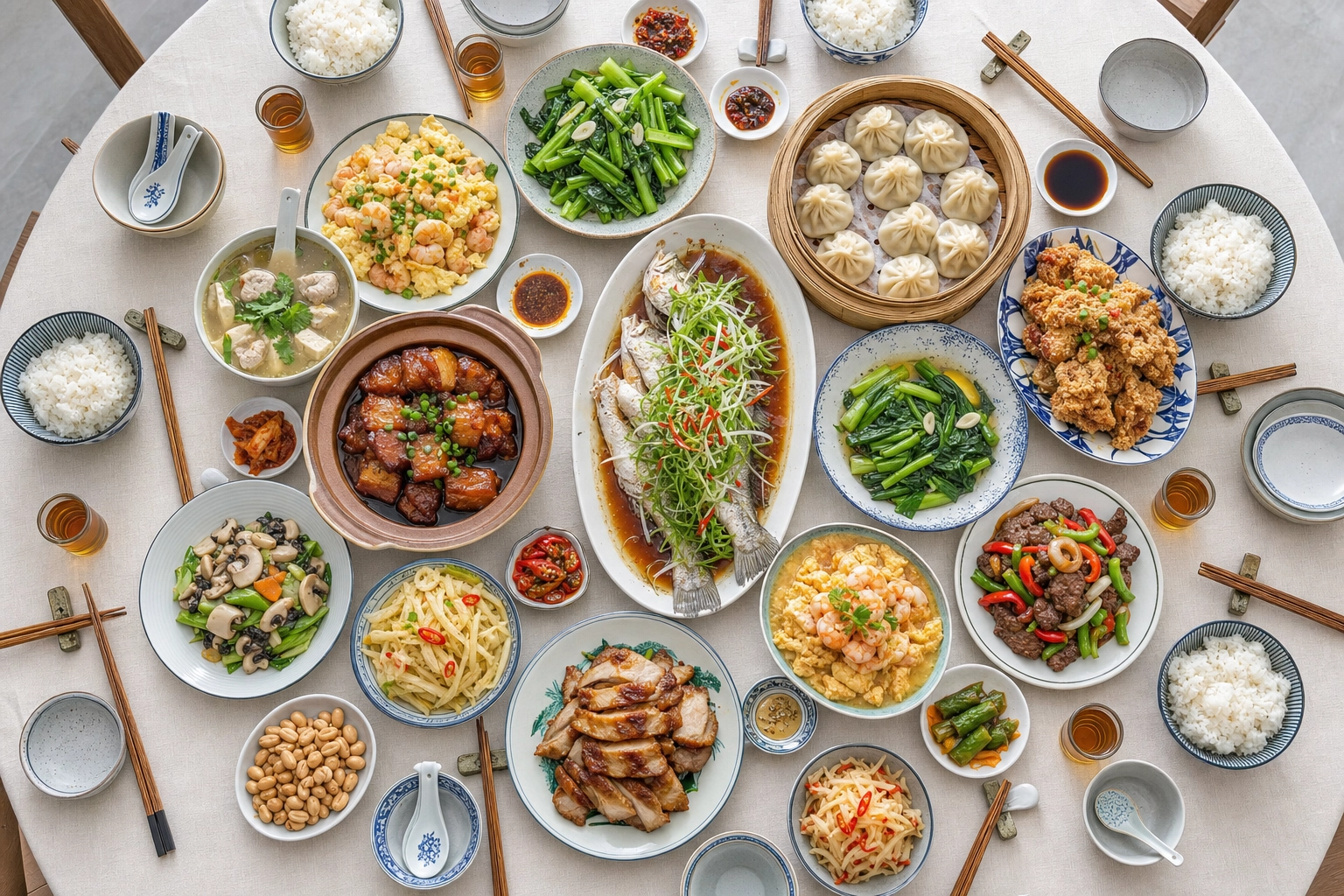 Overhead flat-lay of a family-style Asian dinner with a dozen shared dishes arranged by color on a round table
3. The action shot: wok, steamer, pour and carve
Motion sells freshness. A wok mid-toss with a lick of flame (that's wok hei, the "breath of the wok"), steam curling off a just-opened dim sum basket, broth ladled over a bowl of pho, a Peking duck carved tableside — these frames carry an energy a static plate never will. Bump your shutter to 1/200s or faster and use burst mode to freeze the splash, flame or steam; or drop the shutter and let a little blur imply movement. A human hand in the frame — a chef's, a server's — adds craft and scale for free.
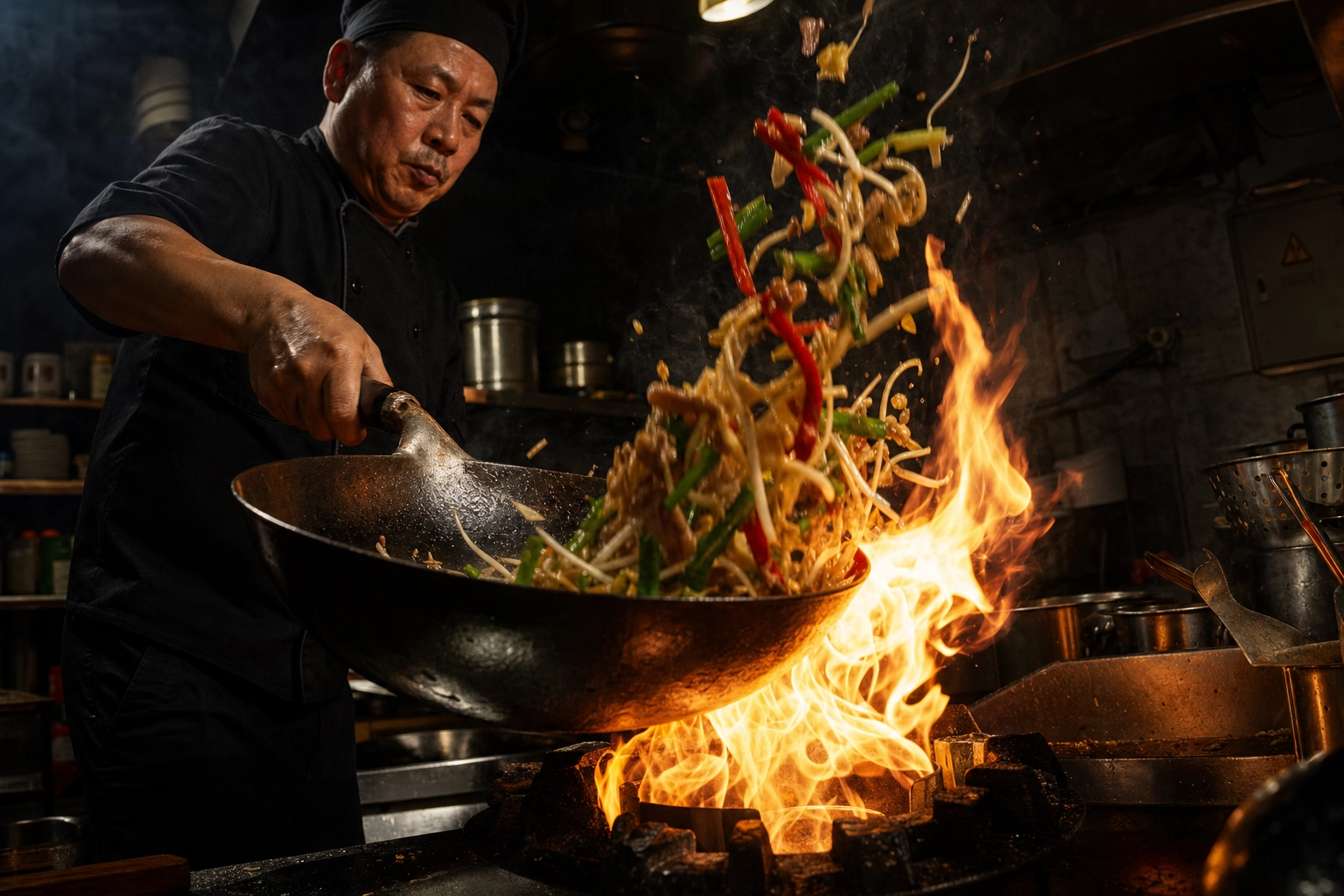 Cook tossing a flaming wok with vegetables flying mid-air in a dark kitchen, energetic Asian stir-fry action shot
4. The garnish and condiment detail
Move in close at 45° on the small things that whisper "authentic": the sheen on a pool of chili oil, a trio of dipping sauces, a scatter of toasted sesame, a Vietnamese plate of herbs, a crown of fried shallots. Open your aperture wide for a shallow depth of field so the background melts and the texture pops. It's a quiet shot, but it's the one that makes a feed look like it knows what it's doing — and it's perfect for telling the flavor story a hero shot can only hint at.
Lighting bold Asian plates
If you fix one thing, fix the light — it does more for an Asian dish than any plate, prop or camera body. The twist is that the right light changes with the dish. Three setups cover nearly everything.
Warm, dramatic side light for bold, textured plates. For curries, Korean BBQ, stir-fries and braises, place your main light (a diffused window works fine) to the side so it rakes across the surface. Side light is what separates a glossy gravy from the chili oil floating on it, lifts the char on grilled meat, and builds the moody, appetite-first look that makes bold colors feel expensive. Keep the white balance neutral-to-warm so reds stay rich without turning orange.
Soft, even, top-down light for spreads. A family-style table needs every dish lit evenly, so flatten and soften the light and shoot from above. Hard, angled light here just buries the back dishes in shadow.
Backlight broth and steam for soups. Pho, ramen, hot pot and any noodle soup want the light behind the bowl, not in front of it. Backlighting makes the broth glow from within, catches the sheen on the noodles, and — over a dark background — turns invisible steam into legible wisps. Then side-light the toppings to bring back their texture. We break the whole soup setup down in the ramen photography guide, and it transfers straight to pho and hot pot.
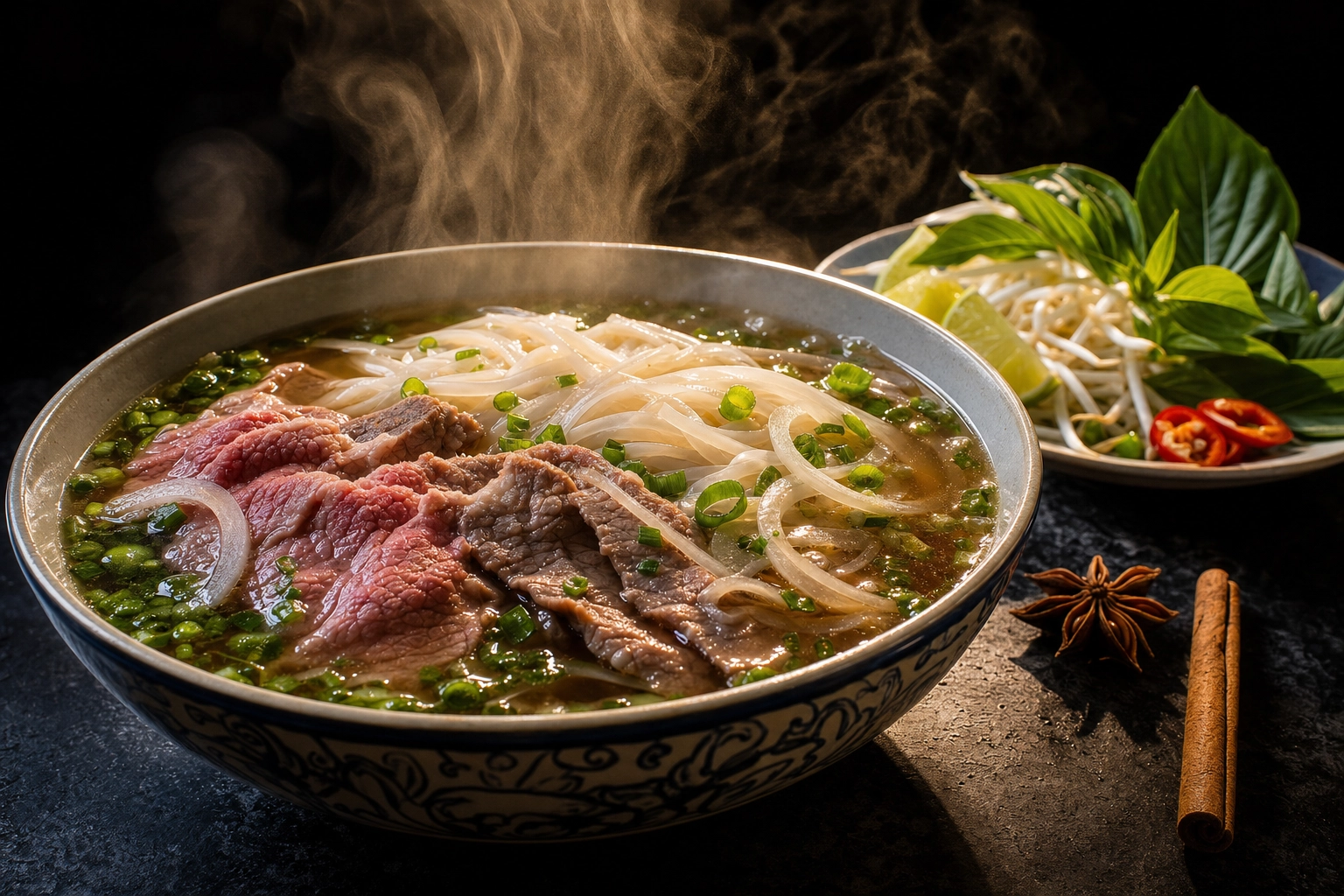 Steaming bowl of Vietnamese pho with backlit broth, rice noodles and beef beside a herb plate of Thai basil and lime
Two rules cut across all three. First, tame the glare. Glossy Asian sauces love to blow out into white hotspots — diffuse your light more, lower its angle, and reach for matte plates over shiny lacquer. Second, kill the on-camera flash. A direct phone flash flattens the dish, browns proteins, and throws an ugly bright spot across every wet surface; culinary schools teach the same fundamental — light that rakes in from the side, not head-on, is what reveals texture. And mind your white balance throughout, because get it wrong and a vibrant green curry photographs grey. If color accuracy is where you struggle, our guide to food color grading walks through dialing it in after the shot.
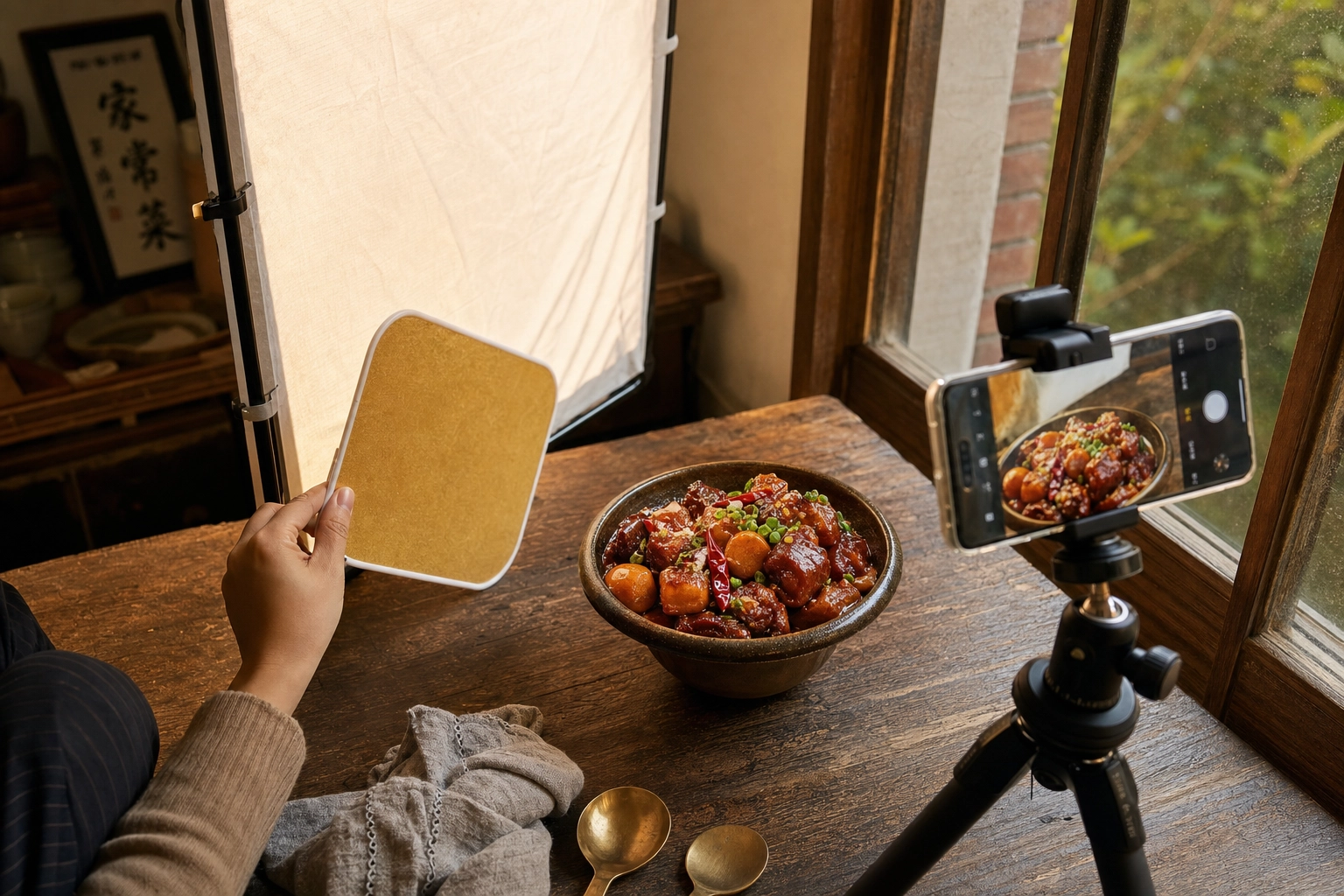 Window side-lighting setup for a glossy red Asian dish with a sheer diffuser, gold reflector card and phone on a tripod
Chopsticks, steamers and serving vessels
In Asian food photography the vessel isn't a prop — it's half the styling. A bamboo steamer, a copper handi, a sizzling dolsot stone bowl or a hammered-brass thali instantly signals authenticity and price register before the food says a word. Match the surface and serviceware to the cuisine: dark slate and walnut for premium and moody, banana leaf for fresh and rustic, lacquer and ceramic for refined. Authentic beats generic every time — a curry in a battered copper kadai outsells the same curry in a white ramekin.
Chopsticks earn their own paragraph because they're both a cultural cue and a compositional tool. The three styles even look different on camera: Chinese chopsticks are long and blunt, Japanese ones short and tapered, Korean ones flat and metal. Lay a pair diagonally across the frame and they become a leading line that walks the eye to the hero. Catch them mid-lift — a dumpling pinched, a tangle of noodles suspended — and you've got an action shot. Just keep the rest of the frame clean: wipe drips off the rim, leave one clear focal path, and resist the urge to crowd in every condiment at once.
One practical styling note for steamed dishes: condensation is the enemy of a crisp dumpling photo. A bamboo steamer breathes, while a steel lid drips water back onto delicate wrappers and leaves them blotchy — which is exactly why Food Network recommends bamboo for dim sum. The basket itself is a gift to the camera, too: that warm woven texture is a built-in background.
Capturing spice, herbs and fresh garnish
Here's the hard truth about Asian garnish: it's the most photogenic part of the plate and the first thing to fail. Fresh herbs go limp under lights, chili threads curl, fried shallots soften, and a dusting of chili flakes loses its edge. So the rule is simple — garnish last, shoot first. Plate and light the dish, then add the fresh elements in the final seconds before you press the shutter.
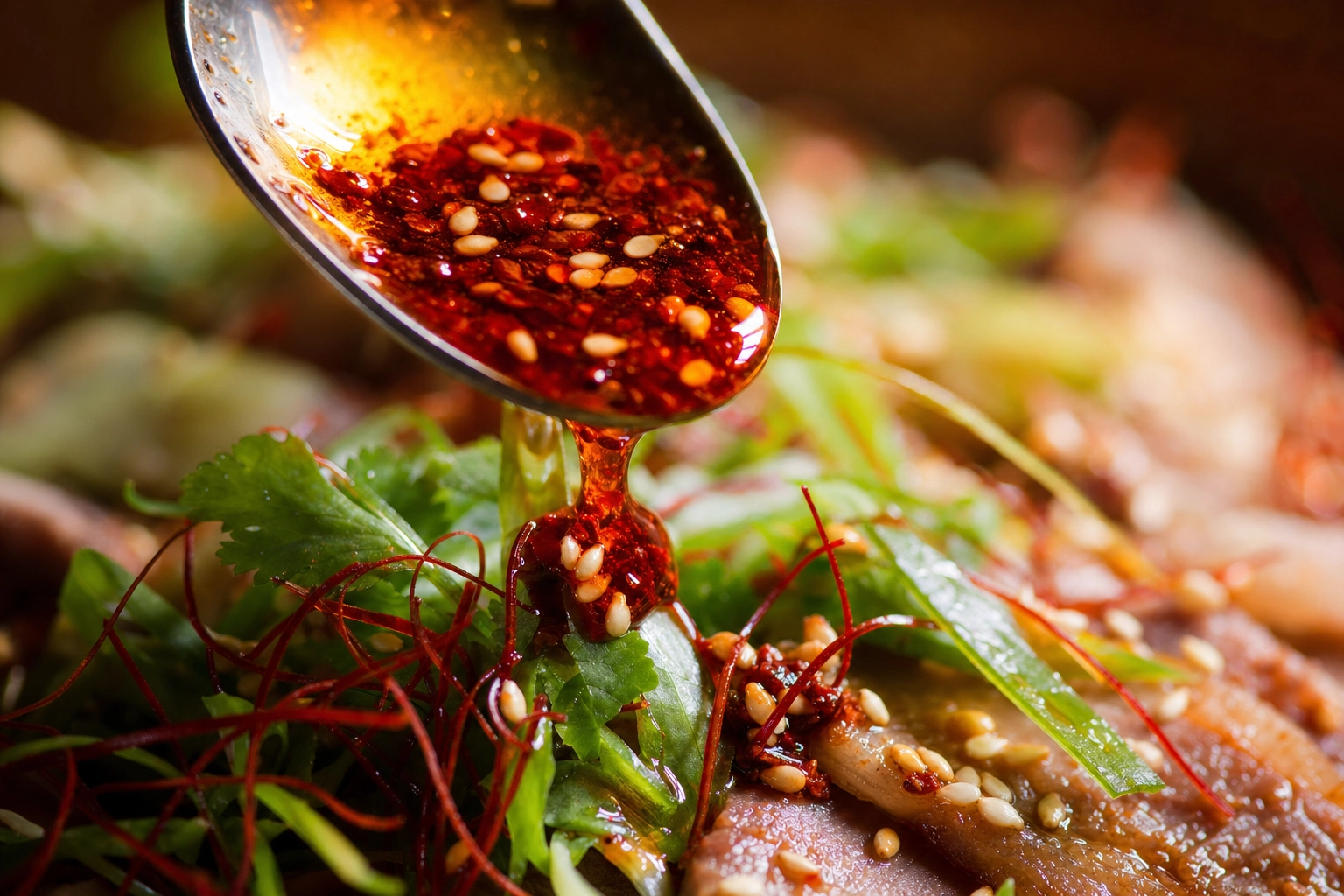 Macro close-up of glossy chili oil drizzled over fresh cilantro, scallion and chili threads garnishing an Asian dish
A few tactics that punch above their weight:
- Green for life. A sprig of Thai basil, a scatter of torn cilantro, a diagonal cut of scallion — fresh green reads as "just made" and provides instant contrast against red and brown dishes.
- Chili oil and threads for color and shine. A spoonful of chili oil dragged across the surface catches the light and screams flavor. Position it so the sheen faces your light source.
- Texture from fried shallots and sesame. These add crunch the eye can feel and a sense of scale on an otherwise smooth surface.
- Trios tell the story. A set of dipping sauces, a Vietnamese herb plate, a little dish of nuoc cham — small supporting elements turn a single dish into a meal with context. Group them in odd numbers.
If garnish and plating is where you want to go deeper, our food styling guide covers the stylist tricks — from steam hacks to sauce control — that apply across every cuisine.
Asian food photography by cuisine: a field guide
The fundamentals above are the backbone of Asian food photography, and they adapt to each kitchen's signature dishes. Here are the quick, practical notes — plus deep-dive links where we have them.
Chinese: dim sum, stir-fry, hot pot and Peking duck
Chinese food photography is a study in contrast. For dim sum, lean on the bamboo steamer's warmth and texture — and remember that pale dumplings vanish on a white plate, so shoot against a dark surface or let the basket be your background. Har gow are the cover stars here: their translucent wrappers, pink shrimp and flash of green chive are made for a close-up, and a wisp of steam off a fresh basket adds life. For better dim sum photos, time the shot to the steam and keep the plate spotless. With stir-fries, light from the side or back to catch the glossy wok hei sheen and any flame; for hot pot, go overhead on the bubbling divided broth with raw platters fanned around it; and for Peking duck, the lacquered mahogany skin is the hero — light it for gloss and shoot the carving. When you're ready to scale, our dim sum photography styles are tuned for exactly these dishes.
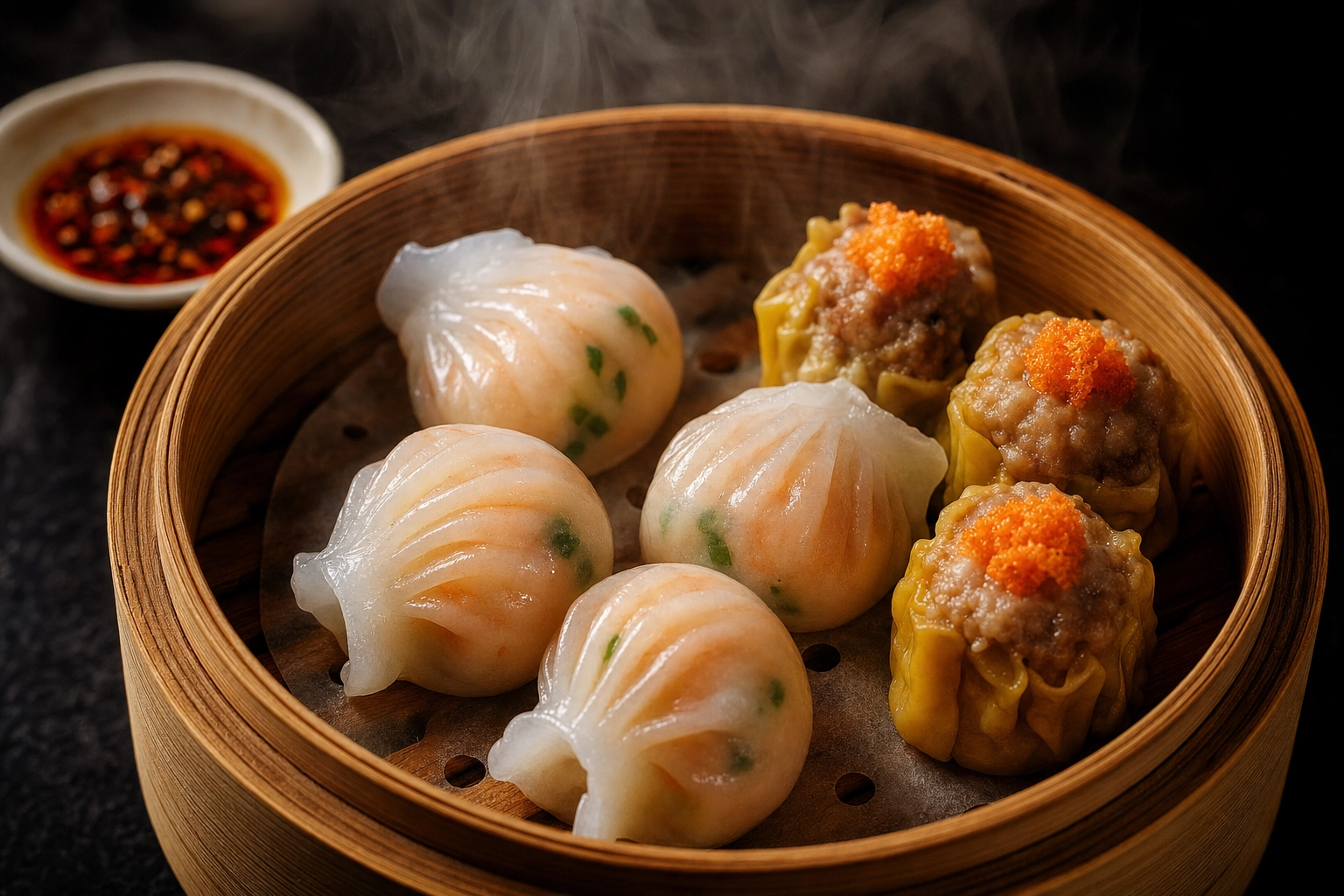 Translucent har gow and golden siu mai dim sum in a bamboo steamer with rising steam against a dark background
Japanese: sushi and ramen (deep-dives)
Japanese cuisine splits cleanly into two photographic problems, and each has its own full guide. Sushi wants cool, soft, directional light and a dark background to keep the fish looking fresh and every grain of rice visible — the complete method, from nigiri angles to sashimi fans, lives in our sushi photography guide (and the raw-fish handling carries over from our seafood photography work). Ramen lives and dies on backlit broth, legible steam and a clean noodle pull — all covered in the ramen photography guide above. Both reward the same instinct: shoot fast, before the sheen and steam are gone.
Korean: BBQ, banchan, bibimbap and kimchi
Korean food photography rewards the overhead. A Korean BBQ table is a top-down dream — shoot straight down on the sizzling grill with raw, marinated galbi and bulgogi fanned around it, and catch a curl of smoke for the action frame. The banchan spread is almost too easy: a constellation of small, colorful side dishes set out to share is a hero shot in itself, and as Bon Appétit notes, those crisp, tart, spicy little plates are half the meal. Bibimbap is best shot overhead before it's mixed, while the vegetables still sit in their color-wheel sections around the egg — and a dolsot stone bowl adds sizzle and steam. For kimchi, lean into that bold fermented red as a color anchor for the whole table.
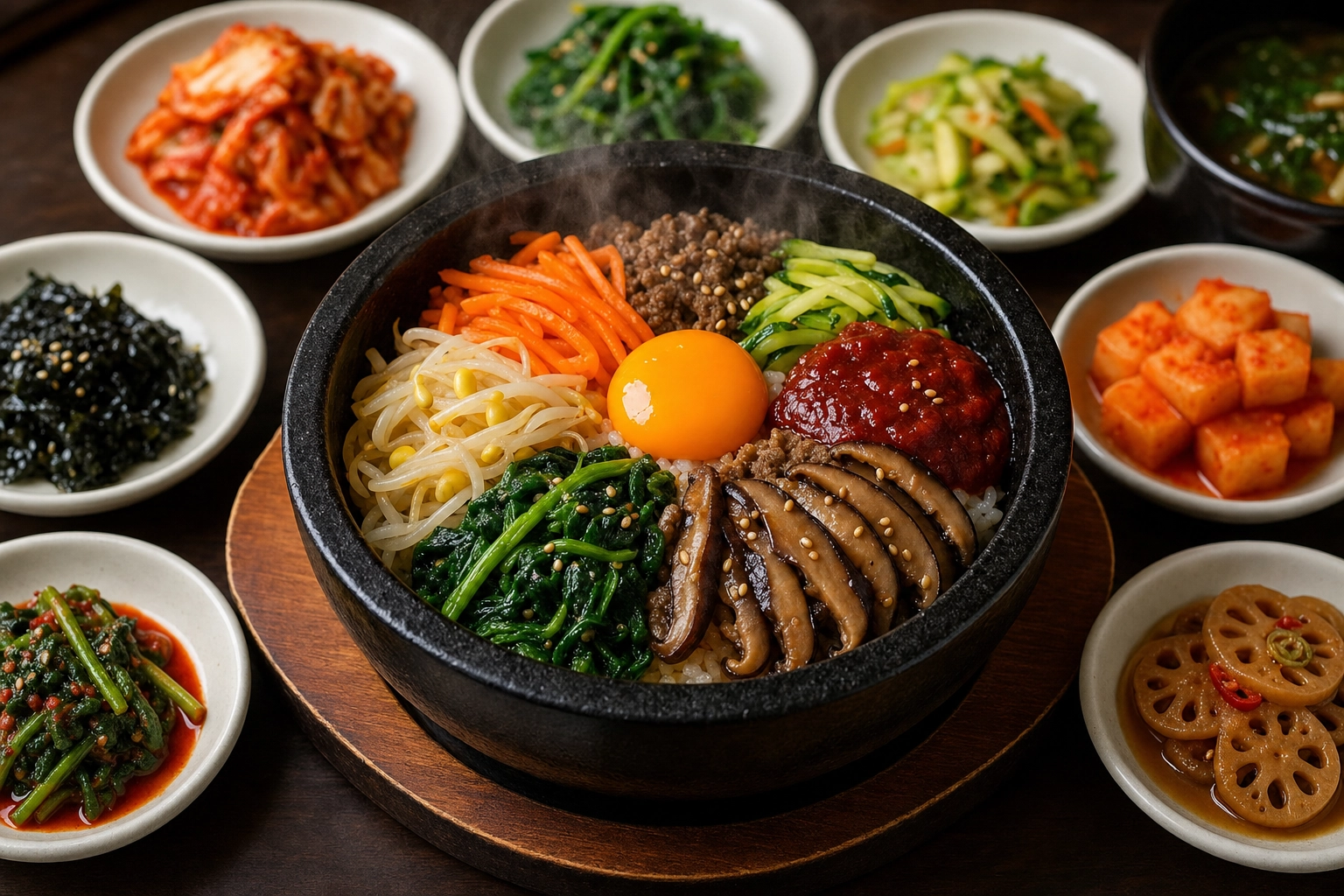 Korean dolsot bibimbap with colorful vegetables and egg arranged in sections, surrounded by banchan side dishes
Thai: curries, pad thai and papaya salad
Thai food photography is all about controlled vibrancy. For curries — green, red, massaman, yellow — capture the swirl where coconut milk meets the paste and the sheen of chili oil pooling on top; a bowl on dark wood makes the color leap. Pad thai is defined by its garnish set, so style it deliberately: a lime wedge, crushed peanuts, bean sprouts and chili flakes arranged toward the camera. Som tam (green papaya salad) is fresh, shredded and glossy with dressing — shoot it close to catch the texture. Throughout, a banana leaf and a few sprigs of Thai basil do more for authenticity than any expensive prop.
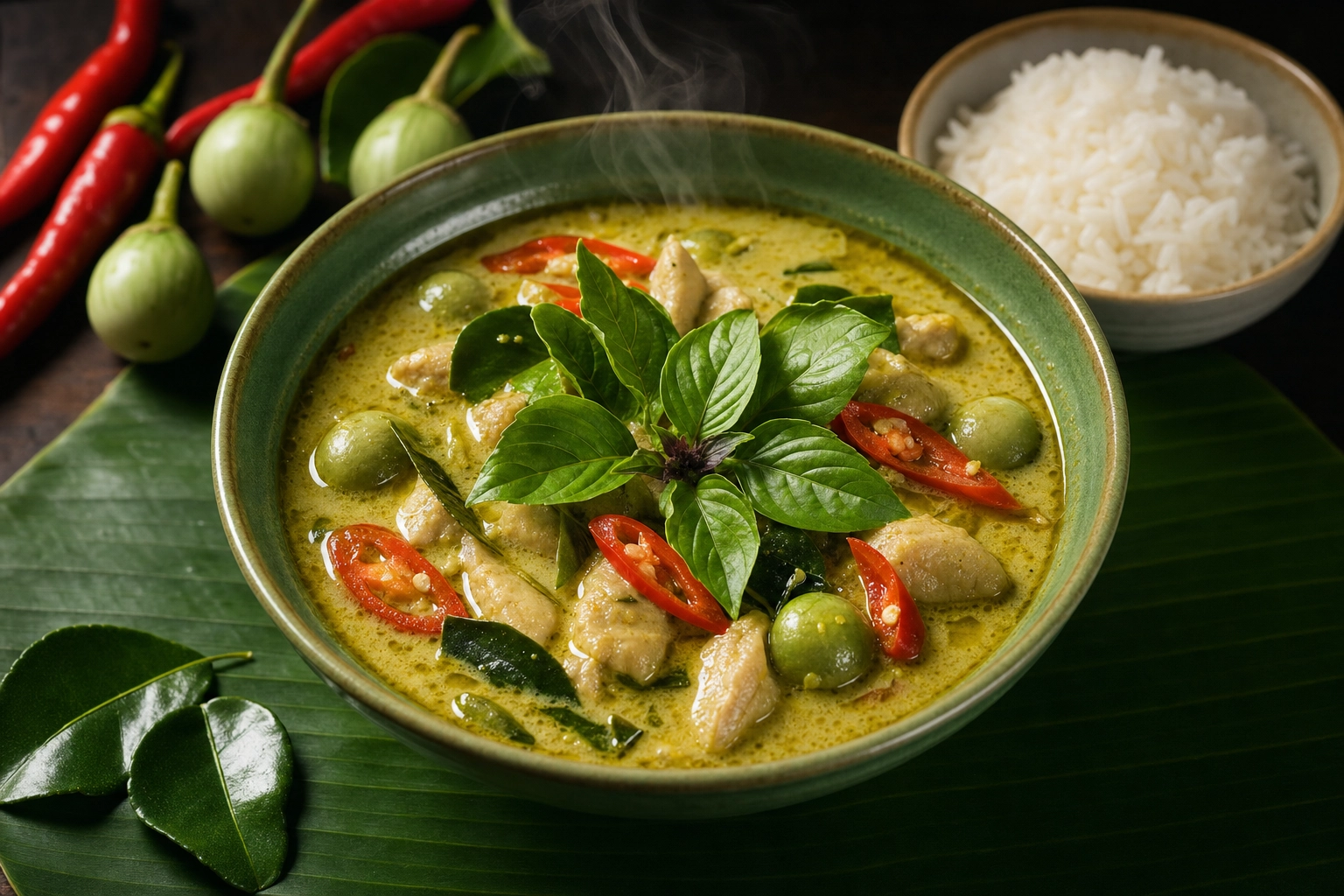 Thai green curry in a bowl on a banana leaf with coconut broth, Thai basil and chili, vibrant 45-degree shot
Vietnamese: pho, banh mi and summer rolls
Vietnamese cooking is light, fresh and herb-forward, and the photos should feel that way too. Pho is a backlit-broth-and-steam shot like ramen — but don't stop there: the iconic side plate of Thai basil, bean sprouts, lime and bird's-eye chili deserves its own detail frame. For banh mi, the money shot is the cross-section — slice it open to reveal the layers of pickled daikon and carrot, cilantro, chili and protein packed into a crackly baguette. Summer rolls (goi cuon) should be cut on the diagonal and stood up so the translucent rice paper shows off the shrimp and herbs inside. Keep the styling clean and let the freshness carry it.
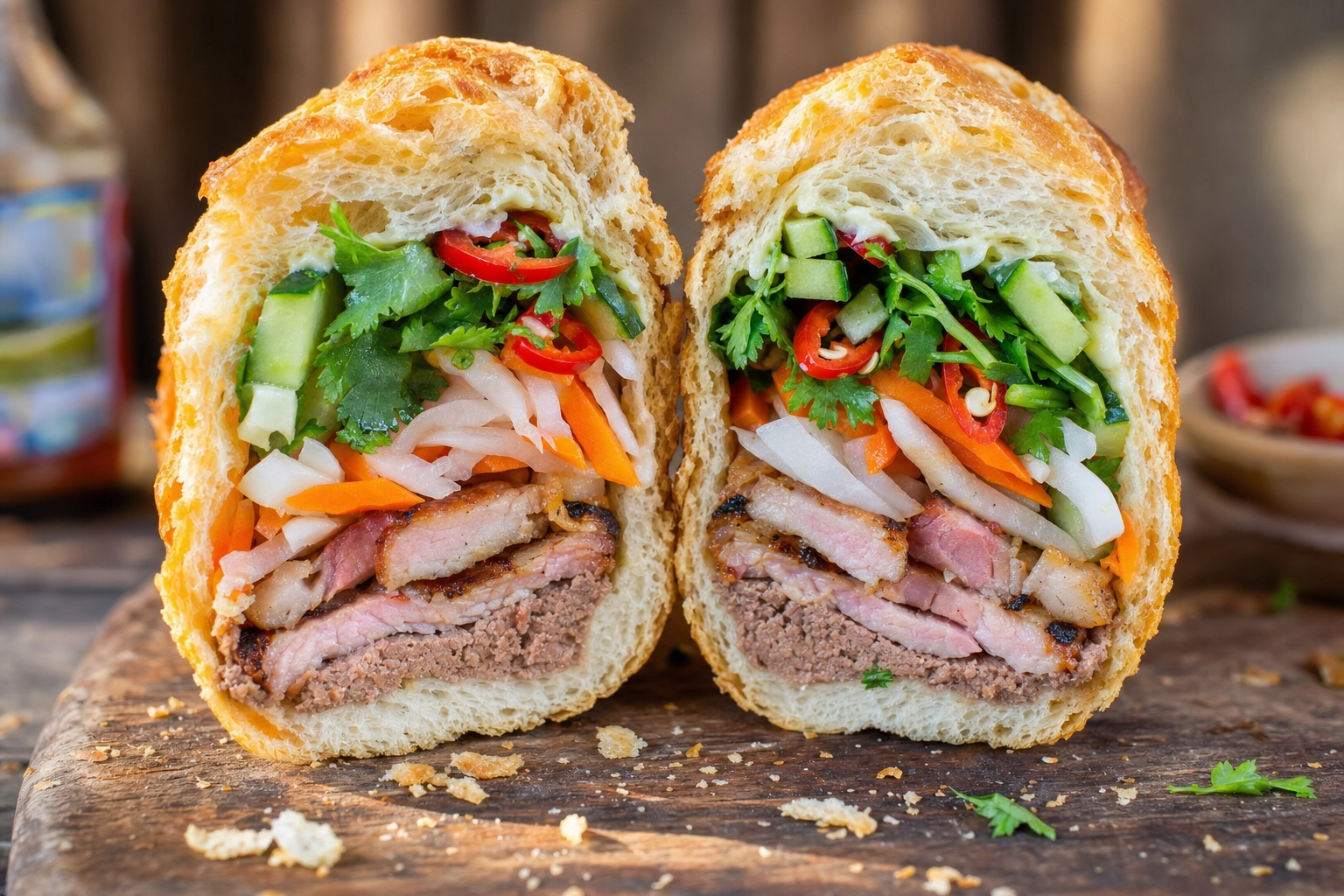 Vietnamese banh mi sliced to show the cross-section of pork, pâté, pickled carrot, daikon, cilantro and chili
Indian: biryani, curry, naan and the thali plate
Indian food photography is rich, warm and layered — and one of the highest-demand corners of this whole category. Serve a biryani in a handi, copper pot or cast-iron vessel, and shoot to show the layers: long saffron-stained and white basmati grains, tender meat, a crown of fried onions (birista), a boiled egg and a scatter of mint. Go 45° or top-down with warm, dramatic light, and whatever you do, don't dead-center it — off-set the bowl and let a side of raita and salan tell the rest of the story. The best biryani photos sell the steam and the grain. For curries — butter chicken, tikka masala, dal — catch the cream swirl and the tadka oil sheen in a copper katori or kadai, finished with cilantro. Light naan to show its leopard-spot char and ghee gloss, in a basket or on slate. And the thali — a round brass platter ringed with little katori bowls — is the ultimate top-down, color-wheel shot in all of Asian food.
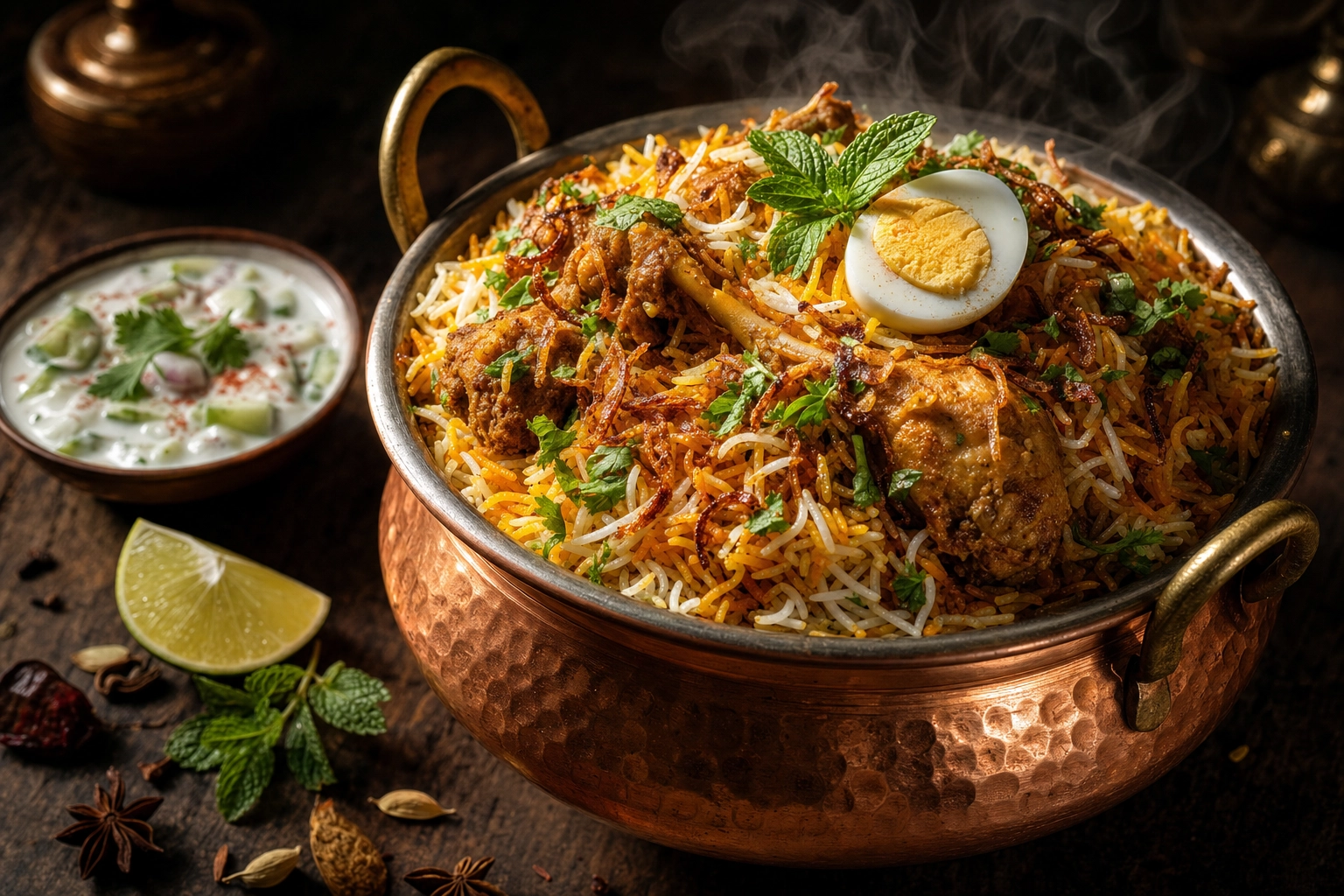 Chicken biryani in a copper handi with layered saffron rice, fried onions, boiled egg and mint beside raita
From phone photo to menu-ready in 90 seconds
Here's the honest problem with everything above: the herbs wilt and the steam fades while you're still adjusting a tripod, and no busy kitchen can book a photographer for every seasonal special. Professional food photography runs roughly $50–$150 per image and $750–$2,500 for a full day, plus $500–$1,200 for a food stylist — math that rarely works for a menu that changes with the season or a delivery listing that needs forty dishes shot yesterday.
This is where an AI workflow changes the game. Shoot one clean phone photo of a real dish — decent light, garnish arranged — then upload it to an AI food photo editor, pick an Asian-tuned style, and export a 4K, menu-ready image in about 90 seconds. The model does the heavy lifting Asian food demands: it corrects color and white balance so a green curry stays green, builds a believable steam halo over a bowl, restores the gloss on sauces and noodles, and cleans up a cluttered background or a harsh window.
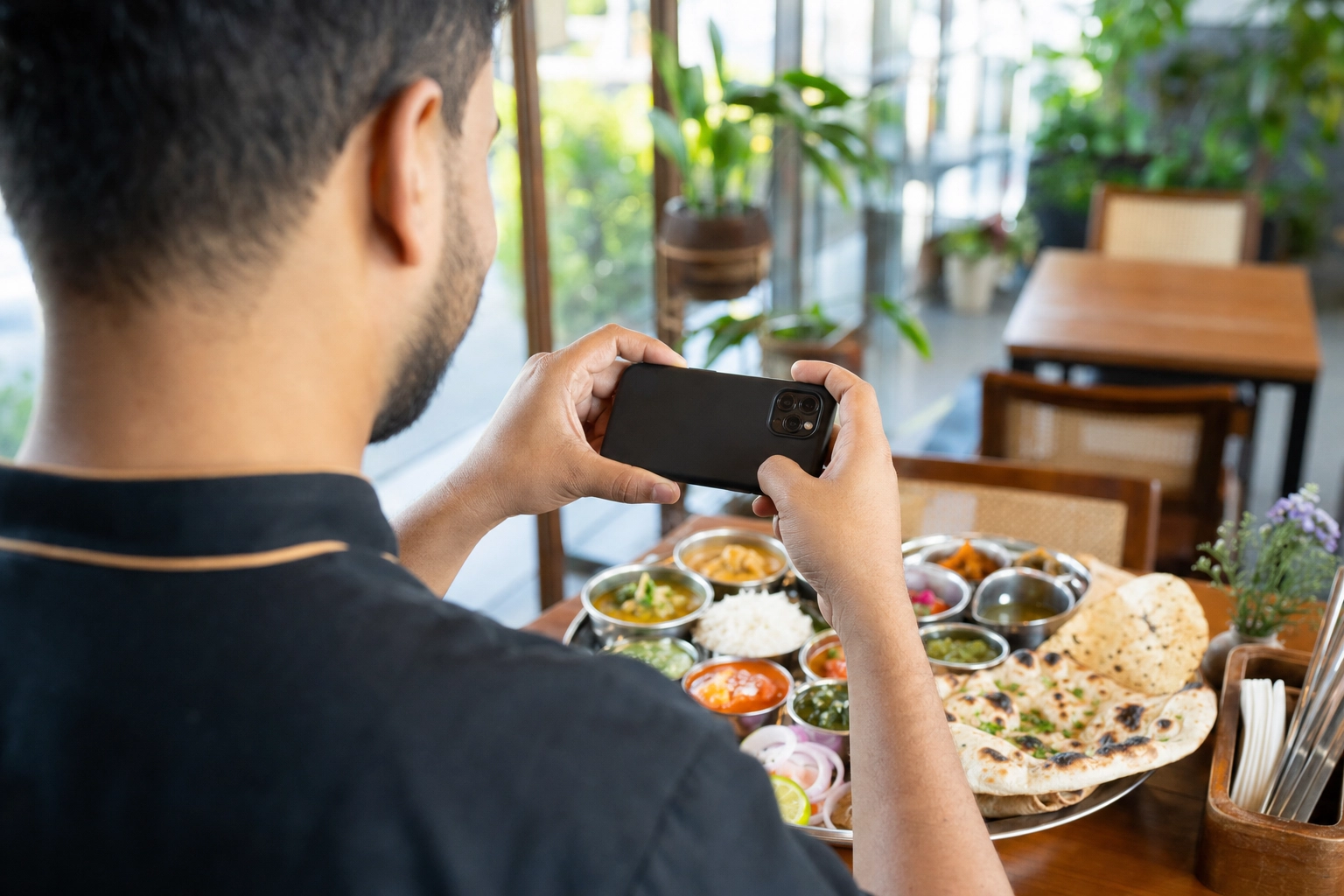 Restaurant owner photographing a colorful Indian thali with a smartphone from above in a bright modern dining room
What it can't do is invent a dish from nothing — it enhances a photo of your food, so the shot still starts with your actual plate. For a multi-location chain or a single owner-operator, the payoff is the same: consistency across menu, delivery and social, with 200+ styles, a commercial license on paid plans, and roughly 95% off the cost of a traditional shoot. It's the same workflow behind great Asian food photography, whether it powers a neighborhood noodle bar or a fine dining tasting-menu page, and it slots straight into your broader restaurant menu photography without a studio day.
Your Asian restaurant can be photo-ready in 90 seconds. Snap the dish, upload it, pick a style, and put mouthwatering plates on your menu before the next ticket fires — start free or see pricing. Want a specific cuisine dialed in further? Browse our ramen style presets or the dim sum library and build your look from there.
Frequently Asked Questions
How do you photograph Asian food so the bold colors pop?
Start with accurate white balance — it controls how every color reads, not just the whites — then resist the urge to crank saturation on everything. Choose one hero color and let the others support it, shoot bold dishes against a dark background for instant contrast, and use complementary pairings like red chili against green cilantro. Contrast often makes colors "pop" more convincingly than saturation does, and it keeps the frame from turning into visual noise.
What's the best camera angle for family-style dishes like dim sum or a Korean banchan spread?
Go straight overhead at 90° — a true top-down. Shared Asian meals are about the whole table, and an overhead angle turns a banchan spread, a lazy-Susan of Chinese dishes or a stack of dim sum baskets into a clean, graphic pattern that reads instantly on a phone. Arrange the dishes by color, build a little height with bowls and steamers, and group elements in odd numbers.
How do you photograph dim sum so the dumplings don't disappear?
The classic mistake is pale dumplings on a pale plate, where they blend right in. Shoot against a dark surface, or let the bamboo steamer be your background — its warm woven texture provides contrast and authenticity at once. Get close to show off translucent wrappers (har gow are perfect for this), time the shot to a fresh wisp of steam, and keep the basket spotless. Strong, clean dim sum photos almost always come down to contrast plus timing.
How do you make biryani look good in photos?
Serve it in an authentic vessel — a handi, copper pot or cast-iron dish — and style it to show the layers: long saffron and white basmati grains, the meat, a crown of crispy fried onions, a boiled egg and fresh mint. Shoot at 45° or directly overhead with warm, slightly dramatic light, and don't center it dead-on; offset the bowl and add a side of raita for context. The best biryani photos capture the steam and the individual grains of rice rather than a flat mound.
What lighting works best for Asian soups like pho and ramen?
Backlight them. Place your main light behind and slightly above the bowl so the broth glows from within and the noodles catch a sheen, and put a dark background behind it so the steam becomes visible. Then add a touch of side light to bring texture back into the toppings, and turn off your on-camera flash, which flattens the broth and kills the steam every time.
Can I get professional Asian food photos without hiring a photographer?
Yes. Shoot a clean phone photo of the real dish in decent light with the garnish arranged, then run it through an AI food photo editor to correct the color, add steam, restore gloss and clean up the background — a 4K, menu-ready image in about 90 seconds, at roughly 95% less than a traditional shoot. The one rule: it enhances a photo of your actual food, so you still start with a real plate of the dish you're selling.