Social Media Marketing for Restaurants (Free 30-Day Plan)
 Ali Tanis28 min read
Forty percent of diners try a new restaurant after seeing food photos on social media. That's not a feel-good marketing stat — it's a direct pipeline from your Instagram grid to filled tables.
Yet most restaurant owners treat social media marketing for restaurants like an afterthought. A quick snapshot of today's special, posted whenever someone remembers, with a generic caption and zero strategy behind it. Then they wonder why their follower count flatlines and their posts get 12 likes from the same 12 people.
Here's the reality: restaurant social media marketing isn't optional anymore. It's how diners discover you, evaluate you, and decide whether you're worth the trip. And the restaurants doing it well are seeing real money — not just vanity metrics.
Quick Summary: Restaurants that invest in a social media strategy see an average 9.9% B2C revenue increase (Deloitte, 2025). This complete guide covers platform selection, content strategy, posting schedules, hashtag tactics, influencer partnerships, paid advertising, and includes a ready-to-use 30-day content calendar. The single biggest lever? Your food photo quality.
Why Social Media Marketing for Restaurants Matters in 2026
The data is unambiguous. According to Deloitte Digital's 2025 State of Social research, restaurants reported an average 9.9% increase in B2C revenue as a direct result of their social media strategies. Social-first brands — those that treat social media as a core business function rather than a side project — saw an even higher 14.1% average increase.
Here's what else the numbers tell us:
- 74% of people use social media to decide where to eat
- 57% of diners have made a reservation directly through social media
- 84% of users say they prefer to see food and drink photos on a restaurant's social media
- 40% of diners have tried a new restaurant after seeing food photos online
- Diners spend an average of 40 minutes researching restaurants on social media before booking
That last stat bears repeating. Your potential customers are spending nearly an hour scrolling through your (and your competitors') social media profiles before deciding where to eat. What they find — or don't find — directly determines whether your business gets their money.
And here's the kicker: 90% of restaurants already consider social media very or extremely important to their overall digital marketing strategy. If you're not investing in it seriously, you're not ahead of the curve — you're behind 9 out of 10 of your competitors.
Choosing the Right Social Media Platforms for Your Restaurant
The biggest mistake in social media for restaurants? Trying to be everywhere at once. You create accounts on seven platforms, post sporadically on all of them, and build momentum on none of them.
A better approach: pick one or two platforms, get excellent at them, then expand. Here's how to choose the best social media platform for your restaurant brand.
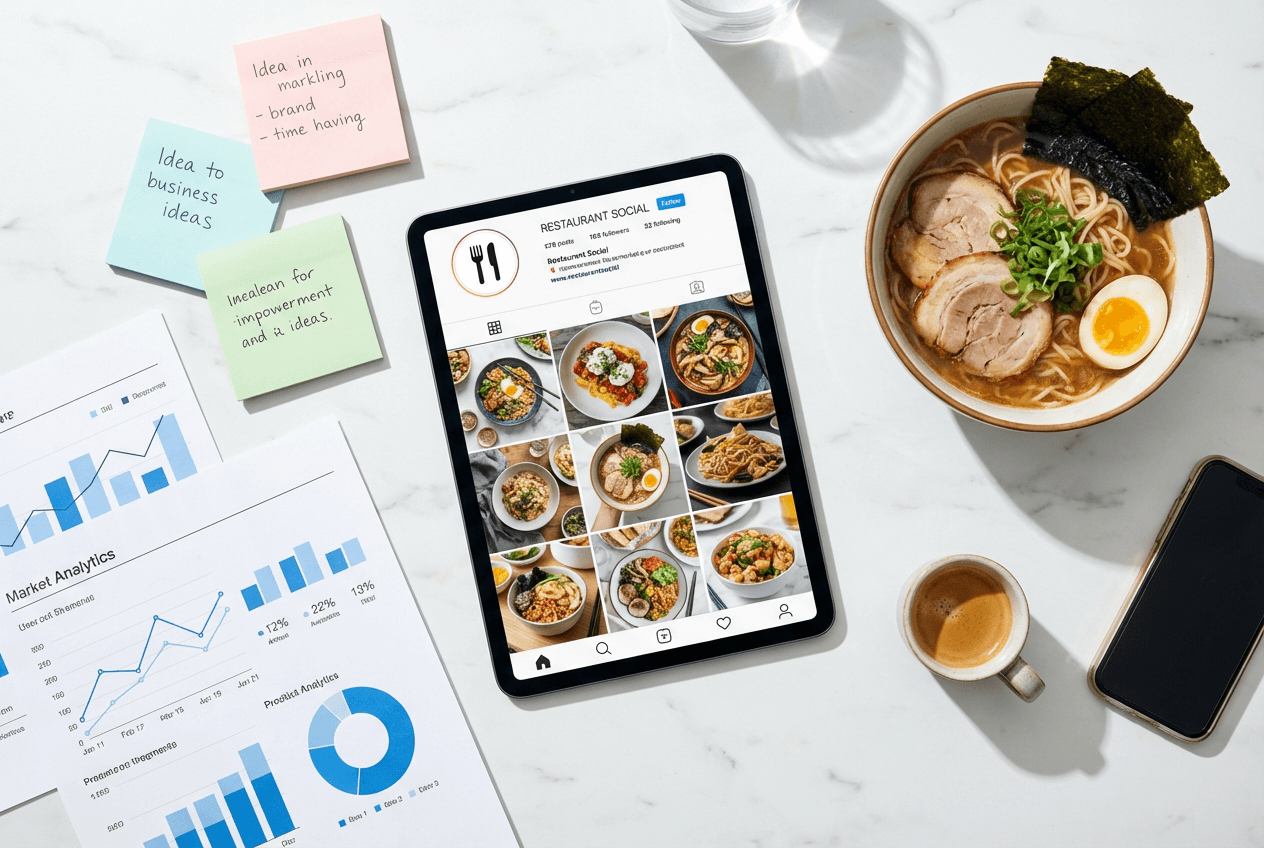 Overhead view of restaurant social media planning workspace with food photos, analytics, and fresh ramen dish
Instagram: Your Visual Storefront
If you only pick one platform for your restaurant social media strategy, make it Instagram.
Instagram's per-follower engagement rate of 2.2% is roughly 10 times higher than Facebook's 0.22%. The #Food hashtag alone has over 250 million posts, making food one of the most active content categories on the platform. And 84% of users specifically want to see food and drink photos from restaurants they follow.
Best for: Polished food photography, short-form video (Reels), Stories for daily specials, user-generated content reposts
Who should prioritize Instagram: Every restaurant, but especially those with visually striking food, strong plating, or a photogenic space.
Features to actually use:
- Reels: Instagram's algorithm heavily favors video. A 15-second plating reel can reach 5-10x more people than a static photo post
- Stories: Daily specials, behind-the-scenes kitchen moments, polls ("Which dessert should we add to the menu?")
- Highlights: Organize Stories into permanent categories — Menu, Reviews, Events, Behind the Scenes
- Carousel posts: Before/after transformations, recipe breakdowns, or staff spotlights in a swipeable format
The key on Instagram? Visual consistency. Your grid should feel cohesive — similar lighting, color tones, and quality across every post. This is where many restaurants struggle, because one day they shoot in perfect natural light and the next day it's a dark, grainy phone photo under fluorescent kitchen lights.
Tools like FoodShot AI's food photo editor solve this by letting you transform any smartphone photo into a consistent, professional-quality image. You upload a photo of your dish, choose a style preset (Instagram, Fine Dining, Restaurant, etc.), and get a polished result in about 2 minutes — no photography skills needed.
TikTok: Where Virality Lives
TikTok isn't just for Gen Z anymore. The platform has become a genuine restaurant discovery engine — 55% of TikTok users have visited a restaurant after seeing it on the app, and the #FoodTok community has billions of views.
Best for: Behind-the-scenes kitchen content, personality-driven videos, trend participation, raw and authentic moments
Who should prioritize TikTok: Casual dining, fast-casual, restaurants with unique concepts or photogenic processes, chef-driven brands with personality
What works on TikTok for restaurants:
- Kitchen prep videos (the "satisfying" factor of chopping, saucing, plating)
- Staff introductions with personality (the charming barista, the head chef's story)
- Trend participation (audio trends adapted to your restaurant context)
- Customer reaction videos
- "Day in the life" of running a restaurant
What doesn't work: Over-produced, commercial-feeling content. TikTok rewards authenticity. A shaky phone video of your chef hand-pulling noodles will outperform a slick corporate ad every time.
Posting rhythm: 3-5 times per week minimum. TikTok's algorithm gives every video a fair shot regardless of follower count, so consistency is more important than perfection.
Facebook: The Local Community Hub
Facebook gets dismissed as "old," but with 3.065 billion monthly active users it's still the world's largest social media platform — and it's particularly strong for local restaurant marketing.
Best for: Local awareness, event promotion, community groups, review management, paid advertising
Who should prioritize Facebook: Family restaurants, fine dining, catering businesses, restaurants targeting 35+ demographics, multi-location brands
Underutilized Facebook features for restaurants:
- Facebook Events: Create events for live music nights, tasting menus, holiday specials. These get organic distribution through invites and shares
- Facebook Groups: Join (or create) local food lover groups. Contribute value, don't just promote
- Recommendations/Reviews: Encourage happy customers to leave reviews — 75% of Facebook users pick restaurants based on reviews and comments
- Facebook Marketplace: Some restaurants use it for catering packages and gift cards
Facebook also has the most sophisticated paid advertising platform, which we'll cover later in this guide. If you plan to run any paid social media ads for your restaurant, you need a Facebook presence.
Other Platforms Worth Considering
Pinterest: 80% of weekly Pinterest users discover new brands on the platform. It's excellent for seasonal content, recipe inspiration, and event-related food imagery. Pins have a much longer shelf life than posts on other platforms — a single pin can drive traffic for months.
YouTube: Ideal for longer-form content: full recipe walkthroughs, restaurant renovation stories, chef interviews. Requires more production effort but builds deep audience connection.
Google Business Profile: Technically not "social media," but your Google profile photos directly influence whether searchers click through to your restaurant. Keep it updated with fresh, high-quality food photos.
Building Your Restaurant Social Media Content Strategy
Posting without a strategy is like cooking without a recipe — you might get lucky occasionally, but you'll mostly end up with a mess.
The foundation of any restaurant social media strategy is content pillars: 4-5 recurring themes that give your posting structure and variety. Content pillars prevent the "what do I post today?" panic and ensure you're building a well-rounded brand presence instead of just posting food photos on repeat.
A solid rule of thumb: 80% of your content should engage, educate, or entertain your audience. Only 20% should directly promote (specials, events, "come visit us" calls to action). People follow restaurant accounts for inspiration and entertainment, not to be sold to constantly.
The 5 Content Pillars Every Restaurant Needs
Pillar 1: Food Photography and Menu Highlights
This is your bread and butter (pun intended). Beautifully shot dishes, seasonal menu additions, signature items, and daily specials. This type of content drives the most engagement on Instagram — food photos can boost engagement rates by up to 60%.
But here's where most restaurants go wrong: inconsistent quality. One gorgeous professional shot followed by three blurry phone photos in bad lighting. This rollercoaster of quality actually hurts your brand perception more than consistently average photos would.
The fix? Standardize your food photography workflow. Whether you're using natural light by the window, a basic ring light setup, or an AI food photography tool to enhance your smartphone shots, the goal is consistency across every single image.
Quick tips for better food content:
- Shoot in natural light whenever possible (or supplement with a simple $30 LED panel)
- Use the overhead angle for flat dishes (bowls, pizzas, charcuterie boards)
- Use 45-degree angle for dishes with height (burgers, stacked desserts, cocktails)
- Check out our iPhone food photography tips for step-by-step guidance on getting better shots with the phone in your pocket
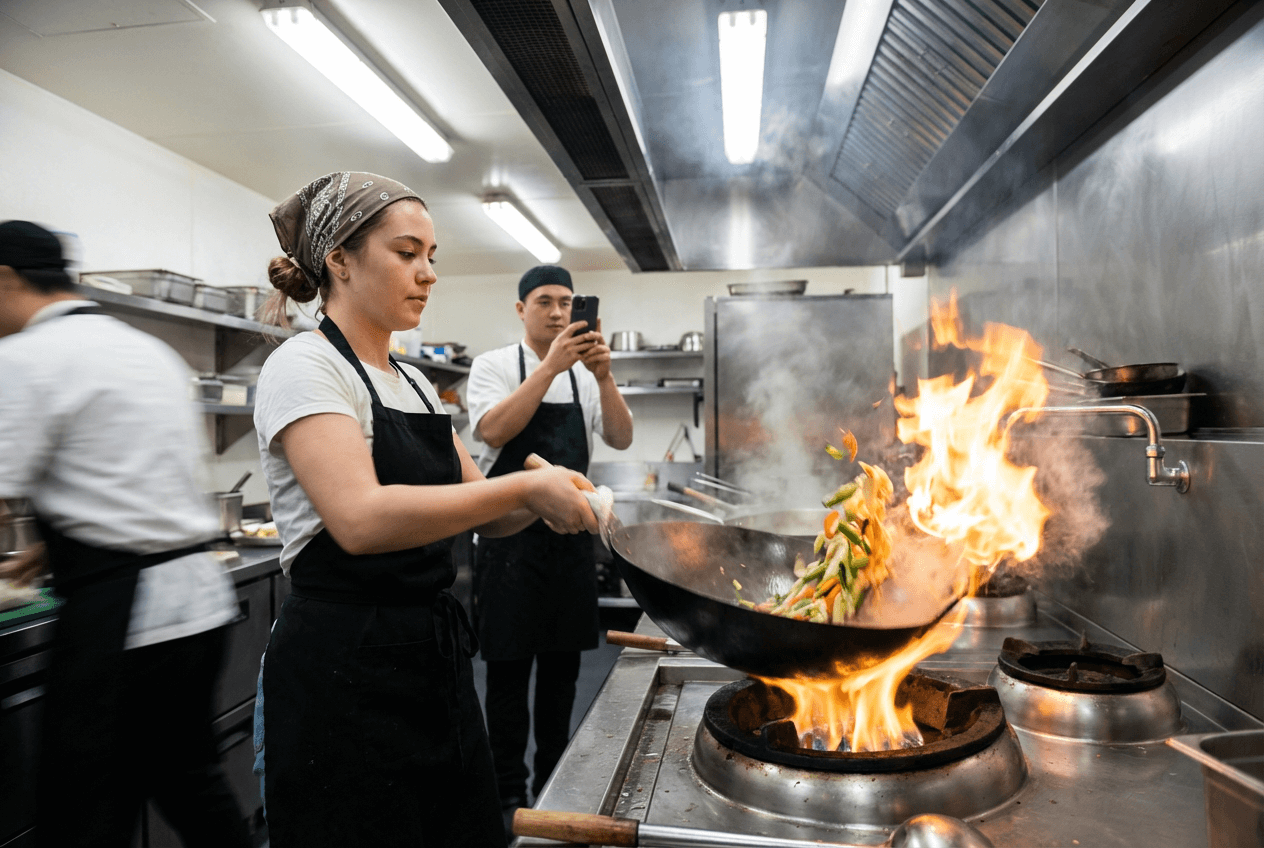 Restaurant kitchen behind-the-scenes content creation with chef cooking over flames while coworker films on smartphone
Pillar 2: Behind-the-Scenes and Kitchen Stories
People are fascinated by the process behind their food. Kitchen prep, dough rising, sauces simmering, the organized chaos of a Friday night service — this type of content humanizes your brand and builds emotional connection with your audience.
Behind-the-scenes content performs especially well on TikTok and Instagram Stories. It doesn't need to be polished — in fact, the rawer it feels, the more authentic and engaging it becomes.
Ideas for behind-the-scenes restaurant content:
- Early morning prep routines
- How a signature dish is made, step by step
- Receiving a delivery of fresh ingredients (bonus points for local farms)
- Kitchen "fails" handled with humor
- Plating process in real-time
Pillar 3: Staff Spotlights and Team Culture
Your team is your brand. Introducing the people behind the food creates personal connections that turn one-time visitors into loyal regulars.
Formats that work:
- "Meet our team" posts with a fun fact or favorite dish
- Staff takeovers on Instagram Stories
- A barista or bartender's signature creation
- Celebrating milestones (5-year work anniversary, culinary school graduation)
This pillar also helps with recruiting. Potential employees check your social media too — showing a positive team culture attracts talent to your restaurant.
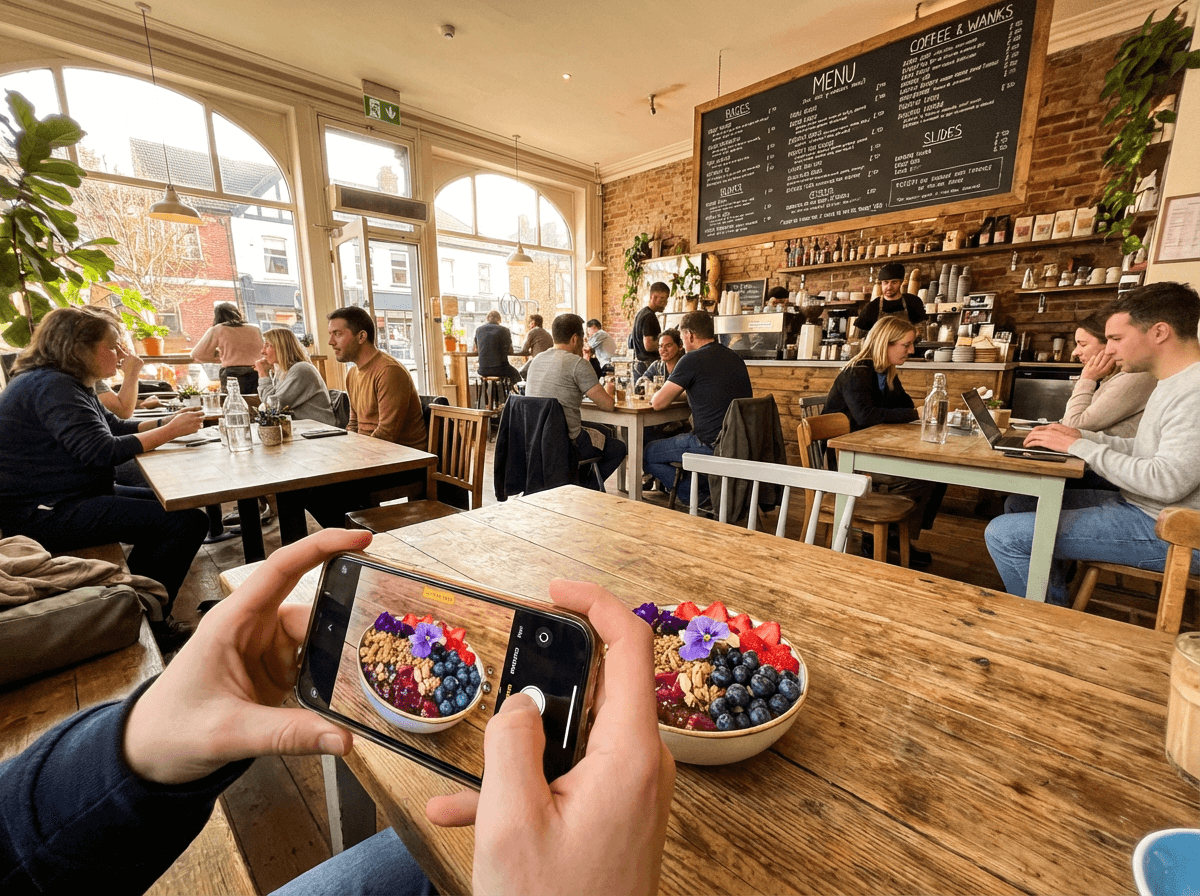 Cafe customer photographing an acai bowl on their phone creating user-generated restaurant content
Pillar 4: Customer Content and Social Proof
User-generated content (UGC) is the most trusted form of restaurant marketing on social media. When diners post photos of your food and tag you, that's free advertising with built-in social proof.
How to encourage more UGC for your restaurant:
- Create a branded hashtag and display it in your restaurant (table tents, wall signage, receipt footers)
- Repost customer photos to your feed (always ask permission and credit them)
- Run photo contests: "Tag us in your meal photo for a chance to win [prize]"
- Make your space and food "Instagrammable" — 86% of diners post about their meal if it looks good
Pillar 5: Seasonal, Events, and Community
Connect your restaurant to the rhythms of your local community: local events, holidays, seasonal menu launches, charity partnerships, and neighborhood happenings.
This content positions you as more than a restaurant — you're a community gathering place. It also gives you natural hooks for timely, relevant content instead of forcing generic posts.
Visual Content That Converts: Why Photo Quality Is Your #1 Lever
Let's talk about the elephant in the room of social media marketing for restaurants.
You can have the perfect posting schedule, the cleverest captions, and the most strategic hashtag game — but if your food photos look bad, none of it matters. This is the single most important principle in restaurant social media.
Here's the data that makes this crystal clear:
- 84% of users want to see food and drink photos on restaurant social media — making visual content the most in-demand content type by far
- 93% say visual appearance influences their purchasing decisions
- 40% of diners have tried a new restaurant specifically because of food photos they saw online
- Food photos boost engagement rates by up to 60% compared to non-visual posts
- 86% of diners will post about their meal if it looks good — generating free UGC for your brand
Meanwhile, Deloitte's research shows that restaurants with strong social media strategies see measurable revenue growth. And visual content is the engine that drives social media performance for restaurant brands.
The math is simple: better photos → higher engagement → more reach → more diners → more revenue.
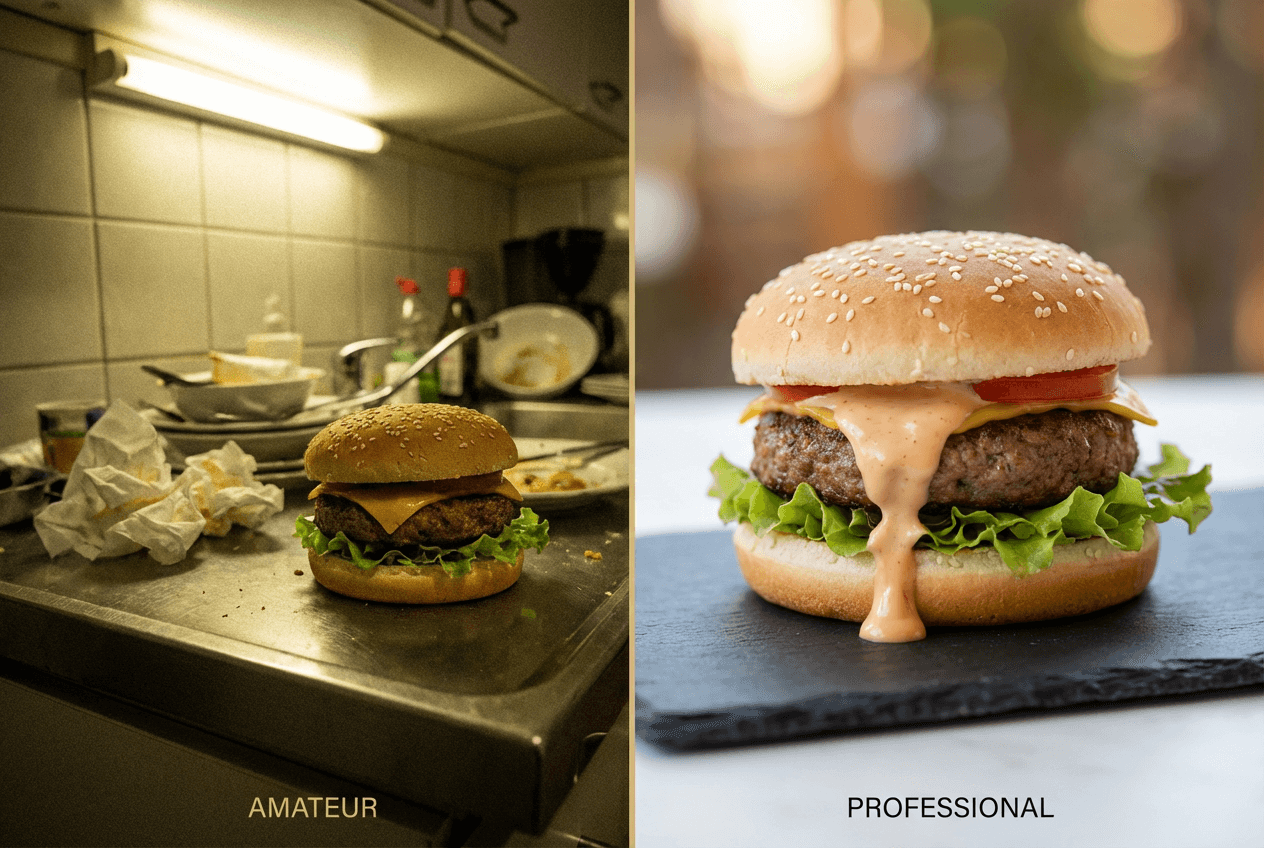 Side-by-side comparison showing amateur versus professional food photography quality for restaurant social media
What Professional-Quality Food Photos Actually Look Like
Professional food photography isn't about having a $5,000 camera. It's about three things:
-
Lighting: Soft, directional light that creates depth and makes colors pop. Natural window light is ideal. Harsh overhead fluorescents are the enemy of good food photos.
-
Composition: Clean backgrounds, intentional styling, proper angles. Overhead for flat dishes, 45-degree for dishes with height, eye-level for drinks and layered items.
-
Consistency: This is the real challenge for restaurants. One great photo doesn't build a brand — dozens of consistently great photos do. Your Instagram grid needs to feel cohesive.
The problem? Professional food photography costs anywhere from $500 to $1,400+ per session, and restaurants need fresh content every week. Most independent restaurants simply can't afford to hire a photographer that frequently.
This is exactly why AI-powered food photography has become a game-changer for restaurant social media marketing. With a tool like FoodShot AI, you snap a photo of your dish on your phone, choose a style (Instagram, Fine Dining, Restaurant, Delivery — over 30 presets), and get a professionally styled image in about 2 minutes. Starting at $15/month, it's a fraction of the cost of a single professional shoot.
The result? Consistent, high-quality visual content across every post, every platform, every week. No more quality rollercoaster. No more skipping posts because you "don't have a good photo." Just take the shot and transform it.
You can even upload a Pinterest reference image to clone the lighting, composition, and styling of any photo you admire — so your social media visuals match the aesthetic standard you're aiming for.
Common food photography mistakes that kill social engagement:
- Shooting under yellow or fluorescent lighting
- Cluttered backgrounds that distract from the dish
- Inconsistent editing styles across posts
- Low-resolution images that look blurry on mobile
- Using the overhead angle for every single dish (vary your angles)
When to Post: Optimal Times and Frequency for Restaurant Social Media
Timing matters, but not as much as you think. Consistency and content quality matter more than hitting an exact time window. That said, data from Sprout Social and Brandwatch gives us useful benchmarks for the food and beverage industry in 2026.
Instagram (food & beverage):
- Best times: Mondays 11 a.m.–1 p.m., Tuesdays–Wednesdays 11 a.m., Thursdays 11 a.m.–noon and 2 p.m.
- Best days: Monday and Thursday
- Avoid: Saturday (lowest engagement)
- Frequency: 2-3 quality feed posts per week, plus daily Stories
TikTok (restaurants):
- Best times: Monday through Thursday, 2–5 p.m.
- Frequency: 3-5 videos per week (TikTok rewards consistency and volume)
Facebook:
- Best times: Mid-week during lunch hours (11 a.m.–1 p.m.) and early evening (5–7 p.m.)
- Frequency: 3-5 posts per week (more than one per day can decrease reach)
The golden rule: It's better to post three excellent pieces of content per week than seven mediocre ones. Quality always beats quantity on social media in 2026, because algorithms prioritize engagement velocity — how quickly people interact with your post after it's published.
Match your posting schedule to your operational reality. If you're a one-person show, start with 3 Instagram posts and 2 TikTok videos per week. You can always scale up as your restaurant social media strategy matures.
Hashtag Strategy That Actually Gets Your Restaurant Discovered
Hashtags are free distribution for your restaurant's social media content. Used well, they put your posts in front of people who don't follow you yet. Used poorly, they look spammy and accomplish nothing.
Instagram hashtag strategy (the tiered approach):
Use 5-15 hashtags per post, mixing from these tiers:
| Tier | Type | Example | Posts | Purpose |
|---|---|---|---|---|
| 1 | Branded | #YourRestaurantName | Any | Build your own community |
| 2 | Location | #AustinEats #NYCfoodie | 100K-1M | Reach local diners |
| 3 | Community | #Foodie #FoodPhotography | 1M-10M | Broad food community |
| 4 | Niche | #HomemadePasta #VeganBrunch | 50K-500K | Targeted food lovers |
| 5 | Trending | #FoodTok #ChefLife | Varies | Ride momentum |
Sample hashtag sets by restaurant type:
Italian restaurant in Chicago: #ChicagoEats #ChicagoFoodie #ItalianFood #PastaLovers #HomemadePasta #ChicagoRestaurants #ItalianRestaurant #FoodieChicago #ChicagoDining #[YourName]
Casual brunch spot in Austin: #AustinBrunch #AustinFoodie #BrunchAustin #WeekendBrunch #BrunchGoals #AustinEats #ATXfood #BrunchVibes #[YourName]
TikTok hashtags: Use 3-5 per video. Focus on trending and community tags: #FoodTok #RestaurantLife #ChefLife plus one or two specific to your content. TikTok's algorithm relies less on hashtags than Instagram, so prioritize your video content quality over hashtag strategy.
Facebook hashtags: Keep it minimal — 1-3 at most. Facebook's algorithm doesn't heavily weight hashtags. Focus on your branded hashtag and one location tag.
Pro tip: Create your own branded hashtag and promote it everywhere — menu inserts, table tents, receipts, even your bathroom mirror. Make it easy to remember and spell. Something like #EatAt[YourName] or #[YourName]Kitchen.
Engagement Tactics: Turn Social Media Followers Into Restaurant Regulars
Posting is half the job. The other half is engaging — responding to comments, starting conversations, and building relationships that translate into repeat visits to your restaurant.
The data backs this up: 71% of customers who receive a quick social media response recommend that brand to others, and active social media engagement correlates with a 20% increase in customer retention.
The 15-minute daily engagement routine:
You don't need hours per day for social media management. Set a timer for 15 minutes and do this:
- Respond to every comment and DM from the last 24 hours (5 min)
- Like and comment on tagged posts from customers (3 min)
- Engage with 5-10 local accounts — food bloggers, neighboring businesses, community pages (5 min)
- Check your branded hashtag and reshare any great UGC (2 min)
Engagement tactics for restaurants that drive real results:
- Instagram Stories polls and questions: "What should our next special be?" or "Team chocolate cake or team cheesecake?" People love having their opinion counted
- Reply to comments with a question to keep the conversation going. Instead of "Thanks! 😊" try "Thanks! Have you tried our new truffle fries yet?"
- Pin your best customer comments to the top of your posts
- Go Live during busy service, a special event, or an off-menu tasting
- DM customers who tag you with a genuine thank-you — personal touches build fierce loyalty
Handling negative comments on social media: Respond publicly, calmly, and quickly. Acknowledge the issue, apologize if warranted, and invite them to continue the conversation privately. Never delete negative comments unless they're abusive — other customers are watching how you handle criticism, and a graceful response can actually build trust in your brand.
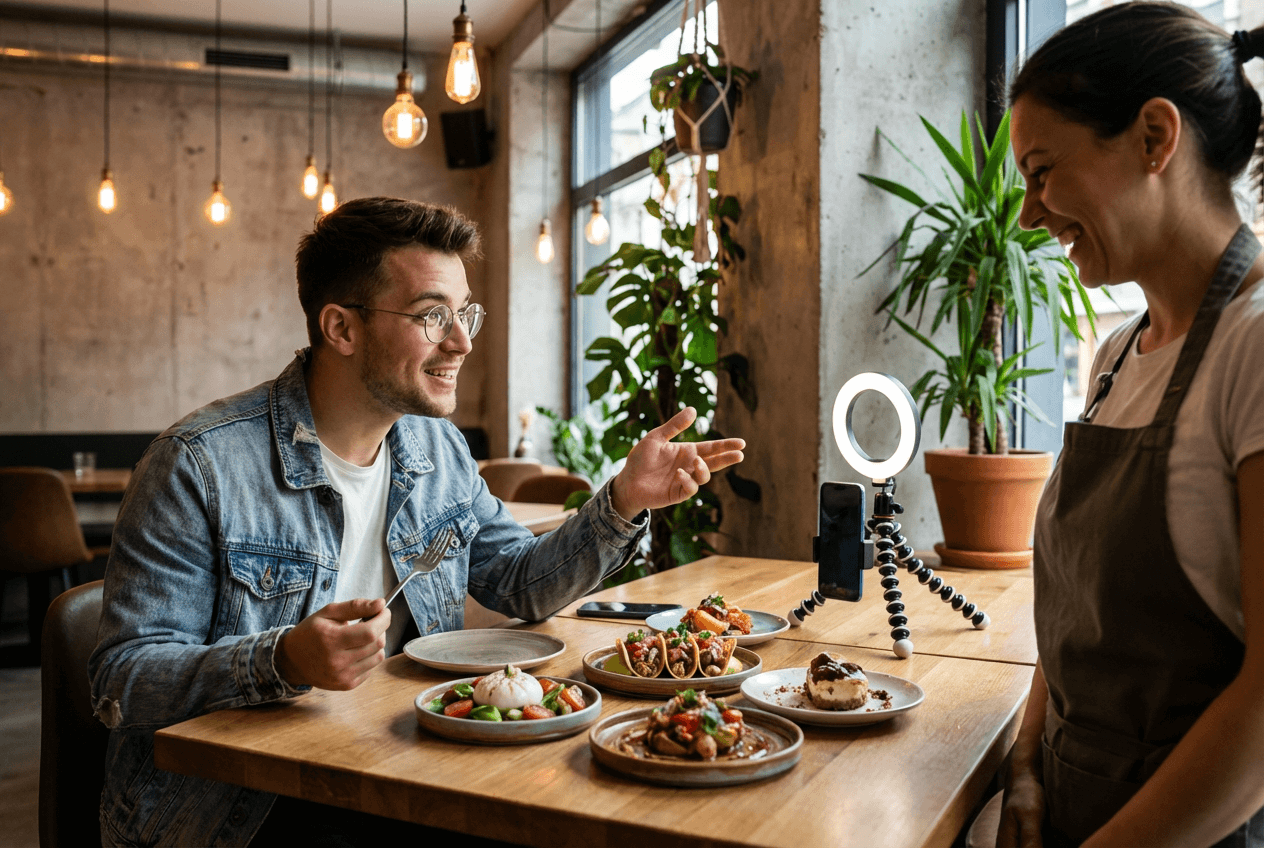 Food influencer meeting with restaurant owner over beautifully plated dishes for social media collaboration
Working With Food Influencers and Creators
Deloitte's research reveals a fascinating disconnect in restaurant social media marketing: brands rank creator partnerships as their lowest-priority tactic, yet 46% of respondents reported it as the second-highest return strategy, trailing only loyalty programs.
In other words, most restaurants are underutilizing the strategy that delivers some of the best results for their social media presence.
Here's why influencer marketing works for restaurants: 83% of consumers view the creators they follow as trusted sources of information. On average, people follow 13 creators compared to just 7 brands. And 1 in 3 consumers have discovered a new brand or restaurant through creator content in the past year.
Micro-influencers are your sweet spot.
For local restaurants, you don't need influencers with millions of followers. Micro-influencers (1,000-50,000 followers) typically deliver better ROI because:
- They have higher engagement rates (often 3-7% vs. under 2% for macro-influencers)
- Their audience is more local and targeted
- They're more affordable (often a comped meal is enough)
- Their recommendations feel more genuine and authentic
How to structure influencer partnerships for your restaurant:
| Tier | Follower Count | Typical Deal | What You Get |
|---|---|---|---|
| Nano | 1K-10K | Comped meal | 1-2 posts, authentic local reach |
| Micro | 10K-50K | Comped meal + $50-200 | 2-3 posts + Stories, solid engagement |
| Mid | 50K-200K | $200-1,000 | Dedicated content, wider reach |
| Macro | 200K+ | $1,000+ | Brand awareness, potential virality |
Finding the right influencers for your restaurant:
- Search local hashtags (#[YourCity]Foodie) and see who's creating great food content
- Check who's tagging restaurants similar to yours
- Look at engagement rates, not just follower counts — anything below 1.5% on Instagram is a red flag
- Review their content quality — do their food photos look good? Would you be proud to have their content associated with your restaurant brand?
- Ask for their audience demographics — you want local followers, not followers from across the country
Red flags to watch for:
- Follower-to-engagement ratio that doesn't add up (100K followers but 50 likes per post = likely bought followers)
- No captions or generic captions (low effort, low impact)
- Promotion of competing restaurants in every other post (your post gets lost in the noise)
Paid Social Media Advertising for Restaurants: Getting Started
Organic reach on social media has declined steadily, making paid advertising a necessary complement — not a replacement — for your organic restaurant social media strategy.
The good news: restaurant social media advertising can start small and still deliver measurable results.
Start here: Facebook and Instagram Ads
Facebook and Instagram share an ad platform (Meta Ads Manager), making it easy to run campaigns across both simultaneously.
Recommended starting budget: $5-10 per day ($150-300/month). This is enough to reach thousands of local diners and test what resonates before scaling up your ad spend.
Best ad types for restaurants on social media:
- Boosted Posts: Take your best-performing organic post and put money behind it. If a food photo already got strong engagement organically, it'll perform even better with ad spend
- Carousel Ads: Showcase multiple dishes in a single ad. Great for promoting a tasting menu or seasonal lineup
- Location-Based Ads: Target people within a specific radius of your restaurant (1-10 miles). The most efficient targeting for single-location restaurants
- Event Promotions: Boost your Facebook Events to reach people beyond your current followers
Targeting tips for restaurant ads:
- Radius targeting: Target a 3-5 mile radius around your location (adjust based on area density)
- Interest targeting: Food, cooking, dining out, specific cuisine types
- Lookalike audiences: Upload your email list and let Meta find similar people in your area
- Retargeting: Show ads to people who've visited your website or engaged with your social media — these warm leads are 3-5x more likely to convert
Track what matters:
- Cost per click (CPC) — aim for under $1 for local restaurant ads
- Reach and frequency — how many unique people saw your ad and how often
- Link clicks to your website, menu, or reservation page
- Ultimately: reservations, online orders, and foot traffic (ask new customers "how did you hear about us?")
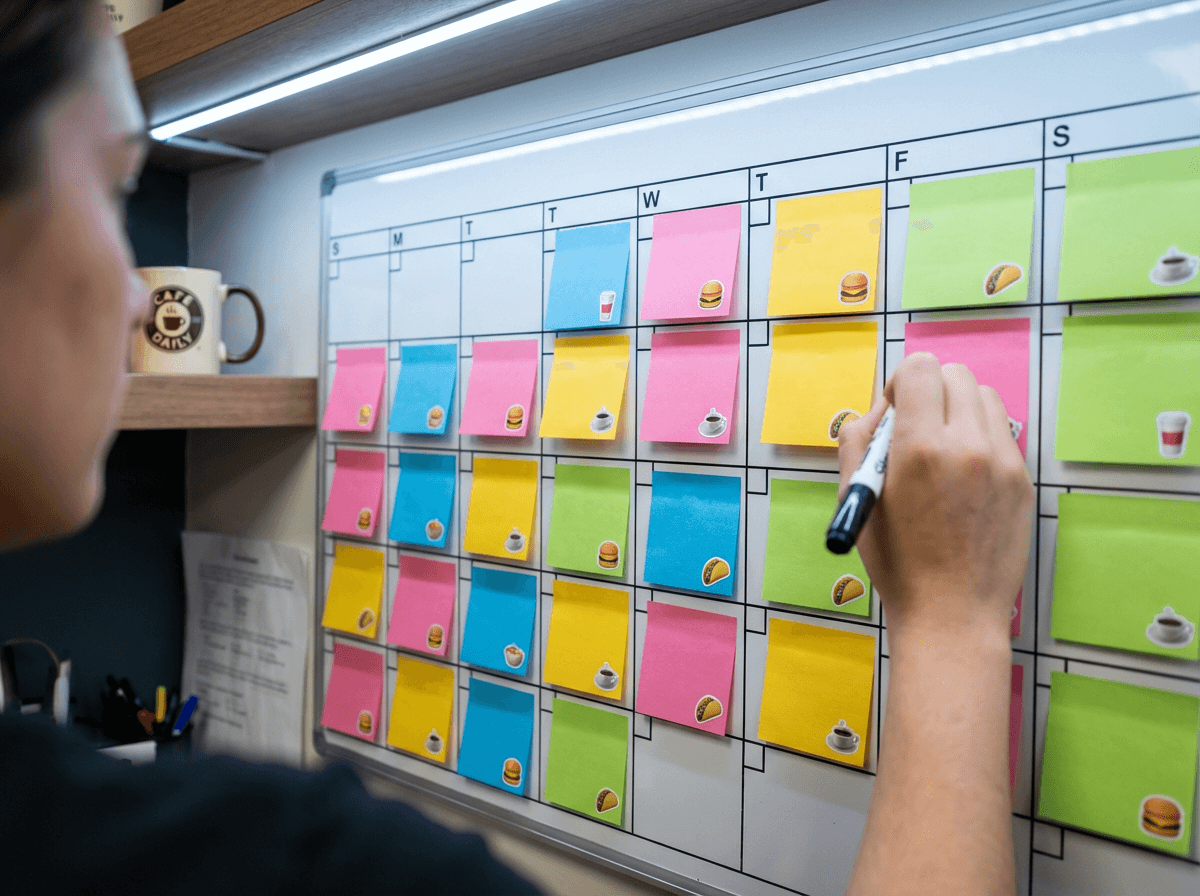 Restaurant owner planning monthly social media content calendar on whiteboard with color-coded platform notes
Your 30-Day Restaurant Social Media Content Calendar
Here's a ready-to-use content calendar for your first month of social media marketing. Adapt the specific content to your restaurant, but use this framework to maintain consistency and variety across platforms.
Week 1: Foundation
| Day | Platform | Content Type | Description |
|---|---|---|---|
| Mon | Food Photo | Signature dish, professionally styled. Strong first impression. | |
| Tue | TikTok | Behind-the-Scenes | Kitchen prep video for a popular dish (15-30 sec) |
| Wed | Community | Share a local event or neighborhood highlight | |
| Thu | Staff Spotlight | "Meet [Name]" with fun facts and their favorite dish | |
| Fri | TikTok | Trending | Participate in a current food trend with your own twist |
| Sat | Instagram Stories | Weekend Special | Today's special or behind-the-scenes of Saturday rush |
| Sun | Customer UGC | Repost a customer's photo with credit and a thank-you |
Week 2: Engagement
| Day | Platform | Content Type | Description |
|---|---|---|---|
| Mon | Carousel | "How [Signature Dish] Is Made" — step-by-step photos | |
| Tue | TikTok | Staff Feature | Bartender making a signature cocktail or barista doing latte art |
| Wed | Instagram Stories | Poll | "Which new menu item should we keep?" (two options) |
| Thu | Event Promo | Promote an upcoming event, theme night, or special | |
| Fri | Food Photo | Weekend-ready dish, styled for cravings (pair with a Reel) | |
| Sat | TikTok | Kitchen Energy | Saturday night service energy — fast cuts, action, teamwork |
| Sun | Instagram Stories | Q&A | "Ask the Chef" Q&A sticker |
Week 3: Growth
| Day | Platform | Content Type | Description |
|---|---|---|---|
| Mon | Reel | 15-sec plating video with trending audio | |
| Tue | Review Highlight | Share a glowing Google or Yelp review as a graphic | |
| Wed | TikTok | Process Video | How you make pasta from scratch, bake bread, etc. |
| Thu | Customer UGC | Repost and celebrate a customer's photo | |
| Fri | Instagram Stories | Countdown | Build excitement for weekend specials or events |
| Sat | TikTok | Fun/Personality | "Things only restaurant workers understand" or relatable content |
| Sun | Story/History | Share the story behind your restaurant, a menu item, or a tradition |
Week 4: Conversion
| Day | Platform | Content Type | Description |
|---|---|---|---|
| Mon | Food Photo | New menu item or seasonal special — drive visits | |
| Tue | TikTok | Before/After | Kitchen prep to final plate transformation |
| Wed | Paid Promo | Boost your best-performing post from the month | |
| Thu | Carousel | "5 Reasons to Visit This Weekend" or "Our Top 5 Dishes" | |
| Fri | All Platforms | Weekend CTA | Strong call to action for weekend dining with your best food photos |
| Sat | Instagram Stories | Live | Go live during service — show the energy and atmosphere |
| Sun | Monthly Recap | Best moments from the month (carousel or Reel) |
Daily habits (every day, 15 minutes):
- Respond to all comments and DMs
- Check tagged photos and reshare the best ones
- Engage with 5-10 local accounts
Want your food photos to look consistently professional across all these social media posts? Snap them with your phone, then run them through FoodShot AI's photo editor to get polished, menu-ready images in about 2 minutes. It's the fastest way to maintain visual consistency without booking a photographer every week. Compare traditional vs AI food photography to see the time and cost savings.
If you run a café, our 2-minute cafe menu refresh guide walks through exactly how this works in practice. And don't forget — the same polished food photos you create for social media can be optimized for your Uber Eats and DoorDash listings to boost delivery orders too.
 Restaurant bar at night with laptop showing social media analytics and engagement metrics alongside a craft cocktail
Measuring ROI: Proving Your Restaurant Social Media Marketing Works
"Social media doesn't work" usually means "I don't know how to measure if social media is working." Let's fix that.
The metrics that actually matter for restaurant social media:
| Metric | What It Tells You | Target Benchmark |
|---|---|---|
| Engagement Rate | How compelling your content is | 1-3% on Instagram, 1-2% on Facebook |
| Reach/Impressions | How many unique people see your brand | Should grow 5-10% monthly |
| Profile Visits | Interest level from your content | Track the trend, not absolute number |
| Website Clicks | Movement toward conversion | Key leading indicator of reservations |
| Follower Growth | Brand awareness trajectory | Steady growth > spikes |
| Saves and Shares | Content value perception | High saves = highly valuable content |
| DMs and Comments | Community health | More conversation = stronger loyalty |
Metrics that DON'T matter (as much):
- Vanity follower count without engagement
- Likes alone (saves and shares are more valuable signals)
- Reach on individual posts (look at trends, not single data points)
How to connect restaurant social media to actual revenue:
- UTM parameters: Add tracking codes to every link you share on social media so you can see exactly how many website visits, reservation clicks, and online orders come from each platform
- "How did you hear about us?" — Add this question to your reservation system, ask it at the host stand, or include it on online order forms
- Promo codes: Create social-media-exclusive discount codes (e.g., INSTA10) to track directly attributed revenue
- Monthly review: Compare social media activity levels against reservation counts and revenue — look for correlation patterns over 3-6 months
Monthly reporting (keep it simple):
Track these numbers on the first of each month:
- Total followers (per platform)
- Average engagement rate
- Total website clicks from social media
- Top 3 performing posts (and why they worked)
- Reservations/orders attributed to social
- What to try differently next month
The 9.9% average revenue increase that Deloitte reported didn't happen by accident — it came from restaurants that measure, learn, and iterate on their social media marketing strategy. Your approach should get smarter every month.
Frequently Asked Questions
How much should a restaurant spend on social media marketing?
Start with your time investment: 30-60 minutes per day for content creation and engagement. For paid advertising, $150-300 per month ($5-10/day) is a solid starting point for a single-location restaurant. For content creation tools, an AI food photo editor like FoodShot AI starts at $15/month — far less than a single professional photo shoot. Scale your budget based on results. Once you can prove ROI, reinvest.
How often should a restaurant post on social media?
Aim for 2-3 Instagram feed posts per week plus daily Stories, 3-5 TikTok videos per week, and 3-5 Facebook posts per week. But quality always trumps quantity in restaurant social media marketing. Two exceptional posts per week will outperform seven mediocre ones. Start with a manageable frequency and build as you find your rhythm.
What's the best social media platform for restaurants?
Instagram is the strongest all-around choice for restaurant social media marketing due to its visual nature and high engagement rates for food content. But the "best" platform depends on your target audience. If you're targeting a younger crowd, TikTok is essential. If your core customers are 35+, Facebook may drive more direct business. Most restaurants benefit from a primary focus on Instagram combined with one other platform.
Can a restaurant handle social media marketing without hiring a specialist?
Yes, especially with the right tools and a content calendar. Many successful restaurant social media accounts are managed by the owner or a team member who dedicates 30-60 minutes per day. The key is having systems: a content calendar for planning, a tool for consistent food photography, and a daily engagement routine. As you grow, consider bringing in help — but start by doing it yourself so you understand what works for your restaurant brand.
How do I get more user-generated content for my restaurant?
Make it easy and rewarding. Display your branded hashtag prominently in your restaurant — table tents, wall art, receipt footers, even bathroom mirrors. Create "Instagrammable" moments: a photogenic wall, unique plating, dramatic presentations. Repost customer content to your feed (with credit) — when people see their photos featured on your restaurant's social media, they're more likely to tag you again. Consider running monthly photo contests where the best tagged photo wins a free dessert or appetizer.