12 Cafe Menu Board Layouts That Sell More Coffee
 Ali Tanis16 min read
A cafe menu board has one job: get a guest from "what's good here?" to a spoken order before they reach the till. In that wait they find a drink, pick a cup, choose a milk and maybe notice the almond croissant. Every second spent hunting adds a second to the line behind them.
Search for cafe menu boards and you'll find shops selling wooden rails, magnetic letters and chalkboard panels. They sell the board. None of them shows what goes where. So this page draws the design: 12 layouts, each mapped as zones (drinks, cups, add-ons, food, specials), with the counter it suits and the one rule it gets right.
Each works on a chalkboard, a letter board or a screen, and each gets one photo at most: a hero drink or pastry, shot at your own counter. If you still need those shots, our cafe menu photos page shows how FoodShot turns a phone photo of your own latte into a studio-quality image in about 2 minutes.
Quick Summary: The best cafe menu board layout follows the order a guest decides: drink, cup size, milk and extras, then food. Align prices in columns without dollar signs, show add-on prices once, make the middle cup the easy pick, and give each panel one photo of the drink you most want to sell.
Four things to settle before you pick a cafe menu board layout
Count your drinks and your cups, measure how far the back of the line stands from the wall, and decide whether guests order at a cart or at a counter where they linger. Those answers rule out most layouts before taste enters the room.
- Drink count. Under 10 drinks fits one panel. Between 10 and 25 wants two or three. Past 25, split hot from iced or move the long tail to a counter card.
- Cups. One cup per drink means no grid at all. Three cups for most drinks means a grid with one header row.
- Reading distance. The signage rule of thumb is about one inch of letter height per 10 feet, so a line that ends 20 feet back needs 2-inch letters. Our menu board ideas by material and cost post covers that rule and what each surface costs.
- Cart or sit-down. A cart guest reads from three to five metres and orders in one breath. A sit-down guest will read a second panel for food.
The material is a separate choice. A black chalkboard, a wooden letter board with letters on rails, a printed lightbox menu display and a screen can each carry any cafe menu board layout below. Custom wooden boards are often made to order, so allow for shipping time before an opening. What to sell is covered in our cafe menu ideas post.
In cafe menu board design, layout comes first and decoration second. A hand-lettered header won't rescue a board whose prices don't line up.
How to read the diagrams: each table is the board itself. Columns are panels from left to right, rows are bands from top to bottom, and ★ marks the one photo. Prices are examples in USD, written the way we recommend: no dollar sign.
12 cafe menu board layouts, drawn zone by zone
Each layout lists its zones, the counter it suits and the one rule that makes it sell. Pick the one that matches your four answers and copy its zone order onto the board you own.
1. The three-panel bar
| Espresso + milk drinks | ★ House drink photo | Brewed, tea, iced |
|---|---|---|
| cups 8, 12, 16 oz | signature drink 5.75 | cups 12, 16 oz |
| add-ons: oat 0.80, shot 1.00 | pastry of the day | cold brew 4.75 |
When it works: the classic wall above a 3 to 4 metre bar, 15 to 25 drinks, a mix of takeaway and sit-down trade.
The rule it gets right: the centre panel usually hangs over the register and faces the guest as they order, so that's where the only photo goes. Use it for your house drink, not a latte every cafe on the street sells.
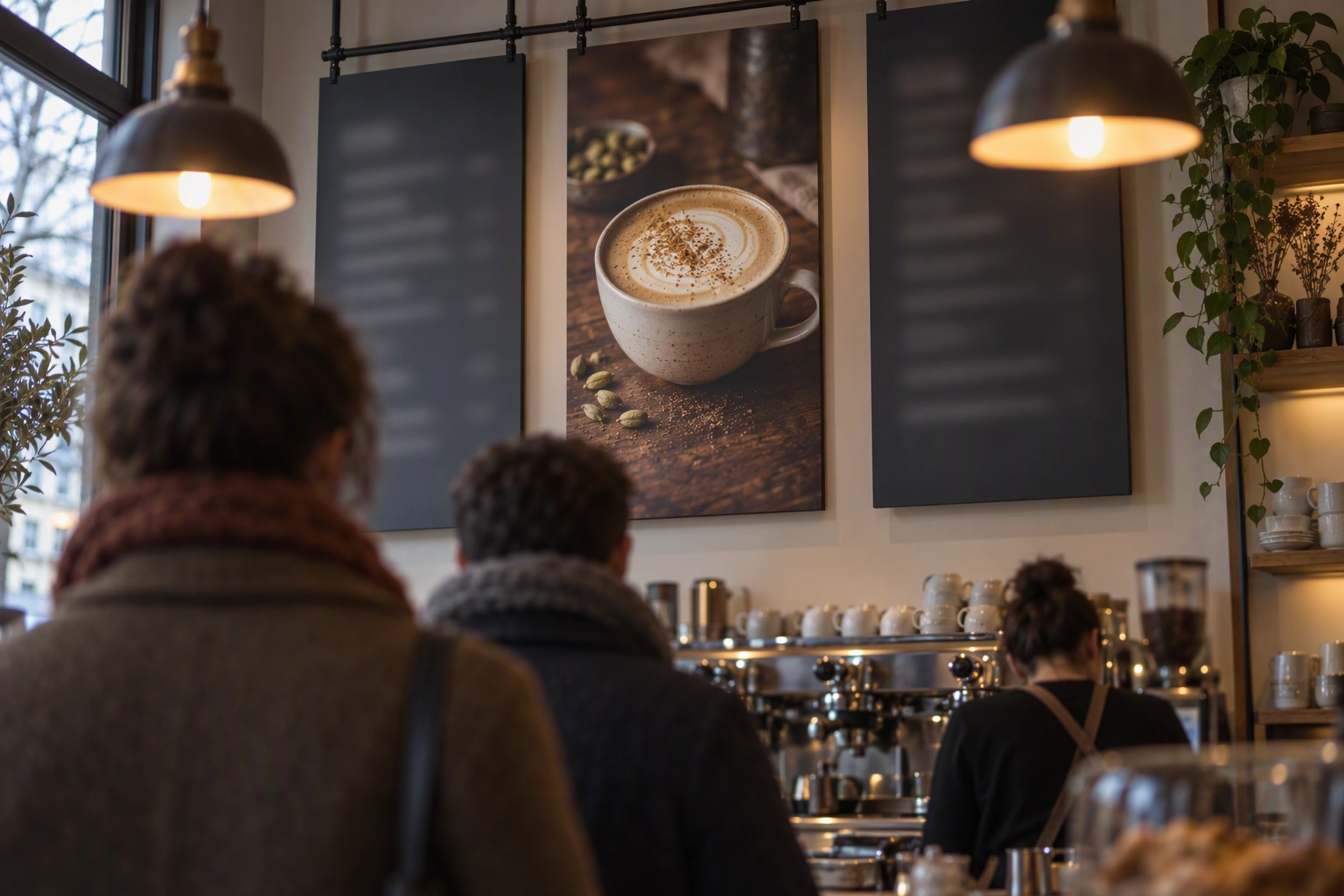 Three-panel cafe menu board over an espresso bar, the centre panel a single large latte photo, seen from the queue
2. The cup-column grid
| Drink | 8 oz | 12 oz | 16 oz |
|---|---|---|---|
| Latte | 4.25 | 4.95 | 5.45 |
| Mocha | 4.75 | 5.45 | 5.95 |
| Chai | 4.25 | 4.95 | 5.45 |
When it works: most drinks come in three cups and the line is long enough that people read while they wait.
The rule it gets right: price alignment. Cups are named once, in the header, and prices are set in straight columns, so a guest compares without reading a label twice. Drop the dollar sign too. In a 2009 Cornell study of 201 diners at a restaurant run by the Culinary Institute of America, guests given numeral-only prices spent significantly more than those shown "$" or prices spelled out. The authors point to the "pain of paying" a currency symbol triggers.
Photo slot: none. A grid is a reference table, and a photo inside it breaks the columns.
3. The decoy size ladder
| Small 8 oz | ★ Medium 12 oz | Large 16 oz |
|---|---|---|
| 4.50 | 4.95 | 5.95 |
| only 0.45 less | the house pour | for long mornings |
When it works: three-cup menus, best on milk drinks. If the 8 and 12 oz get the same double shot, the step up costs you 4 oz of whole milk, roughly 13 cents at about $4 a gallon, against a 0.45 price step.
The rule it gets right: always show three cups. Itamar Simonson's 1989 paper on the compromise effect found an option gains share when it becomes the middle choice, so a 12 oz flanked by an 8 and a 16 is easier to pick than a 12 oz next to a lone 16. The small sits close in price so the medium looks like the better deal. Starbucks plays a version of this: its 8 oz short is still poured but left off the menu board, as Tim Harford explained in Slate in 2006, so the smallest cup a guest sees is the 12 oz tall. Our menu pricing formulas run the numbers on a latte.
Photo slot: the medium cup, in a hand or beside a pastry so its scale reads.
4. The one-cup specialty board
| Espresso, cortado, flat white, latte, filter, seasonal | ★ Seasonal drink photo |
|---|---|
| one cup each, one price each | milk: whole, oat 0.80 |
When it works: a specialty bar with 6 to 10 drinks, a counter under 2.5 metres, and guests who already know what a cortado is. White letters on a black letter board suit it well.
The rule it gets right: one cup per drink. No grid, no decision about ounces. The board reads at a glance and the barista hears the order in one sentence.
Photo slot: half the panel, given to the seasonal drink. It's the only item a regular doesn't already know.
5. The hot and iced split
| Hot | Iced |
|---|---|
| espresso drinks, 8 / 12 oz | cold brew, iced latte, 16 / 20 oz |
| tea, hot chocolate | espresso tonic, iced tea |
| add-ons, shown once | ★ iced drink photo |
When it works: iced drinks carry a big share of your summer sales, or you have two panels side by side. The demand is growing: in the National Coffee Association's Spring 2026 data, cold brew was up 31% since 2025, reaching 18% past-week consumption.
The rule it gets right: iced drinks get their own cups and their own prices. A "+0.50 iced" footnote makes every guest do arithmetic at the till.
Photo slot: one iced drink with condensation on the glass. The hot panel can go without; steam rarely photographs.
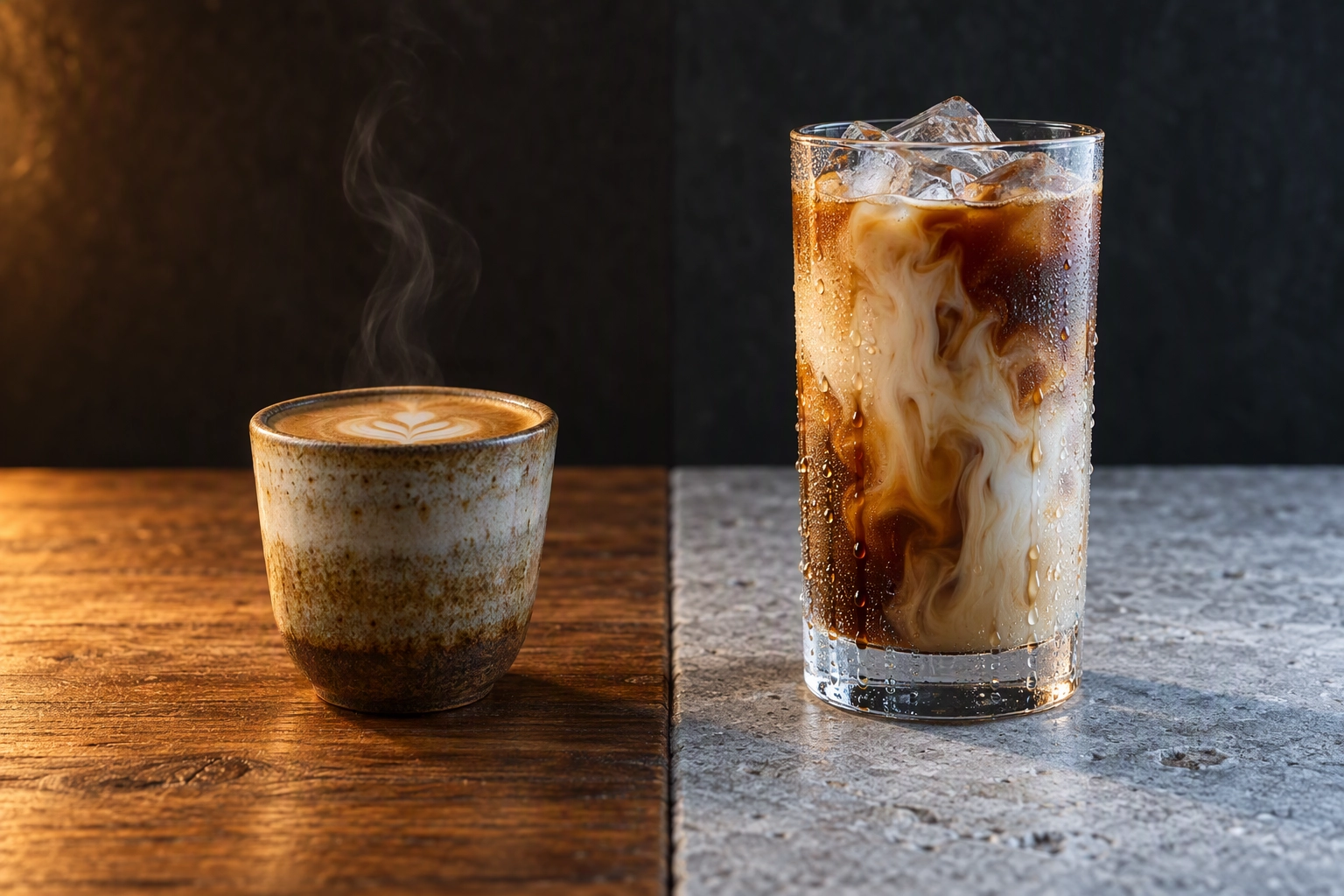 Iced latte with condensation beside a hot cortado on split stone and oak, the hot and iced split of a cafe menu board
6. The build-your-drink steps
| 1. Base | 2. Cup | 3. Milk | 4. Extras |
|---|---|---|---|
| latte, chai, matcha, mocha | 12 / 16 oz | whole, oat 0.80, almond 0.80 | vanilla 0.60, extra shot 1.00 |
When it works: menus driven by modifiers: matcha and chai bars, boba shops, cafes where most orders carry two extras or more.
The rule it gets right: add-on prices appear once, in one zone. Repeating "oat +0.80" beside twelve drinks fills a third of the board with the same line. On a letter board, it also means the extras row is the only one you touch when oat milk costs more.
Photo slot: one finished drink after step 4, the payoff of the build.
7. The daypart swap panel
| Drinks (fixed all day) | Food (swaps at 11:00) |
|---|---|
| espresso, brewed, iced | morning: croissant, banana bread ★ |
| add-ons | lunch: toastie, soup ★ |
When it works: a cafe business with a real food program and two distinct rushes. A reversible hanging menu display or a single screen handles the swap.
The rule it gets right: only the food panel changes. Drinks stay where regulars' eyes already go, so the morning crowd never has to re-read the board.
Photo slot: one per daypart, the morning pastry and then the lunch toastie.
8. The pastry pairing strip
| Espresso | Milk drinks | Brewed + iced |
|---|---|---|
| 3 drinks | 5 drinks | 4 drinks |
| Pair it: | ★ any latte + almond croissant | 8.50, save 0.75 |
When it works: a bakery-cafe, or any counter where the pastry display sits beside the till.
The rule it gets right: the bundle sits at the end of the reading path, in the bottom band nearest the register, so it's the last thing read before the order.
Photo slot: the pairing itself, cup and pastry in one frame. It's the only photo on the board.
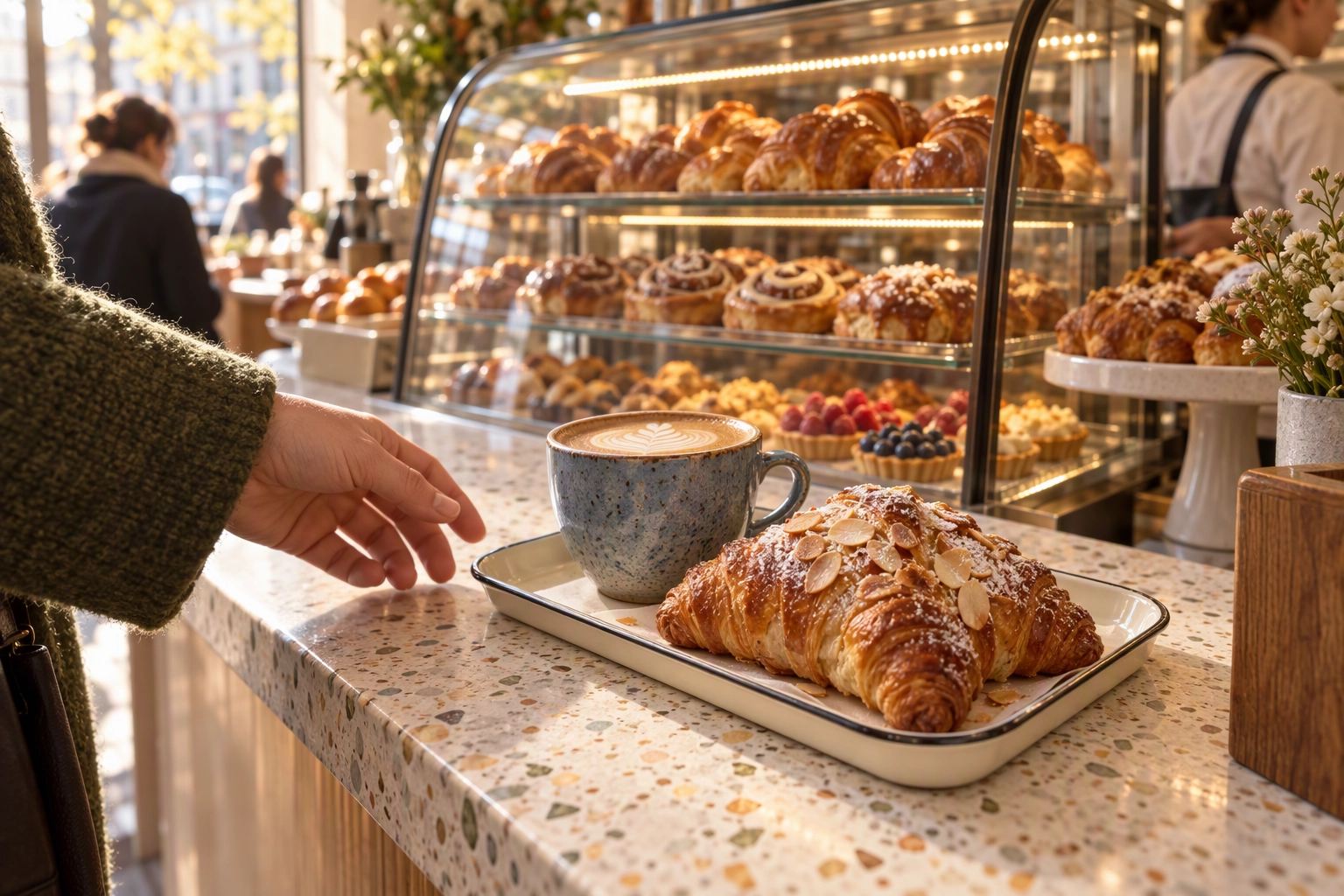 Latte and almond croissant pairing on a tray at the till of a bakery-cafe, the bundle a cafe menu board shows last
9. The coffee cart single panel
| ★ House iced latte photo |
|---|
| espresso 3, americano 3.50, latte 4.50, iced latte 5, chai 4.50, cold brew 4.50 |
| one cup, oat 0.75, card or phone pay |
When it works: carts, kiosks, market stalls and event bars.
The rule it gets right: one panel, one cup, eight drinks at most. If the menu doesn't fit on a single 24 × 36 inch A-frame or wooden panel, it doesn't belong on the cart.
Photo slot: the top third, because a passer-by sees the photo before reading a word. Our page on drink photos for coffee carts shows how cart owners get that hero shot between orders.
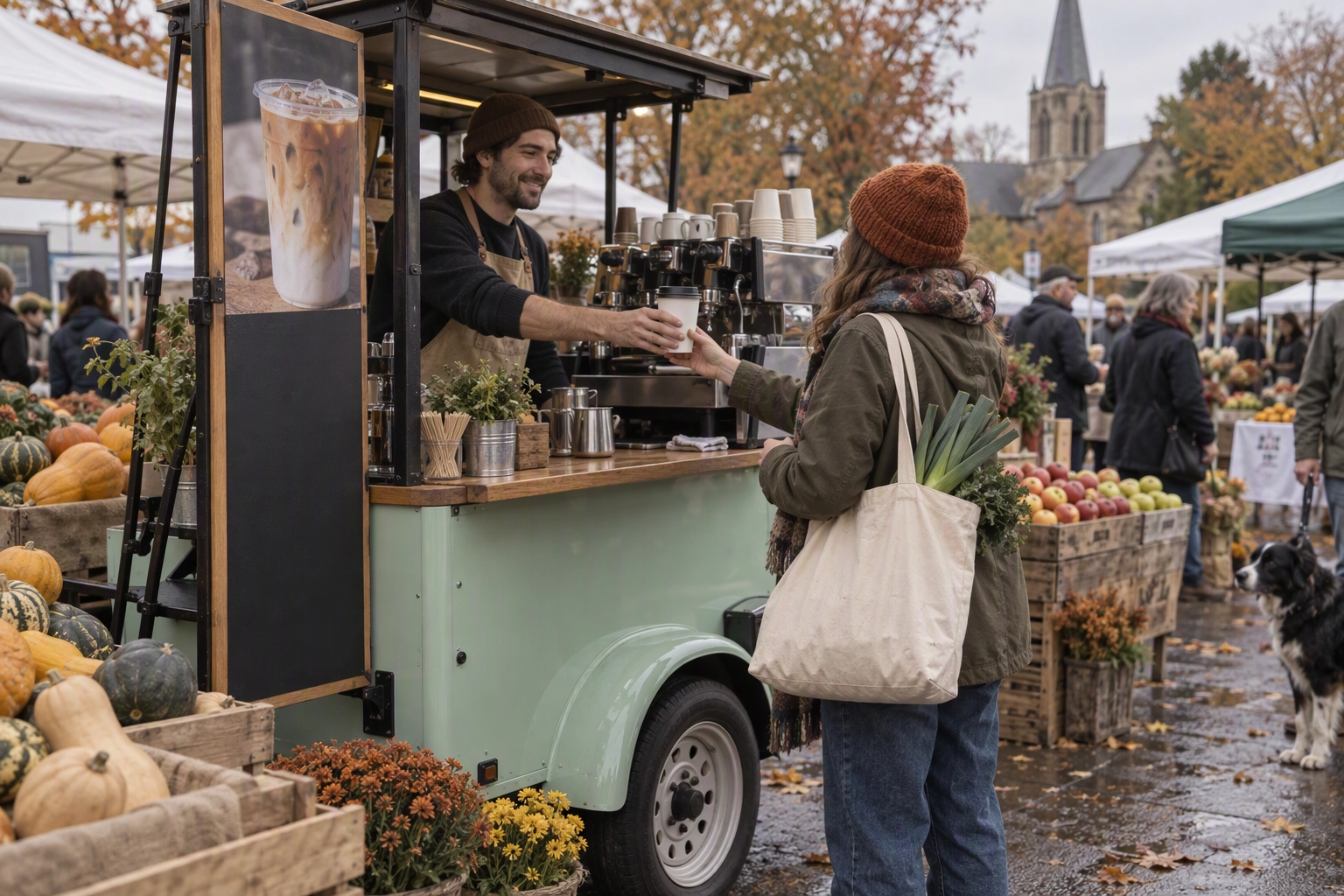 Espresso cart at a farmers market with one portrait menu panel topped by an iced latte photo, a coffee cart menu board
10. The portrait queue board
| Top to bottom |
|---|
| 1. today's special ★ (read from the door) |
| 2. espresso + milk drinks |
| 3. brewed, tea, iced |
| 4. milk + extras |
| 5. food (read at the till) |
When it works: long, narrow shops where the line runs toward the counter, with a tall chalkboard or rail-hung panels above it.
The rule it gets right: reading order equals decision order. A 2012 eye-tracking study by Sybil Yang found diners read restaurant menus in sequence, like a book, with no "sweet spot." So stack the zones in the order guests decide: special, drink, cup, extras, food.
Photo slot: the special at the top, large enough to read from the door.
11. The rotating origin board
| Espresso | Pour-over | This week's beans (cards) |
|---|---|---|
| house blend, decaf | V60, batch brew | Ethiopia: peach, jasmine, 5.50 |
| all milk drinks | Chemex for two | Colombia: cocoa, red apple, 5 |
When it works: roaster cafes and specialty bars where the beans change every few weeks.
The rule it gets right: the fixed menu stays fixed and only the origin cards rotate, clipped to a black steel rail. Each card carries origin, two or three tasting notes and one price, so changing a coffee means swapping a card, not rewriting a wall. Retail products like bags of beans go on a shelf, not the board.
Photo slot: the pour, not the beans. A V60 mid-bloom says "filter" faster than any label.
12. The three-screen counter
| Screen 1 (still) | Screen 2 (still) | Screen 3 (photo loop) ★ |
|---|---|---|
| espresso + milk drinks, cup columns | brewed, tea, iced, food | 3 or 4 hero photos, 8 sec each |
When it works: busy shops with two or more registers that already run screens. Our digital menu boards guide covers the hardware.
The rule it gets right: only one screen moves. Prices never animate: a price that slides away mid-read sends the guest back to the start. The motion screen sells; the still screens carry the text.
Photo slot: three or four drinks and pastries on rotation, the one place where more than one photo earns its space.
Which cafe menu board layout fits your counter?
Find your cafe in the left column; the best cafe menu board layout for it is in the third. The backup is the layout to try when the first feels cramped.
| Your cafe | Drinks | Best layout | Backup |
|---|---|---|---|
| Cart, kiosk or market stall | up to 8 | 9, cart single panel | 4, one-cup board |
| Specialty bar, small counter | 6–10 | 4, one-cup board | 11, origin board |
| Neighbourhood cafe, 3–4 m bar | 15–25 | 1, three-panel bar | 2, cup-column grid |
| Long, narrow shop with a queue | 15–25 | 10, portrait queue | 3, decoy ladder |
| Bakery-cafe with all-day food | 15–25 + food | 7, daypart swap | 8, pairing strip |
| Matcha, chai or boba bar | 10–20 + extras | 6, build-your-drink | 5, hot and iced |
| Multi-register, high volume | 25+ | 12, three-screen counter | 5, hot and iced |
Where photos help on a cafe menu board (and where they hurt)
A cafe menu board should carry one photo per panel, of the drink or pastry you most want ordered, and none inside a price grid. A photo beside every item turns the board into a catalogue where nothing stands out. On most cafe menu boards the problem is too many photos, not too few.
The strongest evidence for photos comes from screens. DoorDash reports that merchants who reach 50% photo coverage on their menus can see sales rise 13% on average, based on its 2023–2025 data. A wall has less room than an app, so choose three or four items:
- the signature or seasonal drink, which carries your best margin and nobody else sells;
- the pastry that pairs with it, for layout 8;
- one iced drink in summer, for layout 5.
Use photos of your own drinks, not stock. A guest who orders the latte in the photo and gets a different cup notices. Shoot each one on the counter by a window with your phone, then let FoodShot turn it into a studio-quality image in about 2 minutes, at 2K (2048 px). At 150 dpi that prints about 13.6 inches wide, plenty for a hero slot read from across the room, and the 2× upscale in the studio covers a bigger print. Builder Mode lets you pick the surface and the cup, and My Styles matches every new drink to one photo you already like, so the whole board looks like a single shoot.
The same files then go on the counter screen and your delivery app listing. A 12-drink board needs three or four photos, so the Starter plan's 25 photos for $15 a month covers the board with room for the delivery menu. Free-plan images are watermarked and for personal use only. FoodShot makes the photos, not the board: the layout, lettering and printing stay with you or your print shop. For shooting by hand, see our coffee photography guide.
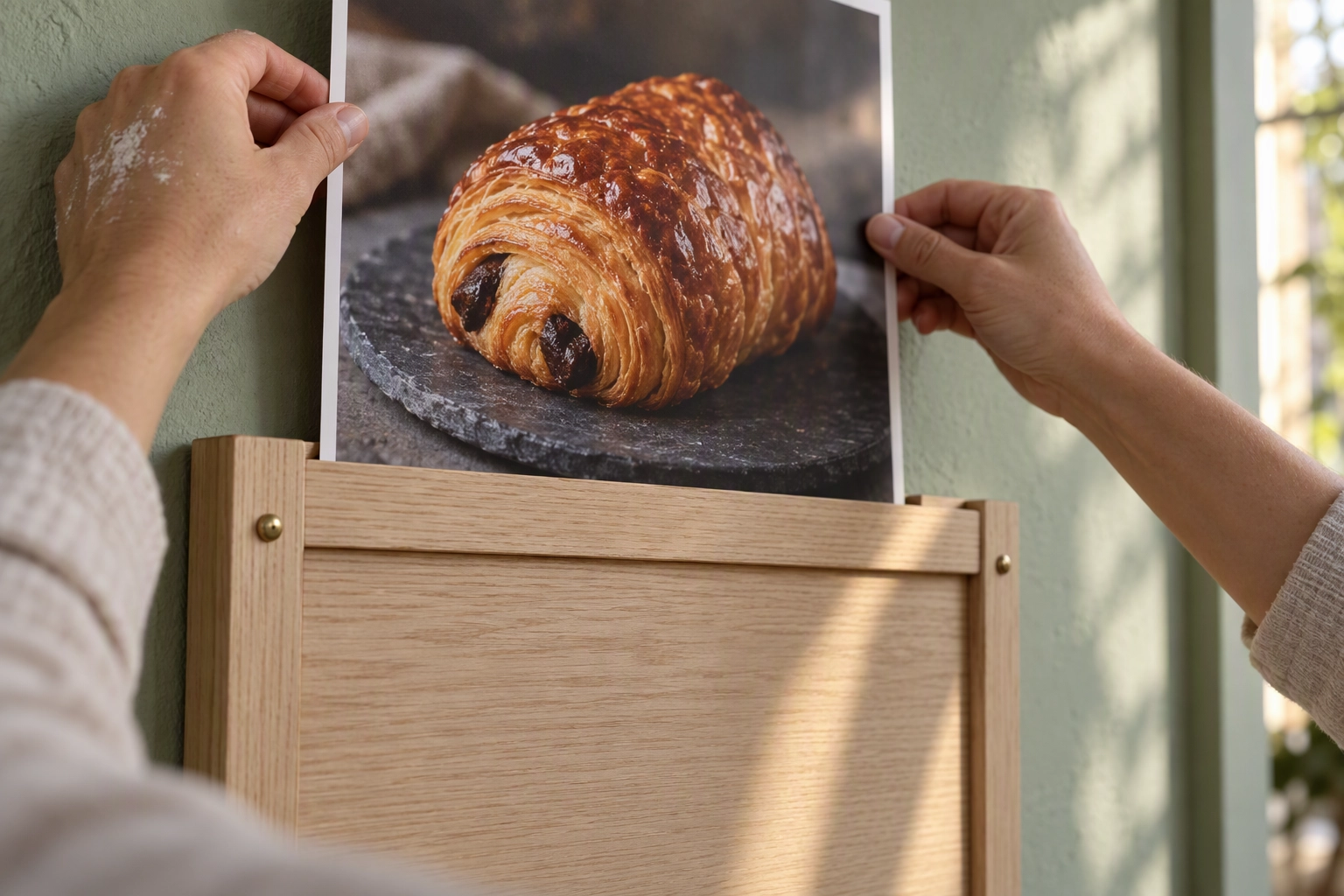 Hands sliding a printed pastry photo into a wooden cafe menu board frame, one hero photo per menu board panel
Frequently Asked Questions
How many items should a cafe menu board have?
Keep each panel to about 12 to 15 lines and split anything longer across a second panel, either hot and iced or drinks and food. A specialty bar can stop at eight drinks. A restaurant menu is read seated; a cafe board is read standing in line.
Should a coffee shop menu board show dollar signs?
No. Cornell's 2009 test found guests spent more when menus showed bare numerals (4.50) than when they showed $4.50 or spelled-out prices. Keep decimals consistent.
Do I have to put calories on my cafe menu board?
Only if you're part of a restaurant chain with 20 or more locations operating under the same name. The FDA's menu labeling rule then requires calories next to each standard item, plus the statement "2,000 calories a day is used for general nutrition advice, but calorie needs vary." Single cafes and small groups are not covered.
Chalkboard, letter board or screen: which cafe menu board is best?
Match the board to how often your menu changes. A chalkboard suits a seasonal menu you redraw monthly. A wooden or felt letter board suits a settled menu with a weekly special. Digital displays suit a menu that changes by daypart. All 12 layouts work on all three kinds of menu boards, and our restaurant menu board design guide covers type and contrast.
Should every drink on the cafe menu board have a photo?
No. One photo per panel, of the item you most want sold. A photo beside every drink competes with itself.