22 Menu Board Ideas: $15 Chalk to $8,000 Drive-Thru
 Ali Tanis21 min read
Every page ranking for menu board ideas is selling you something. Sign makers show you their rails. Signage vendors show you their screens. Nobody tells you what a board costs to buy, or the far more expensive number: what it costs to change on a Tuesday when a supplier raises your oat milk price.
So this list does both. Twenty-two menu board ideas, grouped by venue and by medium, and each one gets an honest 2026 price, an honest update effort, and a straight answer on who it suits. The cheapest idea here runs $15. The most expensive runs $8,000 per screen. Several of the best ones sit under $400.
Quick Summary: The 22 menu board ideas below span chalk walls ($15–200), felt and magnetic letter boards ($240–450), printed panels ($400–1,200 a bay), indoor screens ($390–2,500 plus $5–299 a month for software) and sealed drive-thru displays ($3,000–8,000). Pick by how often your menu changes, not by how the board looks in a photo. And whatever medium you choose, photograph two or three high-margin items — photographed lines outsell text-only lines everywhere the effect has been measured.
What separates a board that sells from one that just lists
Three constraints decide whether a board works, and they apply to every idea on this list.
Legibility comes first. The working rule of thumb in signage is roughly one inch of cap height per ten feet of viewing distance. If the back of your queue stands 25 feet out, your item names want about 2.5 inches of cap height, and your prices want the same. Most boards that "feel cluttered" are simply set too small for the room. For example, a $20 clamp lamp aimed at a dim chalk wall buys more legibility than another six inches of width. This is where most modern minimalist designs quietly fail: thin, elegant type at 1.5 inches look beautiful in a photo and unreadable from the door.
Contrast is a number, not a taste. The W3C's contrast guidance asks for 4.5:1 for normal text and 3:1 for large text. It was written for screens, but it is a sane floor for a wall too. Cream type on pale oak fails it. White on charcoal passes easily.
Calories may be mandatory. Under the FDA's menu labeling requirements — codified at 21 CFR 101.11 — chains of 20 or more locations trading under one name must declare calories on menu boards, next to the item name, in a type size no smaller than the name or price, plus the 2,000-calorie statement. That is a layout constraint, and it kills several designs that look great at 19 locations. Single sites and small groups are exempt.
One more thing worth knowing: the ADA's 2010 Standards for Accessible Design govern permanent room and space signs, not menu boards. But a menu that exists only on a wall is unreadable to a guest who cannot see it, so keep a large-print or online copy within reach at the counter.
For the full method — hierarchy, eye path, how to lay out sections — we already published a restaurant menu board design guide, and the same logic applied to printed menus lives in how to design a restaurant menu. This page is the gallery.
Menu board ideas by medium: the cost and update table
Before the venue-by-venue list, here is the whole field on one table. Find the row whose update effort matches how often your prices actually move, then pick ideas from that medium.
| Medium | Buy-in cost | Cost to change a price | Realistic update time | Suits |
|---|---|---|---|---|
| Chalk wall or mirror | $15–200 | $0 | 10–40 min, in house | Independents with a seasonal, short list |
| Felt or tile character board | $240–450 | $0 | 10 sec to 25 min | Cafes and coffee shops with a settled core menu |
| Printed panel or lightbox | $400–1,200 a bay | $40–150 a panel | 2–5 days at a print shop | A menu you expect to keep for a year |
| Single indoor screen | $540–1,400 + $5–20/mo | $0 | Seconds, remotely | Daily specials, one or two registers |
| Multi-screen counter wall | $1,600–5,000 + $15–60/mo | $0 | Seconds, remotely | Multi-daypart quick service and drive-thru brands |
| Sealed outdoor lane display | $3,000–8,000 a screen | $0 | Seconds, remotely | Lanes carrying the majority of sales |
The medium sets what you pay. The content you put on it sets your average ticket, and the two are independent choices. Two patterns fall out of that table. First, the cheap mediums are cheap to buy and free to change — they cost you time, not money. Second, screens are not expensive because of the screen; they are expensive because of the enclosure, the media player and the subscription. Everything below is an application of one of those six rows.
One thing that is not on it: pavement signs. A-frame chalk signs run $60–250 and belong to the street, not the queue. They stop a passer-by with one line and one price, out on the pavement; a menu board serves someone who has already walked in. Confusing the two is why so many pavement signs carry a full menu nobody stops to read. And a delivery-only kitchen has none at all — for a ghost kitchen the app listing is the menu board, which is a different design problem entirely.
Quick-service counter menu board ideas
Speed of ordering is the whole job here. Fewer lines, bigger type, one obvious upsell. These four work in any quick-service restaurant, from a sandwich shop to a pizzeria.
1. The three-panel backlit lightbox
The format behind almost every fast-casual counter: translucent printed panels dropped into an edge-lit aluminium frame. It glows, it is legible from the door, and it never looks improvised. The trap is that changing a price means a new panel.
Cost: $400–1,200 per bay · Update: reprint at $40–150 per panel, 2–5 days · Best for: a settled menu you expect to keep for a year
2. One portrait screen per register
Instead of one wide landscape display spanning the wall, give each till its own vertical panel showing only the items that queue needs. Ordering gets faster because nobody scans sideways. A 43–55 inch commercial panel runs roughly $390–1,000, plus a media player at $150–400. Our digital menu boards guide covers the hardware in depth.
Cost: 540–1,400 USD per screen · Update: seconds, remotely · Best for: two or more registers and a menu that shifts weekly
3. The hero-photo hybrid panel
Keep the text on a printed panel, and give one third of the bay to a single large photograph of the item you most want sold. Not five photos — one. A photo menu that shows everything reads as a catalogue; a display that shows one dish reads as a recommendation.
Cost: 450–900 USD · Update: swap the photo panel alone, 60–120 USD · Best for: anywhere with a genuine signature item
4. Rail-and-tile board with swappable price strips
Item names live on fixed tiles. Prices live on short strips that slide out. When costs move you replace nine strips, not the whole face. It is the single most underrated idea on this page for anyone whose margins are being squeezed. Pair it with tighter menu descriptions and you can carry more items in the same space.
Cost: 300–650 USD · Update: 30 seconds per price · Best for: operators repricing more than twice a year
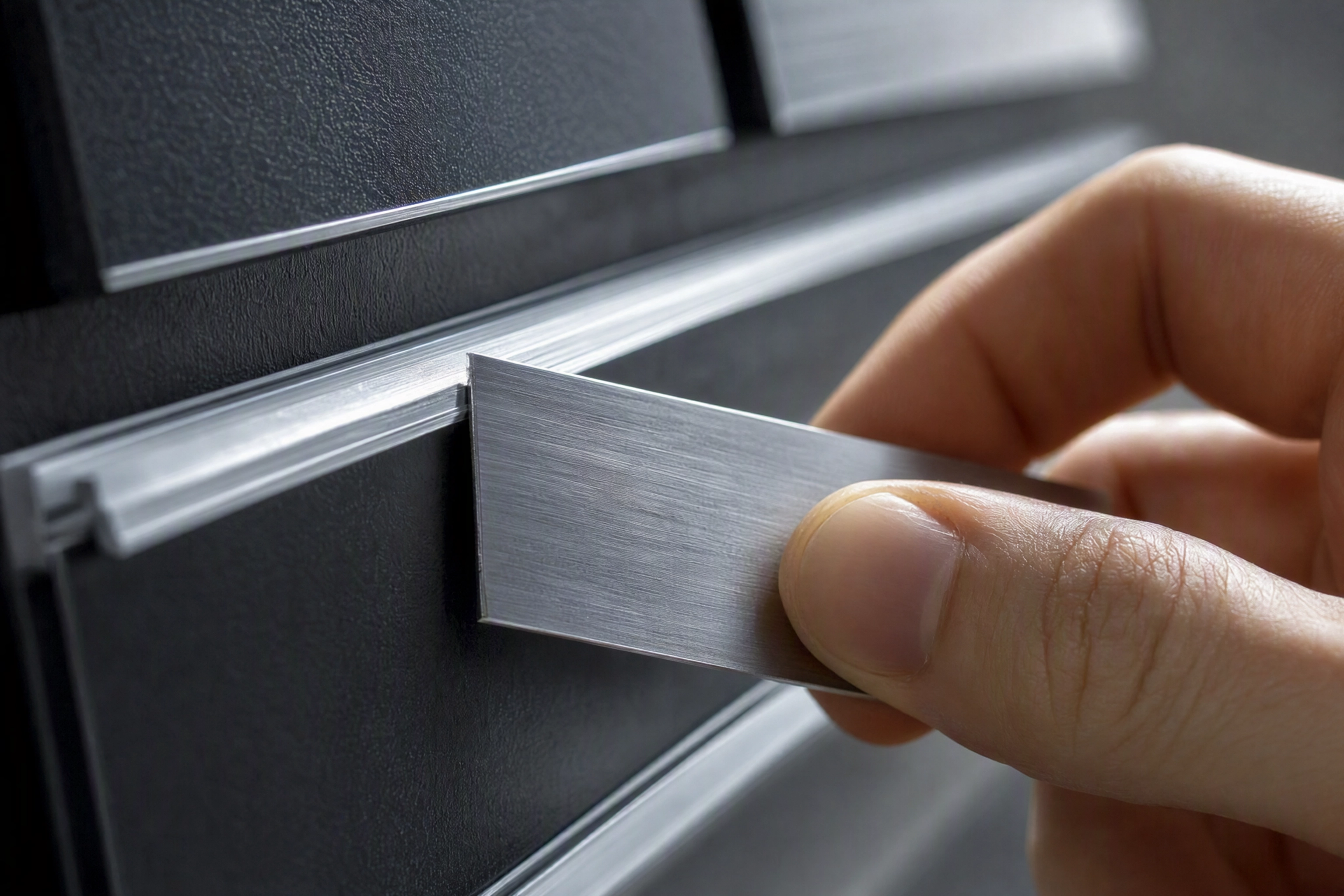 Hand sliding a price strip out of a rail-and-tile menu board, the fastest menu board idea to reprice
Cafe and coffee shop menu board ideas
A cafe board has a second job: it has to look like the room. These five are the ones that hold up.
5. The felt letter board wall
Dense felt, tabbed letters, a warmth that no screen reproduces. It suits a small espresso shop with eight drinks and two pastries. Be honest about the cost in minutes though — a full felt reset is a twenty-minute job with tweezers, and a rushed one looks worse than none at all.
Cost: 240–300 USD entry size · Update: 15–25 minutes for a full reset · Best for: a shop whose core list barely moves
6. Magnetic letters on steel rails
Same look, a fraction of the effort. Characters snap onto powder-coated steel rails and slide freely, so a price change is a ten-second nudge rather than a rebuild. Mid-range magnetic systems land around 380 USD; tile-based versions around 440 USD, and both read as modern rather than rustic.
Cost: 350–450 USD · Update: 10 seconds per line · Best for: a cafe with daily specials and no patience
7. The hanging double-sided board
Suspend a reversible faceplate over the pass on extension rods. One face carries the all-day list, the other carries brunch or the evening menu, and switching is a single flip. Hanging the board rather than mounting it buys two menus in one footprint, which matters when wall space is already spoken for.
Cost: 320–520 USD · Update: one flip · Best for: small rooms running two distinct services
8. A painted chalk wall with a permanent grid
Paint a section of wall in chalk paint, then paint a permanent grid or column rules over it in a slightly lighter tone. The grid does the hard part — alignment — so whoever writes it on a Monday cannot make it crooked. Use liquid chalk markers, never stick chalk. A commissioned redraw from a hand-lettering artist runs 100–400 USD a few times a year, and a custom illustrated header will hold for a season.
Cost: 15–200 USD for the surface · Update: 20–40 minutes in house · Best for: independents whose menu is genuinely seasonal
9. One small screen for specials, analog for the core menu
The hybrid almost nobody builds on purpose. Your ten permanent coffee drinks sit on a letter board that never changes. A single 32-inch portrait screen beside it carries the two things that do change: today's bake and the seasonal drink. You get remote updates where they earn their keep and skip four screens whose content you would never edit. Software for one screen starts around 5–20 USD a month — we priced eight platforms if you want the comparison, and our coffee photography guide covers shooting the drinks that go on it.
Cost: 250–600 USD plus 5–20 USD monthly · Update: seconds for specials, never for the rest · Best for: a single cafe that wants digital without the bill
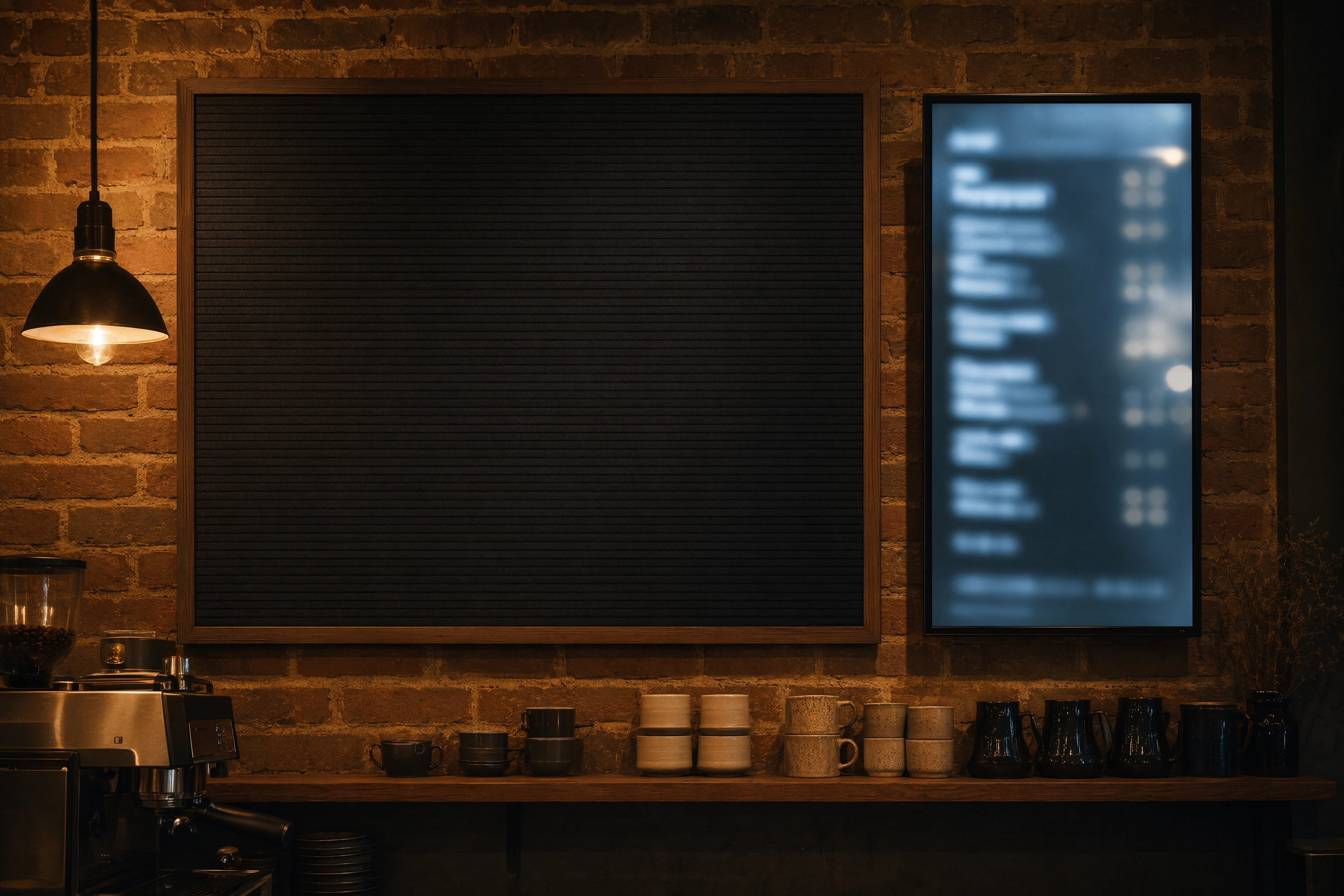 Cafe menu board idea: a felt letter board for the core list beside one small portrait specials screen
Bakery and pastry case menu board ideas
Bakeries have a problem no other venue shares: the stock in front of the guest disappears through the morning, and the display has to keep up.
10. Case-level card rail
Run a slim rail along the front lip of the pastry case and stand a card in front of each tray. Names and prices sit level with the pastry itself, so customers do not have to look up, look down and match by memory. It also kills the classic pointing-and-guessing bottleneck at 8:15am.
Cost: 80–220 USD · Update: 5 seconds per card · Best for: any counter with a glass case
The same rail works on a buffet line, which is why hotels and resorts use it for breakfast service.
11. Overhead tile board with a photographed strip
Above the case, a tile board of tabbed letters carries the drinks and sandwiches. Along its bottom edge, a printed band shows three cross-section photographs — the laminated pastry, the loaf crumb, the cake slice. Cross sections sell baked goods far better than glamour shots; our bakery photoshoot guide explains why the crumb is the money shot, and the bread photography guide covers the lighting that makes an open crumb read at scale.
Cost: 380–700 USD · Update: tiles in minutes, photo band once a season · Best for: bakeries with a laminated or sourdough signature
12. The sold-out peg board
Items hang from pegs on a grid. When the sourdough goes at 11am, someone lifts one peg tag and the line stops asking. It is a tiny idea that removes dozens of small disappointments a day, and it costs less than a case of flour.
Cost: 240–320 USD · Update: instant removal · Best for: bake-until-gone shops
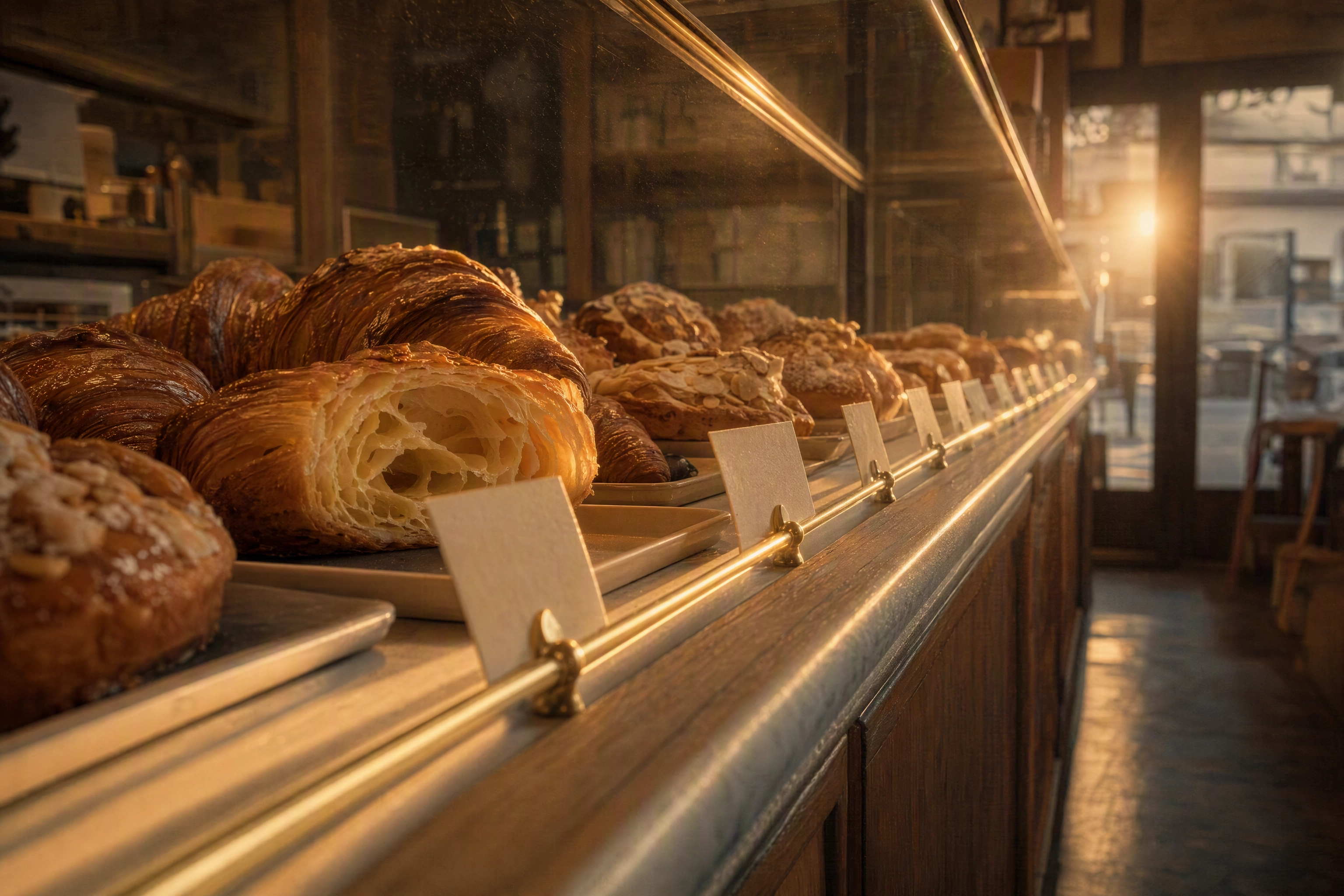 Bakery menu board idea: a brass card rail along the pastry case lip with a card at every tray
Bar and taproom menu board ideas
Rotation frequency drives every decision behind a bar. Twelve lines that change weekly is a different problem from a fixed cocktail list.
13. Clip-on tap tags above the taps
One tag per line, clamped to a slim batten directly above the tap it describes. Nothing else scales as cheaply for a rotating list, and the association is unambiguous — guests read the tag while their eye is already on the handle.
Cost: 60–180 USD for a batten and tags · Update: 20 seconds per line · Best for: taprooms turning kegs weekly
14. A portrait screen for the rotating draft list
If your list changes more than twice a week, a screen is no longer a luxury; it is cheaper than reprinting. One vertical panel, ABV and pour sizes in a clean column, live keg levels if your system supports it. Shoot the pours properly first — our beer photography guide covers head retention and glass angles — and see how we handle visuals for bars and lounges more broadly.
Cost: 540–1,400 USD plus 5–20 USD monthly · Update: seconds · Best for: 12+ rotating lines
15. Backlit acrylic cocktail board
An edge-lit acrylic sheet with the list printed or vinyl-cut onto it, and two photographed signature serves set into the layout. Cocktails are the highest-margin thing most bars sell and almost nobody photographs them well — a proper cocktail photograph beside the name does more for a $16 serve than any adjective will.
Cost: 350–800 USD · Update: reprint the face, 90–200 USD · Best for: a fixed house list you are proud of
16. The mirror menu
Write straight onto the back-bar mirror with a chalk pen. Cost is a box of markers. It reads as confident rather than cheap, it reflects the bottles behind it, and it wipes clean in a minute. The catch is legibility: mirrors throw reflections, so keep to short lines and heavy strokes. If guests are seated, back it up with a table menu — the wall sells the signature serve, the table copy carries the detail.
Cost: 15–40 USD · Update: 10 minutes · Best for: cocktail bars with a short, changing list
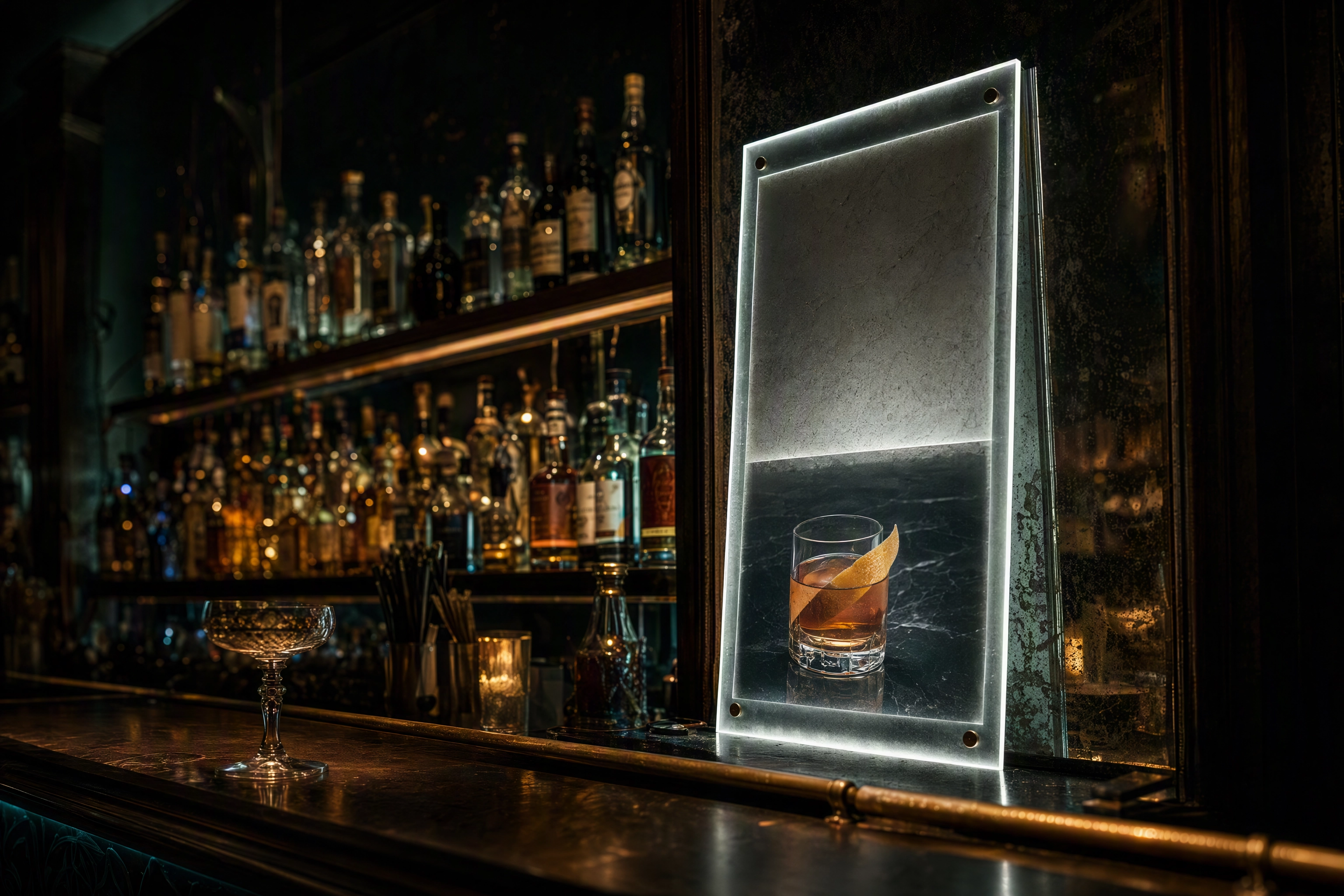 Backlit acrylic cocktail menu board idea glowing on a back bar with one photographed signature serve
Food truck menu board ideas
A truck board has to survive weather, transit and a two-metre reading distance, and it has to be readable by someone standing in the sun.
17. The service-window photo banner
A weatherproof vinyl banner mounted above the hatch, carrying six to eight lines and a strip of three photographs. Cheap, fast to produce, easy to replace when it fades. Photographs matter more on a truck than anywhere else because your queue has no room, no host and about four seconds to decide.
Cost: 90–260 USD · Update: new banner, 90–260 USD · Best for: a stable truck menu
18. Hinged wing panels
Two rigid panels hinged to the truck body that fold flat for transit and swing open at service to roughly double your usable width. It is the standard answer to the truck board's real constraint, which is not cost but surface area. More on the format in our food truck menu board breakdown, and the layout side in food truck menu design.
Cost: 300–800 USD fabricated locally · Update: depends on the insert · Best for: full menus that will not fit one panel
19. Magnetic panels on the truck skin
Flexible magnetic sheets printed with a whole menu, held straight onto the steel body. Carry two or three custom sets and you can run a different menu at a brewery lot than at a lunch rush, or a third for catering gigs where the pricing is different. Pair with the thinking in our truck menu ideas piece and the visuals we make for trucks.
Cost: 120–350 USD per set · Update: swap the whole set in a minute · Best for: multi-pitch operators
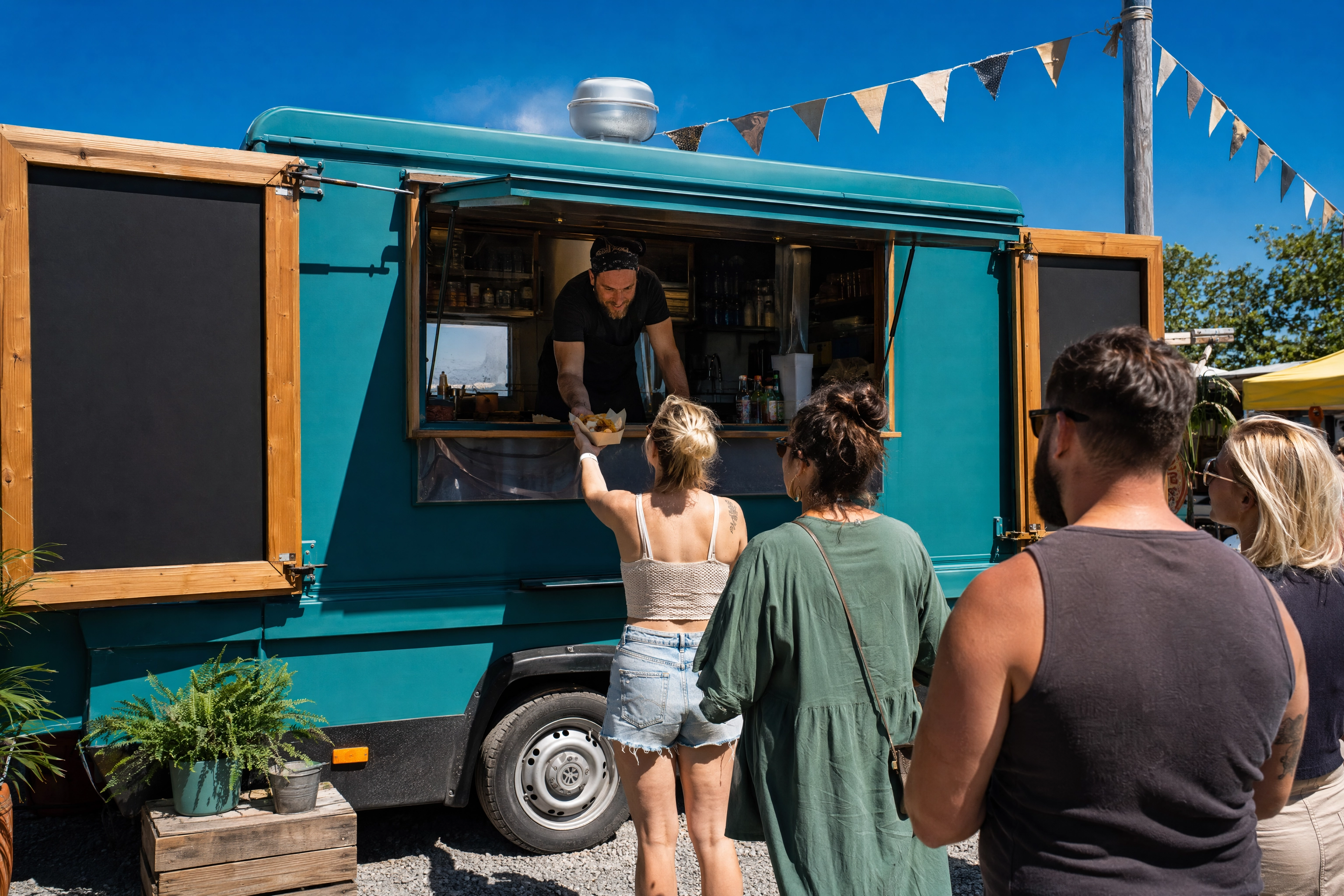 Food truck menu board idea: hinged wing panels swung open beside the service hatch to double the width
Drive-thru menu board ideas
The lane is a different engineering problem: sunlight, weather, and a driver reading at speed.
20. Outdoor high-brightness screen with daypart switching
A sealed outdoor display at 2,500–4,000 nits, IP-rated on the front face, scheduled to swap its content from breakfast to lunch on its own. This is not an indoor panel bolted outside — consumer screens fail fast in a lane. Expect 3,000–8,000 USD per screen before installation.
Cost: 3,000–8,000 USD · Update: seconds, remotely · Best for: multi-site groups where the lane carries most sales
21. The pre-browse board before the order point
A second, simpler sign set 15–20 feet ahead of the speaker, showing only combos and the current promotion. Drivers arrive at the microphone already decided, which shortens the single slowest step in the lane. It is the highest-leverage upgrade most lanes do not have, and it is exactly the kind of placement decision menu engineering is built to answer.
Cost: 600–2,500 USD static, more if digital · Update: with the promotion · Best for: any lane that backs up at the speaker
22. Static backlit drive-thru panel
The budget lane display that still works. Weather-sealed housing, edge-lit printed face, no software and no failure modes. If your promotions change quarterly rather than daily, the running cost is a fraction of a screen and legibility at night is comparable.
Cost: 800–2,200 USD · Update: reprint the face, 120–300 USD · Best for: single sites with a stable lane menu
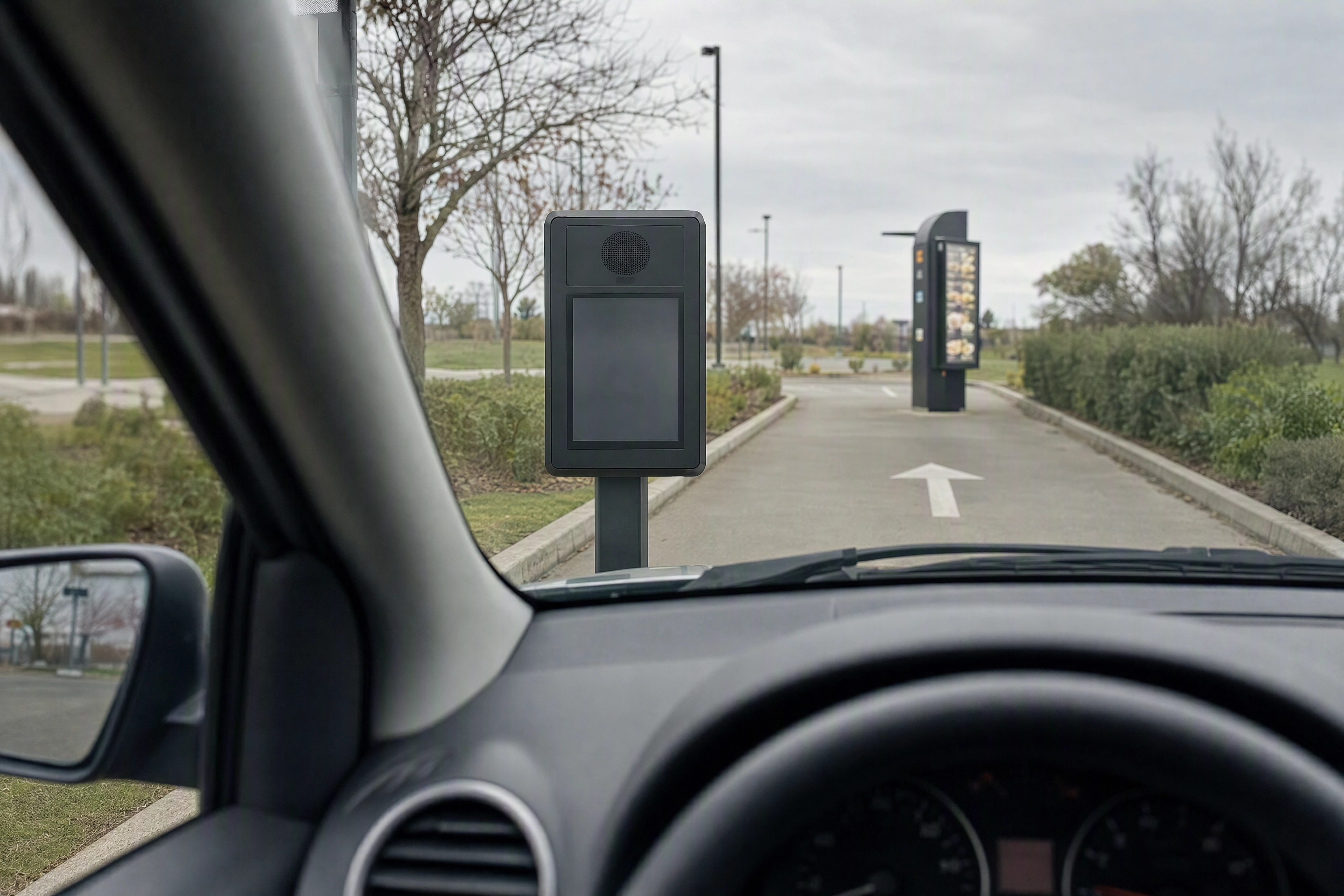 Drive-thru menu board ideas from the driver seat: the order post ahead and the lane menu board beyond
The upgrade that pays on any of these menu board ideas
Here is the pattern across every venue above. A line of text asks the guest to imagine the item. A photograph does the imagining for them, which is why the highest-value content on any board is a picture of the thing you most want sold. That difference lands hardest on the items you most want to add to a ticket: the loaded fries, the extra shot, the dessert nobody planned on.
Be careful with the numbers vendors quote you, though. The honest spread is wide. Grubhub's own analysis put professional listing photographs at roughly a 30% sales lift, and enterprise research on delivery apps has shown 35%+ — but those are delivery listings, where the photo is the storefront. WAND Digital's measurement inside a single store found about 2% incremental sales, against industry estimates of 3–5%. So: a photographed board will not double your revenue. It will reliably move add-ons, and add-ons are where the margin lives.
There is a technical catch, and it is the reason most photographed menus look worse than plain text ones. A phone snap that flatters a dish at thumbnail size falls apart at 42 inches. Fluorescent colour casts, soft focus and a cluttered background are invisible at 400 pixels and glaring at board scale. If you are shooting your own, our phone photography and lighting guides cover the fixes, the menu photoshoot guide gives you a shot list, and there is a good example of the scale problem in our menu photography guide.
One file, two jobs: the image that holds up at 42 inches is also the one your delivery listing wants, and it will already clear the DoorDash photo requirements. Against the cost of a photographer, that is the cheapest line on this page.
That is the part FoodShot handles: you upload a snap of the dish and get a 4K, print-ready image clean enough to sit at board size. We do not print, fabricate or ship boards, and we have no templates to hand you — the hardware above is your call, and the sign trade does it well. We just make the food photography that goes on it. Pricing starts at $15 a month, or browse the styles first.
Frequently Asked Questions
How much should a small cafe spend on a menu board?
Between $250 and $450 covers a genuinely good analog setup — a magnetic system or a mid-size felt board — and that is the right budget for most single sites. Spend the difference on photographs instead of on a bigger one. A $240 board with two strong images beats a $900 one with none.
Are digital menu boards worth it for a single location?
Only if something on your menu changes weekly or faster. A single screen costs $390–1,000 plus $5–20 a month, and the payback is entirely in avoided reprints and faster promo swaps. If your list is stable, idea 9 above — analog core, one small screen for specials — captures most of the benefit for a third of the spend.
How many items should a menu board show?
Seven to nine lines per section, and no more than about 30 lines in total on one counter panel. Beyond that, reading time rises faster than order value does. If you cannot cut items, cut sections instead: split breakfast onto its own face and show it only until 11am.
Do menu boards legally need calorie counts?
In the United States, only if you are part of a chain of 20 or more locations doing business under the same name and offering substantially the same items. Then calories must appear next to each standard item on the board, in a type size no smaller than the item name or price, plus the 2,000-calorie-a-day statement. Independents and small groups are exempt, though some states and cities set their own rules.
What is the cheapest way to make a menu board look expensive?
Three things, in order: raise the type size, cut the number of lines, and add one properly lit photograph. All three are free or nearly free, and together they do more than any frame upgrade. Alignment is the fourth — a painted grid on a chalk wall costs a tin of paint and fixes the crookedness that makes a board read as amateur.
Can I design a menu board myself, or do I need a designer?
You can design the layout yourself if you hold the line on type size and contrast. Most restaurant menu design software exports a print-ready file for under $50 a month, and a local sign shop will take that file straight to a panel. What you cannot fake is the photography — that is the one part of a board where an amateur file shows immediately at 42 inches.
Where the board fits in the rest of your menu marketing
The board is one surface. These are the neighbours it has to agree with:
- Menu photography for restaurants — planning one set of dish photos that serves the board, the printed menu and the delivery app.
- How to edit food photos — the colour and crop fixes that decide whether a phone snap survives being blown up.
- Coffee photography and cocktail photography — the two categories most likely to end up on a drinks list, and the two hardest to shoot well.
- Restaurant marketing ideas — where in-store promotions sit against everything else competing for the same budget.
- Our solutions by venue — what differs between a truck, a bakery and a fine-dining room.
Pick the board you will actually update
The best board in this list is not the most beautiful one. It is the one whose update effort matches the honest frequency of your menu changes. A $900 printed bay is a bargain for a menu you will keep for two years and a millstone for one you reprice quarterly.
So work backwards. Count how many times your prices moved last year, find that row on the table above, then spend whatever is left on the photographs. That order is what separates the boards that sell from the signs that merely list.