
7 Menu Pricing Formulas Run on a Burger, Latte and Tray
 Ali Tanis15 min read
Menu pricing comes down to one choice: which formula sets the number. Most guides explain each formula with a different made-up dish, so you never see them disagree; here they disagree on purpose. We ran the same three items through all seven: a $2.99 cheeseburger, a 99-cent latte and a $29.97 catering tray for 10, each costed in our food cost calculator. The burger alone lands anywhere from 9.95 to 13.65.
Quick Summary: Good menu pricing uses formulas in sequence. Food cost percentage and contribution margin set your floor, competitor prices set the ceiling, and psychological, decoy, bundle and delivery pricing shape the number for a specific job. Our burger's floor is $10.19 and the market pays $11.50, so we'd print 10.95. Judge every dish by the dollars it keeps.
The 7 menu pricing formulas at a glance
Seven formulas cover nearly every menu pricing decision. Two start from what the plate costs you, one starts from what the street charges, and four adjust a base number for a specific job: how it reads, what sits beside it, what it's sold with, and where it's ordered.
| # | Formula | The math | Use it for |
|---|---|---|---|
| 1 | Food cost percentage | Plate cost ÷ target food cost % | A first draft for everything |
| 2 | Contribution margin | Plate cost + dollars it must earn | Anything far from your average cost |
| 3 | Competitive | Local median ± your positioning | Finding the ceiling |
| 4 | Psychological | Move to a sticky ending, drop the $ | Every printed number |
| 5 | Decoy | Put a weaker option beside the target | Sizes and tiers |
| 6 | Bundle | Sum of parts − 10–15% | Raising the average check |
| 7 | Delivery markup | (In-store + packaging) ÷ (1 − commission) | Third-party apps |
The three items and their plate costs
Every formula starts from plate cost: the ingredients and packaging that leave with the order, adjusted for trim and cook loss. Ours come from the calculator's worked examples, built on 2026 invoices:
- Cheeseburger, $2.99: 5 oz of 80/20 beef, brioche bun, American cheese, lettuce, tomato, sauce.
- 12 oz latte, 99¢: double shot, 8 fl oz of whole milk, cup, lid, sleeve.
- Lemon-herb chicken tray for 10, $29.97: chicken thighs, herbed rice, roasted vegetables, rolls, foil pans.
Swap in your own numbers; the arithmetic doesn't change.
Side-by-side: what each formula charges
The same burger ranges from 9.95 to 13.65 depending on the formula you trust, the latte from 4.50 to 6.15 and the tray from about $88 to $133. That spread is the case for testing menu pricing more than one way. Formulas 4 to 7 start from the formula 1 number, rounded. In brackets: what you keep after food, packaging and any app commission.
| Formula | Burger ($2.99) | Latte ($0.99) | Tray for 10 ($29.97) |
|---|---|---|---|
| 1. Food cost % | $9.97 (keeps $6.98) | $4.50 ($3.51) | $99.90 ($69.93) |
| 2. Contribution margin | $10.19 ($7.20) | $4.59 ($3.60) | $87.97 ($58) |
| 3. Competitive | $11.50 ($8.51) | $4.75 ($3.76) | $125 ($95.03) |
| 4. Psychological | 9.95 ($6.96) | 4.5 ($3.51) | $9.95 a guest ($69.53) |
| 5. Decoy | Double, 12.95 ($8.03) | 20 oz, 5.75 ($4.51) | Complete package, $134.50 ($91.33) |
| 6. Bundle | Combo, 14.45 ($10.34) | With croissant, 7.95 ($6.06) | 4 Fridays, $89.50 each ($59.53) |
| 7. Delivery, 25% fee | 13.65 ($6.95) | 6.15 ($3.50) | $132.50 ($69.41) |
Two patterns stand out: a single percentage under-charges cheap items and over-charges big tickets against the dollars each one needs (rows 1 and 2). And the market beat both formulas built on plate cost, by $25 on the tray alone.
Formula 1: Food cost percentage
The food cost percentage formula divides plate cost by the share of the menu price you want ingredients to take. It's the default because it needs one input, and most casual restaurants aim for 28–35%, with coffee and drinks running lower.
Menu price = plate cost ÷ target food cost %

Burger    $2.99 ÷ 0.30 = $9.97
Latte     $0.99 ÷ 0.22 = $4.50
Tray     $29.97 ÷ 0.30 = $99.90
Its blind spot is labor: both pass at their percentage, yet the latte takes a barista about a minute and the tray takes a cook 90 minutes of roasting, portioning and packing. One ratio can't fairly charge for both jobs.
Is gross profit margin a different formula?
No, gross profit margin pricing is the same method turned around: a 70% profit margin is a 30% food cost. Guides that teach both, landing one $4 salad at $14.29 and then $14.50, are teaching one formula twice with different rounding.
Formula 2: Contribution margin
Contribution margin pricing decides how many dollars an item must earn toward labor, rent and profit, then adds plate cost. It corrects the percentage formula's habit of under-charging for cheap plates and over-charging for expensive ones, because a business deposits dollars, not percentages.
The required dollars are your monthly labor, overhead and profit goal divided by what you sell. Our mains carry $36,000 a month across 5,000 sold; the coffee bar carries $27,000 across 7,500 drinks; the tray needs 1.5 labor hours at a loaded $22 plus $25 toward rent and profit.
Menu price = plate cost + required contribution

Burger    $2.99 + $7.20 = $10.19
Latte     $0.99 + $3.60 = $4.59
Tray     $29.97 + $58   = $87.97
Read the gaps: the burger and latte rise because formula 1 never paid for their labor. The tray falls by about $12: at a 30% food cost it was asking $70 for 90 minutes of work.
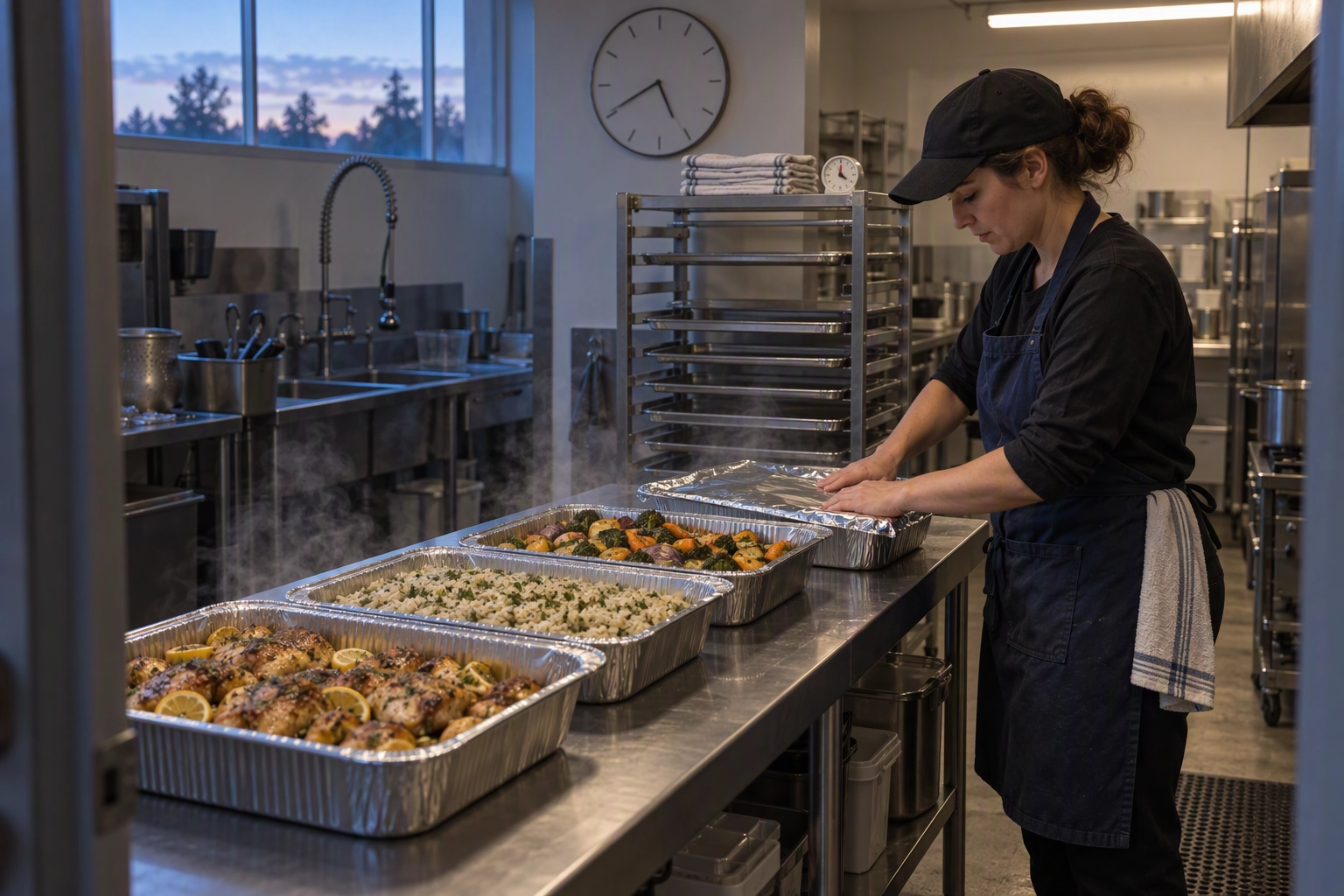 Prep cook sealing foil catering pans of chicken thighs and rice at dawn, the labor hours contribution margin pricing counts
Experienced operators work this way. Ballyhoo Hospitality in Chicago runs steak at a 40–45% food cost against about 20% on starters and salads, the National Restaurant Association reported in December 2025, because the steak still earns more dollars per plate. Our menu engineering walkthrough ranks a whole restaurant menu on these numbers.
Formula 3: Competitive pricing
Competitive menu pricing starts from what nearby rivals charge for a comparable dish and adjusts for how you want customers to see you: at the median, below it for value, or above it for a signature. It's the only formula that shows the ceiling, the most guests will spend before they walk next door.
Survey five comparable places, not the five cheapest. The figures below are illustrative; yours should be based on your own street.
Menu price = local median ± your positioning

Burger   rivals 9.49 / 10.99 / 11.50 / 12.25 / 13.95   → match median: 11.50
Latte    rivals 4.25 / 4.60 / 4.75 / 5.00 / 5.45       → match median: 4.75
Tray     ezCater bands $14–25 a guest                  → undercut: $12.50 a guest ($125)
The tray bands come from the ezCater averages cited in our catering menu ideas guide: unstaffed Italian buffets at $15–25 a person, taco bars at $14–18. At $12.50 a guest the tray still keeps $95.03, so formulas 1 and 2 were leaving real money on the table.
The market is also moving: food-away-from-home prices were 3.4% higher in August 2026 than a year earlier, and the USDA Economic Research Service forecasts 3.5% for the year. A rival's menu from last spring is stale, and their plate cost isn't yours.
 Cafe owner tasting a rival coffee shop latte at its window counter, the local market check behind competitive menu pricing
Formula 4: Psychological pricing
Psychological pricing moves a computed number to the ending guests read most favorably: just under a whole-dollar threshold for value items, round for indulgent ones, and no dollar sign at all. It changes cents rather than dollars, but it decides which digit guests see first. The evidence:
- Drop the dollar sign. In a 2009 Cornell field study at the Culinary Institute of America, diners given menus with plain numerals spent significantly more than diners whose menus showed a dollar sign or amounts in words.
- Left digits matter. In Anderson and Simester's 2003 catalog experiments, a dress at $39 outsold the same dress at $34 and at $44.
- Round for feelings, precise for reasons. Wadhwa and Zhang (Journal of Consumer Research, 2015) found round numbers suit emotional purchases and exact ones suit considered ones.
Applied to our three: the burger's $9.97 becomes 9.95. The latte prints as 4.5, since a daily coffee is a feeling purchase. The tray becomes $9.95 a guest: an office manager buys from a budget sheet, a precise per-head figure reads as calculated, and the order stays under $100.
Now watch beef: the ERS forecasts beef and veal up 9.4% in 2026, lifting our burger's plate cost to about $3.15 and its 30% number to 10.52. Don't print 10.52: it takes the two-digit penalty for 52 cents. Hold 9.95 or move to 10.95.
Formula 5: Decoy pricing
Decoy pricing puts a deliberately weaker option next to the one you want sold, so the target looks like the obvious deal. It sets the target's number against its neighbor rather than its cost, and works best when options differ on one clean number, such as size.
Huber, Payne and Puto first showed the effect in 1982. Later replications found it fades when choices are experiential rather than numeric, so use it on sizes and tiers, not between two different dishes.
Burger   single 5 oz 9.95  |  decoy 7 oz 12.45  |  target double 10 oz 12.95
Latte    12 oz 4.50        |  decoy 16 oz 5.45  |  target 20 oz 5.75
Tray     Essentials $99.50 |  decoy + cookies $124.50  |  target Complete $134.50
Three more ounces of beef for 50 cents makes the double the easy call. It costs $4.92 and keeps $8.03, a dollar more than the single, at a 38% food cost: the percentage looks worse, the deposit is better. The 20 oz latte also keeps a dollar more than the 12 oz, and the Complete package (cookies, salad, drinks) keeps $91.33, $21.80 more than Essentials.
A decoy that sells anyway isn't a failure: it's a poor deal for the guest, which makes it a profitable one for you.
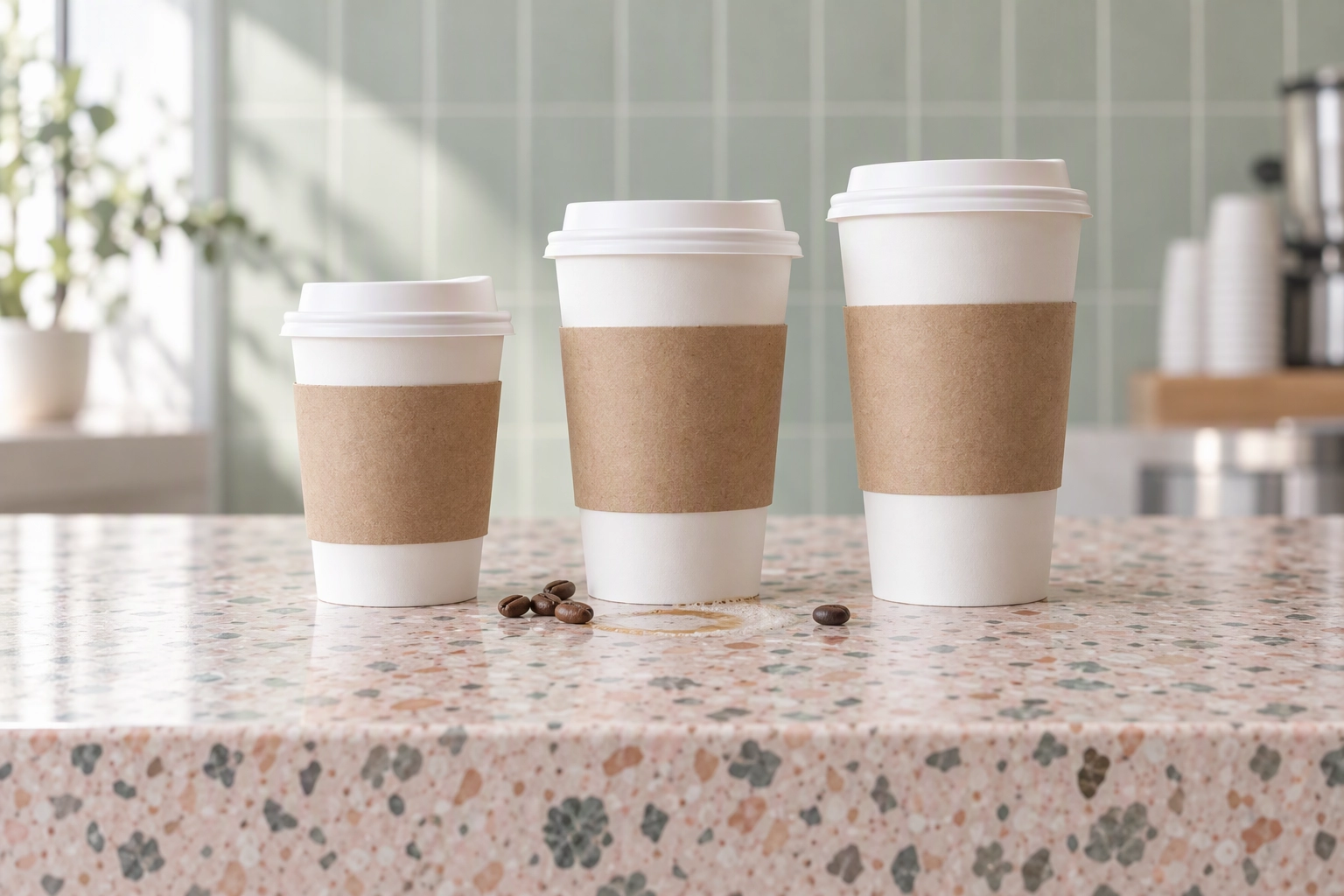 Three latte cup sizes, 12, 16 and 20 oz, in a row on a terrazzo cafe counter, the size ladder used in decoy pricing
Formula 6: Bundle pricing
Bundle pricing sells items together for less than their separate prices, usually 10–15% less, to lift the average check. It pays when the bundle keeps more dollars than the single dish the guest would have ordered alone.
Bundle = sum of parts − discount

Burger combo   9.95 + fries 3.95 + drink 2.75 = 16.65  → combo 14.45
Latte pair     4.50 + croissant 4.25 = 8.75             → together 7.95
Tray           4 standing Friday trays, 10% off         → $89.50 each
The combo costs $4.11 (fries 68 cents, fountain drink 44 cents) and keeps $10.34, about $3.40 more than a burger alone. If the guest would have bought all three anyway, it gives away $2.20, so combos belong at the top of the board, not in a pitch to someone already ordering fries. The latte pair keeps $6.06 versus $3.51.
Catering bundles across dates, not plates. Four Friday trays keep $59.53 apiece, $238 a month, which beats one-off sales unless the client would have booked at least 3.4 of those Fridays anyway. Our restaurant promotions guide runs the same break-even test on discounts that eat into margins.
Formula 7: Delivery markup
Delivery menu pricing raises the in-app number so the commission comes out of the guest's ticket instead of your contribution. At a 25% commission that means a 33% markup before packaging.
DoorDash takes 15%, 25% or 30% on delivered orders, and Uber Eats Lite rose to 20% in March 2026, as our DoorDash fees breakdown details. At 25%:
App price = (in-store price + packaging) ÷ (1 − commission)

Burger   (9.95 + 0.30 clamshell) ÷ 0.75 = 13.67  → 13.65, keeps $6.95
Latte    (4.50 + 0.12 lid, carrier) ÷ 0.75 = 6.16 → 6.15, keeps $3.50
Tray     $99.50 ÷ 0.75 = $132.67                 → $132.50, keeps $69.41
Most restaurants pass through less. Restaurant Business and Intouch Insight's 2025 delivery study, which ordered from 600 restaurants and convenience stores, found app mains cost $1.85 more than in-store on average. At that markup our burger keeps $5.56 on a 25% plan, $1.40 less than at the counter: fine if delivery is extra volume, not if it replaces dine-in demand. Big trays travel best (see large orders on DoorDash), and DoorDash's 6% pickup rate requires your in-store prices.
Which menu pricing formula should you use?
Use all seven in sequence, not as rivals. The higher of formulas 1 and 2 is your floor, formula 3 is your ceiling, and formulas 4 to 7 shape what you print for each job. Land between floor and ceiling, closer to the ceiling for a signature.
| Item | Floor (1 or 2) | Market (3) | We'd print | Keeps | Food cost |
|---|---|---|---|---|---|
| Burger | $10.19 | $11.50 | 10.95 | $7.96 | 27.3% |
| Latte | $4.59 | $4.75 | 4.75 | $3.76 | 20.8% |
| Tray for 10 | $99.90 | $125 | $12.50 a guest | $95.03 | 24% |
Then layer the jobs: decoy targets, bundles, and app listings recalculated with formula 7 (the burger at 10.95 lists at $15 on a 25% plan). Our menu design guide covers placement on the restaurant menu, and strong menu descriptions help a higher menu price feel earned.
How often should you reprice?
Re-run a recipe when one ingredient moves 5% or more, and review menu pricing quarterly against your inventory counts and sales mix. Guests are more forgiving than owners fear: in the National Restaurant Association's 2025 State of the Restaurant Industry report, 67% of adults called it acceptable for restaurants to raise prices to cover higher costs. Our burger at 10.95 absorbs the beef forecast at a 28.8% food cost, and digital menu boards make any change a five-minute job.
Price first, then photograph the stars
Menu pricing decides what each order earns; photos decide how many orders you get. Once the numbers are set, the items that keep the most dollars and sell well (the stars in menu engineering) deserve the top slot on the page and the first photos.
Here, that's the double ($8.03 kept), the combo ($10.34), the 20 oz latte ($4.51) and the Complete package ($91.33). Photos are a measurable lever: DoorDash's 2022 study of more than 15,000 merchants found menus with item photos earn up to 44% more monthly sales.
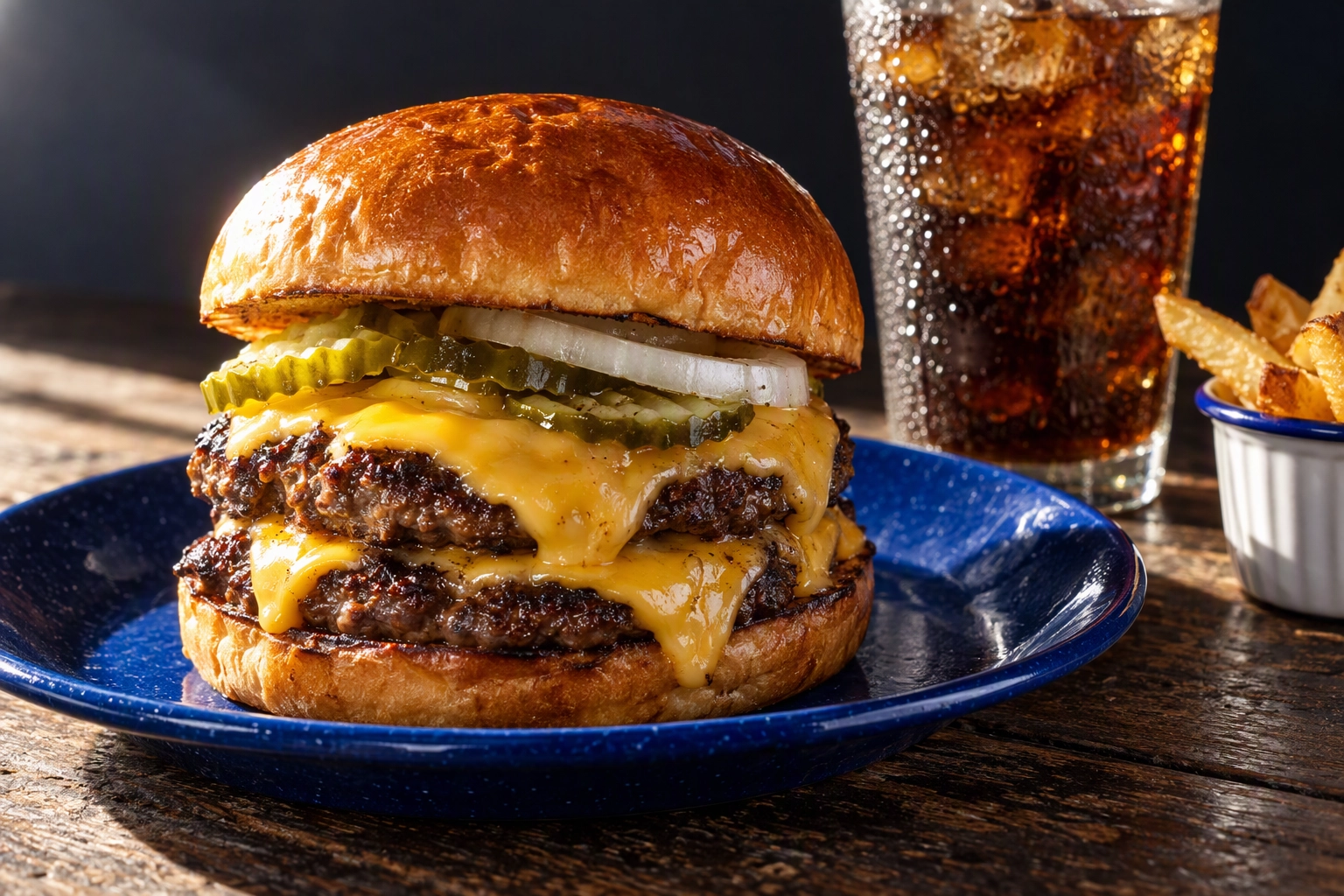 Double cheeseburger shot as a menu photo in hard side light, the high-margin star item to photograph first after menu pricing
You don't need a shoot to start. Photograph the stars on your phone where you plate them, then FoodShot turns each shot into a 2K, menu-ready image in about 2 minutes, with plans from $15 for 25 photos on our pricing page. See how it works for menu photos for restaurants, cafes and caterers. FoodShot restyles the dish you serve rather than inventing one, so the photo matches what customers receive.
Frequently Asked Questions
What is the most common menu pricing formula?
Food cost percentage: plate cost divided by your target, which casual restaurants usually set at 28–35%. Our $2.99 burger at 30% comes out at $9.97. Good menu pricing then checks it against contribution dollars and three to five local rivals.
How do you calculate a menu price from food cost?
Weigh each ingredient at the portion you serve, adjust for trim and cook loss, add takeout packaging, then divide by your food cost goal. A $2.99 plate at 30% needs $9.97. Our food cost calculator costs all three of these dishes line by line.
What is the 3x rule for menu pricing?
Multiplying plate cost by three gives a 33% food cost. It's a fair shortcut for mains but wrong for drinks: our 99-cent latte would sell at $2.97 instead of 4.50, leaving $1.53 a cup on the counter. It's a starting point for menu pricing, not a profit margin plan.
Should delivery app prices be higher than in-store prices?
Usually, if the app takes 15–30%. Dividing the in-store price plus packaging by one minus the commission keeps your dollars whole, though most restaurants add less, about $1.85 a main in 2025. Keep pickup equal to in-store for DoorDash's 6% pickup rate.