
Mexican Food Truck Menu Ideas That Drive Repeat Orders
 Ali Tanis16 min read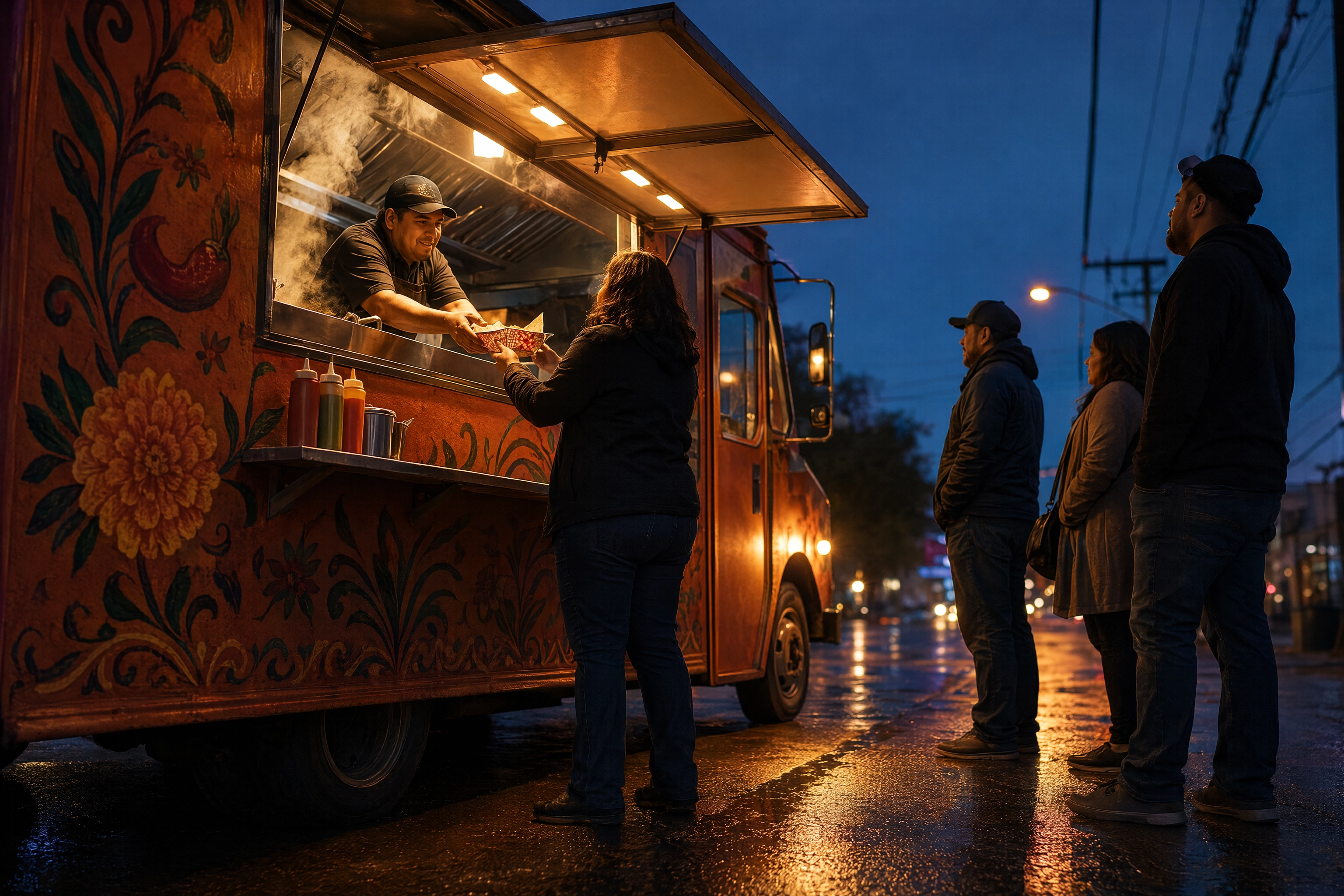
A Mexican food truck menu can be almost anything, and that is exactly the problem. Tacos, burritos, quesadillas, tortas, elote, birria, churros, aguas frescas — every one of them works out of a mobile kitchen, so most first-time operators put all of them on the board. Then the second Saturday rush lands, the plancha is jammed, two proteins have gone cold, and the line walks down the block.
The operators who build regulars do the opposite. They run a short list of common components through a lot of formats, and they know exactly which items pay the rent. Your board is not a list of dishes. It is a production plan you happen to hang on the side of a vehicle.
Quick Summary: Build the board from about six common components — braised beef, adobo pork, grilled steak, pollo, beans and rice, and a melting cheese blend — then sell them across five formats: taco, burrito, quesadilla, torta and bowl. Braised proteins hold all service with almost no labor at the window, while pressed and fried items eat your griddle. Corn items and aguas frescas carry the real margin, an attached combo lifts the ticket $5-6, and honest regional naming beats a vague claim of authenticity.
Build the Board From Components, Not Dishes
The unit of decision on a mobile kitchen is not the dish. It is the component: one thing you prep, hold and portion. Each component costs you a container, a temperature, a spoilage clock and a slot in a fridge the size of a hotel minibar. Each format built on top of components you already hold costs you almost nothing.
That single distinction separates a board that runs smoothly from one that buries the cook. Adding cochinita pibil to an operation that already braises birria means a second braise, a second hold, and a second thing to throw away on a slow Tuesday. Adding a quesadilla to a line that already has melted cheese and pork on it adds a price point and no prep at all.
Here is the rule worth writing on the wall of your commissary: a component earns a slot only if it appears in three or more sellable items. Anything that shows up in a single dish is a garnish pretending to be a business. The National Restaurant Association makes the same argument from the waste side — cross-utilizing one prep across several dishes is one of the most reliable ways to stop throwing money in the bin at the end of the night.
The Six Components That Carry the Whole Board
- Braised beef and consomé. Beef chuck or cheek stewed in guajillo and ancho for birria, plus the broth it makes. One prep, two revenue streams.
- Adobo pork. Achiote-marinated pork for al pastor, finished with pineapple and raw onion, or a slow braise for carnitas. Pick one and do it properly.
- Marinated steak. Carne asada, cooked to order, the item most customers use to judge you.
- Pollo asado. Chicken is the cheapest protein you can put in a tortilla, and the reason families order from you twice a month.
- Frijoles and rice. Refried or de la olla, plus a pot of rice. This is the volume filler that makes a $13 wrap possible.
- A melting cheese blend. Oaxaca for the pull, a little low-moisture mozzarella for coverage, cotija held separately as a finishing crumble.
Chorizo is the cheap seventh if your griddle is already hot. Chorizo blends into eggs, into pollo, into a queso fundido, and it lowers your blended cost per portion every time it goes in.
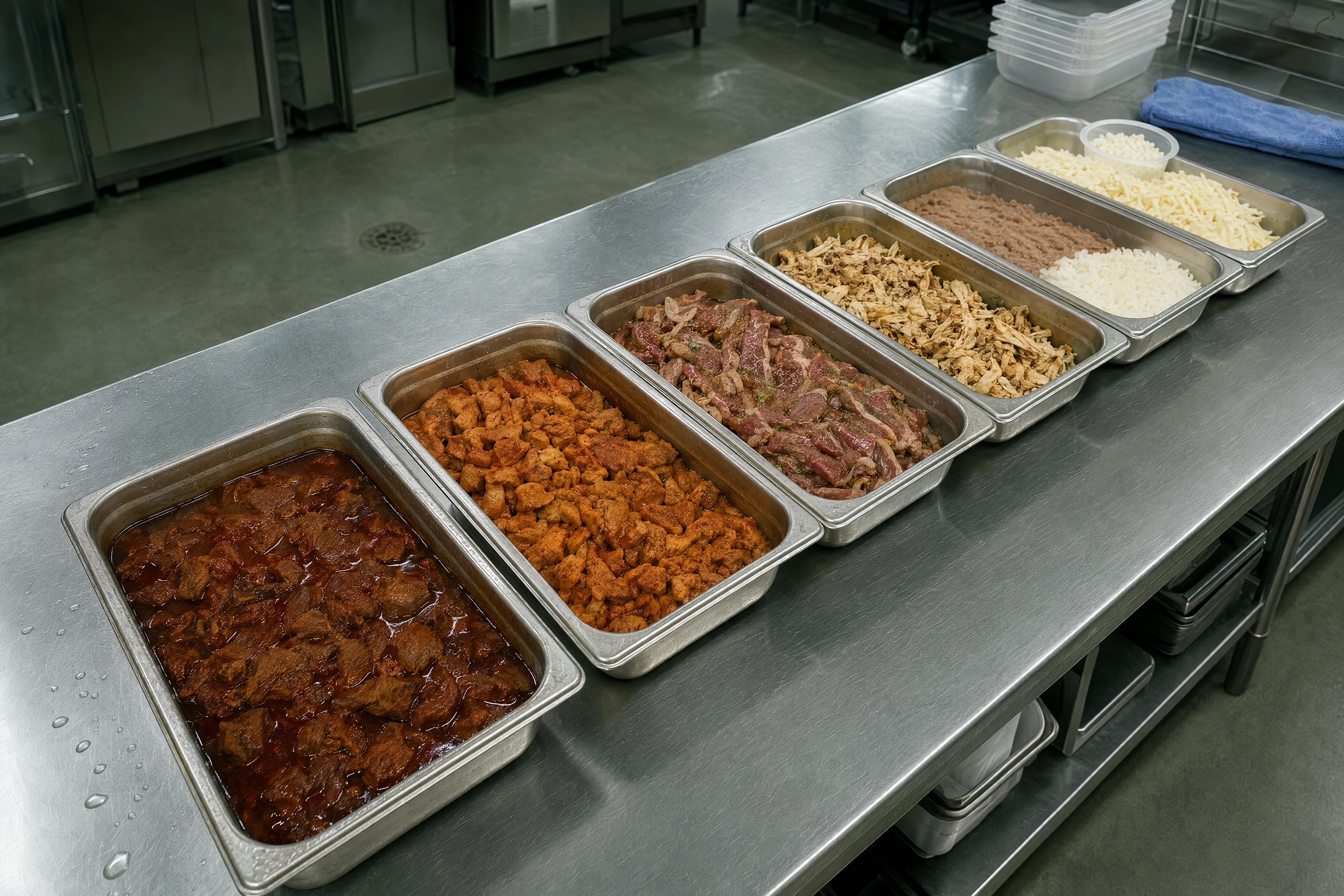 Six prepped Mexican food truck menu components in stainless pans on a commissary bench: braised beef, adobo pork, steak, chicken, beans and cheese
One Prep List, Five Formats
Those components recombine into five formats, and the format is what a customer actually chooses first.
- Taco — corn tortilla, protein, white onion, cilantro, salsa.
- Burrito — a 12-inch flour tortilla wrapped around protein, beans and rice.
- Quesadilla — flour tortilla, melted cheese, any protein.
- Torta — telera roll, the same fillings, plus crema, avocado and a press.
- Bowl or loaded fries — no bread at all, and the highest-margin build of the five.
The same al pastor goes into a quesadilla, a torta and a bowl without a single new prep task. That is the whole point.
The toppings rail is the one place to be generous. Diced white onion, cilantro, fresh lime and two salsas cost almost nothing and are what people describe to their friends. A pickled onion or a spoon of pico de gallo reads as a signature for pennies, while guacamole and sour cream are fair upcharges because avocado genuinely is expensive.
Six components across five formats is thirty theoretical items. You publish twelve to fourteen. The other sixteen live in your head as catering options, event specials, and the answer when somebody asks whether you can do that without rice.
What Actually Survives a Six-Foot Service Window
The constraint here is not the recipe. It is roughly three square feet of hot flat-top and the two hands attached to it. Every item you sell competes for that space during the ninety minutes that matter.
Braised Proteins Are Free Labor
Anything you braise at the commissary and hold hot is, from the window's point of view, free. Birria, carnitas and cochinita get portioned in about four seconds with no cooking at all. The FDA Food Code sets the standard you work to: hot items held at 135°F or above, cold at 41°F or below, and anything sitting in between on a four-hour clock before it has to be discarded. Build your holding around that number and a braised protein will carry an entire lunch service without ever touching the griddle.
That is why birria took over the street, and not only because of social media. It is the rare item that is both a signature and an operational shortcut.
The Formats That Steal Your Griddle
Time a real ticket instead of guessing. An assembled taco takes roughly 30 to 45 seconds. A burrito with beans, rice and a proper fold runs 60 to 75. A quesadilla that has to be pressed and crisped occupies griddle space for two to three minutes, and a torta needs a bread SKU, a press, and a second cutting board that most kitchens this size do not have.
None of that means cut them. It means price them for what they cost you in window time, and cap how many you will run at once. Plenty of operators sell tortas only at catering gigs and evening events, where the line is pre-committed and nobody is timing you against the cart two spaces down.
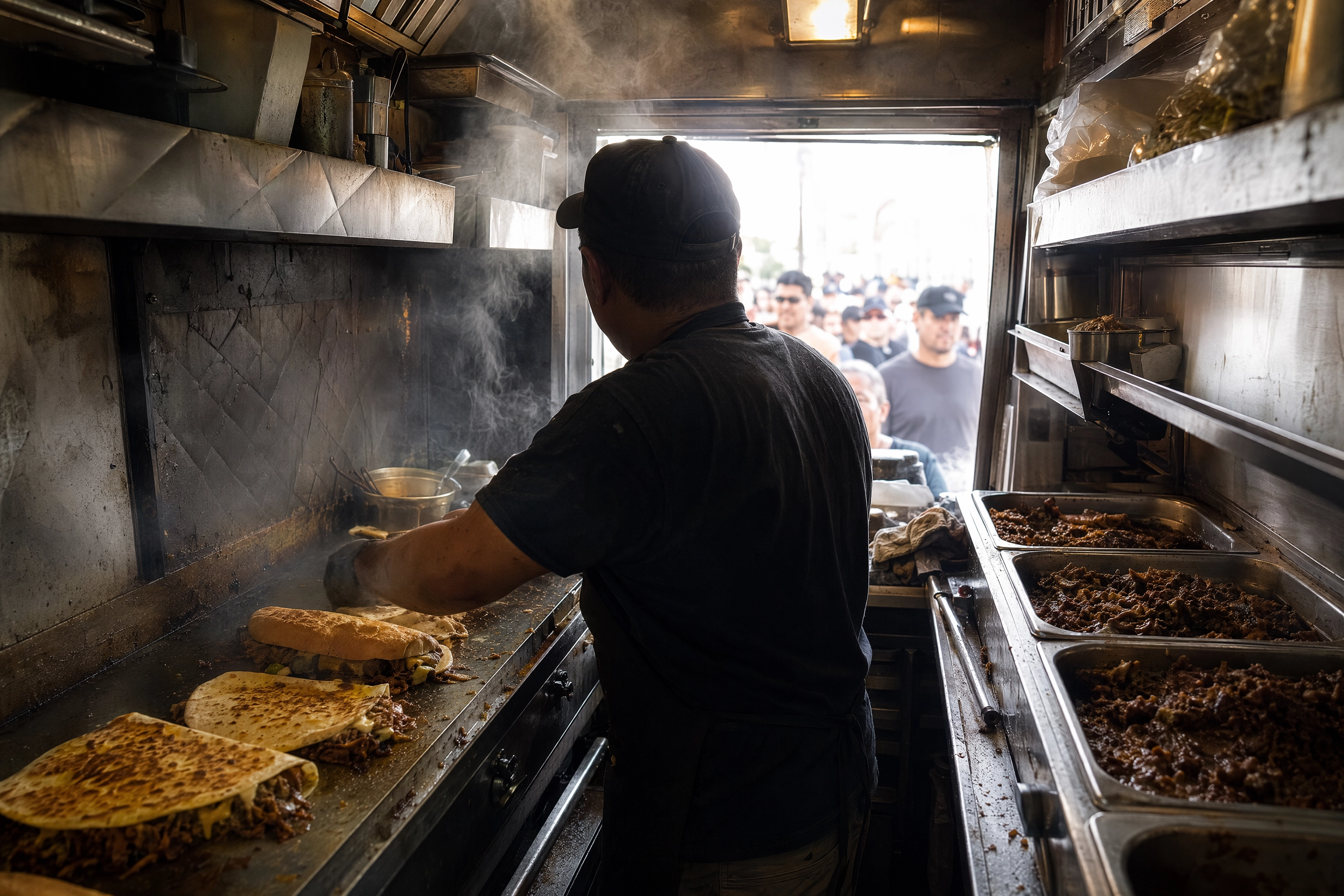 Interior of a Mexican food truck galley during a rush, crowded flat-top griddle beside hot-held braise pans and a queue visible through the hatch
The Margin Ladder on a Mexican Food Truck Menu
Food cost sorts itself into clear bands by category, and knowing the bands beats agonizing over one item.
- Premium proteins — asada, birria, seafood: 30-35%.
- Value proteins — pollo asado, chicken tinga, chorizo: 25-30%.
- Corn and masa items — elote, esquites, chips, quesadillas: 15-20%.
- Drinks and dessert — aguas frescas, churros: 15-25%, the lowest on the board.
The trap is optimizing percentages when your real bottleneck is the window. Contribution dollars are the number that matters. Take the two biggest sellers on most boards, for example: a $14 burrito at 32% food cost puts $9.52 in the till, while two $5 street tacos at 28% put in $7.20 and take about the same handling time. The wrap wins, even though the percentage looks worse.
Then price to your actual market, because there is no national number. In 2026 you can still get five street tacos for $5 in parts of Texas and the Midwest, while Bay Area operators charge $20 for a California burrito and $23 for a birria quesadilla and sell out anyway. The Mexican restaurant segment in the US is a $104 billion market spread across more than 52,000 businesses, which means your competitive set is the six blocks around you, not a national average.
Elote and Esquites: the Corn That Pays for the Day
Corn is the best trade on the board. A cob or a cup of kernels, mayo-crema, cotija, chile-lime powder and a squeeze of lime costs well under a dollar and sells for $3 to $8 depending on where you are parked. Street vendors in Los Angeles hold the line near $2-3; festival pricing runs $7-8 for the same cup.
Esquites is the smarter build of the two. Kernels in a cup travel better than a cob, hand over faster, survive a walk down the street, and never end up on somebody's shirt. Off-season, fire-roasted frozen kernels keep your cost flat when fresh corn triples in January.
The corn item also quietly solves your vegetarian problem. It is a real, craveable, meat-free choice that adds no component, no hold and no prep task. That matters more than it sounds: one person in a group who cannot eat from your board takes the whole group with them.
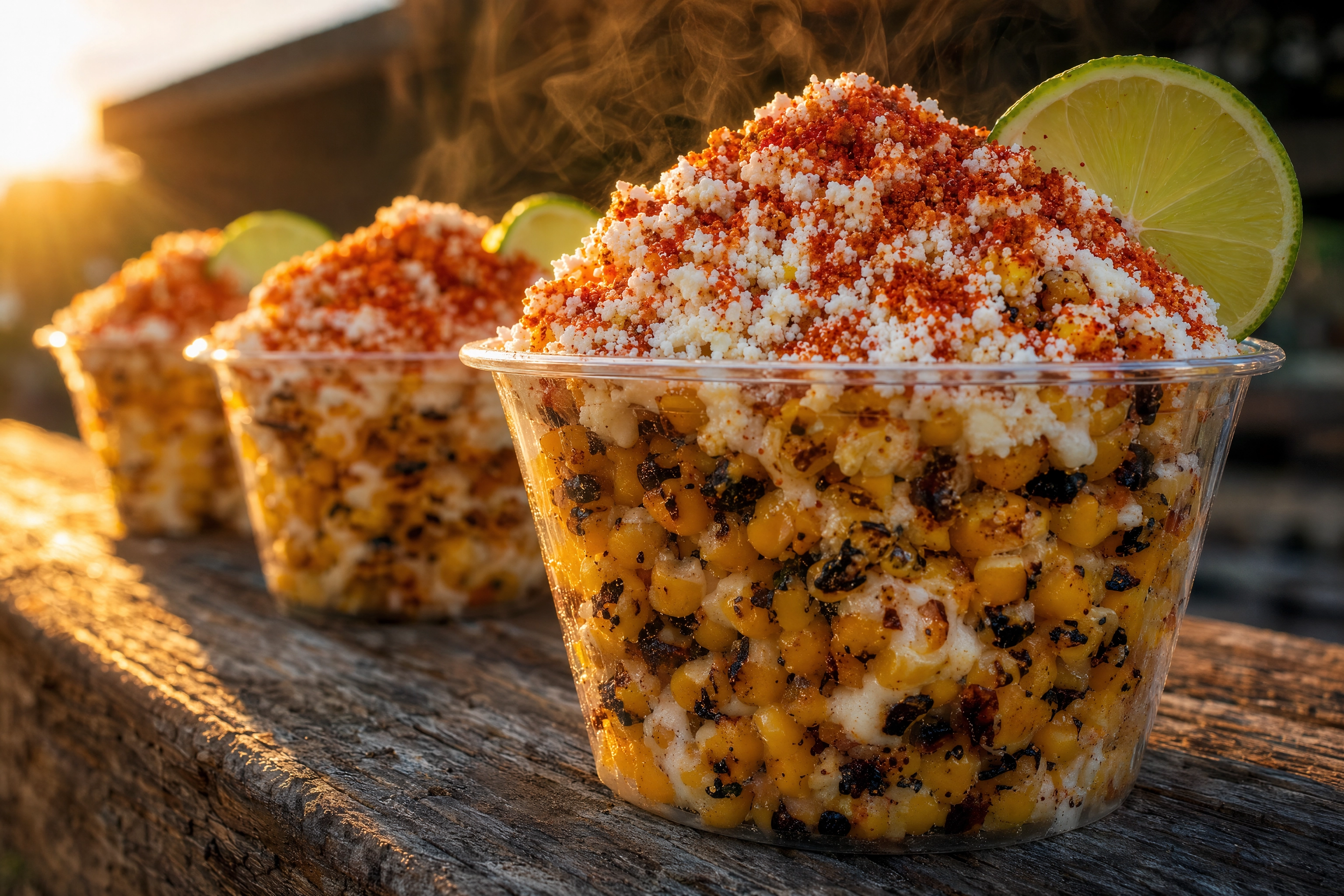 Close-up of esquites cups, Mexican street corn kernels topped with crema, cotija cheese and chile-lime powder on a weathered wooden ledge
Aguas Frescas, Horchata and Churros: the Back Third of the Board
Horchata, jamaica and tamarindo get batched in a vitrolero at the commissary and cost a few cents a cup. At the window they need one scoop of ice and one pour. No labor, no holding temperature to fuss over, and no waste beyond what you fail to sell. Nothing else on your board is that clean.
Churros are a real decision, not an automatic yes. Frying to order gives you the version people talk about, but it costs you a fryer, oil management and a station during a rush. Buying in and warming is defensible if your fryer is already busy with papas. Either way, this delicious back third of the board is what moves a $12 ticket to $18, and it is the cheapest $6 you will ever add.
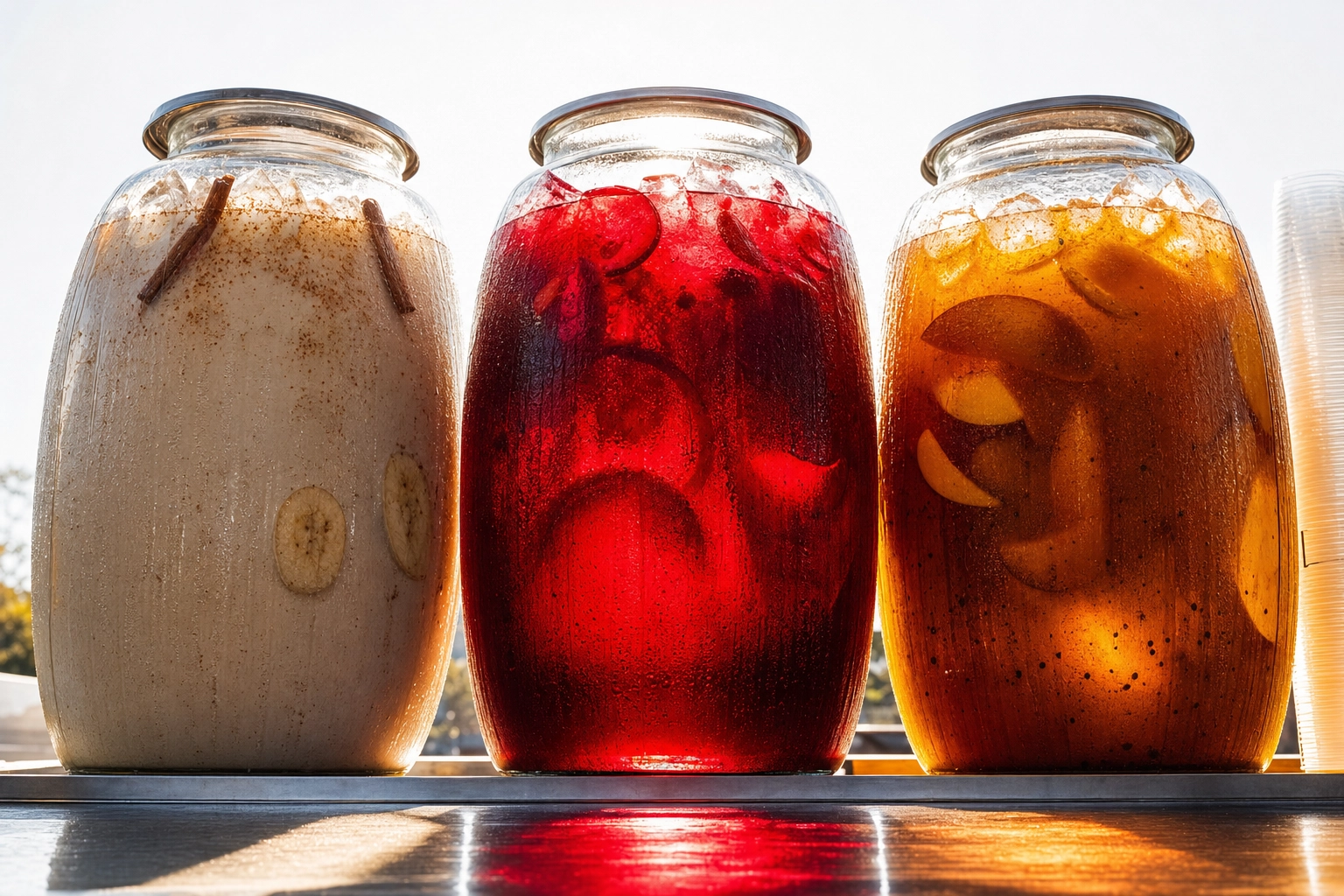 Three glass vitroleros of aguas frescas backlit against bright sky, milky horchata, deep red jamaica and amber tamarindo on a truck counter
Structure the Board So the Profitable Items Get Chosen
Customers pick a format before they pick a protein. Nobody walks up thinking "carnitas" and then decides how to have it — they think "burrito" and then choose what goes inside. So group the board by format — tacos, burritos, quesadillas, tortas, bowls — with the proteins as a line of choices underneath, not the other way around.
Then use the two positions that actually get looked at. The eye lands top-left, and on whatever has a photo beside it. Put your highest-contribution signature in one of those two slots. If your birria quesadilla makes $9 a unit and your chicken taco makes $3, the quesadilla gets the photo.
Cap the whole thing at what a stranger can read in seven seconds from ten feet back while deciding whether to join the line. Align prices in a clean column, drop the dollar signs and the decimals, and cut every description longer than six words. The physical build — sizes, backlighting, weatherproofing, swappable panels — is handled in our food truck menu board guide; this section is about what goes where.
Remember that the same layout has to work as a photograph. Your board shows up on your Google Business Profile, on event listings, and in every phone shot a customer takes of your window, so it is doing marketing work whether you planned for it or not.
Combos That Add $6 Without Adding a Cook
Attach, do not discount. The move is not knocking a dollar off the entree — it is bundling the entree with a corn item and an agua fresca at a perceived saving of 10-15%. Your blended cost improves, because you have just attached two of the cheapest things you sell to one of the most expensive.
One named house combo beats five build-your-own permutations. A stranger at a window under time pressure will take a decision that has already been made for them; give them four ways to configure it and they will order the cheapest thing on the board and leave. Name it, photograph it, price it, done. A bag of chips with salsa is still the easiest thing to bolt on, and chips cost you pennies a portion, and our taco truck guide goes deeper on per-taco pricing and the salsa program that makes people pick you over the operator two blocks away.
For catering and events, run a shorter version of the same board: two proteins, three formats, everything pre-portioned. An operation that pushes 80 covers on a slow street corner can push 250 at a six-hour event with the tighter list, and the catering side of the business is where the predictable revenue lives.
The Regional Authenticity Question, Answered Honestly
Customers know the difference now, and pretending otherwise is a losing bet. Sonoran, Jalisciense, Yucateco and Tex-Mex are distinct things, and a board claiming "authentic Mexican" while selling a hard-shell ground beef taco beside a quesabirria reads as confused rather than broad.
The fix is not to get more authentic. It is to be accurate. Pick a lane and be right about it. If you are running a Tex-Mex board with flour tortillas, queso and fajitas, say so with confidence — that is a real cuisine with real fans, and owning it beats hedging. If you are cooking Jalisciense, name the dishes correctly and describe them the way they are served in the region. Accurate naming is free credibility and costs nothing but attention.
Watch what a trend does to its neighbors, too. Datassential's tracking shows birria growing roughly 350% on US menus over four years with more growth still projected, but that rise came partly at the expense of carnitas on the same boards. When you add the trend item, check what it is quietly killing, and cut that item before it starts costing you a hold.
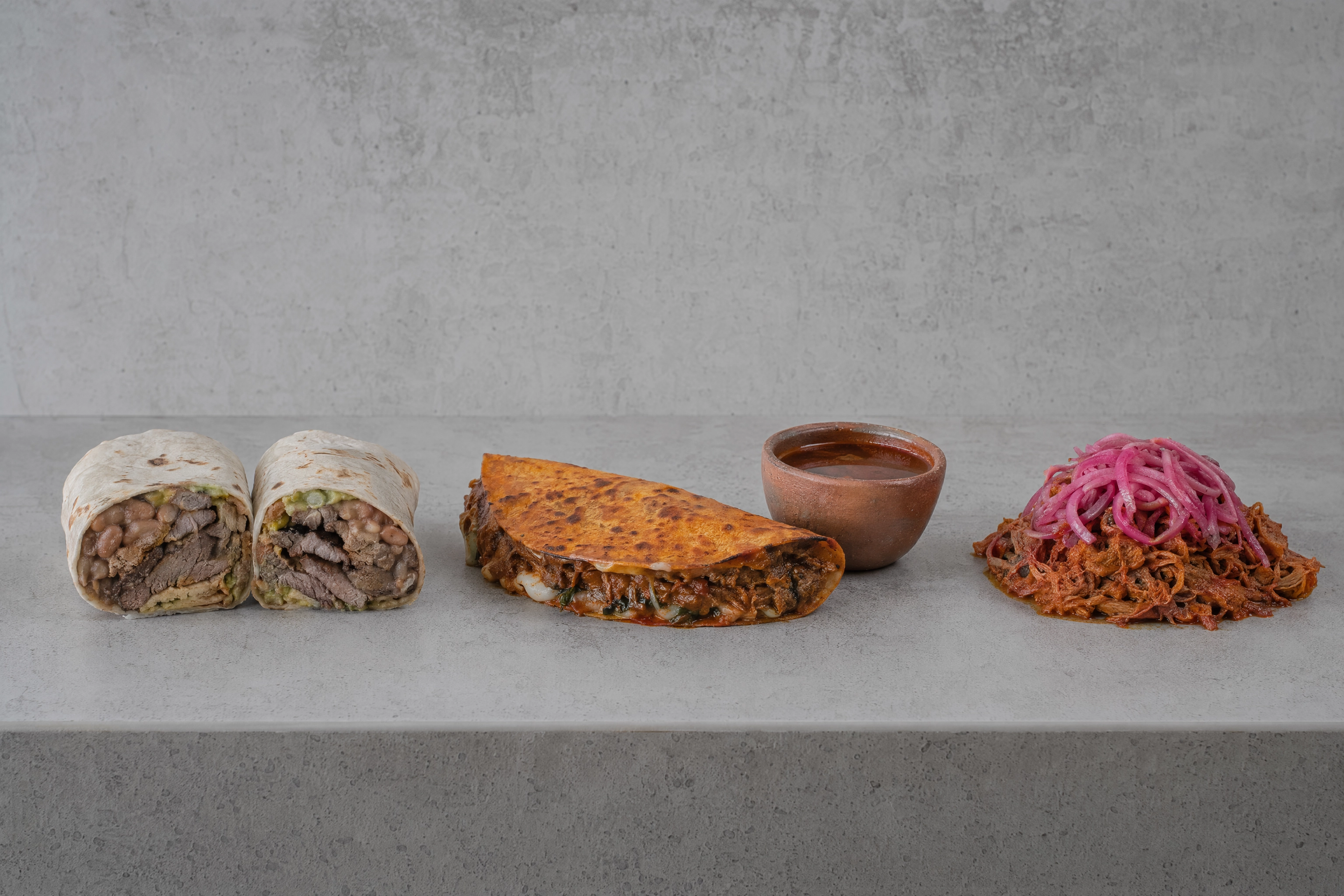 Three regional Mexican dishes compared side by side on concrete: Sonoran flour tortilla burrito, Jalisciense birria with consomme and Yucatecan cochinita pibil
Make the Board Look Like the Food Tastes
A Mexican board is the most photogenic thing on the street: chile-red salsa, charred steak, white crema, green cilantro, a wedge of lime. That contrast is precisely what sells an item on a board and on a delivery listing, where a picture is the only thing a customer has to go on.
The cruel part is that a curbside window is the worst place on earth to shoot it. Midday sun is hard and directly overhead, so it blows out the crema and drops a black shadow across everything else. Your own paint job bounces a color cast onto the plate. The background is a parking lot. And you are trying to do all of this between tickets, on a stainless ledge, with a phone.
That is the exact gap AI restyling closes. Take a clean phone snap of a real order on your counter, then turn it into a bright, studio-lit image that still shows your dish, in about ninety seconds — no photographer, no reshoot, no pause in service. Our Mexican food photography breakdown covers styling tacos, birria and salsa specifically, and the food truck photography page shows how operators run a whole board through it. One good set then does duty everywhere: Google, your delivery app listings, your burrito and taco pages, and every marketing post you publish for the rest of the season.
Frequently Asked Questions
How many items should a Mexican food truck menu have?
Twelve to fourteen published items, built from about six components across four or five formats. That is enough to feel abundant to a stranger and tight enough that one cook can hit every ticket. If you cannot name the three items that pay your rent, the board is too long.
What is the highest-margin item on a Mexican food truck menu?
Aguas frescas, at 15-25% food cost with essentially no labor at the window, followed closely by corn items like esquites. Neither will carry the board on its own — they are what turn a $12 order into an $18 one, which is often the difference between a marginal week and a profitable one.
Do I still need birria in 2026?
Only if you will braise it properly. Birria started as goat in Jalisco and became a beef dish on the way north, and it has moved from trend to expectation on most boards. Quesabirria with melted cheese and a cup of consomé is one of the strongest attachment items you can sell. But it takes real prep time, and half-hearted versions get noticed faster now that most customers have had a good one.
What is the fastest item to serve during a rush?
A braised-protein taco: warm the tortilla, portion, onion, cilantro, salsa, out in under 45 seconds. Grilled-to-order steak is close behind if it is already resting on the plancha. Anything pressed, fried or assembled to order costs you two to three minutes of griddle space each.
How do I add vegetarian options without adding prep?
Use what you already hold. Esquites, a bean-and-cheese quesadilla, a rajas taco and a corn item cover most requests with no new components. Keep one pan of beans cooked without pork fat and half your board is vegetarian-friendly for the cost of a note on the prep list.
Should prices go on the board or only in the app listing?
On the board, always. A walk-up customer who cannot see prices from the back of the line either asks or leaves, and both cost you time. Keep the board and your delivery listings priced consistently, apart from a deliberate uplift to cover platform commission.