25 Creative Food Truck Marketing Ideas That Drive Sales
 Ali Tanis18 min read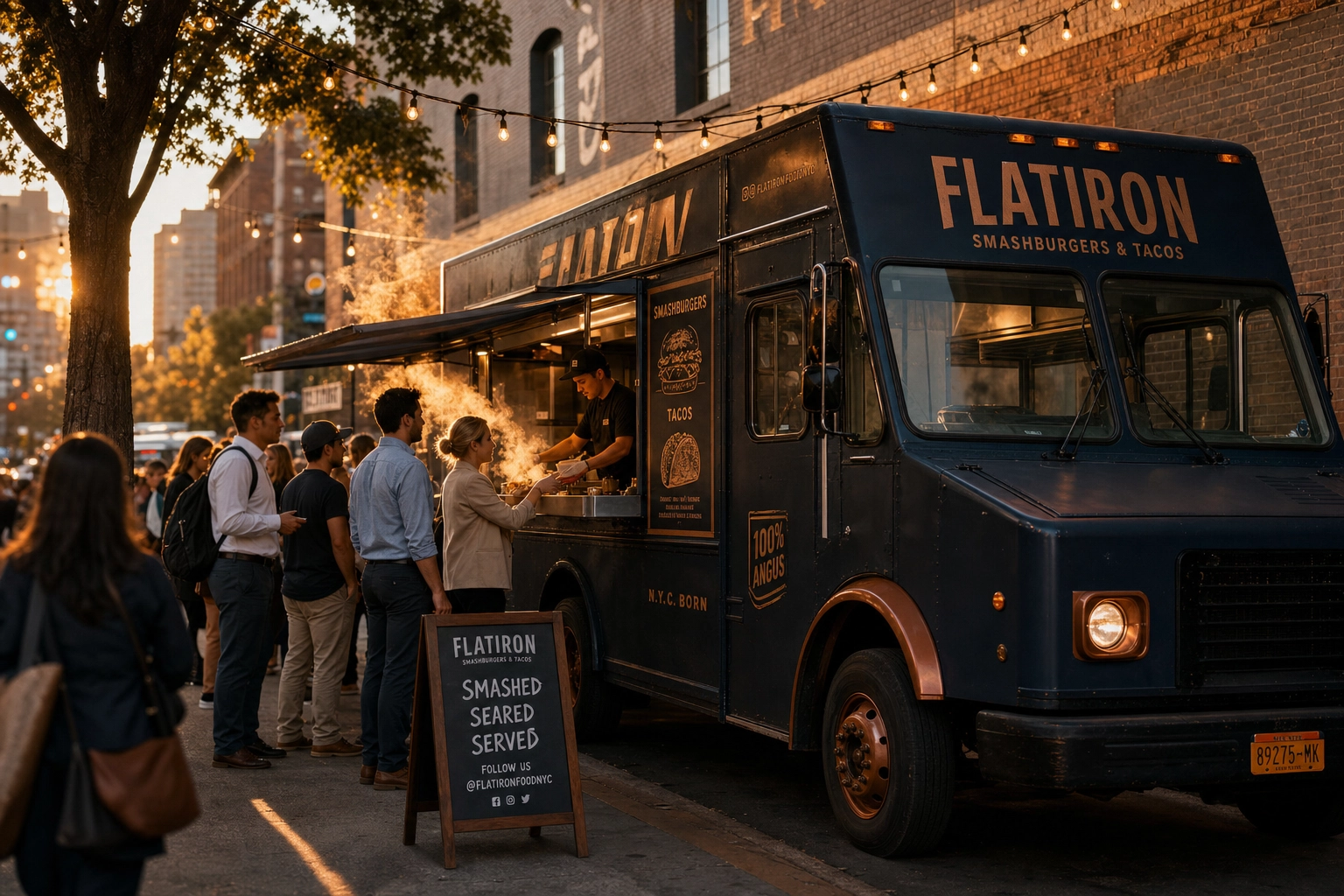
The U.S. food truck industry hit 48,400 trucks in 2026, growing 8% per year for half a decade. The average truck pulls in $346,000 annually — but only the ones that market themselves well. Talented cooking gets you in the game. Marketing keeps you in business.
Below are 25 food truck marketing ideas you can actually use, organized by how much money and effort each one demands. Some you can knock out today on a coffee break. Others are bigger bets that pay off for years. Pick three to start, ignore the rest until you're ready.
Quick Summary: Food trucks live or die on visibility. The fastest wins come from daily location posts, a Google Business Profile loaded with food photos, and one or two anchor weekly slots (brewery, office park). Bigger investments — wraps, catering, delivery apps — compound for years once your fundamentals are solid.
How to Pick the Right Ideas for Your Truck
Food trucks have a marketing problem brick-and-mortar restaurants don't: you move. Your customer can't bookmark your address. Weather can wipe out a Saturday. And 91% of trucks are independent operations, which means you don't have a marketing team — you are the marketing team, between the breakfast prep and the dinner cleanup.
Industry guidance puts marketing spend at 3% to 10% of revenue. For an average truck, that's $10,000 to $35,000 a year. New trucks in their first 12 months should lean toward the 10% end. Established trucks with regular routes can drop to 3-5% and reinvest in retention instead.
Sort the food truck marketing ideas below by your stage. New truck? Stack low-effort visibility plays first. Steady regulars but flat sales? Move to medium-effort retention tactics. Profitable and scaling? Now the high-impact investments make sense.
Low-Effort Marketing Ideas ($0–$50)
These eight ideas cost almost nothing and take an hour or less to set up. The trick isn't creativity — it's consistency. Done daily for 90 days, they compound into a real audience.
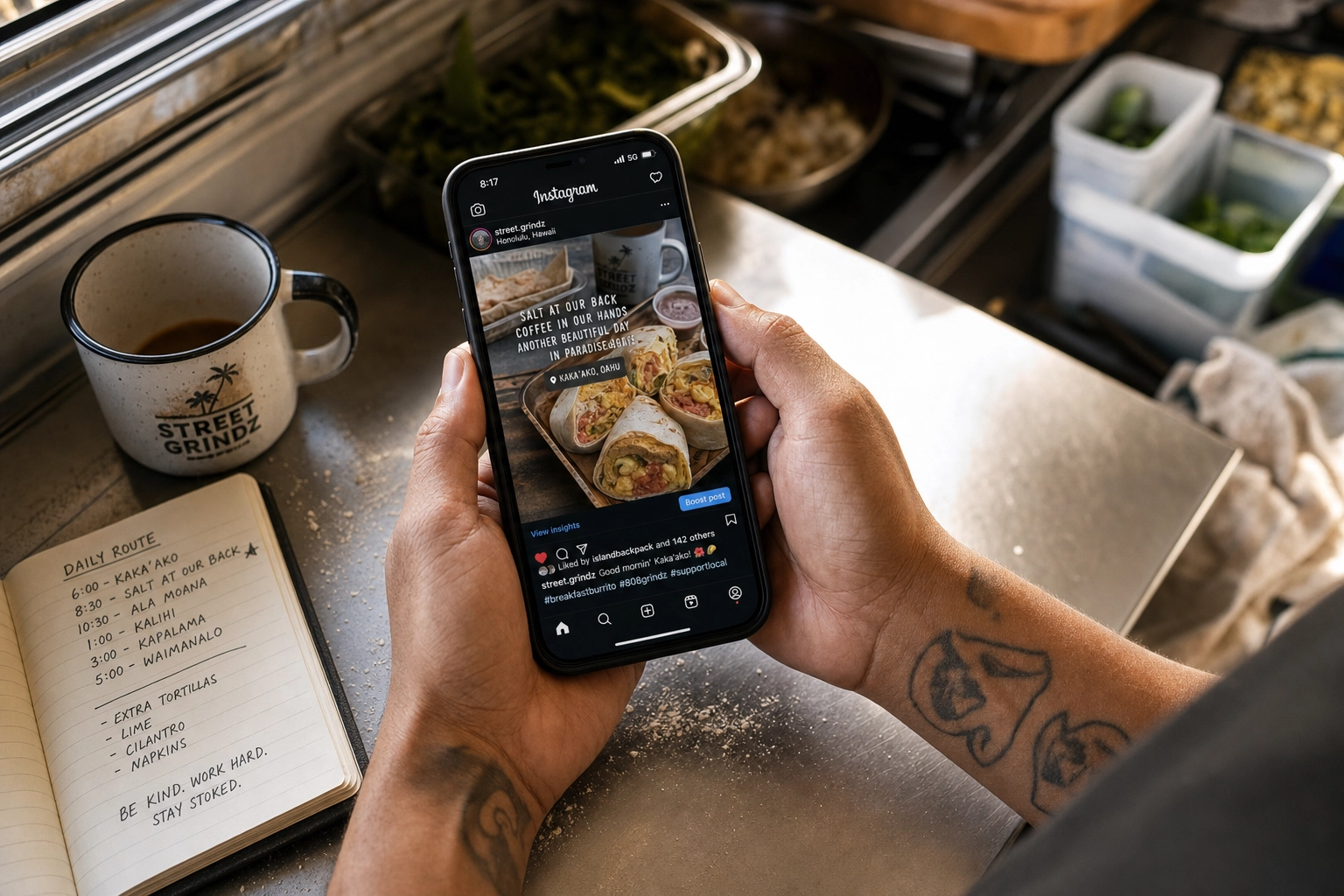 Food truck owner composing a daily location post on a smartphone next to morning prep — low-effort food truck marketing in action
1. Post Your Daily Location at the Same Time, Every Day
Pick one time — 8 AM works, or the night before for breakfast trucks — and post the same template to Instagram, Facebook, and X: a photo of food, today's location, your hours, and one line of personality. ("Brisket sandwiches at 5th & Main till we sell out. Bring a napkin.")
Roughly half of food truck customers discover new trucks through social media. They're following you for one reason: to know where you'll be. Don't make them guess.
2. Launch a Branded Hashtag and a Customer Photo Wall
Pick a tag nobody else uses (#tacotuesdaytruck, not #tacos). Print a small sign in the serving window: "Tag us — we'll repost." Then actually do it. Repost one or two customer photos a week to your stories.
User-generated content earns higher engagement than brand-owned posts because it reads as social proof, not advertising. It also gives shy customers a reason to take a photo before they eat.
3. Upgrade Your Menu Board With Real Food Photos
Most food truck menu boards are pure text. That's a mistake. A photo next to a menu item lifts orders for that item — sometimes by double digits. The cheap version: shoot each dish on your phone, run the photos through an AI food photo enhancer, print the new board, laminate at FedEx Office for $15-30.
For the full breakdown of what to shoot and how, see our food truck photography guide and food truck menu design playbook.
4. Film Behind-the-Scenes Cooking Clips
Fifteen seconds of a smashburger crisping on the flat top will outperform any polished commercial. Shoot vertical, no talking required — sound and visuals carry the message. Post the same clip to Instagram Reels, TikTok, and YouTube Shorts.
The phone in your apron pocket is the entire production budget. Shoot one clip during prep, one during service, one after close. Three pieces of content, zero extra time.
5. Optimize Your Google Business Profile
For mobile trucks, set "service area" instead of a fixed pin. Update hours daily through Google Posts. Add at least 10 photos — businesses with photos get 42% more direction requests and 35% more website clicks, according to Google's own data.
Restaurants and food businesses convert profile views to direction requests at 7-10%, roughly double the average for other industries. Your truck is a high-conversion category. Treat the profile like a landing page.
6. Claim and Build Out Your Yelp Profile
A surprising number of food searchers still default to Yelp. Claim your listing. Add hours, a menu PDF, and 10+ professional-quality photos. Pin a "find us today" line in your business description that links to your social handles.
Total time: 30 minutes. Total cost: $0. Long-tail SEO benefit: years.
7. Hand Out Business Cards With a Hook
Five hundred cards from Vistaprint or Moo run about $20. Front: logo, cuisine type, Instagram handle. Back: "Free upgrade on next visit" plus a QR code that links to your live location page (a free Linktree or one-page Google Site works). Hand one or two to every customer with their order. The QR code turns the card from a forgotten scrap of paper into a real-time route tracker.
8. Engage in Neighborhood Facebook Groups
Roughly 87% of food truck operators use Facebook to promote their business — but most stop at their own page. Join 5-10 community and neighborhood groups in the areas you serve. Comment helpfully on food threads ("Best lunch near downtown?"), then post weekly location updates where group rules allow it.
Local groups beat broad ad targeting because the audience is already filtered by geography and intent. People in those groups want recommendations.
Medium-Effort Marketing Ideas ($50–$200)
Seven ideas that take a weekend to set up and pay back for months. This is where most food trucks plateau because the work is harder. Push through.
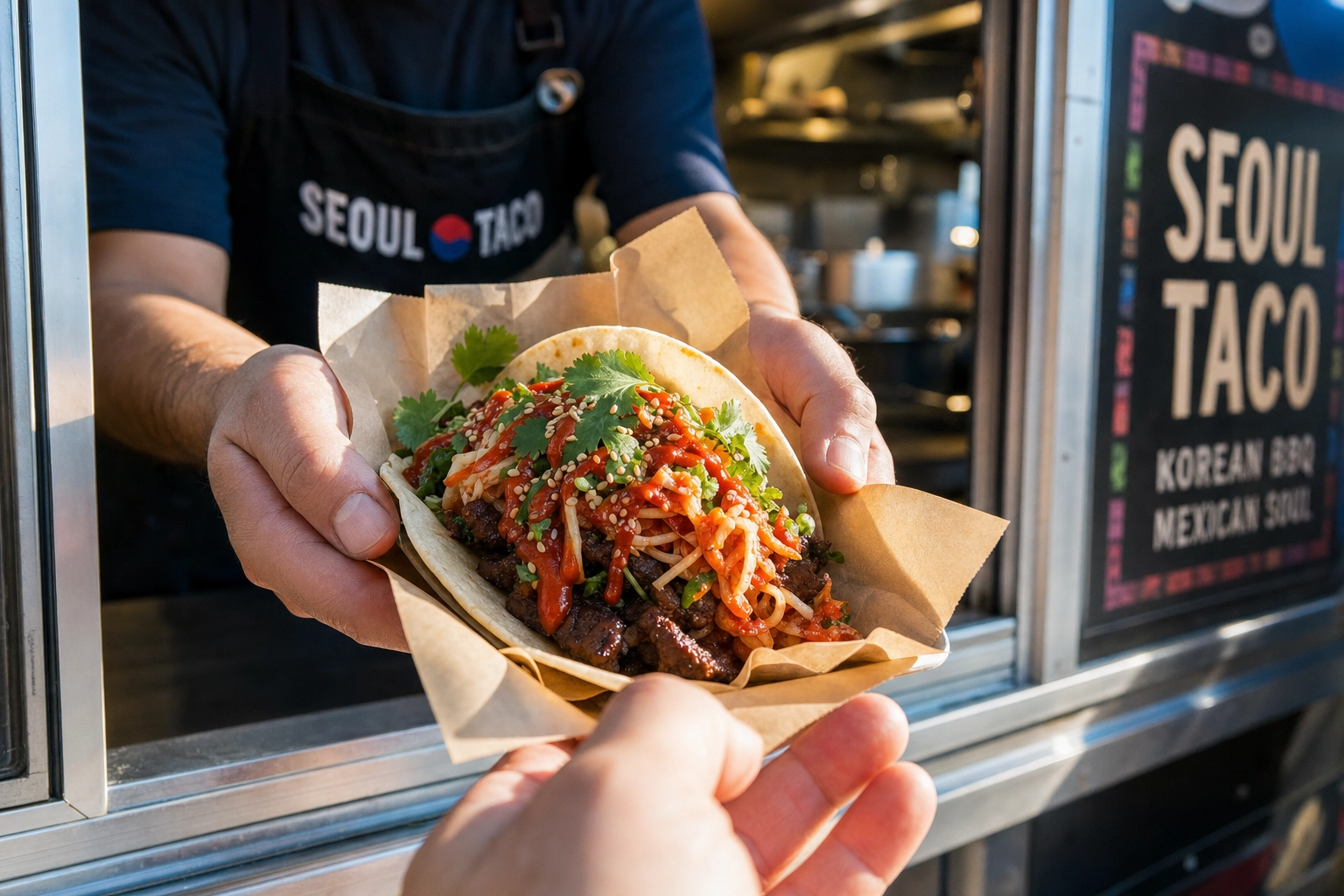 Signature Korean-Mexican fusion taco being handed through a food truck window — Instagram-worthy hero dish photography
9. Engineer One Instagram-Worthy Signature Dish
Pick or design one dish that photographs perfectly: a cheese pull, a sauce drip, vertical height, color contrast. Birria with a consommé dip shot. Lava-center cookies. Ube ice cream in a black charcoal cone. Spend $50-150 testing variations until you have a winner.
This dish becomes the hero of your menu board, your delivery app cover photo, and every paid ad you'll ever run. One photogenic item earns its weight back in foot traffic within a month.
10. Run Limited-Time Specials That Force Urgency
"Today only: braised short rib tacos, $14. We made 60. When they're gone, they're gone." That's the entire formula. Post the special at 11 AM with countdown stickers in stories. Pull from your regular ingredient list with one twist so prep stays manageable.
FOMO works on food trucks because the entire model already implies scarcity — you're here for hours, not days. Lean into that. Customers who plan their lunch around your special are loyal customers.
11. Start a Loyalty Punch Card or Digital Equivalent
Physical punch cards: $30-80 for 500 cards from a local printer. Digital versions: free with Square Loyalty, Toast, or stand-alone apps like Stamp Me. Sixty percent of food truck customers say they return after a positive experience. Punch cards turn that "maybe" into nine documented visits.
Reward at visit five or ten, not twelve. The math has to feel achievable. A free meal at visit ten beats a free meal at visit fifteen, every time.
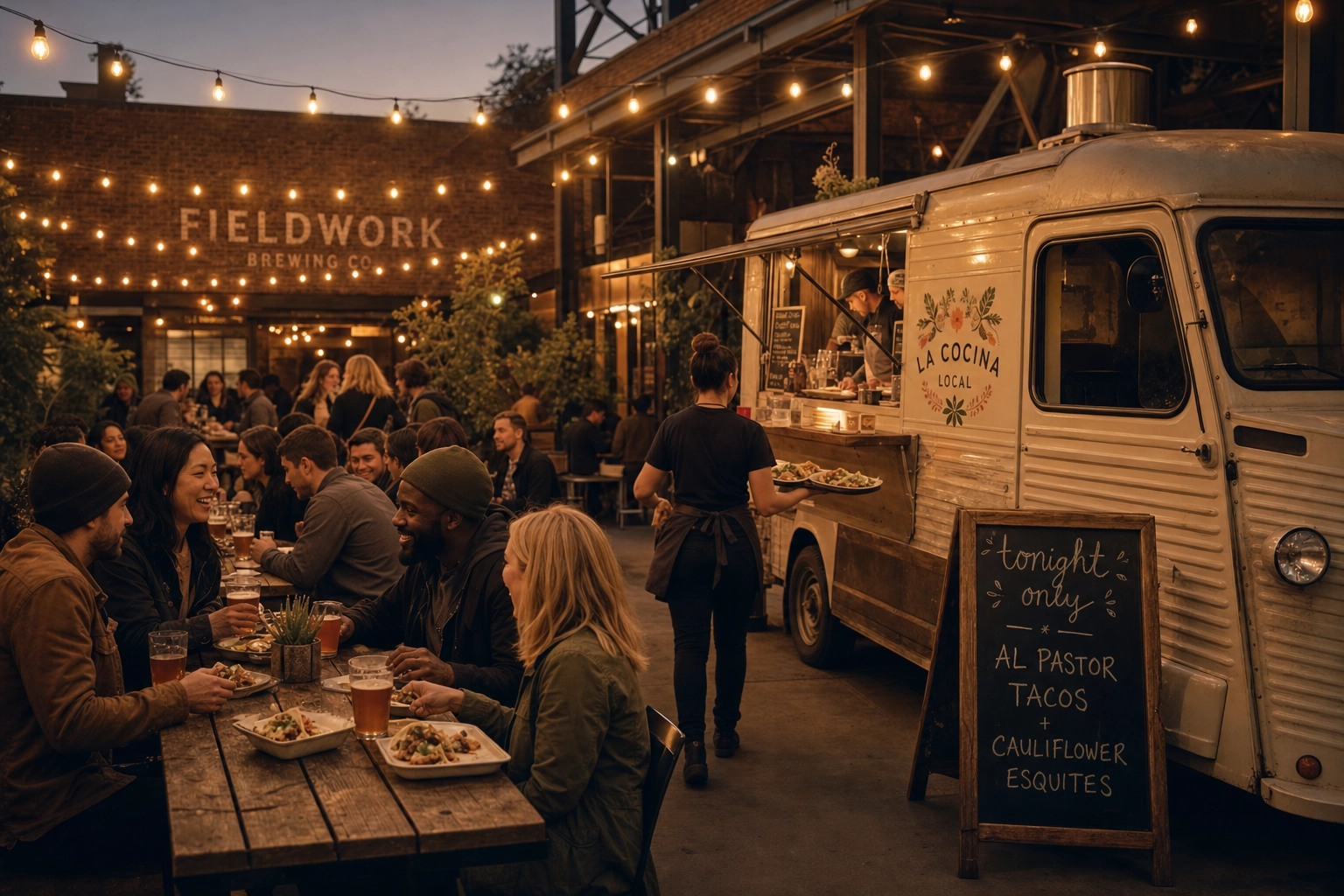 Food truck parked at a brewery courtyard with string lights and communal dining — weekly brewery slot partnership marketing
12. Lock Down a Weekly Brewery or Taproom Slot
Most state laws require breweries to serve food on-premises if they want to keep the doors open past a certain hour. That's a built-in mutual benefit. Pitch the local brewery: "I bring the food, you keep your guests another hour, we cross-promote on social." Slot fees range from $0 to $50, sometimes free in exchange for tagged posts.
These slots are gold in winter when festival season dries up. Brewery crowds are pre-hungry, pre-thirsty, and pre-loyal to the venue. You're the missing third leg.
13. Build an Office Park Lunch Route
Business districts account for 34% of food truck patron locations, according to industry surveys. Email three to five office buildings in your radius and pitch a Tuesday-Thursday lunch slot, plus a discount code for tenants. Set up pre-orders via QR code at the front desk. Predictable revenue, predictable hours, predictable food cost.
Office lunch slots often beat festival economics on a per-hour basis. No vendor fee, smaller line, higher average ticket because office workers buy for the whole team.
14. Add a Customer Referral Reward
"Bring a friend who hasn't tried us — both get 20% off." Print on receipts, share through your SMS list, post in stories. Track with a simple code or punch on the loyalty card.
Referral acquisition costs roughly $2-3 per new customer in discount value — a fraction of what paid ads cost. The catch: it only works if your food and service are referral-worthy. If your repeat rate is under 30%, fix the product first.
15. Show Up at Local Festivals and Events
Festivals are the single biggest customer acquisition channel for food trucks. About 47% of patrons report finding their favorite trucks at festivals and street fairs. Vendor fees range from $100 to $500 per day for small events, up to $2,000+ for the big ones.
Apply 6-12 months ahead for the popular slots. Stack two or three festivals a month with your weekday route, and you'll have a balanced calendar — discovery on weekends, retention during the week.
High-Impact Marketing Investments ($200+)
Five bigger bets. Each costs more upfront but compounds for years. Don't tackle these until your low-effort fundamentals are running on autopilot.
16. Invest in a Professional Truck Wrap
Full vinyl wraps run $2,500-$5,000. Partial wraps come in around $700-$1,500. Either way, you're buying a mobile billboard that passes tens of thousands of eyes during a typical commute day. Compared to billboard rentals, the math is absurd in the truck's favor.
Design rules: legible from 50 feet, social handles and cuisine type front and center, contrast over cleverness. Get the design proofed by three people who've never seen your truck. If they can't tell what you sell in two seconds, redesign.
17. Partner With Local Micro-Influencers
Skip mega-influencers. For food trucks, micro-influencers in the 5,000-25,000 follower range deliver better results — engagement is higher, audiences are more local, and rates are reasonable. Expect $50-200 per post, or comp meals in exchange for a reel.
Search Instagram for "[your city] food" and track who's posting weekly. DM five to ten of them with a free meal offer. Track conversions with a unique discount code so you know which influencer actually drove orders.
18. Build a Catering Arm of the Business
For diversified trucks, catering can hit 30-50% of total revenue. It's also weather-proof — catering doesn't care if it's raining at the lunch spot. Build a dedicated catering page on your website with a PDF menu, package pricing, and a fast inquiry form.
Push hard on corporate accounts. One company that books a $400 lunch every other Friday is worth more than 50 walk-up customers. For more depth on catering positioning and client acquisition, see our catering marketing guide.
19. List on Food Delivery Apps (Strategically)
Uber Eats, DoorDash, and Grubhub take 15-30% commission per order. That's brutal on food truck margins unless you're parked in one spot for at least four-hour blocks. Listing makes sense for office park days, brewery slots, and festival weekends — not for a constantly moving route.
Photos drive the conversion lift on delivery apps, sometimes 30-50% per listing. Generic phone shots get scrolled past. Crisp, on-brand imagery gets ordered. See our DIY vs pro vs AI food photography breakdown for the cost comparison, or jump straight to AI photography for food trucks.
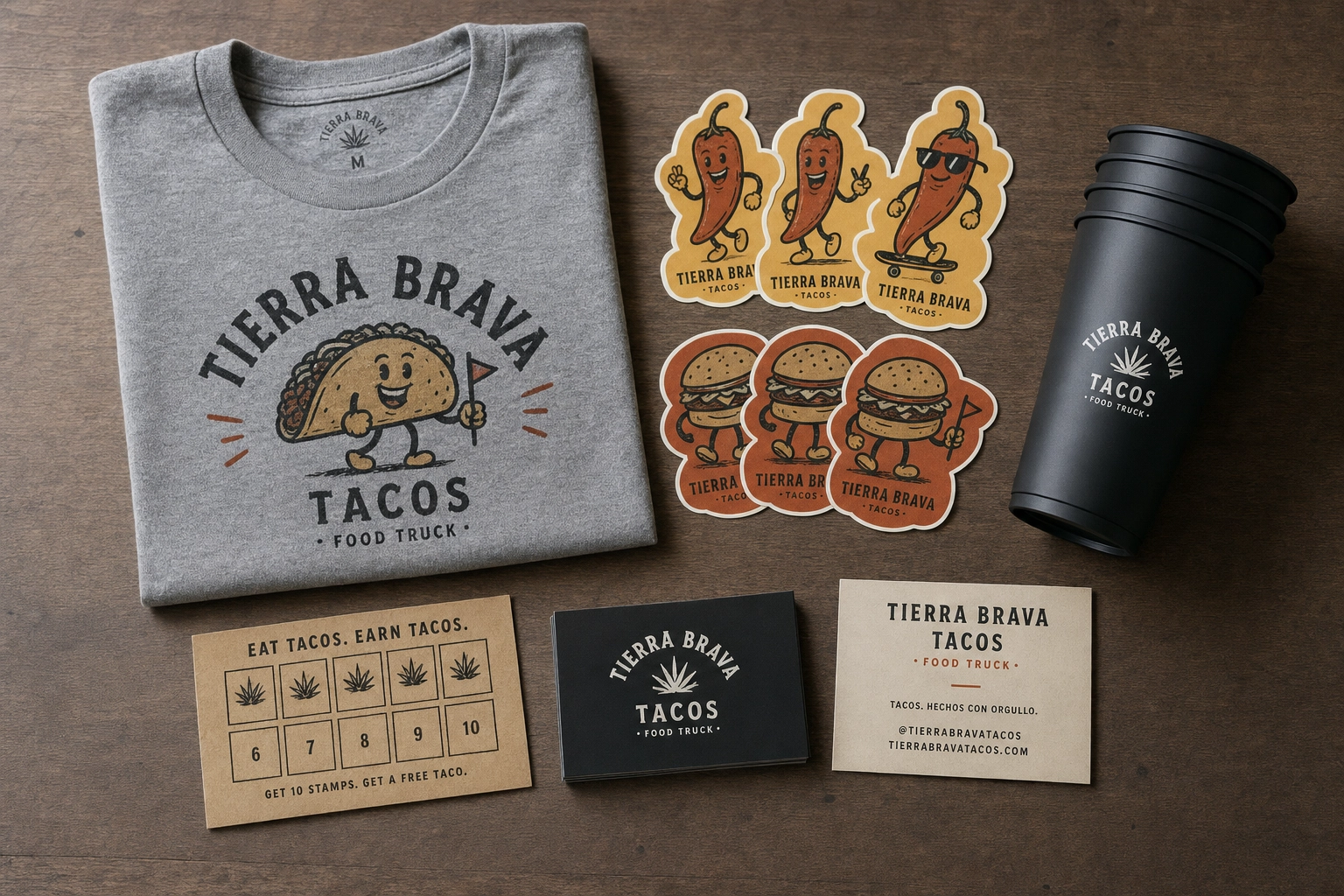 Flat-lay of branded food truck merchandise: t-shirt, stickers, reusable cups, punch card and business cards on walnut surface
20. Sell Branded Merchandise Customers Actually Want
Stickers run $50-100 for 250 die-cut units. T-shirts cost $8-12 per unit at 50+ quantity. Branded reusable cups: $1-3 each. Sell at cost or a small markup — the goal is exposure, not profit.
The best sellers are stickers that end up on laptops, water bottles, and notebook covers. Each sticker is roughly $0.30 of investment for hundreds of impressions. A $12 t-shirt? It walks around your city for years. Treat merch as a marketing line item, not a revenue line.
Digital Marketing Channels Worth Mastering
Five digital plays where food trucks can punch above their weight. The advantage: digital scales with effort, not budget.
21. Build an Email and SMS List for Location Drops
SMS open rates run 90-98%, compared to email's 20-28%. For a "we're at 5th & Main till 2 PM" message, SMS wins every time. Tools like SimpleTexting or EZTexting start at $15-30 a month for small lists.
Capture phone numbers at the point of sale: "Text JOIN to [number] for $1 off today." Send one or two messages per week, maximum. Over-texting is the fastest way to kill a list. Save SMS for time-sensitive drops; use email for longer-form updates like new menu launches.
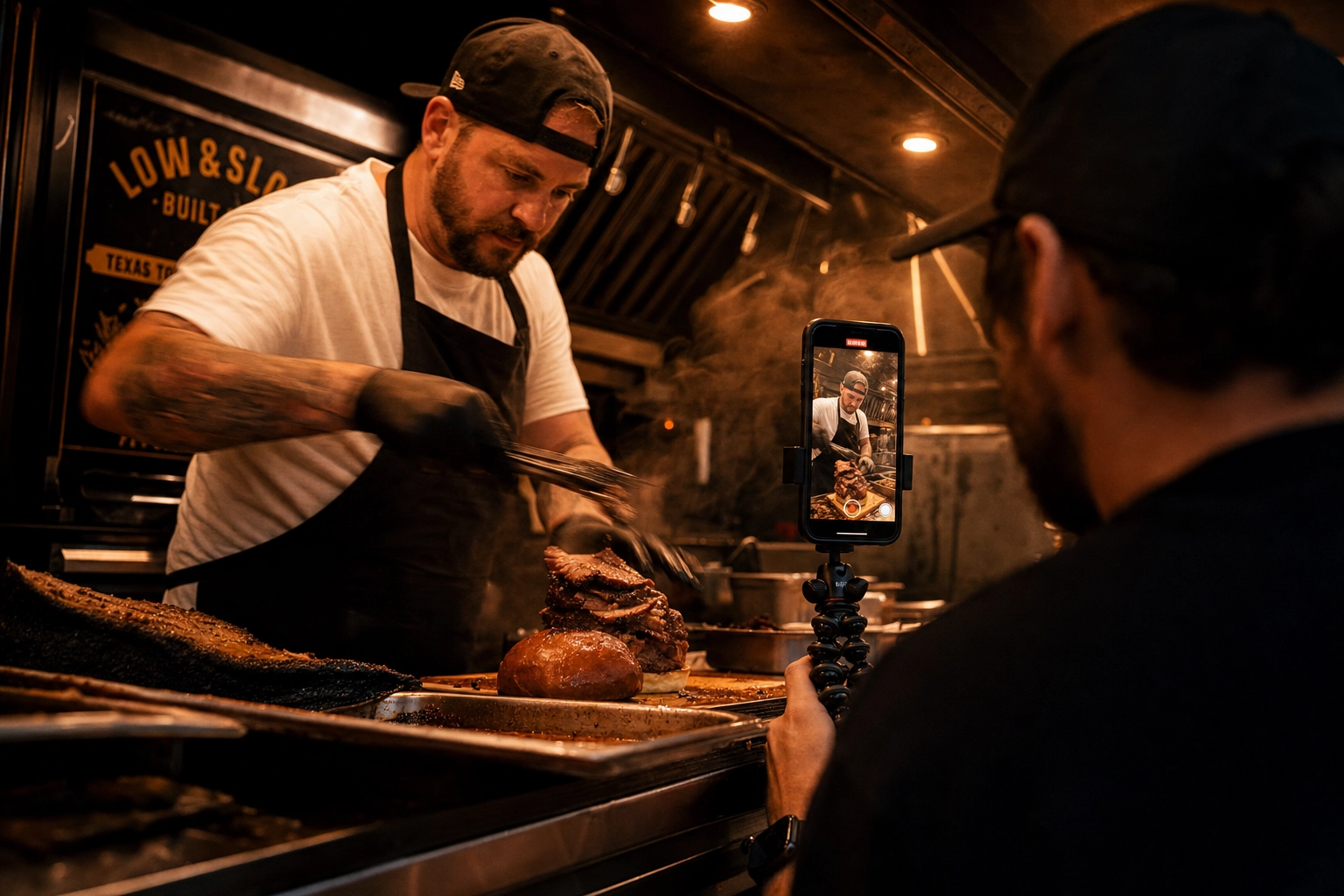 Food truck chef plating brisket while crew member films vertical content on a smartphone tripod — TikTok and Reels production
22. Make TikTok and Reels Your Free Acquisition Engine
Vertical, 15-60 second clips of cooking, plating, and customer reactions. Layer trending audio over the visuals. The "food truck" tag on TikTok has billions of cumulative views, and the platform's algorithm pushes hyper-local content to nearby users automatically.
One viral clip can pull 10,000-100,000 local impressions in 48 hours. The catch: you can't fake authenticity. Shoot real food, real customers, real moments. Polish kills reach on these platforms.
23. Take Food Photography Seriously
Most truck owners use blurry phone shots — and lose to better-photographed competitors on every single channel. The fix has three options:
- Hire a food photographer: $300-1,500 per session, 3-7 day turnaround, scheduling friction.
- Shoot yourself with a guide: free, but takes practice. Start with how to take good food photos.
- Use AI enhancement: snap a phone photo, transform it into a menu-ready image in 90 seconds at a fraction of pro pricing.
The right answer depends on volume. Trucks shooting one signature dish a quarter can hire a pro. Trucks rotating weekly specials need something faster. See FoodShot pricing for AI options under $15/month.
24. Drop a Seasonal Menu Every Quarter
Four seasonal launches a year give you four built-in marketing events. Tease for two weeks before each drop with countdown posts and behind-the-scenes prep clips. Add "gone after [date]" urgency for limited items.
Each seasonal menu earns fresh photos, a press angle for local food bloggers, and renewed social momentum. Food media outlets will cover a thoughtful seasonal pivot but will ignore a year-round menu, every time.
25. Run Pop-Up Collaborations With Other Trucks
Pair with a non-competing truck for a one-night collab menu. BBQ truck plus dessert truck. Mexican plus Korean fusion. Each truck brings its own audience — 2x reach for 1x effort.
Document the collab with reels and tag both accounts. The algorithm pushes shared content to both audiences, often outperforming solo posts on engagement. Bonus: you get to learn from another operator's workflow up close. Most trucks come back with two or three operational improvements after a single collab.
How to Sequence These 25 Food Truck Marketing Ideas Without Burning Out
Twenty-five ideas at once is a recipe for burnout. Sequence matters more than ambition.
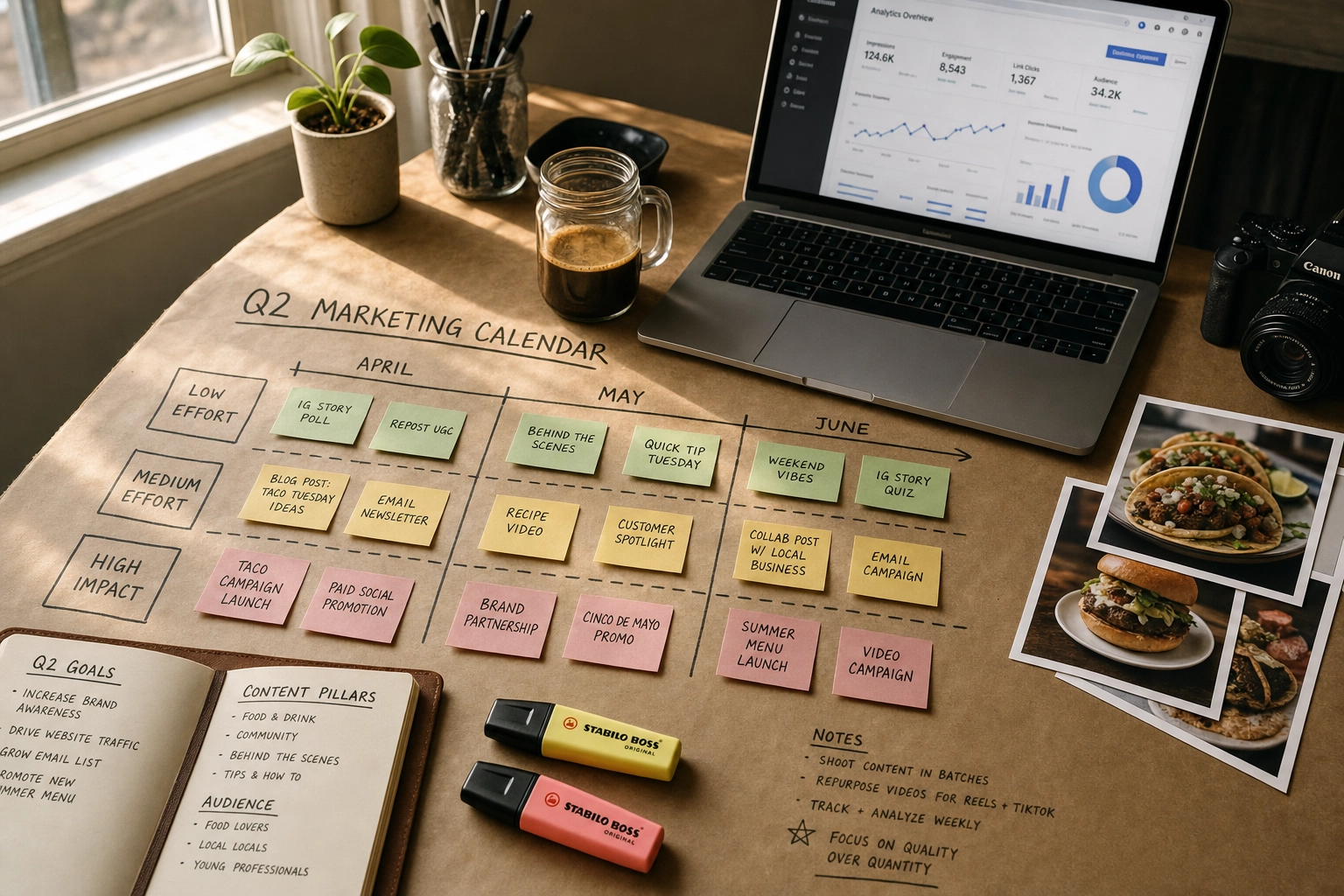 Food truck owner's quarterly marketing planning workspace with sticky-note calendar, laptop and notebook — sequencing strategy
Week 1: Pick three low-effort food truck marketing ideas. The defaults that work for almost any truck: daily location post (#1), Google Business Profile cleanup (#5), and the menu board photo upgrade (#3). Knock all three out before Friday.
Month 1: Add one medium-effort play. The brewery slot (#12) is usually the fastest path to recurring revenue. Office park route (#13) is the next-best.
Month 3: Layer in catering (#18) and start collecting SMS opt-ins (#21). These compound into your most reliable revenue streams within a year.
Quarter 2 onward: Plan one high-impact investment per quarter — wrap, festival circuit, delivery app expansion. Treat the rest as a rotation, not a checklist.
For the strategic framework that ties all of this together — positioning, brand, retention math — see our complete food truck marketing strategy guide. And for the social-specific playbook, social media marketing for food trucks goes deeper on platform-specific tactics.
Frequently Asked Questions
How much should a food truck spend on marketing?
Industry guidance puts marketing spend at 3-10% of revenue. For the average $346,000 truck, that's $10,000-$35,000 a year. New trucks in their first 12 months should lean closer to 10% to build awareness. Established trucks with regular routes can drop to 3-5% and reinvest the difference into retention plays — loyalty, SMS, catering — that have higher long-term ROI.
What's the single most effective food truck marketing channel?
Daily social media location posts, paired with a memorable physical experience and an SMS follow-up list. Roughly half of food truck customers discover new trucks through social media. But discovery only converts to repeat business when the food, service, and follow-up are all there. Pick the channel where your customers already are, post daily, and capture phone numbers at every transaction.
How do food trucks attract customers in winter or off-season?
Three plays: pivot to catering (corporate lunches, holiday parties, weddings), lock in indoor venues (food halls, brewery taprooms, indoor markets), and stay visible on social even with reduced hours. Catering alone can carry a truck through January and February. Most successful trucks tell us catering becomes 30-50% of total revenue once they invest in it.
Are food delivery apps worth it for food trucks?
Only with a stable location for at least four-hour blocks. The 15-30% commission cuts truck margins thin, and constantly-changing locations confuse the apps. Use Uber Eats, DoorDash, and Grubhub for fixed-route days — office park lunches, brewery dinners, festival weekends — not for full reliance. Solid photography is non-negotiable; listings without strong food photos lose to listings with them.
How do I get my food truck on local "best of" lists?
Email local food bloggers, weekly newspapers, and city magazine editors directly. Pitch a story angle, not a press release: "first [cuisine] truck doing X in [neighborhood]." Attend food media events when you can — editors cover trucks they meet in person. Once you land one feature, "as seen in [outlet]" becomes a credibility multiplier for every other pitch.
Do food truck owners need a website?
Yes. At minimum, a one-page site with your menu, weekly schedule, social links, and a catering inquiry form. Tools like Squarespace, Wix, or Carrd run $10-20 a month. Two reasons it matters: catering inquiries (people aren't going to DM you a wedding booking) and SEO for "best [cuisine] near me" searches. Search engines still trust websites more than social profiles.
Pick Three. Start This Week.
Don't try to run all 25 food truck marketing ideas. The trucks that win usually do five or six things consistently — not 25 things sporadically. Pick one low-effort idea you can knock out today. Pick one medium-effort idea you can launch this month. Plan one high-impact investment for next quarter.
The fundamentals never change: be findable, be photographable, be worth coming back for. Everything in this list is just a different way to amplify those three things.
If your photography is the gap — and for most trucks, it is — that's the highest-ROI fix on this entire list. Better menu board photos lift average ticket size. Better delivery app photos lift conversion. Better social photos lift discovery. AI photography built for food trucks handles all three from your phone in 90 seconds. Compare plans on FoodShot pricing — the Starter tier covers a typical food truck's full menu for $9 a month on the annual plan.
Now stop reading. Pick three. Go.