Ghost Kitchen Marketing: 10 Tactics to Drive Delivery Orders
 Ali Tanis21 min read
Ghost kitchen marketing has a brutal truth most operators learn the hard way: your food can be incredible, your prices fair, your service flawless — and you'll still lose to the restaurant down the block whose photos look better on the app.
That's because ghost kitchen customers never walk past your sign, never smell garlic on the breeze, never peek in your window. Every single delivery order starts and ends on a screen. The marketing problem isn't getting people in the door — it's getting them to tap one specific tile out of 200 on DoorDash.
This guide breaks down ten ghost kitchen marketing tactics that actually move the needle, ranked by impact. We'll cover the conversion data, the platform rules, and the dollar math behind each one — with one constant theme: ghost kitchens live and die by their food photos.
Quick Summary: Ghost kitchen marketing is 100% digital, with food photography as the highest-leverage lever — professional photos drive 30–70% more orders on Grubhub and 24% more on Deliveroo. Layer on delivery app optimization, smart promotions, a direct ordering site, social, Google Business Profile, influencers, multi-brand strategy, packaging, and retargeting to compound results.
Why Ghost Kitchen Marketing Is Different (And Harder)
The global ghost kitchen market hit roughly $113 billion in 2026 and is projected to reach $204 billion by 2030, growing at a 16% CAGR. That growth attracts thousands of new entrants every quarter — which means your delivery listings now compete with more virtual restaurant brands than ever, often coming out of the same building you do.
A traditional restaurant has built-in marketing: foot traffic, signage, the smell of bread baking, a host smiling at the door. You have none of that. What you have instead:
- A 1400×800 hero image on each delivery platform
- A few lines of menu copy that have to do the work of a server
- Whatever your packaging says when the food arrives
- Whatever a stranger posted about you on TikTok
That's it. That's your entire online storefront. And the operators who treat it that way are the ones still standing in two years.
The good news: digital marketing rewards precision. Every dollar is trackable, every photo can be A/B tested, every menu description is iterable. Ghost kitchens that lean into measurement beat ghost kitchens that wing it. Every time.
1. Treat Food Photography as Your Virtual Storefront
This is non-negotiable, and it's why we're listing it first in any ghost kitchen marketing plan. If you only do one thing on this list, do this.
The conversion data isn't subtle:
- Grubhub: restaurants with food photos see 30–70% more online orders than text-only listings
- Deliveroo: professional photography drives a 24% sales boost
- DoorDash: menus with images see roughly a 15% increase in delivery volume
- Just Eat: dishes with quality photos get 4× more basket additions
- Limetray industry data: photo-based menus convert at 25% higher rates than text menus
And from the consumer side: 73% of customers say they won't order a dish that doesn't have a photo. Not "prefer not to" — won't.
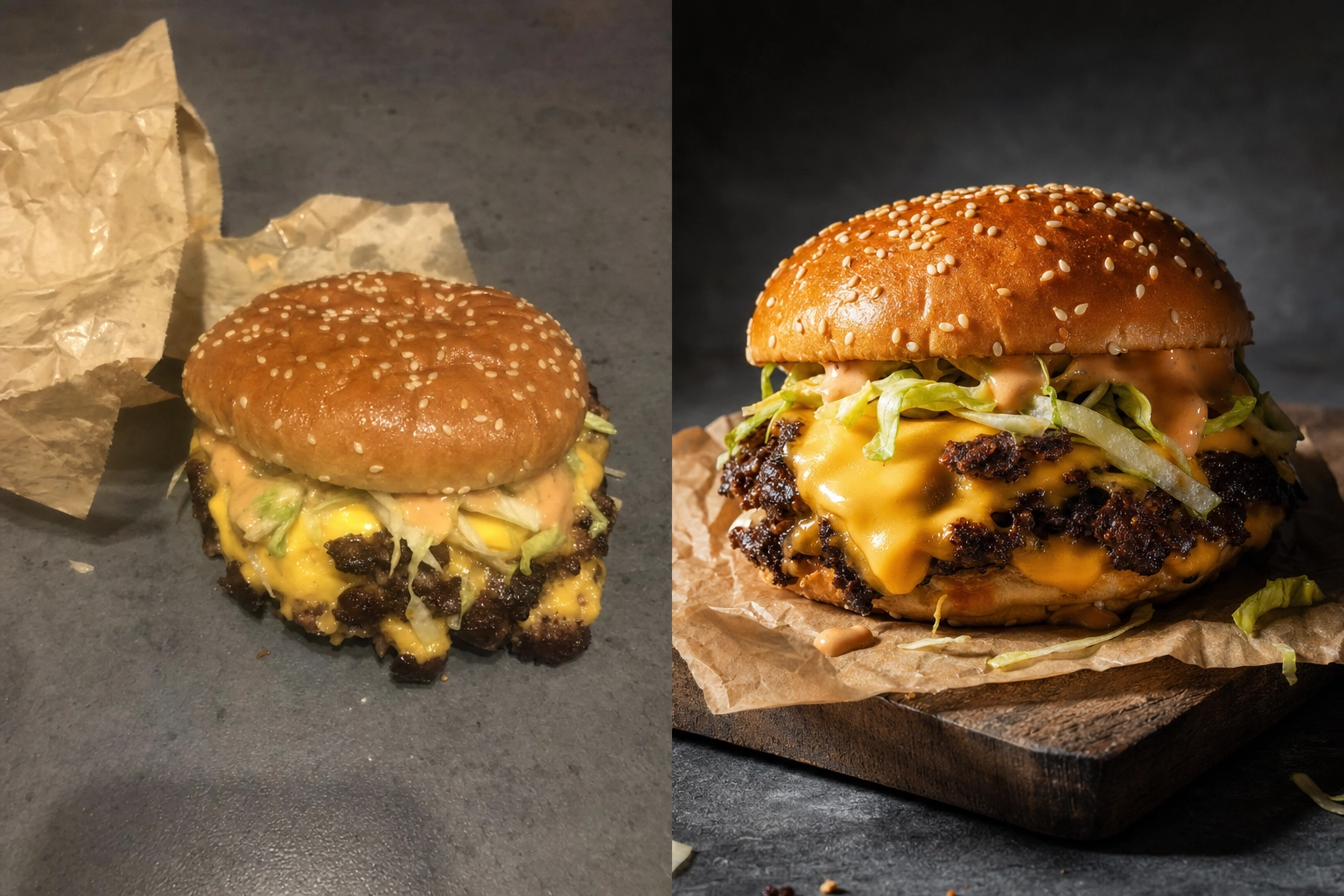 Phone snap versus professional studio food photography comparison of the same cheeseburger for delivery apps
Here's the part most ghost kitchen operators miss: a bad photo is worse than no photo. A blurry, poorly lit phone snap signals low effort and makes the food look unappetizing — both of which crater your conversion rate. The delivery apps know this too. DoorDash and Uber Eats algorithms factor menu-view-to-order conversion into how often they surface your listing, so weak photos quietly demote you in search.
The cost reality of professional restaurant photography:
| Option | Cost per dish | Turnaround | Reshoot for menu changes |
|---|---|---|---|
| Studio photographer | $50–150 | 1–2 weeks | Pay again every time |
| Day-rate photographer | $700–1,400/day | Schedule + edit | Schedule + pay again |
| Phone snap + filter | $0 | 5 min | Free but underperforms |
| AI food photo enhancement | A few cents | 90 seconds | Re-run anytime |
For a 30-item menu, that's $1,500–4,500 with a traditional photographer — every time you change the menu. Most ghost kitchens iterate menus monthly. The math doesn't work.
This is exactly the gap AI food photography was built to close. Take a phone photo of the actual dish, run it through a delivery-optimized style preset, and you have a menu-ready shot in 90 seconds. For a deeper breakdown of platform-specific photo specs, see our food delivery app photography guide. For a detailed cost comparison, our food photography for restaurants post breaks down DIY vs pro vs AI side by side.
The point isn't which tool you use. The point is that "we'll fix the photos later" is the most expensive sentence in ghost kitchen operations. Fix them now.
2. Optimize Your Delivery App Profiles Like Landing Pages
Your DoorDash, Uber Eats, and Grubhub profiles aren't just listings — they're online conversion funnels. Treat them with the same rigor you'd treat a high-traffic landing page.
Hero image: Pick your most-ordered or visually striking dish, never your logo. The hero is what hungry customers see in delivery search results. A bowl of glistening ramen pulls taps; a grayscale logo doesn't.
Menu item descriptions: Lead with the craving — texture, technique, sensory cues — not an ingredients list.
- ❌ "Burger with cheese, lettuce, tomato, sauce, brioche bun."
- ✅ "Smashed two-patty cheeseburger with crispy edges, melty American, secret sauce on a buttered brioche bun."
You have about 8 seconds before a hungry user scrolls past. Make every word work.
Category order matters: Apps display categories in the sequence you set. Order them by margin × velocity — your highest-margin, fastest-selling category at the top. Most operators leave categories in alphabetical or random order and silently lose 10–15% of revenue.
Photo specs that work across platforms:
- Minimum 1400×800 pixels (DoorDash and Uber Eats both prefer landscape)
- Bright, even lighting — no harsh shadows
- Centered subject, ~60–70% frame fill
- Consistent style across the menu (this is what brand recognition looks like at scale)
Quality thresholds you have to clear: In 2023, Uber Eats removed roughly 5,000 virtual kitchens from the platform for violating quality rules. The current bar:
- Minimum 4.3-star average rating
- 5% or fewer canceled orders
- 5% or fewer inaccurate orders
Drop below those and your ranking tanks — or you get delisted entirely. Photos drive volume; operations keep you on the platform.
3. Run Smart Promotions Across DoorDash, Uber Eats, and Grubhub
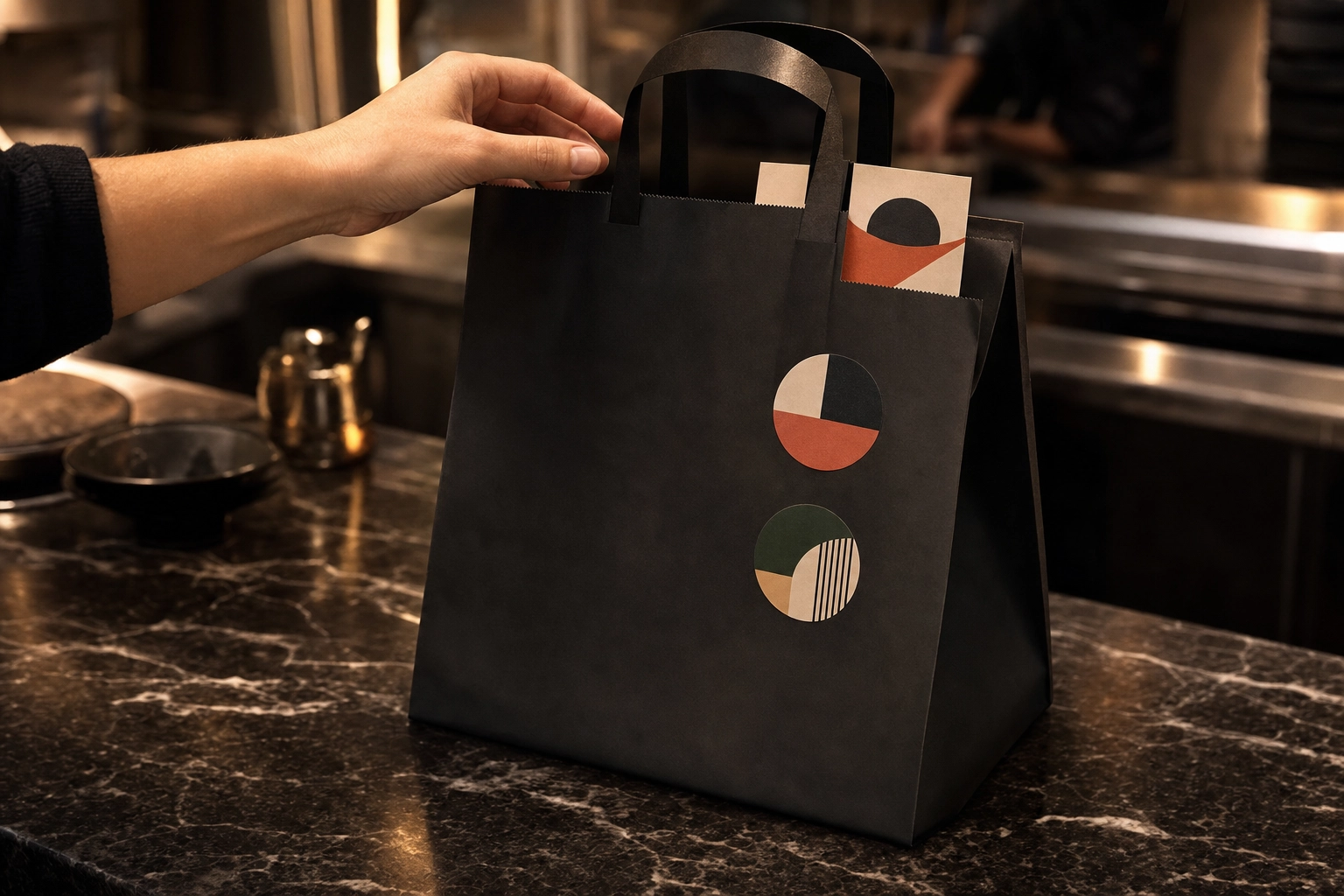 Branded ghost kitchen takeout bag with promotional sticker badges on marble countertop
Promotions on third-party platforms do two things at once: they buy you visibility (the algorithm boosts promoted listings in search) and they give cold customers a reason to try you. Run them wrong and they torch your margin. Run them right and they're the cheapest customer acquisition you'll find in ghost kitchen marketing.
Three promo types that actually work:
- BOGO on high-margin items. A buy-one-get-one on a $14 bowl that costs you $4 to produce is profitable even after platform commission. BOGO on a $9 sandwich that costs $6 is not.
- Free delivery above a basket threshold. "Free delivery on orders $25+" lifts average order value by ~18% in most categories. The platform usually splits the cost with you.
- Sponsored listings during your slow hours. Pay-to-play placement during 2–4pm or post-9pm windows when competition is thinnest delivers the best ROI on ad spend.
Promos to avoid:
- ❌ 30%-off the entire menu — kills margin after platform commission stacks on top
- ❌ Permanent discounts — train customers to never pay full price
- ❌ Identical promotions running on every platform simultaneously — no platform-level differentiation, no urgency
The math you need to track: Customer acquisition cost (CAC) per platform. If a Sponsored Listing campaign on DoorDash costs $400 and brings 80 first orders at $18 average, that's a $5 CAC. If your contribution margin per order is $6, you broke even on order #1 — and now those customers are in your retargeting funnel for free.
One 2026 wrinkle: Uber Eats raised commissions in two of its three pricing tiers earlier this year. Promotions that worked at the old rates may not pencil out at the new ones — recheck your unit economics quarterly.
Most ghost kitchen operators run promos by gut feel. The ones who track CAC and lifetime value pull ahead within a quarter.
4. Build a Direct Ordering Website to Escape 30% Commissions
DoorDash, Uber Eats, and Grubhub charge 15–30% per delivery order on commission tiers, and once processing fees, promotions, and refund chargebacks are stacked in, the effective cost often hits 30–40% of revenue. That's a brutal tax on a thin-margin restaurant business.
A direct ordering channel changes the math. Compare:
| Channel | Cost per $50 order |
|---|---|
| Marketplace order (30% tier) | ~$15 in fees |
| Uber Eats Webshop | ~$1.54 (2.5% + $0.29) |
| Owner-built website + Stripe | ~$1.75 (3.5% + $0.30) |
| White-label delivery (Uber Direct, DoorDash Drive) | Flat fee, no % commission |
That's $13+ per online order in your pocket — every order, forever.
The smart strategy isn't "abandon marketplaces." It's three layers:
- Marketplaces for discovery — pay the toll to acquire new customers
- Direct ordering for repeats — drive customers to your site after the first order
- White-label delivery on direct orders — use Uber Direct or DoorDash Drive's drivers without paying their marketplace cut
To make the funnel work, you need real reasons for customers to leave the app. Try:
- Loyalty rewards only available on direct orders ("every 10th meal free")
- 10–15% off direct-order code printed on every package
- Faster delivery promise on direct orders (you control dispatch)
- Exclusive menu items on direct ordering only
Tools to build the channel without engineers: Toast Online Ordering, Square Online, Owner.com, Flipdish, Lunchbox. Most run $50–250/month all-in. If you're doing $30K+/month in delivery revenue, this pays for itself in week one.
5. Build a Social Media Presence Without a Storefront
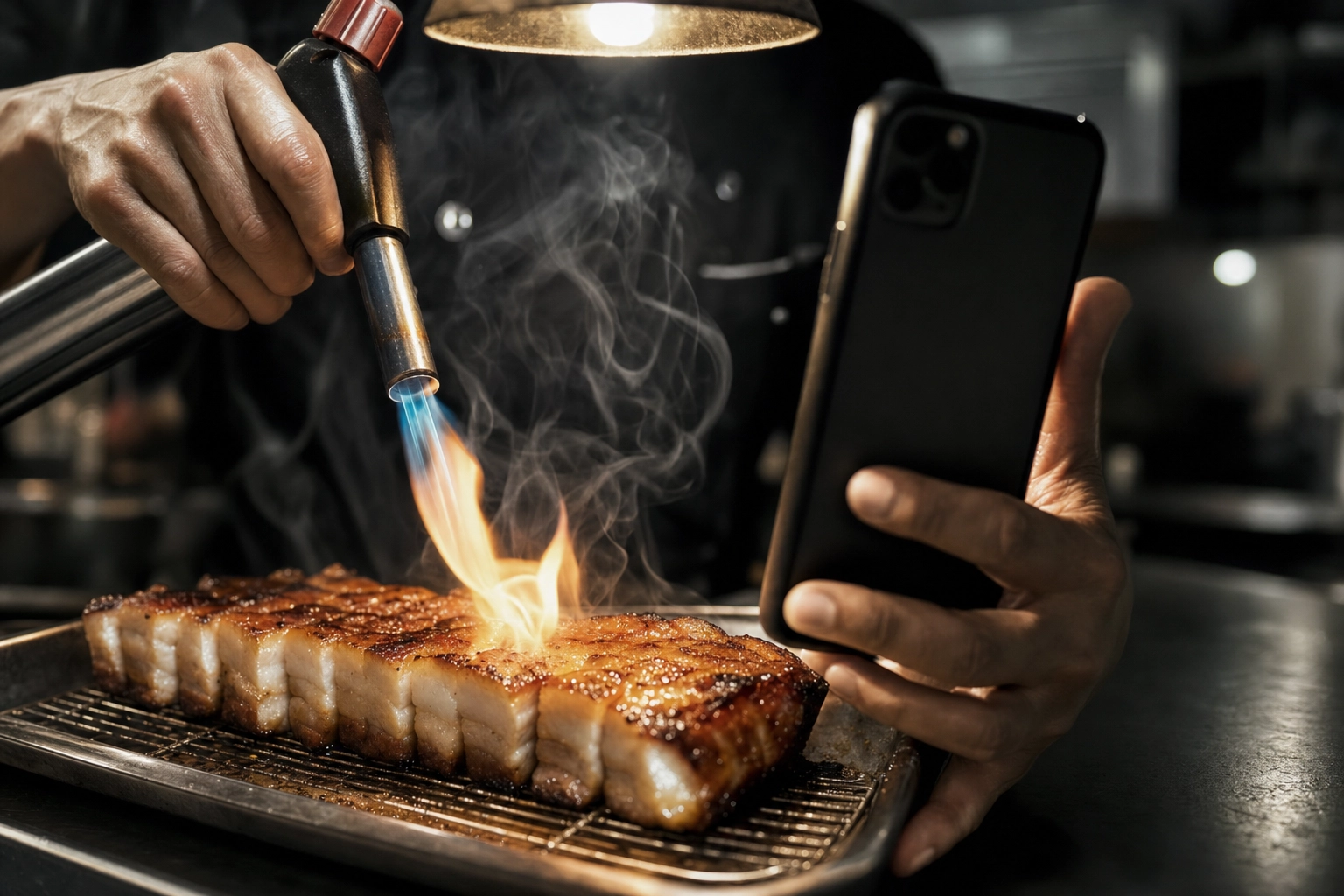 Chef torching pork belly while filming behind-the-scenes social media content for ghost kitchen
Without a physical storefront, social media isn't a nice-to-have for ghost kitchen marketing — it is your storefront window. The kitchen tour, the chef's hands, the cheese pull — this is what replaces the smell of fresh bread on the sidewalk.
The four content pillars that work for ghost kitchens:
- Behind-the-kitchen process clips. Hands-only POV of the food being made. Sizzle. Sear. Sauce. Plate. 7–15 seconds. This is your highest-converting content.
- Hero food close-ups. Macro shots of one perfect bite. Cheese pull. Steam rising. Knife cutting through. Use the same photo library you built for your delivery apps.
- Customer testimonials and UGC. Repost (with permission) anything customers share. A real person with a real bite hits harder than any ad you'll ever run.
- Founder and team moments. People order from people. Even a 30-second clip of you naming why you started the brand humanizes a faceless delivery business.
Tactical specifics:
- Hook in the first 3 seconds — assume the viewer's thumb is hovering
- Geo-tag posts with city + neighborhood + nearest landmark
- Use 5–8 hyperlocal hashtags (#brooklynramen beats #foodporn for delivery conversion)
- Post 3–4 times a week minimum on at least one platform — consistency beats virality
- Cross-post Reels and TikToks with platform-specific hooks
For a more thorough playbook on adapting these tactics across platforms, our cloud kitchen marketing strategies guide goes deeper on creator partnerships and analytics.
6. Claim a Google Business Profile (Yes, You Can)
Most ghost kitchen operators assume Google Business Profile (GBP) is for restaurants with a physical address. Not true since 2022. Google updated its policies to allow virtual food brands to maintain GBP listings — and most ghost kitchens are still leaving this free online traffic on the table.
Why this matters: GBP listings appear in "food near me" searches, in Google Maps results, and in the local pack — three of the highest-intent surfaces on the open web. Free distribution that the delivery apps don't control.
Google's requirements for delivery-only brands:
- Distinct branded packaging (not generic)
- Distinct website (a landing page works)
- Hide the address (delivery-only operators must not display the kitchen address)
- Add service areas (cities or neighborhoods you deliver to)
- Multi-brand operators face additional verification steps — each brand needs separately branded packaging and its own site
The official rules live in Google's Business Profile guidelines. Worth reading word-for-word before you set up.
What to put on your profile:
- Same hero photo you use on delivery apps (consistency = recognition)
- 8–12 menu photos uploaded directly to the profile
- Service area set to your actual delivery radius
- Direct ordering link as the primary website
- Hours that match when delivery is actually live
Pair the profile with an active reviews strategy (more on that in retargeting) and you've got an organic local channel that doesn't pay anyone a commission.
7. Partner With Local Food Influencers for Delivery Reviews
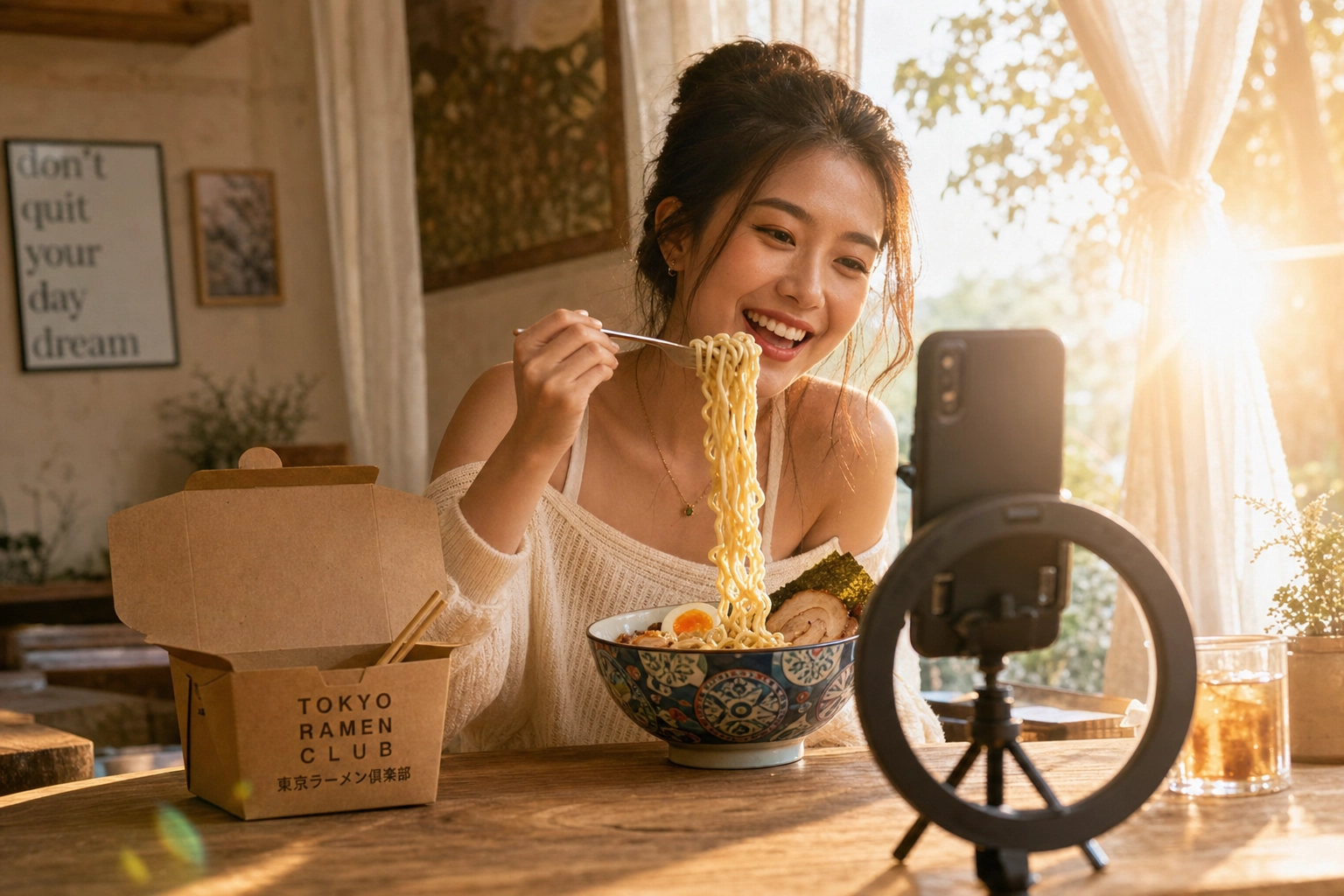 Food influencer filming a ghost kitchen ramen delivery review at a sunlit cafe table
Influencer marketing for ghost kitchens isn't about chasing follower counts. It's about finding hyper-local food creators whose audience overlaps with your delivery zone — and who already make content about ordering food.
The tier breakdown for 2026:
- Nano-influencers (1K–10K followers): $100–500 per post, often willing to do a comp meal collaboration
- Micro-influencers (10K–50K): $500–5,000 per post, the sweet spot for most ghost kitchens
- TikTok food reviewers: typically 30–40% cheaper than Instagram for similar reach, with stronger conversion to delivery orders
The model that works:
- Send a comp delivery (full menu sampler if budget allows)
- Offer a small fee + the meal in exchange for an honest review
- Provide a unique promo code so you can track redemptions
- Encourage them to film unboxing — the packaging reveal converts viewers
Vetting checklist before paying anyone:
- Is their audience geographically aligned with your delivery zone?
- Are their last 10 posts food-focused or all over the place?
- Do their comments come from real people, not bot accounts?
- Have they reviewed competitors? (Sometimes a yes, often a no — depends on context)
Track promo code redemptions and profile traffic spikes during the campaign window. A $400 micro-influencer post that drives 35 orders at $20 average is an $11 CAC — beat that with paid ads.
8. Run a Multi-Brand Strategy From One Kitchen
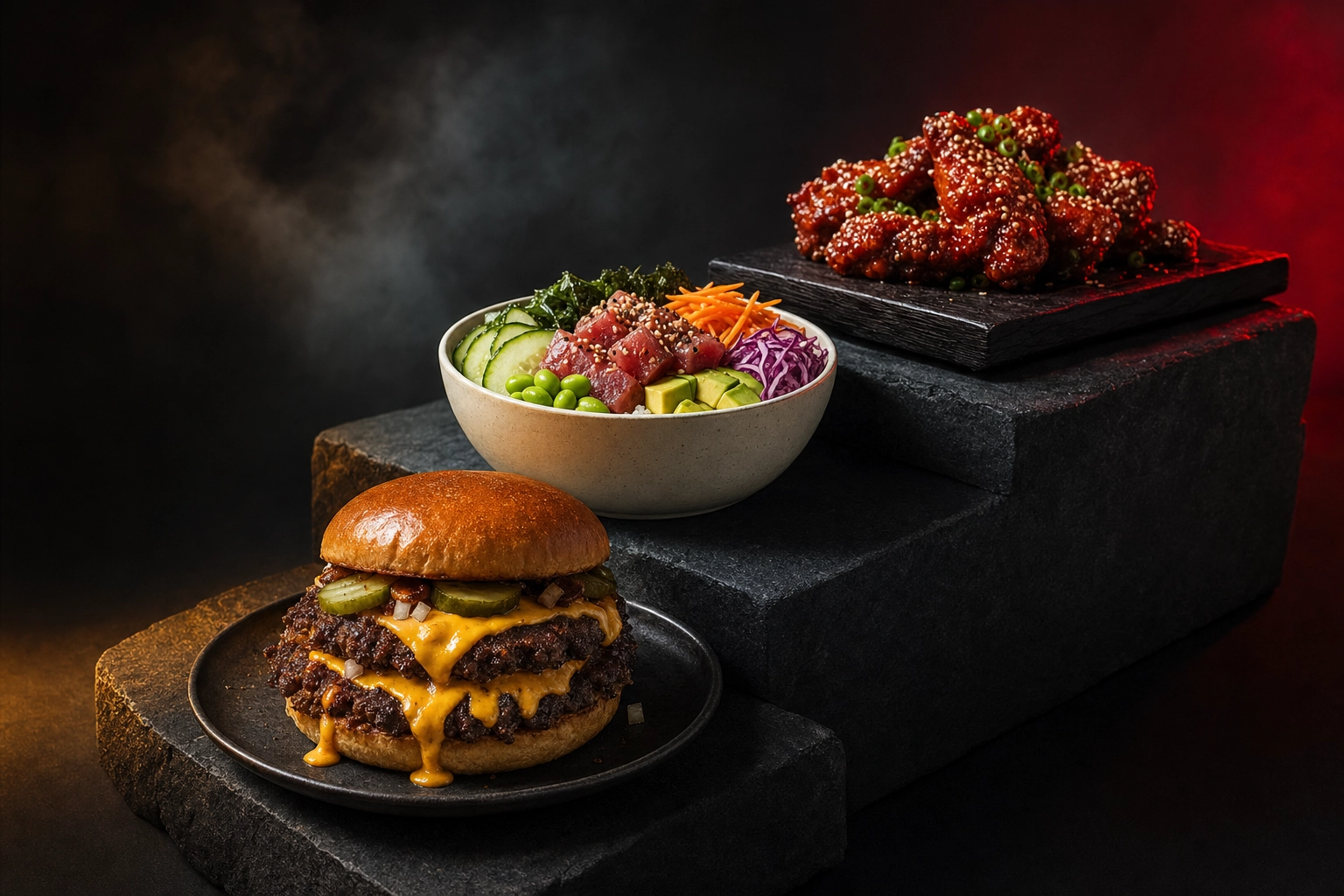 Three different ghost kitchen virtual brands shown as distinct dishes from one shared kitchen
The economics are what make multi-brand ghost kitchen marketing work: same kitchen, same staff, same prep — three different storefronts on every delivery app. Industry data suggests over 50% of ghost kitchens already run multiple brands, and projections put that closer to 90% by the end of the decade.
The Berlin case study often cited: one operator tested 7 virtual restaurant brands over 18 months, killed 4, and now runs 3 successful concepts doing 160 orders per day from a single kitchen.
Three brands that share a base prep but feel completely different:
- The Burger Brand — smash patties, brioche, fries. Bold, neon-leaning aesthetic.
- The Bowl Brand — same protein, different finishing. Healthy-clean photography style.
- The Late-Night Brand — wings, loaded fries, comfort plates. Moody, dimly-lit photo aesthetic.
Each brand needs:
- Distinct logo and brand identity
- Distinct photo set (this is where AI photography earns its keep — different style presets for each brand from the same source dish)
- Separate delivery app listings, GBP, social handles, and packaging
- Different price points if the positioning calls for it
The cautionary tale: Uber Eats removed roughly 5,000 virtual kitchens in 2023 specifically because operators were running 14 spam brands selling the same menu under different names from the same kitchen. The platforms now actively police this. Don't run brands that are obviously the same food relabeled — the platforms detect it, customers leave 1-star reviews, and you get delisted.
If you're considering this approach, our virtual kitchen guide and ghost kitchen menu planning walk through the operational mechanics in detail. You can also see how AI food photography for ghost kitchens handles the brand-differentiation problem with style presets.
9. Turn Packaging Into a Marketing Channel
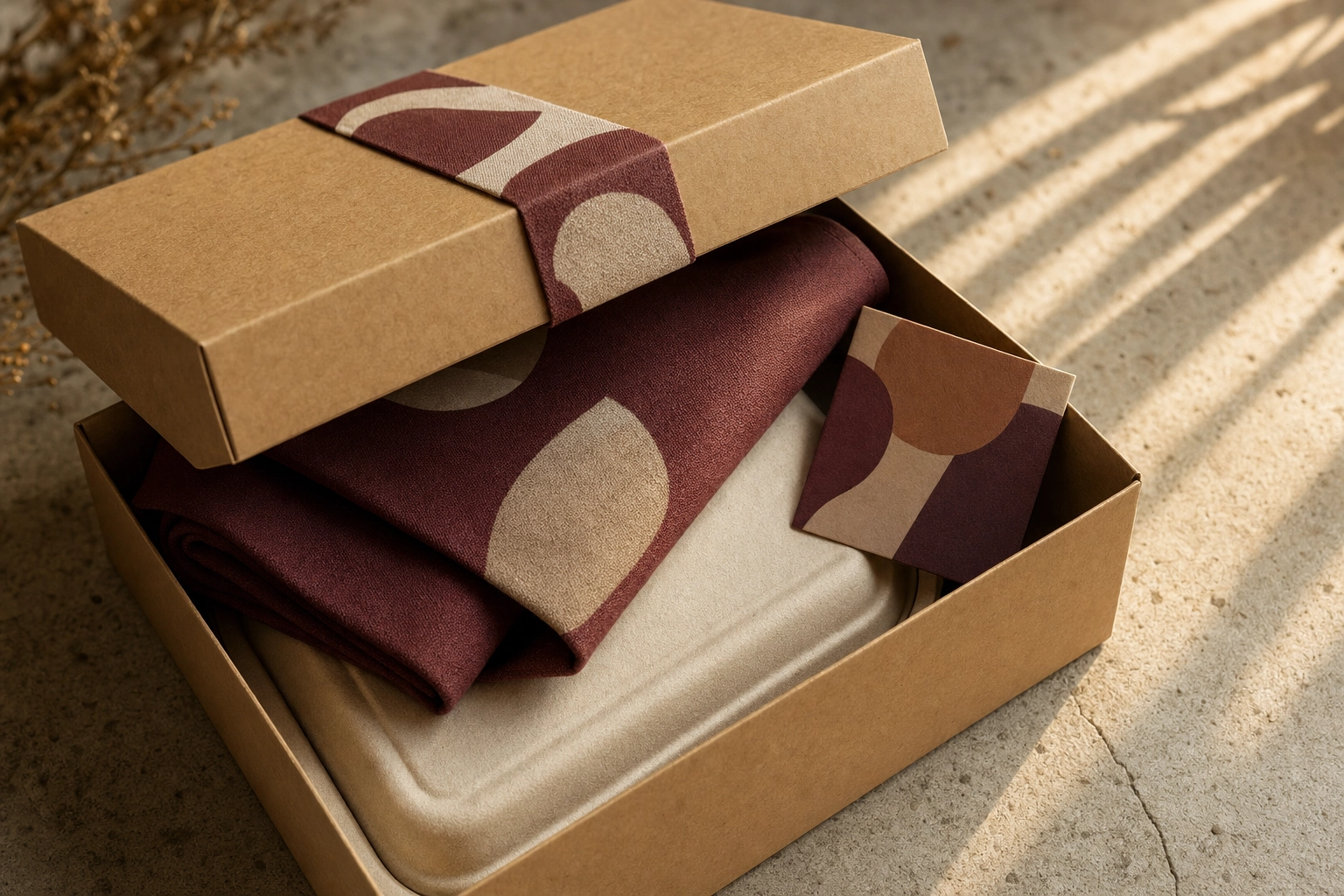 Branded ghost kitchen packaging with napkin and insert card revealed in opened kraft box
Every order is a physical brand impression delivered to someone's kitchen counter. Plain white containers waste that opportunity. Branded packaging is one of the cheapest customer acquisition tools in ghost kitchen marketing — because the customer is already paying for shipping it.
Packaging essentials that earn their cost:
- Custom sticker on the bag. $0.05–0.12 each in volume. Logo + handle.
- Branded napkin or insert card. $0.10–0.30. The card is where you put your QR code.
- QR code that goes somewhere useful. Not your homepage. Three options that work: (a) a "Reorder in one tap" page pre-loaded with their last items, (b) a "Leave a review" landing page, (c) a "Get 15% off your next direct order" coupon page.
- Compostable or recycled containers. Sustainability cues now drive a measurable price-tolerance lift in urban delivery markets — and the unboxing photo is much more shareable.
Realistic budget: $0.40–0.80 per order in branded packaging on a $15–25 average ticket is a defensible spend. That's 3–5% of order value buying you repeat customers, social posts, and review generation.
One thing to never skimp on: packaging that protects the food's presentation. The plate of food in your photos is what customers expect. If it arrives looking like it survived a paint shaker, the gap between expectation and reality kills your reviews — and your reviews drive your ranking. Splurge on dividers, leak-proof seals, and right-sized containers.
10. Run Retargeting Ads to Past Customers
Cold customer acquisition is expensive. Retargeting people who already engaged with your brand is dramatically cheaper — typically 40–70% lower CPA than prospecting campaigns on Meta. For ghost kitchens, retargeting is where margin gets reclaimed.
Build your retargeting audiences from these sources:
- Meta Pixel on your direct ordering site — anyone who hit the site, viewed the menu, or started a checkout but didn't complete
- Customer email list — uploaded as a custom audience, then matched to Meta accounts
- Instagram and Facebook engagers — people who liked, commented, or saved posts in the last 30/60/90 days
- Video viewers — people who watched 50%+ of any of your food clips on Instagram or TikTok
Creative that converts on retargeting:
- Your strongest food photo (this is where the photo investment pays off again)
- A specific limited-time offer ("$5 off your next order, today only")
- A direct link to the product page on your direct ordering site, not the homepage
- 15-second video format performs roughly 2× static images on cost-per-conversion
Budget allocation that works for most ghost kitchens:
- 60% to awareness/prospecting (build the retargeting audience)
- 25–30% to retargeting (close the loop)
- 10–15% to conversion campaigns on warmest audiences
Email is your second retargeting channel. Industry benchmarks put email ROI at roughly $36 per $1 spent for restaurants. Capture emails at every direct order, segment by frequency (lapsed vs active), and send a weekly campaign featuring whatever's hot that week.
Your Ghost Kitchen Marketing Priority Checklist
Don't try to do all ten ghost kitchen marketing tactics at once. Here's the sequence that compounds fastest:
Week 1: Get professional photos for every single menu item. This is the multiplier on everything else — every other tactic on this list assumes you have great photos.
Week 2: Optimize all delivery platform profiles. Hero photos, descriptions, category order, photo upload across the entire menu.
Week 3: Set up a Google Business Profile and stand up a basic direct ordering page (Toast, Square, or Owner.com works in a day).
Week 4: Launch one social channel (Instagram or TikTok — pick one and commit) with a 30-day content calendar built around your existing photo library.
Month 2: Start your first influencer partnership and upgrade packaging with a branded sticker + QR code linking to your direct ordering page.
Month 3: Layer in retargeting ads, audit which menu items underperform on photos and re-shoot, and evaluate whether a second virtual brand makes sense.
The compounding part is real. Better photos lift your delivery app conversion (#1), which lifts your platform ranking, which lowers your effective CAC, which makes promotions more profitable, which feeds your retargeting pool, which lowers your overall cost per online order. Skip the photos and the rest never compounds.
If you want a tool built specifically to handle this photo problem — phone snap in, menu-ready hero shot out in 90 seconds — start free with FoodShot AI and run a few of your menu items through it before you invest in any of the other nine tactics.
Frequently Asked Questions
How much should a ghost kitchen spend on marketing monthly?
Most profitable ghost kitchens spend 6–10% of monthly revenue on ghost kitchen marketing once they're past the launch phase. In the first 90 days, that number is often 15–20% as you fund Sponsored Listings, initial influencer collaborations, and direct ordering setup. The exact number matters less than the unit economics: every channel needs a defensible CAC-to-LTV ratio. If retargeting CPA is $4 and customers reorder twice in 90 days, that channel scales. If a Sponsored Listing campaign costs $40 per first order with no repeats, kill it.
Which delivery platform should a new ghost kitchen launch on first?
DoorDash typically delivers the highest order volume in most US markets — it owns roughly 67% of the third-party delivery market share. Launch there first to validate the concept, optimize your photos and menu, then expand to Uber Eats and Grubhub once you have 50+ orders of operational rhythm. Trying to launch on three platforms simultaneously usually means none of them get the attention they need to rank.
Do ghost kitchens need a website if they're on DoorDash and Uber Eats?
Yes — for two reasons. First, Google Business Profile requires a distinct website to verify a virtual restaurant brand. Second, every order routed through the marketplaces costs you 15–30% in commission. Even a simple direct ordering page can capture 10–20% of repeat orders at platform-fee costs of 3% or less. The website pays for itself in weeks, not months.
Can ghost kitchens really compete without a physical brand presence?
Yes, but only if you commit to digital fundamentals: professional photography, optimized delivery platform profiles, a direct ordering channel, and active social. Without those, ghost kitchens are essentially invisible. The brands winning today are the ones treating their delivery app listing with the same rigor a traditional restaurant treats its dining room.
How long until ghost kitchen marketing starts paying off?
Photo upgrades typically show measurable conversion lift within 7–14 days. Delivery platform optimization shows within a billing cycle (2 weeks). Social and SEO are 3–6 month investments before they compound. Influencer partnerships and retargeting are immediate-impact channels — you'll see ROAS within the first campaign window. The mistake most operators make is expecting paid channels to perform before they've fixed photos. They won't. Photos first, every time.
The thread running through all ten ghost kitchen marketing tactics: ghost kitchens compete on visuals because that's all customers see online. Get the photos right and every other tactic on this list works harder. Get the photos wrong and you can spend $10K on promotions that quietly fail, because no amount of paid traffic can save a delivery listing that doesn't convert. Start there, then layer the rest.