Cloud Kitchen Marketing: 8 Strategies to Grow Delivery Orders
 Ali Tanis12 min read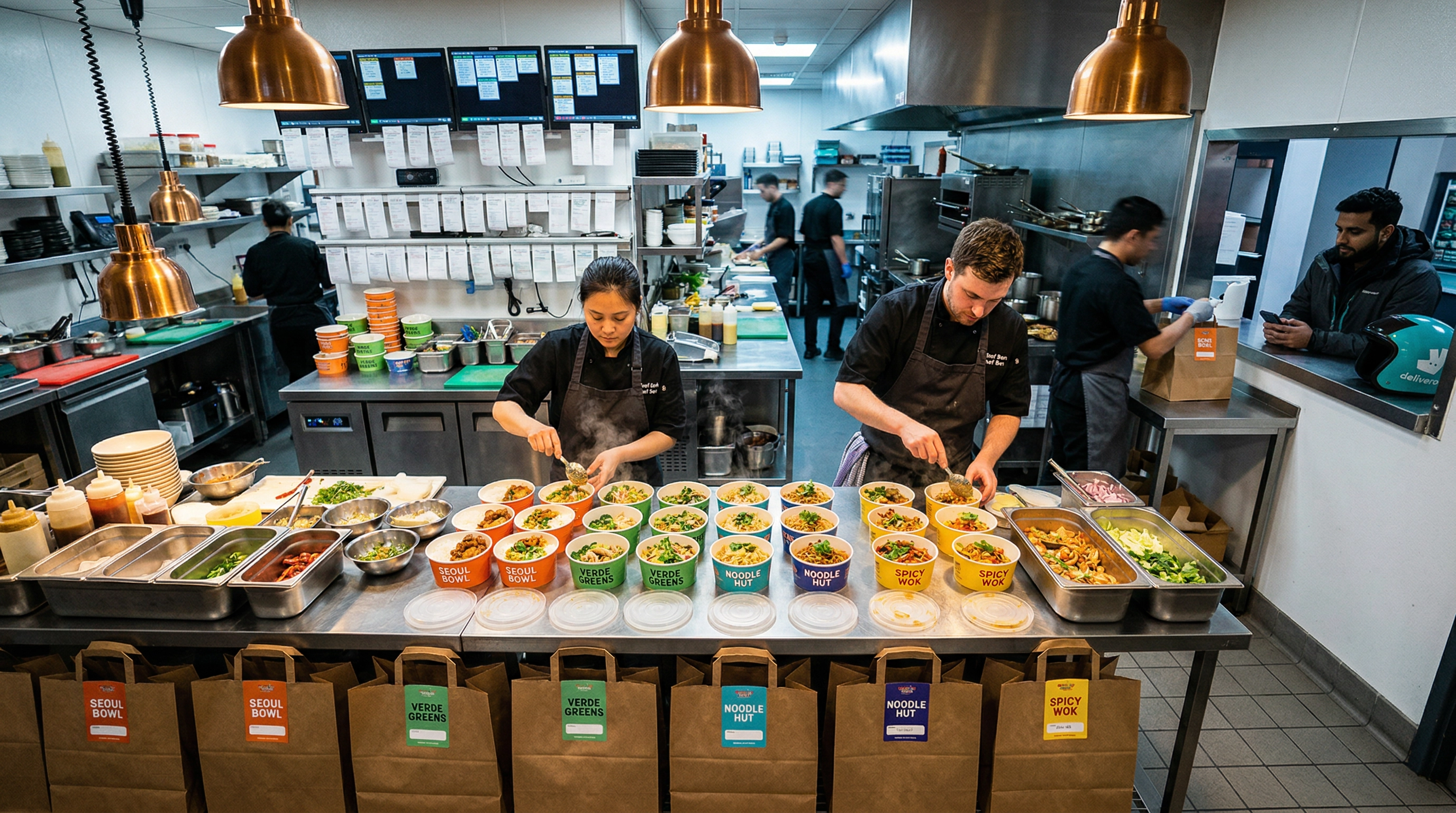
Cloud kitchens have no front door. No sidewalk signage. No cozy dining room pulling people in off the street. Your entire restaurant brand lives inside a 3-inch thumbnail on someone's phone — and that changes everything about how you approach cloud kitchen marketing.
Quick Summary: Cloud kitchen marketing revolves around one reality: you compete entirely on digital presence. The 8 strategies that drive the most growth are optimizing delivery app listings with professional food photos, launching multiple virtual brands, running platform promotions, building a social media presence, turning packaging into a branding channel, leveraging customer reviews, using data analytics for menu optimization, and creating a direct ordering website to cut 20-30% commission fees.
The global cloud kitchen market hit roughly $82 billion in 2025, growing at about 12% annually. More competition means the kitchens that master their online marketing strategy will thrive while the rest get buried on delivery platforms.
Here are 8 cloud kitchen marketing strategies that actually move the needle.
Why Cloud Kitchen Marketing Demands a Different Approach
No Physical Presence Means 100% Digital Competition
A traditional restaurant can rely on foot traffic, signage, and word-of-mouth from neighbors. A cloud kitchen has none of that. Every single customer discovers you through a digital channel — primarily delivery platforms, but also social media, search engines, and direct websites.
Your marketing budget, creative energy, and operational focus all need to align around how your brand appears online.
Your Menu Photos Are Your Storefront
In a brick-and-mortar restaurant, the ambiance, the smell of food, and the menu design all work together to convert visitors into customers. In a cloud kitchen, a single food photo thumbnail does all that work. If that photo doesn't stop someone mid-scroll, you've lost the order.
1. Optimize Delivery App Listings with Professional Food Photos
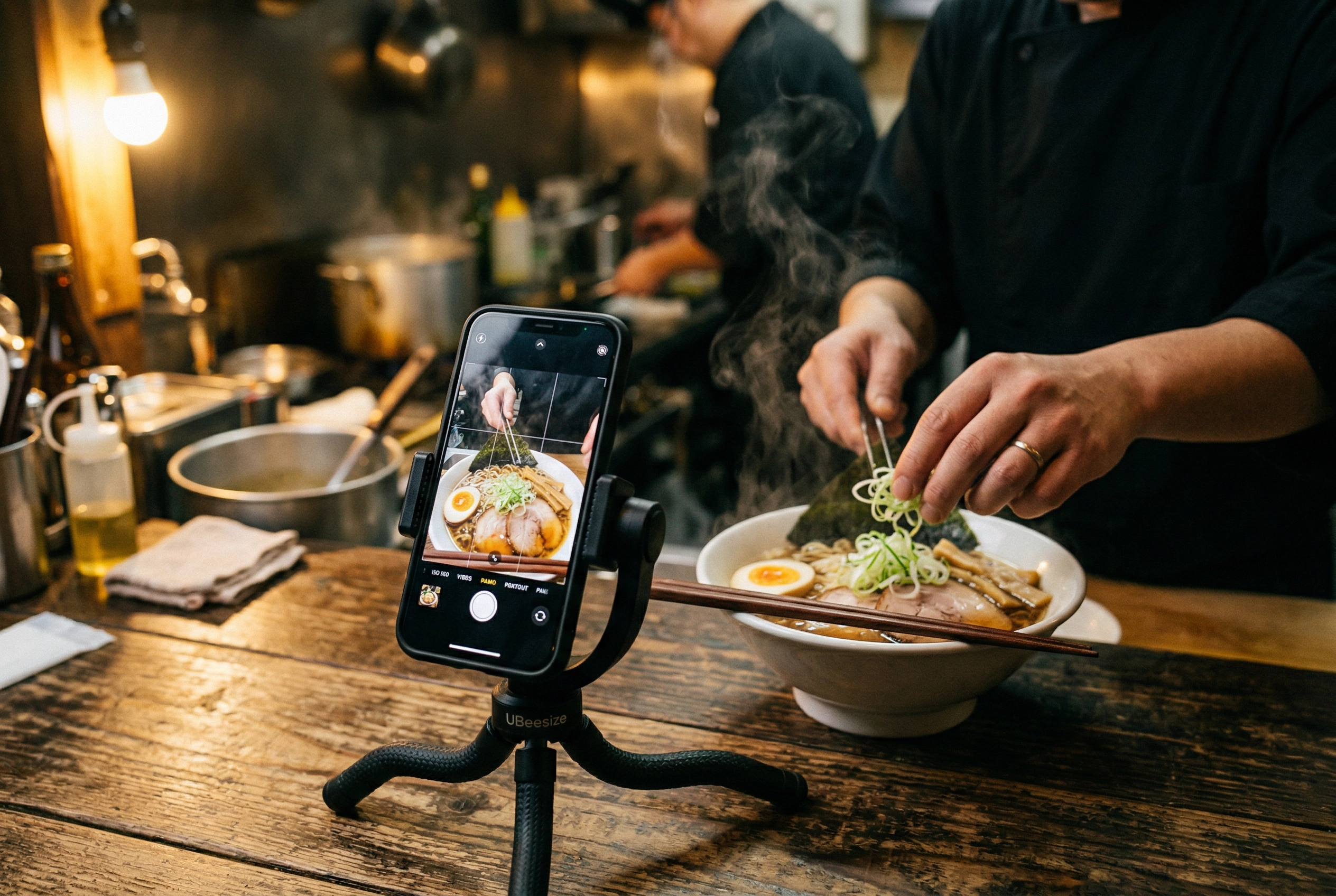 Photographing a bowl of ramen with a smartphone for food delivery app listing optimization
Food photos are the #1 driver of orders for delivery-only kitchens. Industry research from Limetray shows menus with quality images see conversion rates jump by 25%, and restaurants with professional photos report more than 35% more total orders on delivery apps. For a cloud kitchen, that's the difference between profitability and shutting down.
What Top-Performing Delivery App Photos Look Like
- Overhead or 45-degree angles that show the full dish clearly in a small thumbnail
- Vibrant, natural colors — no heavy filters that make food look artificial
- Consistent style across your entire menu so the listing looks professional
- Clean backgrounds that don't compete with the food itself
Solving the Photography Cost Problem
Hiring a professional food photographer costs $700-$1,400 per session. For a cloud kitchen on thin margins, that's hard to justify every time you update your menu.
AI food photography has changed this equation entirely. FoodShot AI transforms basic phone snapshots into studio-quality, menu-ready images in about a minute, at a fraction of the cost. For delivery-only kitchens running multiple virtual brands, updating photos quickly and affordably is a competitive edge that compounds.
For platform-specific optimization tips, check our guides on food delivery app photography and how to get more orders on DoorDash.
2. Launch Multiple Virtual Brands from One Kitchen
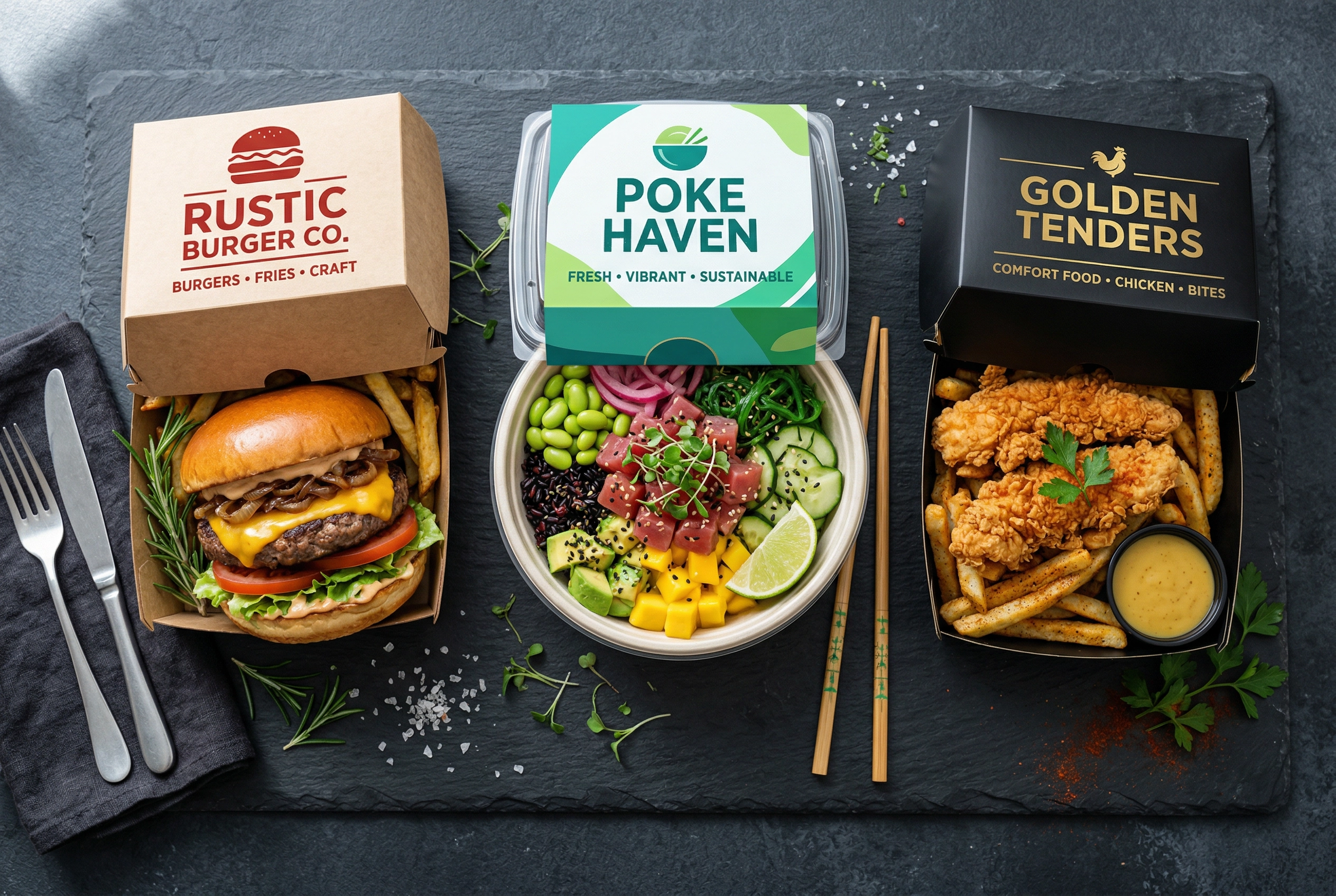 Three different virtual brand meals from one cloud kitchen showing burger, poke bowl, and comfort food
Running multiple virtual restaurant brands from a single kitchen is one of the smartest growth moves in the cloud kitchen business. About 41% of independent restaurants now operate virtual brands. For delivery-only kitchens, it's even more natural since there's no storefront locking you into one identity.
How Multi-Brand Strategy Works
One kitchen, three brands — say a burger concept, a healthy poke bowl brand, and a late-night comfort food label. Each gets its own delivery app listing with distinct branding, food photos, and a menu targeting a specific customer segment.
The economics are compelling. You're already paying rent, utilities, and kitchen staff. Adding another brand means incremental revenue on mostly fixed costs — especially when brands share ingredients across menus.
How to Validate a New Brand
- Start with a focused menu of 8-12 items
- Launch on one delivery platform first
- Invest in professional food photos for every dish
- Track order volume, ratings, and repeat customers for 30-60 days
- Expand to more platforms if it works. Shut it down with minimal losses if it doesn't.
Rebel Foods in India runs 45+ virtual brands from shared kitchens. You don't need that scale — even two well-executed brands can meaningfully grow your delivery orders.
3. Run Delivery Platform Promotions and Featured Listings
Delivery platforms like Uber Eats, DoorDash, and Grubhub offer paid promotion tools. For cloud kitchens, these are often the fastest path to online visibility and new customer acquisition.
Types of Promotions That Work
- Featured listings: Your restaurant appears at the top of category pages — like renting a prime digital location
- Percentage-off deals: 20% off first orders, BOGO combos, or free delivery to reduce friction for new customers
- Sponsored search results: Your listing appears when customers search terms like "Thai food near me"
Maximizing Return on Ad Spend
Average ROAS sits at 2-3X with default settings but 4-5X with optimization. Optimize by:
- Running promotions during peak windows: 11am-1pm and 5pm-8pm weekdays, plus weekends
- Starting with $15-25/day, measuring for a week, then scaling winners
- Pairing every promotion with strong food photos — a promoted listing with bad images wastes money
- Tracking new vs. returning customers to see if you're building your base or just discounting
4. Build a Social Media Presence Without a Storefront
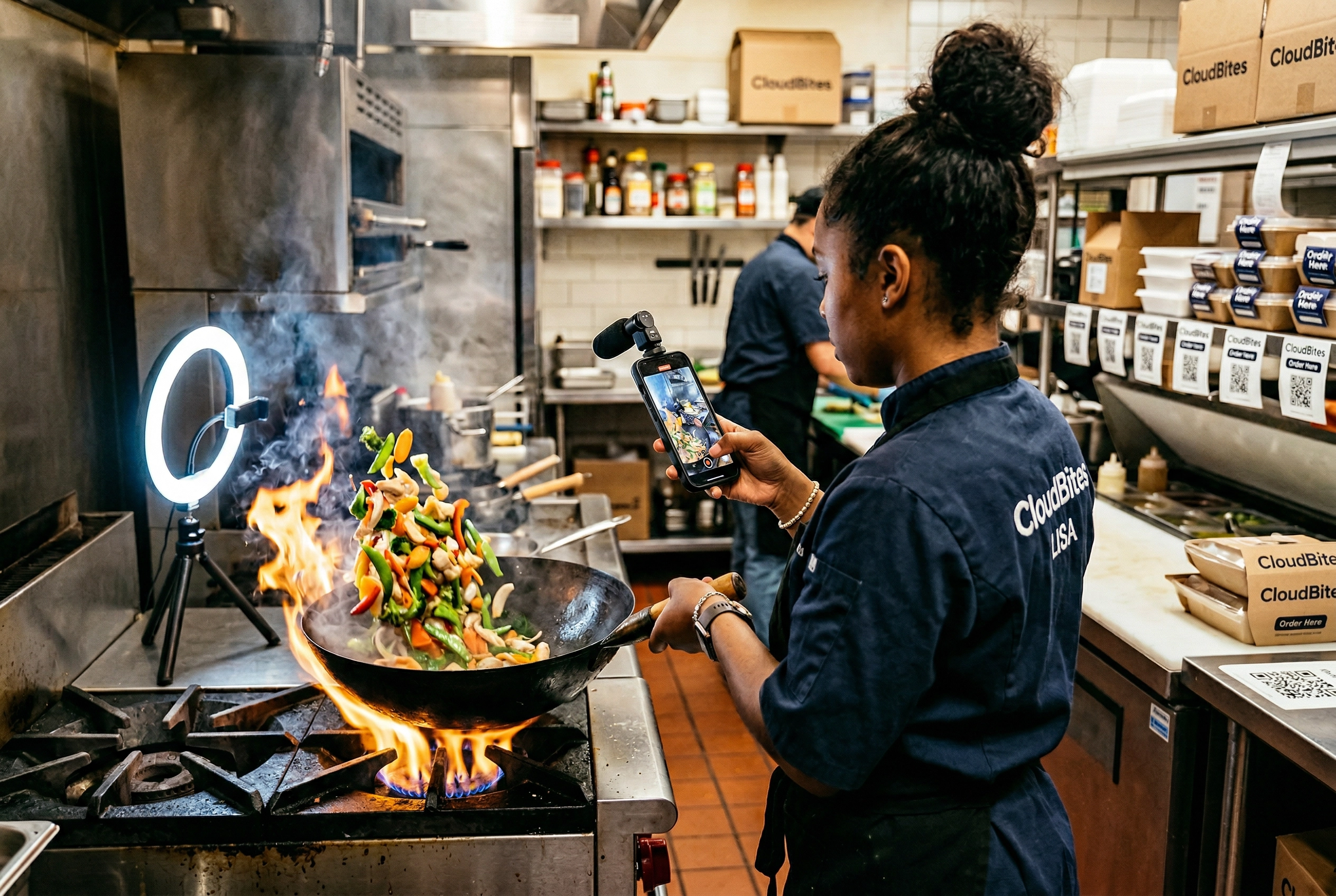 Cloud kitchen chef creating social media video content of food preparation for Instagram and TikTok
Cloud kitchens have a unique social media advantage: the behind-the-scenes story. Customers are genuinely fascinated by delivery-only restaurants. Lean into that novelty.
Content That Drives Engagement
- Kitchen action reels — food sizzling in pans, sauces being drizzled, plates being assembled
- Packaging and delivery prep — showing care builds customer trust
- Menu launches and limited-time offers — create anticipation and urgency
- Customer reposts — when customers share delivery photos, reshare them for free social proof
Focus on Instagram and TikTok where food content thrives. Three to four quality posts per week with consistent branding outperform daily low-effort content. According to Sprout Social, food-related content gets the highest engagement during lunch (11am-1pm) and evening (7-9pm) hours.
Micro-Influencer Partnerships
Local food influencers with 10K-50K followers deliver exceptional ROI. Their audiences are geographically concentrated — exactly the customers within your delivery radius. Send a free meal, request an honest review, and give their followers a trackable promo code.
Read our restaurant social media strategy guide and breakdown of the best social media platforms for restaurants for more digital marketing tactics.
5. Turn Packaging into a Branding Channel
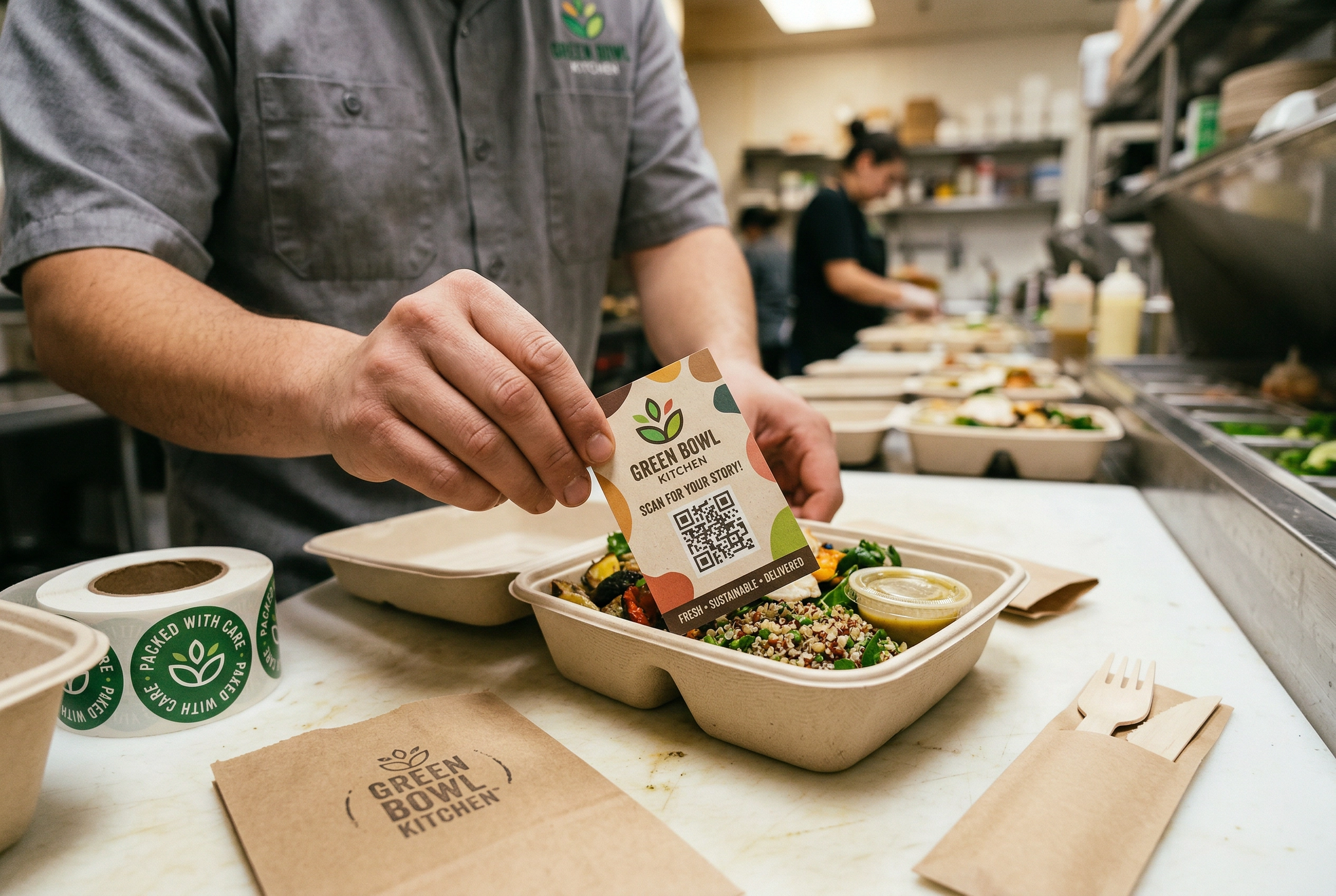 Branded cloud kitchen packaging with QR code insert cards and eco-friendly takeout containers
Packaging is your only physical touchpoint with customers. It's the one moment where your brand exists in the real world. Most cloud kitchen operators underuse this opportunity.
Packaging Essentials
- Branded containers with your logo, colors, and brand name — generic white containers are forgettable
- Insert cards with a QR code to your direct ordering website, a promo code for the next order, and social media handles
- Review request — "Loved your meal? Leave a review!" increases review volume significantly
- Eco-friendly materials — sustainable packaging resonates with today's customers and works as a marketing differentiator
Protect Food Presentation
A crushed, messy dish inside beautiful packaging still earns bad reviews. Invest in containers that keep food intact, separated, and visually appealing on arrival. This directly impacts your online rating and repeat order rate.
6. Leverage Customer Reviews Actively
On delivery platforms, your star rating is your reputation. Most customers won't order from a restaurant rated below 4.0, and the sweet spot for maximum orders is 4.5+ stars.
Getting More Reviews from Customers
- Include review requests in every delivery via packaging inserts
- Ask within 30-60 minutes of delivery when the experience is fresh
- Provide a direct link to the review page — don't make customers search for it
Responding Strategically to Reviews
- Reply to every negative review within 24 hours. Acknowledge issues and explain your fix.
- Thank positive reviewers specifically. "Glad you loved the pad thai!" feels genuine.
- Act on patterns. Multiple mentions of cold food? That's a packaging problem, not a marketing problem.
Reviews directly affect your ranking algorithm on delivery platforms. More reviews with higher ratings means better search placement, which drives more orders — a virtuous cycle for your cloud kitchen business.
7. Use Data Analytics for Menu Optimization
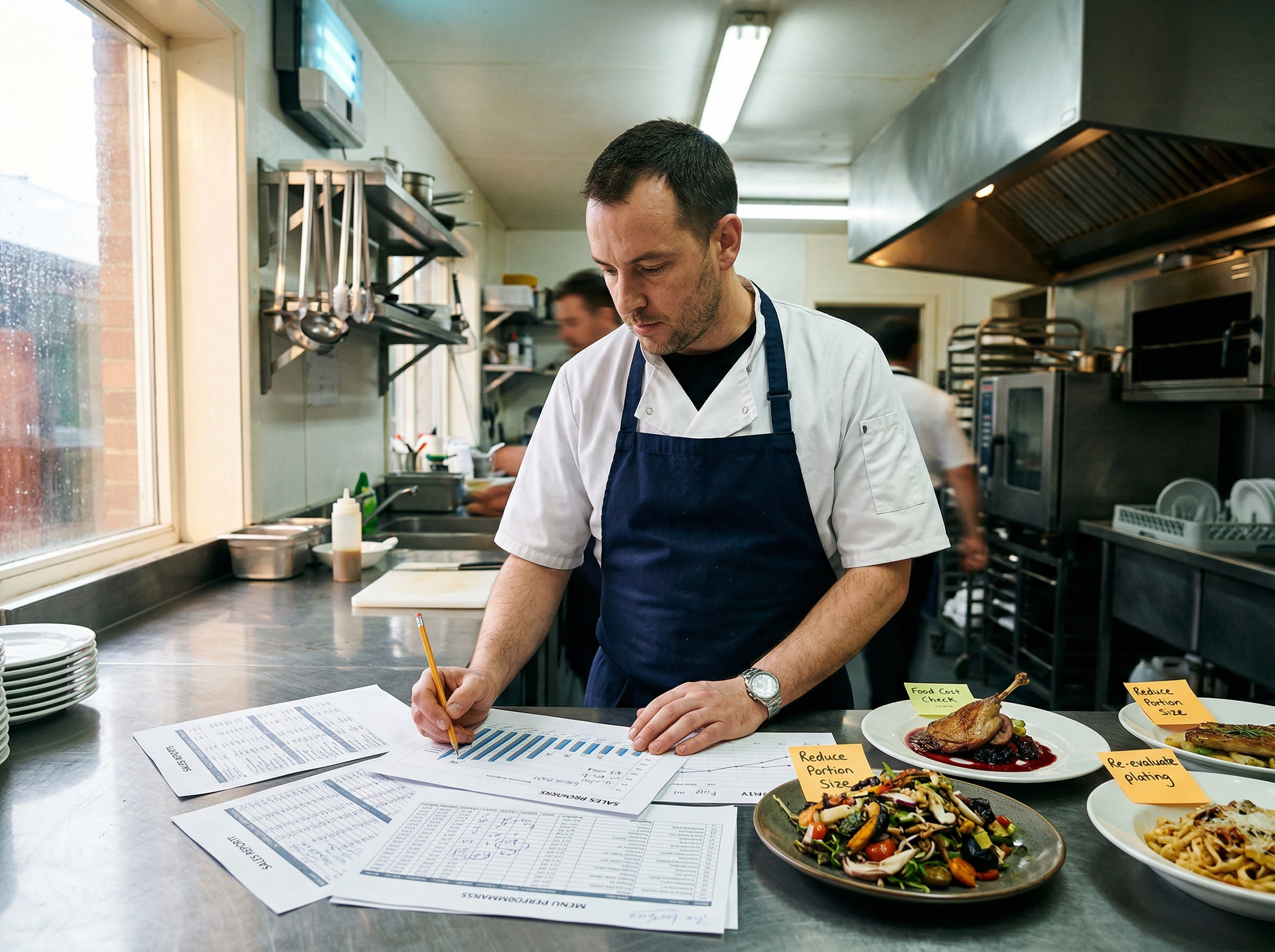 Chef analyzing menu performance data and sales reports in a cloud kitchen for menu optimization
Every delivery platform gives you performance data. Most operators barely use it. The kitchens that analyze and act on this data have a massive competitive advantage.
Key Metrics to Track
- Bestsellers vs. underperformers — Double down on high-margin, high-volume "stars." Cut items nobody orders.
- Order timing patterns — Adjust staffing, prep, and promoted items to match demand spikes.
- Click-through vs. order completion — High views but low orders? Test changing the price, description, or photo.
- Customer demographics — Use location and ordering data to tailor your menu by neighborhood.
Why Smaller Menus Win
A focused menu of 15-25 items typically outperforms 50+ items in delivery. Fewer items means faster prep, fewer errors, less waste, and better quality.
Update your menu seasonally and reshoot photos every time you add or change items. FoodShot AI makes it economically viable to refresh your entire menu's images whenever you need, keeping your online listings competitive.
8. Build a Direct Ordering Website
Delivery platforms take 20-30% commission on every order. On a $30 order, that's $6-9 going to the platform instead of your kitchen. A direct ordering website helps you reclaim those margins.
Making Direct Orders Work
- Offer clear incentives: 10-15% off for ordering directly — you still save vs. platform commissions
- Drive traffic through packaging: QR code on every delivery container → your website → discount on next order
- Collect customer data: Direct orders give you email addresses and phone numbers for digital remarketing
- Keep it simple: Clean menu with professional food photos, easy checkout, mobile-friendly design
Even shifting 20% of orders direct can meaningfully improve profitability. Over time, your email and SMS lists become a marketing channel that doesn't depend on any platform's algorithm.
For more growth tactics, explore our list of 50 restaurant marketing ideas and our guide to commercial food photography.
Your Cloud Kitchen Marketing Checklist
Week 1 — Foundation:
- Photograph every menu item (FoodShot AI transforms phone photos into studio-quality images)
- Optimize delivery app listings with updated food photos and descriptions
- Set up branded packaging with insert cards and QR codes
Month 1 — Expand Reach:
- Launch promoted listings on your top delivery platform
- Start Instagram and/or TikTok with 3-4 posts per week
- Implement a review request system
Quarter 1 — Build Your Moat:
- Analyze delivery data and engineer your menu
- Test a second virtual brand
- Launch a direct ordering website
- Partner with 3-5 local micro-influencers
The cloud kitchens that win aren't always making the best food. They're the ones whose food looks best on a customer's screen, shows up fast, and consistently delivers on expectations. Smart cloud kitchen marketing is how you get there.
Frequently Asked Questions
How much should a cloud kitchen spend on marketing?
Most operators allocate 10-15% of revenue, split between delivery platform promotions (largest share), food photography, social media, and website maintenance. During your first 3 months, lean closer to 15-20% to build initial visibility and online reviews.
What's the best delivery platform for cloud kitchens?
In the US, DoorDash holds the largest market share, followed by Uber Eats and Grubhub. The smart strategy is to list on all major platforms in your area and let the data guide where you focus your promotional budget. See our guide on getting more orders on DoorDash for platform-specific tactics.
How do cloud kitchens get their first customers?
First orders almost always come from delivery platforms. Optimize your listing with professional food photography, run a launch promotion (20% off first orders), and earn 5-star reviews from early customers to build algorithmic momentum.
Do cloud kitchens need a website?
Yes. A direct ordering website cuts your dependence on 20-30% platform commissions and gives you customer contact information for email and SMS marketing. Prioritize delivery app listings first, but plan to launch a website within your first quarter.
How important are food photos for cloud kitchen success?
Essential. Food photos are literally your storefront. Industry research shows professional photos increase delivery orders by 35% and boost menu conversion by 25%. Since customers can't see or smell your food, the image on their screen is everything. Quality food delivery app photography is the highest-ROI marketing investment a cloud kitchen can make.