How to Market a Food Product in 90 Days
 Ali Tanis22 min read
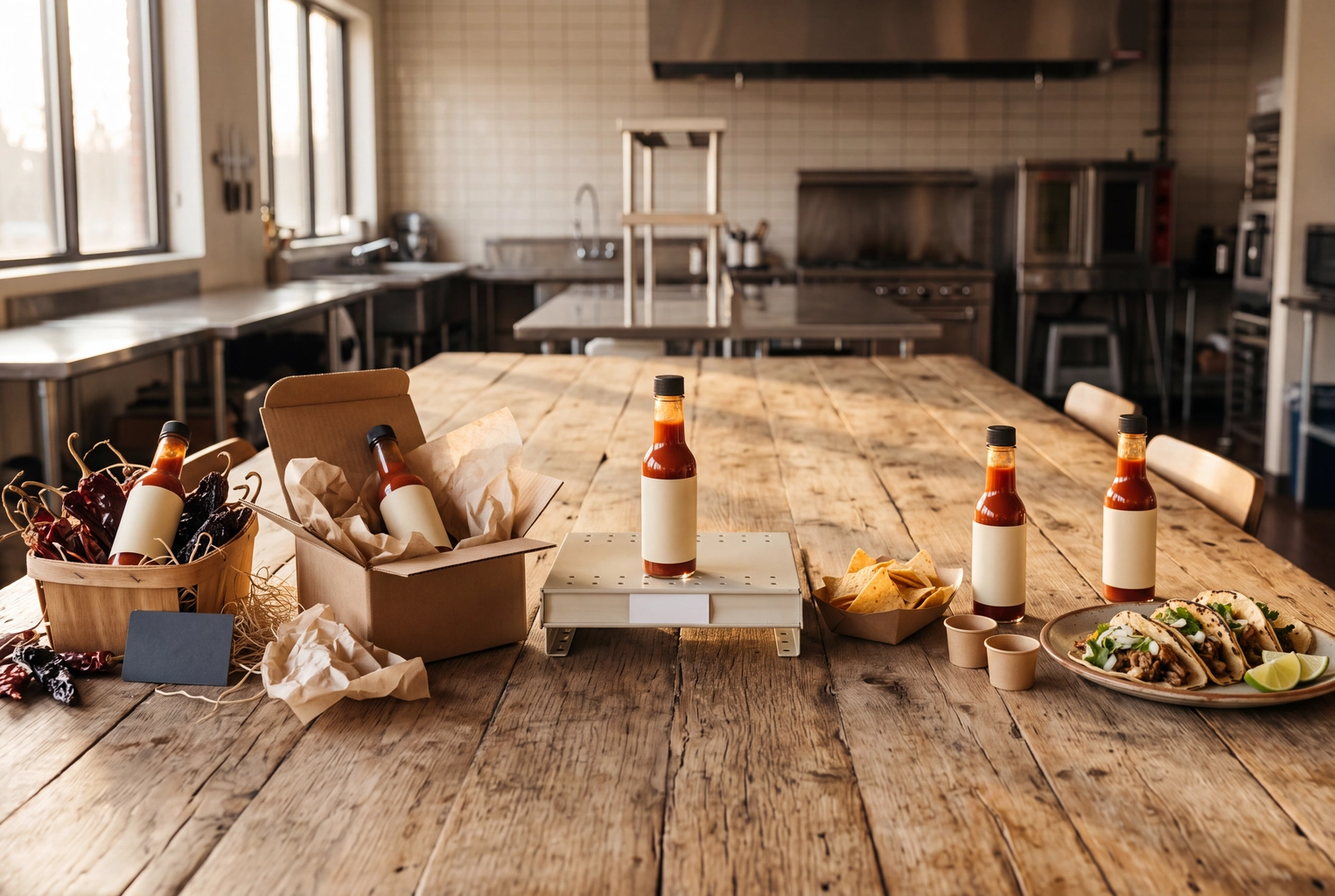
Most guides on how to market a food product list marketing tactics. Few say which one to run first, what it costs or which photos it needs, and that order matters more than the tactics. A hot sauce brand that opens on Amazon, Shopify, three farmers markets and Instagram in one week usually runs short of cash before any channel proves itself. This guide maps 15 tactics to the channel and stage they serve, with a starter budget for each, a 90-day plan and the image list for a 5-SKU launch. If you need images first, our food brand photography page shows how phone photos of your real packs become a full set.
Quick Summary: Prove demand in one hands-on channel (farmers markets, tastings or your own store), shoot one consistent image kit for every SKU, then add Amazon, wholesale and paid advertising in that order. A lean 90-day launch costs roughly $1,150 to $6,750 before inventory, and a 5-SKU range needs about 41 images.
How to market a food product: the short answer
You market a food product by getting it tasted, making it easy to buy again, and only then paying for reach. A food marketing plan has three moves in that order. Pick one channel where you meet consumers face to face. Build one set of images that works on every shelf and screen. Then add one repeat-purchase engine, such as email.
The rest of food product marketing is sequencing. Penn State Extension's Food for Profit material notes that many new food entrepreneurs start with small-scale direct sales, so they can adjust their food products to a target audience. The founder of Lucky Dog Hot Sauce told r/hotsauce that farmers markets became the brand's "bread & butter" retail events, and that web orders just about doubled after the sauce appeared on Hot Ones.
The category rewards patience. The Specialty Food Association put specialty food and beverage sales above $295 billion in 2025 and projects $510 billion by 2030.
How to market a food product: 15 tactics by channel and budget
This table puts 15 strategies in launch order. Marketing budget bands are our planning estimates for a small food business's first 90 days; where a platform publishes a price, the band uses it, and the sections below cite it. "Asset" is the image or document the tactic can't run without. Pre-launch is the four weeks before your first sale, launch is days 1 to 30, traction is days 31 to 60 and repeat is day 61 onward.
| # | Tactic | Channel | Stage | Starter budget | Asset it needs |
|---|---|---|---|---|---|
| 1 | One-line positioning | All | Pre-launch | $0 | Front-of-pack claim order |
| 2 | Price from the shelf back | All | Pre-launch | $0 | Price ladder |
| 3 | Labels and barcodes | Retail, Amazon | Pre-launch | $30–$300 | Label file, GS1 barcode |
| 4 | Master image kit | Every channel | Pre-launch | $45–$2,000 | Packshots, lifestyle, close-ups |
| 5 | Farmers market stall | Farmers markets | Launch | $300–$1,200 | Banner, price cards, QR sign-up |
| 6 | Tastings and demos | Sampling | Launch | $0–$1,400 | Tasting cups, recipe card |
| 7 | Your own store | Own site | Launch | $117 | Square packshots |
| 8 | Amazon listing | Amazon | Launch | $120 plus fees | White main image, secondaries |
| 9 | Creator seeding | Social media | Launch | $200–$400 | Gift box, one-page brief |
| 10 | Independent retail pitch | Retail | Traction | $50–$300 | Sell sheet, range image |
| 11 | Wholesale marketplace | Retail | Traction | $0 upfront | Square catalog images |
| 12 | Recipe-led social posts | Social media | Traction | $0–$300 | 4:5 lifestyle images |
| 13 | Paid advertising | Social, Amazon | Traction | $300–$600 | Two winning creatives |
| 14 | Email and reorder flows | Own site | Repeat | $0 | Recipe images |
| 15 | Earned media, trade shows | PR | Repeat | $0 to pitch | Press kit, a story |
If you remember one column, make it the stage. Nearly every tactic works; the order decides whether you can afford the next one.
Pre-launch marketing: tactics 1 to 4
1. Write one sentence a shopper can repeat
Positioning is your first marketing asset: the sentence a customer uses to recommend you. "The hot sauce that tastes like smoked peaches" works. "Small-batch artisanal condiments" doesn't, because it isn't specific. The label, the Amazon title and every caption borrow from it.
Test it at your first tasting table. If consumers repeat your words to a friend, keep them; if they describe it differently, use their words. Your unique selling point should fit on the front of the pack as one main claim and one supporting claim.
2. Price from the shelf back
Pricing is a marketing decision, not only an accounting one. A common rule in founder threads on r/Entrepreneur is cost times two for wholesale, then wholesale times two for retail. A sauce that costs $2.10 to make wholesales at $4.20 and retails at about $8.40. Run the channel math before you lock a pack size:
- Amazon: the Grocery & Gourmet referral fee is 8% on items priced $15 or less and 15% of the whole price above $15. A three-pack at $14.99 pays about $1.20 in fees; at $15.99 it pays about $2.40, so the extra dollar nets you 20 cents less.
- Wholesale marketplaces: Faire keeps 15% of each marketplace order, so a $4.20 wholesale unit nets about $3.57 before shipping.
- Distributors: their margin sits between your wholesale price and the store. If the item only works at farmers market prices, find out before printing 5,000 labels.
3. Get labels and barcodes right before you print
Labels are marketing too, and a reprint wastes stock and delays launch day. In the US, a packaged food label needs a statement of identity, net quantity, ingredients, allergens and, in most cases, a Nutrition Facts panel. The FDA's small business nutrition labeling exemption covers a low-volume item when the firm has fewer than 100 full-time equivalent employees and sells fewer than 100,000 units of it in the US in 12 months. Most firms that claim it file a notice each year. Home kitchens should also check their state's cottage food law.
Retailers and Amazon expect GS1 barcodes, and Amazon checks UPCs against the GS1 database. GS1 US licenses a single GTIN for $30 with no renewal fee, or a Company Prefix for up to 10 items at $250 plus $50 a year. Five single GTINs cost $150; the prefix leaves room for five more flavors.
4. Shoot one master image kit for every SKU
Every later marketing tactic depends on images: the Amazon main image, the Shopify grid, the sell sheet, the creator brief and the ad. Shoot them once, in one consistent look, before launch. Changing backgrounds between SKUs makes a five-flavor range look like five unrelated products.
Each SKU needs a front packshot on pure white, an angled packshot and a back-of-pack shot with the label readable. Add two lifestyle shots, one ingredient close-up and one scale shot in a hand. Our food product photography guide covers lighting and angles, and product photography pricing compares studio, photographer and AI costs.
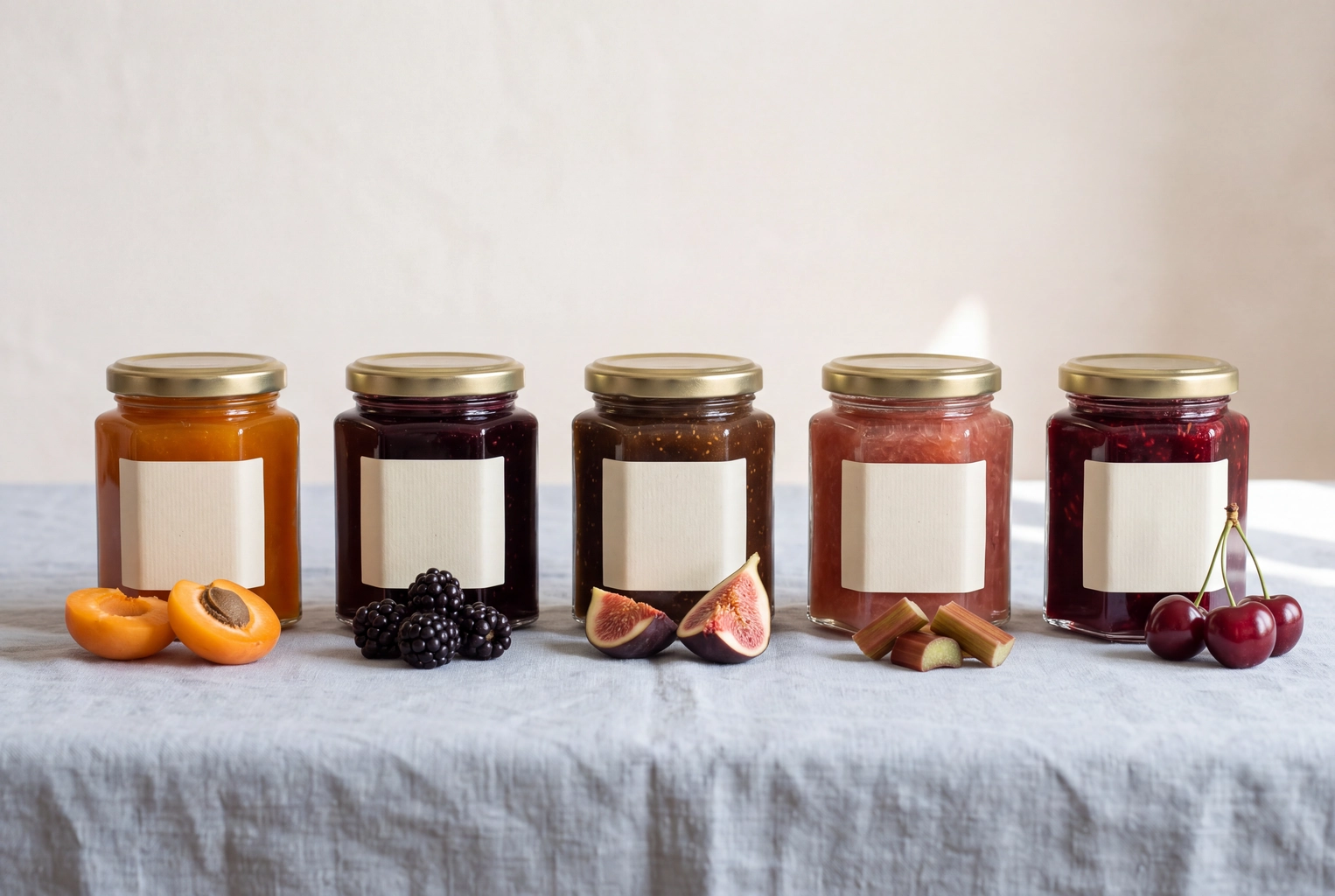 Five fruit preserve jars with matching blank labels on one blue-grey linen surface, a five-SKU food product range shot in one consistent look
Launch marketing: tactics 5 to 9
5. Treat farmers markets as your test kitchen
A market stall is about the cheapest marketing research you can buy. In one Saturday, dozens of consumers tell you which flavor sells, what price feels fair and which sentence makes them stop. The USDA's National Farmers Market Directory lists markets with operating days and accepted payments, so you can pick markets whose audience matches your price.
Run every market day like an experiment. Track units sold per flavor, note the questions people ask and put a QR code on the table that links to an email sign-up, building your list from day one. Tasting rules are set locally, so check with the market manager and county health department first.
Heat You Can Handle hot sauce is a useful model. Its founder took the brand from farmers markets and cooler sales to more than 100 stores across the Pacific Northwest, as he describes on the Escoffier podcast. Our page for farms and market stalls shows how stall sellers build a matching photo set.
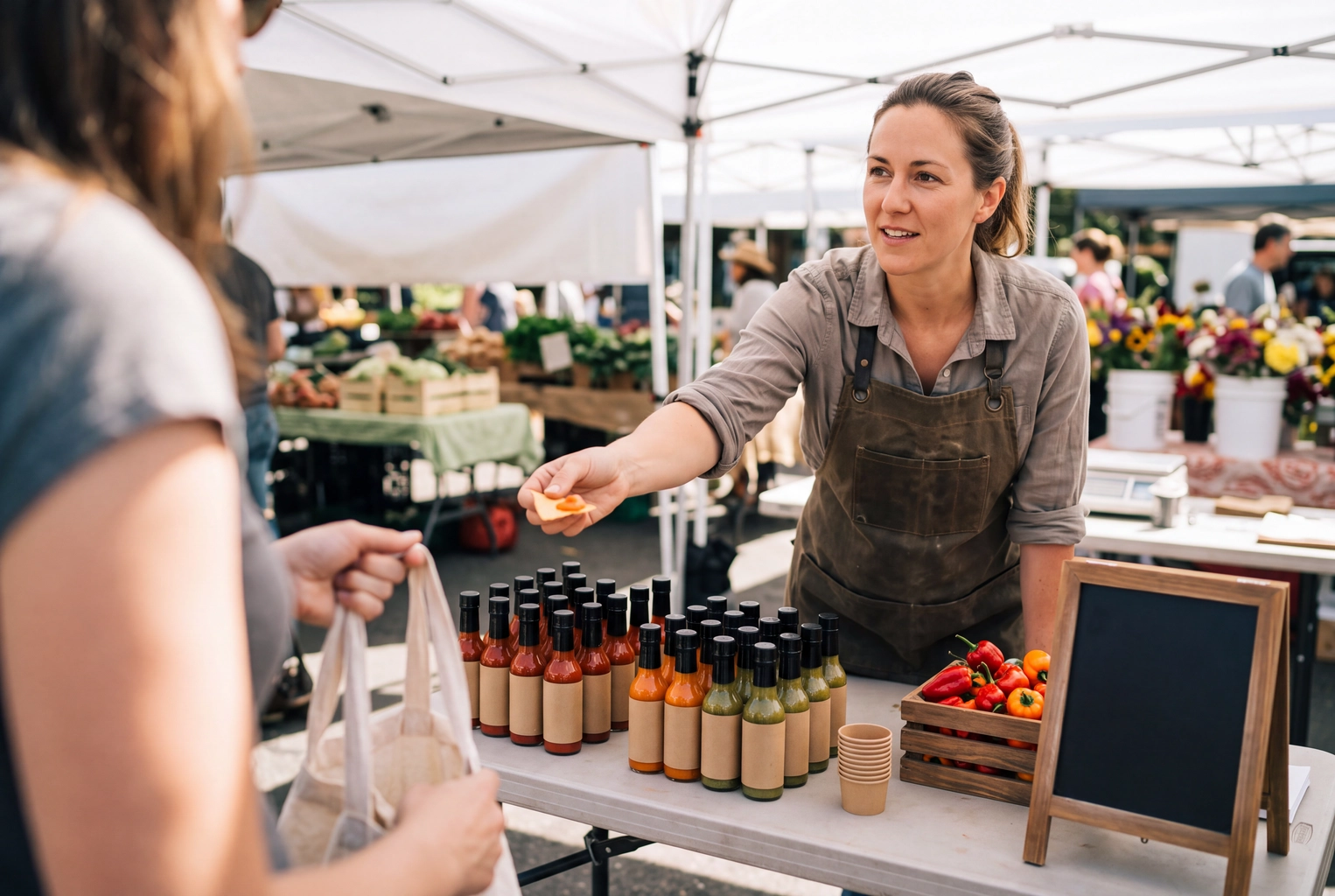 Founder in a canvas apron offering a chip with hot sauce to a shopper at a Saturday farmers market stall, testing a food product face to face
6. Run tastings as a sales channel, not a giveaway
Food marketing starts with taste, so a tasting is often the first real sale a new brand makes. Yellowbird, the Austin hot sauce brand, handed out samples at Wheatsville and Whole Foods, and one reached a Thrillist writer who planned to write about the brand, as the Houston Chronicle reported.
Doing it yourself costs product and a few hours. An agency costs more: one founder told Inc. that the average agency charges "upwards of $300 for a three- to four-hour session." An effective tasting earns its cost:
- Offer a same-day price or bundle so tasters buy before they walk away.
- Count units sold per tasting hour, not compliments.
- Hand out a recipe card with a QR code that links to your store.
7. Open your own store before your first marketplace
Your own site keeps the full margin and the customer's email address for email marketing later. Shopify's Basic plan costs $39 a month, or $29 a month billed yearly, which covers a 5-SKU catalog with bundles and discount codes.
Consistency matters most on the collection page, where all your products sit side by side. Shopify's help center says images can be up to 5000 x 5000 px and under 20 MB, and that 2048 x 2048 px usually displays best for square product images. Keep one aspect ratio for every featured image. Our Shopify product image size page covers tall bottles and long loaves.
On the product page, answer what a market buyer asks out loud. How hot is it? What do I put it on? How long does it keep? Put ingredients and allergens in text, not only in a label photo.
8. List on Amazon with every image slot filled
Amazon is a search channel, so marketing there is mostly images and reviews. List once you know which SKU has proven demand. The Professional selling plan costs $39.99 a month, according to Amazon's selling fees page, or the Individual plan charges $0.99 per item sold.
The main image has the strictest rules. Amazon's product image requirements call for a pure white background (RGB 255, 255, 255), the item filling about 85% of the frame and no added text or logos. The longest side needs at least 1,000 px for zoom; files from 500 to 10,000 px are accepted, and we work at 1600 px or more. Glossy jars and clear bottles are where food fails: the jar reflects the room, and translucent liquids fade into the white.
Use the secondary slots for questions a shopper can't ask you: the back panel, a serving shot, a close-up and a scale shot. Brand-registered sellers can add A+ Content, whose Basic standard image header is 970 x 600 px. Brand Registry needs a registered or pending trademark, so file early. Our Amazon food product photos page covers each slot for jars, pouches and tins.
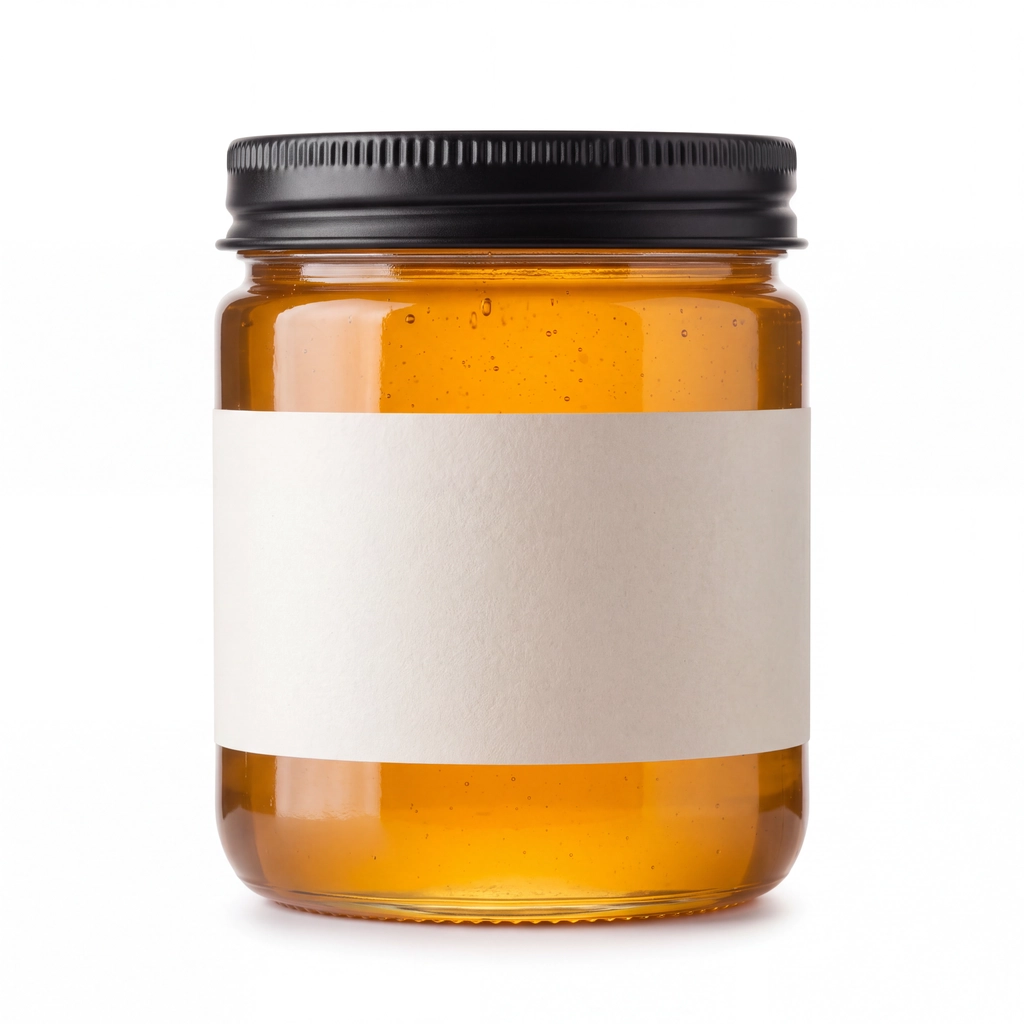 Glossy jar of golden wildflower honey on pure white with one clean highlight, an Amazon main image filling about 85% of the frame
9. Seed your product to 20 to 30 small creators
Send product to creators whose audience already cooks with your category, not the biggest food accounts. In our view, a hot sauce reviewer with 8,000 followers who films an honest taste test is worth more at launch than a lifestyle account posting a flat lay. Micro influencers also answer messages, which makes a second round easier.
Keep the brief to one page: what the item is, two specific recipe ideas, your sentence from tactic 1 and a link to your content folder. Don't require a post. If a creator posts about a free item, the FTC expects a clear disclosure; its Disclosures 101 for Social Media Influencers explains what counts. Our food influencer marketing guide covers outreach and rates for influencers of every size. Budget about $8 to $16 per box.
Traction marketing: tactics 10 to 13
10. Pitch independent and specialty retailers with a sell sheet
Start with five to ten independent grocers, delis and specialty shops near you, ideally ones whose customers already tasted you at a market. Many independent and natural retailers don't charge chain-style cash slotting fees for new products, though some ask for a free first case or a demo.
A sell sheet is the marketing document retail buyers actually read. Put an image, wholesale and retail price, case pack, shelf life, UPC, minimum order and launch support on one page. Buyers want to know how you'll send consumers to the shelf, not only why it tastes good. A range shot on white at the top makes five SKUs read as one line; a full US Letter page at 300 dpi needs 2550 x 3300 px. Our grocery product photography page shows the range shots buyers expect.
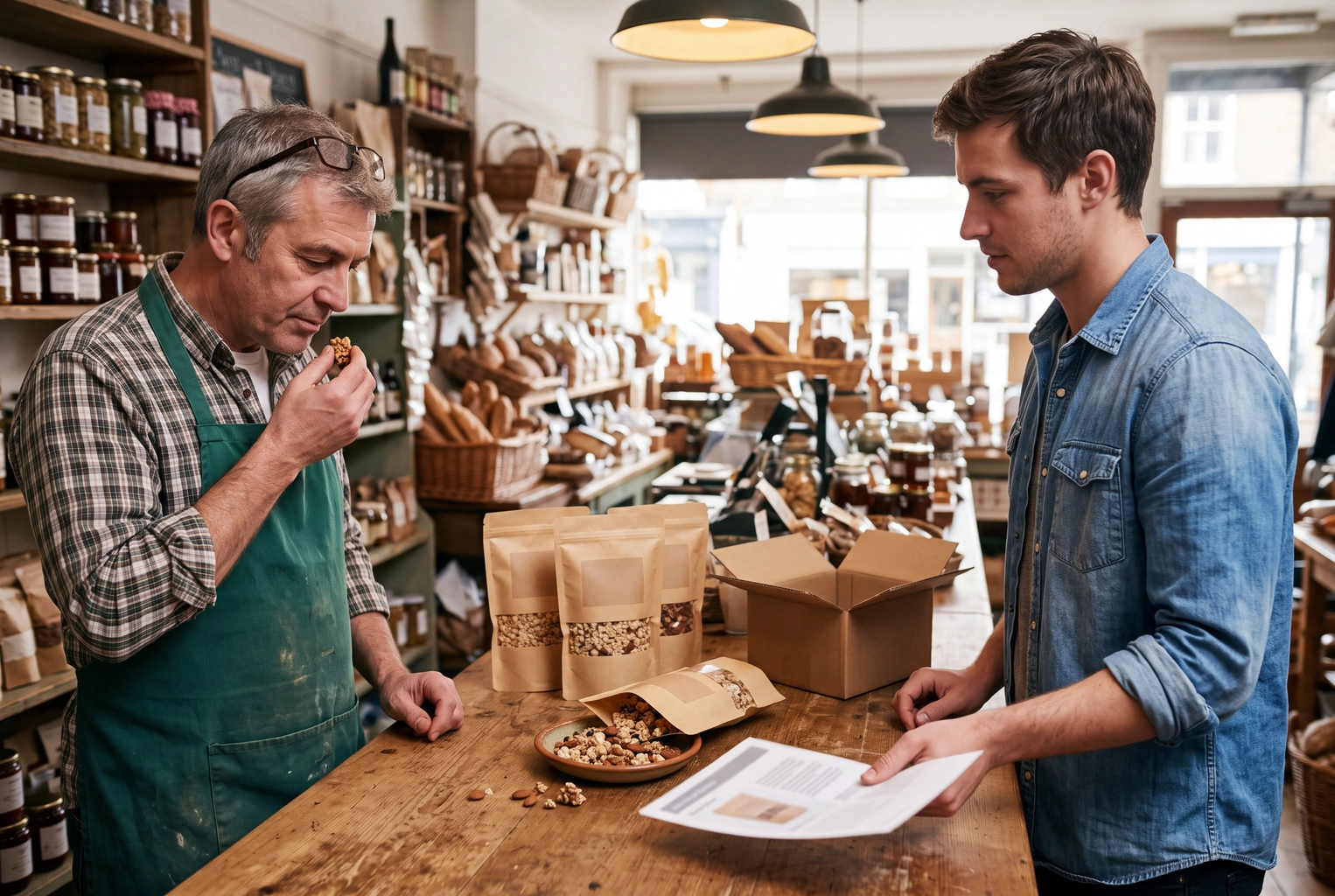 Snack founder showing granola samples and a printed sell sheet to an independent grocer at a wooden deli counter, pitching retail buyers
11. Add a wholesale marketplace for reach
A wholesale marketplace puts your catalog in front of shops you would never reach by walking in. Faire's help center lists a 15% commission on marketplace orders, plus a one-time $10 fee on a new retailer's first order for North American brands. Brands outside North America pay 25% on that first order. Orders from retailers you invite through Faire Direct carry 0% commission. Reuse your square packshots and use the range lifestyle shot as the cover image.
12. Post recipes, not promotions
Recipes are the content food brands never run out of: every dish your sauce, snack or coffee goes into is a post. Three posts a week is a sustainable start. Make one a recipe, one a behind-the-scenes from production or a market, and one a customer repost people will share.
Use 1080 x 1350 px (4:5) for Instagram feed posts; Instagram also accepts 1080 x 1440 px (3:4), which matches its current profile grid. On Pinterest, recipe pins that show the jar in the finished dish give searchers a reason to click through. Our Pinterest food trends roundup lists the trends worth shooting, and food photography for social media has the size chart. 60 food content ideas will fill a quarter, and our social media marketing guide, written for restaurants, works just as well for a snack brand.
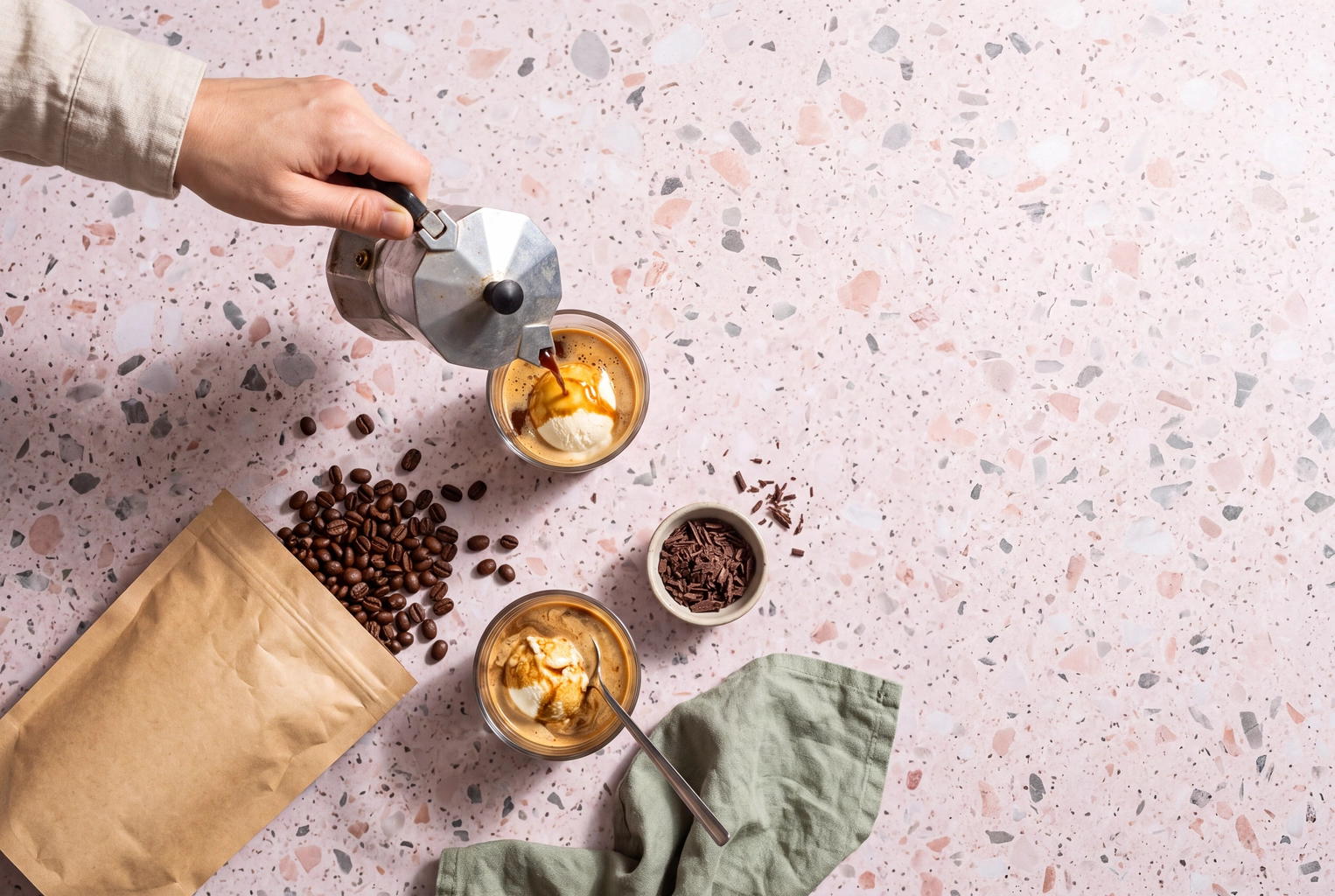 Overhead of espresso poured over vanilla gelato beside a kraft coffee bag and beans on terrazzo, a recipe post for a coffee brand's social media
13. Pay for reach only on posts that already work
Paid advertising multiplies what your organic marketing already proved. In our experience, it rarely rescues a post nobody engaged with. Wait until two or three posts clearly beat the rest, then put $10 to $20 a day behind them for two weeks and judge them on sales. Meta doesn't publish one minimum budget; the floor depends on country, objective and bid strategy.
On Amazon, Sponsored Products on your best-reviewed SKU are the usual first test. Our food ads breakdown shows 31 examples worth copying, and the food advertisement poster page shows how an ad layout is built from your own photo.
Repeat-sales marketing: tactics 14 and 15
14. Email the people who already bought
Repeat buyers are where a food brand's margin lives, and email reaches them without a per-click fee. Klaviyo's free plan covers up to 250 active profiles and 500 email sends a month, enough for a first season of market sign-ups. Set up three automated emails first:
- Welcome: your story in three sentences, a best-seller and one recipe.
- Reorder reminder: timed to how long the item lasts. A 5 oz hot sauce bottle and a 12 oz coffee bag empty at different speeds, so set each flow from your own reorder data.
- Post-purchase recipe: a week after delivery, so the jar doesn't sit unopened.
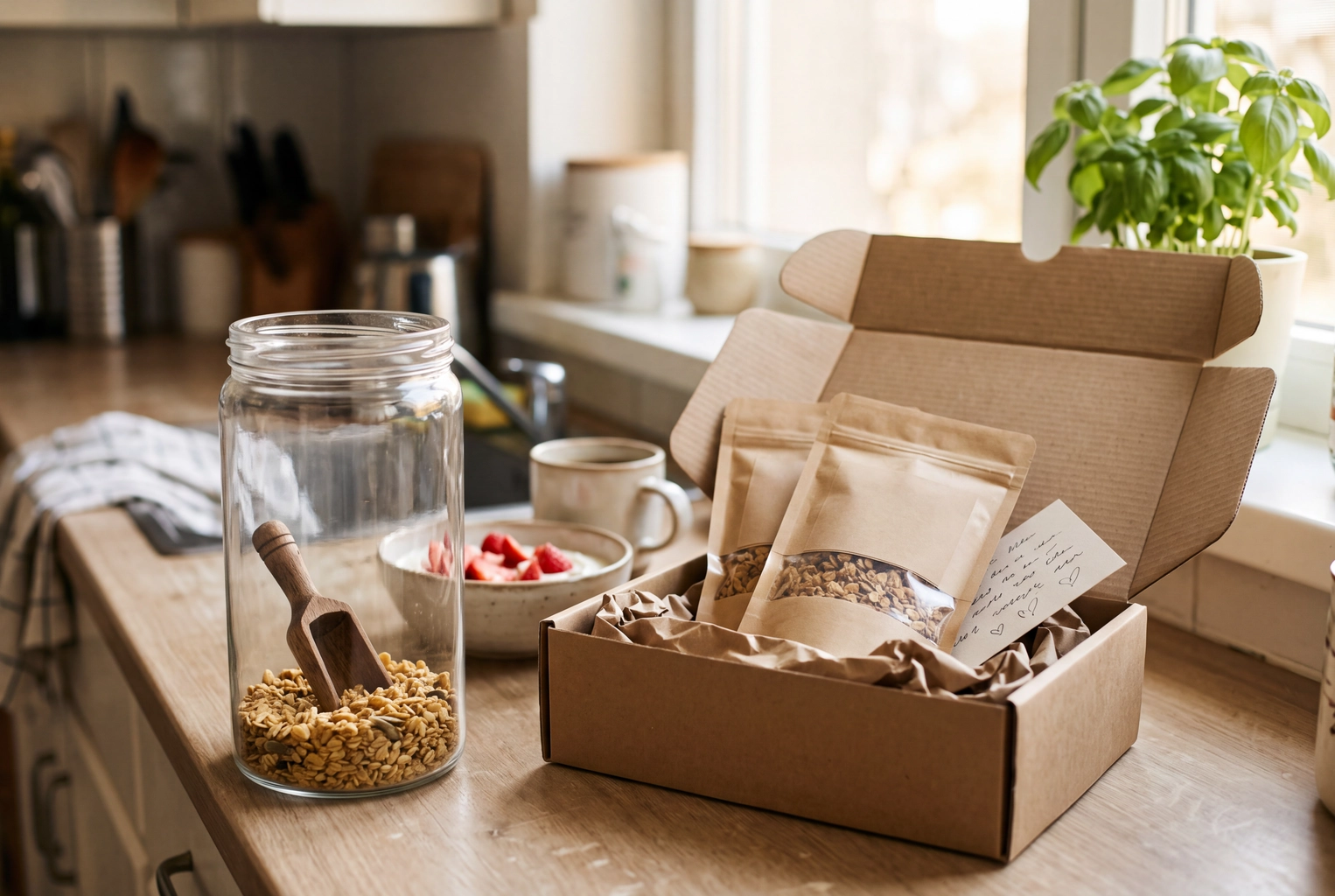 Nearly empty granola jar beside a just-opened mailer holding two fresh pouches on a home kitchen counter, a repeat order a reorder email earns
At five SKUs, building loyalty comes from these small touches more than from a points program. Brand loyalty is the key number in month three, and email is the most effective marketing a founder can automate.
15. Earn media coverage and trade shows when you have a story
Earned media is low-cost marketing once you have a story plus proof: a unique founder angle, a sales number from your markets and photos editors can run. Pitch local food writers first with a short email, a sample and a press kit folder of high-resolution images.
Trade shows come later. The Specialty Food Association calls its Summer Fancy Food Show specialty food's premier trade show, but a booth only pays when you can supply the distributors you meet. Until then, regional food festivals are cheaper places to collect buyer contacts and watch food trends.
The 90-day food product marketing plan
This plan for how to market a food product assumes one founder, five SKUs and a budget toward the low end of the table. Each phase has one key number to watch, because a food product launch with ten metrics usually tracks none.
| Weeks | Stage | Tasks | Number to watch |
|---|---|---|---|
| −4 to 0 | Pre-launch | Write the positioning line. Order labels and barcodes. Shoot the image kit and build the store. | Sign-ups before launch |
| 1–2 | Launch | Open the store. Work 2 market days. Ship 25 creator boxes. | Units sold per market day |
| 3–4 | Launch | Run 2 tastings at markets or events. Put the Amazon listing live. Ask for reviews. | Units sold per tasting hour |
| 5–6 | Traction | Pitch 10 independent stores. List on Faire. Post 3 recipes a week. | Stores that say yes |
| 7–8 | Traction | Hold a tasting in every new store. Turn on the reorder email. | Reorders from stores |
| 9–10 | Traction | Spend $10–$20 a day on the 2 best posts. Test Sponsored Products. | Cost per first order |
| 11–12 | Repeat | Review every channel. Cut the weakest. | Repeat purchase rate |
After week 12, keep the channel with the best sales per hour of your time and drop at least one. The plan isn't meant to keep all 15 tactics running; it shows which three deserve your next quarter.
The image asset list for a 5-SKU launch
A 5-SKU launch needs about 41 finished images: seven per SKU plus six range-level shots. One consistent set covers the store, Amazon, the sell sheet, the creator brief and the ads.
| Asset | Per SKU | 5-SKU total | Where it's used |
|---|---|---|---|
| Front packshot on pure white | 1 | 5 | Amazon main, store grid, Walmart, Faire |
| Angled packshot | 1 | 5 | Amazon secondary, product page |
| Back-of-pack, label readable | 1 | 5 | Amazon secondary, retailer listings |
| Serving or lifestyle shot | 2 | 10 | Product page, social, creator brief |
| Ingredient or texture close-up | 1 | 5 | Amazon zoom, A+ Content |
| Scale shot in a hand | 1 | 5 | Amazon secondary, product page |
| Full range on white | – | 1 | Sell sheet, Faire, line sheet |
| Full range lifestyle | – | 1 | Homepage banner, press kit |
| Ad creatives with room for text | – | 4 | Meta and Amazon campaigns |
Deliver at the largest size you need and crop down; a 4096 x 4096 px master covers every row below without upscaling.
| Where | Size to deliver | Rule that matters |
|---|---|---|
| Amazon main image | 1,000 px+ on the longest side | Pure white, item fills about 85% |
| Amazon A+ Basic header | 970 x 600 px | Brand Registry required |
| Shopify product image | 2048 x 2048 px square | Under 20 MB, one aspect ratio |
| Walmart Marketplace | 2200 x 2200 px | Seamless white main image |
| Instagram feed | 1080 x 1350 px | Pack clear of crop edges |
| Stories and Reels covers | 1080 x 1920 px | Detail out of top and bottom |
| Sell sheet, US Letter | 2550 x 3300 px | 300 dpi for print |
What does the list cost? Our product photography pricing research found published rates of $15 to $50 per white packshot and $75 to $500 per styled shot. At those rates the 16 packshots run $240 to $800 and the 25 styled shots $1,875 to $12,500, before setup fees and shipping samples.
Where FoodShot fits in the kit
FoodShot is built for CPG brands that need this list without a studio day. You photograph each real product with your phone and pick one of 200+ styles, and FoodShot restyles that photo into a studio-quality image in about a minute, delivered in 4K (4096 x 4096 px for a square). Builder Mode sets the surface and backdrop, such as pure white for the Amazon main slot. My Styles saves one look, so all five SKUs, and flavor six later, share the same surface and light. Poster Mode turns a photo into an ad layout with your text in about 2 minutes.
The math: 41 finals with a second option each is about 82 generations, which fits the Business plan's 100 photos for $45 a month. Every paid plan includes a commercial license; see pricing. Two limits are important. FoodShot makes still images only, not video, and it works from your photo of your real pack, so check that every label matches what ships. For jars, pouches and cans, see packaged food photography and white background food product photos.
Marketing to skip in your first 90 days
Much of the advice on how to market a food product assumes a marketing team and a trade budget. Three common strategies burn a small budget without teaching you much:
- Chain slotting fees. Conventional grocery chains can charge $250 to $1,000 per SKU per store to stock a new item, according to Eightx's 2026 planning ranges. Five SKUs in a 50-store chain at the low end is $62,500 before a single unit sells.
- Every channel at once. Each channel needs its own listing, inventory and follow-up, so a founder spread across six learns little about any of them.
- Paid reach before organic proof. If a post doesn't move people for free, paying to show it to more people mostly buys a bigger version of the same result.
Successful food brands look narrow in year one. They win one channel, then copy what worked into the next.
Frequently Asked Questions
How much does it cost to market a food product?
A lean 90-day marketing budget runs roughly $1,150 to $6,750 before inventory, by our estimate from the bands in the tactic table. The low end is DIY tastings, one market a week and AI-restyled photos. The high end adds agency demos, a studio for packshots and a month of paid advertising.
How to market a food product with no money?
Use marketing strategies that cost time instead of cash: farmers market tastings, a free email plan, recipe posts and pitches to local independent stores. Faire charges nothing upfront and takes a commission only when an order arrives. The one cost worth paying early is clean images, because every free channel still needs them.
How do I get my food product into grocery stores?
Start with independent and specialty grocers near you, using reorder data from markets and your own store as proof. Bring a sell sheet with pricing, case pack, shelf life and UPC, and offer a tasting. Regional chains and distributors come after steady reorders.
Should I sell on Amazon or my own website first?
Start with your own website if you already have an audience from markets or social media, because you keep the margin and the email. Go to Amazon early if consumers already search for your category there. Either way, price with the 8% and 15% referral tiers in mind.
How many photos does a food product launch need?
Plan on about seven images per SKU: a white front packshot, an angled packshot, a back-of-pack shot, two lifestyle shots, a close-up and a scale shot. Add two range shots and four ad creatives, and a 5-SKU launch needs about 41 images.
How long does it take to market new food products?
Ninety days is enough to learn which channel and strategies sell best per hour of your time. Repeat-purchase data takes longer, because buyers have to finish the first bottle or bag before they reorder.