Lebanese Food Photography: Mezze, Shawarma & More
 Ali Tanis23 min read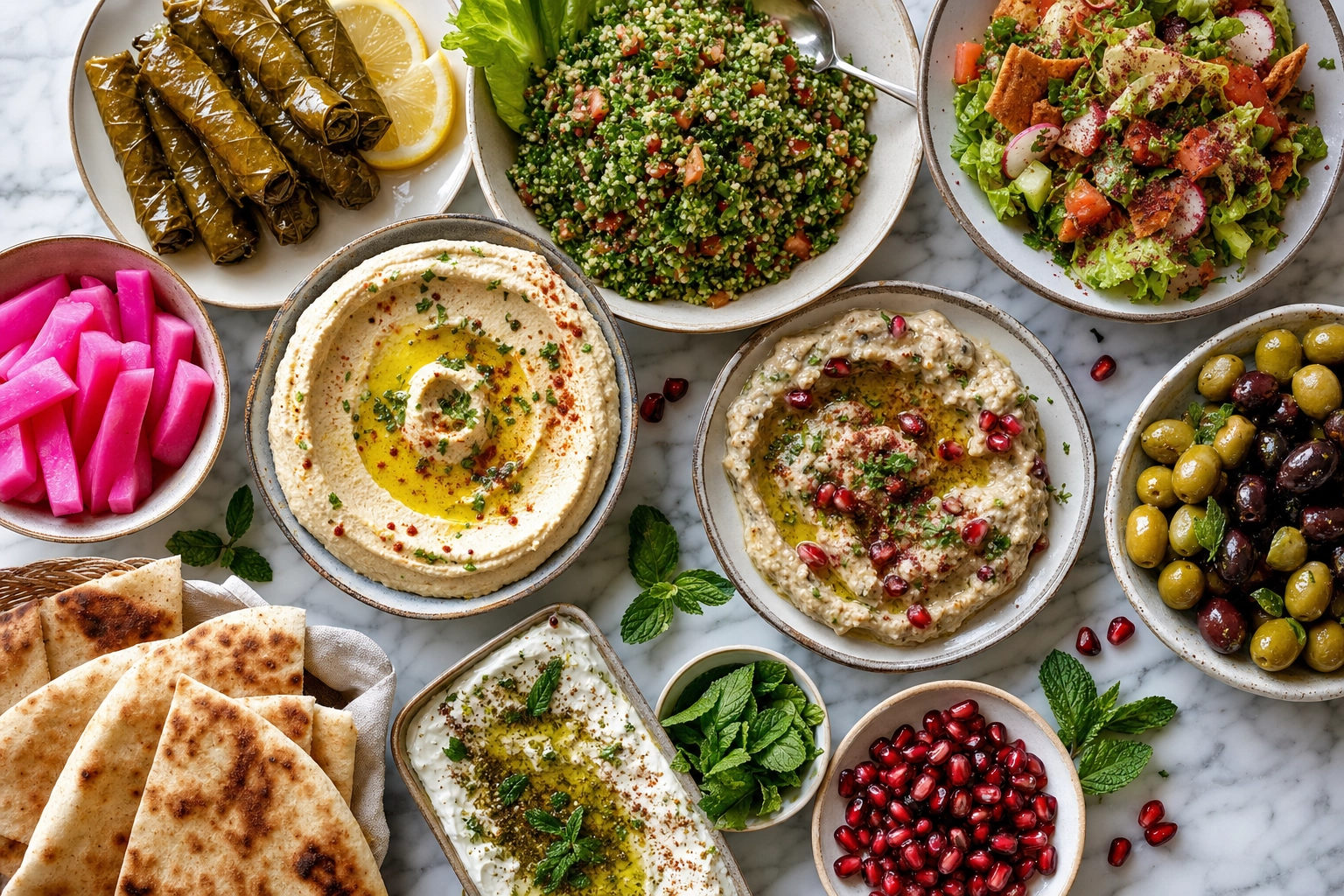
Walk into a good Lebanese restaurant and the table fills before you've decided anything. Hummus lands first, then baba ghanoush, tabbouleh, warm pita, olives, pickled turnips glowing hot pink, a plate of falafel, skewers straight off the grill — and somewhere in the middle, a swirl of olive oil catching the light. Abundance is the entire point of a Lebanese mezze. So why does the photo you snapped between orders look like a tray of beige leftovers?
That gap is what this Lebanese food photography guide fixes. Search "lebanese mezze" and you'll scroll a hundred near-identical recipe photos of someone else's hummus — and diners can smell a stock photo across a delivery app. Unlike the endless Lebanese recipes online, your menu has exactly one job: sell the dish a guest can order right now. So this isn't a recipes roundup. It's about making your own food look as good as it tastes — the abundant mezze aesthetic, the one camera angle that does the heavy lifting, the six shots that carry any Levantine menu, and the 2-minute shortcut for when the lunch rush won't wait.
Quick Summary: Great Lebanese food photography — a generous Lebanese mezze spread especially — comes down to four things: the abundant, warm, jewel-toned aesthetic (creamy dips, herb green, sumac red and golden oil on marble or dark wood); the straight-overhead angle that turns a crowded table into one wheel of color; the six shots that sell any Levantine menu (the full mezze table, the hummus swirl, the shawarma carve and wrap, falafel and pita, the mixed grill, and baklava); and one consistent look across the whole menu. Shoot them on a phone, or turn phone snaps into menu-ready images in about 2 minutes with an AI food photo editor.
Why Lebanese Mezze Is the Most Generous Table to Shoot Badly
Here's the cruel joke of Lebanese food photography: the food is generous, colorful and alive on the table, and that's exactly why it's so easy to get wrong. A mezze spread is built for a crowd of hungry people, not for a lens — and your phone flattens all of it. Four things go wrong, again and again.
Everything reads beige. Line up hummus, moutabal, labneh, a basket of pita, golden falafel and toasted chickpeas, and the camera sees one tan-and-cream blob. The very abundance that makes the table exciting collapses into sameness the moment 8–12 similar-toned plates crowd the frame under flat light.
The hummus swirl dulls fast. That glossy pool of olive oil is your number-one freshness cue, but the chickpea base drinks it within minutes. A bowl that looked luscious at the pass reads dry and tired by the time you've framed the shot.
Char turns to mud. Grill marks on kafta and shish tawook, the smoky top of baba ghanoush, the crackle on a shawarma cone — all of it looks alive in person. Under flat fluorescent light those darks smear into a muddy brown with no texture.
The register flattens. There's a real difference between a bright, editorial Beirut mezze bar and a generic "Middle Eastern" plate, and it lives entirely in the styling. Lose it and your food looks like everyone else's.
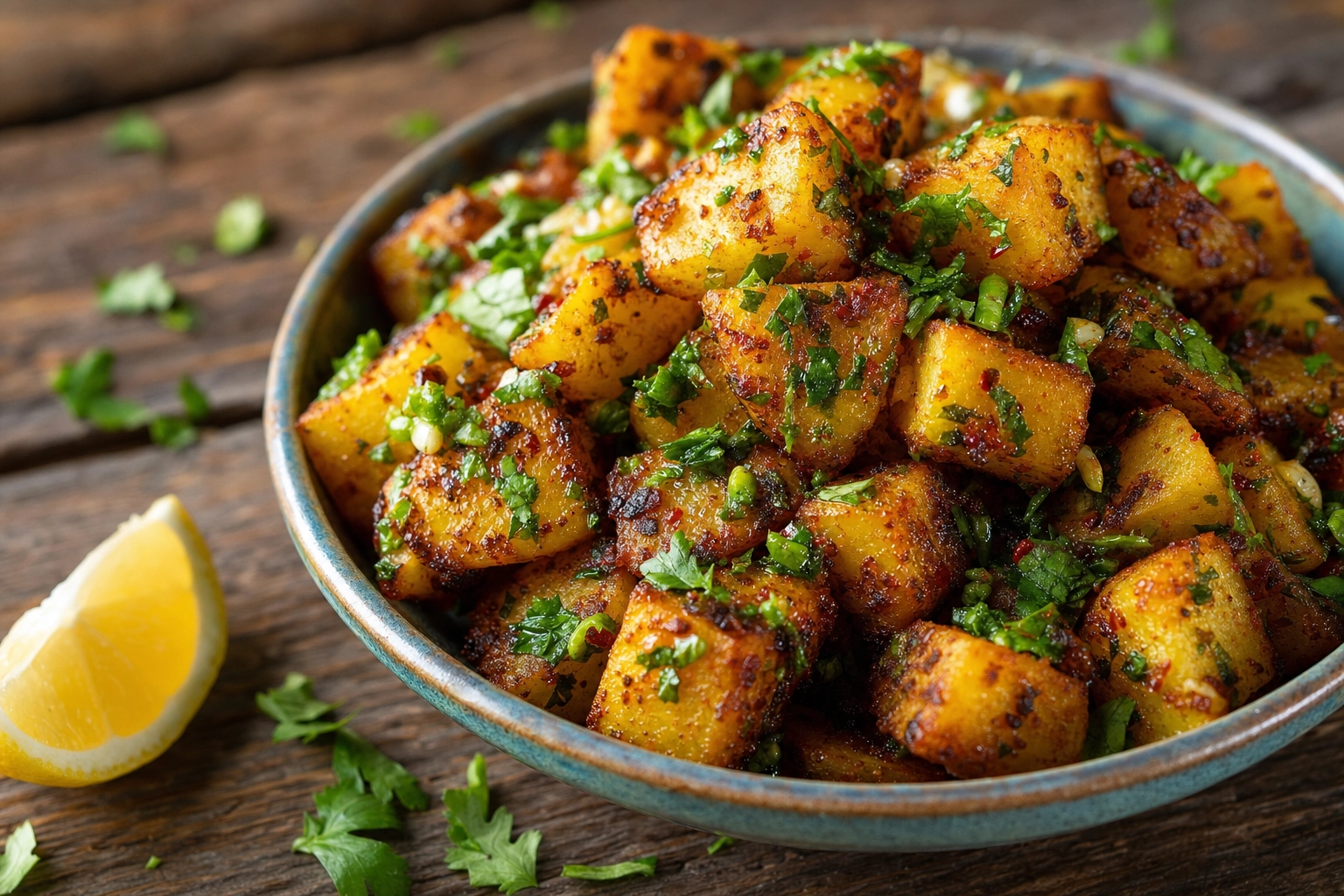 Lebanese batata harra — crispy fried potato cubes with garlic, cilantro and chili — in a rustic bowl
The stakes aren't small, because Levantine food is having a moment. Trend forecasters at Datassential put Middle Eastern flavors — shawarma, harissa and the rest — among the fastest-rising in the U.S., especially with Gen Z and Millennial diners, and one industry analysis pegs the global Middle Eastern restaurant market at roughly $32.6 billion in 2025. A big share of those orders now come through delivery apps, where your photo is a thumbnail fighting a dozen others. And stock photos won't save you: a library plate is someone else's lunch, while your own food is the only image that's honest and ownable.
The Abundant Mezze Aesthetic: What "Beirut on a Table" Looks Like
Before you touch a camera, fix the target in your head. Almost every great Lebanese food picture shares one feeling: a generous, warm, shared table where there's always room for one more plate. Think of the bright, mirror-and-marble rooms of modern Beirut — the register set by restaurants like Em Sherif and Tawlet — where the food is precise but the spirit is ahlan wa sahlan, welcome, dig in. Abundant, not precious. Warm, not clinical.
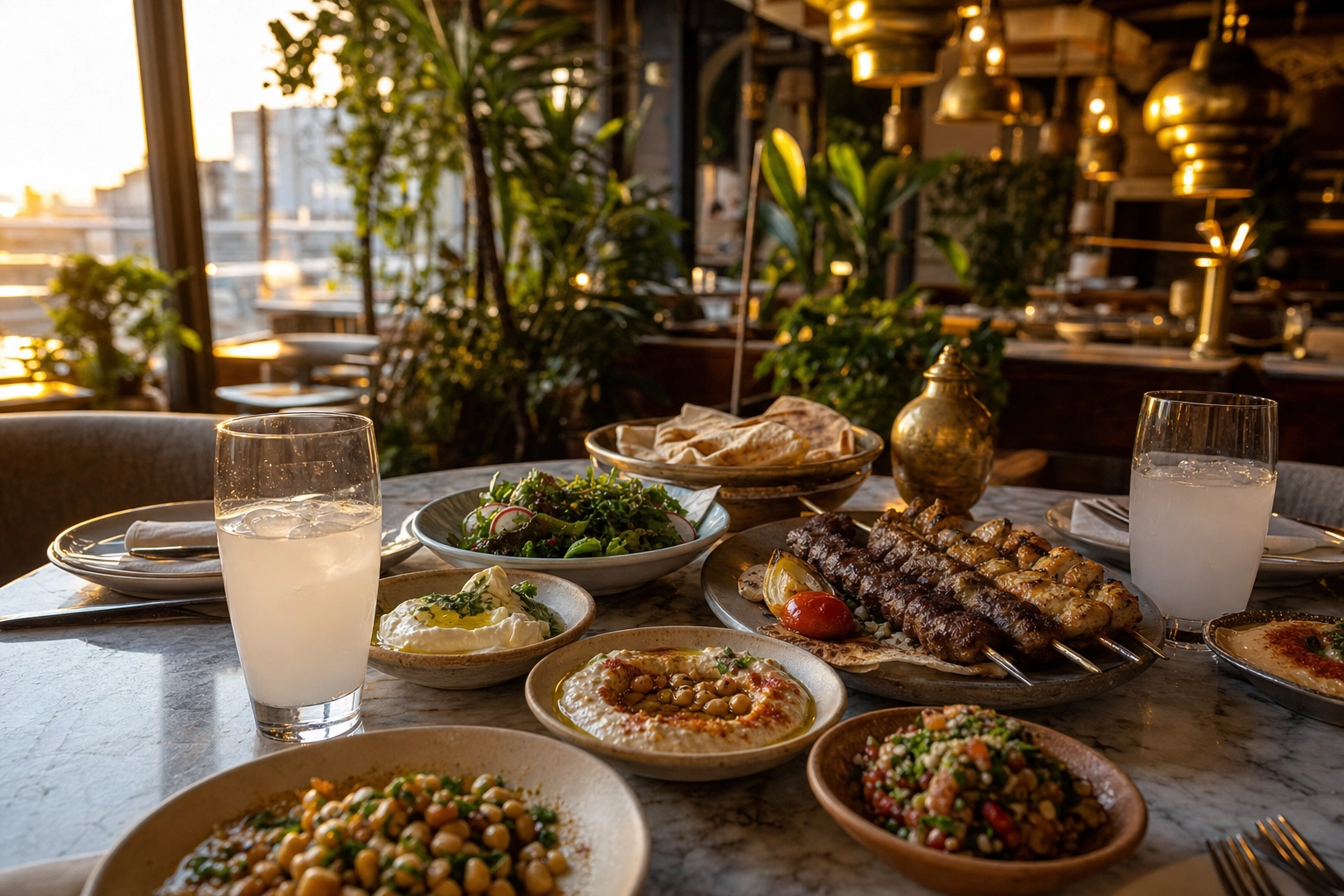 Warm Beirut-style Lebanese mezze restaurant table set for sharing at golden hour with small plates and arak
Paint With the Levantine Palette
The fastest shortcut to "this looks Lebanese" is color. Build two or three of these into every frame:
- Creamy white — hummus, labneh (strained yogurt), moutabal, tahini, garlicky toum.
- Herb-and-olive green — parsley, mint, tabbouleh, olives, the oil itself, pistachio.
- Sumac-and-tomato red — that rust-red dust on the dips, fattoush tomatoes, muhammara, chili.
- Golden fried — falafel, kibbeh shells, toasted pita, baklava phyllo.
- Jewel accents — ruby pomegranate arils and green pistachio, the two garnishes that make everything look intentional.
Running through all of it is olive oil — the connective tissue of the cuisine. Its sheen is the single most important "fresh and alive" signal you can put in a photo, whether it pools in a hummus well, glosses a dip or slicks a charred pepper.
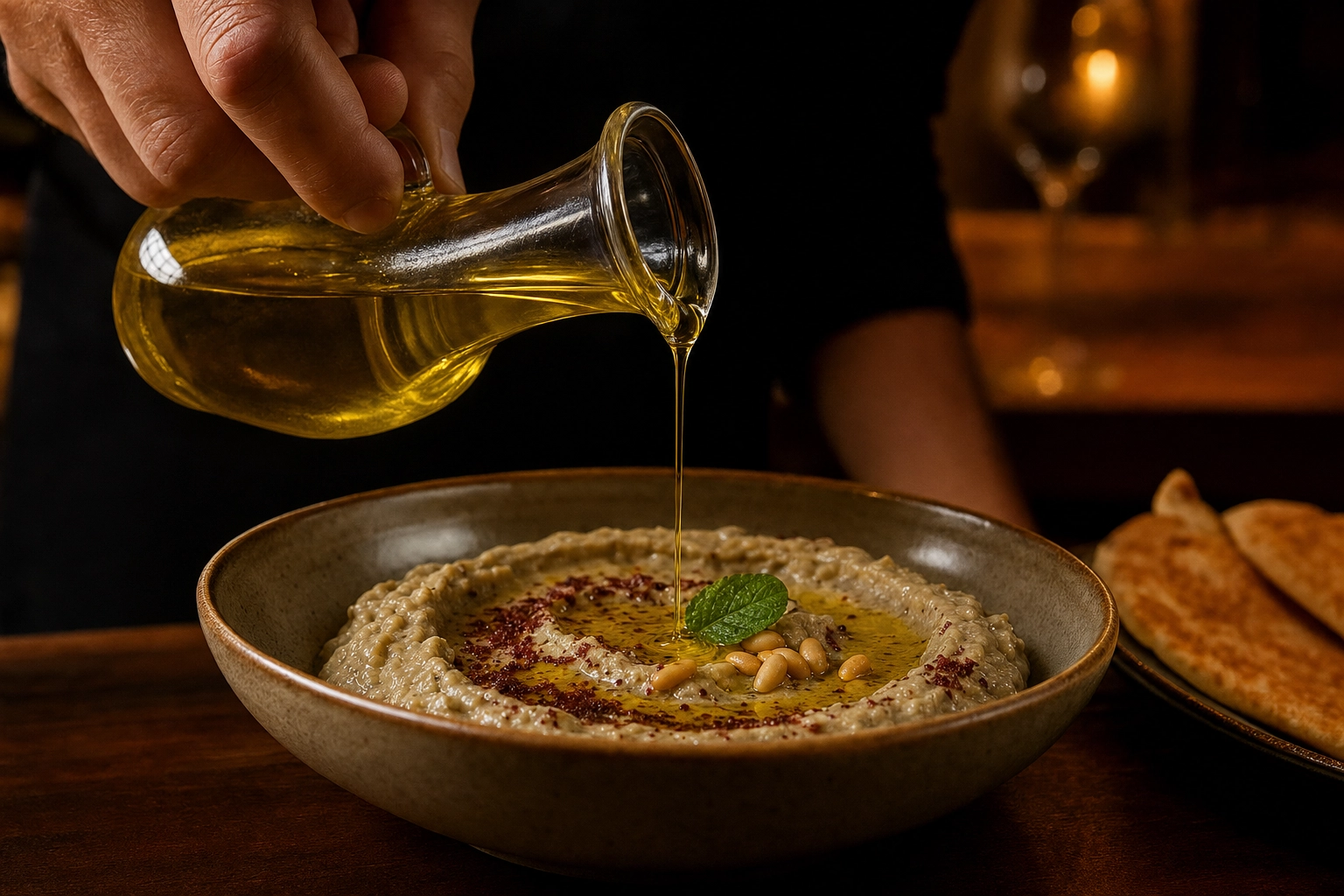 Hand pouring olive oil over smoky baba ghanoush dusted with sumac on a dark walnut counter, warm light
Surfaces and Props That Say Levantine
Lebanese food belongs on materials that feel both bright and a little rustic. White or Carrara marble gives you the clean, editorial Beirut-mezze-bar look. Weathered blond wood reads warmer and more casual. Dark walnut and cream linen push things toward an intimate, evening register, and dark slate or hammered copper is where the grill belongs.
For props, a few earn their keep: a dusting of sumac or za'atar, a scatter of pomegranate arils, a few pine nuts, a sprig of mint or parsley, hot-pink pickled turnips, a handful of olives, a small cruet of olive oil. The keyword is few. The biggest mistake in homemade Lebanese food images is cramming olives, a lemon, a herb plant and three dips into one frame until nothing has room to breathe. Pick one or two props that hint at a story, then stop.
Two Registers of Light: Bright Beirut vs. Warm Shawarma Joint
Most Lebanese photography lives in one of two lighting worlds, and knowing which you're in solves half the problem.
The default for mezze, dips, salads and sweets is bright, soft, diffused daylight — a big window with a sheer curtain, or open shade just out of direct sun. It keeps the whites clean and the greens crisp. Hard noon light blows out the labneh; flat restaurant fluorescents cast a yellow-green tint that makes herbs look sickly.
The second register is the warm tungsten glow of a shawarma joint or grill house — the cozy amber of a wrap counter at night, where the meat on the spit is the brightest thing in the room. Save this moody, low-key look for the shawarma carve, the mixed grill and the occasional dramatic dip. In both worlds, light from the side or slightly behind rakes across textures and lifts that oil sheen, and a cheap sheet of white foam board bounces it back so shadows don't go muddy.
Overhead and Flat-Lay: The Power Angle for a Mezze Table
Most cuisines make you choose an angle. Lebanese food chooses for you: shoot from above.
Look at the menu — dip bowls, small plates, platters, spreads. Mezze is composed on a flat plane, so it's built to be seen from the top. And a Lebanese mezze table is the ultimate flat-lay subject on earth: eight, ten, twelve plates arranged into a single abundant wheel of color that no single-dish angle could ever capture. The 90-degree overhead shows every ingredient edge to edge, turns the table into a mosaic, and reads instantly on a tiny delivery-app thumbnail.
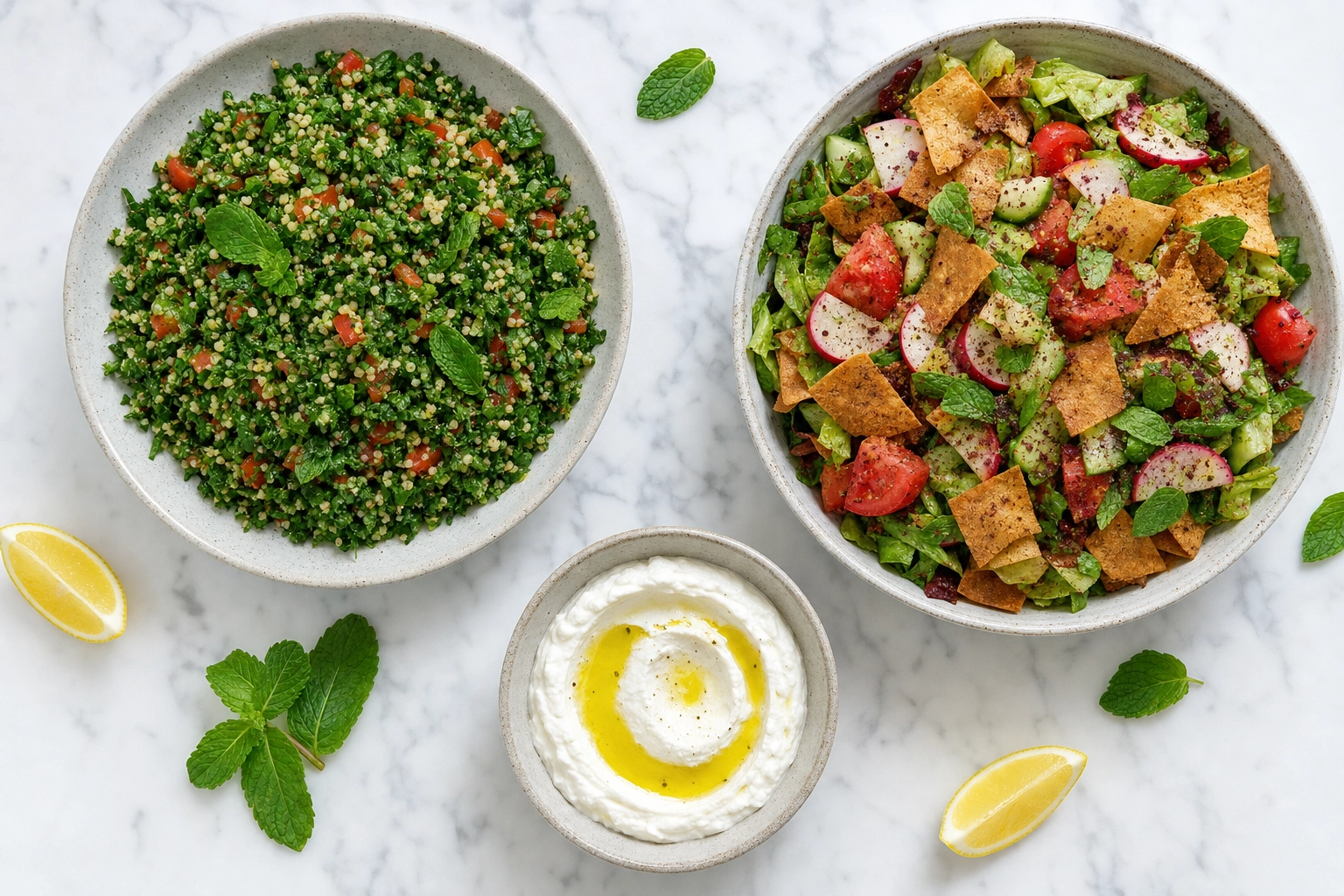 Overhead Lebanese tabbouleh, fattoush and labneh on marble showing color-contrast flat-lay composition
Composing a crowded overhead is a craft, though. A few rules keep it from looking like a cluttered bus tray:
- Group in odd numbers. Three dips, five small plates — odd arrangements feel more natural than even ones.
- Fight the beige. Never let two same-toned dishes touch. Slot the green tabbouleh between the cream hummus and the red fattoush so color contrast does the work.
- Vary the height. A tall stack of pita, a mounded salad and a flat dip in the same frame give the eye somewhere to travel.
- Leave deliberate negative space. A little breathing room between plates makes a board look intentional, not emptier.
- Anchor, then fill. Set the dips first, then fill the gaps with pita, olives, pickles and a final scatter of herbs and sumac.
Shooting a clean flat-lay on a phone is mostly discipline. Keep the lens parallel to the table so bowls look round, not warped. Turn on grid lines and shoot from a step stool so you're directly over the spread, arms steady. Watch your own shadow — put the soft light to the side, not blocked by your head.
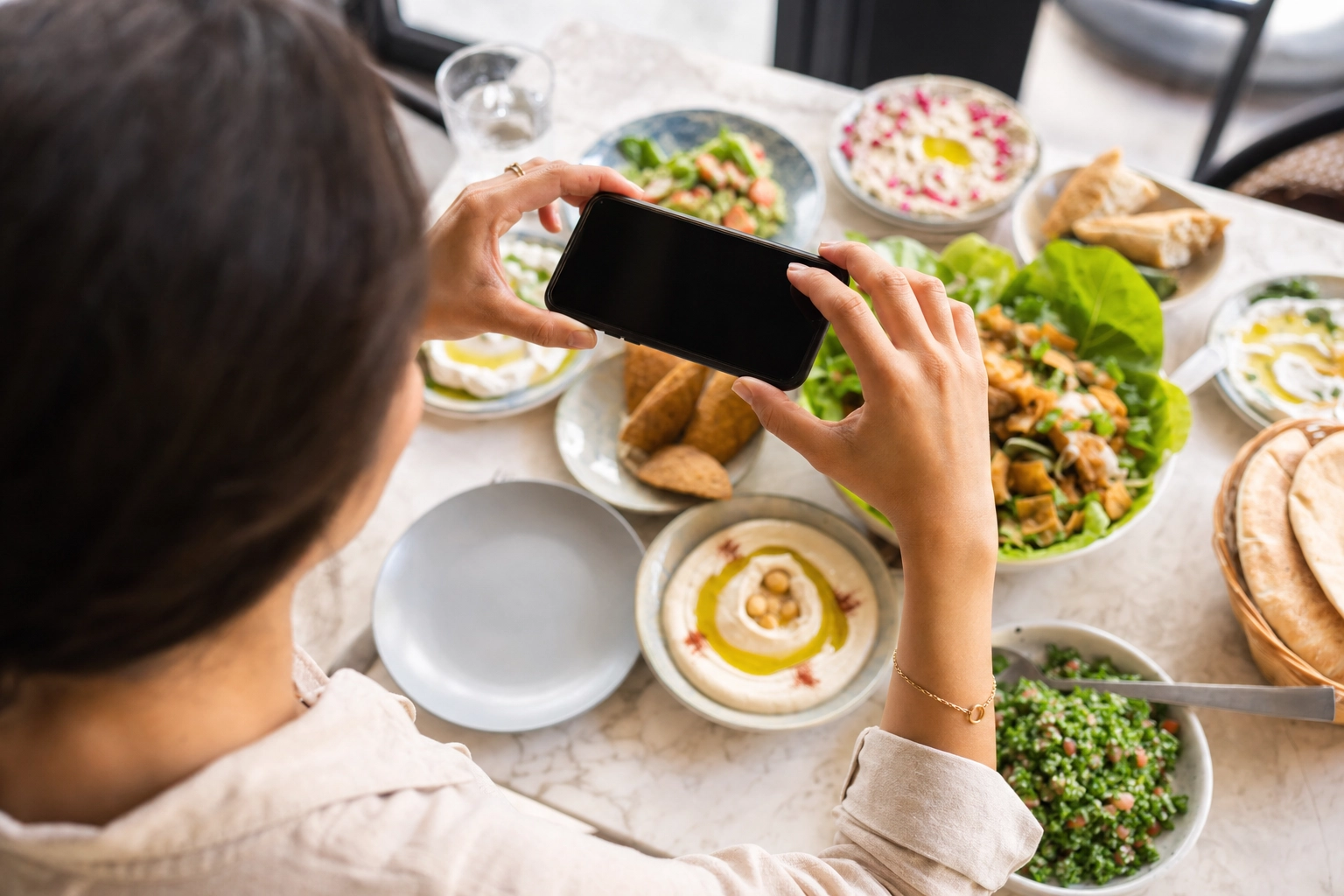 Person holding a smartphone directly above a Lebanese mezze spread to shoot an overhead flat-lay photo
Then switch to a 45-degree, three-quarter angle only when height or action is the story: the shawarma carve, a drizzle mid-pour, a stack of pita, a kibbeh cracked open to show its core. The rule of thumb — flat, composed spreads go overhead; tall things and action shots go to 45 degrees.
The 6 Essential Lebanese Food Shots Every Menu Needs
You don't need all forty items on the menu photographed. Six shots do most of the selling, because they cover the dishes diners look for first when they picture a Lebanese mezze.
1. The Full Mezze Table (Your Abundance Hero)
The full Lebanese mezze is the soul of the table — small-plate appetizers, shared, that turn eating into an event. The word traces to the Persian maza, "to taste," and the tradition runs across the Levant as the cousin of Spanish tapas and Italian antipasti. As Wikipedia notes, it's a selection of small dishes served as appetizers, and in Lebanon it's often split into cold mezze and hot mezze — so many options that many diners skip the mains entirely.
That abundance is your most shareable image, because abundance is something the camera can actually see. Build it for the lens: anchor with hummus and baba ghanoush, add green with tabbouleh and fattoush, then fill in warak enab (rolled stuffed grape leaves), olives, hot-pink pickles and a basket of warm pita, and finish with a scatter of herbs and sumac. Shoot it dead overhead on marble or blond wood and you've got the cover model of your menu — the same shot that anchors any Lebanese catering spread or event proposal.
2. The Hummus Swirl (Well, Olive-Oil Pool, Drizzle)
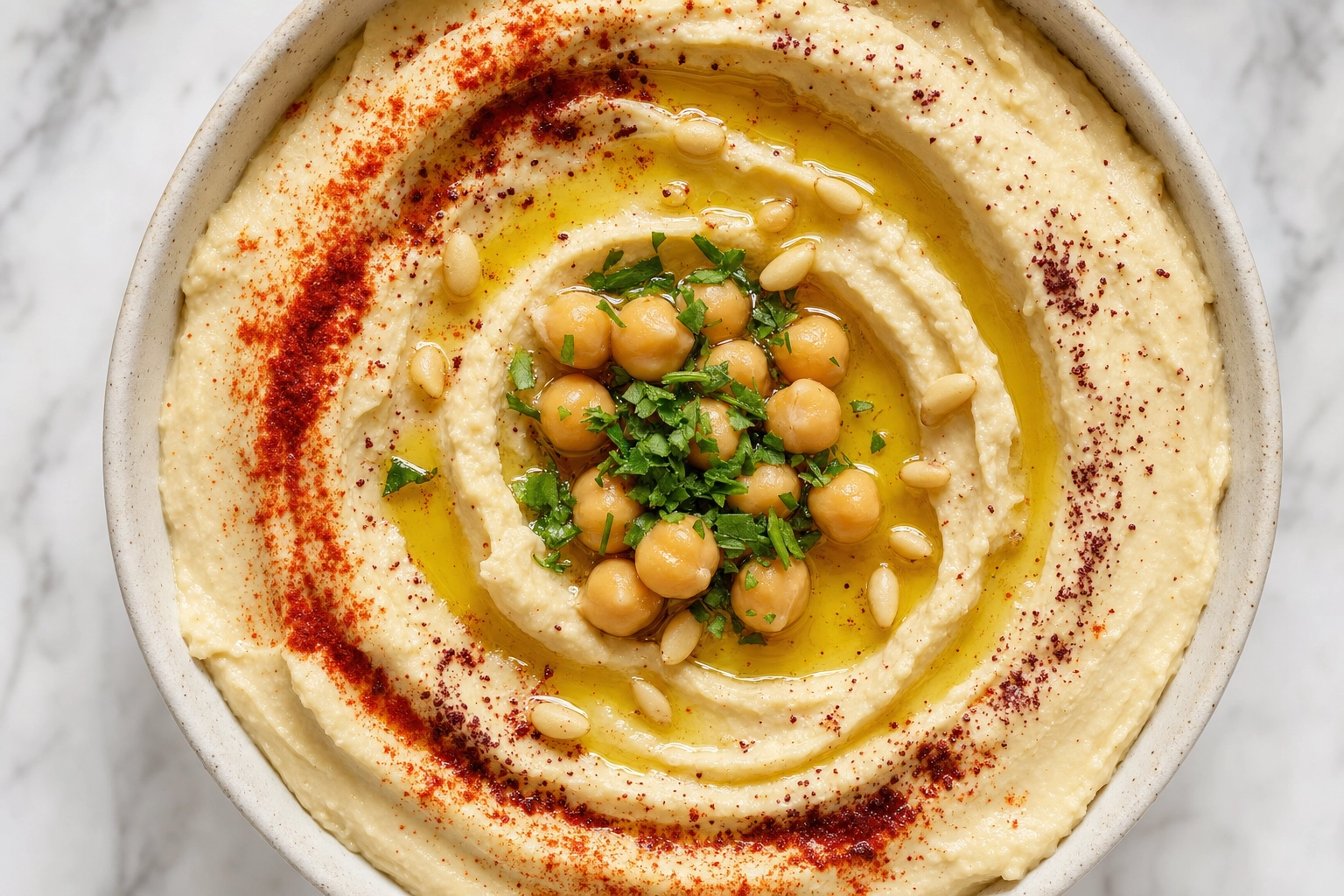 Overhead hummus swirl with olive-oil pool, paprika, whole chickpeas and pine nuts in a bowl on marble
Hummus is the single most-photographed Levantine dish, and the one that dies fastest on camera. The anatomy of a great hummus shot is specific: a smooth surface spooned into a spiral well, a glossy pool of olive oil caught in it, a dusting of paprika or sumac around the rim, a small heap of whole chickpeas and a pinch of parsley in the middle, maybe a few pine nuts.
The trick that separates good hummus images from flat ones is timing. Pour the oil last, and shoot the moment it's in the well — within a few minutes the chickpea base absorbs it and the sheen goes matte. A fresh drizzle right before the shutter, straight overhead or from a low 45 degrees, is the whole game. The same technique carries baba ghanoush, moutabal and labneh.
3. Shawarma: The Carve and the Wrap
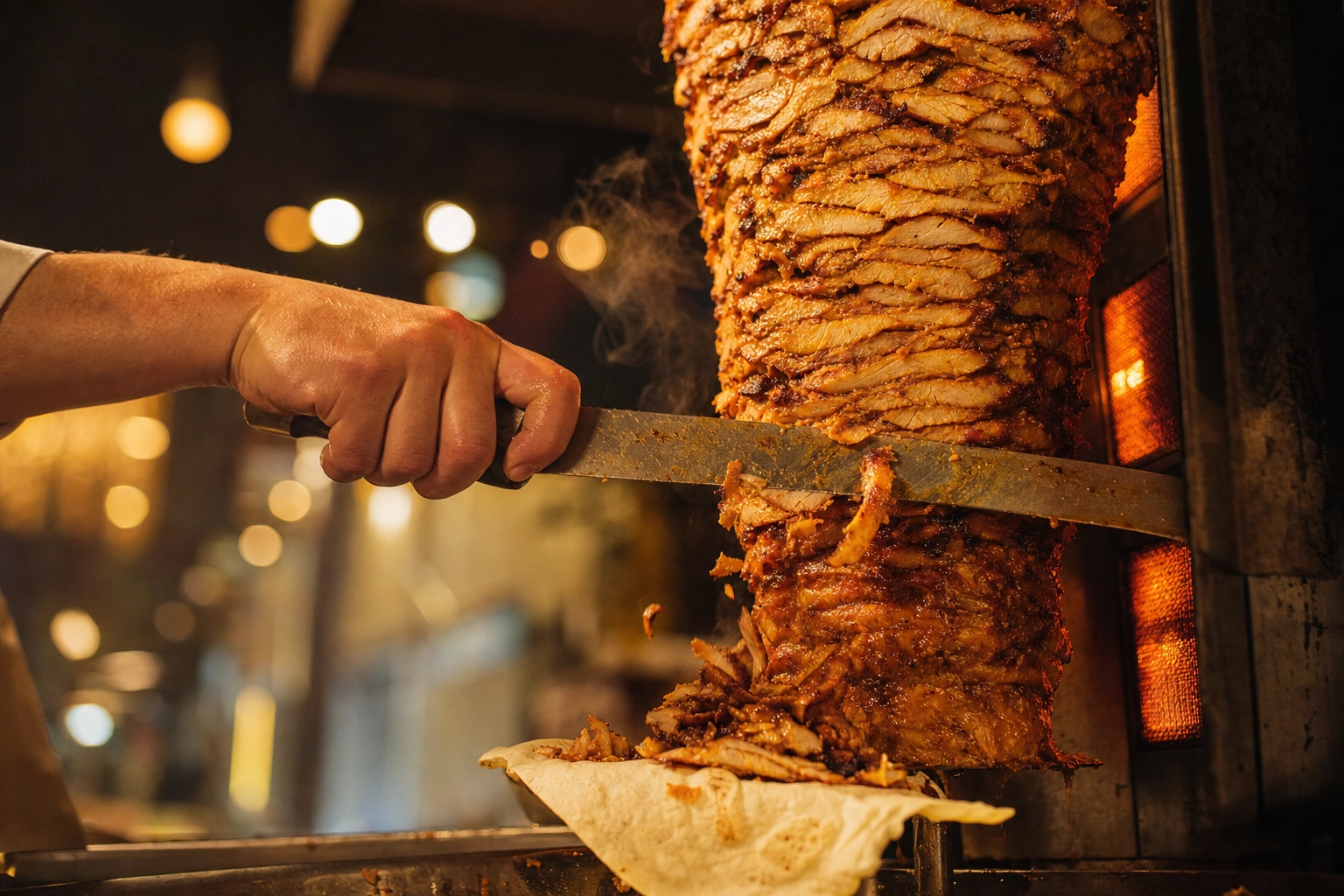 Cook carving spiced chicken shawarma off a vertical rotisserie spit with a long knife under warm light
Shawarma gives you two hero shots, and you want both. The first is the carve: glistening, spice-crusted meat shaved off a slow-turning vertical spit with a long flat knife, shavings falling, a wisp of steam rising. It's motion and craft in one frame. The technique dates to the 19th-century Ottoman doner kebab — Britannica notes the word comes from the Turkish çevirme, "to turn," and that the meat bastes in its own juices as the spit rotates, which is exactly the moist, burnished look you're shooting for. Take the carve at 45 degrees in that warm tungsten light so you catch the spit, the knife and the falling meat.
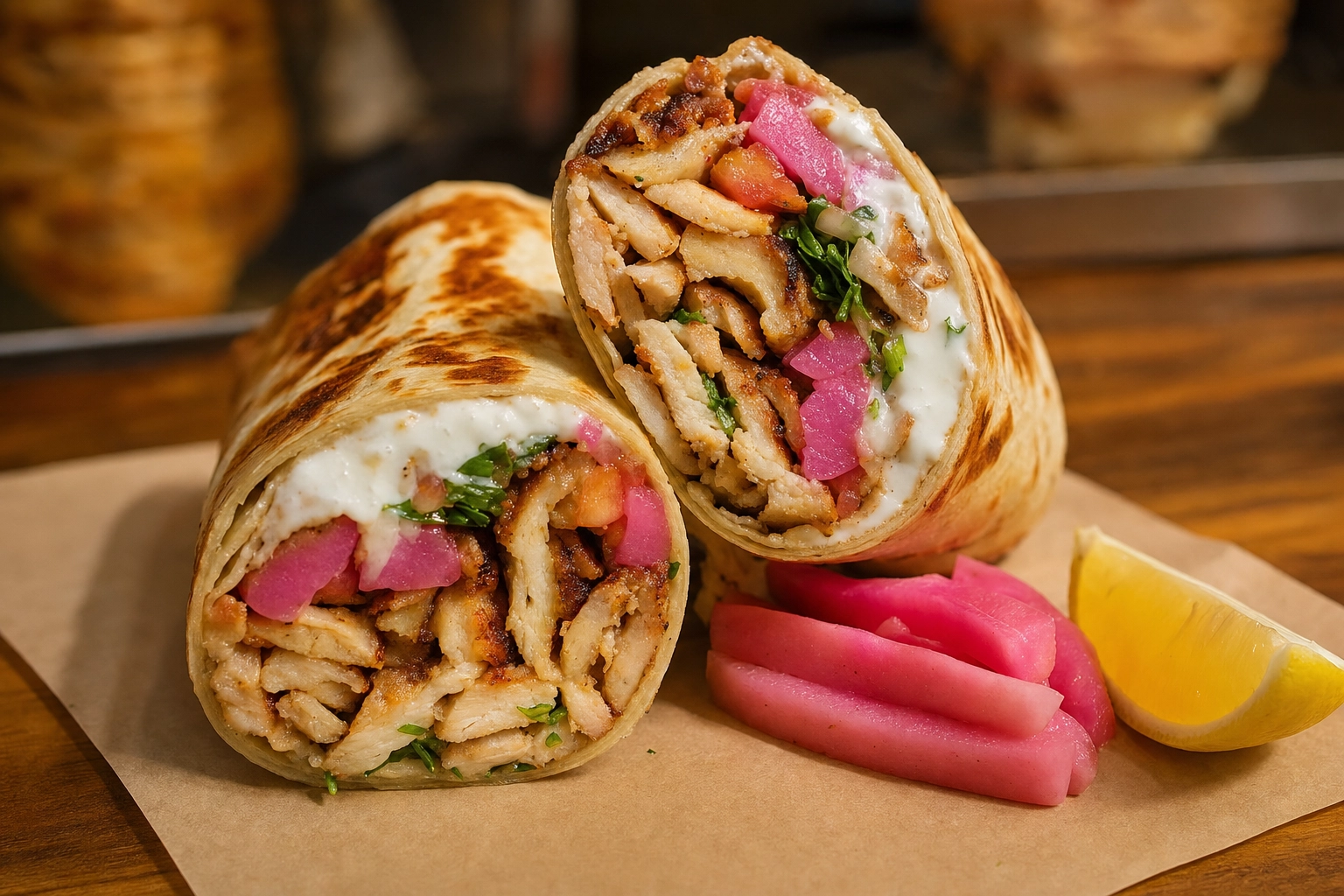 Lebanese chicken shawarma wrap cut in half showing meat, toum, pink pickles and parsley in saj bread
The second is the wrap: cut it and shoot the cross-section straight on, so the camera sees the spiced meat, the toum garlic sauce, the pink pickled turnips and the parsley layered inside the pita or saj bread. A clean cut is the difference between "delicious" and "someone's half-eaten lunch." Between the two, you'll rank for the shawarma images every shop needs for its board and its delivery listing.
4. Falafel and Pita (The Golden-Crunch Shot)
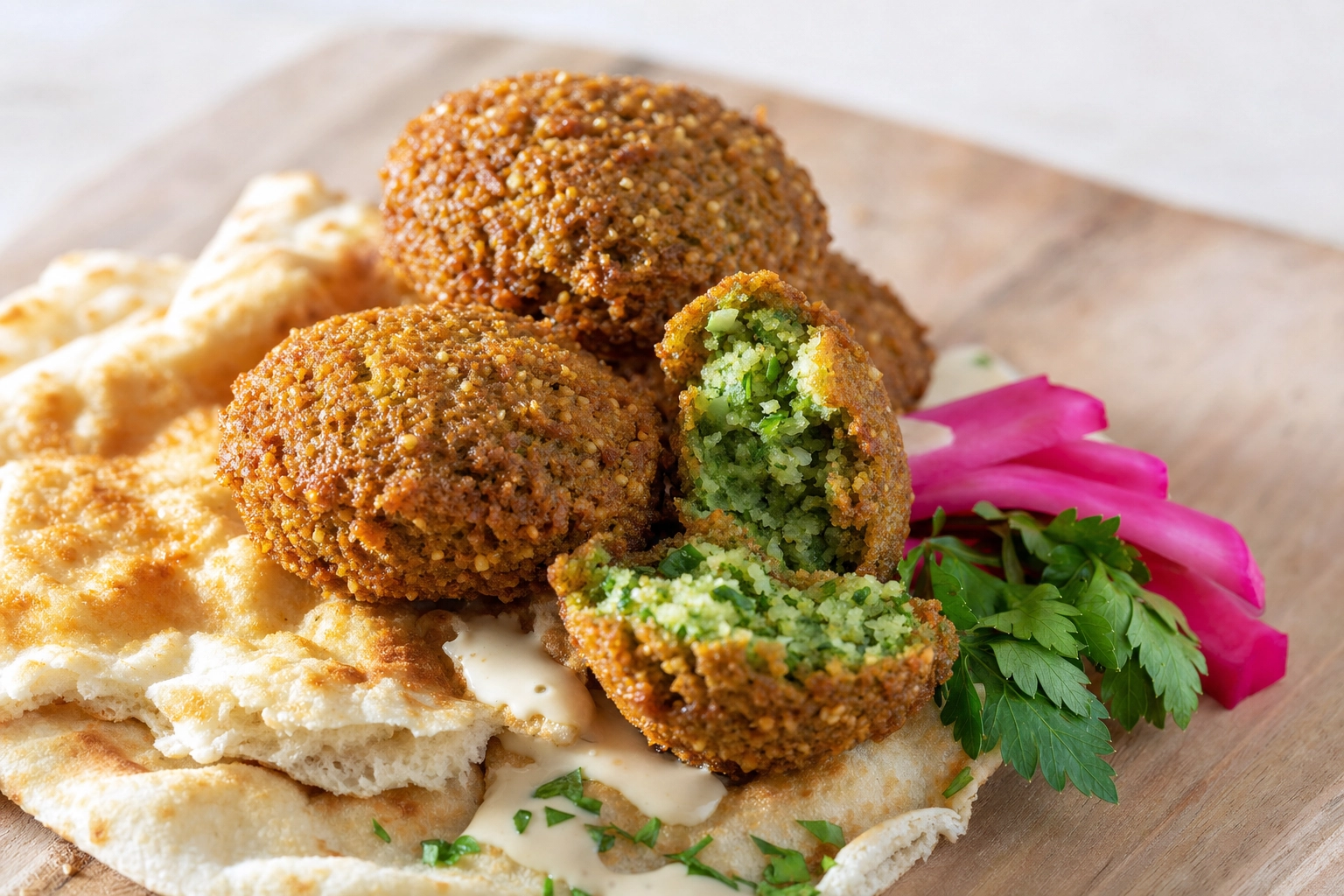 Lebanese falafel cracked open showing green herb interior beside pita, tahini and pink pickles on wood
Falafel is texture theater. The whole appeal is the contrast between the craggy, deep-golden crust and the vivid herb-green interior of parsley and coriander — so the money shot shows both. Crack one open and set it beside two or three whole ones, add warm pita, a drizzle of pale tahini and a few pickles, and light it from the side to rake across that crunchy shell.
Speed matters here more than almost any other dish: falafel goes leathery and dull within minutes of leaving the fryer, so style the plate first and shoot the second it lands. Overhead works for a bowl; the cracked-open 45-degree hero is what earns the falafel images that make a vegetarian menu section pop.
5. The Mixed Grill (Kafta, Shish Tawook, Lamb)
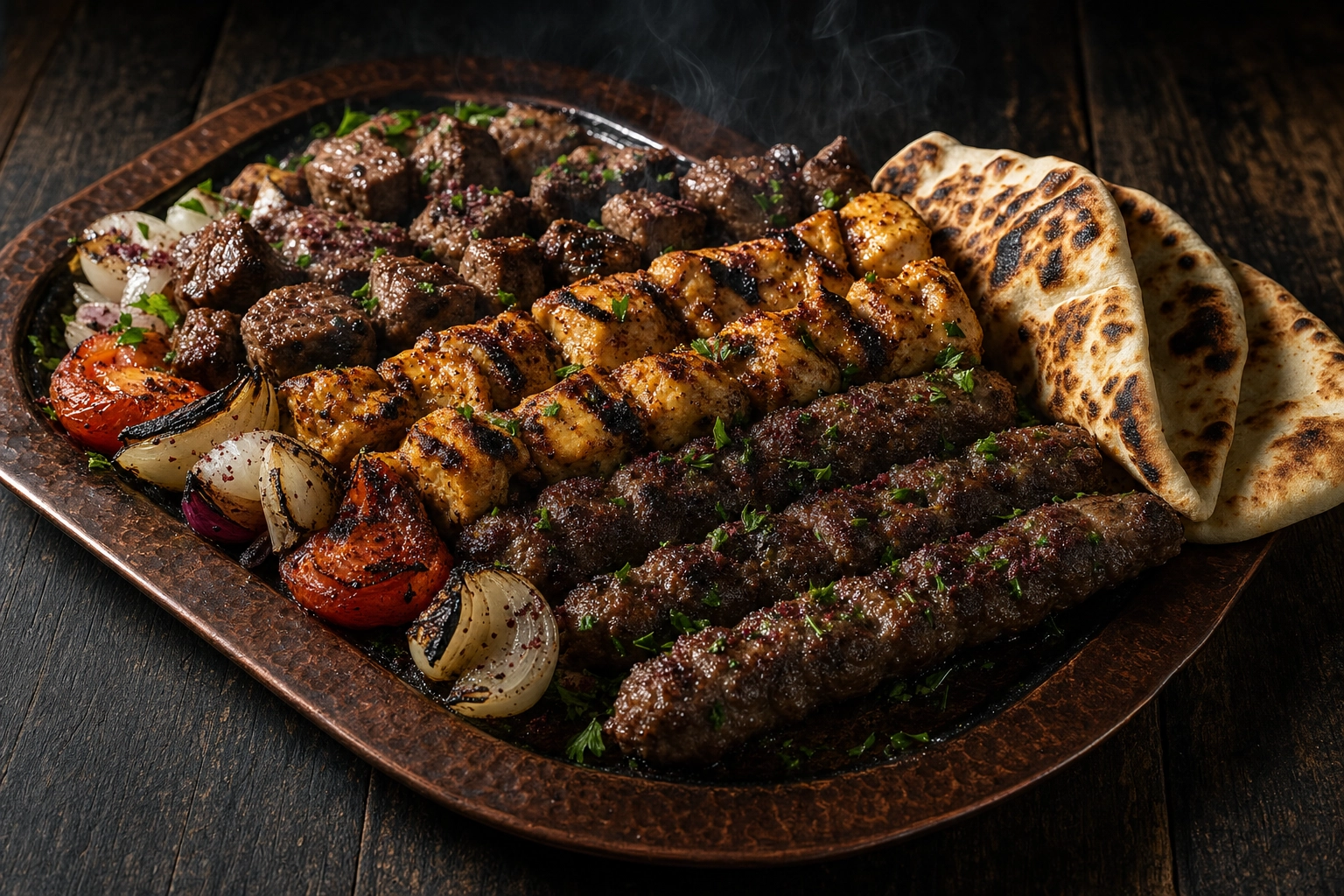 Lebanese mixed grill of kafta, shish tawook and lamb skewers with sumac on a copper tray in moody light
The mashawi platter is the centerpiece of any Lebanese grill house: skewers of kafta (minced, spiced lamb), shish tawook (marinated chicken) and cubed lamb, laid over grilled tomato and onion, dusted with sumac and parsley, with charred pita alongside. It's the dish that justifies the "warm register" — dark slate or hammered copper, dramatic side light, moody shadows.
Char is both the hero and the hazard. Those grill marks read as flavor to a hungry diner but collapse into a flat brown smear under bad light. Rake a hard side light across the skewers so the char keeps its ridges and the juices glisten, and let a thin wisp of steam (or a fresh squeeze of lemon) sell the just-off-the-coals moment. Overhead for the full platter; 45 degrees to show the height and depth of the char.
6. Baklava and Sweets (The Pistachio-Layer Close-Up)
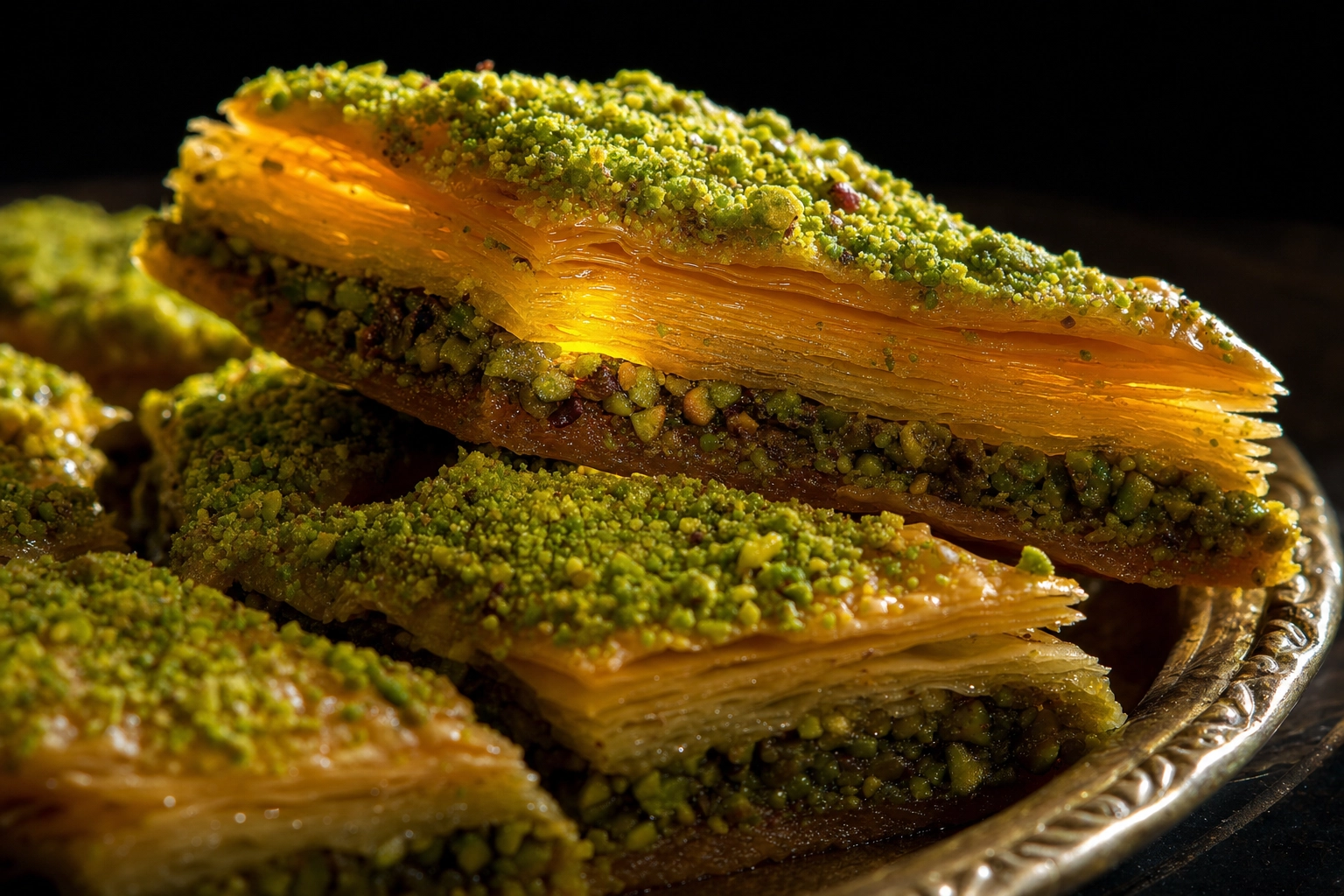 Macro of diamond-cut pistachio baklava showing golden phyllo layers, green pistachios and syrup sheen
Baklava is a close-up dessert. Its beauty is in the cross-section: dozens of paper-thin, butter-brushed phyllo layers — recipes stack anywhere from 8 to 40 sheets — around a crust of crushed pistachios, cut into diamonds and soaked in orange-blossom or rose syrup. Lebanese baklava leans pistachio-forward and less honey-heavy than the Greek style, so your color story is golden phyllo, bright-green nut and glossy syrup.
Shoot it macro, focused right on the cut edge, with strong side or back light so it glows through the flaky strata and glints off the glaze. A quick brush of syrup restores the sheen if the tray's been sitting.
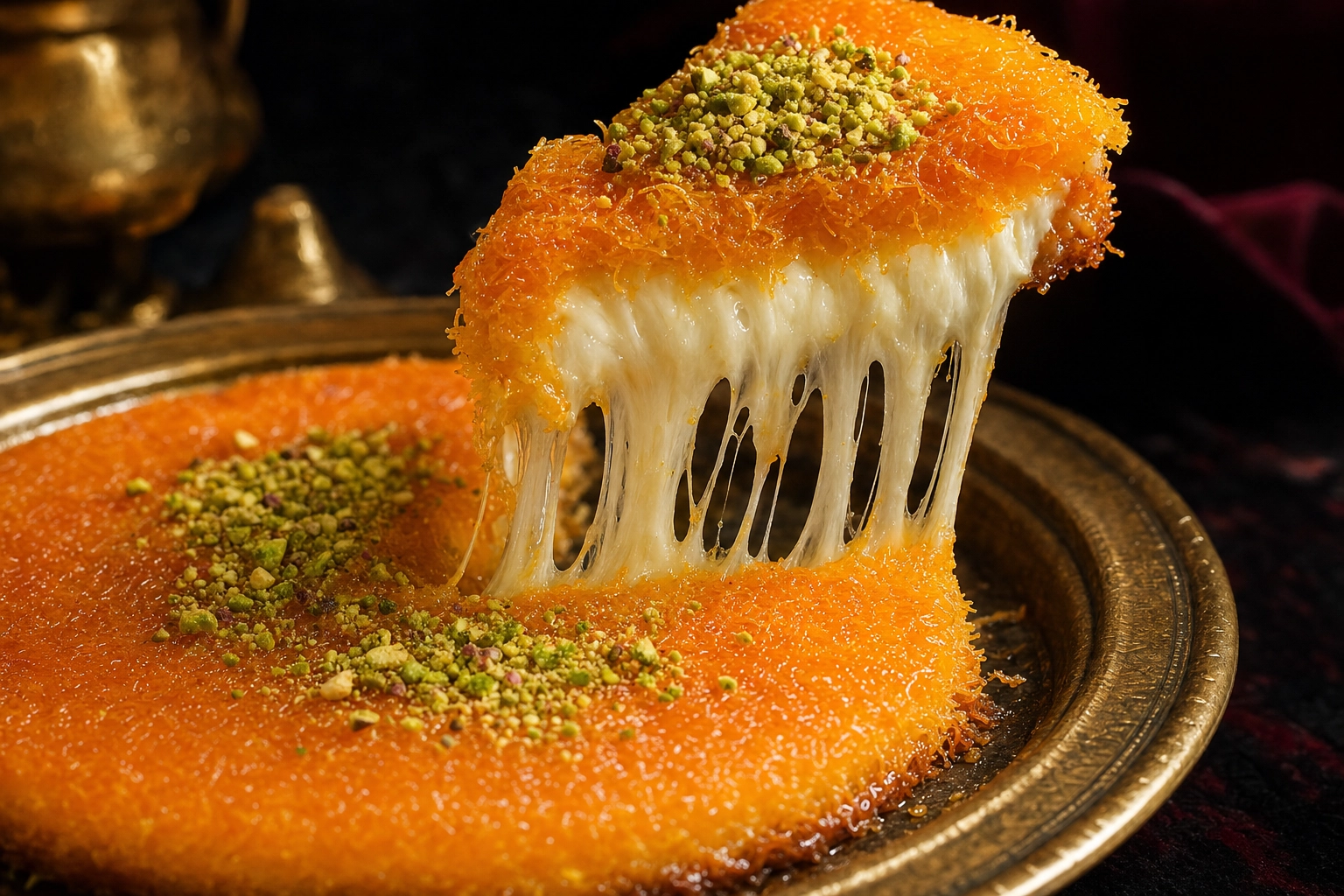 Wedge of bright-orange Lebanese knafeh with a molten cheese pull and crushed pistachios on a brass tray
The same logic covers knafeh (bright-orange, cheese-filled, syrup-soaked) and ma'amoul (date-stuffed shortbread) — the sweets that earn the baklava images every Levantine bakery wants for its window and its dessert photography. Knafeh, in particular, is a performance dish: shoot it mid-lift so the molten cheese pulls into strands, exactly the way pizza cheese sells a slice.
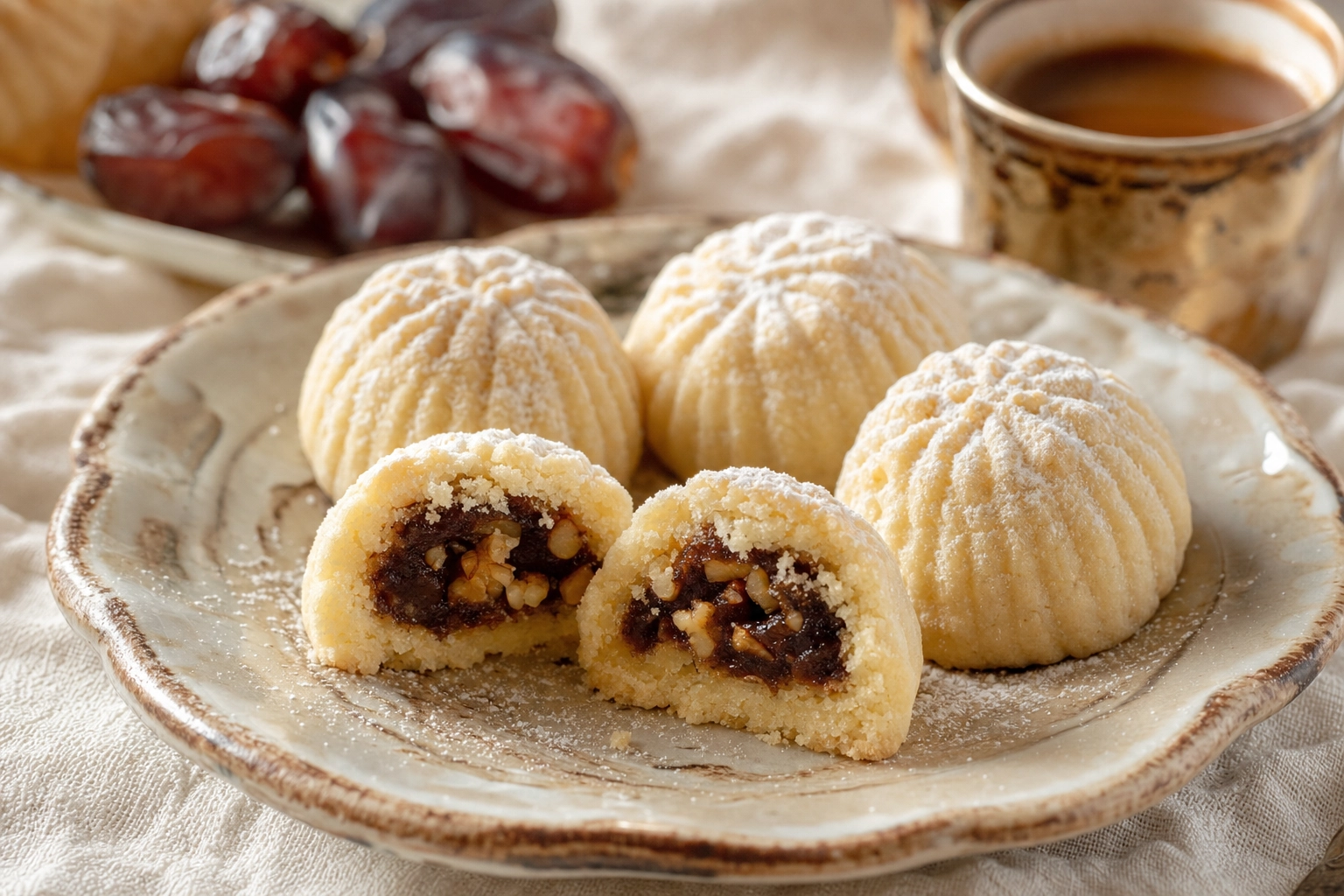 Lebanese ma'amoul date-filled shortbread cookies dusted with sugar, one broken open, on a ceramic plate
Ma'amoul rewards the opposite approach — quiet, warm and homey. Break one open so the date or walnut filling shows, dust with powdered sugar, and shoot it beside a cup of Arabic coffee. For the full sugar-and-syrup backstory, Wikipedia's baklava entry traces its Ottoman roots and regional variations.
A Few More Lebanese Dishes Worth Shooting
Once you've nailed the six, round out the library with the supporting cast. There are countless recipes for these online, but again — you're photographing the plate a guest can order, not a recipe card.
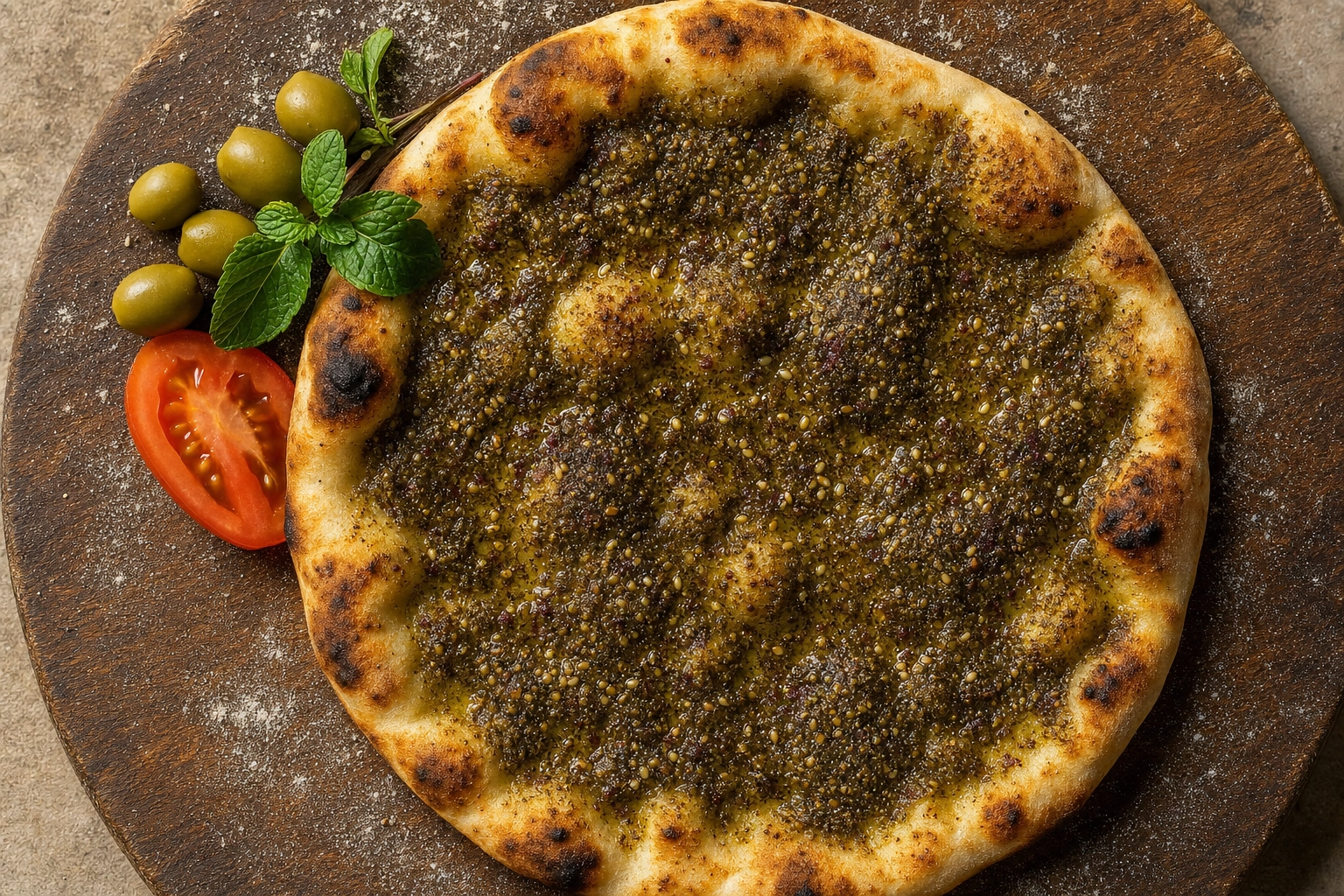 Overhead za'atar manakish flatbread with glistening green herb topping on a rustic wooden board
- Manakish za'atar — the morning flatbread, its green herb-and-oil top best shown straight overhead on the saj board or a wooden peel.
- Kibbeh — football-shaped fried bulgur-and-lamb shells; shoot one halved to reveal the spiced-meat core, exactly the way you crack a falafel.
- Tabbouleh and fattoush — Lebanon's two great salads. Tabbouleh is a confetti of parsley, mint and bulgur; fattoush adds crisp pita chips and sumac. Overhead shows off all that color.
- Baba ghanoush and moutabal — the smoky eggplant dips, styled with the same well-and-oil treatment as hummus.
- Warak enab — tightly rolled stuffed grape leaves, lined up glossy and even, with a lemon wedge for a pop of yellow.
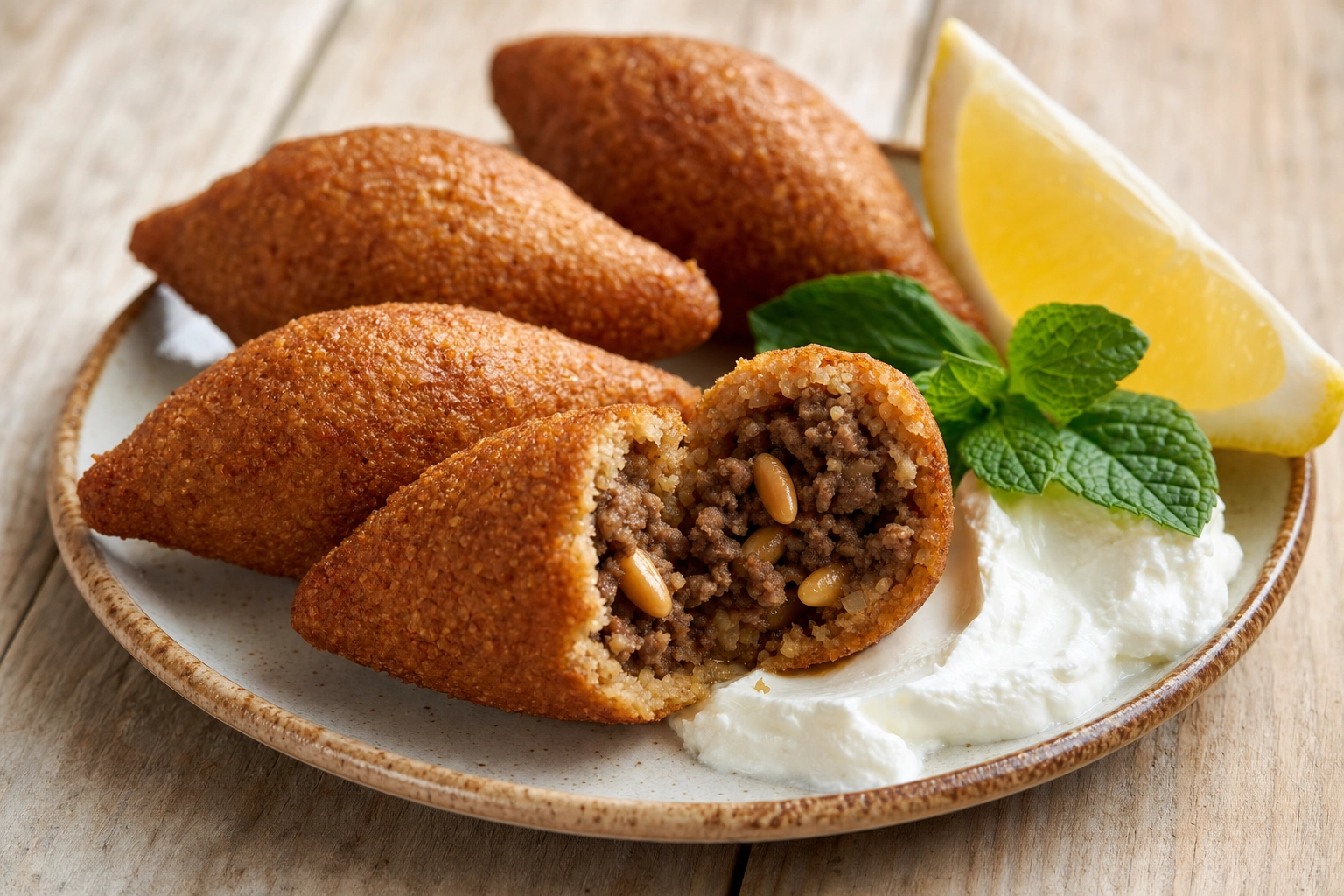 Fried Lebanese kibbeh with one split open showing the spiced lamb and pine-nut core, beside labneh
None of these are hard once you've internalized the palette and the angle. They're variations on the same two skills — the well-and-oil treatment for anything creamy, and the crack-it-open reveal for anything fried or stuffed.
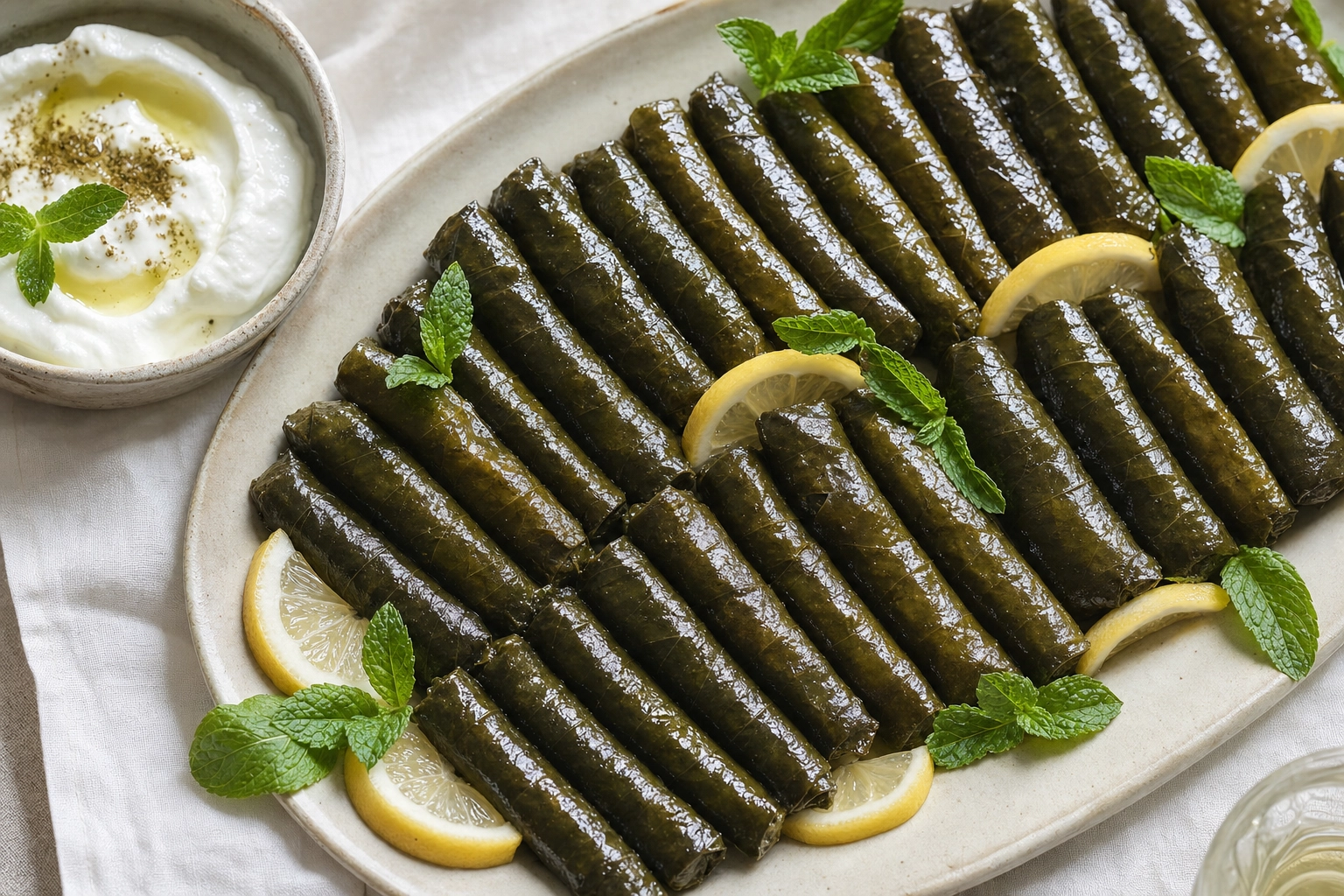 Overhead rows of glossy Lebanese stuffed grape leaves (warak enab) with lemon and mint on a platter
The Lebanese Styling and Lighting Toolkit
These are the small, repeatable tricks that travel to every dish on the menu:
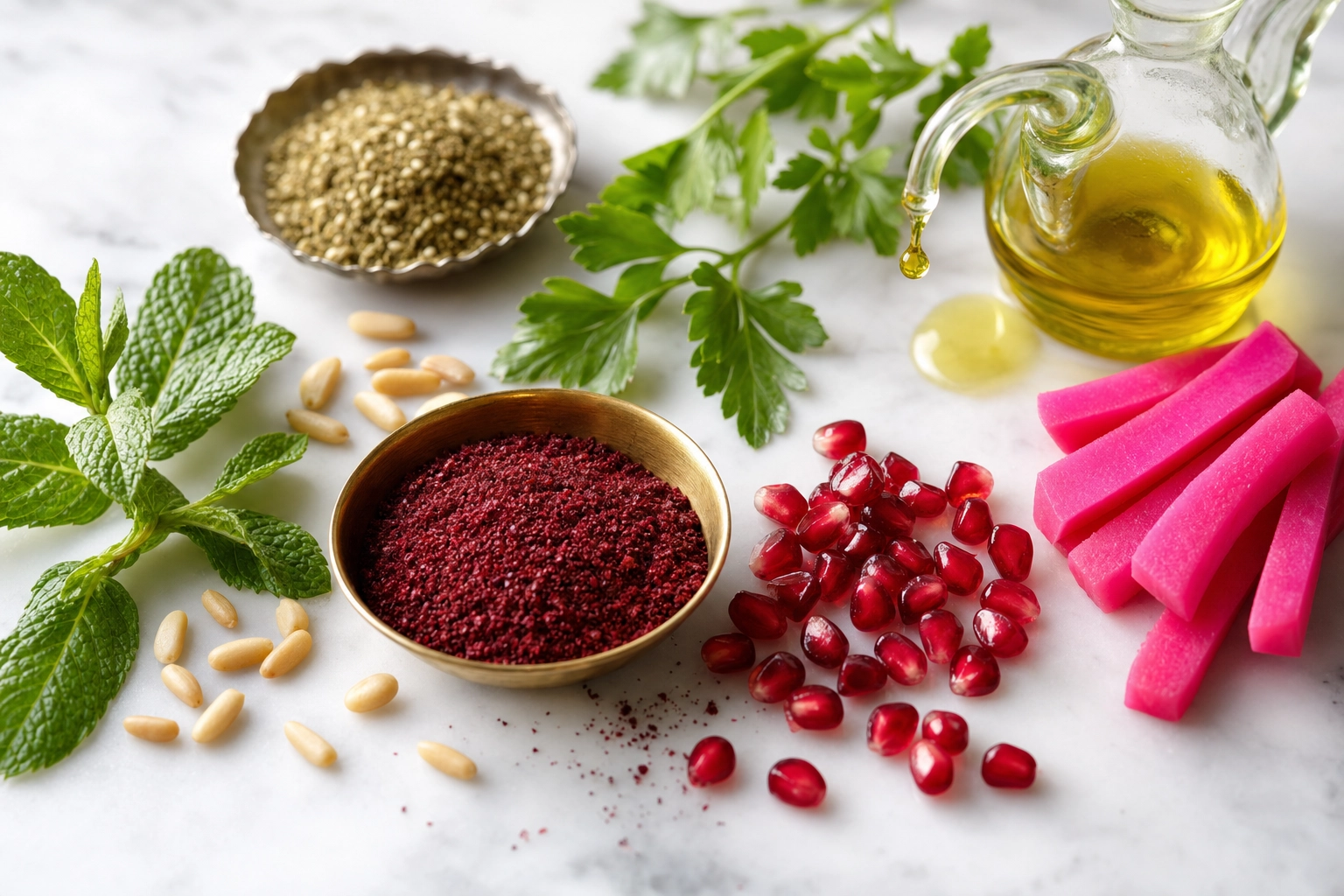 Lebanese food styling props on marble: sumac, za'atar, pomegranate, pine nuts, mint and olive oil cruet
- Pour the oil last. A fresh olive-oil drizzle right before the shutter is the single biggest upgrade to any dip, grain or grill shot. Nothing else restores "fresh" as fast.
- Dust from a height. Sprinkle sumac, paprika or za'atar from eight inches up for even, editorial coverage instead of a clumpy pile.
- Swoosh with intent. A clean quenelle or spoon-swoosh of toum, labneh or hummus reads deliberate and professional.
- Finish with life. A few pomegranate arils, a scatter of pine nuts, a single torn mint leaf — jewel accents that break up the beige.
- Bring back the heat. A wisp of steam and a wipe of oil make grilled meat look like it just came off the coals.
- Clean every edge. Wipe the plate rim, clear stray crumbs and stray drips. On a big overhead spread, one smudged bowl ruins the whole frame.
None of this requires studio gear. A window, a foam board and a phone will carry you a long way — the discipline matters more than the equipment.
One Look Across the Whole Menu: Consistency Is Your Brand
A single great shot is nice. A whole menu that shares one visual language is a brand. Here's the test: your flagship's hummus should read as the same restaurant as the new location's hummus — same surface, same light, same plating grammar.
That means picking your lane and committing. One surface (say, bright marble), one lighting register, one way you swirl the dip and pour the oil, applied across the mezze, the shawarma, the grill and the sweets. It's the difference an experienced diner feels instantly, even if they can't name it — and it's what multi-location chains and Lebanese-diaspora caterers from Dearborn to Sydney, São Paulo, Paris and London rely on to look like one confident operation instead of a dozen different kitchens.
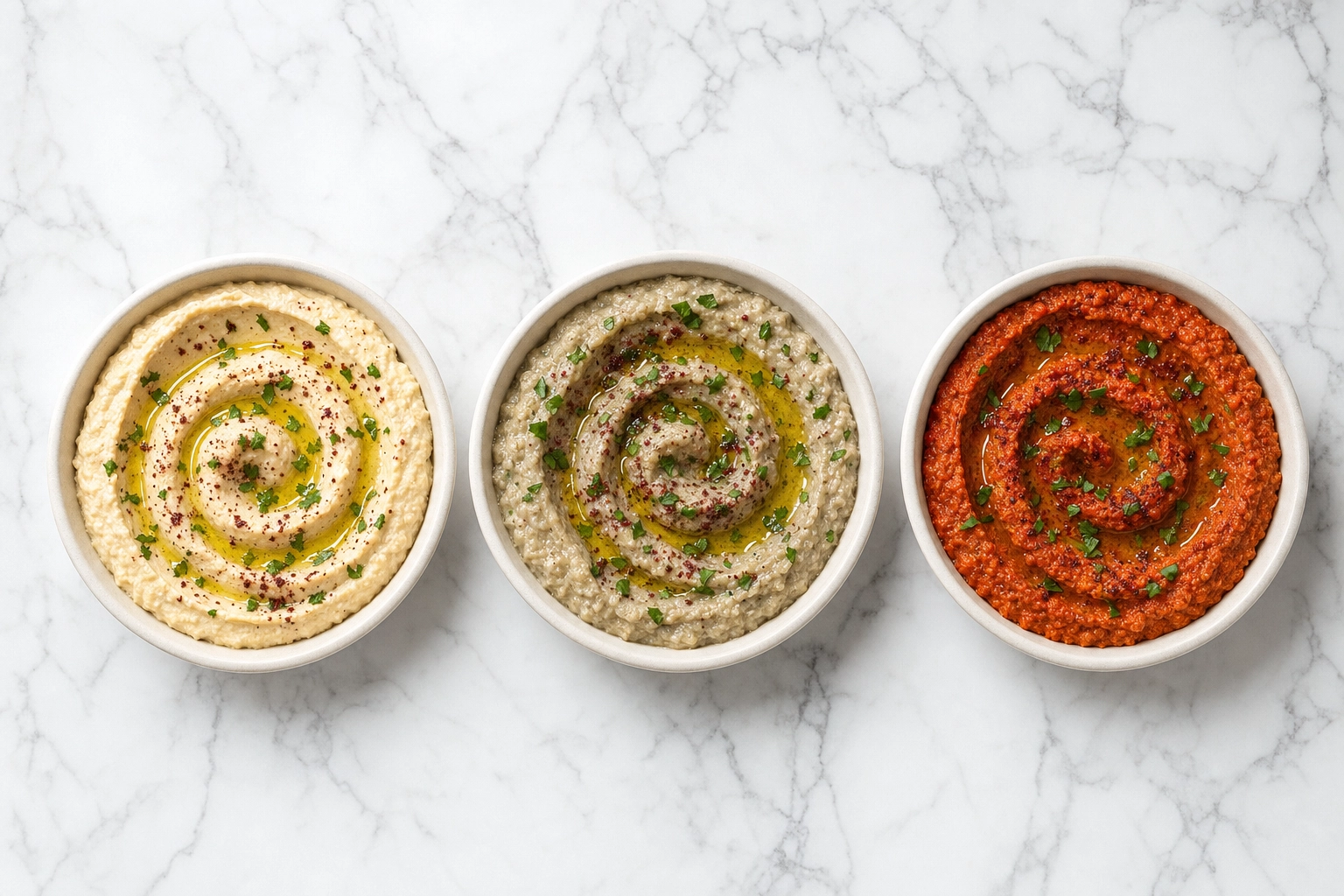 Three matching Lebanese dips — hummus, baba ghanoush and muhammara — styled identically on white marble
This is also where a whole cluster of Levantine and Mediterranean cooking meets. If you run a modern, Tel-Aviv-leaning concept, the Israeli food photography playbook (shakshuka, sabich, salatim) shares the same DNA; if you're a bowl bar or coastal-grill concept, our broader Mediterranean food photography guide covers grain bowls and grilled vegetables. You can browse the whole set of styles by cuisine, but for hummus swirls, shawarma and baklava specifically, the Lebanese food photography styles are tuned to exactly this look.
From Phone Snap to Menu-Ready in About 2 Minutes
Here's the honest problem with everything above: it assumes you have time to style a plate, set up a window and wait for the oil to catch the light. During a Friday dinner rush, you don't.
That's the shortcut an AI food photo editor is built for. You snap the dish on your phone — even under bad kitchen fluorescents — upload it, pick a Lebanese-tuned style, and get a studio-quality, brand-consistent image back in about 2 minutes. It relights the scene, cleans the surface, restores the oil sheen and brings back the char on your actual food. It doesn't invent a dish you don't serve; it makes the one you do serve look like it deserves to.
The economics are the real argument. Professional food photography runs anywhere from $500 to $2,500 a session, and often $2,500–$7,500 once you add a stylist, studio rental and retouching — which is a lot to swallow every time you add a seasonal mezze or a new wrap (here's what restaurants actually pay for food photography). AI plans start around $15 a month, or roughly $0.60 a photo, which is why it fits menus that change constantly.
And on delivery, the picture is the product. Restaurants with professional menu photos are commonly cited as seeing 25–30% more orders, and a Google-commissioned survey found diners weigh food photos about 1.44x more heavily than the written description when deciding what to order. Export straight to the specs each platform wants — Uber Eats at 5:4, DoorDash at 16:9 — and your delivery app photos stop losing the thumbnail war. For a delivery-first or ghost-kitchen Lebanese brand with no dining room to sell the vibe, that thumbnail is the entire storefront.
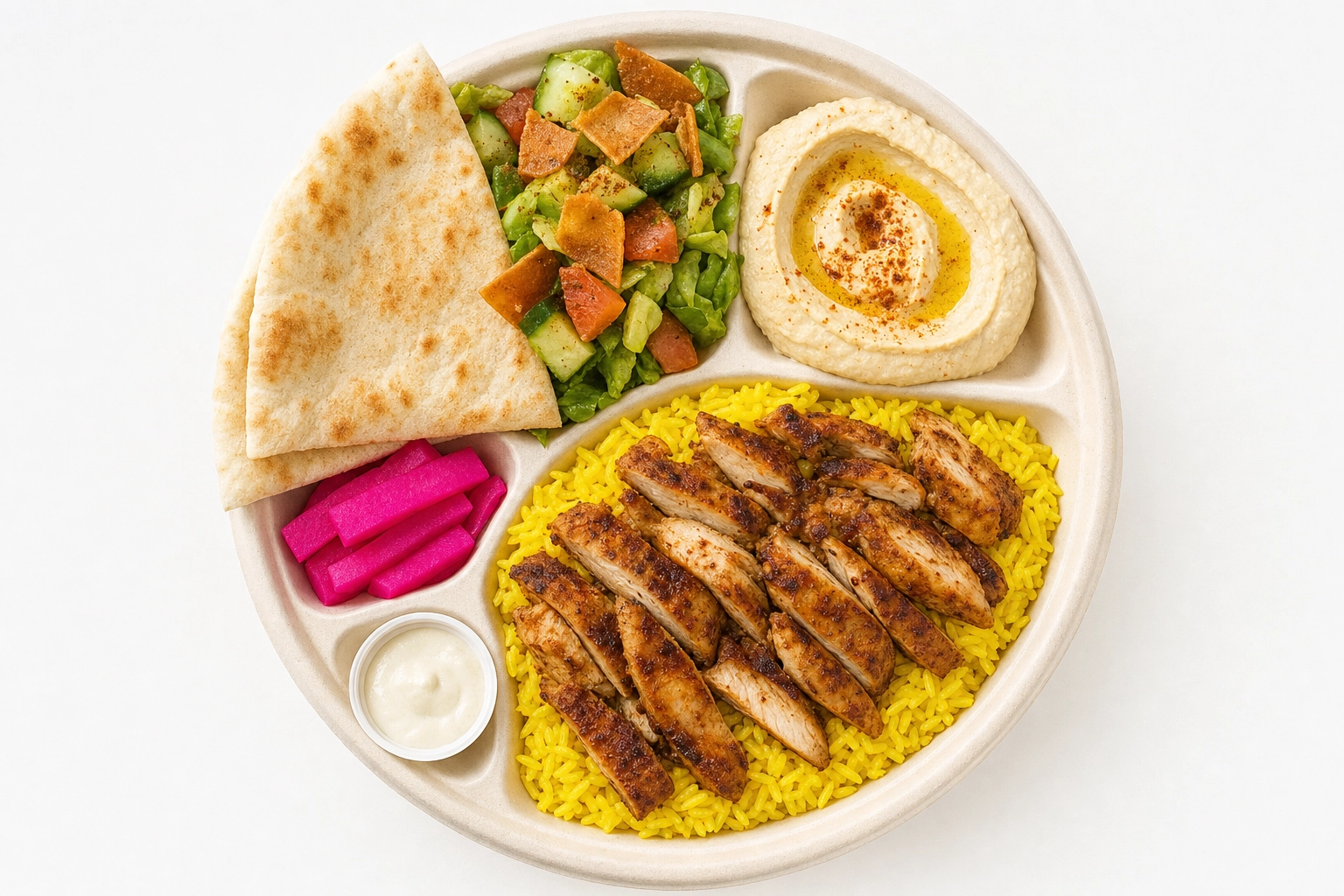 Overhead Lebanese shawarma rice plate with hummus, pita and salad styled for a delivery-app thumbnail
Frequently Asked Questions
What is Lebanese mezze?
Lebanese mezze is a selection of small, shared plates served before — or often instead of — main courses, at the heart of Lebanese and wider Levantine dining. The word comes from the Persian maza, "to taste," and the style is the Middle Eastern cousin of Spanish tapas and Italian antipasti. It's usually split into cold mezze (hummus, baba ghanoush, tabbouleh, labneh, olives and pickles) and hot mezze (falafel, kibbeh, sambousek and manakish), all meant to be grazed at ease rather than finished.
What dishes are on a traditional Lebanese mezze platter?
A classic spread mixes cold and hot dishes. On the cold side: hummus, baba ghanoush or moutabal, tabbouleh, fattoush, labneh, muhammara, warak enab (stuffed grape leaves), olives and pickled turnips. On the hot side: falafel, kibbeh, sambousek, fatayer (spinach pies), grilled halloumi and batata harra — always with warm pita for scooping. Many Lebanese restaurants carry only a short list of mains but a long menu of mezze, which is why photographing the spread well matters so much.
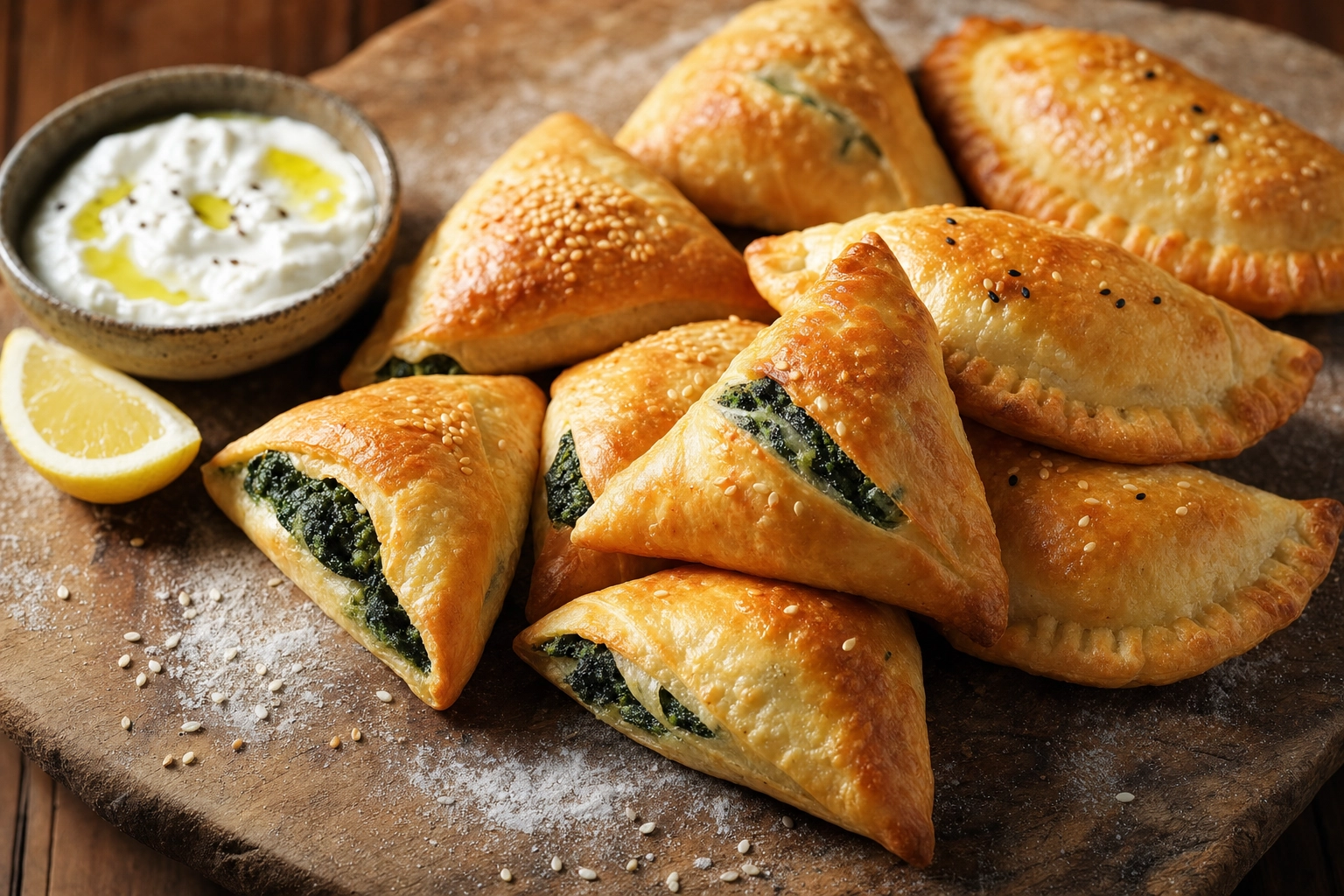 Golden Lebanese hot-mezze pastries — spinach fatayer and meat sambousek — on a rustic wooden board
What's the best angle for photographing a mezze spread?
Straight overhead — a 90-degree flat-lay — for the full table, the dip bowls and the salads. Mezze is arranged on a flat plane, so shooting from directly above shows every plate edge to edge and reads clearly even as a small delivery-app thumbnail. Switch to a 45-degree angle only when height or action is the story: the shawarma carve, a drizzle mid-pour, a stack of pita or a kibbeh cross-section.
How do you take a good hummus photo?
Spoon the surface into a smooth spiral well, pour olive oil into the well, dust the rim with paprika or sumac, and add a small heap of whole chickpeas plus a pinch of parsley. Then shoot immediately — the chickpea base absorbs the oil and loses its sheen within minutes. Straight overhead or a low 45-degree angle both work; the real secret is a fresh drizzle of oil right before you press the shutter.
How do you photograph shawarma off the spit?
Shoot the carve at a 45-degree angle so you capture the vertical spit, the long knife and the shavings falling away, ideally with a little steam and warm light behind it for that street-food glow. For the wrap, cut it in half and photograph the cross-section straight on, so the camera sees the layered meat, toum garlic sauce and pink pickled turnips inside the pita. Together they cover both the "come hungry" action shot and the clean product shot a menu needs.
Can I make Lebanese menu photos without hiring a photographer?
Yes. An AI food photo editor turns phone snaps into menu-ready images in about 2 minutes, at roughly 95% less than a professional session, using styles tuned to the Lebanese look — the hummus swirl, the shawarma glow, the pistachio-green baklava. It's ideal for restaurants that update menus often, need consistent visuals across delivery apps and social media, and can't shut the kitchen down for a photo shoot every season.
Keep Building Your Lebanese Menu Photo Library
Great Lebanese food photography isn't about expensive gear — it's about understanding what makes the food special and getting out of its way. Nail the abundant, jewel-toned aesthetic, master the overhead angle, capture the six essential shots, and hold one consistent look across the whole menu, and your photos will finally match the generosity of a Lebanese mezze table.
Start with the two that do the most work: the full mezze spread and the hummus swirl. Then move through the shawarma, the grill and the sweets until every corner of your menu has an image that sells. The recipes are the easy part — the photography is what turns them into orders. When the rush won't wait, let the AI food photo editor and its Lebanese food photography styles do the heavy lifting: upload a phone photo, and get a menu-ready shot back before the next order's up.