Thai Food Photography: Pad Thai, Curry & Street Eats
 Ali Tanis20 min read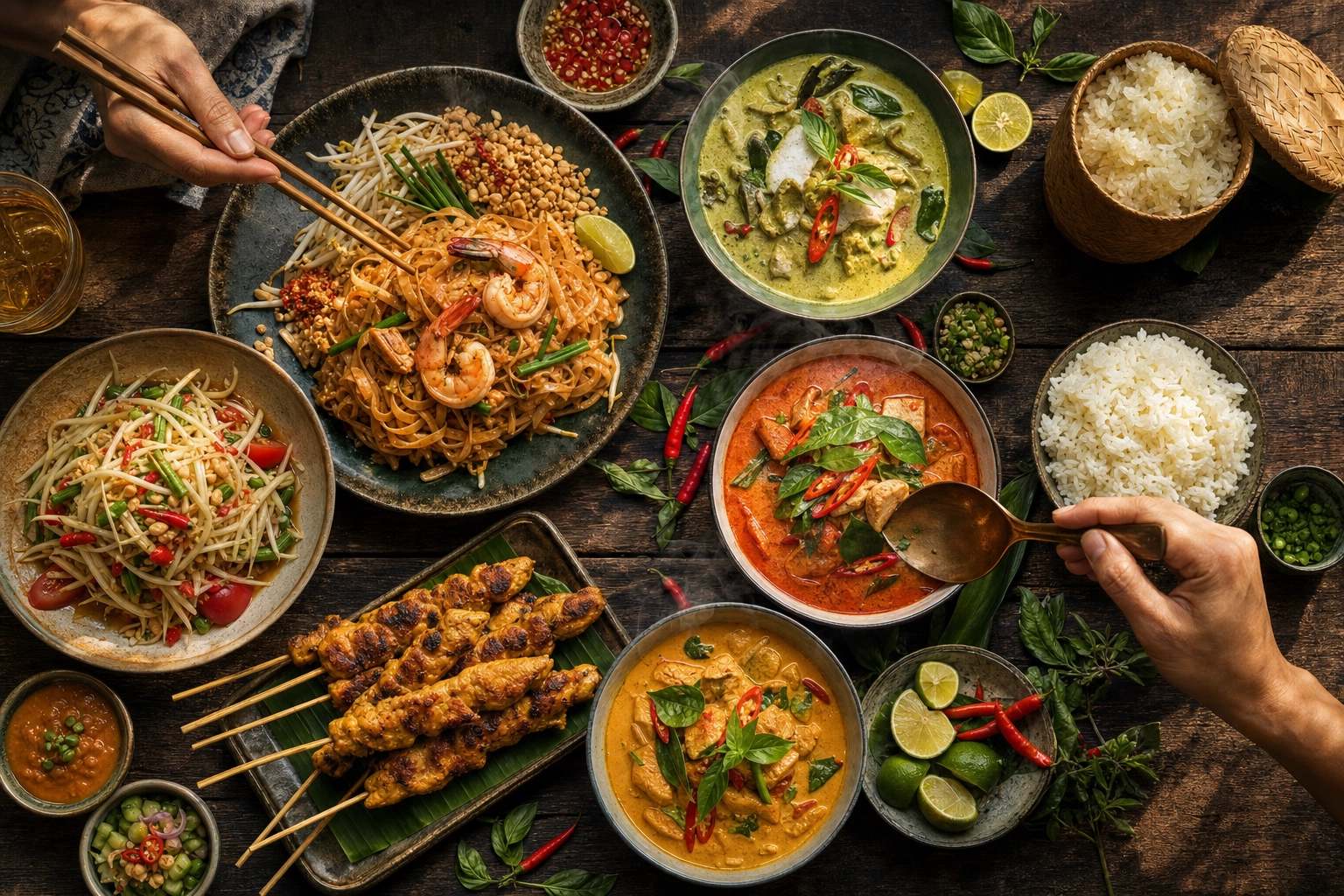
Search "thai food pictures" and you'll drown in stock photos — a million flawless bowls of pad thai shot by someone who has never seen your kitchen.
They look incredible. They also do nothing for your restaurant, because the dish a customer actually orders has to be your dish, photographed well enough to win on a delivery app where a Vietnamese, Chinese and Indian place are one thumbnail away.
Thai food should be the easiest cuisine on earth to photograph. It's loud, glossy, herb-strewn and built to dazzle.
CNN Travel once ranked massaman curry the number one food on the planet, ahead of pizza and hamburgers, with tom yum and som tam also making the cut. The cuisine is everywhere, too — partly by design, since Thailand spent two decades seeding restaurants abroad through a government gastrodiplomacy program. Pew Research now counts Thai as the third-most-common Asian cuisine in America, with a Thai restaurant in every single state.
So why do so many real Thai dishes photograph badly? Because everything that makes the food thrilling at the table — the chili heat, the curry color, the steam, the tangle of herbs — collapses into visual noise the moment a phone gets involved.
This guide fixes that. You'll get the five thai food images every menu needs, how to light heat and steam, how to keep green curry actually green, and the 90-second shortcut for kitchens drowning in a 100-item menu.
Quick Summary: Great Thai food pictures come down to five shots — pad thai with lime and peanut, a curry bowl with a coconut-cream swirl, a fresh som tam, a smoky skewer shot, and a top-down family spread — plus matching the light to the dish (side light for gloss and char, backlight for broth and steam) and grading color so green, red and yellow curries stay distinct instead of bleeding into muddy orange. Shoot it well, or snap a clean phone photo and finish it with an AI editor in about 90 seconds.
Why Thai food fights the camera (and how to win)
Western plating gives a camera an easy job: one hero on a wide white plate with room to breathe.
Thai food does the opposite on purpose. It piles color, sauce, garnish and heat into a single bowl, and that generosity — the whole appeal — is exactly what trips up an ordinary photo. Five specific things go wrong, and naming them is half the battle.
The curry-color collapse
A Thai menu's superpower is its curry palette — emerald green, brick red, golden yellow, deep-brown massaman.
Under the warm fluorescent tubes most Thai dining rooms run, those four distinct colors photograph as one muddy orange. Your green curry photography looks like your red, your red looks like your massaman, and the menu loses the variety that sells.
Wok-hei goes flat
Pad thai and stir-fries carry a glossy, faintly smoky sheen — the trace of wok hei, the "breath of the wok." Shot under flat overhead light, that living shine dies and the noodles read like leftovers instead of something that just left a screaming-hot pan.
The camera can't taste heat
A bird's-eye chili is doing enormous work on the palate and zero work on a sensor. Spice is invisible, so if "fiery" is part of the dish's story, you have to show it — a scatter of sliced chili, a slick of chili oil, a little dish of nam pla prik on the side.
Herbs and steam are on a timer
Thai basil, cilantro and a delicate crown of kaffir lime leaf wilt within minutes under lights. Steam off a bowl of tom yum vanishes in about 90 seconds. Miss the window and the freshness cue is gone for good, so set up the shot before the food leaves the pass.
The 100-item menu
Thai kitchens run enormous menus — noodles, a dozen curries, salads, soups, grills, rice dishes, desserts. Photographing all of it, consistently, every time a special changes, is the logistical nightmare that stops most owners before they start.
The good news: every one of these is fixable with a handful of repeatable habits. Get them right and you don't just match the stock photos — you beat them, because yours is the real food customers can order tonight.
For the broader cross-cuisine playbook, our Asian food photography guide covers the shared principles; below, we go deep on Thai specifically.
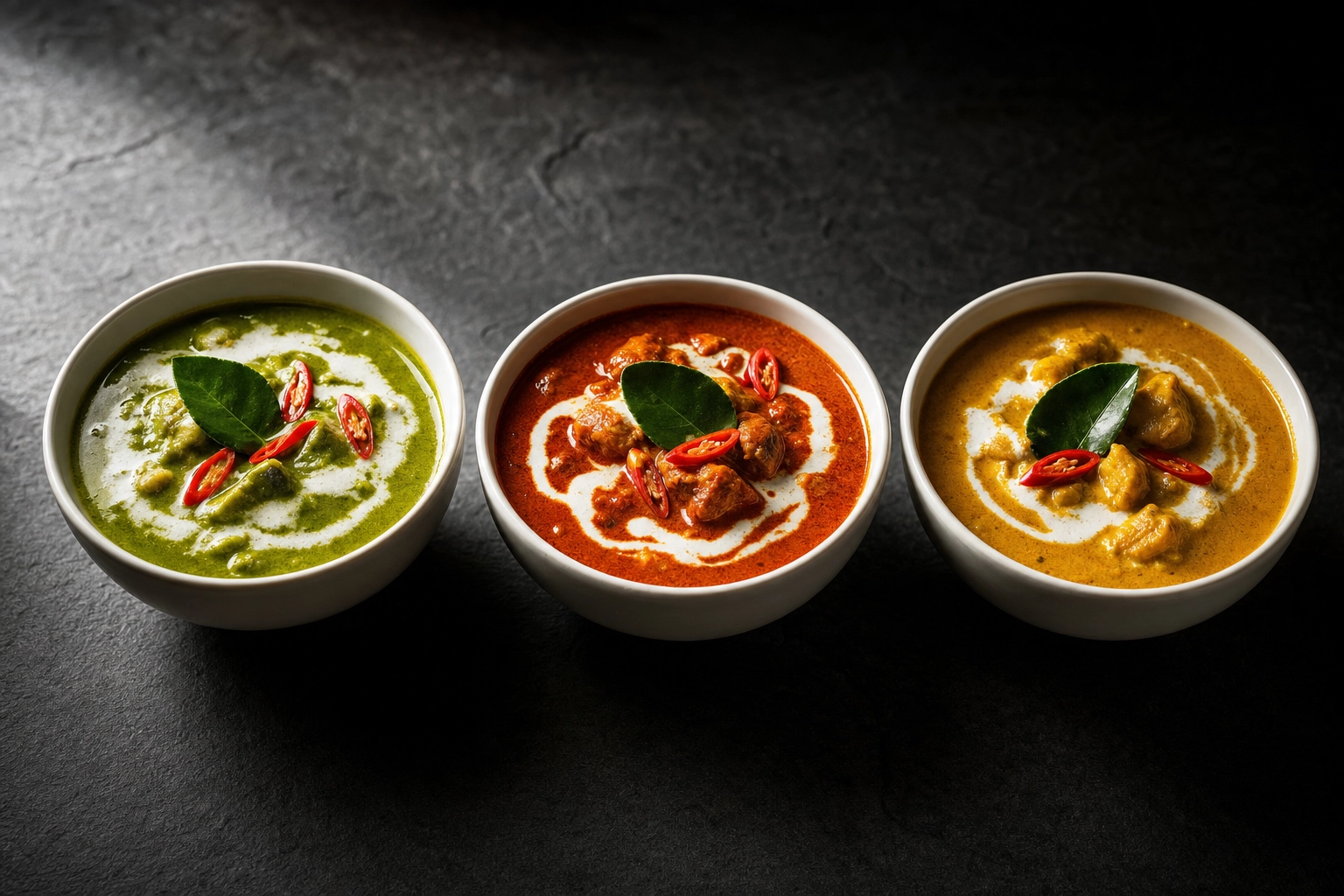 Three Thai curries — emerald green, brick red and golden yellow — in white bowls on dark slate showing distinct colors
The 5 Thai food pictures every menu needs
You don't need fifty setups for a 100-item menu. Five reliable shots carry almost any Thai restaurant across delivery apps, printed menus and social feeds — and each one maps to a dish people already search for and order.
These are the popular thai dishes that earn the click, so master the template once and run it on everything.
1. Pad thai with lime and crushed peanut
Pad thai is the dish a customer recognizes at thumbnail size, which makes it your single most important image.
Shoot it at a 45-degree angle — roughly the eye line of someone leaning in for the first bite. That angle gives the tangle of rice noodles height and dimension instead of flattening it into a beige circle.
Style the classic trio in the frame, not off to the side: a fresh lime wedge, a little pile of crushed peanuts, and a few raw bean sprouts. Turn the best element — a glossy prawn, the folded egg, a char-flecked piece of tofu — toward the lens.
Then chase the sheen: a single diffused light raking in from the side will catch the slick on the noodles that says "this just hit the wok." Wipe the rim of the plate before you shoot; a smear of sauce reads as careless at full size.
Want energy? Add an action frame. A pair of chopsticks lifting a suspended tangle of noodles, shot at 1/200s or faster, turns a static plate into something alive. These are the pad thai images that stop a scroll — and the ones worth perfecting first, because customers compare every other photo on your menu to this one.
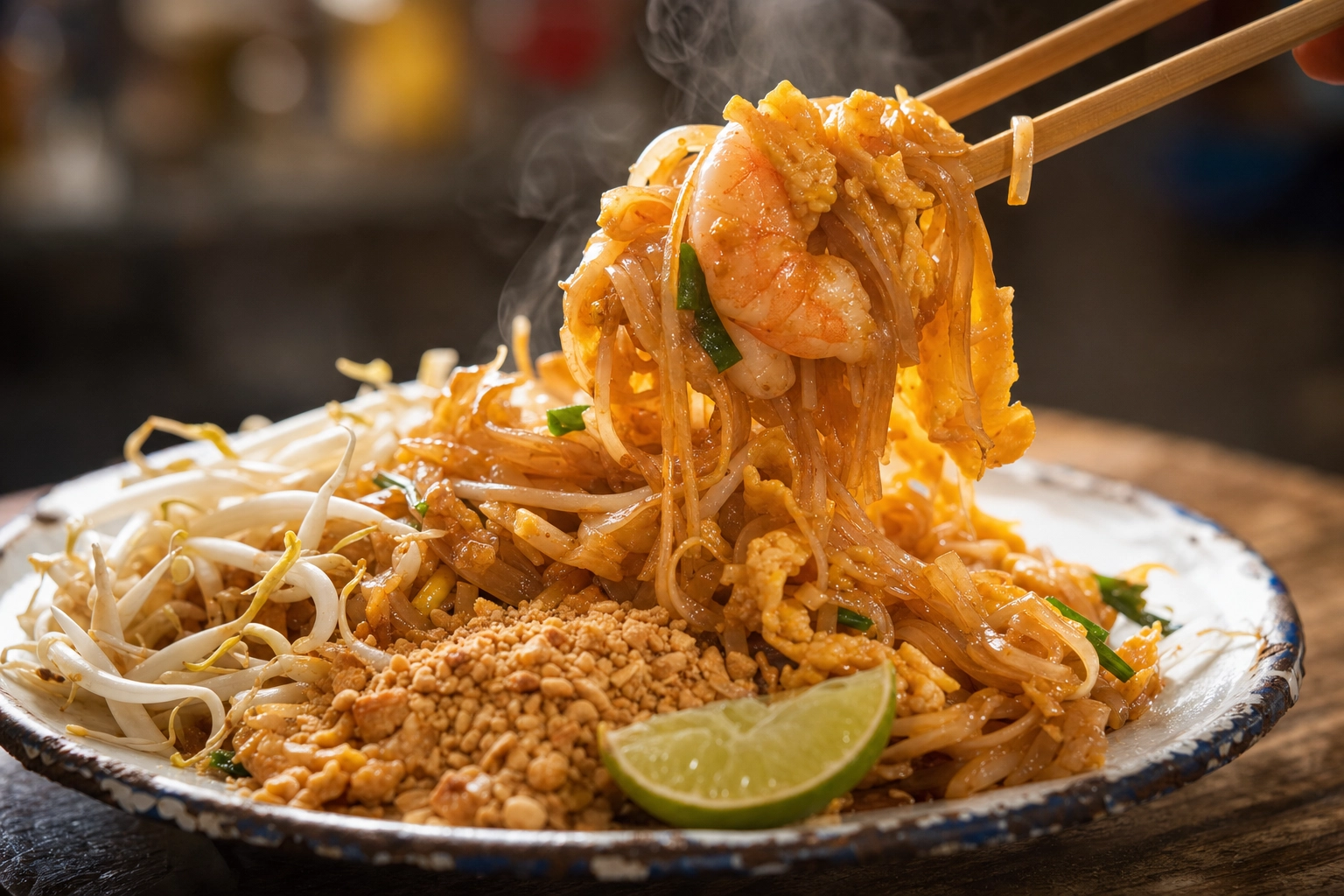 Wooden chopsticks lifting glossy pad thai rice noodles with prawn, peanuts and lime in a close-up action shot
2. The curry bowl with a coconut-cream swirl
A bowl of curry is a flat lake of sauce — which is why it's the dish most likely to photograph as muddy orange. Two moves rescue it.
First, the coconut-cream swirl. A spoonful of thick coconut cream dragged across the surface in a loose spiral adds instant contrast, depth and a fresh-from-the-kitchen cue. It's the most useful single styling trick in Thai food photography, and it works on green, red, yellow and massaman alike.
Second, shoot just above the rim, not straight down. A shallow angle lets you see the surface texture — the slick of red curry oil, a floating kaffir lime leaf, the chunks of chicken or duck — instead of a featureless pool. Drop a few sliced bird's-eye chilies on top for heat and a punch of color.
Color is everything here, and it starts in-camera with white balance: get it wrong and a vibrant green curry photographs grey-brown. Keep your green curry photography leaning cool-neutral so it stays emerald, and let red and massaman run warm.
Plate a small bowl of jasmine rice alongside for scale and a clean white counterpoint. And give massaman its due — this is the curry CNN crowned the world's best food, so make it a hero, not an afterthought.
3. Som tam and the fresh-herb salads
If curry is about richness, som tam is about crunch — and crunch is hard to photograph.
Green papaya salad lives on freshness: julienned papaya, snapped long beans, cherry tomatoes, peanuts, dried shrimp and chili tossed in a sharp lime-and-fish-sauce dressing. The enemy is time. That dressing starts wilting the papaya within minutes, so this is a shoot-fast dish — style it, shoot it, then eat it.
Make the dressing the hero. A glistening sheen on the julienned papaya is what signals fresh and tangy, so light it to catch a highlight on the wet strands. The clay mortar and wooden pestle that som tam is pounded in doubles as a gorgeous, unmistakably-Thai prop — and a great action shot if you catch a hand mid-pound with chili flying.
Bright, high-key daylight suits salads far better than the moody light you'd give a curry; you want it to read clean and alive. A 45-degree angle shows the texture, while a top-down frame turns a platter of larb, naem and yum into a graphic, color-blocked image. The same rules cover every Thai salad on the menu.
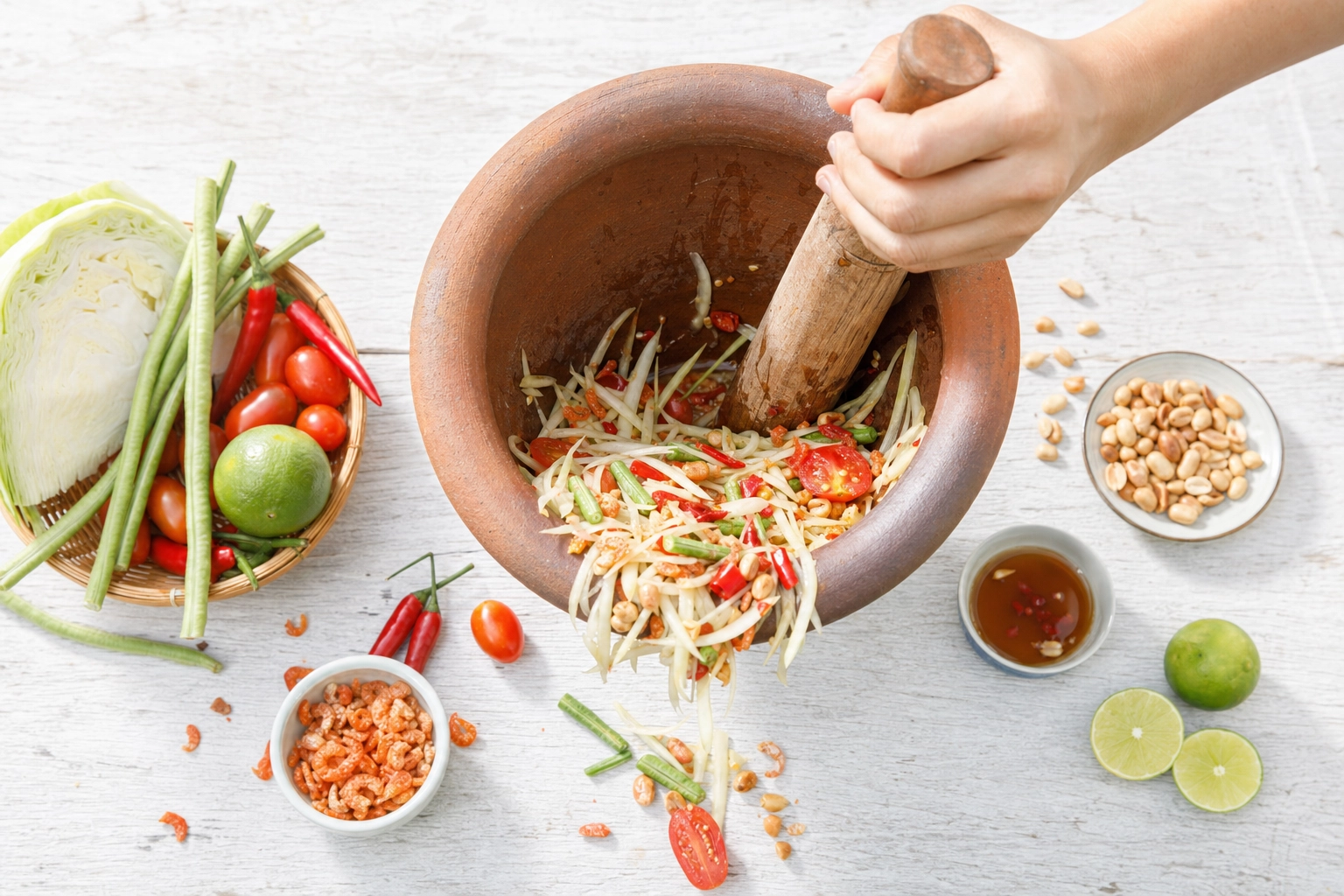 Overhead view of green papaya som tam being pounded in a clay mortar with chilies, peanuts, long beans and lime
4. Street-food skewers and the grill
Satay, moo ping and gai yang are built on two things a camera can capture brilliantly: char and smoke. This is the warm, smoky, street-food register — the one that makes a food-truck menu or a delivery listing feel authentic rather than corporate.
The signature shot is the grill itself. Rows of skewers over glowing charcoal, a curl of smoke, a brush of marinade mid-baste — those are thai street food photos with built-in motion and heat. Shoot a touch underexposed so the char reads deep and the embers glow, and let a little smoke drift through the frame.
For the plated version, lay chicken satay on a board or a square of banana leaf with a pool of peanut sauce and a side of cucumber relish. Two cues sell it: the char marks on the meat and the basting gloss catching the light.
Keep the light warm — tungsten or golden-hour tones flatter grilled protein, where cool light makes it look raw. A low, close angle puts the viewer right at the grill.
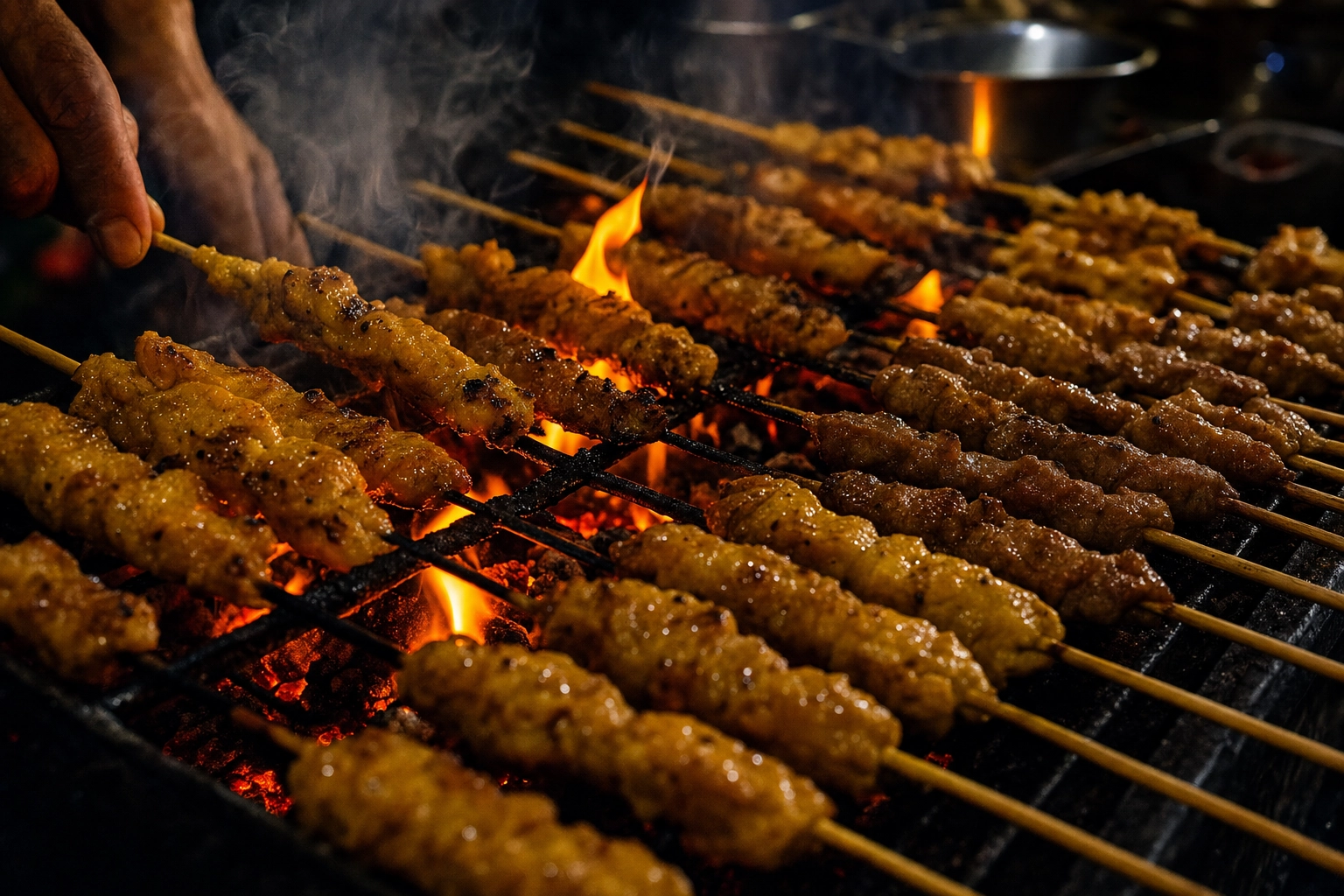 Thai satay and moo ping skewers grilling over glowing charcoal with smoke and char at a night street stall
5. The family spread, shot top-down
Thai meals are shared, and a single plate only ever tells a fraction of the story. The fifth shot is the whole table: pad thai, a trio of curries, a som tam, a plate of satay and a basket of sticky rice in one generous frame.
These are the thai food images people screenshot and share — your hero banner, your "about us" picture, your scroll-stopper.
Get directly overhead at 90 degrees. A true top-down turns the spread into a clean graphic pattern that reads instantly on a phone.
Then arrange with intent: place dishes so no two same-toned bowls sit side by side (two orange curries touching is mush), lean on the rule of odds — three or five hero elements beat four — and build a little height with bowls, baskets and a stacked steamer so the frame doesn't go flat. Tuck limes, chilies and a few loose herbs into the negative space.
End the meal on mango sticky rice: a fan of ripe mango beside a dome of coconut rice. It's the sweet full stop that makes the spread feel complete — and one of Thai cuisine's most photogenic dishes in its own right.
Lighting Thai dishes: heat, steam and gloss
If you fix one thing, fix the light. It does more for a Thai dish than any plate, prop or pricey camera — and the trick is that the right light changes with the dish.
Side light for gloss, char and noodle sheen
Curries, grilled skewers, pad thai and stir-fries all want a single soft light raking in from the side (a diffused window is perfect).
Side light is what separates a glossy gravy from the chili oil floating on it, lifts the char on a skewer, and gives noodles that living sheen. Keep the white balance neutral-to-warm so reds stay rich without sliding into orange.
Backlight for broth and steam
Tom yum, tom kha and any noodle soup want the light behind the bowl. Backlighting makes the broth glow from within, catches the sheen on the surface, and — over a darker background — turns otherwise-invisible steam into legible wisps.
It's also the only reliable way to tell tom yum (clear-red and sour) apart from tom kha (creamy-white and coconutty) in a photo. Add a touch of side light afterward to bring the toppings back.
Soft top-down light for the shared spread
A shared table needs every dish lit, so flatten and diffuse the light when you shoot overhead — hard, angled light just buries the back bowls in shadow.
Two rules cut across all of it. Kill the on-camera flash — a direct phone flash flattens the food, browns the proteins and blasts an ugly hotspot across every wet, glossy surface (and Thai food is nothing but wet, glossy surfaces). And mind your white balance throughout, because it's the difference between a green curry that looks fresh and one that looks grey.
Color grading: make Thai dishes pop without going fake
Even a well-lit Thai photo usually needs a color pass — and this is where the muddy-orange problem is finally solved. The goal isn't to crank saturation until everything screams; it's to separate the colors so each dish reads as itself.
Separate the curries in the HSL panel
Work in the HSL panel (hue, saturation, luminance) and treat each curry as its own channel. The classic mistake is global saturation, which makes the whole frame radioactive.
Instead, nudge the greens toward emerald and pull yellow saturation down a touch so green curry doesn't go sickly fluorescent — the single most common way Thai greens go wrong. Warm the reds slightly without letting them glow neon. Leave the deep browns of massaman alone; they're already appetizing.
Anchor the edit on your whites
Anchor the whole edit on your whites — the coconut cream, the jasmine rice, the plate. Keep those neutral and honest, and every color around them stays believable.
It helps to know the psychology: warm tones gently increase appetite, while blue (rare in natural food) suppresses it, which is why a hair of warmth flatters almost any dish and a cool cast almost never does. On the bright white backgrounds delivery apps demand, every one of these choices is amplified, so go precise rather than heavy-handed.
This is a craft in itself, and we've written the full step-by-step — white balance, HSL by food type, tone curves and the white-background traps — in our guide to food color grading. Run a green curry through it once and you'll never shoot one the same way again.
Props and vessels that say "Thai" without a word
In Thai food photography the vessel is half the styling. Long before the food registers, the right serviceware tells the diner exactly what they're looking at.
A battered enamel plate says street stall; a blue-and-white melamine bowl says neighborhood noodle shop; dark slate and walnut say modern, premium curry house — the kind of moody, fine-dining register a flagship menu lives in. Match the surface to the register you're selling and the photo does cultural work for free.
Reach for authentic cues and scatter them with restraint: a few bird's-eye chilies, a halved lime, a stalk of lemongrass, a torn kaffir lime leaf, a small dish of nam pla prik (fish sauce with chili). A square of glossy banana leaf under the food instantly reads "Thai," and a woven bamboo basket of sticky rice adds height and texture. The clay mortar from your som tam shot earns a second cameo here too.
The principle underneath all of it: authentic beats generic, every time. Pad thai served on humble enamel street-ware will out-sell the same noodles on a sterile white ramekin, because one looks like Thailand and the other looks like a hospital.
You can explore how this plays out across other kitchens in our food photography by cuisine library.
Don't forget Thai desserts and drinks
A Thai menu doesn't end at the curry, and neither should your camera roll. Dessert and drink shots are some of the easiest wins on the whole menu, because the dishes are naturally photogenic and far less time-sensitive than a wilting salad.
Mango sticky rice and coconut sweets
Mango sticky rice is Thailand's dessert ambassador, and it photographs like a dream: a neat fan of ripe golden mango beside a glossy dome of coconut sticky rice, a drizzle of coconut cream and a scatter of toasted mung beans or sesame on top.
Shoot it at 45 degrees on a clean light surface so the mango's color sings. Banana roti, coconut ice cream and lod chong work the same way — bright, simple, high-key. Style them with the same care our dessert photography tips bring to pastry.
Thai iced tea and the layered-drink shot
Thai iced tea is built for the camera: that sunset-orange tea with a cloud of condensed milk poured over ice is a layered drink, so shoot it dead level in a tall clear glass and capture the gradient before it stirs together.
Backlight it slightly so the layers glow. The same approach flatters Thai iced coffee, butterfly-pea lemonade and any boba the kitchen pours — and gives a dessert-and-bubble-tea concept a coherent, crave-worthy feed.
From phone snap to menu-ready in 90 seconds
Here's the honest before-and-after most restaurants live. The "before" is a hurried phone photo of a green curry, shot one-handed under fluorescent tubes during a Friday rush — grey-ish, flat, the herbs already wilting.
The "after" you want is styled, side-lit, color-true and consistent with every other dish on the menu. The gap between them is real skill, real time, and a 100-item menu nobody has the hours to shoot.
That's the problem AI was built for. Upload the messy phone snap, choose a Thai style tuned for wok-heat, curry color and street-food warmth, and get a 4K, menu-ready image back in about 90 seconds — no studio, no stylist, no reshoot when you add a special.
The consistency is the real win: the same look across your pad thai, your three curries, your som tam and your mango sticky rice, so a 100-item menu finally reads as one brand — whether you run a single dining room or a delivery-first ghost kitchen. See how it handles real dishes on our Thai food photography styles page, and how kitchens use it day to day in AI food photography for restaurants.
The cost math is what makes it obvious. A professional food shoot runs roughly $700–$1,400 per session, and a Thai menu needs several — then another every time the kitchen changes a dish.
An AI food photo editor starts at $15 a month for 25 menu-ready images, around 95% less, with a commercial license to use them on Uber Eats and DoorDash, your printed menu and Instagram. It won't replace a great photographer for a flagship campaign. But for the daily reality of keeping a huge Thai menu looking sharp, it's the difference between photos you keep meaning to take and the thai food photos you actually have.
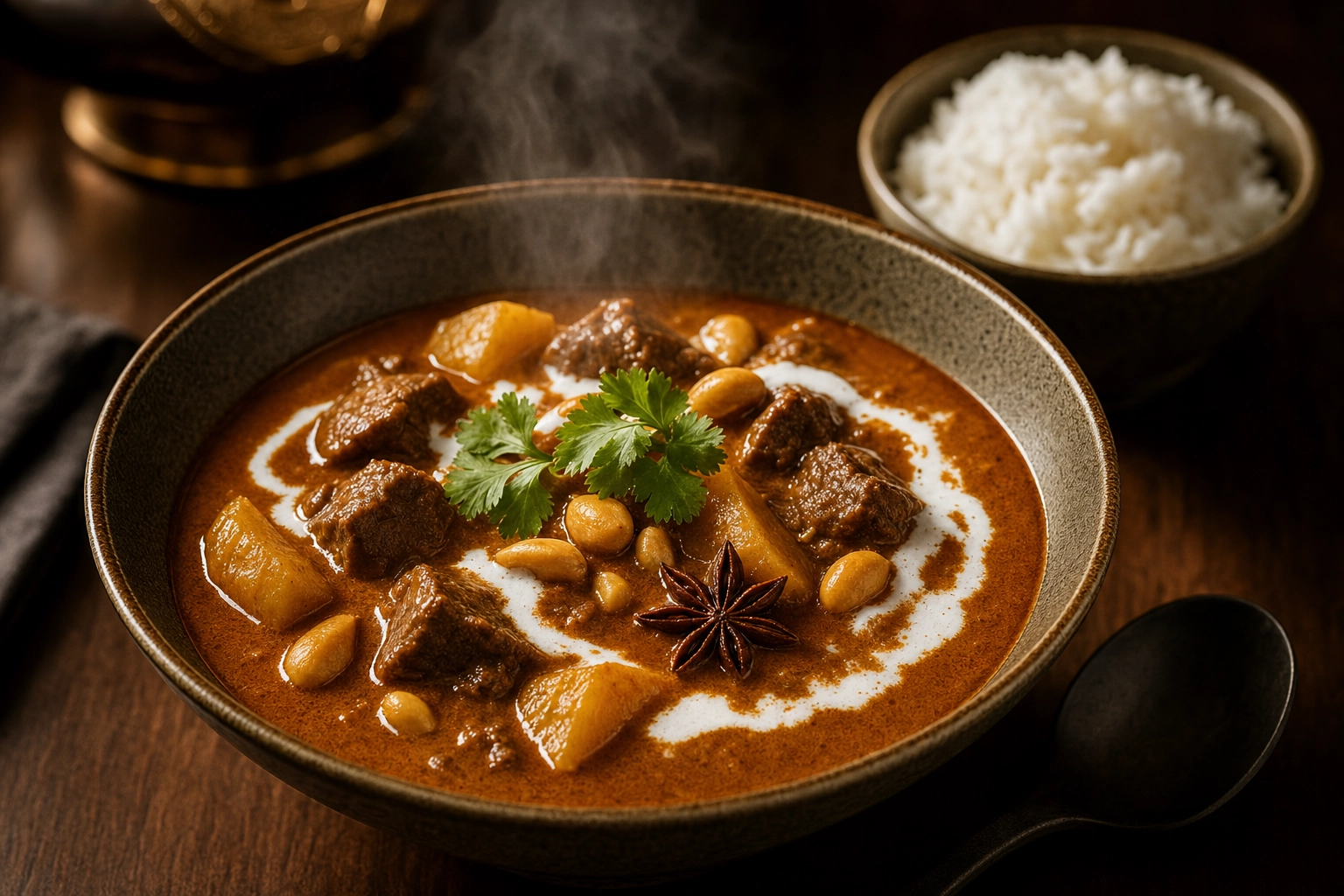 Menu-ready Thai massaman curry beauty shot with coconut swirl, beef, potatoes and peanuts on a dark elegant table
Frequently Asked Questions
How do you take good pictures of Thai food?
Start with three habits. Shoot most dishes at a 45-degree angle to show height and texture, then go top-down for shared spreads. Use soft side light (a diffused window is ideal) to bring out gloss and char, and never fire a direct phone flash.
Finally, style in the frame — a lime wedge, fresh chili, a coconut-cream swirl on curry — and shoot fast, before herbs wilt and steam fades. Get those right and even a phone produces menu-worthy thai food pictures.
Why does my green curry look brown or muddy in photos?
Almost always white balance and saturation. Warm fluorescent restaurant light pushes greens toward grey-brown, so the camera records mud instead of emerald.
Fix it in two places: set a neutral-to-cool white balance when you shoot the curry, then in editing nudge the greens toward emerald and pull yellow saturation down so the color doesn't go sickly fluorescent. Keeping the coconut cream and rice neutral-white gives every other color an honest anchor. Our food color grading guide walks through the exact sliders.
What are the most popular Thai dishes to photograph?
The ones diners already crave and recognize. CNN Travel ranked massaman curry the world's number one food, with tom yum goong and som tam also on its list, so those are natural heroes.
Round out the menu with pad thai (the most recognizable Thai dish on a delivery thumbnail), green and red curry, satay skewers, khao soi and mango sticky rice for dessert. Photograph the popular thai dishes first — they earn the most clicks and orders.
How do I make pad thai look as good as the restaurant version?
Shoot at 45 degrees with raking side light to catch the glossy sheen on the rice noodles, and build the dish up so it has height instead of lying flat.
Style the trio of lime, crushed peanut and bean sprouts directly in the frame, turn the prawn or egg toward the camera, and wipe the plate rim. For energy, add a chopstick-lift shot at a fast shutter speed. Those small moves separate appetizing pad thai images from a sad takeaway box.
What background works best for Thai food pictures?
Match the surface to the mood you're selling. Weathered dark wood and slate give curries and grills a moody, premium register; bright maple, marble and clean white suit modern fast-casual and delivery thumbnails; a square of banana leaf or an enamel street plate signals authentic street food.
Avoid busy patterns that fight the food — the dish should always be the loudest thing in the frame.
Can I use AI to edit Thai food photos for my menu?
Yes — it's the fastest way to keep a big Thai menu looking consistent. Upload a clean phone photo, pick a Thai-tuned style, and an AI food photo editor returns a 4K, menu-ready image in about 90 seconds, with the same look across every dish.
It enhances and restyles your real food rather than inventing fake dishes, and paid plans include a commercial license for delivery apps, menus and social. For a Thai kitchen with 100-plus items, that consistency is the whole point.