Food Truck Menu Ideas: 25 Profitable Concepts for 2026
 Ali Tanis28 min read
Roughly 48,400 food trucks operate in the United States right now, and about 60% of new ones fail in their first year. The difference between the winners and the casualties almost always comes down to one early decision: which food truck menu ideas you actually commit to.
Pick the wrong concept and every other choice gets harder — the truck you buy, the equipment you need, the crowd you attract, the margin you keep. Pick the right one and the business starts working for you from day one.
This is the complete guide to 25 profitable food truck menu ideas for 2026, organized by cuisine category. For each concept you'll get a realistic startup cost range, an average food cost percentage, peak demand times, and a visual marketing tip specific to that food. We'll also cover how to photograph your menu without hiring a photographer — because on a food truck, the photos on your menu board and Instagram feed are doing more sales work than you are.
Quick Summary: The most profitable food truck menu ideas in 2026 combine a signature high-ticket main (burgers, BBQ, birria, lobster rolls) with a high-margin sidekick (fries, coffee, boba, desserts). Beverage and dessert concepts carry the lowest food cost (15-25%), while BBQ and premium burgers drive the highest revenue per customer. Whatever you serve, the mouth-watering photos you put on your menu board and social feeds will decide whether people stop at your window or walk past.
Why Your Menu Is the Single Biggest Decision You'll Make
Food trucks are a $1.8 billion industry growing roughly 8% a year, and the format rewards focus. The average truck generates about $346,000 in annual revenue on roughly $950 per operating day, and net margins land between 6% and 15% depending on whether the owner works the window. The peak window is tight: 63.6% of operators say their busiest hours are 5–8 p.m., and the average customer spends $12.76 per visit.
Inside those numbers, your menu quietly controls everything. It decides the equipment you buy, the commissary space you need, the ingredients you waste, the speed you can serve, and whether you're a lunch truck, a late-night truck, or an event truck. It also decides how photogenic your food is — which matters more than most first-time owners think, because food trucks compete entirely on visual appeal. You don't have a dining room atmosphere, a celebrity chef, or a Michelin review to lean on. You have the truck, the menu board, and the photos people see before they've ever tasted your food.
The food truck menu ideas below are the ones that consistently work. They're chosen because they hit at least three of four criteria: proven demand, manageable food cost, fast prep, and strong visual potential.
How to Read This Guide: The 4 Numbers That Matter
For each of the 25 concepts ahead, you'll see four data points. Here's what each one actually tells you:
- Startup cost range. All-in: truck or trailer, kitchen buildout, permits, initial inventory, and working capital for the first 90 days. Used trailers bring the low end down; custom builds with specialty equipment push the high end up.
- Food cost percentage. The industry target is 28–35%. Anything below 25% is extraordinary margin; anything above 40% means you need premium pricing or catering revenue to survive.
- Peak demand times. When this concept actually sells. This tells you where to park, which events to book, and whether the idea layers well with a dayparting strategy.
- Visual marketing tip. The specific photo angle or detail that sells this food better than a text menu ever will. Every concept has one.
One more framing point. Food trucks don't need 30 menu items — they need 6 to 10 great ones. The food truck menu ideas below are blueprints for menus, not recipes for a whole restaurant.
Classic American Food Truck Menu Ideas: The Proven Workhorses (1–5)
Classic American comfort food is over-represented on every successful food truck street for a reason. The ingredients are affordable, the crowd is wide, and you can execute fast out of a tight kitchen. According to 2024 industry data, burgers, BBQ, and fried chicken are three of the top five most-offered food truck menu items in the country. If you're a first-time owner trying to build a viable book of business — corporate lunches, breweries, sports venues, street corners — these are the popular concepts new trucks start with for good reason.
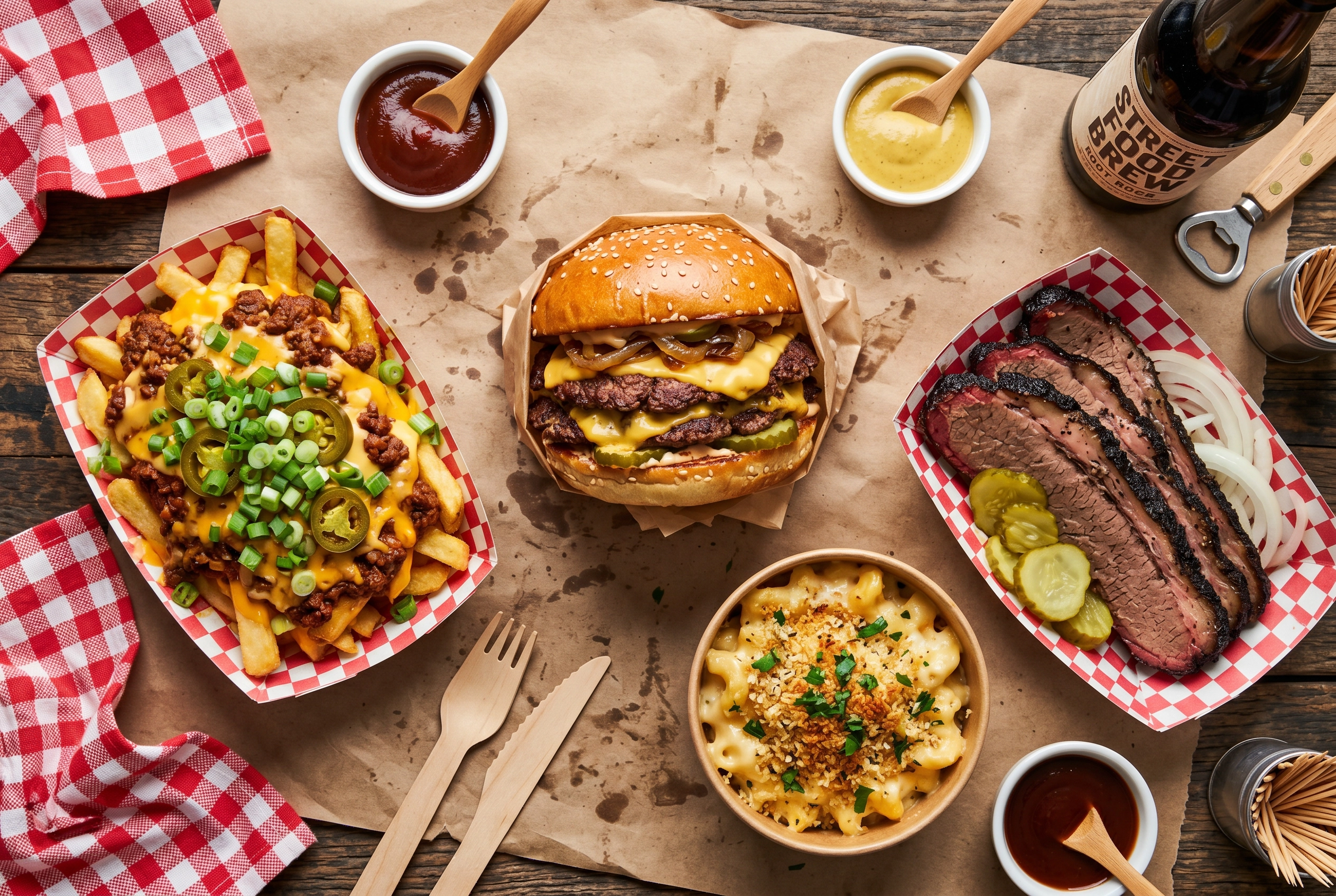 Overhead flat-lay of classic American food truck menu items including smash burger, chili cheese fries, sliced brisket, and mac and cheese on kraft paper
1. Gourmet Burgers & Smash Burgers
Burgers appear on 19.2% of American food trucks — the single most common main item in the industry. Smash burgers in particular have dominated the last five years because they cook in under 90 seconds, travel well in a wrap, and photograph beautifully with a visible cheese pull. Upsell into wagyu, truffle aioli, or bacon jam and you lift your average ticket without doubling your food cost.
- Startup cost: $60,000–$120,000
- Food cost: 28–32%
- Avg ticket: $12–$16
- Peak demand: Weekday lunch 11 a.m.–2 p.m.; dinner and event 5–9 p.m.
- Visual tip: Shoot at 45 degrees with the burger cut in half, cheese mid-drip, on unfinished wood or kraft paper. Avoid the flat overhead — a burger's whole story lives in its stack.
2. Loaded Fries & Poutine
Fries appear on 21% of food trucks, making them the single most popular item in the industry. They carry a spectacular 18–25% food cost and function as both a headline dish ("truffle parmesan fries") and an add-on that lifts every ticket by $4–$8. Poutine, loaded Korean fries, carne asada fries, and disco fries all extend the same base cost into very different cuisines — one of the most flexible food truck menu ideas on this list.
- Startup cost: $50,000–$90,000
- Food cost: 18–25%
- Avg ticket: $8–$14
- Peak demand: Late night 9 p.m.–2 a.m., festivals, sports events
- Visual tip: Shoot from directly overhead in a metal basket or red-and-white paper boat. Toppings have to read instantly — cheese curds, jalapeños, carnitas, chives all arranged, not piled.
3. BBQ & Smoked Meats
BBQ is on 15.3% of trucks and ties with premium burgers as the single highest-revenue item category in the business. Brisket, pulled pork, ribs, and smoked sausage all work — the trick is committing to one or two proteins instead of the whole pit. Sandwich it, taco it, bowl it, and sell the sides (mac, beans, slaw) at 70%+ margin.
- Startup cost: $80,000–$150,000 (smoker adds the most to the build)
- Food cost: 30–38%
- Avg ticket: $14–$22
- Peak demand: Weekend festivals, weekday lunch in business districts
- Visual tip: Close-crop on the smoke ring. Pull brisket apart by hand on butcher paper in natural light — sauce pools and bark textures are what stop scrolls.
4. Gourmet Hot Dogs
Hot dogs are the sleeper concept of the industry. Startup costs are among the lowest, food cost sits at 20–25%, and you can push gourmet with Sonoran-style, banh mi dogs, Chicago-style, or chili cheese. Because hot dogs cook in a steam basket or on a flat-top, your kitchen stays small and your line moves fast.
- Startup cost: $40,000–$75,000
- Food cost: 20–25%
- Avg ticket: $7–$12
- Peak demand: Late night, sports venues, concerts
- Visual tip: Shoot from a tight side angle so toppings cascade toward the camera. Bright relishes (neon green, yellow mustard) pop against a classic yellow or natural bun.
5. Mac & Cheese Bowls
Mac and cheese travels well in a paper cup, scales endlessly with toppings, and carries strong comfort-food appeal at festivals. A Philadelphia truck called Mac Mart scaled this exact concept from a food truck at street festivals to a real restaurant business — proof that a single indulgent idea can build a brand.
- Startup cost: $50,000–$85,000
- Food cost: 22–28%
- Avg ticket: $10–$15
- Peak demand: Fall and winter, comfort-food festivals, game-day tailgates
- Visual tip: The cheese pull on a fork is the single most shareable food video format on Instagram. Practice it. Film it. Post it weekly.
Global Street Food Truck Menu Ideas: Fusion That Sells (6–10)
International and fusion cuisines have moved from niche to mainstream corporate catering in 2026 — Caribbean jerk chicken, Mediterranean mezze, Korean BBQ tacos, and Latin street food now show up in company lunch rotations once reserved for pizza. The reason is margin: global street food lets you charge a premium over a domestic baseline with roughly the same ingredient cost. A $14 Korean short rib taco uses the same beef budget as a $9 cheeseburger, but it reads as a specialty experience.
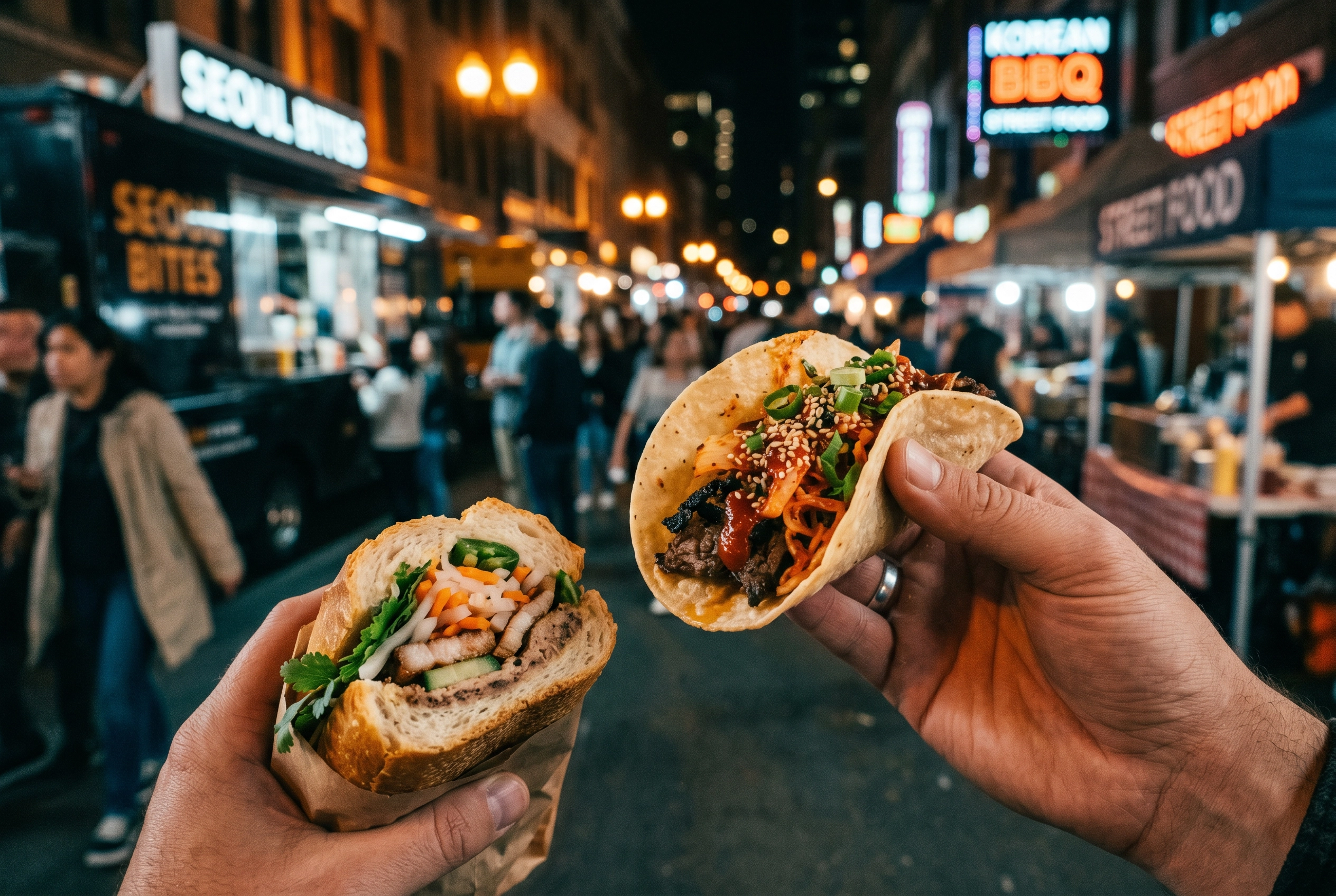 First-person view of hands holding a Korean BBQ taco and banh mi sandwich with blurred urban food truck street scene in the background
6. Korean Fusion Tacos
Kogi BBQ launched this category in Los Angeles in 2008 and the idea has been growing ever since. Kalbi short rib, spicy pork, or chicken bulgogi folded into a corn tortilla with kimchi slaw and gochujang crema is still one of the most reliable lunch-crowd pleasers in the country.
- Startup cost: $70,000–$120,000
- Food cost: 26–30%
- Avg ticket: $12–$18
- Peak demand: Weekday lunch, late-night bar districts
- Visual tip: Lean into color contrast. Bright red kimchi, green scallion, a gochujang drizzle against the dark char of a corn tortilla — the photo almost composes itself.
7. Poke Bowls
Customizable, health-coded, and built for the lunch crowd. Poke bowls run a higher food cost because of sashimi-grade tuna and salmon, but the perceived-value premium justifies a $14–$18 average ticket. Rice bases, spicy mayo, edamame, seaweed salad, and wonton crunch extend the menu without adding new proteins.
- Startup cost: $60,000–$100,000
- Food cost: 32–38%
- Avg ticket: $14–$18
- Peak demand: Weekday lunch 11 a.m.–2 p.m., beach and park traffic in summer
- Visual tip: Shoot straight down. Group ingredients by color in wedge patterns around the bowl — it's the only composition that reads cleanly at thumbnail size.
8. Empanadas
Empanadas are the quietly perfect food truck item. They're walk-and-eat, they batch easily, they hold heat, and a three-pack sampler upsells into a full meal. Argentine, Colombian, Venezuelan, and Chilean styles all give you distinct menu anchors from the same dough and fryer.
- Startup cost: $40,000–$80,000
- Food cost: 22–28%
- Avg ticket: $6–$12 for a 3-pack
- Peak demand: Weekday lunch, event circuit, walking traffic corridors
- Visual tip: Cross-section shot — bite one in half and photograph the steaming filling. The golden crust catches light beautifully in shaded outdoor settings.
9. Banh Mi
A properly made banh mi is a 60-second build once your proteins are braised ahead of time. The baguette, pâté, pickled daikon and carrot, cucumber, cilantro, and jalapeño create a sandwich that delivers more flavor per square inch than almost anything else on the street. Works especially well in business lunch corridors.
- Startup cost: $45,000–$85,000
- Food cost: 25–30%
- Avg ticket: $10–$14
- Peak demand: Weekday lunch
- Visual tip: Side-angle cross-section. The pickled vegetable layers and crusty baguette edge are the only sandwich worth the visual real estate — close-crop them.
10. Falafel Wraps & Mediterranean Bowls
Naturally vegetarian, naturally affordable, and built around one central technology (the falafel fryer) that can also handle fries and onions. The category includes shawarma, gyros, kafta, and grain bowls with hummus and tzatziki. Very strong catering demand for corporate lunches where dietary inclusion matters.
- Startup cost: $45,000–$80,000
- Food cost: 20–26%
- Avg ticket: $10–$14
- Peak demand: Weekday lunch, corporate catering
- Visual tip: Bright green herbs (parsley, mint) and red sumac dust over white tzatziki. The color palette is already the aesthetic — lean all the way in.
Trending Food Truck Menu Ideas for 2026: Ride the Wave (11–15)
Trending food truck menu ideas come with a built-in marketing flywheel: influencers already want to cover them, Instagram already favors them, and the search demand already exists. The trade-off is trend cycles can compress quickly, so the smart play is to treat a trend concept as your hook and have a stable menu backbone underneath.
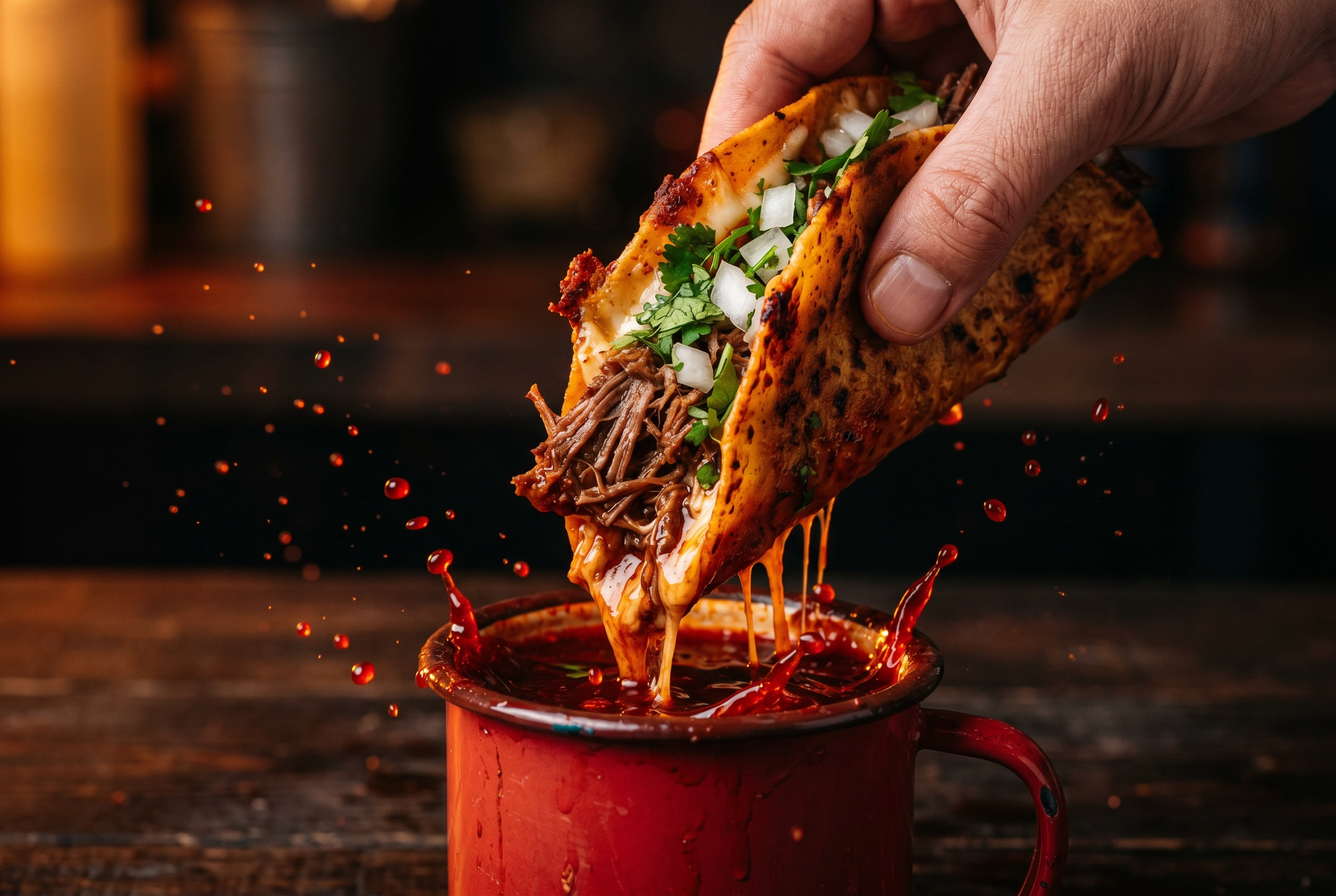 Macro close-up of a quesabirria taco being dipped into red consommé with broth splashing and melted cheese strands in dramatic lighting
11. Açaí Bowls
Açaí has outlasted the "wellness fad" label and is now a stable year-round idea in beach towns, college districts, gym-adjacent parking lots, and corporate parks. Granola, banana, coconut flakes, cacao nibs, and seasonal fruit turn a single base into dozens of combinations.
- Startup cost: $50,000–$90,000
- Food cost: 28–34%
- Avg ticket: $10–$15
- Peak demand: Mid-morning and early afternoon, peaking in summer
- Visual tip: Top-down composition. Every topping should read clearly with clear borders between ingredients — customers buy with their eyes on this category more than any other.
12. Loaded Cookies (Crumbl-Style)
Oversized gourmet cookies stuffed or topped with candy, frosting, ganache, or cheesecake. This idea exploded because the pull-apart shot is endlessly shareable on Reels and TikTok. Rotate the menu weekly to give followers a reason to check in.
- Startup cost: $35,000–$70,000
- Food cost: 18–24%
- Avg ticket: $5–$9 per cookie; $15–$24 for a 4-pack
- Peak demand: Afternoons and weekends
- Visual tip: Pull-apart the cookie while it's warm. The ooze of filling, the strands of chocolate — that's the hook. Short vertical video beats any still photo here.
13. Nashville Hot Chicken
Nashville hot has traveled far from Nashville. Tenders, sandwiches, and bone-in are all viable formats, and the spice-ladder upsell (mild → medium → hot → "stupid hot") is a built-in conversation and social media hook. Ties beautifully with mac, slaw, and pickles at very clean food cost.
- Startup cost: $60,000–$110,000
- Food cost: 26–32%
- Avg ticket: $12–$16
- Peak demand: Weekday lunch and dinner, late-night
- Visual tip: That rich red-orange crust against soft white bread and pickle-green slices is an already-designed color scheme. Shoot tight enough that you can see the cayenne-oil glisten.
14. Birria Tacos
Birria is the taco trend of the decade. Mike's Red Tacos, a food truck that opened in San Diego in 2021, is currently expanding to more than 200 franchise locations nationally — proof that birria isn't slowing down. The slow-cooked, chile-stewed beef (or goat, or chicken) gets tucked into a cheese-crisped tortilla and served with a cup of consommé for dipping.
- Startup cost: $55,000–$100,000
- Food cost: 28–34%
- Avg ticket: $12–$18
- Peak demand: Weekday lunch and dinner, social-media-driven traffic
- Visual tip: The consommé dip in motion. A quesabirria held mid-air, mid-dunk, drip captured — this is the most viral food video format of the decade. A single well-lit clip can pay for a week of ads.
15. Boba Tea & Specialty Drinks
Beverages are the highest-margin category on any food truck. Boba tea, Vietnamese coffee, fruit teas, and matcha lattes can all run a 15–22% food cost. The format also opens afternoon daypart hours when most food trucks are dark.
- Startup cost: $45,000–$80,000
- Food cost: 15–22%
- Avg ticket: $6–$9
- Peak demand: 2–7 p.m., youngest demographic of any category
- Visual tip: Clear plastic cups against bright solid-color backdrops. Tapioca pearls, layered syrups, color gradients — every drink should look like it was art-directed.
Niche High-Margin Food Truck Menu Ideas: Stand Out With a Specialty (16–20)
Niche concepts have less local competition and tend to punch above their weight on search ("lobster roll truck near me") and social proof. They also land more catering bookings because corporate planners specifically want a point of view, not a generalist. The trade-off: you have to commit. A niche truck that waffles on identity defeats the whole strategy.
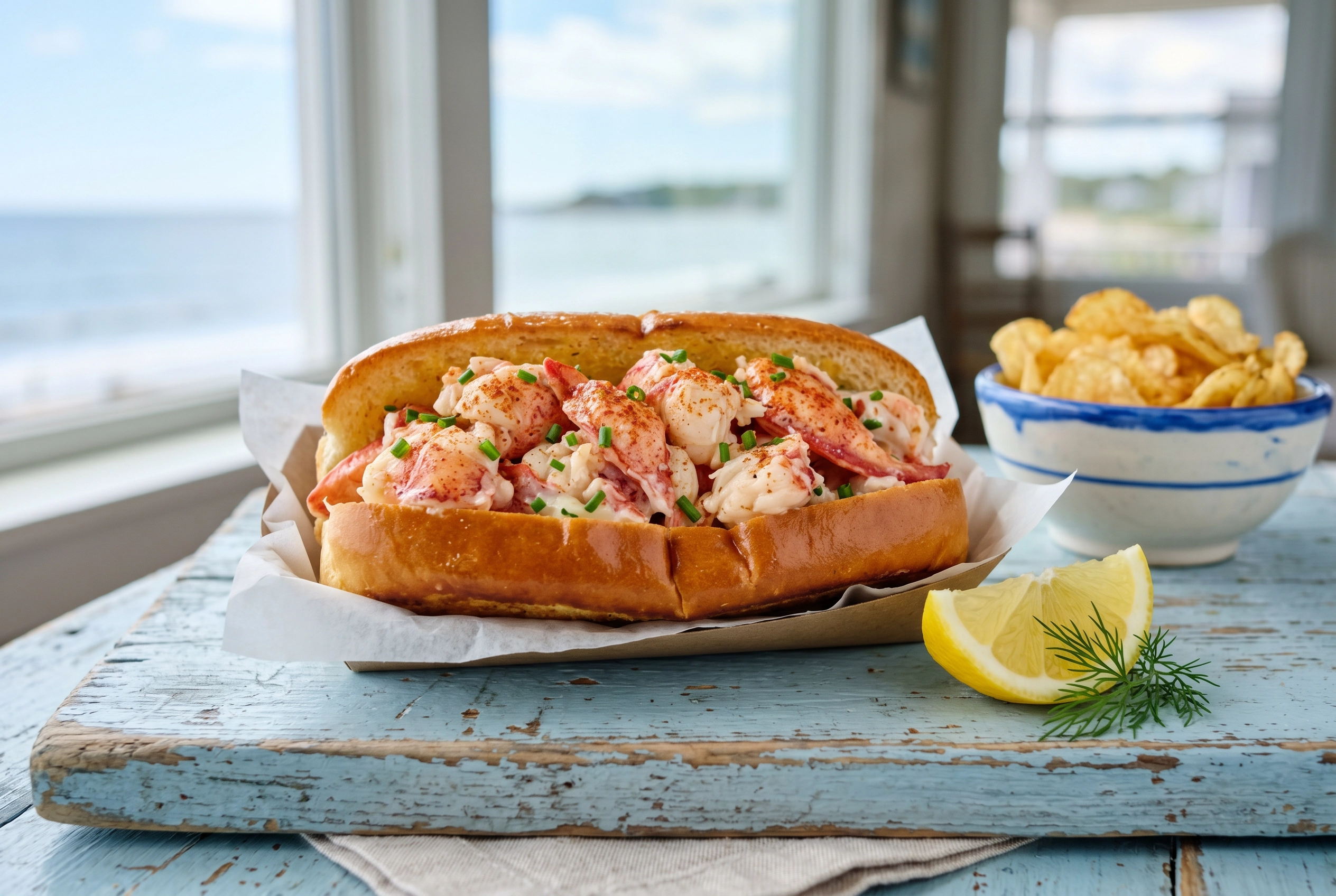 Maine lobster roll on toasted split-top bun with chives and paprika on pale blue wooden board with coastal pastel styling
16. Vegan Comfort Food
The growth category of the last three years, specifically because most vegan menus still read as "health food." The trucks winning this niche lean the other way — plant-based smash burgers, jackfruit BBQ sandwiches, crispy cauliflower wings, vegan mac and cheese. Make it feel like indulgence, not sacrifice.
- Startup cost: $55,000–$95,000
- Food cost: 28–32%
- Avg ticket: $12–$16
- Peak demand: Weekday lunch, event catering
- Visual tip: Don't shoot vegan food like health food. Warm lighting, dark backgrounds, generous sauce pours. If the photo could pass for a non-vegan burger, you've done it right.
17. Breakfast All Day
Most food trucks ignore the morning daypart entirely. Breakfast burritos, egg-and-cheese bagels, sweet-and-savory waffles, and shakshuka bowls all travel well and cook fast. "All day" is the real unlock — you pick up commuters at 7 a.m. and bar-adjacent hungry customers at 1 a.m.
- Startup cost: $50,000–$85,000
- Food cost: 22–28%
- Avg ticket: $9–$14
- Peak demand: 6–11 a.m. commuter traffic; late-night after bars
- Visual tip: The runny yolk at the moment of break. Cut the sandwich or burrito, let the camera roll, capture the drip. Instant scroll-stopper for breakfast content.
18. Wood-Fired Pizza
Event-heavy, premium-priced, and harder to start — the oven is the cost driver. But a wood-fired truck dominates weddings, corporate events, and breweries in a way almost no other idea on this list can. The theater of the fire and the 90-second bake are a built-in show.
- Startup cost: $100,000–$180,000
- Food cost: 22–28%
- Avg ticket: $14–$20
- Peak demand: Dinner, private events, weekends
- Visual tip: The leopard-spotted char on the crust is your signature shot. Shoot the pizza coming out of the oven with the flames visible in the background — then shoot the finished slice against a dark wood board.
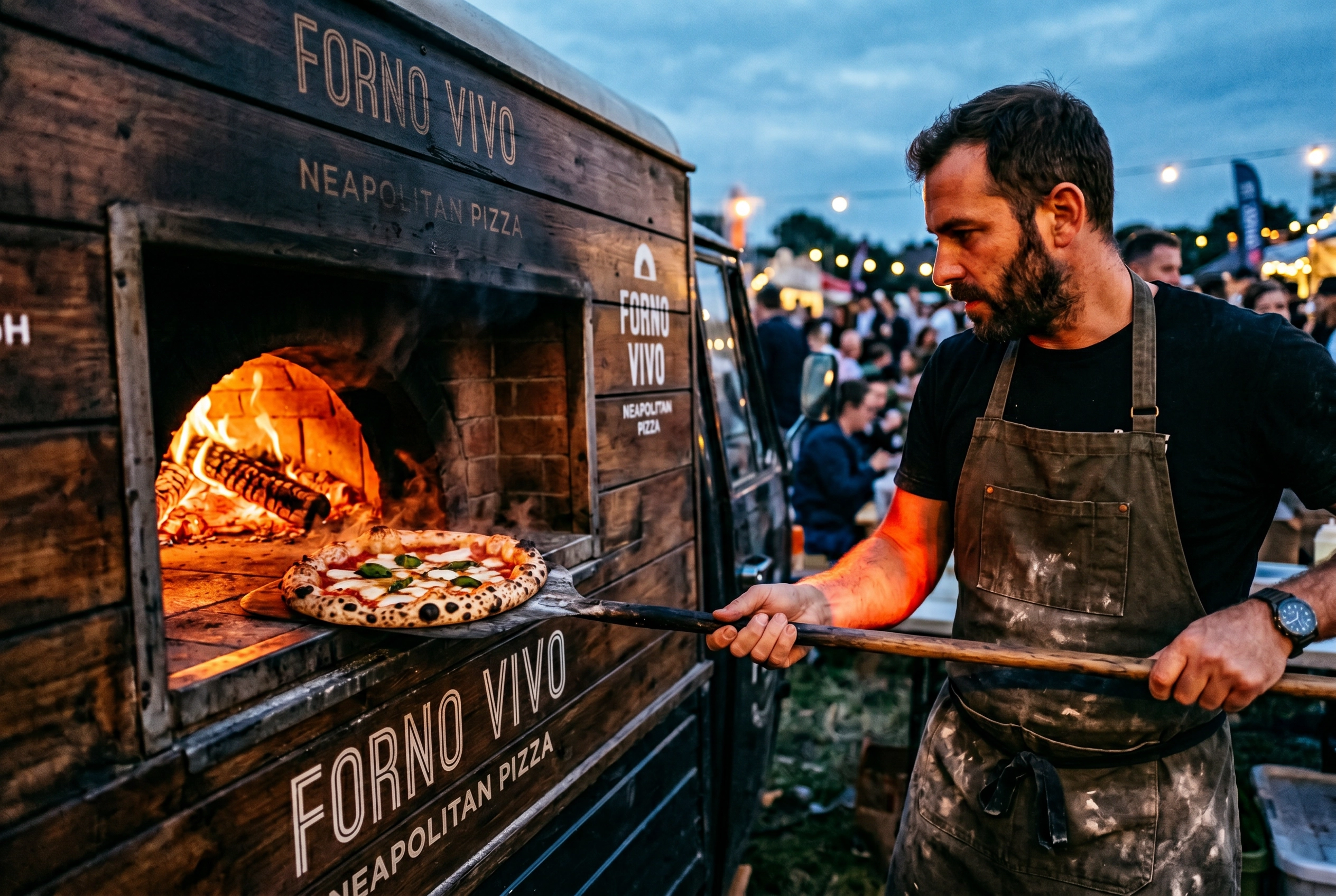 Wood-fired pizza truck at dusk with glowing oven flames and pizzaiolo pulling a leopard-charred Neapolitan pizza out on a wooden peel
19. Lobster Rolls & Premium Seafood
Cousins Maine Lobster proved that a lobster roll truck can scale into a national franchise. Premium pricing, a cleaner menu than BBQ or burgers, and a direct line to the catering market. Food cost is the highest on this list because seafood is expensive — but the ticket size makes the math work.
- Startup cost: $60,000–$110,000
- Food cost: 38–45%
- Avg ticket: $22–$32
- Peak demand: Lunch and dinner in warmer months, coastal events
- Visual tip: The butter sheen on a toasted split-top. Shoot at eye level with the lobster piled high, paprika dust on top, a lemon wedge for color. The food already looks iconic — don't overcomplicate.
20. Gourmet Grilled Cheese
The Grilled Cheeserie in Nashville turned this idea into a local institution. The appeal is universal (literally no one dislikes grilled cheese), equipment needs are minimal (a good flat-top), and the upsell ladder is deep — brisket, bacon jam, short rib, apple, fig, caramelized onion.
- Startup cost: $40,000–$75,000
- Food cost: 22–28%
- Avg ticket: $9–$14
- Peak demand: Weekday lunch, late-night
- Visual tip: The cheese pull. Own it. Cut the sandwich, lift one half slowly, capture the strand. It's been done a million times because it works a million times.
Dessert Food Truck Menu Ideas: The Highest Margins on the Street (21–25)
Dessert trucks carry the lowest food cost percentages in the entire industry — 15–25% is the standard range. They also ride impulse psychology: a dessert purchase is an emotional decision made in under 30 seconds, which is a gift to a food truck whose whole job is to convert walk-by traffic. Event demand is strong year-round: weddings, fairs, festivals, corporate parties, farmers markets.
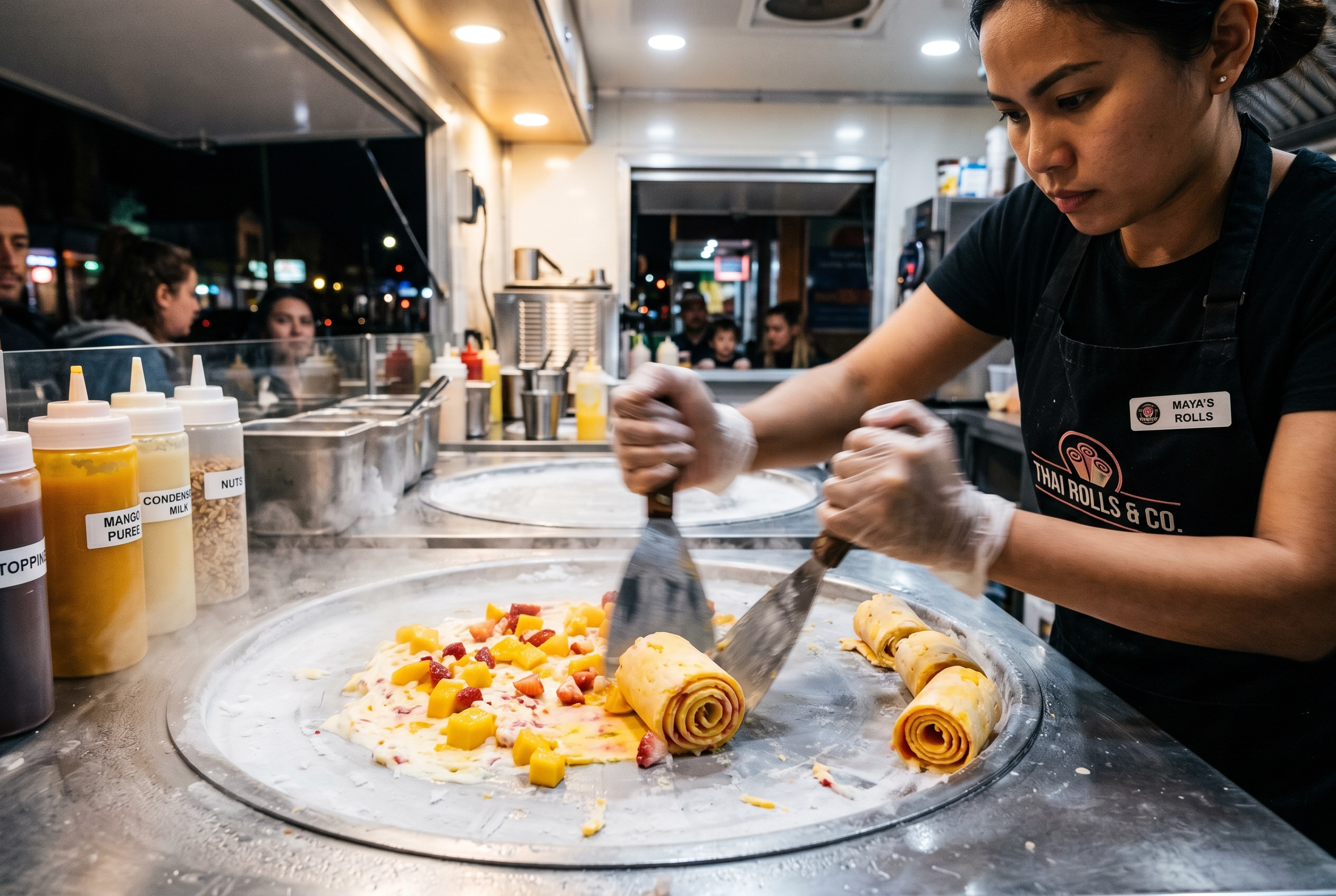 Action shot of a worker rolling Thai-style ice cream on a frozen steel plate with metal scrapers in motion and fruit mixed into the rolls
21. Rolled Ice Cream (Thai-Style)
The prep is the product. Pouring the cream base, mixing in flavors on the cold plate, scraping and rolling it into perfect cylinders — the whole process is the marketing. Customers film it. Customers post it. Customers bring friends.
- Startup cost: $45,000–$80,000 (cold plates are the major line item)
- Food cost: 20–26%
- Avg ticket: $8–$12
- Peak demand: Summer evenings, fairs, festivals, family events
- Visual tip: Short-form vertical video of the rolling process outperforms any still photo by a wide margin. Train your staff to do it cleanly while a phone records.
22. Churros
Low equipment threshold, low food cost, and a smell that sells the product from 50 feet away. Classic cinnamon-sugar, filled churros, dipping sauces (dulce de leche, dark chocolate, Nutella), churro sundaes, churro waffles. A small menu is a feature here, not a limitation.
- Startup cost: $35,000–$65,000
- Food cost: 18–24%
- Avg ticket: $6–$10
- Peak demand: Evenings, night markets, events
- Visual tip: Catch powdered sugar mid-fall onto a cone with a fast shutter. The suspended-sugar look is instant dessert advertising.
23. Mini Donuts
Fresh-fried, small-batch, and hot from the fryer. The aroma alone pulls crowds at farmers markets and fairs. A bag of 12 mini donuts with powdered sugar, cinnamon, or maple glaze is a classic impulse buy at a $6–$10 ticket that costs you under $2 in ingredients.
- Startup cost: $35,000–$60,000
- Food cost: 15–22%
- Avg ticket: $6–$10
- Peak demand: Morning at markets, evenings at events, weekends year-round
- Visual tip: Steam coming off fresh donuts into cool morning air. Shoot backlit against a lighter background so the steam reads clearly in the photo.
24. Specialty Coffee Truck
The lowest food cost idea on this entire list. Coffee beans, milk, and syrups add up to a 10–15% cost of goods on a $5.50 latte. Compact equipment footprint means you can run out of a smaller trailer, and the morning-focused schedule leaves your afternoons free for catering or private events.
- Startup cost: $40,000–$80,000
- Food cost: 10–18%
- Avg ticket: $5–$8
- Peak demand: 6–11 a.m. commuter rush
- Visual tip: Latte art close-up with morning light filtering through the espresso steam. Also shoot the whole drink-on-counter composition — cup, saucer, small pastry — for cafe-style menu boards.
25. Nitrogen Ice Cream
Liquid nitrogen ice cream is a show disguised as dessert. You pour the dairy base, hit it with nitrogen from a canister, and a dramatic vapor cloud envelops the bowl while the ice cream sets in under 30 seconds. Higher startup cost because of the nitrogen tanks and safety equipment, but the theater is the whole moat.
- Startup cost: $70,000–$120,000
- Food cost: 22–28%
- Avg ticket: $8–$14
- Peak demand: Summer, evening events, night markets, family festivals
- Visual tip: Slow-motion video of the nitrogen cloud rolling over the bowl. Every customer wants to film this — make it easy for them by setting up a clear sight line to the mixing station.
The One Universal Truth: Your Photos Decide Whether People Stop
Every concept above has its visual tip for a reason. Food trucks compete on visual appeal more than any other food-service format — you don't have a dining room to wow people, a website above the fold to sell them, or a reservation system to lock them in. You have the truck, the menu board, and the photos on your social feed. That's the entire funnel.
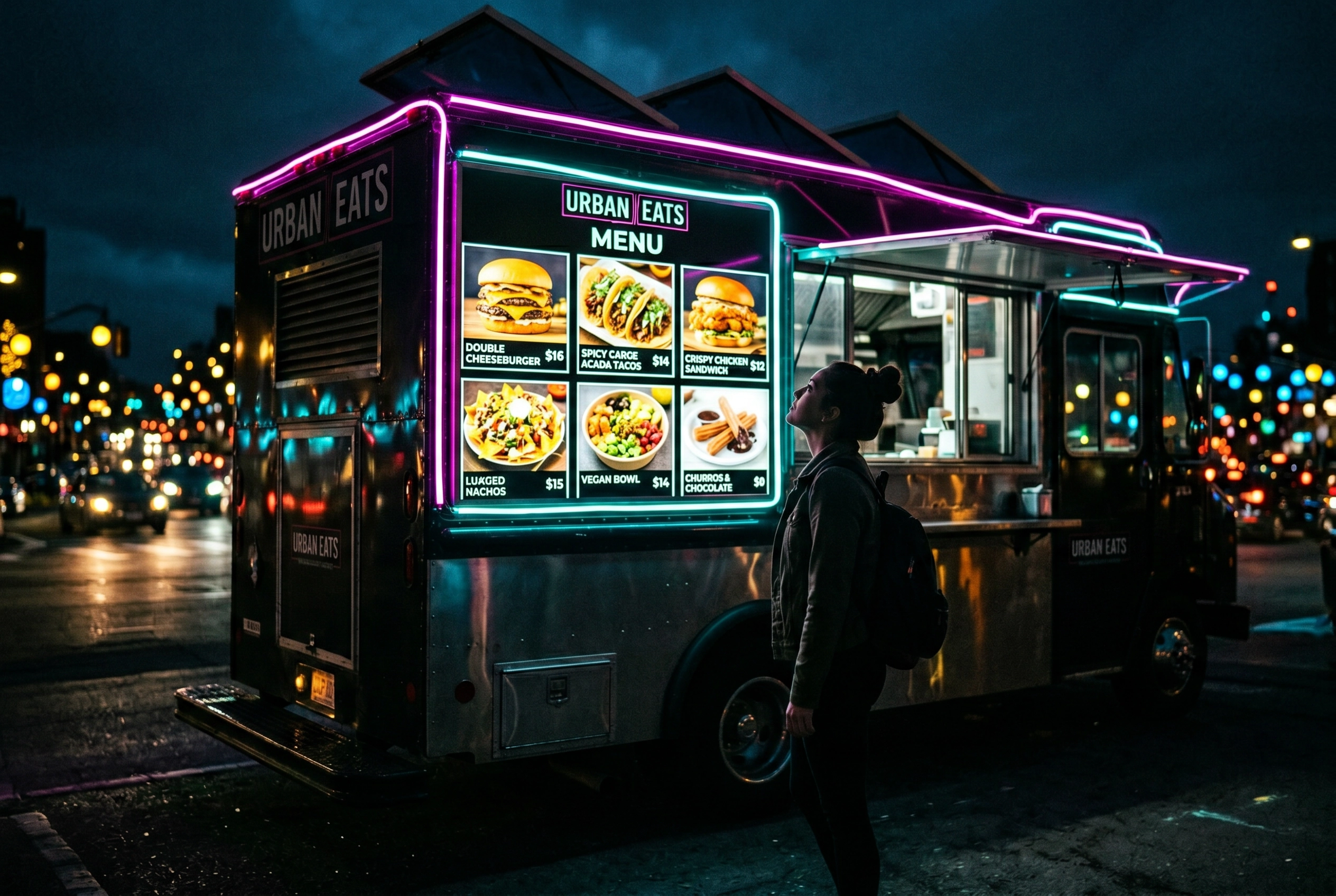 Customer silhouette looking up at an illuminated food truck menu board at night with glowing backlit photographs of dishes
Industry research on restaurant menus consistently shows that menu boards with strong food photos lift average check size compared to text-only menus, sometimes by 20–30%. Dynamic digital menu boards with mouth-watering food photography outperform static text boards because customers can't mentally picture a "Korean short rib banh mi" as well as they can look at one. Instagram and TikTok are the top discovery channel for food truck customers under 35, with more than 60% of millennials having visited a food truck in the last year — and the reason they pick a specific truck is almost always a photo they scrolled past.
The problem is that the photos you need and the photos you can realistically capture during a 12-hour service day don't match. Traditional food photography takes a studio, a photographer, hours of setup per dish, and $500–$2,000 per shoot. A food truck launching 20 menu items cannot shoot 20 photo sessions. That's the gap, and it's what the next section solves.
How to Photograph Your Food Truck Menu (Without Hiring a Photographer)
You don't need a photographer. You need a repeatable few-minute process you can run in the quiet window between rushes. Here's exactly how.
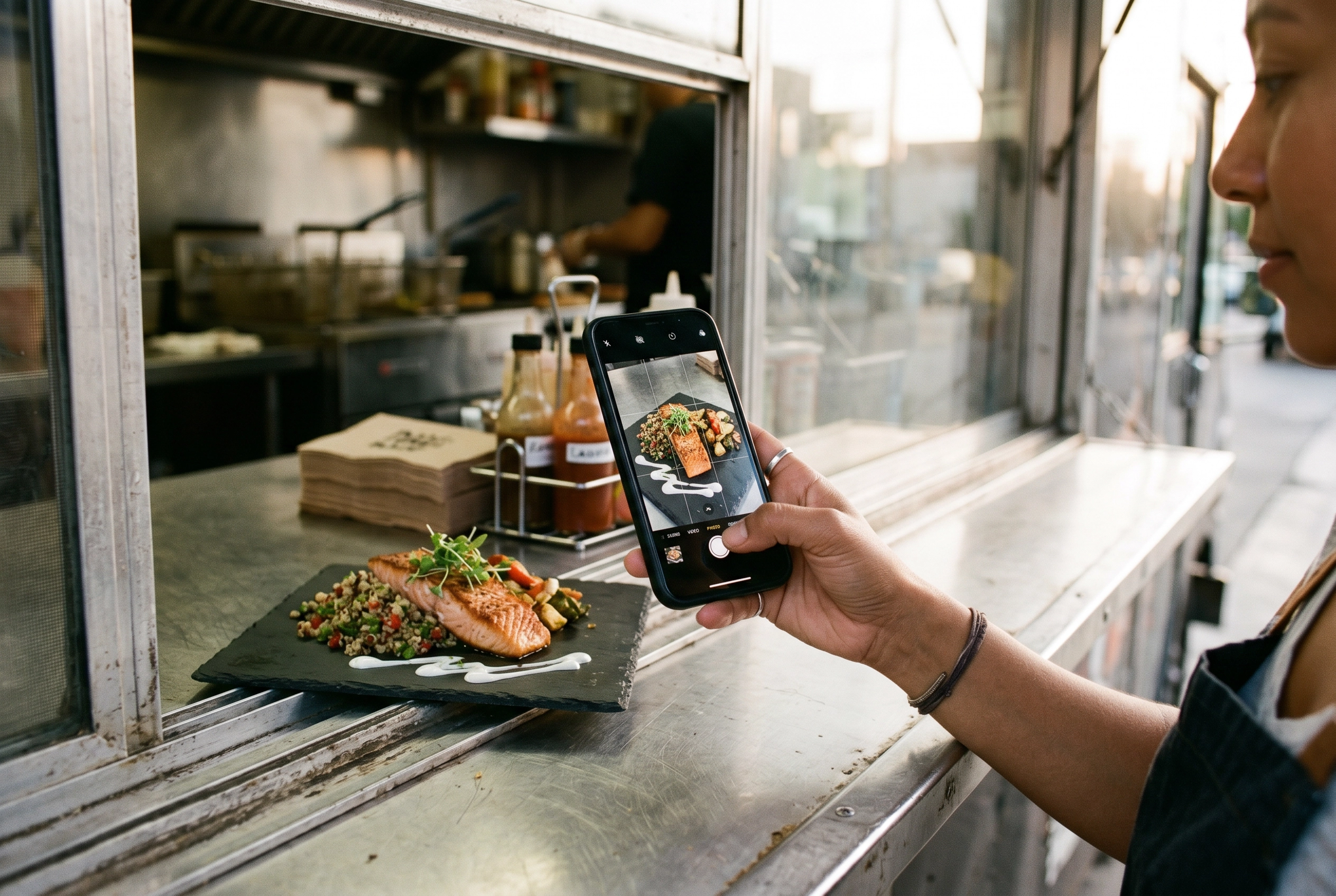 Food truck owner's hand holding a smartphone to photograph a plated signature dish on the serving window counter in soft daylight
Step 1: Pick your shoot window. The best time to photograph food on a food truck is the 10–15 minute lull between the end of the lunch rush and the start of dinner prep — usually 2:15–2:45 p.m. for lunch trucks. Morning is second-best if you're shooting breakfast items. Golden hour right before sunset works for hero shots of the truck itself, but not for individual dishes because the color temperature is too warm.
Step 2: Use open shade. The side of your truck that faces away from direct sun creates open shade — soft, even, natural light with no harsh shadows. Set up a small prep surface (a flip-down shelf, a stool with a cutting board, a serving window ledge) three to four feet from the edge of the truck so you're in diffused light but not dim interior shadow.
Step 3: Shoot at the right angle. Burgers, sandwiches, and plates photograph best at a 45-degree angle — high enough to see the whole composition, low enough to see the stack. Bowls, poke, açaí, loaded fries, and round pizzas shoot best straight down (90 degrees). Tall drinks and layered desserts shoot best at eye level (0 degrees).
Step 4: Shoot the real dish. Don't over-style. Serve the dish the way a customer would receive it — paper-wrapped, on a metal tray, in a taco basket. The authenticity is what makes food truck photos feel different from restaurant photos, and it's what resonates with the audience. For more detailed phone technique, see our guide on how to take good food photos with a phone.
Step 5: Enhance, don't fake. This is where modern AI earns its keep. Upload the phone photo to FoodShot AI and it turns the raw image into a studio-style menu shot — cleaner background, balanced lighting, sharp focus on the hero — in about 2 minutes. It's not generating food from thin air. It's enhancing the real photo of the real dish you actually serve, which is the only honest approach for a menu. For the full breakdown of the workflow, see our food truck photography guide.
This matters for food trucks specifically because you're constantly refreshing your menu. A new weekly special, a seasonal LTO, a catering-menu variation, a collab item — every single one needs a photo. Traditional photography makes that economically impossible. AI enhancement makes it trivial. A new menu item in the morning can have a finished menu-board image and an Instagram post by lunch service.
A few practical notes on what to try shooting:
- Menu board photos need a consistent style across every item. Same background, same lighting, same angle logic. AI tools with "style" or "preset" libraries let you lock in one look and apply it across all 10 menu items. Learn more about AI food photography for food trucks and why consistency matters.
- Instagram and TikTok content should break style deliberately. Mix process shots, close-ups, customer reactions, and team moments. Treat Instagram as behind-the-scenes and the menu board as finished product.
- Delivery app listings (if you list on Uber Eats or DoorDash) demand clean, bright, square photos with solid neutral backgrounds. Follow our guide on delivery app food photography for the exact specs.
- Catering pitch decks need high-resolution, studio-style shots that hold up when printed. AI tools that output at 2K, with a 2x upscale for larger prints, cover this without a separate shoot.
The photography advice in this section applies to every one of the 25 food truck menu ideas above. A Nashville hot chicken truck with a bad menu board loses to a gourmet grilled cheese truck with a great one. That's the business you're actually in.
For the deep dive on menu board layout, typography, and pricing psychology, see our guide on food truck menu design fundamentals. For more on shooting individual dishes, the 12 food photography techniques post is a useful companion, as is our menu photoshoot guide for planning a bigger shoot.
Frequently Asked Questions
What is the most profitable food truck menu concept in 2026?
Dessert and beverage concepts — coffee, boba, churros, mini donuts, loaded cookies — have the lowest food cost percentages (15–25%), which gives them the highest raw margin per item. BBQ and premium burgers generate the highest revenue per customer ($14–$22 average ticket) but at a higher food cost. The most profitable food truck menu ideas combine both: a high-ticket main (birria, brisket, lobster roll) paired with a high-margin drink or dessert that lifts the average check.
How many items should a food truck menu have?
Six to ten items is the sweet spot. Smaller menus mean faster service, less ingredient waste, less prep complexity, and more consistent execution. A good menu structure is one signature item, two or three variations of that signature, one or two sides, and one or two drinks. Anything more and your line slows down — which directly cuts your daily revenue because food truck customers walk away after about seven minutes of waiting.
What are the cheapest food truck menu ideas to start?
Churros, mini donuts, coffee trucks, and loaded-cookie concepts sit in the $35,000–$70,000 total startup range. Lower equipment needs (no smoker, no fryer bank, no multi-burner range), smaller commissary requirements, and simpler health-permit profiles keep costs down. A trailer-based build instead of a truck can cut another 30–50% off the vehicle cost — a useful path if you're trying to launch the best food truck menu for a small budget.
Do I really need professional-looking photos for my food truck menu?
Yes, and more than almost any other food business. Food trucks compete on visual appeal because you don't have a dining room atmosphere, a celebrity chef, or a physical location reputation to lean on. Customers make a decision in under 10 seconds whether to stop at your window or walk to the next truck, and that decision is driven by what they see on your menu board and your Instagram feed. Modern AI food photography has made professional-quality photos accessible for any food truck budget, which removes the last real excuse for a text-only menu.
What food truck items have the highest profit margins?
Beverages lead the industry — coffee, boba, fresh juice, and soft drinks run 10–22% food cost. Desserts are second — donuts, cookies, churros, and ice cream typically run 15–25% food cost. Fries and other carbohydrate-heavy sides are third at 18–25% food cost. The pattern: items with cheap base ingredients and strong perceived value carry the best margins. Protein-centric mains (BBQ, seafood, steak tacos) drive higher revenue but tighter margins.
Should I niche down or offer a broader menu?
Niche wins on food trucks, and the data backs it. Customers find niche trucks through search ("birria truck near me," "lobster roll food truck") and through social proof on Instagram — neither of which favors a generalist. A narrow list of food truck menu ideas also simplifies your prep, your supply chain, and your food cost control. The one caveat is that niche trucks need a stronger visual identity to compete, because your concept alone has to tell the whole story before a customer has tasted your food.
Your Menu Decided. Now Make It Look As Good As It Tastes.
The concept you pick sets the ceiling. How you present it sets the floor. A brilliant birria truck with a faded chalkboard menu loses to a mid-tier taco truck with a professional photo-driven board and a clean Instagram feed. That's the honest truth of this business.
The barrier to great photos used to be money and time — neither of which a food truck owner has much of. That barrier is gone. FoodShot AI was built specifically for this problem: take the phone photo you already snapped between rushes, turn it into a studio-quality menu image in about 2 minutes, and get back to serving. No studio, no photographer, no afternoon off the road.
Start with a few of your dishes on the Starter plan, see the difference on your menu board and feeds, then scale up when you're ready. Whichever of these 25 food truck menu ideas you pick, make it look as good as it tastes — that's the part of the business that compounds.
Try FoodShot AI or see the full pricing breakdown. For teams running multiple trucks or rotating menus weekly, check out how food trucks use FoodShot AI to keep every menu item on-brand and camera-ready.