Food Truck Menu Design: Templates, Tips & Photo Ideas
 Ali Tanis19 min read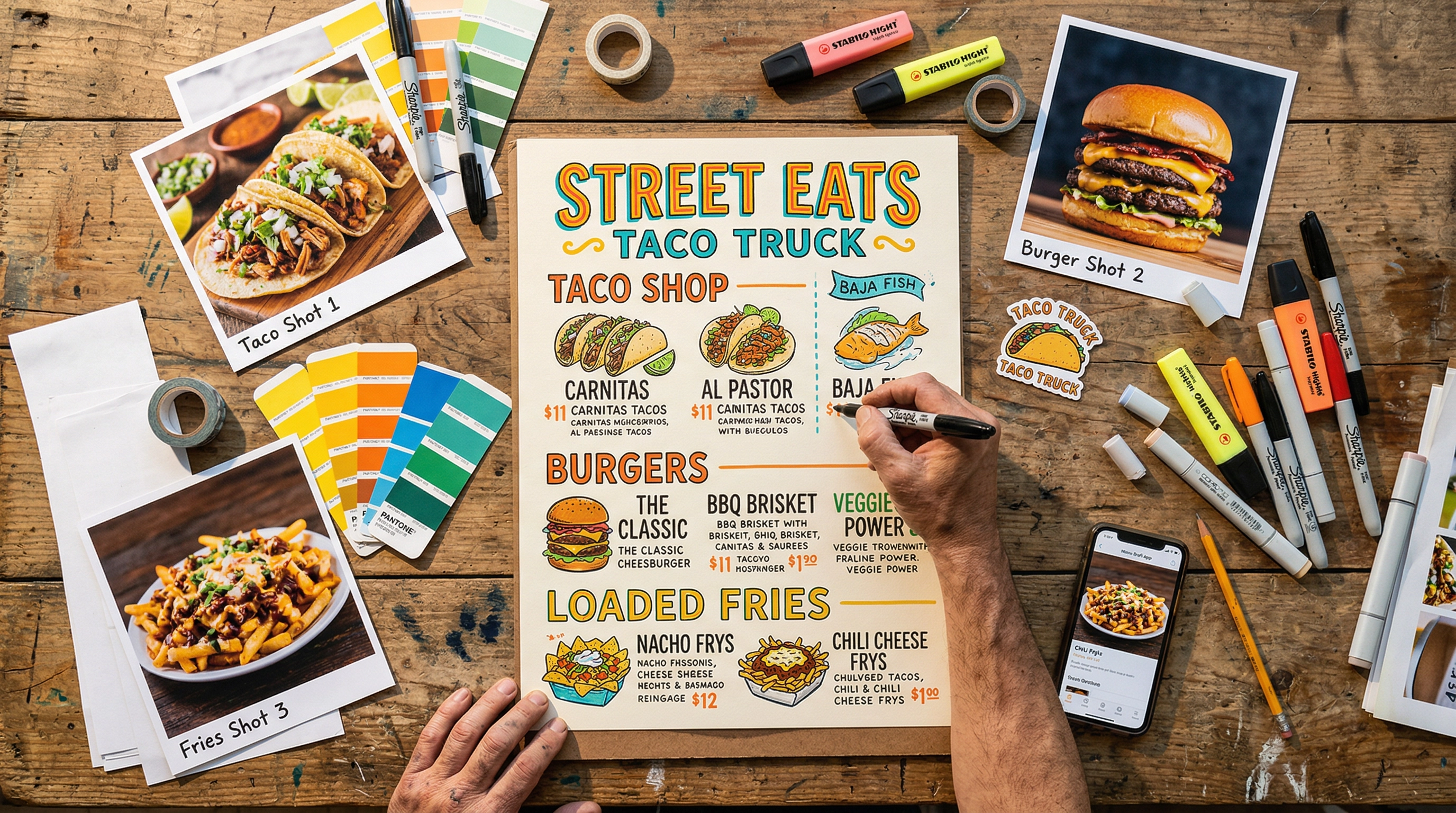
Your food truck might serve the best al pastor tacos in the city, but if your menu board looks like a spreadsheet, half your potential customers will walk right past you. Great food truck menu design is the difference between a line around the block and an empty window.
Quick Summary: Effective food truck menu design balances readability from a distance, ruthless simplicity (6–12 items max), brand consistency, strategic photo placement, and pricing psychology. This guide covers all five design principles, compares physical vs. digital menu boards, shares 10 free food truck menu template ideas organized by cuisine type, and shows how food photography — including AI-powered shortcuts — can boost your sales by 30% or more.
Food truck menu design workspace with printed food photos, color swatches, and menu board layout in progress
The U.S. food truck industry hit $2.8 billion in 2026, with over 92,000 trucks competing for customers. That's a lot of competition for sidewalk attention. Your food truck menu isn't just a list of things you sell — it's your storefront, your salesperson, and your billboard, all crammed into a few square feet of board space.
Get your food truck menu layout right, and you speed up your line, increase your average ticket, and turn first-timers into regulars. Get it wrong, and you lose customers before they ever taste your food.
Here's how to design a food truck menu that actually converts — with practical ideas, customizable template inspiration, and professional tips you can start using today.
5 Principles of Food Truck Menu Design That Sells
Every great food truck menu follows the same fundamentals, whether it's hand-lettered on a chalkboard or glowing on a digital screen. These five design principles separate menus that sell from menus that confuse.
1. Readability From 10 Feet Away
Your customers are reading your food truck menu while standing on a sidewalk, squinting in sunlight, probably distracted. If they can't read it quickly, they'll move on to the next truck.
The rules for readable food truck menu board design:
- Item names: at least 1-inch tall lettering. Category headers should be even larger.
- High contrast is non-negotiable. Dark text on a light background (or white text on a dark background) with no busy patterns behind the text.
- Stick with sans-serif fonts for item names and prices. Save the decorative script for your food truck's name or logo, not your menu items.
- Test it: stand 10 feet from your menu board. If you have to squint at anything, make it bigger.
A common food truck menu design mistake is cramming too many items into limited space, which shrinks everything to near-illegible size. If your text is fighting for space, you don't have a design problem — you have a menu size problem.
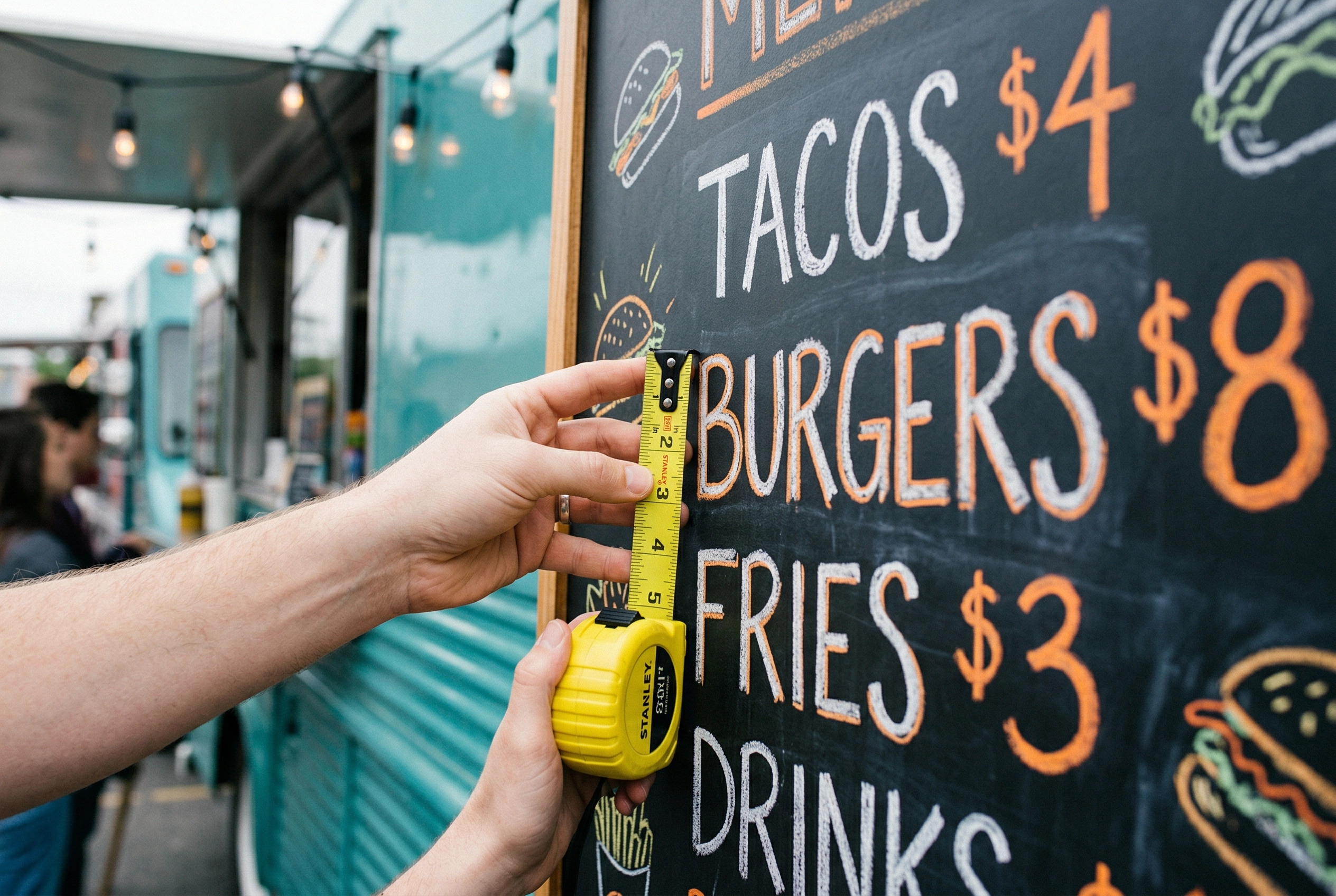 Measuring food truck menu text size for readability with tape measure against chalkboard menu
2. Ruthless Simplicity
The biggest menu design mistake food truck owners make? Offering too many items.
Restaurant menus can get away with 40 items because customers are seated, relaxed, and browsing. Food truck customers are standing in the sun with a line behind them. They need to decide in under 30 seconds.
The sweet spot is 6–12 items. Here's why:
- Faster decisions = faster line movement = more customers served per hour
- Less decision paralysis = higher customer satisfaction (studies show people are happier with choices from smaller sets)
- Tighter operations = less waste, fewer ingredients to stock in a tiny kitchen
Group your food items into 2–3 clear categories (mains, sides, drinks — or however your menu naturally divides). Use short, punchy descriptions: 5–8 words max per item. "Smoked brisket with house slaw and pickles" beats "Our slow-smoked beef brisket served on a brioche bun with our signature house-made coleslaw, house pickles, and a side of our award-winning BBQ sauce."
3. Brand Consistency Across Every Touchpoint
Your food truck menu design should feel like it belongs on your truck. If your truck wrap is bold and colorful, a minimalist black-and-white menu template will feel disconnected. If your Instagram aesthetic is clean and modern, a messy chalkboard sends mixed signals.
Consistency means:
- Same color palette on your menu board, truck, social media, and packaging
- Same fonts (or at least the same font family) everywhere customers see your brand
- Same photographic style for all food images across your menu, website, and online profiles
- Same logo placement and sizing on every template and print piece
This isn't just about aesthetics — it builds recognition. When a customer sees your Instagram post and then spots your food truck at a festival, the visual connection should be instant. Restaurants and food trucks that nail brand consistency see higher customer loyalty and repeat business. For a deeper dive, check out our restaurant branding guide. You can also see how aesthetic food backgrounds create visual cohesion across your menu photos.
4. Strategic Photo Integration
Not every item on your food truck menu needs a photo. In fact, overdoing food photography on your menu board creates visual clutter that's worse than having no photos at all.
The smart approach: photograph your 3–5 hero items — the dishes that are most popular, most photogenic, and highest-margin. These photos serve three purposes:
- They guide orders toward profitable items. Customers naturally gravitate toward dishes they can see.
- They reduce ordering anxiety. For unfamiliar cuisines like Asian fusion or specialty food items, a photo tells customers exactly what they'll get.
- They create appetite appeal. A great photo of a loaded smash burger does more selling than any description could.
The data backs this up. According to GrubHub, adding food photography to your menu increases sales by up to 30%. DoorDash reports a 15% increase in delivery volume when restaurant and food truck menus include quality photos. For food trucks, where customers can't browse a plated dish at the next table, these visuals are even more critical.
We'll cover how to get these photos affordably later — it's one of the most impactful food truck menu ideas in this entire guide.
5. Pricing Psychology That Works at a Truck Window
You don't need a psychology degree to use pricing tactics that nudge customers toward higher-margin menu items. A few simple strategies can meaningfully increase your average ticket.
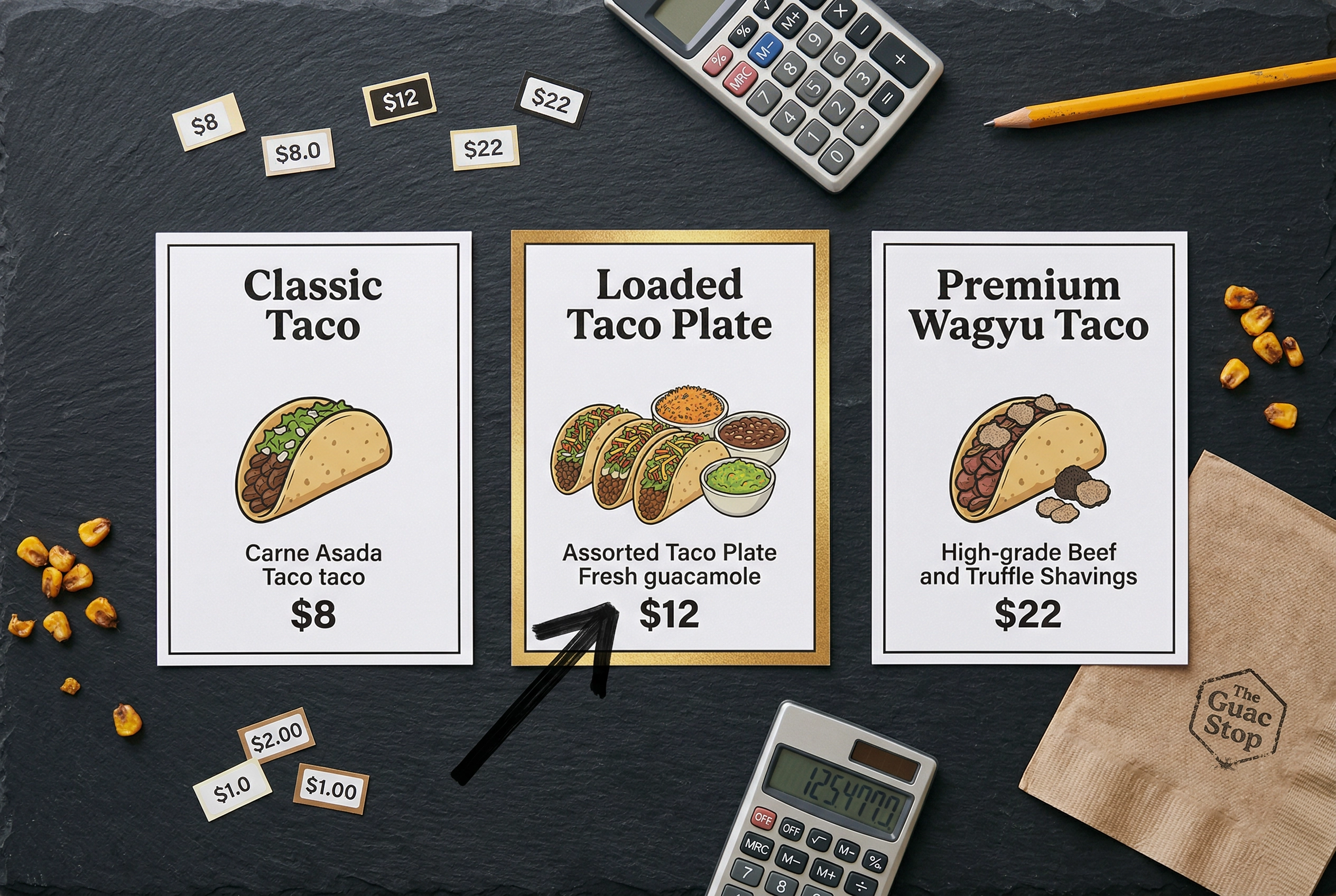 Pricing psychology demonstration showing decoy pricing concept with three food truck menu price tiers
Price anchoring: List your most expensive item first in each menu category. When a customer sees a $16 loaded platter first, the $11 regular version feels like a deal — even though $11 was your target price all along. One National Restaurant Association study found anchoring increased profits by 4.1% on targeted menu items.
Tiered pricing: Offer 2–3 sizes or levels — regular, loaded, combo. This naturally upsells customers who might have ordered the base version. "Add fries and a drink for $3" is almost always a yes.
Charm pricing: For casual food trucks, prices ending in .99 or .95 ($8.99 vs. $9.00) feel more affordable. For premium or gourmet trucks, round numbers ($12, $15) signal quality.
Drop the dollar sign when your food truck menu layout allows it. "Brisket Sandwich 12" reads as less expensive than "$12.00" — it's subtle, but it works.
Decoy pricing: Include one premium option that's priced notably higher than your mid-range items. Most customers won't order the $22 wagyu burger, but it makes your $13 smash burger feel like a steal. This menu design idea sounds trivial until you see it impact your daily revenue.
Food Truck Menu Board Design: Physical vs. Digital
Choosing the right menu board is a critical part of food truck menu design. There's no single right answer — the best choice depends on your budget, your menu's complexity, and how often you change things up.
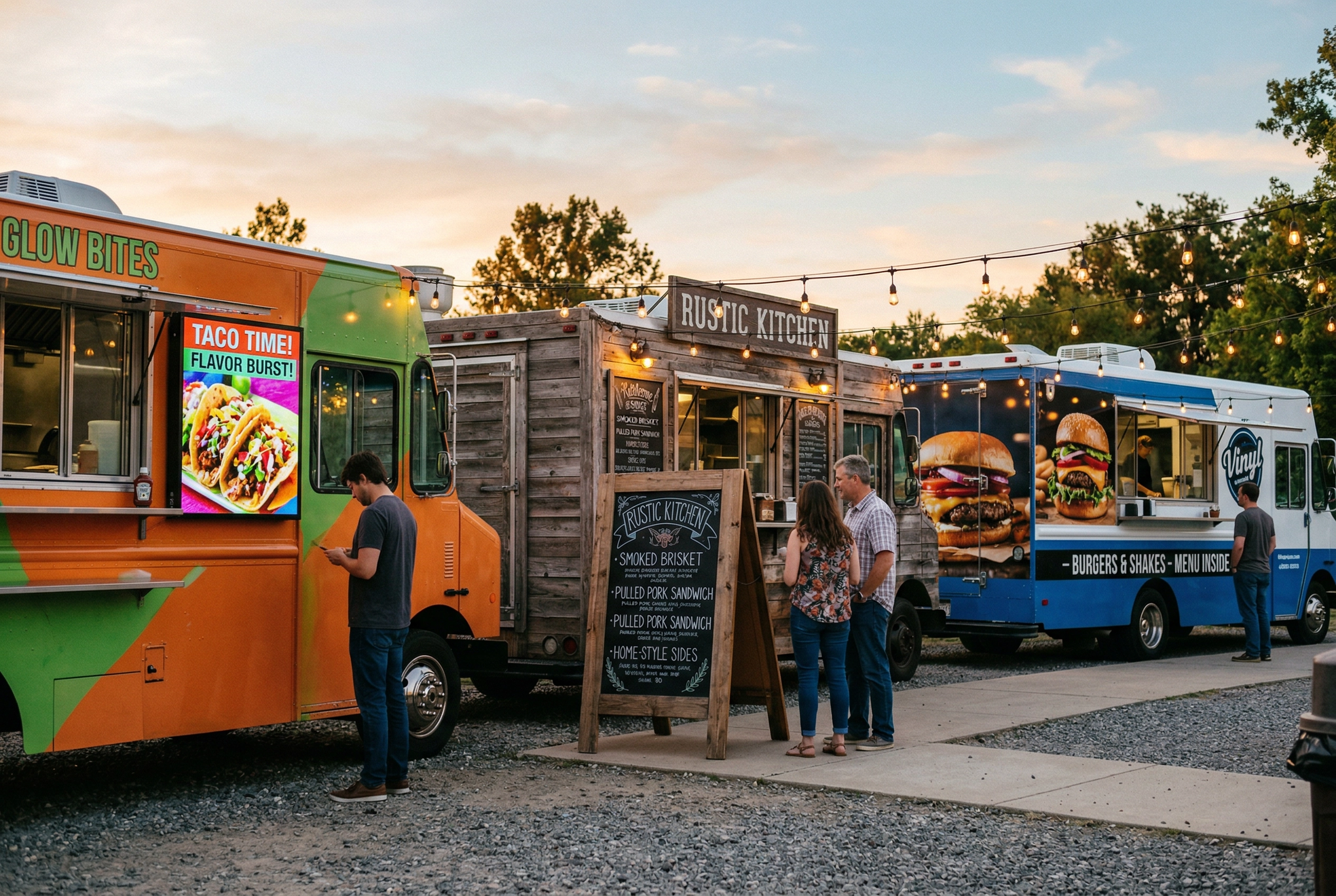 Food truck park at evening showing three different menu board styles: digital screen, chalkboard, and vinyl graphics
Physical Menu Boards
Types: Chalkboards, printed and laminated boards, vinyl decals applied directly to the truck, A-frame sidewalk signs.
| Pros | Cons |
|---|---|
| No power source needed | Hard to update for daily specials |
| Cheap to produce ($50–300) | Weather damage over time (fading, water) |
| Chalkboards add rustic charm | Limited space for food photos |
| Vinyl decals are durable and professional | Design changes require reprinting |
Best for: Food trucks with a stable menu that rarely changes, rustic or handcrafted brand aesthetics, and operators who want zero-tech simplicity.
Pro tip: If you go with a chalkboard for your food truck menu board, invest in a liquid chalk marker — they're weather-resistant and look much cleaner than traditional chalk. Many food truck owners also keep a laminated backup board for rainy days.
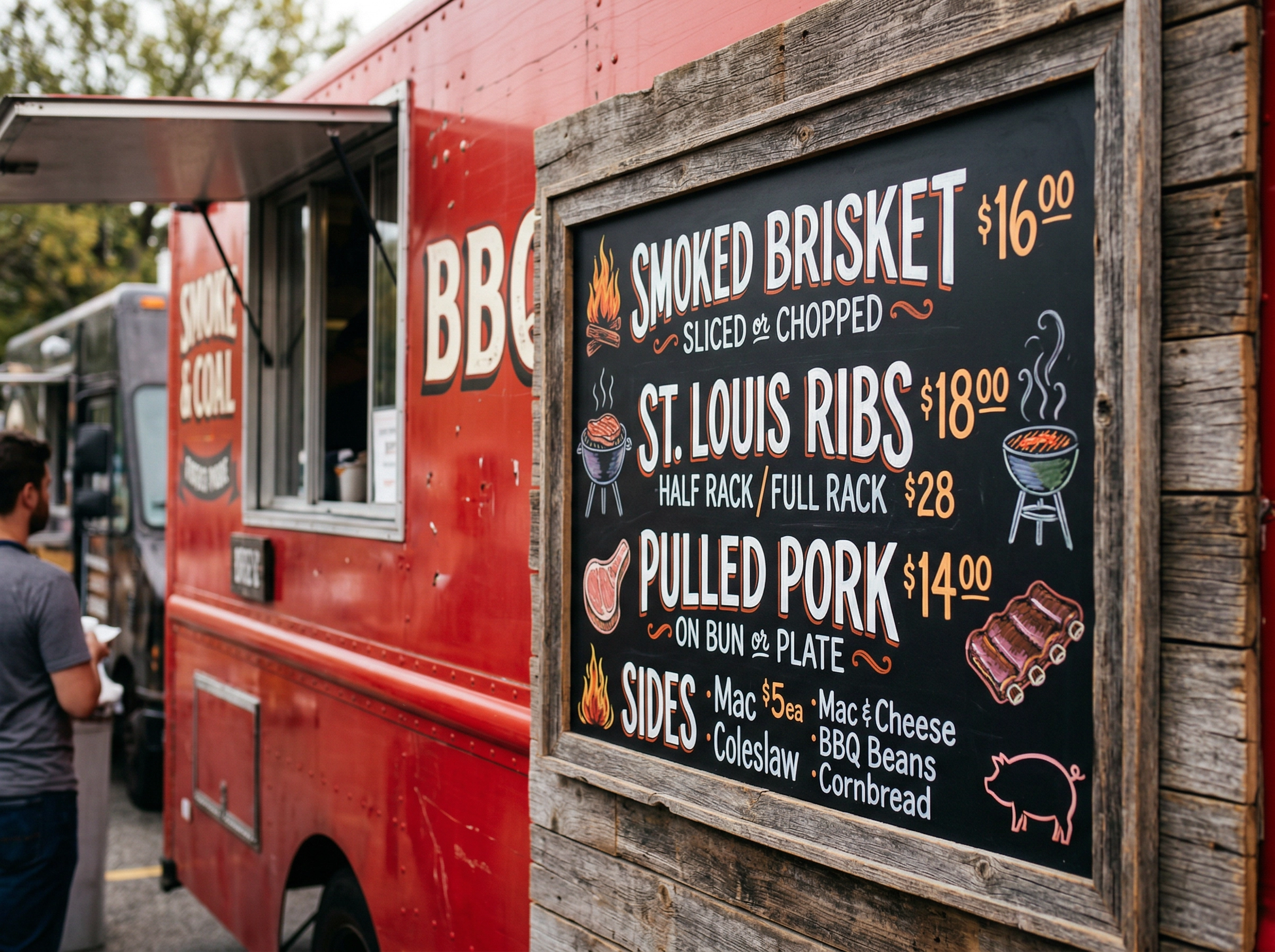 Hand-lettered BBQ food truck chalkboard menu with colorful liquid chalk marker lettering and meat illustrations
Digital Menu Boards
Types: Outdoor-rated LCD/LED screens, mounted tablets, QR codes that load a digital menu on customers' phones.
| Pros | Cons |
|---|---|
| Update food items instantly for specials or sold-out dishes | Higher upfront cost ($300–1,500+) |
| Rotate photos and animations to catch eyes | Requires power (generator or battery) |
| Dayparting: switch between breakfast and lunch menus automatically | Sun glare can make screens unreadable |
| Can show multiple pages of menu content | Equipment theft risk at events |
Best for: Food trucks with rotating specials, multiple dayparts, or photo-heavy menus. Also ideal if your food truck sells through online delivery apps and you want your in-person menu to match your restaurant's digital presence.
The Hybrid Approach
Most successful food trucks in 2026 use a combination: a permanent vinyl menu on the truck body for core items, plus a digital screen or QR code for specials, food photos, and rotating content.
QR codes are particularly effective because they bridge physical and digital — a customer scans the code and gets a full visual menu on their phone, complete with photos of every food item, while standing in line. And it costs essentially nothing to set up. This is one of the smartest food truck menu ideas for operators on a tight budget.
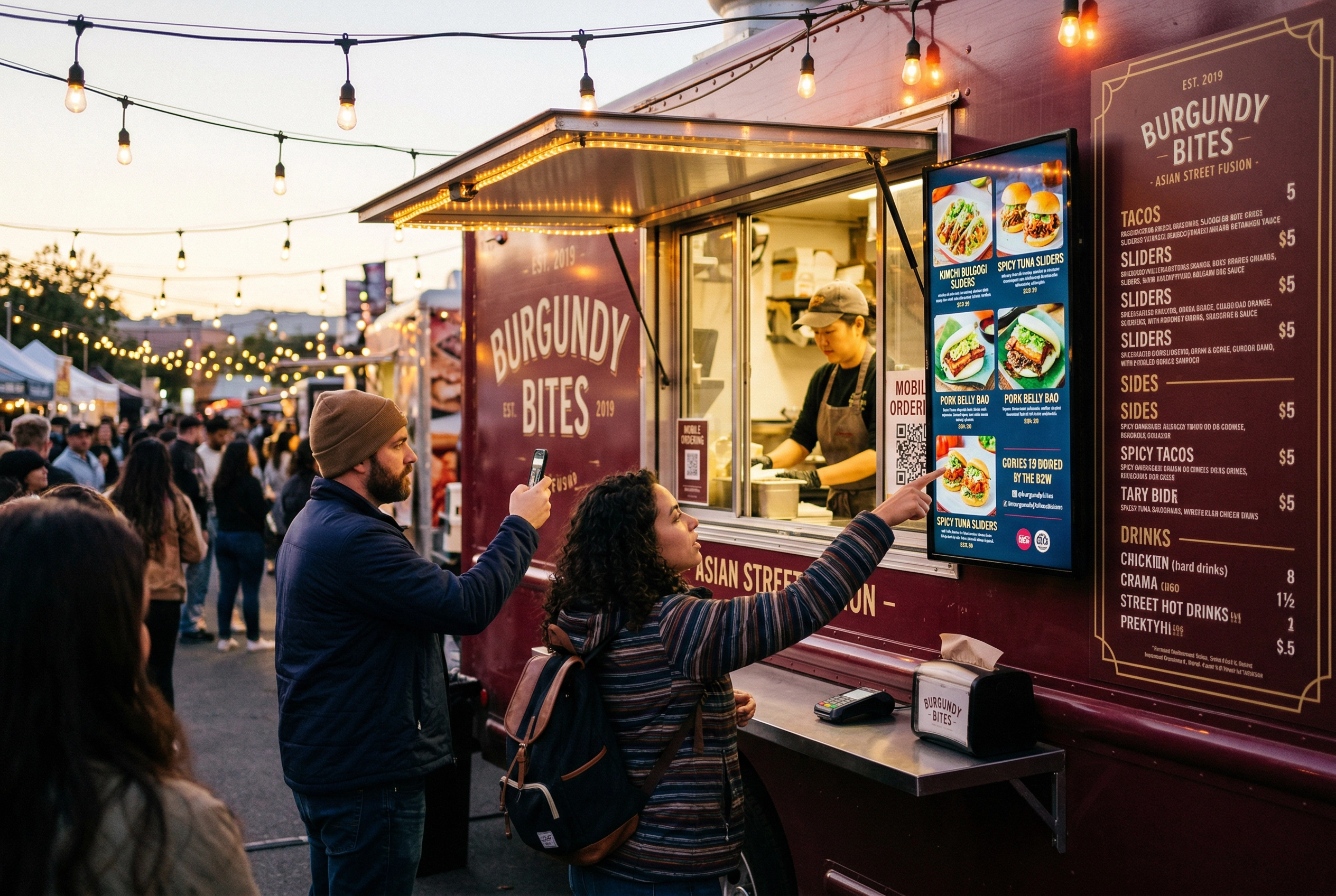 Food truck with hybrid menu setup showing vinyl decal menu and digital screen at ordering window
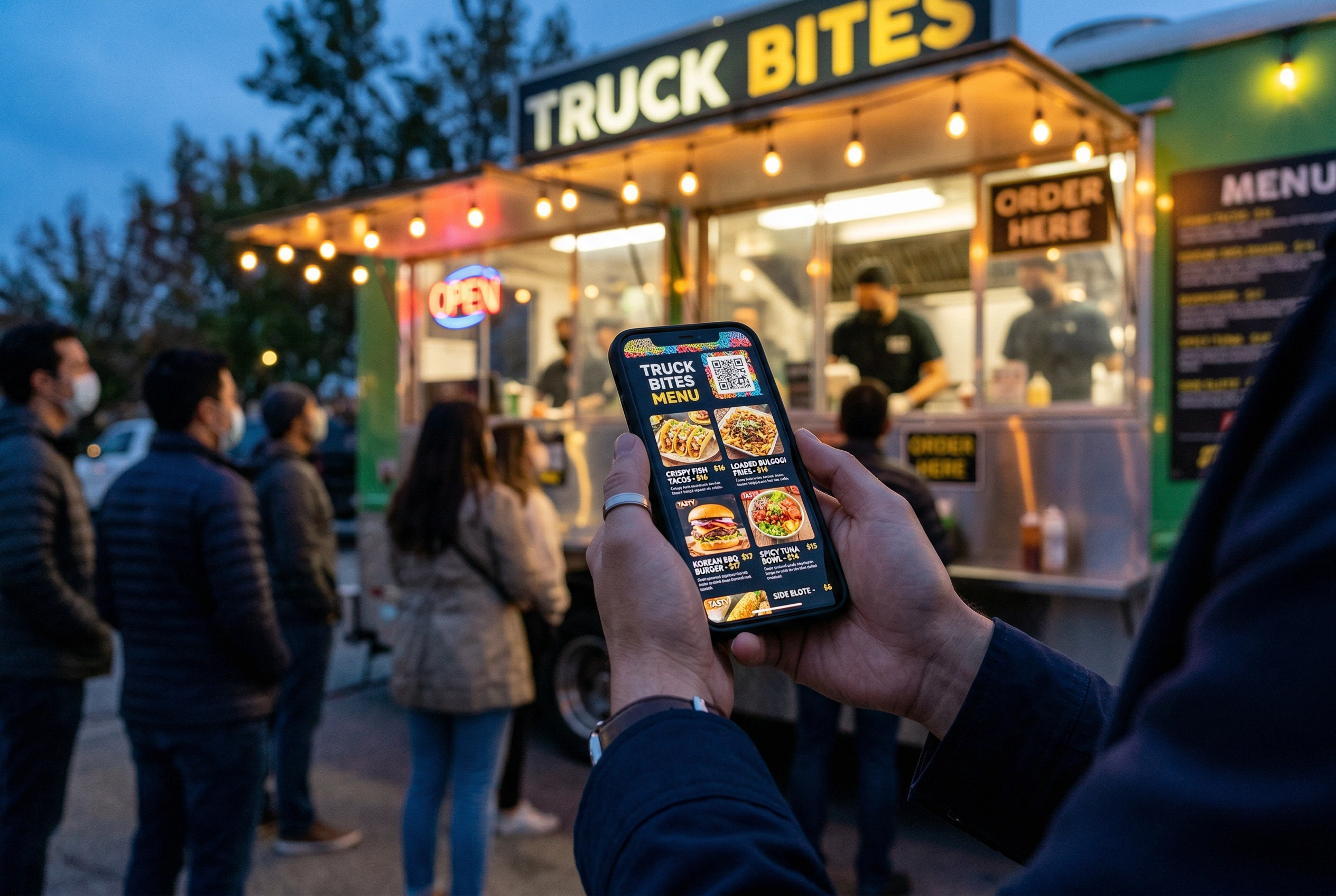 Customer viewing food truck digital menu on smartphone via QR code with food photos and prices
10 Food Truck Menu Template Ideas by Cuisine
These aren't generic food truck menu templates — they're specific design ideas tailored to different food truck types. Use each template concept as a starting framework and customize it to match your brand. For more food truck and restaurant marketing inspiration, browse our 50 restaurant marketing ideas.
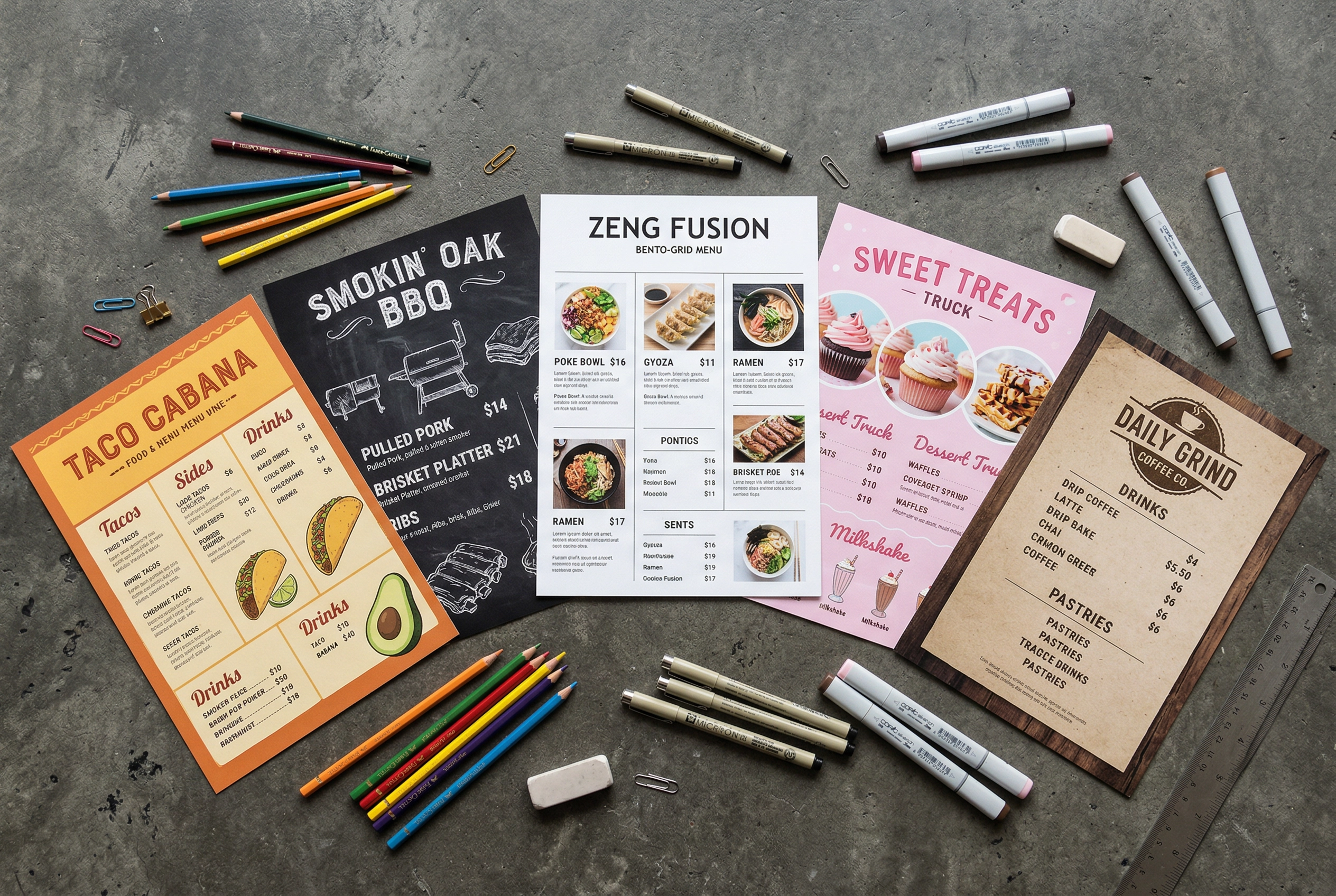 Five different food truck menu templates arranged by cuisine type including taco, BBQ, Asian, dessert, and coffee
Taco Truck Menu Templates
Template 1: The Build-Your-Own Grid. Photos of your tortilla options across the top. Protein options listed down the left side. Toppings and salsas across the bottom. Customers visually "build" their taco by scanning the grid. This food truck menu template idea works especially well on a wide board.
Template 2: The Numbered Combo Board. Large numbered combo photos: #1 is two tacos + drink, #2 is three tacos + rice + drink, #3 is the family pack. Numbering speeds up ordering — customers just say a number instead of reciting custom food orders. A simple menu design idea that saves time for everyone in line.
Design notes: Warm colors (orange, red, yellow) trigger appetite. Bold, slightly hand-drawn typography feels authentic. Lime green accents work well as highlights on any taco truck menu template.
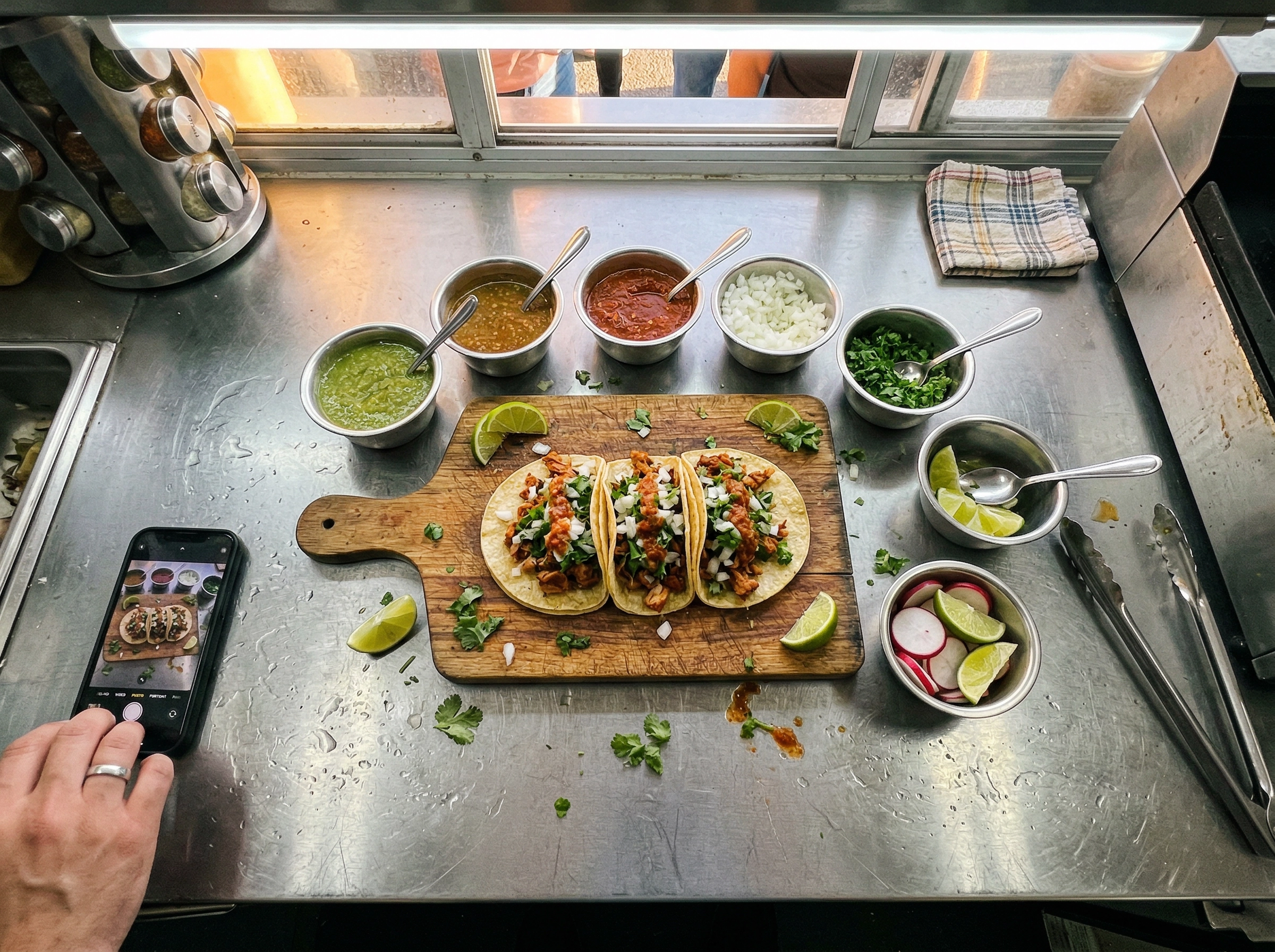 Taco truck prep station with freshly assembled street tacos surrounded by colorful toppings ready to photograph
BBQ Food Truck Menu Templates
Template 3: The Butcher-Style Board. Dark background with hand-drawn meat cut illustrations (brisket, ribs, pulled pork, sausage). Weights and prices listed next to each cut. This food truck menu design idea works beautifully on a chalkboard or dark vinyl print.
Template 4: The Platter Spotlight. One large hero photo of your signature platter takes up the top third of the menu board. Individual food items are listed below in clean rows. The platter photo does the selling; the item list handles the details. This BBQ template is perfect for trucks with a clear star dish.
Design notes: Dark backgrounds (black, charcoal, dark wood textures) with warm accent colors. Bold serif fonts feel traditional and meaty. Burnt orange and gold accents add warmth to any BBQ food truck menu template.
Asian Fusion Food Truck Menu Templates
Template 5: The Bento-Box Grid. Food items arranged in a grid that mimics a bento box layout — each item gets its own "compartment" with photo and description. Clean lines, equal spacing, organized visual flow. A food truck menu layout idea that's both functional and visually interesting.
Template 6: The Street Market Board. Numbered items with small food photos, bold contrasting colors, and clean sans-serif type. Think Bangkok street market energy — vibrant, fast, a little chaotic, but ultimately organized. Restaurants and food trucks serving Asian fusion do well with this energetic design template.
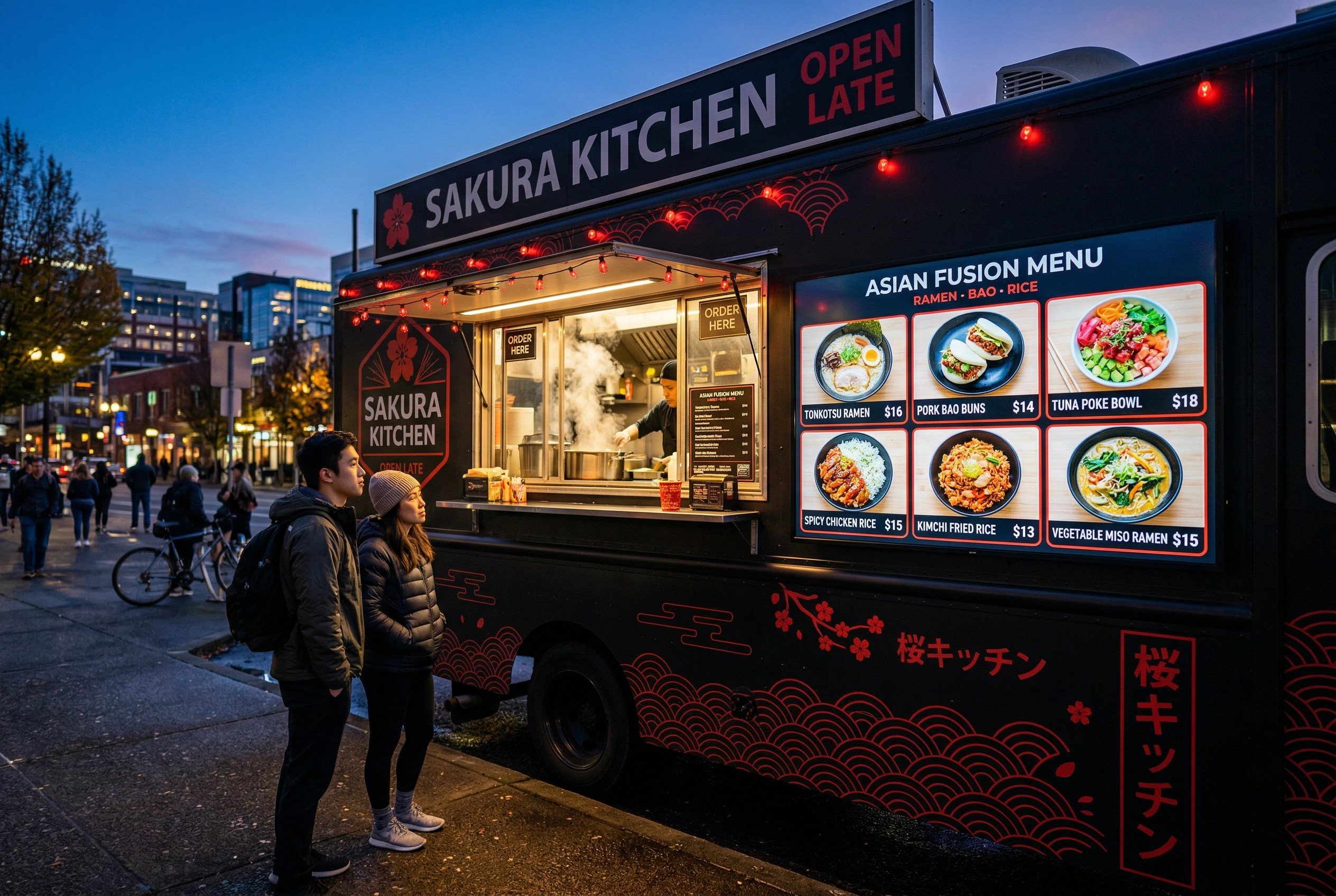 Asian fusion food truck with illuminated digital bento-box grid menu layout showing ramen and bao bun photos
Design notes: You can go two directions with this food truck menu design — minimalist Japanese-inspired (black, white, red accents) or vibrant street-market (bright colors, lots of photos). Either template style works, but pick one and commit.
Dessert Food Truck Menu Templates
Template 7: The Photo Gallery. Large food photos dominate — this is one menu template where every item should have a photo. Minimal text (just name and price). Desserts sell almost entirely on visual appeal, so let the images do the heavy lifting.
Template 8: The Seasonal Rotation. A permanent section for signature food items, plus a clearly marked "seasonal" or "this week" section that rotates. This template idea works great on digital screens or with a swappable chalkboard panel, keeping regulars coming back to see what's new.
Design notes: Pastel colors (pink, mint, lavender) for whimsical vibes, or bold colors (hot pink, electric blue) for trendy dessert brands. Playful, rounded fonts match the fun factor of any dessert food truck menu design.
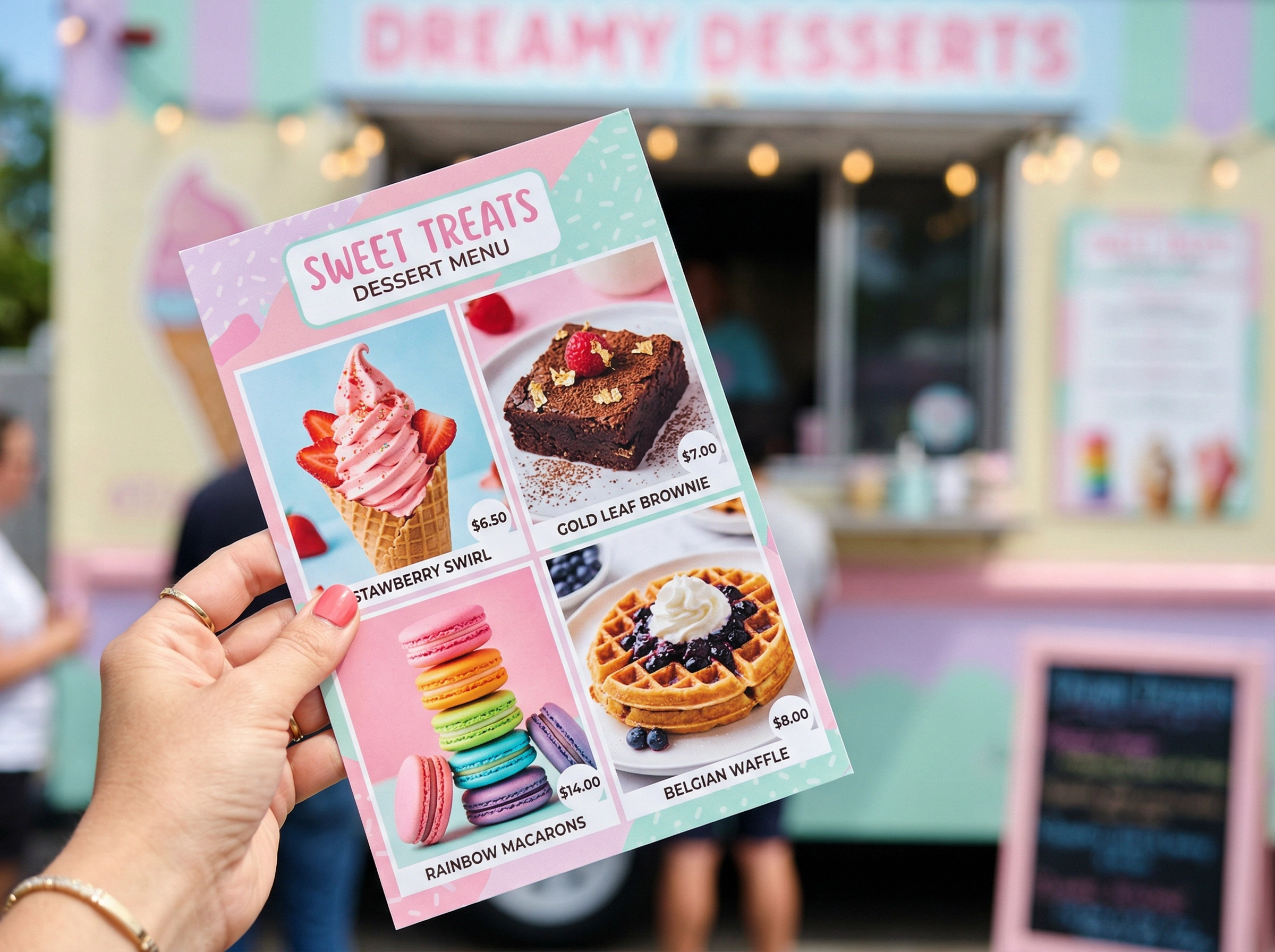 Dessert truck menu card with large vibrant food photos of soft serve, brownies, and macarons in pastel design
Coffee Food Truck Menu Templates
Template 9: The Café Vertical Board. Espresso drinks at top (highest margin), blended/iced drinks in the middle, seasonal specials at the bottom. Size options (S/M/L) as columns. Clean, no clutter — a classic food truck menu board design for beverage-focused trucks.
Template 10: The Size-Tier Board. Three columns for small, medium, and large, with visual cup icons at the top showing the size difference. All drinks listed in rows across columns. This coffee truck menu template makes upselling visual and effortless.
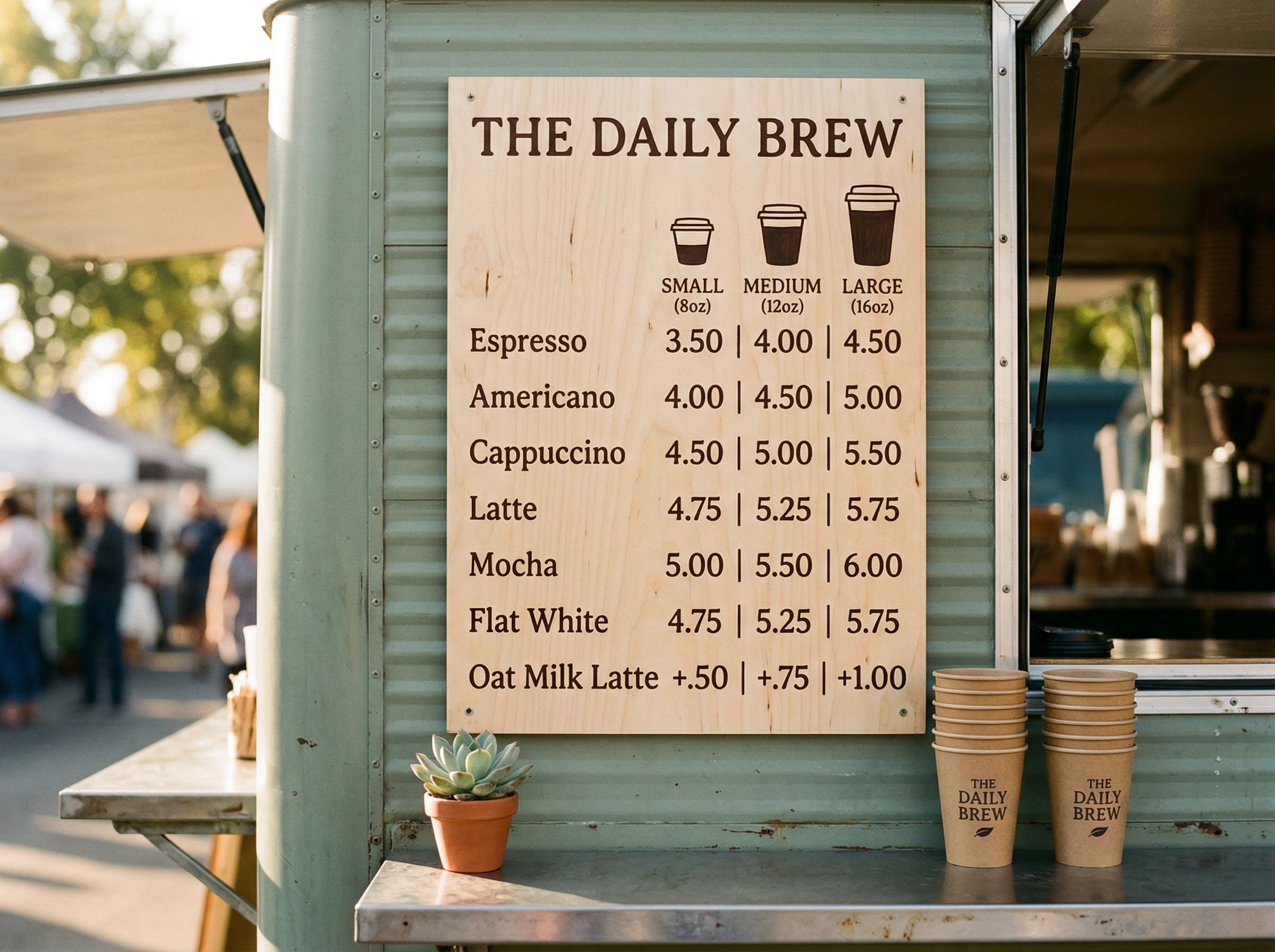 Coffee truck vertical menu board with minimalist design showing drink sizes in columns on natural birch wood
Design notes: Earth tones (cream, brown, forest green), minimalist layouts, and thin-weight modern fonts. Coffee trucks look best when the menu design feels calm and curated, matching the coffeehouse aesthetic customers expect.
How Food Photography Transforms Food Truck Menus
Here's where we stop talking design theory and start talking revenue — the reason food photography might be the single best food truck menu design idea on this list.
The data on food photography's impact is remarkably consistent across multiple studies and platforms:
- GrubHub reports that adding food photography to menu pages increases sales by 30% and that restaurants with food photos receive 70% more orders than text-only listings.
- DoorDash found that quality photos boost delivery volume by 15%.
- Deliveroo saw a 6.5% conversion increase when menus included specific images for each food item.
- Industry research aggregated in our restaurant food photography guide shows menus with professional photos increase sales by 20–45% overall.
For food trucks specifically, the impact is arguably even higher. Unlike sit-down restaurants where customers can see other tables' food, smell the kitchen, and ask the server for recommendations — food truck customers are making fast, visual decisions from a distance. Your menu photos might be the only information they have about your food before committing to stand in line.
The problem? Professional food photography typically costs $500–$2,000+ per session. For a food truck averaging $346,000 in annual revenue, that's a significant investment — especially when you update your menu seasonally or run weekly specials. For more on what professional shoots involve, see our commercial food photography guide. That cost challenge is what makes the next section particularly relevant for food truck owners looking for better ideas.
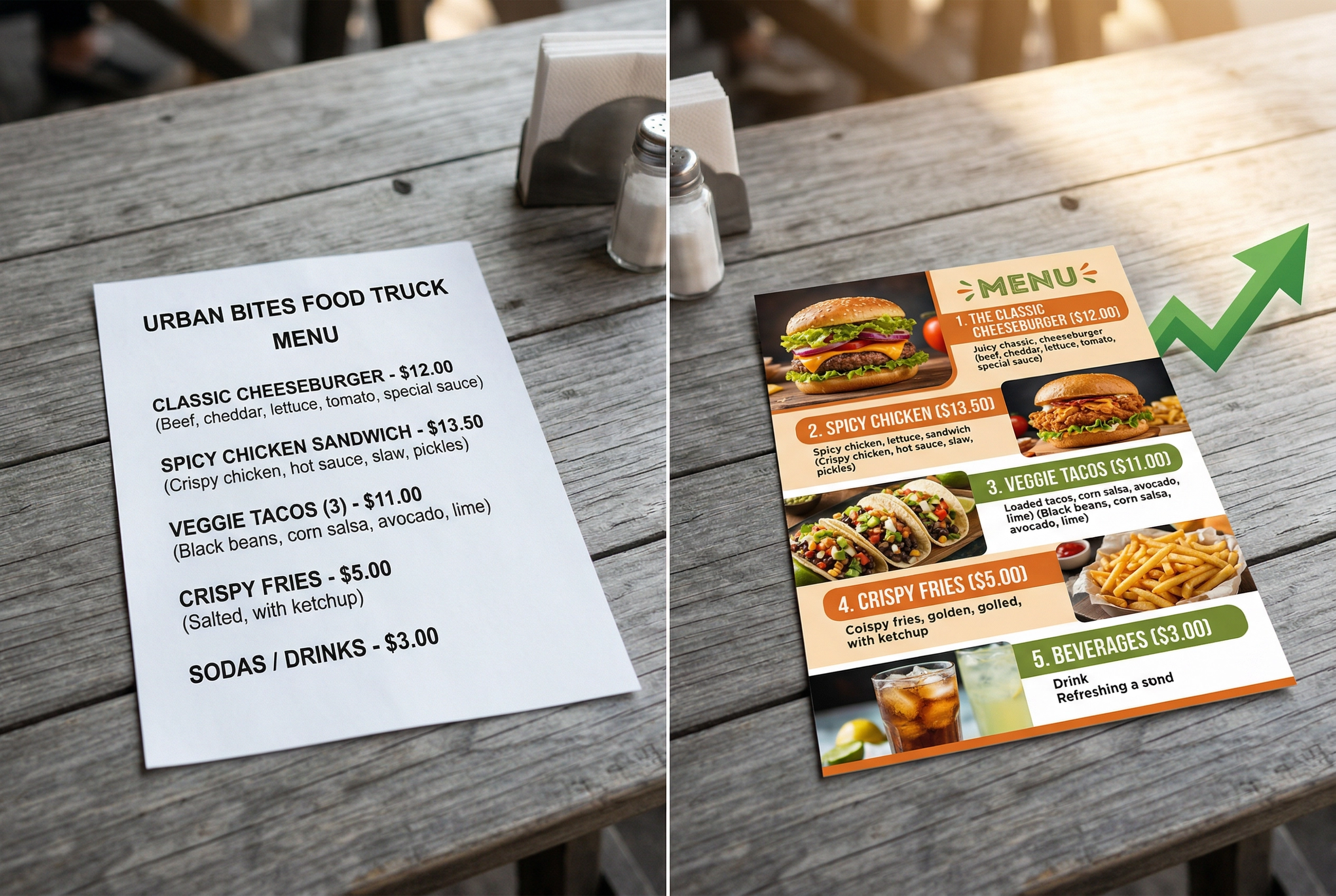 Side-by-side comparison of text-only food truck menu versus photo-enhanced menu design
The AI Shortcut: Food Truck Menu Photos in Minutes
Traditional food photography requires a photographer, a studio (or at least proper lighting), food styling, and hours of time. For food trucks, that's wildly impractical — you're cooking out of a 100-square-foot kitchen and your best dish might be plated for exactly 45 seconds before it's handed through a window.
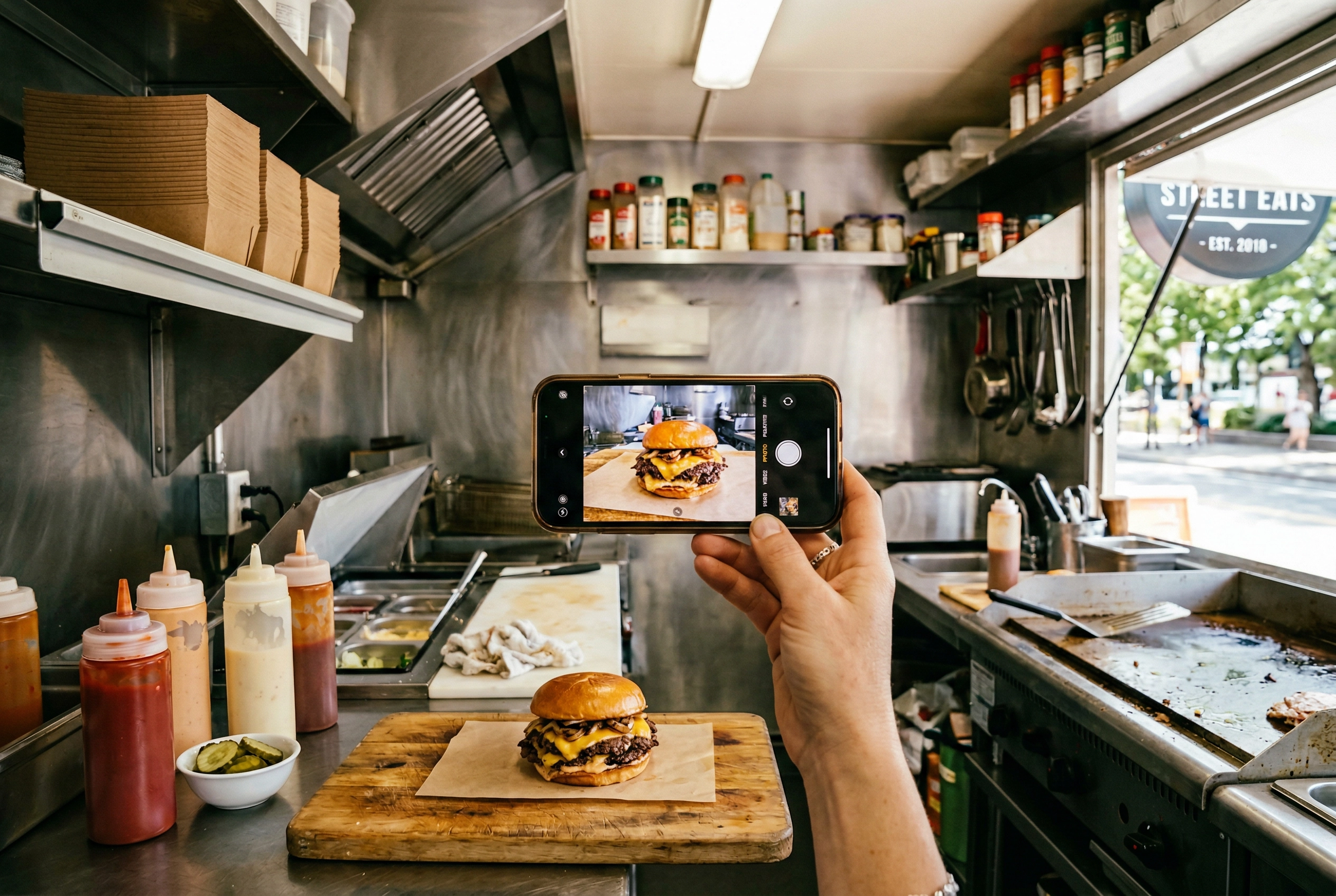 Food truck owner photographing a smash burger with smartphone during kitchen prep for AI enhancement
FoodShot AI solves this by transforming any phone-taken food photo into professional, studio-quality menu imagery. Here's the actual workflow to design a food truck menu with stunning photos:
- Snap a photo of each food item on your phone. It doesn't need to be perfect — any decent phone camera works. For tips on getting a good starting shot, see our guide to taking good food photos with your phone.
- Upload to FoodShot AI and choose from 100+ curated styles — there are template options specifically designed for delivery apps, menu boards, and social media.
- Use Builder Mode to select a background surface and plate style, creating a cohesive look across your entire food truck menu. This is critical for brand consistency (principle #3 above).
- Download your photos in up to 2K resolution, ready for print menus, digital boards, delivery apps, or online ordering platforms.
Each transformation takes about 2 minutes. A full 10-item food truck menu? You could shoot and enhance every dish during a single prep session.
Pricing starts at $15/month on the Starter plan (25 photo transformations), which is enough to photograph your entire menu with room for specials and seasonal updates. Compare that to a single photography session at a restaurant that might cost $500+ and doesn't include re-shoots when your menu changes.
The My Styles feature is particularly useful for multi-truck operations or food truck pods — upload a reference photo of your brand's look, and every future image will match that exact style. No photographer needed to maintain visual consistency across locations. It's one of those food truck ideas that pays for itself after a few extra orders.
For the complete walkthrough on using AI for food truck photography, visit our food truck use case page. You can also explore the full style library to see what's possible. For a deeper comparison, read our breakdown of DIY vs. pro vs. AI food photography. And if you're planning a bigger photoshoot for your restaurant or truck, our menu photoshoot guide covers setup to delivery.
Frequently Asked Questions
How many items should a food truck menu have?
Aim for 6–12 food items. This range keeps ordering fast (critical when you have a line), reduces kitchen complexity in a tiny space, and helps with ingredient management and waste reduction. If you find yourself exceeding 12 items on your food truck menu, look for overlap: can two similar items become one with a modifier? Can slow sellers be cut? Many successful food truck operators say cutting their menu design down to 8 core items was the best decision they ever made.
What size should food truck menu board text be?
Item names should be at least 1 inch tall, and category headers should be even larger. Prices need to be clearly readable from 8–10 feet away. The fastest way to test your food truck menu board design: print the template, tape it up, and walk 10 feet back. If anything is hard to read, it's too small. For outdoor readability, high contrast (dark on light or light on dark) matters as much as font size.
Should I use photos on my food truck menu?
Yes — strategically. You don't need a photo of every food item. Focus on 3–5 hero dishes: your best-sellers, highest-margin items, and any dishes that are hard to visualize from the name alone. Studies consistently show that menus with food photos increase sales by 20–45%. For a budget-friendly way to get professional food photography for your truck, AI tools like FoodShot AI can transform phone snapshots into menu-ready images — one of the best ideas for food truck owners on a tight budget.
How much does it cost to design a food truck menu?
It ranges widely. A DIY design using free online template tools like Canva can cost $0–50. Printed menu boards run $100–500 depending on materials and size. Custom vinyl decals for your food truck body cost $200–800 including design and installation. Digital menu screens add $300–1,500 for hardware. Professional food truck menu design services charge $200–1,000+. And food photography — often the most expensive element — runs $500–2,000 per session traditionally, or as little as $15/month with AI alternatives.
What's the best menu board material for outdoor food truck use?
For durability, vinyl decals applied directly to the truck body are the most weather-resistant option — they handle rain, sun, and temperature swings. Aluminum composite panels (like Dibond) are excellent for mounted menu boards: lightweight, rigid, and resistant to warping. If you want updateability, an outdoor-rated LCD screen (look for at least 700 nits brightness for daylight visibility) gives you the most flexibility. Avoid paper-based materials and untreated wood, which deteriorate quickly outdoors. For more ideas on making your food truck menu photos pop on any board, check out our guide to food photography techniques that make dishes look irresistible.