Top Ghost Kitchen Brands & How They Build Visual Identities
 Ali Tanis14 min read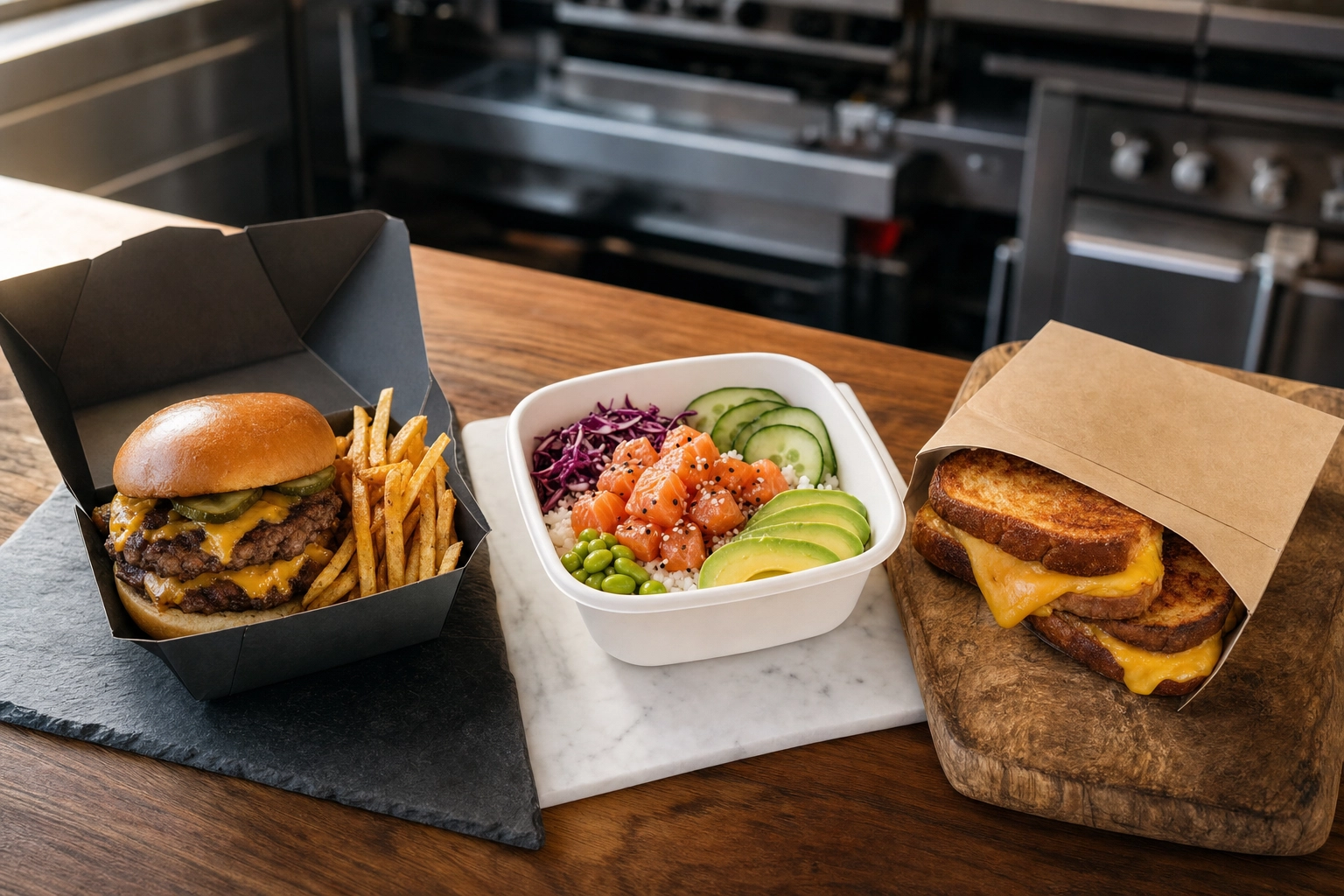
A ghost kitchen has no front door, no neon sign, no host stand. Every reason a customer taps "order" happens inside a 3-inch app thumbnail. The top ghost kitchen brands aren't winning because of pretty logos — they're winning because they treat food photography, packaging, and delivery app profiles as the entire brand experience, since that's all the customer ever sees.
Quick Summary: The top ghost kitchen brands — CloudKitchens, REEF Technology, Kitchen United, Virtual Dining Concepts (MrBeast Burger), and Nextbite — succeed by making photography, packaging, and app listings the full brand experience. Common patterns: punchy names, single-category menus, bold colors that pop in thumbnails, and packaging that doubles as a marketing channel. AI food photography is what makes running 3-5 distinct visual identities from one kitchen actually feasible.
Why Ghost Kitchen Branding Plays by Different Rules
Traditional restaurants get free marketing every time someone walks past. Signage, smell, ambiance — these are brand impressions that cost nothing and shape perception before anyone reads a menu.
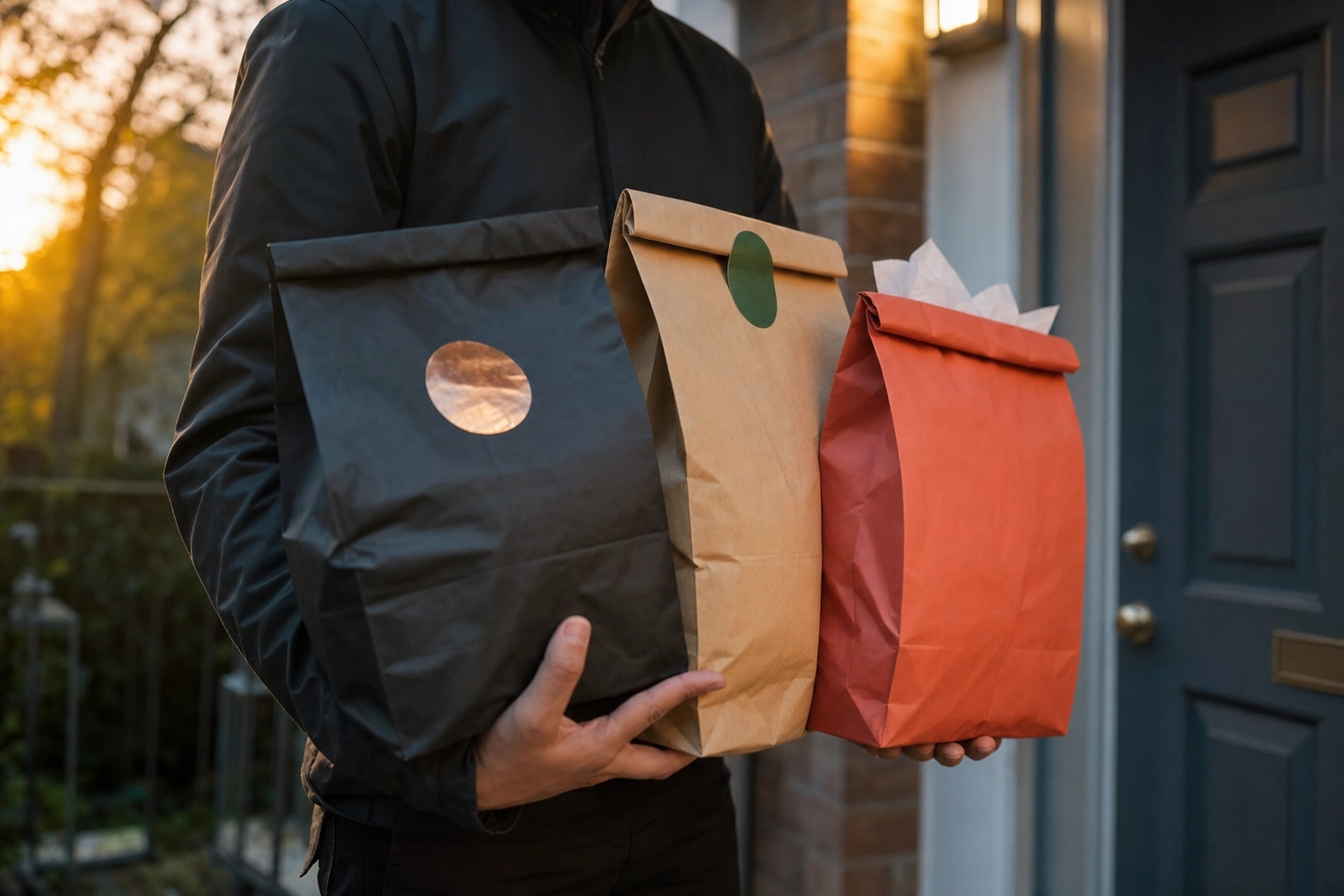
Ghost kitchen brands get none of that. Your brand exists in three places only: the delivery app listing (logo, banner, menu photos), the food itself when the lid comes off, and the package on the doorstep. Miss any one and the brand collapses. A great logo with bad food photos? Customers scroll past. Beautiful photos with generic packaging? The brand vanishes the moment delivery happens.
The market is large enough that getting this right matters. The global ghost kitchen industry is projected to grow from $97 billion in 2025 to about $113 billion in 2026 at a 16.2% CAGR, per Research and Markets. Roughly 7,600 ghost kitchen operations are active in the US alone, and about 41% of independent restaurants now run at least one virtual brand.
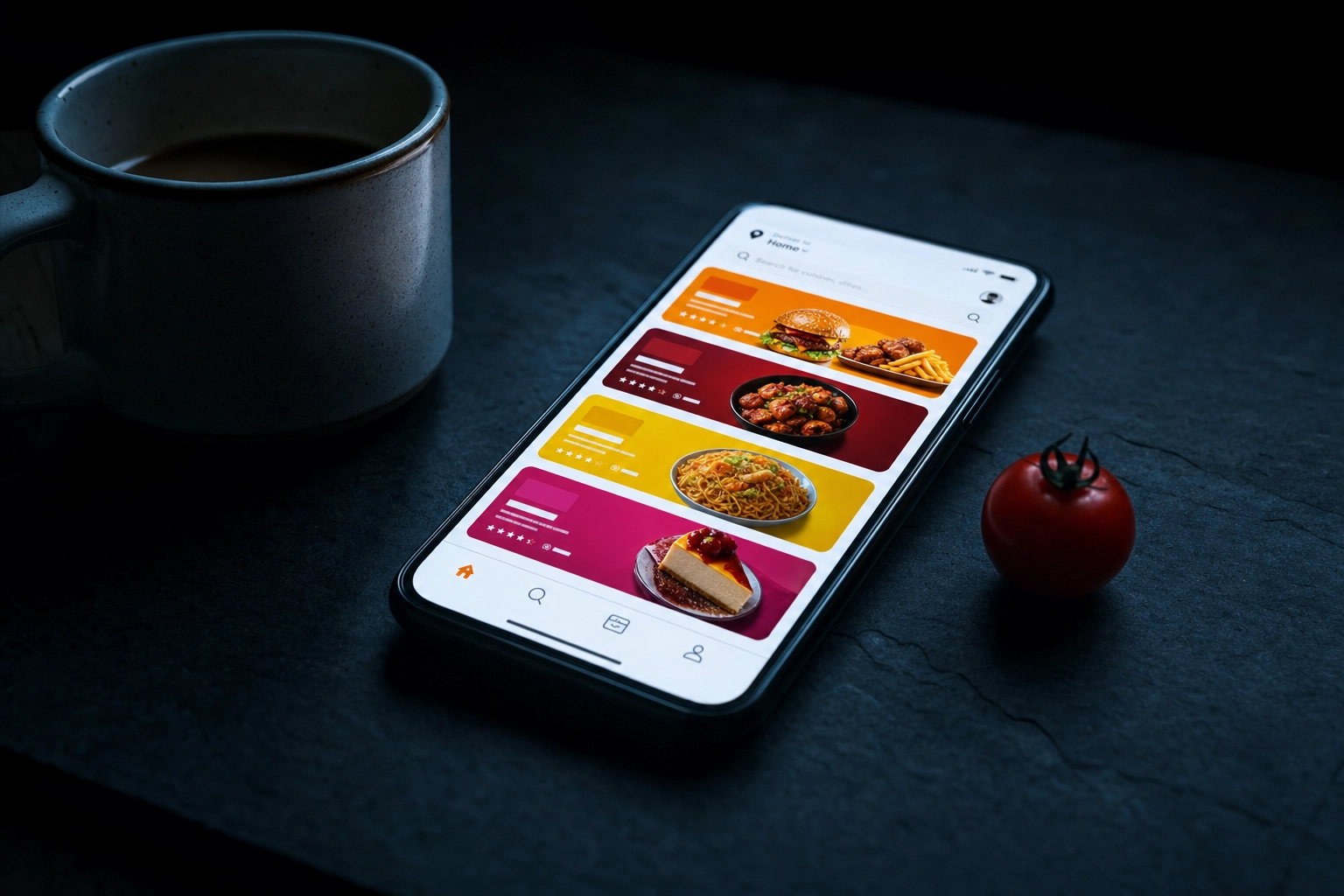 Smartphone showing a delivery app feed of colorful ghost kitchen brand thumbnails competing for attention in dim lighting
The Top Ghost Kitchen Brands Worth Studying in 2026
Quick distinction: "ghost kitchen brands" refers to two different things. There are the operators — companies like CloudKitchens and REEF that build the kitchen infrastructure — and the consumer-facing virtual brands — names like MrBeast Burger that customers actually order from. Both layers offer branding lessons.
1. CloudKitchens — Travis Kalanick's Invisible Empire
CloudKitchens was founded in 2016, and former Uber CEO Travis Kalanick took control of parent company City Storage Systems in 2019 for around $150 million. Today the company operates 400+ locations across roughly 110 cities in 30 countries, with each site housing 20-30 individual kitchen units, per Wikipedia. Tenant brands include Chick-fil-A, Wendy's, Wingstop, Sweetfin, Noodles & Company, and Capriotti's, alongside hundreds of independent virtual brands.
What makes CloudKitchens fascinating from a branding angle is the deliberate absence of public-facing identity. The company barely communicated externally for years. In 2024, Kalanick unveiled the "Internet Food Court" concept — sub-15-minute delivery via automation, with sister companies Otter (point of sale) and Lab37 (kitchen robotics) wrapped into one infrastructure stack.
The branding lesson: CloudKitchens chose to be invisible at the operator level so each tenant brand could own the customer relationship. If you're building infrastructure, get out of the way. If you're a tenant brand inside infrastructure like this, your photography and packaging are the only signals customers ever get that you're a real restaurant.
2. REEF Technology — Celebrity-Fronted Speed
REEF Technology, headquartered in Miami, took the opposite approach. The company runs more than 5,000 tech-enhanced parking lots across North America and Europe, with delivery-only kitchen vessels parked inside many of them.
Its breakout play was DJ Khaled's Another Wing, launched in November 2021 across 165 locations in 5 countries simultaneously — billed as the first restaurant concept to launch on three continents at once, reported by Restaurant Business. The menu was pure DJ Khaled: "Un Un Un Believable Buffalo," "You Loyal! Lemon Pepper," "They Don't Want You To Win Truffalo." REEF also built virtual brands with MrBeast, Rachael Ray, David Chang, and Tyga.
The branding lesson: When a celebrity has built-in visual identity, audience, and tone, the smartest play is to amplify what already resonates. Khaled's catchphrases became menu copy. The brand didn't try to be subtle. (Caveat: REEF's 2022 Portland health-department violations and scaled-back Wendy's deal show that bold visuals only work when operations live up to the hype.)
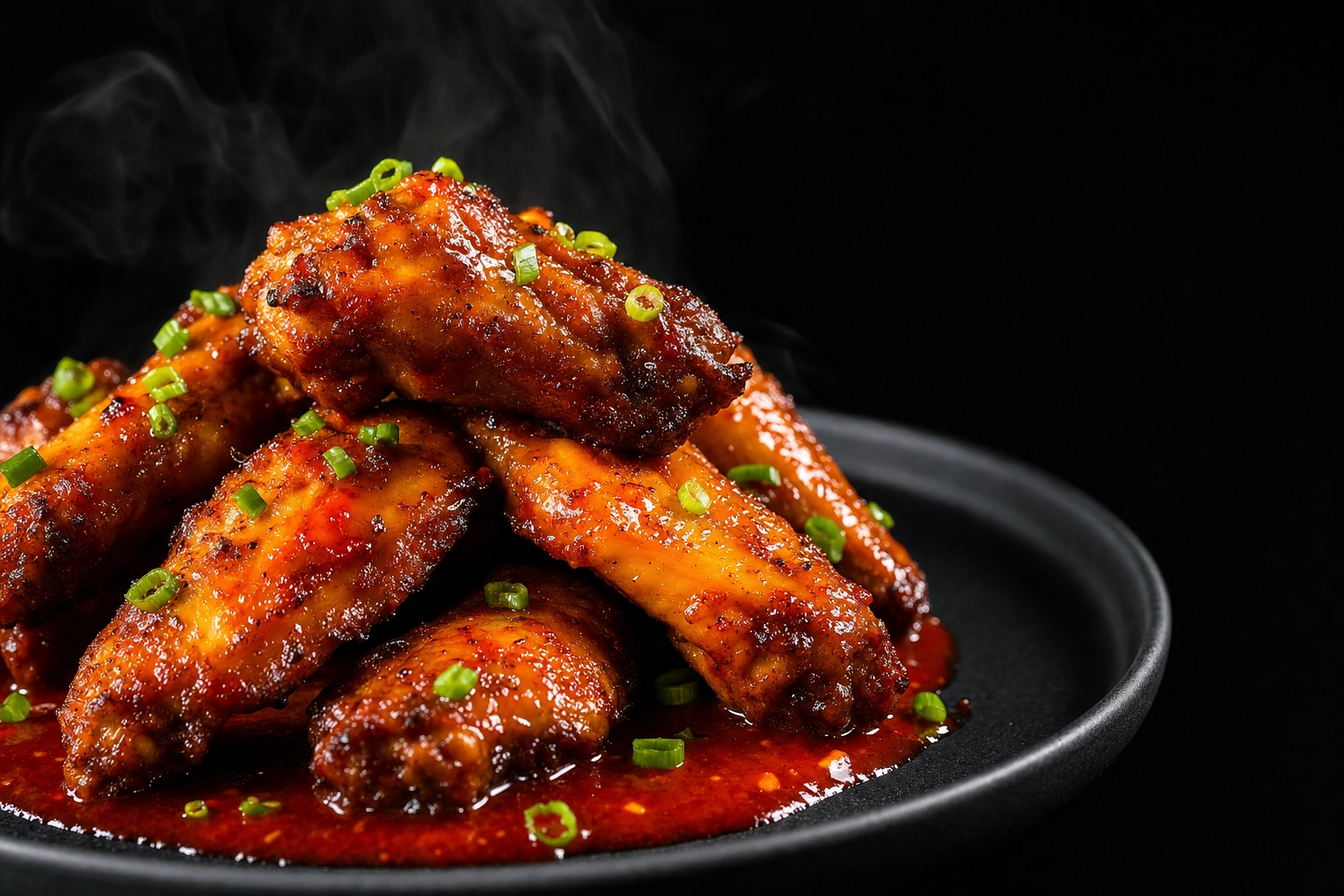 Glazed chicken wings on matte black ceramic plate shot in dramatic moody lighting for ghost kitchen virtual brand listing
3. Kitchen United — The Multi-Brand Food Hall Model
Kitchen United was founded in 2017 and raised approximately $175 million from Google Ventures, Fidelity, Kroger, Restaurant Brands International, and Couche-Tard. At its peak it operated about 200 kitchens across 20 regions.
Its real innovation was the in-store virtual food hall. The company opened locations inside Kroger supermarkets and Simon Malls, letting customers order from multiple virtual brands at one screen, pay once, and pick up everything together. Sam Nazarian's SBE Entertainment Group acquired Kitchen United in March 2024 and folded it into the "Everybody Eats" holding company alongside C3 and Nextbite, per Restaurant Business.
The branding lesson: When five brands share a screen or kiosk, photo style is the primary signal that tells customers they're looking at five different restaurants. Without sharp visual differentiation between tenants — different angles, lighting moods, plating styles — multi-brand food halls just look like one giant menu.
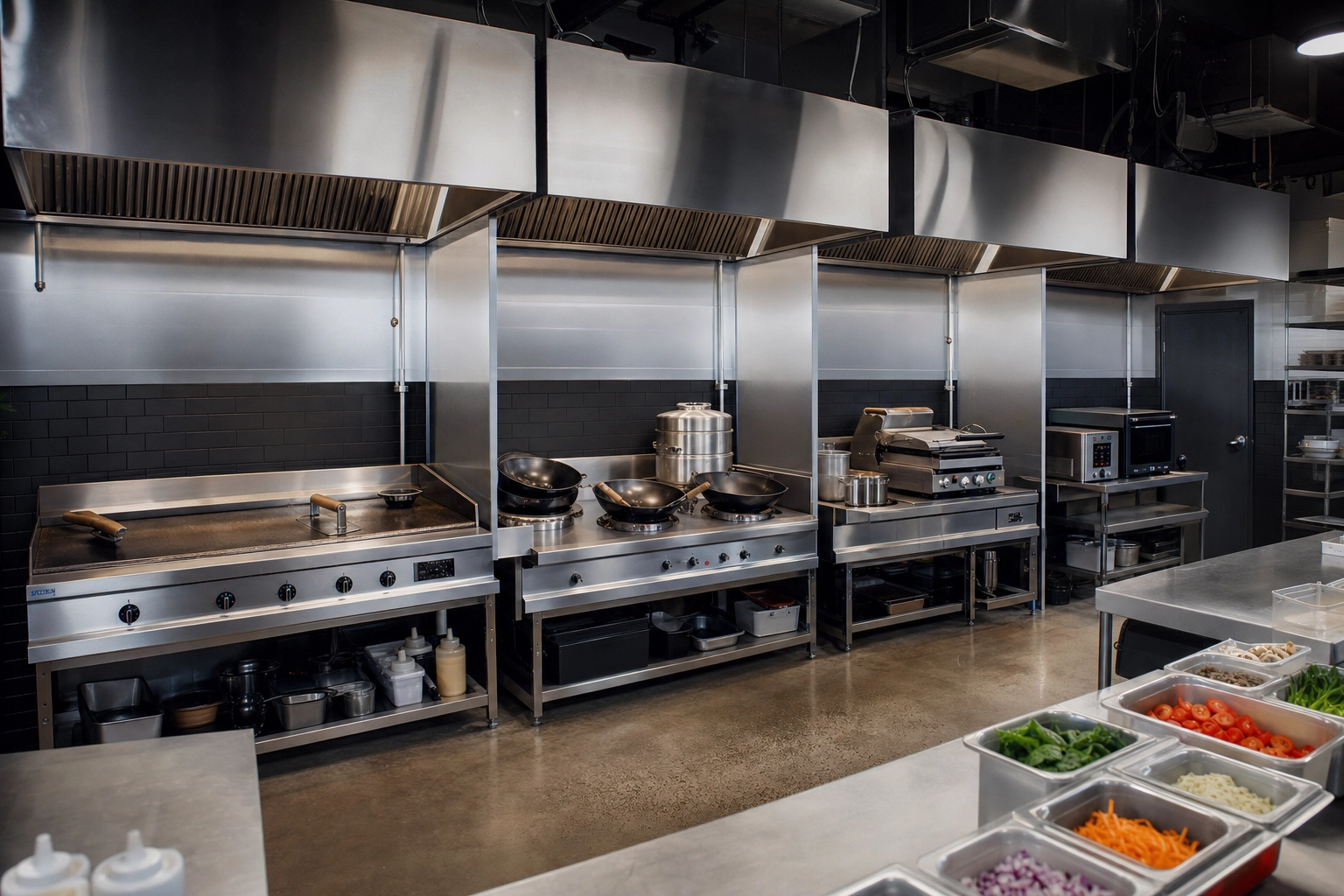 Modern multi-tenant ghost kitchen interior with separate cooking stations for different virtual brand operations
4. Virtual Dining Concepts — The MrBeast Burger Playbook
Virtual Dining Concepts (VDC) was founded in 2019 by Robert Earl, the former CEO of Hard Rock Cafe and Planet Hollywood. The company started running its Wing Squad concept out of Earl's existing Buca di Beppo restaurants — a pure capacity play to monetize idle kitchen time.
The breakthrough came in December 2020 with MrBeast Burger. YouTuber Jimmy Donaldson announced the brand in a single video, and within weeks the concept hit hundreds of virtual locations. At its peak it operated more than 2,000 virtual locations globally, according to Wikipedia. VDC went on to launch Tyga Bites, Mariah's Cookies, Pauly D's Italian Subs, Guy Fieri's Flavortown Kitchen, and a FaZe Clan brand.
The branding lesson: VDC perfected the social-media-first virtual brand. Bold colors, oversized type, menu items engineered to photograph well in delivery app thumbnails, packaging that survives transit and looks good on a TikTok unboxing. The cautionary tale: in August 2023, Donaldson sued VDC over food quality, calling the deal "terrible for my brand." Visual hype can outrun operations for a while, but when it stops, the collapse is public, fast, and often legal.
5. Nextbite — The Modular Brand System
Nextbite, originally based in Denver, raised $120 million from SoftBank to scale a different model: licensable virtual brands. Restaurants pick from a Nextbite catalog and start cooking. Brands include Wing Squad, Monster Mac, CraveBurger, Grilled Cheese Society, Firebelly Wings, Hotbox by Wiz Khalifa, and George Lopez Tacos. C3 acquired Nextbite in 2023, and it now sits inside the Everybody Eats holding company.
Designer Natalie Suarez documented Nextbite's brand system in a public case study: a rounded soft-serif logotype, multiple weights of the same font family chosen specifically to suggest "many different pieces coming together to create a larger whole," and a flexible color palette built around appetite appeal.
The branding lesson: When you license dozens of brands to thousands of partner kitchens, the parent identity needs to feel like a system, not a single brand. Each licensed brand gets its own complete kit (logo, photo style, packaging) that any partner restaurant can plug in without designing from scratch.
What Successful Ghost Kitchen Brands Have in Common
Pattern-match across the five ghost kitchen brands above and a clear playbook emerges:
- Punchy, distinctive names. Monster Mac. Wing Squad. Hotbox. Another Wing. None are generic — each suggests a personality or category.
- Focused, single-category menus. Wings only. Mac only. Smash burgers only. Focused menus are easier to brand, easier to photograph consistently, and easier for customers to remember.
- Bold, saturated color palettes. Black and red. Hot pink and yellow. Deep teal and orange. Ghost kitchen brands dial up saturation because they're competing against 50 other listings on a small screen.
- Consistent food photography. Top brands shoot every menu item at the same angle (overhead or 45°), with the same lighting mood, on the same surface palette.
- Menu copy with personality. Sensory specificity, named ingredients, no fluff.
- Packaging as a marketing channel. Custom-printed containers, insert cards, QR codes. Ghost kitchen brands that ignore packaging waste the only physical brand impression they ever get.
- Items engineered for transit. A brand isn't a brand if the food arrives soggy.
For marketing tactics that turn this visual foundation into actual orders, our cloud kitchen marketing guide walks through eight specific strategies.
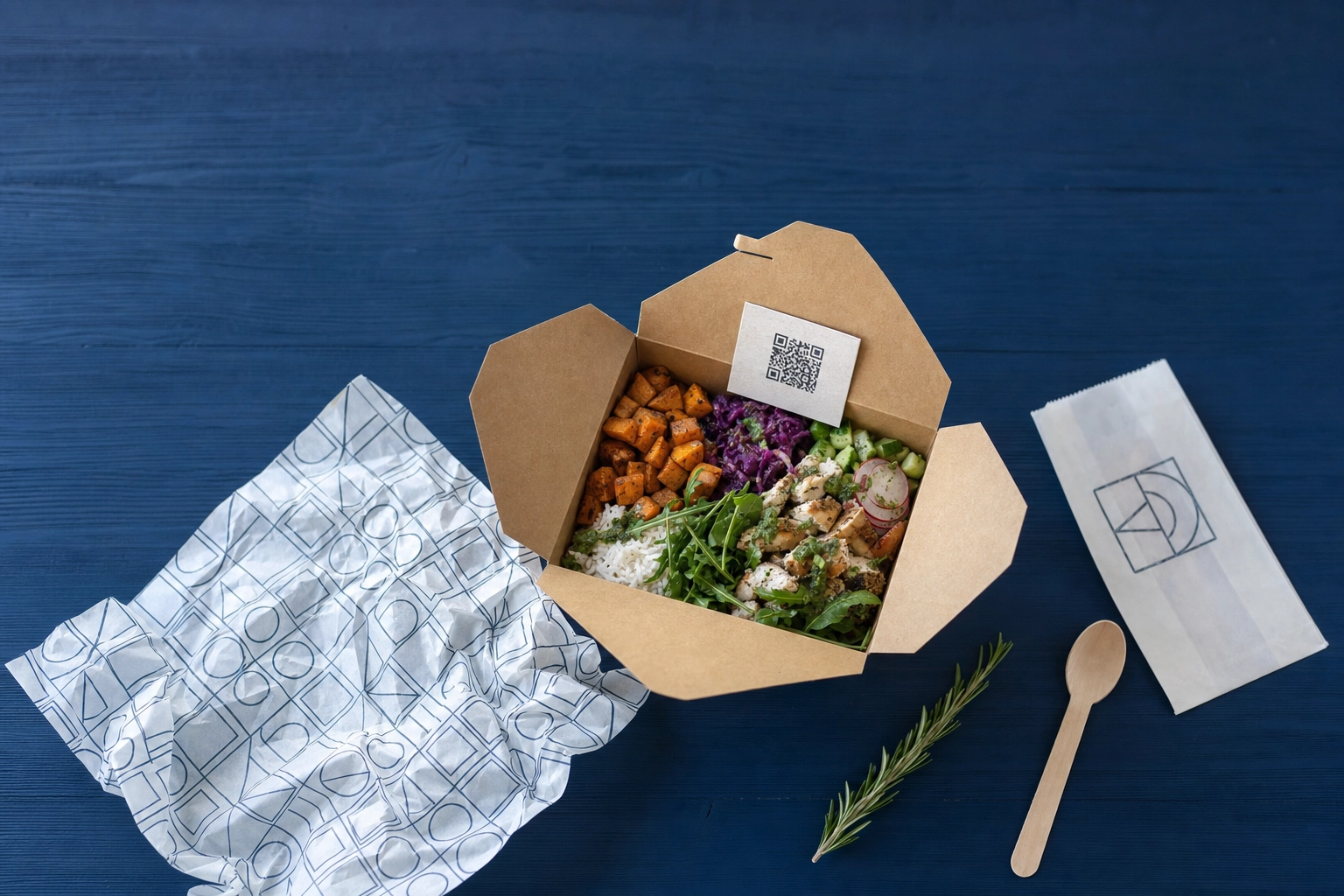 Eco-friendly branded ghost kitchen takeout packaging with insert card and QR code symbol shown from overhead
How to Build Your Ghost Kitchen's Visual Identity From Scratch
You don't need a $50,000 branding agency. Here's a five-step framework that mirrors how the top operators actually build virtual brands. For broader principles, our restaurant branding guide covers naming, positioning, and brand-story development in more depth.
Step 1: Pick a Name That Travels
Three name patterns reliably work for ghost kitchen brands: descriptive (Wing Squad, Grilled Cheese Society), playful (Hotbox, Monster Mac), or wordplay (Another Wing, CraveBurger). Avoid names that need a logo or backstory to make sense — your brand name shows up as plain text in delivery apps, push notifications, and reviews. Run a USPTO trademark search before committing.
Step 2: Build a Tight Brand Kit
You need less than you think:
- A wordmark logo — text-based logos generally read better than icon logos at the 60×60 pixel avatar sizes delivery apps use.
- 2-3 colors maximum — one dominant, one accent, one neutral.
- A color philosophy that matches the menu. Warm reds, oranges, and yellows trigger appetite. Earthy greens signal healthy. Black and gold reads premium.
- One or two typefaces — one for the logo, one for menu copy.
- A one-page brand sheet documenting everything for collaborators.
Step 3: Define a Photo Style Guide
This is the step most ghost kitchen brands skip, and it's the biggest reason their app listings look amateur. Lock four decisions:
- Primary angle. Overhead for bowls and pizzas. 45° for layered foods. Eye-level for tall items. Pick one and use it for at least 80% of menu items.
- Lighting mood. Bright and airy for healthy. Warm golden for comfort food. Dark and moody for premium burgers.
- Plate and surface palette. Two or three background materials max — matte ceramic, dark wood, marble.
- Framing rules. Tight crops vs. context props. Negative space. Focal point.
Document with three or four reference shots. Those become the lock for every dish that follows. For deeper craft, our food photography techniques guide covers lighting and composition in detail.
Step 4: Design Packaging as a Brand Touchpoint
Packaging is the only physical impression your ghost kitchen brand ever makes. Use custom-printed containers or branded sleeves. Include an insert card with social handles, a QR code to your direct ordering site, and a review request — this single card lifts direct-order rates and review volume noticeably. Choose eco-friendly materials when feasible. Test with a 25-minute delivery sit before launching to make sure food still looks good when it arrives.
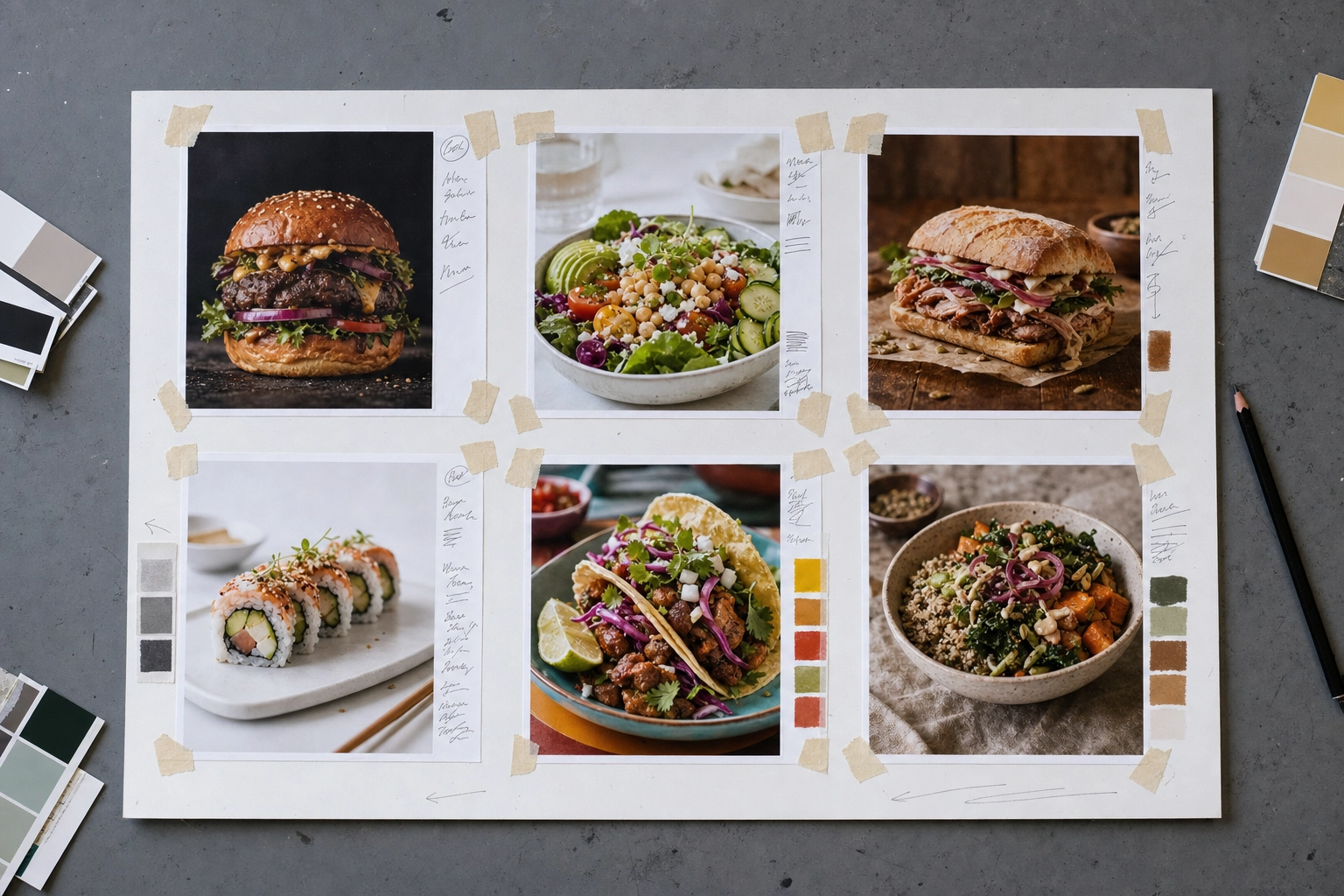 Photo style guide mood board with reference shots and color swatches for multiple ghost kitchen virtual brand identities
Step 5: Optimize Your Delivery App Profile
Once kit, photos, and packaging are set, the delivery app profile pulls it all together: a hero image at each platform's required dimensions, a logo avatar readable at thumbnail size, a photo for every single menu item, concise sensory descriptions with named ingredients, and consistent presentation across DoorDash, Uber Eats, and Grubhub. Listings without item photos convert dramatically worse — research compiled by Toast shows menus with quality images significantly outperform photo-light listings. For platform-specific tactics, our delivery app photography guide covers the full optimization playbook.
The Photography Advantage: One Kitchen, Multiple Brand Identities
Here's the math that breaks most multi-brand ghost kitchen brands: each virtual brand needs 30-100 menu photos. Run five brands and you're looking at 150-500 photos. Traditional food photography costs $700-$1,400 per session and covers maybe 15-25 dishes per shoot. The numbers don't pencil — and that's before seasonal menu changes and A/B tests.
This is where AI food photography genuinely changes the equation, not as a buzzword but as operational math. FoodShot AI turns a phone photo of a finished dish into a studio-quality, menu-ready image in about 90 seconds. For multi-brand operators, the My Styles feature is the unlock: upload one reference photo for each virtual brand, and every subsequent dish for that brand gets generated with the same lighting, angle, and mood automatically.
Practical example. Three ghost kitchen brands, one kitchen:
- A smash-burger brand with dark, moody photography on slate
- A poke bowl brand with bright, clean photography on matte white ceramic
- A late-night grilled cheese brand with warm, golden photography on rustic wood
Each brand has its own locked reference inside FoodShot. New menu item? Snap a phone photo on the prep counter, run it through the appropriate brand style, image is ready for DoorDash before lunch. Same kitchen, three completely different visual identities, all consistent within their own brand worlds. Our ghost kitchen photography use case walks through the full workflow with examples, and you can compare plans on the FoodShot pricing page to see which tier fits your menu volume.
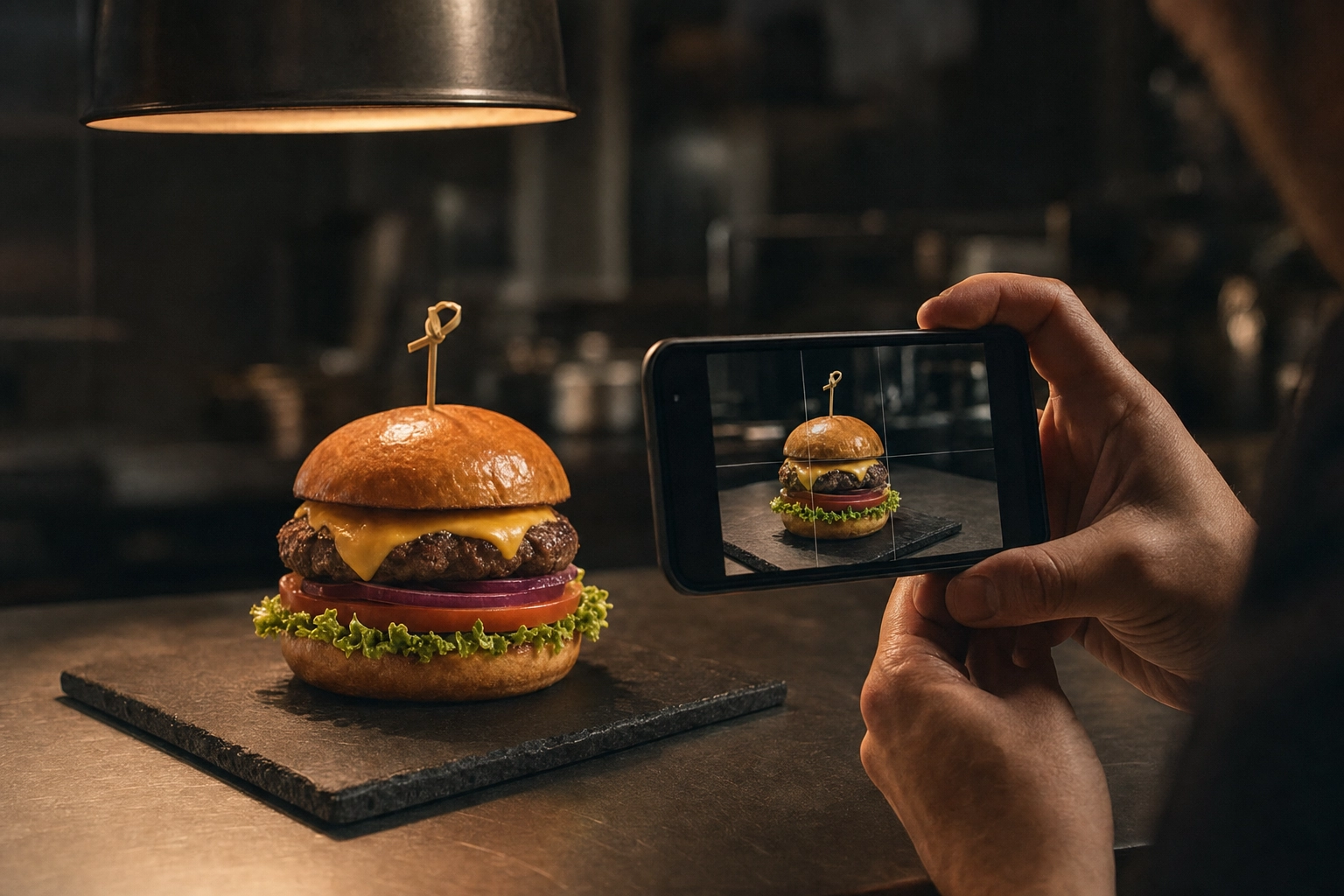 Chef capturing phone photo of a freshly plated cheeseburger to transform into menu-ready imagery for ghost kitchen brand
Frequently Asked Questions
What is the most successful ghost kitchen brand?
It depends on how you measure. By infrastructure scale, CloudKitchens leads with 400+ locations across 30 countries. By single-brand awareness peak, MrBeast Burger reached 2,000+ virtual locations after one launch video, though it later contracted significantly amid quality and partnership disputes. By breadth of multi-brand reach, the Nextbite/C3/Everybody Eats portfolio (which now includes the assets of Kitchen United) covers thousands of partner restaurants across dozens of brands.
How many ghost kitchens are there in 2026?
Approximately 7,600 ghost kitchen operations are active in the US alone, per OysterLink's 2026 industry data. The global ghost kitchen market is projected to grow from $97 billion in 2025 to $113 billion in 2026 at a 16.2% CAGR. By 2030, ghost kitchens are projected to capture about half of the drive-thru and takeaway foodservice market.
Do you need a logo for a ghost kitchen brand?
Yes — your logo is the avatar customers see in delivery app listings, push notifications, and order confirmations. Wordmark logos (text-based) generally outperform icon logos at thumbnail sizes around 60×60 pixels because they remain readable. Test your logo at small sizes before finalizing it.
Can you run multiple ghost kitchen brands from one kitchen?
Yes — and it's one of the most common growth strategies. Roughly 41% of independent restaurants now operate at least one virtual brand. Each brand needs its own distinct visual identity, dedicated menu photos, and separate delivery app listing. Successful multi-brand operators share kitchen capacity but never share visual identity. AI food photography tools that maintain brand-specific photo styles are essential — a single reshoot budget can't realistically cover three to five fully differentiated ghost kitchen brands.
How much does it cost to brand a ghost kitchen?
Realistic budget ranges:
- DIY approach: $200-$500 for a logo and basic brand kit through Fiverr or 99designs.
- Mid-range professional: $1,500-$5,000 for a freelance designer delivering logo, brand guidelines, and packaging design.
- Photography: $700-$1,400 per traditional photoshoot for 15-25 dishes, or roughly $9-$59 per month for an AI food photography subscription that handles unlimited menu updates.
- Total launch budget for one virtual brand: $1,000-$3,000 if you DIY photography with AI tools, or $5,000-$10,000 with full agency branding and traditional photoshoots.
The takeaway: visual identity matters more than ever for ghost kitchen brands, but the cost has dropped dramatically. The brands that win in 2026 will be the ones that obsess over photography, packaging, and delivery app presentation — and use AI tools to scale that obsession across multiple brands without scaling the budget linearly.
 Delivery courier holding three distinct branded ghost kitchen bags at a customer's doorstep during evening handoff