Catering Marketing: The Complete Guide to Growing Revenue
 Ali Tanis24 min read
Catering is one of the last food businesses where a single good booking can change your month — and one bad quarter can sink it. In 2026, the industry is growing, competition is crowding in, and the caterers pulling ahead are the ones treating catering marketing like a system, not a side project. This guide shows you how to build that system end-to-end.
Quick Summary: The U.S. catering services market sits around $77B heading into 2026, with corporate events now the #1 growth driver. Winning caterers don't just collect tactics — they run a catering marketing funnel (awareness → consideration → conversion → retention) with food photography as the unifying asset across every channel. This guide is the complete catering marketing strategy playbook, from brand identity to ROI measurement.
The Catering Market in 2026: Where the Revenue Is Hiding
The catering industry is bigger, and more fragmented, than most operators realize. Before you plan a single catering marketing campaign, memorize these numbers:
- U.S. caterers industry (narrow NAICS definition): roughly $15.7 billion in 2026, per IBISWorld's February 2026 update, with a 6.7% CAGR over the prior five years.
- Broader U.S. catering services market: approximately $77.18 billion in 2025, projected to reach $140.85 billion by 2035 at a 6.20% CAGR, according to Expert Market Research.
- Global catering services market: $135.87 billion in 2026, on track for $196.2 billion by 2034 (Business Research Insights).
- U.S. market 2030 forecast: Grand View Research projects the U.S. catering services market hitting $109.41 billion by 2030 at a 7.7% CAGR.
- Operator sentiment is bullish: 48.5% of caterers plan to expand their operations in 2026, even though 60.2% cite rising costs as their biggest challenge (FLIP 2026 Catering Statistics).
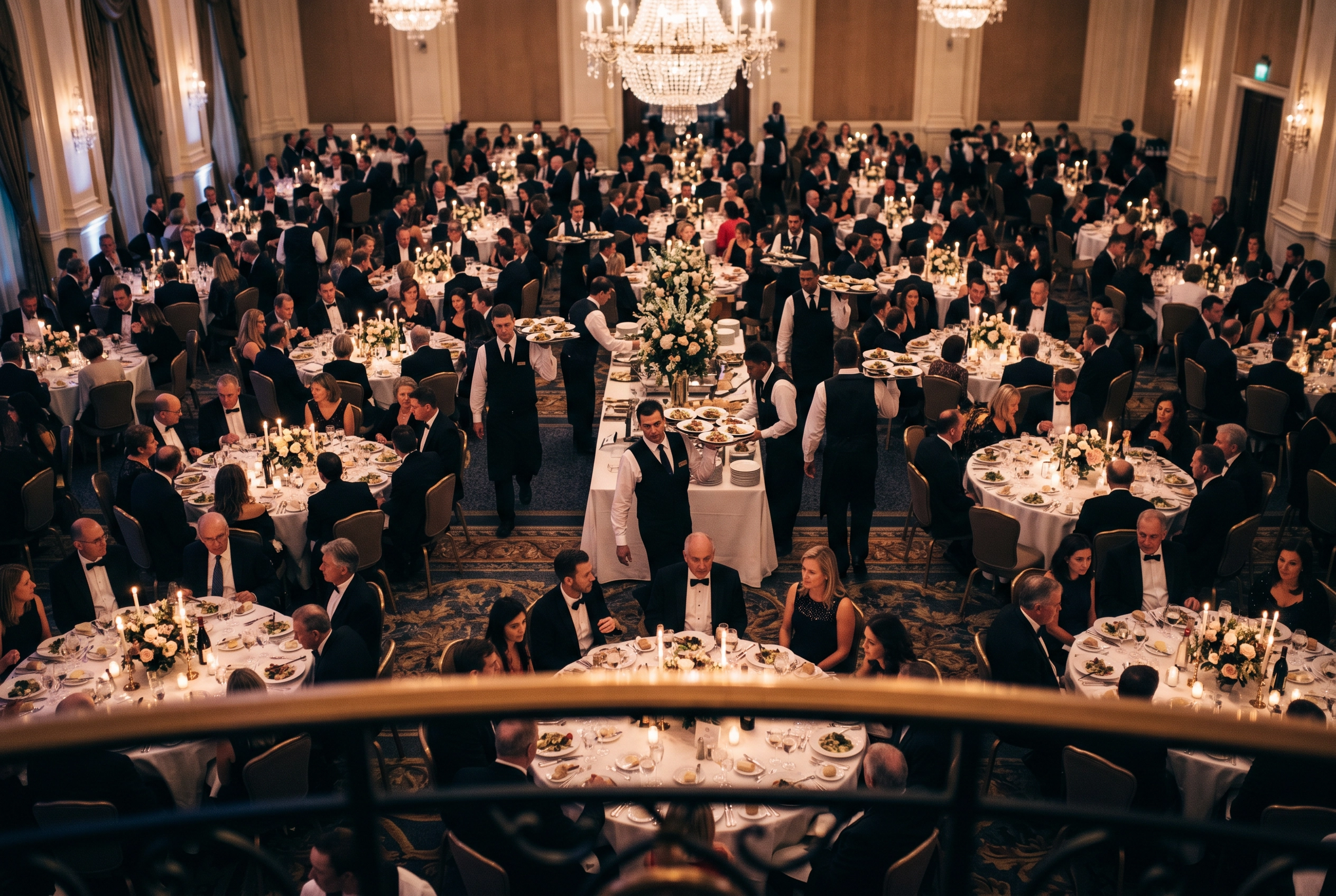 Elevated view of a full corporate gala ballroom with catering servers moving between dozens of plated tables
The growth isn't evenly distributed. Two segments are pulling the catering market forward:
Corporate catering is now the #1 growth engine. Per the International Caterers Association, 48% of caterers say corporate events are their largest area of growth, fueled by return-to-office mandates and workplace meal budgets. Corporate clients order on recurring cycles, don't haggle like consumers, and peak on Monday–Wednesday — exactly when your restaurant dining revenue dips.
Weddings remain the anchor. Roughly 2 million weddings happen each year in the U.S., and weddings were the primary source of revenue growth for 35% of caterers in the most recent ICA survey. Wedding clients have longer sales cycles but higher average event values, often $15,000–$40,000 for full-service events.
The implication for your catering marketing plan: there is more than enough demand, but buyers have more options than ever. If your marketing is vague, inconsistent, or invisible, even a good caterer gets ignored. If it's sharp, you'll win disproportionate share — because most of your local competitors are still winging it.
This guide is the complete hub for catering business marketing. For tactical deep-dives, we'll link to our companion articles on how to market a catering business, catering food photography, and catering marketing ideas as we go.
Build Your Catering Brand Identity Before You Spend a Dollar on Ads
Most caterers skip straight to tactics — "I need an Instagram strategy, I need a website, I need ads." That's backwards. The caterers who win in 2026 are the ones clients remember, which means brand comes first in any serious catering marketing strategy.
A catering brand isn't a logo. It's the answer to three questions a client should be able to finish before they finish reading your homepage:
- Who is this for? (wedding clients, corporate buyers, luxury social events, casual drop-off, or a clear hybrid)
- What do you do differently? (cuisine specialty, service model, values, aesthetic)
- What will the experience feel like? (polished and formal, warm and family-style, modern and minimalist, etc.)
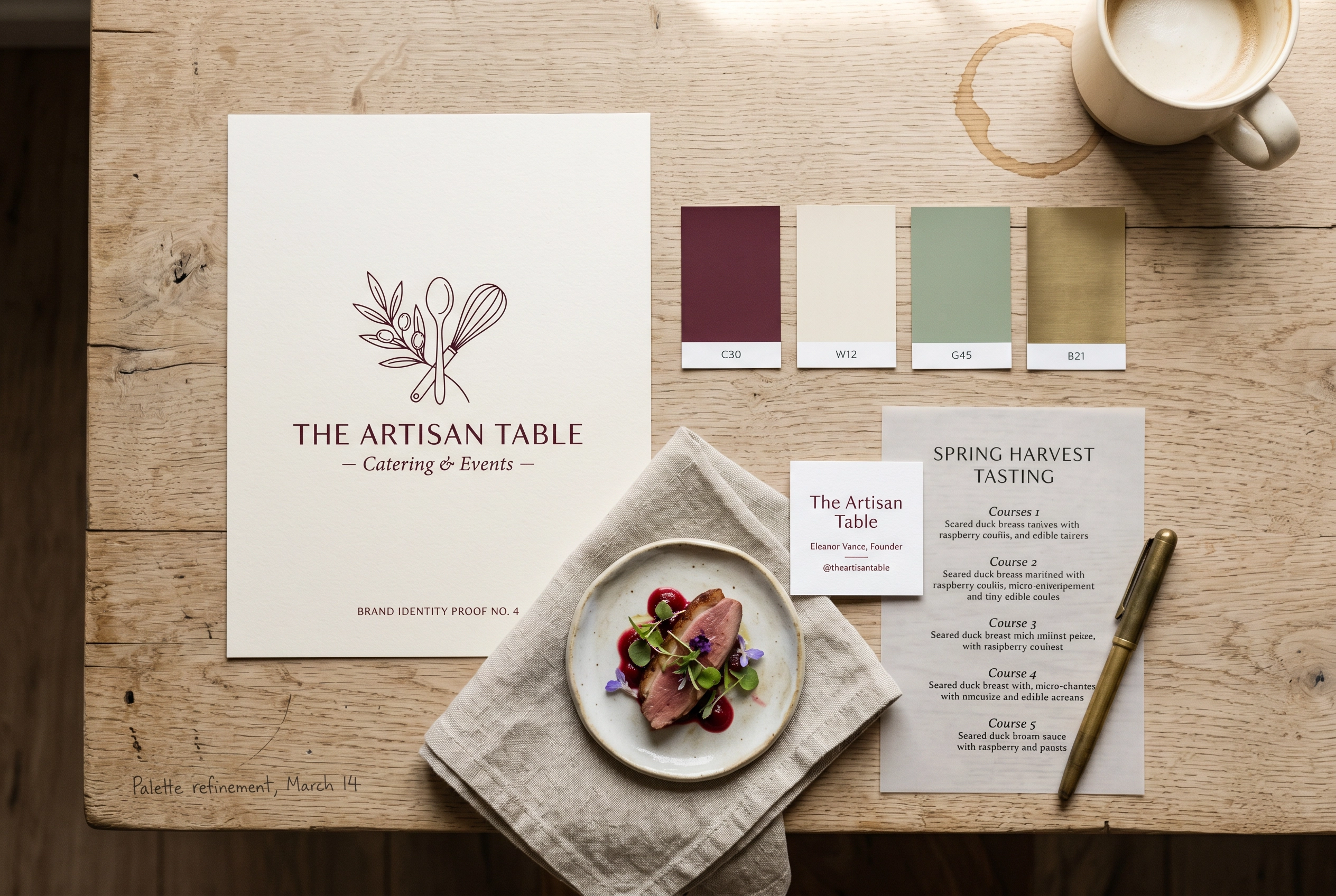 Overhead flat-lay of catering brand identity elements including logo proof, color swatches, and a plated amuse-bouche
The five elements of a catering brand identity
1. Positioning. Pick a segment and lead with it. Caterers who say "weddings, corporate, birthdays, bar mitzvahs, and funerals" rank for nothing and are remembered for nothing. You can still serve multiple segments — you just need one headline story.
2. Visual identity. Logo, color palette (3–5 colors max), typography, and an icon or pattern system. This lives on your website, proposals, packaging, vehicle wraps, signage, and staff uniforms.
3. Photography style. This is the single most under-invested element for caterers, and we'll come back to it repeatedly. A consistent photographic look — the same lighting temperature, plating angle, background palette, and editing style across every image — is what makes a five-person catering company look like a fifty-person operation.
4. Brand voice. How you write proposals, emails, Instagram captions, and voicemail greetings. Decide on a tone (polished vs. conversational), a vocabulary list (the words you use and the ones you don't), and a signature phrase or two.
5. Physical touchpoints. Packaging, food labels, stationery, tasting kits, thank-you cards. Every time a client touches something with your name on it, your brand is either building equity or leaking it.
If you only have budget for two of the five, pick photography style and positioning. Those two alone will outperform a bigger marketing budget spent on a weak foundation.
The Catering Marketing Funnel: Awareness → Consideration → Conversion → Retention
Most "catering marketing" advice is a pile of disconnected tactics. What you actually need is a funnel — a map of how strangers become clients, and clients become regulars. Without it, you can't tell which tactics are working or which stage of the journey is broken.
Here's the catering marketing funnel framework that applies to almost every catering business:
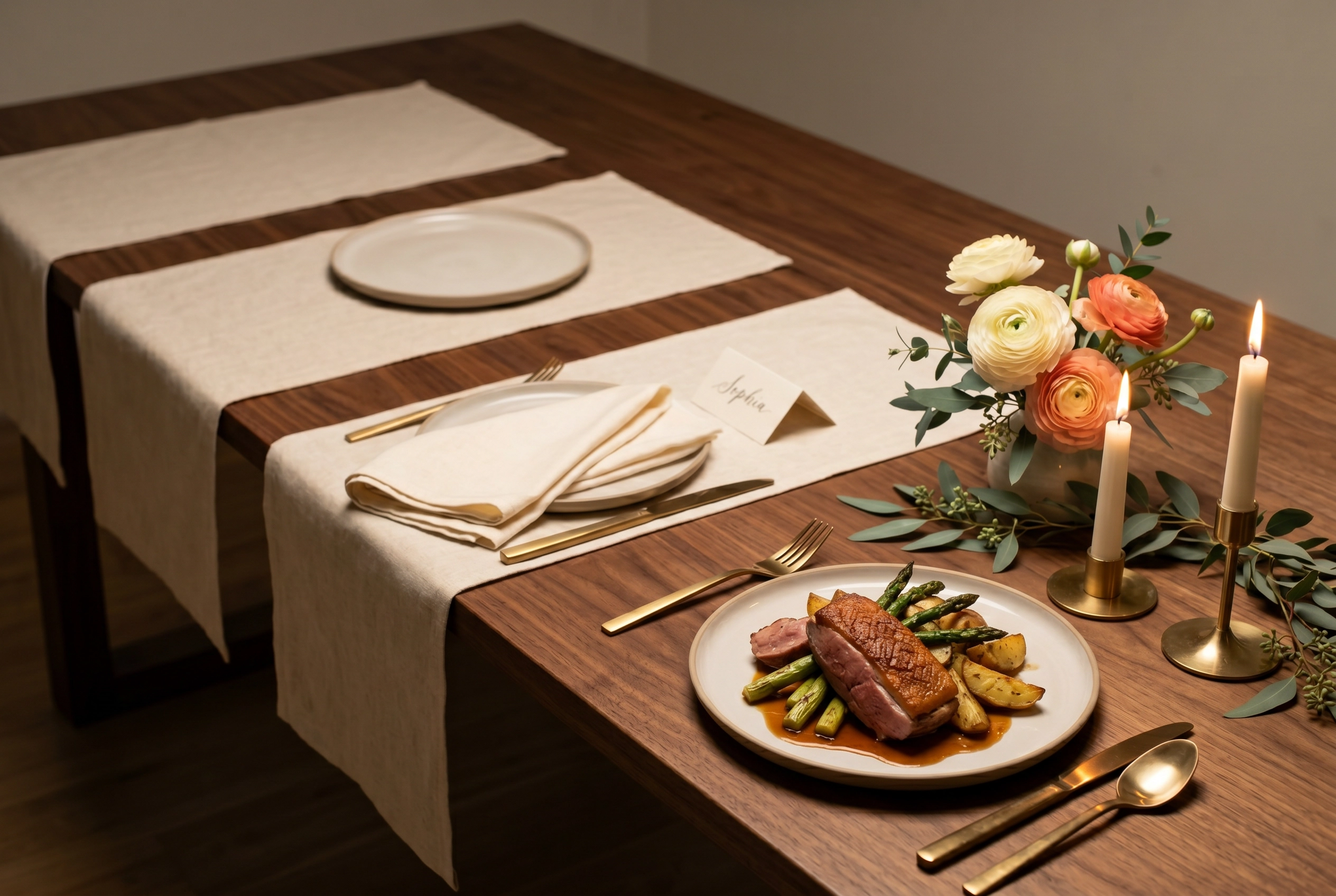 Four progressively styled place settings on a dining table representing the catering marketing funnel stages
Stage 1: Awareness — getting on the shortlist
At this stage, a potential client doesn't know you exist. Your job is to show up in the places they already go:
- Local SEO — ranking for "catering in [city]," "wedding caterers [city]," "corporate catering [neighborhood]"
- Google Business Profile — the single highest-ROI visibility asset for most caterers
- Social media — mostly Instagram for weddings/social, LinkedIn for corporate, TikTok for personality
- Community events and sponsorships — bridal expos, chamber mixers, charity galas
- PR and editorial coverage — local food publications, wedding blogs, business journals
- Venue and planner referrals — often the largest awareness source for wedding caterers
Stage 2: Consideration — earning the shortlist
Now they know you exist and they're comparing 3–5 options. This is where most caterers lose deals they could have won. What moves the needle here:
- Portfolio website with real photography from real events, organized by event type
- Testimonials and reviews from recognizable clients (companies, venues, planners by name with permission)
- Case studies — a wedding you catered, with photos, menu, and quote from the couple
- Transparent pricing frameworks — per-person ranges by service style
- Sample menus — clients want to see what they can actually order
- Response speed — 80% of inquiries go to whoever replies first
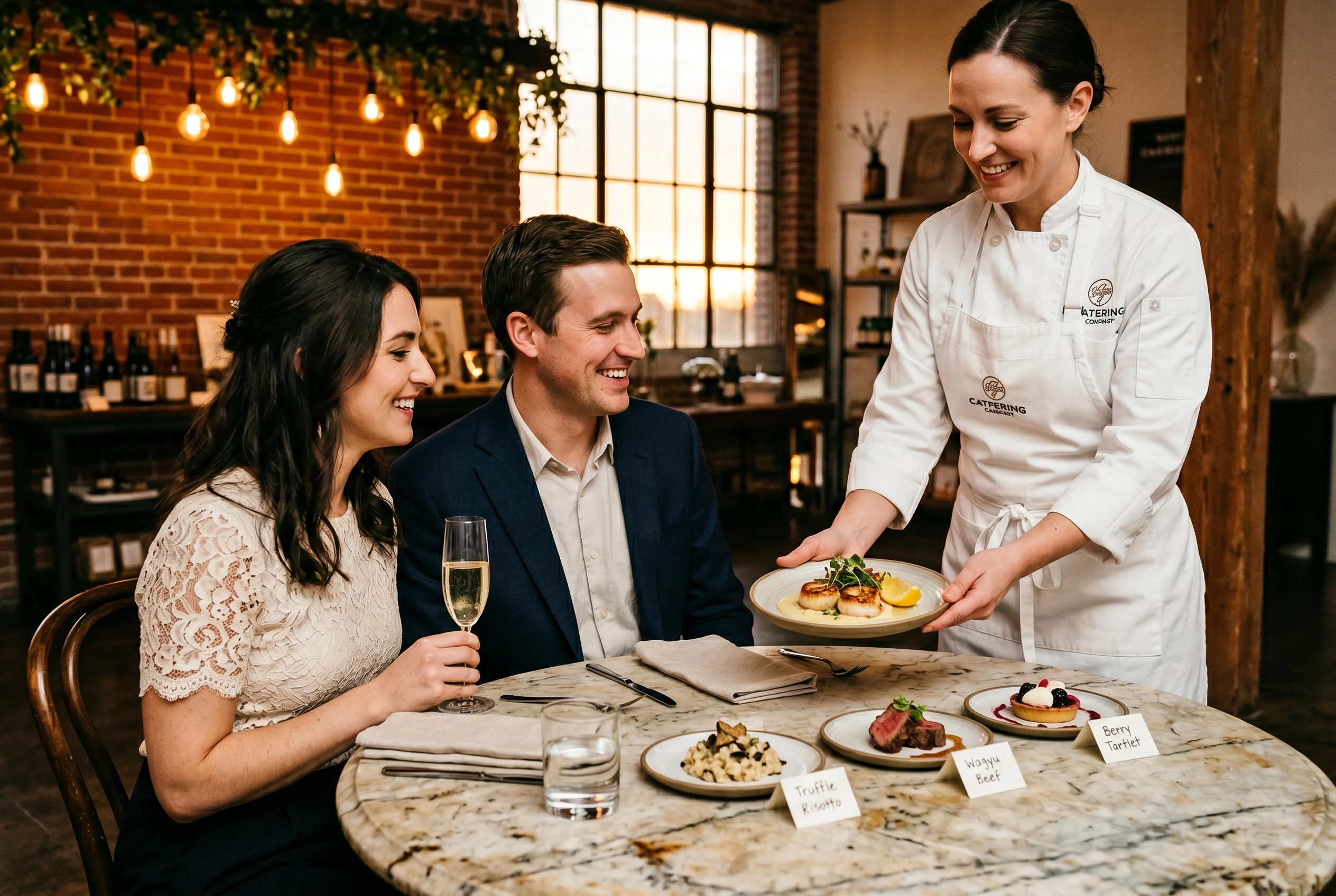 Catering chef presenting a plated tasting course to a wedding couple at a showroom tasting session in warm sunset light
Stage 3: Conversion — closing the booking
The deal is yours to lose. Conversion is about removing friction and building confidence:
- Proposals that look as good as your food — branded PDFs with photography, menu, and terms
- Tastings (for weddings and large corporate accounts) — often the single strongest conversion tool
- Clear next steps — deposit amount, timeline, what they need to send you
- Contracts that read like humans wrote them — not 14 pages of legalese
- Payment options — credit card, ACH, invoicing terms for corporate
Stage 4: Retention — the stage almost nobody invests in
This is where the real margin lives. Industry data suggests roughly 60% of catering revenue comes from repeat and referral business in established operations. Retention tactics:
- Post-event follow-up within 48 hours — thank you, photo share, review request
- Quarterly email nurture for corporate accounts with seasonal menus
- Anniversary touches — "One year ago this week, we catered your wedding…"
- Referral programs with real incentives ($200 credit, bottle of wine, etc.)
- VIP client tiers — unlock perks after 3 events
A caterer with a 20% booking conversion rate and a broken retention system will always lose to a caterer with a 15% conversion rate and a repeat-business engine. Build the full catering marketing funnel, not just the top of it.
Digital Marketing Essentials for Caterers
Your digital presence is the one catering marketing asset that works for you while you're in service, while you're sleeping, and during the slow season. Here's what needs to be in place.
 Catering business owner reviewing her website and marketing plan at a commercial kitchen workstation in morning light
Your catering website
A catering website isn't a digital brochure. It's a 24/7 sales tool that needs to do five specific jobs:
- Convince them you're real — hero photography, team photos, venue partner logos
- Show them what you do — service types (wedding, corporate, social), cuisine styles, a visible menu or menu PDF
- Prove it with receipts — gallery organized by event type, testimonials, case studies
- Give them per-person context — even a range ($25–$65 per person depending on service style) prevents 50% of unqualified inquiries
- Make the next step obvious — inquiry form above the fold, phone number in the header, email response time promise
Ideal pages to build out: Home, Services (split by segment), Menus, Portfolio/Gallery, About, Contact/Inquiry, Blog. For most caterers, the Services pages do more heavy SEO lifting than the homepage.
Local SEO for caterers
Catering is a local business, which means local SEO is the highest-leverage SEO work you can do for your catering marketing. Three priorities:
- Google Business Profile fully optimized — categories (Caterer, Wedding Service, Corporate Event Caterer), services, hours, 30+ photos, regular posts. Google publishes its own Business Profile setup guide that's worth reading in full.
- On-page local signals — city name in title tags, NAP (name/address/phone) on every page, LocalBusiness + FoodEstablishment schema
- City + service landing pages — a separate page for "Wedding Catering in [City]," "Corporate Catering in [City]," etc., each with unique content (not duplicated)
Reviews matter more than most caterers realize. Google's local algorithm weighs recency and velocity heavily — a caterer with 40 reviews from the last 6 months will outrank one with 200 reviews from 2022.
Email marketing for caterers
Email is still one of the most cost-effective catering marketing channels. Three sequences every caterer should run:
- Corporate nurture — a monthly or bi-weekly email to past corporate clients with seasonal menus, holiday ideas, and booking reminders timed to Mondays
- Wedding inquiry drip — automated sequence for couples who submit an inquiry but don't book immediately (3–5 emails over 30 days)
- Post-event follow-up — a short automated series within a week of the event asking for a review, offering a referral incentive, and sharing photos from their event
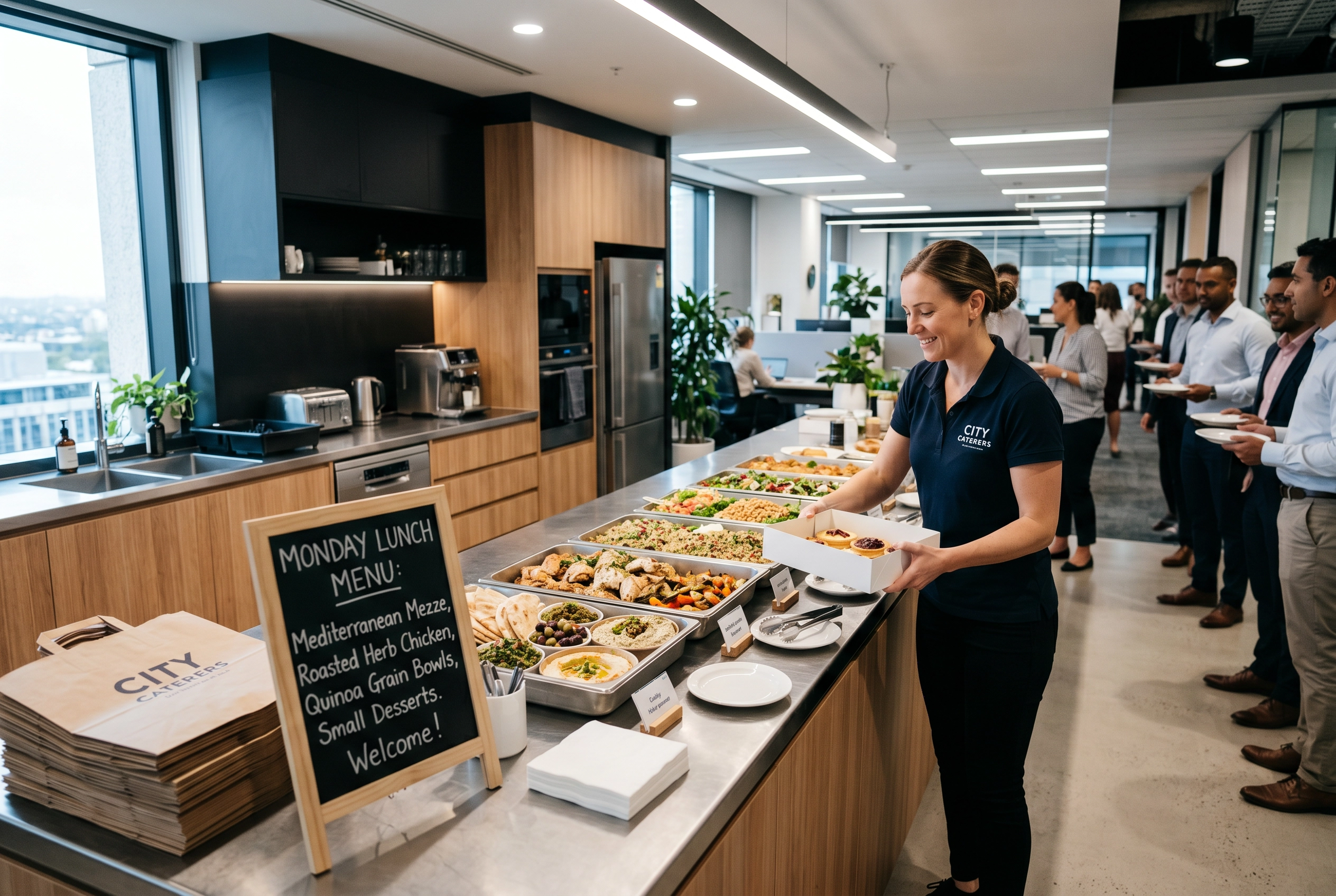 Catering delivery driver setting up Mediterranean lunch spread in a modern corporate office kitchen on a Monday
The Monday corporate email is criminally underused. Office managers are planning the week. A Monday 7 AM email with "This week's trending corporate lunch" and a single-click ordering CTA captures orders your competitors never see. If you need software, we cover the full stack in our restaurant marketing software comparison.
Social Media Strategy for Caterers
Social media isn't about posting constantly on every platform. It's about picking the 1–2 platforms where your ideal clients actually spend time and showing up consistently.
Platform priorities by segment
- Wedding and luxury social caterers: Instagram (primary), Pinterest (secondary), TikTok (optional for personality). Wedding planners actively scout caterers on Instagram tagged locations and event hashtags.
- Corporate caterers: LinkedIn (primary), Instagram (secondary), Google Business Profile posts. LinkedIn outbound to office managers, HR directors, and executive assistants converts better than any paid channel for B2B catering marketing.
- Food truck / casual caterers: Instagram and TikTok. Facebook Events for public bookings.
- Multicultural / specialty caterers: Instagram plus community-specific platforms (e.g., WeChat, WhatsApp groups depending on client base).
Don't try to run all four. Pick two, run them well, and ignore the rest until you have the capacity.
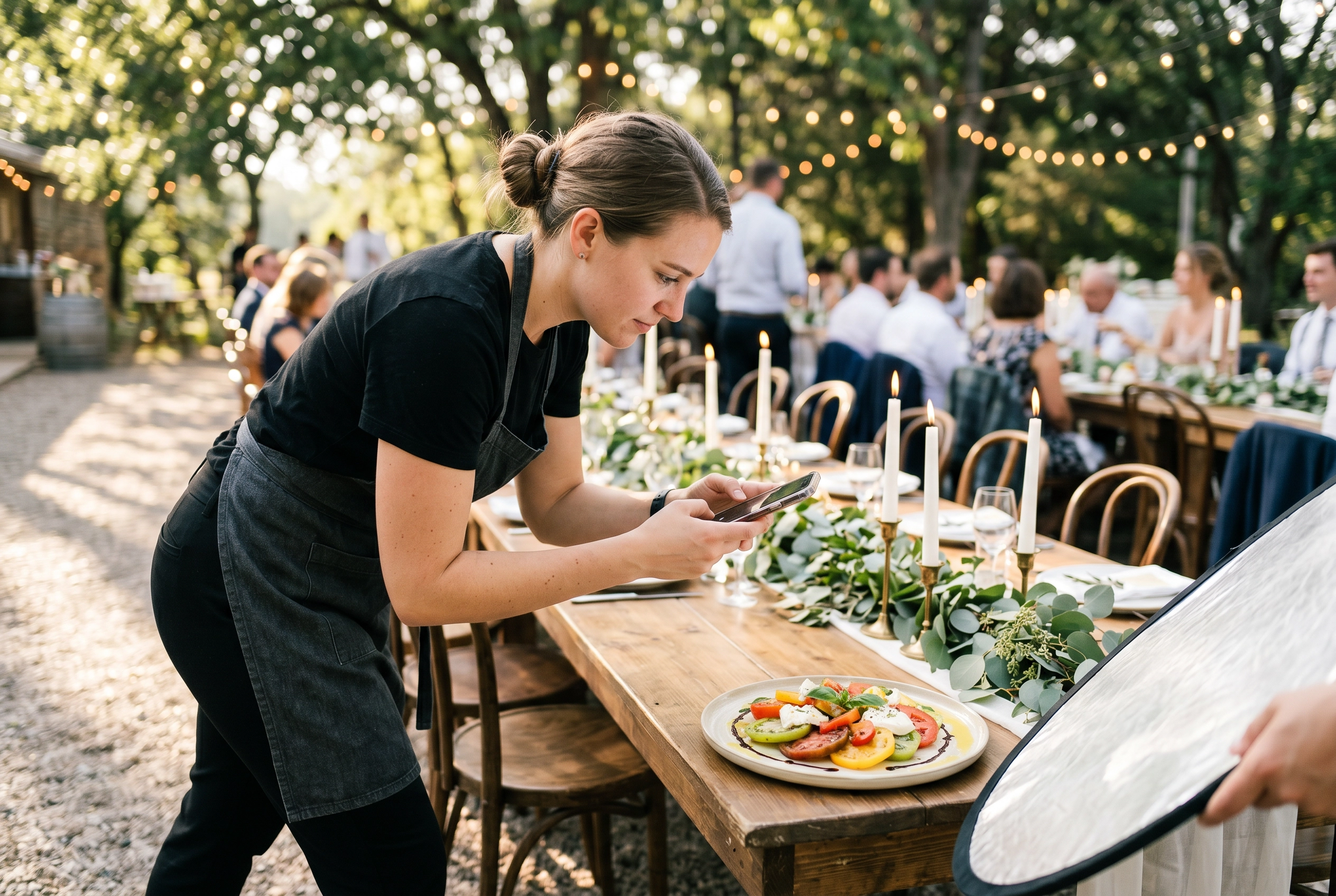 Catering content creator photographing a styled heirloom tomato salad with a phone at an outdoor wedding reception
Content pillars that work
Rotate between these pillar types so you're not posting the same thing every day:
- Hero dishes — your best photography, cropped for the platform, tagged with details
- Behind-the-scenes — prep, setup, plating — humanizes your team
- Event reveals — before/after of a space, timelapses of a buffet setup
- Educational — planning tips, per-guest quantity guides, menu inspiration
- Client love — testimonials, review screenshots, repost client photos
- Seasonal and trending — holiday menus, wedding trends, corporate season reminders
A realistic weekly content calendar
For a solo-marketer catering business, a sustainable cadence looks like:
| Day | LinkedIn (if corporate) | Story/Reel | |
|---|---|---|---|
| Mon | Hero dish | Corporate menu tip | — |
| Tue | — | — | BTS prep |
| Wed | Educational carousel | Client testimonial | — |
| Thu | — | — | Event setup |
| Fri | Event reveal | — | — |
| Sat | Client love / repost | — | Behind the scenes |
| Sun | — | Weekly roundup | — |
One well-photographed event can feed two to three weeks of content if you shoot with intention. Take 10 minutes during setup to get hero shots, 5 minutes during service for action shots, and request client permission to reshare their photos afterward.
Visual Marketing: How Food Photography Transforms Every Channel
Every section above — website, social, email, proposals — has the same fuel source: photography. Clients book caterers they can picture. No image, no booking.
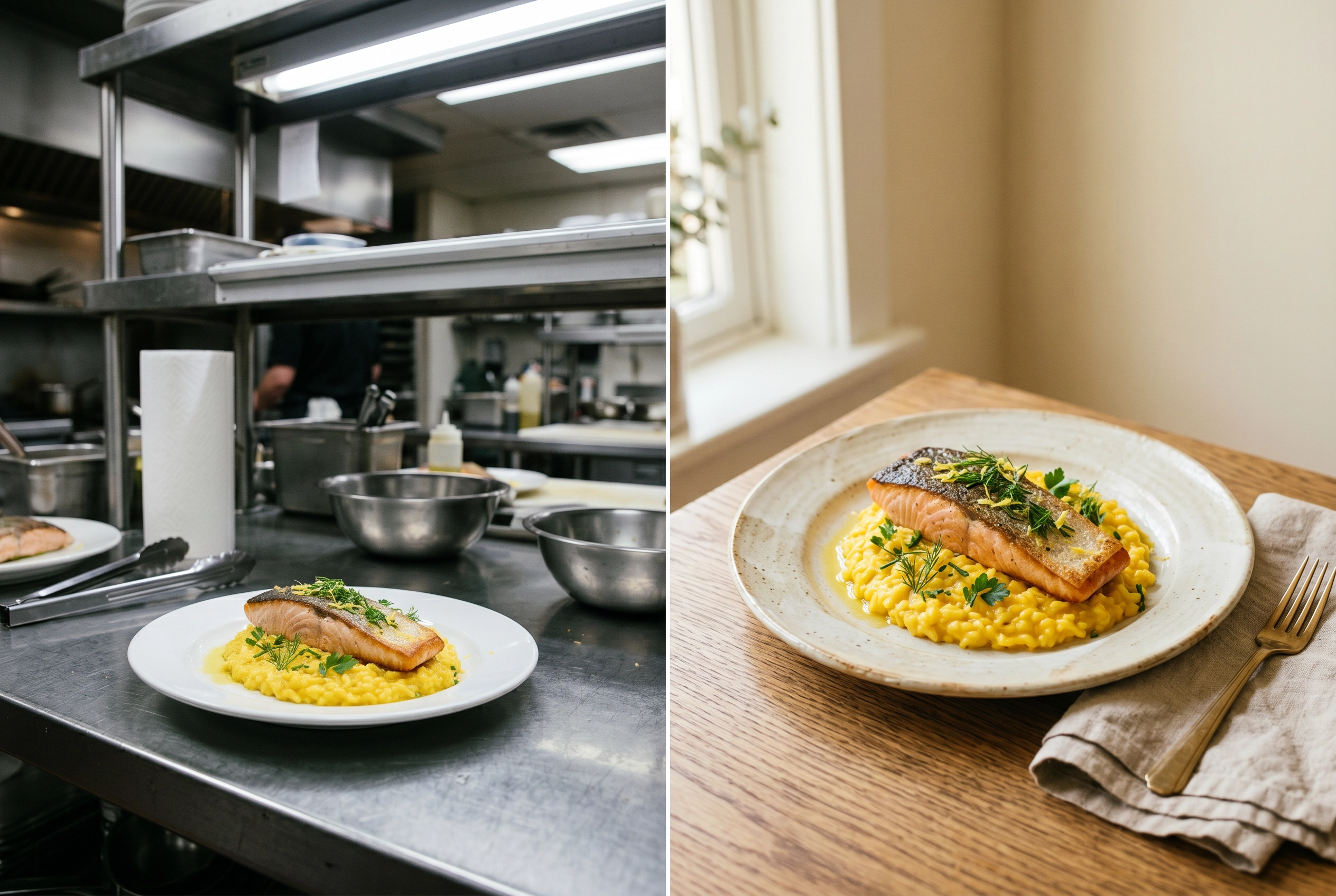 Split-image comparison of the same catering dish photographed under harsh kitchen lighting versus styled editorial lighting
Why photography is the #1 trust signal in catering
Unlike a restaurant, where a customer can walk in, sit down, and read a room, catering clients buy something they've never tasted for an event that hasn't happened yet. Photography is the proxy for everything they can't experience in advance. When a wedding couple or corporate buyer sees:
- Lighting that matches their event's aesthetic
- Plating with the kind of care they want for their guests
- Tablescapes that feel like they belong in a real venue
- Action shots that prove you've actually done this before
…you've closed the trust gap before the tasting. When they don't see these things, you've created doubt you'll have to overcome with price cuts or extra work.
The multiplier effect of great catering photography
One well-produced catering image earns its keep across at least eight channels:
- Website portfolio and service pages
- Proposal PDFs and pitch decks
- Instagram grid and reels
- Pinterest boards (wedding caterers, take note — pins have a 3–6 month half-life)
- Google Business Profile posts and photos
- Email campaigns
- Paid ad creative (Meta, Google Display)
- Printed menus, postcards, trade show banners
The cost per use of a good image drops dramatically as you reuse it. A portfolio of 50 strong images can power a full year of catering marketing.
The cost math: traditional photography vs. AI enhancement
Professional food photography traditionally runs:
- Single event session: $700–$1,400 per shoot
- Full portfolio build (50+ images): $2,000–$5,000+ depending on market
- Ongoing retainer: $1,500–$4,000/month for monthly shoots
That's not wrong — it's just out of reach for most catering businesses under $500K in annual revenue. And even if you can afford it, you still can't photograph every dish at every event.
This is the gap FoodShot AI was built to close. Instead of replacing the photography workflow, it enhances what you're already doing. You photograph dishes and events on a phone (or ask your on-site team to), then upload and transform each image into a studio-quality version in about a minute — matched to a consistent style across your entire portfolio.
For a full playbook on what to shoot and how to use it, read our catering food photography guide. For a side-by-side cost breakdown, see food photography for restaurants: DIY vs pro vs AI and our general overview of commercial food photography.
A shot list to build at every event
Make this your crew's standard operating procedure — three minutes before guests arrive:
- Hero plating shot of each main dish (overhead and 45°)
- Buffet line or station spread (wide and close-up)
- Canapé or passed tray (close-up, shallow depth)
- Tablescape or centerpiece with place setting
- Action shot — carving, pouring, plating
- Room shot with food as the focal point
Six shots per event × 20 events per year = 120 usable images, which is more than most catering websites ever display.
Partnership and Referral Marketing for Caterers
Here's the stat that reshapes most catering marketing plans: in FLIP's 2026 catering survey, 89.7% of caterers listed word-of-mouth referrals as their primary method for attracting new clientele. It remains the single most effective source of high-value bookings — and it's the one most operators under-invest in.
Partnerships don't replace digital marketing; they amplify it. A wedding planner who vouches for you sends clients who are already 80% closed.
 Florist, wedding planner, and catering owner collaborating on an event mood board in a bright studio workspace
Four partnership categories to pursue
1. Venues and wedding planners. For wedding and social caterers, this is often the #1 revenue channel. Build a preferred-vendor list by researching every venue within 30 miles that hosts events your size. Reach out with a short intro, a PDF portfolio, and a specific ask (to be on their preferred vendor list). Follow up at the 30-day mark with a tasting invitation.
2. Corporate gatekeepers. For corporate catering, the decision-makers are usually not the executives — they're executive assistants, office managers, HR coordinators, and property/facility managers. Build relationships with these roles at companies within your delivery radius. LinkedIn outreach, sponsored office tastings, and referral-only discounts move the needle here.
3. Related event vendors. Florists, event photographers, DJs and bands, rental companies, mobile bartenders, and lighting designers all get asked "do you know a good caterer?" constantly. If five of them recommend you, your inquiry flow compounds faster than any ad spend.
4. Industry associations and community. ICA (International Caterers Association), NACE (National Association for Catering and Events), local chambers of commerce, and regional wedding/event professional networks. These are slow-build relationships but produce the highest-trust referrals you'll ever get.
Structuring a referral program that actually works
A referral program fails for predictable reasons: the incentive is unclear, the tracking is manual, or nobody ever reminds partners it exists.
What works:
- Clear, memorable incentive. 5–10% of the first event's booking value as a credit or check, or a flat amount per booked event.
- Easy referral mechanism. A unique link, a dedicated email alias (referrals@yourcatering.com), or a simple form.
- Feedback loop. Notify the referrer when the lead becomes a booking — people keep referring when they feel acknowledged.
- Annual partner event. Host a "partner appreciation" tasting once a year. Low-cost, high-loyalty.
For a more tactical, idea-by-idea breakdown of partnership and referral plays, work through our catering marketing ideas article alongside this one.
Measuring Catering Marketing ROI
If you can't measure it, you can't improve it — and most caterers can't measure it. They know revenue went up or down, but they can't tell you which catering marketing channel delivered which booking.
You don't need enterprise marketing software. You need a simple system.
 Catering business owner reviewing a printed booking spreadsheet and quarterly goals at her kitchen island at dusk
The metrics that matter for catering
| Metric | What it measures | Good target |
|---|---|---|
| Inquiries per month | Top-of-funnel volume | Trending up month-over-month |
| Inquiry-to-booking rate | Conversion quality | 15–30% depending on segment |
| Average event value | Revenue per booking | Trending up year-over-year |
| Cost per lead (CPL) | Efficiency of marketing spend | Under 10% of average event value |
| Cost per acquisition (CPA) | Fully loaded cost per booked event | Under 15% of booking value |
| Customer lifetime value (CLV) | Total revenue per client relationship | Grows with retention investment |
| Repeat booking rate | Retention health | 30%+ for corporate, 10%+ for wedding (weddings are one-time but referrals count) |
| Lead source attribution | Which channels actually produce bookings | Every inquiry tagged |
B2B website conversion rates industry-wide average around 1.8%, with healthy performers in the 3–5% range. Catering inquiry-to-booking rates tend to run higher (because the inquiry itself is a qualifying action), so if you're under 15%, something in your proposal or response process is broken.
A minimum viable measurement setup
You don't need a CRM on day one. A spreadsheet will cover you until you're doing $500K+ in catering revenue. Track every inquiry with:
- Date
- Source (Google search, Instagram, referral from [name], walk-in, etc.)
- Event type
- Event date
- Estimated value
- Status (inquiry → tasting → proposal → booked → lost)
- Close reason if lost
Once a quarter, tally the data. You'll quickly see which channels produce, which produce noise, and which are a waste of time. That's the information that lets you reallocate catering marketing budget with confidence.
UTM parameters and Google Business Profile insights
Two free tools most caterers ignore:
- UTM parameters on every link you share (Instagram bio, email signature, partner referral links). These show up in Google Analytics 4 and tell you which specific source drove the click.
- Google Business Profile Insights. GBP tells you how many people called, requested directions, or visited your website from search — broken down by search query. This is a goldmine for local SEO feedback.
Common catering marketing ROI mistakes
Three mistakes to avoid:
- Tracking vanity metrics only. Follower count doesn't pay rent. Bookings do.
- Ignoring the retention side of ROI. A $5,000 booking that becomes a $30,000/year corporate account is worth 6x what the initial math showed.
- Reviewing too infrequently. Monthly is too often (catering has lumpy data). Quarterly is the sweet spot. Annually is when you do strategic re-planning.
Your 30-60-90 Day Catering Marketing Plan
Reading is easy. Executing is harder. Here's a realistic 90-day catering marketing plan that moves the needle without burning you out.
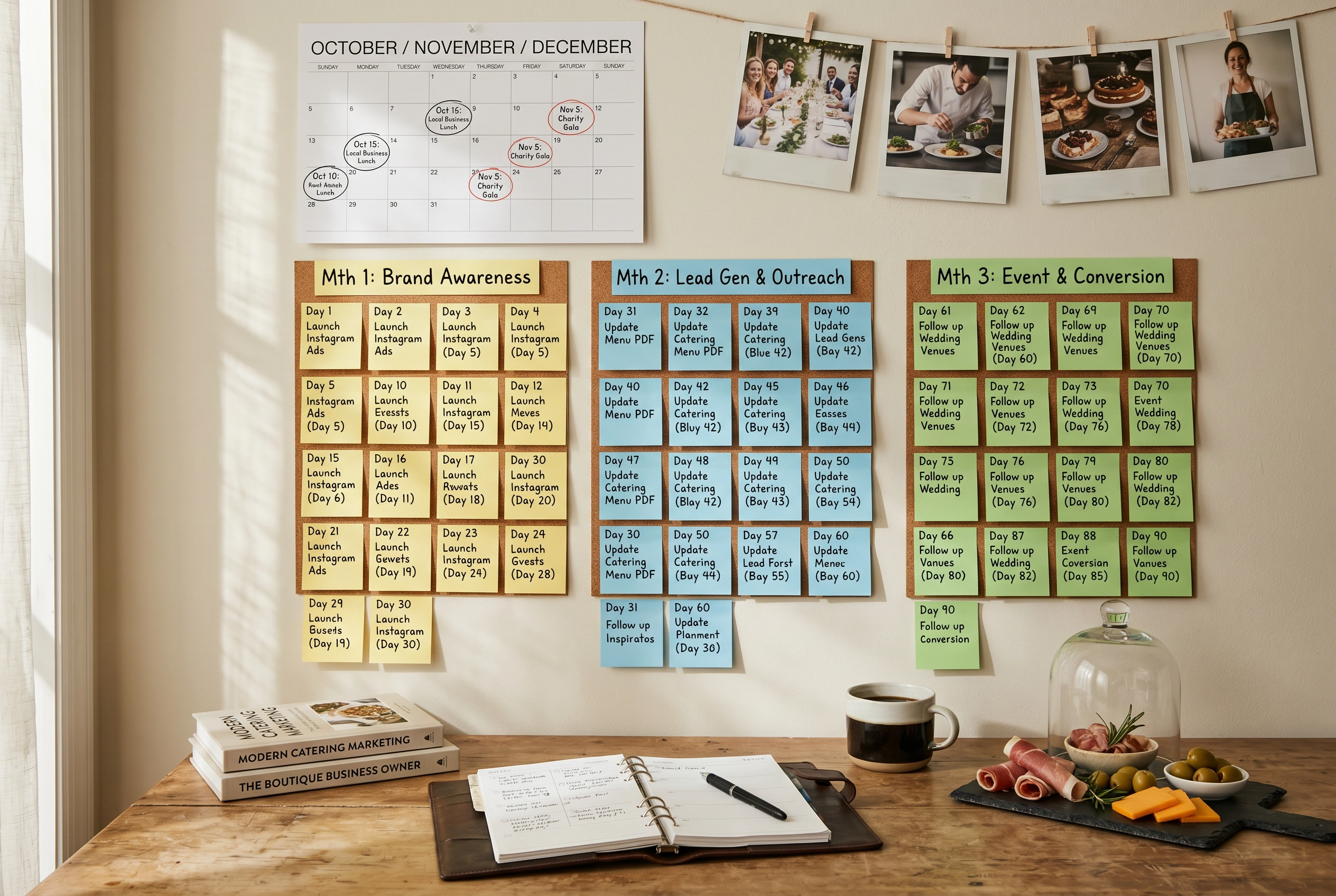 Catering business owner's 90-day marketing plan displayed on a mood wall with color-coded sticky notes and calendar
Days 1–30: Foundation.
- Claim/optimize Google Business Profile (30 photos, all fields filled, first 5 reviews requested)
- Audit and refresh your website (photography, service pages, inquiry form)
- Nail down brand basics: logo, color palette, photography style, 1-page brand guide
- Build your first 30-image portfolio from existing events (enhance phone photos if needed)
- Set up a simple inquiry tracking spreadsheet
Days 31–60: Engine.
- Launch one consistent social channel with a 3x/week cadence
- Write three core email sequences (inquiry follow-up, post-event, quarterly corporate)
- Make first outreach to 5 venues and 5 event vendors
- Publish 2–3 cornerstone blog posts (city+service pages)
- Request a review from every recent client
Days 61–90: Scale.
- Review inquiry sources, booking conversion, and average event value
- Double down on the two channels delivering the most bookings
- Run your first partner tasting event (invite 10 vendors)
- Set up a formal referral program with tracking
- Plan the next 90 days based on actual data, not gut feel
Frequently Asked Questions
How much should a catering business spend on marketing?
Newer catering programs should budget 6–10% of catering revenue toward marketing; established programs with strong repeat business typically run at 2–5%. The specific split matters: for most caterers, at least 40% of marketing spend should go to photography and visual assets because they're reused across every other channel. If you're below 5% and you're not growing, your catering marketing is under-invested.
What is the most effective catering marketing channel?
Referrals — consistently, across every industry survey. In FLIP's 2026 data, 89.7% of caterers rank word-of-mouth as their top channel. The catch: referrals aren't passive. The caterers who dominate referral channels actively maintain venue/vendor relationships, run structured referral programs, and earn reviews systematically. For paid and digital channels, the highest-ROI first investment is a properly optimized Google Business Profile paired with local SEO — that's where marketing for caterers actually starts.
How do I get my first corporate catering client?
Target the decision-maker, not the company. Office managers, executive assistants, HR coordinators, and facility managers book the majority of recurring corporate catering. Use LinkedIn to build a list of 50 local companies within your delivery radius, identify the right role at each, and reach out with a specific offer — often a low-risk "sponsored lunch" for 10–15 people at a discounted rate, delivered with branded materials so every attendee knows who catered it. Convert 1 in 10 and you have 5 accounts.
How long does it take to see results from catering marketing?
Expect the timeline in three phases: 30 days to see the first traffic and inquiry bumps from GBP and content work; 90 days to see booked events from new SEO rankings, social media, and initial partnerships; 12 months to see compounding from reviews, referrals, and repeat corporate accounts. Caterers who quit at month 2 because "catering marketing isn't working" almost always gave up right before the curve started bending upward.
Do I really need professional food photography, or can AI enhancement handle it?
Both — at different points. In your first 12 months, high-quality AI-enhanced phone photography will get you further than a single expensive shoot, because you can cover every event and build a 100+ image portfolio instead of a 20-image one. Once you're at consistent scale and your brand identity is proven, adding 1–2 pro shoots a year for cornerstone campaigns is a reasonable investment. FoodShot AI was built specifically for this middle ground: AI food photography for catering companies produces studio-quality images from phone shots in about a minute, at a fraction of traditional costs. You can start on the $15/month Starter plan and move up once you're generating regularly.
How do I compete with bigger catering companies in my area?
Don't compete on scale — compete on specificity. The bigger the competitor, the less specialized they are. Pick a narrow position (kosher weddings, plant-forward corporate, South Asian fusion, specific cuisine, specific venue) and own it. Dominate the local SEO terms for that niche. Partner with the venues and planners who serve that segment. Build your photography library around it. A small caterer who is clearly #1 in one segment will always outperform a larger caterer who is vaguely #3 in five segments.
Catering marketing in 2026 is not a mystery — it's a system. Brand → funnel → channels → measurement. The caterers who treat it that way grow predictably. The ones who treat it as a list of disconnected ideas grow by accident. You're now set up to be the first kind. Start with your Google Business Profile today, build your photography library this month, and come back to this catering marketing guide whenever you're planning the next quarter.