Best Restaurant Marketing Software Compared (2026 Guide)
 Ali Tanis20 min read
Choosing restaurant marketing software in 2026 feels like ordering from a 200-item menu — overwhelming, and the descriptions don't tell you what anything actually tastes like.
The restaurant management software market hit $7.49 billion this year and is growing at 14.52% annually. That growth has flooded the market with platforms that all claim to be "the only marketing tool restaurants need." Spoiler: none of them are. Every restaurant — from a single-location café to a multi-location chain — needs a different combination of software to attract guests and keep customers coming back.
Quick Summary: The best restaurant marketing software depends on what you already have and what you actually need. Toast Marketing works best if you're already on Toast POS. Owner.com is the strongest all-in-one platform for independents fighting delivery app commissions. Popmenu and BentoBox nail the website-plus-marketing combo. Mailchimp remains the cheapest email-only option. And every platform performs better when your food photos look professional — which is where a dedicated AI food photo editor like FoodShot AI fits in. Below, I compare all 10 restaurant marketing platforms on pricing, features, and which restaurant types they actually serve.
Quick Comparison: All 10 Restaurant Marketing Platforms at a Glance
Before diving deep, here's every restaurant marketing software platform side by side. Scan this to narrow your shortlist, then read the detailed reviews below.
| Platform | Starting Price | SMS | Loyalty | Social Tools | Visual Content | Best For | |
|---|---|---|---|---|---|---|---|
| Toast Marketing | ~$185/mo add-on | ✅ | ✅ | ✅ | ❌ | ❌ | Toast POS users |
| Bloom Intelligence | Custom quote | ✅ | ✅ | ✅ | ❌ | ❌ | Multi-location chains |
| Popmenu | ~$300/mo | ✅ | ✅ | ❌ | Limited | ❌ | Independents wanting websites + marketing |
| BentoBox | ~$119/mo | ✅ | ✅ | ❌ | ❌ | ❌ | Full-service restaurants |
| Mailchimp | $13/mo | ✅ | Add-on | ❌ | ❌ | ❌ | Budget email marketing |
| Owner.com | ~$499/mo | ✅ | ✅ | ✅ | ❌ | ❌ | Independents cutting delivery fees |
| Yelp for Business | Free (ads extra) | ❌ | ❌ | ❌ | ❌ | ❌ | Metro-area discovery |
| TripAdvisor for Restaurants | Free (premium extra) | ❌ | ❌ | ❌ | ❌ | ❌ | Tourist-area restaurants |
| ChowNow | ~$150–$300/mo | ✅ | ❌ | ✅ | ❌ | ❌ | Takeout-heavy restaurants |
| FoodShot AI | $15/mo | ❌ | ❌ | ❌ | Templates | ✅ | Visual content for any platform |
Key takeaway: No single restaurant marketing platform covers everything. Most restaurants need 2–3 tools working together. And notice that "Visual Content" column — only one platform handles it, which is why your food photos are usually the weakest link in your marketing.
Now let's break down each platform in detail.
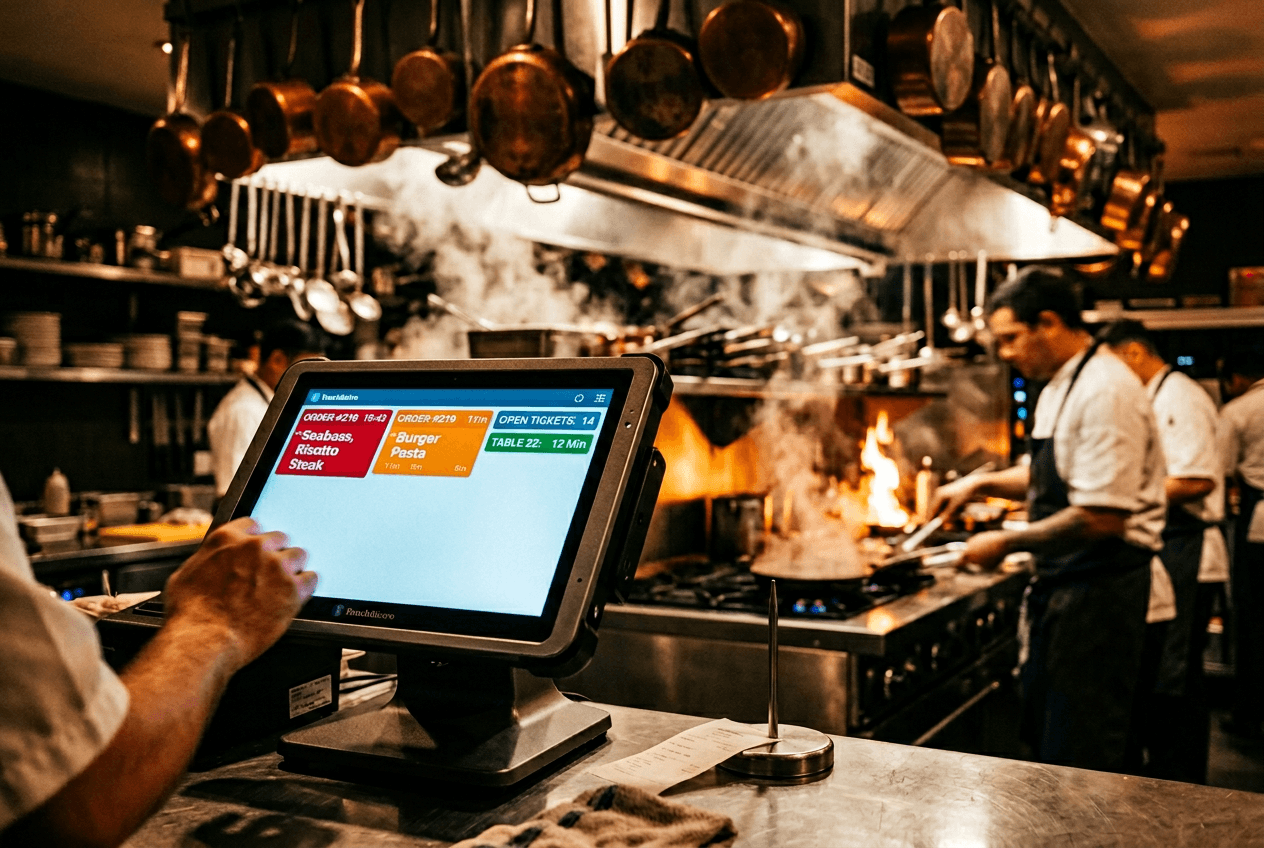 Restaurant POS terminal displaying marketing metrics in busy kitchen during evening dinner service
Toast Marketing Suite
What it is: A marketing add-on built into the Toast POS ecosystem — email campaigns, SMS messaging, loyalty programs, and automated guest engagement, all powered by your POS transaction data.
Pricing: The marketing suite runs approximately $185/month on top of your Toast POS subscription ($0–$69/month base). Total costs for a typical restaurant using Toast with marketing: $300–$700/month for small operations, $1,000–$2,000+ for full-service locations once processing fees and other add-ons are included. Toast typically requires a two-year contract.
Key features:
- Automated email and SMS campaigns triggered by guest behavior
- Built-in loyalty program tied directly to POS transactions
- Guest feedback collection and management
- Marketing ROI tracking at the dish level
- Online ordering integration
Pros: The biggest advantage is data. Because Toast controls your POS, it knows exactly what each customer ordered, when they last visited, and how much they spent. That makes automated marketing campaigns like "we miss you" re-engagement emails genuinely effective. You're not guessing — you're targeting guests based on real purchase history.
Cons: You're locked into the Toast ecosystem. The marketing tools only work with Toast POS, and the add-on pricing stacks up quickly on top of an already-expensive system. Switching away later means losing your entire marketing setup.
Best for: Restaurants already using Toast POS who want marketing that's tightly integrated with their transaction data. If you're not on Toast, this isn't an option.
Bloom Intelligence
What it is: An AI-powered customer data platform (CDP) that unifies guest data from WiFi, POS, reservations, online ordering, and review sites into one system — then automates restaurant marketing campaigns based on that intelligence.
Pricing: Quote-based only. Bloom targets multi-location restaurant groups, so expect enterprise-level pricing. They don't publish rates, which typically means $500+/month minimum, scaling with location count.
Key features:
- Customer Data Platform that merges data from every guest touchpoint
- WiFi analytics capturing walk-in guest data
- Automated email and SMS campaigns based on customer behavior
- AI-powered sentiment analysis and reputation management
- Lost guest recovery automation (claims to recover 38% of at-risk guests)
- Revenue attribution reporting
Pros: Bloom's real strength is intelligence. It doesn't just send emails — it identifies which guests are slipping away, what they're saying in reviews, and which marketing campaigns actually drive revenue. For multi-location operators, that kind of unified guest view across locations is genuinely hard to get elsewhere. The platform is trusted by 1,000+ restaurant locations.
Cons: The lack of public pricing is a red flag for small operators — you'll need to sit through a sales process. Setup requires integrating with your existing tech stack, which takes time. And the platform is clearly designed for restaurant chains, not a 20-seat café.
Best for: Restaurant groups with 5+ locations that need centralized guest intelligence and marketing automation at scale. Overkill for single-location independents.
Popmenu
What it is: A restaurant marketing platform that combines an interactive website builder, digital menu technology, and marketing automation (email, SMS, promotions) in one subscription. Over 10,000 restaurants in the US, UK, and Canada use it.
Pricing: Approximately $300/month per location. Multi-location pricing scales linearly — each additional location adds roughly $300/month regardless of order volume. Online ordering is available as an add-on rather than a core feature.
Key features:
- Interactive digital menus with dish-level data
- Restaurant website builder
- Email and SMS marketing campaigns
- AI-powered marketing content generation
- Review management and response tools
- Promotional offers and discount management
Pros: Popmenu's interactive menus are genuinely innovative — they capture data on which dishes get the most attention from guests, letting you make smarter marketing decisions. Their AI marketing tools help resource-strapped restaurants generate campaign content faster. A recent industry survey of 328 restaurant operators found that 97% are sharpening their focus on guest experience in 2026 — and this platform is designed to help deliver exactly that.
Cons: The $300/location/month adds up fast for groups. Ordering is treated as a secondary feature, not a core workflow. And for restaurants that already have a website they're happy with, rebuilding on Popmenu might feel unnecessary.
Best for: Independent restaurants that need a professional website AND digital marketing software in one package. Particularly strong if you don't have an existing website or your current one is underperforming.
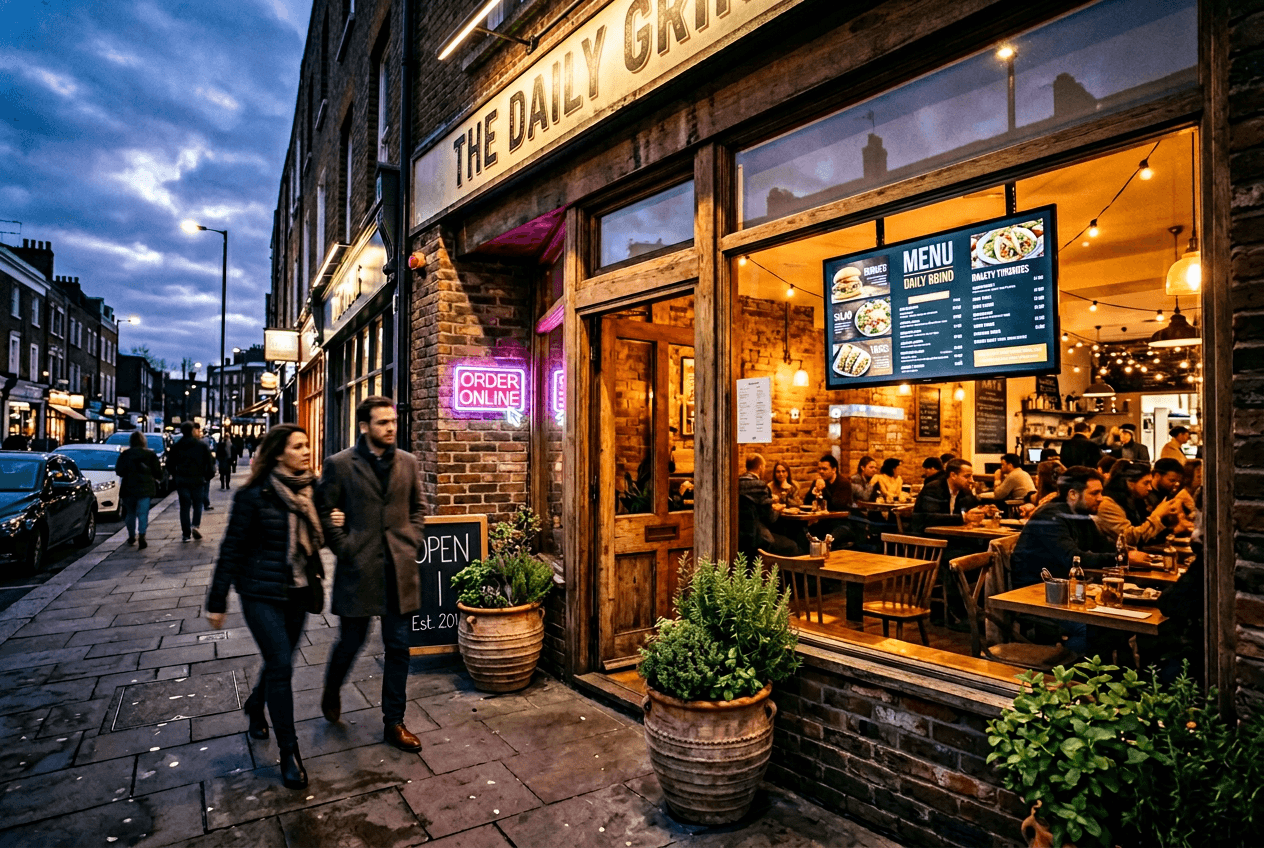 Independent restaurant storefront at twilight with digital menu board showing professional food photography visible through window
BentoBox (by Fiserv)
What it is: A marketing and commerce platform built specifically for restaurants, anchored by premium restaurant websites. BentoCore, the data hub at the center of the platform, collects diner information across every module and powers targeted marketing to your customers.
Pricing: The Core package starts at approximately $119/month for a restaurant website with built-in menu management, email, and SMS marketing. Add-ons include Takeout & Delivery ($49/month), Online Catering ($79/month), and Events Management. No contracts required.
Key features:
- Beautiful, restaurant-specific website templates
- BentoCore diner database with centralized guest data
- Email and SMS marketing tools
- Online ordering, reservations, and event ticketing
- Catering management module
- Gift card sales integration
Pros: BentoBox websites look excellent — this matters because your restaurant's brand identity starts with your website. The modular pricing means you only pay for what you use. Support gets consistently strong reviews from restaurant customers. And no contracts means you can leave if it's not working.
Cons: Limited customization for technically-savvy teams — you can't access source code or add custom plugins. The platform doesn't have a public API, which limits integration with other marketing tools. Add-on costs can accumulate if you need the full suite.
Best for: Full-service and upscale restaurants that want a polished online presence without hiring a web developer. The sweet spot is a restaurant business that needs a great website, basic marketing, and the option to add ordering and events over time.
 Restaurant owner's hands using smartphone for email marketing campaign on flour-dusted kitchen counter
Mailchimp
What it is: The most widely-used email marketing platform, now owned by Intuit. While not restaurant-specific, many restaurants use Mailchimp for email campaigns, automated sequences, and basic audience segmentation to reach customers.
Pricing: Free plan: 250 contacts, 500 emails/month (reduced significantly in early 2026, with another price increase effective April 2026). Essentials: $13/month for 500 contacts and 5,000 emails. Standard: approximately $20/month with more automation. Premium: $175/month. SMS messaging is an additional cost.
Key features:
- Drag-and-drop email builder with templates
- Marketing automation workflows (welcome series, birthday emails, re-engagement)
- Audience segmentation and targeting
- Landing page builder
- Basic analytics and reporting
- Integrates with virtually every other restaurant platform
Pros: The learning curve is gentle — most restaurant staff can build and send a campaign within an hour. Mailchimp integrates with almost everything: your POS, online ordering system, reservation platform, and website. At $13/month, it's the most affordable way to start email marketing for your restaurant business. The template library makes your emails look professional without design skills.
Cons: Nothing about Mailchimp is designed for restaurants. There's no POS integration logic, no guest intelligence, and no industry-specific templates beyond generic food images. The free plan is now nearly useless (250 contacts won't even cover a busy weekend's email captures). And costs escalate quickly — once your customer list grows past a few thousand, you'll pay $50–$100+/month.
Best for: Restaurants with tight budgets that need basic email marketing and don't want to commit to a restaurant-specific platform yet. If you're just starting to collect customer emails, Mailchimp is a reasonable first step. For deeper guidance on promoting your restaurant on social media, you'll need additional marketing tools for restaurants.
Owner.com
What it is: An all-in-one restaurant marketing platform designed to help independent restaurants compete with major chains. It bundles an AI-powered website, online ordering system, branded mobile app, and automated marketing campaigns into one subscription. Rated the #1 restaurant marketing software on G2 for Winter 2026 with 500+ five-star reviews.
Pricing: Two plans: Flat ($499/month with no additional restaurant fees) and Flex (lower subscription plus 5% per order). Both include the full feature set.
Key features:
- AI-built restaurant website optimized for conversions
- Commission-free online ordering
- Branded mobile app for your restaurant
- Automated email and SMS marketing campaigns
- Google Ads integration for driving new customers
- POS integrations (Toast, Clover, Square)
Pros: Owner.com's core pitch — reducing dependence on third-party delivery apps — resonates with restaurant owners watching 15–30% of each order disappear in commissions. The automated restaurant marketing is genuinely hands-off: campaigns trigger based on customer behavior without you building anything. Users frequently praise the customer support.
Cons: $499/month is steep for a small restaurant business, especially one not doing heavy online ordering. Some users report that the attentive pre-sale communication drops off after signing up. And the platform's flexibility is limited — it works a specific way, and you adapt to it.
Best for: Independent restaurants doing significant online ordering volume who are tired of paying 15–30% commissions to DoorDash, Uber Eats, and Grubhub. The math works once your monthly delivery commissions exceed what you'd pay Owner.com. For tips on getting more DoorDash orders regardless of platform, we've got a separate guide.
 Overhead view of busy restaurant takeout counter with branded delivery bags and online order tablet during lunch rush
Yelp for Business
What it is: A review and discovery platform where 2.4 million people search for restaurants daily. The business tools let you manage your listing, respond to reviews, run ads, and manage reservations through Yelp Guest Manager.
Pricing: Basic business profile is free. Yelp Ads start at approximately $5/day ($150+/month for meaningful visibility). Enhanced profile features and Yelp Guest Manager cost extra.
Key features:
- Free business profile with photos, hours, and menu
- Review monitoring and response tools for guest feedback
- Yelp Ads (appear above organic results and on competitor pages)
- Yelp Guest Manager (reservations and waitlist)
- Photo slideshow and call-to-action buttons (enhanced profiles)
- Performance analytics and customer insights
Pros: Yelp users are high-intent — they're actively deciding where to eat right now. The free listing alone provides meaningful visibility in Yelp-heavy markets. The reservation and waitlist tools compete directly with dedicated platforms. And Yelp reviews remain one of the most influential factors in restaurant discovery for customers.
Cons: Yelp's ad practices have generated significant controversy among restaurant owners. Ad spend can escalate quickly without clear ROI attribution. The platform's influence varies hugely by geography — dominant in major US metro areas, much weaker in smaller cities and rural areas. You also can't control negative reviews, which creates ongoing reputation management work.
Best for: Restaurants in major US cities where Yelp is a primary discovery channel. Essential as a free listing; worth testing paid ads only if you can track ROI carefully. Either way, great food photos on your Yelp profile make a huge difference — see our guide to food photography for delivery apps for photo tips that apply to listing sites too.
TripAdvisor for Restaurants (formerly SinglePlatform)
What it is: TripAdvisor acquired SinglePlatform in 2019, integrating its menu syndication and listing management technology into TripAdvisor's restaurant suite. The platform helps restaurants manage their presence across TripAdvisor's global travel audience and syndicate menu information to directories and search engines.
Pricing: Basic listing is free. Premium placement options, advertising, and enhanced features require paid subscriptions (pricing varies by market and features selected).
Key features:
- Restaurant listing management on TripAdvisor's global platform
- Menu syndication across online directories
- Review management and response tools
- Advertising options for increased visibility among guests
- Traveler engagement analytics
Pros: TripAdvisor reaches a massive global audience of travelers actively researching where to eat. For restaurants in tourist areas, this exposure is hard to replicate through other marketing channels. Menu syndication ensures your business information stays accurate across the web.
Cons: The platform's relevance for restaurant marketing has declined in recent years as Google Maps and Instagram have captured more dining discovery traffic. Marketing features are limited compared to dedicated restaurant marketing software. And the primarily traveler-focused audience means less value for neighborhood restaurants serving mostly local customers.
Best for: Restaurants in tourist-heavy areas or destinations where TripAdvisor rankings significantly influence where guests choose to eat. Less critical for local neighborhood spots.
ChowNow
What it is: A commission-free online ordering platform with built-in marketing tools for restaurants. ChowNow lets restaurants take unlimited orders through their website, a branded mobile app, and the ChowNow marketplace — while keeping customer data and avoiding per-order commissions.
Pricing: Not publicly listed, but reported at approximately $150–$300/month depending on features and plan level. Commission-free ordering is the core value proposition.
Key features:
- Commission-free online ordering
- Branded mobile app for your restaurant
- Customizable loyalty and rewards program
- Automated email marketing campaigns for customers
- Google ordering integration
- POS system integrations
- Order aggregation and menu management
Pros: The commission-free model is ChowNow's killer feature. For restaurants spending $1,000+/month in delivery app commissions, the math is straightforward. The loyalty program encourages direct repeat ordering from guests, and automated email marketing keeps customers coming back. Excellent reviews from operators, with particular praise for customer support.
Cons: Pricing opacity makes it hard to budget upfront. Marketing capabilities are secondary to the ordering platform — you won't get the depth of Bloom Intelligence or Popmenu's marketing automation. And building a customer base on your direct ordering channel takes time — you're competing against the convenience of third-party delivery apps.
Best for: Takeout-heavy restaurants whose main goal is shifting orders from commission-heavy third-party platforms to direct channels. The stronger your existing customer base, the faster this pays for itself. Avoid common food delivery photography mistakes to maximize your listing conversions.
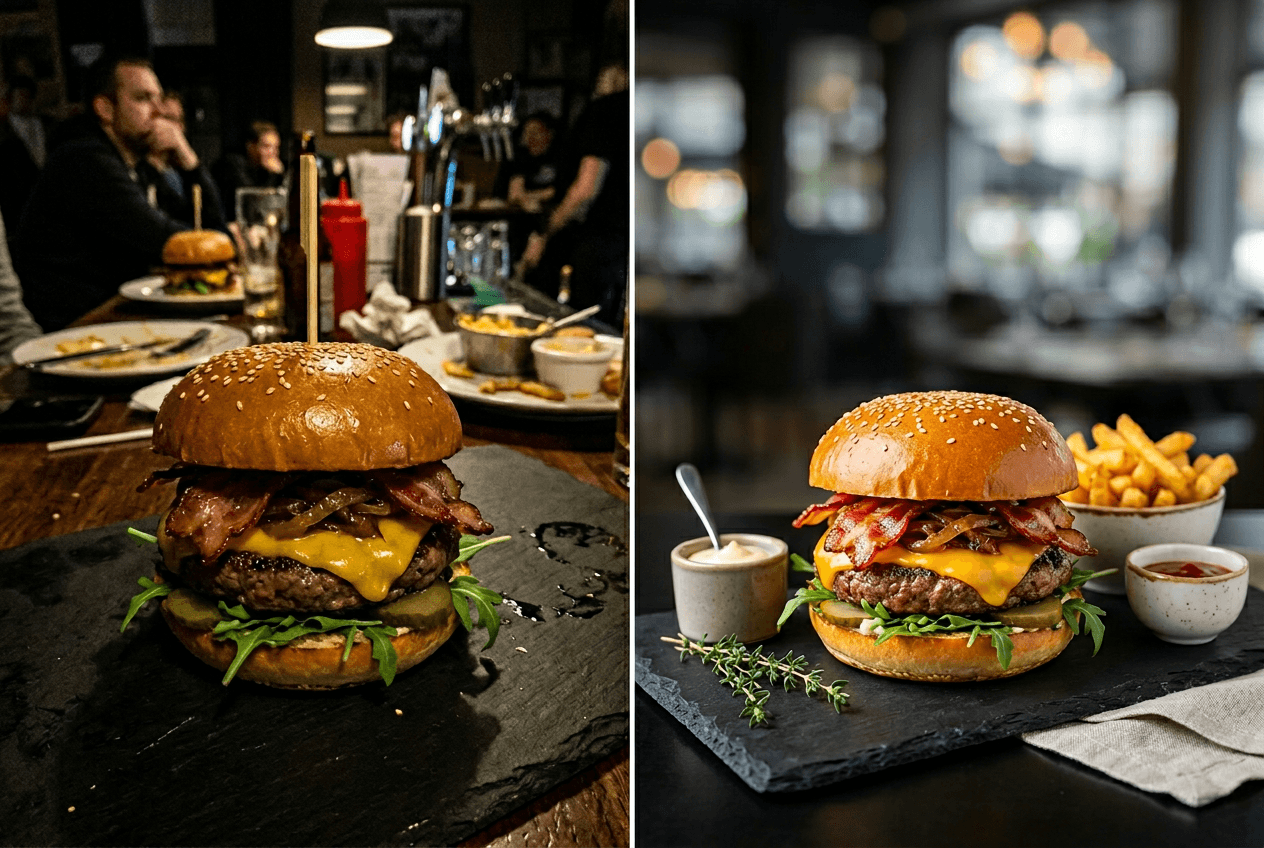 Side-by-side comparison of amateur versus AI-enhanced professional restaurant food photography showing dramatic quality difference
FoodShot AI — The Visual Marketing Layer
Here's what the comparison table above reveals: almost no restaurant marketing software addresses the one thing every marketing channel depends on — your food photos.
Every email campaign, social media post, website page, delivery app listing, and marketing poster needs food visuals. Yet the platforms above focus on distribution (getting your message out) while assuming you've already got great images. Most restaurants don't.
That's the gap FoodShot AI fills.
What it is: A purpose-built AI food photo editor that transforms smartphone photos of your actual dishes into professional, studio-quality images in about 2 minutes. It's not a full marketing suite — it's the visual foundation that makes every other restaurant marketing platform perform better.
Pricing:
- Free: 3 generations (watermarked)
- Starter: $15/month (25 generations, commercial license)
- Business: $45/month (100 generations)
- Scale: $99/month (250 generations, bulk processing)
- Enterprise: Custom (API access, volume pricing)
All paid plans include 40% off with annual billing.
What it does:
- Transforms any food photo with 30+ style presets (Delivery, Fine Dining, Instagram, Restaurant, and more)
- Removes and replaces backgrounds (luxury restaurant settings, beach cafes, minimalist surfaces)
- Creates social media posters and delivery app banners from 50+ templates
- Clones the style of any Pinterest or reference photo onto your dish
- Edits individual elements: add sauces, swap plates, adjust garnishes
- Adjusts camera angles and lighting styles
- Processes up to 5 photos at once on the Scale plan
Why it complements every platform above: Run a Toast email campaign with professional food photos instead of dark smartphone snapshots. Build your Popmenu website with images that match a fine dining aesthetic. Upload optimized visuals to your Yelp listing that stop scrollers. Create consistent content for your social media campaigns. Whatever marketing platform you choose, better food photos directly improve its performance.
Professional food photography typically costs $500–$1,500 per session. FoodShot delivers comparable visual quality at roughly 95% less — and you can update photos whenever your menu changes, not just when you can afford another photoshoot. That's why it pairs perfectly with any restaurant marketing software stack.
Best for: Any restaurant using any of the platforms above that wants their marketing visuals to match the quality of their marketing strategy. Particularly valuable for restaurants on delivery platforms where photo quality directly impacts order volume and customer decisions.
 Conceptual still-life of layered plates and marketing icons representing building a restaurant marketing technology stack
How to Build Your Restaurant Marketing Stack
No single restaurant marketing software platform does everything well. Here's how to combine them based on your business situation:
Single-location, tight budget ($30–$130/month): Mailchimp for email ($13/month) + Yelp free listing + FoodShot AI Starter for visuals ($15/month). This covers the essentials — email marketing, restaurant discovery, and professional food photos — for under $30/month. Add your free Google Business Profile as a non-negotiable baseline for any restaurant.
Growing independent restaurant ($165–$550/month): BentoBox for your website and basic marketing ($119/month) + FoodShot AI Business for visual content ($45/month). This gives you a professional web presence with marketing tools and a steady supply of great food photos for every channel. Or, if online ordering is your priority, ChowNow (~$200/month) + Mailchimp ($13/month) + FoodShot AI ($15/month).
Multi-location or high-volume ($500–$1,000+/month): Owner.com ($499/month) or Popmenu (~$300/location) for the core platform + FoodShot AI Scale ($99/month) for bulk visual content across locations. For larger chains, Bloom Intelligence provides the guest data intelligence layer that generic marketing platforms lack.
The through-line across every stack: Visual content. Your emails get higher click-through rates with professional food photos. Your social media marketing gets more engagement. Your delivery app listings convert more customers. Your restaurant website looks more appealing to guests. Investing in visual content isn't separate from your marketing software — it's what makes all of it work harder. For even more options beyond these software platforms, check out our broader restaurant marketing tools guide.
Frequently Asked Questions
What is the best restaurant marketing software for small restaurants?
For most small restaurants, Mailchimp ($13/month for email) paired with FoodShot AI ($15/month for visuals) and a free Yelp listing provides the highest impact per dollar spent. Total cost: under $30/month. If you need a website too, BentoBox starting at $119/month is the most restaurant-focused option without the complexity of larger platforms. For cafes specifically, visual marketing often has the highest ROI since customers heavily rely on food photos when deciding what to order.
How much should a restaurant spend on marketing software?
Industry guidance suggests restaurants allocate 3–6% of revenue to marketing overall. For marketing software specifically, expect $30–$500/month depending on your size and needs. A single-location café might spend $30–$130/month effectively on their restaurant marketing platform. A multi-location group running automated campaigns across channels will likely spend $500–$1,000+/month on their digital marketing software.
Do I need separate software for email, SMS, and loyalty?
Not necessarily. Restaurant marketing platforms like Toast Marketing, Owner.com, and Popmenu bundle email, SMS, and loyalty into one subscription. Bundling simplifies your workflow and keeps customer data unified. The tradeoff: bundled tools are rarely best-in-class at any single function. If email marketing is your primary channel for reaching guests, a dedicated tool like Mailchimp will outperform most bundled email features.
Can AI tools help with restaurant marketing?
AI is reshaping restaurant marketing in two major areas. First, content creation: tools like FoodShot AI transform amateur food photos into professional visuals, and Popmenu uses AI to generate campaign copy. Second, campaign optimization: Bloom Intelligence uses AI to identify at-risk guests and trigger recovery campaigns automatically. According to data from the 2025 FS/TEC conference, restaurants using AI-driven optimization see revenue increases of 5–12% per location — a compelling business case for adding AI to your marketing stack.
What's the ROI of restaurant marketing software?
Email marketing delivers an average of $36 for every $1 spent across industries — the highest of any digital marketing channel. Restaurant-specific email campaigns see open rates up to 43%, well above the cross-industry average. For ordering platforms like Owner.com and ChowNow, ROI is clearer: every order shifted from a 15–30% commission platform to your direct channel drops straight to your margin. Visual marketing tools like FoodShot AI pay for themselves if even one extra customer per week orders based on better photos — and delivery platforms recommend professional photos specifically because they increase order conversion rates for restaurant businesses.