How to Market a Catering Business: 10 Strategies That Work
 Ali Tanis16 min read
Your food is incredible. Your events run flawlessly. But your phone isn't ringing enough. If you're figuring out how to market a catering business, you're not alone — it's the single biggest challenge caterers face, and it has nothing to do with your cooking.
The U.S. catering market hit $77 billion in 2025 and is growing at a 6.2% CAGR through 2035. There's no shortage of demand. The real problem? Most potential clients simply don't know your catering business exists. Marketing fixes that.
Quick Summary: The biggest barrier to growing a catering business isn't your food — it's obscurity. These 10 marketing strategies focus on making your catering services visible online, building trust through visual content, and converting inquiries into booked events. Professional food photography is the common thread: menus with quality images increase sales by 20–45%, and delivery app listings with photos generate up to 70% more orders.
Why Marketing a Catering Business Is Different
Marketing a catering business isn't the same as promoting a restaurant. You don't have a storefront with foot traffic. Nobody stumbles past your commercial kitchen and decides to book a 200-person wedding reception.
Catering is a high-trust, high-ticket purchase. When an office manager books a $2,000 corporate lunch or a bride selects a $15,000 wedding package, they need confidence before they pick up the phone. That confidence comes from three things:
- Proof you can deliver — beautiful food photos of past events and setups
- Social proof — online reviews and testimonials from real clients
- Easy discovery — showing up where your target audience is actually searching
Every strategy below works toward at least one of these goals. For broader marketing context beyond catering, check out our guide to 50 restaurant marketing ideas — many translate directly to catering operations.
1. Build a Portfolio Website That Sells for You
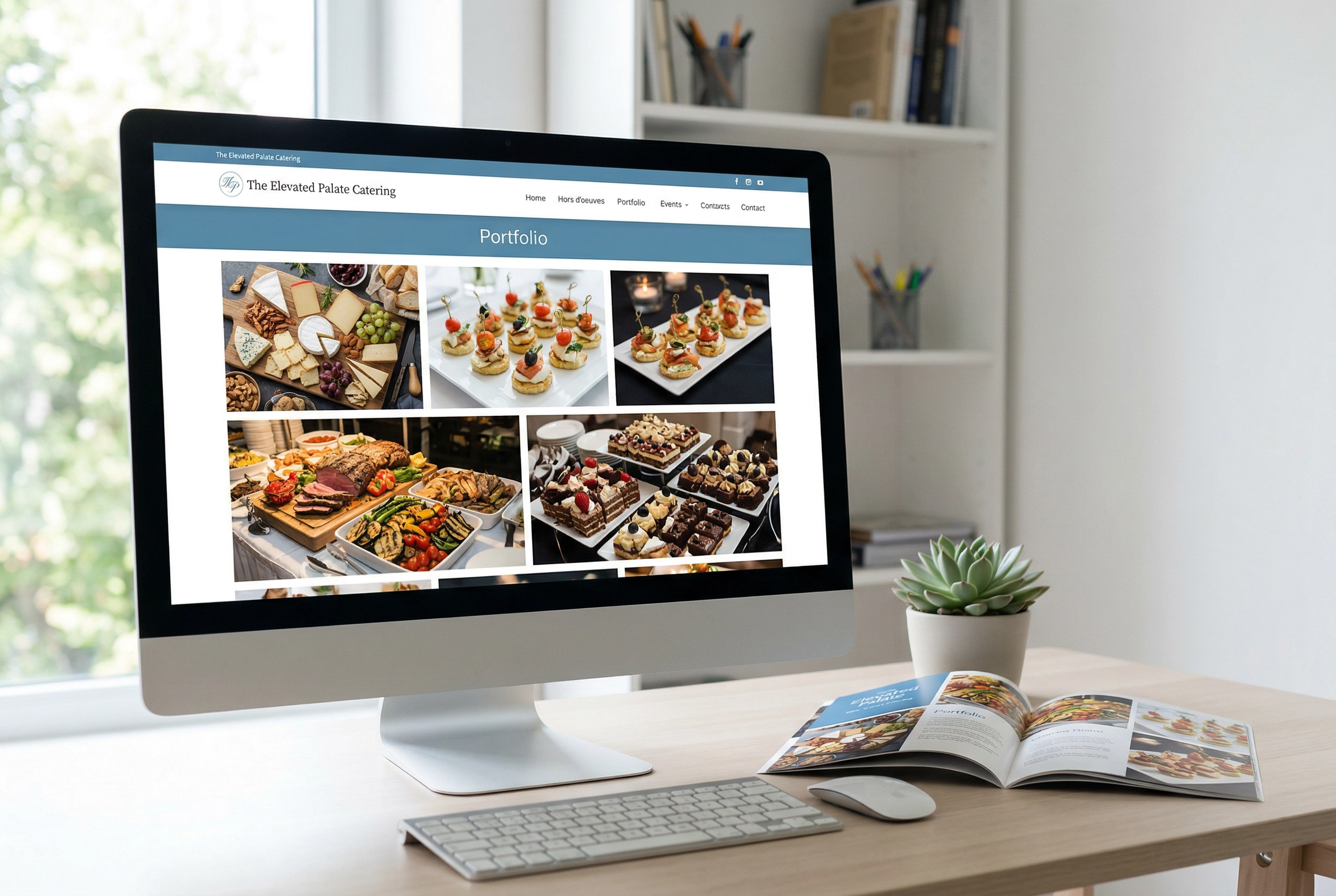 Catering portfolio website displayed on desktop monitor showing professional food photography of platters and events
Your website is your 24/7 sales rep. When a prospective client Googles "catering near me," your site needs to close the deal before they click the back button.
What your catering website must include:
- A dedicated catering page with clear menu packages (e.g., "Corporate Lunch Box — $12/person," "Wedding Buffet — from $45/person")
- Professional food photography of your platters, buffet stations, and event setups — not grainy phone photos of foil trays
- A simple inquiry form that captures event date, guest count, and budget range
- 2–3 client testimonials above the fold
- Mobile-friendly design — over 60% of local searches happen on mobile devices
Here's the data that makes this non-negotiable: restaurants that switch from text-only menus to photo-based menus see a 25% conversion rate increase. For catering, where clients can't walk in and taste the food, that visual trust factor matters even more.
Don't bury your catering menu in a downloadable PDF. Make it browsable, visual, and easy to act on. Check our restaurant food photography guide for tips on shooting dishes that convert browsers into paying customers.
2. Claim and Optimize Your Google Business Profile
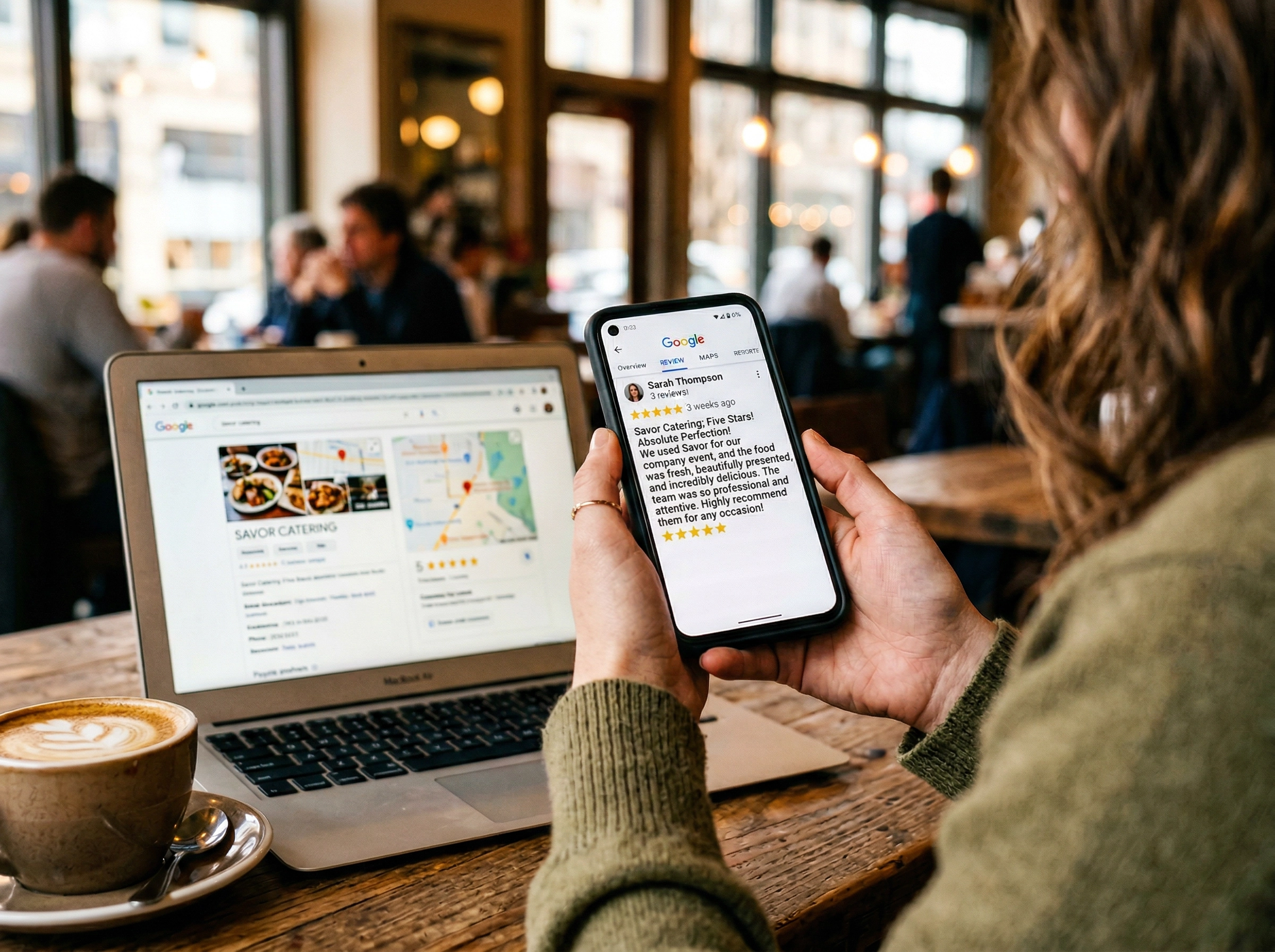 Five-star Google review for catering business displayed on smartphone with Google Business Profile on laptop behind
When a local office manager needs lunch catered for 30 people by Friday, they search Google. If your Google Business Profile (GBP) isn't optimized for catering services, you're invisible at the exact moment someone is ready to book.
How to optimize your GBP for catering:
- Add "Catering" as a service category. Don't just list "Restaurant" — explicitly add catering services with descriptions and pricing ranges.
- Upload 10+ professional photos of platters, buffet lines, boxed lunches, and event setups. Google profiles with photos receive 42% more direction requests than those without.
- Use Google Posts to share seasonal catering promotions: "Book your holiday party catering by November 1st — 10% early bird discount."
- Proactively add Q&As: "Do you deliver catering?" "What's your minimum order size?" "Do you offer vegan and gluten-free options?" Answer them yourself before prospects have to ask.
- Ask every satisfied client to leave a Google review — specifically mentioning the event. "Amazing corporate lunch for our team of 50!" carries more weight than a generic five-star click.
Your GBP is free, powerful, and the first thing most local prospects see when searching online. Treat it like a second homepage for your catering business.
3. Partner with Event Venues and Wedding Planners
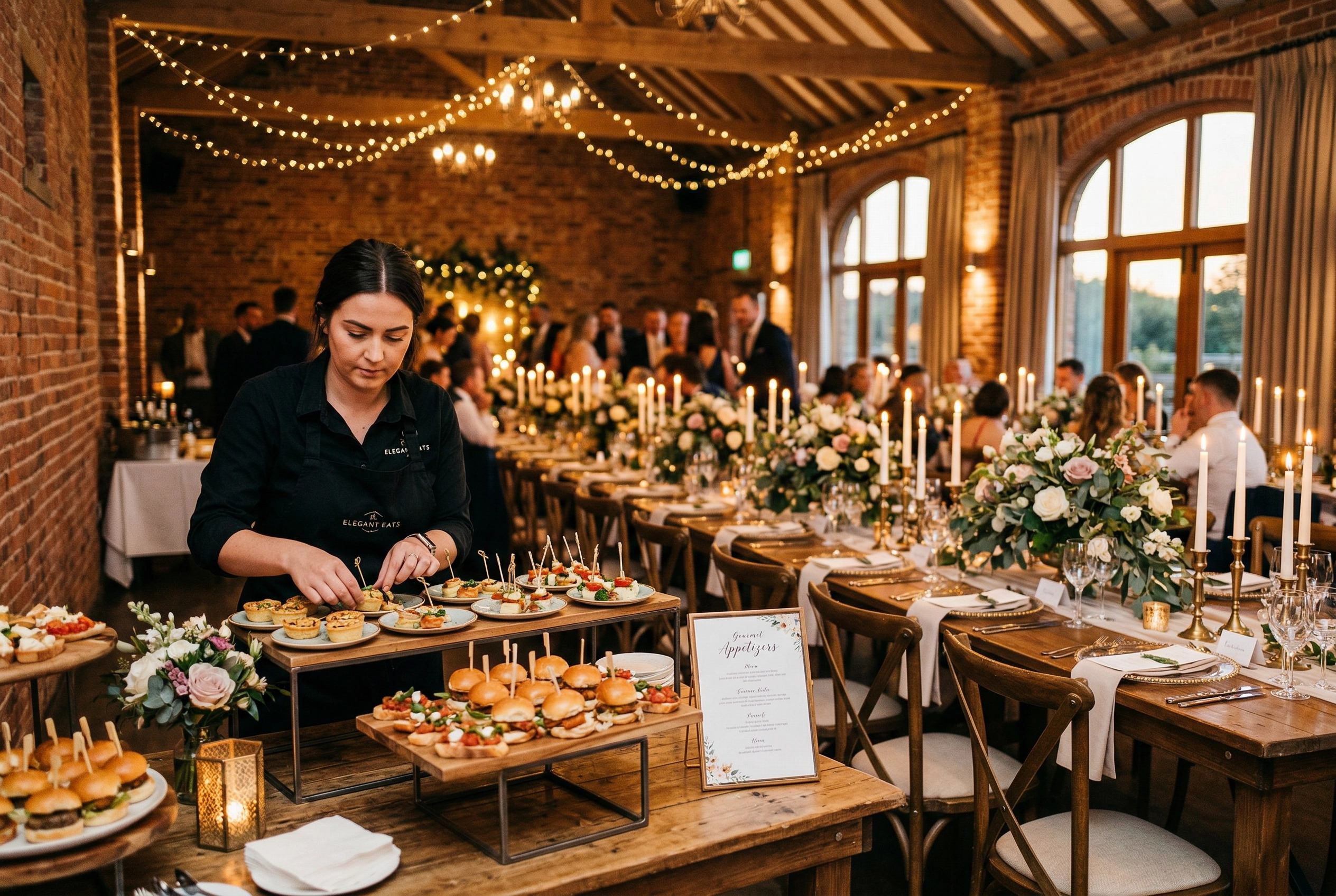 Wedding reception catering setup with caterer arranging appetizer platters at an elegant venue with string lights
Venue partnerships are one of the most underused catering advertising strategies — and potentially the most profitable. When a venue recommends your services, that referral comes with built-in trust that no ad can replicate.
How to build venue partnerships:
- Make a list of every event venue, brewery taproom, community hall, and boutique hotel within your delivery radius that does not have an exclusive in-house caterer.
- Offer a free tasting lunch for their event coordinators and sales team. Let your food do the selling.
- Ask to join their preferred vendor list. This is the gold standard — venues hand this list to every client booking a wedding or corporate event.
- Cross-promote on social media: Mention the venue in your posts (and tag them). They'll return the favor to their audience.
Do the same outreach with wedding planners, corporate event coordinators, and florists. These referral relationships compound over time. One strong relationship with a busy wedding planner can generate 10–15 qualified leads per year — with zero advertising spend.
4. Use Social Media to Showcase Your Catering Events
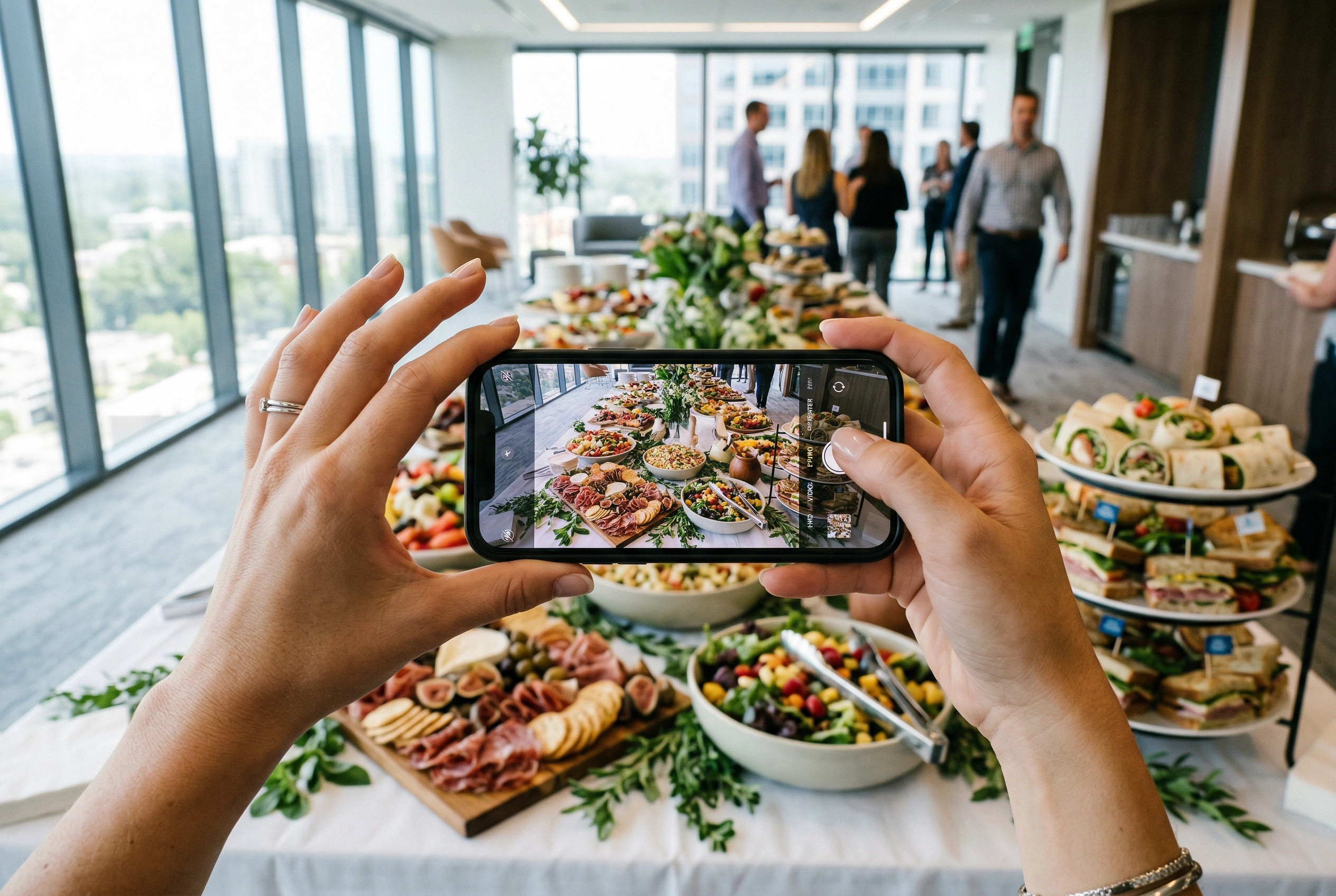 Hands photographing a catering buffet spread with smartphone for social media marketing content
Social media marketing for a catering business isn't about posting daily food specials. It's about building a visual portfolio that proves you can handle any event — from a 20-person office lunch to a 300-person wedding. Research shows that 40% of people have tried a new restaurant after seeing food photos on social media, and the same impulse drives catering inquiries.
Platform-by-platform strategy:
- Instagram → Your visual portfolio. Post Reels of your team plating dishes, loading the delivery van, and setting up at a gorgeous venue. Before-and-after content works great: raw kitchen prep → stunning buffet display. Use Instagram Stories for behind-the-scenes moments.
- Facebook → Your community hub. After every event (with client permission), create a photo album: "The Johnson Wedding at Hillcrest Estate." Tag the venue, florist, and DJ to expand your reach to their audiences.
- LinkedIn → Your corporate catering channel. Post about successful corporate lunches, company milestones, and client partnerships. Office managers and executive assistants scroll LinkedIn daily — put your catering services in front of them.
Pro tip on local hashtags: Nobody searching for catering uses #food. They use #DallasCatering, #NYCEventCatering, or #ChicagoCorporateLunch. Use specific local hashtags to get discovered by people actively searching in your service area.
For a deeper dive, read our restaurant social media strategy guide or explore the best social media platforms for food businesses.
5. Invest in Professional Food Photography (or Use AI)
Every single marketing strategy on this list performs dramatically better with great food photography. Your website, GBP, social media posts, proposals, printed menus, email campaigns — all of them live or die by how your food looks on screen and in print.
The numbers are clear: menus with professional photos increase sales by 20–45%, and delivery listings with images generate up to 70% more orders according to Grubhub data.
Your two main options:
Traditional food photography typically runs $500–$1,500 per session. You'll get 15–30 polished images, and you'll need to schedule a new shoot every time your menu changes or you add seasonal items. For a detailed look at what's involved, see our guide to commercial food photography.
AI food photography is the faster, more budget-friendly alternative. With FoodShot AI, you snap a photo of your dish with your phone and transform it into studio-quality imagery in about 2 minutes — at roughly 95% less cost than a traditional shoot. FoodShot offers 100+ curated styles including categories specifically built for catering: delivery, menu, and fine dining looks. The My Styles feature lets you upload reference photos so every image matches your brand's exact aesthetic.
This is especially valuable for catering businesses because you need so much variety. Charcuterie boards look different from corporate boxed lunches, which look different from wedding dessert tables. AI lets you photograph everything as you prep it — no scheduling delays, no $1,500 reshoot when you update your spring menu.
Plans start at $15/month for 25 images with commercial licensing included.
If you'd rather DIY your initial food photos, our guide on how to take good food photos covers the essentials with no professional gear required.
6. Collect and Display Testimonials Prominently
In the catering business, trust is everything. A glowing review from a bride who booked a 200-person reception carries more marketing power than any paid ad you could run.
How to build a testimonial engine for your catering company:
- Ask within 24–48 hours of the event while the experience is fresh. Send a short text or email: "We loved catering your event! Would you mind leaving a quick review on Google?"
- Make it frictionless — include direct links to your Google and Yelp review pages. The fewer clicks required, the higher your response rate.
- Feature testimonials everywhere — your website homepage, catering menu page, proposals, social media content, and even printed brochures. Don't hide them on a separate page nobody visits.
- Ask for specifics — "What did your guests say about the food?" yields far better testimonials than "How was our service?"
- Respond to every online review — positive or negative. Publicly resolving a concern shows future clients you handle problems professionally.
Corporate clients in particular check reviews before booking. A handful of detailed, recent reviews mentioning specific event types ("perfect for our 75-person holiday party") will outperform dozens of generic five-star ratings.
7. Create Seasonal Promotion Campaigns
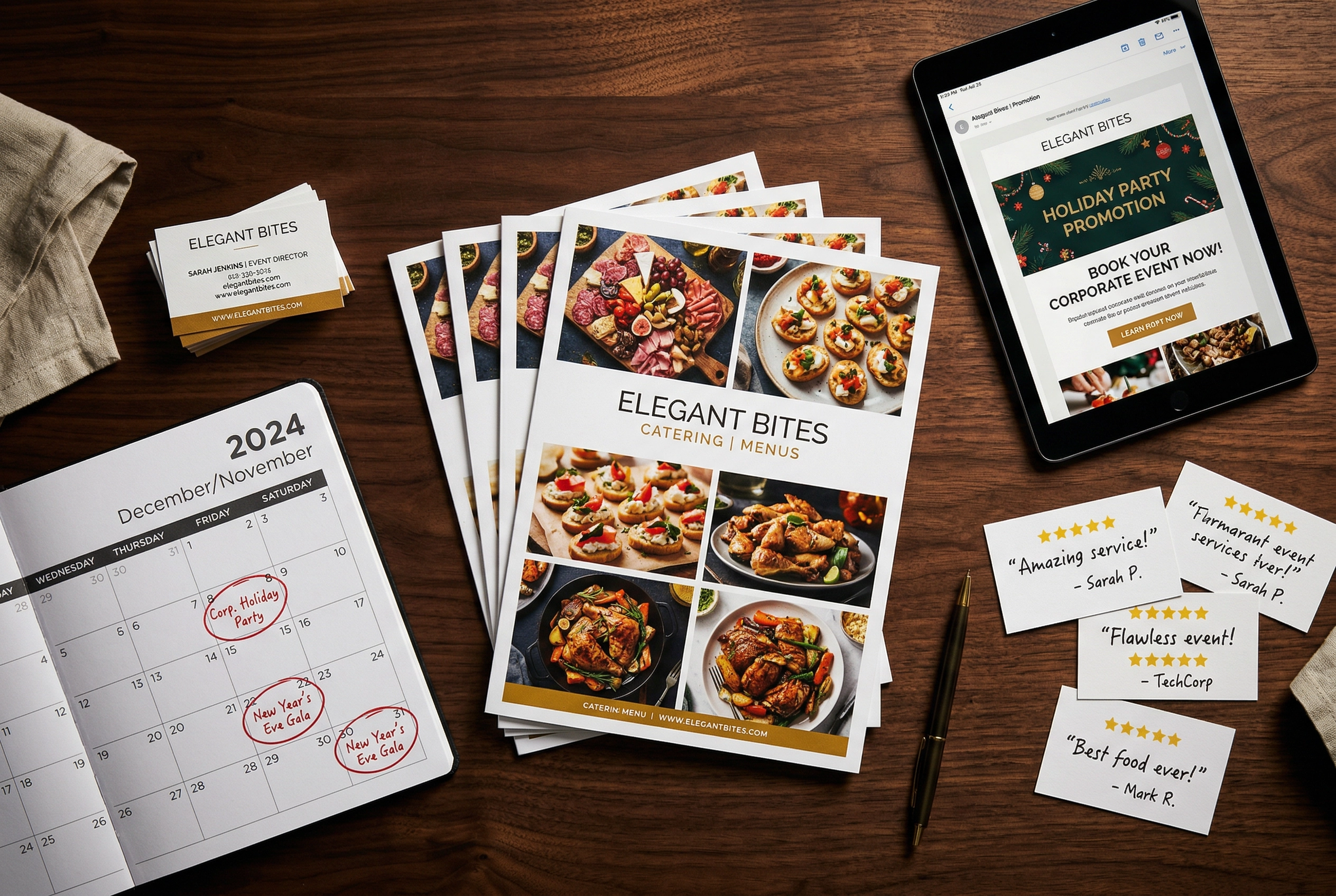 Flat-lay of catering marketing materials including menus, email newsletter, testimonials, and seasonal calendar
Catering demand is seasonal, and smart marketing follows that cycle. Plan your promotional campaigns around when clients are booking — not when events are happening. That means promoting holiday party packages in September, not December.
A seasonal catering marketing calendar:
| Season | Opportunity | Start Promoting |
|---|---|---|
| Q4 (Oct–Dec) | Holiday parties, year-end celebrations | September |
| Spring | Wedding season, graduations | January–February |
| Summer | Outdoor events, corporate retreats | April |
| Q1 (Jan–Mar) | Corporate kickoffs, New Year events | November |
Tactical tips for promotions:
- Create themed packages: "Holiday Party Package — $35/person, 50-person minimum, includes setup and cleanup"
- Use urgency: "Only 8 Saturday slots remaining for December — book your holiday catering now"
- Target corporate catering on peak days: Corporate catering demand is heaviest Monday through Wednesday. Time your advertising and email promotions accordingly.
- Update your food photography seasonally to reflect current menus and seasonal dishes
8. Network at Industry Events and Trade Shows
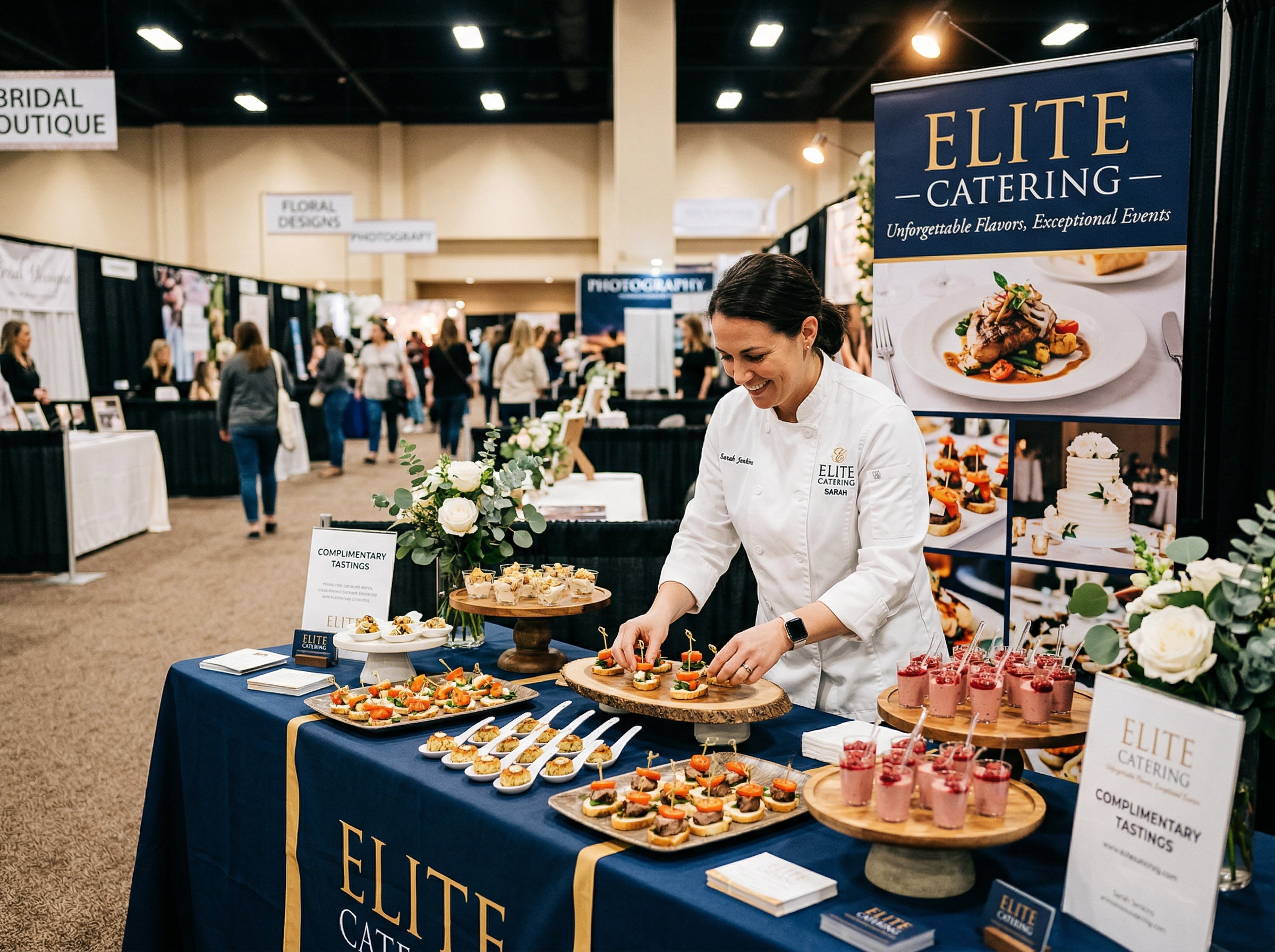 Caterer setting up a branded booth at a bridal expo with food samples and professional photography banner display
Digital marketing is powerful, but catering is still a relationship business. Showing up in person with a sample platter and a professional lookbook can open doors that a Facebook ad never will.
Where to network to grow your catering business:
- Bridal expos and wedding fairs — high-value leads with clear intent to book
- Chamber of Commerce meetings — connect with local business owners who need corporate catering services
- Restaurant and hospitality trade shows — meet venue managers, event planners, and food industry suppliers
- Local food festivals — showcase your food to hundreds of potential customers in a single day
What to bring: Business cards, a QR code linking to your catering page, printed menus featuring professional food photos, and — most importantly — food samples. Let people taste what you offer. It's the most persuasive marketing pitch you'll ever make.
The follow-up is where deals happen. Collect contact information and follow up within 48 hours. A simple email — "Great meeting you at the bridal expo! Here's our catering portfolio" — converts better than most paid advertising.
9. Offer Tasting Events for Corporate Prospects
 Corporate office tasting event with employees sampling catering food and receiving printed menus from caterer
Corporate catering is the most profitable and repeatable revenue stream in the catering industry. A single office that orders lunch twice a week at $500 per order is worth $52,000 annually. But here's what most caterers get wrong: they pitch to the CEO when the actual decision-maker is the office manager or executive assistant.
How to land and grow corporate catering clients:
- Identify the 10–15 largest office buildings in your delivery radius.
- Drop off a small sample platter with your catering menu, a business card, and a handwritten note to the front desk or office manager. A $30 investment in pastries can start a relationship worth thousands.
- Host quarterly "Taste & Meet" events at your kitchen or a partner venue. Invite office managers from local businesses. Keep it casual, social, and delicious.
- Follow up with a direct ordering link — make it as easy as possible for them to place a first order. Remove every point of friction.
- Frame pricing per person rather than total cost. "$10–12 per person" sounds reasonable. "$500 for 50 people" triggers sticker shock — even though it's the same thing.
One corporate account that reorders weekly is worth more than 20 one-time social events. Invest your time and marketing budget accordingly.
10. Implement Email Marketing for Repeat Business
Email marketing delivers the highest ROI of any digital marketing channel — roughly $36 for every $1 spent. For catering businesses, where repeat bookings and seasonal demand drive revenue, email is an essential tool in your marketing plan.
Build your email list from:
- Event inquiry forms (even prospects who didn't book)
- Past clients and their contacts
- Tasting event attendees
- Trade show and expo contacts
- Website newsletter signups
What to send to promote your catering business:
- Monday morning emails to corporate clients: "Need a last-minute lunch catered this week? Order direct by 10 AM." Catch them during their Monday planning session.
- Seasonal reminders: "It's November — have you booked your holiday party catering yet? Only 6 December dates remaining."
- New menu announcements: Share updated seasonal menus with fresh food photos. Another reason to keep your food photography current year-round.
- Client spotlights: "See how we catered the Johnson wedding at Oakwood Estate — 150 guests, farm-to-table menu." Real stories with great photos build trust with new prospects.
Segment your list by client type — corporate, wedding, social events — so every email feels relevant. A corporate office manager doesn't care about wedding packages, and a bride-to-be doesn't need Monday lunch specials. Personalized emails get opened; generic blasts get deleted.
For tools to manage your marketing campaigns, see our roundup of the best restaurant marketing tools.
The Common Thread: Visual Marketing Drives Catering Inquiries
Look at every strategy above. Each one performs dramatically better with professional food photography:
- Your website converts more inquiries with beautiful food images
- Your Google Business Profile earns more clicks with high-quality photos
- Your social media generates more engagement with polished visual content
- Your proposals and brochures close more deals when clients can see exactly what they'll get
- Your email campaigns achieve higher click-through rates with appetizing food imagery
The historical challenge for caterers was that professional photography is expensive, time-consuming, and hard to keep current across a rotating menu. AI tools like FoodShot AI solve this by letting you transform any phone photo into studio-quality imagery in about 2 minutes — so you can photograph every platter, every buffet station, and every new seasonal menu item without booking a photographer or spending hundreds per session.
When your visuals are sharp across every marketing channel, you're not just advertising. You're building the kind of trust that turns online browsers into booked events.
Frequently Asked Questions
How much should a catering business spend on marketing?
Most catering businesses allocate 3–6% of annual revenue to marketing. For a business doing $300,000/year, that's $9,000–$18,000 annually. Start with free channels — Google Business Profile, social media, and email marketing — before investing in paid ads. Many strategies in this guide, like venue partnerships and review collection, cost little beyond your time and food samples.
What is the most effective catering marketing strategy for beginners?
Optimize your Google Business Profile and build a portfolio website with professional food photography. These two steps ensure you show up when local prospects search for catering and give them a compelling reason to inquire. They're free (or nearly free) and generate passive leads once set up properly.
How do I market a catering business with no budget?
Focus on relationship-based strategies: partner with local venues, ask satisfied clients for referrals, post consistently on social media, and actively collect Google reviews. Drop off sample platters at nearby offices — the food cost is minimal compared to the potential lifetime value of a corporate account. Use FoodShot AI to create professional-quality portfolio images from your own event photos.
How do I get corporate catering clients?
Target office managers and executive assistants — they're the ones who actually place catering orders, not the CEO. Drop off sample platters at large office buildings, attend Chamber of Commerce events, post catering content on LinkedIn, and send Monday morning email campaigns. Corporate clients reorder repeatedly, so even a small investment in landing one account pays off quickly over time.
Does food photography really matter for catering businesses?
Yes — it's arguably the most impactful investment you can make. Catering clients can't taste your food before booking, so they buy with their eyes. Menus with professional photos see 20–45% higher sales, and 40% of consumers have tried a new food business after seeing appealing images on social media. For caterers, where average order values range from $500 to $15,000+, even a modest improvement in conversion rate translates to significant revenue growth.