20 Catering Marketing Ideas to Book More Events in 2026
 Ali Tanis26 min read
Most caterers don't have a food problem. They have a visibility problem.
The U.S. catering market hit $77 billion in 2025 and is projected to reach $140 billion by 2035, growing at a 6.2% CAGR. There are over 13,600 catering businesses in the U.S. competing for those dollars — which means great cooking is the price of entry, not the thing that wins the booking. Marketing is.
This list gives you 20 specific catering marketing ideas you can put to work this month. Each one is tagged with Effort, Cost, and Impact so you can pick what fits your calendar and budget. They're organized into four categories — Digital, Local Partnerships, Content Marketing, and Traditional — because a healthy marketing mix pulls from all four.
Quick Summary: The biggest growth lever for most caterers isn't a new channel — it's consistency across channels. These 20 catering marketing ideas are organized by effort, cost, and impact so you can prioritize what fits your catering business. The thread running through nearly every one of them: professional food photography. It's the single investment that makes your website convert better, your Google profile rank higher, your social media posts stop the scroll, and your proposals close faster. For a deeper strategic framework, see our complete catering marketing strategy guide.
How to Use This List (Effort · Cost · Impact)
Every catering marketing idea below is tagged with three quick indicators so you can triage them against your time and budget.
- Effort — How much of your time it takes. Low = a few hours total. Medium = a few hours to set up, weekly upkeep. High = ongoing project or significant time investment.
- Cost — Monthly or per-project spend. Free to $50/mo is easy to justify. $500+ needs clearer ROI thinking.
- Impact — Realistic booking lift once the tactic is running. Low adds to the mix, Medium drives steady inquiries, High can be a primary growth driver for your catering business.
One pattern you'll notice throughout: food photography shows up everywhere. Your website, your Google profile, your Instagram, your proposals, your packaging. It's not one of the 20 catering marketing ideas because it stands alone — it's one of them because it makes the other 19 work harder. We'll come back to that at the end.
Digital Catering Marketing Ideas (1–7)
Digital marketing is where most caterers under-invest, then wonder why inquiries are slow. These seven ideas are your foundation — they run 24/7 whether you're plating canapés or asleep.
1. Build a Portfolio Website That Actually Converts
Effort: Medium · Cost: $500–2,000 to build + $20–50/mo hosting · Impact: High
Your catering business website is a salesperson that never sleeps. When a prospect searches "wedding caterer near me" at 11 p.m., your site has about 15 seconds to close the gap between curiosity and inquiry.
The non-negotiables for a catering website that converts:
- A dedicated catering page with clear menu packages and price ranges (e.g., "Corporate Lunch Box — $14/person," "Wedding Buffet — from $55/person")
- Professional food photos of your platters, buffet stations, and past event setups — not grainy foil-tray phone shots
- A simple inquiry form capturing event date, guest count, venue, and budget range
- 2–3 client testimonials above the fold, with event type and guest count ("Corporate holiday party, 180 guests")
- Mobile-first design — over 60% of local service searches happen on phones
Restaurants that switched from text menus to photo menus saw a 25% conversion lift in industry studies. For catering, where clients can't taste before they book, visual trust matters even more.
2. Optimize Your Google Business Profile for Catering
Effort: Low · Cost: Free · Impact: High
Your Google Business Profile (GBP) is the highest-leverage free tool in catering marketing. When a local office manager needs lunch for 30 people by Friday, they're searching Google — and whoever ranks in the local map pack gets the call.
The optimization checklist:
- Add "Catering" as a primary service, not just "Restaurant"
- Upload 10+ professional photos of platters, buffet lines, boxed lunches, and event setups. Google profiles with photos get 42% more direction requests than those without.
- Use Google Posts for seasonal promotions ("Book holiday catering by November 1st — 10% early-bird discount")
- Proactively answer Q&As: "Do you deliver?" "What's your minimum?" "Do you offer vegan options?"
- Ask every client for a Google review within 48 hours of the event, and ask them to mention the event type
This one tactic alone can double local catering inquiries within 90 days. It's free. Do it this week.
3. Post Tasting and Behind-the-Scenes Reels
Effort: Medium (1–2 hours/week) · Cost: $0 if you use a phone · Impact: Medium–High
Short-form video is where food content lives in 2026. Instagram Reels, TikTok, and YouTube Shorts all prioritize food content, and catering has a natural advantage: every event is a production, and productions are fascinating to watch.
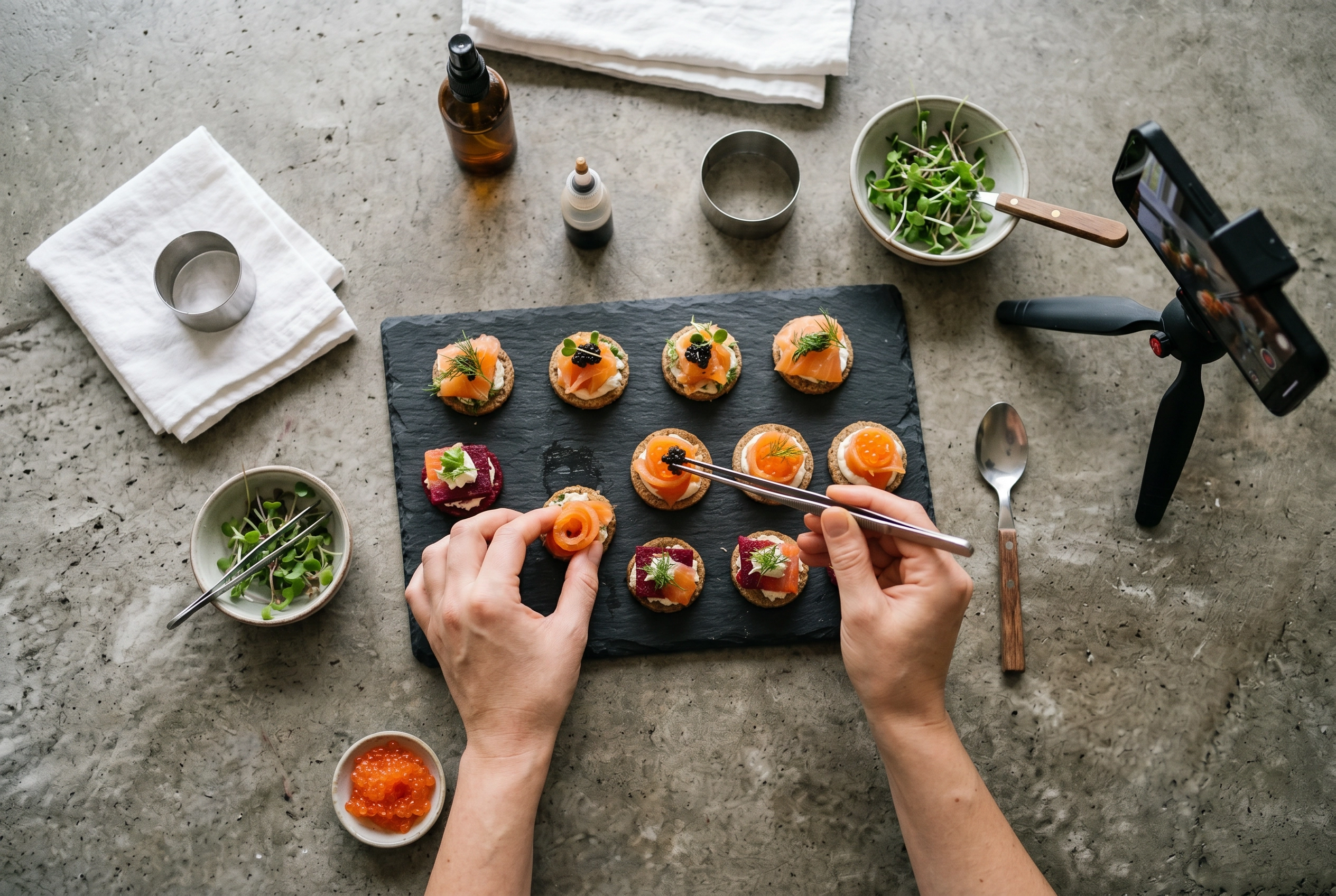 Overhead view of chef plating canapés on slate board while smartphone on tripod films social media reel content
High-performing reel formats for catering businesses:
- Plate-up sequences — 10 seconds of a canapé being built, shot from above
- Buffet reveal — cutaway from empty tables to finished spread
- Van-to-venue — loading out, driving, setting up at a gorgeous location
- Client reaction — the moment the guests of honor see their food
- Before/after — raw ingredients in a prep kitchen cutting to the plated final
Research from the National Restaurant Association and consumer surveys suggests roughly 40% of diners have tried a restaurant after seeing its food on social media. The same impulse drives catering inquiries — especially for weddings and milestone events where people spend months on Pinterest and Instagram before deciding.
4. Run Email Drip Campaigns for Past Clients
Effort: Medium to set up, Low ongoing · Cost: $20–50/mo · Impact: High
Past clients are the highest-intent audience you'll ever have. They already know your food, they already trusted you with an event, and they're already on your email list (you do have their email, right?).
Four sequences worth building:
- Post-event thank-you (sent 24 hours after) — Thank them, ask for a review, include 3–5 photos from their event, and a 10% discount code for a future booking.
- Anniversary reminder (1 year after) — "A year ago we catered your launch party — ready to plan the next one?" Corporate clients especially book on repeating cycles.
- Seasonal menu drop (4x/year) — New spring menu, summer cocktail hour menu, fall harvest menu, holiday party menu. Each one is a reason to re-engage.
- Referral ask (sent 30 days after event) — "Know anyone planning an event? We'd love to be their caterer. Here's a 15% discount for them and a $100 credit for you."
Any standard email platform works for this — look for one that integrates with your booking or CRM system. Our roundup of restaurant marketing software covers the options that fit catering workflows.
5. Build Pinterest Boards of Past Events
Effort: Low–Medium · Cost: Free · Impact: Medium (long-tail)
Pinterest is often dismissed as an Instagram also-ran, but it's actually a visual search engine — and it's where couples, event planners, and party hosts go six months before they book a caterer. Pins have a shelf life measured in years, not hours.
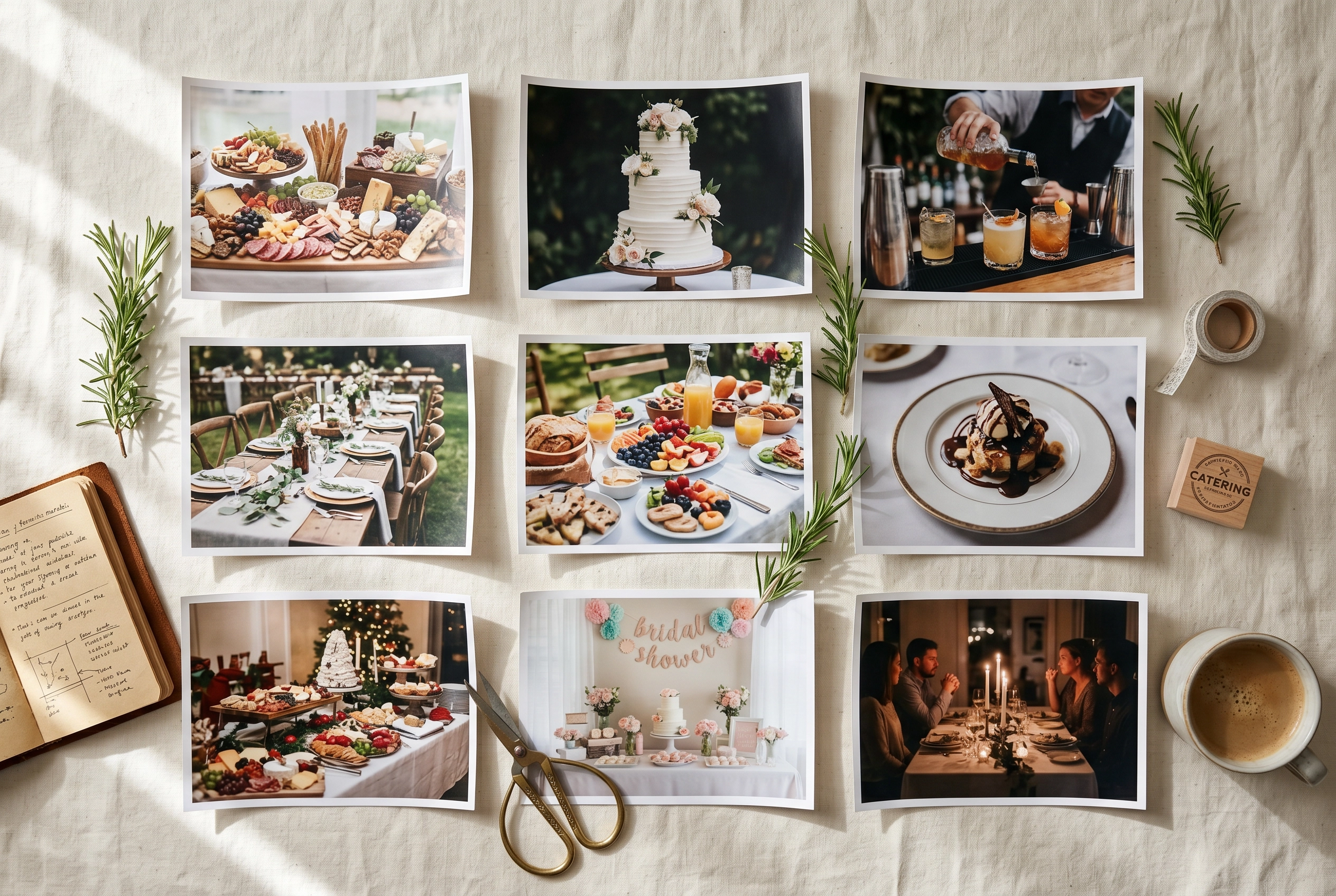 Overhead styled moodboard of printed catering event photos and planning tools arranged on linen
How to make Pinterest pull its weight for your catering business:
- Create boards organized by event type: "Rustic Barn Weddings," "Corporate Breakfast Catering," "Bridal Shower Brunch," "Holiday Office Party"
- Pin 8–12 images per event, styled with your logo watermarked in the corner
- Write keyword-rich pin descriptions that include your city ("Dallas wedding caterer," "NYC corporate lunch catering")
- Link every pin back to your catering page, not just the homepage
- Aim for 5–10 new pins per week
A single pin of a well-styled charcuterie display can drive traffic to your site for two years. That's the magic of Pinterest — it's slow, then suddenly it's compounding.
6. Manage Online Reviews Like a Full-Time Job
Effort: Low (once systemized) · Cost: $0–50/mo · Impact: High
Reviews are the single biggest trust signal a potential client sees before inquiring. According to consumer research, review count, recency, and star average all factor into local search rankings and booking decisions.
Build a review engine, not a review habit:
- Ask every client within 24–48 hours of the event — while the experience is fresh and the thank-you is genuine
- Give them a direct link to leave a Google review (use the short URL Google provides)
- Ask for specifics — "If you could mention the event type and guest count, it really helps other clients find us"
- Respond to every review, good or bad, within 48 hours. A thoughtful response to a 3-star review often converts better than 100 five-star reviews with no engagement.
- Never pay for reviews or ask employees to post fakes — Google penalizes both, and they read as fake to real clients
A catering business with 80 recent reviews averaging 4.7 stars will out-convert one with 15 reviews averaging 5.0 every time.
7. Invest in Professional Food Photography
Effort: Low (AI) to High (traditional shoot) · Cost: $15–100/mo (AI) or $500–1,500 per shoot · Impact: Very High
Here's the uncomfortable truth: if your food photos look amateur, every other catering marketing idea on this list underperforms. Your website converts worse. Your Google profile ranks lower. Your reels get scrolled past. Your proposals lose to the caterer with better pictures.
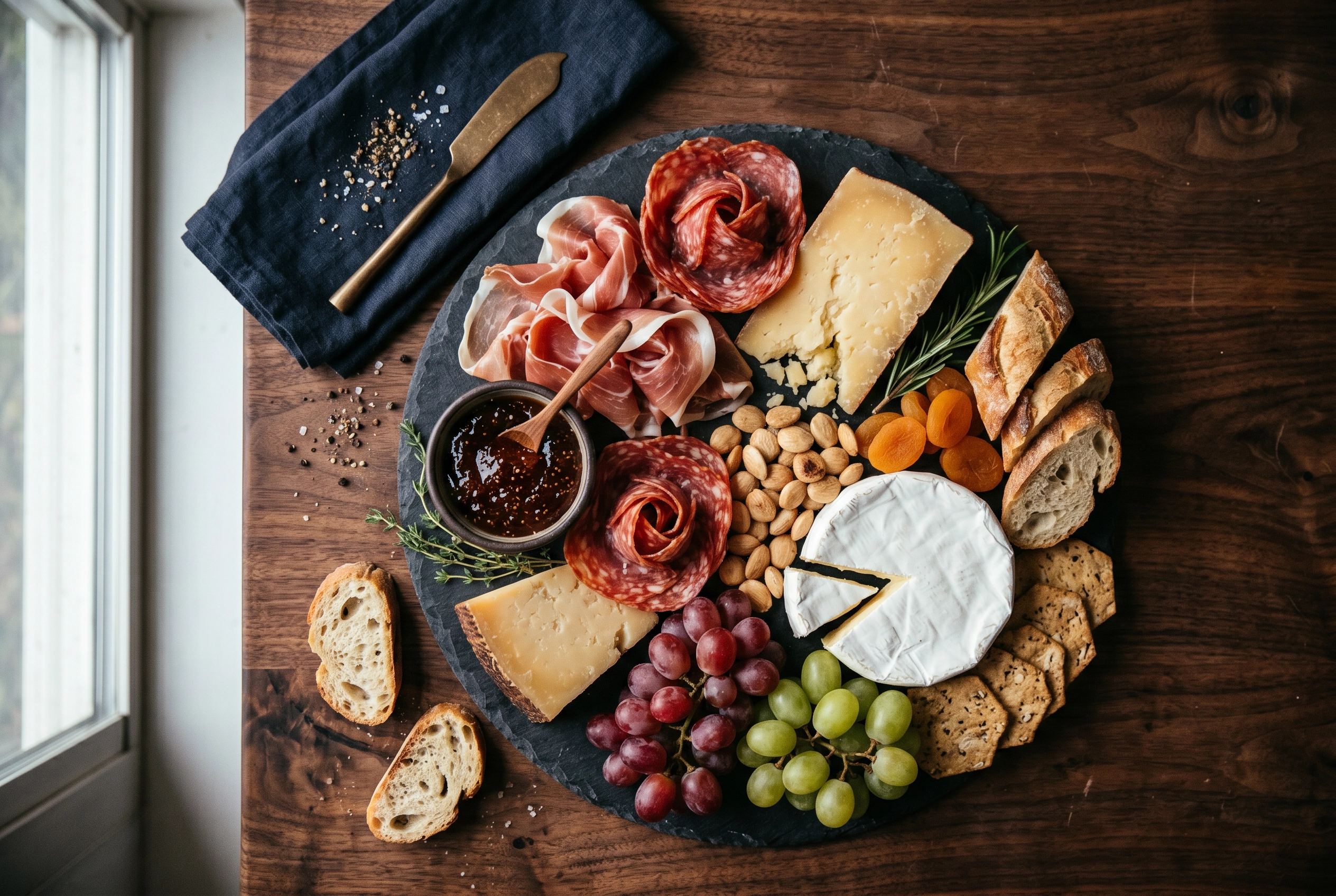 Editorial overhead shot of a professional catering charcuterie board on dark walnut with dramatic moody lighting
Two paths, both valid:
- Traditional food photography — Book a food photographer for $500–1,500 per session. You'll get 15–30 polished images. Expect to re-book every time your menu evolves.
- AI food photography — FoodShot AI turns your phone photos of real platters, buffets, and dessert tables into studio-quality imagery in about a minute per shot. Plans start at $15/month with commercial licensing. You shoot as you prep — no studio, no reshoot fees.
For catering businesses specifically, AI wins on variety. You're not photographing one menu — you're photographing charcuterie, corporate boxes, wedding buffets, carving stations, and dessert tables across different events and lighting conditions. Professional shoots can't keep up with that volume. AI can.
For a deeper look at the economics, see our catering food photography guide and our walkthrough on how to plan a menu photoshoot.
Local Partnership Catering Marketing Ideas (8–12)
Partnerships are the highest-ROI tactic most caterers underuse. They take months to build and produce leads for years. Every one of these catering marketing ideas works on the principle of trust transfer — someone else's credibility flows to you.
8. Join Event Venue Preferred Vendor Lists
Effort: High · Cost: $100–300 per tasting · Impact: Very High
When a venue hands a couple their preferred caterer list, that list often becomes the final three choices. Getting on it is the single most valuable partnership play in catering.
Target venues without exclusive in-house catering:
- Boutique hotels and historic mansions
- Brewery taprooms and wineries
- Community halls, barns, and farm venues
- Art galleries and museum event spaces
- Country clubs with open catering policies
The play: make a list of every such venue within your delivery radius. Reach out to the events manager. Offer a free tasting lunch for their team — six or seven signature items, plated properly. Let the food do the selling. One preferred vendor slot at a busy venue can generate 20–40 bookings a year for your catering business.
9. Build a Wedding Planner Referral Network
Effort: High · Cost: $200–500/mo · Impact: Very High
Wedding planners are multipliers. A single strong relationship with a busy planner can send 10–15 qualified leads your way every year — pre-qualified, pre-educated, and ready to book.
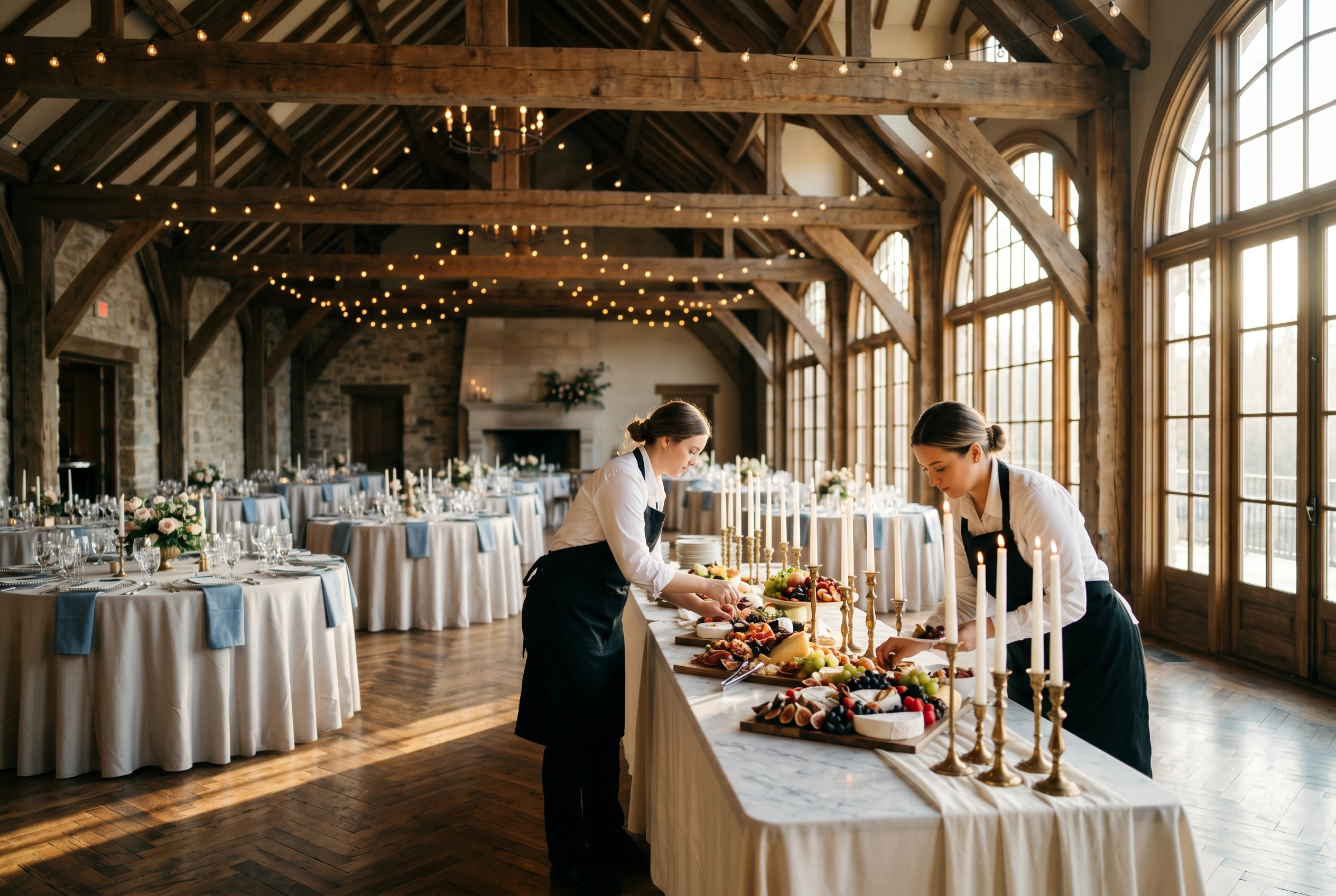 Elegant wedding venue during catering setup with staff arranging buffet platters before guests arrive
How to build the network:
- Attend bridal shows as an attendee, not just an exhibitor — introduce yourself to planners working the booths
- Host a vendor mixer at your commissary kitchen twice a year, with tasting stations and wine
- Send quarterly menu samples — seasonal hors d'oeuvres delivered to their office with a note
- Reciprocate referrals — when a couple asks you for a planner recommendation, have three you trust
- Never cut the planner out of the deal once they've introduced you — nothing kills a referral relationship faster
Planners don't just refer once. They refer forever, to every client, for as long as you deliver consistently.
10. Run Corporate Office Lunch Sampling
Effort: Medium · Cost: $150–300 per office · Impact: High
Corporate catering is 48% of catering industry growth according to International Caterers Association data. It's recurring, predictable, and far less weather-dependent than weddings. Sampling is how you get in the door.
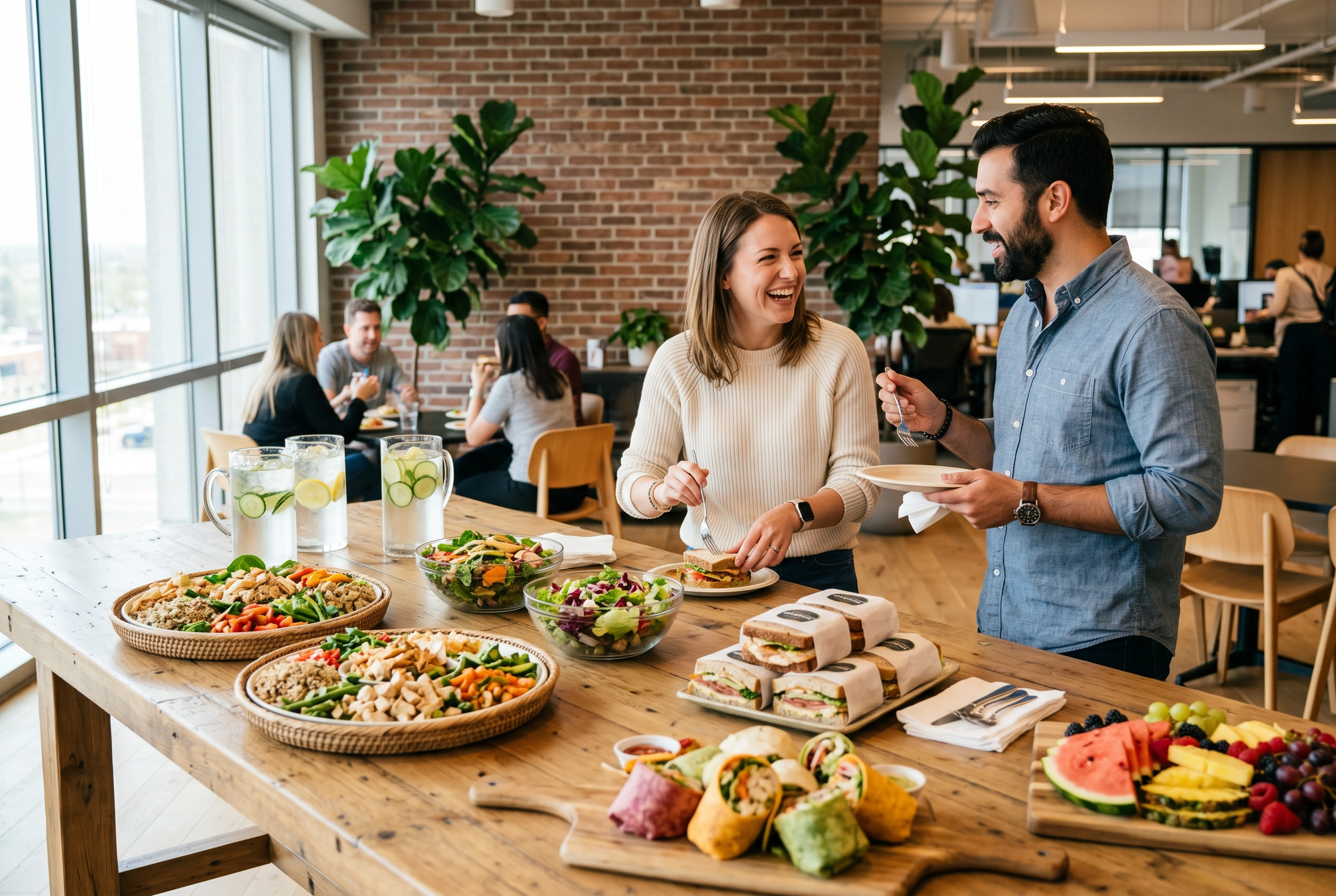 Catered corporate lunch spread on a long wooden table in a modern tech office with two employees chatting
The corporate sampling playbook:
- Pick one target office per week — 50–200 person headcount, tech/finance/law/agency sectors work well
- Call and offer a free sample lunch for 15–20 people (the exec team, the office manager, whoever orders lunch)
- Show up on time, looking professional, with branded packaging
- Leave behind: a one-page menu PDF, 10 business cards, a QR code to a pre-filled inquiry form, and handwritten thank-you notes for the office manager
Conversion rates for corporate sampling typically run 15–25% — meaning roughly one in every four to seven offices books within 90 days. At $2,000 average per order and 10 recurring orders per year, the math gets interesting fast.
11. Host Pop-Up Events and Food Truck Activations
Effort: High · Cost: $500–2,000 per event · Impact: Medium–High
Pop-ups put your food in front of people who've never heard of your catering business — and create a library of social content in the process. Farmers markets, community festivals, brewery collaborations, holiday markets, and street fairs all work.
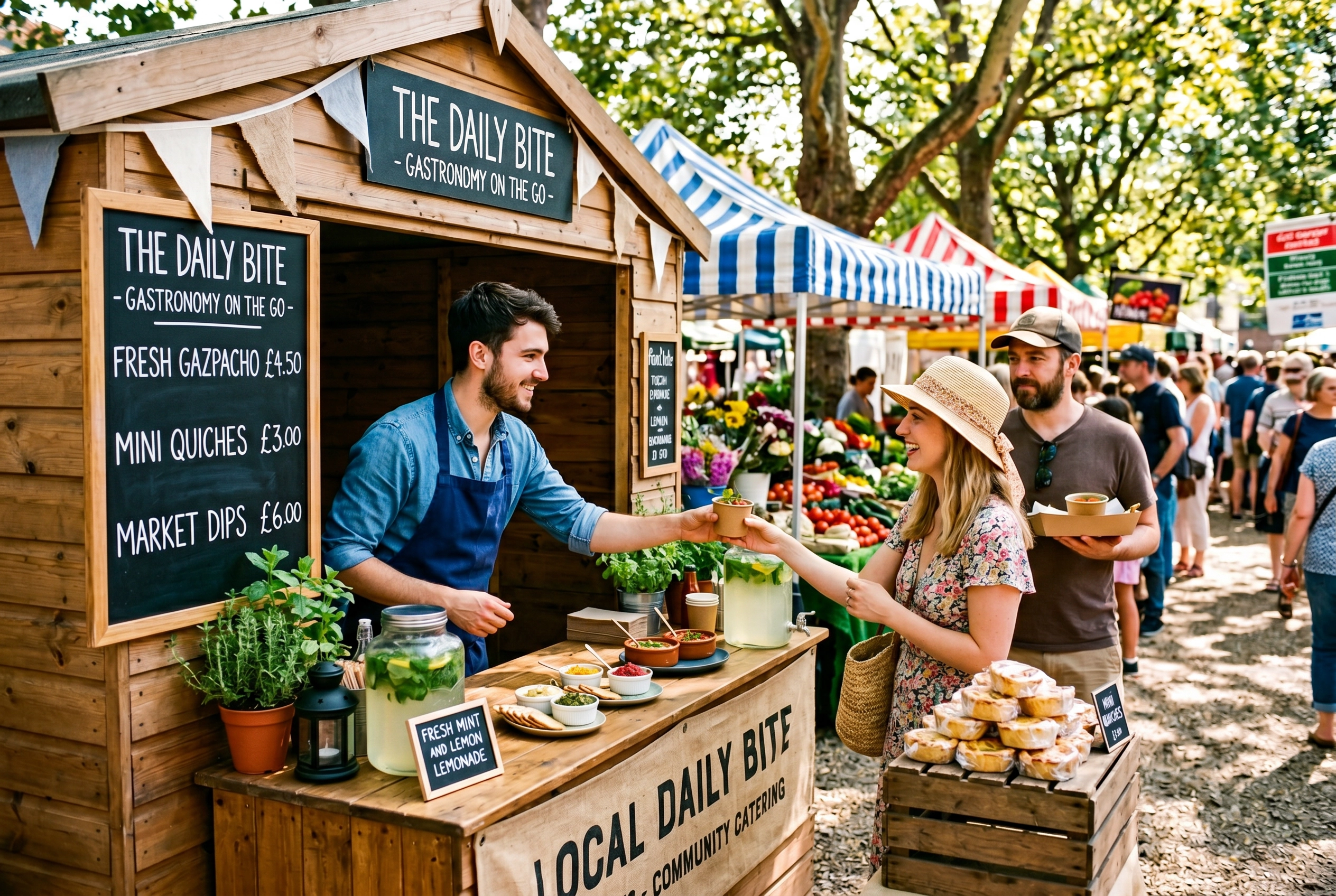 Caterer serving samples at outdoor farmers market pop-up stall with customers sampling food
What makes pop-ups pay off:
- Pick events where your target clients actually show up — a foodie farmers market beats a generic street fair
- Collect emails at the booth with a "enter to win a free catered lunch for your office" card
- Photograph and film everything — a single pop-up can produce 20+ social media posts
- Offer a pop-up exclusive promo code for catering inquiries within 30 days
The pop-up itself usually breaks even. The lead list and content library are the real prize.
12. Sponsor Community Events and Charities
Effort: Medium · Cost: $500–3,000 per event · Impact: Medium–High
Donate catering to a local nonprofit gala, school auction, or community fundraiser. You get logo placement in the program, a mention from the podium, direct exposure to the donors and board members (often your exact target clients), and the goodwill of doing something good.
Choose carefully:
- Follow the audience — sponsor events your target clients attend
- Negotiate for your logo on the program, signage, and email communications
- Ask for a short speaking moment — 60 seconds about your catering business at the dessert break
- Collect business cards from every attendee who compliments the food
The return is rarely immediate. But the business owners, executives, and philanthropists at these events are often the exact people planning their company's next holiday party or their daughter's wedding.
Content Marketing Catering Ideas (13–16)
Content builds authority at scale. The timelines are longer than other catering marketing tactics — but the compounding is enormous. A blog post that ranks for "Chicago corporate catering ideas" can bring qualified leads for five years.
13. Publish Behind-the-Scenes Blog and Video Content
Effort: High · Cost: $0–500/mo · Impact: Medium (long term)
People book caterers they feel they know. Behind-the-scenes content marketing is how you manufacture familiarity at scale.
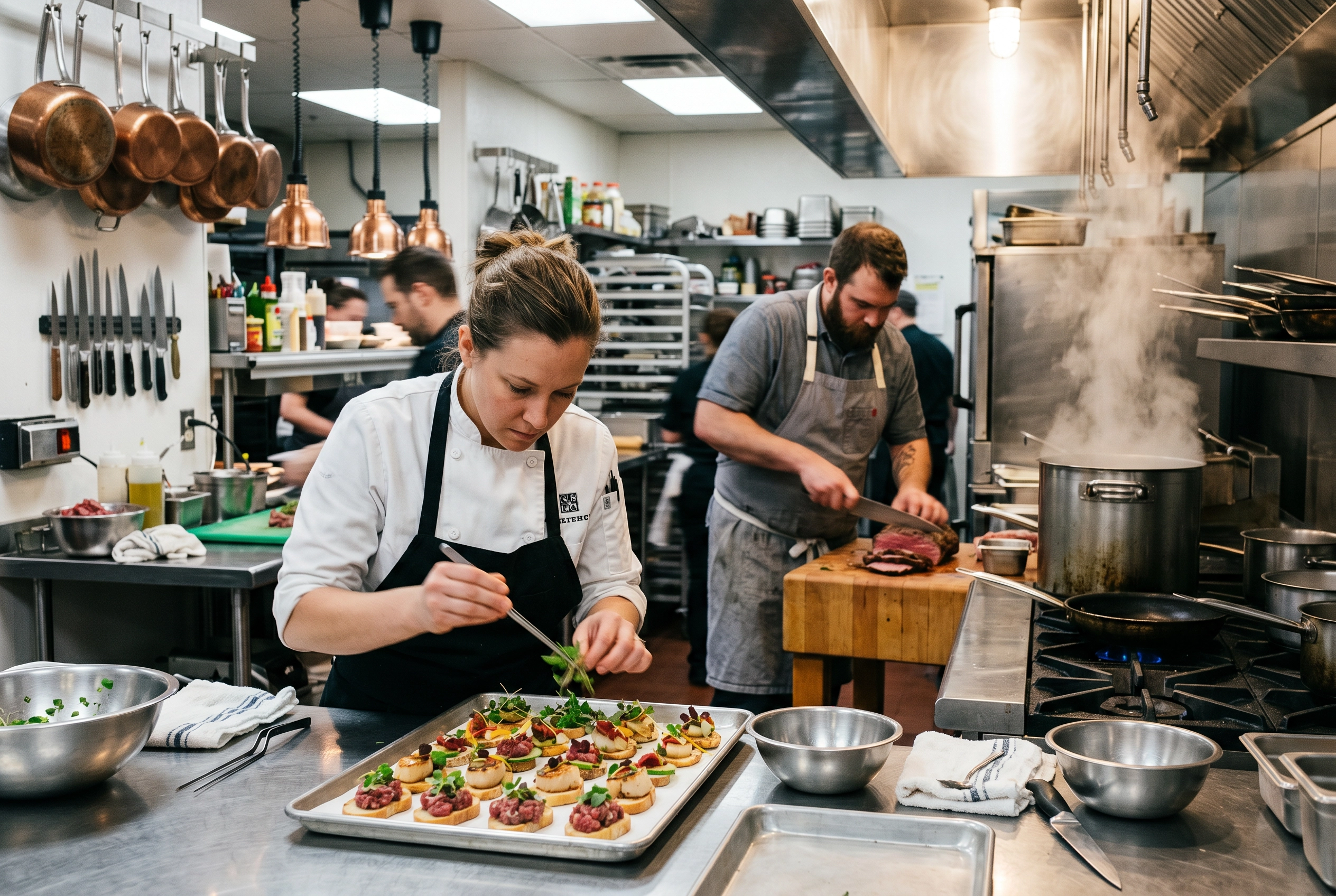 Professional catering kitchen during event prep with head chef plating appetizers and staff working in background
Topic ideas that perform:
- "How we catered a 300-person wedding (start to finish)"
- "A day in the life at our catering kitchen"
- "How we plan menus for dietary restrictions"
- "The one thing that always goes wrong at weddings (and how we handle it)"
- "What's actually in our guac" (recipe-adjacent content)
Post to your blog, then repurpose the same footage as Instagram Reels, YouTube Shorts, and LinkedIn posts. Google ranks original content. YouTube drives consideration. One well-produced "day in the kitchen" video can serve your catering business for three years.
14. Announce Seasonal Menus With a Campaign
Effort: Medium · Cost: $100–300 per campaign · Impact: Medium–High
Seasonality is a built-in excuse to re-engage every past client and prospect four times a year. Make it a campaign, not an email.
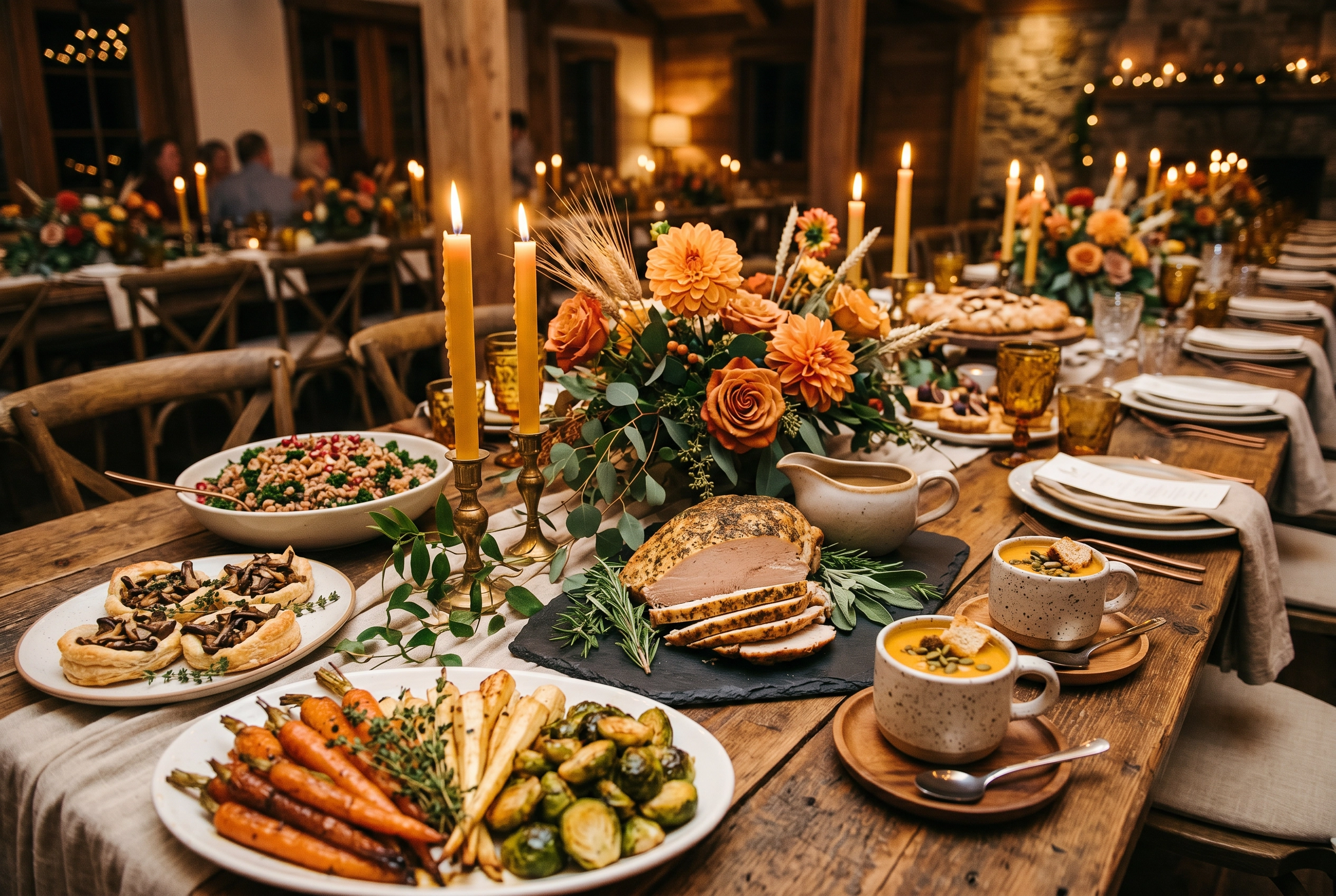 Rustic fall harvest catering tablescape with roasted vegetables, turkey, and autumn florals in warm evening light
The three-beat seasonal menu launch:
- Teaser (1 week out) — "Our fall catering menu drops next Friday." One moody shot of a seasonal ingredient.
- Reveal day — Email + Instagram post + LinkedIn post + Pinterest pins with the full menu and pricing
- Deadline push (2 weeks out) — "Bookings for October close Friday" with social proof
Photograph every new seasonal menu item — this is where AI food photography earns its keep, because a traditional shoot for 20 new items every quarter would cost $6,000 a year. AI delivers the same library for a fraction of that, with consistent styling so every menu update looks like it came from the same catering business brand.
15. Publish Client Success Stories and Case Studies
Effort: Medium · Cost: $0–200 · Impact: High
A well-told case study is worth 10 generic testimonials. Real events, real numbers, real photos, real names (with permission).
The six-part case study template:
- Client — who they are and what event
- Challenge — guest count, dietary restrictions, venue quirks, timing
- Menu — what you served and why
- Execution — how the event actually went
- Photos — 5–8 from the event itself
- Client quote — a specific, not-generic reaction
Publish to your blog, link from your catering page, and pull highlights into every sales proposal. One great case study often closes a dozen future bookings.
16. Share Recipes and Entertaining Tips
Effort: Medium · Cost: $0 · Impact: Low–Medium (long term brand)
Caterers often worry that sharing recipes will cannibalize bookings. The opposite tends to happen: sharing recipes positions you as the expert, builds SEO traffic, and creates the trust that leads to "I could make this myself, but I'd rather hire them."
Content that works for catering audiences:
- Signature entertaining dips and appetizers
- "How much food to order per guest" calculators
- Wine and cocktail pairing guides
- Leftovers-from-a-catered-event ideas
- "What a caterer looks for when planning a menu"
The people who can pull off a 100-person dinner from a recipe aren't your clients anyway. The people who can't will pay you to do it for them.
Traditional Catering Marketing Ideas (17–20)
Traditional doesn't mean dated. These four catering marketing ideas still deliver because they reach people at the exact moment they're experiencing your food — which is when they're most likely to act.
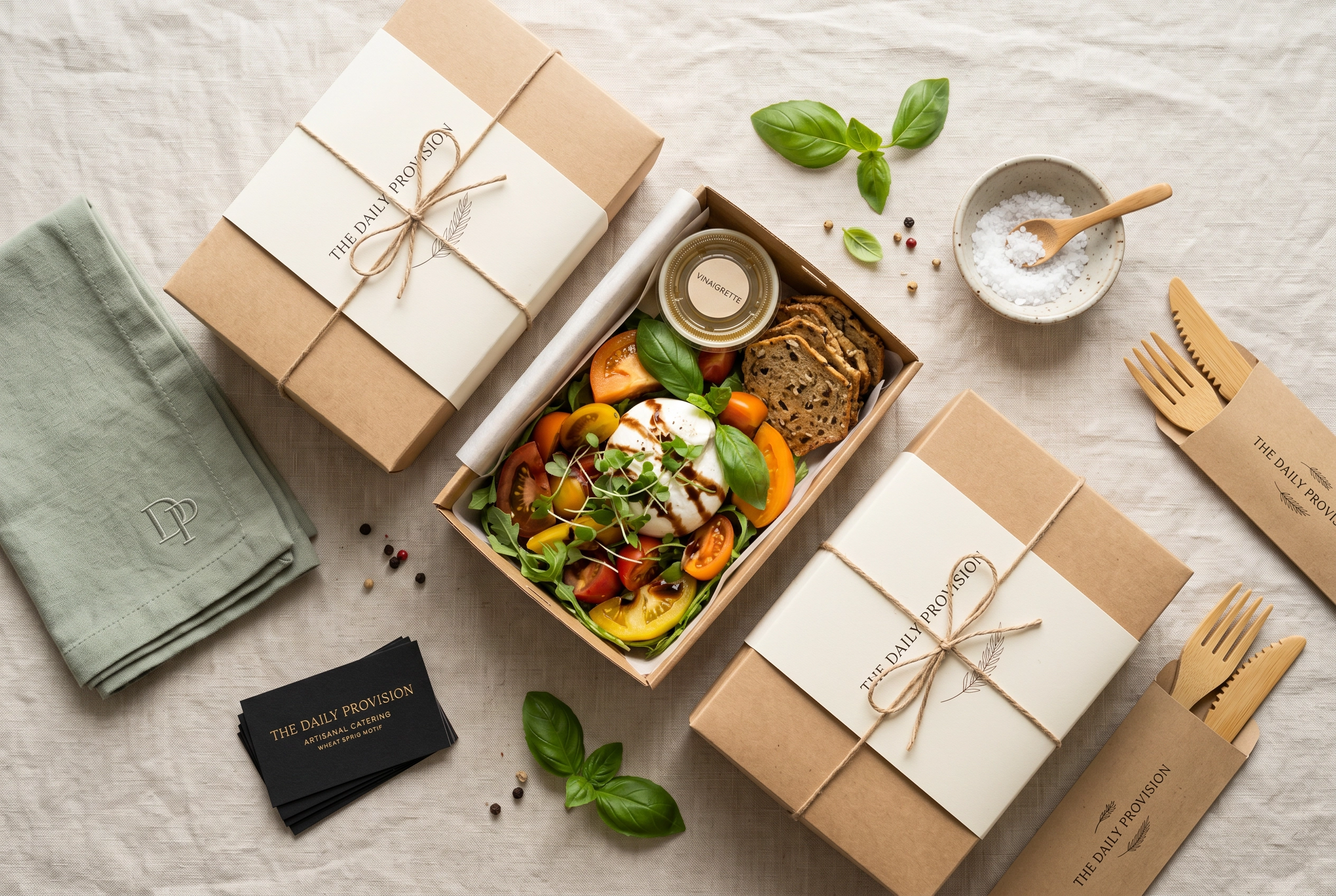 Flat-lay of branded catering boxed lunches with custom sleeves, napkins and business cards on linen tablecloth
17. Hand Out Business Cards at Every Event
Effort: Low · Cost: $50–200 for 500 cards · Impact: Medium (compounds)
A 150-guest wedding has 150 potential future clients sitting at the tables. Every one of them is experiencing your food right now. Give them an easy way to remember your catering business.
What to put on the card:
- Your business name, logo, and tagline
- One photo of a signature dish (this is why great food photography matters even here)
- Phone, email, website
- A QR code that opens a pre-filled inquiry form (or your Instagram)
- An offer — "$50 off your first booking"
Leave a stack with the venue coordinator, the wedding planner, and the bar. Put one on every table at corporate events. Sticking cards on boxed lunches is free distribution.
18. Invest in Branded Packaging
Effort: Medium · Cost: $0.25–1 per unit · Impact: Medium–High
Every boxed lunch dropped at a 200-person office is 200 mobile billboards sitting on desks for two hours. Don't waste that.
Upgrade targets in order of ROI:
- Custom sleeves or stickers on delivery boxes — $0.20–0.50 per unit at volume
- Branded napkins with your logo and website — $0.03–0.08 per napkin
- Reusable tote bags for premium accounts — $2–5 per bag, stays with the client for years
- Custom labels on dressing cups, cookie bags, and bread packs — $0.10–0.30 per unit
The upcharge is usually $1 or less per person. The marketing value over 12 months of corporate catering is enormous — clients see your logo every week, their coworkers see it, their clients see it when the boxes are in the kitchen.
19. Launch a Loyalty Program for Repeat Corporate Clients
Effort: Medium · Cost: 5–10% revenue share · Impact: High
Corporate catering is a recurring revenue engine — and recurring revenue only works if clients don't shop around. A loyalty program gives them a reason to keep calling your catering business.
Tiered programs work best:
- Bronze (first 5 orders) — 5% off every order
- Silver (6–20 orders) — 8% off + priority delivery windows
- Gold (20+ orders) — 10% off + dedicated account manager + custom menus on request
Add a "10th order free" punch card for psychological momentum. Assign a dedicated contact for any client doing 10+ orders per year — office managers will stay loyal to a human contact far longer than to a pricing page.
20. Exhibit at Trade Shows and Bridal Expos
Effort: High · Cost: $500–3,000 per booth · Impact: High
One well-run bridal expo can produce 20–50 qualified wedding leads in a single weekend. Chamber of commerce events, corporate event fairs, and meeting-planner expos do the same for corporate work.
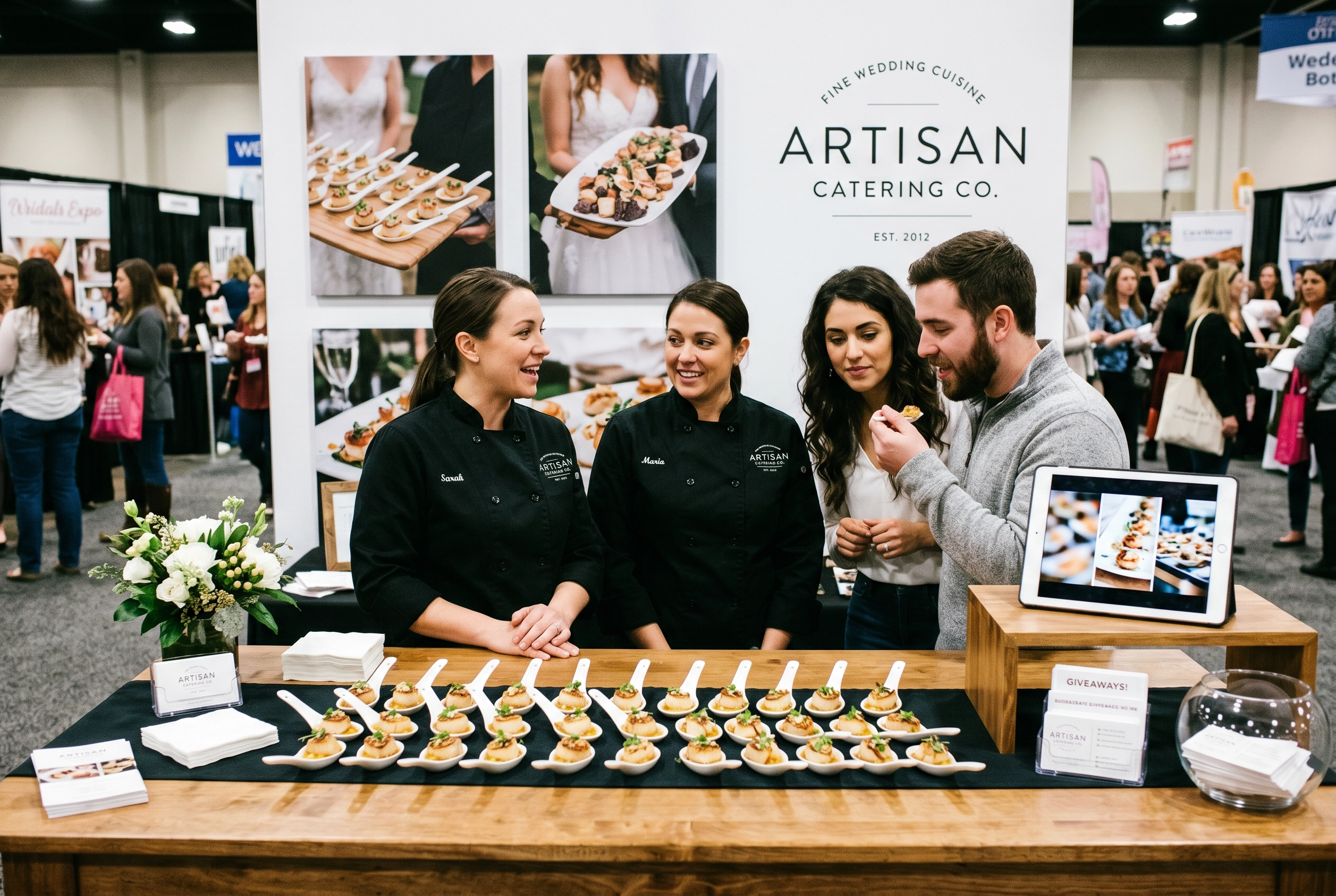 Catering company booth at bridal expo with tasting table and staff talking with engaged couple
What separates a booth that books from one that gets walked past:
- A tasting table — not just business cards. Fresh, signature-level food that people remember.
- A portfolio iPad or TV loop — 30-second cut of your best event setups
- A lead capture form with a giveaway — "Enter to win a free bridal shower lunch for 10"
- Two people working the booth — one chatting, one capturing emails
- Rapid follow-up — every lead gets a personalized email within 48 hours, not 2 weeks
Budget an hour of post-show follow-up for every hour you spent at the booth. The show isn't where bookings happen. The follow-up is.
The Thread That Ties It All Together: Food Photography
Look back at the list. A catering portfolio website needs photos. Google Business Profile ranks higher with photos. Instagram Reels are photos in motion. Email campaigns open more with photos. Pinterest is pure photos. Case studies need photos. Trade show booths need photos. Even business cards and branded packaging benefit from photos.
That's 18 of the 20 catering marketing ideas above where food photography directly affects performance.
For decades, this meant catering businesses had two options: invest $5,000–15,000 a year in professional food photography, or live with amateur phone photos that undercut every marketing dollar. Today there's a third path. AI food photography lets you shoot real dishes with your phone — during prep, at the event, in the delivery van — and transform them into consistent, on-brand, studio-quality imagery in minutes.
FoodShot AI is built specifically for this workflow. Upload a phone photo of your charcuterie board, pick a style (or upload one from a past event for brand consistency), and get a menu-ready image back in about a minute. Commercial licensing included. Plans start at $15/month on the Starter tier, with bulk processing available on higher plans for caterers photographing full seasonal menus at once.
The point isn't which tool you use. The point is: if you fix the food photography, nearly every other catering marketing idea on this list starts performing dramatically better — and many catering businesses see the lift within 30 days.
Your 90-Day Catering Marketing Plan
Twenty catering marketing ideas is a lot. Don't try to run all of them at once — that's how marketing plans die. Here's how to sequence them.
Days 1–30: Foundation
- Audit your catering website (Idea #1) — fix the glaring gaps
- Optimize your Google Business Profile (Idea #2)
- Set up your food photography workflow (Idea #7) — whether traditional or AI
- Start asking every recent client for reviews (Idea #6)
Days 31–60: Relationships and Retention
- Identify 10 target venues and 10 target wedding planners (Ideas #8 and #9)
- Build and launch your email sequences for past clients (Idea #4)
- Start one corporate office sampling drop per week (Idea #10)
- Order branded packaging (Idea #18)
Days 61–90: Content and Volume
- Post 2 Instagram Reels per week (Idea #3)
- Publish your first case study and seasonal menu announcement (Ideas #14 and #15)
- Start Pinterest boards and pin 3x per week (Idea #5)
- Book one bridal expo or trade show for the next 6 months (Idea #20)
By day 90, you'll have a running system — not a to-do list. Then you layer in the rest, one catering marketing idea at a time, based on what's working for your business.
For the strategic framework that sits above this tactical list, read our complete catering marketing strategy guide. For broader inspiration across foodservice, check out our restaurant marketing ideas roundup.
Frequently Asked Questions
What is the most effective marketing strategy for a catering business?
For most caterers, the highest-ROI tactic is building relationships with event venues and wedding planners that don't have exclusive in-house catering. A single preferred-vendor slot at a busy venue can produce 20–40 bookings per year. That said, partnerships only work if your portfolio website, Google Business Profile, and food photography are already in good shape — venues will Google you before they recommend you.
How much should a catering business spend on marketing?
Most established catering businesses spend 3–7% of revenue on marketing, with newer companies often investing 8–12% to build momentum. For a catering business doing $500,000 annually, that's $15,000–35,000 per year. The biggest line items are typically a professional website, food photography, paid advertising, and trade show or bridal expo presence. Free channels like Google Business Profile, email to past clients, and Pinterest can make up a surprising share of leads at near-zero ongoing cost.
How do I attract more wedding catering clients?
Wedding catering clients almost always research visually before they inquire. The four moves that matter most for your catering business: a portfolio website with real event photos organized by style (rustic, modern, formal), presence on the preferred vendor list at 5–10 local wedding venues, a referral relationship with 2–3 wedding planners, and active Pinterest boards showing your work. Bridal expos work if you commit to rapid follow-up — leads go cold within a week.
Is social media worth it for a catering company?
Instagram and Pinterest are essentially non-negotiable for wedding and event catering because that's where couples and planners look during the research phase. LinkedIn is increasingly valuable for corporate catering — office managers and executive assistants scroll it daily. TikTok is optional but can drive explosive local awareness for food-truck-style or pop-up catering. The key to social media marketing is consistency over novelty: two well-photographed posts per week beats daily posts of blurry phone photos.
How do I get corporate catering accounts?
Corporate catering grows through sampling, not ads. Drop a free lunch for 15–20 people at one target office per week — tech companies, law firms, agencies, and any office with 50+ employees. Leave behind branded packaging, a one-page menu, and a QR code to a pre-filled inquiry form. Typical conversion rates run 15–25%, meaning one in four to seven offices books within 90 days. Once you have a repeat account, protect it with a loyalty program and a dedicated contact person — that's how you turn a one-off order into years of recurring revenue for your catering business.
Do I need professional food photography to market my catering business?
Yes — but "professional" no longer means a $1,500 studio shoot. Nearly every marketing channel (website, Google Business Profile, social media, email, Pinterest, proposals, packaging) performs dramatically better with high-quality food images, and AI food photography tools have made polished visuals accessible at $15–100 per month instead of thousands per shoot. If budget is the barrier, start with AI to photograph your existing menu, then invest in a traditional shoot for hero images once you're booking enough events to justify it. Our guide to DIY food photography covers what you can do with just a phone in the meantime.
How long does it take for catering marketing to pay off?
Most catering marketing ideas on this list start producing results within 30–90 days if executed consistently. Google Business Profile optimization, email to past clients, and review generation can move the needle in weeks. Venue partnerships, wedding planner relationships, and content marketing are 3–12 month investments that pay off for years once established. Pinterest and SEO are the slowest — often 6–12 months before they compound meaningfully — but they become nearly free lead sources once they do. The catering businesses that compound the fastest are the ones who don't quit after 60 days when something hasn't clicked yet.