Social Media Marketing for Food Trucks: The 2026 Guide
 Ali Tanis16 min read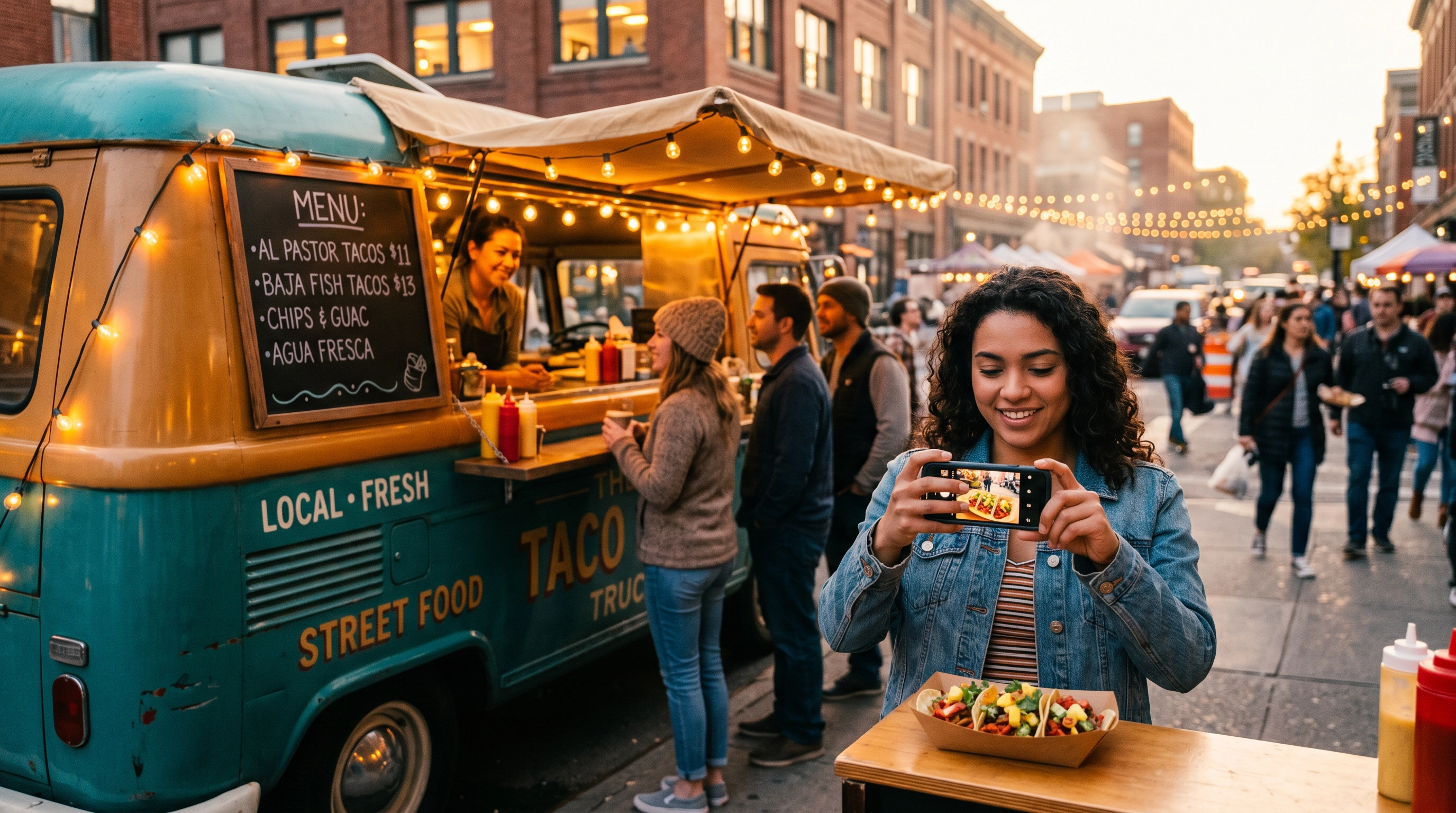
A restaurant's address is a building. A food truck's address is an Instagram Story.
That's the uncomfortable truth most social media marketing for food trucks guides gloss over. Run a brick-and-mortar restaurant and customers can walk past, see the sign, decide to come in. Run a food truck and nobody stumbles in off the street — because there is no street. You move. Your customers have to find you, and in 2026, they find you through social media or they don't find you at all.
Quick Summary: For food trucks, social media marketing is operational infrastructure, not a side channel. Every daily post answers three questions: where, when, and what. This guide covers platform priorities, a realistic content calendar, the Instagram playbook, user-generated content tactics, paid ads on a $50–$200/month budget, and how to post professional-quality content every day without burning out.
Over 74% of diners discover new food trucks through social media, and 50% find them specifically on Instagram, per Gitnux's 2026 food truck data. About 86.9% of food truck operators use Facebook — the highest-adoption channel in the industry, per FLIP's Food Truck Statistics. Nearly nine in ten food truck owners rely on digital tools daily, per the FoodTruckProfit 2026 survey. Social media isn't one of your marketing channels — for a food truck, it's the channel.
This guide covers food truck social media strategy specifically — not restaurants. For broader context on fixed-location venues, see our social media marketing for restaurants guide.
Why Social Media Marketing for Food Trucks Is the #1 Channel (Not #2)
A brick-and-mortar restaurant can survive a bad social media week. Walk-by traffic still happens. Food trucks don't have that cushion. Miss a day of posting and regulars won't know where to find you — your line is shorter because of it.
Internalize this: your Instagram feed IS your address. The feed tells people where to drive, where to park, and when to show up. Miss a post and you effectively didn't open.
This is why a restaurant social strategy fails for a food truck. Restaurants post three times a week about specials. That cadence would bankrupt a food truck. You need a daily rhythm to build presence.
Three questions every follower needs answered every service day:
- Where are you parked today?
- When are you open (start time, sell-out risk)?
- What is on the menu — specials, collabs, limited drops?
Social media influences 80% of food truck purchases. That's direct attribution, not branding. People open the app, decide, show up. Winning means being visible in the thirty-second decision window before lunch.
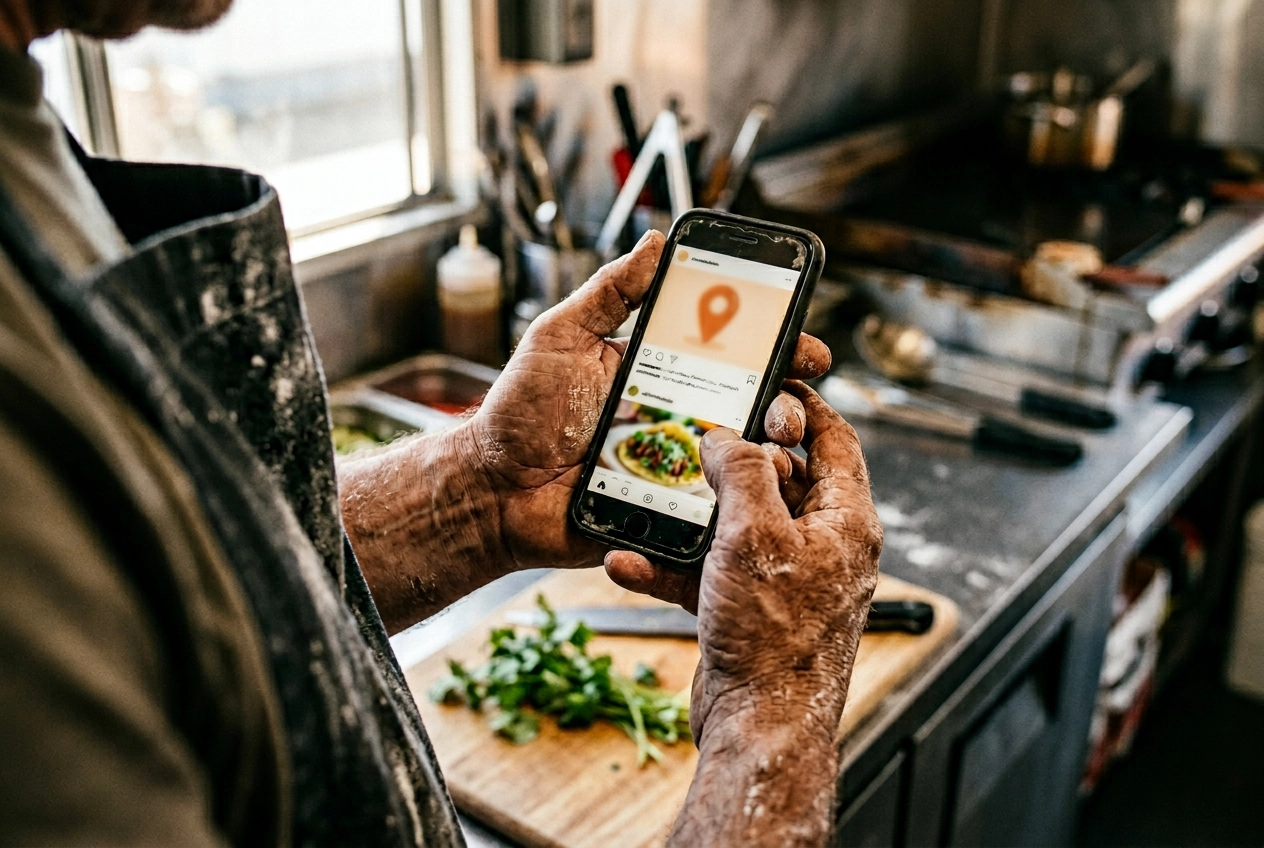 Food truck operator checking location post on phone with flour-dusted hands inside the truck
The Food Truck Platform Map: Where to Spend Your Time
"Be everywhere" is terrible advice. Most owner-operators have 90 minutes of total content time per day. You need a priority stack for your food truck social media strategy:
| Platform | Effort % | Primary Use |
|---|---|---|
| 40% | Visual menu, daily Stories, Reels for discovery | |
| TikTok | 25% | Behind-the-scenes, day-in-the-life, viral reach |
| 25% | Local groups, events, catering leads, paid ads | |
| X (Twitter) | 10% | Real-time location + sell-out alerts |
| Everything else | 0% | Skip unless you have specific reason |
Instagram: Your Visual Menu and Daily Address (40% of Effort)
Instagram is the highest-ROI platform for food trucks in 2026. Stories handle daily location posts, the feed doubles as a browsable menu, and Reels push content to non-followers to help build audience reach — which is how you grow.
Food truck Instagram marketing non-negotiables: geo-tag every post, use the "collab" feature at events (the host shares your post to their audience), and pin your three best dish photos to the top of your grid as a quasi-menu.
TikTok: Where New Customers Find You (25% of Effort)
TikTok works differently. Instagram is where existing fans check in. TikTok is where strangers discover you exist. The algorithm rewards authenticity over polish — which helps food trucks, since nobody expects a studio shoot from a truck.
Food truck TikTok marketing formats that drive engagement:
- Cooking POV videos — first-person, 15-30 seconds, dish from start to handoff
- Day-in-the-life — 4am farmers market, prep, service, cleanup
- "What does $X get you at a food truck" — a template that performs predictably
- Customer reactions — the first bite, with permission
About one-third of TikTok users are 18-25, a core food truck audience. You don't need to go viral — one TikTok hitting 50,000 local views is worth months of feed posts.
Facebook: Events, Catering Leads, and Local Groups (25% of Effort)
Facebook is where the over-40 audience, corporate catering, and event bookings live. Three things matter:
- Local Facebook groups — "Austin Food Finds," "NYC Lunch Spots." Every city has 3-5 active ones. Post 1-2 times weekly, not more. Groups punish spam.
- Facebook Events — for festivals, pop-ups, catering appearances. Direct RSVP tracking Instagram doesn't offer.
- Paid ads — Facebook's geo-targeting is still best for sub-5-mile radius campaigns.
The 86.9% Facebook adoption rate exists for a reason: catering leads run through Messenger, and paid ads convert cheaper here than anywhere else.
X (Twitter): The Real-Time Lifeline (10% of Effort)
X is dying for most businesses and living for food trucks. It's still the fastest channel for instant updates: weather cancellations, sell-outs, location changes. Die-hard regulars built the habit a decade ago. Copy-paste from your Instagram Story. Ten seconds. Still worth doing.
Platforms to Skip
- Pinterest — minimal ROI unless you sell desserts
- LinkedIn — only if corporate catering is real revenue
- YouTube — high production lift, low daily relevance
Being ruthless about what to skip is itself a strategy.
The Food Truck Content Calendar That Works
The mistake most operators make: treating content as inspiration-driven. "What should I post today?" is the wrong question. The right question: "What's scheduled today, and how do I make it great?"
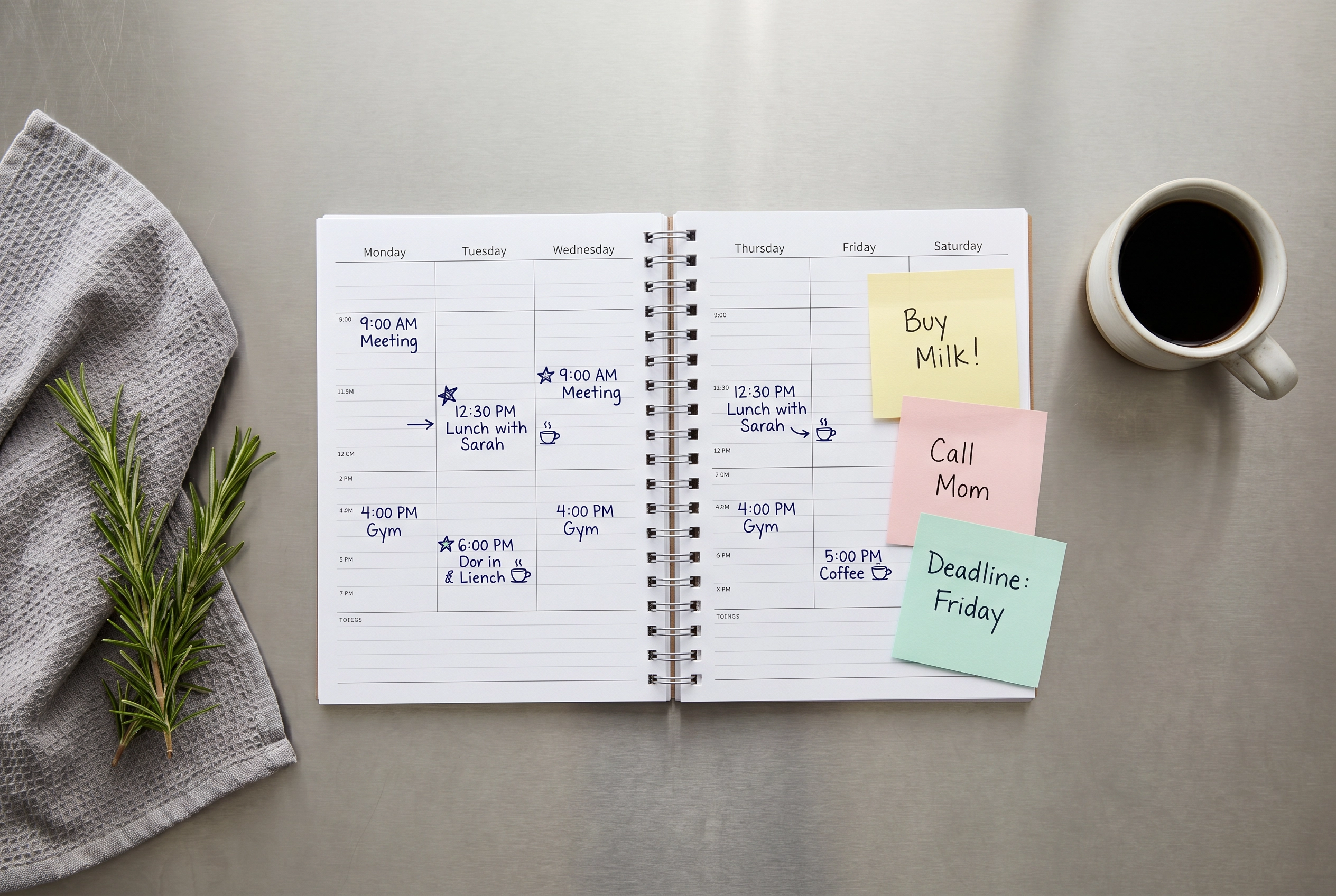 Weekly content planner with handwritten schedule and colorful sticky notes on a metal food truck counter
The Daily Non-Negotiable: Your Location Post
One post, every service day, 1-2 hours before you open. Not after. Before. People check social media when they're deciding what to eat, not after. Post at 12:45 PM saying "we're at 5th and Main" and you've missed 80% of the lunch decision window.
The daily location post should include:
- Street address (written out, not just a pin — people screenshot)
- Hours (flag sell-out risk)
- One dish photo that makes the decision easy
- Any "today only" specials
- Geo-tag and 8-12 hashtags
Cross-post to Instagram Feed, Instagram Story, X, and Facebook simultaneously. Template the caption so it takes three minutes, not thirty.
The Weekly Rhythm
Layer a predictable weekly rhythm on top of daily location posts:
- Monday — Menu Monday. Spotlight one dish with a hero photo. Tell its story.
- Wednesday — Behind-the-scenes. Prep, sourcing, the team. Behind-the-scenes content converts followers into regulars.
- Friday — Reel Day. One cooking-process Reel, trending audio. Your weekly growth lever.
- Weekend — Event push. Flood Stories with real-time content from festivals.
- Sunday night — Week recap Story. Highlights + next week's schedule preview.
Monthly Deep-Cut Content
Once a month, go deeper: team spotlights, sourcing features, customer feature walls, collab announcements, data drops (best-selling item). Monthly content separates a food truck social presence from a location bot — it builds the emotional investment that keeps people following through a rainy week when you didn't open.
Instagram for Food Trucks: The Tactical Playbook
Instagram deserves its own deep section. Here's what works in 2026.
The Hashtag Ladder Strategy
The days of spamming 30 hashtags are over. Instagram's 2026 algorithm interprets hashtags as AI-powered audience signals, not keyword tags. Too many dilutes the signal.
Use 8-15 hashtags per post, structured as a ladder:
- 5 small tags (under 10K posts) — niche discovery, high relevance
- 5 medium tags (50K-500K posts) — steady exposure
- 3 large tags (500K-5M posts) — occasional viral pickup
- 2 brand/location tags — your own + city-specific
Location tags matter more than food tags for trucks. Examples: #NYCfoodtrucks, #ATXeats, #LAfoodscene, #DMVeats. People search their city, not "#foodporn."
Core food truck hashtags: #foodtruck, #foodtrucklife, #streetfood, #supportlocal, #foodtruckfestival. Create a brand hashtag for UGC (e.g., #eatatmarias). Rotate 3-4 hashtag sets across the week to avoid shadow bans.
Story Highlights: Your Permanent Menu
Stories disappear in 24 hours, but Highlights stay forever. For a food truck, Highlights should function as a permanent operating manual:
- Menu — current full menu (refreshed monthly)
- Schedule — this week's locations (refreshed weekly)
- Reviews — UGC and testimonials
- Events — upcoming festivals and pop-ups
- Catering — past event photos + "how to book"
Fresh Highlights signal an active business. Stale ones signal a dead account.
Reels: The Discovery Engine
Reels are the key growth tool because they're shown to non-followers by default. Feed posts reach your existing audience. Reels reach new people.
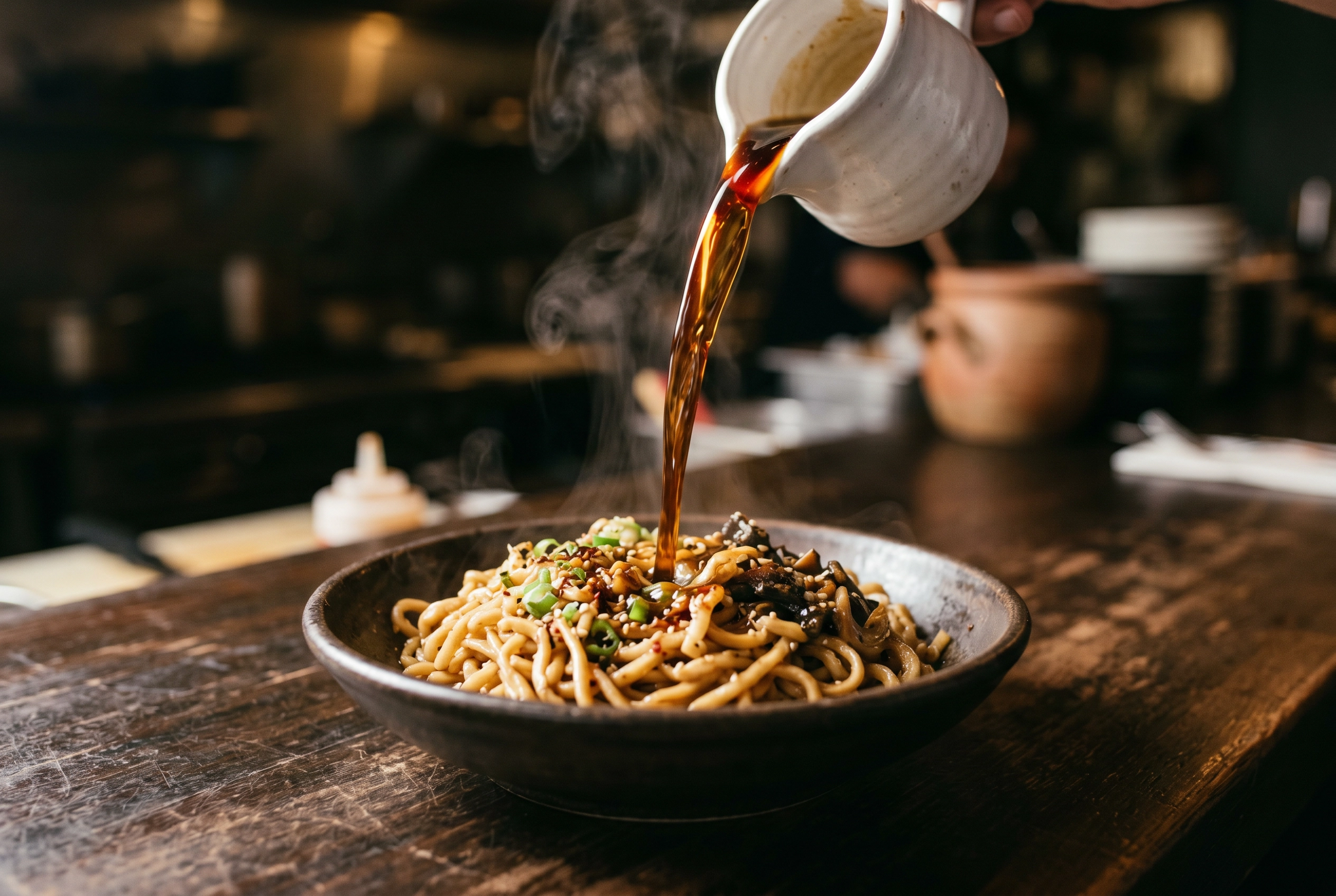 Dramatic sauce pour over noodles — the satisfying food moments that drive Reels engagement
What works in 2026:
- Cooking POV videos — first-person action shots of your signature dish
- "How it's made" videos — one ingredient or step per Reel, weekly
- Customer reveal videos — the handoff moment, with permission
Post 1-3 Reels per week minimum. Use trending audio (if the arrow points up, use it). Add captions — 85% of Reels are watched on mute.
Bio Optimization
- Name field should include "Food Truck" + your city (Instagram searches this)
- Bio keywords: cuisine, neighborhood, what makes your brand unique
- Link-in-bio: today's location, menu, catering inquiry
- Contact button: catering email separate from personal inbox
Photographing Food in the Truck
Food truck photography has its own problem set. Harsh direct sun. 20 seconds between plating and handoff. 18-inch prep space. Light changes with the clouds.
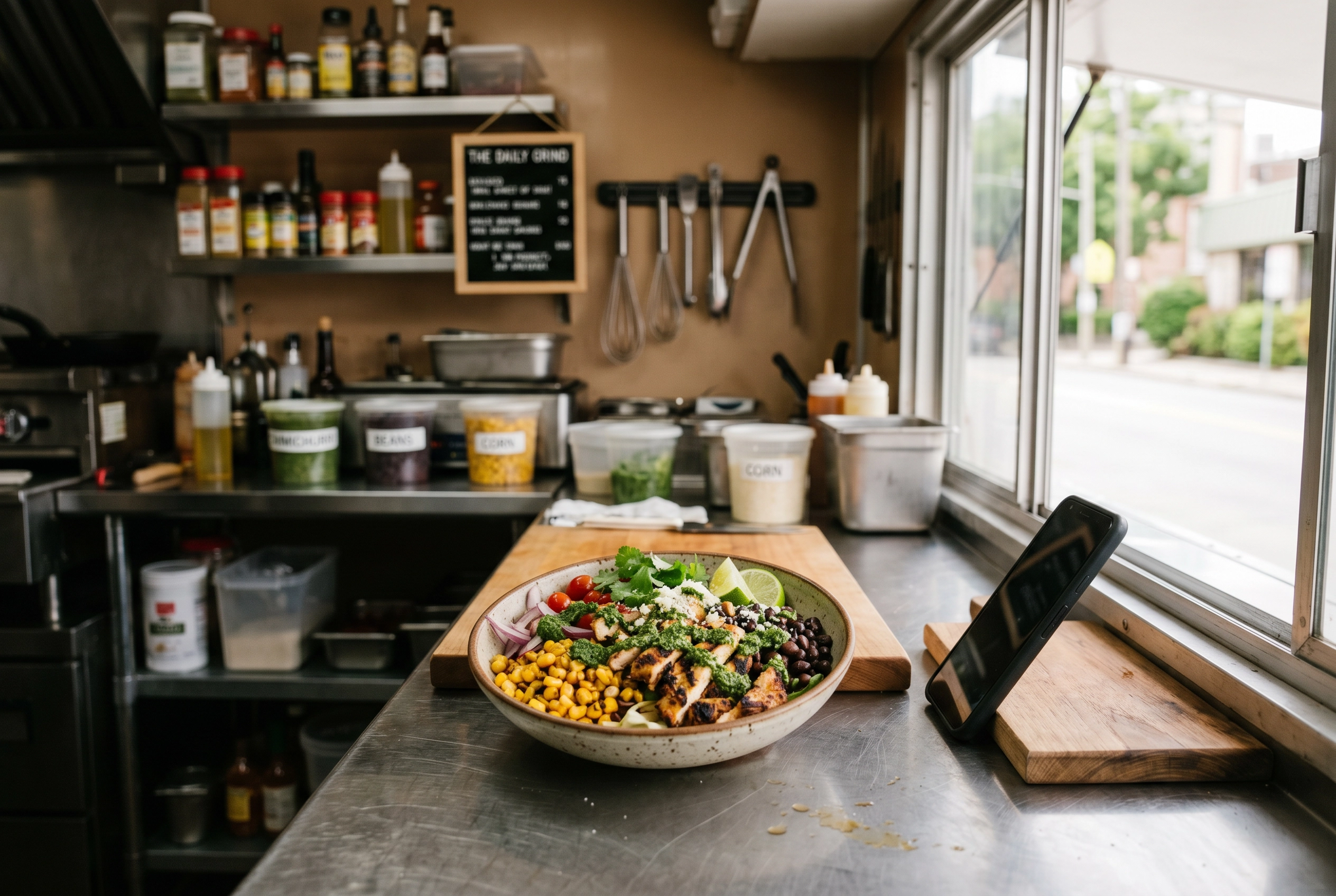 Food truck dish being photographed with natural window light — professional food photography inside a truck
What works:
- The shade-of-the-truck shot. Park food in your truck's own shadow. The side becomes a giant diffuser.
- Window light from inside. Plate near the service window. Directional soft light, dark interior as backdrop.
- The "customer angle" shot. Hand-held, received-through-window. Authentic because it is.
- The daily plating station. Clear a 12-inch corner of the counter. Same surface, same angle builds your visual brand.
Shoot 5 photos of every dish before handoff: overhead, 45-degree, close-up, with-drink, in-context. Pick the best one later. Modern phones in 2026 are good enough — you don't need a DSLR, you need the habit. For deeper breakdowns, see our food truck photography guide, how to take good food photos with your phone, and Instagram food photography.
User-Generated Content: Your Customers Are Your Content Team
Food trucks are uniquely set up for UGC. Every customer is holding a phone, and food from a window is inherently photogenic. You just need a system to help share what customers already create.
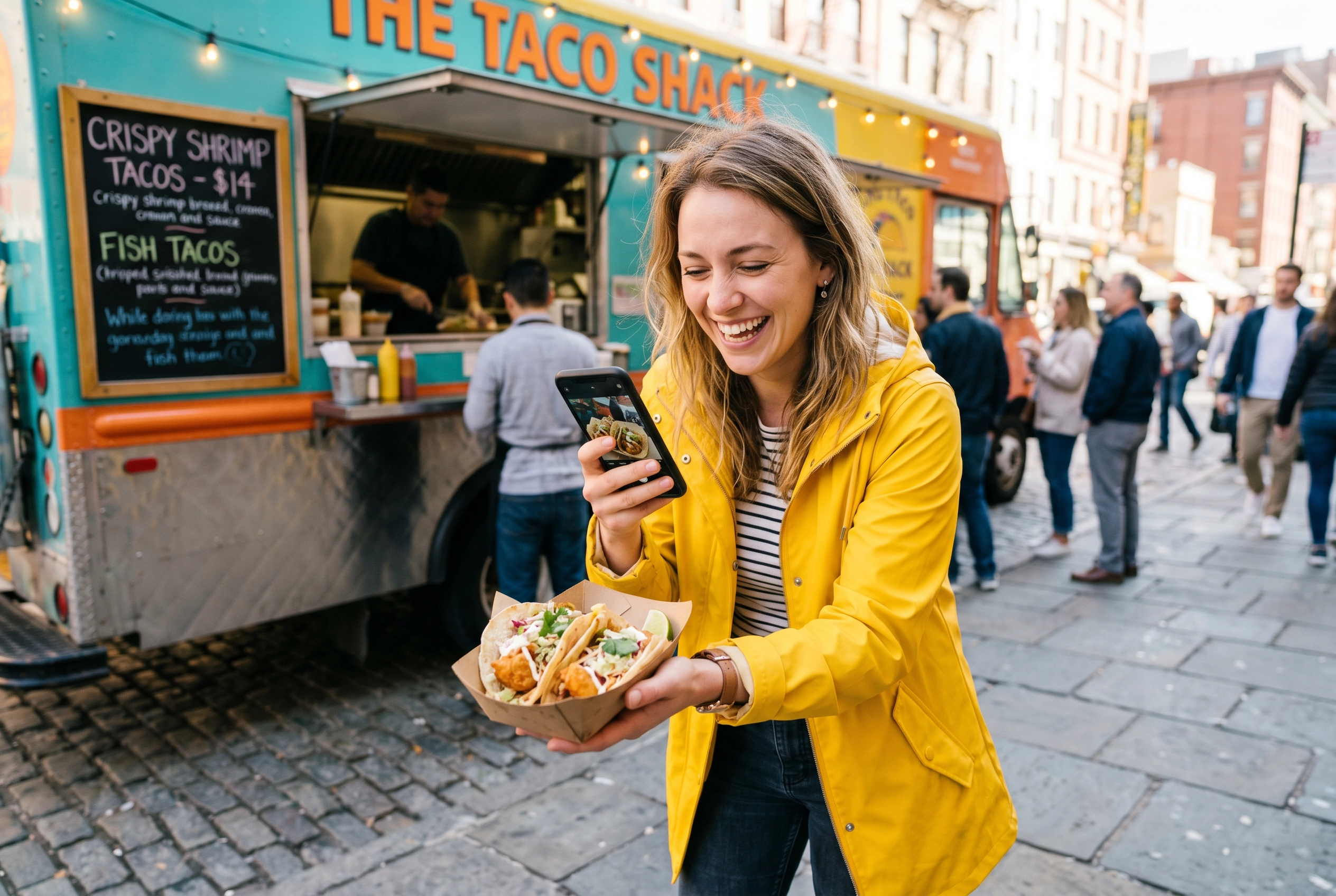 Customer photographing her food truck tacos on sidewalk — user-generated content for food truck social media
Tactics That Work
- "Tag for a free drink" incentive. Sign on the truck: "Tag us on Instagram, show the server, get a free soda."
- Brand hashtag discovery. Search your brand hashtag daily, repost the best photo, tag the customer to build community.
- Customer photo wall. Physical display with the week's best UGC. People create content to get on the wall.
- Weekly shoutout Reel. Every Sunday, compile customer photos into a 15-second Reel.
- Giveaway mechanic. "Repost + tag 2 friends + follow = free meal." Monthly. Adds 200-500 followers per campaign.
What NOT to Do
- Don't repost customer photos without permission (a DM takes 20 seconds)
- Don't use low-quality UGC just because it was tagged — your feed's aesthetic matters
- Don't ignore tagged photos — the algorithm notices engagement, customers notice silence
Paid Advertising on a Food Truck Budget ($50–$200/Month)
Most operators assume they can't afford paid ads. They can. The budget just looks different from a restaurant's.
A $5/day Facebook/Instagram ad budget reaches 1,000-3,000 local people per day, per Meta's reach estimates. In a 5-mile radius, that's meaningful foot traffic for a food truck business.
The Three-Tier Budget Framework
$50/month — Weekly location boost. $10-15 boosting your Monday-morning location post. 3-4 boosts per month. Geo-target a 3-5 mile radius. Increases foot traffic 15-30% on boosted days.
$100/month — Location boosts + one monthly event or catering campaign.
$200/month — Full funnel. Daily location awareness ($60-80), event promotion ($50-70), catering lead form ($30), retargeting ($20-40).
Campaigns That Work for Food Trucks
- Location awareness. "We're at 5th & Main tonight 5-9pm." Geo-targeted 5-mile radius. Cheapest campaign.
- Event promotion. "Find us at Taco Festival Saturday." 10-mile radius.
- Catering lead form. Target users interested in events, weddings, corporate planning.
- Grand opening. One-time $100-300 burst.
- Retargeting. Website visitors or people who watched a Reel 75% through. Cheapest clicks.
Always track with promo codes. Running ads without attribution is buying hope. For deeper strategy, see our social media advertising ROI guide.
The AI Photo Advantage: Professional Content Every Day
The hidden tax of a great social media marketing for food trucks strategy: it demands great photos. Daily. Great food photos take time — time you don't have during prep, service, and cleanup. AI photo enhancement changes the math.
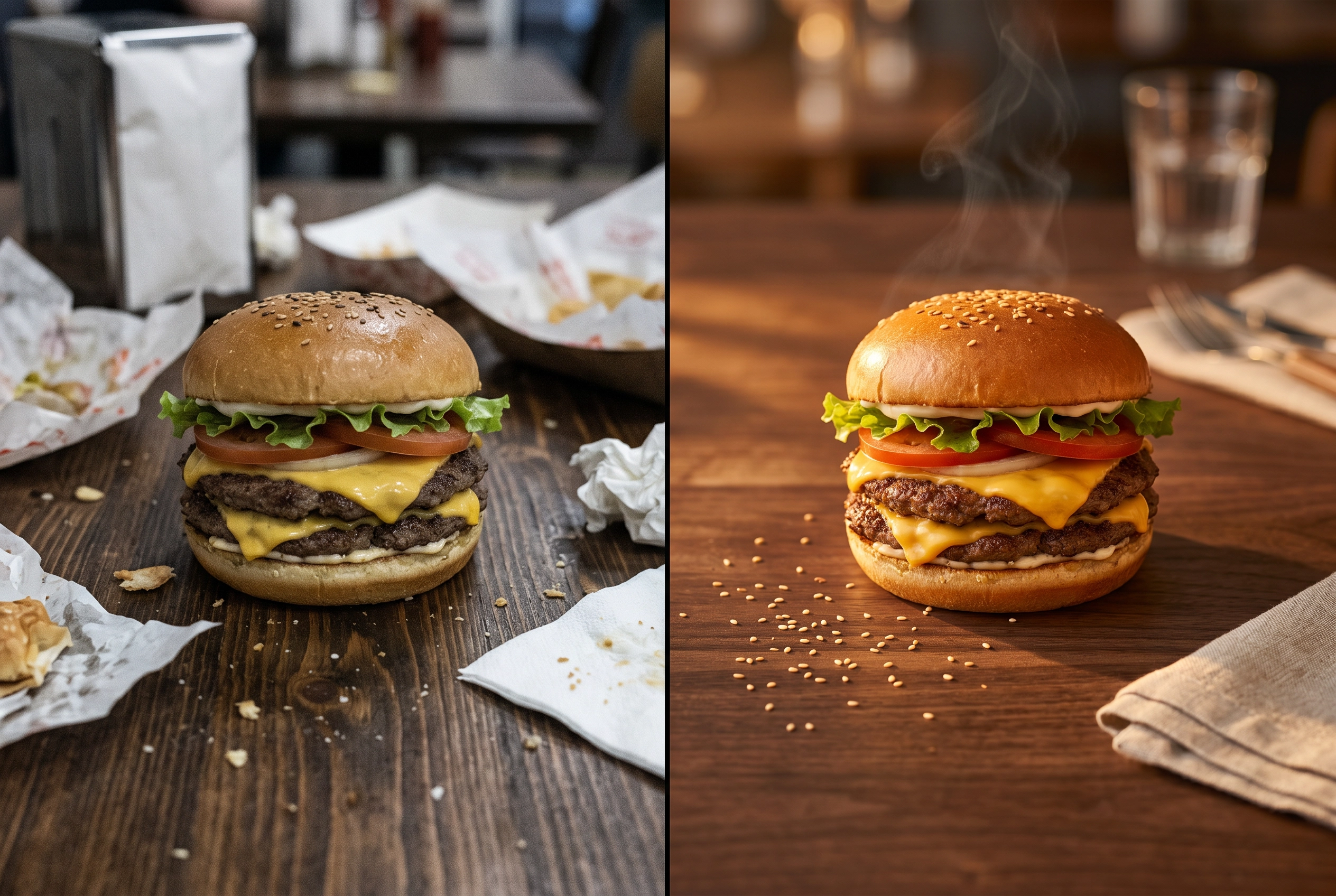 Before and after comparison of food truck burger photo — phone snapshot versus AI-enhanced professional quality
The workflow: snap a phone photo during prep. Run it through an AI food photo tool. Post. Total time: 60 seconds per image. Compared to setting up a styling station, shooting, editing, exporting — 20-40 minutes per dish — you've just unlocked daily posting without adding an hour of work.
FoodShot AI is purpose-built for food trucks operating under these constraints. Upload a phone photo of real food and it transforms into a studio-quality shot with proper lighting, cleaner background, and menu-ready styling — while keeping the dish real (no AI-generated fake food, which customers spot instantly).
A Starter plan ($15/month, or $9/month billed yearly) gives 25 enhanced photos per month — enough to refresh your feed weekly. A Business plan ($45/month) takes you to 100 credits — daily posting without thinking. All paid plans include a commercial license, which matters for paid ads. FoodShot AI pricing breaks down the tiers.
Why this matters for food trucks: unpredictable lighting, cluttered backgrounds, short handoff windows. Traditional food photography doesn't fit the operation. AI enhancement does — batch enhance Sunday night, schedule your feed, focus on cooking.
Food Truck Social Media Ideas That Won't Run Out
When you're stuck for food truck social media ideas mid-week, pull from this evergreen list:
- Dish origin story ("why we put cumin in this")
- Sourcing feature (farm, butcher, bakery)
- Team member introduction
- Secret menu reveal
- Customer takeover day
- Before/after prep transformation
- Truck anniversary milestones
- Local collaboration (another truck, brewery, bakery)
- Weather-themed specials ("rainy day ramen")
Mistakes That Quietly Kill Food Truck Social Media
Most food trucks fail at social media marketing for food trucks from a slow accumulation of small mistakes, not one big one:
- Posting AFTER you open. You've missed the decision window.
- Treating it like a restaurant strategy. You aren't a restaurant. You move.
- Skipping the location geo-tag. Invisible to "near me" discovery.
- Inconsistent posting. Three days off costs weeks of algorithm recovery.
- Ignoring Stories. They drive more daily engagement than feed posts.
- Perfectionism. The great photo never posted beats the perfect one in drafts.
- Identical content across every platform. TikTok audiences hate Instagram reposts.
- Ignoring DMs. Catering leads live in your inbox. Missed DMs are missed revenue.
The 90-Minute-a-Day System
If you take nothing else from this guide on social media marketing for food trucks, take this rhythm:
- Morning (30 min): Location post across Instagram, Facebook, X. Respond to overnight DMs.
- Mid-service (15 min): Shoot 5-10 dish photos. Capture a customer moment for a Reel.
- Post-service (30 min): Batch enhance photos. Draft tomorrow's content. Check hashtag performance.
- Weekly (60 min, Sunday): Plan Reels, write captions in advance, schedule events.
Ninety minutes a day is enough to build a real food truck brand presence. You don't need an agency. You need a system.
For the broader picture beyond social, see our guides on food truck menu design and catering food photography. Food truck operators in r/foodtrucks on Reddit regularly report 60,000 profile visits per year just from consistent posting plus trending hashtags.
Frequently Asked Questions
How often should a food truck post on social media?
Minimum: one daily location post on Instagram Stories plus X. For your feed, 3-4 posts per week. For Reels, 1-3 per week. Consistency matters more than volume — skipping a day is better than posting low-quality content that drags down your engagement rate.
What's the best social media platform for a new food truck?
Start with Instagram. It combines visual menu (feed), daily location broadcasts (Stories), and audience growth (Reels) in one place. Add Facebook in month two for local groups, events, and catering leads. Bring TikTok in once Instagram is automatic.
Do I need to be on every platform?
No. Doing two platforms well beats five poorly. Pick two primary platforms (Instagram + Facebook is the most common winner), plus X for real-time updates. Skip Pinterest, LinkedIn, and YouTube unless you have a specific reason.
How much should I spend on social media ads?
Start at $50/month to test. Scale to $100-200/month once you know what works. Never run ads without tracking attribution — use promo codes or "mention this ad" specials so you can measure what each dollar returned.
How do I grow my food truck Instagram followers?
Reels are the #1 growth driver in 2026 — they're shown to non-followers by default. Combine with a proper hashtag ladder, consistent geo-tags, collaborations with local food accounts, and UGC reposts. Be patient: 2,000 followers in year one is normal and plenty for a profitable food truck business.
Should I hire someone to run my food truck social media?
Most food trucks can't justify a full-service agency ($500-2,000/month). A freelancer at $200-400/month is more realistic. The better route for most owner-operators: take 30 minutes a day, batch-create content weekly, and use AI tools to close the photography gap.
How do I handle negative reviews online?
Respond within 24 hours, publicly, once — then take it to DM. Acknowledge, apologize where warranted, offer to make it right privately. Never argue in public. Delete only spam or abusive comments, not legitimate criticism. Most readers judge your response more than the original complaint.