Food Photography Services Compared: Freelancer, Studio & AI
 Ali Tanis25 min read
Food photography services in 2026 range from $0.40 per image to $500+ per image — a 1,000x price spread for solutions that all claim to produce "professional food photos." The right food photography service for your business depends entirely on what you're shooting, how often, and why.
This guide compares all five food photography service categories available to restaurants and food brands today: local freelance photographers, full-service studios, on-demand booking platforms like Snappr and Thumbtack, stock photography libraries, and AI photo enhancement tools. You'll see real 2026 pricing, honest trade-offs, food photography packages by tier, and a clear framework for choosing the right one for your restaurant.
Quick Summary: Freelance food photographers charge $300–$1,500 per session, professional studios run $2,000–$7,500+ all-in, on-demand platforms cost $150–$500 per shoot, stock photos cost $1–$30 each, and AI enhancement runs $15–$99/month (~$0.40–$0.60 per image). Traditional professional food photography services still win for brand launches, cookbooks, and editorial campaigns. AI handles 80–90% of a working restaurant's daily photography needs — menus, delivery apps, social media — at a fraction of the cost.
The 5 Food Photography Services You Actually Have in 2026
Five years ago, "hiring a photographer" was essentially your only option for professional food images. That's no longer true. Here's the full landscape of food photography services restaurants and food businesses actually use today:
- Local freelance food photographers — Independent pros with their own equipment, typically booked for half-day or full-day shoot sessions at your location or theirs.
- Photography studios and creative agencies — Full-production teams with photographers, food stylists, prop stylists, and dedicated studio space.
- On-demand photography platforms — Booking marketplaces like Snappr and Thumbtack that match you with a photographer on short notice at fixed rates.
- Stock food photography libraries — Shutterstock, Adobe Stock, Getty, Unsplash and others that license generic food images by subscription or on demand.
- AI food photo enhancement services — Software that transforms phone photos of your real dishes into studio-quality images in seconds.
Here's how these food photography services stack up at a glance:
| Service Type | Cost Per Image | Turnaround | Authenticity | Scalability | Best For |
|---|---|---|---|---|---|
| Local freelancer | $25–$150 | 3–7 days | Your real food | Low | One-off shoots, personal brand |
| Photography studio | $50–$500+ | 1–3 weeks | Your real food | Low | Brand launches, print, editorial |
| On-demand platform | $30–$100 | 2–7 days | Your real food | Medium | Quick menu refreshes |
| Stock photography | $1–$30 | Instant | Generic (not yours) | High | Blog illustrations only |
| AI enhancement | $0.40–$0.60 | 90 seconds | Your real food | Unlimited | Menus, delivery apps, social |
Each food photography service has a place. The mistake most restaurant owners make is assuming more expensive equals more appropriate. A $5,000 studio session is worth every penny for a cookbook or national campaign — and complete overkill for updating your Tuesday special on DoorDash.
Option 1: Local Freelance Food Photographers
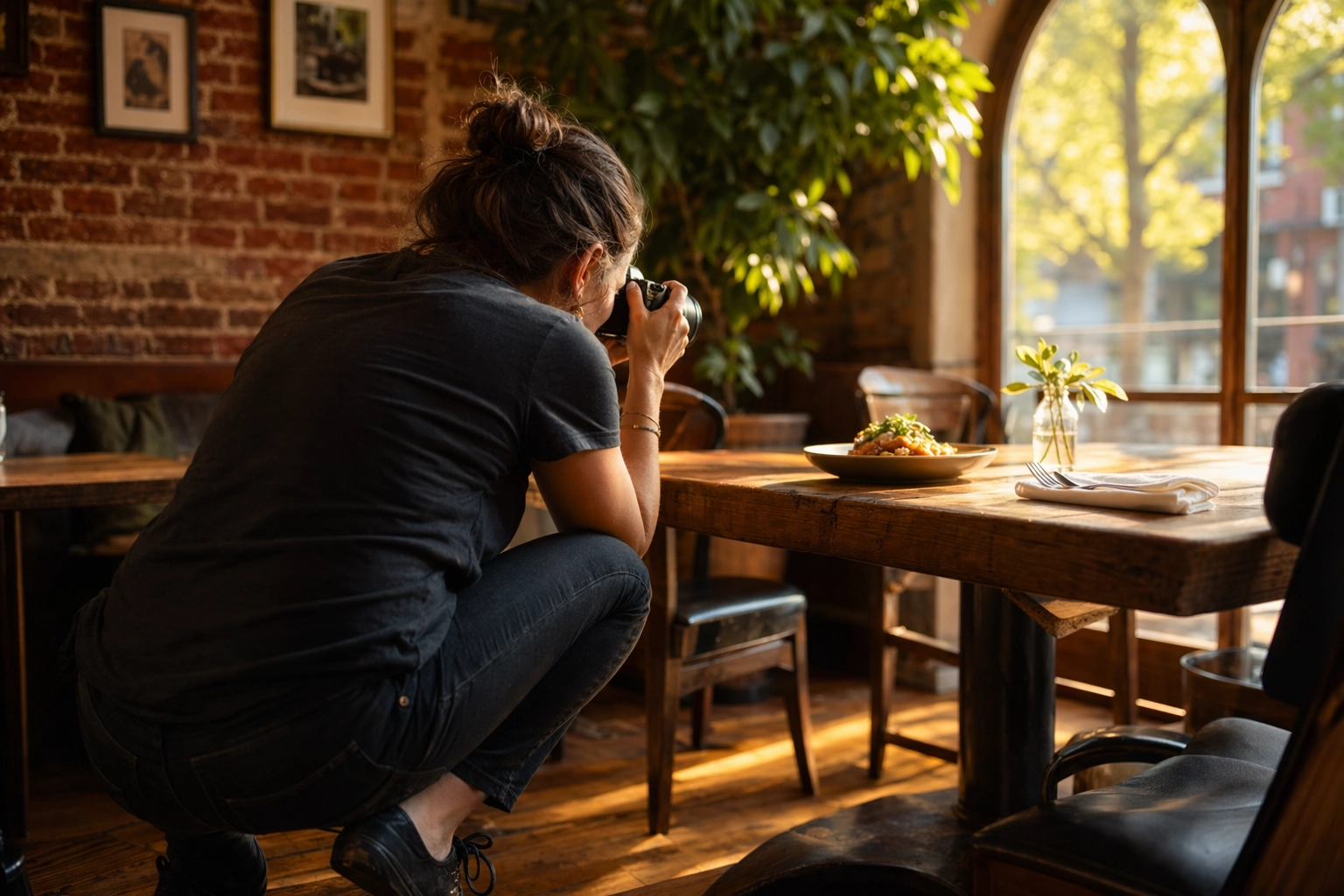 Freelance food photographer crouched with mirrorless camera photographing a plated dish near a sunlit arched window in a small restaurant
Local freelance food photographers are independent professionals who run their own business, bring their own equipment, and typically work on-location at your restaurant or in a home studio. They're what most people picture when they think "food photography services."
Typical pricing and food photography packages in 2026:
- Entry-level photographer: $250–$600 per session (3–4 hours, 15–25 edited images)
- Mid-range photographer: $750–$2,500 per session (full day, 25–40 edited images)
- Premium photographer (major cities): $1,200–$2,500+ per session (40+ images, extended licensing)
- Hourly rates: $150–$500 depending on experience and market
Prices swing hard by geography. Food photographers in Los Angeles charge roughly 45% above the national average, while Nashville, Denver, and Dallas run 5–10% below. Food-specific photographers usually command 20–40% more than general commercial photographers because food is a demanding niche — lighting changes as dishes cool, color accuracy matters for appetite appeal, and composition has to sell the dish.
What's great about hiring local freelance photographers:
- Real creative direction. You get a conversation, a mood board, and someone who cares about your brand.
- On-location flexibility. They can shoot your actual space — the dining room, the bar, the open kitchen — in ways no studio can replicate.
- Relationship-based. A good food photographer becomes a long-term creative partner who understands your aesthetic and brand over time.
What's not great:
- Hidden costs are the norm. The quoted session fee almost never includes food styling (add $500–$1,200/day for a professional stylist), props ($150–$400), studio rental if they prefer one ($750–$2,500/day), or extended usage licensing.
- Quality varies wildly within the same price band. A $1,000 session with one photographer can produce stunning work; the same budget with another produces usable-but-forgettable images.
- Scheduling friction. Good photographers book 2–6 weeks out. Launching a new menu next week? You're out of luck.
Best for: Brand photography, lifestyle shots of your restaurant space, portrait work (chef headshots, team photos), and annual content refreshes where creative direction matters more than speed or scale.
Watch out for: Photographers who won't share a rate card, won't show a food-specific portfolio, or gloss over licensing terms. Food is a specialty — hiring a wedding photographer to shoot your menu rarely ends well.
Option 2: Photography Studios & Creative Agencies
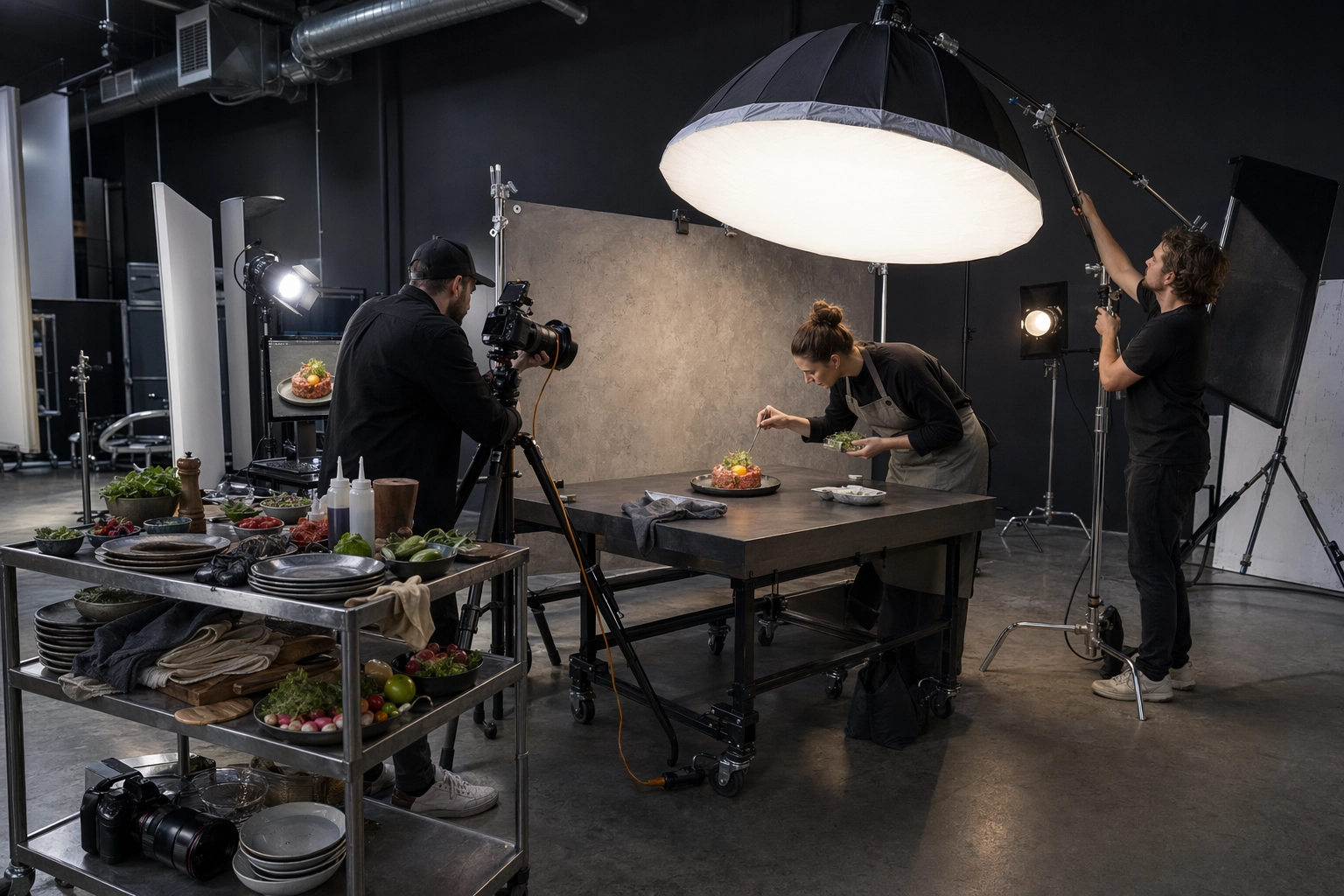 Commercial food photography studio with food stylist, photographer, and assistant working on an elaborate styled dish set under large softbox lighting
Photography studios are the full-production tier of food photography services: a photographer, a food stylist, often a prop stylist, a digital tech or assistant, and a dedicated studio space with commercial-grade lighting equipment and kitchen facilities. Creative agencies like Yum Creative, NYC Food Photo, and Pennington Studios offer the same service packaged with art direction and creative strategy.
Typical pricing for professional studio food photography services in 2026:
- Studio session (photographer only): $1,000–$5,000 per day
- Food stylist: $500–$1,200 per day (advertising shoots run $850–$1,200)
- Studio rental: $750–$2,500 per day in major metros
- Props, groceries, materials: $150–$400 per shoot (ingredients are duplicated because food deteriorates fast under lights)
- Assistant/crew: $350–$500 per day
- Advanced retouching and editing: $10–$25 per image for compositing, background replacement, heavy color work
Realistic all-in cost for one session: $2,330–$7,400. Editorial campaigns with unique creative direction, multi-day shoots, or extended usage rights can push past $10,000–$15,000.
Here's an actual budget from a mid-range studio shoot: $1,200 photographer + $650 food stylist + $200 props + basic retouching included = $2,050 total for roughly 40 edited images. That's ~$51 per image — a reasonable per-image rate for the quality, but a massive upfront commitment.
What studios do better than anyone:
- Ceiling-level quality. The best food photography you've seen — magazine covers, cookbook hero shots, billboard campaigns — is almost always studio work.
- True creative direction. A dedicated team plans mood, lighting, composition, and styling for weeks before the shutter clicks.
- Complex setups. Action shots (pour shots, steam, cracking ice), lifestyle scenes with hands and people, large tablescapes — these need a crew.
- Brand consistency across a campaign. When 30 images need to feel like one coherent story for your brand, studios deliver.
What studios don't do well:
- Speed. Between pre-production planning, shoot day, and post-production, 2–3 weeks is typical. Rush jobs add 25–50%.
- Daily operational needs. No studio will photograph this week's soup special for you on Thursday.
- Small menu updates. Minimum session bookings mean even a "small" job starts at $1,500+.
Best for: Brand launches, cookbook projects, print advertising (billboards, magazines), annual hero campaigns, packaging for consumer packaged goods, and situations where you need a creative director — not just a photographer.
For a deeper look at the budget breakdown behind studio work, see our commercial food photography guide.
Option 3: On-Demand Photography Platforms (Snappr, Thumbtack, Fiverr)
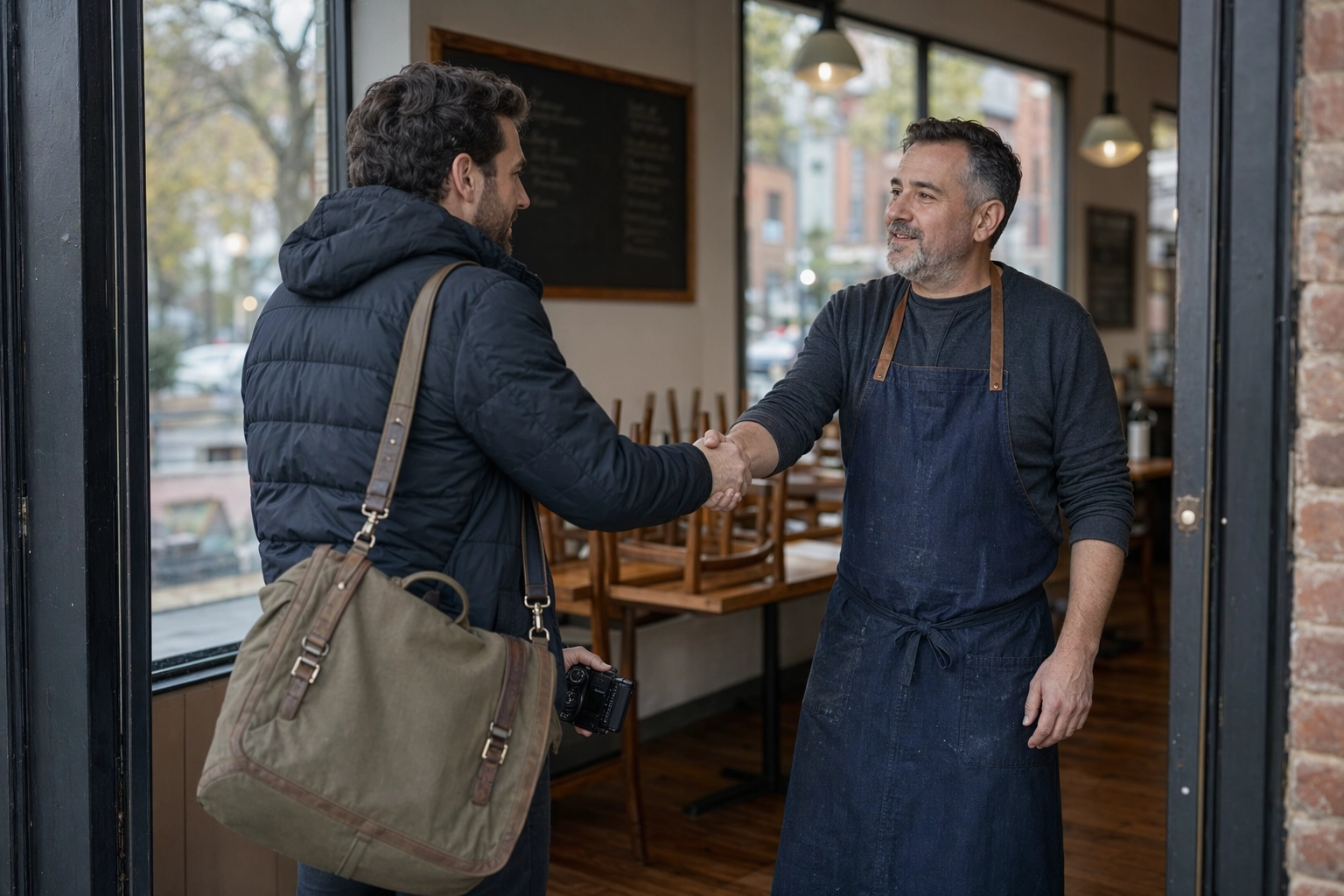 On-demand photographer with camera arriving at a restaurant entrance shaking hands with the chef owner during pre-service daylight
On-demand food photography services apply the Uber model to photography: standardized pricing, quick booking, a vetted network of photographers, and minimal negotiation. They occupy the middle ground between "find a local freelancer" and "book a full studio."
How pricing and booking works on the major platforms:
Snappr charges flat hourly rates for food shoots with 48-hour edited photo delivery. Based on Snappr's own city-by-city pricing data, a food shoot booking runs:
- 1 hour: $227–$361 (Chicago/Dallas to Los Angeles)
- 2 hours: $362–$578
- 4 hours: $634–$1,012
- LA is roughly 45% above average; mid-sized cities sit slightly below the US mean
Photographers are assigned from the Snappr network (they describe it as the "top 5%"), bookings can happen with as little as 2 hours' notice in some markets, and delivery is standardized at 48 hours after the shoot.
Thumbtack is a pure marketplace — you post a request, photographers send quotes, you pick one and book directly. There are hundreds of listed food photographers per major metro (228 in New York, 83 in Dallas). Quotes typically land between $200 and $800 per shoot, but variance is huge because you're hiring individual freelancers who happen to use Thumbtack for lead generation.
Fiverr and Upwork are different — they're primarily for photo retouching and editing services, not on-location shooting. Food photo editing ranges from $5/image (basic color correction) to $100/image (heavy compositing and background work). Useful if you already have source photos that need polish, but can't solve a bad starting photo.
What on-demand food photography services do well:
- Convenience. Booking takes under 5 minutes. No back-and-forth emails, no contracts to negotiate, no contact chains with multiple people.
- Predictable pricing. You know the rate before you commit.
- Fast availability. Same-week bookings are common in major cities.
- Volume coverage. Chains can book consistent shoots across locations through a single platform.
What they don't do well:
- Variable quality within the platform. "Top 5% of photographers" is a marketing claim, not a guarantee. You might get someone excellent; you might get someone mediocre.
- Limited creative direction. These are transactional shoots — there's no pre-production conversation, no custom lighting plan.
- Food-specific expertise isn't guaranteed. Many on-demand photographers shoot everything — real estate, headshots, events — and food is one more vertical rather than a specialty.
- Still a full shoot. You need to close the kitchen for the session, prep the food, and coordinate logistics. That's the real cost that AI eliminates.
Best for: Restaurants in major metros needing a quick, no-fuss menu refresh where "professional enough" beats "perfect." Less well-suited for brand-defining hero work or restaurants in smaller markets where network coverage is thin.
Option 4: Stock Food Photography (Shutterstock, Adobe Stock, Getty)
Stock photography is the cheapest food photography service on paper. It's also the riskiest choice for restaurants — for reasons that have nothing to do with image quality.
Typical pricing in 2026:
- Subscription plans: Shutterstock $29–$49/month for 10 images ($2.90–$4.90 each); Adobe Stock $29.99/month for 10 images ($3 each); iStock $29–$40/month ($2.90–$4 each)
- On-demand purchases: $1–$20 per image for standard royalty-free
- Extended commercial licenses: $49–$150 per image
- Premium editorial (Shutterstock Offset, Getty): $199–$500 per image
Free options exist too — Unsplash, Pexels, and Pixabay offer decent food photography at no cost, though licensing terms vary and image uniqueness is low (the same "perfect latte art" shows up on thousands of sites).
The core problem with stock for restaurants: those aren't your dishes.
A customer scrolls DoorDash, sees a stunning stock photo of mushroom risotto on your listing, orders it, and receives something that looks completely different. That's a one-star review written before the customer has even finished eating.
Specific problems stack on top of the authenticity issue:
- Delivery platform compliance risk. DoorDash, Uber Eats, and Grubhub increasingly require images to accurately represent the dish served. Stock photos can be flagged, removed, or lead to account warnings.
- Competitors use the same image. That "perfect burger" shot on Shutterstock is licensed thousands of times — your competitor down the street might run the identical photo.
- Zero brand value. Stock photos don't build visual identity for your restaurant business. They could be anyone's.
- Customer trust erosion. Industry surveys consistently show that 70%+ of delivery app users say photos influence their ordering decisions. Misleading photos destroy that trust permanently.
When stock photos make sense: Food blog illustrations, generic social media background graphics, pitch decks, or internal marketing materials where no specific dish is being sold. That's a narrow window.
When they don't: Anything customers will see tied to a specific menu item — menus, delivery apps, online ordering, catering proposals, website hero images of "your" food.
The right answer isn't "cheaper stock" — it's to take a phone photo of your actual dish and use AI enhancement to get stock-quality results. More on that next.
Option 5: AI Food Photo Enhancement Services
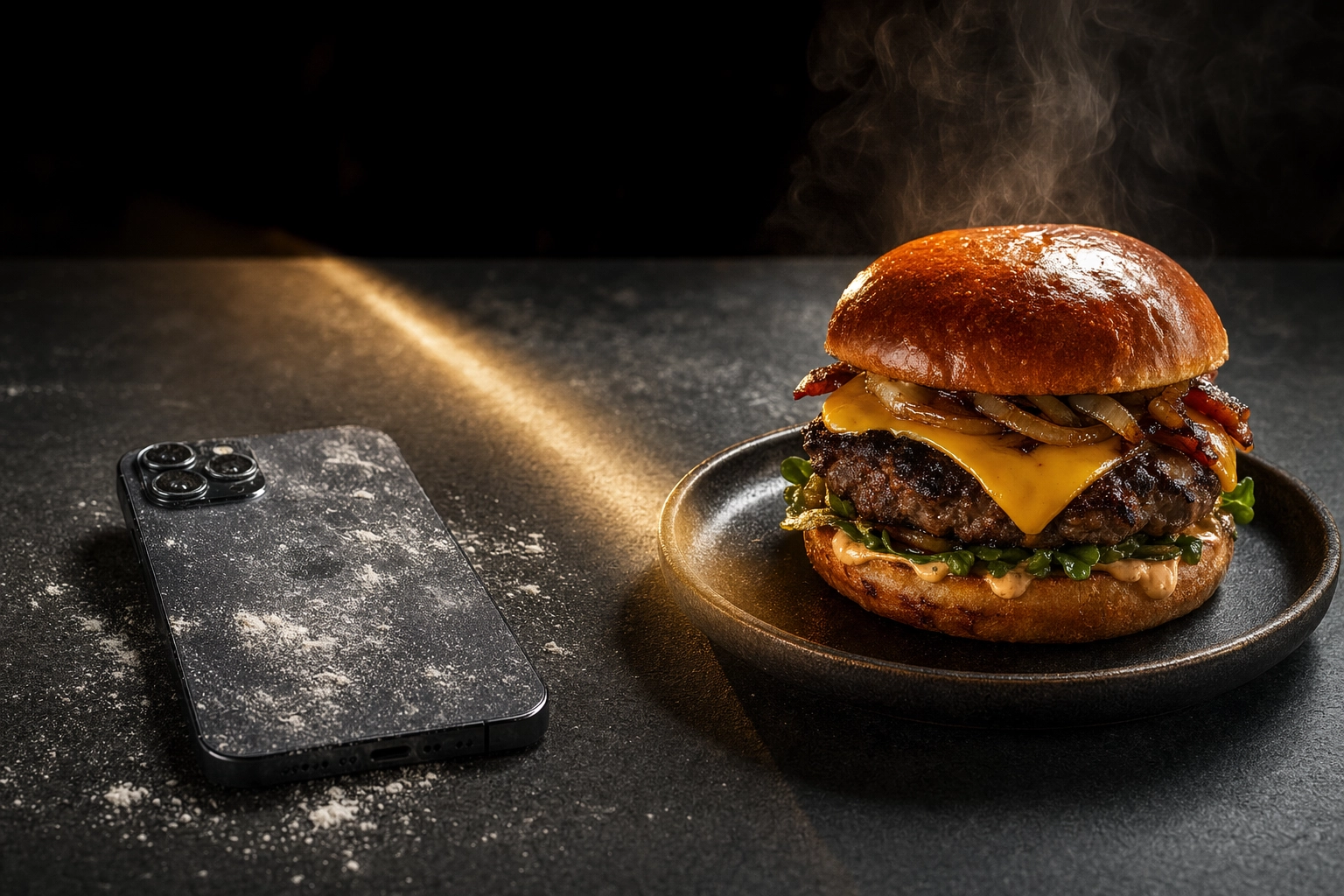 Flour-dusted smartphone beside a dramatically lit gourmet burger with steam and golden rim light on a dark concrete surface
AI food photo enhancement is the newest category of food photography services, and it reshapes the cost equation for restaurants. Instead of hiring a production team or licensing generic stock, you take a photo of your actual dish with your phone and the software transforms it into a studio-quality image in roughly 90 seconds.
Typical pricing for dedicated AI food photography services:
- Free tier (watermarked): $0 for 3–10 starter credits
- Entry plans: $9–$15/month for 25 images (~$0.36–$0.60 per image)
- Business plans: $27–$45/month for 100 images (~$0.27–$0.45 per image)
- Scale plans: $59–$99/month for 250 images with bulk processing (~$0.24–$0.40 per image)
- Enterprise/API: Custom volume pricing (contact sales teams directly for quotes)
FoodShot AI, MenuPhotoAI, GourmetPix, and PlatePhoto all operate in this category with broadly similar pricing structures. For FoodShot AI specifically, you can see full plan details on the pricing page.
The critical distinction: enhancement vs. generation.
Some AI tools (Midjourney, DALL-E, and general-purpose image generators) create food images from text prompts — they invent food that doesn't exist. That's a compliance problem for restaurants because delivery platforms and truth-in-advertising rules require images to represent the actual dish served.
AI enhancement is different. You upload a photo of your real dish, and the AI improves the lighting, background, composition, and styling while preserving what the food actually looks like. The steak on your menu is still your steak — it just looks better lit. That's compliance-safe and customer-honest.
What AI food photography services do well:
- Use your real food. Authenticity and platform compliance are baked in.
- Near-zero incremental cost. Once you're on a plan, each additional image costs cents, not dollars.
- Instant turnaround. 90 seconds versus 3–14 days.
- Unlimited iteration. Don't love the output? Try a different style, background, or angle with one click.
- Scales infinitely. Shooting 30 dishes or 300 dishes takes the same amount of your time per image.
- No scheduling. Update your menu Thursday night for Friday's launch.
- Multi-location consistency. Features like style libraries and reference-photo uploads let a chain maintain visual consistency across 50 locations from one account.
What AI enhancement doesn't do well:
- Still needs a reasonable source photo. The AI can't rescue an out-of-focus photo shot in the dark. Your phone shot needs to be in focus, decently lit, and show the dish clearly. Our guide on how to take good food photos covers the basics.
- Less creative direction than a human photographer. You're picking from style presets and reference images rather than sitting down with an art director.
- Monthly credit limits. Unlike a one-time photographer fee, AI is subscription-based with monthly caps.
- Not suited for complex action or lifestyle shots. A photographer capturing a chef's hands pouring sauce mid-plate is still a human's job.
Best for: Menu photography, delivery app listings (DoorDash, Uber Eats, Grubhub), social media content, seasonal specials, daily operations photography, multi-location brand consistency, ghost kitchens, and any situation where you need a steady flow of professional-looking food photos without the logistics of a shoot.
For a deeper head-to-head on this specific decision, read our full AI vs hiring a food photographer comparison.
Side-by-Side: The Complete Food Photography Services Comparison
Here's everything in one place, scored on the dimensions that actually matter when you're picking a food photography service for your business:
| Dimension | Freelancer | Studio | On-Demand | Stock | AI Enhancement |
|---|---|---|---|---|---|
| Cost per image | $25–$150 | $50–$500+ | $30–$100 | $1–$30 | $0.40–$0.60 |
| Session/monthly cost | $300–$1,500 | $2,000–$7,500+ | $150–$500 | $29–$49/mo | $15–$99/mo |
| Turnaround | 3–7 days | 1–3 weeks | 2–7 days | Instant | 90 seconds |
| Quality ceiling (1–10) | 8 | 10 | 7 | 9 (but generic) | 8 |
| Your real food | ✅ Yes | ✅ Yes | ✅ Yes | ❌ No | ✅ Yes |
| Creative direction | Medium–High | High | Low | None | Preset-based |
| Scalability | Low | Low | Medium | High | Unlimited |
| Scheduling needed | Yes | Yes (weeks) | Yes (days) | No | No |
| Food stylist included | Rarely | Yes (extra) | No | N/A | Software handles |
| Delivery app safe | ✅ Yes | ✅ Yes | ✅ Yes | ⚠️ Risky | ✅ Yes |
| Monthly ongoing cost | High | Very High | Medium | Low | Very Low |
The quick read: studios win on absolute quality ceiling and complex creative work. AI wins on everything operational — cost, speed, scale, and daily restaurant needs. Stock photos win on cheapness and lose on basically everything else that matters for a restaurant business.
When Each Food Photography Service Actually Wins
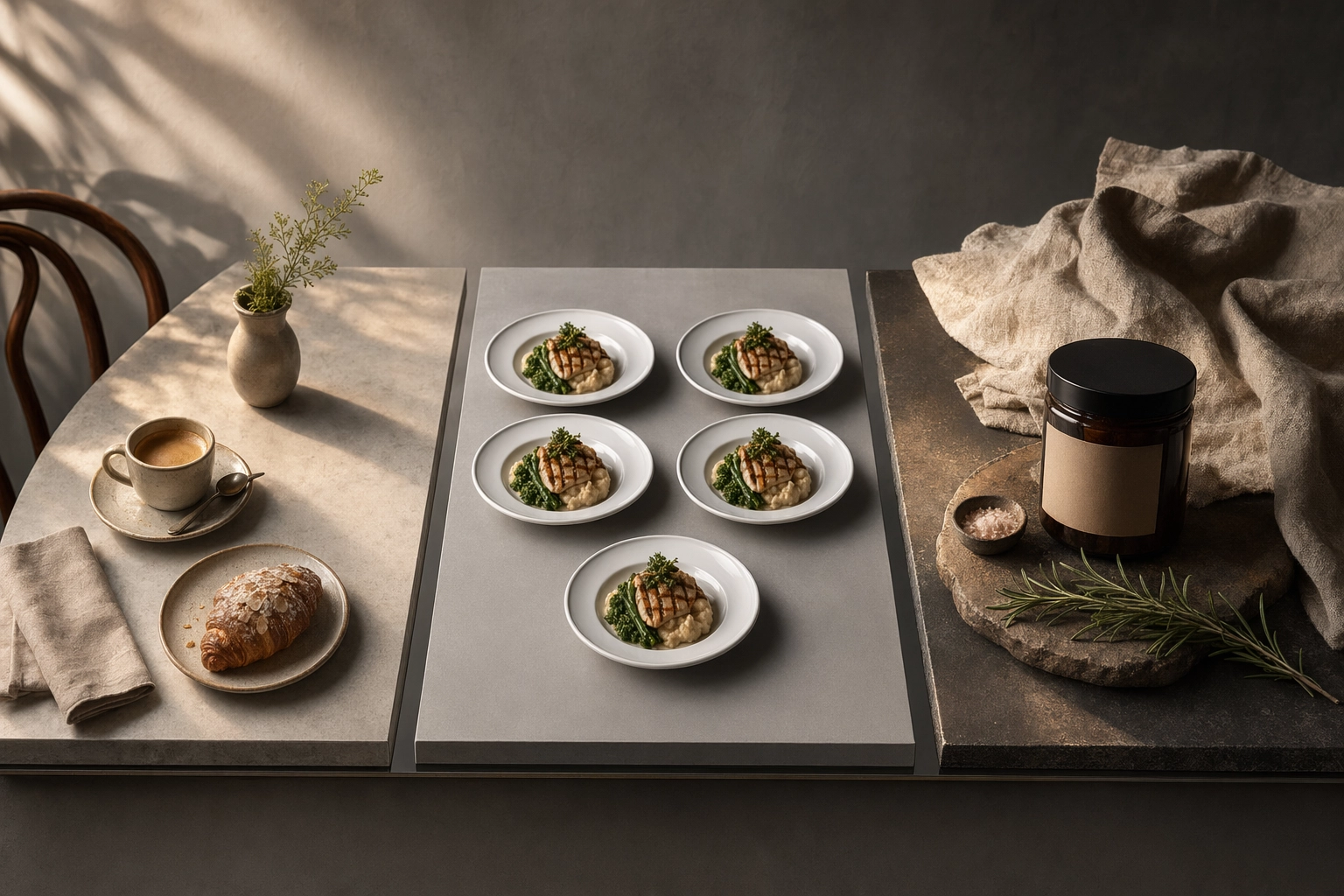 Three miniature food scenes side by side showing cafe, multi-location chain, and CPG product photography approaches on a neutral gray surface
The wrong way to pick a food photography service is by quality rank. The right way is by use case. Here's what each situation calls for:
Menu updates (weekly or monthly changes) → AI enhancement. The economics don't work any other way. A restaurant updating 20 items a month through a freelance photographer costs $2,000–$5,000 per refresh. AI handles the same refresh for under $20.
Delivery app listings (DoorDash, Uber Eats, Grubhub) → AI enhancement. These platforms reward fresh, authentic, high-quality images. You need 30–100 dish photos that update as your menu shifts. See our delivery app photography guide for platform-specific specs.
Social media daily content → AI enhancement, sometimes combined with iPhone photos. Instagram and TikTok demand volume and variety that no professional photographer can economically support for a restaurant.
Brand launch or grand opening → Premium freelancer or studio. This is the moment where creative direction, a unique visual identity, and hero-level quality define your first impression. Budget $3,000–$15,000 for a proper launch package.
Cookbook or editorial project → Studio, always. Cookbooks need styled environments, complex setups, consistent art direction across 50–200 images, and print-resolution quality that goes beyond what AI enhancement outputs.
Print advertising (billboards, magazine ads) → Studio. High-resolution requirements and unique creative direction are non-negotiable.
One-time location photography (your space, chef portraits, team) → Local freelance photographer. Food photographers who also shoot lifestyle are the right tool — AI can't photograph your chef.
Multi-location chain consistency → AI enhancement with brand style features. Maintaining a unified visual identity across 20 stores is nearly impossible with freelancers. Tools that let you upload reference photos and apply them as brand styles solve this specifically.
CPG product photography (packaging, branded campaigns) → Studio for the hero packaging shots. AI enhancement for the ongoing social and e-commerce imagery that follows.
Ghost kitchen virtual brands → AI enhancement. Virtual brands launch and iterate fast. The economics and speed of professional photography don't match the business model.
The Real Cost Math: Three Restaurant Scenarios
Pricing per image is misleading because different businesses need different volumes. Here's what annual spend on food photography services actually looks like across three common restaurant profiles:
Scenario 1: Single-location café, 30 menu items, quarterly updates
- Professional freelance photographer: $1,200 session × 4 = $4,800/year, plus $650 × 4 = $2,600 in food stylist fees = ~$7,400/year all-in
- Photography studio: $2,500 session × 4 = ~$10,000/year (usually more with styling)
- AI enhancement ($15/month Starter plan): 25 images/month covers 30 quarterly refreshes with headroom = $180/year
- Savings with AI: $7,220–$9,820/year (97–98% cheaper)
Scenario 2: Multi-location chain (5 locations), 50 items, monthly updates, weekly social
- Professional shoots: 12 full-day studio sessions/year at $3,500 average = $42,000/year
- AI enhancement ($99/month Scale plan): 250 images/month × 12 = 3,000 images/year, easily covers the need = $1,188/year
- Savings with AI: ~$40,800/year (97% cheaper)
Scenario 3: New restaurant brand launching with ongoing marketing
- Launch: one studio session with full production for hero shots = $5,500 (one-time)
- Ongoing: AI enhancement on Business plan for year-round menu, social, delivery app updates = $540/year
- Total year one: ~$6,040. Compare to all-professional coverage at $25,000+.
The pattern: the professional/AI hybrid almost always wins for restaurants that are operating, not just launching. Pay for professional food photography services when creative direction defines the outcome. Use AI for everything that follows.
Red Flags When Evaluating Any Food Photography Service
Not every food photography service (or provider within a service category) is worth your money. Watch for these:
For freelance photographers and studios:
- Vague pricing. If they won't share a rate card or ballpark, they're almost always more expensive than you expect.
- No food-specific portfolio. Food is a genuine specialty. A portrait photographer who "also does food" isn't the same as a food photographer.
- Missing licensing terms. Who owns the images? Can you use them on packaging? For how long? Get it in writing before you sign a contract.
- No food stylist discussion. On any shoot over a few hours, a professional stylist meaningfully changes the output. If they don't mention one, ask.
- Unrealistic rush promises. "24-hour delivery on a full menu shoot" means corners are being cut — usually on retouching.
For on-demand booking platforms:
- Review before booking. Platform-assigned photographers vary. Check the individual's portfolio if the platform allows it.
- Understand the delivery timeline. 48-hour promises sometimes slip; confirm before committing.
For AI food photography services:
- No commercial license on your plan means you can't legally use the images for your business — a dealbreaker for restaurants.
- Watermarked outputs on paid plans are a downgrade signal.
- Generation vs. enhancement confusion. If the tool creates food images from text prompts (rather than enhancing your uploaded photos), that's AI generation and a compliance risk for delivery apps.
- No bulk processing on higher-volume plans means manual work as you scale.
How to Choose: A 4-Question Framework
 Restaurant owner reviewing a handwritten budget notebook under warm pendant light at a wooden table in her empty restaurant after hours
Skip the analysis paralysis. Answer these four questions about your food photography needs and the right service falls out:
1. How often does your menu change?
- Monthly or more → AI enhancement
- Quarterly → AI, or hybrid with one pro session per year
- Annually or rarely → Professional food photography services are viable
2. What's the primary use?
- Menu, delivery apps, social media, website → AI
- Print ads, cookbooks, billboards → Studio
- Chef portraits, space photos → Local freelance photographer
3. What's your monthly budget for food photography?
- Under $100 → AI
- $100–$500 → AI, plus one pro session annually
- $500–$2,000 → AI + freelancer hybrid
- $2,000+ → Studio food photography packages available if you want them
4. Do you already have decent source photos?
- Yes → AI enhancement will transform them immediately
- No → Start with one professional session to build a library, then AI for ongoing work. Our menu photoshoot planning guide helps if you've never organized one before.
Frequently Asked Questions
What do food photography services typically cost in 2026?
The range is enormous. Local freelance food photography services charge $300–$1,500 per session. Studios run $2,000–$7,500 all-in once food styling and studio rental are included. On-demand platforms like Snappr charge $150–$500 per shoot. Stock photos run $1–$30 per image. AI enhancement costs $15–$99 per month, which works out to roughly $0.40–$0.60 per image. For a complete breakdown by method, see our food photography cost guide.
How long does a professional food photography session take?
A half-day session runs 3–4 hours on-site, with 3–7 days of post-production before delivery. Full-day sessions are 6–8 hours on-site with 1–2 weeks of editing. Studio productions with pre-production planning often span 2–3 weeks from booking to delivery. AI food photo services take roughly 90 seconds per image and require no on-site shoot.
Can I use AI-enhanced food photos on DoorDash and Uber Eats?
Yes — as long as the AI enhances your real dish photo rather than generating a fake one. Delivery platforms require images to accurately represent what customers will receive. AI tools that enhance actual food photography (the category FoodShot AI and similar services operate in) preserve the real dish while improving lighting, composition, and styling. That's compliance-safe. AI tools that generate food images from text prompts create fabricated dishes, which is a policy risk.
Do I still need a professional food photographer if I use AI?
For roughly 80–90% of a working restaurant's daily photography needs — menu updates, delivery app listings, social media posts, seasonal specials — no. For brand launches, cookbooks, print advertising, billboard campaigns, and hero shots that define your visual identity, yes. A hybrid model with one professional session per year for hero content and AI for ongoing operational needs delivers the best ROI for most restaurants.
What's the cheapest way to get good restaurant menu photos?
A smartphone plus AI enhancement. A decent iPhone or Android photo ($0), combined with AI enhancement ($15/month), produces menu-ready images at the lowest possible cost. Avoid stock photos for actual menu items — the customer trust problem outweighs the savings. Our guide on how to take good food photos covers the technique for getting source photos that enhance well.
How often should restaurants refresh their food photography?
Update individual menu item photos whenever the dish's plating or presentation changes. Seasonal specials should get fresh photos with each new season. Delivery platform listings benefit from refreshes every 3–6 months to maintain visibility and conversion. Social media content needs weekly or bi-weekly new imagery to keep engagement up. The lower the marginal cost per photo (which is AI's biggest advantage), the more frequently you can reasonably refresh.
Are food photography services tax-deductible for restaurants?
In most jurisdictions, yes — food photography services for menu, marketing, and advertising purposes are a deductible business expense. Monthly AI subscriptions, freelance photographer session fees, and studio invoices all typically qualify under marketing or advertising expenses. Talk to your accountant about categorization and rules in your country, because specifics vary.
Can AI food photography work for fine dining restaurants?
Yes, with two caveats. First, fine dining plating is often intricate — so the source photo you upload has to capture the dish's detail clearly. Second, fine dining brands typically want a specific visual identity that requires reference-style uploads (features like FoodShot's "My Styles" let you upload your existing brand images as AI reference points). For the most elevated editorial work — Michelin-star cookbooks, fine dining magazines — a full studio production is still the right choice. But for menu imagery, delivery listings (yes, even fine dining uses delivery now), and social content, AI handles it well. Our fine dining photography page shows examples.
The Bottom Line on Food Photography Services
There's no single "best" food photography service — there's the right service for your specific situation. Studios deliver ceiling-level quality for brand-defining work. Local freelance food photographers give you creative partnership and on-location flexibility. On-demand booking platforms solve the friction problem for quick shoot needs. Stock photos belong on blog illustrations, not restaurant menus. AI enhancement solves the daily operational photography problem that was never cost-effective to solve any other way.
For most operating restaurants, the answer is a hybrid. Hire professional food photography services for the moments that define your brand — launches, cookbooks, campaign hero shots. Use AI enhancement for the 80–90% of ongoing work that used to drain your marketing budget: menu updates, delivery app photos, social media, and seasonal specials.
The restaurants winning on food imagery in 2026 aren't the ones spending the most. They're the ones matching the right tool to each job — and freeing up budget for the work that actually moves the needle.
Try AI enhancement free: Upload three dishes, pick a style, see the results. No credit card required. Start on FoodShot AI or see the full pricing breakdown. Questions? Contact our team and we'll help you figure out the right plan for your restaurant.