What Is a Food Stylist? Job, Salary & the AI Alternative
 Ali Tanis15 min read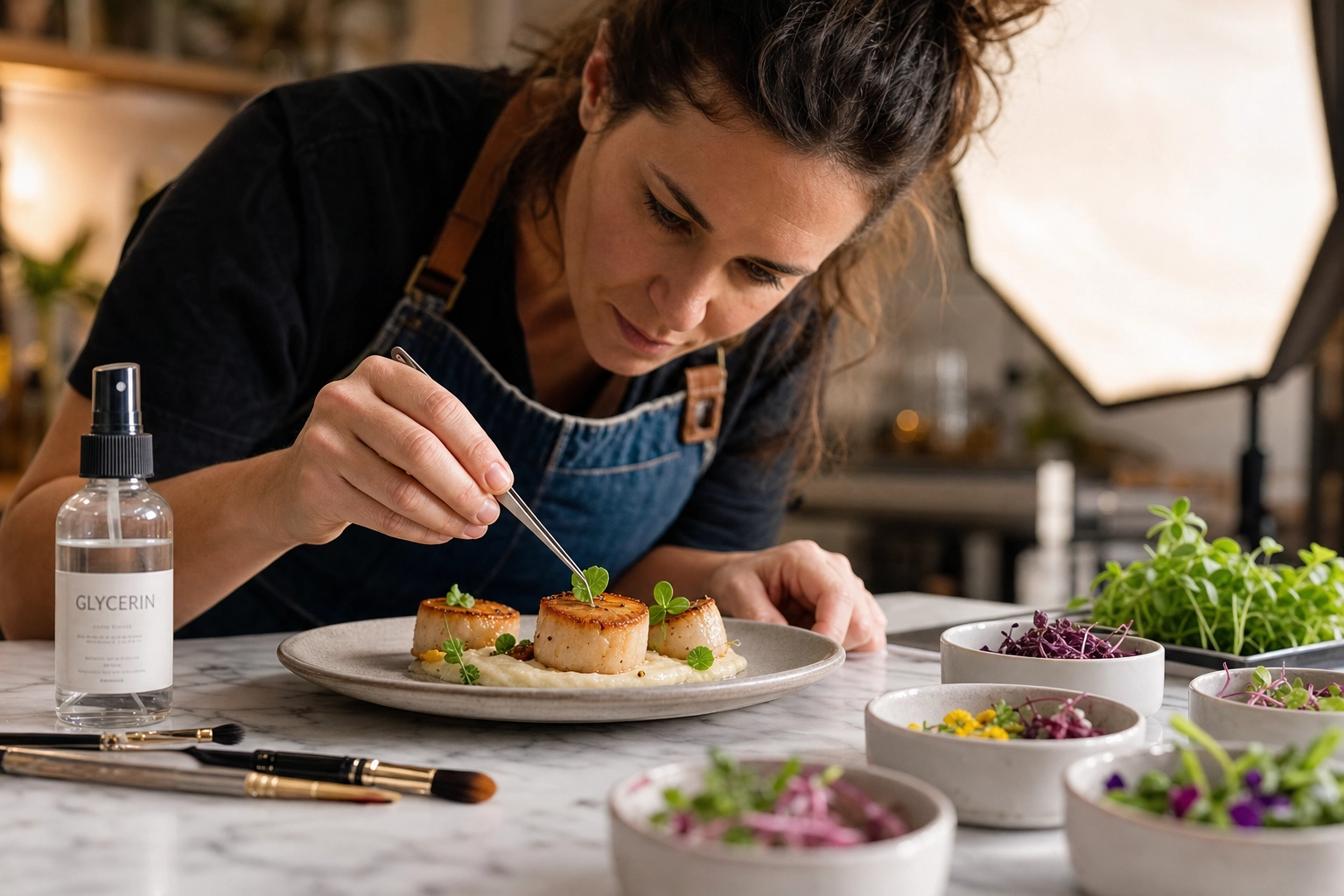
A food stylist is the person who makes the burger in an ad look juicier than anything you've ever eaten — and the dish on a cookbook cover look like it's still steaming. If you've ever wondered what a food stylist actually does, what they earn, how to become one, or whether your restaurant needs to hire one, this guide answers all of it in one place. We'll also cover something the career sites skip: when a human food stylist is worth $1,500 a day, and when AI food styling does the job for the price of lunch.
Quick Summary: A food stylist prepares and stages food to look irresistible on camera for ads, cookbooks, menus, and film. U.S. salaries average $55,000–$81,000 a year, with freelance day rates of $800–$1,500+. For high-end commercials and editorial shoots you still need a human, but for menus, delivery apps, and social posts, AI styling now delivers studio-quality results in seconds.
What Does a Food Stylist Do?
A food stylist prepares, plates, and stages food so it looks as appetizing as possible on camera. That's the whole job in one sentence — but the reality is far more demanding. A working stylist might shop for groceries at dawn, cook a dish a dozen times to get one flawless "hero," then spend hours keeping it picture-perfect under hot studio lights that wilt greens and melt anything frozen. Unlike a chef cooking purely for flavor, a stylist is cooking for the camera — a completely different goal that changes how every dish is built, plated, and held together.
Their work shows up everywhere: restaurant menus, magazine spreads, cookbooks, TV commercials, movie scenes, food packaging, and the photos on delivery apps. As the Auguste Escoffier School of Culinary Arts puts it, a food stylist "prepares and stages food for film and photo shoots… through props, scenery, and presentation." In practice, that means being part chef, part artist, part food scientist, and part problem-solver — all at once.
The toolkit is famously unusual. Stylists reach for glycerin to make food glisten and look fresh, surgical tweezers to place a single sesame seed, Q-tips to wipe a smudge off a plate rim, fine brushes to add a sheen of oil, and heat guns to brown cheese on cue.
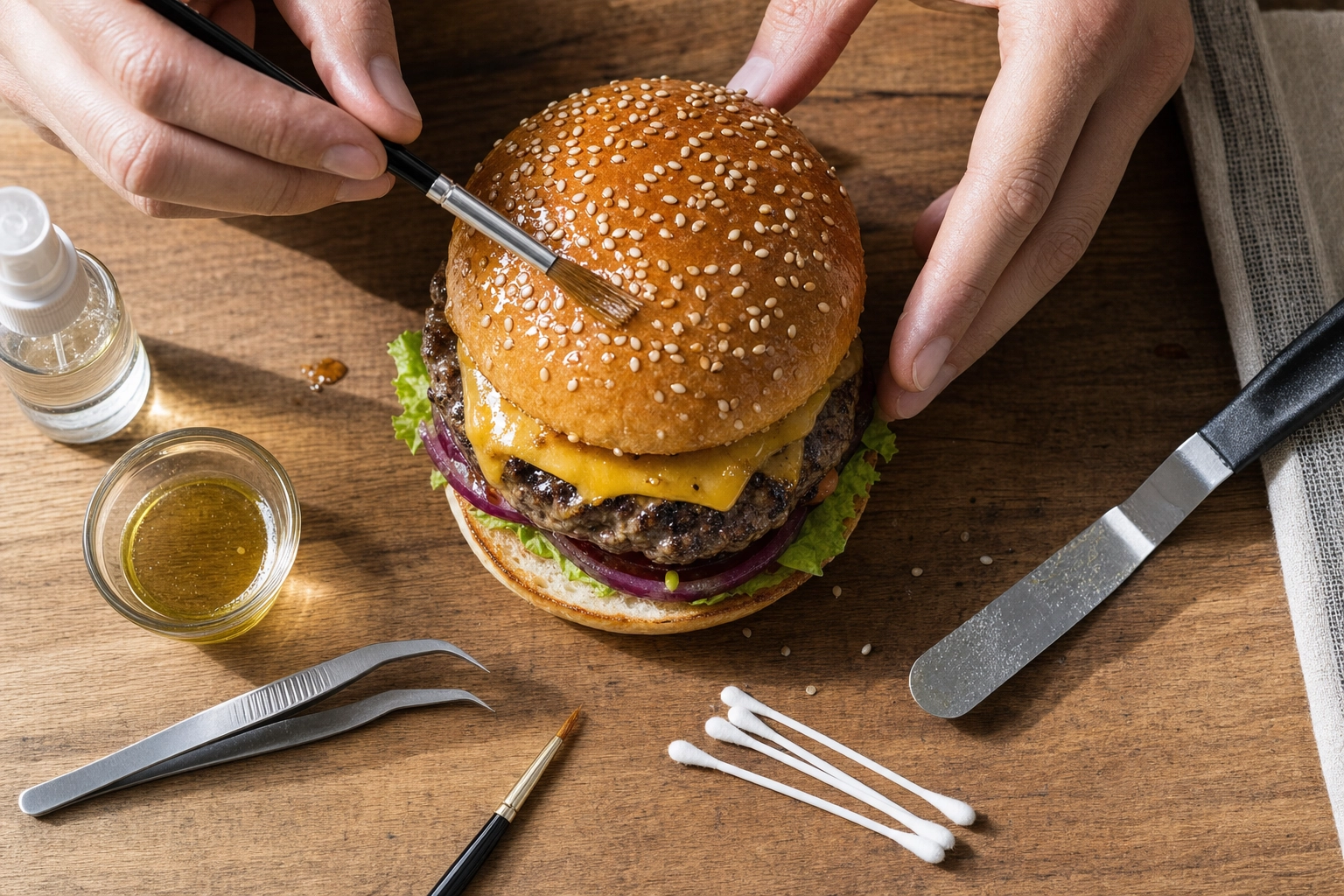 Close-up of a food stylist brushing oil onto a cheeseburger bun surrounded by food styling tools
Then there are the legendary tricks. To beat the clock and the lights, commercial stylists have long used substitutes: scoops of dyed mashed potato standing in for ice cream (it won't melt), white glue instead of milk in cereal shots (so the flakes don't go soggy), motor oil brushed on pancakes in place of syrup, and shaving cream where whipped cream would collapse. Need steam? Often it's a microwaved cotton ball hidden behind the plate.
Here's the nuance most articles skip: those inedible swaps are only used for non-essential items. Under U.S. truth-in-advertising rules enforced by the Federal Trade Commission, you can't fake the actual product being sold — an ice cream brand has to show real ice cream, and you can't photograph soy sauce and call it coffee. Editorial and cookbook styling, meanwhile, is almost always real, edible food. Want to try the legitimate techniques on your own dishes? Our step-by-step food styling guide breaks down the ones that actually work at home.
Food Stylist vs. Food Photographer: What's the Difference?
People use the terms interchangeably, but they're two different jobs. The food stylist is responsible for the food — sourcing it, cooking it, plating it, and keeping it flawless. The food photographer is responsible for the image — the camera, the lens, the lighting, the angles, and the final edit.
On a small shoot, one person often wears both hats. On a big commercial production they're distinct roles, usually joined by a prop stylist (who handles plates, linens, and surfaces) and an art director (who owns the overall look). The stylist hands the photographer a perfect plate; the photographer makes sure the camera captures it perfectly. If you're weighing the photography side specifically, see our breakdown of the food photographer career path and the best food photographers to follow.
The Four Main Types of Food Stylists
Not all food styling is the same. The skills overlap, but the day rates, deadlines, and even the rules change depending on the niche.
Commercial and advertising stylists work on packaging, billboards, and fast-food campaigns. This is the highest-paid corner of the field — and the one where the inedible tricks live, because a single image might run nationally for years. Precision is everything when a burger has to look identical across a hundred frames.
Editorial and cookbook stylists style for magazines, recipe sites, and cookbooks. The aesthetic here leans natural and "honest," because the food is real and readers are meant to cook it themselves. Much of the most celebrated styling work — including the food in major cookbooks — grows out of this editorial tradition.
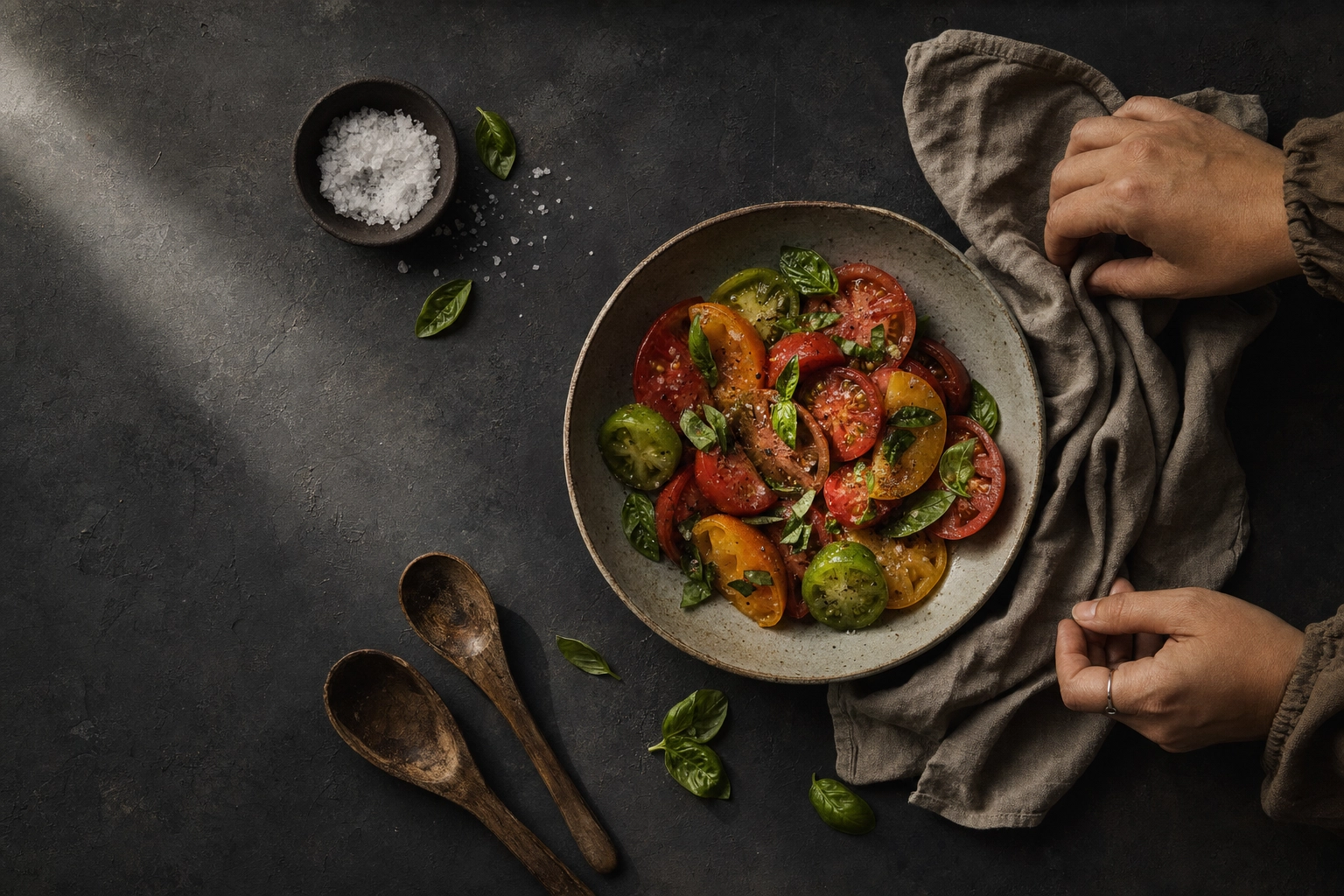 Overhead editorial food styling of heirloom tomato salad with linen and props on a dark slate table
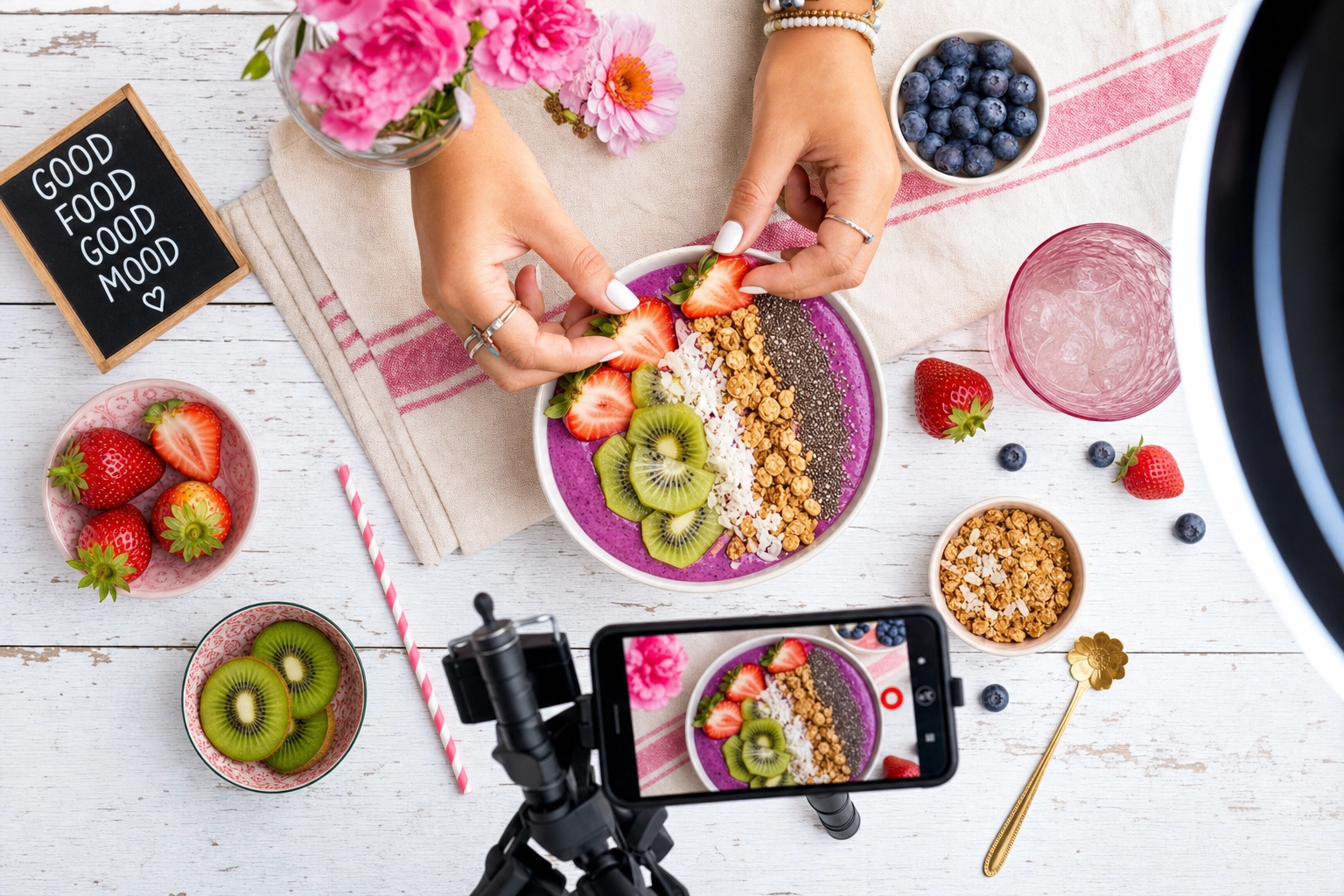
Social media and UGC stylists create content for Instagram, TikTok, and brand feeds. The work is faster and looser than commercial styling, prioritizing volume and a scroll-stopping, authentic feel over studio perfection.
 Food content creator styling a colorful smoothie bowl for social media with a phone tripod and ring light
Restaurant and menu stylists handle the everyday work most food businesses actually need: menu boards, in-store displays, catering portfolios, and delivery app photos for platforms like Uber Eats and DoorDash. It's less glamorous than a national ad campaign, but it's where demand is highest — and, as we'll see, where AI styling has completely changed the math.
How Much Does a Food Stylist Make? Salary & Day Rates
Food stylist salary data is all over the map, partly because the job rarely comes with a fixed salary at all. Across the major aggregators in 2025–2026, the averages land roughly like this:
- Salary.com: ~$71,000/year (about $34/hour)
- PayScale: ~$70,300/year
- ZipRecruiter: ~$62,500/year
- Glassdoor: ~$80,800/year, with top earners reaching ~$147,000
- Comparably: ~$55,400/year
So a fair headline is $55,000–$81,000 a year on average, with experienced commercial stylists pushing well into six figures. (For context, the U.S. Bureau of Labor Statistics groups stylists under arts and design occupations, where the median sits lower — a reminder that averages hide a wide spread.)
But if you're hiring, the number that matters is the day rate. A working food stylist in the U.S. typically charges $800–$1,500+ per day, plus expenses for ingredients, props, and a kit fee. Assistants earn roughly $150–$350 a day, while top commercial stylists can command $1,500–$2,500+ daily. As one Houston-based pro put it on Reddit's r/AskCulinary: "A range of day rates might be $800–$1,500 plus expenses for materials, ingredients, etc."
Why Salary Numbers Vary So Wildly
The spread exists because most food stylists are freelance, not salaried. "Annual salary" is almost a fiction in this field — real income is your day rate multiplied by the number of days you're actually booked, minus all the unpaid time spent shopping, prepping, testing, and chasing the next gig.
Three factors move the needle most: specialty (commercial pays more than editorial), location (New York and Los Angeles, the media and advertising hubs, pay the most — stylists in metros like San Jose average $78,000–$109,000), and experience (a first-year assistant and a 20-year veteran live in completely different pay brackets). A great year and a lean year can look nothing alike.
How to Become a Food Stylist: Career Path & Education
There's no single road into food styling, and almost nobody arrives in a straight line. But the people who make it tend to follow a recognizable pattern.
1. Get hands-on food experience. Working in a restaurant, bakery, or catering kitchen teaches you how food behaves — how it browns, wilts, sets, and melts. That fluency is the foundation of everything a stylist does, whether or not you ever train as a chef.
2. Decide on education: culinary school vs. apprenticeship. This is the field's great debate. Some pros swear by culinary school for its grounding in food science and technique; others insist you learn more in a working kitchen. In a Food & Wine feature, one stylist argued that "the bulk of the information is given, learned, and taught in culinary school," while another countered that much of it can be picked up on the job. The honest answer: school helps, but it isn't required.
 Assistant food stylist plating multiple ramen bowls beside a mentor on a busy photography studio set
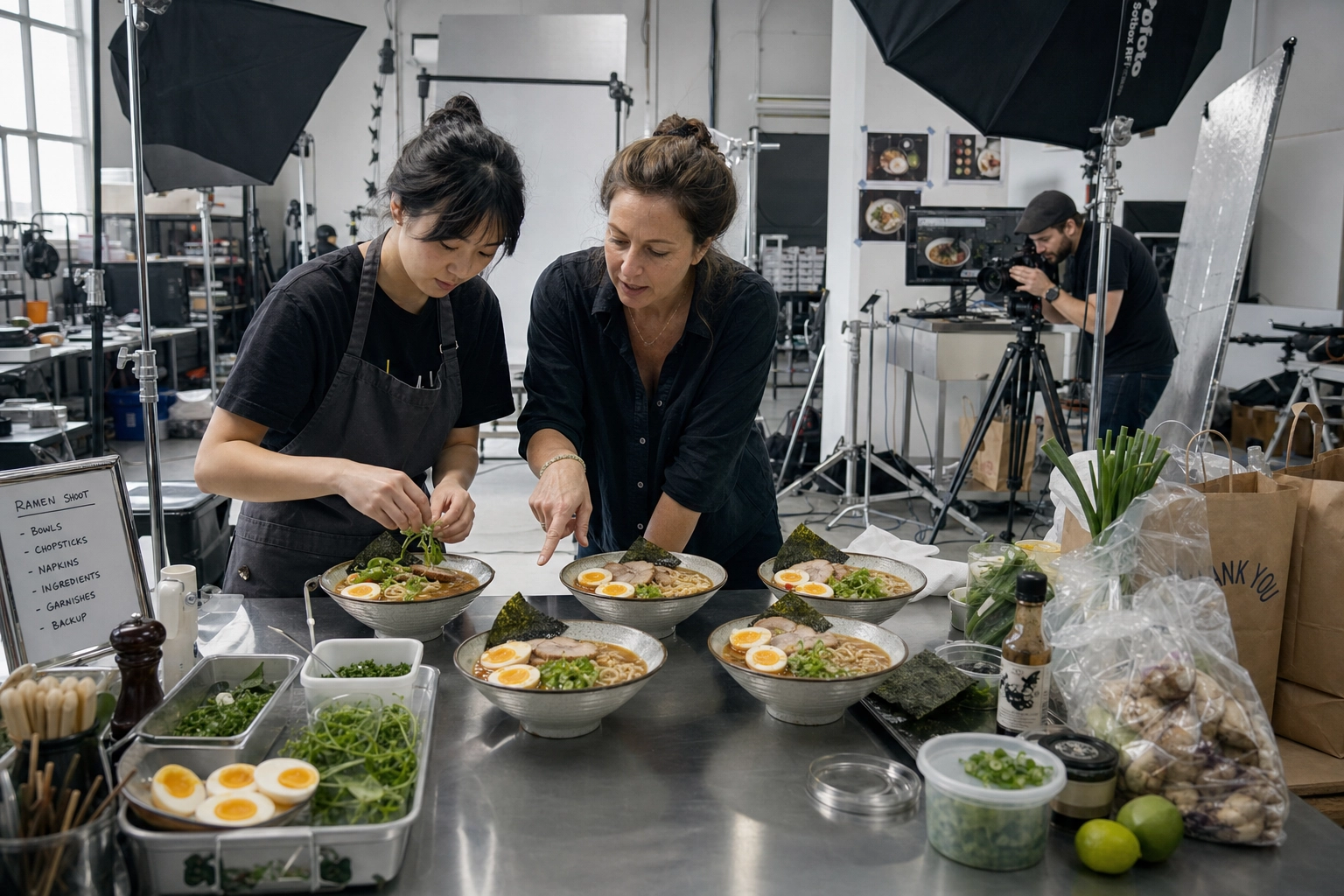
3. Assist established stylists. This is the real entry point. Nearly every working stylist started by assisting someone more experienced — carrying kits, prepping multiples, and absorbing the tricks of the trade. The standard advice: reach out to stylists whose work you admire and offer to assist.
4. Build a portfolio and network. Your work is your calling card. Because the industry runs on freelance relationships, a strong portfolio plus genuine connections will get you booked far faster than a résumé ever will.
Famous Food Stylists Worth Knowing
A handful of names have shaped what food styling is today:
- Delores Custer wrote the field's reference textbook, Food Styling: The Art of Preparing Food for the Camera, and has worked as a stylist and culinary educator since the 1970s. If food styling has a syllabus, she wrote it.
- Susan Spungen was the founding food editor at Martha Stewart Living before becoming Hollywood's go-to stylist. She styled and consulted on Julie & Julia, It's Complicated, and Eat Pray Love — even coaching Meryl Streep and Amy Adams to cook convincingly on camera, per her published biography.
- Rick Ellis is a pioneering stylist whose work was featured in a 1990 New York Times editorial that helped establish food styling as a recognized profession.
- Kimberly Espinel represents the modern, social-first era — a stylist, photographer, and educator known for warm, seasonal imagery and clients like Waitrose and KitchenAid.
Do You Actually Need a Food Stylist?
If you run a restaurant, a busy café, or a growing food brand, here's the question the career guides never address: do you actually need to hire one? The honest answer is sometimes — and it depends entirely on what you're shooting.
Start with the cost. A single professional shoot typically runs around $2,050 once you add up the photographer ($1,200), the food stylist ($650), and props (~$200) — and that's before quarterly menu updates push the annual bill past $8,000. In major metros, an all-in production can run $3,000–$7,750. Here's the full breakdown of what professional food photography really costs.
When You Need a Human Food Stylist
Some jobs simply can't be faked or automated. Hire a human stylist when:
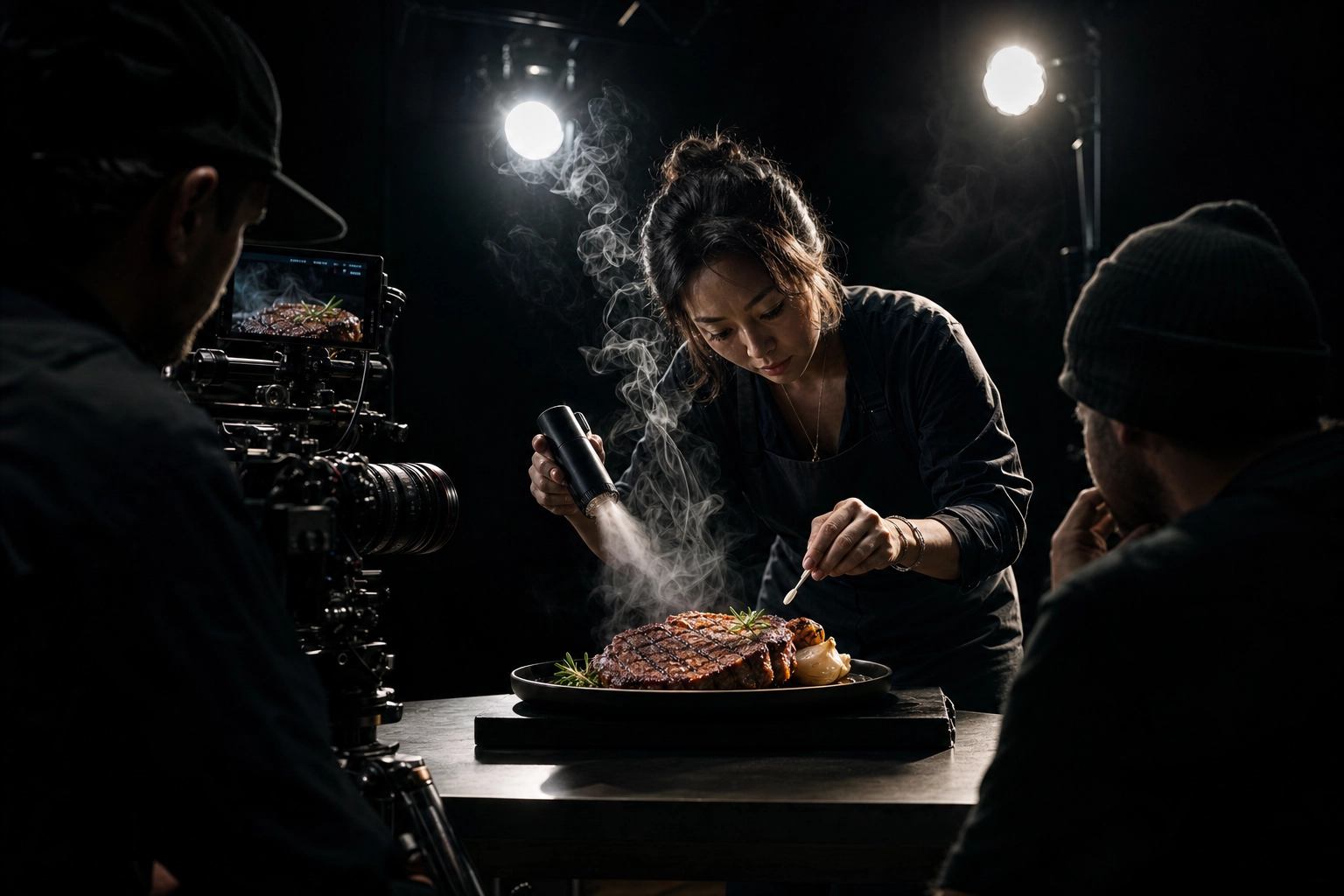
- You're shooting a national TV commercial or a film, where food has to perform in motion — steam rising, cheese pulling, syrup pouring, an actor taking a believable bite, take after take.
- You're producing a big-budget national ad campaign or a cookbook where a specific, tactile creative vision has to be executed by hand.
- You need packaging hero shots that must meet strict legal standards for the real product.
- The brief is highly conceptual — sculptural, surreal, or art-directed down to the last crumb.
 Food stylist creating steam on a ribeye steak under cinematic lights on a commercial film set
In these scenarios, a stylist's hands-on craft and on-set problem-solving are irreplaceable, and the day rate is money well spent.
When AI Food Styling Is Enough
For the vast majority of everyday food businesses, though, the work is far more routine — and that's where AI styling shines. You probably don't need a $1,500-a-day stylist for:
- Menu photos and delivery-app listings — restaurant menu photography for Uber Eats, DoorDash, and your website
- Social media content that needs to ship daily, not quarterly
- Catering proposals, seasonal specials, and daily updates
- Any project that needs high volume, fast turnaround, menu-wide consistency, and a tight budget
If you've already got a real photo of the dish on your phone, modern AI can handle the styling for a tiny fraction of the cost. We compare the two approaches head-to-head in AI vs. hiring a food photographer.
The AI Food Stylist: How FoodShot Replicates $1,500/Day Styling
Here's the part that would have sounded like science fiction a few years ago: much of what a food stylist does to an image can now be done by AI in about 90 seconds. FoodShot AI is built to do exactly that — it acts like an on-demand food stylist for photos you already have.
 Cafe owner photographing plated avocado toast and coffee with a smartphone on a sunny wooden table
Think about what a human stylist actually delivers: a polished "look," the right surface and props, and a consistent style across every dish. FoodShot maps to each of those:
- 200+ curated presets give you instant editorial, fine-dining, or delivery-ready looks — a stylist's aesthetic, applied in one tap.
- Builder Mode lets you combine backgrounds, plates, and surfaces — exactly the choices a prop stylist makes on set.
- My Styles lets you upload your own brand reference photos so every image matches your look, like briefing a stylist on your visual identity once and having it remembered forever.
The crucial difference from the old commercial tricks: FoodShot transforms a real photo of your actual dish. There's no motor oil, no glue, no inedible stand-ins — just an honest, enhanced version of the food you genuinely serve. It works as an AI food photo editor and food image enhancer in one, with 4K output and a commercial license on paid plans.
The math is hard to argue with. A human stylist costs roughly $1,500 a day; FoodShot starts at $15/month — or $9/month billed yearly — for the full styling toolkit. See the pricing plans, or explore how AI food photography works in practice.
How to Hire a Food Stylist (Tips, Contracts & Expectations)
If your project does call for a human, hiring the right one is its own skill. A few things to get right before you book:
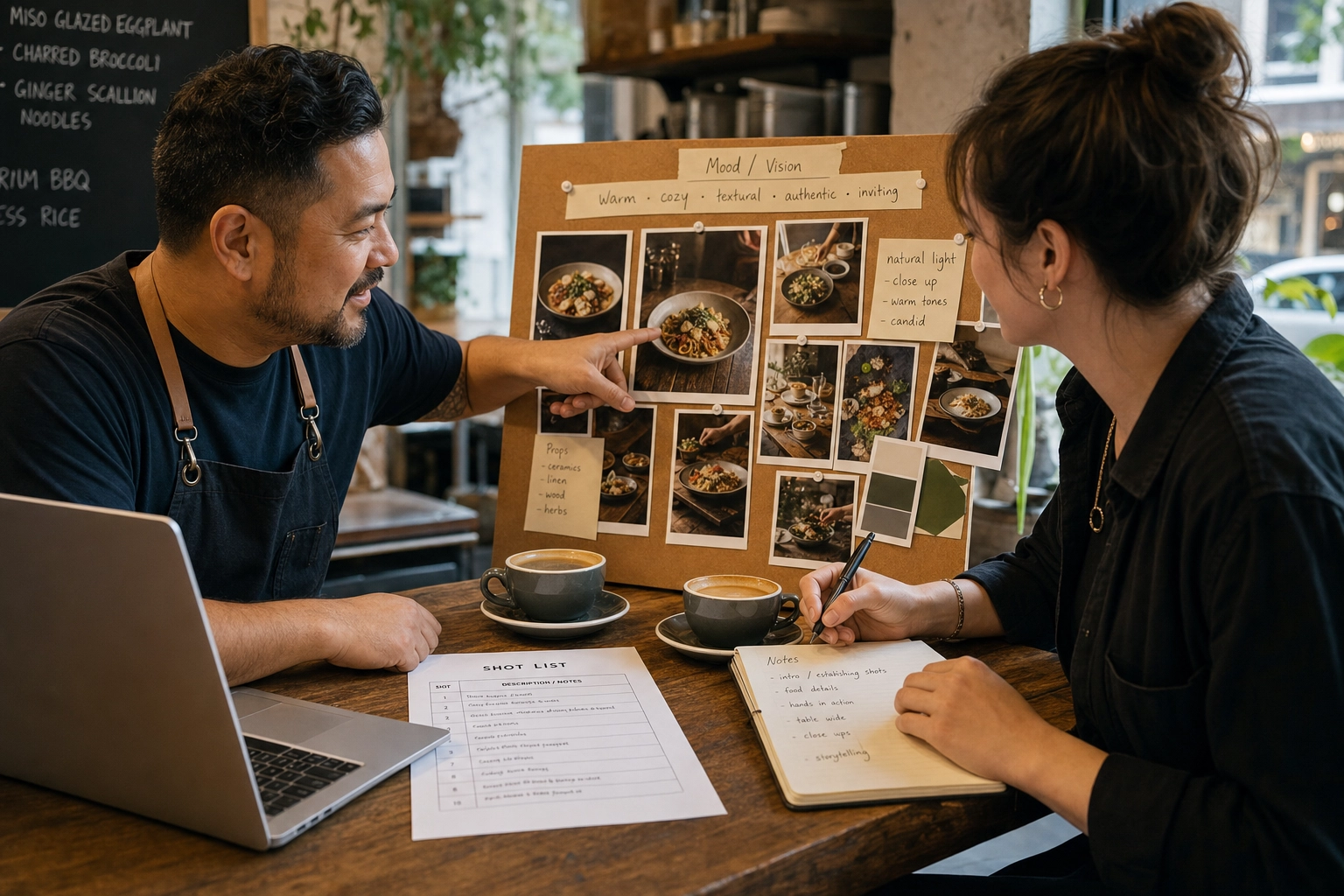 Restaurant owner and food stylist reviewing a shot list and mood board during pre-production planning
Review their portfolio in your niche. A brilliant cookbook stylist isn't automatically right for a fast-food campaign, and vice versa. Look for work that resembles what you actually need — your food type, your medium, your style.
Pin down the scope. Ask exactly what's included: Do they shop and cook, or just plate? How many "multiples" of each dish will they prepare? Who supplies the ingredients, the props, and the backgrounds? Vague scope is where budgets blow up.
Understand the money. Confirm whether it's a day rate or a project rate, and get expenses in writing — ingredients, props, and any kit or cleanup fees. Just as important, clarify usage and licensing: where the images can run (web, ads, packaging) and for how long.
Get it in a contract. A simple written agreement should cover deliverables, the number of revisions, cancellation terms, the payment schedule, and who owns the final images. A pre-production call and a shared shot list will save everyone a stressful shoot day — and always ask for references.
Frequently Asked Questions
How much does it cost to hire a food stylist?
Most working food stylists in the U.S. charge $800–$1,500+ per day, plus expenses for ingredients, props, and a kit fee. Assistants run $150–$350 a day, and top commercial stylists can exceed $2,500 daily. Bundled into a full photo shoot, the stylist alone usually adds $500–$1,200 to the bill.
Do you need to go to culinary school to become a food stylist?
No. Culinary school can help by teaching food science and technique, but it isn't required. Many successful stylists learned entirely on the job — first in restaurant kitchens, then by assisting established stylists. Hands-on experience and a strong portfolio matter far more than a diploma.
Are food stylists freelance or employed full-time?
The large majority are freelance, booking project to project. A smaller number hold in-house roles at magazines, test kitchens, ad agencies, and large food brands. Because freelance work dominates, networking and repeat-client relationships are central to a stable food stylist career.
What is the difference between a food stylist and a food photographer?
A food stylist makes the food look perfect — sourcing, cooking, plating, and maintaining it on set. A food photographer makes the image look perfect — handling the camera, lighting, and composition. On small jobs one person may do both; on large shoots they're separate specialists who work side by side.
Will AI replace food stylists?
Not entirely — but it's reshaping the field. AI handles routine, high-volume work like menu shots, delivery-app images, and social content extremely well, which reduces demand for human styling on those everyday jobs. For national commercials, film, and big-budget campaigns that need in-camera, hands-on craft, human stylists remain essential. The realistic future is a split: AI for volume, humans for the high end.
What tools does a food stylist use?
Beyond a chef's normal kit, stylists rely on surgical tweezers, Q-tips, fine brushes, syringes, heat guns, and glue guns, plus tricks like glycerin sprays for a fresh sheen. On commercial sets they may use inedible stand-ins — mashed potato for ice cream, glue for milk — though never for the actual product being advertised.