Food Photographer Career: Jobs, Salary & How to Start
 Ali Tanis18 min read
Looking for food photographer jobs? You've picked a career that sits at the intersection of art, food, and business — and it's one of the more accessible photography specializations to break into. You don't need a degree. You don't need $10,000 in gear. And with restaurants, delivery apps, food brands, and content platforms all competing for attention, the demand for food photographers has never been higher.
But "accessible" doesn't mean easy. Turning a passion for food photos into paying food photographer jobs takes specific skills, smart positioning, and a clear understanding of where the money actually comes from.
This guide covers all of it: the types of food photographer jobs available, realistic salary expectations backed by real data, the skills you'll need, and a step-by-step path from beginner to working professional.
Quick Summary: Food photographers earn a median salary of $56,000–$65,000/year in full-time roles, with top earners clearing $100K+. Freelancers charge $25–$200 per photo depending on experience. The fastest path in: learn photography fundamentals, build a portfolio by shooting for free, assist established photographers, and start pitching local restaurants. The industry is evolving with AI tools, but demand for skilled food photographers continues to grow.
What Food Photographers Actually Do
If you're new to what food photography is, here's the short version: food photographers create images that make food look irresistible — for menus, ads, social media, cookbooks, packaging, and delivery platforms.
But the job goes well beyond pressing a shutter button. A typical food photography project involves:
- Pre-production planning — discussing the client's vision, selecting props, choosing locations or studio setups
- Styling and setup — arranging food, backgrounds, and props (sometimes with a dedicated food stylist)
- Shooting — multiple angles, lighting adjustments, dozens to hundreds of shots per dish
- Post-processing — color correction, retouching, and final delivery in client-specified formats
- Business admin — invoicing, licensing, client communication, marketing
It's part creative art, part technical craft, part small business. The food photographers who thrive treat it as all three.
Types of Food Photographer Jobs
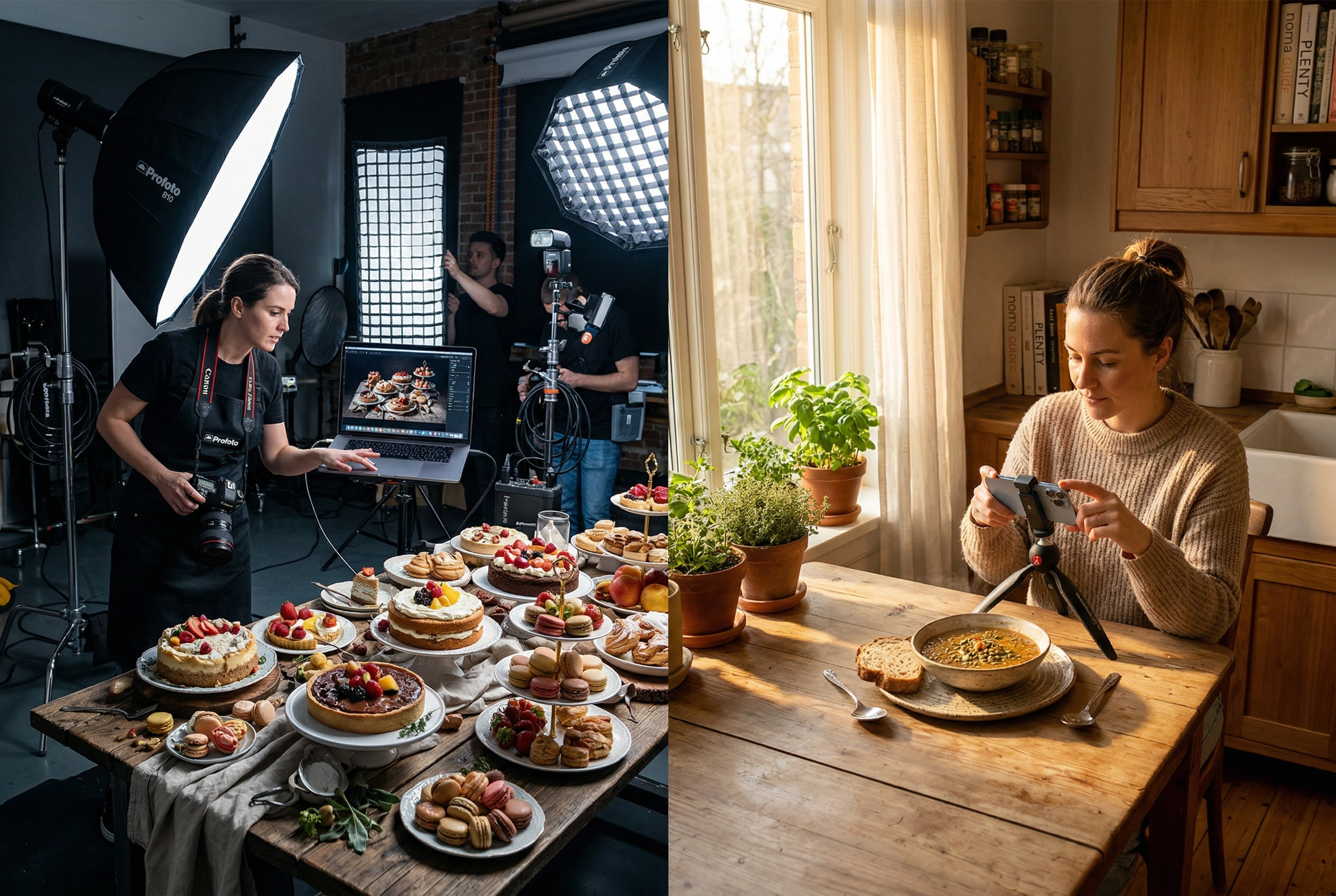 Split view comparing professional food photography studio setup with accessible home kitchen smartphone photography
There's no single "food photographer" career path. The field branches into distinct specializations, each with different income potential, lifestyle, and skill requirements. Here's where the food photographer jobs actually are.
Freelance Food Photographer
This is the most common path. According to Bureau of Labor Statistics data, roughly 65% of all photographers are self-employed — and food photography skews even higher.
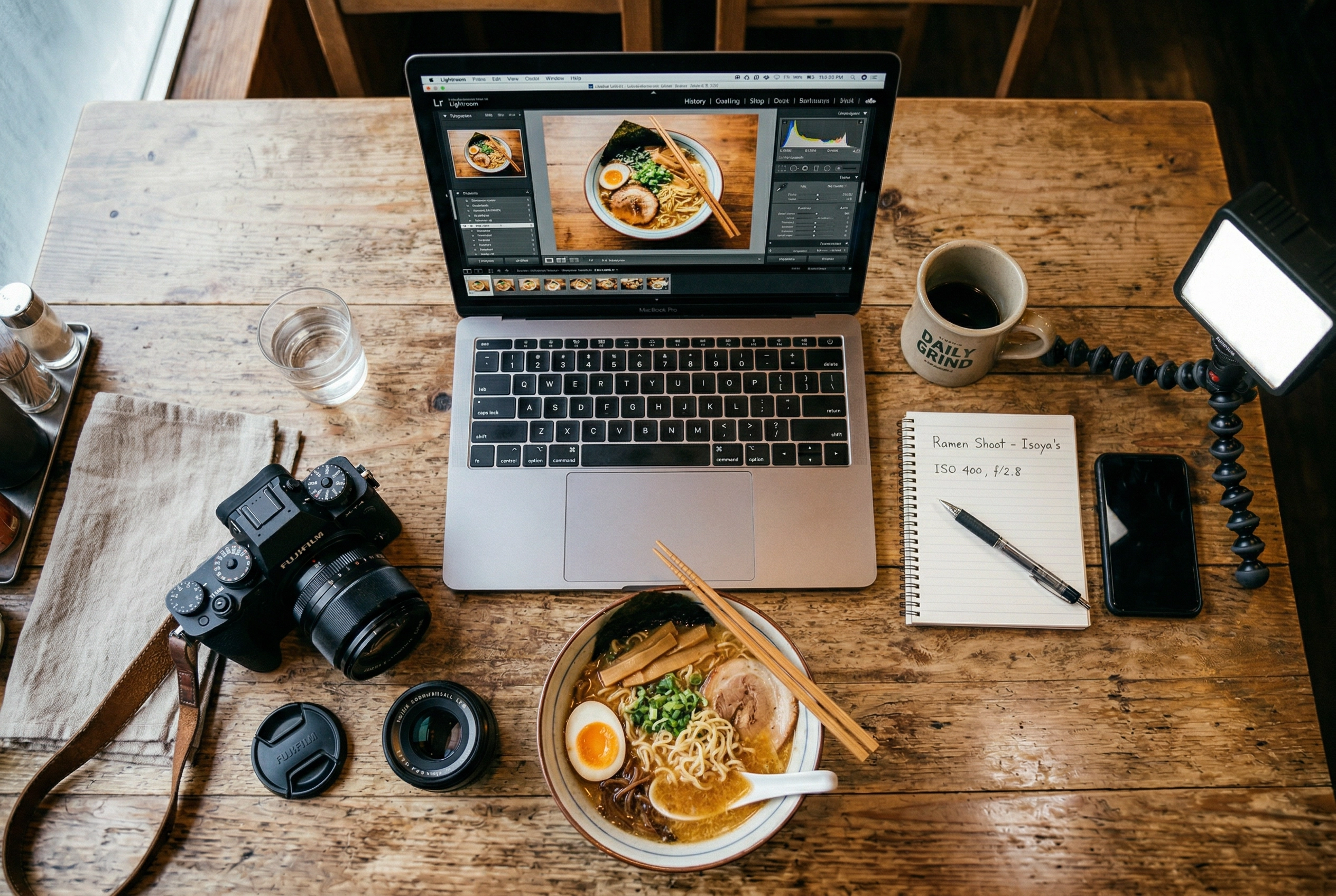 Overhead view of a freelance food photographer's portable workspace set up in a restaurant with camera and laptop
Freelance food photographers work project-by-project for multiple clients: restaurants needing menu photos, food brands launching new products, publishers producing cookbooks. You set your own rates, choose your clients, and control your schedule.
The trade-off? Income is inconsistent, especially early on. You might book three shoots one week and nothing the next. Most successful freelancers build a base of recurring clients — restaurants that update their menus quarterly, food brands that need ongoing content — to smooth out the feast-or-famine cycle.
In-House Photographer for Food Brands
Some food companies, restaurant chains, and grocery brands hire full-time staff photographers. You'll get a steady salary, benefits, and predictable hours — but you're shooting one company's food products day after day.
These roles are less common than freelance food photographer jobs, but they pop up on job boards regularly. Think companies like Whole Foods, Blue Apron, or large restaurant groups. In-house food photographers often handle both photography and some video content.
Agency and Commercial Photographer
The highest-paying food photography work often flows through advertising and marketing agencies. These are the big-budget campaigns: national restaurant chains launching new menu items, CPG brands redesigning packaging, beverage companies producing glossy ad campaigns.
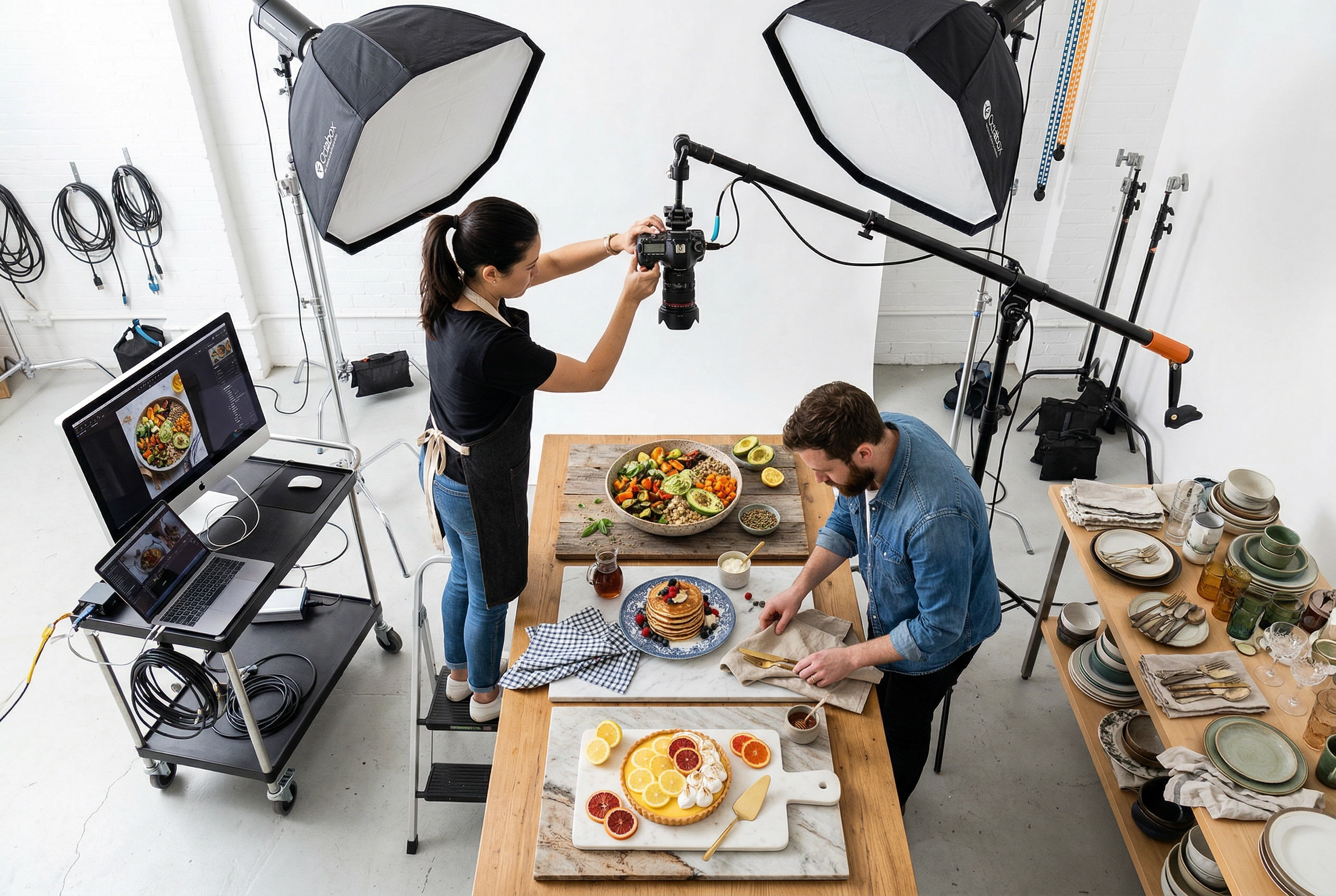 Bird's-eye view of a professional editorial food photography studio with styled dishes and lighting equipment
Getting agency work usually requires an impressive portfolio and often a photography agent or rep. Per-project fees can reach $2,500–$7,500+ when you factor in creative fees, licensing, and production costs.
Editorial Photographer (Magazines & Cookbooks)
Editorial food photography means shooting for publications — think Bon Appétit, Food & Wine, Saveur, or cookbook publishers. The work is highly creative and looks fantastic in a portfolio.
The reality check: editorial rates are typically lower than commercial work. Magazine day rates might range from $400–$1,500, while cookbook projects pay $5,000–$15,000 for the entire book. The prestige and portfolio value often make it worthwhile, especially for food photographers building their reputation.
Social Media Content Specialist
This is the fastest-growing category of food photographer jobs. Restaurants, food brands, and content agencies need photographers who understand what performs on Instagram, TikTok, and Pinterest — not just what looks good in print.
Social media food photographers often combine still photography with short-form video, and they understand platform-specific requirements: aspect ratios, trending formats, hook-driven content. If you're comfortable with a smartphone and editing apps alongside professional gear, this niche has strong demand. For tips on excelling here, check out our Instagram food photography guide.
Delivery Platform Photographer
The explosion of food delivery has created an entirely new category of food photographer jobs. Uber Eats, DoorDash, Grubhub, and regional platforms all need professional-looking food images from their restaurant partners.
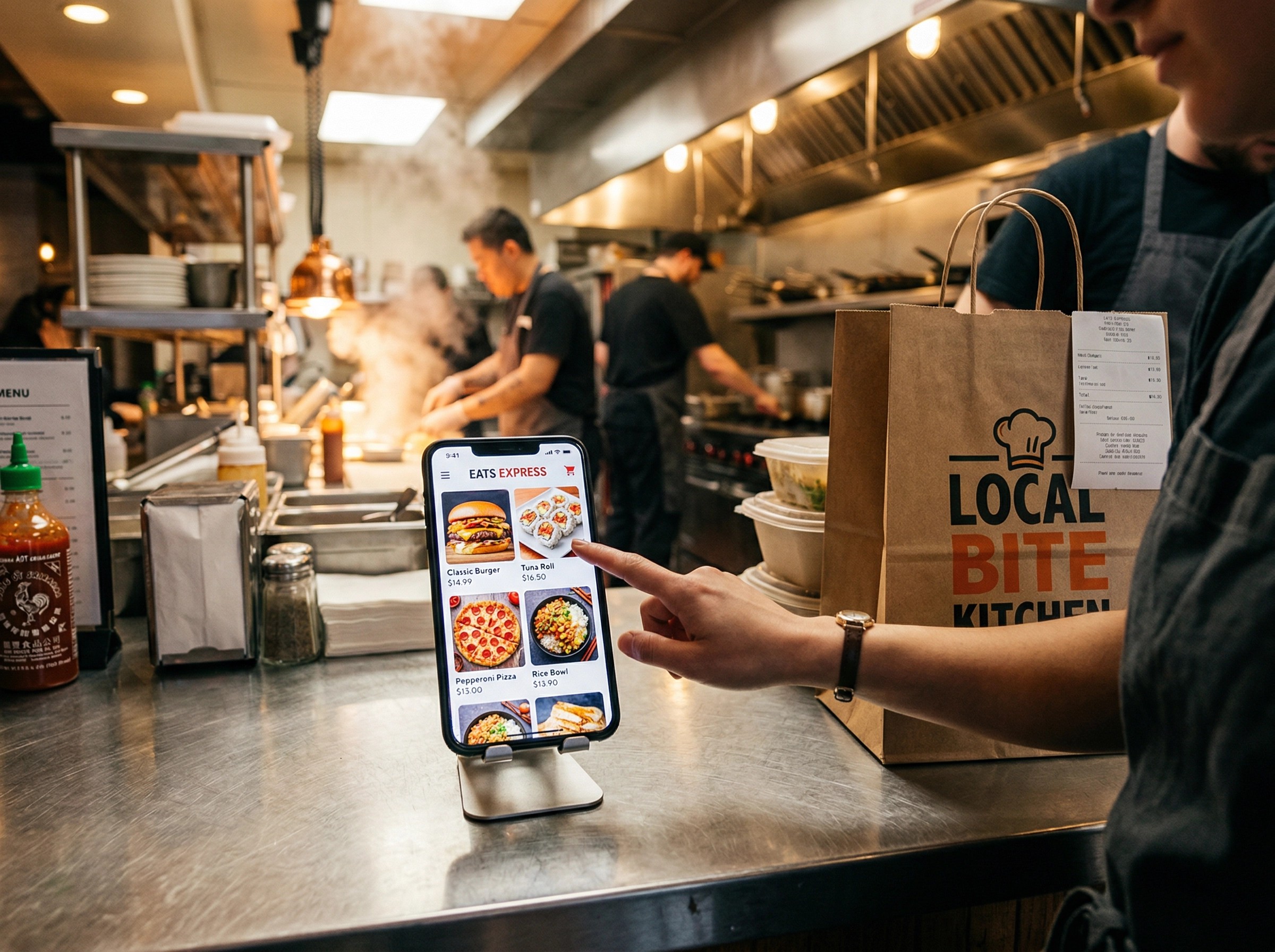 Smartphone displaying food delivery app menu photos on a restaurant counter next to a takeout bag
Some platforms hire food photographers directly or through partner networks. Others create demand indirectly — restaurants realize their delivery sales increase with better photos and hire photographers to upgrade their listings. This is high-volume, quick-turnaround work and a solid entry point for new food photographers. (See our guide to food photography for delivery apps for more on this segment.)
Stock Food Photographer
Stock photography — uploading food images to platforms like Shutterstock or Adobe Stock for commission per download — works as supplementary income, not a primary career. You might earn $0.25–$2.00 per download, but popular food photos can accumulate thousands of downloads over time.
It's passive income worth building on the side, but don't count on it to pay the bills.
Food Photographer Salary: What You Can Actually Earn
Let's get specific with real food photographer salary data. There's a wide range out there, and the numbers vary significantly depending on source, location, and employment type.
Full-Time Salary Ranges
Based on 2025–2026 data from multiple salary aggregators:
| Experience Level | Annual Salary Range | Source |
|---|---|---|
| Entry Level (0–2 years) | $23,000–$49,000 | Glassdoor 25th percentile |
| Average / Median | $56,000–$65,000 | Salary.com, Glassdoor, ZipRecruiter |
| Experienced (5+ years) | $75,000–$87,000 | Glassdoor 75th percentile |
| Top Earners | $100,000–$112,000+ | Glassdoor 90th percentile |
Glassdoor reports the average food photographer salary at $65,347/year as of 2026. Salary.com puts it at $60,236/year. ZipRecruiter's data shows $62,338/year average.
Location matters enormously for food photographer income. Food photographers in New York City average around $70,000/year, while those in smaller markets may earn closer to $45,000–$50,000. The highest-paying metro areas include San Jose, New York, San Francisco, and Los Angeles.
Freelance Rates and Project Pricing
Freelance food photographer income is harder to pin down because it varies by pricing model:
- Beginners: $100–$200/day rate or $25–$50 per edited photo
- Experienced freelancers: $75–$200 per photo or $500–$2,500 per session
- Top commercial food photographers: $2,500–$7,500+ per project (including styling, editing, and licensing)
According to our food photography cost breakdown, a professional food photography session typically runs $500–$2,500 for the photographer's time alone — and total project costs often climb to $2,500–$7,500 when you add a food stylist, studio rental, and retouching.
Our restaurant photography pricing guide has even more detail on what restaurants actually pay food photographers.
What Affects Your Earning Potential
Five factors matter most for food photographer salary:
- Location — NYC and LA food photographers command 20–40% premiums over national averages
- Specialization — Commercial and advertising work pays significantly more than editorial or delivery platform shoots
- Portfolio quality — Your portfolio is your salary negotiation tool. A stunning book opens doors to premium clients.
- Client type — Agencies and national food brands pay more than individual restaurants
- Recurring relationships — Food photographers with monthly retainer clients earn more predictably than those chasing one-off gigs
Essential Skills Every Food Photographer Needs
Technical photography skill is table stakes. What separates working food photographers from hobbyists is the full skill stack.
Camera and Technical Photography Skills
You need to understand your camera inside and out — particularly manual exposure settings. That means:
- Aperture — controls depth of field (crucial for food photography's signature blurred backgrounds)
- Shutter speed — manages motion and exposure
- ISO — balances light sensitivity with image noise
- Lens selection — a 50mm or 100mm macro lens covers most food photography needs
Most professional food photographers shoot with DSLR or mirrorless cameras, though increasingly capable smartphone cameras are changing the equation for some work. Check out our food photography equipment guide for specific gear recommendations at every budget.
Lighting Mastery
Lighting makes or breaks food photography. It's arguably the single most important technical skill for food photographers.
You'll need to be comfortable with:
- Natural light — window light is the go-to for many food photographers, especially starting out
- Artificial/studio lighting — strobes, continuous lights, and how to shape them with modifiers
- Light shaping tools — diffusers, reflectors, bounce cards, and flags to control light direction and quality
Our deep dive on food photography lighting covers techniques from beginner to advanced.
Food Styling Fundamentals
You don't need to be a chef, but you need to understand how food should look at its peak. That means knowing:
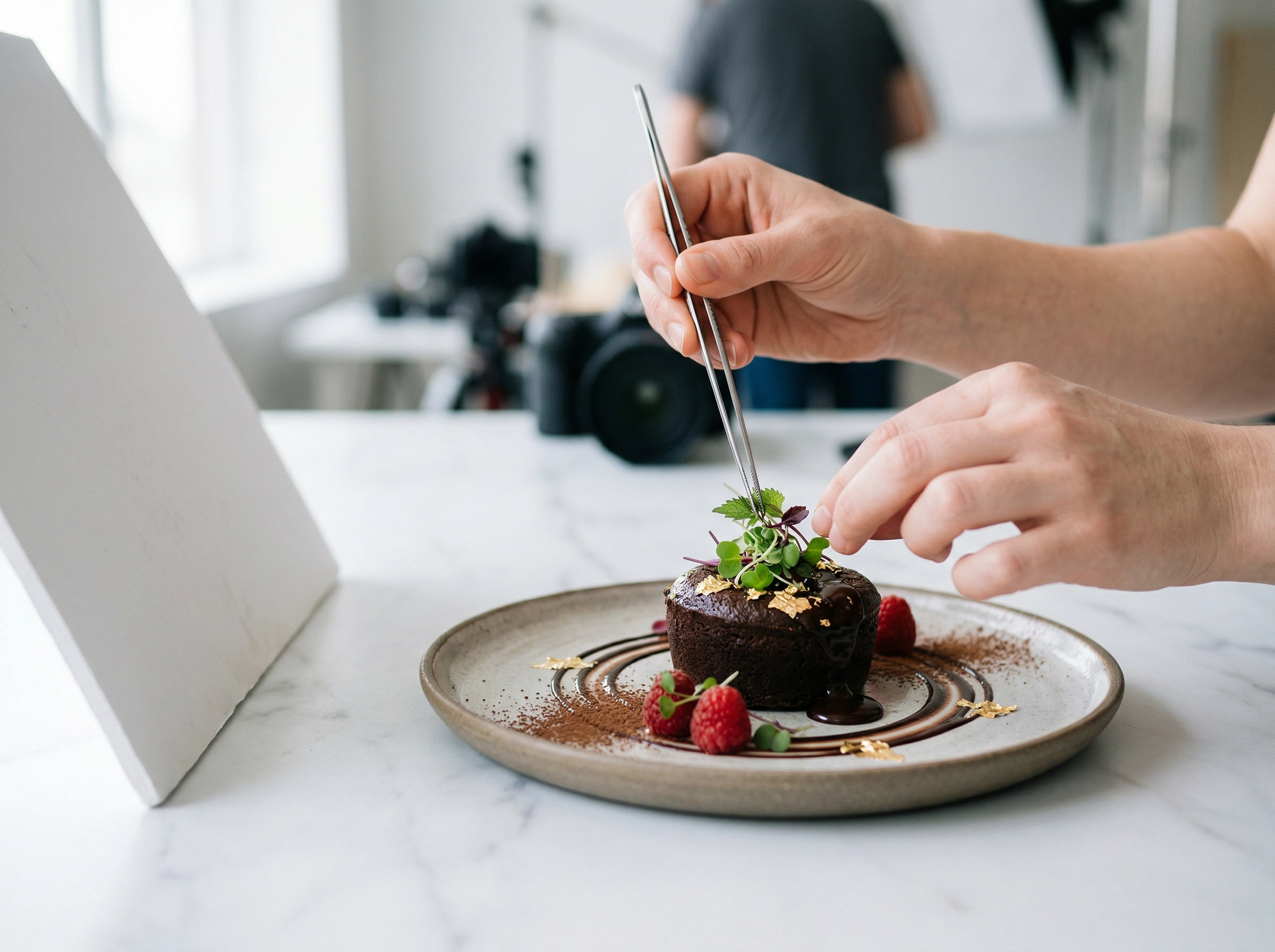 Close-up of hands using tweezers to style microgreens on a chocolate dessert during a food photography shoot
- How to plate and garnish food for the camera (not the same as plating for diners)
- Basic food styling tricks — glycerin for a dewy look, blowtorches for browning, strategic sauce placement
- When to work with a professional food stylist vs. doing it yourself
For smaller food shoots, the photographer often does their own styling. For bigger productions, you'll collaborate with dedicated food stylists. Either way, food styling fundamentals are essential knowledge for food photographers.
Post-Processing and Editing
Raw photos from a food shoot are starting points, not finished products. You'll need proficiency in:
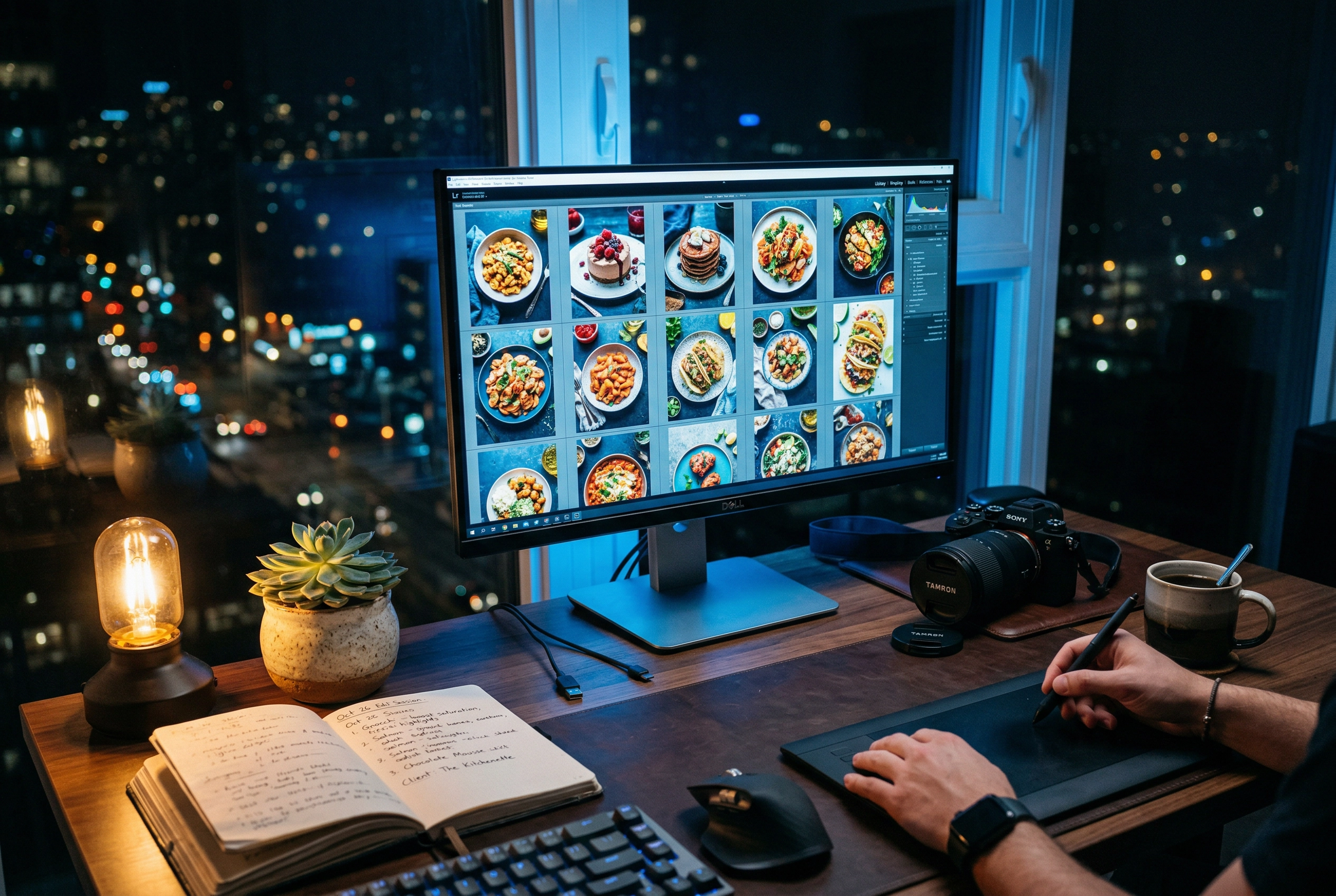 Food photographer's desk at night with monitor showing edited food photos and camera equipment
- Adobe Lightroom — color correction, exposure adjustments, batch editing
- Adobe Photoshop — retouching, compositing, removing distractions from food images
- White balance correction — making food colors look accurate and appetizing
Learn more in our guide on how to edit food photos like a professional.
Business and Marketing Skills
Here's what most "how to become a food photographer" guides skip: the business side. As a freelance food photographer, you're running a small business. That means:
- Client communication — briefs, expectation setting, revisions
- Contracts and licensing — what usage rights clients get for your food images, model releases, terms
- Invoicing and bookkeeping — tracking income, expenses, taxes (quarterly estimated taxes if freelancing)
- Self-promotion — maintaining a portfolio, social media presence, and professional network
The food photographers who earn the most aren't always the most talented shooters. They're the ones who market themselves effectively and run their business well.
How to Become a Food Photographer: Step by Step
There's no single required path into food photographer jobs, but this sequence works for most people.
Step 1: Learn Photography Fundamentals
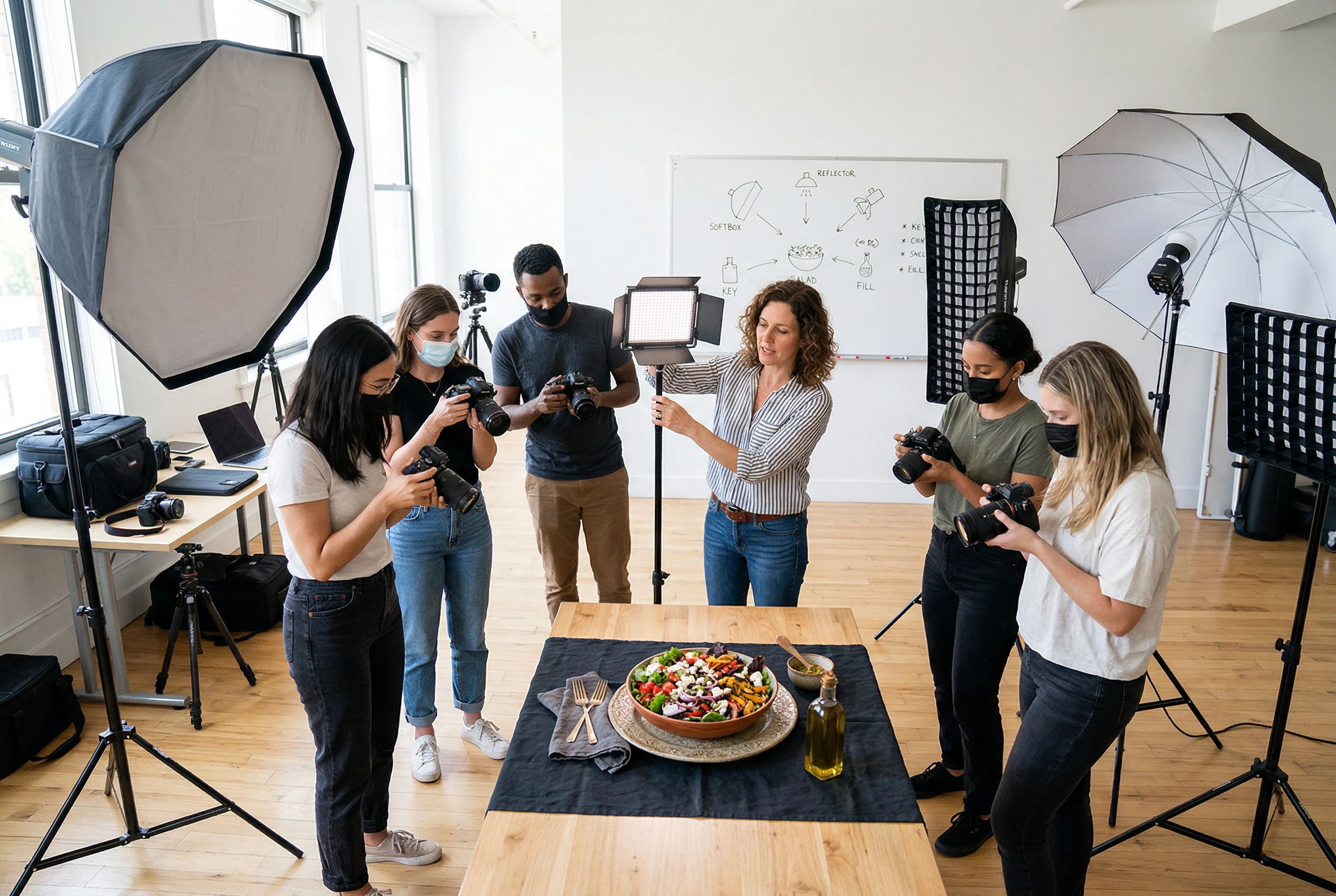 Food photography workshop with students learning lighting techniques around a styled food subject
Before specializing in food, you need a solid foundation in photography basics — composition, exposure, and how your camera works.
Your options:
- Free resources: YouTube channels, photography blogs, and communities like r/photography
- Online courses: Platforms like Skillshare, Udemy, and CreativeLive offer food-specific photography courses
- Formal education: Photography degrees or certificate programs at community colleges or art schools
- Dedicated food photography courses: Check our roundup of food photography courses for curated options
Most working food photographers are self-taught or took specific workshops rather than pursuing four-year degrees. The key is practice — shoot every day, review your work critically, and study what the best food photographers are doing differently.
Step 2: Study Food and Culinary Arts
The best food photographers understand food — not just how it looks, but how it's prepared, what makes it look appetizing, and what's happening when food sits under hot studio lights.
You don't need culinary school (though it's not a bad idea). At minimum:
- Cook regularly and pay attention to how dishes look at different stages of preparation
- Dine at restaurants and study how chefs plate their food
- Learn culinary terminology so you can communicate credibly with chefs and food stylists
- Follow food photography tips from working professionals
Step 3: Build Your Portfolio (Even for Free)
Your portfolio is everything in this career. No one hires food photographers based on credentials alone — they hire based on what your food images look like.
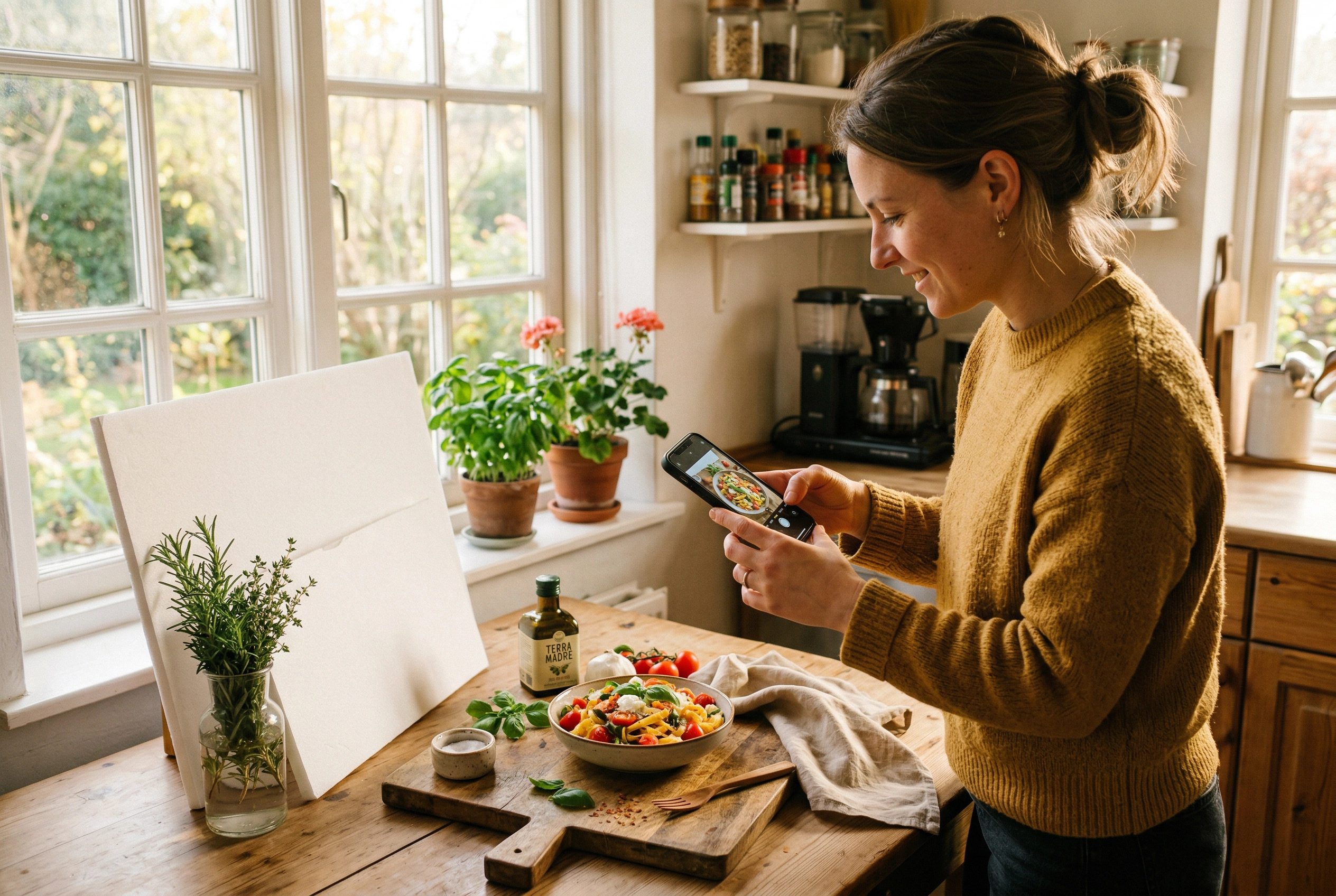 Person photographing homemade pasta with smartphone near a bright window in a home kitchen setup
Start by shooting what's accessible:
- Your own cooking — practice lighting and styling food at home
- Friends' restaurants — offer free or discounted shoots in exchange for portfolio food images
- Styled personal projects — buy interesting ingredients, props, and backgrounds and create editorial-style food setups
- Local food events — farmers' markets, food festivals, restaurant pop-ups
Aim for 15–20 of your absolute best food images to start. Quality always beats quantity. Show range: different cuisines, lighting styles, compositions, and moods.
Step 4: Assist Established Food Photographers
This is the most underrated shortcut into food photographer jobs. Assisting a working food photographer teaches you:
- Real-world workflow and client management
- Studio setup and breakdown for food shoots
- How professional food photographers handle unexpected problems on set
- Industry connections and potential referrals
Reach out to food photographers in your area and offer to assist for free or a minimal rate. Most are willing to bring on reliable help, and it's the fastest way to learn what no photography course can teach.
Step 5: Create Your Online Presence
You need two things to land food photographer jobs:
- A portfolio website — Clean, fast-loading, and showcasing your best food photography work. Squarespace, Format, and Pixieset are popular among photographers. Include your contact info, services, and a brief bio.
- An Instagram account — This functions as a visual resume for food photographers. Post consistently, use relevant hashtags, tag restaurants and food brands, and engage with the food photography community.
Step 6: Start Pitching and Networking
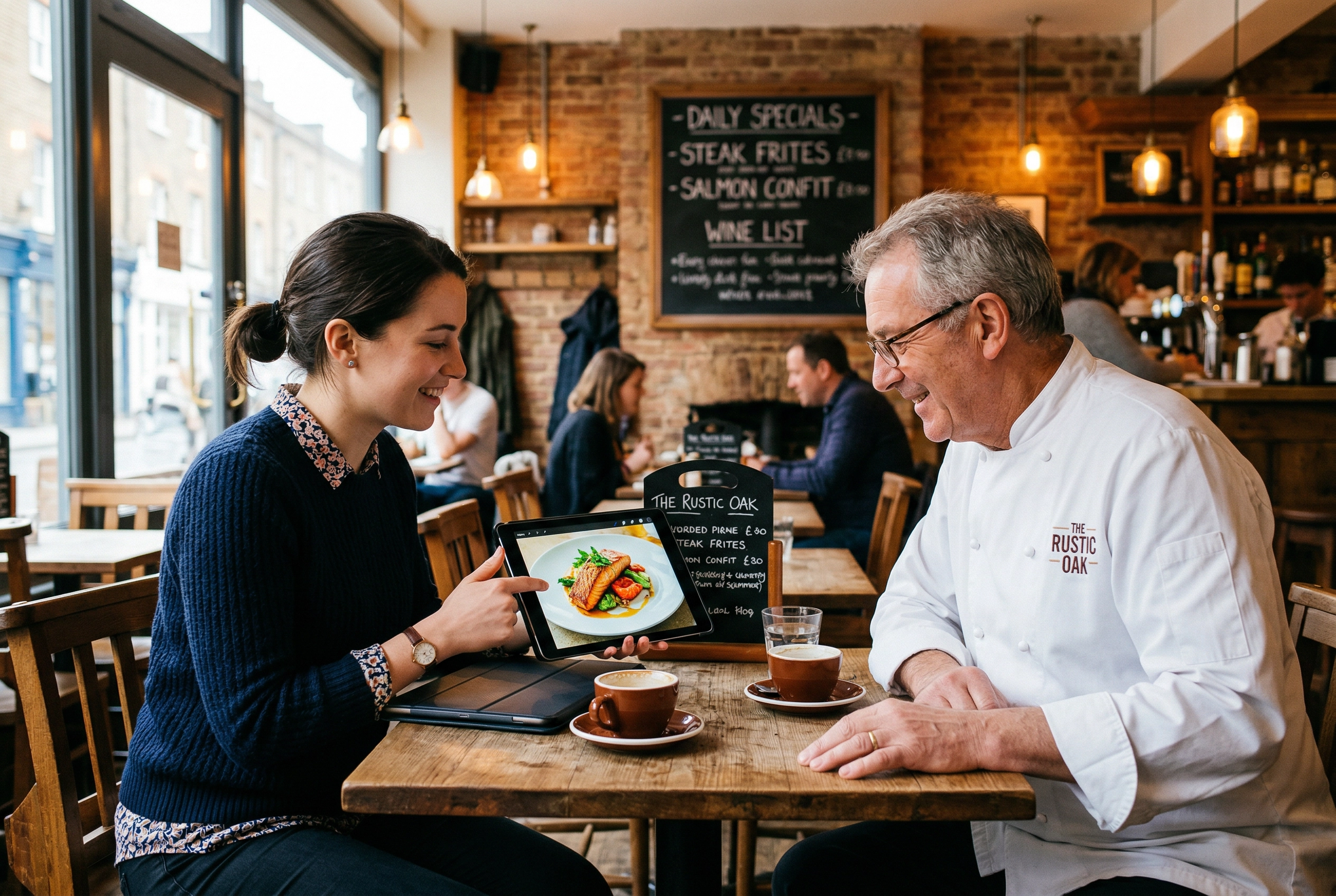 Food photographer presenting her portfolio on a tablet to a restaurant owner during a client meeting in a cafe
Once your portfolio has 20+ strong food images, start reaching out to potential clients:
- Local restaurants — especially newer ones or those with weak food photos on their delivery apps or social media
- Food bloggers and publications — pitch yourself as a food photographer for their content needs
- Delivery platforms — research if Uber Eats or DoorDash has photographer partner programs in your area
- Industry events — food industry trade shows, restaurant association meetings, photography meetups
Follow up persistently. Most clients don't respond to the first email. A polite second or third follow-up is expected and often when food photographer jobs actually close.
Building a Sustainable Food Photography Business
Getting your first few food photography clients is one challenge. Building a sustainable business is another.
Setting Your Prices
Early on, use a cost-plus-profit model: calculate your costs (equipment, transportation, editing time, overhead) and add your desired profit margin. As you gain experience as a food photographer, transition to value-based pricing — charging based on the value to the client, not just your time.
Include these in every food photography quote:
- Photographer's creative fee (time on set)
- Pre-production and planning time
- Post-processing and editing of food images
- Image licensing (specify usage rights)
- Travel expenses
- Any additional costs (studio rental, props, food styling)
Marketing Your Services
The best marketing for a food photographer is visible, excellent work. But you also need to:
- Keep your Instagram updated and tag clients in published food photography work
- Optimize your portfolio website for local SEO (e.g., "food photographer [your city]")
- Ask happy clients for referrals — word of mouth drives most food photography businesses
- Create case studies showing before/after results for restaurant clients
Investing in Your Gear
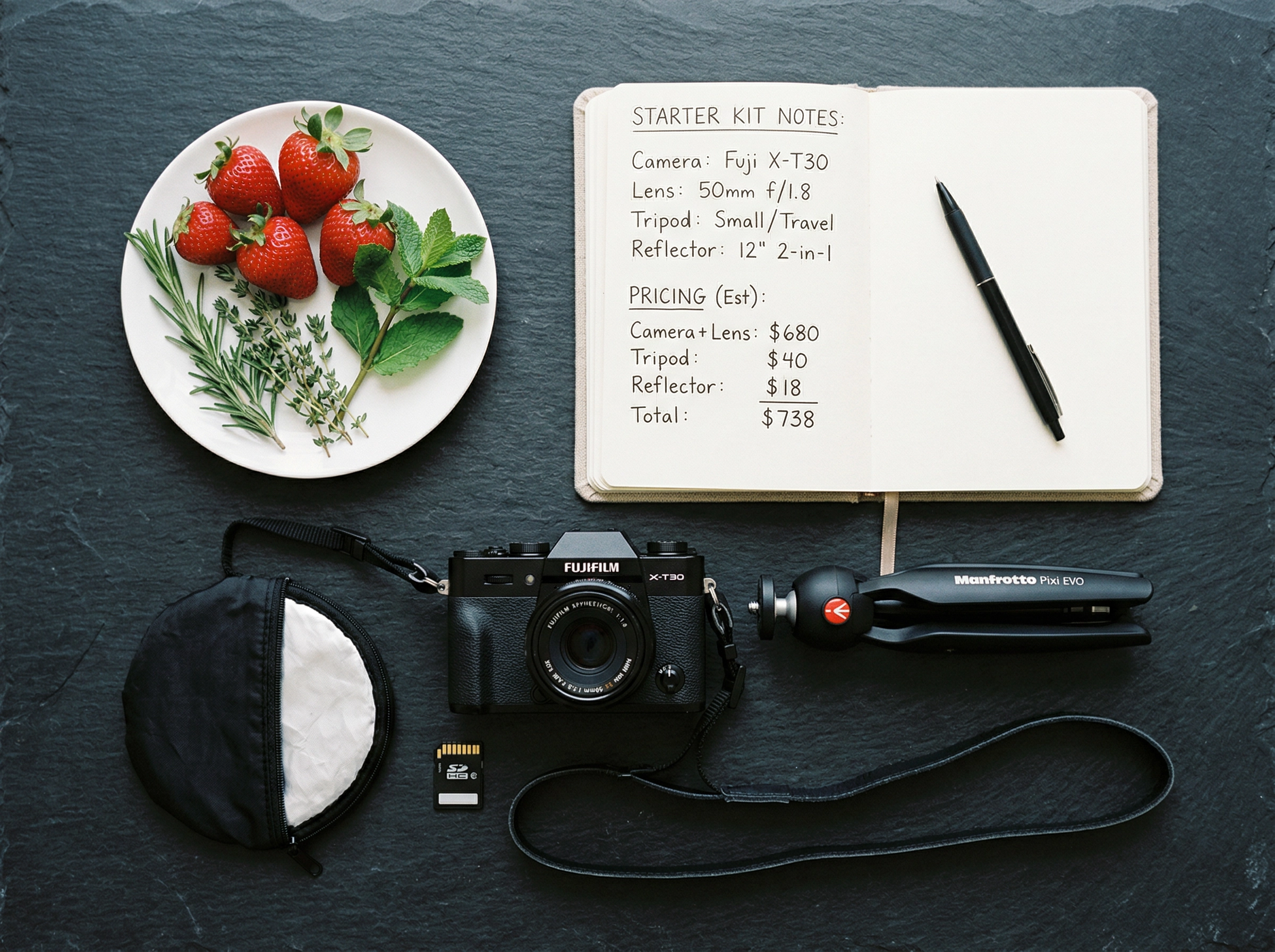 Flat-lay of essential food photography starter equipment including mirrorless camera, lens, reflector, and tripod
Don't blow your savings on camera gear before you've booked your first food photography client. Start with:
- A capable camera body (even entry-level mirrorless works for food photography)
- One versatile lens (a 50mm f/1.8 is affordable and excellent for food)
- A reflector and diffuser for controlling light on food
- A basic tripod for sharp food images
Upgrade as your food photography income justifies it. Our food photography equipment guide breaks down exactly what you need at every budget level.
The Changing Landscape: AI and the Future of Food Photography
Let's be honest about what's happening: AI is transforming the food photography industry. According to recent industry data, over 60% of top brands plan to integrate AI into their visual content strategies by 2026.
Here's what that means for food photographers and food photographer jobs:
The demand for food images is exploding. Delivery platforms, social media, and digital menus all need constantly updated food visuals. This is good for food photographers — there's more work to go around than ever before.
Basic food photo enhancement is being automated. Tools like FoodShot's AI food photo editor let restaurants transform smartphone food photos into professional-looking images in about 2 minutes. For a small restaurant that can't afford a $2,500 food photography shoot, this means they can finally have quality food visuals. For more on this shift, see our traditional vs AI food photography analysis and our detailed look at AI vs hiring a food photographer.
Smart food photographers are adapting, not panicking. The 2025 Aftershoot industry report found that only 1% of clients expressed concerns about AI use in photography — they care about speed and consistency. Food photographers who learn to use AI tools in their workflow become more efficient and more valuable to clients.
High-end food photography work remains human-driven. Magazine spreads, national ad campaigns, cookbook photography, and brand identity shoots still require a food photographer's creative vision, on-set problem-solving, and artistic eye. AI handles execution; food photographers provide direction.
The food photographers most at risk are those doing commoditized work — basic product shots or simple menu photography — without adding creative or strategic value. The ones thriving are positioning themselves as creative directors who use cameras (and increasingly, AI tools) to execute their vision.
Frequently Asked Questions
Do you need a degree to become a food photographer?
No. Most working food photographers are self-taught or learned through workshops and mentorships rather than formal degree programs. What matters is your food photography portfolio and ability to deliver results. That said, courses in photography, culinary arts, or visual communications can accelerate your learning. Many food photographers find targeted food photography courses more valuable than a four-year degree.
How much do food photographers charge per hour?
Rates vary widely. According to ZipRecruiter data, the average hourly rate for food photographers is around $20–$30/hour for salaried positions. Freelance food photographers typically charge per photo ($25–$200) or per session ($500–$2,500+) rather than hourly. Your rate depends on experience, location, and client type.
Is food photography a good career in 2026?
Yes — with caveats. The demand for food imagery is at an all-time high thanks to delivery platforms, social media, and digital marketing. But competition for food photographer jobs has also increased, and AI tools are handling some basic food photography work that used to go to entry-level photographers. The path to success now involves combining technical food photography skills with business acumen and adaptability to new tools.
What equipment do I need to start food photography?
You can start with a smartphone camera and natural window light. To go professional as a food photographer, you'll need a camera body with manual controls (entry-level mirrorless cameras start around $500–$800), a 50mm lens (~$100–$250), a reflector ($15–$30), and editing software (Lightroom is ~$10/month). Total starting investment: roughly $650–$1,100. See our complete food photography equipment guide for detailed recommendations.
How long does it take to become a professional food photographer?
Most people need 6–18 months of focused practice and portfolio building before booking paid food photographer jobs consistently. The timeline depends on how much time you invest, your existing photography skills, and your local market. Assisting an established food photographer can significantly shorten this timeline by giving you hands-on experience and industry connections faster.