What Is a Dark Kitchen? Complete Guide for Entrepreneurs
 Ali Tanis33 min read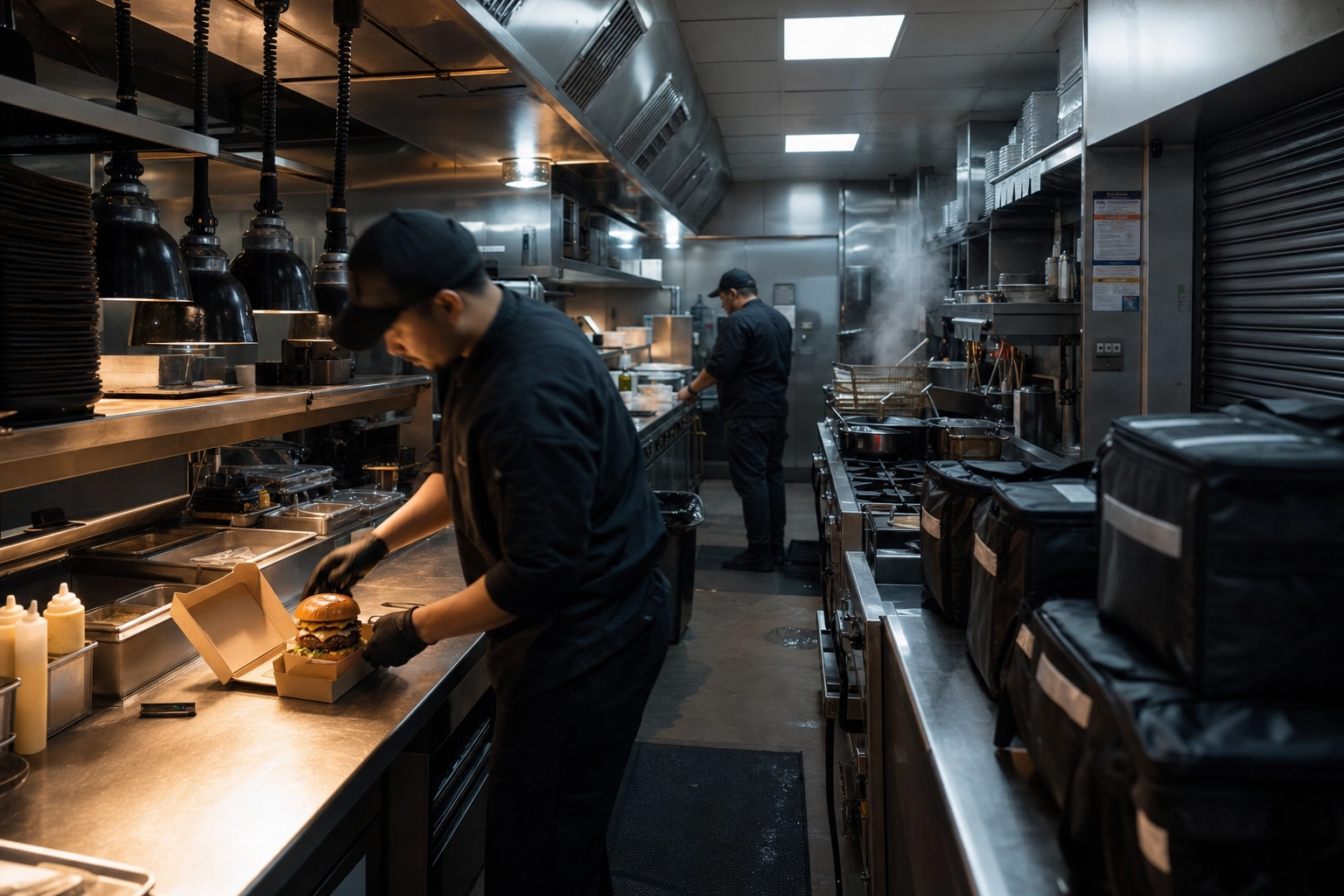
A dark kitchen is a commercial cooking facility built exclusively for delivery and pickup orders. There's no dining room, no host stand, no customers walking through the door — just a kitchen, a tight crew, and a steady stream of orders coming in through DoorDash, Uber Eats, Grubhub, and direct apps.
If you've heard the terms ghost kitchen, cloud kitchen, or virtual kitchen and weren't sure how they relate to a dark kitchen — they're essentially the same thing. The terminology shifted as the industry grew across regions between 2018 and 2021, but the business model is consistent: cook food, hand it to a courier, never see the customer.
Quick Summary: A dark kitchen is a delivery-only restaurant with no dine-in space, customer-facing only through food delivery apps. Startup costs typically run $30,000–$100,000 (vs. $175,000+ for a traditional restaurant), EBITDA margins reach 8–15% when operated well, and your delivery app photos act as the entire storefront — making professional food photography the single highest-leverage marketing investment for any new operator.
This guide walks you through everything an entrepreneur needs to evaluate, plan, and launch a dark kitchen — including the operational models, real-world economics, and the often-overlooked role food photography plays in whether your kitchen survives or quietly dies on page three of the app.
What Is a Dark Kitchen?
A dark kitchen is a foodservice business that exists only as a kitchen. There is no front-of-house, no signage on the street, and in most cases no walk-in option at all. Customers discover the kitchen through delivery platforms, place orders through an app, and receive their food via a courier — usually within 30–45 minutes.
The model emerged in the late 2010s as third-party delivery apps changed how people ordered food. Once a meaningful share of orders started flowing through DoorDash, Uber Eats, and similar platforms, operators realized they were paying for an expensive dining room that those customers would never visit. Strip the dining room out, and you're left with just a kitchen — cheaper to rent, faster to launch, and built for a customer who only ever sees the food in a phone screen.
The pandemic accelerated everything. Indoor dining restrictions in 2020 forced experimentation, and by 2021 venture capital was pouring into the segment. As Restaurant Dive reported in 2020, the delivery market expanded "what would typically take five or so years" almost overnight. Today, the global ghost kitchen market is worth roughly $98 billion and is forecast to surpass $200 billion by 2032, growing at around a 15% compound annual rate. There are an estimated 7,600 active dark kitchen operations in the United States alone, with much higher density in markets like India, the UAE, and major European cities.
Dark kitchens range from one chef in a rented commissary to multi-brand operators running 10+ virtual restaurants out of a single 1,500-square-foot facility. The model is flexible, but the rules are unforgiving: if your delivery app listing isn't excellent, you don't exist.
Dark Kitchen vs. Ghost Kitchen vs. Cloud Kitchen: What's the Difference?
In casual conversation and most published guides, dark kitchen, ghost kitchen, cloud kitchen, and virtual kitchen mean the same thing. Wikipedia bundles them all under "virtual restaurant." Merriam-Webster defines a dark kitchen as "a commercial cooking facility used for the preparation of food consumed off the premises: ghost kitchen."
That said, there are subtle distinctions some industry insiders draw:
- Dark kitchen tends to refer to the infrastructure — the physical commercial kitchen built for delivery. The term is more common in the UK and Europe.
- Ghost kitchen tends to refer to the brand or restaurant concept — a virtual restaurant that exists only on apps. More common in the US.
- Cloud kitchen often implies a multi-brand operation — one physical kitchen running several virtual restaurants. The term carries a "scalable, tech-enabled" connotation that took hold around 2020–2021 with major venture-backed launches.
- Virtual kitchen is sometimes used for a delivery-only brand operating out of an existing restaurant's kitchen during off-hours.
These distinctions are real but not consistently observed. A KaaS provider in California might call its product a "ghost kitchen," while a restaurant operator in London building the same thing calls theirs a "dark kitchen." For practical purposes, treat dark kitchens, ghost kitchens, and cloud kitchens as synonyms and use whichever term your customer base searches for. For a deeper look at the multi-brand approach specifically, see our virtual kitchen guide.
How Dark Kitchens Differ From Traditional Restaurants
The dark kitchen model rewires almost every variable a traditional restaurant operator is used to. Dark kitchens and traditional restaurants compare like this side-by-side:
| Factor | Traditional Restaurant | Dark Kitchen |
|---|---|---|
| Dine-in space | Required | None |
| Front-of-house staff | Hosts, servers, bussers, bar | None |
| Real estate priority | Foot traffic, visibility, parking | Delivery radius density, lease cost |
| Typical startup cost | $175,000–$750,000+ | $30,000–$100,000 |
| Time from lease to launch | 6–18 months | 2–8 weeks |
| Customer acquisition | Walk-ins, signage, location, word-of-mouth | 100% digital — app listings, ads, reviews |
| Revenue ceiling | Seats × turns × ticket | Kitchen capacity × delivery radius |
| Brand experience | Full sensory (decor, music, plating, service) | Photos, packaging, food quality at the door |
| Margin profile | 3–5% net (industry benchmarks) | 8–15% EBITDA, 5–10% net for top operators |
The biggest mental shift for restaurateurs coming from traditional restaurants is this: in a dark kitchen, your customer never experiences your restaurant — only the food you ship to them. Every brand cue you'd normally communicate through interior design, music, server training, and plating presentation has to be compressed into a 1,024×1,024 pixel photo, a paragraph of menu copy, and the sturdiness of a takeout container.
That compression is what makes the model so capital-efficient — and so unforgiving when you skimp on the parts that actually reach the customer.
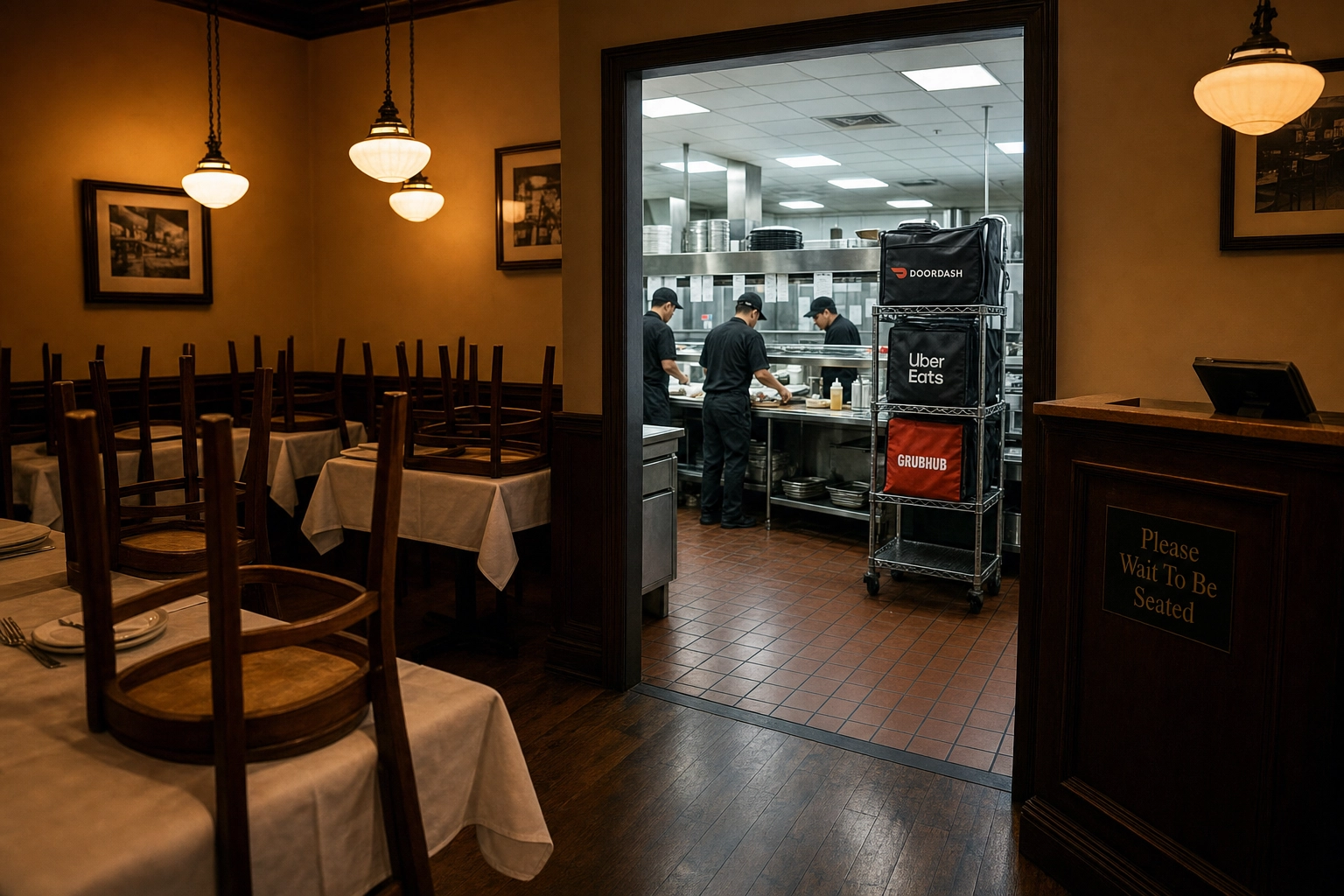 Empty traditional restaurant dining room contrasted with active commercial kitchen working delivery orders behind it
The 5 Main Types of Dark Kitchen Models
Choosing your operational structure is the first real decision after concept validation. Each of the dark kitchen models below has a different cost profile, scalability ceiling, and operational complexity.
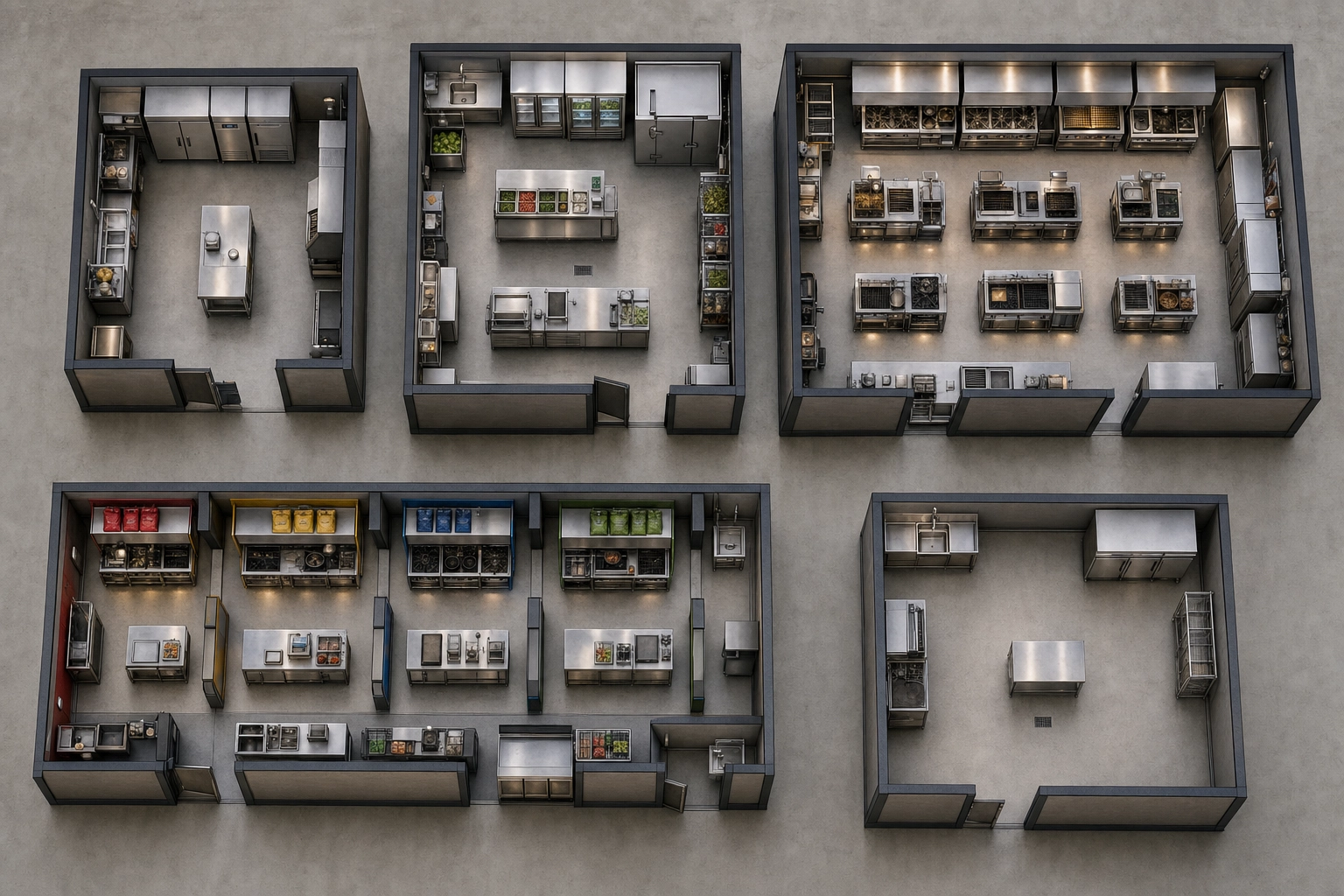 Overhead architectural visualization of five different dark kitchen operational models laid out as modular units
1. Single-Brand Dark Kitchen
One menu, one identity, one focus. A single-brand dark kitchen is a delivery-only restaurant operating exactly like a traditional restaurant, minus the dining room. You build one brand, photograph one menu, and run one set of operations.
Best for: chefs with a specific concept, established restaurants expanding into delivery-only locations, franchises adapting to delivery markets.
Pros: Simpler operations. Clearer brand storytelling. Smaller menu means easier inventory and faster tickets. Reviews compound for one brand instead of fragmenting across many.
Cons: Lower kitchen utilization (you're not maximizing the asset). All revenue depends on one concept catching fire. Less optionality if the cuisine underperforms in your area.
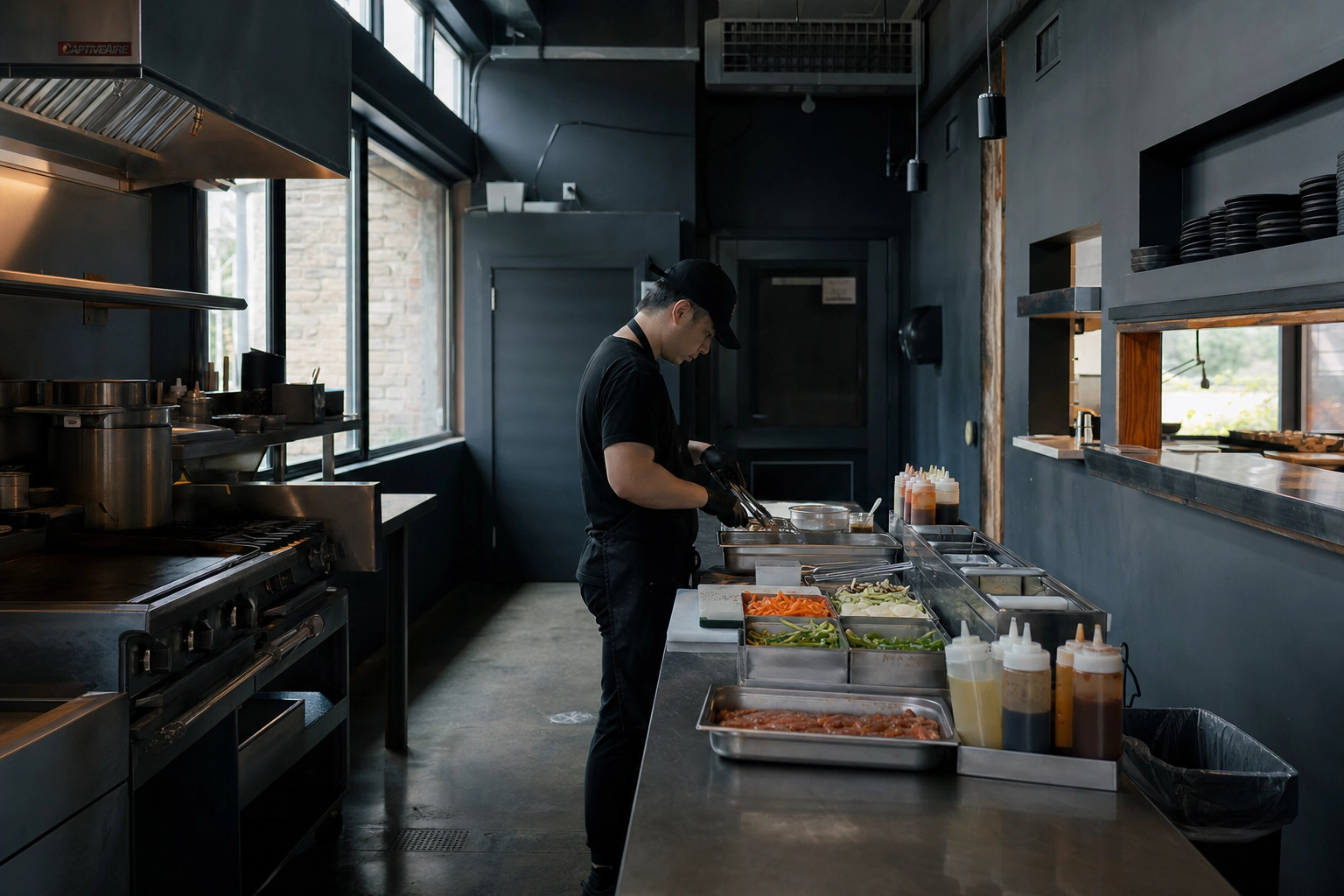 Single chef preparing ingredients alone in a focused small single-brand dark kitchen operation
2. Multi-Brand (Cloud Kitchen) Operation
One physical kitchen runs several virtual brands at once. The same six cooks might be turning out burgers under "Smashed Up" at 6:00 PM, wings under "Wing Theory" at 6:05, and rice bowls under "Bowl Religion" at 6:10. Each brand has its own delivery app listing, its own visual identity, and its own customer base.
The strategic logic is straightforward: a hungry customer searching DoorDash for "burgers" will scroll past your wings listing, but if you have a burger brand, they'll find you. Multi-brand operators essentially buy more shelf space on the apps without adding kitchen capacity. According to industry analysis from Restroworks, multi-brand cloud kitchens see 15–25% higher EBITDA margins than single-brand peers because fixed costs are spread across more revenue streams.
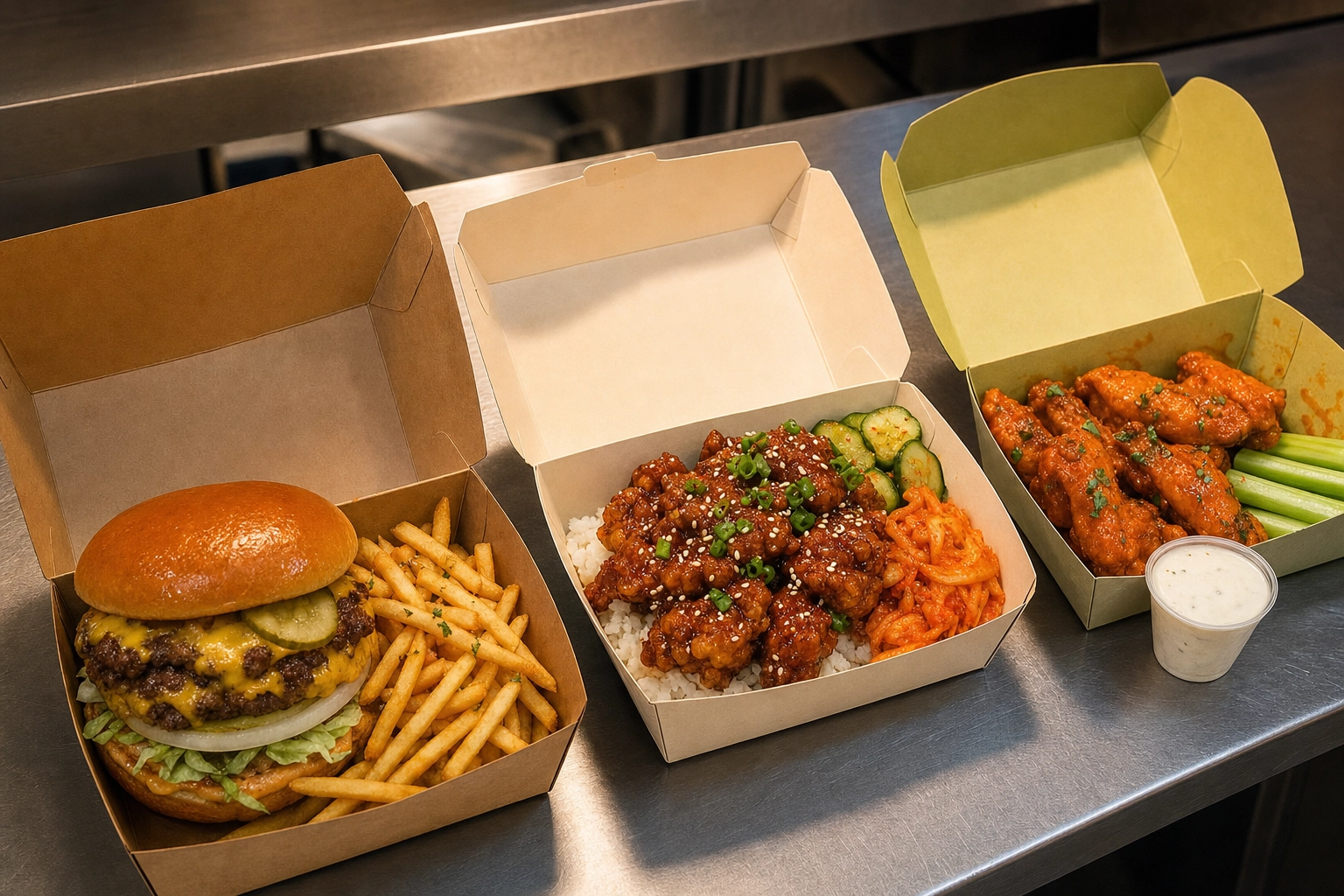 Three different cuisines plated for separate virtual brands operated from one multi-brand cloud kitchen
Pros: Higher kitchen utilization. Captures multiple search intents on delivery apps. Lets you A/B test new concepts at near-zero marginal cost. Spreads risk across cuisines.
Cons: Operational complexity multiplies. Each brand needs distinct photography and menu copy. Quality control is harder. The "celebrity ghost kitchen" backlash of 2021–2022 showed that customers eventually catch on when 12 different "brands" all taste similar.
For more on launching virtual brands successfully, see our breakdown of examples of successful ghost kitchen brands.
3. Shell Kitchen (Commissary Rental)
A shell kitchen — sometimes called a commissary kitchen — is a licensed commercial kitchen space you rent by the hour, shift, or month, often shared with other food businesses. You bring (or buy) most of your equipment. You get health-department-approved space, dishwashing, and storage, but the operation is yours.
Hourly rates typically run $15–$50 per hour. Monthly leases for a dedicated bench start around $1,500 and scale up depending on the city and footprint. Total startup costs sit at the low end — often $20,000–$40,000 — because the kitchen infrastructure already exists.
Best for: testing concepts before committing to a dedicated space, low-volume operations, pop-ups, caterers wanting a delivery channel.
Cons: Limited storage. Scheduling conflicts with other tenants. Hard to scale beyond a certain order volume. Branding is invisible because you don't control the space.
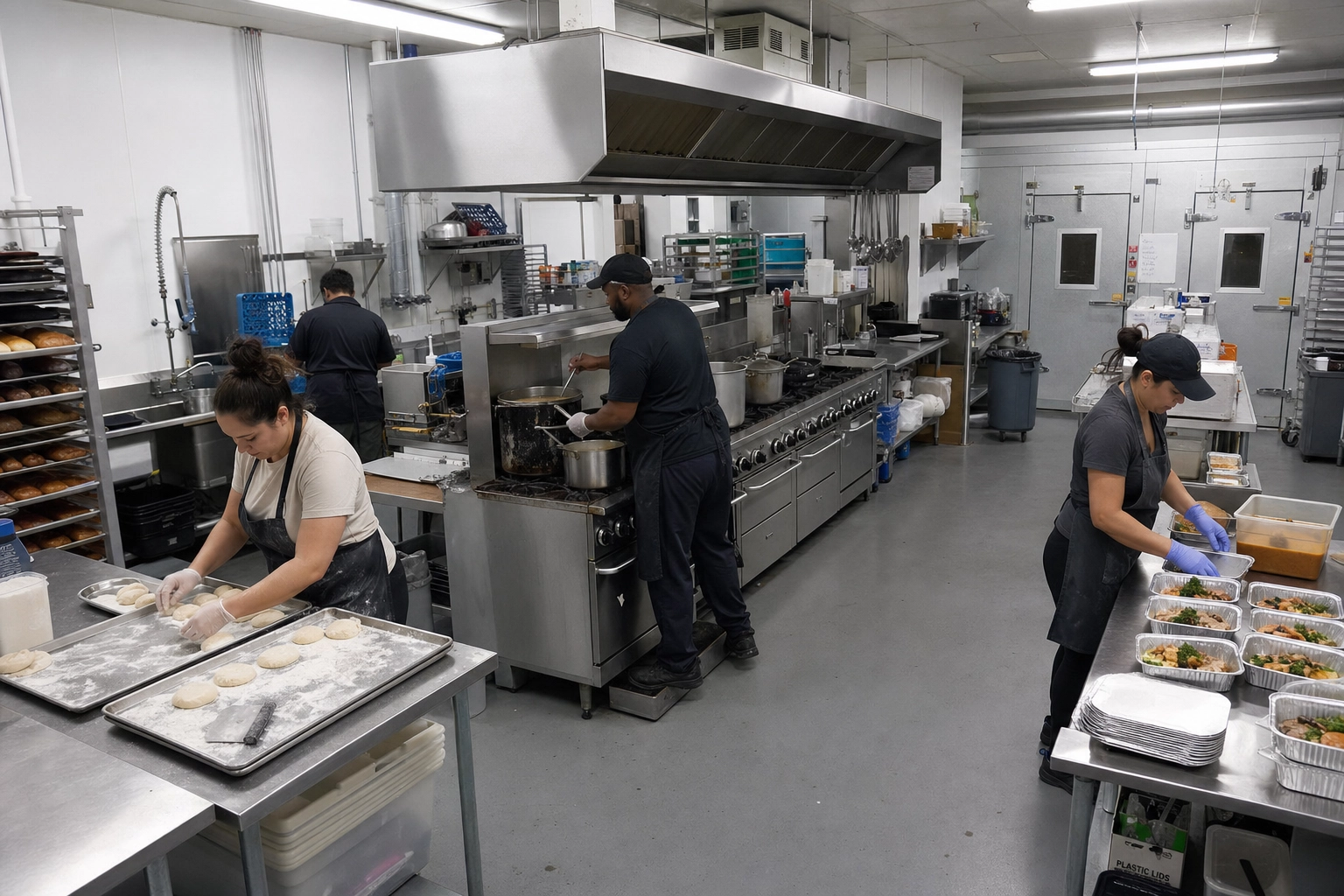 Shared commissary kitchen with multiple food businesses operating in parallel at separate stainless steel benches
4. Kitchen-as-a-Service (KaaS)
KaaS providers operate purpose-built dark kitchen facilities and lease individual private units to operators. You walk in, plug in your tech, and start cooking the same day. Major providers include CloudKitchens (the Travis Kalanick-backed venture launched in 2018 that hosts up to 30 brands per facility), Kitchen United, Kitopi, REEF Technology, Zuul, and Karma Kitchen.
A typical KaaS unit is 150–300 square feet, with shared loading docks, walk-in storage, order management software, and sometimes a courier handoff zone. Monthly rent ranges from $3,000 to $15,000 depending on the market. All-in startup costs land around $40,000–$80,000 because the buildout is done — you mostly just need equipment beyond what's included, working capital, and your tech stack.
Best for: fast launches, multi-city expansion, operators who want zero buildout hassle, brands testing new markets.
Cons: Higher monthly cost than commissary rentals. Less customization. You're competing with neighboring operators for courier attention during peak.
5. Aggregator-Owned Kitchens
Delivery platforms run their own dark kitchen facilities and lease space to selected restaurant partners. DoorDash Kitchens, Deliveroo Editions, and Glovo Cook Rooms (launched in 2018) are the main examples. The catch: when you operate from one of these, you typically must list exclusively on that platform.
Pros: Built-in demand. Optimized order flow. Lower commissions on some platforms in exchange for exclusivity. Often the only way certain markets are accessible.
Cons: Platform lock-in is the dealbreaker. You lose the ability to diversify across delivery apps, which means if that platform changes its algorithm, raises commissions, or kicks you off, you have no fallback channel. Notably, Wendy's announced in 2023 that it would permanently close its entire US ghost kitchen partnership with REEF Technology, as Bloomberg reported — a cautionary tale on platform-dependent dark kitchens. Most operator forums advise treating these as a starting point at most, not a long-term home.
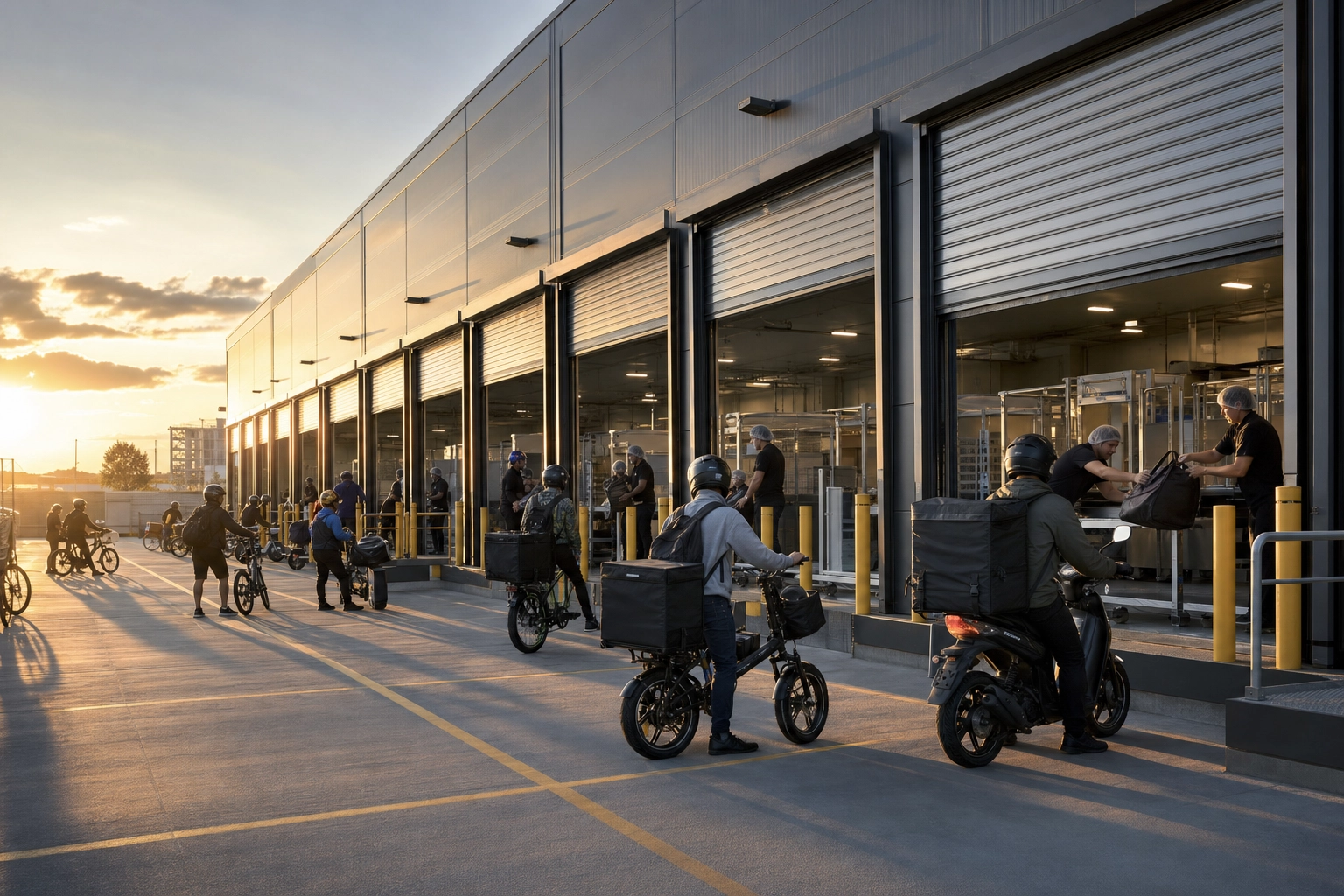 Exterior of aggregator-owned dark kitchen facility with couriers picking up sealed delivery orders from bay doors
Pros and Cons of Running a Dark Kitchen
A clear-eyed look at both sides — without the hype most marketing pages put on dark kitchens.
Pros: Why Operators Choose This Model
Lower startup cost. A dark kitchen typically costs 3–5x less to launch than a comparable traditional restaurant. You skip dining room buildout, front-of-house furniture, expensive retail rent, and most decor.
Lower fixed overhead. No servers, hosts, bartenders, or bussers. A two-cook line can sustain $40,000–$60,000 in monthly delivery revenue, especially in a multi-brand setup.
Faster launch timeline. A KaaS operator can be live in 2–4 weeks. A shell kitchen launch can happen in under 8 weeks. A traditional restaurant build typically takes 6–18 months from lease to opening.
Multi-brand flexibility. You can spin up a new virtual brand for the cost of a menu, photography, and a delivery platform application. If a brand doesn't catch on, close it without firing anyone or breaking a lease.
Geographic flexibility. Locate where rent is cheap, not where foot traffic exists. Industrial zones, basements, back of strip malls — anywhere a courier can find the door works.
Test concepts cheaply. Want to know if a Korean fried chicken brand would work in your delivery zone? Launch one for $3,000–$8,000 in incremental cost (photography, packaging, listing setup) and watch the data for two months.
Higher EBITDA margin potential. Industry benchmarks put EBITDA margins for well-run dark kitchens at 8–15%, versus 3–5% for traditional restaurants. The top decile of multi-brand operators reach 15–25%.
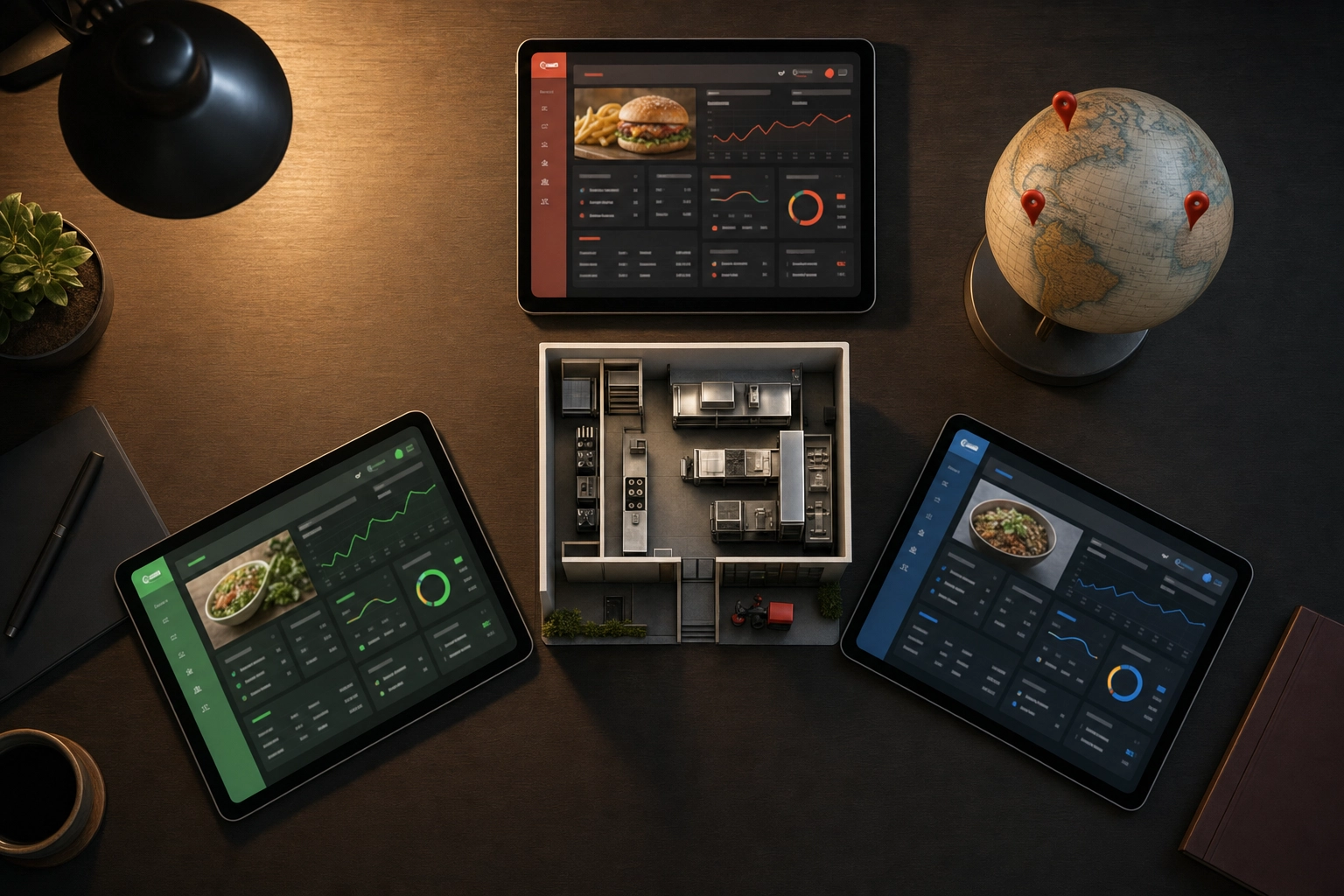 Conceptual overhead view of dark kitchen multi-brand and multi-city scalability with three branded delivery app dashboards
Cons: The Hard Realities Most Guides Don't Mention
Platform commission fees are brutal. DoorDash, Uber Eats, and Grubhub take 15–30% of every order. Layer on optional ad spend, "free delivery" promotions, and processing fees, and total platform cost can exceed 40% of revenue on heavily promoted orders.
100% digital customer acquisition. A traditional restaurant gets free customers from people walking past. A dark kitchen gets zero free customers. Every single order has to come from a digital channel that costs money — which means your marketing budget is a real, ongoing line item, not an afterthought.
You're invisible without great photos and ratings. Delivery app algorithms reward listings with high-resolution images, complete menus, fast prep times, and 4.5+ star ratings. A new listing with phone-quality photos and a sparse menu will languish on page 3 forever.
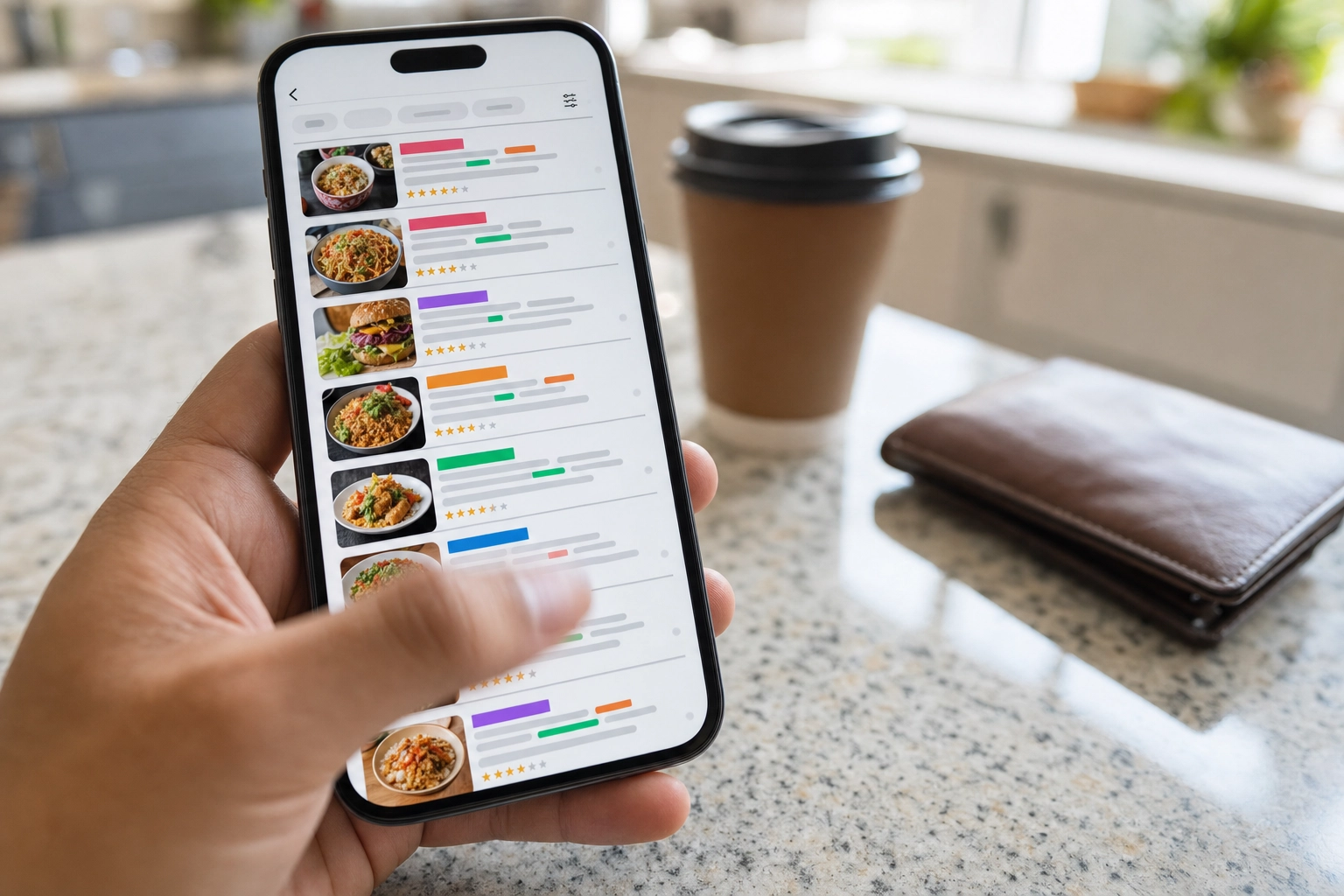 Customer scrolling crowded delivery app showing dozens of competing dark kitchen restaurant listings on smartphone
Quality control is mechanical. Food has to survive 20–40 minutes in a courier bag and still look right when it lands on a customer's kitchen counter. Fries go soggy. Hot bowls steam up clamshells. Sauces bleed. The menu has to be engineered for transit, not just taste.
The customer relationship belongs to the platform. DoorDash knows who your customer is, what they ordered, and how often they reorder. You typically don't. Building direct ordering channels is the only way to claw back any of that data.
The failure rate is real. Reddit operators running ghost kitchens since 2020 commonly cite a 60% failure rate within two years. Many of the early "celebrity ghost kitchen" experiments — virtual brands fronted by celebrities and operated out of partner restaurants between 2020 and 2022 — collapsed when reorder rates revealed the food wasn't memorable.
Hidden costs. Operators frequently report that advertised kitchen rents understate true monthly costs by 30–50% once utilities, shared equipment fees, packaging, insurance, and platform commissions are layered in.
How to Start a Dark Kitchen: Step-by-Step
The realistic path from idea to first order, with the numbers and decisions that actually matter.
Step 1: Validate Your Concept and Pick Your Model
Start with three questions: What cuisine? What price point? What customer? Then validate against your delivery zone.
Open DoorDash, Uber Eats, and Grubhub. Search for your proposed cuisine in the ZIP code you'd operate in. Count how many existing restaurants serve it, look at their photos, prices, and ratings. If there are 40 burger options and the top three have 4.8 stars and 2,000+ reviews, your generic burger brand is dead on arrival. Look for gaps — cuisines underserved relative to demand, or quality gaps in well-served categories where most listings are mediocre.
Next, pick your structural model: single-brand vs. multi-brand, KaaS vs. shell vs. dedicated buildout. Most first-time operators should start single-brand in a KaaS or shell kitchen. The complexity of multi-brand is rarely worth it before you've proven you can run one brand profitably.
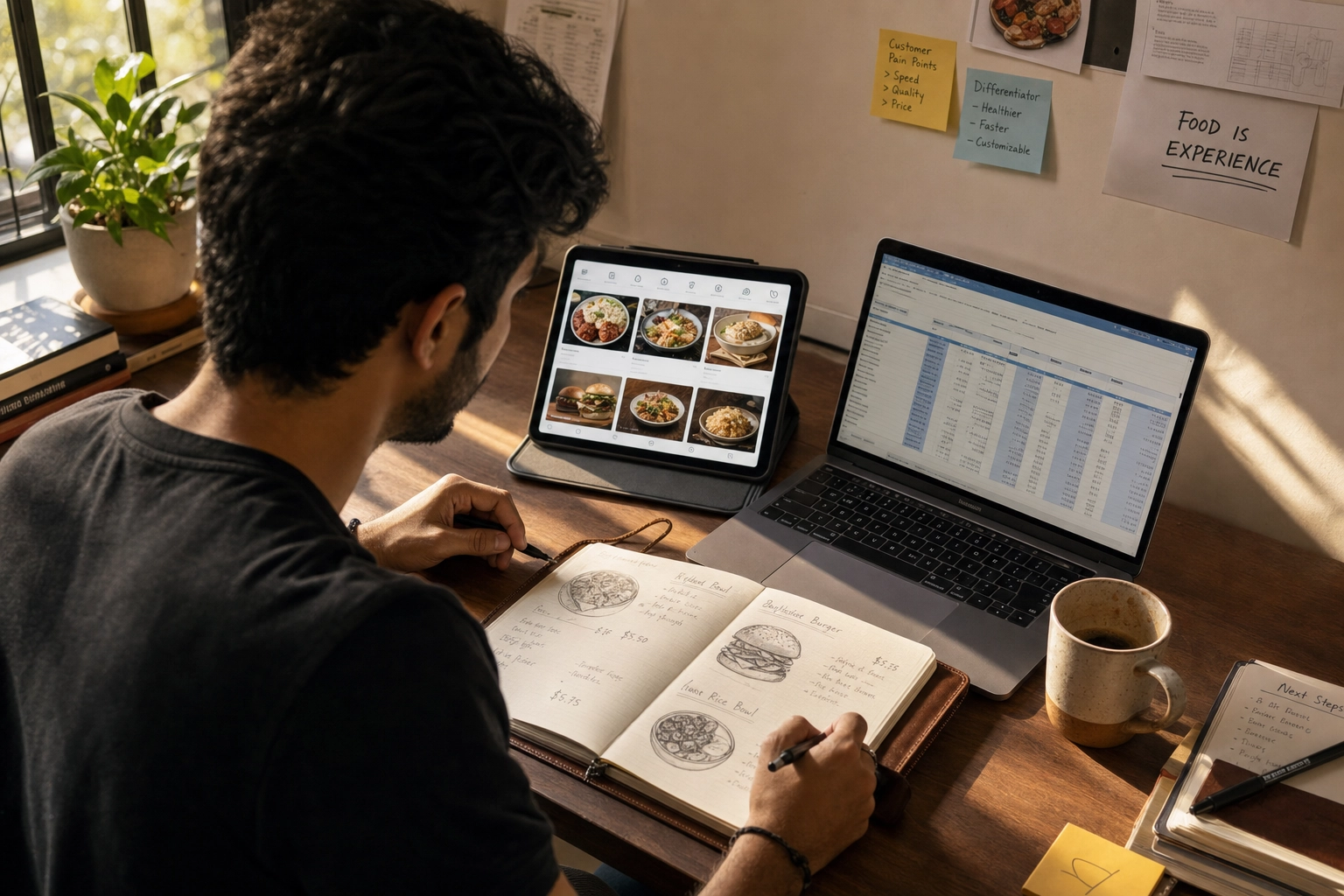 Food entrepreneur researching dark kitchen competitors and sketching menu concepts at a workspace with tablet and laptop
Step 2: Choose a Location Based on Delivery Demand
Forget retail visibility. Optimize for delivery economics.
Most platforms cap delivery radius at 3–5 miles. Inside that radius, you want population density (residential or office), enough disposable income to support your price point, and gaps in your category. A basement unit in a mixed-use neighborhood often outperforms a strip mall corner two miles further out.
Check zoning before you fall in love with a space. Commercial food preparation has specific zoning requirements that vary by city. Industrial zones almost always work; some commercial mixed-use zones have restrictions. Call the local health department and planning office before signing anything.
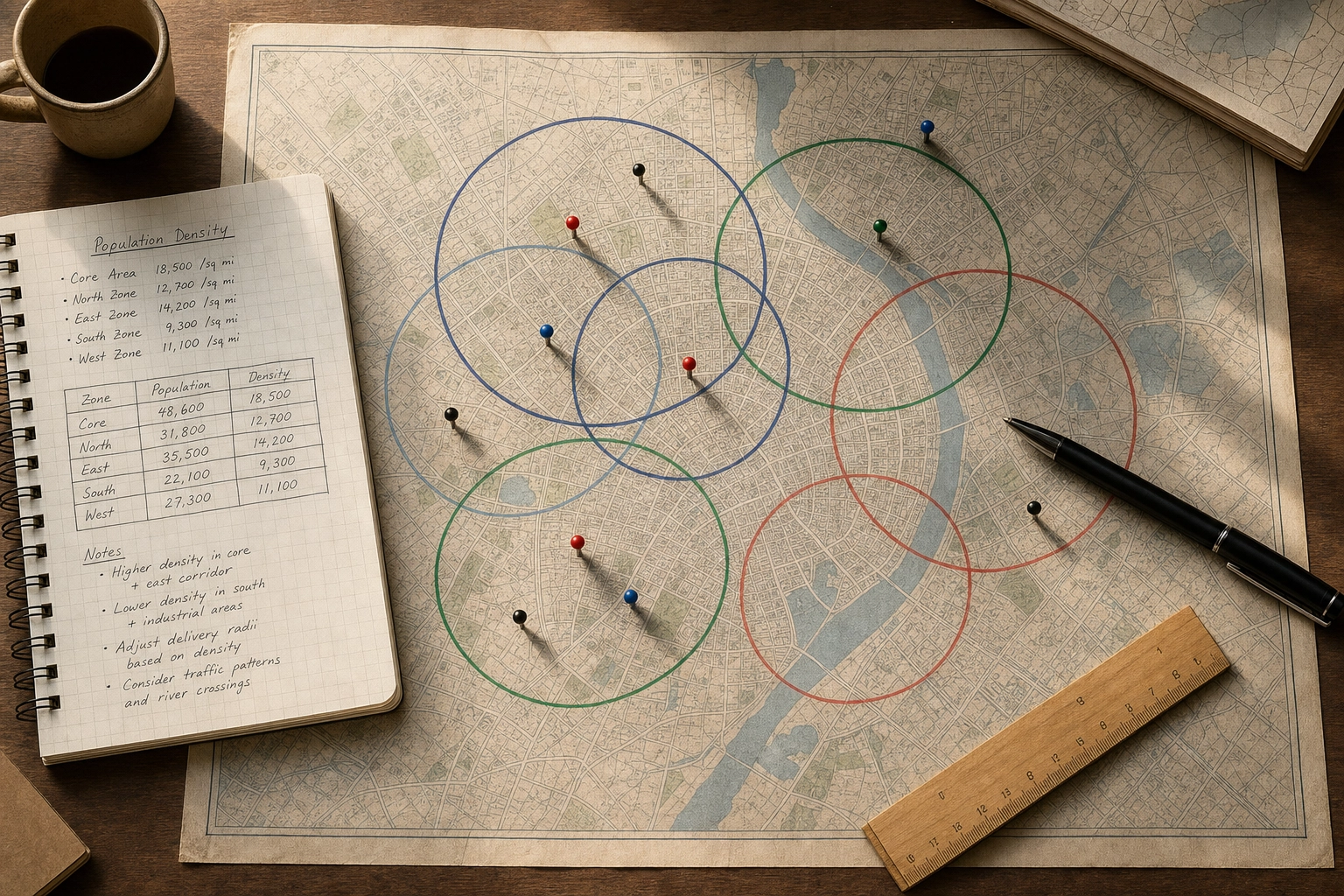 Hand-drawn delivery radius analysis on a city map with competitor markers for dark kitchen location strategy
Step 3: Get Your Licenses and Permits
Requirements vary by jurisdiction, but the typical US checklist looks like this:
- Business entity registration (LLC is most common)
- Food handler / manager certification (ServSafe in most US states)
- Commercial kitchen license / health department permit
- Sales tax permit
- Fire safety inspection
- Federal EIN
- If hiring: state employer registration, workers' compensation insurance, payroll tax setup
Plan 4–8 weeks for permits in most US cities. London, Toronto, Sydney, and most EU cities require additional food premises registration and HACCP-aligned hazard plans. Pull the requirements early — permitting is often the longest single lead time in the launch.
Step 4: Set Up the Kitchen
The setup work depends entirely on which model you chose:
- KaaS path: Sign the lease, walk in, plug in your equipment additions, and start cooking. Buildout is mostly done.
- Shell kitchen: Bring or buy your equipment ($15,000–$40,000 depending on menu), figure out cold and dry storage, work out your prep schedule with the facility manager.
- Dedicated buildout: Full HVAC, hood, plumbing, and equipment installation. Budget $80,000–$150,000+ and 3–6 months of buildout time. Rarely the right choice for a first-time operator.
Tech stack essentials, regardless of model: a POS that integrates with delivery platforms, a kitchen display system to keep tickets moving, inventory management software, and a backup ordering channel if a delivery platform goes down mid-service.
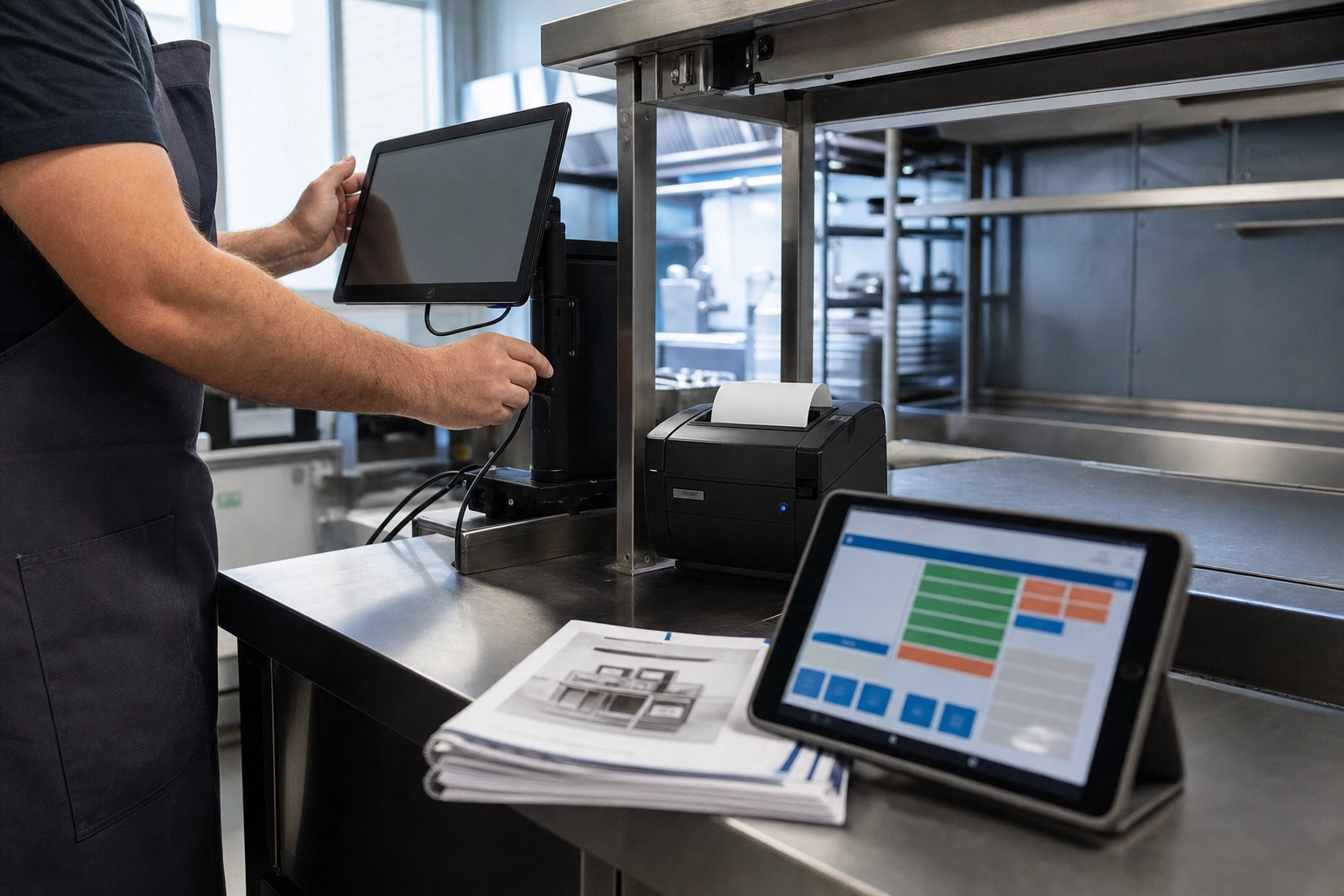 Operator setting up kitchen display system and POS technology in a new Kitchen-as-a-Service unit
Step 5: Design a Delivery-Optimized Menu
Tight menus win. Industry guides converge on 15–25 items as the operational sweet spot — enough variety to satisfy a delivery customer, few enough that prep stays fast and inventory stays simple.
Three principles for delivery menu design:
- Travels well. Skip soufflés, fries that go soggy in five minutes, anything that has to be eaten immediately. Bowls, sandwiches, wings, pastas, baked goods, and most Asian-inspired dishes survive transit well.
- Engineered for sub-30% food cost. Build menu prices that target food costs under 30% of menu price after factoring delivery commissions. If your $14 bowl costs $5 to make and you pay 25% commission, your contribution after food and platform fees is around $5.50 — and labor still has to come out of that.
- Shared base ingredients. A protein, two starches, and a few vegetables can drive 12+ menu items if recipes share base components. Fewer SKUs in the cooler, less waste, faster prep.
For deeper menu strategy, see ghost kitchen menu planning.
Step 6: Develop Your Brand Identity
Without a storefront, the brand exists entirely on the apps. That makes naming, visual identity, and packaging the only brand cues you have.
Pick a name that's searchable, spellable, and not easily confused with existing listings. Avoid trademark conflicts (search USPTO and your local equivalent). Build a logo that reads at thumbnail scale, a color palette that pops on a delivery app's white background, and packaging that protects food and reinforces the brand when it lands on the customer's table.
Register social handles even if you don't plan to use them right away. The brand handle being available is worth the 30 minutes of registration work.
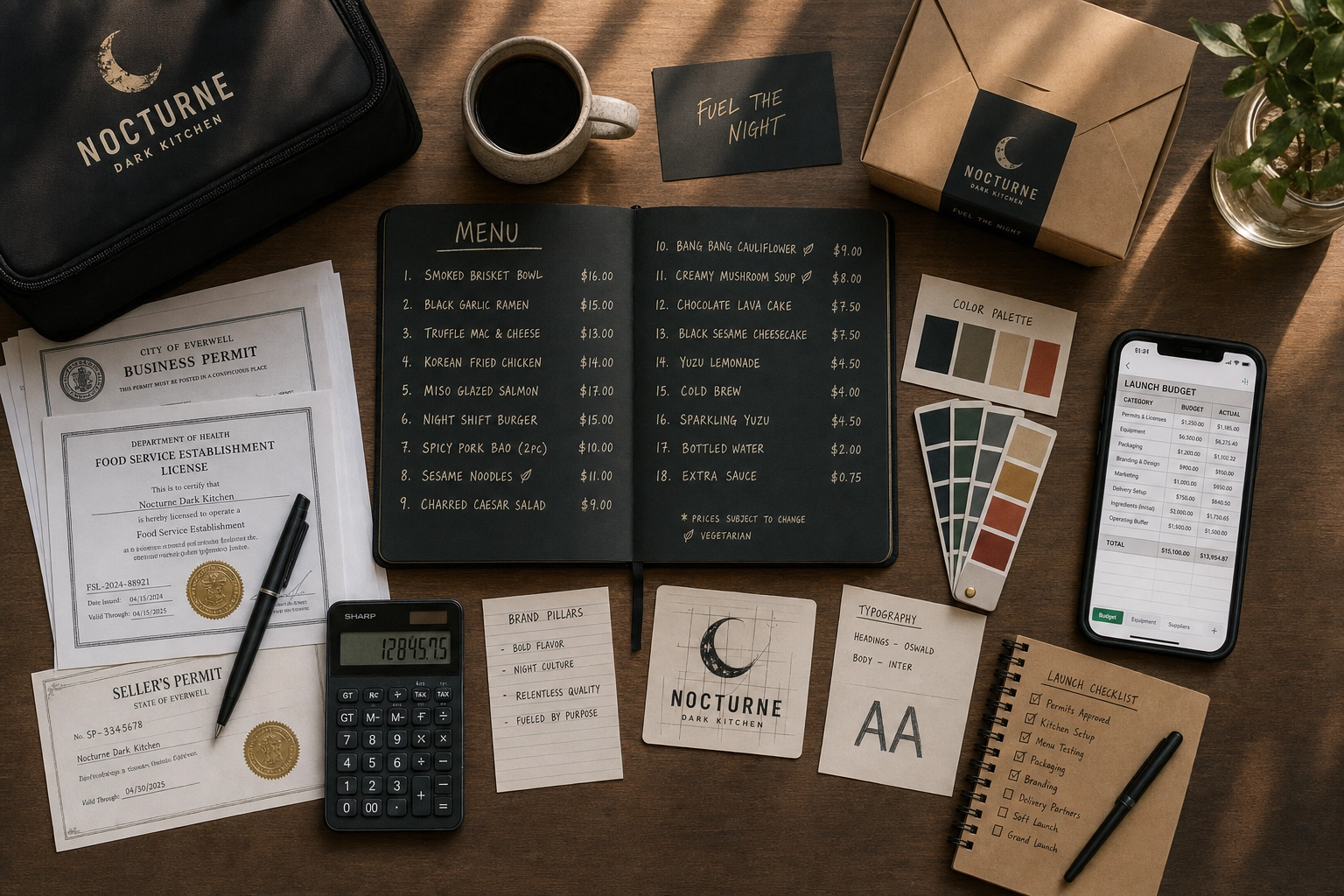 Flat-lay of dark kitchen launch planning materials including menu sketches permits packaging and brand swatches
Step 7: Photograph Every Menu Item
This is the highest-leverage step in the entire launch — and the one most first-time operators underinvest in.
Photo-rich delivery menus convert 25–35% better than text-only or sparse menus, according to studies cited across the industry. Customers scrolling through 60 burger options on DoorDash decide in less than two seconds whether to tap your listing or scroll past. The photo is the entire decision.
Each platform has specific specs: DoorDash uses 1,024×1,024 square images, Uber Eats prefers 1,200×900 (4:3 landscape), and Grubhub wants 1,024×768. Photos need to be sharp at thumbnail size, with clear single-dish framing, neutral or branded backgrounds, vibrant but realistic color, and recognizable portion size.
The traditional path is hiring a food photographer for $700–$1,400 per session covering 8–12 dishes. For a 25-item menu across three virtual brands, that's $5,000–$15,000 in photography alone — and you'll need to reshoot every time you update the menu.
This is where AI-powered tools have changed the equation. Platforms like FoodShot AI take a phone snap of an actual plated dish and transform it into a studio-quality, platform-spec image in about 2 minutes. For a multi-brand operator running 60+ menu items, that's the difference between a $15,000 photography line item and a $15-per-month subscription. See our restaurant food photography guide for a deeper comparison of options.
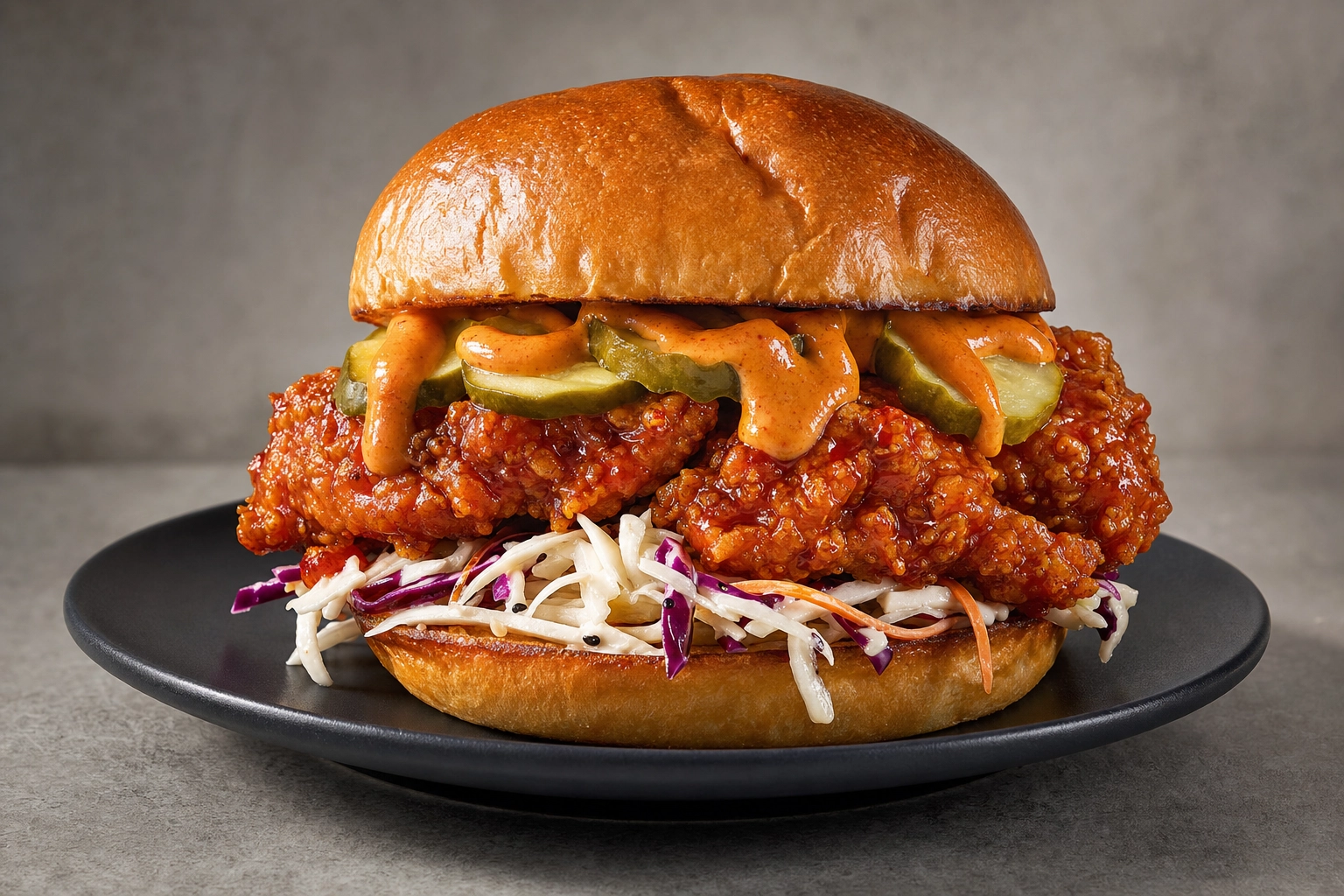 Professional Korean fried chicken sandwich photographed in delivery-app-optimized style with clean background and directional lighting
Step 8: Register on Delivery Platforms
The big three in the US are DoorDash, Uber Eats, and Grubhub. In the UK, add Deliveroo and Just Eat. Continental Europe adds Wolt and Glovo. Asia adds Foodpanda, Swiggy, and Zomato depending on country.
Submit your business documents, full menu with prices, photos, hours, and delivery zone. Approval usually takes 1–3 weeks per platform. Set up direct ordering simultaneously — your own website with online ordering (most POS systems include this) plus a simple branded mobile presence. Every direct order skips the 15–30% commission, and over time, building a 30%+ direct-order share is the single biggest margin lever you have.
Step 9: Launch With a Plan to Get the First 100 Orders
Algorithms reward early traction. The first two weeks of a new listing dictate where you sit in search results for the next several months.
A typical launch playbook:
- Day 1–14: Run platform-paid promotions (free delivery, $5 off, BOGO on a hero item). Most platforms offer matching ad credits for new listings.
- Run targeted geo-fenced social ads in your delivery radius. Instagram and TikTok work especially well for visual food content.
- Aim for a 4.7+ rating from day one. Train staff on packaging, double-check every order, and respond to every review — good or bad — within 24 hours.
- Track key metrics daily: order volume, average order value, prep time, accept rate, contact rate, and customer rating.
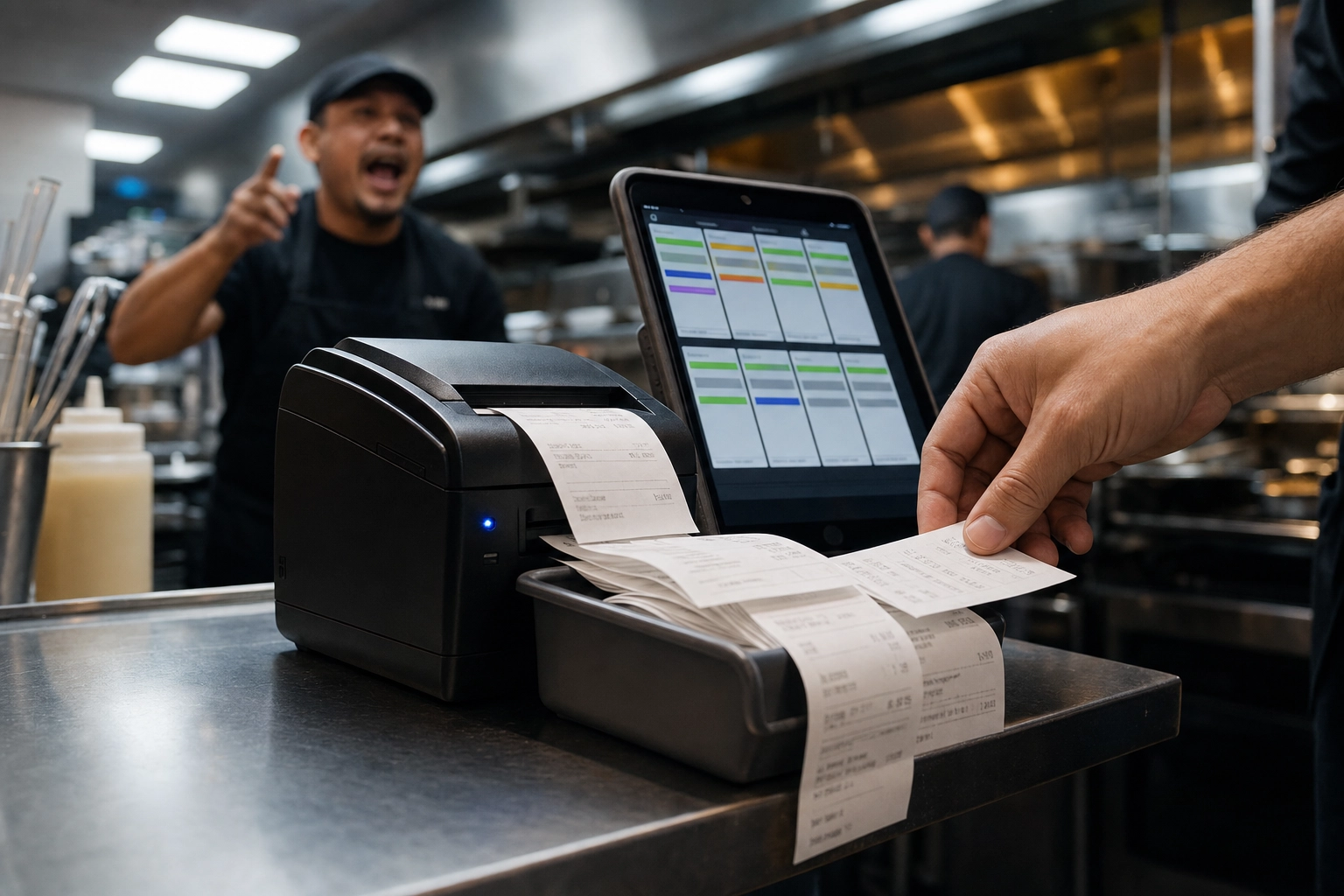 Order tickets printing rapidly during a dark kitchen launch as cooks grab incoming orders
For the full playbook, see our ghost kitchen marketing playbook and cloud kitchen marketing strategies.
Dark Kitchen Marketing: Your Photos Are Your Storefront
Marketing a traditional restaurant is partly about location. A great cafe on a busy corner gets discovered by people walking by. A dark kitchen has none of that — every customer must be acquired through a digital channel, and most of those channels boil down to one moment: a person scrolling a list of restaurants on their phone, deciding in two seconds which one to tap.
That two-second decision is driven almost entirely by the photo. Not the menu copy, not the rating (that influences the second tap, not the first), not the price. The photo.
That makes dark kitchen marketing fundamentally different from traditional restaurant marketing. Five priorities matter, in roughly this order:
- Photography. Every item, professional quality, platform-spec, and consistent across the menu.
- Listing optimization. Complete menu, accurate prep times, clear descriptions, hours that match reality.
- Reviews and ratings. Active management, fast response to negative feedback, never argue with customers in public.
- Direct ordering channels. Your own website, branded packaging that drives QR-code reorders, loyalty programs.
- Packaging-as-marketing. The unboxing moment is the only physical brand touchpoint you have.
Photography ranks first because it gates everything else. A listing with weak photos doesn't get the impressions to generate the reviews that drive the rating that fuels the algorithm. The whole flywheel starts with whether someone taps the listing.
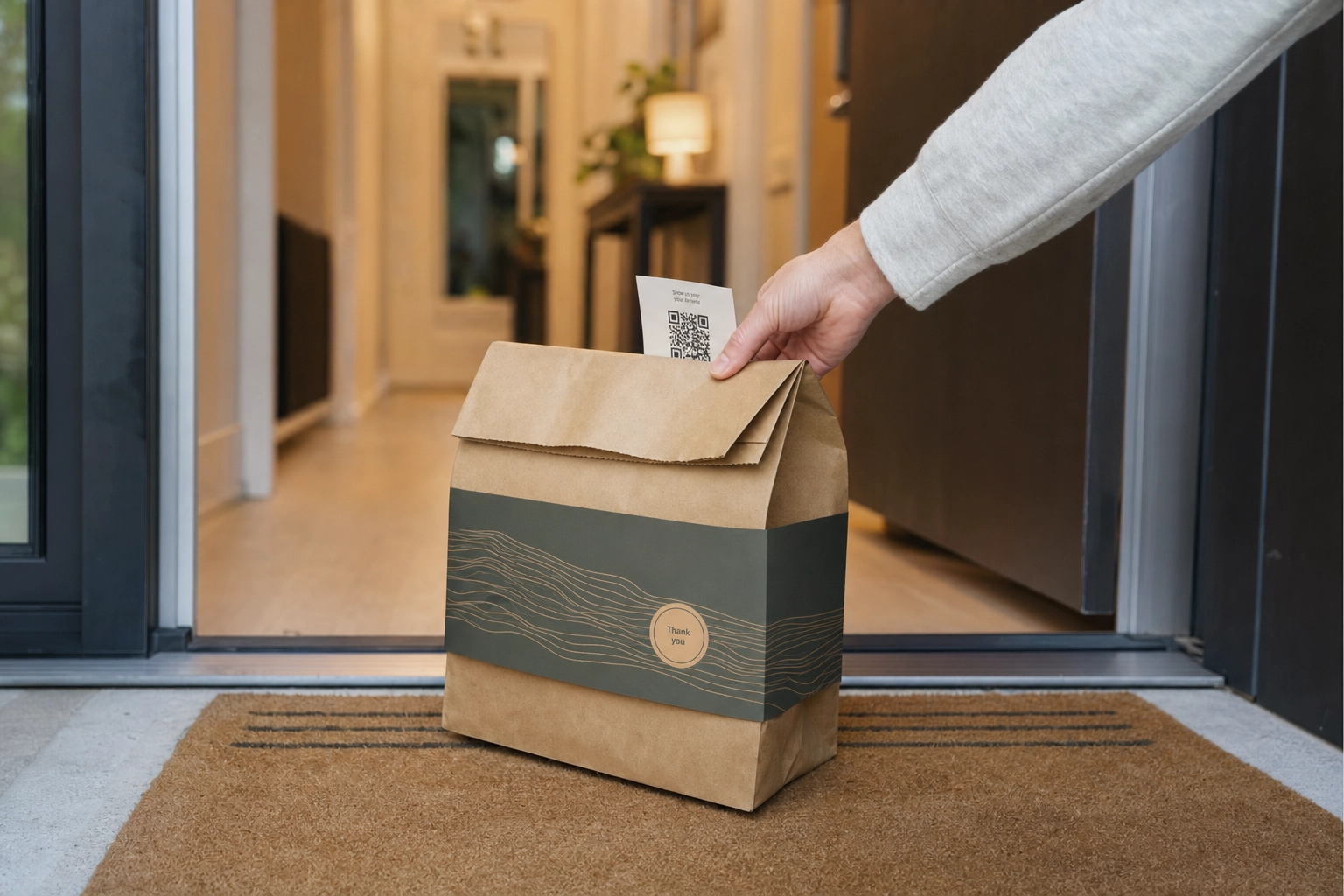 Branded dark kitchen takeout packaging arriving at customer doorstep emphasizing the unboxing brand moment
For multi-brand operators, this gets exponentially harder. Each virtual brand needs its own visual identity — different colors, plating styles, backgrounds, and mood. If three of your brands all look the same, customers eventually figure out it's the same kitchen and trust craters. AI-powered tools that let you lock a reference style and apply it consistently across an entire menu have made this kind of brand differentiation feasible at small-operator scale.
The Role of Food Photography in Dark Kitchen Success
If you take one thing from this guide, take this: in a dark kitchen, your food photography is your customer experience. There is nothing else.
A traditional restaurant communicates quality through dozens of cues — the smell when you walk in, the weight of the cutlery, the music, the server's posture, the wine list, the plating. A dark kitchen communicates quality through a 1,024×1,024 pixel image and a paragraph of menu copy. That's the entire pre-purchase brand experience.
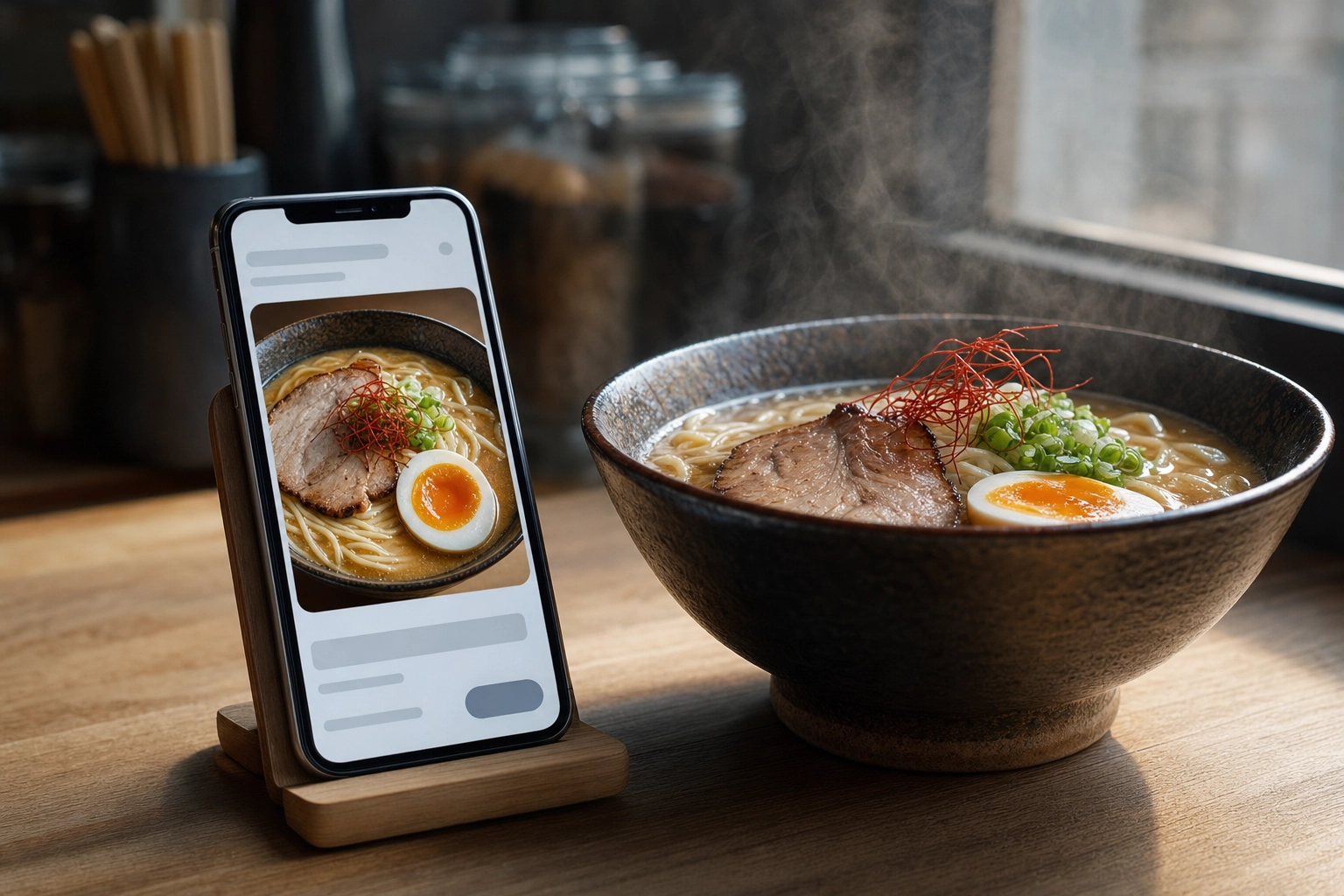 Smartphone showing delivery app dish photo next to actual prepared ramen bowl illustrating the photo-to-reality moment
Studies consistently show photo quality is the single biggest driver of conversion on delivery platforms:
- Menus with images convert 25%+ higher than text-only menus
- High-quality food photography increases delivery app orders by up to 35%
- Listings with complete photo coverage rank substantially higher in DoorDash and Uber Eats search algorithms
What "good" looks like on delivery apps is specific and surprisingly narrow. Top-converting photos share a pattern: tight crop on the dish, clean or branded background, vibrant but realistic color, soft directional light, recognizable portion size, no clutter or props that could be mistaken for sides. Generic stock photos read as fake and erode trust. Phone snaps with bad lighting communicate "small operation, probably inconsistent." Editorial photography with elaborate styling can look so far from reality that customers feel deceived when the food arrives.
The cost problem has always been scale. A traditional photographer charges $700–$1,400 per session and shoots 8–12 dishes. For a 25-item single-brand kitchen, that's two sessions and $1,400–$2,800. For a three-brand cloud kitchen with 60 items, you're looking at five sessions and $7,000–$14,000 — and you'll need to reshoot every time you change the menu.
This is exactly what AI food photo enhancement was built to solve. With AI food photography for ghost kitchens, an operator can shoot a phone photo of every plated dish during a single afternoon's prep, run each through a delivery-optimized style preset, and have a menu's worth of professional, consistent imagery ready before the kitchen opens. For multi-brand operators, the same tool lets you lock a separate visual style per brand, so your burger brand looks like a burger brand and your wellness brand looks like a wellness brand — even though they're cooked five feet apart. For platform-specific specs and workflow, our food delivery app photography page walks through exactly how to format each output for DoorDash, Uber Eats, and Grubhub.
Dark Kitchen Financial Model: Costs, Revenue, and Break-Even
Dark kitchens look like a printing press for money on paper. The reality is that economics are tight, dependent on volume, and very sensitive to the channel mix between platform orders and direct orders.
Typical Startup Costs ($30,000–$100,000)
Most operators land somewhere in this range. The two biggest variables are which kitchen model you choose and how built-out you want the operation to be on day one.
Sample budget — KaaS path (faster, lower-friction launch):
| Line item | Cost range |
|---|---|
| KaaS deposit + first month rent | $6,000–$25,000 |
| Equipment additions (mostly small wares) | $3,000–$10,000 |
| Licenses, permits, business setup | $1,500–$4,000 |
| Tech stack (POS, KDS, integrations, year 1) | $2,000–$6,000 |
| Initial inventory (food + packaging) | $3,000–$8,000 |
| Photography & branding | $500–$5,000 |
| Marketing budget (first 90 days) | $5,000–$15,000 |
| Working capital (2–3 months operating buffer) | $15,000–$30,000 |
| Total | $36,000–$103,000 |
Sample budget — Shell kitchen / commissary path (cheapest entry):
| Line item | Cost range |
|---|---|
| First/last month rent + deposit | $3,000–$8,000 |
| Equipment (you typically own most of it) | $15,000–$40,000 |
| Licenses, permits, setup | $1,500–$4,000 |
| Tech stack | $2,000–$6,000 |
| Initial inventory | $2,000–$6,000 |
| Photography & branding | $500–$5,000 |
| Marketing | $3,000–$10,000 |
| Working capital | $10,000–$25,000 |
| Total | $37,000–$104,000 |
The line operators most commonly underestimate is working capital. Dark kitchens take 60–90 days to develop steady order flow. Without 2–3 months of operating buffer, a slow start can sink the operation before the platform algorithm even ranks the listing.
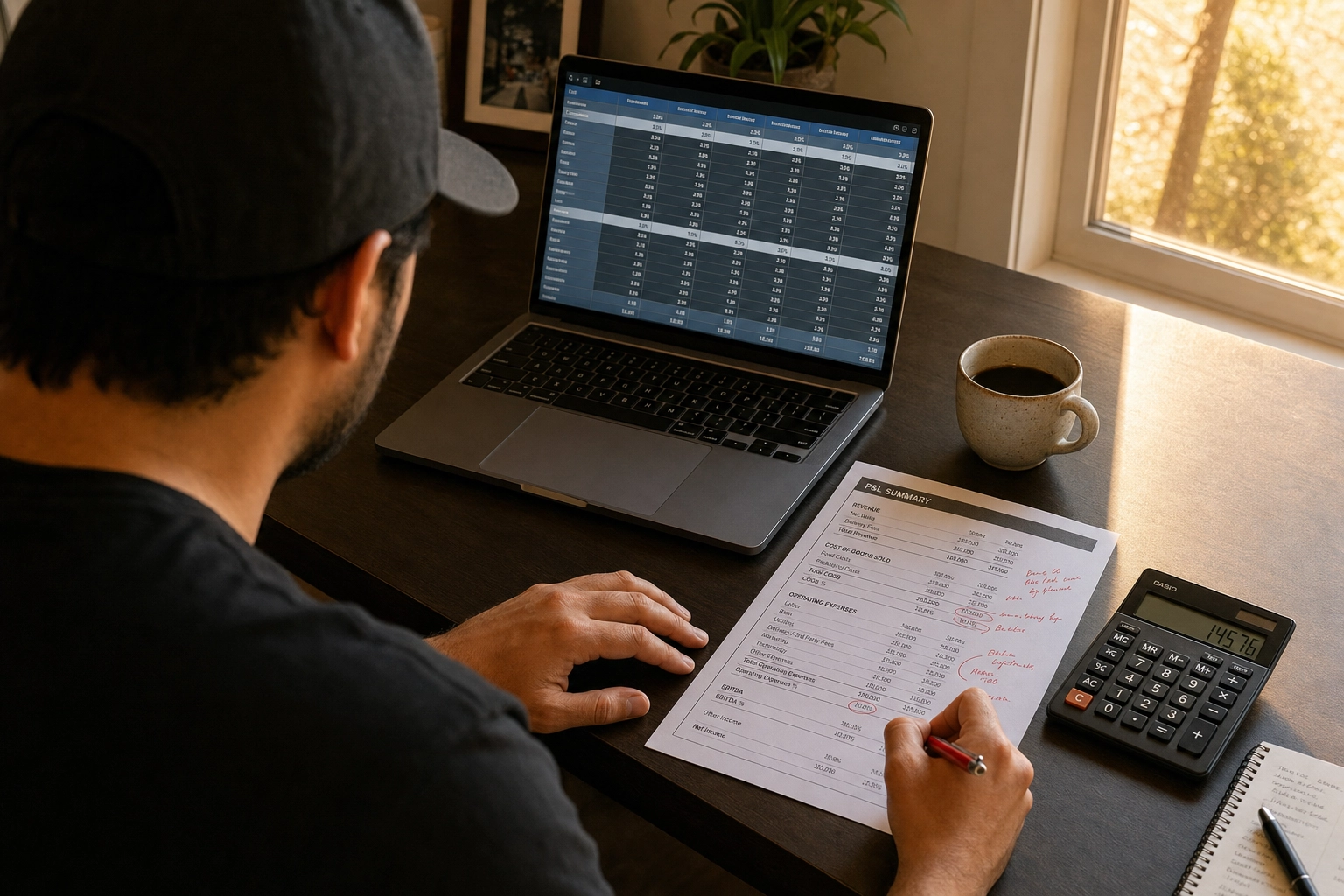 Restaurant operator analyzing dark kitchen unit economics and break-even financial model on laptop with printed P&L
Operating Costs and Unit Economics
Here's how a typical $20 delivery order breaks down on a third-party platform:
| Category | Amount | % of order |
|---|---|---|
| Gross order value | $20.00 | 100% |
| Food cost (target <30%) | $6.00 | 30% |
| Delivery platform commission (15–30%) | $5.00 | 25% |
| Packaging | $1.00 | 5% |
| Payment processing & fees | $0.60 | 3% |
| Labor allocated to this order | $4.00 | 20% |
| Rent / utilities allocated | $2.40 | 12% |
| Contribution before fixed overhead | $1.00 | 5% |
That $1 contribution per order is why volume matters so much. A kitchen doing 50 orders a day generates $50/day in pre-overhead margin — barely enough to cover insurance and tech subscriptions. The same kitchen doing 200 orders a day generates $200/day, which is where real profitability starts.
This is also why direct ordering matters disproportionately. Every order that comes through your own website skips the 15–25% platform commission. Move 30% of your volume to direct channels and your effective margin jumps by 4–7 percentage points — the difference between a struggling operation and a healthy one.
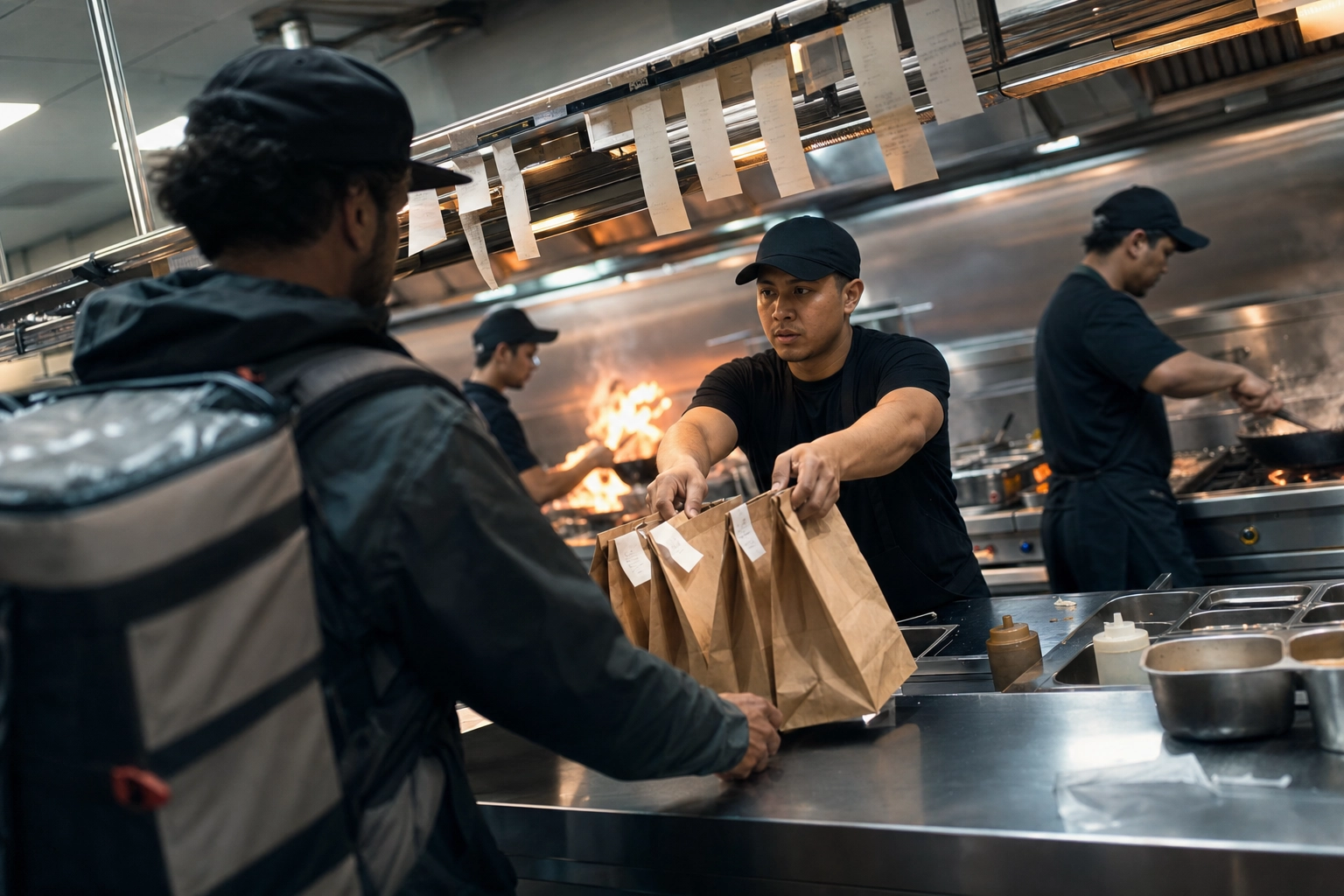 Delivery courier picking up multiple orders from busy cloud kitchen during peak service rush
Industry benchmarks for well-run dark kitchens:
- Gross margin (after food, packaging, payment fees): ~50%
- EBITDA margin: 8–15%
- Net margin: 5–10% for top performers, up to 15–25% for the best multi-brand operators
- Average order value: $25–$35
- Average annual revenue: ~$315,000 (US median, per industry analysis)
Break-Even Timeline
Most well-run dark kitchens reach break-even in 6–12 months. The fastest operators — typically multi-brand setups in dense urban markets with strong photography and direct ordering — hit break-even in as little as 3 months.
Order volume to break even depends on your AOV and cost structure:
- $25 AOV operation: roughly 80–150 orders/day
- $35 AOV operation: roughly 60–100 orders/day
- Multi-brand operators with shared kitchen utilization: often closer to the low end of these ranges
Operations that don't break even within 12 months almost always have one of three problems: order volume that never crests above 30/day (almost always a photography or listing problem), AOV stuck below $20 (a menu engineering problem), or commission stacking that pushes platform costs above 35% (a channel mix and marketing problem).
Common Dark Kitchen Mistakes to Avoid
Patterns that show up over and over again in dark kitchen operator post-mortems:
Underestimating commission stacking. That headline 15% commission balloons to 25–35% once you add platform-paid ads, free delivery promotions, and processing fees. Build pricing models that assume 30%+ effective commission, not the headline rate.
Launching with smartphone-quality photos. Phone snaps are visible from a mile away on a delivery app. They tank conversion immediately, which tanks the ranking algorithm, which means even great photography 60 days later will struggle to dig out of the hole. Photograph the menu professionally before you launch.
Menu too big. A 60-item menu sounds like more revenue. In practice it slows tickets, which lowers your platform rating ("food took too long"), which lowers your ranking. Most successful dark kitchens run 15–25 items and add seasonally rather than permanently expanding.
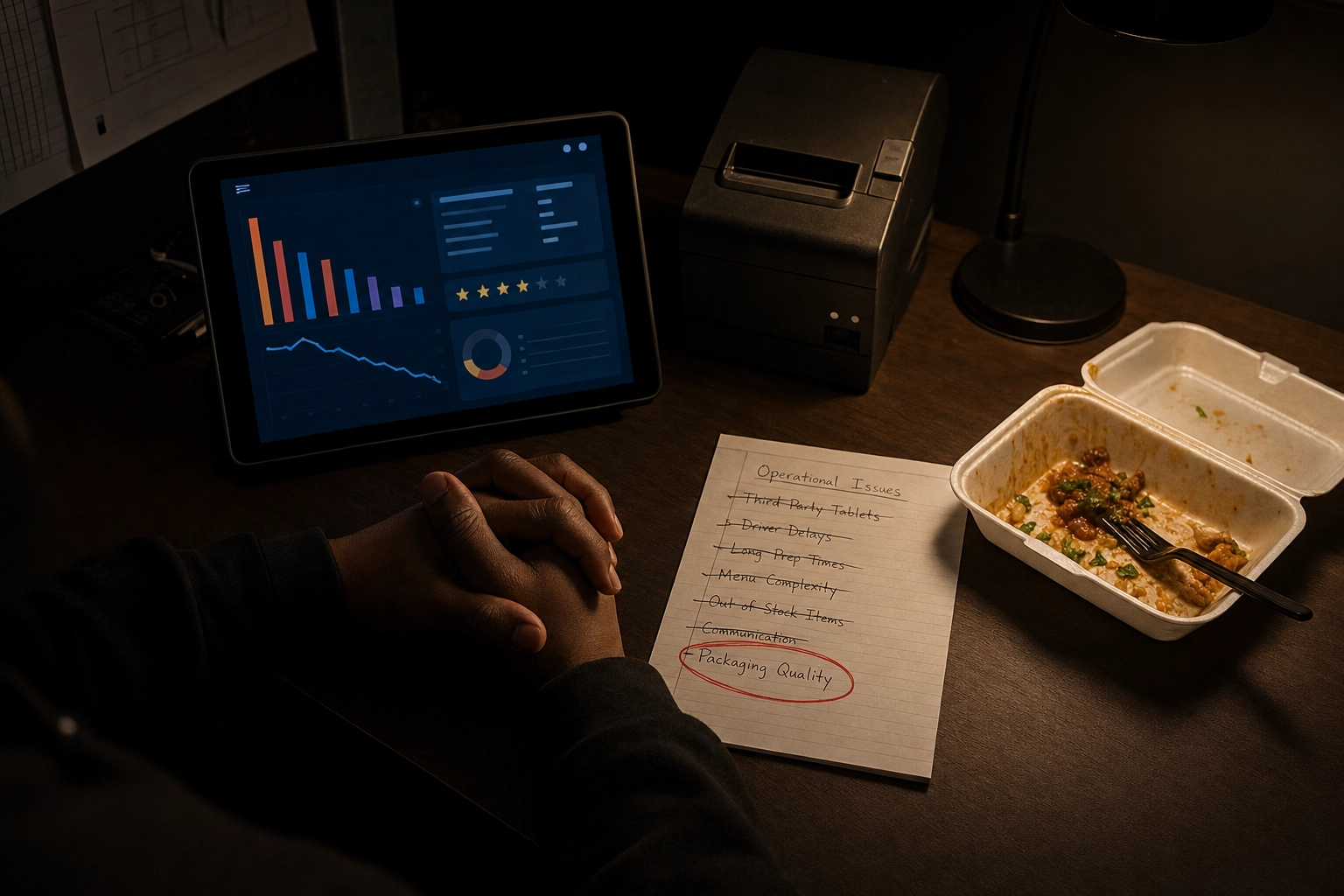 Dark kitchen operator reviewing performance data and operational issues at a late-night office table
Ignoring direct ordering from day one. Operators who treat delivery apps as their permanent home leave 4–7 percentage points of margin on the table forever. Set up direct ordering when you set up DoorDash. Push it via packaging inserts, QR codes, and follow-up promotions.
Building five virtual brands before proving one works. Multi-brand looks great on a spreadsheet, but each brand needs its own photography, menu copy, ratings flywheel, and operational rhythm. Prove one brand profitable before launching a second.
Skipping zoning checks until after the lease is signed. It happens often enough to be a cliché. Health department and zoning approval take weeks; a non-compliant lease can take months to escape.
Treating delivery apps as a permanent home. The platforms are a customer acquisition channel, not a business model. Operators who never build direct channels are 100% exposed to commission increases, algorithm changes, and platform disputes.
Is a Dark Kitchen Right for You?
Dark kitchens are a strong fit if:
- You're an existing chef or restaurateur expanding delivery without building a second dining room
- You have a specific food concept that travels well and has clear demand in a definable delivery zone
- You're comfortable running a digital-first business where marketing, data, and platform optimization are core operational skills
- You have $30,000–$100,000 in accessible capital plus a 6–12 month runway
- You're willing to treat photography and packaging as core line items, not afterthoughts
Dark kitchens are a poor fit if:
- You went into hospitality for the customer interaction (you'll miss it within a month)
- Your concept relies on ambiance, plating presentation, or a tasting menu format
- You can't tolerate working through a third-party platform that owns your customer data
- Your cuisine is heavily price-sensitive and can't absorb 25–30% delivery commissions
- You don't have working capital for a 90-day ramp before the platform algorithm rewards your listing
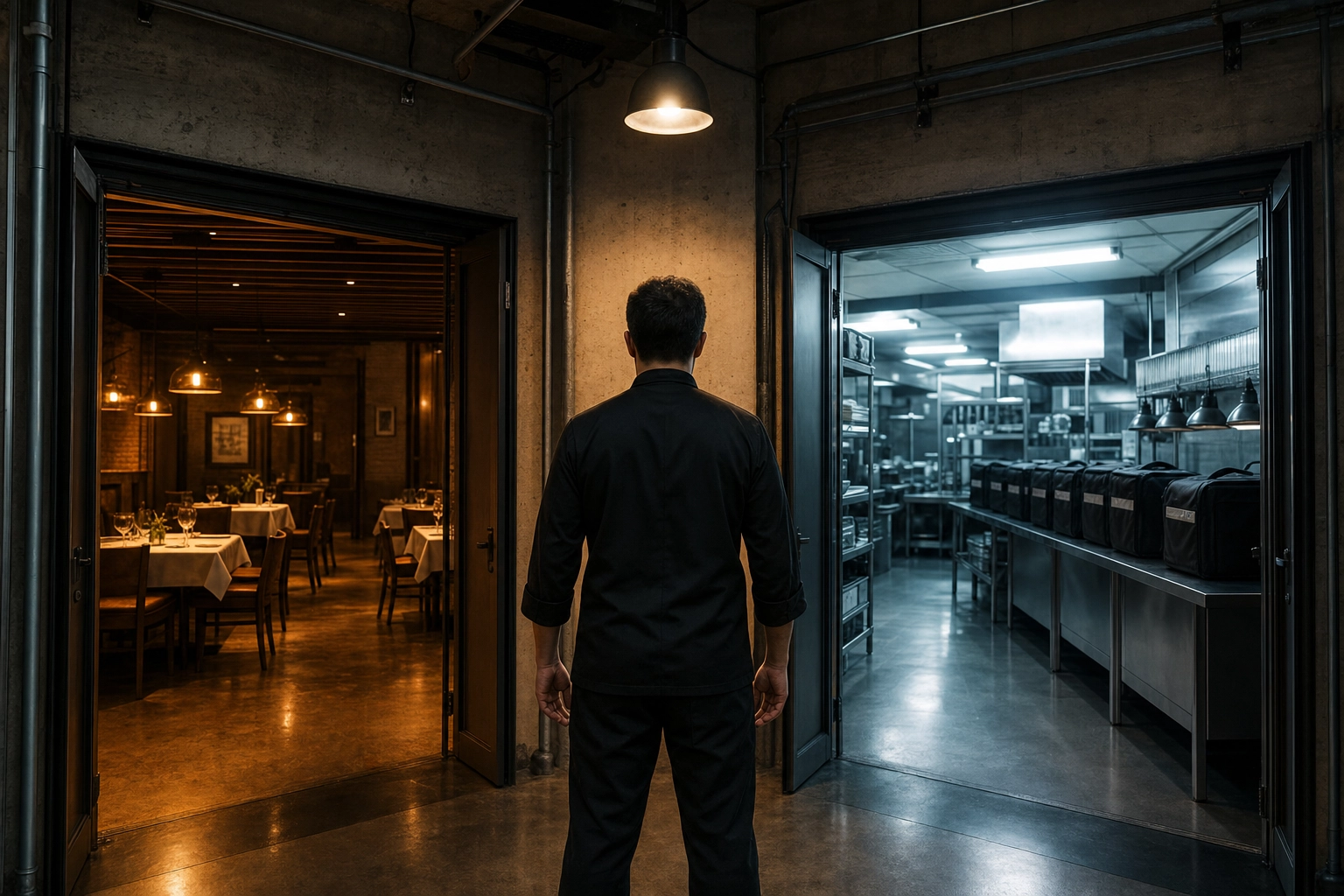 Chef entrepreneur deciding between traditional restaurant and dark kitchen business models at a corridor with two doorways
If the fit looks right, the next concrete steps are simple: order from existing competitors in your delivery zone for two weeks and take notes; price out a KaaS unit and a commissary kitchen in your city; sketch a 15–20 item menu and a brand identity; and call your local health department to map the licensing timeline. Most of those steps cost nothing and tell you within a week whether you're really ready to commit. When you're ready to handle the menu photography, AI food photography for ghost kitchens will get every dish ready for DoorDash, Uber Eats, and Grubhub before launch day.
Frequently Asked Questions
What is the difference between a dark kitchen and a ghost kitchen?
In everyday usage and most published guides, the terms are interchangeable. Both dark kitchens and ghost kitchens refer to commercial kitchens that exist exclusively for food delivery and pickup, with no dine-in space. Some industry insiders use "dark kitchen" to refer specifically to the physical infrastructure (more common in the UK and Europe) and "ghost kitchen" to refer to the brand or restaurant concept (more common in the US), but these distinctions aren't consistently observed. Wikipedia, Merriam-Webster, and most industry analysts treat dark kitchens and ghost kitchens as synonyms.
How much does it cost to start a dark kitchen?
Typical startup costs for dark kitchens run $30,000–$100,000 for most first-time operators. The lowest-cost path is a commissary or shared shell kitchen, where total launch costs can be as low as $20,000–$40,000. A Kitchen-as-a-Service (KaaS) lease typically runs $40,000–$80,000 all-in. A full dedicated dark kitchen buildout can exceed $200,000 depending on equipment and tenant improvements. Compare those numbers to $175,000–$750,000+ for a comparable traditional restaurant.
Are dark kitchens profitable?
Yes — when operated well. Industry benchmarks put EBITDA margins for healthy dark kitchens at 8–15%, versus 3–5% for traditional restaurants. Top multi-brand operators reach 15–25% EBITDA margins. Profitability of dark kitchens depends heavily on average order value, daily order volume, photography quality (which drives conversion), and the share of orders coming through direct channels rather than third-party platforms. A typical break-even threshold is 80–150 orders/day at $25–$35 AOV.
Do I need professional food photography for a dark kitchen?
Yes. Professional food photography is the single highest-leverage marketing investment for a dark kitchen. Studies show photo-rich delivery menus convert 25–35% higher than text-only or sparse menus, and weak photos depress your ranking on delivery platforms — making it harder to recover even if you upgrade later. Traditional photographers charge $700–$1,400 per session for 8–12 dishes; AI-powered tools like FoodShot AI now generate platform-spec images from phone photos in about 2 minutes, making professional-quality menu photography feasible at any operator scale. See our menu photoshoot guide for a step-by-step process.
How long does it take to break even on a dark kitchen?
Most well-run dark kitchens reach break-even in 6–12 months. The fastest dark kitchen operators — typically multi-brand setups in dense urban markets with strong photography, tight menus, and active direct-ordering channels — hit break-even in as little as 3 months. Operations that haven't broken even within 12 months usually have a fixable problem with photography, menu engineering, or channel mix rather than a fundamental concept failure.
Can I run a dark kitchen from home?
In most US states and EU countries, no. Commercial food preparation for sale through delivery platforms requires a licensed commercial kitchen and health department approval, which typically can't be granted to a residential property. Some jurisdictions have "cottage food" laws that allow limited home production of specific low-risk products (baked goods, jams, honey), but these typically prohibit foods requiring refrigeration and don't qualify you for delivery app partnerships. Most home-based operators end up renting a commissary kitchen by the hour, which is the cheapest legal entry point.