Instagram Ads for Restaurants: $5–$30/Day Setup & ROI
 Ali Tanis11 min read
Instagram ads for restaurants are a different job from posting. Posting feeds people who already follow you; ads buy attention from locals who have never heard of you, and cost money every day they run. This is the paid half of our restaurant Instagram marketing playbook: objectives, radius targeting for one location, what $5–$30 a day buys, reading the numbers when the sale happens at the table, and a static-image test you can run with ten photos. Video and Reels are out of scope.
Quick Summary: Instagram ads for restaurants work best as one campaign at a time with one of three objectives: Awareness for local reach, Traffic (landing page views) for click-to-order, Leads with a Higher Intent form for catering. Draw a 1–3 mile radius in a city or 3–7 in the suburbs, spend $10–$20 a day, and judge results on reach, frequency, cost per landing page view and coded-offer redemptions at the till. Test three images against two headlines with one offer, with ten usable stills in reserve.
Instagram Ads for Restaurants: Three Objectives That Work
Meta Ads Manager runs Instagram and Facebook together and offers six objectives: Awareness, Traffic, Engagement, Leads, App Promotion and Sales. The objective locks when you create the campaign and sets which event you pay for. Three earn their place for a single location: Sales campaigns need about 50 purchase events a week to learn, Engagement buys likes rather than covers, and the Boost button defaults to both problems.
Local awareness: Awareness, judged on reach
For a new opening or a relaunched menu, the goal is "people within two miles know we exist." It is the brand-building objective: optimise for reach, cap frequency near two views a week, and judge it on locals reached and CPM. Never judge brand awareness campaigns on orders.
Click-to-order: Traffic, optimised for landing page views
For delivery and pickup, run Traffic with "landing page views" as the performance goal, not link clicks. A click is charged when someone taps; a landing page view counts only when your ordering page loads, which filters accidental taps. Send diners to the ordering page, never the homepage (every extra tap in the ordering experience loses orders), and do the same for your delivery app listing.
Catering: Leads with a Higher Intent form
Catering suits lead forms: the buyer expects to give a date, headcount and budget. Facebook's lead ads with instant form let people submit without leaving the app; choose "Higher Intent," which adds a review screen. The benchmarks help: in the WordStream/LocaliQ 2025 Facebook ads study of 726 US leads campaigns, Restaurants and Food had the lowest cost per lead of any industry at $3.16 and the highest conversion rate at 18.25%. Reply within the hour; our catering marketing guide covers what happens next.
Targeting One Location: Radius First
Your most valuable audience lives within the distance someone will travel on a Tuesday. Meta's location targeting lets you drop a pin on your address and set a radius of 1 to 50 miles (1 to 70 km outside the US).
How wide to draw the circle
- Dense city: 1–3 miles. Lunchtime trade is tighter; 1 mile around an office district works.
- Suburban: 3–7 miles.
- Destination restaurant: 10–15 miles, if people already drive for it.
Pick "living in or recently in this location" for a neighbourhood restaurant; "travelling in" is for a tourist-district or hotel kitchen. The location breakdown in Ads Manager shows where spend landed; if a third leaks outside your circle, tighten it.
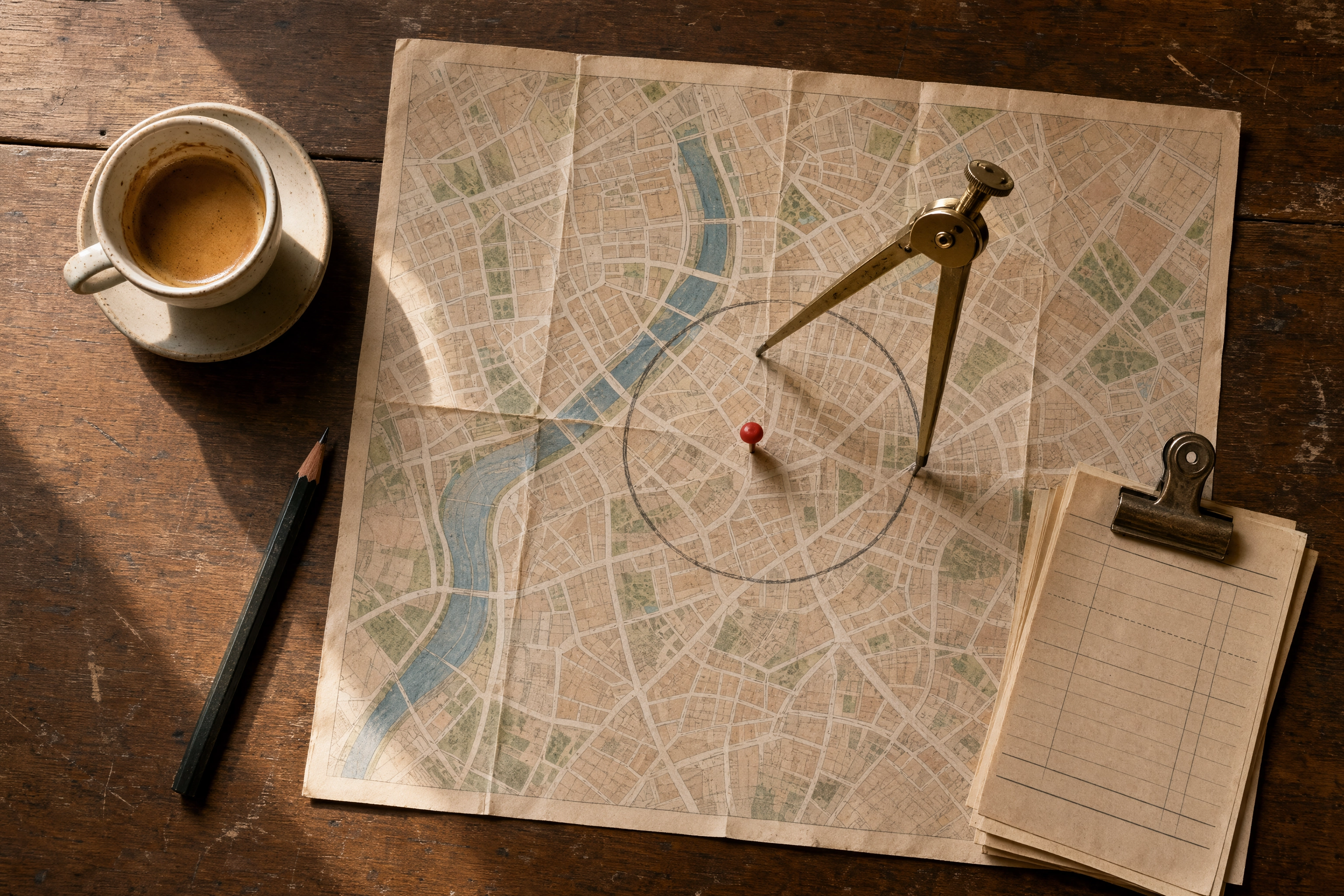 Paper street map with a pin and a compass drawing a radius circle, radius targeting for Instagram ads for restaurants
Interests are suggestions now, not fences
Detailed-targeting exclusions went on March 31, 2025, food and cuisine interests were merged from June 2025, and on January 15, 2026 ad sets still using discontinued options stopped delivering (the detailed targeting update lists them). With Advantage+ audience on, the default for Leads and Sales, interests are a suggestion delivery can override. The hard controls left are location, minimum age, language and custom-audience exclusions, so put the effort into radius-based targeting and the creative.
Two audiences worth building
Create two custom audiences, because they are hard controls: 60-day Instagram engagers, and your customer list uploaded as hashed emails and phone numbers, used to exclude regulars from an acquisition offer.
What $5 to $30 a Day Actually Buys
Facebook's minimum daily budget is $1 for ad sets charged on impressions and $5 for those optimised for clicks or conversions, so $5 restaurant ads are technically live. The table is based on the $8–$10 CPM that 2026 benchmark reports cluster around for food and beverage advertising and a 1.5–2.5% link click-through rate; small city radiuses price higher, and Ads Manager shows its own estimate before you publish.
| Daily budget | Monthly spend | Impressions per day | Link clicks per day |
|---|---|---|---|
| $5 | $150 | 500–600 | 8–15 |
| $10 | $300 | 1,000–1,250 | 15–30 |
| $20 | $600 | 2,000–2,500 | 30–60 |
| $30 | $900 | 3,000–3,750 | 45–90 |
The learning-phase trap
Delivery wants around 50 of your chosen optimisation event per ad set per week before it settles. Instagram ads for restaurants at $10 a day optimised for landing page views at $0.70–$1.00 each clear that; optimised for purchases at $15 apiece they get five a week and sit in "learning limited" with costs 20–40% above normal. The fix is a cheaper event, not more money. A daily budget helps keep spend predictable, dayparting to 10am–1pm and 3pm–7pm catches people deciding what to eat, and Q4 costs more.
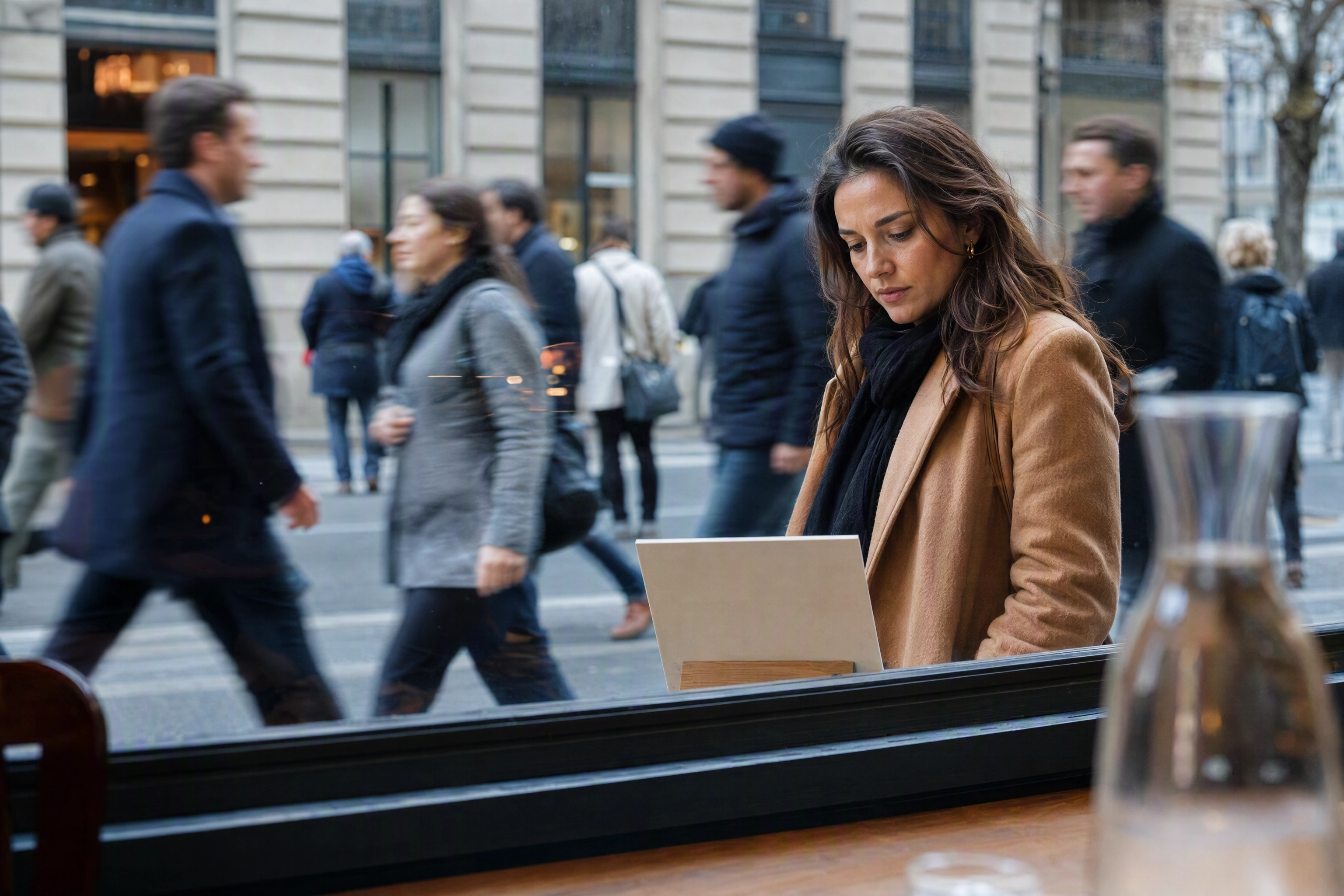 Lunchtime crowd passing a restaurant window while one person stops to look, impressions versus clicks for restaurant ads
Reading the Numbers When the Sale Happens at the Table
Most Instagram restaurant ads end in a walk-in, a phone order or a booking the platform cannot see, so Ads Manager reports clicks and zero purchases, then steers budget toward whatever produced clicks. Keep your own scoreboard.
The four numbers that are real at $10 a day
- Reach — distinct local diners who saw the ad this week.
- Frequency — views per person; above 3 on a small radius people tune out.
- Cost per landing page view — what a diner looking at your menu costs.
- Cost per lead for catering, against that $3.16 median.
Till-side attribution: codes, QR menus, reservation links
Give every campaign one thing that exists only in the ad — a code for a free side, a QR menu at a distinct URL, a UTM-tagged reservation link, or a host-stand tally — and count it weekly against spend; owners in the r/restaurantowners thread on Instagram advertising call this what made results legible. Once you have a POS export, Meta's offline conversions match hashed emails and phone numbers back to people who saw the ad within 28 days.
The ROI sum, with the assumptions showing
Spend $300 in a month on "free dessert with two mains, show this ad," and say the host records 40 redemptions at an average two-main ticket of $52. Revenue tied to the ad is $2,080; at a 65% gross margin that is $1,352, minus $100 in desserts and the $300 spend, leaving roughly $950. Halve the redemptions because some diners would have come anyway and it still clears; do the menu engineering first so the offer sits on a dish worth selling.
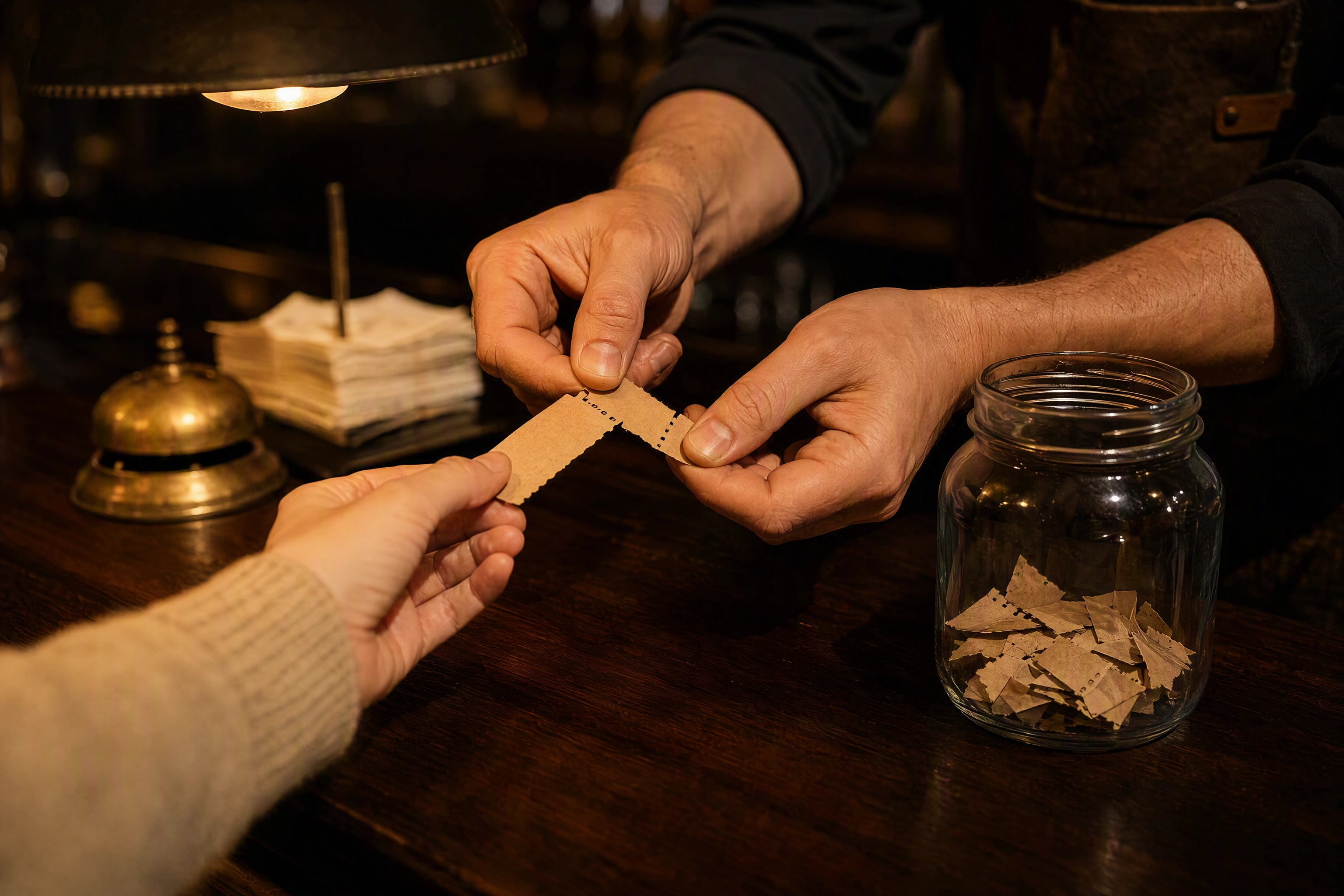 Bartender tearing a paper voucher stub beside a jar of collected stubs, till-side tracking for Instagram ads for restaurants
Creative: Why Static Image Restaurant Ads Win
The instinct is that video beats a still. In our experience with local food advertising it usually loses on cost per result over a month: feeds scroll sound-off, a still shows the dish in the first frame, and ten image variants cost less than one edited clip. A widely shared r/FacebookAds account of a single image beating three videos drew media buyers agreeing statics are easier to win with. This guide covers static content only; FoodShot makes stills, not video.
The specs that matter
Build feed ads at 4:5, 1080×1350 pixels; carousel cards stay 1:1; Story ads run 9:16. Primary text shows about 125 characters before "See more" and the headline about 40, so the offer must fit. Keep overlaid text to one line; the food is the message.
Ten usable variants, not one perfect shot
The constraint on Instagram ads for restaurants is supply. A test needs three stills at launch and replacements weekly, so a month needs about ten usable ones of two or three dishes at different angles and crops. Shoot them in one block with our restaurant photoshoot plan and lighting basics, or restyle phone photos you already have: FoodShot AI turns a phone shot into a 2K studio still in about a minute, creates several variations from one upload, and its Poster Mode drops the offer onto a marketing-ready template at 4:5. The Starter plan is $15 a month for 25 generations with a commercial licence, and handles burgers, cocktails and desserts; the restaurant use case shows before-and-afters.
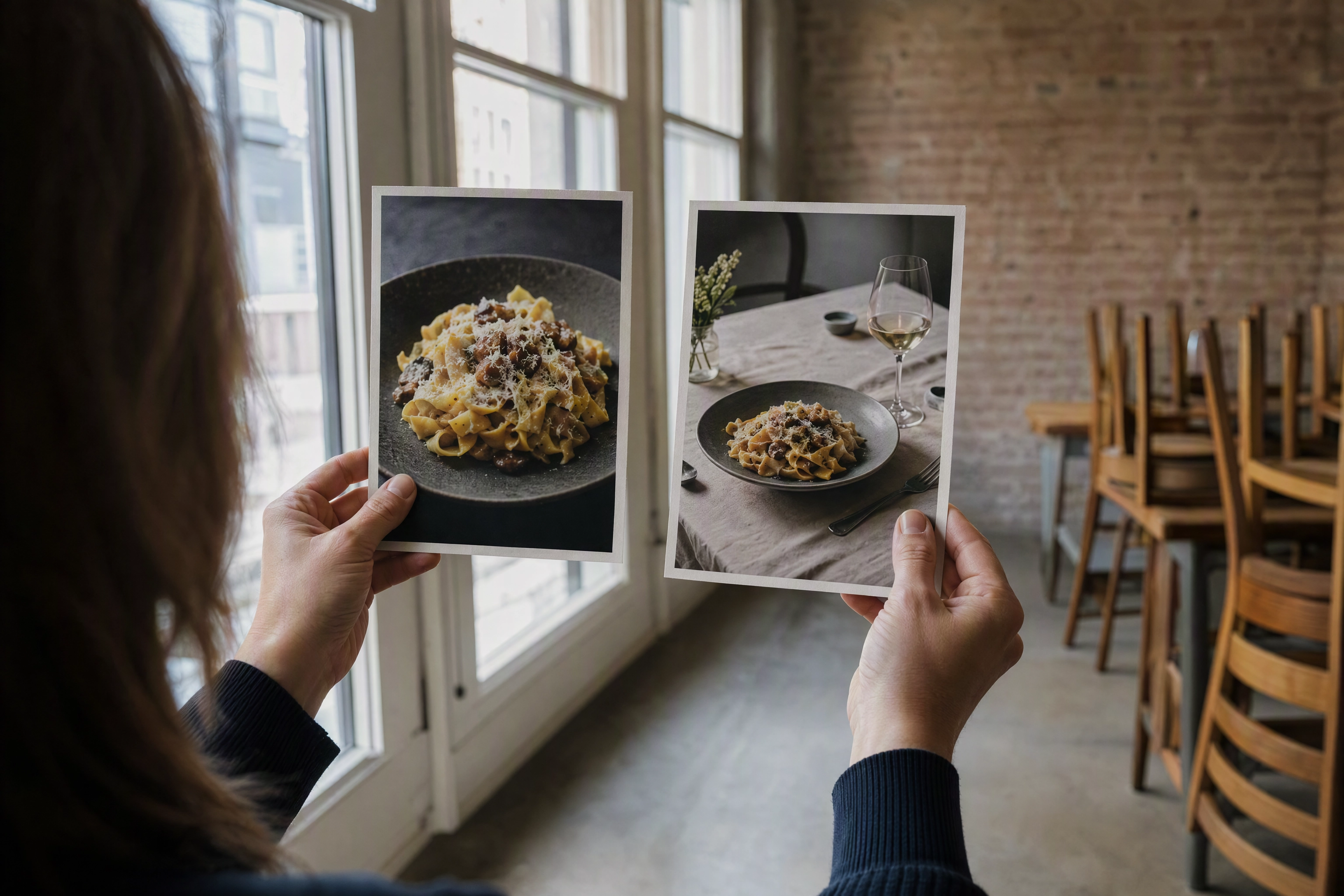 Two hands comparing two printed 4:5 photos of the same dish against a window, static image testing for restaurant ads
The 3-2-1 Test: Three Images, Two Headlines, One Offer
Create one campaign, one ad set with your radius and a minimum age, and six Instagram restaurant ads: three images paired with two headlines, same primary text, same offer, same button. Fund it at $10–$20 a day and leave it alone for seven days; uneven delivery is the data.
- Day 8: sort by cost per landing page view and pause the worst two. The headline in more winners becomes fixed.
- Next: add two new stills against the fixed headline. Keep the offer unchanged all month.
- Refresh triggers: frequency above 3 in a seven-day window, or click-through rate down 20% on week one.
- Bank arithmetic: three at launch, two in week two, two in week three, three spare. Ten stills, one month.
Write the two headlines as different reasons — "Free dessert with two mains this week" against "Wood-fired pizza, 12 minutes from you" — and make the three images differ the same way: tight on the dish, the table, the room.
Where Paid Stops and Organic Starts
Instagram ads for restaurants buy reach for one message; organic content keeps the profile worth landing on, which is the job of the restaurant Instagram marketing rota. Run an ad onto an abandoned grid and you pay for people to leave. For budgets across Facebook, TikTok and Instagram together, our social media advertising for restaurants guide sits above this one; the restaurant social media strategy covers platform choice, food truck marketing and ghost kitchen marketing cover their own wrinkles.
Frequently Asked Questions
How much do Instagram ads for restaurants cost per day?
The floor is $1–$5 a day depending on the optimisation event; $10–$20 a day is where a single location gets readable results, roughly 1,000–2,500 impressions and 15–60 link clicks daily.
Should restaurant ads run on Instagram only, or Facebook too?
Both, from the same ad set. Ads Manager places one static creative on Instagram feed, Stories and Facebook feed and reports performance per placement.
What radius should Instagram ads for restaurants target?
Start at 1–3 miles in a dense city, 3–7 in the suburbs, and 10–15 only if you are a destination people drive to, then check the location breakdown weekly.
Can I run Instagram ads for restaurants without online ordering?
Yes. Run Awareness campaigns to your radius with a coded offer, or Leads with an instant form for bookings and catering, and track till redemptions instead of landing page views.
How do I know Instagram ads for restaurants worked if the sale is offline?
Attach one thing only the ad has — a code, a QR menu URL, a tagged reservation link — and count it weekly against spend; later, upload offline conversions.
How many photos do restaurant ads need to start?
Three to launch and about ten for the first month, covering two or three dishes at different angles and crops in 4:5. In our experience batching a shoot beats chasing one perfect image.