Food Truck Marketing: 15 Proven Strategies for Growth
 Ali Tanis24 min read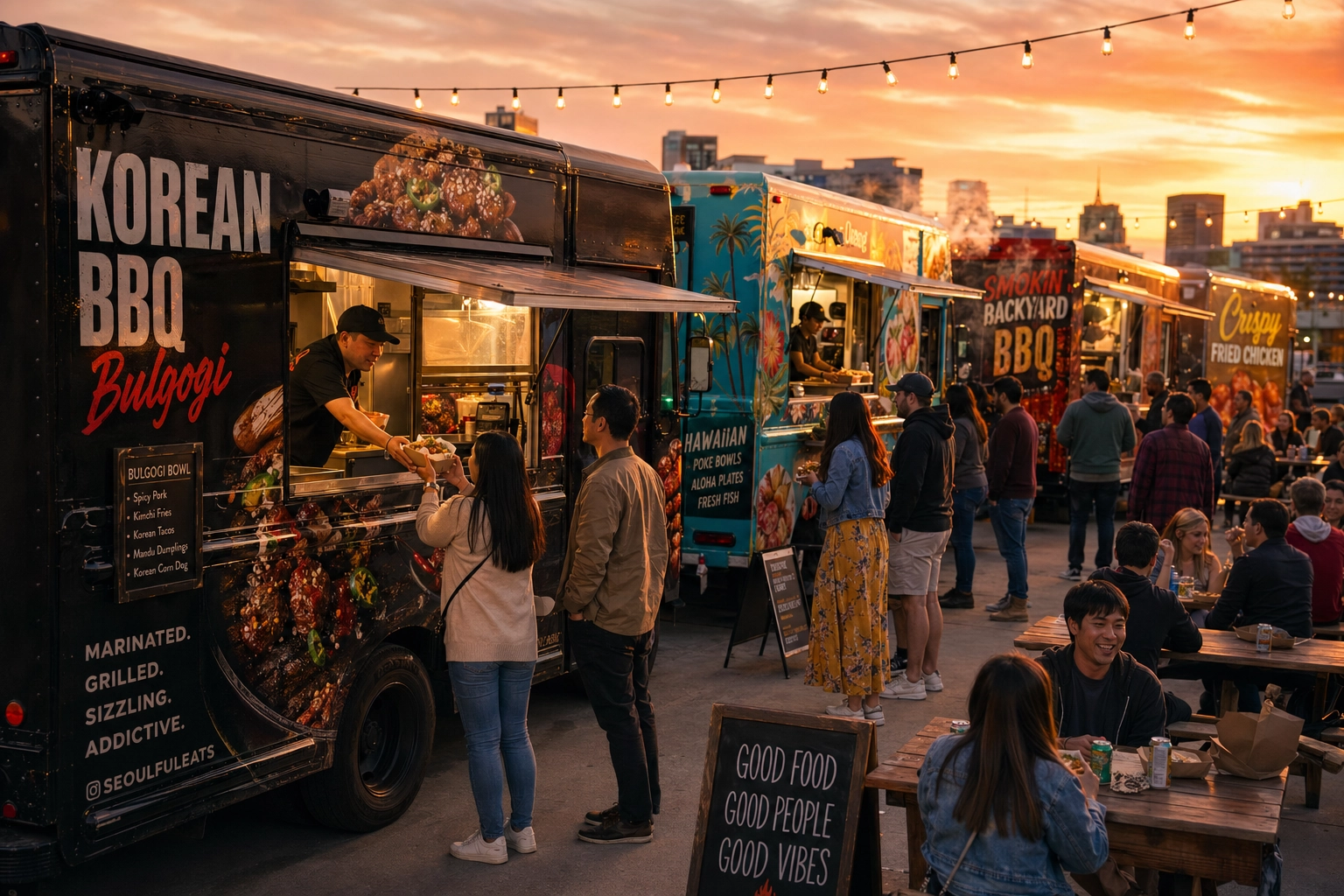
The U.S. food truck industry hit $2.8 billion in 2026, with roughly 48,400 trucks competing for the same hungry crowds. The trucks that grow aren't the ones with the best food — they're the ones whose marketing actually pulls people to a parking lot at 12:15 PM on a Tuesday.
This guide breaks down 15 marketing strategies that work right now, organized into three buckets: digital, physical, and brand building. Almost every one of them runs on the same fuel: good food photos. We'll show you exactly how that works.
Quick Summary: The most effective food truck marketing combines daily location updates on social media, a Google Business Profile, eye-catching truck wraps, strategic event presence, and a unified visual identity. Across all 15 strategies, professional food photography is the single asset that multiplies every channel — your signature dish photo runs on Instagram, your menu board, your delivery listing, your loyalty card, and your festival promo simultaneously.
Why Food Truck Marketing Is Different (And Harder)
A brick-and-mortar restaurant has one address customers can return to. You don't. Your customer base has to rediscover you almost every day, and the people who tried you Saturday at the brewery might have no idea you're at the office park on Wednesday.
That's the core marketing problem of the mobile food business: location is variable, but you still need to build a loyal following. Layer on the constraints — most food truck owners do their own marketing, the average truck has just 1.8 full-time employees, and operating costs jumped 7.9% from 2020 to 2026 — and you can see why generic restaurant marketing advice doesn't quite fit.
Some context that shapes every strategy below:
- The market is growing but crowded. The U.S. food truck market reached $2.8 billion in 2026 according to IBISWorld industry data, with about 92,257 registered businesses. Industry growth has averaged 8% annually for the past five years.
- 91% of trucks operate independently rather than as part of larger chains, which means most marketing decisions land on the owner.
- Peak hours skew evening. 63.6% of food truck operators report 5–8 PM as their busiest window, according to Food Liability Insurance Program (FLIP) survey data.
- Average ticket is small. Customers spend roughly $12.76 per visit per FoodTruckProfit industry data, so volume and repeat business matter more than upselling.
- Average annual revenue runs about $346,000, but the spread is enormous — the gap between a $150K truck and a $600K truck almost always comes down to marketing and location strategy.
The 15 strategies below are organized into three categories: Digital (1–5), Physical (6–10), and Brand Building (11–15). Don't try all of them at once. Start with the four or five that fit your stage and budget, then layer in the rest.
The Common Thread: Visual Marketing Powers Almost Every Strategy
Before we get into the list, here's a pattern most food truck marketing guides miss: the same dish photo appears on at least eight different surfaces in your business.
Take one hero shot of your signature taco. That single image powers:
- Instagram post and story
- Google Business Profile photo
- DoorDash / Uber Eats menu item
- Menu board on the truck
- Loyalty card reward visual
- Festival application portfolio
- Email/SMS announcement
- Truck wrap design reference
Photography isn't strategy #2 on the list. It's the multiplier on every other strategy. A blurry phone snap weakens all eight surfaces. A great shot strengthens all eight. That's why we keep coming back to imagery throughout this guide — and why a phone-photo workflow that produces menu-ready images in under two minutes (using AI tools like ours) has become standard practice for food trucks who can't afford a $700–$1,400 photographer for every menu refresh.
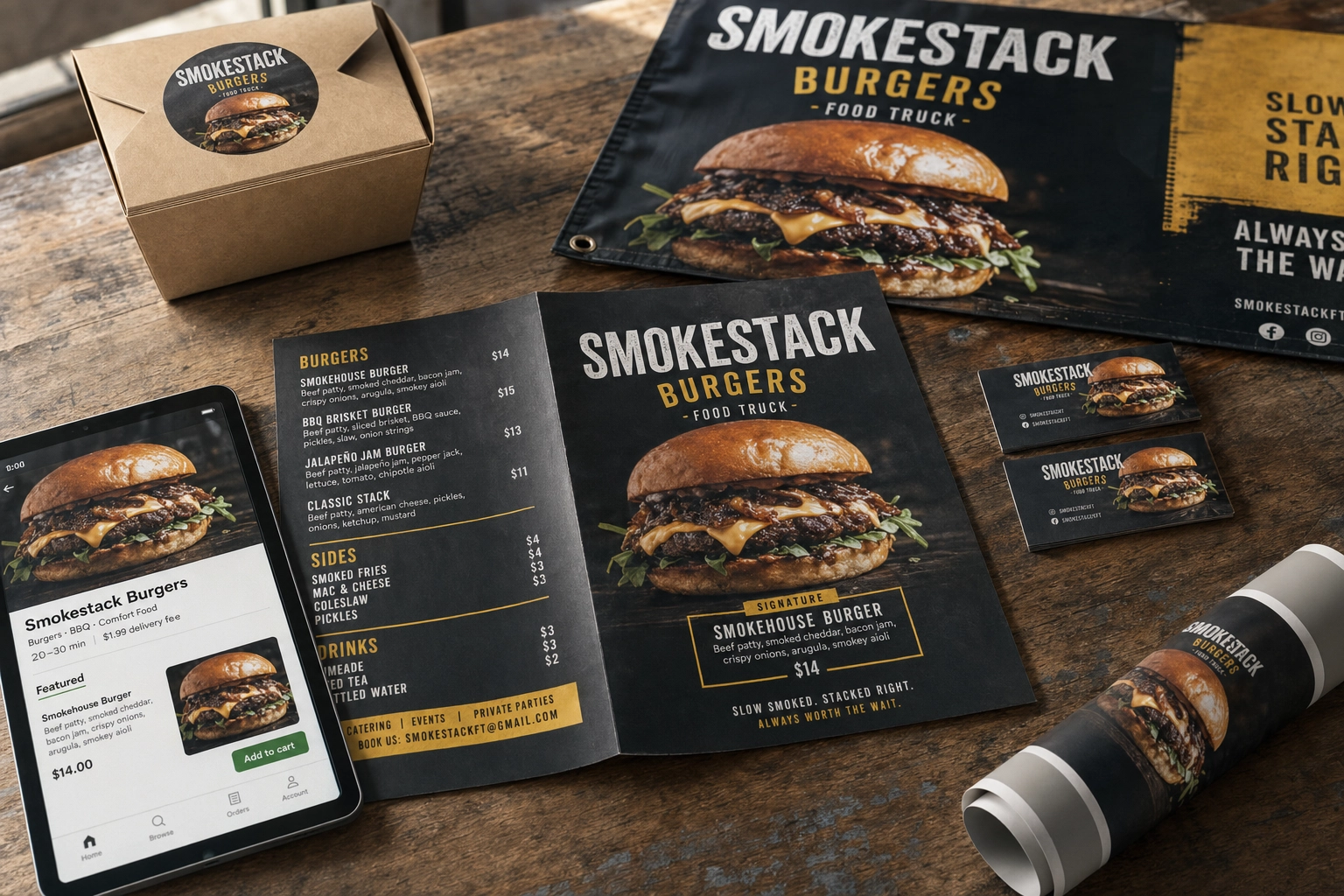 Food truck marketing collateral flat lay showing the same dish photo reused across menu, takeaway box, sticker, banner, business cards, and digital listing
With that foundation set, let's get into the list.
Digital Marketing Strategies (1–5)
Most new food truck customers find you online before they ever stand in front of the truck. These first five strategies are where the discovery happens.
1. Build a Magnetic Social Media Presence
86.9% of food truck operators use Facebook to promote their business according to FLIP's industry survey — making it the most-adopted platform in the space. But adoption isn't the same as effectiveness. The trucks that actually grow on social media share three habits.
They post daily location updates. "We're at Riverside Park, 5–9 PM tonight, slinging carnitas." That format, plus a great photo, is the bread and butter of food truck social media. People plan their evenings around where you'll be.
They match the platform to the content.
- Instagram — high-quality dish photos, behind-the-scenes Reels, weekly schedule in your bio
- TikTok — quick prep videos, customer reactions, signature dish builds
- Facebook — events, location updates, longer announcements (skews older but high engagement)
- X (Twitter) — real-time location updates and short replies to customers
They post 3–5 times per week. Not 30. The trucks that try to post twice a day burn out within a month. Consistent weekly cadence beats sporadic blasts.
For the deeper playbook, see our dedicated guide on social media marketing for food trucks. The short version: pick two platforms, post your location every operating day, and lead every post with a great photo.
2. Invest in Professional Food Photography
This is the strategy that compounds everything else. We touched on it above, but it deserves its own slot because it's the asset that powers all your other channels.
The five photos every food truck needs:
- Signature dish hero shot — your top-seller, perfectly styled
- Menu board grid — every item, consistent angle and lighting
- Customer action shot — hands holding food at the window
- Truck exterior — magic hour, three-quarter angle
- Process / ingredient close-up — chef plating, fresh prep
Three ways to get them:
- Hire a pro photographer. Cost runs $700–$1,400 per session in most U.S. markets. Quality is highest, but the budget kills it for most trucks doing weekly menu updates.
- DIY with your phone. Free, but the results vary wildly with lighting, angle, and styling skills. Most phone shots aren't good enough for delivery apps or printed menus.
- Phone + AI enhancement. Snap on your phone, run it through an AI food photo tool, get menu-ready output in 90 seconds. Plans start at $9/month. This is what most growing trucks use today.
For a deeper breakdown of what works on the truck (and which $150 mini-kit to keep in the cab), our food truck photography guide walks through the exact workflow. If you want to compare options head-to-head, DIY vs pro vs AI food photography is the resource.
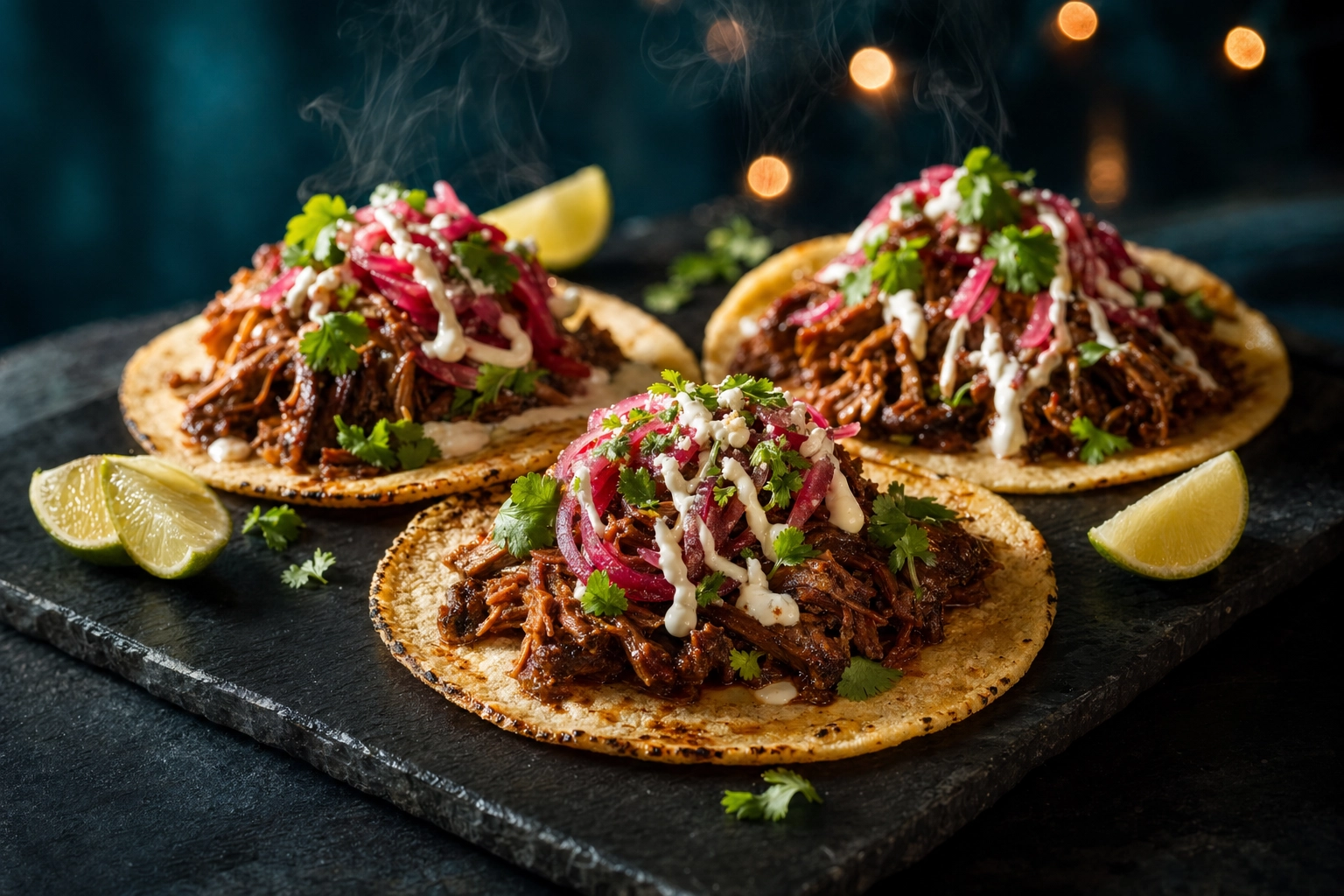 Studio-quality signature food truck dish photography of three styled gourmet short rib street tacos on dark slate with dramatic side lighting
3. Claim and Optimize Your Google Business Profile
A surprising number of food trucks skip this because they assume Google Business Profile (GBP) only works for fixed addresses. It doesn't. Food trucks qualify as Service Area Businesses, which means you can register using your home or commissary address (hidden from public view) and list the areas you serve.
The setup steps:
- Create a Google Business Profile using your verifiable mailing address.
- Choose "I deliver goods and services to my customers" and hide your address.
- Add the cities or neighborhoods you operate in.
- Upload at least 10 high-quality dish photos plus exterior truck shots.
- Verify via postcard, phone, or video (Google's options vary by region).
Once you're live, the secret weapon is Google Posts. You can publish updates the same way you'd post on Facebook — daily location, special menu items, event announcements. These show up in search results and Maps when someone Googles your truck name or "food trucks near me."
Reviews matter more here than almost anywhere else. After a great event, a quick "Loved it? Drop us a quick Google review!" line on your receipt or sign can earn 5–10 reviews per service in a way that compounds your local search visibility for months.
4. List on Food Delivery Apps Strategically
DoorDash, Uber Eats, Grubhub, and similar platforms can work for food trucks — but only under specific conditions. If your truck has a stationary spot for at least part of the week (a brewery lot every Thursday, a downtown corner Monday–Friday lunch), delivery apps can add 15–30% to revenue without much extra labor.
The catch: photo quality drives conversion. Listings with professional dish photos can convert significantly better than text-only listings, and the apps actively boost listings with complete imagery in their search rankings. A grainy phone photo of your burger in styrofoam under fluorescent light is genuinely worse than no photo at all.
If you want a deeper playbook for what photos delivery apps actually want and the exact specs each platform requires, our page on food delivery app photography covers it.
One creative option a lot of trucks now use: spin up a virtual brand for delivery only. Your taco truck registers a "Loaded Fries Co." brand on DoorDash with three fry-only items. Same kitchen, separate brand, different search terms — and it can capture customers who'd never search for tacos.
5. Build an Email and SMS Notification List
If social media platforms went dark tomorrow, what would you have left? An email list and a phone number list. These are the only marketing channels you actually own.
The mechanic is dead simple:
- Put a QR code on your truck and on every receipt
- Customers scan, opt in to "Get a text when we're at your spot"
- You text them: "We're at Mueller Lake Park 5–9 PM tonight 🌮"
A discussion on r/foodtrucks captured this perfectly: trucks are increasingly moving away from punch cards (which get lost) toward SMS lists, because most people genuinely forget where trucks are week to week. A simple "We're back at Riverside" text can pull a meaningful chunk of your previous customers back instantly.
Costs run $10–30/month for an SMS service for a small list. Email is essentially free up to a few hundred contacts. The ROI on owned audience channels is hard to beat.
Physical & Location Marketing Strategies (6–10)
Where the truck physically operates is itself a marketing channel. The next five strategies turn the truck and its locations into discovery engines.
6. Eye-Catching Truck Wrap and Signage
Your truck is a 26-foot rolling billboard that's seen by thousands of people per week. A well-designed wrap is the single highest-leverage physical asset you have.
The numbers from industry sources:
- A full vinyl wrap costs $2,500–$5,000 for professional design and installation
- That's roughly 3–5% of the typical $75,000–$100,000 startup budget
- Quality wraps can boost sales up to 20% (3M case data)
- Plain signage runs $500–$3,000 for partial coverage
What separates wraps that work from wraps that don't:
- Readability from 30 feet beats artistic detail. Your truck name needs to be legible from across a parking lot.
- One signature dish photo on the wrap. Photo-realistic imagery of your hero menu item drives trial more than abstract design.
- Cuisine clarity. "Tacos" or "BBQ" needs to be obvious in two seconds.
- A QR code on the side panel that opens your Instagram or live menu.
- A consistent color palette that ties into your menu, social, and packaging.
If you're designing or refreshing your wrap, your dish photos are the centerpiece. Vague "stock photo of a burger" energy is exactly what makes trucks look generic. Your real signature item, properly shot and enhanced, is what makes the truck feel premium.
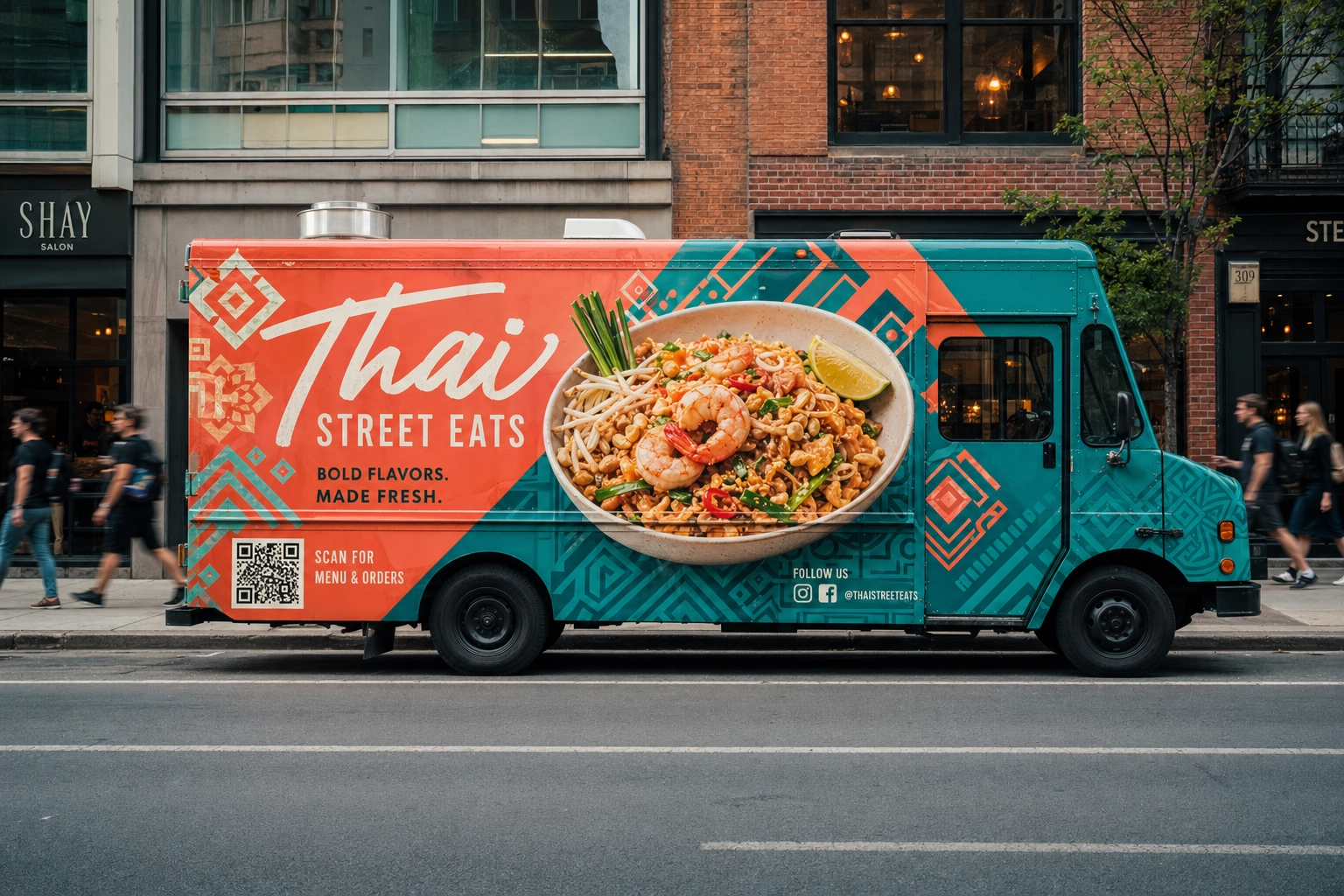 Boldly wrapped food truck parked on a downtown street showing eye-catching brand design with oversized dish photography and QR code
7. Strategic Location Selection
Where you park matters more than almost any other operational decision. Most successful trucks operate on roughly the same daypart pattern:
- Lunch (11:30 AM–1:30 PM): Office parks, business districts, hospitals, college campuses. Predictable volume, fast turnover.
- Dinner (5–8 PM): Breweries, residential events, food truck parks. This is the 63.6% peak window FLIP identified.
- Late night (9 PM–close): Bar districts, music venues. Higher per-ticket but more weather-dependent.
Track sales by location relentlessly. Most food trucks discover that 60–80% of their revenue comes from their top three spots. Once you know your winners, you protect those slots — get on the recurring schedule, build relationships with the property manager, become the default truck.
Test new spots monthly. Give a new location three to four visits before you decide if it's a winner. Kill underperformers without sentimentality. The opportunity cost of a slow lunch is the busy lunch you could've had three blocks away.
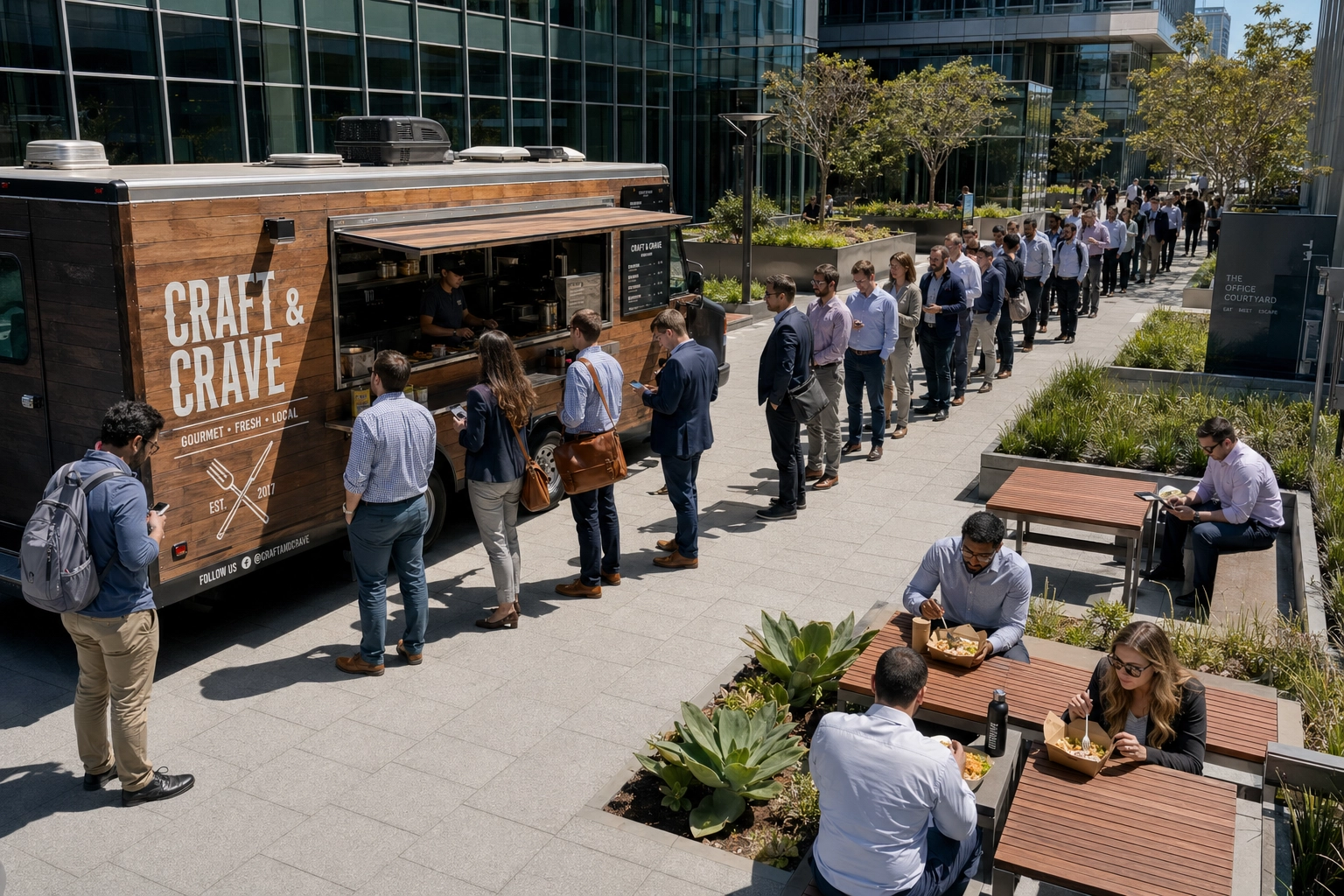 Food truck parked at a corporate office park during midday lunch rush with a long line of office workers in business casual attire
8. Event and Festival Presence
Events are where food trucks earn outsized days. According to FLIP, 51.2% of food truck operators vend at music festivals, 47.6% work farmers markets, and 36.6% participate in food truck rallies.
A good festival day can do 3–5x your normal daily revenue. The math also gets harder: vendor fees often run $200–$1,500, prep costs scale with volume, and you're competing for attention with 20+ other trucks.
Practical event playbook:
- Apply 60–90 days in advance for major festivals; the best events are full by then.
- Bring a simplified menu. Three to five items max. Speed wins at events.
- Photograph everything. A busy festival day generates a month of social content.
- Capture leads. A QR code on your menu board for SMS signup turns one event into ongoing customer relationships.
Smaller community events (street fairs, brewery openings, charity walks) are often more profitable than huge festivals once you factor in costs and competition.
9. Partnerships With Breweries, Offices, and Venues
Recurring weekly slots beat one-off events for stability and customer-retention math.
The partnerships that work for most food trucks:
- Brewery / taproom partnerships. They sell drinks, you sell food, both businesses win. Most breweries don't want their own kitchen and actively want a rotation of trucks. Land the same Thursday slot every week and you've created a built-in audience.
- Corporate office Friday lunches. Predictable headcount, single point of contact, often pre-orders. Many companies will pay a flat catering fee plus letting employees order.
- Event venues, music halls, sports stadiums. Lower-frequency but high-volume.
- Catering pivot. Weddings, corporate events, private parties. Some trucks make 30–50% of revenue from catering once they're established.
Cross-promotion is the bonus benefit. Each partner posts about you on their social, your reach effectively doubles, and you get social proof that you couldn't buy. A brewery posting "Friday Night with [Your Truck Name] from 5 PM" is more credible than any ad you could run.
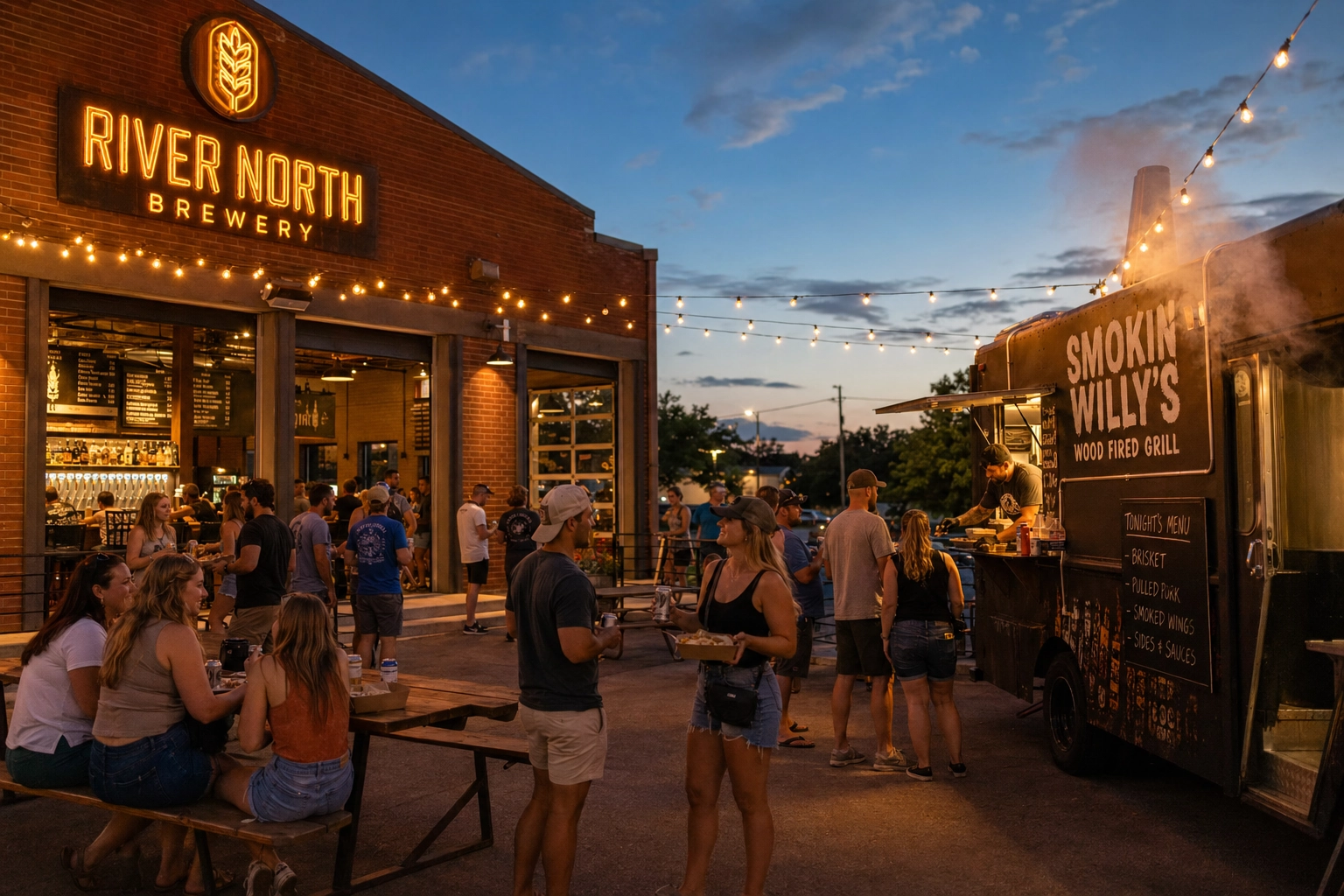 Food truck parked outside a brewery taproom in the evening with customers mingling between the truck and outdoor seating under string lights
10. Loyalty Cards and Repeat Customer Programs
Acquiring a new customer costs about five times more than keeping an existing one — that's a marketing rule of thumb that holds particularly well for food trucks, where your average ticket is only $12.76 and margins are tight.
The standard food truck loyalty offer is "buy 9, get the 10th free." It works because it's familiar and the math is obvious. Variations:
- Paper punch cards — cheapest, easiest to launch, but customers lose them constantly.
- Digital loyalty (Stamp Me, Boomerangme, Square Loyalty) — QR-code based, harder to lose, gives you customer data. Monthly fees usually $20–$60.
- POS-integrated loyalty — built into systems like Toast or Square, simplest at the counter.
Whichever format you pick, link the loyalty signup to your SMS list. One customer interaction, two channels filled. And put a great photo of the reward item (the free taco, the free coffee) on the card itself — visual reinforcement matters more than the rules.
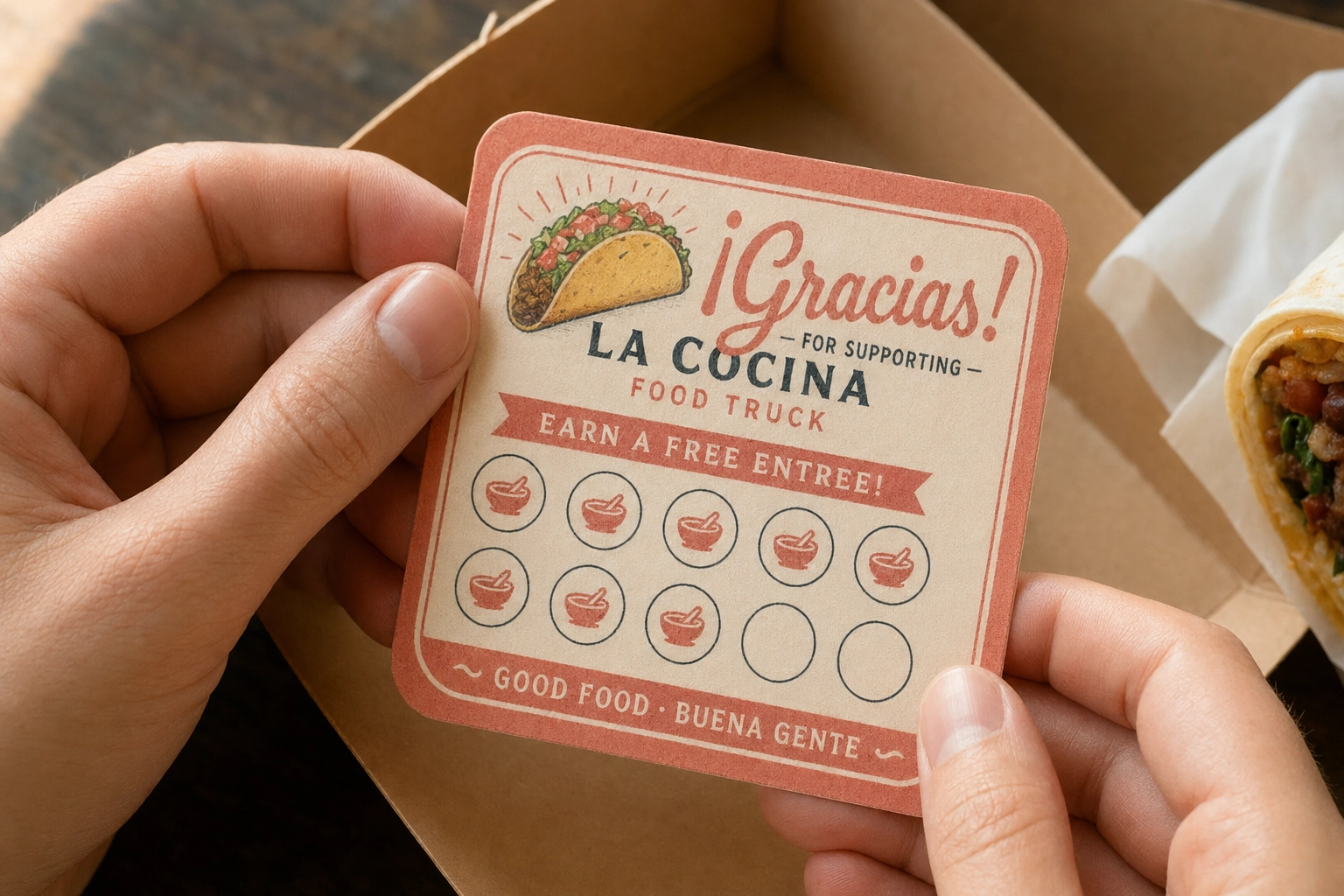 Hands holding a designed food truck loyalty punch card with seven stamps next to a kraft takeaway tray with wrapped burrito
Brand Building Strategies (11–15)
The first ten strategies fill the truck this week. The next five build a brand customers seek out by name.
11. Develop a Unique Concept or Niche
Generic gets ignored. The trucks that get press, build cult followings, and command premium pricing all have a specific point of view.
Examples of concept clarity:
- Korean-Mexican fusion instead of "tacos"
- Vegan BBQ instead of "BBQ"
- Nashville hot chicken specialist instead of "chicken sandwiches"
- Regional cuisine (Oaxacan tlayudas, Trinidadian doubles, Lebanese man'oushe)
- Single-item obsession (one truck, one perfect smash burger, six toppings)
- Dietary-specific (gluten-free, plant-based, keto-friendly)
A focused concept does three things at once: it makes your marketing easier (you have a clear story), it makes you findable in search ("vegan BBQ Austin"), and it lets you charge more because you're not competing on price with 30 other generic trucks.
The flip side: keep the menu tight. Eight to twelve items is the sweet spot. Too much menu choice slows your line, dilutes your concept, and makes your photography work harder. For concept inspiration matched to actual food truck operations, see food truck menu ideas.
12. Build a Consistent Visual Identity
Your truck wrap, menu board, social media, packaging, business cards, and email templates should look like they came from the same brand. Most food trucks fail this test — the truck has one design language, the Instagram has another, the menu PDF has a third.
The minimum viable brand kit:
- Two fonts (one display, one body)
- Three colors (primary, secondary, accent)
- One photo treatment style (warm and golden? bright and clean? moody and dark?)
- One logo lockup that works on truck, menu, and Instagram bio
Photo style consistency is the most overlooked element here. If your Instagram has 90 photos in 90 different lighting setups and color grades, the feed feels chaotic. Pick a look — and stick with it. AI photo enhancement tools make this easier because you can apply the same style preset across every shot, getting visual consistency without a stylist.
For a deeper walkthrough on tying your photography, menu, and brand together, food truck menu design is the companion piece to this guide.
13. Customer Experience and Speed of Service
Marketing gets people to your truck. Experience gets them to come back, post your food, tell their friends.
The factors that matter most at a truck window:
- Speed. Customers expect five minutes or less at peak. If your line moves faster than the truck next to you, you'll win loyal customers.
- Order accuracy. A wrong order at a food truck is harder to recover from than at a restaurant — the customer may have already walked away.
- Eye contact and a name. "Thanks, Sarah, see you next week" is a tiny thing that drives Google reviews.
- Cleanliness. A clean truck, clean apron, clean prep area visible through the window — these are part of your brand whether you intend them to be.
- Pre-order options. A QR code on your sign that takes people to a digital menu they can pre-order from cuts wait times in half.
Reviews and word-of-mouth are still the #1 driver of food truck discovery according to operator surveys and r/foodtrucks discussions. The experience at the window is what generates them.
14. Community Involvement and Local PR
Food trucks that embed in their local community generate the kind of organic press that paid marketing can't buy.
Tactics that consistently work:
- Donate meals to local fundraisers. Schools, churches, fire departments, charity 5Ks. Small cost, big goodwill, sometimes local press.
- Sponsor a local sports team. $200–$500 gets your name on jerseys and signage in front of weekly captive audiences.
- Source from local farms or producers. Tell that story. Customers care about it, journalists love writing about it.
- Pitch local food bloggers and journalists with a specific hook — a new menu item, a milestone, a unique partnership.
- Show up at farmers markets even when sales are mediocre. The relationships you build with other vendors and regulars compound.
Press isn't just vanity. A single feature in a local food blog or "Best Food Trucks in [Your City]" list can drive customer flow for years. Make it easy for journalists to write about you by maintaining a "media kit" page on your site with high-res photos, your concept story, and contact info.
15. Merchandise and Packaging as Marketing
Every takeaway box leaves your truck and goes somewhere — an office, a park bench, a customer's car, a friend's living room. If it's branded, you've just placed an ad in front of every person who sees that customer for the next 30 minutes.
The packaging-as-marketing playbook:
- Custom-printed food trays, wrappers, and sauce cups with your logo and Instagram handle. Cost adds maybe $0.05–$0.20 per order; the marketing impact is huge over thousands of orders.
- Stickers. The cheapest, highest-distribution merch you can make. People put them on laptops, water bottles, helmets. A $0.30 sticker can travel for years.
- T-shirts and hats. Your superfans will pay $25–$35 for branded gear and become walking advertisements. Sell them at events and on the truck.
- Signature item kits (hot sauce bottles, seasoning blends, branded tote bags) that customers can take home or give as gifts.
Branded packaging also gets photographed and shared on social. Your customer holding a wrapped burger with your logo visible in their Instagram story is a free impression you didn't have to pay for. Make every surface count.
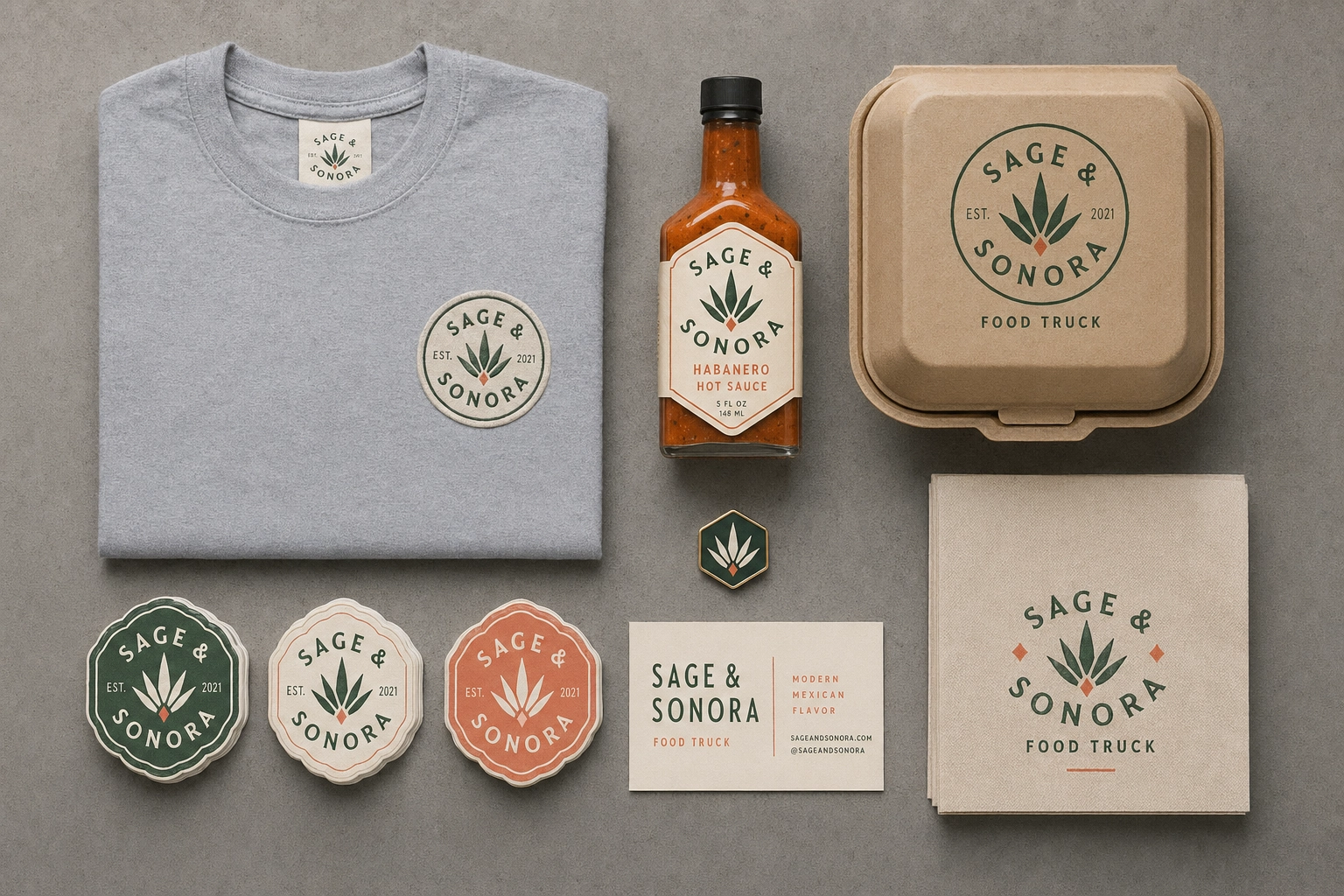 Flat lay of food truck branded merchandise including t-shirt, stickers, hot sauce bottle, takeaway box, enamel pin, and napkins in unified colors
Building Your Food Truck Marketing Plan
Fifteen strategies is a lot. You're not running all of them at once — and you shouldn't try.
Here's a phased rollout based on what consistently works for trucks in their first year:
First 90 days (foundation):
- Professional dish photos for your top 8–12 items
- Active Instagram and Facebook with daily location posts
- Google Business Profile claimed and verified
- Basic loyalty card or digital stamp program
- SMS list signup via QR code on the truck
Months 3–6 (expansion): 6. Apply to 2–3 events per month 7. Establish 1–2 brewery or office partnerships 8. List on the right delivery apps for your operating model 9. Refine your truck wrap or signage if needed 10. Build out email list and start a monthly newsletter
Months 6–12 (brand building): 11. Sharpen your concept — drop weak menu items, double down on what's working 12. Audit and unify your visual identity across every surface 13. Invest in customer experience improvements (faster ordering, pre-order) 14. Pursue community partnerships and local press 15. Add branded merchandise and upgrade packaging
Track three metrics monthly:
- Cost per new customer (marketing spend ÷ new customers)
- Repeat rate (% of customers who came back within 30 days)
- Average ticket ($12.76 is the industry average — beat it with thoughtful menu design)
If those three numbers are moving in the right direction, your marketing is working. If they're flat or declining, look at which strategies you've genuinely executed (not just started) and where photography quality might be the bottleneck.
Speaking of photography — that's the asset that ties this whole list together. If you've been putting off the menu photoshoot, our menu photoshoot guide shows you how to plan one in a single afternoon. And if you're working with a phone camera, how to take good food photos covers the basics. From there, AI food photography tools (including ours) can take phone shots and produce menu-board, delivery-app, and social-media-ready imagery in 90 seconds — at a fraction of the cost of hiring a photographer for every menu update. The Starter plan runs $9/month billed yearly; full pricing is on our pricing page.
Pick three strategies. Execute them well for 90 days. Then expand.
Frequently Asked Questions
How much should a food truck spend on marketing?
Most successful food trucks spend 5–10% of revenue on marketing in their first two years, then taper to 3–5% as word-of-mouth and repeat customers carry more of the weight. For a truck doing the industry-average $346,000 annually, that's $10,000–$35,000/year — covering social media tools ($30–$100/month), photography ($100–$300/month for AI tools or $700–$1,400/quarter for a pro), event vendor fees, paid social, and merchandise. The biggest mistake is spending zero on photography — every other dollar gets less effective when your visuals are weak.
What's the single most effective food truck marketing strategy?
For most trucks, it's the combination of a Google Business Profile, daily Instagram location posts, and high-quality dish photos that work across both. That trio gets new customers discovering you, knowing where to find you, and being convinced your food is worth a trip. Once those three are running well, layer in events, partnerships, and loyalty programs. There's no single tactic that wins alone — but visual content is the multiplier on every channel.
How do food trucks let customers know where they'll be each day?
The standard practice is a daily post across Instagram, Facebook, and X (Twitter) with the day's location, hours, and a photo of a featured item. Successful trucks supplement this with a Google Business Profile post, an SMS to their text-list subscribers, and an updated location pin on a tracker like Truckster or Roaming Hunger. Customers expect to see today's location by 10–11 AM if you're doing lunch service, or 3–4 PM for dinner.
Do food trucks need a website?
Yes — but it doesn't need to be elaborate. A single-page site that shows your menu, weekly schedule, social media links, contact for catering, and a few high-quality dish photos is enough. The real value of a website is owning your URL, ranking for "[your truck name]" searches, and giving event organizers and journalists an easy place to learn about you. Squarespace, Wix, and Carrd templates run $10–$20/month and take an afternoon to set up.
How do you market a food truck on a tight budget?
Focus on the free and low-cost channels first: Google Business Profile (free), Instagram and Facebook (free), an SMS list ($10–$30/month), and great photos generated with AI tools instead of hiring a photographer ($9–$15/month for most usage). Add a $50–$100 batch of branded stickers as your only physical marketing. That entire stack runs under $50/month and covers 80% of what most growing trucks need. Once you have revenue, reinvest into events, a quality wrap, and partnerships.
What's the best social media platform for food trucks?
It depends on your audience, but Instagram and Facebook are the default starting pair — Instagram for visual content and reach, Facebook for events and an older customer base. TikTok is increasingly important for trucks targeting customers under 30, especially for behind-the-scenes content. X (Twitter) still works well for real-time location updates if your audience is on it. Pick two platforms, post daily on both, and don't waste energy spreading yourself across five accounts you can't maintain.
How long does it take for food truck marketing to show results?
Expect 60–90 days of consistent execution before you see clear traction. Social media followings build slowly at first, Google Business Profile rankings take a few weeks of activity to climb, and repeat customers need at least one or two return visits to become regulars. The trucks that fail at marketing usually quit at the 30-day mark when they don't see overnight results. The trucks that win are the ones still posting daily location updates in month three, when their first wave of regulars starts bringing friends.
Looking for more on the visual side of food truck marketing? Our food truck photography platform is built specifically for the realities of mobile food businesses — turn phone photos into menu-ready images in 90 seconds, with 200+ styles tuned for delivery apps, social media, and menu boards.