Restaurant Instagram Marketing: 100 Minutes a Week
 Ali Tanis16 min read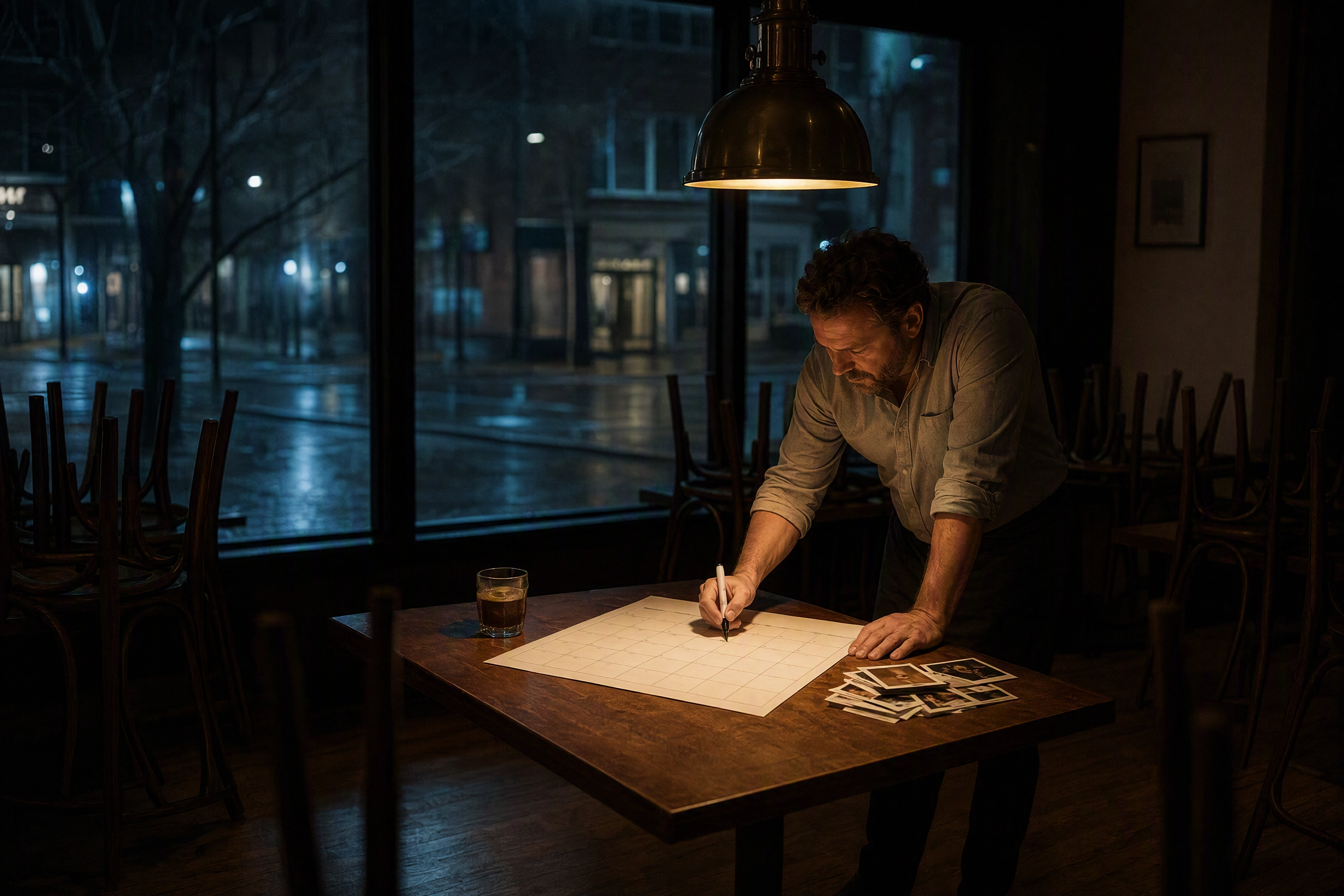
Most restaurant Instagram accounts don't die because the owner lost interest. They die on a Tuesday in week three, at 4pm, when something has to go out and there is nothing left to put up. Every dish worth showing has already been shown. Twice.
That is the real failure mode. Restaurant Instagram marketing is an inventory problem wearing the costume of a creativity problem — you don't need more ideas, you need a rota you can run on a bad week and enough content to feed it.
Quick Summary: Restaurant Instagram marketing runs on supply. Four feed posts a week for a month means 16–20 distinct photos, so build that bank before you start, then run a fixed Monday-to-Sunday rota — about 100 minutes a week, 45 of them in one Sunday block. Lock three visual variables so nine tiles read as one brand, and track profile visits, link taps, saves and DMs instead of follower count.
Why Restaurant Instagram Marketing Dies in Week Three
Ambition sets the cadence in week one. Supply kills it in week three. An owner commits to four posts a week, burns the four best menu items immediately, spends week two on the next four, then ends up shooting the same carbonara under the same pendant light at the same angle.
Customers read that instantly. A grid repeating itself looks like a business that ran out of things to be proud of. Most guides to restaurant Instagram marketing skip this, because "have enough photos" is a boring answer to an exciting question.
The Asset Math Nobody Does First
Run the arithmetic before committing to a cadence:
| Feed posts weekly | Distinct photos monthly | Per quarter |
|---|---|---|
| 3 | 12–14 | 36–42 |
| 4 | 16–20 | 48–60 |
| 5 | 20–24 | 60–72 |
| 7 | 28–32 | 84–96 |
The ranges allow for carousels, which eat two or three frames each. Four a week suits most independents: 2026 benchmark studies find accounts publishing three to five times weekly beat daily publishers on average engagement, because high-frequency content at low quality just fatigues the audience you already have.
So: 16–20 usable images. Not 16 snaps on a phone — 16 you'd be happy to see on a billboard.
Step 1: The 30-Minute Instagram Profile Setup
Restaurant Instagram marketing lives or dies here, not in the feed. Content brings people to the profile; the profile turns them into a table or an order. Most independents have a lovely feed hanging off an Instagram profile that answers none of the four questions a hungry stranger has: what do you serve, where are you, are you open, how do I order?
Name Field, Username and the 150-Character Bio
Your username is your handle. Your name field — the bold line above the bio — is what Instagram search actually weights, and most restaurants waste it by repeating the handle. Put cuisine and neighbourhood there instead — for example, "Sicilian Kitchen · Fitzroy North".
The bio is capped at 150 characters. One simple formula works: what you serve, where, one reason to care, one instruction. For example:
Wood-fired Neapolitan pizza in Deptford. Dough fermented 72 hours. Walk-ins after 9pm →
Cut the emoji rows, and cut "family owned since 1998" unless 1998 is why someone should walk in tonight.
Five Bio Links, in Priority Order
Instagram's links field takes up to five destinations, each with a label you write. Most restaurants still point one link at a slow website. Order them by revenue:
- Order online — your ordering page, direct if you have one
- Menu — a fast page, not a PDF nobody can pinch-zoom
- Book a table
- Find us and hours
- We're hiring
If your website is the only link, make it the online ordering page rather than the front door, and repeat that online CTA in the bio itself. Every extra tap costs orders.
The Five Story Highlights That Earn Their Place
Highlights are the second row of your shop window. Five is plenty: Menu, This Week, Inside, Reviews, Find Us.
Covers use one colour and one icon style, so the row reads as a set — one example is a single flat colour with a white line icon on each. This Week gets rebuilt weekly — Stories full of expired specials are worse than no Stories at all, because they prove nobody is home. Instagram's own guide to building highlights from Stories helps if you have never set them up.
Location Tag and the Ordering CTA
Claim your location tag and use it on everything shot on site. Tagged content builds a place page customers browse before booking, and every diner who tags you adds to it free. Instagram explains how location tagging works; make the pin match your Google Business Profile address.
Then pick one call to action and repeat it until you're bored. "Order online." "Book a table." One instruction per caption — three CTAs is the same as none.
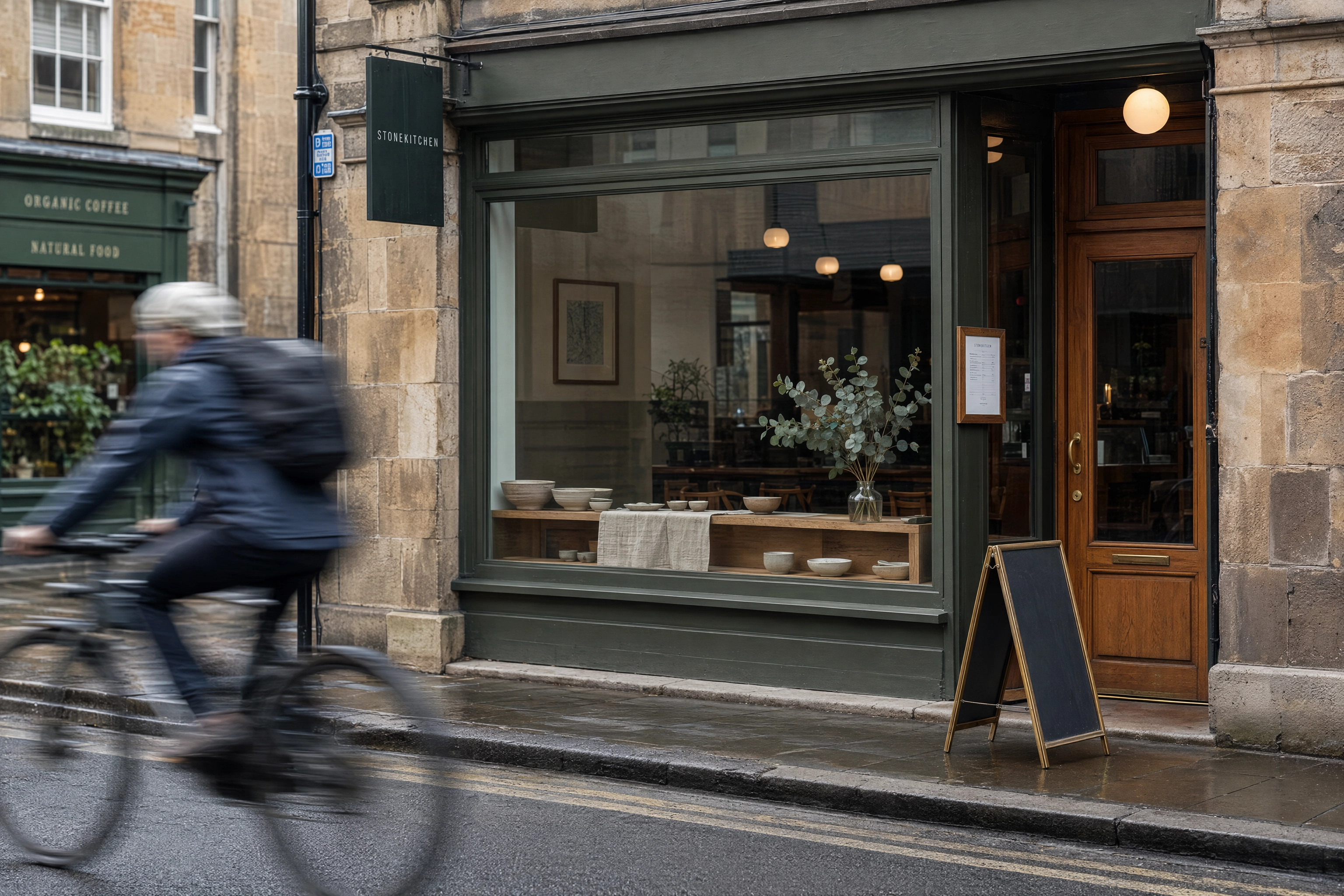 Independent restaurant shopfront window in morning light, the physical equivalent of an Instagram profile
Step 2: Build the 20-Photo Bank First
Everyone skips this, and skipping it is why the content calendar collapses. You are not making one post. You are stocking a month of supply for the customers who have not found you yet, which is the part of restaurant Instagram marketing nobody budgets for.
The 20-Shot List
Five buckets, twenty frames:
- 8 hero dishes — actual best sellers, one frame each, shot to survive a tight crop
- 4 drinks — coffee, a signature cocktail, something alcohol-free, one seasonal
- 3 process — dough, grill, plating; hands allowed, faces optional
- 3 room and people — the pass at service, a two-top by the window, a staff portrait
- 2 seasonal — whatever is about to land on the menu
Cross-check the list against your best sellers. If you've never done menu engineering, do it first: photographing a low-margin dish beautifully is an expensive way to sell the wrong thing.
Where the Photos Come From
Your camera roll. Most kitchens already hold hundreds of phone photos. The dish is rarely the problem; the light and the background are. Our Instagram food photography guide covers framing, crop and shot mechanics, so none of that is repeated here. Short version: shoot on your phone beside one window with a foam card, and check your iPhone camera settings before service.
One 40-minute shoot on a closed day. Twenty frames is achievable in a single block with a restaurant photoshoot plan, prepped props and a running order.
Restyle what you already have. That is what FoodShot AI does: upload the phone photo you already took and it returns a 2K, menu-ready still in about 2 minutes — same dish, controlled light, a background you chose. Twenty-five credits on the $15/month Starter plan covers the bank plus spares. It handles menu photography, dessert shots, cocktails and coffee from one upload flow, and the files drop into delivery app listings too. What it does not do is video — no Reels, no clips. Stills only, which is what this playbook runs on.
Step 3: The Monday-to-Sunday Rota
Here is the week. It never changes, and that is the entire point: restaurant Instagram marketing only survives contact with a busy service if the decisions are already made.
| Day | What goes out | Format | Minutes |
|---|---|---|---|
| Mon | What's on this week | Stories | 5 |
| Tue | Hero dish | Feed | 5 |
| Wed | Process or people | Feed | 5 |
| Thu | Behind the pass | Stories | 5 |
| Fri | Hero dish, weekend CTA | Feed | 5 |
| Sat | The room at service | Stories | 5 |
| Sun | A review or a tagged guest | Feed | 5 |
What the Week Actually Costs
- Sunday batch: 45 minutes. Pick four photos, write four captions, schedule the whole week's content.
- Each day: 5 minutes. Publish whatever the rota says, reply to whatever came in.
- Friday: 10 minutes. Clear every comment and DM you missed.
About 100 minutes a week, against the four or five hours most owners lose to reactive posting at 11pm. For the wider framework this sits inside, our restaurant social media strategy guide covers goals, pillars and platform choice.
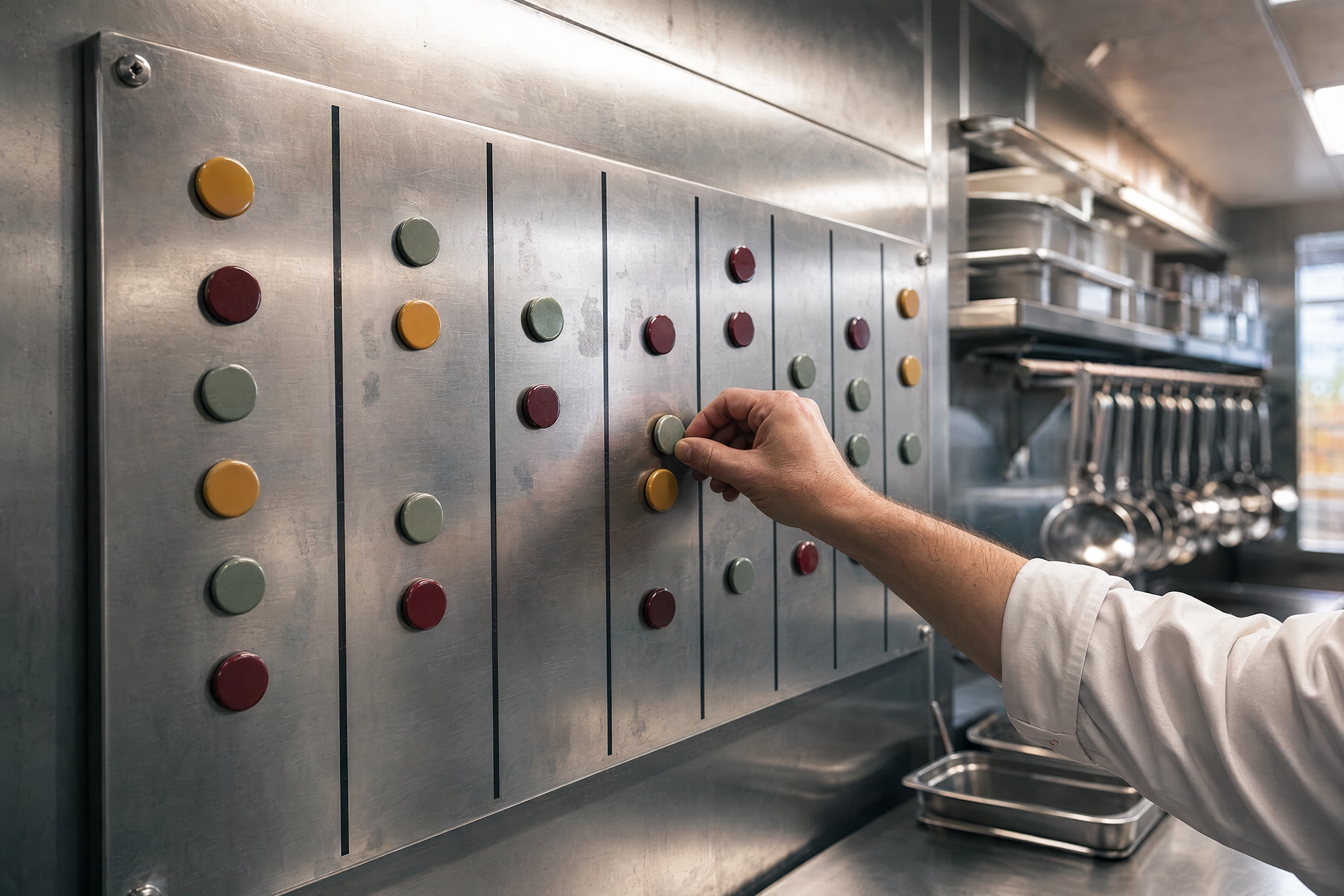 Chef moving a magnet across a seven-column kitchen planning board, a weekly restaurant posting rota
Step 4: The Four-Week Restaurant Instagram Marketing Calendar
Each week has a job, not a mood. Run these four, then run them again.
Week 1: Menu Foundation
Four menu items, four best sellers, one per slot, an online ordering CTA every time. Nothing clever. You're teaching a cold audience what you sell, and the success metric is saves, not likes. Uses four of your eight hero frames.
Week 2: People and Process
Two process posts, one staff portrait, one dish — four pieces of content in total. Faces and hands, still images only. This week reliably out-saves week one, because process is what customers can't see from the street.
Week 3: Proof
The week most restaurants never reach. One five-star review as a quote card, one repost of a tagged guest, one "regular's order", one dish. Ask permission by DM in a line: "Love this shot — can we share it with credit?" Nearly everyone says yes, and a guest whose photo you share usually tells their friends. Study restaurant social campaigns that worked, or work with a local food influencer to seed it.
 Stack of handwritten guest comment cards under a tumbler on a bar top, social proof for restaurant content
Week 4: The Offer
One offer, four angles: the dish, the price, the deadline, last call. Hard CTA to your first bio link every time, and share it to Stories the same day. This is where a month of goodwill turns browsers into paying customers.
Month two keeps the identical shape. Swap six of the twenty photos for six new ones — a seasonal dish, a new drink, two frames from another station. You now hold a rolling bank instead of a one-off shoot.
Step 5: Grid Planning So Nine Tiles Read as One Brand
A stranger lands on your profile, sees nine tiles and decides in about a second and a half. They aren't reading captions. They're asking whether this place has its act together.
One spec detail matters more than any aesthetic advice. The Instagram profile grid crops thumbnails to 3:4, while the maximum feed upload is 4:5 at 1080×1350 — the platform publishes its own image resolution notes. A dish framed dead-centre survives the grid crop; a dish with its garnish near the bottom edge loses it.
The Three-Lane Rotation
Sort every food photo into one of three lanes — dish, context (room, hands, process), proof (guests, reviews) — and never place two of the same lane side by side. Nine tiles then land as roughly five dish, two context, two proof. That one rule does more for a restaurant grid than any preset.
Lock Three Variables, Not Ten
Brand consistency isn't a filter. It's three simple decisions you stop remaking:
- One surface family — pick two background surfaces and use only those
- One light direction — side light from the left, every dish, forever
- One crop — 4:5, subject centred
Hold those and the grid looks designed even when three people shot it on three phones. Match them to your restaurant branding, keep food styling minimal, and use one colour grading recipe rather than a new mood weekly — editing food photos covers a repeatable version. This is the half of restaurant Instagram marketing that compounds.
 Restaurant facade of nine glowing square windows in a 3x3 grid, a metaphor for Instagram grid planning
Step 6: When to Post, and How to Find Your Own Windows
Timing is the most over-analysed question in restaurant Instagram marketing, and published best-hour data is a starting hypothesis rather than an answer. Buffer's 2026 analysis of 9.6 million posts put the strongest slots on Thursday morning and Wednesday midday; Sprout Social's read of roughly two billion engagements found weekends weakest; Iconosquare argues Thursday and Friday suit restaurants, because that's when weekend plans get made. They disagree because their data sets aren't your neighbourhood, so treat any published table as a hypothesis to test rather than a rule to follow.
Starting Defaults for a Restaurant Account
| Window | Local hours | Best for |
|---|---|---|
| Late morning | 10:30–11:30 | Lunch menu items, daily specials |
| Pre-dinner | 16:30–17:30 | Dinner heroes, bookings |
| Thursday planning | 17:00–19:00 | Weekend offers |
Posting 60 to 90 minutes ahead of the decision beats posting during it.
 Late-morning sunlight crossing an empty bistro floor with one table set, timing restaurant Instagram posts Someone deciding where to eat at 12:15 chose at 11:40.
The Two-Week Split Test
Two weeks, one variable:
- Week A — all four posts in the late-morning window
- Week B — same lane mix, same caption style, all four pre-dinner
- Compare reach from non-followers, profile visits and total engagement, not likes
Instagram's account and content insights give you all three, and a business account is required to see them — Instagram's getting started guide walks through the switch. Two weeks of your own data beats any published table, and it costs nothing to try.
Step 7: The Four Numbers Worth Tracking
Follower count is the vanity metric restaurants keep reporting to themselves. It doesn't book tables. Four numbers do, and Instagram's insights documentation explains where each lives:
- Profile visits — did the content make anyone curious enough to look you up?
- Link taps — did curiosity turn into ordering intent?
- Saves — the best single signal a food business gets: "I want to eat here later."
- DMs and door mentions — have the host log every "we saw it on Instagram."
Review them monthly, in the same Sunday block. Roughly two-thirds of customers check a restaurant's social media before visiting, so a gap between profile visits and link taps is telling you something concrete about your bio, not about the algorithm. That gap is where restaurant Instagram marketing quietly leaks money, and it is fixable in ten minutes. Pew Research tracks which platforms your customers actually use — worth a look before spreading yourself across five of them. Instagram itself reports over two billion monthly users, which is precisely why local specificity beats raw reach for a single dining room.
When the System Breaks
Three failure states show up in nearly every restaurant Instagram marketing plan. Each has a simple fix, and none of them is "post more content".
You Missed Four Days
Don't apologise, don't catch up, don't dump four pieces on Thursday. Resume at the next scheduled slot as though nothing happened. Owners badly overestimate how closely anyone watches — as threads like this one on r/socialmedia point out, the only person who sees the gap is you.
Engagement Fell Off a Cliff
Before blaming the algorithm, check three things: are two same-lane tiles adjacent, is the subject getting cropped out of the grid thumbnail, and have you run the identical CTA fourteen times running? It's almost always one of those. More diagnostic help sits in our restaurant marketing ideas and social media marketing for restaurants guides.
You're Out of Photos Again
Set the restock trigger at eight remaining, not zero. Eight left means two weeks of runway — enough to plan a shoot or restyle a batch calmly. Zero means you publish something bad on a Tuesday. This is also where paid advertising tempts people: advertising works fine on top of a healthy account, but boosting a thin one buys reach for a grid that isn't ready. More tactics in how to promote your restaurant on social media.
 Nearly empty nine-compartment bar garnish caddy at end of service, running out of restaurant content
Frequently Asked Questions
How often should a restaurant post on Instagram?
Four feed posts a week plus Stories on open days. Three is fine. Seven is a trap: it burns your bank four times faster, and 2026 engagement studies show daily posting underperforms a three-to-five cadence per post. Engagement follows consistency, not volume.
How much does restaurant Instagram marketing cost per month?
Organic restaurant Instagram marketing carries no platform fee. The real cost is photos. A local photographer runs a few hundred to well over a thousand for a half-day; a restyling tool like FoodShot starts at $15 monthly for 25 credits. See FoodShot pricing for tiers, or the AI food photography overview for how the output compares.
Do hashtags still work for restaurant Instagram marketing?
They're a small discovery lever, not a growth strategy. Five to eight tags mixing your city, your neighbourhood and your food type is plenty. Your location tag and the quality of the content do far more work than a block of thirty, which mostly signals an account trying too hard.
Should a restaurant pay for Instagram advertising?
Only once the organic rota runs and the profile converts. Advertising magnifies whatever exists — a strong Instagram profile with a clear ordering link, or a half-built one. Promote a proven post to a tight local radius rather than running cold, and treat it as a top-up.
How many photos does a restaurant need for a month?
Sixteen to twenty distinct images for four posts a week, allowing for a couple of carousels. That's the number nobody plans for, and it's why restaurant Instagram marketing stalls in week three. Build the bank, then start the content calendar.
Is follower count worth chasing for a restaurant account?
No. A 900-follower account where 400 people live within three miles will out-earn a 9,000-follower one built on giveaways. Judge success on saves, link taps and how many customers mention Instagram at the door.
Does this playbook cover Reels and video?
No, deliberately. Every step above works without shooting a second of footage, and over-promising video is the fastest way to abandon the content calendar in week two. Cafes running the same rota can start from our cafe workflow, restaurants from the restaurants use case, and Instagram publishes changes on its official blog.