How to Get Big Orders on DoorDash: $400 Trays, Not $25
 Ali Tanis16 min read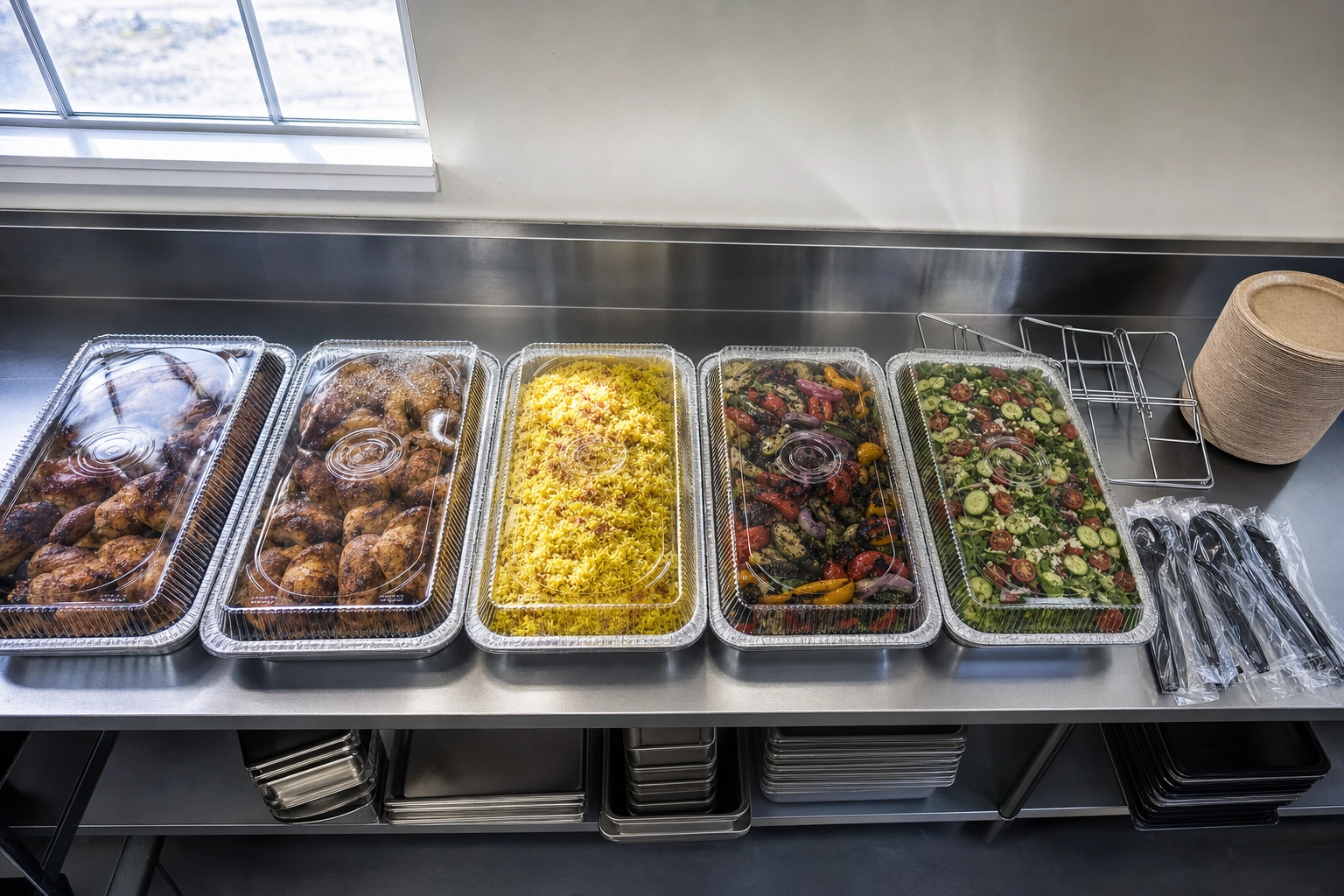
If you are searching how to get big orders on DoorDash and you run the kitchen rather than drive for it, almost every result you find is written for Dashers. This one is not. On the merchant side, big orders are not a volume problem. They are a product problem. The average DoorDash basket sits around $28 to $38. A catering tray package sits between $200 and $800. No promotion closes that gap. You close it by listing something a group buyer can actually buy: a package, priced per head, with a serving count, a lead time, and one photo that proves the tray is real.
Quick Summary: Large DoorDash orders arrive through three lanes — Group Orders for teams up to 15, DoorDash Catering inside DoorDash for Business for events of 10 to 200, and Large Order Fulfillment through DoorDash Drive for catering you sell yourself. Commission is the same percentage on a $400 tray as on a $25 basket, so the gain is operational: one prep window instead of sixteen.
Big Orders Are a Different Product, Not a Bigger One
Promotions, DashPass, ad placements and peak-hour coverage all add tickets. None adds dollars per ticket. Our order volume playbook covers that side in twelve steps, so it is not repeated here.
Basket size responds to something else. A group buyer is not browsing for dinner. Somebody has a meeting at noon on Thursday, a headcount of 24 and a budget of $18 a head. They are shopping for a solution and filter out any listing that does not obviously provide one. Most kitchens never reach that shortlist — not because the cooking is worse, but because the menu answers a question nobody asked.
The Three Large-Order Lanes on DoorDash
These are different products with different rules. Pick the ones that match your kitchen before you build anything.
| Lane | Who it serves | How it works | What you must set up |
|---|---|---|---|
| Group Orders | Teams up to about 15, same day | One shared cart; each person picks their own item; one delivery | Nothing new — but your menu must hold up to 15 simultaneous picks |
| DoorDash Catering | Events of roughly 10 to 200 | Buyers order trays and bundles from a catering menu, scheduled ahead | A real catering menu with serving sizes, lead times and a cutoff |
| Large Order Fulfillment (Drive) | Catering you sold yourself | DoorDash delivers your booked order with a premium Dasher fleet | An LOF addendum to your merchant agreement, via support |
Group Orders are the easiest entry point because they need no new menu. The organiser sets a spending cap per person and shares a link; everyone adds to one cart. Split billing lets each participant pay individually or draw on an expensed meal budget, and the cart can be planned up to a week ahead.
DoorDash Catering is the tray-style product: packages rather than plates, from merchants pre-vetted for large-order reliability, on menus that carry explicit serving counts. DoorDash launched it for the workplace alongside Meal Manager, starting in New York City and San Francisco with more markets planned. If your city is not live yet, group ordering is the lane open to you today.
Large Order Fulfillment is the white-label option. You take the booking; DoorDash sends a Dasher from a screened pool — 200-plus lifetime deliveries, a 4.7-plus star rating, better than 95% completion last month, a hot bag and a car. Those deliveries face tighter punctuality and completeness standards than a normal run, which matters when a room full of people is waiting.
What a $400 Tray Actually Pays You
Answer the money question before you touch the menu builder. It is less flattering than most operators assume.
Commission on One $400 Order vs Sixteen $25 Orders
DoorDash's published merchant rates are 15% delivery commission on Basic, 25% on Plus and 30% on Premier, with pickup at 6% across all plans and DoorDash's own online ordering on your website at zero commission.
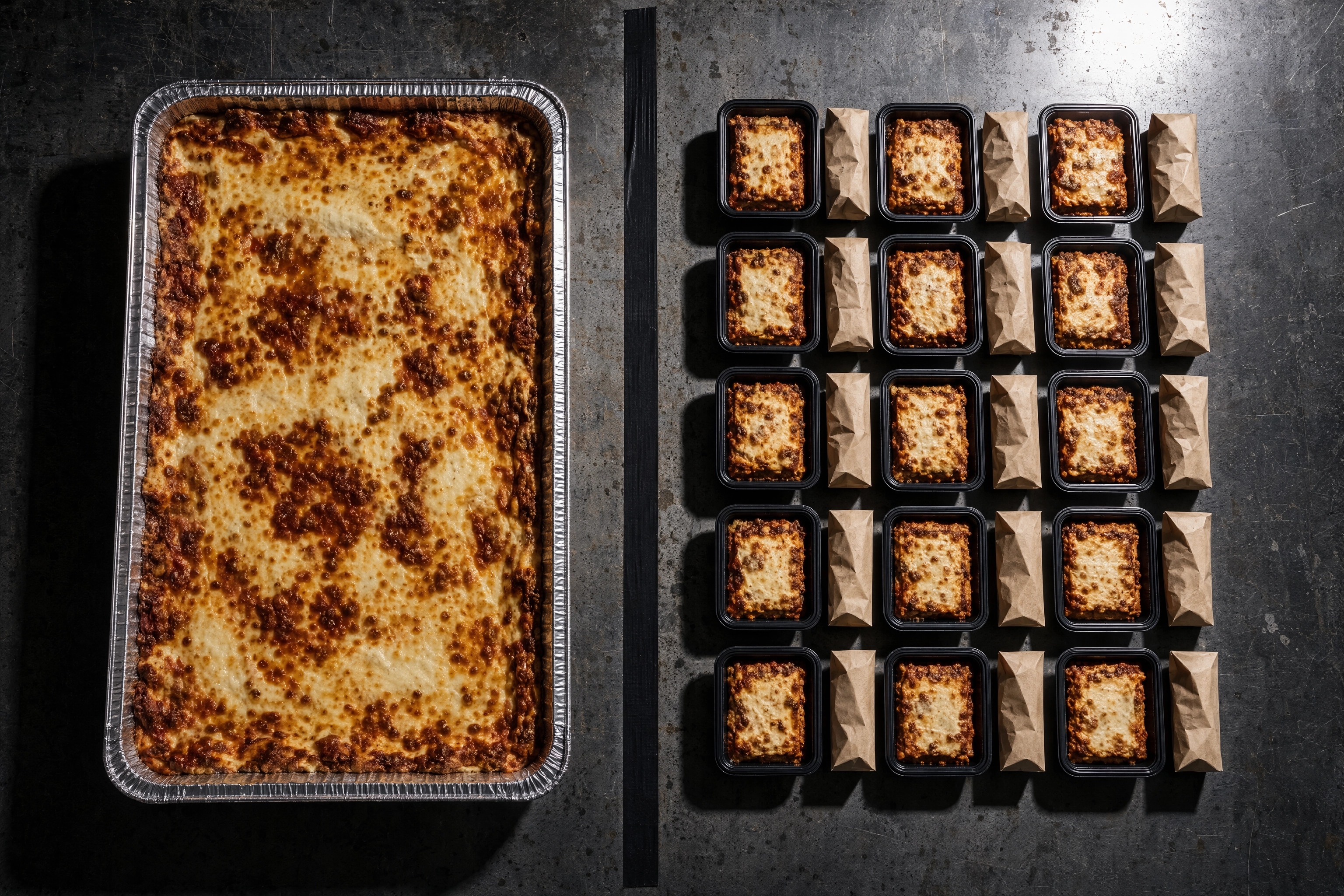 One large foil catering tray beside a grid of single-portion takeaway containers, the $400 versus $25 DoorDash order economics
Run it on the Plus plan. A $400 tray costs $100 in commission and nets $300 gross. Sixteen $25 baskets cost the same $100 and net the same $300. The fee is identical, because a percentage does not care how the dollars are grouped.
Everything else changes. One order is one ticket, one prep window, one packing job, one handoff, one chance to be late. Sixteen orders are sixteen of each, scattered across a shift, each carrying its own ratings risk. In labour minutes and error surface per dollar the tray wins by a distance; in fees it is a draw. Say that out loud before you build a case on savings that do not exist.
The Packaging Line Nobody Budgets For
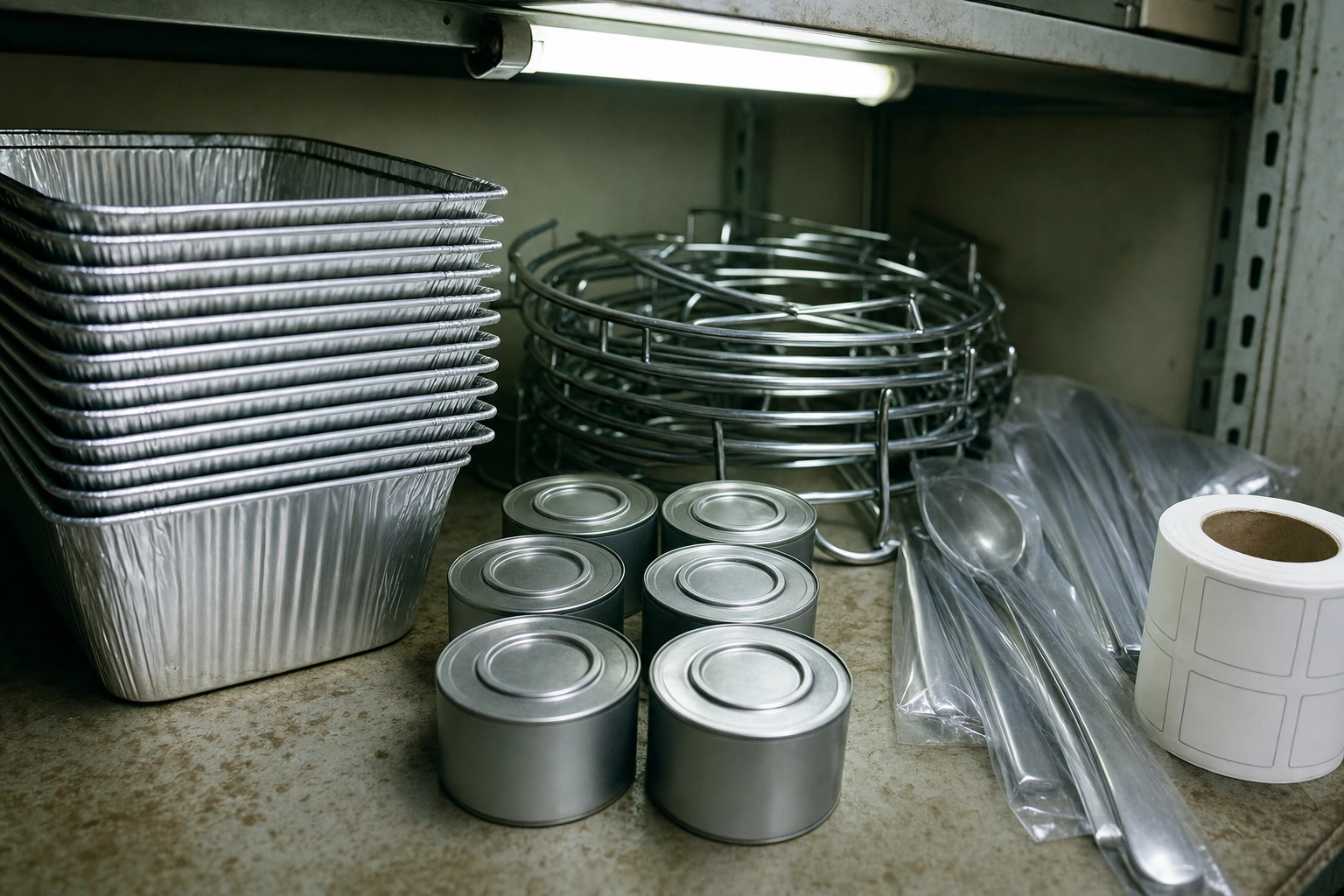 Stockroom shelf of aluminium pans, chafer racks, fuel tins and serving spoons, the packaging cost behind every catering tray
Here is the cost most kitchens forget. Half and full-size aluminium steam-table pans, lids, wire chafer racks, fuel cans, utensils, plates, napkins and labels scale with the number of trays, not the number of orders. At retail prices, one package can easily carry $8 to $20 of disposables before a gram of food goes in.
Costing each package the whole way helps: food, the labour to prep and pack it, the packaging spec, and the commission rate on your plan. If it cannot carry all four and still leave a contribution you would accept from a table of four, do not list it. A tray that loses money at scale bleeds far faster than a single plate does. Menu engineering applies to trays exactly as it does to entrees.
Build a Catering Menu DoorDash Can Actually Sell
A catering menu is its own menu, with its own hours and its own logic — not five large-format items pinned to the bottom of the regular one, where they get scrolled past by somebody ordering a burrito. The Merchant Portal supports multiple menus with distinct windows, so scope it to the hours you can genuinely honour.
Say How Many People It Feeds, In the Item Name
These customers do not convert portions into trays in their head. They have a headcount and want to know how many of these things to buy. Put the number in the item name — "Chicken Shawarma Tray (Feeds 12–15)" — and repeat it in the description.
DoorDash's guidance to office buyers is instructive: order for 85–90% of confirmed RSVPs rather than invitations, and assume 15–20% of any team has a dietary need. Write packages so one order covers vegetarian, gluten-free and halal demand without a second checkout. Then write the description properly — DoorDash's merchant Learning Center reports menus with item descriptions earn up to 18% more each month, and our guide to menu descriptions that sell has the formula.
Price Per Head, Then Show the Tray Price
Office admins budget per head, because that is how approval works. Lead with the per-head number, then show the package price beside it. A $216 tray is a shrug; $18 a head for 12 people is a decision.
Build a small, medium and large ladder so the middle option looks obvious, and bundle a main with two sides and a dessert tray so the buyer makes one choice, not six. Bundling is the most reliable way to increase basket size anywhere, which is why the same logic is driving the Uber Eats equivalent of this playbook.
Lead Time, Minimums and Prep: The Settings That Stop the Damage
Almost every catering disaster is a settings problem, not a kitchen problem. The kitchen can make the trays. What it cannot do is make them in eleven minutes because nobody told the platform otherwise. Getting these three fields right does more for you than any promotion.
24 to 48 Hours Is the Real Lead Time
DoorDash's guidance for office buyers puts groups of 20 to 50 at a 24 to 48 hour minimum, and catering menus are built with schedule-ahead windows for that reason. Set yours to the notice your kitchen needs, so you receive every booking with room to prep, then set a cutoff after which a buyer cannot modify or cancel. That cutoff protects you once the protein is ordered.
Set a minimum order value in the same pass and black out the windows you cannot serve. If Friday dinner is your peak, a six-tray pickup at 6:45pm is not incremental revenue; it is a service failure with a delayed invoice. Catering demand sits in off-peak weekday lunches anyway — the happy part, because it fills the hours your line is idle.
Item-Level Prep Times Use the Longest Item, Not the Sum
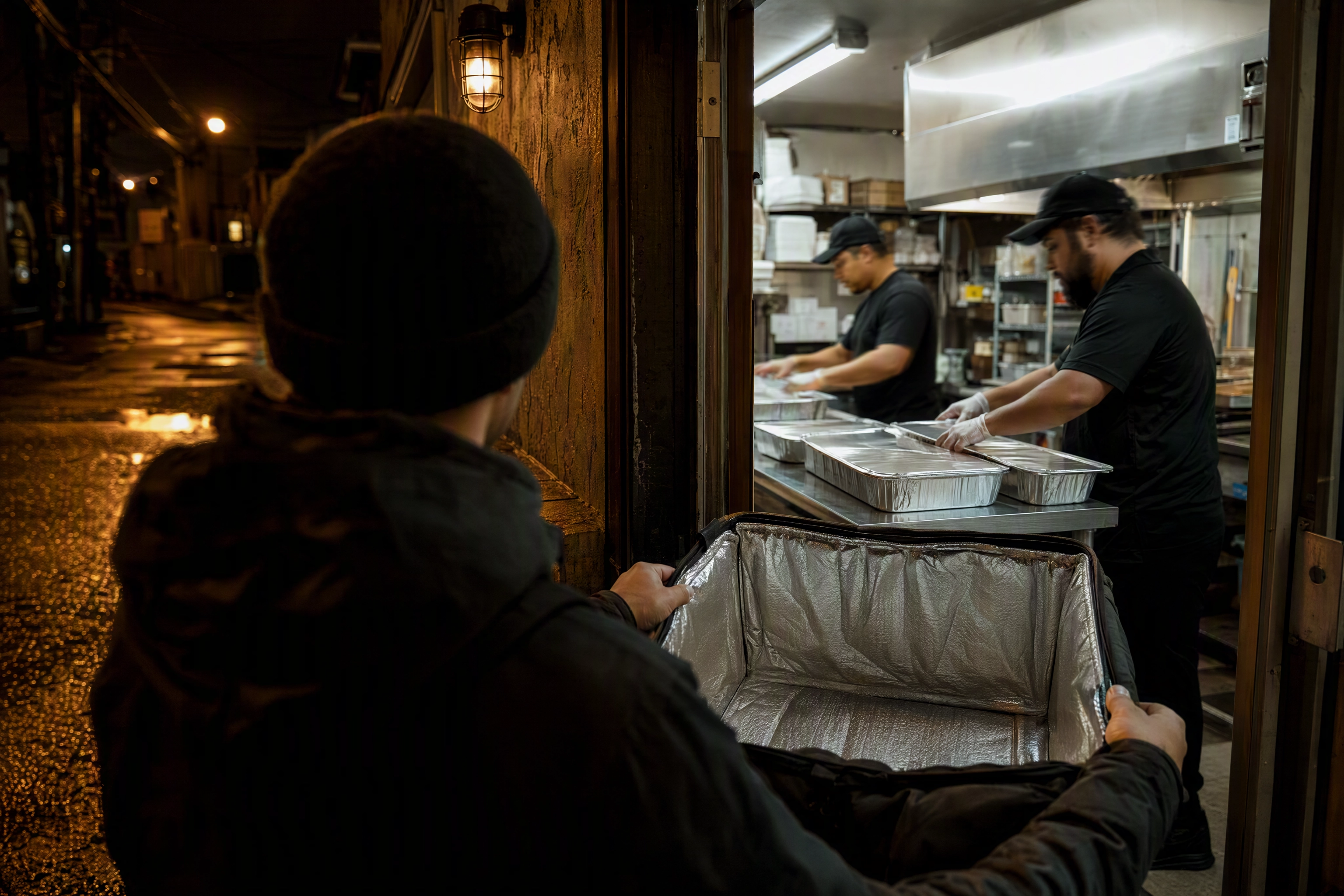 Courier waiting with an open hot bag at a service door while cooks seal catering trays, the prep time problem on large DoorDash orders
This one catches people out. DoorDash calculates an order's prep window from the longest single item, not the total, because kitchens normally prepare items in parallel. That is right for a sandwich and fries. It is wrong for six trays queueing through one oven.
Set item-level prep times on catering items to real oven-to-lid duration and keep them current. Realistic prep times also help stop a Dasher arriving twenty minutes early and standing in your pass. Worth knowing on the driver side: Dashers see tips before they accept, so a large delivery with a flat tip can sit unclaimed while your trays cool.
One more trap. If your store is POS-linked, DoorDash's documentation warns that Menu Manager edits are not permanent and can be overwritten by the next menu push from your POS — or cause orders to fail outright. Build catering items, prices and photos in the POS. Merchants running a ghost kitchen on DoorDash or several virtual brands get hit hardest, because one bad sync takes down every brand at once.
The Photo Problem: One Portion Where a Platter Belongs
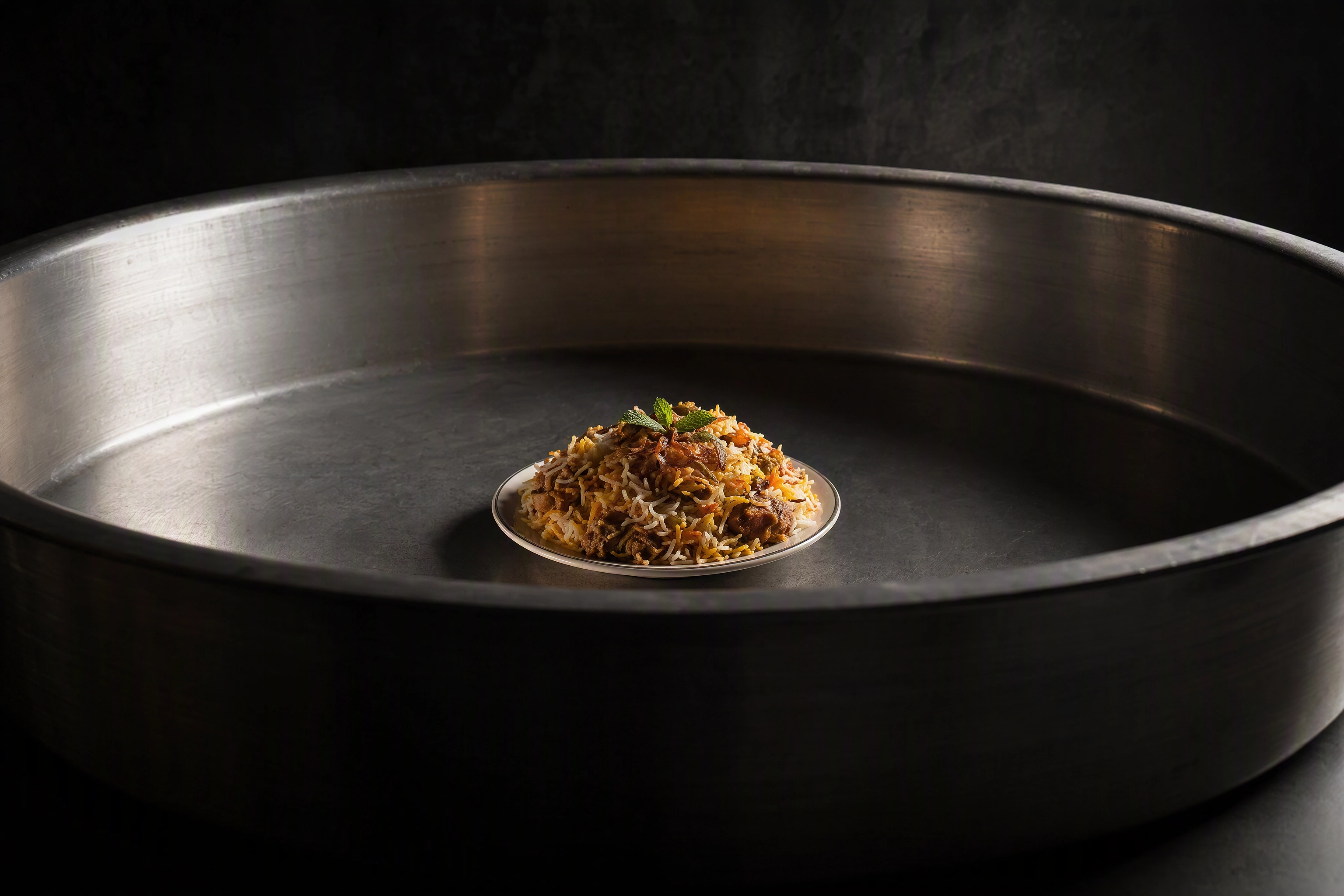 One small plated portion alone inside a huge empty catering pan, the single-portion photo problem on DoorDash catering listings
Here is the failure I see most, and it is the expensive one. A catering listing sells from a single image. The buyer is deciding whether this tray really feeds 20 people and whether it arrives looking like the picture. Almost every merchant uploads the single-portion plate shot from the regular menu — so a picture of one $22 entree carries a $400 decision.
What a Catering Hero Shot Has to Prove
A catering image has three jobs a plate shot never has to do.
- Scale. Show the full pan, filled edge to edge, with something in frame that reads as size — a serving spoon, a stack of plates, a second tray behind it. "Feeds 12–15" must look believable before anyone reads the description.
- Completeness. Photograph the package as delivered: the main, the sides, the sauces, the utensils. If the bundle includes a dessert tray, it is in the shot.
- Travel strength. It should look like it survives thirty minutes in a hot bag: glossy, saucy, structurally sound. Same discipline as good delivery app photography, turned up, because the stakes per image are higher.
The payoff is measurable. DoorDash's merchant Learning Center reports menus with item photos see up to a 44% increase in monthly sales. On a catering menu, where one image is the entire sales page, that increase is the floor, not the ceiling. Our catering food photography guide goes deeper on styling full-format trays, and photo menus covers why visual menus lift conversion.
The Specs Still Apply, and the Square Crop Bites Trays
Catering items live under the same rules as everything else on your menu: 1400 x 800 pixels minimum, 16:9 landscape, JPG, JPEG or PNG. The full spec sheet, including the eleven official rejection reasons, is in our DoorDash photo requirements guide.
The detail that ruins tray shots: thumbnails are cropped to a 1:1 square from the centre. Shoot a wide pan edge to edge and both ends are amputated, so browsing customers see a close-up of rice. Two tips save you a reshoot: centre the tray with margin left and right, and check the square crop before you upload. Uber Eats runs its own rules, so if you list on both, read the Uber Eats photo specs — and see what delivery apps allow first.
Shooting a Whole Catering Menu Without Booking a Photographer
DoorDash's free menu photoshoot, where you qualify, covers roughly 20 items plus a store header. That is a regular menu — not a regular menu plus eight to twenty catering packages, each needing its own full-package shot. Commissioning the gap costs real money: our breakdown of what a photoshoot costs has current market numbers, and planning a menu photoshoot shows what staging a tray session involves.
The practical route for most kitchens is to shoot the real tray on a phone during a prep run and transform it. That is what FoodShot AI is built for: photograph the pan you actually produce, pick a delivery style, and get a 4K, 16:9 image that meets spec the same afternoon. It keeps the picture honest — never publish a tray you cannot produce, because the buyer counts the portions. See FoodShot AI pricing, the menu photography guide for shot-by-shot technique, and the usual delivery photo mistakes to avoid.
Winning Office Accounts, Not Just Office Orders
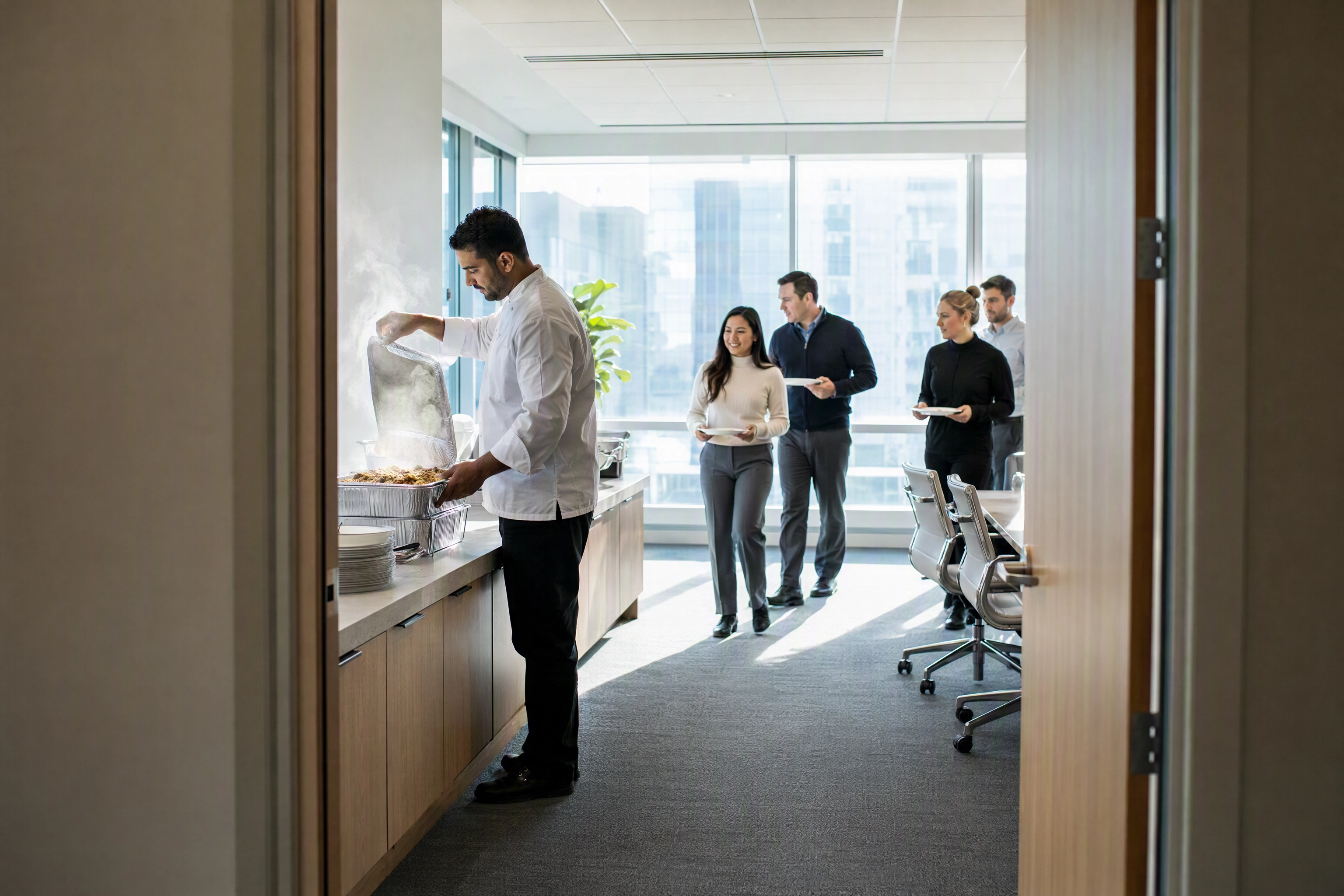 Caterer opening a foil tray on a credenza as office staff gather with plates, a workplace catering account being served
One won workplace account is a recurring weekly line, not a ticket. DoorDash's 2026 operations research found that 79% of delivery orders come from merchants the customer has ordered from before. Repeat behaviour is what is driving the economics here, and it compounds where an admin feeds the same team every week.
Be Findable Inside DoorDash for Business
Workplace admins filter on reliability before price. Dietary coverage, on-time rate, cancellation rate and order accuracy are the signals driving that shortlist, and the last three come straight out of your Merchant Portal quality metrics. Clean them up before you chase demand: a restaurant with shaky ratings will not be shortlisted, however good the photo is.
Availability is expanding market by market. Check whether catering is live in your delivery areas; if not, run group ordering in those areas while you wait — the menu work you do now makes you eligible later, and it carries into adjacent areas of the business.
The Off-Platform Half of the Job
Marketplace gives you discovery, not the relationship. Use the platform to be found, then move repeat customers onto a direct line where the commission is not 25%.
Drop sample trays at offices, clinics and studios inside the delivery radius you cover. Ten targeted visits beat a thousand impressions here. And when you book catering yourself, LOF supplies screened drivers without you hiring any, so cross-town deliveries stop being a reason to decline. Our guides to marketing a catering business, the catering marketing guide and 20 practical catering marketing ideas cover the outbound side.
How to Get Big Orders on DoorDash: A 30-Day Rollout
- Week 1 — Cost it. Pick 6 to 10 packages your line makes well. Cost each one: food, labour, packaging, commission. Set the floor price. Kill anything that does not clear it.
- Week 2 — Build it. Create the catering menu in your POS, not the Merchant Portal. Set its hours, the schedule-ahead lead time, the cutoff, the minimum order value and honest item-level prep times. Put the serving count in every item name — menu planning discipline helps.
- Week 3 — Shoot it. Photograph every package as a full tray, at spec, and check the square crop before it goes live. Our food photography guide and the delivery-app photo styles library get you there in an afternoon.
- Week 4 — Sell it. Turn on scheduling, pitch ten nearby offices with a sample, then read the data: which packages convert and where timing slipped. Adjust prep times first, prices second.
Three tips that shorten the ramp: launch with fewer packages than you think, price the middle tier to be chosen, and photograph the tray before you write the description.
Frequently Asked Questions
How to get big orders on DoorDash without hiring a catering manager?
Start with Group Orders, which need no new menu, then add a catering menu of 6 to 10 packages built from dishes your line makes anyway. The work that scales is setup — serving counts, lead times, prep times and one good tray photo per package. Once those are right, you receive the orders without anybody coordinating them by phone.
What is the minimum order size for DoorDash catering?
DoorDash does not impose one universal number on merchants. Catering is positioned for events of roughly 10 to 200 people, and you set your own minimum order value and notice period. Set it at the point where a tray order is genuinely worth interrupting your line for.
Does DoorDash charge a different commission on catering orders?
Commission follows your partnership plan, not the order size: 15% on Basic, 25% on Plus and 30% on Premier for delivery, plus 6% for pickup. A $400 order pays the same percentage as a $25 one. Confirm your own terms in your Merchant Portal agreement — custom rates exist.
How far in advance do DoorDash catering orders come in?
DoorDash tells office buyers that groups of 20 to 50 typically need 24 to 48 hours of notice, and catering menus are built around schedule-ahead windows. You set that window and the cutoff after which the customer can no longer change the order.
Do I need different photos for catering items on DoorDash?
Yes, and this is where most merchants lose the sale. A catering item needs a photo of the full package as delivered — the whole pan, the sides, a size reference — not the single-portion plate shot from your regular menu. Same specs, completely different job.
Can Dashers refuse a large catering order?
Dashers choose which offers to accept, which is why Large Order Fulfillment exists: it routes big deliveries to a screened pool of experienced Dashers with hot bags and cars. Honest prep times keep those drivers from arriving before the trays are packed. If a restaurant sees repeated late pickups, DoorDash's Help Center guidance on prep times is the first place to look.