
Food Cost Calculator: Price Any Recipe in 5 Minutes
 Ali Tanis8 min read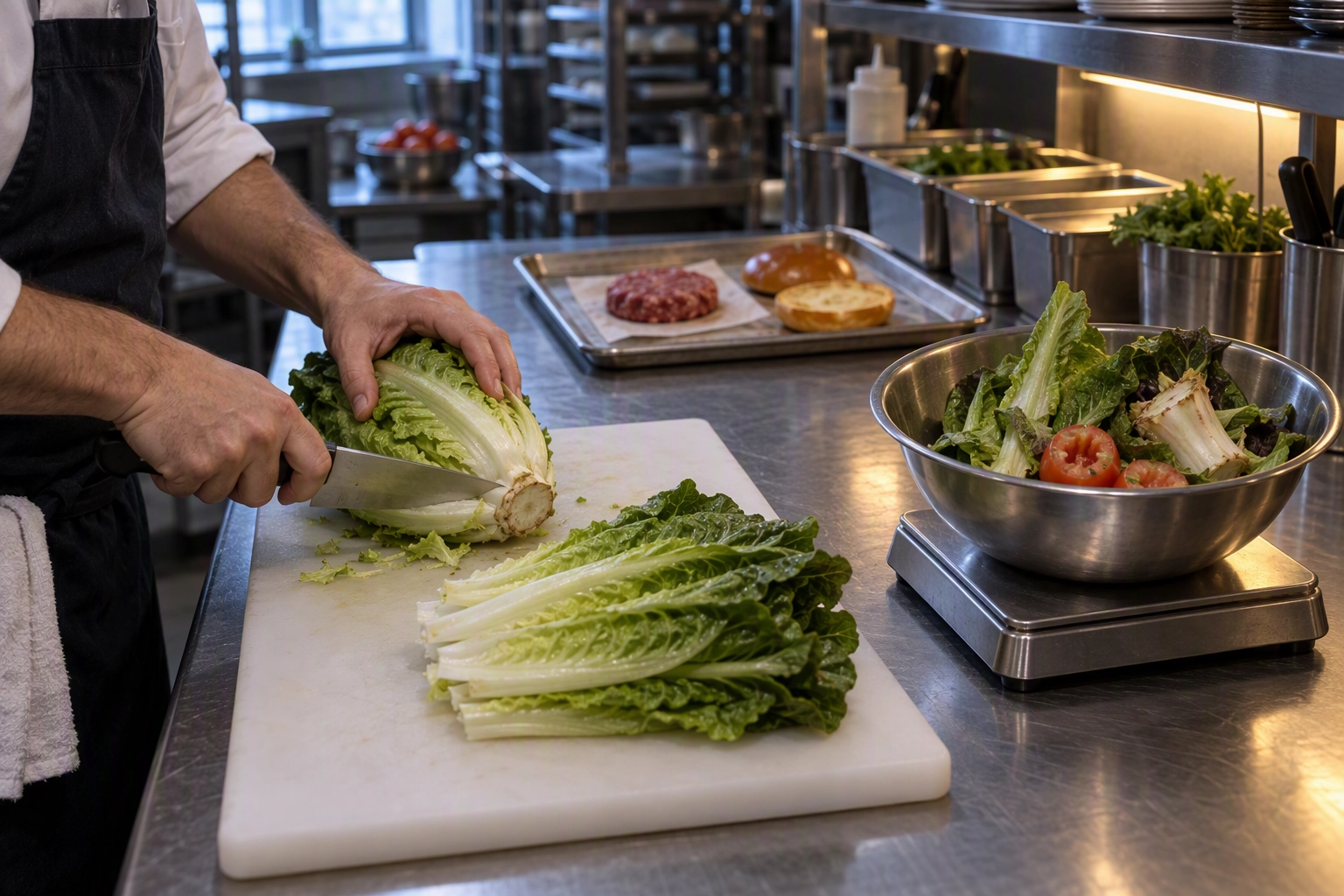
A food cost calculator turns what you paid for ingredients into the price a dish has to sell for. Most free tools skip what quietly eats restaurant margins: trim loss, cook shrink, pitcher waste and the pan the food leaves in. Here's a six-step worksheet, a Google Sheets food cost calculator you can build in two minutes, and three dishes worked end to end: a cheeseburger, a latte and a 10-guest catering tray.
Quick Summary: Plate cost is the sum of every ingredient's yield-adjusted line at the portion you serve. Selling price is plate cost divided by your target food cost percentage. Skip the yield step and our catering tray would have sold at $85 and run 35.3% instead of 30%.
How to use this food cost calculator in 6 steps
- Weigh the portion you serve. Guessed portions are where most sheets go wrong; weighing starts portion control.
- Turn the invoice into a unit price. A 10 lb case of ground beef at $56 is 35 cents an ounce.
- Divide by yield, the share of what you bought that reaches the plate. Untrimmed romaine yields 64% usable leaf, per the USDA Food Buying Guide.
- Multiply by the quantity served to get each ingredient cost line.
- Add the hidden lines. A flat Q-factor covers oil, salt, sauces and garnish too small to weigh. Takeout and catering also carry packaging costs.
- Calculate the price. Plate cost ÷ target food cost % = selling price. To test a price you already charge: plate cost ÷ menu price × 100 = your food cost percentage.
The theory lives in our food cost formula guide.
The free food cost calculator template (Google Sheets)
No email, no demo request. Open a blank Google Sheet and type this in:
A1 Ingredient | B1 Pack price | C1 Pack size | D1 Unit | E1 Yield % | F1 Portion | G1 Unit price | H1 Line total

G2  =IFERROR(B2/C2,0)
H2  =IFERROR(G2/E2*F2,0)        (select G2:H2 and fill down to row 15)

G17 Plate cost           H17 =SUM(H2:H15)
G18 Target food cost %   H18 30%
G19 Suggested price      H19 =H17/H18
G20 Your menu price      H20 (type it)
G21 Actual food cost %   H21 =H17/H20
G22 Gross profit         H22 =H20-H17
Enter pack size in the unit you portion in (a 10 lb case becomes 160 for ounces) and yield as a percentage. Name each tab after its recipe; File › Download saves an Excel or PDF copy for the kitchen binder. This food cost calculator works the same for restaurants, cafés, food trucks, ghost kitchens and caterers.
Worked example 1: a $9.95 cheeseburger
| Ingredients | Bought at | Yield | Portion | Line |
|---|---|---|---|---|
| Ground beef 80/20 | $5.60/lb | 100% | 5 oz raw | $1.75 |
| Brioche bun | $6.60 per 12 | 100% | 1 | 55¢ |
| American cheese | $28.80 per 160 slices | 100% | 1 slice | 18¢ |
| Romaine leaf | $2.40/lb | 64% | ½ oz | 12¢ |
| Tomato | $2/lb | 90%* | 1 oz | 14¢ |
| Q-factor: sauce, pickles, butter | flat | – | – | 25¢ |
| Recipe total | $2.99 |
At a 30% target the burger needs $9.97, so list it at $9.95 (30.1%). *Tomato yield is our assumption after coring; weigh your own. Beef sits at 100% because you portion the patty raw, so cook shrink is already paid for.
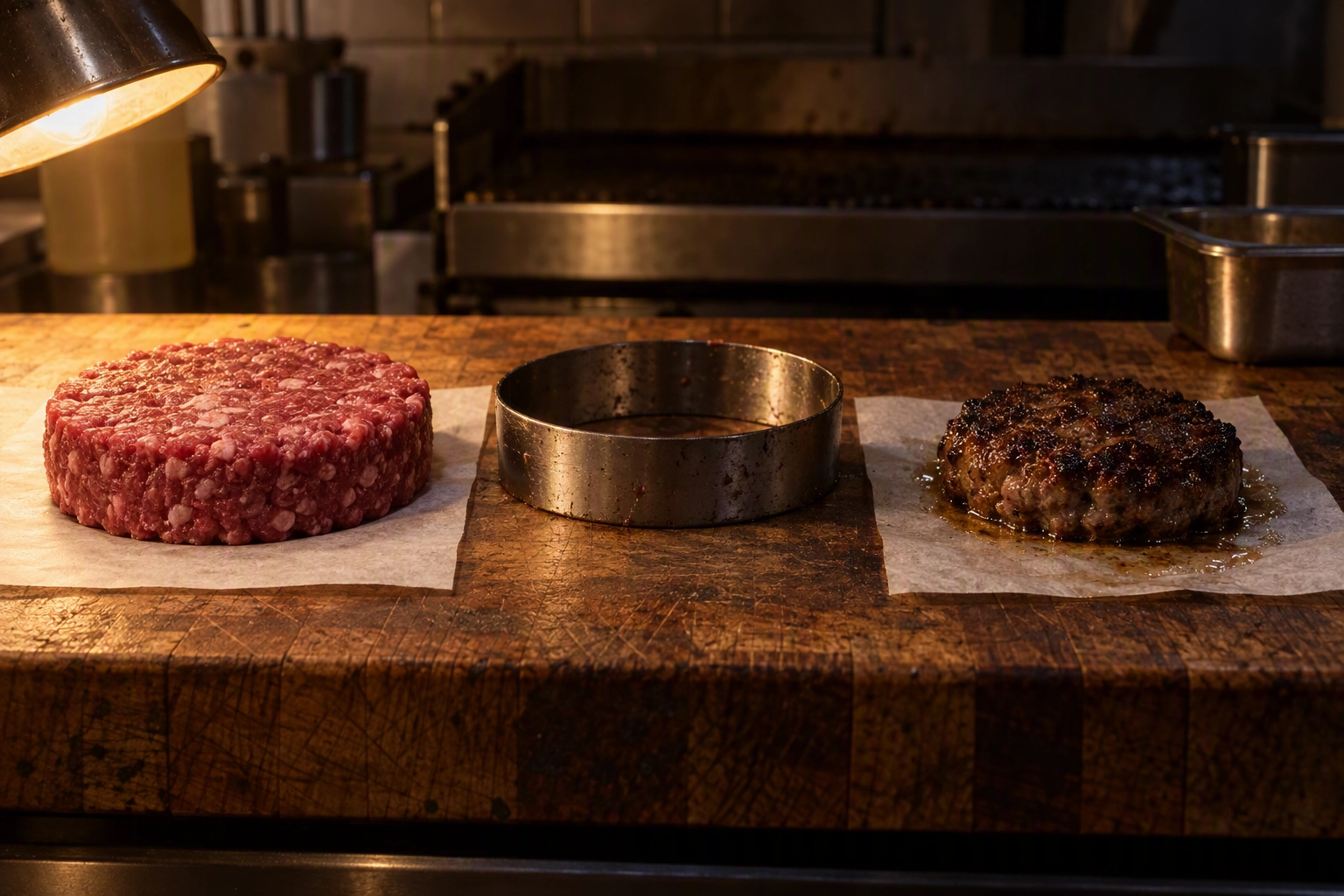 Raw beef patty beside the same patty after cooking, the cook shrink already paid for in a burger's food cost
Now the part no food cost calculator warns you about. USDA's Economic Research Service forecasts beef and veal prices up 9.8% in 2026 (Food Price Outlook). Push your case to $6.15/lb and the same burger runs $3.16, or 31.8% at $9.95. Nothing on the plate changed; the margin did. The BLS retail average for ground beef was $6.92/lb in August 2026; a distributor quote above that deserves a phone call.
Worked example 2: a 12 oz latte (and the oat milk trap)
| Ingredients | Bought at | Yield | Portion | Line |
|---|---|---|---|---|
| Espresso beans | $11.50/lb | 95% | 18 g double | 48¢ |
| Whole milk | $3.90/gal | 85% | 8 fl oz | 29¢ |
| Cup, lid, sleeve | 18¢ per set | 100% | 1 | 18¢ |
| Q-factor: sugar, stir sticks, napkins | flat | – | – | 4¢ |
| Recipe total | 99¢ |
At a 22% target that's a $4.50 latte. The 95% on beans covers dial-in shots; the 85% on milk covers what gets dumped from the pitcher. Both are assumptions; measure your own. Whole milk averaged $4.23 a gallon at retail in August 2026. Skip the cup and a takeaway latte is 18 cents light, which at 22% prices it 82 cents too cheap.
The trap is the modifier. Oat milk at $40 for twelve 32 oz cartons pushes the milk line to 98 cents and the drink to $1.68. Holding 22% would demand a $7.64 latte, a $3.14 upcharge nobody pays. Hold the dollars instead: the dairy latte earns $3.51 gross profit, so $1.68 plus $3.51 is $5.19, and a 70-cent oat upcharge keeps you whole. Set modifier pricing on profit per cup, never on percentage.
Worked example 3: a 10-guest catering tray
Lemon-herb chicken thighs, herbed rice, roasted vegetables and rolls in foil pans. Catering is where yield errors get expensive, because you portion cooked food by weight.
| Ingredients | Bought at | Yield | Portion | Line |
|---|---|---|---|---|
| Boneless chicken thighs | $3.20/lb | 75% cooked | 50 oz cooked | $13.33 |
| Herbed rice (sub-recipe) | 24¢ per portion | – | 10 | $2.40 |
| Mixed vegetables | $1.90/lb | 80% trimmed | 40 oz | $5.94 |
| Rolls and butter | 30¢ per guest | 100% | 10 | $3 |
| Q-factor: marinade, oil, lemon, herbs | flat | – | – | $1.80 |
| Foil pans, lids, serving spoons | $3.50 per set | 100% | 1 | $3.50 |
| Recipe total | $29.97 |
At 30% the tray prices just under $100: call it $10 a guest, an easy number to market (see these catering marketing ideas).
Now run it without yield. Cost the chicken as if 50 oz raw were enough ($10) and the vegetables as bought ($4.75), and the tray looks like $25.45. Priced at 30%, that's an $85 tray that really runs at 35.3%. Same food, five points of margin gone. Our 75% is a planning figure; USDA research on cooking yields puts roasted chicken anywhere from 65% to 84%, so roast one test batch and weigh it. The same math scales to $400 delivery trays and underpins any plan to grow catering sales.
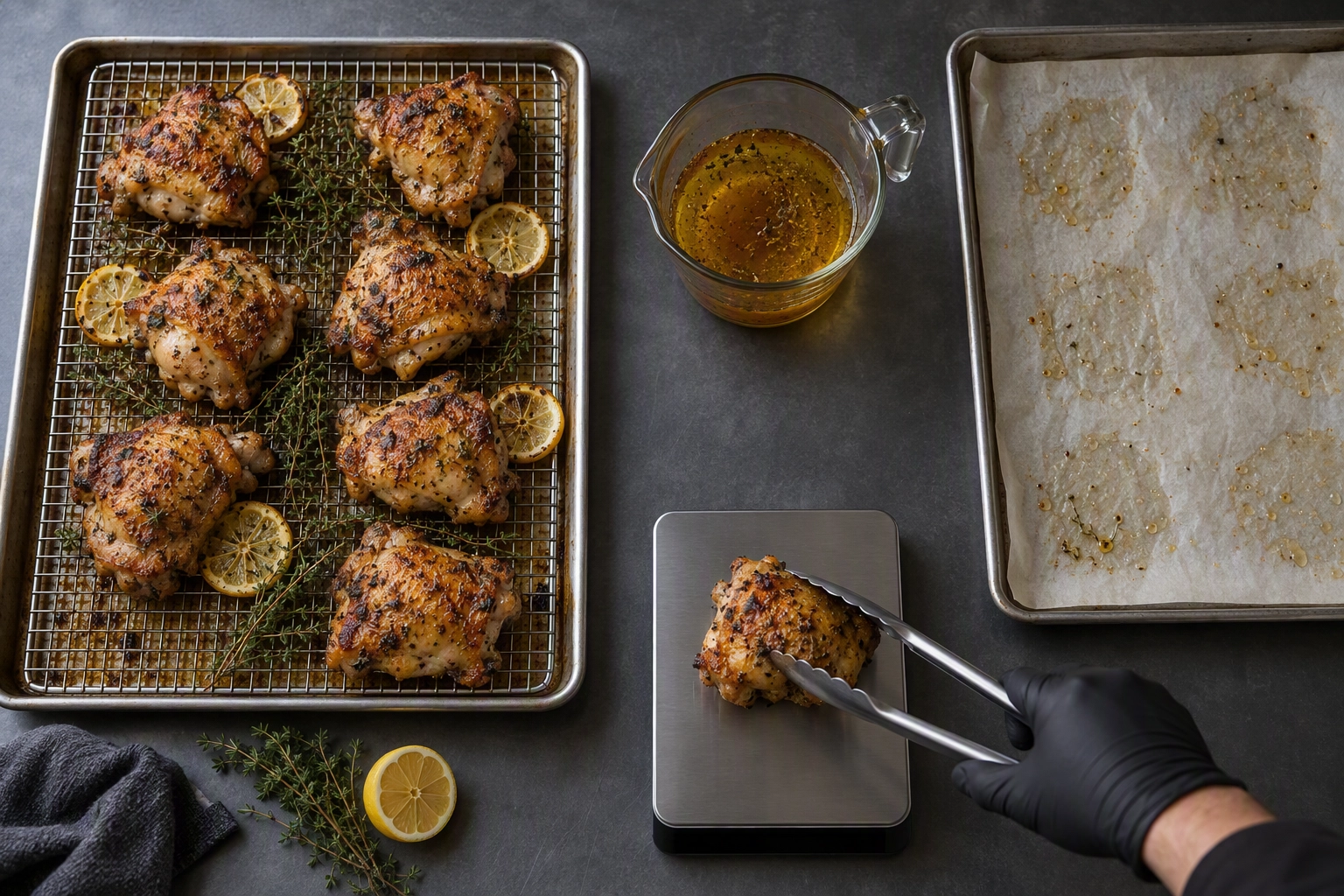 Roasted chicken thigh test batch with its drained pan juices, weighed to find cooked yield for catering tray food cost
Plate cost vs period cost
A food cost calculator gives you plate cost: what a dish should cost when the recipe is followed. Period cost is what you actually spent, measured from inventory:
Period food cost % = (opening inventory + purchases − closing inventory) ÷ food sales × 100
Example week: $8,200 opening stock plus $11,400 purchases minus $7,900 closing stock means $11,700 used. On $36,000 of food sales, that's 32.5%. If plate costs weighted by what sold come to 29.8%, the 2.7-point gap is $972 lost to waste, heavy portions, comps, theft or stale numbers.
Many operators treat a one-to-two-point gap as normal and anything wider as a reason to walk the line. Inventory management software can automate the count (see our AI tools for restaurants roundup), but a clipboard works. If the gap stays wide for months, owners often bring in a restaurant consultant or food consultant.
What food cost percentage should you target?
| Concept type | Typical target |
|---|---|
| Quick service, fast casual | 25–32% |
| Casual full service | 28–35% |
| Fine dining, steakhouse | 30–40% |
Treat these as sanity checks, not goals. A $42 steak at 38% earns $26.04; an $18 pasta at 22% earns $14.04. Dollars pay rent, percentages don't. Trucks and delivery-only kitchens carry event fees, app commissions and kitchen rent on top, so see the food truck business plan, food truck concepts, ghost kitchen planning and Uber Eats tactics.
Run the numbers before any discount too, and before repricing; our fall promotion ideas show the margin math per offer. Digital boards make the change cheap, and a new price lands best on a page built for it (menu design, descriptions that sell).
Once a dish is priced and on the menu, it needs a photo that sells it; our menu engineering breakdown shows which plates to shoot first.
Frequently Asked Questions
How do I calculate food cost for one menu item?
Weigh each ingredient at the served portion, convert invoices to unit prices, divide by yield, multiply by portion and sum. Divide that plate cost by what you charge and multiply by 100.
Is 30% a good food cost percentage?
For most casual restaurants it's a reasonable middle; quick service runs lower, fine dining higher. Better tests: gross profit per plate, and period cost within two points of plate cost.
Should packaging count as food cost?
For takeout, delivery and catering items, yes: the cup, clamshell or pan leaves with the food. Track it as its own line item if you like, but price it in.
Does food cost include labor?
No. Labor sits in prime cost (food plus labor), which operators commonly keep under 60% of sales to protect profits.
How often should I update my food cost calculator?
Re-run a recipe the first time an ingredient moves 5% or more, and review the whole sheet quarterly. In 2026, watch beef.