Menu Descriptions That Sell: 18 Rewrites, 20-Word Rule
 Ali Tanis13 min read
Most advice on this subject tells you to add adjectives. Sizzling. Mouthwatering. Hand-crafted. That instinct is backwards, and it is why so many menu descriptions sound like one tired copywriter wrote every restaurant in town.
Your copy is not a compliment. It is a spec. Its only job is to move a guest from maybe to that one, and the words that do that work are nouns and verbs: what is in it, what the kitchen did to it, where it came from. Everything else is padding customers wade through while their table waits.
Below: a repeatable formula for menu descriptions, 18 rewritten examples, the length rules that change between a printed card and a delivery app, and the legal boundary almost every guide skips.
Quick Summary: Strong menu descriptions follow a fixed sequence — hero ingredient, method, origin or supplier, one sensory cue — and stop under 20 words. Delete anything that would not change a decision. Online, front-load the first line, because the rest is truncated behind a thumbnail.
The five-slot formula for menu descriptions
Write the slots in this sequence every time, and any two people on your team create the same result. If a slot has nothing true to say, skip it — never fill it with an adjective.
- Hero ingredient. The thing you are selling. First noun, first position.
- Method. What the kitchen did: braised, cold-smoked, cured 21 days, charred over binchotan. Method is the cheapest luxury signal a restaurant owns: free to state, expensive to fake.
- Origin or supplier, only when real. A farm, a region, a boat, a mill. If you cannot produce the invoice, delete the slot.
- One sensory cue. One. Texture or heat, not both: crackling, cold, spoon-soft, lightly numbing.
- Stop. Twenty words, hard ceiling.
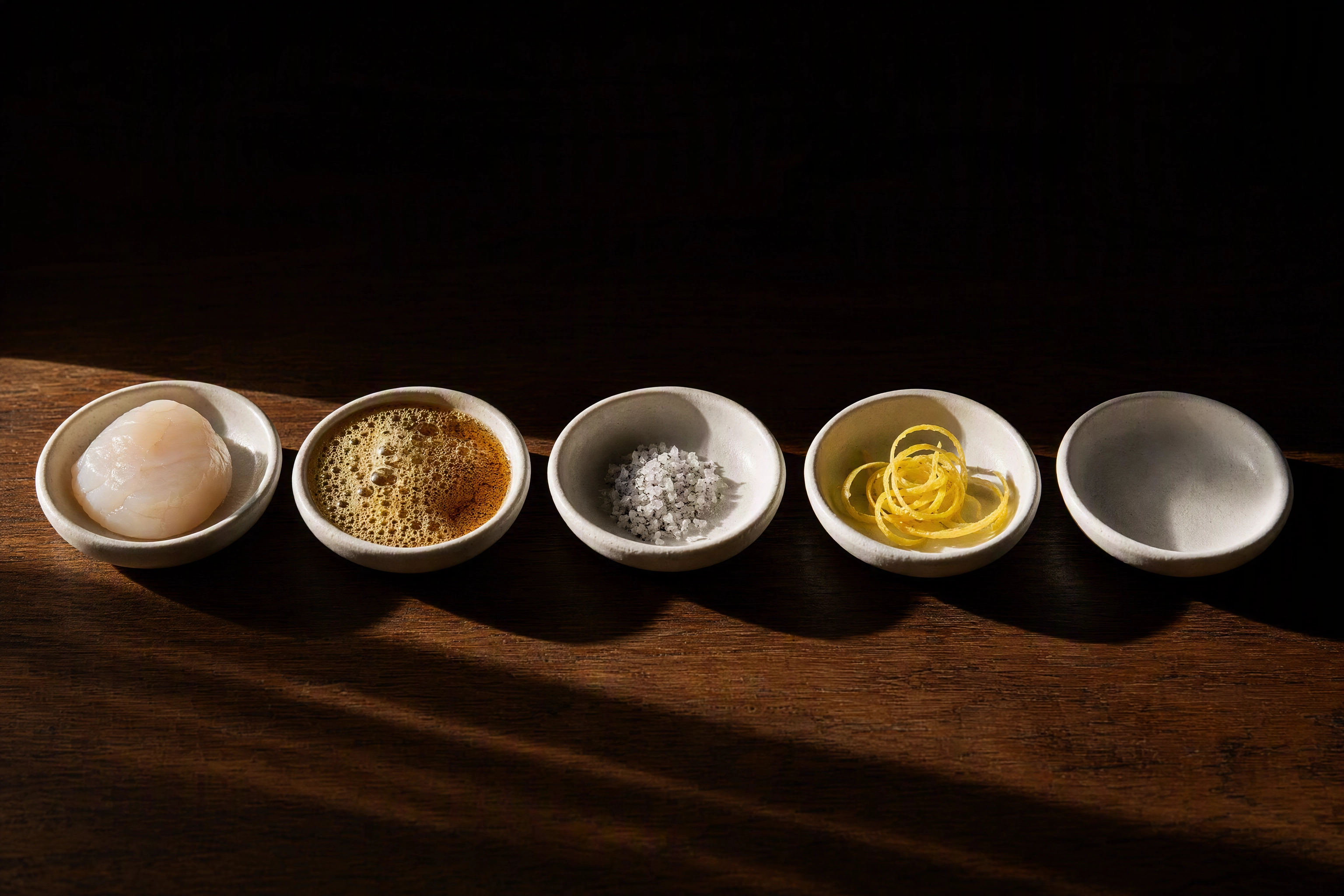 Five small dishes in a row holding one ingredient each with the fifth left empty, the five-slot menu description formula
Now run the deletion test. Take each key word and ask whether cutting it changes what a guest decides. Fresh never does — nobody advertises stale. Delicious never does. Our famous never does. Aged 45 days does. Yuzu does. Serves two does.
The formula scales because it is mechanical. It behaves the same on a printed card, on digital menu boards, on a food truck menu and inside a delivery app, and it hands the kitchen a spec instead of a mood. It pairs with menu engineering too: once you know which menu items carry the margin, you know which ten menu items to rewrite first.
18 menu descriptions, rewritten
Each pair runs before → after. The italic note is the key edit that created the change. Shoot them as carefully as you write them — our menu photography for restaurants guide covers the other half of the page.
Appetisers and small plates
- Calamari. "Crispy fried calamari with marinara." → "Salt-and-pepper squid fried in rice flour, lemon aioli." Rice flour explains the crunch; crispy only asserts it.
- Hummus. "Our delicious homemade hummus with warm pita." → "Chickpea hummus whipped with tahini and lemon, Kalamata oil." A compliment traded for two real ingredients.
- Wings. "Mouthwatering wings tossed in our signature sauce." → "Brined wings, twice-fried, gochujang and honey. Mild or brutal." Signature sauce says nothing; now the flavors have names.
- Burrata. "Fresh burrata with tomatoes and basil." → "Burrata, heirloom tomatoes, basil, aged balsamic, torn sourdough." Fresh out, the side in — what diners ask staff anyway.
- Soup. "A rich and hearty tomato soup made with love." → "Tomatoes roasted six hours with garlic, finished with cream." Time is proof; made with love is not.
Mains
- Steak. "Perfectly cooked ribeye with seasonal vegetables." → "Ribeye aged 45 days, grilled over oak, marrow butter, charred leeks." Vague adjectives swapped for a number, a fuel and a cut.
- Pasta. "Classic cacio e pepe, a Roman favourite." → "Tonnarelli, Pecorino Romano DOP, black pepper toasted in the pan." Three ingredients beat an adjective and a history lesson.
- Burger. "Our famous juicy burger with all the fixings." → "Dry-aged chuck and brisket, smoked cheddar, pickled shallot, potato bun." All the fixings hides what a hungry customer wants.
- Curry. "Authentic chicken curry with rice." → "Chicken thigh in Kerala coconut curry, curry leaf, black mustard seed." Authentic is a claim; a region and two spices are evidence.
- Salmon. "Fresh Atlantic salmon, pan-seared to perfection." → "Faroe Islands salmon, skin crisped, brown butter, capers, dill potatoes." Origin does the job fresh pretended to do.
Desserts
- Chocolate cake. "Decadent chocolate cake, a chocolate lover's dream." → "Flourless dark chocolate cake, 70% Peruvian, salted creme fraiche." One percentage and one origin outsell two cliches.
- Cheesecake. "Creamy New York style cheesecake." → "Baked cheesecake, burnt Basque top, cardamom. Cuts into two." A style name plus the sharing answer nobody printed.
- Affogato. "Vanilla ice cream with espresso poured over." → "Tahitian vanilla gelato drowned in a double espresso. Ninety seconds, then eat." A serving instruction persuades harder than naming the parts.
- Tiramisu. "Traditional Italian tiramisu made in house." → "Mascarpone tiramisu, savoiardi soaked in espresso and marsala, cocoa." Made in house is table stakes; the soak is the sell.
Drinks
- Margarita. "Our classic margarita, shaken and refreshing." → "Blanco tequila, lime pressed per drink, agave. Salt on request." Pressed per drink is a checkable operational fact.
- Wine by the glass. "A crisp and refreshing white wine." → "Assyrtiko, Santorini. Volcanic, high acid, drinks like a squeeze of lemon." Grape and place first, then one honest note.
- Iced coffee. "Delicious iced latte with our house blend." → "Double ristretto over ice, whole milk, Ethiopian natural. Tastes of blueberry." Named flavors beat "house blend", which describes nothing.
- House soda. "Homemade lemonade, sweet and tangy." → "Lemon and thyme soda, pressed daily, lightly sweet. Free refills." The refill line converts more customers than any adjective.
Fourteen of those eighteen dishes got shorter. That is normal, and it is the clearest example of what the formula does to a restaurant menu.
Length and tone: dine-in versus delivery app
The same dish needs two descriptions, because the customer is doing two different jobs.
Dine-in menus
Diners read a printed card in sequence, comparing dishes against neighbours, so 12 to 20 words is the working range and tone can carry some of the experience the room is selling. Vary your openers: five items beginning with "slow-cooked" flattens the page. Give the longest line to the highest-margin plate — length signals importance whether you intend it or not. Keep the rest short enough that the page still breathes. To rebuild the page itself, how to design a restaurant menu covers layout, and menu board design covers counter service.
Delivery-app listings
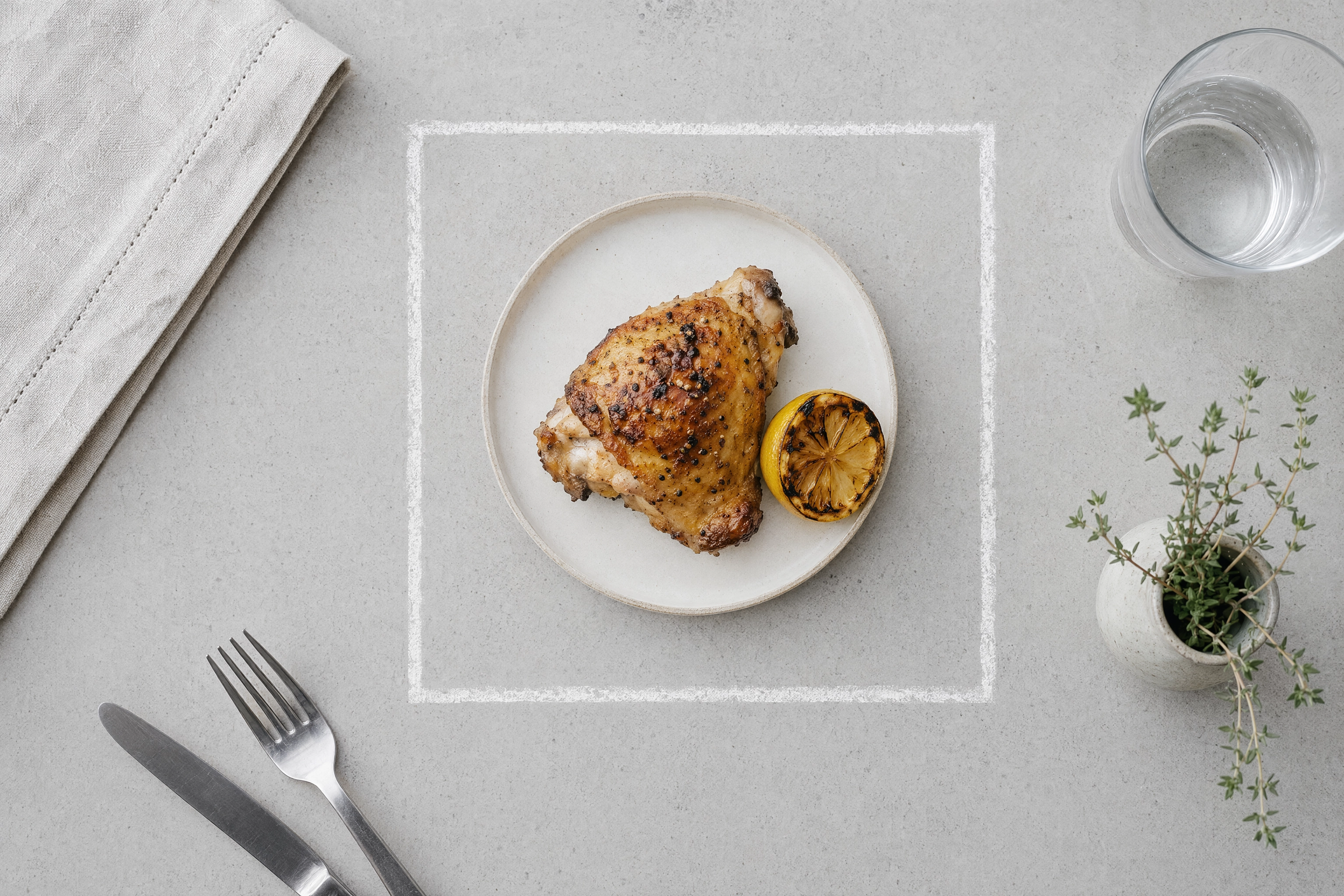 Chalk square drawn tightly around a plated dish while the table setting spills outside it, how a delivery app crops a listing
Online ordering changes everything, and menu descriptions have to change with it. Nobody experiences the page in sequence; customers scroll a grid, and the text truncates after a line or two, with the cut-off varying by app, device and font size. Write as though only the first 60 characters survive — hero ingredient and method go there, and the rest is a bonus for anyone who taps through. Skip brand voice in that opening line; it spends the only characters guaranteed to be seen. DoorDash publishes its own merchant guidance on menu items, and the same front-loading logic applies. Uber Eats' merchant team states that item descriptions and photos together can boost menu conversion by up to 50%. For the rest of the funnel, see our Uber Eats ordering guide and the DoorDash version.
The words to cut first
Delete on sight: delicious, mouthwatering, savory, scrumptious, tantalising, perfectly, generous portion, our famous, world-class, made with love, homemade, and any line opening "a symphony of". Each describes your opinion of the food rather than the food itself. Customers discount them the way they discount a five-star review with no details behind it. Swap each for concrete details: a cut, a time, a temperature, a place, a producer.
Cuisine changes the language
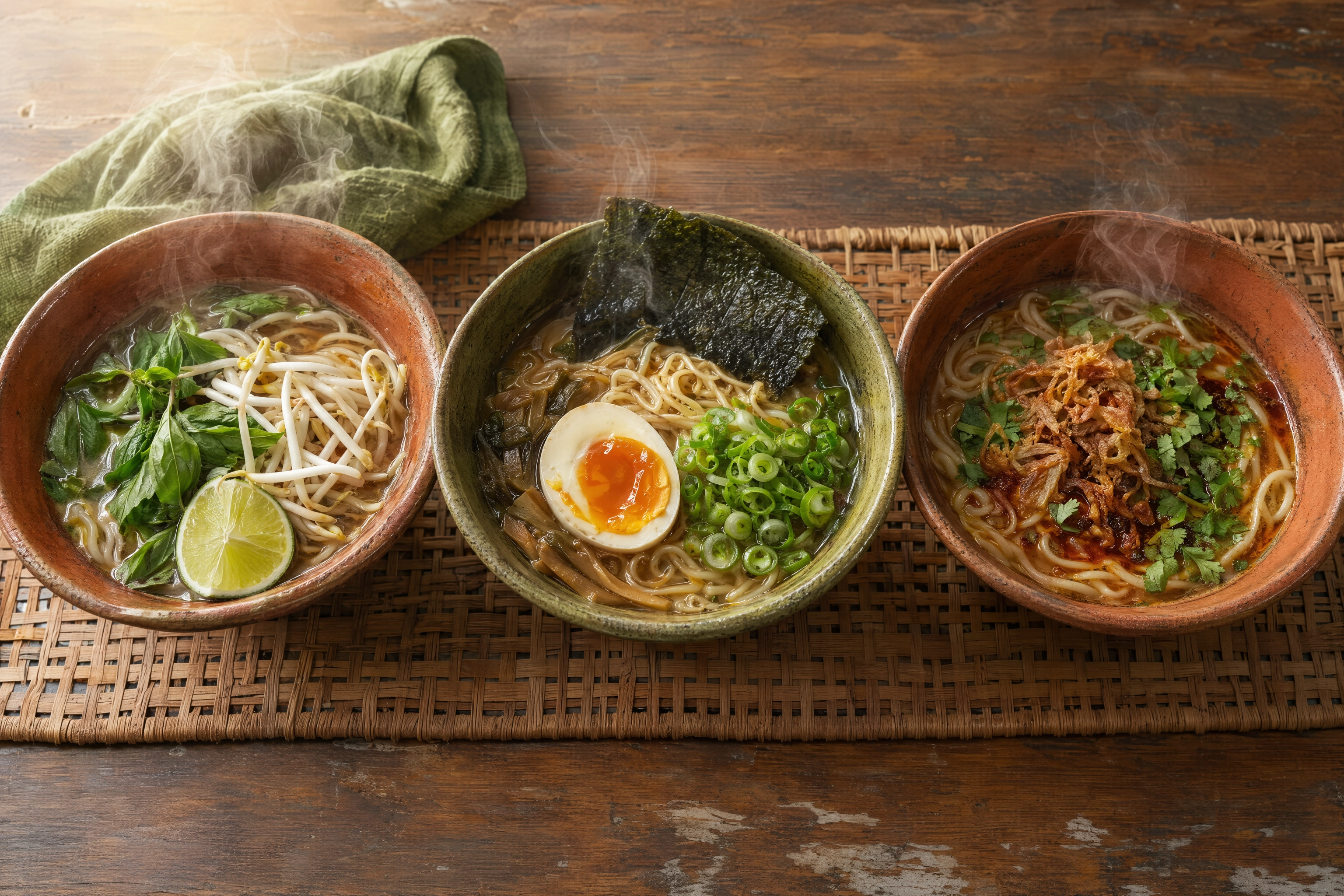 Three similar noodle soups from different cuisines side by side, showing why menu language must stay cuisine-specific
Do not translate a dish into English mush. "Beef noodle soup" throws away what pho bo carries, and "spicy pork stew" is not jjigae. Print the real name, gloss it once in four words, and trust people. The exception is a term genuinely opaque to your market: lead with the recognisable anchor, then the true name. Our cuisine photography pages show how visual language shifts alongside vocabulary, from pasta plating to sushi presentation.
The legal line most menu guides skip
Menu descriptions are advertising, so it is important to know where the edge sits before writing near it. Descriptions create expectations, and the kitchen has to meet them. Two kinds of wording carry real exposure for a restaurant.
Allergen and dietary wording
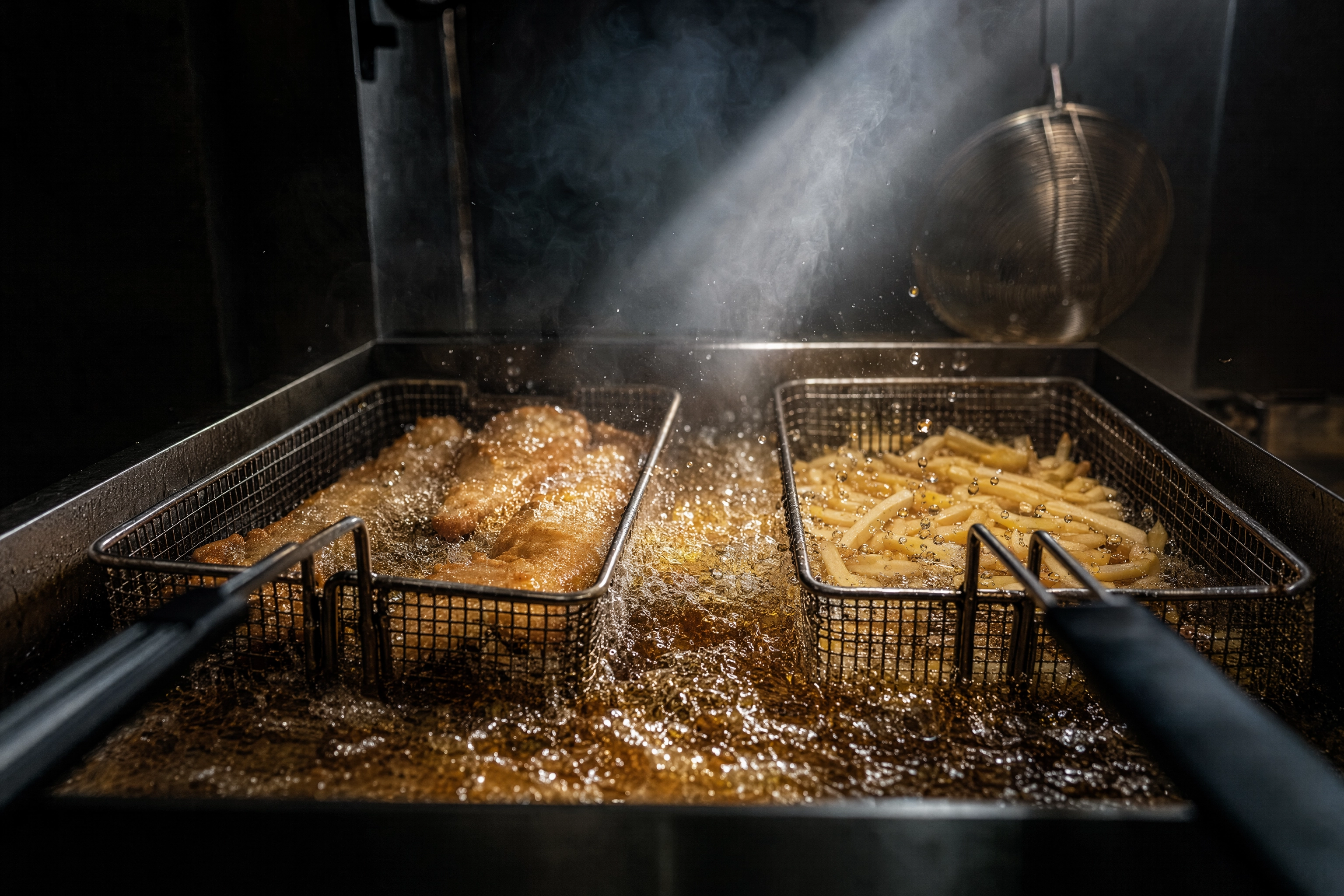 Battered fish and plain potatoes frying in one shared vat of oil, the cross-contact problem behind gluten-free menu wording
US federal allergen law — FALCPA, plus the FASTER Act that made sesame the ninth major food allergen from 1 January 2023 — governs packaged goods, not the plate a kitchen cooks for you. No federal rule forces a restaurant to print allergens, though several states impose their own. That cuts both ways: nothing obliges you to list them, but anything you do print becomes a representation. Diners with allergies experience your card as a promise, so "gluten-free" beside fryer output sharing oil with battered items is a dietary claim you cannot support. Use "contains" for certainty, "prepared in a kitchen that also handles…" for shared equipment, and train staff to help customers with dietary questions rather than pointing at the card. Chains of 20 or more locations carry a separate duty: the FDA's menu labeling requirements mandate calorie disclosure.
Origin, grade and supplier claims
Name a farm only if you can produce the invoice. Breed and grade language is the usual trap: wagyu names a breed and is used widely, while Kobe is a protected regional designation almost no kitchen outside Japan may legitimately claim. American origin wording tightened this year. Under the USDA's voluntary U.S.-origin labeling rule, effective 1 January 2026, "Product of USA" needs an animal born, raised, slaughtered and processed here, with documents to match. The FTC's Made in USA standard governs advertising generally, and a menu is advertising.
On a delivery app, the photo does most of the work
On a printed card the words are the whole listing. In an app the description and the photo are the entire experience, and the thumbnail is what stops the scroll — perfect copy on a grey, badly lit plate loses to average copy on a photo that looks like food. Write the copy and shoot the image as one job. A photo menu usually moves numbers faster than a copy pass alone, and that is where FoodShot AI helps: it turns a phone snap into a 2K, menu-ready shot in about 2 minutes, so the picture beside your new copy is not the weak link. See also delivery app photography and the specs for Uber Eats and DoorDash.
A 20-minute audit of your existing restaurant menu
- Export the item list and sort by contribution margin. Fix the top ten only.
- Count every line. Anything over 20 gets cut, not rewritten.
- Circle every adjective. Replace each with a noun, a method or a number.
- Read the page aloud. If two dishes open the same way, change one. A steak and a salad should not share an opener.
- Check that every origin claim has an invoice behind it.
- Look at the photo beside each item. If your copy now beats the picture, the picture is the bottleneck — our menu photography and menu photoshoot guides cover it.
Create a house rule from step two and your menu descriptions stay short for good. It is an easy, boring routine, which is why it keeps working while everyone else hunts for another word meaning "tasty".
Frequently Asked Questions
How long should menu descriptions be?
Twelve to twenty words for dine-in, front-loaded for online ordering because customers ordering on a phone see a truncated line. Under six usually means you skipped the method or the ingredients, the two slots that actually sell. Past twenty, customers stop mid-item and pick something simpler.
Do menu descriptions increase sales?
Probably, but be careful with the numbers you get quoted. The famous "27% sales lift from descriptive labels" traces to a 2001 Cornell paper by Brian Wansink, who was later found by Cornell to have committed academic misconduct, resigned, and has had 18 papers retracted. Treat it as folklore. The defensible evidence comes from platforms measuring live behaviour and from your own before-and-after item mix.
Should every dish be described?
No. Describe dishes that need explaining or that carry margin. A cheeseburger does not need a paragraph; your hundred-dollar fine dining chop does. Blank space beside a familiar name is a design decision, and it makes the menu descriptions you do write louder.
How do delivery apps change the rules?
Three ways. The opening line is the only guaranteed-visible part, so the hero ingredient goes there. Your text competes with a thumbnail, not with the item above it. And no server is there to help, so resolve the top question — heat, size, what it comes with — inside the text. Delivery-first operators should also see ghost kitchen menu planning and our delivery app use cases.
Can AI write menu descriptions for you?
It drafts, it cannot verify. A model does not know your supplier, your ageing time or your allergen process, so it creates plausible versions of all three — exactly where the exposure sits. Use it for a first pass on low-stakes items, then apply the five slots and the deletion test yourself. We compared the tools in AI menu generators.
What are the best tips for a wine or cocktail menu?
Lead with grape or spirit, then place, then one structural note — the same five slots, shorter. Skip tasting poetry nobody can verify. Our wine and cocktail photography guides cover the visual half, and restaurant brand voice covers tone across the whole guest experience.
Menu descriptions are the cheapest lever a restaurant owns. Rewriting ten is a morning's work, it costs nothing, and unlike a price rise, no customers resent it. Start with the dishes that make money and let the formula do the writing.