Best Food Photography Classes & Workshops (In-Person & Online)
 Ali Tanis19 min read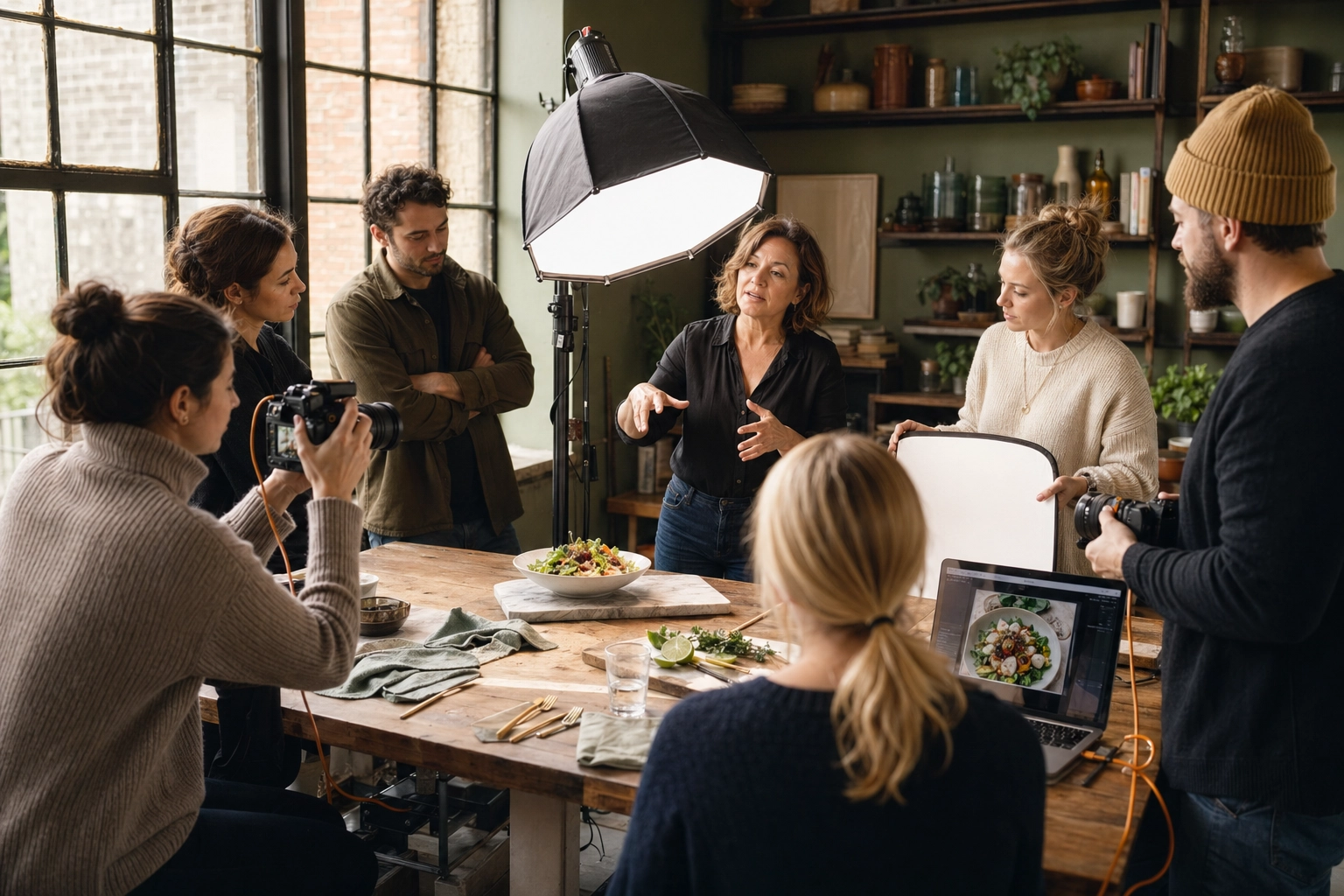
Anyone can watch a food photography tutorial on YouTube. Almost nobody learns to shoot great food photos that way.
The reason isn't the videos — there's plenty of free content that's genuinely excellent. The reason is that food photography is a hands-on craft. You can read about controlling shadow falloff with a 4×6 diffuser for 200 hours, but until you've actually moved that diffuser two inches to the left while staring at a tethered laptop and your instructor says "stop right there" — you don't really know what you're seeing.
That's what an in-person food photography class gives you that no online course or blog post can.
Quick Summary: In-person food photography classes range from $150 single-day workshops to $1,850 multi-day intensives at schools like Maine Media Workshops. The best options live at photography schools (ICE, ArtCenter, Maine Media), independent photographer studios, and culinary school continuing-ed courses in major cities. If you want self-paced online learning instead, see our best online food photography courses guide. And if you're a restaurant owner who needs menu photos this week — not in six months — AI food photo enhancement skips the learning curve entirely.
This guide covers in-person food photography classes specifically — workshops where you actually shoot, get critiqued, and meet other photographers. For self-paced courses you can take at 2 a.m. in your kitchen, our online food photography courses review covers those in detail.
Why an In-Person Food Photography Class Beats a YouTube Tutorial
I'll be direct: most online food photography content teaches you what to do. In-person classes teach you why your specific photo isn't working — which is the only feedback that actually moves your skill forward.
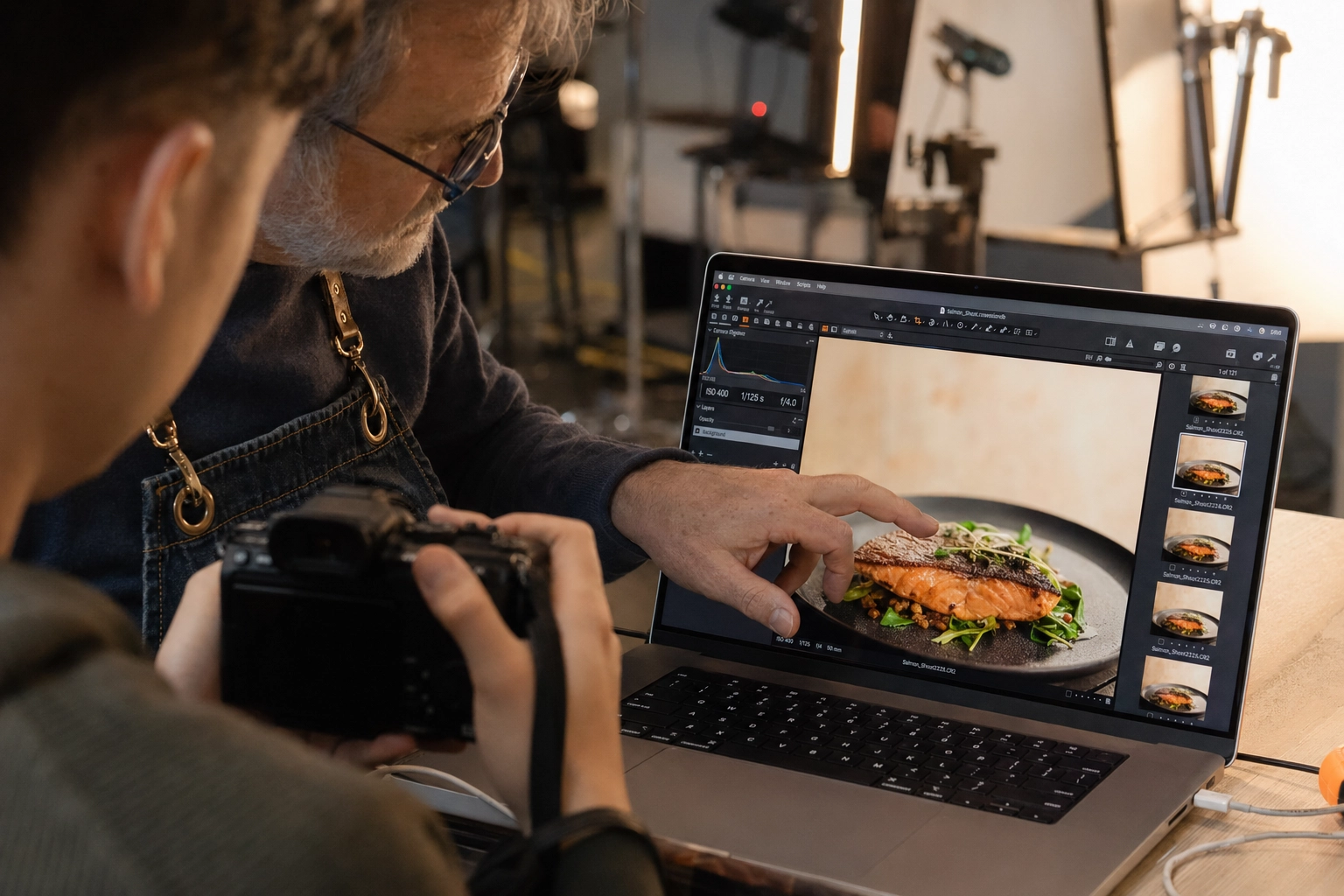 Photography instructor providing real-time feedback on tethered laptop preview during food photography workshop
Here's what changes when you're in the room:
Real-time feedback on your photos, not generic advice. Online courses show you a hero shot with leading lines through a fork handle. In a workshop, the instructor walks over, looks at your laptop, and says, "Your fork is pointing at the edge of the bread, not at the dish — flip it 30 degrees." That kind of correction takes 5 seconds and saves you 50 hours of unguided practice.
Hands-on lighting setups you wouldn't buy yourself. A serious workshop has Profoto strobes, multiple modifiers, V-flats, scrims, tethering rigs, and dedicated food-styling tables. Buying that gear costs $5,000+. Learning to use it in a class teaches you what you actually need before you spend a dollar.
Working with real plated food. Most home practice happens with whatever's in your fridge. A workshop hands you eight perfectly plated dishes from a chef and a food stylist. You learn how plating choices, garnish placement, and steam work in a controlled environment.
Networking that turns into work. Multiple workshop instructors confirm the same pattern: students hire each other, recommend each other to clients, and form long-term collaborator relationships. Photography is a relationship business, and YouTube doesn't introduce you to anyone. Communities like r/foodphotography extend that network online and through social media, but the strongest bonds form in person.
Accountability. You actually shoot. You can't pause the workshop and finish later. By Sunday afternoon, you've taken 300 frames you'd never have taken at home.
The trade-off is obvious — in-person food photography classes cost more and require travel. But for the right person at the right moment, the speed of progress is genuinely worth it.
Types of In-Person Food Photography Classes (And What You'll Pay)
In-person food photography education isn't one product — it's at least six different formats with very different price tags and outcomes.
Single-Day Workshops ($150–$500)
Three to six hours, usually a Saturday. Morning is theory, afternoon is shooting. You leave with a few good photos and a basic mental model.
Examples: Boston Photography Workshops runs a beginner food photography day at this price tier. Photo UNO in Manhattan offers an interactive single-session class where the instructor guides you through shooting plated entrées under different lighting conditions. Photosprouts in San Francisco runs food photography workshops for students who already know manual mode.
Best for: Hobbyists, food bloggers in their first year, restaurant owners exploring whether photography is something they want to learn or outsource.
Limitation: One day isn't enough to internalize lighting. You'll go home excited and then forget half of what you learned within two weeks unless you practice immediately.
Weekend and Multi-Day Intensives ($600–$1,850)
Two to five days, usually with a residential or near-residential format. These are where serious skill jumps happen.
The standout in this tier is Maine Media Workshops + College in Rockport, Maine. Their week-long Food Photography workshop costs $1,850, caps at eight students, and includes hands-on shooting at the critically acclaimed restaurant Nîna June with chef Sara Jenkins. Maine Media has been running photography workshops since 1973 and is one of the longest-running residency programs in the country.
Poppy Bee Surfaces in Brattleboro, Vermont runs $1,200 three-day intensives multiple times in 2026 (April, June, October), plus a separate on-location workshop in September. Instructor Clare Barboza covers lighting, composition, prop styling, and food styling — and the class works for all skill levels.
Best for: Aspiring pros, people transitioning careers, photographers who want a portfolio refresh.
Multi-Week Photography School Classes ($300–$1,500)
Six to twelve weeks, usually one evening per week. The pacing matches how skills actually develop — practice between sessions, return with questions, build incrementally.
Chicago Photography School runs a six-week food photography class with Juliana Schneider, who's the Art Director and food photographer at Urban Accents. The capstone is shooting dishes for a national natural-foods restaurant chain whose marketing director reviews student work. That's a structured portfolio piece you can show real clients.
The Institute of Culinary Education (ICE) in New York and Los Angeles offers Food Photography with Natural Light as a recreational class, plus a Food Styling & Photography continuing education course taught by stylist Junita Bognanni and photographer Steve Legato.
Best for: Steady learners who want to build skills over a season, not a weekend.
College and Culinary School Programs (Tuition Rates)
If you want a credential, not just skills:
- ArtCenter College of Design (Pasadena, CA) — Pornchai Mittongtare, who's shot for Bon Appétit, In-N-Out, and GE Appliances for 20+ years, teaches a semester-long Food Photography elective in their Photography & Imaging program.
- NYU Steinhardt (NYC) — runs a Food Photography course in the Food Studies program, combining food culture coursework with photographic practice.
- Santa Monica College — offers a photography certificate program where food photography is one of the named career paths. At ~$46/unit for California residents, it's the most affordable structured option in this category.
- University of South Florida — has a Food Writing and Photography track within their journalism program with hands-on photo coursework.
- Le Cordon Bleu campuses occasionally offer food photography modules as electives in their culinary programs (varies by location).
Best for: Career-changers, photography minors, students who want a credential plus structured progression.
One-on-One Private Coaching ($200–$500/hour)
Many working food photographers offer private coaching sessions. Alexandra Shytsman in NYC, Karen Wise in Brooklyn, and Cyntia Apps in the Bay Area all offer private workshops. Corporate workshops (groups from food brands and agencies) are common at this tier too — Evi Abeler has run private workshops for OXO, West Elm, and Hot Bread Kitchen.
Best for: Photographers with specific gaps (I can't shoot drinks, I struggle with overhead shots) who want targeted instruction.
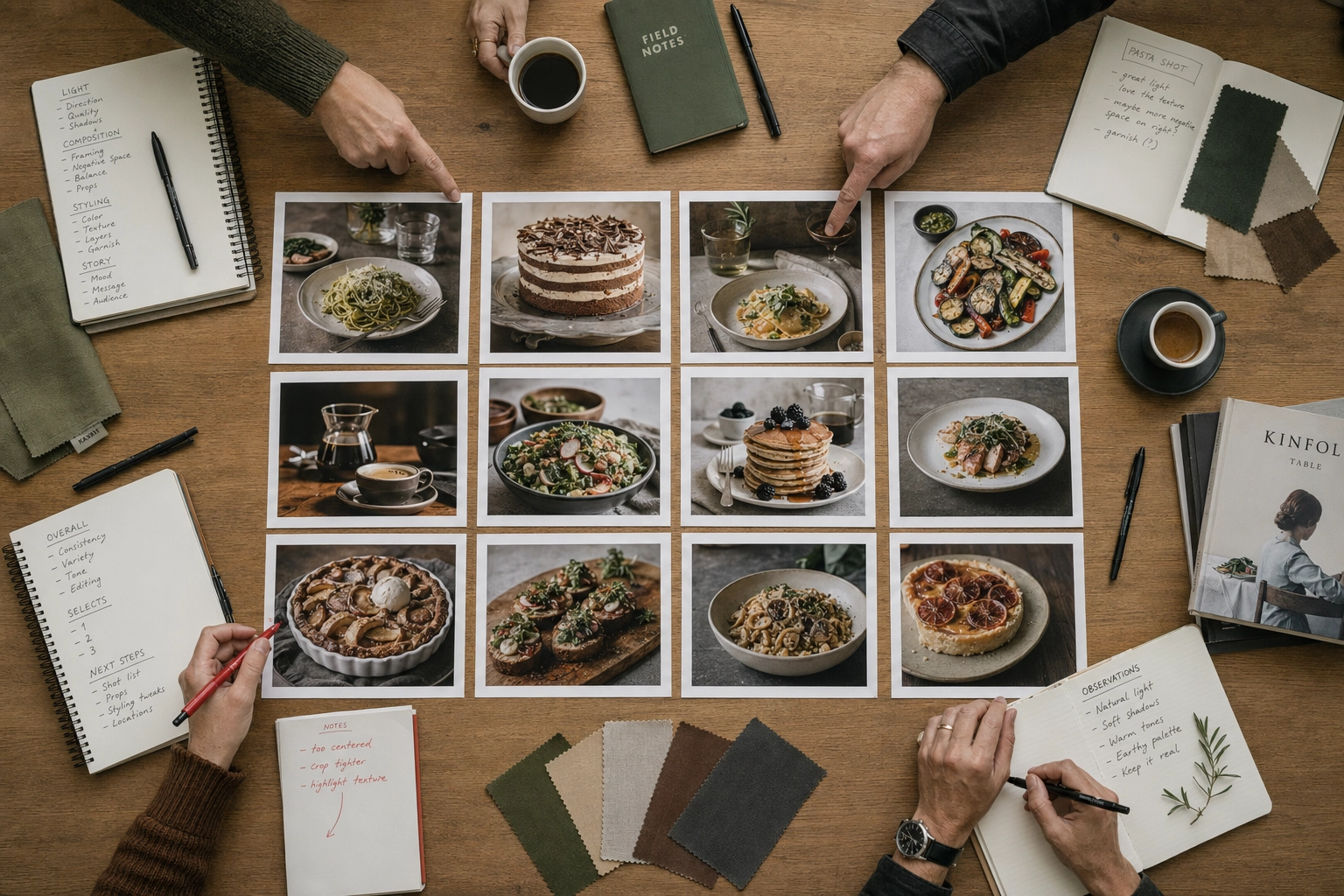 Workshop participants reviewing printed food photographs together during a portfolio critique session
Where to Actually Find Food Photography Classes Near You
Honest answer: dedicated food photography classes are rare outside major metros. Here's how to find them in order of reliability.
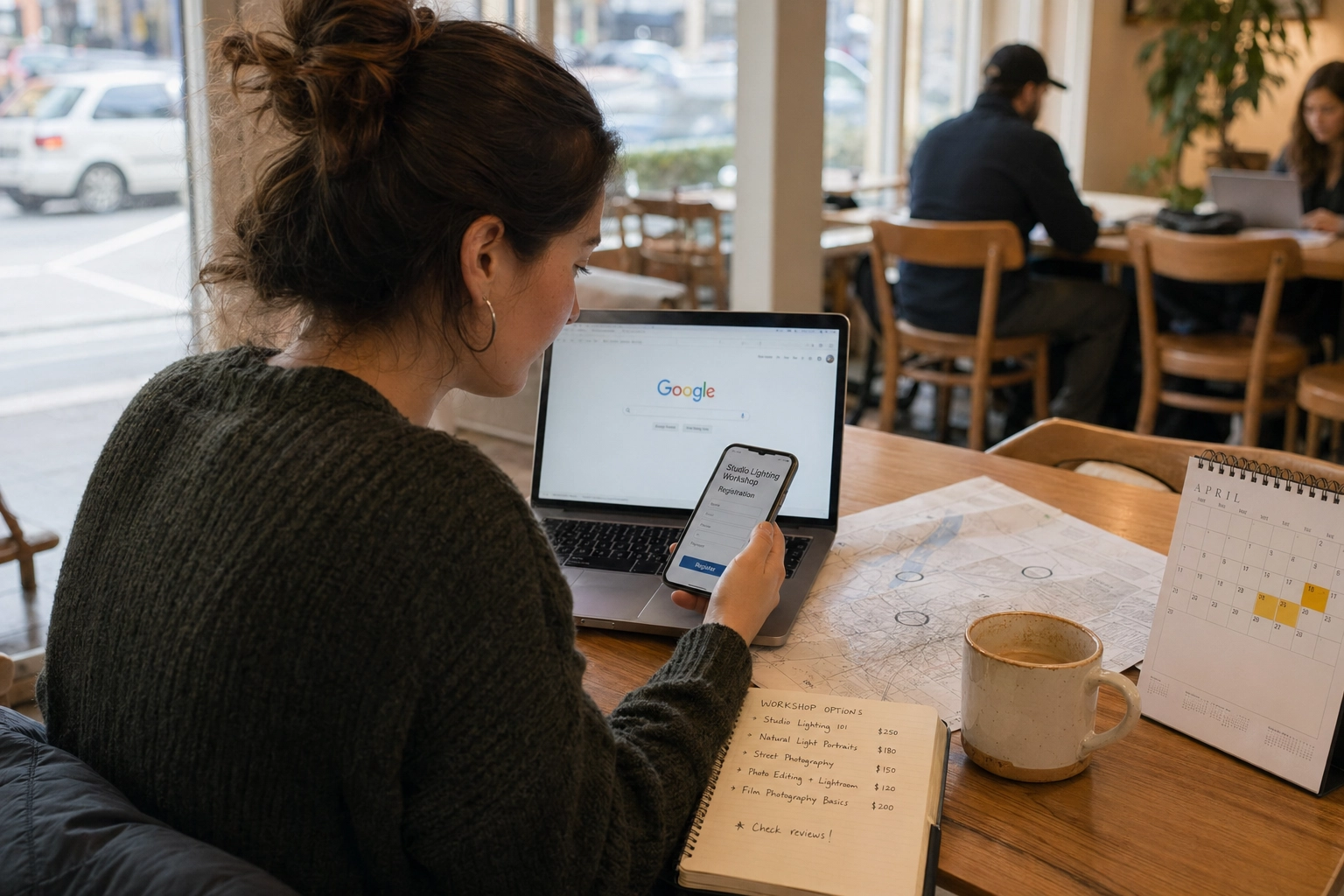 Aspiring food photographer researching local food photography classes near her in a coffee shop
1. Photography schools first. Independent photography schools (Photosprouts in SF, Chicago Photography School, Boston Photography Workshops, Maine Media) run food photography classes more consistently than any other type of provider. Search "[your city] photography school" and check their schedule.
2. Continuing education at culinary schools. ICE, the Culinary Institute of America (CIA), and some Le Cordon Bleu campuses run continuing-ed photography courses for people in food careers. These tend to be more affordable than dedicated photo schools and the food itself is excellent.
3. Independent photographer studios. Search "[your city] food photography workshop" with quotes. Many working food photographers run quarterly or seasonal workshops out of their studios. These are often the best value because the instructor is a current working pro.
4. University extension and community college photography programs. Most don't offer food-specific classes, but a strong fundamentals course plus self-directed food practice is a legitimate path. California community colleges are especially affordable.
5. MeetUp and Eventbrite. Search "food photography" filtered by your city. You'll find one-off workshops, photographer meetups, and brand-sponsored events on social platforms. Quality varies wildly. Read reviews.
6. Camera shop events. B&H Photo, Samy's, and many local camera stores run free or low-cost workshops featuring camera and lighting brand reps. Less curriculum, more product demo, but useful for trying gear.
A note about Sur La Table and Williams-Sonoma: Both run cooking classes — not photography classes. A two-hour Sur La Table cooking class costs around $79–$149, and Williams-Sonoma flagship stores host occasional cooking demos and private culinary events. They're great for learning to plate and present food, which is half of food photography. They aren't where you'll learn to shoot.
Top Food Photography Workshops by City
These are workshops verified to be running in 2026. Always check current schedules before booking.
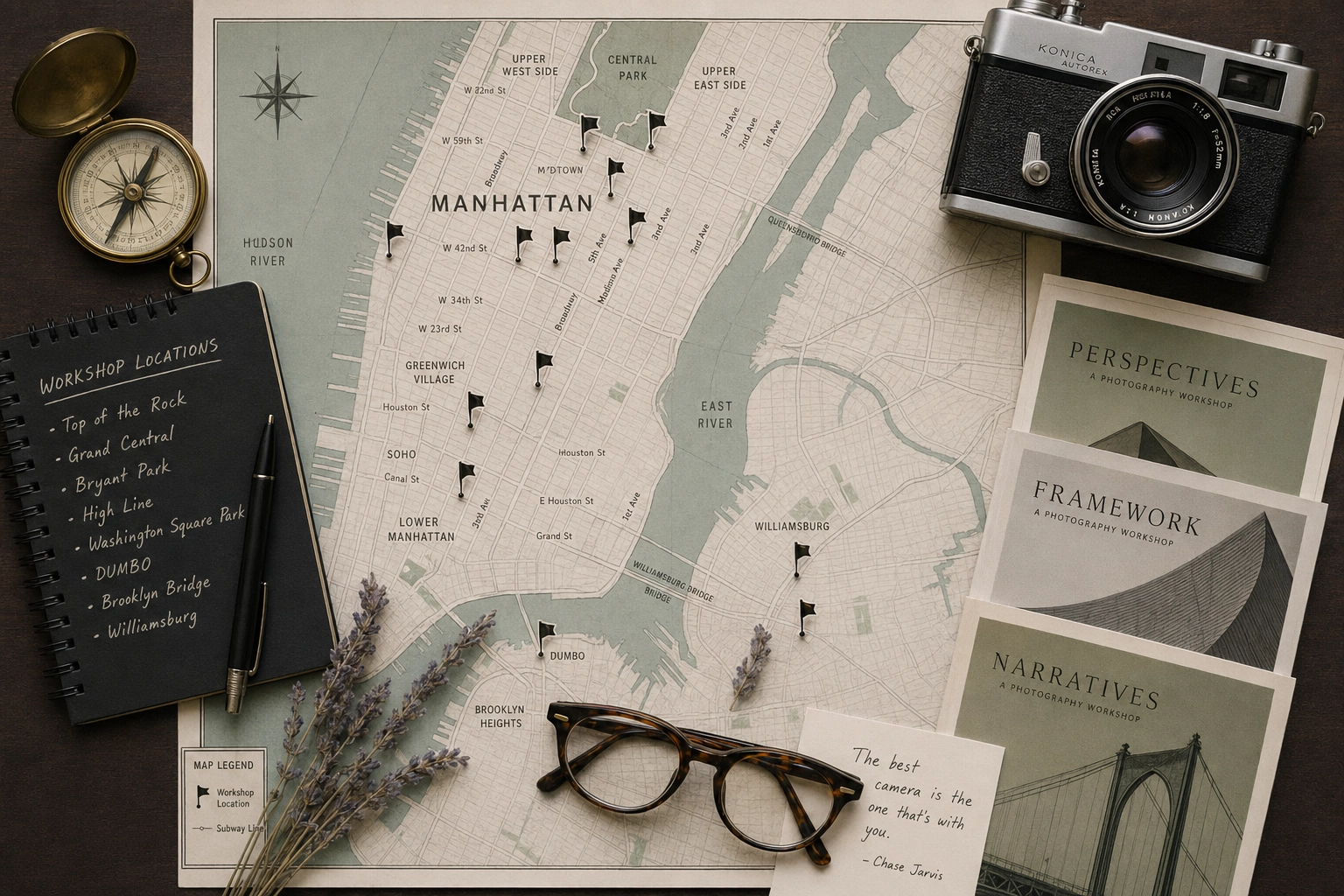 Map flat lay showing food photography workshop locations across major cities for class planning
New York City
- Institute of Culinary Education — Food Photography with Natural Light recreational class plus continuing-ed Food Styling & Photography track. Best for serious students who want a structured curriculum.
- NYU Steinhardt — semester-long Food Photography course (for-credit, requires university enrollment).
- Karen Wise Photography — periodic Brooklyn workshops historically held at Runner & Stone bakery and other working food spaces.
- Alexandra Shytsman — one-on-one and private corporate workshops; over 300 students taught and corporate clients including OXO and Tony's Chocolonely.
- Photo UNO — interactive single-session food photography class with provided entrées and instructor guidance through ambient, low, and flash lighting.
- Evi Abeler — group workshops covering image strategy, food and prop styling, editing, and Instagram-ready social media imagery.
Los Angeles
- ArtCenter College of Design — Pornchai Mittongtare's Food Photography elective in the BFA Photography & Imaging program (full-time enrollment required).
- Santa Monica College — affordable photography certificate with food photography as a named career track.
- TD Photographers — boutique LA/Orange County creative agency that periodically runs studio workshops covering food photography, food styling, and creative arts.
- Independent LA food photographers — many work out of Atwater Village and Echo Park studios offering one-on-one coaching.
Chicago
- Chicago Photography School — six-week food photography class with Juliana Schneider; capstone shooting for a national restaurant chain.
- Columbia College Chicago — continuing education photography offerings; check current schedule for food-specific topics.
San Francisco Bay Area
- Photosprouts — top-rated SF photography school running food photography workshops (manual-mode camera proficiency required).
- Cyntia Apps Photography — "Savor the Light" hands-on workshops at restaurants like Bouche SF, working with executive chefs in a real dining environment.
- Stanford Continuing Studies — occasional photography offerings; check seasonal schedule.
Beyond Major Cities (Destination Workshops)
- Maine Media Workshops + College (Rockport, ME) — $1,850 one-week food photography intensive with restaurant collaboration. The most established residency option.
- Poppy Bee Surfaces (Brattleboro, VT) — $1,200 three-day intensives with Clare Barboza; multiple 2026 dates. Strong for surfaces, styling, and on-location work.
- Rachel Shoots Food (Golden, CO) — multi-day workshops by appointment plus custom corporate workshops.
- International — many European and Australian instructors run weekend workshops in food capitals like Paris, Lisbon, Melbourne, and Copenhagen. Worth considering if you want to combine education with travel.
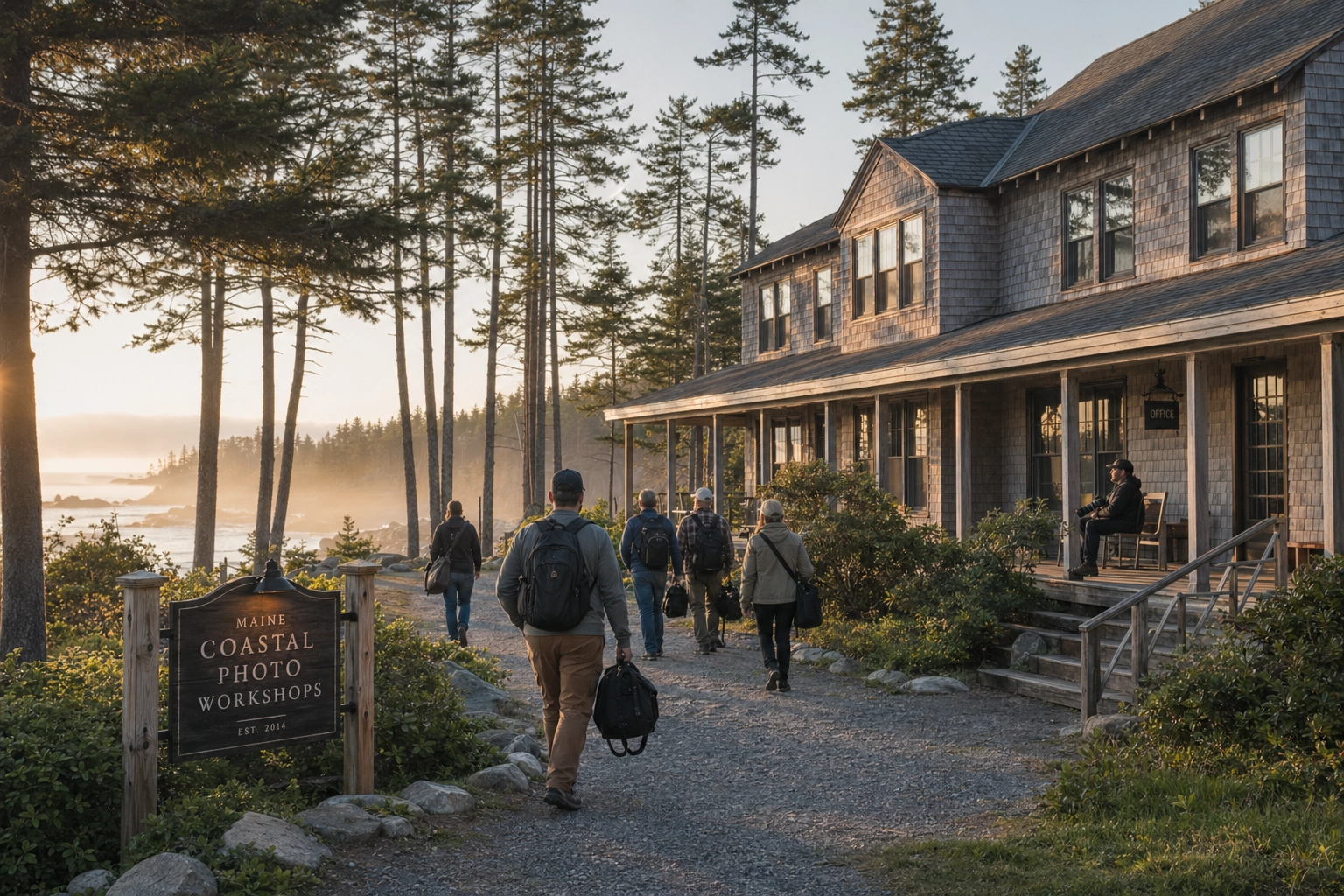 Coastal Maine photography workshop campus where students attend multi-day food photography intensives
What to Look For in a Food Photography Class
Class quality varies enormously. Here's what separates worth-it from waste-of-money.
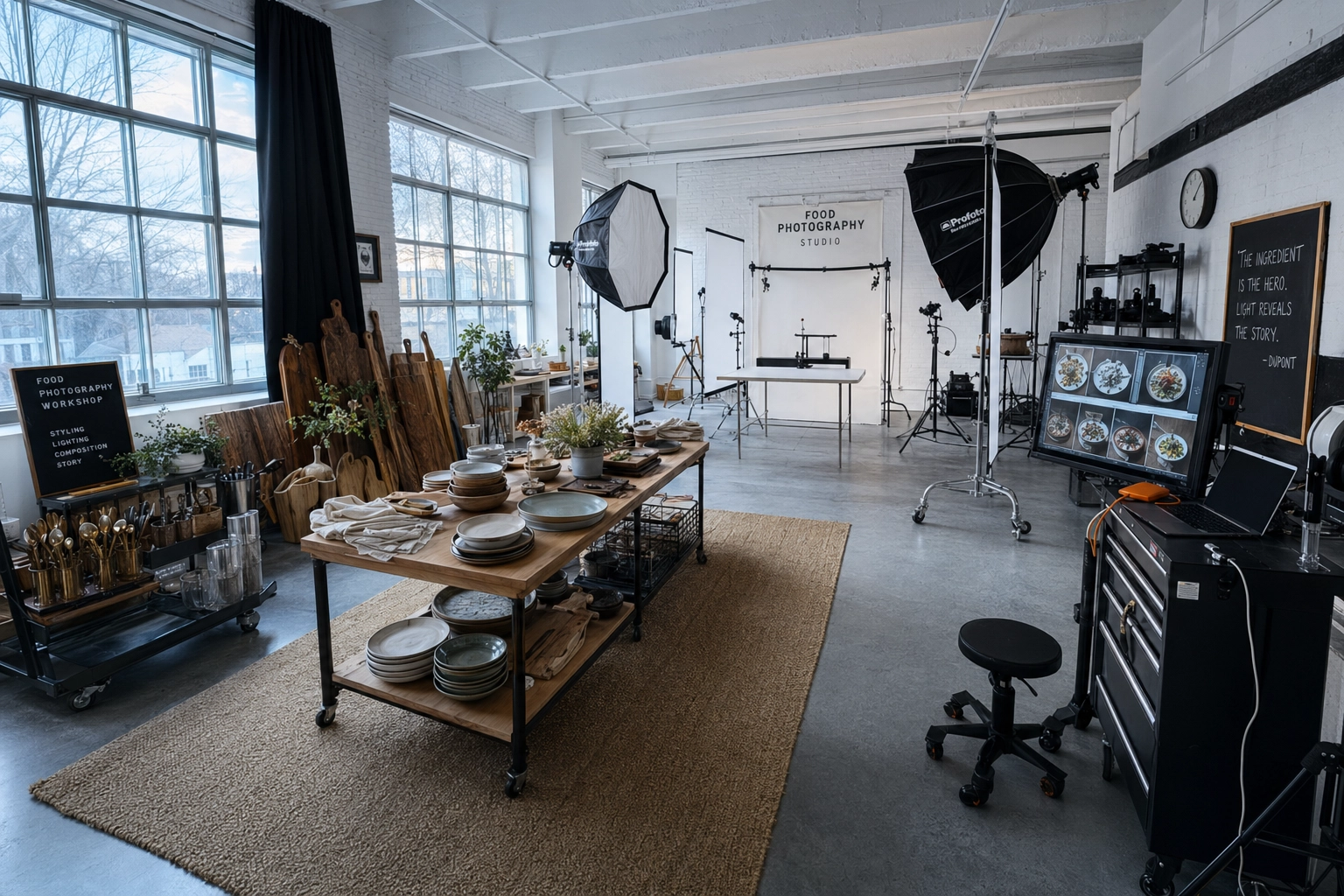 Professional food photography studio interior with proper equipment setup before a workshop class begins
Instructor credentials. Look for a working portfolio with named clients you recognize — magazines (Bon Appétit, Food & Wine, NYT), restaurant chains, or major food brands. "Award-winning" with no specifics is a red flag. A good test: can you find their published work on a major media outlet in 30 seconds of Googling?
Class size. Six to twelve students is the sweet spot for hands-on learning. Anything over 15 and the instructor becomes a lecturer rather than a coach. Maine Media caps at eight. Poppy Bee runs even smaller groups. That's not a coincidence.
Hands-on shooting time. Ask for a schedule. At least half of class hours should be active shooting, not lecture or demonstration. The best workshops are 70%+ hands-on with brief teaching segments between shoots.
Equipment provided. A good class provides cameras and lenses if you don't have them, lighting modifiers, tripods, props, surfaces, and food. You should not be expected to bring your own strobes for a $1,500 workshop.
Studio quality. Look for big windows for natural light, blackout capability for controlled artificial lighting, tethering setups (camera tethered to a laptop monitor for live review), and proper food styling space with a refrigerator and wash station.
Post-workshop support. The best workshops include some form of follow-up — a portfolio review, a private community, a 30-day Q&A window. This is where in-person learning compounds.
Real student reviews. Curated testimonials on a website are marketing. Check r/foodphotography on Reddit, Google Reviews, and social media comments for unfiltered feedback. Ask the instructor for student email references — pros will provide them.
Refund and cancellation policy. Workshops get cancelled for low enrollment or instructor emergencies. A reputable workshop has a clear refund policy. If the policy is "all sales final" — pass.
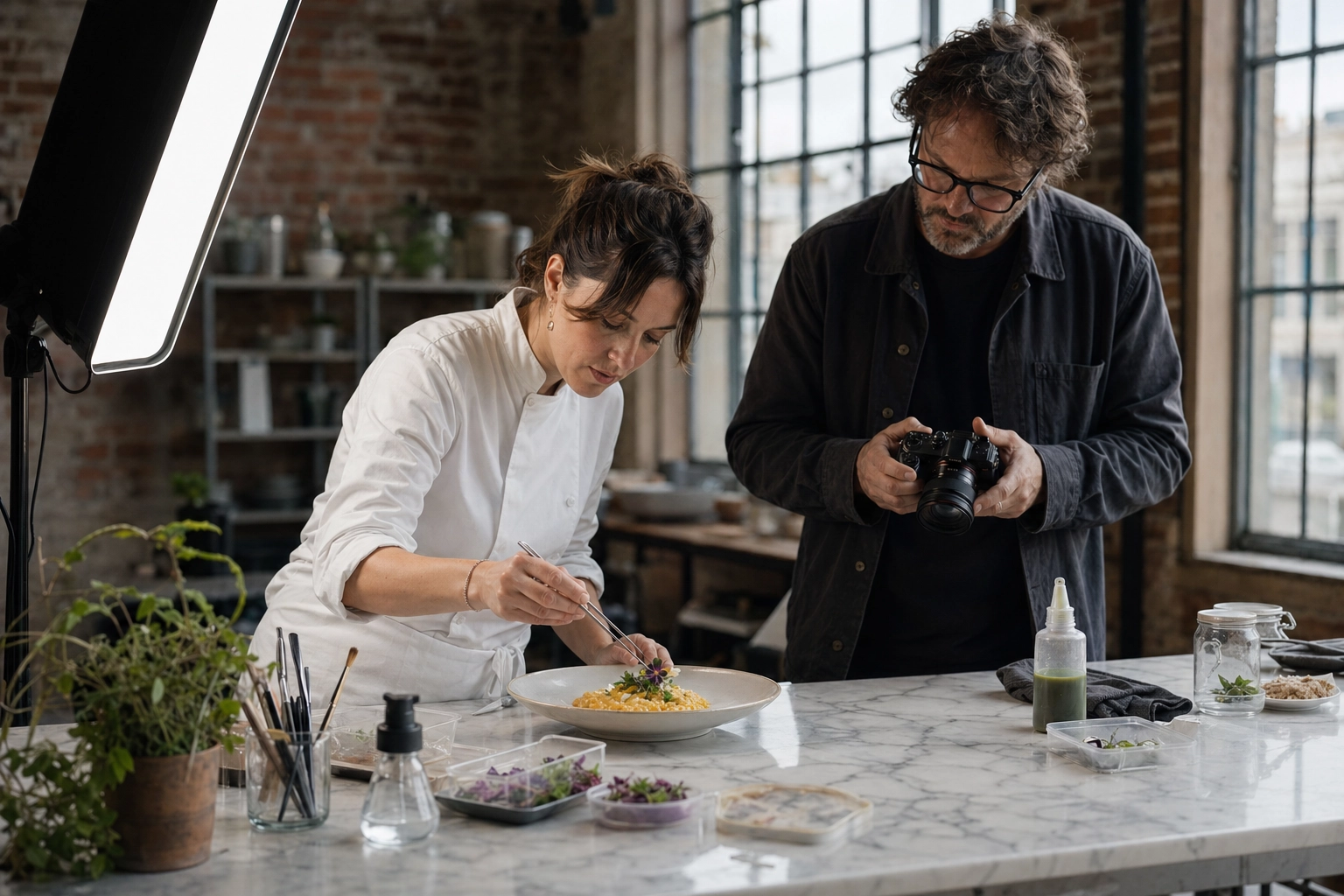 Food stylist and photographer collaborating during a hands-on food photography workshop with plated risotto
The Real Cost of Becoming a Food Photographer Through Classes
The class fee is the smallest line item in the actual budget.
| Cost Category | Realistic Range |
|---|---|
| Workshop or class fee | $150–$1,850 |
| Camera body (mirrorless or DSLR) | $800–$3,000 |
| Lenses (50mm + 100mm macro) | $400–$1,500 |
| Tripod and modifiers | $300–$800 |
| Lighting (strobes or LED panels) | $400–$2,000 |
| Props, surfaces, backdrops | $200–$1,500+ ongoing |
| Editing software (Lightroom, Capture One) | $10–$30/month |
| First-year total | $4,000–$12,000+ |
According to the U.S. Bureau of Labor Statistics, the median pay for photographers is around $40,000 annually — and that's after several years building a portfolio. The financial picture only works if photography is something you actually want to do as a craft.
The bigger investment is time. Realistic timeline from first workshop to client-ready portfolio is 6–18 months of consistent practice — usually multiple shoots per week, ongoing critique, and rebuilding your portfolio as your taste matures.
This is fine if your goal is to become a food photographer. It's a brutal path if your goal is just to have great photos of your restaurant's menu.
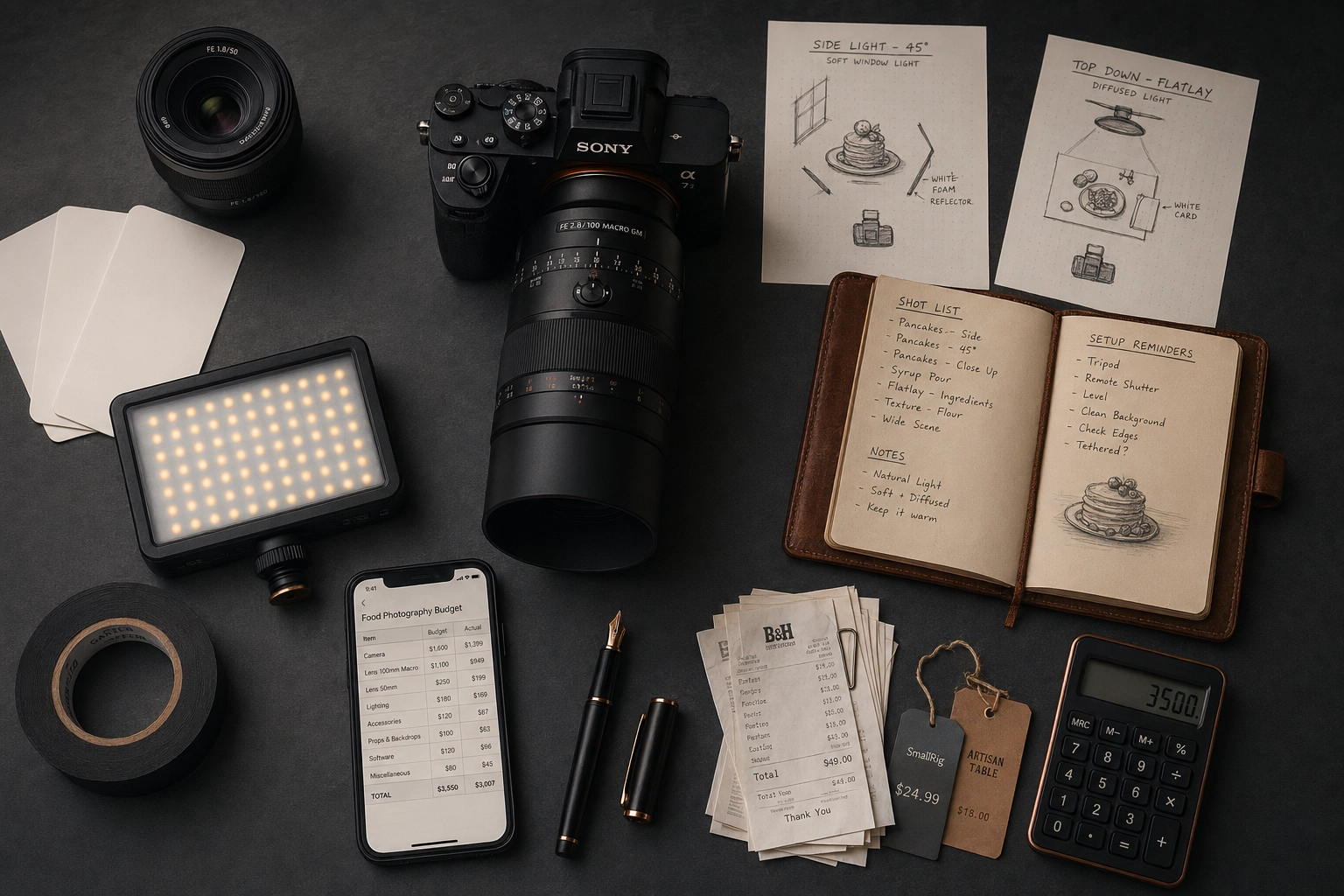 Food photography gear and budget materials laid out flat showing the real cost of becoming a food photographer
When You Don't Need a Class — The Restaurant Owner's Honest Path
Here's the conversation almost no photography workshop website will have with you.
If you're a restaurant owner reading this, you probably opened this article because your menu photos are killing your delivery app conversion. You don't have a sudden passion for f-stops. You need photos that look like they belong on Uber Eats next to the chains, and you need them by next week.
A food photography class will not solve this. Not because classes are bad — because the timeline doesn't work.
The realistic restaurant-owner alternatives:
Hire a professional photographer. Day rates run $1,000–$5,000 in major cities, plus food styling ($500–$1,200/day) and studio rental ($750–$2,500/day if you can't shoot on-location). A typical 10-dish shoot lands at $2,000–$5,000 once you add post-production. See our restaurant food photography guide for what to expect when hiring out, and our DIY vs pro vs AI photography comparison for the trade-offs.
Use AI food photo enhancement. Tools like FoodShot AI take a phone photo of your dish and turn it into a studio-quality menu image in about 90 seconds. The Starter plan is $9/month billed yearly with 25 credits, 200+ photography styles, 4K output, and a commercial license. That's the same cost as one pizza compared to four figures for a traditional shoot. See our pricing page for the full breakdown.
DIY with your phone. With reasonable lighting and basic composition, modern phones produce acceptable results. Our no-pro-gear food photography guide covers the essentials, and our 12 food photography techniques guide goes deeper on composition.
Plan a real photoshoot when it matters. For seasonal menu changes or marketing campaigns, our menu photoshoot planning guide walks through every step.
There's no rule against doing all four. Most operators we work with use AI for daily content and social media, hire a pro once a year for hero shots, and improve their phone photography over time as a side benefit.
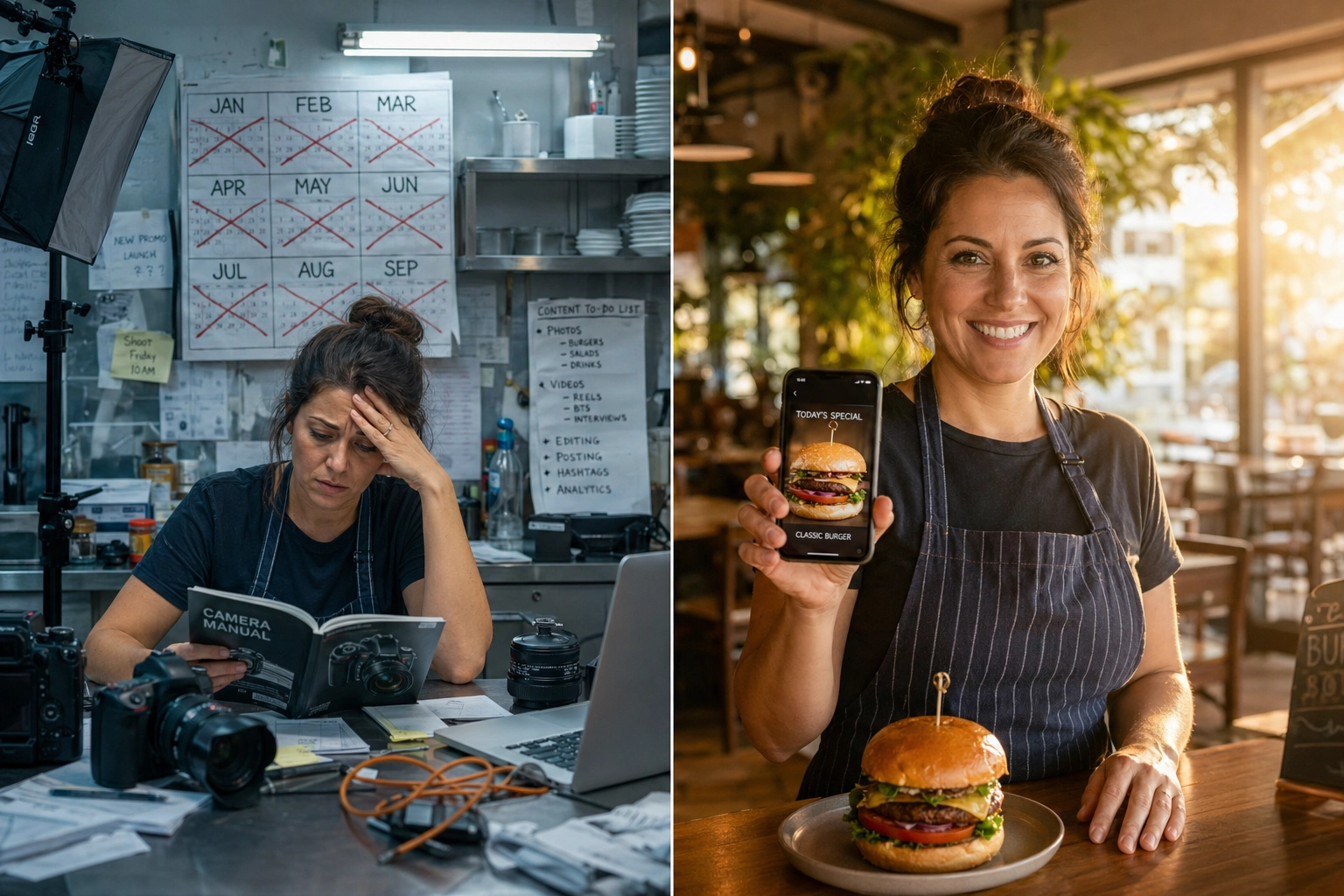 Restaurant owner choosing between long photography learning path and instant AI-enhanced menu photo solution
The honest version of this guide: take a food photography class because you want to become a better photographer. Don't take one because you need menu photos. Those are two completely different problems with two completely different solutions. If you're curious about whether food photography is a career fit at all, our food photographer career blog post covers the realistic path.
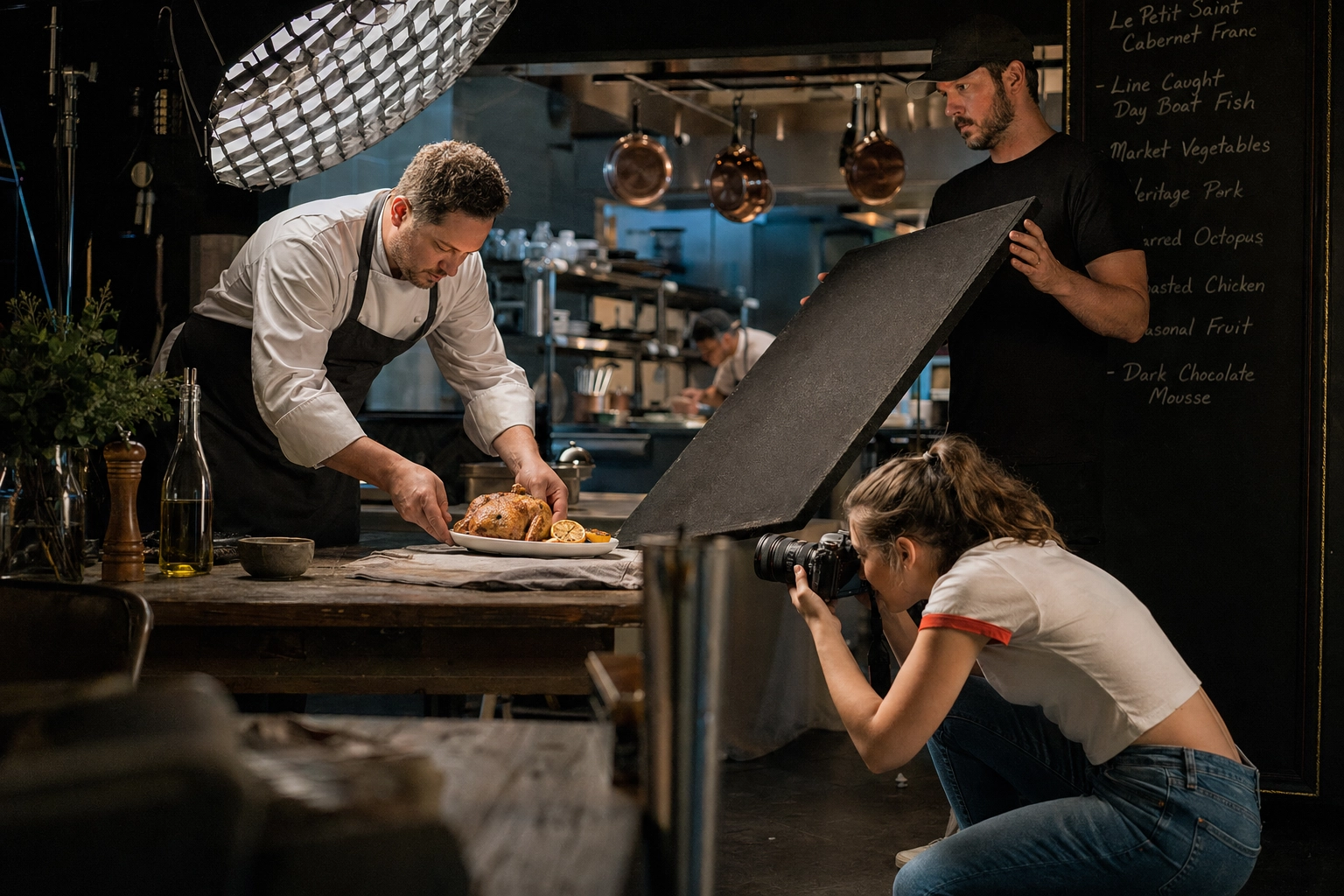 Food photography workshop participant shooting a chef plated dish on location at a working restaurant kitchen
Frequently Asked Questions
How much does a food photography class cost?
Single-day in-person food photography classes run $150–$500. Weekend and three-day intensives run $600–$1,200. Multi-day residencies like Maine Media's run $1,500–$1,850. College and culinary school courses charge regular tuition rates, which vary from ~$46/unit at California community colleges to several thousand per credit at private art schools. The most popular tier: weekend workshops in the $400–$700 range.
Are in-person food photography workshops worth it?
For aspiring professionals, yes — the real-time feedback, networking, and equipment access genuinely accelerate skill development in ways online courses can't replicate. For hobbyists, it depends on whether you'll keep shooting consistently after the class ends. For restaurant owners who just need menu and social media photos, no — the timeline is too long and the goal mismatch is too big. Pick the path that matches your actual goal.
Do I need my own camera for a food photography workshop?
Most independent workshops and intensives expect you to bring your own DSLR or mirrorless camera with at least one lens (50mm or 100mm macro is ideal for food). Many photography schools, college programs, and beginner classes provide loaner gear. A few smartphone-specific food photography workshops exist but they're less common in-person — that format works better as online courses. Always check the equipment requirements before booking.
What's the difference between a food photography class and a workshop?
A class is typically multi-session and structured — you meet weekly for six to twelve weeks, follow a progressive curriculum, and often complete graded assignments. A workshop is typically intensive and event-based — you spend one to five concentrated days shooting and getting critiqued, with limited curriculum but maximum hands-on time. Classes build broader fundamentals; workshops accelerate specific skills.
Can I find free in-person food photography classes?
Genuinely free in-person food photography classes are rare. Some public libraries occasionally run beginner photography programs. Camera brands (Canon, Sony, Fuji) sponsor occasional free events at retailers like B&H Photo. MeetUp groups are free but peer-led, not instructor-taught. Williams-Sonoma flagship stores sometimes run free Sunday cooking demonstrations, but those teach cooking technique, not photography. For free education, online resources are far better — see our online food photography courses guide for the best free YouTube channels and trial-period courses.
How long does it take to become good at food photography?
Realistic expectation: 6–18 months of regular practice after a workshop to reach genuinely portfolio-quality work. The class teaches you the framework; the practice between classes teaches you to see. Photographers who shoot weekly with ongoing critique progress fastest. Photographers who attend a single workshop and never shoot again forget most of what they learn within a month. If you want to see real portfolio progression, plan on at least 100 deliberate shoots in the year following your first class. For deeper learning between sessions, see our 12 food photography techniques guide and our commercial food photography overview.
Do online courses give the same results as in-person classes?
Not for most people. Online courses are excellent for theory, reference material, and learning at your own pace — and they cost a fraction of in-person tuition. But they don't replicate the most valuable parts of an in-person food photography class: live critique on your specific work, hands-on use of professional lighting, peer relationships, and the discipline of showing up. The strongest path combines both: take a self-paced online course first to learn fundamentals, then attend an in-person workshop to refine technique with feedback. Our online food photography courses review covers the best self-paced options.
The right food photography class can change your work in a weekend. The wrong one is an expensive nap. Be honest about what you actually want — to become a photographer, or to have great photos — and pick the path that fits. If you're chasing the craft, the workshops above are real, currently running, and worth your time. If you just need menu photos, FoodShot AI takes the same phone photo you already have and gives you back a studio-quality image in 90 seconds, no class required.