Best Food Photography Courses Online (2026 Review)
 Ali Tanis17 min read
Spending $500+ on a food photography course sounds like a serious commitment — because it is. Some courses are worth every penny. Others aren't worth the bandwidth to download them.
I reviewed 10 of the most popular food photography courses available online in 2026, from completely free YouTube channels to premium programs costing over $1,000. For each one, you'll get real prices, what's actually included, who it's best for, and whether it's worth your time.
Quick Summary: The best food photography course depends on your goal. For free education, The Bite Shot YouTube channel is unmatched. For serious learners on a budget, Domestika and Food Photography Academy offer exceptional value under $50. For career-building, Eva Kosmas Flores' Photography + Styling + Branding course ($547) is the standout premium option. And if you're a restaurant owner who just needs great food photos — not photography skills — FoodShot AI delivers professional results in about 2 minutes from any smartphone photo.
Best Food Photography Courses at a Glance
| Course | Price | Level | Best For |
|---|---|---|---|
| Fig & Light (YouTube) | Free | Beginner–Intermediate | Lighting technique |
| The Bite Shot (YouTube) | Free | Beginner–Intermediate | All-around education |
| Skillshare (Free Trial) | Free → $165/yr | Beginner | Sampling topics |
| Food Photography Academy | Membership (~$20-30/mo) | Beginner–Intermediate | Community + feedback |
| Domestika | $10–$40/course | Beginner | Creative, bite-sized lessons |
| Udemy | $15–$25 on sale | Beginner | Budget deep-dives |
| Le Cordon Bleu (Self-Study) | ~$270 (€250) | Beginner | Brand-name credential |
| Eva Kosmas Flores | $547 (or $94/mo × 6) | All Levels | Comprehensive styling + branding |
| Two Loves Studio | Varies (revamping 2026) | Intermediate–Advanced | Technique mastery |
| Foodtography School | ~$1,167 | Beginner | Food blogger career path |
Free Food Photography Courses and Resources
You don't need to spend a dime to start learning food photography. These free resources are genuinely excellent — some rival paid courses in quality.
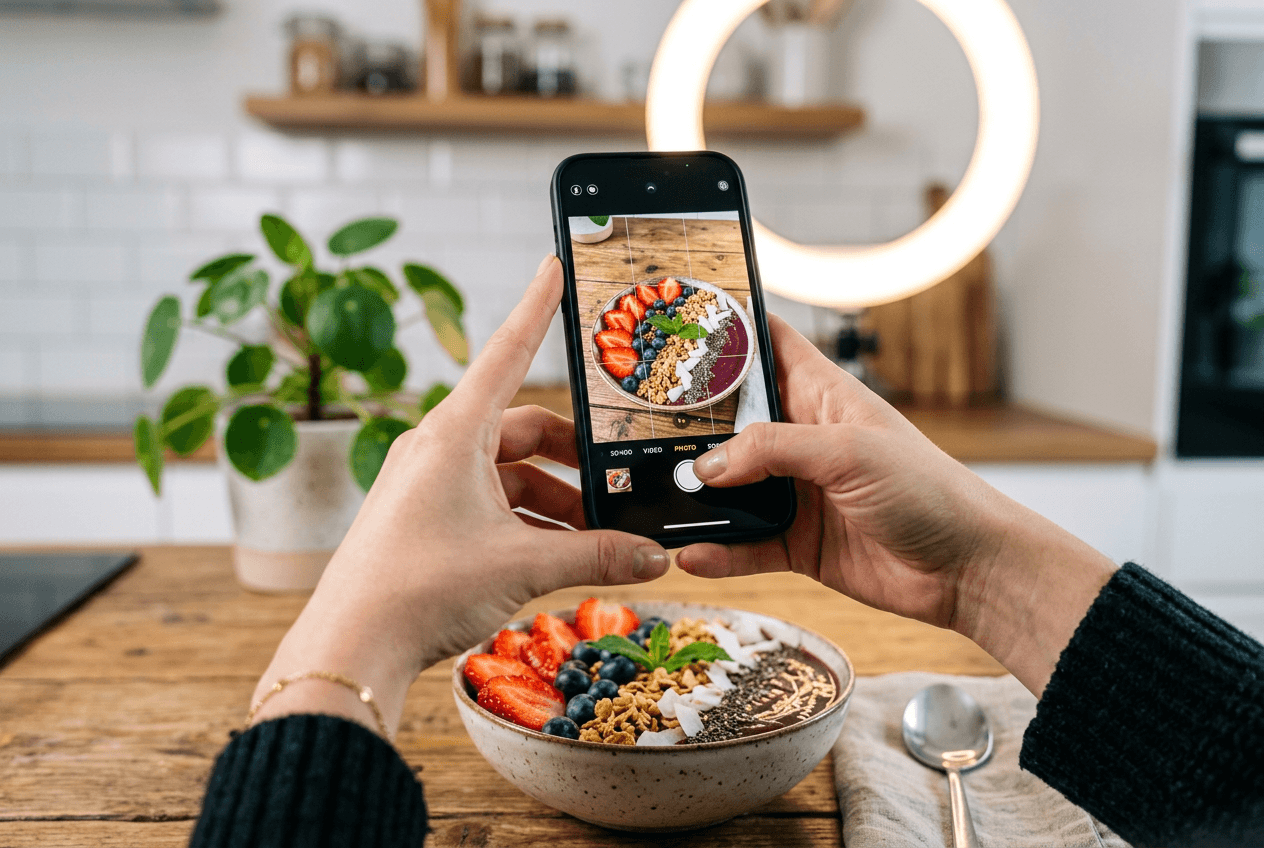 Learning food photography basics with smartphone capturing a styled acai bowl in home kitchen
Fig & Light (YouTube) — Best Free Lighting Education
Price: Free (premium content at figandlight.com) Creator: Brandon Figueroa Best for: Understanding lighting and composition fundamentals
Brandon Figueroa's Fig & Light channel has earned a dedicated following for one reason: he makes complex lighting concepts feel approachable. His tutorials cover everything from controlling contrast and shaping shadows to building compositions that draw the eye.
What makes Fig & Light stand out is its visual-first teaching style. Instead of lecturing over slides, Brandon shoots in real-time and explains his decisions as he works. You see the setup, the adjustments, and the final result — all in one video.
He's also expanded into 3D food visualization and CGI product renders, which is unusual for a food photography educator. If you're curious about where food imagery is heading, his channel is worth watching for that alone.
Best videos to start with: His lighting control tutorials and composition breakdowns. Reddit's r/foodphotography community specifically recommends Fig & Light as their top food-specific YouTube channel.
Limitations: No structured curriculum — it's individual tutorials, not a guided course. You'll need to self-direct your learning path.
The Bite Shot (YouTube) — Best All-Around Free Channel
Price: Free Creator: Joanie Simon Best for: Comprehensive beginner education across all food photography skills
Joanie Simon's The Bite Shot is probably the most-recommended free food photography resource on the internet, and it deserves that reputation. Her channel covers the full spectrum: DSLR manual mode basics, composition theory, artificial lighting, DIY backdrop creation, and Lightroom editing.
What sets Joanie apart is her teaching clarity. She breaks down technical concepts (aperture, shutter speed, white balance) in plain language without dumbing them down. Many professional food photographers credit The Bite Shot as where they first learned to shoot in manual mode.
Important note for 2026: Joanie's paid courses — including the highly regarded Artificial Light Academy ($299) — are no longer available for new enrollment. She's shifted to individual mentorship and live workshops. Her YouTube library remains freely available and is still one of the best self-directed food photography education resources out there.
Best videos to start with: Her beginner series on camera manual mode, the food photography lighting tutorials, and her DIY backdrop builds.
Limitations: Some older content references Instagram strategies that feel dated for 2026. The free content lacks the structured progression of a paid course.
Skillshare Free Trial — Best for Sampling Multiple Topics
Price: Free 30-day trial, then ~$165/year for unlimited access Best for: Exploring whether food photography education is right for you
Skillshare's free trial gives you access to dozens of food photography classes. The standout courses:
- Food Photography: Shooting At Restaurants by Daniel Krieger — 7 lessons, 35 minutes. A professional food photographer teaches you to capture great shots in real restaurant environments. Includes both camera and iPhone techniques.
- DIY Backdrops: Dynamic Surfaces For Tabletop Photography — 8 lessons, 30 minutes. Solves one of the most common beginner problems: boring backgrounds.
- Making A Splash! Photographing Drinks In Motion — 8 lessons, 40+ minutes. Covers one of food photography's hardest sub-genres with practical equipment and editing guidance.
These are short courses (30–45 minutes), so don't expect the depth of premium programs. But the free trial is a low-risk way to test whether structured food photography learning clicks for you before committing real money.
Limitations: Individual courses are shallow. After the trial, the $165/year subscription makes sense only if you use Skillshare for multiple topics beyond food photography.
Affordable Food Photography Courses ($10–$250)
This tier offers the best bang-for-buck in food photography education. You'll find structured learning, real instructor feedback, and enough depth to meaningfully improve your work.
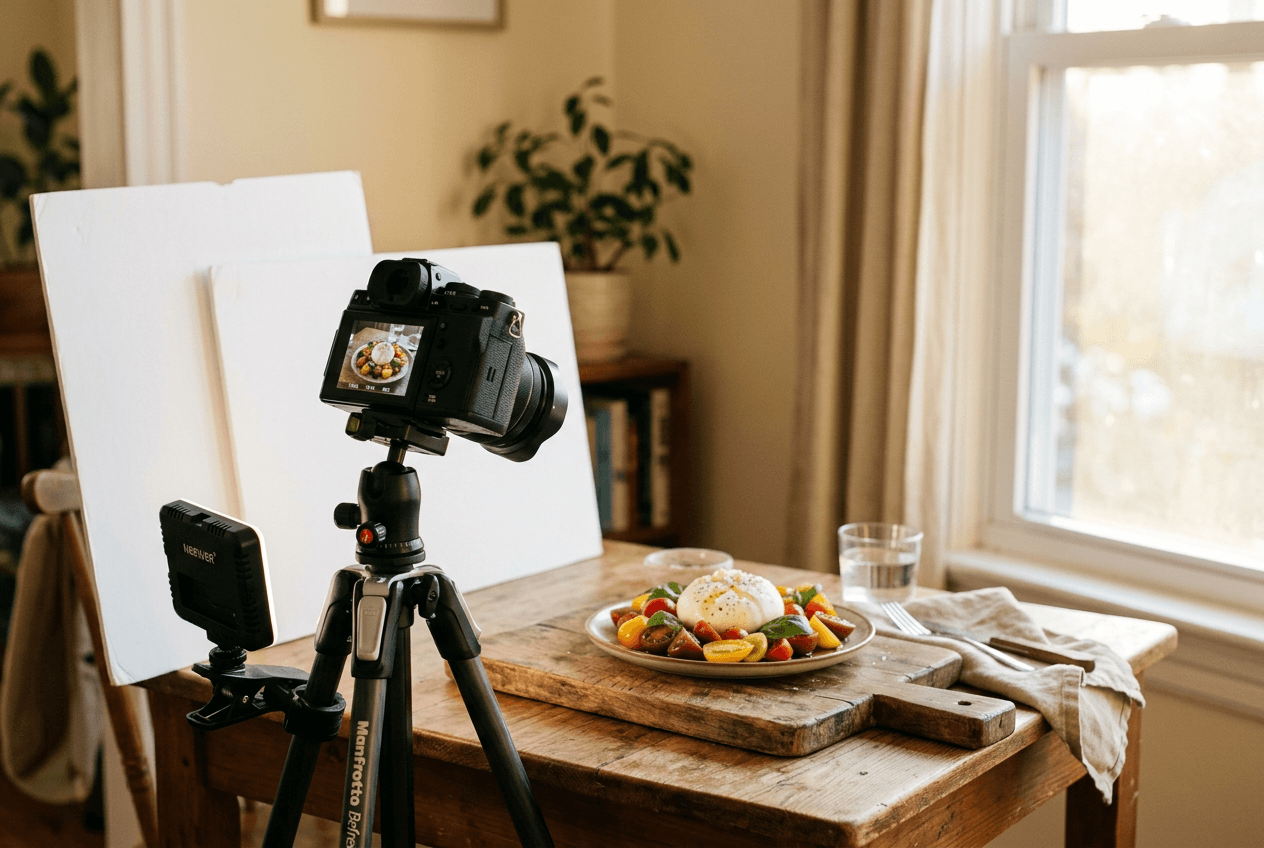 Affordable food photography course setup with budget equipment, DIY reflectors, and natural window light
Food Photography Academy — Best Budget Membership
Price: Monthly membership (individual courses also available) Creator: Lauren Short Founded: 2017 Level: Beginner to Intermediate Best for: Photographers who want ongoing feedback and community support
Food Photography Academy stands out for its membership model. Instead of paying $500+ for a single course, you get access to Lauren's full library — composition, food styling, business roadmap, and more — plus monthly live Zoom calls where members submit images for personal feedback.
That live feedback component is genuinely rare at this price point. Most affordable courses are "watch and figure it out yourself." Lauren's approach is closer to a mentor relationship, which can accelerate your growth significantly.
The courses themselves are practical and no-nonsense. The Composition Course teaches you how to place your hero dish, create leading lines, and build visual texture. The Business Roadmap covers pricing strategy, finding clients, and turning food photography into actual income.
Best for: Self-taught photographers who've hit a plateau and need structured guidance. The community aspect also helps with accountability.
Limitations: Less polished production quality than premium courses. The membership model means ongoing costs rather than one-time payment.
Domestika — Best for Bite-Sized Creative Courses
Price: $10–$40 per course (sales regularly drop prices to $7–$15) Level: Beginner Best for: Visual learners who prefer beautifully produced, short-format courses
Domestika courses are works of art in themselves. The production quality is remarkably high for the price — cinematic filming, professional audio, and gorgeous demonstrations from working photographers.
Top pick: Introduction to Food Photography for Restaurants by Cole Wilson. This course specifically teaches restaurant-context photography — shooting in real dining environments with existing light, styling plated dishes, and creating images that work for menus and social media. If you're learning food photography specifically for a food business, this is one of the best-targeted courses available.
Other notable options include food styling for Instagram courses and dark-and-moody food photography workshops. At $10–$40 each, you can take several and explore different styles without financial stress.
Limitations: Courses are standalone — there's no community, feedback, or progression path. Some courses are translated, and occasionally the dubbing feels awkward.
Udemy — Best for Budget Deep-Dives
Price: $40–$85 list price, but almost always $10–$25 during frequent sales Level: Beginner Best for: Self-directed learners who want comprehensive content at rock-bottom prices
Never pay full price on Udemy. Sales happen almost weekly, dropping courses from $70 to $15. The food photography selection is large, but quality varies — filter by rating (4.5+ stars) and number of reviews.
Top pick: Smartphone Food Photography: Practical Guide — 15 hours of content across 25 lectures. It's specifically designed for people without expensive camera equipment, focusing on dark-mood photography and artificial light techniques using what you already own. For someone who wants to take food photos with their phone, this is comprehensive.
Also worth noting: Food Styling Tips and Techniques for Beginners (~1 hour, $40 list). It's short but directly addresses why photos look "off" even when lighting and equipment are fine — the styling is usually the issue. Pairs nicely with our food styling guide for deeper learning.
Limitations: Production quality and instructor expertise vary wildly. No community or feedback. Lifetime access is a plus, but some courses go years without updates.
Le Cordon Bleu Online (Self-Study) — Best Brand-Name Value
Price: €250 (~$270 USD) Level: Beginner Duration: Self-paced Instructor: Nelly Le Comte Best for: Anyone who wants a recognized credential alongside real skills
Let's be honest: part of what you're paying for here is the Le Cordon Bleu name. But that name carries genuine weight on a résumé or portfolio site, especially if you're pitching food photography services to restaurants or brands.
The course itself is solid. It covers artificial and studio lighting, controlling hard light and shadows, capturing steam and splash effects, and post-processing in editing software. Instructor Nelly Le Comte has years of professional experience, and student reviews are consistently positive ("I was a beginner when I started and gained so much knowledge").
They also offer an instructor-led version (€390, ~$420) with structured timelines and feedback, which is worth the upgrade if you need external accountability.
Limitations: Self-paced means self-motivated. Without community or feedback loops, it's easy to stall. The price is steeper than comparable courses on Udemy or Domestika.
Premium Food Photography Courses ($500+)
These are career-level investments. If you're serious about food photography as a profession — or if you're a food blogger whose income depends on image quality — this tier makes financial sense.
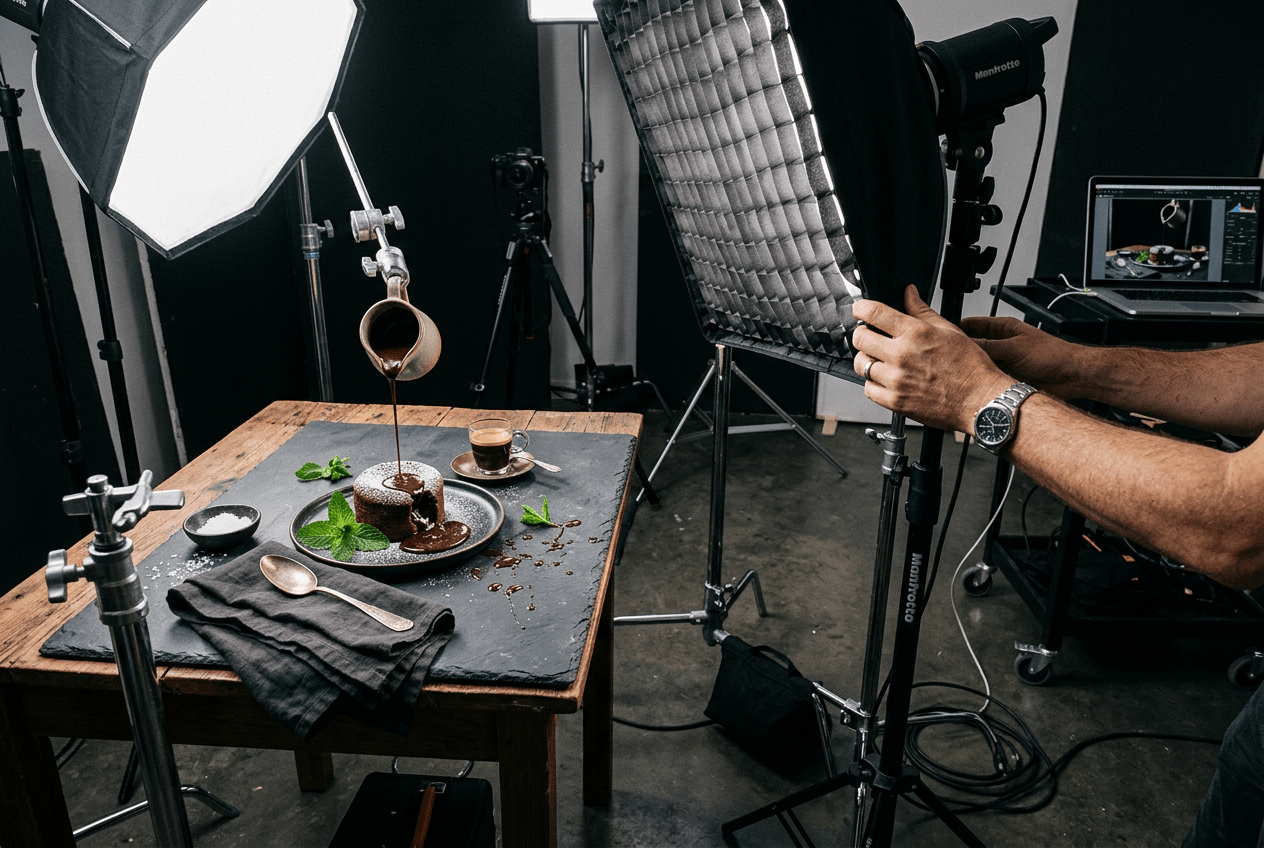 Professional food photography studio with artificial lighting setup and styled chocolate dessert
Eva Kosmas Flores — Best Overall Premium Course
Price: $547 one-time (or 6 monthly payments of $94) Bundle with Video Course: $1,098 one-time (or 8 × $138/mo) Level: Beginner to Advanced Best for: Anyone building a food photography career or brand
Eva's Photography + Styling + Branding course is, in my assessment, the best comprehensive food photography course available online in 2026. Here's why.
The 7-lesson structure covers the full journey: camera settings and lenses, working with natural light, styling and visual storytelling, composition theory, branding and social media strategy, and deep-dive Lightroom editing. But what elevates it above competitors is the storytelling approach. Eva doesn't just teach you how to take technically correct photos — she teaches you how to create images that make people feel something.
Student before-and-after transformations are striking. Reviews consistently use words like "in-depth," "generous," and "life-changing." Multiple reviews note that the course is worth far more than the price.
Eva also offers a free mini-course covering composition, storytelling, and texture basics — take it first to see if her teaching style resonates with you.
Why it's worth the price: The branding and social media modules alone would cost $200+ as standalone courses elsewhere. You're getting a complete creative education, not just technical photography training. For context, professional food photography often costs $700–$1,400 per session — one well-executed client shoot after completing this course pays for it.
Limitations: Heavy focus on natural light. If you specifically need artificial lighting skills, you'll want to supplement with other resources. The $547 price point is a real commitment for hobbyists.
Two Loves Studio — Best for Intermediate Photographers
Price: Varies (individual courses, bundles, and mentoring available) Creator: Rachel Korinek Level: Intermediate to Advanced Best for: Photographers who already know basics and want to level up specific skills
Rachel Korinek's Two Loves Studio has been a trusted name in food photography education for years, known for technique-focused, detail-oriented teaching.
Important for 2026: Two Loves Studio is currently revamping its entire course lineup. Rachel is shifting from large multi-module courses to smaller, targeted, affordable classes focused on specific skills: artistic movement capture, macro food photography, working with gels, creative lighting, and product retouching.
The flagship Composition Essentials course — a deep-dive into styling, composing, and photographing food — is retiring in October 2026. If it's still available when you're reading this, it's worth considering. Past courses like Lightroom Magic and Capture One Magic have received strong praise for making post-processing intuitive.
For now, you can join Rachel's waitlist for priority access to 2026 offerings. Her free resources and blog posts on composition and food photography tips and food photography props remain among the best on the web.
Limitations: The 2026 transition means the course catalog is limited right now. New offerings may not have the review track record of established courses.
Foodtography School — Best for Food Bloggers
Price: ~$1,167 (pay-in-full), or installment plan Creator: Sarah Crawford (Broma Bakery) Level: Beginner Best for: Aspiring food bloggers who want an all-in-one course covering photography, Instagram, and brand partnerships
Foodtography School was the original all-in-one food photography course, and it deserves credit for pioneering the category. It now includes expanded modules on business, social media marketing, and working with brands.
However, I want to be transparent: reviews are mixed at this price point. The course started at $600 and has nearly doubled in price while some of the core photography content remains at a beginner level that experienced photographers find too basic. Multiple independent (non-affiliate) reviewers note that similar material — and often more depth — is available in courses costing half as much.
Where it shines: If you specifically want to build a food blog with a consistent Instagram aesthetic, attract brand partnerships, and you want everything in one place without piecing together multiple courses, Foodtography School delivers on that promise. The Facebook community is active, and the brand-building focus is genuine.
Limitations: Price-to-value ratio is its biggest criticism. Limited styling diversity (tends toward bright, modern, airy aesthetics). Instructor access within the community is limited. At $1,167, compare carefully against Eva Kosmas Flores' course ($547) which covers similar ground with more depth in photography fundamentals.
Which Food Photography Course Is Right for You?
Skip the guesswork. Find your situation below:
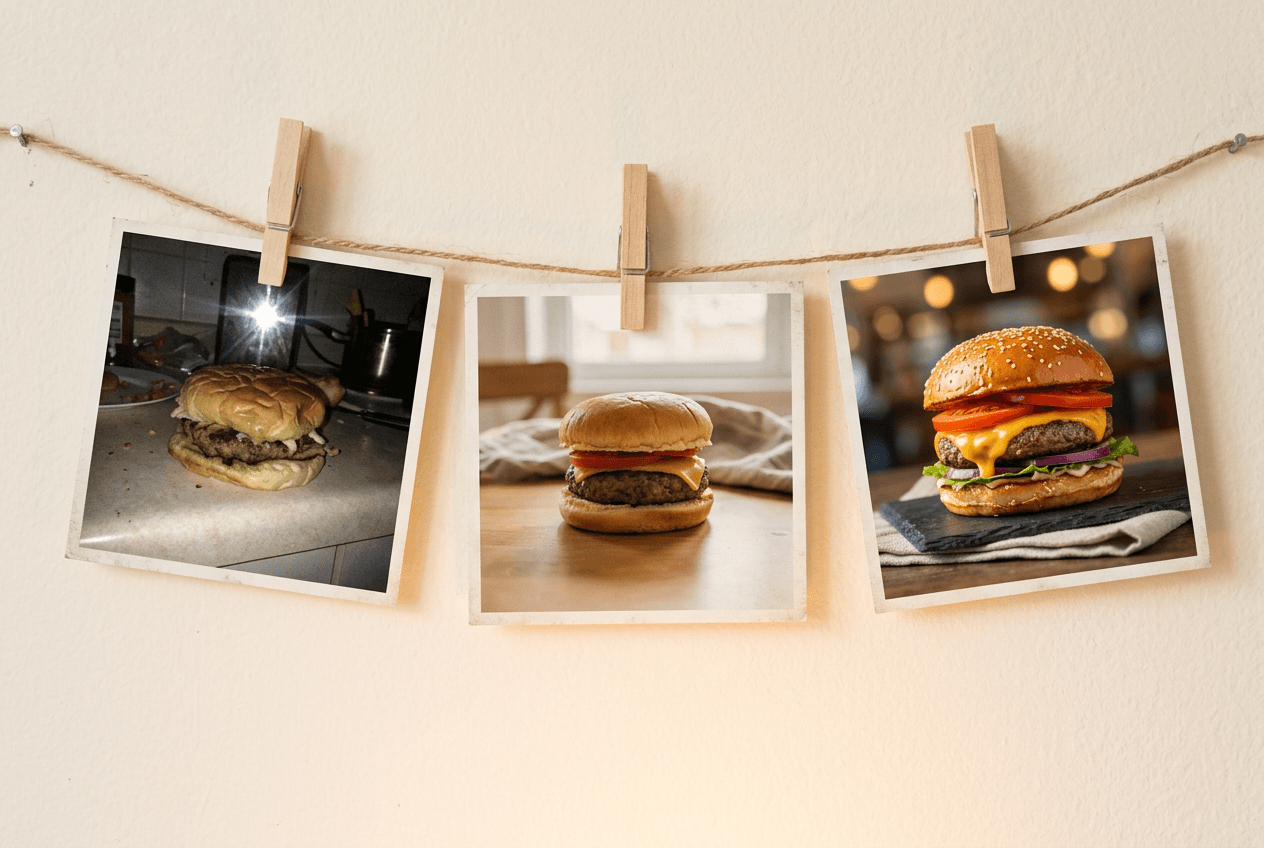 Food photography skill progression from amateur to professional quality showing learning course results
"I'm completely new and not sure food photography is for me." → Start with The Bite Shot YouTube channel (free) and the Skillshare free trial. Spend a week watching and practicing. If you're hooked, move to a paid course.
"I'm a hobbyist food blogger on a budget." → Food Photography Academy membership or 2–3 Domestika courses ($30–$90 total). You'll get real skill development without overcommitting financially. Supplement with our free food photography tips.
"I want to turn food photography into a career." → Eva Kosmas Flores' Photography + Styling + Branding ($547). It's the most complete creative and business education at a reasonable price. Follow up with specialized courses from Two Loves Studio once their 2026 lineup launches.
"I own a restaurant/cafe and just need better food photos." → You probably don't need a course at all. Read on. ↓
When You Don't Need a Food Photography Course
Here's something the course industry won't tell you: not everyone who needs food photos needs food photography skills.
If you're a restaurant owner, cafe operator, or food delivery business, your goal isn't to become a photographer. It's to have professional-looking photos for your menu, delivery apps, social media, and website — ideally without spending weeks learning aperture settings or hundreds on lighting equipment.
This is exactly why we built FoodShot AI.
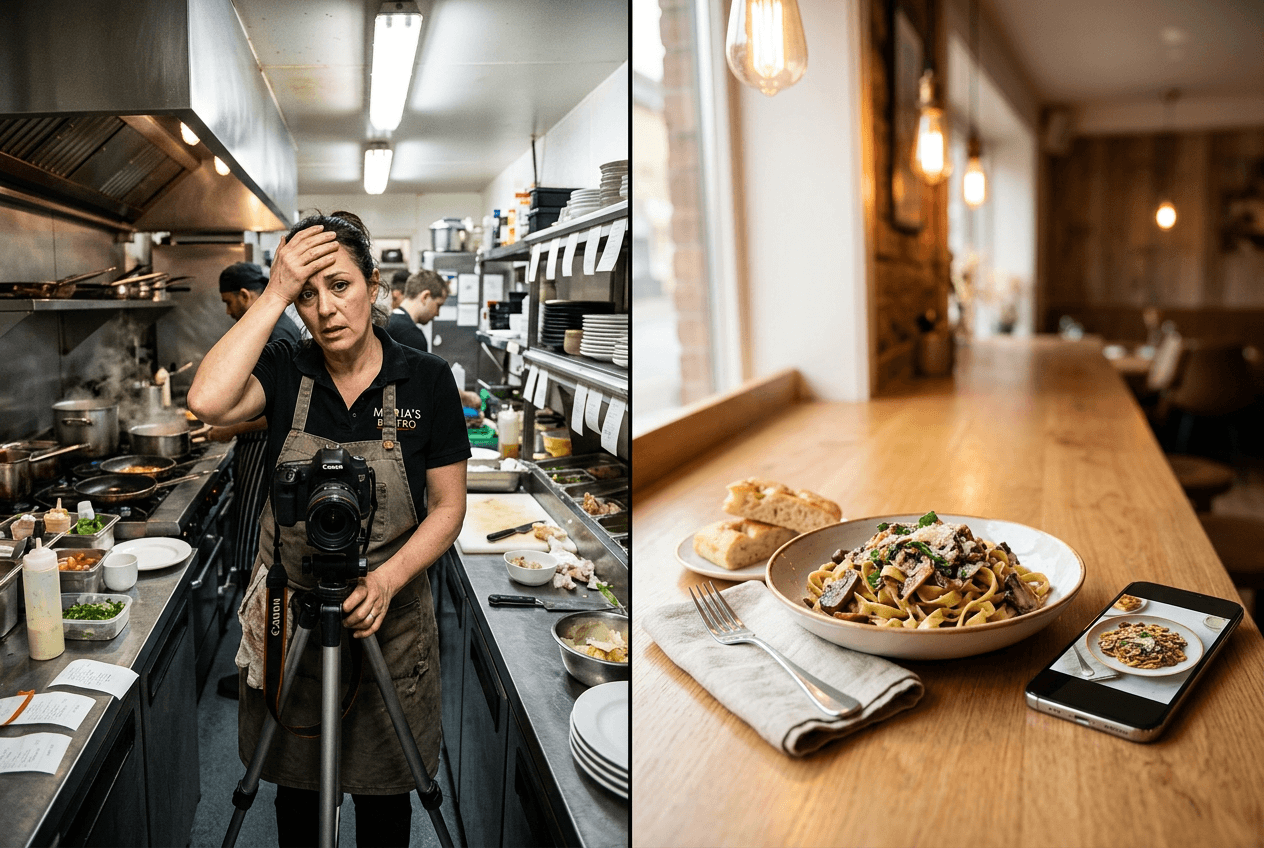 Restaurant owner comparing difficult photography setup versus easy smartphone food photo solution
The math is straightforward:
- Premium photography course: $547–$1,167 + equipment ($500–$2,000) + weeks of learning time
- Professional photographer: $700–$1,400 per session
- FoodShot AI: Starting at $9/month — upload a smartphone photo, choose a style, get professional results in about 2 minutes
Courses teach you to take better photos. FoodShot transforms the photos you already have into professional, menu-ready images — with 30+ style presets for delivery apps, restaurant menus, Instagram, fine dining, and more.
If your interest is food photography as a craft or career, absolutely invest in a course. If your interest is food photography as a business tool, try the food photo editor first and see if you even need a course.
Frequently Asked Questions
Can you learn food photography online?
Yes — and arguably better than in-person for most people. Online courses let you pause, rewind, and practice at your own pace. The best instructors (Eva Kosmas Flores, Joanie Simon, Rachel Korinek) teach online because it reaches more students and allows for richer, longer-form content than a weekend workshop. Start with free YouTube content to build foundations, then invest in a structured course when you're ready to commit. Our guide on what food photography actually involves is a good starting point.
How long does it take to learn food photography?
Basics (decent Instagram photos): 2–4 weeks of focused practice. Intermediate (consistent, portfolio-worthy work): 3–6 months. Professional level (client-ready work): 6–12 months of dedicated learning and shooting. The biggest accelerator isn't the course you choose — it's how often you practice. Shoot something every day, even if it's just your lunch. Our food photography equipment guide covers what gear you actually need at each stage.
Are food photography courses worth the money?
Depends on the course and your goals. Free resources (YouTube, blogs) can take you surprisingly far. Paid courses become worth it when you need structured progression, expert feedback, or specialized skills (artificial lighting, advanced composition). If you're spending more than $500, expect community access, direct instructor feedback, and comprehensive curriculum — not just video lectures you could find summarized on YouTube.
What equipment do I need for a food photography course?
Most beginner courses only require a smartphone or entry-level DSLR/mirrorless camera. Some recommend a tripod ($20–$50) and a reflector or white foam board ($5). Premium courses may assume you have Lightroom ($10/month) for editing exercises. Don't buy expensive equipment before starting a course — many instructors specifically cover how to get professional results on a budget. You can also edit food photos after the fact to elevate your results.
Can I learn food photography with just my phone?
Absolutely. Modern smartphones shoot in RAW, control exposure manually, and produce images sharp enough for social media, delivery apps, and even print menus. Several courses on this list (Udemy's Smartphone Food Photography, Skillshare's restaurant shooting class) are specifically designed for phone shooters. Our guide to taking food photos with your phone covers this in detail. And if you want to skip the learning curve entirely, FoodShot AI transforms any phone photo into professional food imagery — try it.