Food Photography Studio: Build One or Skip It With AI?
 Ali Tanis22 min read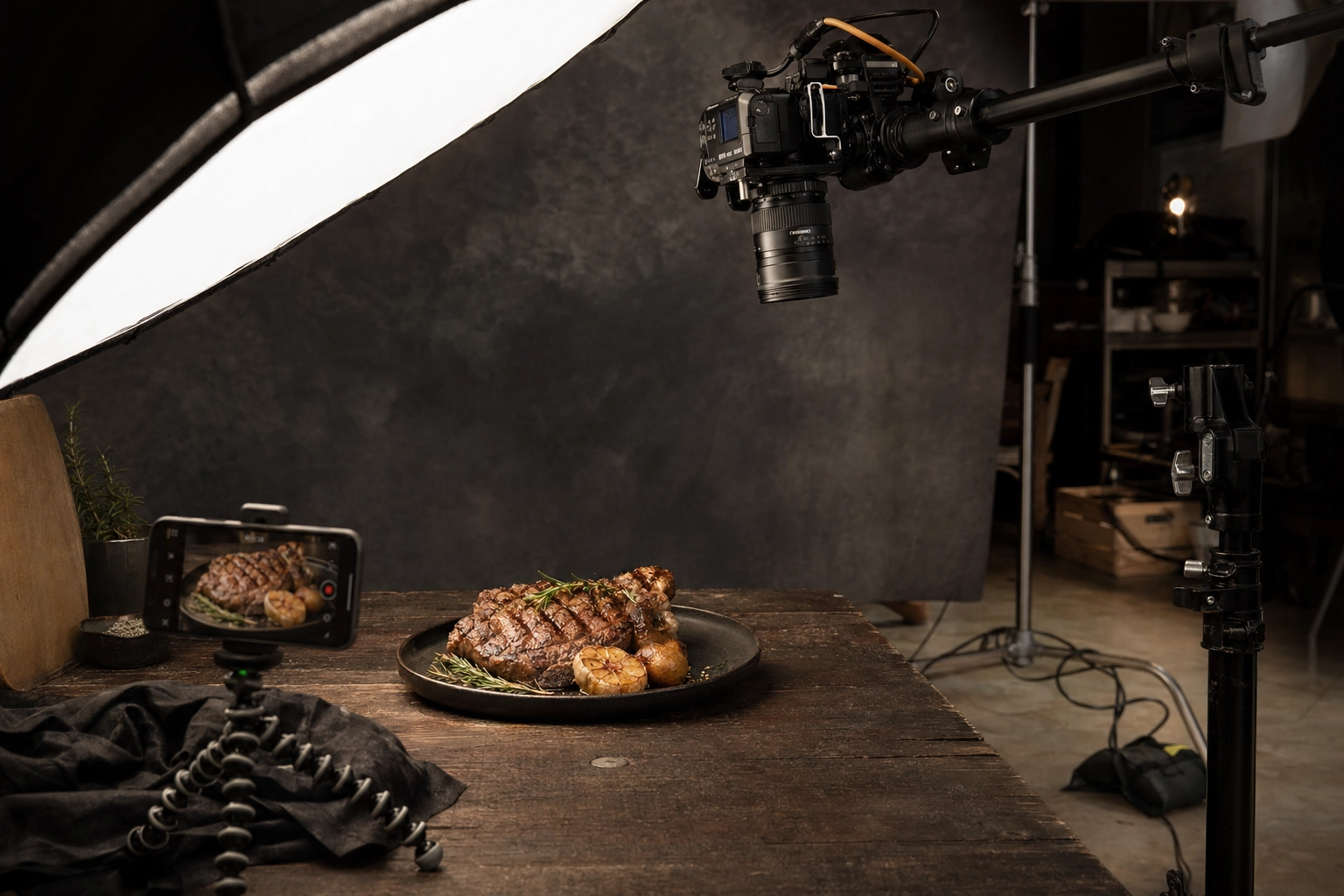
A proper food photography studio costs more to build than most independent restaurants spend on a year of marketing. The cheapest viable rental in a major city runs $750 a day. And once you've got the space and gear, you're looking at six to twelve months of practice before your photos look like the ones that made you want a studio in the first place.
So before you sign a lease or fill a shopping cart with strobes and seamless paper, it's worth asking the unglamorous question: do you actually need a food photography studio, or do you just need food photos that look like they came from one?
This guide breaks down what it really takes to build, rent, or skip a food photography studio in 2026 — with real prices, real timelines, and an honest view of where AI food photography fits in.
Quick Summary: Building a food photography studio runs $3,000–$8,000+ in equipment plus 100+ sqft of dedicated space, with $500–$2,000/year in ongoing costs. Studio rental costs $50–$500/hour. Most restaurants get 90% of studio quality from AI food photo tools at $15/month — making a studio buildout hard to justify for everyday menu and social media content.
Professional food photography studio shoot with overhead camera and softbox lighting a plated steak, with phone tripod nearby
What Counts as a Food Photography Studio (and Who Actually Needs One)
A food photography studio is a dedicated space — usually 100 to 300 square feet — built around three things: controlled lighting, swappable backdrops, and easy access to a kitchen. The gear sits there permanently. The lighting is repeatable. You can shoot at 11pm in February and get the same look you got at noon in July.
That repeatability is the entire point. Without a studio, every shoot starts from zero: clear the table, drag a light stand into the kitchen, hope nobody opens the fridge during the shot.
There are three ways to get studio-quality food photos:
- Build your own studio — full creative control, biggest upfront cost, longest ramp-up
- Rent a studio by the hour or day — flexible, no buildout, but expensive per shoot and limited to scheduled bookings
- Skip the studio entirely — use AI food photography to enhance phone photos into menu-ready images
The right answer depends on what you're shooting, how often, and what you'll do with the photos. A cookbook author needs a different setup than a pizzeria owner updating delivery app photos every quarter. The rest of this guide walks through each path with the actual numbers, so you can do the math for your business or brand.
Part 1: Building Your Own Food Photography Studio
If you genuinely love photography or you're producing food content as a primary business activity, a dedicated studio is worth considering. Here's an honest preview of what it actually takes.
Space Requirements: 100 Square Feet Minimum
The minimum footprint for a functional food photography studio is 10x10 feet (100 sqft) of clear, dedicated shooting space. That's enough for one shooting table, a single light with a softbox, and room to walk around it without bumping into things.
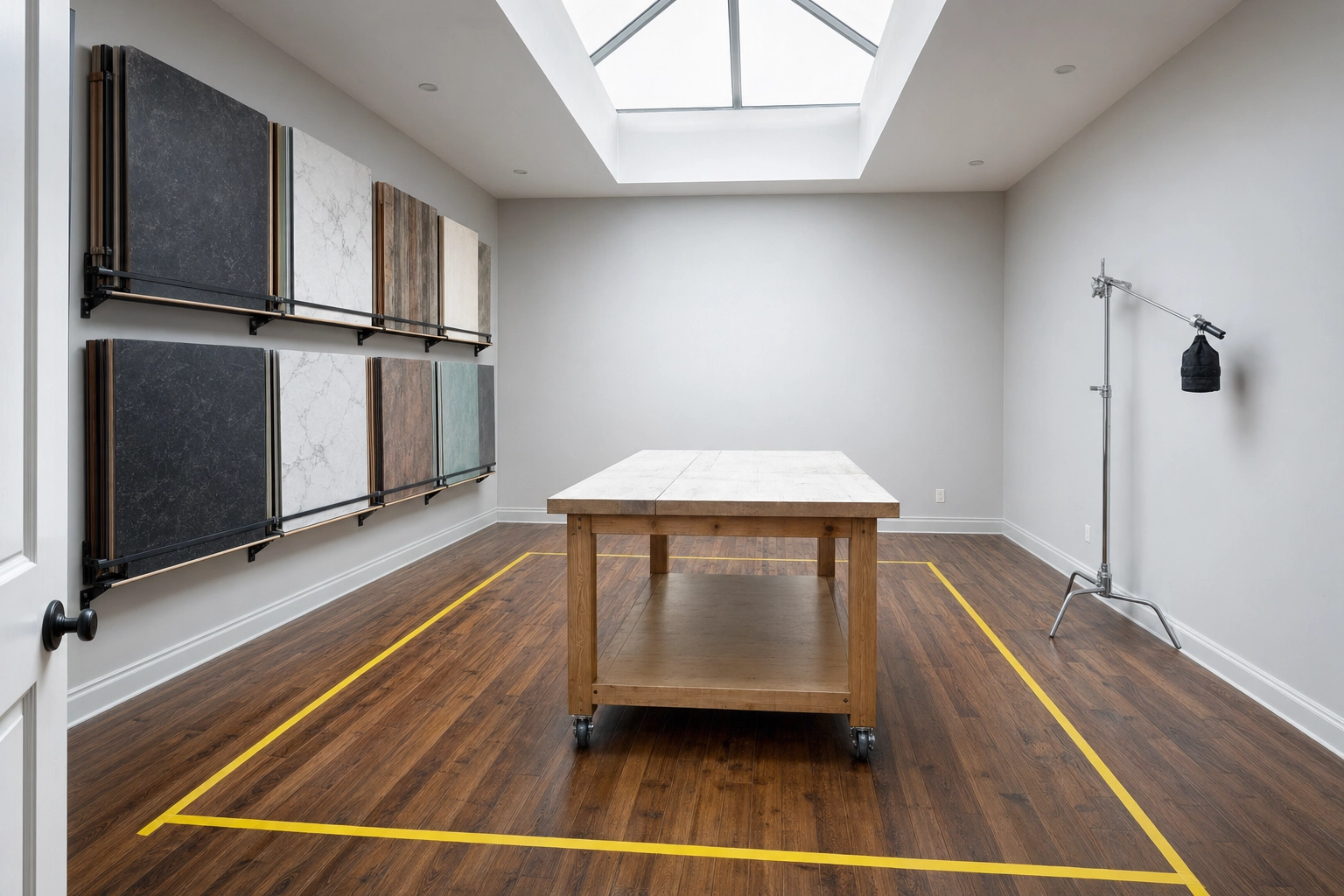 Empty 12x15 foot dedicated food photography studio room with shooting table, backdrop storage shelves, and skylight
A more realistic working footprint is 12x15 feet (180 sqft), which gives you space for:
- A shooting table or surface (3x4 to 4x6 feet)
- One key light with stand and modifier (needs ~3 feet of clearance)
- A second light or reflector position
- A tripod with overhead arm
- A laptop cart for tethered shooting (so you can preview shots on a bigger screen)
- Walking room for the photographer and a stylist
A few requirements that tend to surprise first-timers:
- 9-foot minimum ceilings if you want to shoot true overhead (flat-lay) shots with a boom arm
- A north or east-facing window if you want natural light — south light is too harsh, west light shifts color through the day
- A dedicated 15-amp electrical circuit for lighting (strobes can trip a shared kitchen circuit instantly)
- Storage for backdrops, props, and equipment — plan on another 30–50 sqft
For most restaurants, the cheapest "space" is a back-of-house corner or unused private dining room. For home shooters, it's a spare bedroom or a section of a finished basement.
Essential Equipment: $1,500 to $5,000+ to Outfit One Room
This is where the bill adds up fast. Here's an overview of what a working food photography studio actually contains, with realistic 2026 prices.
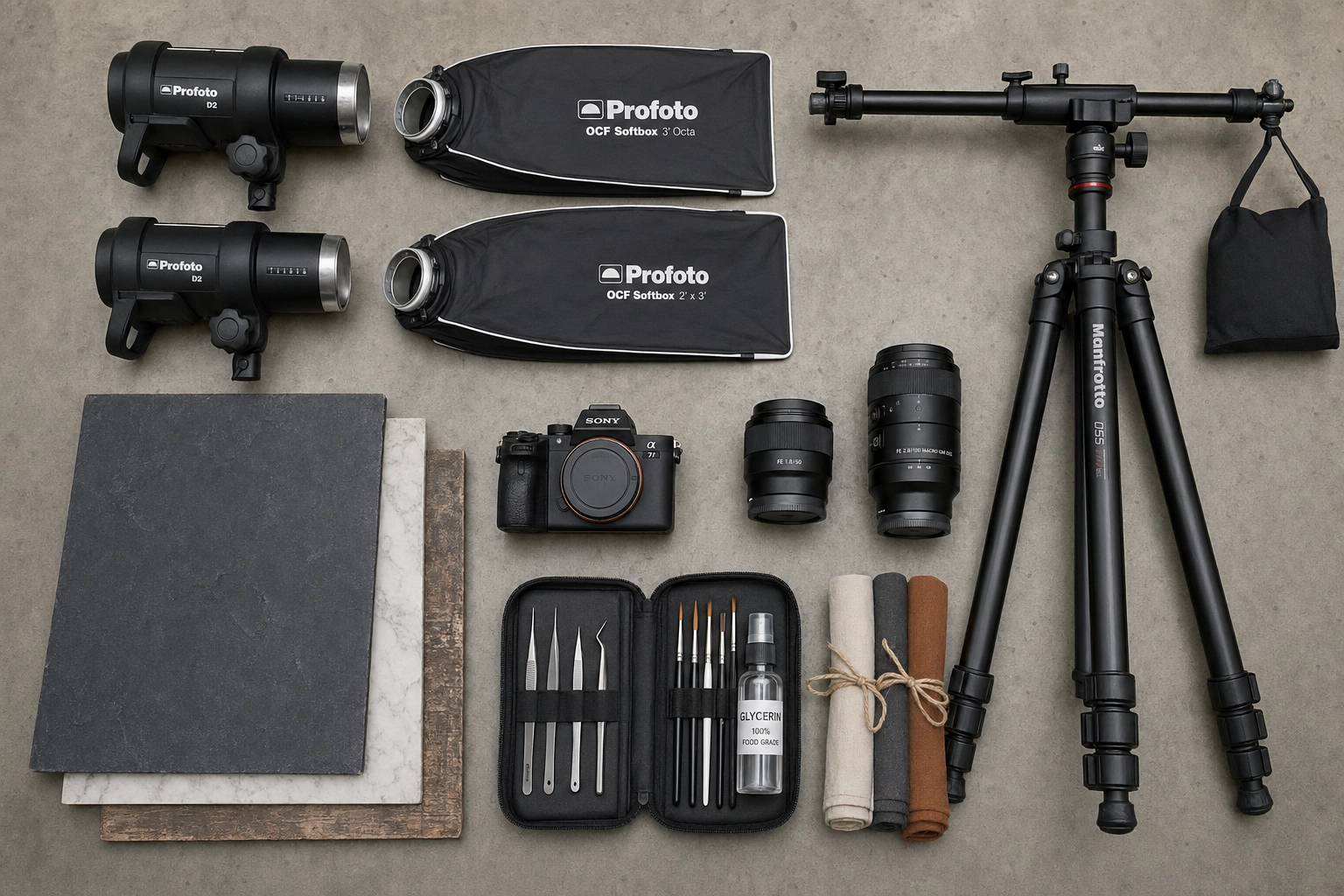 Overhead flat-lay of food photography studio equipment including strobes, softboxes, mirrorless camera, lenses, tripod, and styling tools
Lighting kits — $200 to $2,500
| Tier | Gear | Price Range |
|---|---|---|
| Entry continuous LED | Neewer 660 panel, Godox SL60W | $70–$150 per light |
| Mid-tier flash | Godox AD200 Pro, AD300 Pro | $300–$500 per head |
| Pro studio strobes | Profoto B10X, Elinchrom ELB 500, Broncolor Siros | $1,500–$2,500+ per head |
Add modifiers — softboxes, octaboxes, grids, scrims — at $50–$300 each. A two-light setup with two modifiers, two stands, and a sandbag or two lands around $500 (entry) to $4,000 (pro). Lighting is by far the most important food photography investment, which is why our food photography lighting guide goes deep on placement and modifiers.
Backdrops and surfaces — $50 to $800
Forget the photographer-budget-blowing seamless paper rolls. Food photographers work with surfaces:
- DIY contact-paper marble or wood-look — $5–$15 per sheet
- Single vinyl backdrop (Bessie Bakes, Captured by Lucy) — $15–$30 each
- Quality starter set of 5 boards — $200–$350
- Comprehensive collection of 10+ surfaces — $400–$800
Real surfaces stain. Backdrops dent. Plan to refresh 1–2 surfaces per year. Browse our gallery of food backgrounds and wallpapers for free alternatives if you want to test looks before you buy.
Camera, lens, and tripod — $1,000 to $3,000
- Entry mirrorless body (Canon R50, Sony a6400, Fujifilm X-T30 II) — $600–$800
- 50mm f/1.8 prime — $100–$200 (the food photography workhorse)
- 100mm macro lens — $400–$600 (for texture and detail shots that reviewers and editors actually notice)
- Sturdy tripod with center column reversal or boom arm — $150–$400
- Tethering cable and software — $30–$200
For a deeper breakdown by budget, see our full food photography equipment guide.
Styling tools and props — $200 to $1,500
The kit nobody warns you about. A working food stylist's tray includes tweezers, fine paint brushes, food-safe glycerin spray, syringes for sauce placement, kitchen torches, paper towels, and surgical scissors. Then there are the props: plates, bowls, cutlery, linen napkins, glassware, cutting boards. A starter kit runs $200; a working collection grows to $1,000–$3,000 over a couple of years.
Realistic total to outfit a working studio:
- Bare-bones functional setup: $1,500–$2,500
- Solid mid-tier studio: $3,000–$5,000
- Professional commercial studio: $5,000–$10,000+
That's just the gear. It doesn't include the space itself or the time you'll spend learning to use it.
Studio Rental: $50–$500 per Hour Without the Buildout
If you don't want to commit thousands to a permanent space, you can rent. Food-specific photography studios are surprisingly common — almost every mid-size city has at least one with a working kitchen, and a quick view of local listings will tell you what's available in your market.
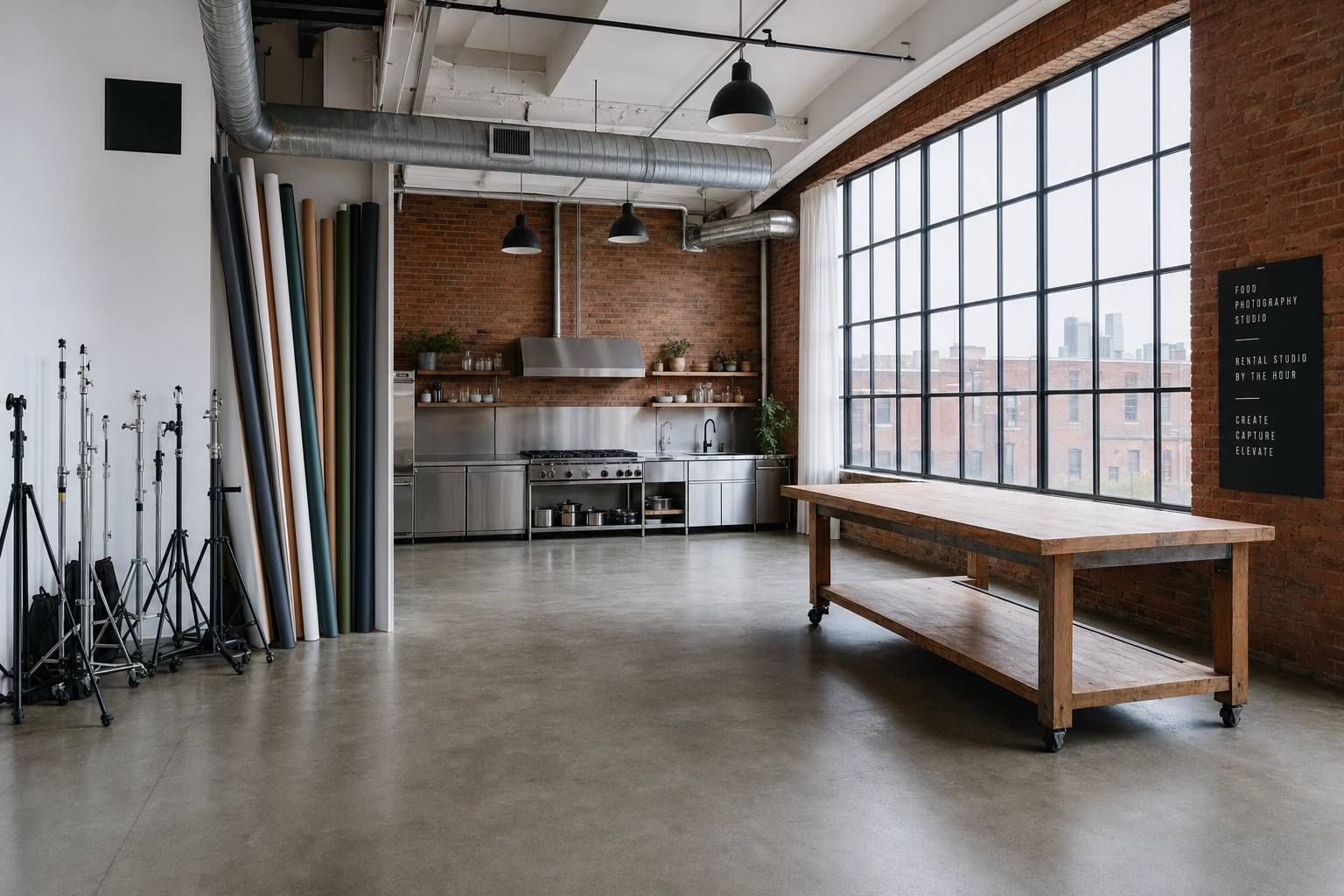 Empty rental food photography studio with high ceilings, kitchen counter, large windows, and waiting equipment
Typical hourly rates by market (2026):
- Smaller US markets (Nashville, Austin, Denver): $50–$150/hour
- Mid-tier cities (Chicago, Atlanta, Miami): $100–$250/hour
- Los Angeles: $150–$400/hour
- Manhattan: $200–$500/hour
- Brooklyn / Queens: $150–$350/hour (40–50% cheaper than Manhattan for comparable spaces)
Daily rates for kitchen-equipped food photography studios in major cities run $750–$2,500/day, with premium West Hollywood or Beverly Hills spaces hitting $3,000/day.
Marketplace platforms like Peerspace list food photography studios with full kitchens starting around $150 for natural-light spaces in mid-size markets. Photographer-owned studios sometimes rent off-hours at lower rates if you ask. Always preview the space in person or via video before booking — listings can be misleading.
What's usually included vs extra:
- ✅ Included: shooting space, basic lighting, backdrop walls, kitchen access, tables
- ❌ Extra (usually): stylist assistance, premium props/surfaces, food prep, parking, after-hours fees, cleaning fees, equipment damage waivers
Rental makes sense for occasional shoots — a quarterly menu update, a one-time campaign, a seasonal launch. It stops making sense once you're booking more than one full day per month, at which point a buildout starts paying back within 12–18 months. For a fuller view of professional rates and rental dynamics, see our breakdown of professional food photography costs.
DIY Home Food Photography Studio for Beginners
Not ready to spend $3,000? You can put together a functional home food photography studio for under $300 if you start with what you already own.
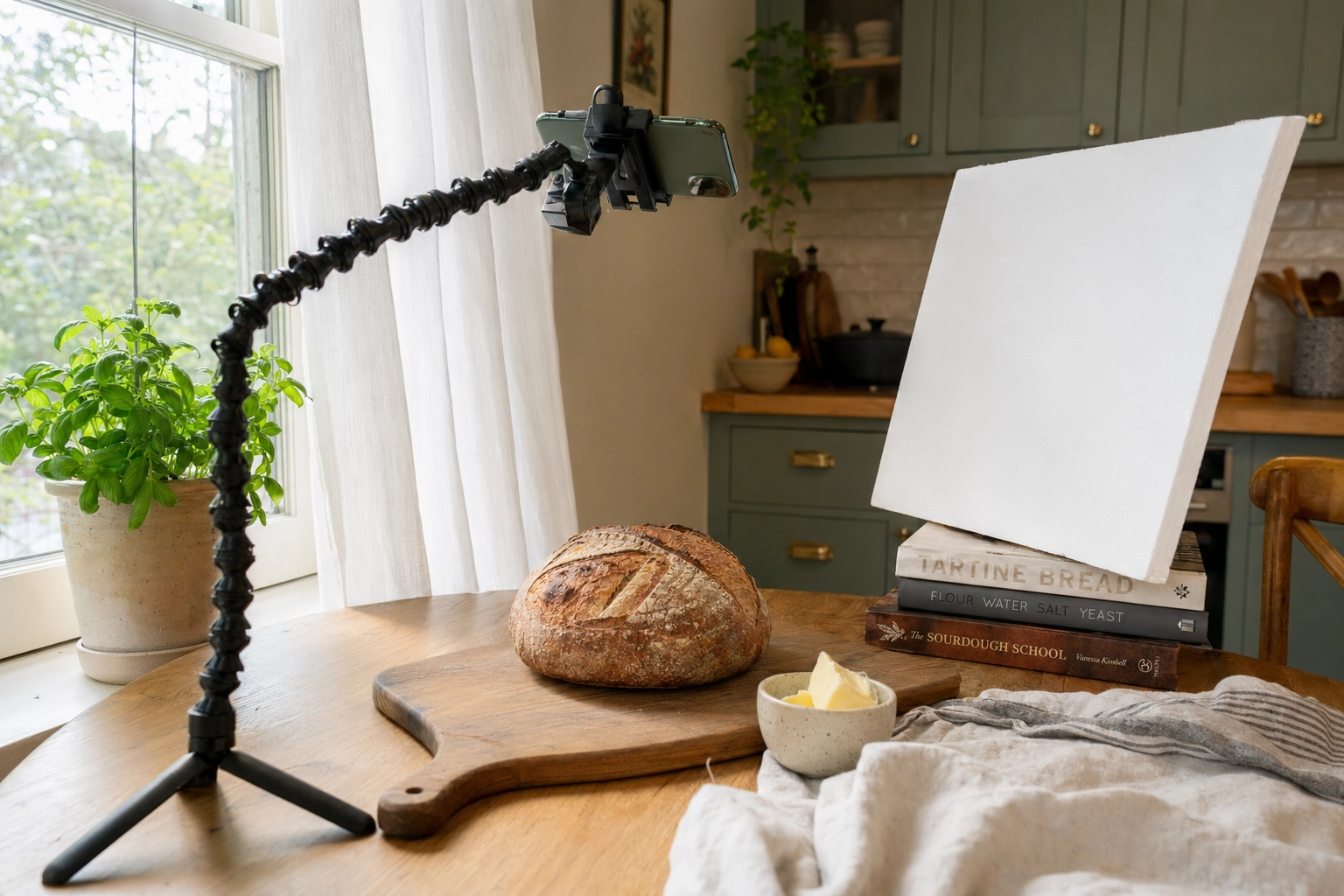 DIY home food photography setup with smartphone tripod, foam board reflector, sourdough on cutting board near a sunlit window
The $200–$500 starter setup:
- Existing space — kitchen counter or dining table near a north or east-facing window. No buildout required.
- Light shapers — two white foam boards as reflectors ($10), two black foam boards as shadow flags ($10), one 5-in-1 collapsible diffuser ($20). This is the single highest-ROI purchase in food photography.
- Backgrounds — one marble-look contact paper sheet ($10), wooden cutting boards you already own, one vinyl backdrop in a complementary tone ($25).
- Camera — your phone. A recent iPhone, Pixel, or Galaxy outperforms entry DSLRs from five years ago for food work. Use the rear camera and review every shot zoomed in to confirm focus.
- Tripod — a flexible phone tripod or desk-mount overhead arm ($25–$40). Non-negotiable for flat-lays.
- Styling basics — tweezers from a pharmacy, a small spray bottle for water-misting greens, a small brush for sauce placement. About $20.
Total: $130–$300 depending on which surfaces and tripod you choose.
A typical shoot in this setup: clear the table, position a diffuser between the window and the food, place a white reflector opposite the window to fill shadows, style the dish, mount the phone overhead, shoot 30–50 frames, then review and pick three keepers. Time per finished image: 20–40 minutes once you've practiced. For specific staging tactics, our guide on how to stage food for photography covers the full styling workflow.
This setup gets you 70–80% of what a $3,000 studio produces — until you hit the limitations: cloudy days, evening shoots, days when the kitchen is busy, weeks when you simply don't have time. That's where the case for either a studio or AI starts to matter.
Part 2: The Real Cost of a Food Photography Studio
The buildout is the entry fee. Here are the four costs that catch most operators off guard once they review the full picture.
Total Investment: $3,000–$5,000 Is the Floor, Not the Ceiling
Adding up the equipment from Part 1, here's a realistic minimum bill for a working food photography studio:
| Category | Realistic Cost |
|---|---|
| Two-light setup with modifiers and stands | $800 |
| Backdrop/surface starter set (5 pieces) | $300 |
| Mirrorless camera + 50mm lens + macro lens | $1,400 |
| Tripod with overhead arm | $200 |
| Styling kit + initial prop collection | $400 |
| Editing software (first year) | $250 |
| Studio buildout floor | $3,350 |
That assumes you already own the space. Add a year of rent on a 200 sqft commercial space, and you're at $8,000–$15,000+ in major cities.
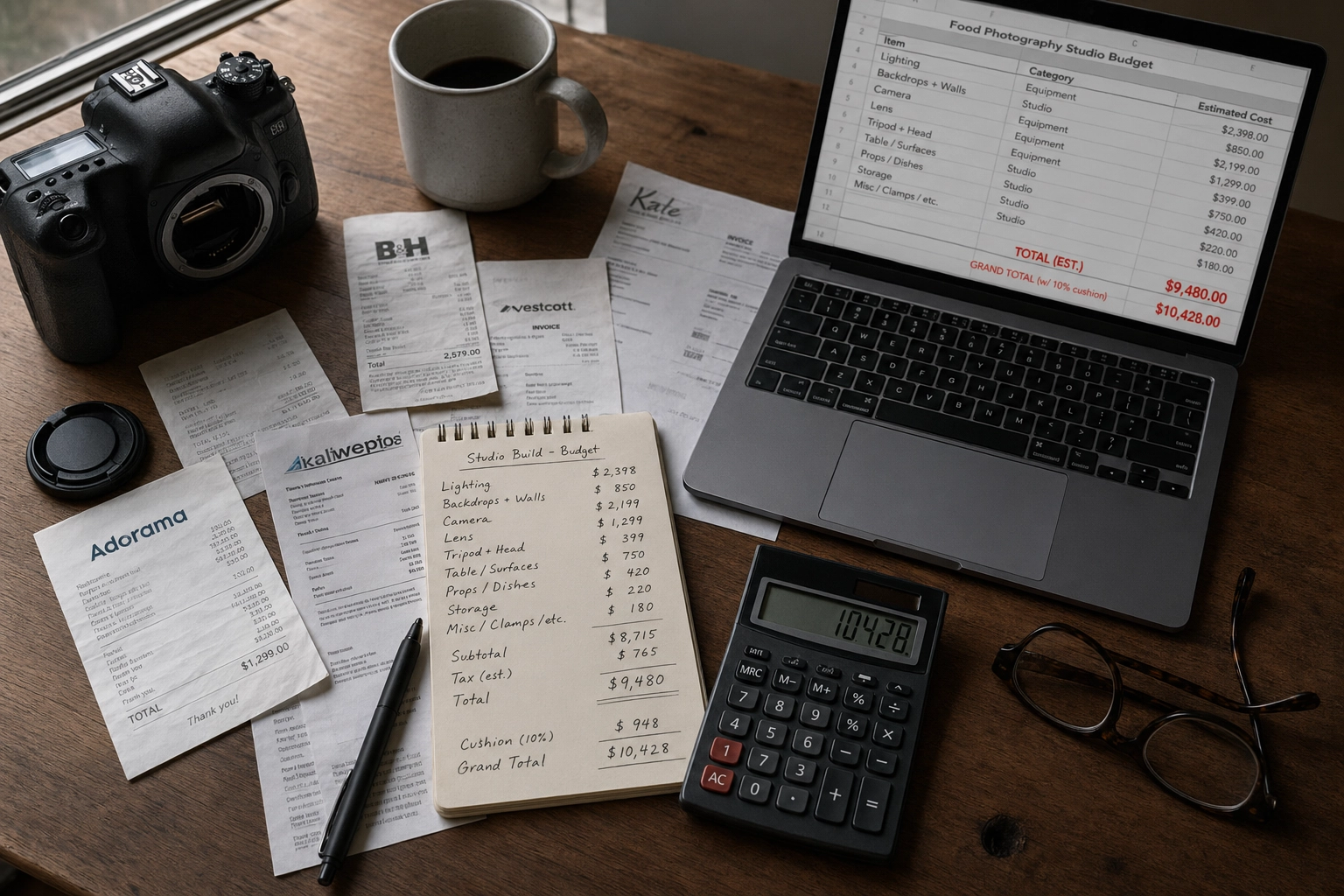 Desk view with photography equipment receipts, calculator, laptop spreadsheet, and DSLR showing the real cost of building a food photography studio
For perspective: $3,350 is roughly two years of marketing budget for a typical small independent restaurant — and it produces zero photos until you also invest in learning to use it.
Ongoing Costs Most People Forget
A studio isn't a one-time purchase. Maintenance is real:
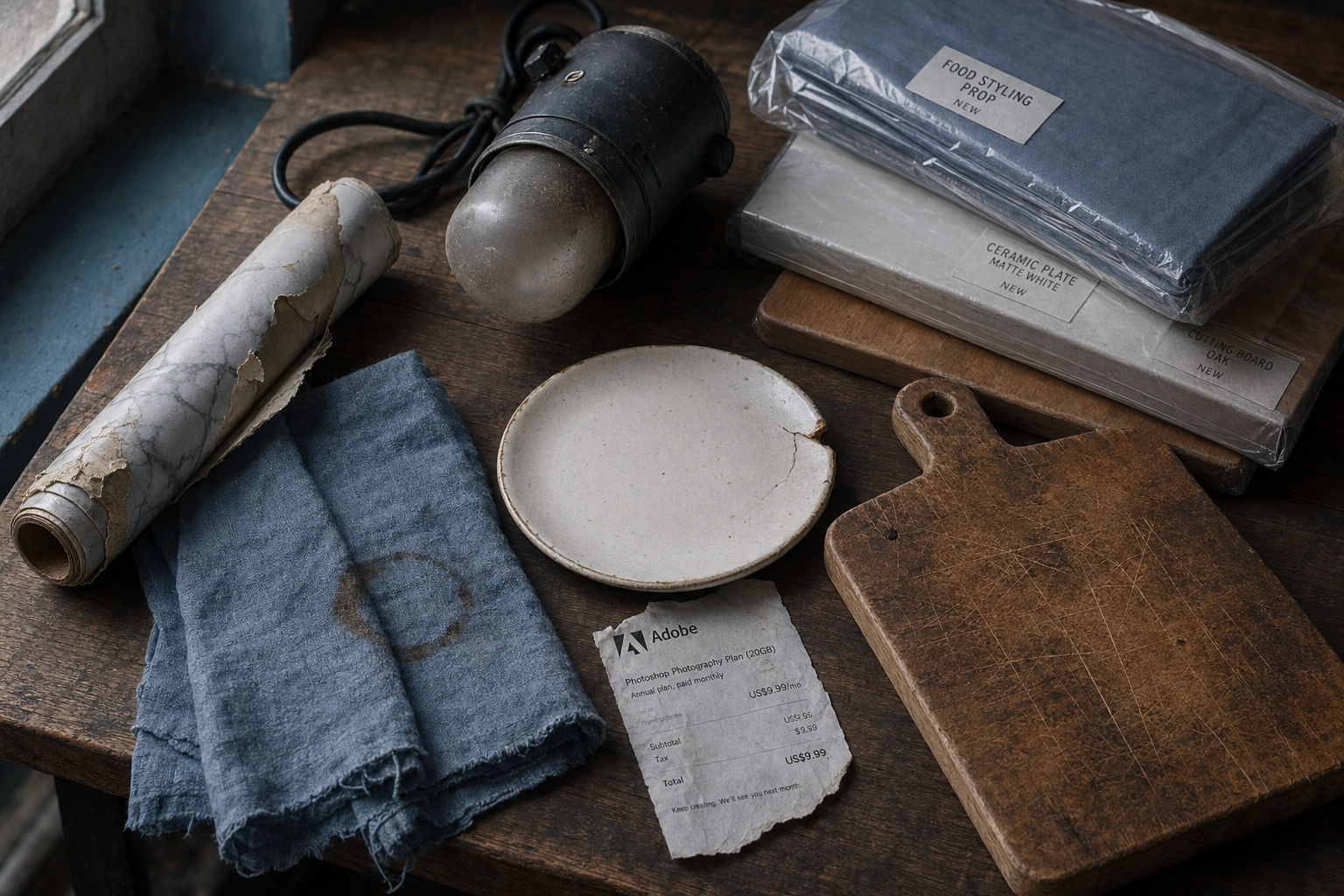 Worn food photography studio props including stained linen, chipped plate, scarred cutting board, and exhausted bulb showing ongoing replacement costs
- Backdrops and surfaces — they stain, dent, warp. Plan on replacing 1–2 per year. $50–$200/year
- Lighting consumables — modeling lamps, flash tubes, gels. Strobes need professional servicing every 50,000 flashes. $50–$300/year
- Props that get broken or feel stale — ceramics chip, linens fade, you'll get bored of the same plates. Active food shooters spend $300–$1,000/year on props alone.
- Software — Adobe Creative Cloud is around $20–$30/month. $240–$360/year
- Camera and lens upgrades — every 4–6 years to stay current. Amortized: $200–$500/year
Realistic ongoing studio cost: $500–$2,000/year, every year, just to maintain the same level of output for your brand.
The Learning Curve: Months to Years
Owning a $5,000 studio doesn't make you a food photographer any more than buying a Stratocaster makes you Jimi Hendrix. Here's the realistic skill timeline:
- Decent Instagram-quality photos — 2–4 weeks of focused practice
- Consistent portfolio-worthy work — 3–6 months
- Client-ready professional results — 6–12 months of dedicated learning
- Mastery of lighting, styling, and post-processing — 2+ years
What you're actually learning during that time: the exposure triangle (aperture, shutter, ISO), how light direction and quality affects food, food styling techniques, color theory, plating psychology, post-processing in Lightroom, color grading, retouching, and your own visual signature.
Online courses help compress the timeline somewhat, but the bottleneck isn't information — it's reps. Most working food photographers shot for 12–18 months before they had a portfolio they'd show a paying client. Our deep dive into food photography techniques covers the core skills you'll need to build.
Time Per Image: 30 to 60 Minutes Each
Even a fully-equipped studio with a skilled photographer doesn't crank out images quickly. Here's what one menu-ready food photo actually requires:
 Analog stopwatch resting on a wooden surface beside a half-styled pasta bowl symbolizing time spent on food photography
- Setup (10–15 min) — position lights, dial in white balance, run test exposures, set up tethering, preview the frame
- Styling (10–20 min) — plate the dish, position garnishes, add steam or moisture, fix imperfections, swap props if a composition isn't working
- Shooting (5–15 min) — typically 30–50 frames per dish to get 3–5 keepers
- Editing (5–10 min) — import, cull, edit the hero, export at correct size and format
 Close-up of food stylist hands using tweezers to place fresh herb garnish on a risotto under studio lighting
Typical total: 30–60 minutes per finished, menu-ready image.
Multiply across a real workload:
- A 20-dish menu shoot: 10–20 hours of shooting time alone, plus 5–10 hours of editing
- A restaurant updating its menu monthly: 120–240+ hours per year spent on photography
- A multi-location chain with seasonal LTOs: easily 300+ hours/year
That's the real cost most people miss. A studio is a tool, not a time machine.
Part 3: The AI Alternative — Skip the Studio Entirely
Here's the part of this article where we say what we do. FoodShot AI is an AI food photography tool that takes a phone photo of your real dish and transforms it into a studio-quality menu image in 90 seconds. It's not a hypothetical alternative — it's how thousands of restaurants are now handling photography in 2026.
The basic premise: instead of building or renting a studio, you skip the studio entirely. The work that used to require space, gear, and skill happens in the AI model. You provide the dish; we handle the lighting, the backdrop, the composition, the polish.
It's not a replacement for every kind of food photography — and we'll be honest about where studios still win — but for the daily reality of restaurant photography needs and most social media content, the math is hard to ignore.
How AI Food Photography Actually Works
The workflow is intentionally simple:
 Chef using smartphone to photograph a fresh bowl of ramen on a prep counter in a real working restaurant kitchen
- Take a phone photo of your real dish. Natural light, kitchen counter, no styling required. The dish has to be real and recognizable — AI can't fabricate a dish that doesn't exist.
- Upload to FoodShot AI through the web app or mobile app.
- Pick a style from 200+ curated options — Delivery, Menu, Fine Dining, Moody, Bright Top-Down, Café, Bistro, dozens more.
- Preview and pick — the result lands in about 90 seconds at 4K resolution with a commercial license.
- Generate variations from the same upload to A/B test different looks for the same dish.
The AI preserves the actual dish — your real burger, your real pasta, your real cocktail — while transforming the surrounding scene: lighting, backdrop, surface, props, depth of field, color grading. The result looks like the photo a human stylist and photographer would have produced over an hour in a studio.
200+ Styles Replace Multiple Backdrops, Lights, and Setups
A physical studio gives you a finite set of looks based on what gear and surfaces you own. A 5-board backdrop kit gives you 5 looks. Three lighting setups give you three lighting moods. AI gives you a different model.
Each FoodShot AI style is a complete styled scene — backdrop, lighting, composition, color tone — packaged as a one-click preset. Want a dark moody Italian look? Click. Want a bright airy Pacific Northwest brunch flat-lay? Click. Want a clean white background for delivery apps? Click.
A few features that replace specific physical investments:
- Builder Mode — pick a background, plate, and food composition independently, like swapping props in real time
- My Styles — upload reference photos to lock in your brand aesthetic across every dish (no need for a $400 prop styling system to get brand consistency across menus and social media)
- Poster Mode — built-in marketing templates for promotions, specials, and seasonal campaigns
You're not limited to the surfaces in your closet or the modifiers on your light stand. The whole studio inventory lives as software.
Cost: $15/Month vs $3,000+ Studio Investment
The simple math:
| Approach | Initial Cost | Annual Cost | 5-Year Total |
|---|---|---|---|
| DIY home setup | $200–$500 | $100–$300 | $700–$2,000 |
| Built studio (mid-tier) | $3,000–$5,000 | $500–$2,000 | $5,500–$15,000 |
| Studio rental (12 days/year) | $0 | $9,000–$18,000 | $45,000–$90,000 |
| FoodShot AI Starter | $0 | $108–$180 | $540–$900 |
A FoodShot AI Starter plan at $9/month (yearly) or $15/month (monthly) gets you 25 menu-ready credits per month with the full 200+ style library, Builder Mode, 4K output, and a commercial license. Business is $45/month for 100 credits. Scale is $99/month for 250 credits with bulk processing.
Five years of FoodShot AI Starter costs less than the cheapest backdrop set in a working studio. That's not marketing math — it's just math.
Side-by-Side: Studio Shot vs AI-Enhanced Phone Photo
The honest comparison:
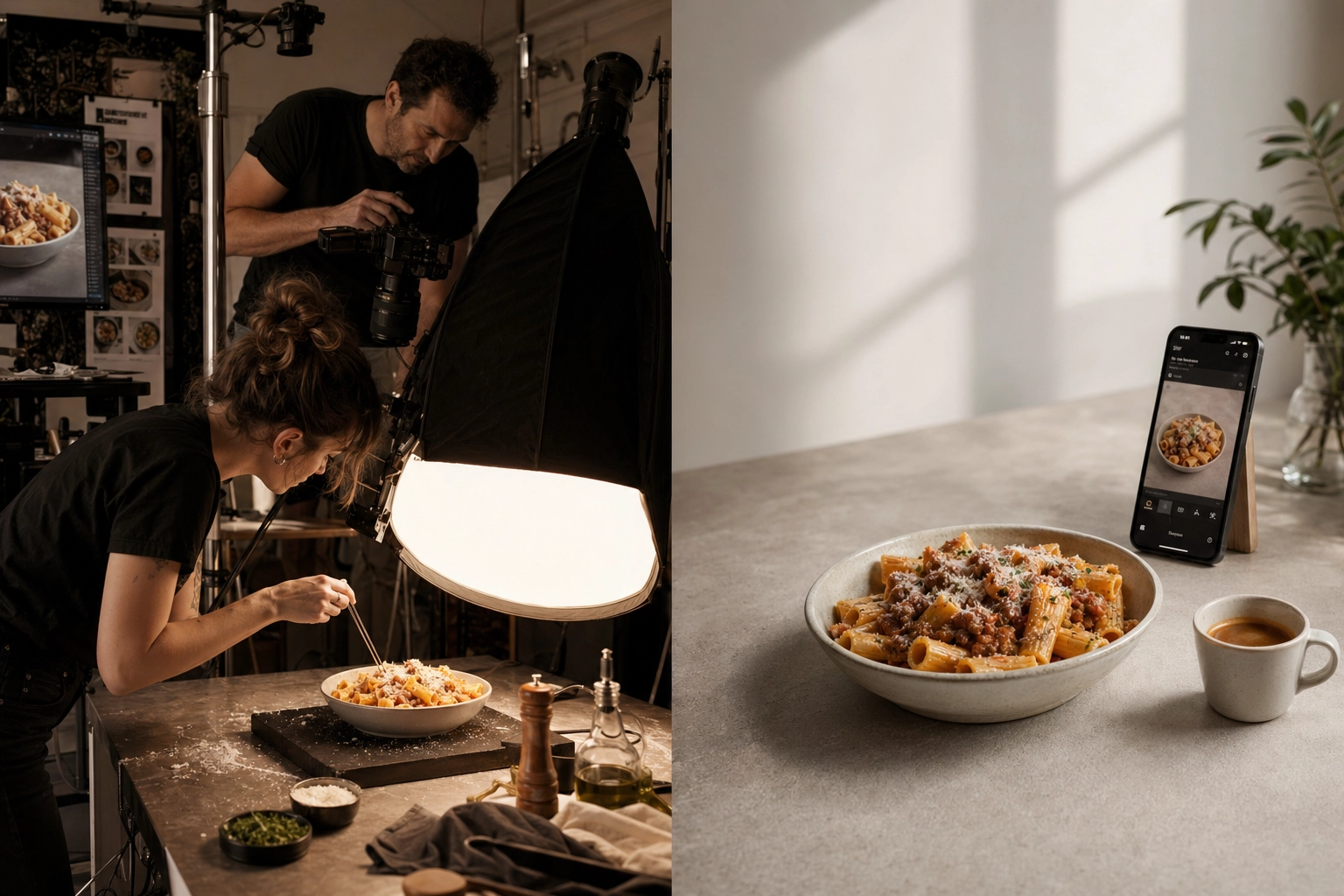 Side-by-side diptych contrasting a complex food photography studio shoot with a calm minimalist phone-and-AI workflow
Where a studio shot still wins:
- Cookbook covers and editorial spreads where every pixel matters
- National advertising campaigns with specific creative briefs
- Magazine features judged by other photographers and reviewed by art directors
- Highly specific motion shots (splashes, pour shots, smoke)
- Video content (FoodShot AI handles stills only)
Where AI matches or beats a studio shot:
- Delivery app menu photos (Uber Eats, DoorDash, Grubhub)
- Restaurant website galleries
- Social media content (Instagram, TikTok stills, Pinterest)
- Seasonal menu updates and limited-time offers
- Catering portfolios and proposals
- Hotel and resort F&B menus
- Catalog imagery for CPG brands
For most restaurants, 95%+ of their photography needs fall in the second category. The difference between a $3,000 studio shot and a $0.60 AI-enhanced phone photo is invisible to a customer scrolling Uber Eats at 9pm. Our deeper comparison of AI vs hiring a food photographer breaks down the quality and use-case fit head-to-head.
When a Food Photography Studio Still Makes Sense
This isn't a one-size answer. A studio is the right call for:
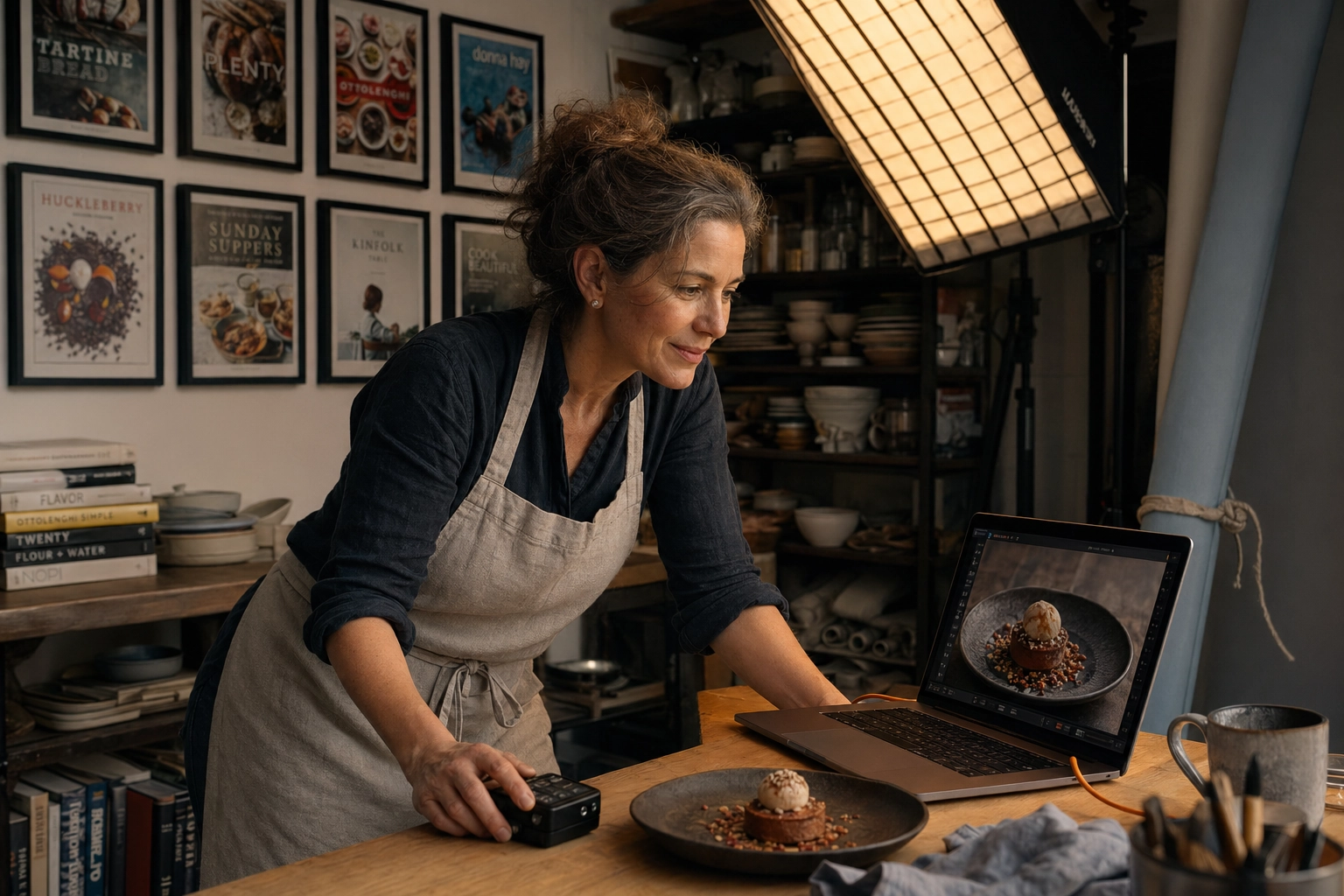 Professional food photographer working in her established studio reviewing a tethered laptop image of a dessert plate
- Working food photographers building a service business — the studio is your tool of trade and a marketing asset for clients
- CPG brands and packaging shoots — packaging requires very specific lighting signatures and physical product handling that AI can't replicate
- Cookbook and editorial work — publishers expect studio production values and reviewers will notice the difference
- Multi-brand creative agencies — serving multiple clients makes the buildout pay back
- Hands-on creatives who genuinely love the craft — owning the medium is part of the appeal
- High-end restaurants with distinct editorial brands — hybrid approach: studio for hero campaigns, AI for daily content
The flag goes up when "I want a studio" really means "I want better food photos." Those aren't the same thing, and they don't require the same investment. If your goal is photos that drive orders, our restaurant food photography guide maps out the cheapest path to that outcome.
The Decision Framework: Build, Rent, or Skip
A simple matrix for matching the option to the use case:
 Restaurant owner reviewing professionally styled food photos on a tablet inside her dimly lit bistro after service
| Your Situation | Best Option |
|---|---|
| Single restaurant, stable menu | Skip — AI for delivery and social media |
| Single restaurant, monthly menu changes | Skip — AI handles ongoing volume |
| Multi-location chain (3+ locations) | Skip — AI with brand consistency tools |
| Fine dining, editorial brand | Hybrid — AI daily, studio rental for hero campaigns |
| Café or bakery | Skip — AI is more than enough |
| Food truck or pop-up | Skip — no space for a studio anyway |
| Catering business | Skip — AI for portfolio, occasional rental for key events |
| CPG / packaged food brand | Build or rent — packaging demands physical control |
| Aspiring food photographer | Build — it's your tool of trade |
| Cookbook author with publisher | Rent — match publisher's production standards |
For more on what each restaurant type actually needs in 2026, see our use-case breakdown for AI food photography for restaurants.
Frequently Asked Questions
How much space do I need for a food photography studio?
The practical minimum is 10x10 feet (100 sqft) of clear shooting space, with 9-foot ceilings if you want to shoot true overhead flat-lays. A comfortable working studio for one photographer with a stylist is closer to 12x15 feet (180 sqft), plus an additional 30–50 sqft of storage for backdrops, props, and gear. Without that storage, you'll end up with equipment scattered across your kitchen.
Can I use my kitchen as a food photography studio?
Yes, for occasional shoots — and it's how most food bloggers start. A kitchen with a north or east-facing window, clear counter space, and an outlet on its own circuit can produce excellent natural-light food photography. The limitations show up at scale: you can't shoot during prep or service, lighting changes throughout the day, and you'll constantly be moving food and props out of view. Workable for a few shoots per month, painful for weekly content production.
Is renting a food photography studio cheaper than building one?
For occasional use (4–6 shoots per year), rental is significantly cheaper. At $150/hour for a four-hour shoot, six rentals per year totals around $3,600 — roughly the cost of a single mid-tier studio buildout, with no ongoing maintenance. For frequent use (monthly or more), a buildout typically pays back within 12–18 months. For most restaurants doing menu refreshes a few times per year, neither option is as cost-effective as AI-enhanced phone photos.
Do I need a professional camera for a food photography studio?
For traditional studio work, an entry mirrorless body in the $600–$800 range (Canon R50, Sony a6400, Fujifilm X-T30 II) is the practical minimum, paired with a 50mm prime and ideally a 100mm macro. For AI-enhanced workflows, a recent smartphone is genuinely sufficient — the iPhone 15/16/17 Pro, Pixel 9/10 Pro, and Galaxy S24/S25 Ultra all produce inputs that AI tools can transform into menu-quality results. Lens quality and lighting matter far more than camera body choice in either case.
How does AI food photography compare to studio shots in quality?
For delivery app menus, social media, and most restaurant website use, AI-enhanced photos are visually indistinguishable from studio shots to the people who matter — your customers. Studio photography still wins for cookbook covers, magazine editorial, national advertising campaigns, and packaging shoots where physical product control and creative specificity are essential. For the 95% of restaurant photography needs that fall outside those categories, the quality difference doesn't justify a 30x–100x cost difference for your brand.
The Bottom Line on Food Photography Studios
A food photography studio is a powerful tool. It's also a tool that costs $3,000–$10,000 to acquire, takes 6–12 months to use well, eats $500–$2,000 per year to maintain, and burns 30–60 minutes per finished image.
For a working food photographer or a brand with a real production budget, that math works. For most restaurants — the cafés, pizzerias, food trucks, ghost kitchens, and independent operators who actually need menu and social media photos — it doesn't.
The honest test: spend $0 on the FoodShot AI free plan. Take a phone photo of one of your dishes. Run it through a few styles and review the results. If the output handles 95% of what you needed photography for, you've just saved yourself a studio buildout. If it doesn't, you've lost nothing and you know your business genuinely needs the studio path.
Either way, the question worth asking isn't "should I build a food photography studio?" — it's "what's the cheapest, fastest path to photos that sell my food?" In 2026, the answer for most food businesses isn't a studio at all.
Ready to test it? See FoodShot AI pricing or browse AI food photography for restaurants to see how operators in your category are using it.