
Restaurant Consultant: What They Do, Cost & When to Hire One
 Ali Tanis21 min read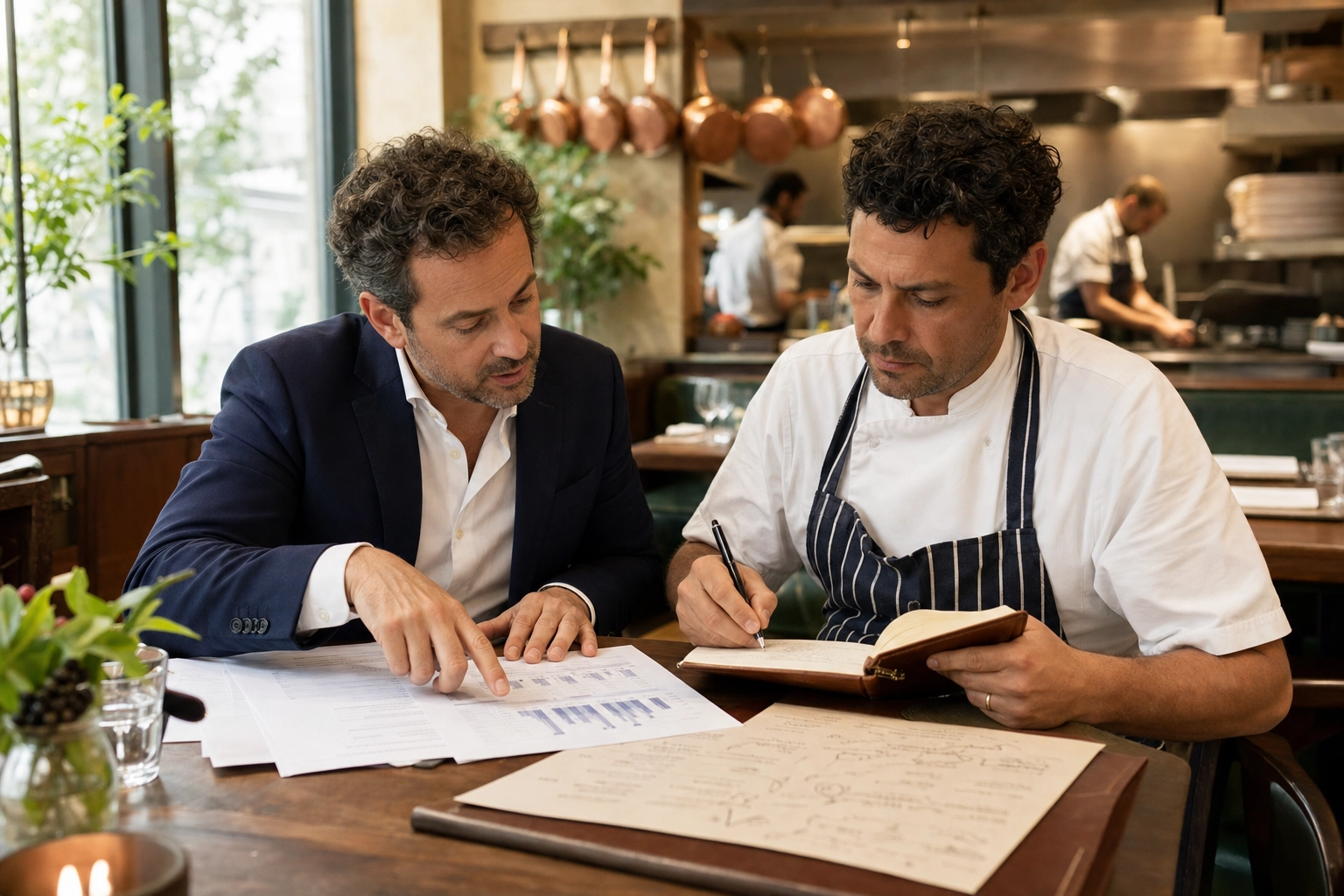
A restaurant consultant is a paid expert advisor who diagnoses what's broken (or untapped) in your business and prescribes specific fixes — covering operations, menu engineering, marketing, financial analysis, concept development, or full-scale turnaround work. Think of them as a contract specialist you bring in to solve a problem your existing team can't, or won't, solve alone.
The 2026 reality is that good consultants charge between $100 and $500 per hour, projects run $5,000 to $50,000+, and monthly retainers sit in the $3,000 to $15,000 range. Whether they're worth it depends on three things: the specificity of your problem, the consultant's track record solving that exact problem, and your willingness to actually execute their recommendations.
This guide covers what restaurant consultants do, the eleven types you'll encounter, when hiring one makes financial sense, what they actually cost in 2026, how to vet them before signing, and the playbook most of them run on day one (spoiler: it almost always starts with your visuals).
Quick Summary: Restaurant consultants charge $100–$500/hour, $5K–$50K per project, or $3K–$15K monthly retainers. They're worth hiring when you have a specific, measurable problem — opening, declining sales, scaling, or rebranding — and need expertise your team doesn't have. The first thing most modern consultants tackle: visual marketing, menu photography, and delivery app presentation, because they produce measurable lift in weeks, not quarters.
What does a restaurant consultant actually do?
The job title sounds vague on purpose because the work varies wildly. A consultant might spend a week observing your line, sampling your food, talking to your servers, and pulling six months of POS data — then deliver a 40-page audit. Or they might parachute in for three months as a fractional COO to rebuild your training program. Or they might charge a flat fee to engineer your menu, retrain your staff on upselling, and disappear.
What stays constant across all engagements is the structure: diagnose → recommend → (sometimes) implement → measure. The output is always advice; the variable is whether they roll up their sleeves and execute it with you.
Most consultants work in one or more of these six service areas:
- Operations optimization — kitchen flow, scheduling, prep stations, inventory systems, ticket times, FOH/BOH coordination
- Menu engineering — analyzing every item by popularity and contribution margin, then repricing, repositioning, or removing items to lift profit per check
- Marketing strategy — branding, social, paid ads, loyalty programs, customer acquisition, review management
- Financial analysis — P&L review, food cost and labor cost benchmarking, vendor audits, forecasting
- Concept development — taking a vision (cuisine, format, location) and turning it into a viable, profitable concept
- Turnaround management — distressed-restaurant work, often with aggressive timelines and decisions about closing, downsizing, or pivoting
The biggest distinction worth understanding: some consultants are advisors (they recommend, you execute) and some are operators (they recommend AND execute). Advisor engagements are cheaper per hour but shift the implementation risk back to you. Operator engagements cost more but produce results faster — assuming you've hired someone who actually knows what they're doing.
If you want a wider perspective on the discipline beyond restaurants, our broader food consulting industry overview covers consultants working across CPG, hospitality groups, and food-service contracts.
Types of restaurant consultants (and which one you actually need)
The biggest mistake operators make is hiring a generalist when they need a specialist. The second biggest is hiring a specialist for a problem that needs a generalist. Below are the eleven distinct types you'll encounter, what they do best, and when to call them.
 Flat-lay of restaurant consulting tools: tasting spoon, blueprint, menu, calculator, and notebook
Operations consultants. Focused on the mechanics of running a restaurant — workflow, kitchen efficiency, prep systems, scheduling, inventory, ticket times, and supply chain. Hire when service is slow, food cost is creeping, or labor cost is out of line.
Concept and brand developers. Take a raw vision (cuisine, vibe, neighborhood) and turn it into a viable, market-ready concept. They handle positioning, naming, brand voice, and the early menu skeleton. Hire pre-opening or before a major rebrand.
Menu engineering specialists. Live in spreadsheets. They calculate contribution margin per item, classify each dish (stars, plowhorses, puzzles, dogs), and rebuild your menu for profit. A well-executed menu engineering project lifts profits 10–15% on an ongoing basis, according to industry research published by Menu Cover Depot. Hire when sales feel okay but margins are flat.
Marketing and digital consultants. Cover branding, social media, paid acquisition, email, loyalty, and review management. The good ones now treat third-party delivery and Google Business Profile as core channels, not afterthoughts. Pair this with our restaurant marketing ideas playbook to see what they typically recommend.
Design and architecture consultants. Layout, interior design, kitchen flow, signage, lighting, and acoustics. Pre-opening they're essential. Established restaurants hire them to optimize seating density and update an aging room.
Financial consultants and CFOs-for-hire. P&L surgery, cost control systems, food cost and labor cost benchmarking, cash flow forecasting, lender packages, and exit prep. Hire when the books are messy or you're preparing for a sale, raise, or expansion.
Opening specialists. Project managers who handle permits, vendor selection, hiring, training, soft launches, and grand opening logistics. They overlap with concept developers but focus on execution rather than strategy.
Franchise consultants. Specialists in multi-unit scaling — brand standards, franchise disclosure documents (FDDs), royalty structures, training systems, and unit economics. Only hire if you're seriously considering franchising; this is a regulated discipline.
Technology consultants. POS selection, kitchen display systems, online ordering integrations, data infrastructure, and inventory tools. Increasingly important as the restaurant tech stack gets more complex. Useful when you're choosing or replacing a POS, or stitching together delivery, loyalty, and CRM.
Turnaround and recovery specialists. Brought in when a restaurant is bleeding cash. They make hard, fast calls — closing locations, cutting menus, renegotiating leases, replacing leadership. Often work on percentage-of-revenue or upside-based deals.
Chef and beverage consultants. Recipe development, kitchen training, wine list building, cocktail program design. Often hired for a defined scope: redesign the spring menu, build the new bar program, train the team to execute it.
The key question: what specific outcome do you need in the next 6 months? That answer tells you which type to hire — not the other way around.
When should you hire a restaurant consultant?
The honest version: you should hire a consultant when you have a specific, measurable problem you can't solve internally, AND the cost of not solving it exceeds the consulting fee. That's it. Everything else is rationalization.
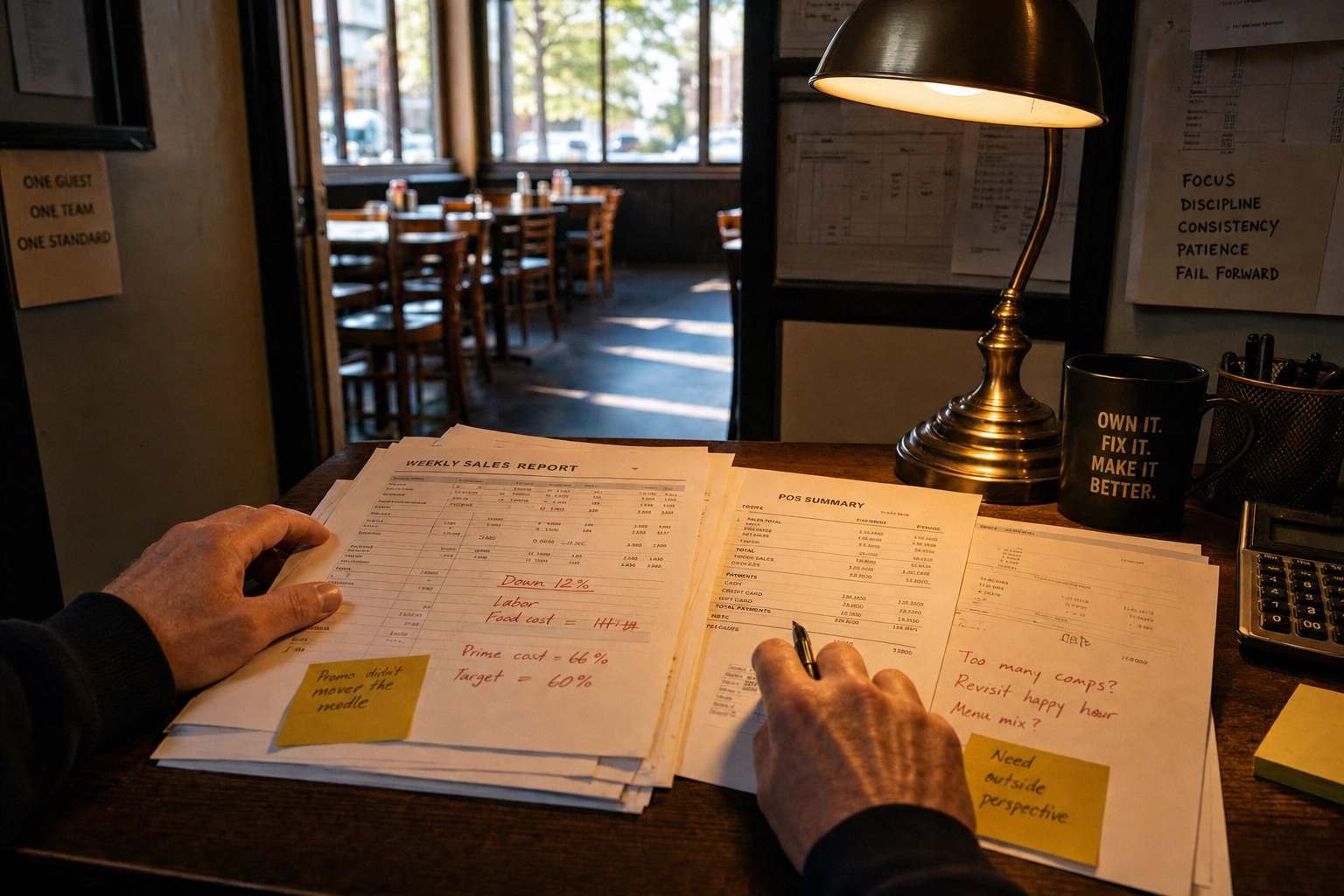
Here are the nine concrete scenarios where bringing in outside expertise consistently pays back:
 Restaurant owner reviewing weekly sales reports at a back-office desk with empty dining room behind
1. Opening a new restaurant. Especially if it's your first. The 2026 industry data is more optimistic than the old "90% fail" myth — U.S. Bureau of Labor Statistics data and 2025 Datassential research both show first-year failure rates closer to 17% (or even lower in some segments). But about half of restaurants still close within five years, and most of those failures trace back to decisions made before opening day. Bring on a consultant 6–12 months pre-launch.
2. Sales decline for three or more consecutive months. Especially if foot traffic is steady but ticket size or frequency is dropping. That pattern almost always points to menu, pricing, or product issues — exactly what a consultant can isolate.
3. Margins are shrinking. If your food cost is creeping above 32–35% or labor cost is above 30–35% of revenue, and you can't explain why, get help. These are the two largest cost lines in a restaurant; small fixes here have outsized impact.
4. You're expanding to a second (or fifth) location. Replicating a single-unit concept is the moment most groups discover their systems don't actually exist — they live in the founder's head. Consultants document, systematize, and stress-test before you scale.
5. Rebranding or pivoting concept. A new name, new menu, new positioning. Getting this wrong costs more than the consulting fee.
6. Delivery platform performance is flat. If your Uber Eats or DoorDash sales aren't growing 15–25% year over year in 2026, something's broken in your photos, descriptions, hours, or hero items. This is a fixable problem with the right specialist.
7. Negative review patterns. When the same complaints keep showing up — slow service, inconsistent food, rude staff — you have a systems problem, not a luck problem.
8. Staff turnover above industry norms. Restaurant turnover averages around 75% annually. If yours is 100%+ or your management team won't stay, the issue is usually culture or compensation structure, both of which consultants can audit.
9. You're preparing to sell or exit. A pre-sale operations and financial cleanup typically lifts valuation by 10–20%.
The signal you DON'T need a consultant: you already know exactly what to fix and you just need execution. In that case, hire a contractor or buy a tool — both are cheaper.
How much do restaurant consultants charge in 2026?
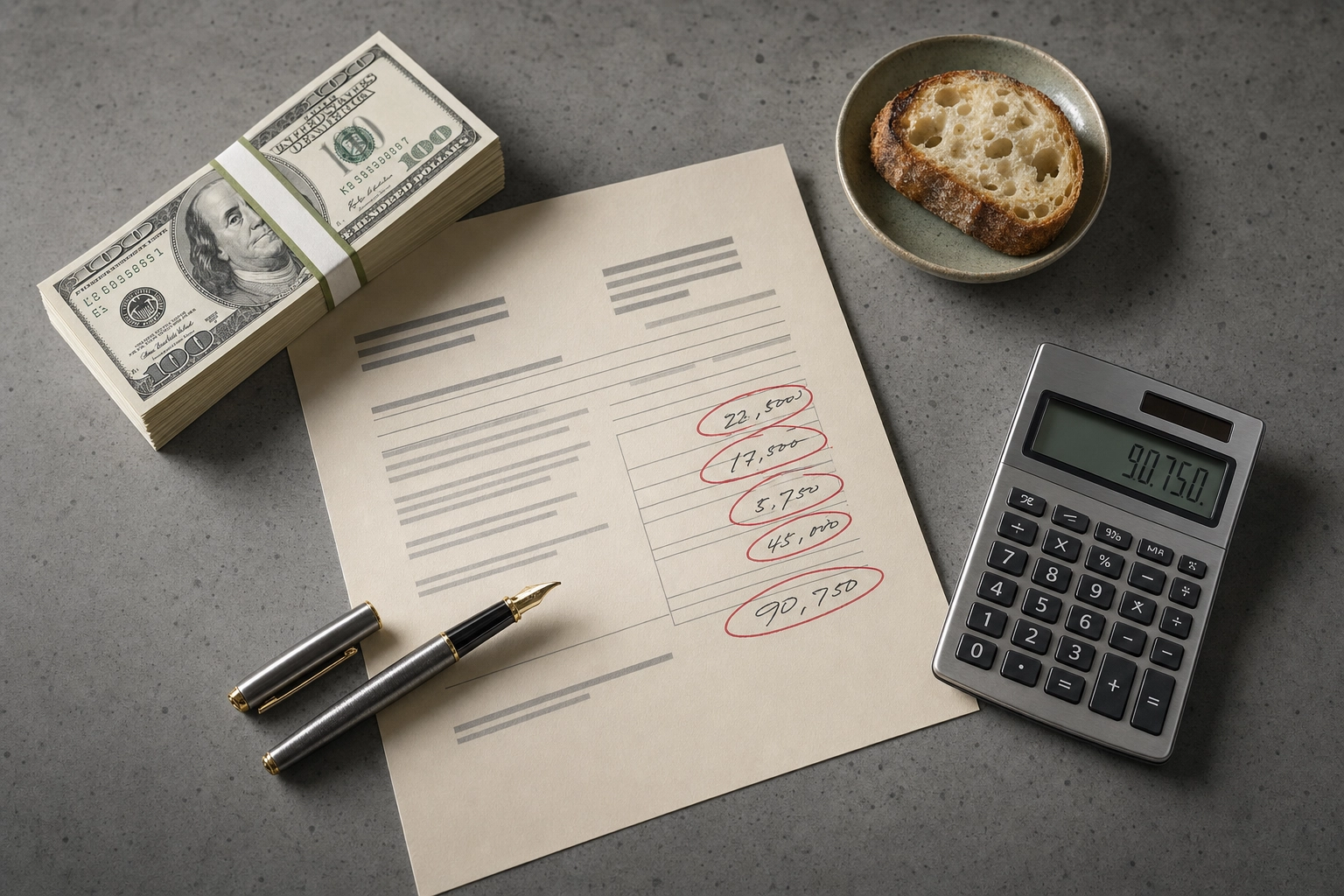
There are four pricing models. Most consultants use one or two of them; some use all four depending on the engagement.
 Overhead view of cash, contract with circled dollar figures, fountain pen, and calculator on a concrete counter
Hourly rates
The most common entry point. Independent consultants charge $100–$300 per hour. Senior strategy consultants and turnaround specialists charge $300–$500 per hour. Bain-tier hospitality strategy work runs higher, but you won't be hiring those firms unless you're a chain.
Some chef consultants charge as little as $80/hour for hands-on kitchen work, based on rates discussed in r/restaurateur threads, but $100–$150 is more typical for someone with real operating experience. Best for short coaching engagements, audits, or advisory hours.
Project-based fees
Range: $5,000 to $50,000+ for a defined deliverable. Some examples we see in the market:
- Menu engineering for a single-location café: $5,000–$10,000
- Brand and concept package for a new opening: $15,000–$30,000
- Full pre-opening engagement (concept, menu, training, soft launch): $35,000–$75,000
- Turnaround diagnostic + 90-day plan: $20,000–$40,000
One independent operator profiled by the consulting firm Eustress and Demeter invested $15,000 in a catering program build — and that program generated over $200,000 in incremental revenue within a year. That's the upside math when project scoping goes right.
Always ask what's NOT included in the proposal. Travel, expenses, software, and post-engagement support are often line items, not extras.
Monthly retainers
Range: $3,000–$10,000/mo for independent consultants, $5,000–$15,000+/mo for established firms. A NYC restaurant owner with 15 years of experience self-cited $5,000–$10,000/mo as their consulting rate in a r/restaurantowners thread, which is consistent with what most independents charge.
Retainers work well when you need a fractional executive — someone in your business 5–15 hours a week for 6+ months. Common for multi-unit operators preparing for expansion or restaurants in extended turnaround.
Percentage of revenue (or upside-based)
Range: 5–15% of revenue for the duration of the engagement. Most common in turnaround scenarios where the consultant takes risk alongside the operator. Less common, but increasingly used: equity stakes for opening consultants in exchange for reduced cash fees.
Be careful here. Percentage models align incentives but cap your upside; if your business takes off, you'll pay the consultant for years for a 90-day engagement. Build in a sunset clause.
What drives consulting prices up or down
- Experience. A consultant with 25 years and three successful turnarounds in your segment costs 3–5x a generalist.
- Geography. NYC, LA, and SF rates run 30–50% above secondary markets. According to ZipRecruiter 2026 data, the average restaurant consultant salary in Los Angeles is around $111,442/year; the national average is around $103,425. Glassdoor reports similar figures at $95,852 average and $46/hour.
- Scope. Open-ended discovery costs more per hour; tightly scoped projects cost more per project.
- Brand. Big-name firms charge a premium that's partly capability and partly insurance.
A useful rule of thumb from a Restaurant Business Online column: a consultant who values their time at $120,000/year typically charges around $500/day, $2,500/week, or $10,000/month for full-time work. That's the floor for someone with real chops.
How to find and evaluate a restaurant consultant
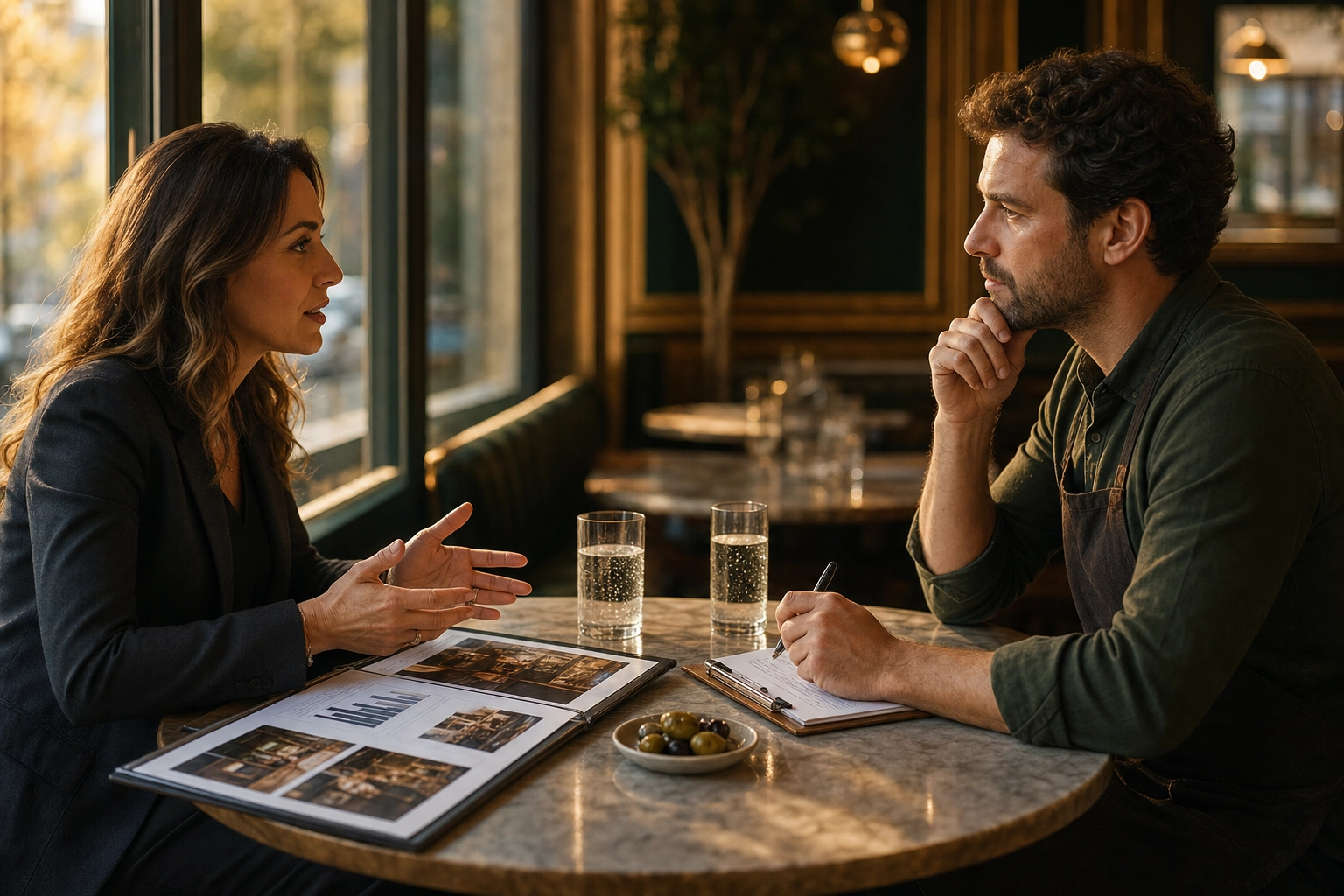
The vetting process matters more than the search. Most operators find consultants through referrals from their POS provider, accountant, lawyer, or trade association — and that's fine. Where things go wrong is in the evaluation.
 Restaurant owner interviewing a consultant across a marble table with a portfolio and question checklist
10 questions to ask before signing
- What restaurants like mine have you worked with? Fast casual ≠ fine dining ≠ ghost kitchen ≠ catering. Segment fit matters more than total years of experience.
- Show me three specific outcomes with numbers. "We grew their revenue 30% over 18 months" is a usable answer. "We helped them transform their business" is not.
- What's your framework or methodology? Consultants without a repeatable process are selling improvisation. Skip them.
- Will you implement, or just recommend? Both are valid; the price should reflect which one you're getting.
- What's your exit strategy — when do you leave? A consultant with no plan to leave is not a consultant. They're a permanent overhead expense.
- Who actually does the work — you or junior staff? Big-firm proposals often hide a senior partner pitching and an associate executing. Know who's on your account.
- Do you take vendor commissions? Many consultants get kickbacks from POS vendors, suppliers, and equipment dealers. That's not automatically disqualifying, but it must be disclosed.
- What's NOT included in the proposal? Travel, expenses, software, post-engagement support, follow-up calls.
- What KPIs will we measure together? Pin them down in writing before you start, with target numbers and review dates.
- Can I speak directly to two recent clients? Refusal here is a hard no.
Red flags that should end the conversation
- Vague pitches with no measurable past outcomes
- Refusal to share references or case studies with specifics
- Pricing significantly below market (you're getting a junior in a senior's clothing)
- Hidden vendor or supplier commissions
- No clear deliverables, milestones, or timeline
- Promises that sound like guarantees ("we'll double your revenue")
- A polished pitch deck with zero numbers behind it
A useful warning surfaces in r/restaurantowners discussions: one operator hired based on a polished pitch, paid $40,000 over three months, and ended up with nothing changed. The difference between that experience and a successful one came down to asking the questions above before signing.
What restaurant consultants recommend first (and why visual marketing is almost always at the top)
Walk into ten consulting engagements and you'll see roughly the same first 90-day playbook. There's a reason: experienced consultants know which interventions produce visible results in weeks instead of quarters, because early wins build operator trust and pay for the rest of the engagement.
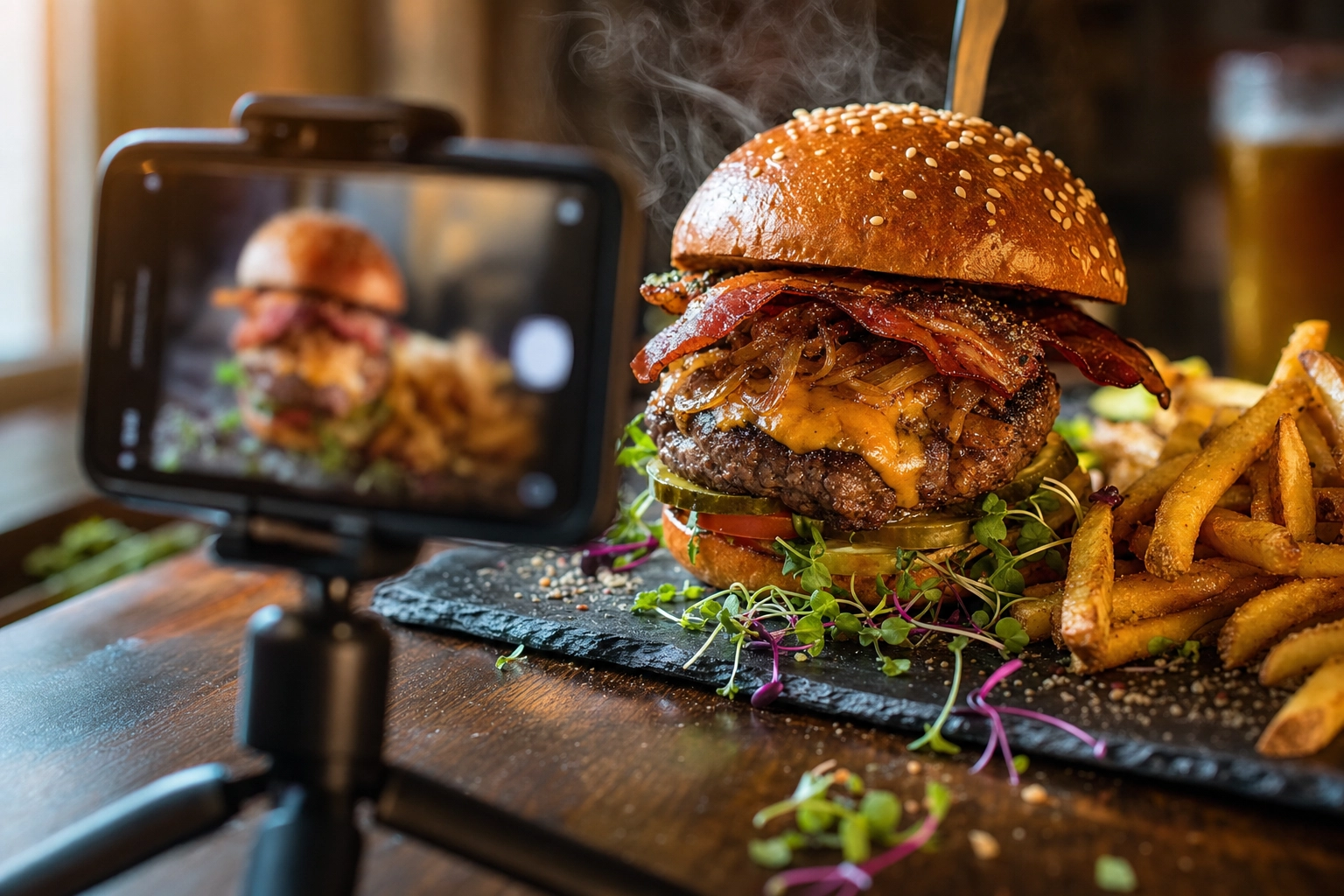 Smartphone capturing a beautifully styled gourmet burger demonstrating visual marketing for restaurants
Here's the typical priority stack:
1. Visual marketing audit and upgrade. Almost universally first. Why? Because it's the highest-ROI fix in the playbook. A restaurant's photos appear on its website, Google Business Profile, Yelp, Uber Eats, DoorDash, Instagram, and on the printed menu — and they directly drive ordering decisions. Industry research consistently shows that around 82% of consumers say food photos influence what they order, and restaurants that switched from text-only to photo menus on online ordering platforms reported conversion lifts in the 25–30% range. Visual upgrades cost very little to test and produce measurable lift across every channel simultaneously.
2. Menu engineering. Re-pricing, repositioning, removing the dogs, highlighting the stars. As noted earlier, well-executed menu engineering produces 10–15% ongoing profit lift. A small team can complete a first pass in a week.
3. Online presence audit. Google Business Profile, hours, address consistency, photo coverage, review response cadence, and basic local SEO. The bar here is shockingly low for most independents.
4. Delivery platform optimization. Photos, item descriptions, modifier groups, hero items, store hours, and platform-specific pricing. Often grouped with the visual marketing fix because the leverage is the same. Our cloud kitchen and delivery marketing guide covers what good looks like here.
5. Cost control basics. Invoice audit, vendor consolidation, food cost variance analysis, labor scheduling tightening. Less glamorous, more impactful long-term.
6. Staff training and SOPs. Documenting the unwritten rules in the founder's head, training the team, building consistency.
7. Review management. Responding to every review, mining patterns, training staff on the recurring complaints.
The takeaway: if your prospective consultant DOESN'T propose visual upgrades and menu engineering in the first 90 days, that's worth a conversation. They might have a good reason — but you should hear it.
Modern tools restaurant consultants recommend in 2026
The 2026 consultant prescription almost always includes a tech stack overhaul. Here's what shows up in proposals most often, organized by category. (None of these are sponsored; this is what we see consultants actually recommend.)
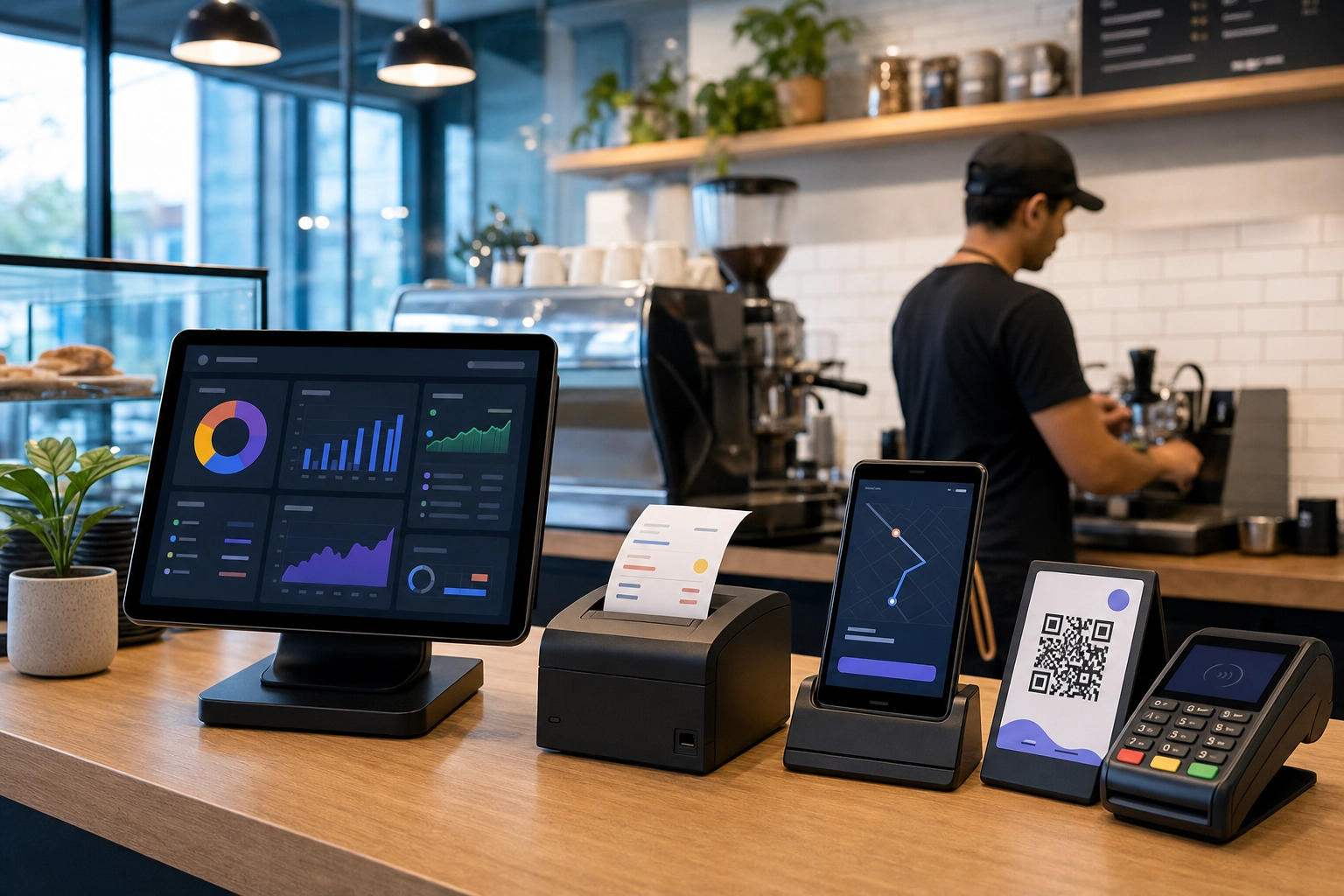 Modern restaurant counter with integrated technology stack: tablet, payment terminal, receipt printer
POS systems. Toast, Square for Restaurants, Lightspeed, and TouchBistro dominate the independent and small-chain market. Consultants evaluate them on reporting depth, integrations, payment processing fees, and offline reliability — not on flashy features.
Inventory and food cost management. MarketMan, MarginEdge, and BlueCart are the go-to picks for variance tracking and invoice processing. The pitch: most restaurants leak 1–3% of revenue through invoice errors and inventory blind spots, and these tools usually pay for themselves in the first quarter.
Online ordering. ChowNow, Owner.com, BentoBox, and ToastTab for direct ordering — which is the strategic move because direct orders avoid the 15–30% commission stack on third-party delivery.
Reservation and CRM. OpenTable, Resy, and SevenRooms for full-service. The CRM data is what consultants actually care about; reservations are the entry point.
Review management. Birdeye, Podium, Reputation.com, and Marqii (especially for multi-location). Automating the response cadence is the win.
AI food photography. This is the newest entry on the list and one consultants increasingly recommend as a replacement for traditional photography for menu and delivery photos. A traditional food photo shoot costs $700–$2,000+ per session, takes 1–3 weeks to schedule and deliver, and is impractical when your menu changes monthly. AI tools like FoodShot AI transform real phone photos of your dishes into menu-ready, studio-quality images in around 90 seconds for $9–$99/month — which makes refreshing photos for every menu change financially viable for the first time. See FoodShot AI pricing for current plans, or browse our professional restaurant food photography guide to see how the workflow compares to traditional shoots.
Delivery management. Otter and Deliverect consolidate Uber Eats, DoorDash, Grubhub, and others into one tablet, one menu source, one set of analytics. Essential once you're on three or more platforms.
Scheduling and team management. 7shifts and HotSchedules for labor cost optimization, shift swaps, and tip pooling. Most consultants treat scheduling tightening as one of the fastest ways to recover 1–2% of labor cost.
For a deeper look at the tools side of this list, see our restaurant marketing software breakdown and the best restaurant marketing tools shortlist.
The pattern to notice: integrations now matter more than best-of-breed for small operators. A consultant should be helping you build a connected stack, not the most expensive one.
Is hiring a restaurant consultant worth it?
The boring, accurate answer: it depends on the problem and the consultant.
 Brass scale balancing financial reports against a chef's notebook representing restaurant consulting ROI
The clearest scenarios where consulting pays back:
- Openings. Costs $20K–$75K, typically saves 2–5x that in avoided mistakes.
- Menu engineering. Costs $5K–$15K, typically returns 10–15% profit lift on ongoing sales.
- Multi-unit scaling. Costs $30K–$100K+, typically saves millions in avoided rollout failures.
- Turnarounds. Costs vary, but the alternative is closure.
- Delivery platform optimization. Often $5K–$15K with returns visible in 60 days.
The scenarios where consulting often disappoints:
- You don't have a specific problem. "Make my restaurant better" is not a brief.
- You don't have internal capacity to execute recommendations. A consultant's report is worthless if no one implements it.
- You're shopping for validation, not change. If you've already decided what to do, you don't need outside expertise.
The decision rule that holds up across 100+ engagements: specific problem + measurable outcome + the right specialist = a worthwhile investment. Drop any of those three and you're paying for an expensive education.
Frequently Asked Questions
What's the difference between a restaurant consultant and a restaurant manager?
A restaurant manager is a full-time employee responsible for daily operations — running shifts, managing staff, hitting financial targets, and reporting to ownership. A restaurant consultant is an external advisor brought in for a specific outcome on a defined timeline (project or retainer), then leaves when the work is done. Managers execute the plan; consultants help build (or fix) it.
How long does a restaurant consulting engagement typically last?
Quick wins like menu redesigns, marketing audits, and delivery optimization run 2–6 weeks. Operational changes — training, SOPs, cost control systems — typically take 3–6 months. New restaurant openings run 6–12 months. Multi-unit transformations or franchise rollouts can stretch to 12–18+ months. Beware open-ended engagements with no exit timeline; that's how retainer creep happens.
Can a restaurant consultant guarantee results?
No legitimate consultant guarantees specific revenue or profit outcomes — too many variables (weather, staff, competition, macro economy) sit outside their control. What they CAN guarantee is deliverables: an audit, a plan, a training program, a launch package, or a defined number of advisory hours. Outcomes always depend on the operator's willingness to execute. If a consultant promises a guaranteed sales lift, ask for the contract clauses that back it up.
Do I need a consultant or just better tools?
Tools fix processes. Consultants fix decisions. If you already know exactly what to change and just need execution, buy software, hire a contractor, or train your team. If you don't know which problem is killing your margins or which lever will move the needle, hire a consultant for diagnosis first. The worst outcome is buying a $300/month POS upgrade when the actual issue is a 15% labor overrun nobody's caught.
Should I hire a local consultant or someone remote?
Local consultants understand your specific market — local labor, supply chain, real estate, customer behavior, and regulations. Remote consultants bring broader pattern recognition from working across many segments and geographies. The strongest engagements are often hybrid: a remote strategist with deep segment expertise paired with on-site visits at key milestones, or a local execution partner working under a remote senior consultant's framework.
What's the average salary of a restaurant consultant?
According to Glassdoor 2026 data, the average restaurant consultant earns around $95,852/year ($46/hour). ZipRecruiter places the average at $103,425/year nationally and $111,442/year in Los Angeles. The full range stretches from $50,500 (25th percentile) to $192,500 (90th percentile), with the highest earners — typically partners at established firms or specialized turnaround consultants — clearing $250,000+. These figures track well with hourly rates in the $100–$300 range for working consultants.
Can a restaurant consultant help with delivery app optimization?
Yes — and increasingly, this is a core part of marketing and operations engagements rather than a niche specialty. A delivery-focused consultant audits your photos, item descriptions, modifier groups, hero items, store hours, platform-specific pricing, and promotional cadence on Uber Eats, DoorDash, Grubhub, and regional platforms. The fixes are often the highest-ROI work in the entire engagement: better photos and descriptions can lift conversion 20–40% in 60 days, and you can plan a menu photoshoot (or use AI photography) to handle the visual side affordably.
The honest bottom line
Restaurant consultants aren't magic. They don't fix bad concepts, save restaurants run by disengaged owners, or compensate for poor location decisions. What they do — when matched correctly to a specific, well-scoped problem — is collapse the timeline between "we have an issue" and "we have a working solution." For openings, expansions, turnarounds, and any scenario where the cost of being wrong is high, that timeline collapse usually pays for the engagement many times over.
If you're deciding whether to hire one, start with the test in this guide: name the specific problem, name the specific outcome you want, and name the type of consultant who has actually solved that problem before. If you can't fill in all three blanks, you're not ready to hire — and that's useful information by itself.