What Is a Ghost Kitchen? The 2026 Guide for Food Businesses
 Ali Tanis23 min read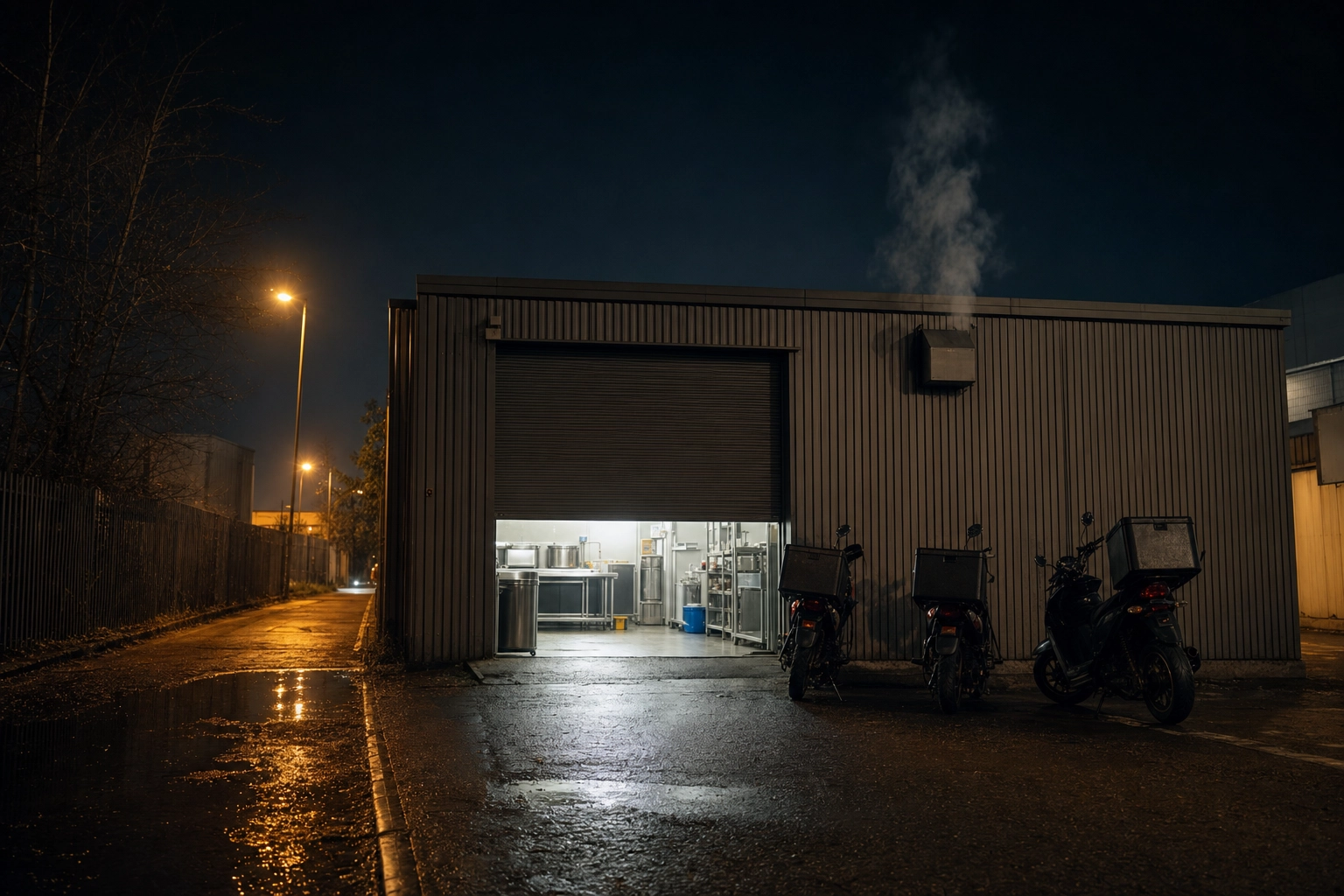
A ghost kitchen is a commercial kitchen that prepares food exclusively for delivery and pickup. It has no dining room, no storefront, and no walk-in customers. Orders arrive through third-party delivery apps like DoorDash, Uber Eats, and Grubhub, or through the brand's own online ordering site. The kitchen is the entire business.
The question isn't just "what is a ghost kitchen" — it's whether the model fits your business. Everything else, from the cloud kitchen and dark kitchen synonyms to the multi-brand strategy and the startup math, hangs off that one idea.
The detail is where operators lose money. So this guide covers how the model works day to day, what it costs against a traditional restaurant, who it genuinely suits, and the downsides the 2023 shakeout exposed. Including the one nobody writing about this seems willing to say plainly: your listing photo isn't marketing. It's the building.
Quick Summary: A ghost kitchen is a delivery-only commercial kitchen with no dining room or storefront — customers find it only through delivery apps. Startup costs run roughly $5,000–$80,000 depending on the model, against a median of $375,500 to open a traditional restaurant. The tradeoff is permanent: you save on real estate but pay 15–30% commission per order forever, and the platform owns your discovery, your customer, and your data.
What Is a Ghost Kitchen?
A ghost kitchen is a foodservice business that exists only as a kitchen. There's no sign on the street, no host stand, no window to look through. Food gets cooked, handed to a courier, and driven away. The customer never sees the place their dinner came from.
Merriam-Webster defines it as "a commercial cooking facility used for the preparation of food consumed off the premises," and lists cloud kitchen and dark kitchen as direct synonyms. Wikipedia's entry frames it the same way: a business serving customers "exclusively by delivery and pick-up based on phone and online ordering."
Four traits define the model:
- Delivery-only. No dine-in service. Some allow customer pickup; most don't bother.
- No customer-facing space. No dining room, no counter, no seating, no signage.
- Digital-only discovery. Nobody walks past and wanders in. Every order arrives through an app or a website.
- Often multi-brand. One kitchen can run several delivery brands at once from the same walk-in and the same line.
The distinction almost every explainer gets wrong
Here's what most articles on this topic blur, and it matters more than any other detail on this page:
A ghost kitchen is a place. A virtual restaurant is a brand.
The ghost kitchen is the physical facility — the room, the ovens, the hood, the health permit. A virtual restaurant (or virtual kitchen) is the concept that lives on the app: a name, a menu, a logo, a photo set. One ghost kitchen can host a dozen virtual restaurants. One virtual restaurant can be cooked out of a pizzeria's existing kitchen with no ghost kitchen involved at all.
People use the terms interchangeably. They aren't the same thing, and confusing them is how operators end up budgeting for a facility they don't need — or launching a brand with no plan for how anyone will ever find it.
How a Ghost Kitchen Actually Works
Follow one order end to end and the model explains itself.
A customer opens a third-party delivery app. They scroll a wall of listings — each one a photo, a name, a rating, a delivery time. Something looks good. They tap, they order online, they pay. The ticket lands on a kitchen display screen a few miles away. A line cook fires it. Someone packs it, seals the bag with a tamper-evident sticker, and sets it on a numbered pickup shelf by the door. A courier walks in, scans the bag, and leaves. Thirty to forty-five minutes after the tap, dinner arrives.
At no point in that sequence does anyone see the kitchen, the staff, or the building. The courier sees a shelf. The customer sees a bag.
The staffing is a different business. A traditional restaurant is two operations stapled together: a kitchen and a hospitality floor. Ghost kitchens delete the second one. No hosts, no servers, no bussers, no bar, no floor manager, nobody folding napkins. The staff is a few chefs on the line, plus someone packing and handing off.
That's a real cost saving, and it's also the model's whole personality. Nobody is charming anyone. There's no upsell at the table, no server recommending the special, no room to make a bad day better. The food and the photo do 100% of the persuading.
Where the kitchen physically lives. Three arrangements cover almost everything:
- A commissary or shared kitchen. You rent time — often hourly or by the shift — in a licensed commercial kitchen alongside other food businesses. Cheapest entry, least control.
- A private unit in a managed ghost kitchen facility. Your own 150–300 sq ft box inside a larger building, with shared loading docks and cold storage. More control, real monthly rent.
- An existing restaurant's kitchen. A restaurant that already owns a kitchen launches extra delivery brands out of it, monetizing the dead air between lunch and dinner. This is a virtual kitchen, and it's the cheapest way into the model by a wide margin.
Our dark kitchen guide breaks down five distinct operational variants of these if you want the full taxonomy.
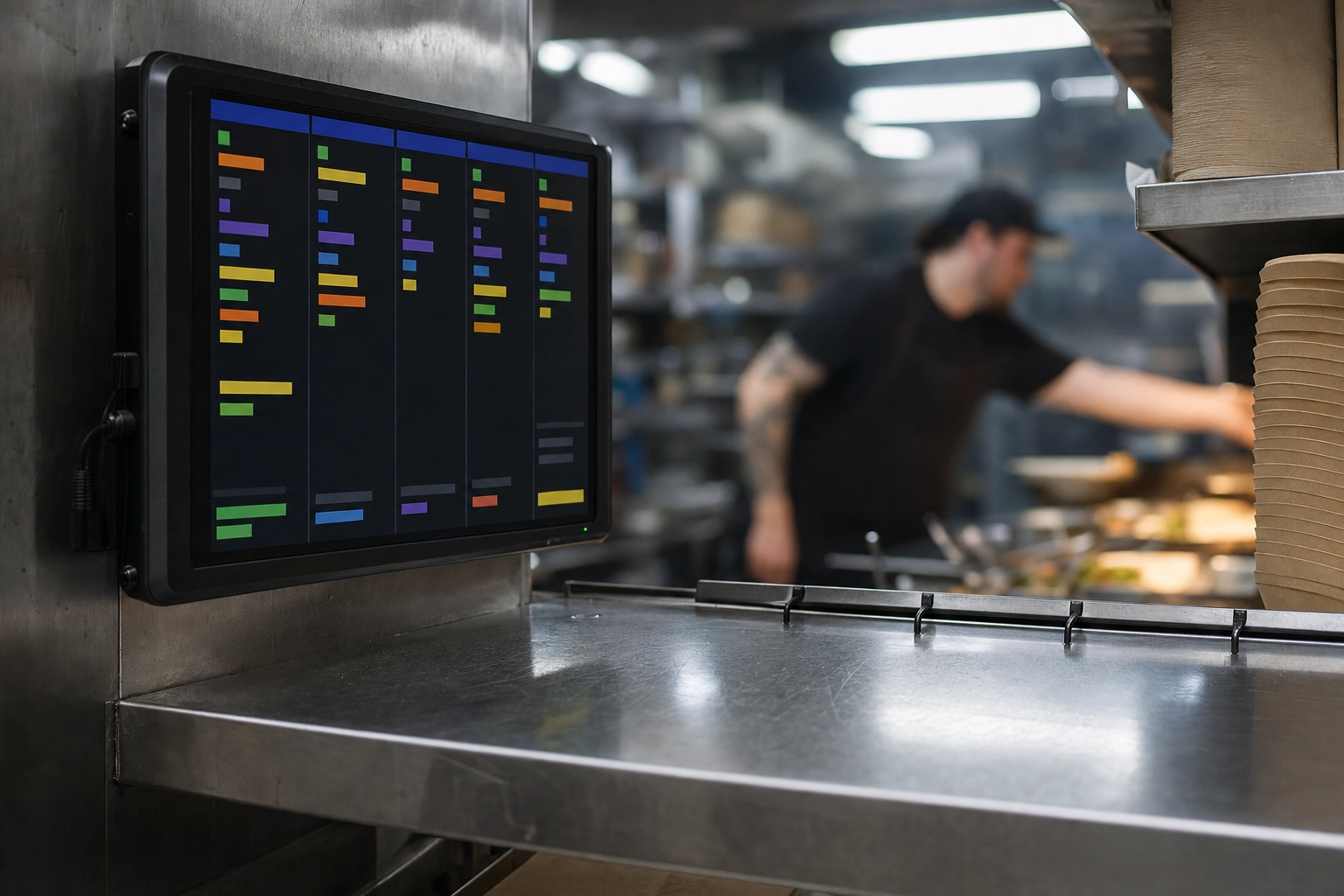 Kitchen display screen showing incoming delivery orders on a stainless pass as a ghost kitchen cook works behind it
Ghost Kitchen vs Cloud Kitchen vs Dark Kitchen vs Virtual Kitchen
Let's kill this one quickly, because it eats more reader attention than it deserves.
Ghost kitchen, cloud kitchen, and dark kitchen are the same business model. Different words, same thing. The vocabulary split by geography and by era as the industry grew between roughly 2018 and 2021 — it was never a difference in substance.
| Term | What it emphasizes | Where you'll hear it | Actually different? |
|---|---|---|---|
| Ghost kitchen | The invisibility — no storefront to see | US, most common | No |
| Dark kitchen | The unlit, closed-to-public space | UK, Europe | No |
| Cloud kitchen | The tech-platform framing | India, Middle East, Asia | No |
| Virtual kitchen / virtual restaurant | The brand, not the building | Everywhere, often misused | Yes — a brand, not a facility |
Only that last row is a genuine distinction, and it's the facility-vs-brand split from earlier. The rest is vocabulary.
Rather than re-explaining each term here, we've got a dedicated guide for each: dark kitchens for the full operational taxonomy, virtual kitchens for launching a delivery brand from a restaurant you already run, cloud kitchen marketing for growth strategy, and ghost kitchen brands for how the notable operators build identity.
What a Ghost Kitchen Costs to Start (vs a Traditional Restaurant)
This is the number everyone actually came for.
| Model | Typical startup cost | Ongoing space cost |
|---|---|---|
| Virtual brand from your existing kitchen | $5,000 – $15,000 | $0 (you already pay it) |
| Commissary / shared kitchen | $20,000 – $40,000 | $15 – $50 per hour |
| Private unit in a managed facility | $40,000 – $80,000 | $3,000 – $15,000 / month |
| Traditional restaurant | Median $375,500 | Prime-location lease |
That $375,500 figure is the median cost to open an independent restaurant in the US, from a RestaurantOwner.com survey of more than 350 owners — roughly $113 per square foot. Full-service restaurants skew higher, around $475,500; limited-service restaurants land nearer $225,500.
So the headline is real: a ghost kitchen can cost 5% to 20% of what brick-and-mortar restaurants cost to open.
Why it's cheaper. Strip out what a ghost kitchen doesn't buy and the savings explain themselves. No dining room build-out. No front-of-house furniture, no bar, no guest bathrooms, no décor. No prime foot-traffic lease — nobody's walking past anyway, so you can sit in a cheap industrial zone. And the footprint collapses from thousands of square feet to 150–300.
You're buying a kitchen. Just the kitchen.
The part the cost tables leave out. Here's the honest counterweight, and it's structural rather than temporary: you pay 15–30% commission on every order, forever.
DoorDash runs tiered commission plans commonly cited at 15%, 25%, and 30% — the higher tiers buy better marketplace visibility and marketing support, with pickup orders around 6%. Uber Eats mirrors a similar band. That's not a launch promo that expires. It's the rent you pay instead of a lease, and unlike a lease it scales with your success.
Run the math before you fall in love with the startup number. Brick-and-mortar restaurants pay fixed rent whether they sell $20,000 or $80,000 in a month. A ghost kitchen pays a percentage that grows with every order. There's a crossover volume where the "cheap" model stops being cheap, and knowing where yours sits is the difference between a business and a hobby. Both our dark kitchen guide and the virtual kitchen guide work through the full financial models and break-even timelines.
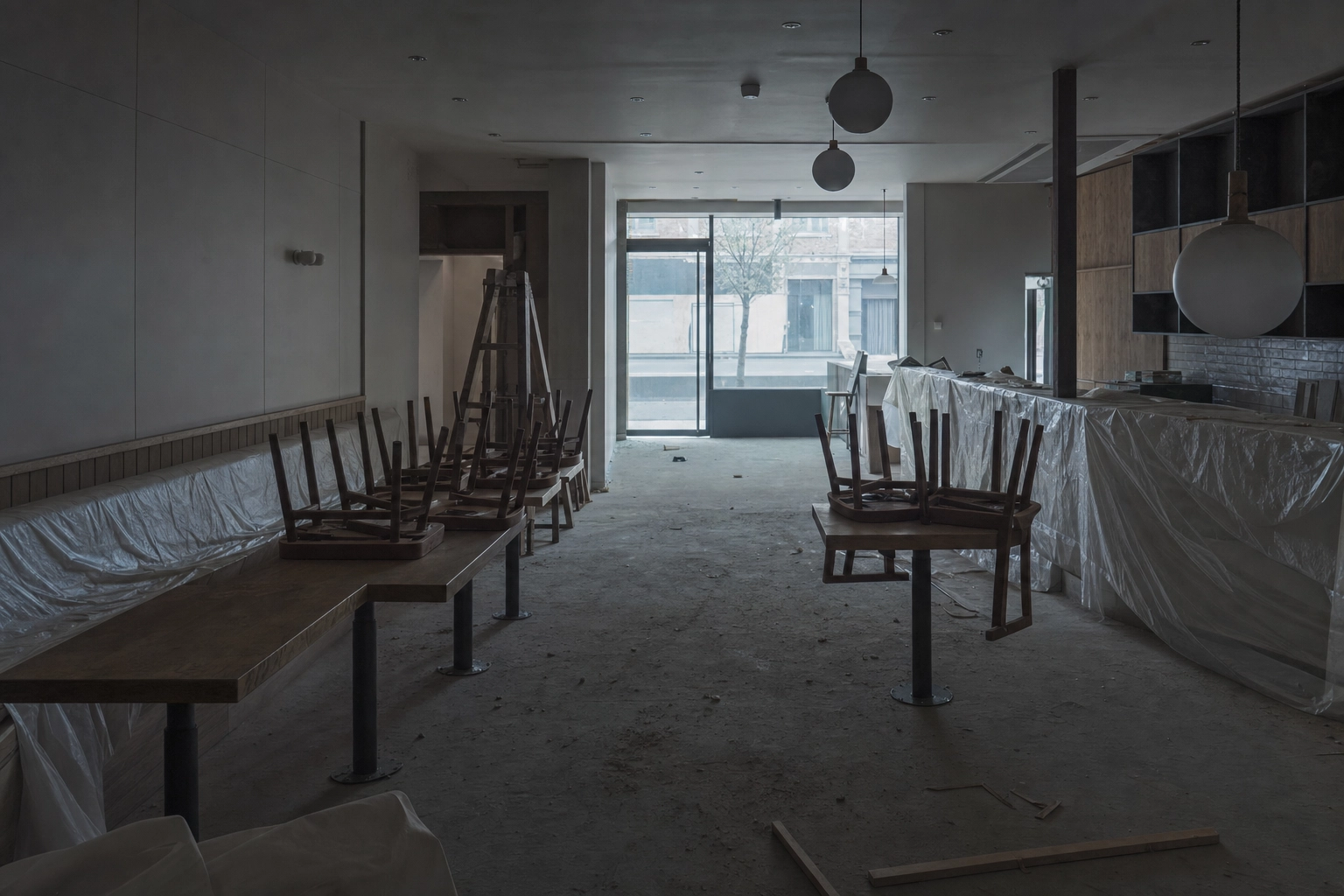 Empty restaurant dining room with stacked chairs and dust sheets, the costly build-out ghost kitchens avoid
How Big Is the Ghost Kitchen Market, Really?
Every article on this topic quotes a market size. Almost none of them mention that the estimates don't agree with each other.
Here are three published figures for the same year, 2026:
- ~$80 billion (New Market Pitch, CAGR ~10%)
- ~$99.3 billion (Coherent Market Insights, CAGR 12.3%, projecting $223.66B by 2033)
- ~$113 billion (Research and Markets, CAGR 16.2%, up from $97.2B in 2025)
That's a $33 billion spread — for one year, in a sector these firms are all describing with a straight face.
Why? Because they're measuring different things. One counts revenue at ghost kitchen facilities. Another counts food sales through delivery-only brands. A third folds in virtual restaurants run from traditional restaurants. Nobody is auditing this industry; these are models built on assumptions, not measurements — most of them extrapolating from the distorted 2020 spike, when lockdowns made delivery the only option and growth curves briefly went vertical.
The useful takeaway: the direction is real — this industry is growing, and North America accounts for roughly a third of it. The precision is theatre. When a vendor quotes you a ghost kitchen market figure to the decimal, they're citing someone's spreadsheet. Plan your business off your own delivery-radius volume, not off a number with a $33 billion error bar.
Who a Ghost Kitchen Actually Suits
The model isn't universally good or bad. It's sharply good for some operators and quietly terrible for others.
Good fit
- Restaurants with idle kitchen capacity. If your line is dead at 2 PM and your chefs are cleaning things that are already clean, you're paying for capacity you're not selling. Adding a delivery brand is the highest-ROI version of this model.
- Delivery-native food. Wings, burgers, bowls, sandwiches, pizza, tacos, most Asian-inspired menus. Food engineered to survive twenty minutes in a bag.
- Concept testing before a lease. Try the idea for $10,000 instead of $375,000. If it dies, it dies cheap.
- Radius expansion. Restaurants that only deliver three miles can rent kitchen space six miles away and double their map coverage without building a second restaurant.
- Caterers with downtime. A catering kitchen sitting idle between events is a ghost kitchen that hasn't been switched on yet.
Bad fit
- Experience-driven concepts. If people come for the room, the service, or the occasion, delivery deletes your product and keeps your costs.
- Fine dining. A dish built to be eaten ninety seconds off the pass does not survive a Honda Civic.
- Food that travels badly. Soufflés, anything crisp-fried at distance, tableside prep, delicate plating.
- Operators who dislike marketing. This is the big one. Skipping the dining room doesn't skip the work — it moves the work to listing optimization, photography, and promotions. If that sounds like someone else's job, this model will punish you.
Real businesses doing this. Denny's runs The Burger Den, Banda Burrito, and The Meltdown — all cooked by Denny's chefs in Denny's kitchens, all appearing on delivery apps as separate restaurants. TGI Fridays operates Conviction Chicken. Outback Steakhouse has Aussie Chicken. Wingstop, Applebee's, and IHOP all run virtual restaurants alongside their dining rooms.
And the model predates the pandemic that made it famous: Rebel Foods launched its first cloud kitchen in 2015 and went cloud-only in 2016. Ghost kitchens went mainstream in 2020, when dining rooms closed and every restaurant in the world briefly became a delivery business by force.
If you're weighing what to actually put on the menu, our ghost kitchen menu planning guide makes the case for a 15–25 item cap and walks through delivery-specific menu engineering.
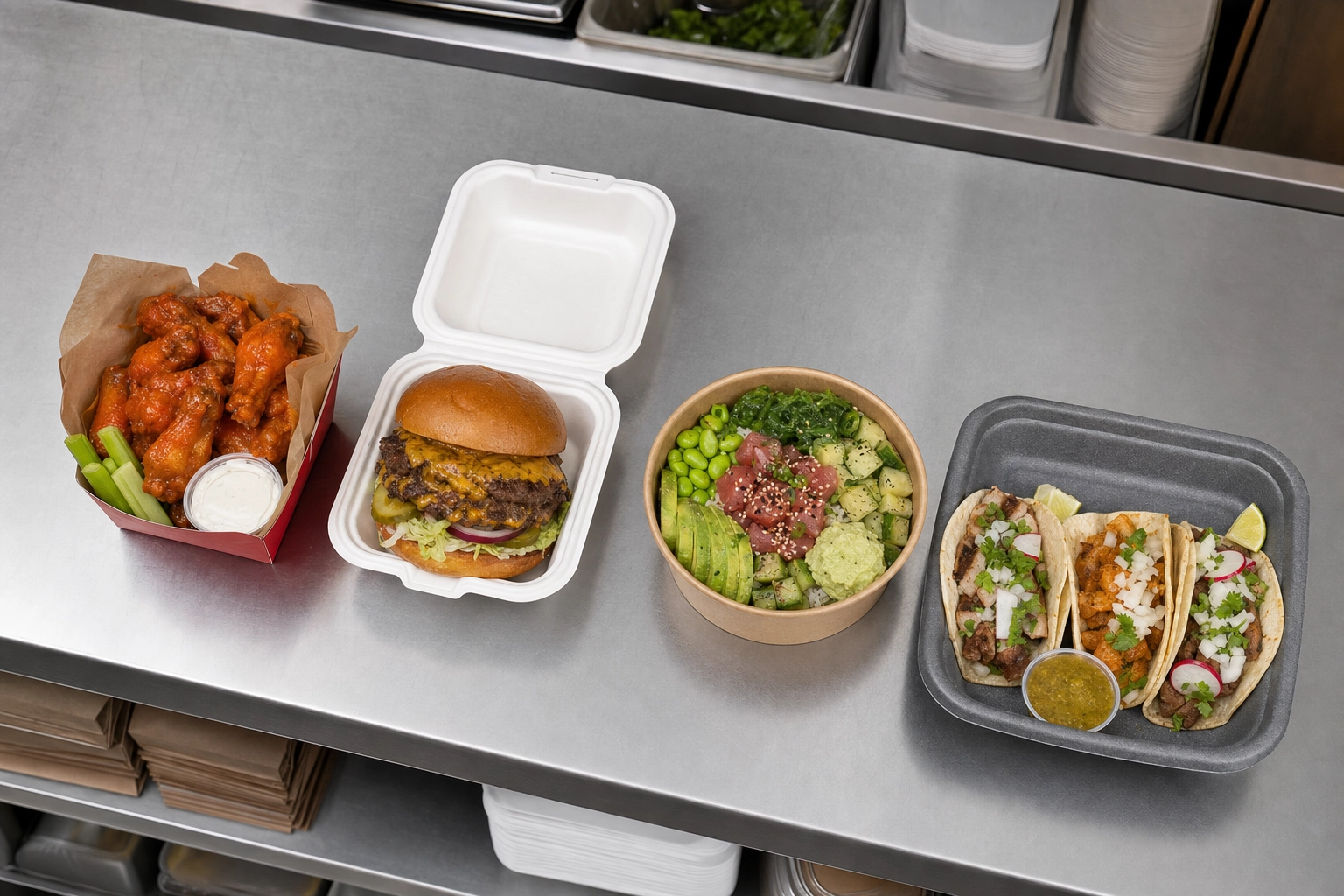 Four different unbranded takeout meals on one kitchen counter, showing multiple virtual brands run from a single ghost kitchen
The Honest Downsides Nobody Puts in the Brochure
The ghost kitchen pitch is seductive: all the revenue, none of the rent. Here's what the pitch leaves out.
1. You are renting your customers. This is the defining risk, and everything else is downstream of it. The third-party platform owns discovery. It owns the customer relationship. It owns the order data. You don't know who your customers are, you can't email them, and you can't call them back. A ranking-algorithm change you'll never be told about can halve your revenue on a Tuesday.
Brick-and-mortar restaurants having a bad month on the apps still have a door. You don't have a door.
2. The commission is permanent. 15–30% per order, structurally, forever. See the math above.
3. Platform risk is real, and it's documented. In 2023, Uber Eats removed roughly 8,000 virtual restaurants from its app after complaints about duplicate listings clogging search. Virtual storefronts on the platform had exploded from about 10,000 in 2021 to nearly 40,000. Business Insider reported that many were serving identical menus from the same address under different names. Uber's response was a new quality bar: as Fortune reported, a virtual brand's menu now has to differ from its parent restaurant by more than half its items. DoorDash had started investigating delivery-only brands on its own app a year earlier, in 2022.
Read that again as an operator: eight thousand businesses were switched off by someone else's policy update.
4. The speculative operators already washed out. The infrastructure players who raised money promising a ghost kitchen on every corner did not make it. Kitchen United closed all of its locations inside Kroger stores, then sold or closed the rest of its physical units and pivoted back to being a software company. Reef Technology suspended its modular kitchens across New York City after permits expired, and shut down sites in Portland, Philadelphia, and Houston — after announcing partnerships for 700 units with Wendy's, 500 with 800 Degrees, and 300 with TGI Fridays that never materialized at anything like that scale.
The model survived. Several of the biggest companies selling it didn't.
5. Quality control is the fault line. The best cautionary tale in this industry is MrBeast Burger. In July 2023, Jimmy Donaldson's Beast Investments sued Virtual Dining Concepts in federal court, alleging the burgers sold under his name were described by customers as "disgusting," "revolting," and "inedible," and that this damaged his brand. VDC called the suit meritless and said Donaldson was trying to renegotiate. Variety covered the filing and the response.
Set aside who was right. The structural lesson stands: he controlled the brand and the listing. He did not control the kitchen. When your name is on an app and someone else's hands are making the food, the model itself is the risk.
6. Zero walk-in discovery. Ever. No window. No signage. No smell drifting down the block at 6 PM. Nobody has ever impulse-bought from a ghost kitchen while walking to the train. Every customer, every order, for the entire life of the business, has to be won on a screen.
Which brings us to the part most operators underrate.
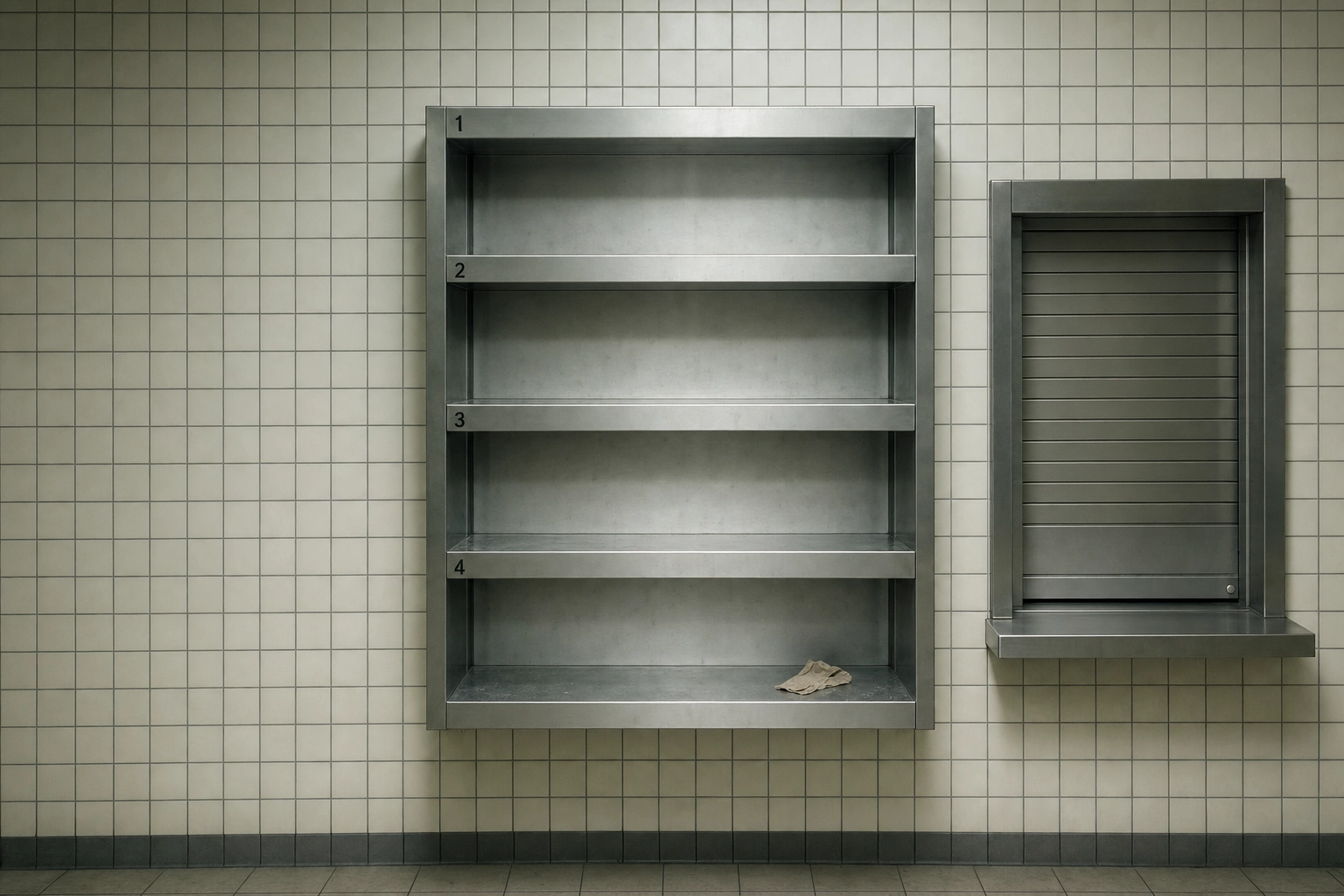 Empty numbered courier pickup shelves under harsh light, showing the risk of a ghost kitchen losing delivery app visibility
Why Your Listing Photo Is the Entire Storefront
This isn't a marketing tip. It's arithmetic.
Brick-and-mortar restaurants sell with a building on a corner, a lit window, the smell of garlic, a menu board, a chalkboard special, and a server who says the short rib is incredible tonight. That's six or seven persuasion channels working before anyone spends a dollar.
A ghost kitchen has one. A thumbnail, roughly two inches wide, on a phone, surrounded by forty competitors' thumbnails.
That's it. That's the entire storefront.
The platforms' own data backs this up. According to DoorDash's internal merchant data, merchants with header photos on their store pages saw over 5x more sales in their first 28 days compared to those without them. Not 5% more. Five times. That's the closest thing to a free lunch in this industry, and it's a photo.
DoorDash also reports that more than 15% of consumers who tried a restaurant for the first time in 2025 ordered from it again within a month, and that by month three, repeat customers made up nearly 40% of a new merchant's orders. Every one of those relationships started with someone looking at a picture and deciding to risk $18 on it.
Multi-brand makes it harder, not easier. Running three virtual restaurants from one kitchen is the standard playbook for squeezing revenue out of fixed overhead. But it means three genuinely distinct photo sets — because after the 2023 crackdown, brands that look like reskins of the same kitchen get pulled. The visual identity of each has to actually be different, not just the logo. Our guide to ghost kitchen brands digs into how the good operators handle this.
The nuance most vendors won't mention
Before anyone sells you a photography solution: DoorDash offers free professional photoshoots to eligible merchants, plus a $200 photography credit on its Premier plan. Take it. It's free, it's good, and you'd be silly not to.
But understand its limits. It's capacity-limited and geography-dependent, it's essentially a one-time event, and it won't cover you when you change the menu next quarter, launch a second brand, add a seasonal special, or need a different visual identity for each of your three concepts. Ghost kitchens change menus constantly — that's the model's advantage. Photography that only happens once doesn't fit a business that changes weekly.
That gap is why FoodShot AI exists. Shoot the real dish on a phone, and turn it into a 4K, menu-ready image in about ninety seconds — a different style per brand, no photographer booking, no shoot day, commercial license included on paid plans. It's built for exactly the operator running three delivery brands who needs each one to look like its own restaurant. If you're optimizing listings across platforms, our food delivery app photography guide and the most common delivery photo mistakes cover what actually converts, and pricing starts at $15/month.
For the broader tactical picture, see ghost kitchen marketing for ten delivery-specific tactics, how to get more orders on Uber Eats, and our menu photography guide.
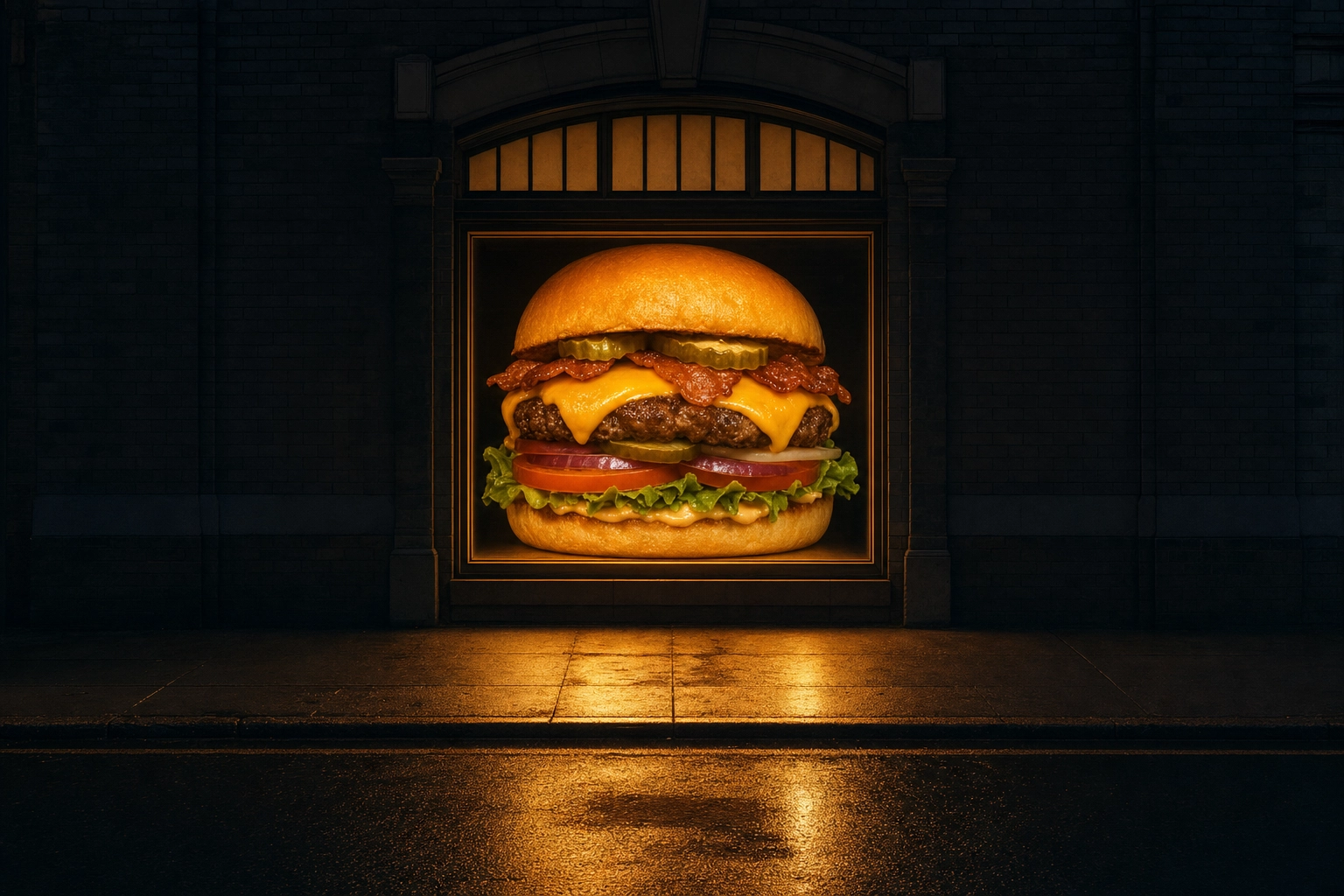 Restaurant storefront window glowing at night framing a single burger, showing how a delivery listing photo is the ghost kitchen storefront
How to Tell If You're Ordering From a Ghost Kitchen
Plenty of people arrive at this question as customers, not operators. So: how do you know?
The tells are easy once you know them:
- The address matches another restaurant on the same app. If "Nashville Hot Chicken Co." and your local sports bar share a street address, it's one kitchen.
- No website beyond the app listing. No site, no phone number, no Google Maps presence with photos of a room.
- The brand appeared recently with no local history. No reviews older than a few months, no news coverage, no social presence before this year.
- The menu is oddly narrow and delivery-optimized. Twelve items, all of which travel well.
- Several "different" restaurants share one address. Four cuisines, one kitchen.
Is that a bad thing? Honestly, no — not inherently. A good kitchen is a good kitchen regardless of whether it has a dining room. Ghost kitchens hold the same health permits and pass the same inspections as any other commercial kitchen; delivery-only businesses aren't less regulated, just less visible.
The fair criticism is transparency, not safety. Some diners feel misled when the "local Thai place" turns out to be the pizzeria down the street running a second menu. That's a reasonable thing to want disclosed. It isn't a reason to think the food is unsafe.
Is a Ghost Kitchen Worth It in 2026?
Here's a real answer instead of a hedge. First, the short version of how this industry got here:
- 2015–2016: Rebel Foods opens the first cloud kitchen and goes delivery-only.
- 2018–2021: the terminology splits regionally into ghost, dark, and cloud kitchens.
- 2020: dining rooms close, online ordering explodes, and ghost kitchens go mainstream. Making a delivery-only menu work stops being a niche experiment and becomes survival.
- 2021: Uber Eats hosts ~10,000 virtual storefronts; Reef announces a 700-unit deal with Wendy's.
- 2022: DoorDash begins investigating delivery-only brands as listings multiply.
- 2023: the reckoning — Uber Eats cuts ~8,000 brands, Reef retreats, Kitchen United exits physical units, MrBeast sues his operator.
- 2024–2026: the model settles into kitchens that were already paid for.
The land-grab era is over. The story that ghost kitchens would replace restaurants was always investor fan fiction, written in 2020 when delivery looked permanent and dining rooms looked finished. The companies selling that story hardest — Reef, Kitchen United — are gone or unrecognizable. If you're arriving now expecting a gold rush, you're five years late to a party that got shut down.
What's left is better than the hype was. Stripped of the froth, the ghost kitchen is a legitimate, lower-risk way to run a delivery business. It's just a delivery business — not a cheap restaurant. That distinction decides who makes money.
Who wins now: operators with a kitchen they're already paying for, adding focused delivery brands to sell capacity they own. And tight, delivery-native concepts run by people who treat listing optimization as the actual job. Their economics are genuinely good, because the marginal cost of a new brand is close to zero.
Who loses: anyone who thought skipping the dining room meant skipping the marketing. The dining room was doing marketing work — signage, smells, walk-bys, word of mouth. Delete it and that work doesn't disappear. It just becomes yours, on a screen, against forty competitors.
If you're going to do this, do it in this order: pick food that travels, cook it somewhere you're already paying for, keep the menu small, and make your photos genuinely good before you spend a dollar on promotions. The photo is the storefront. Build the storefront first.
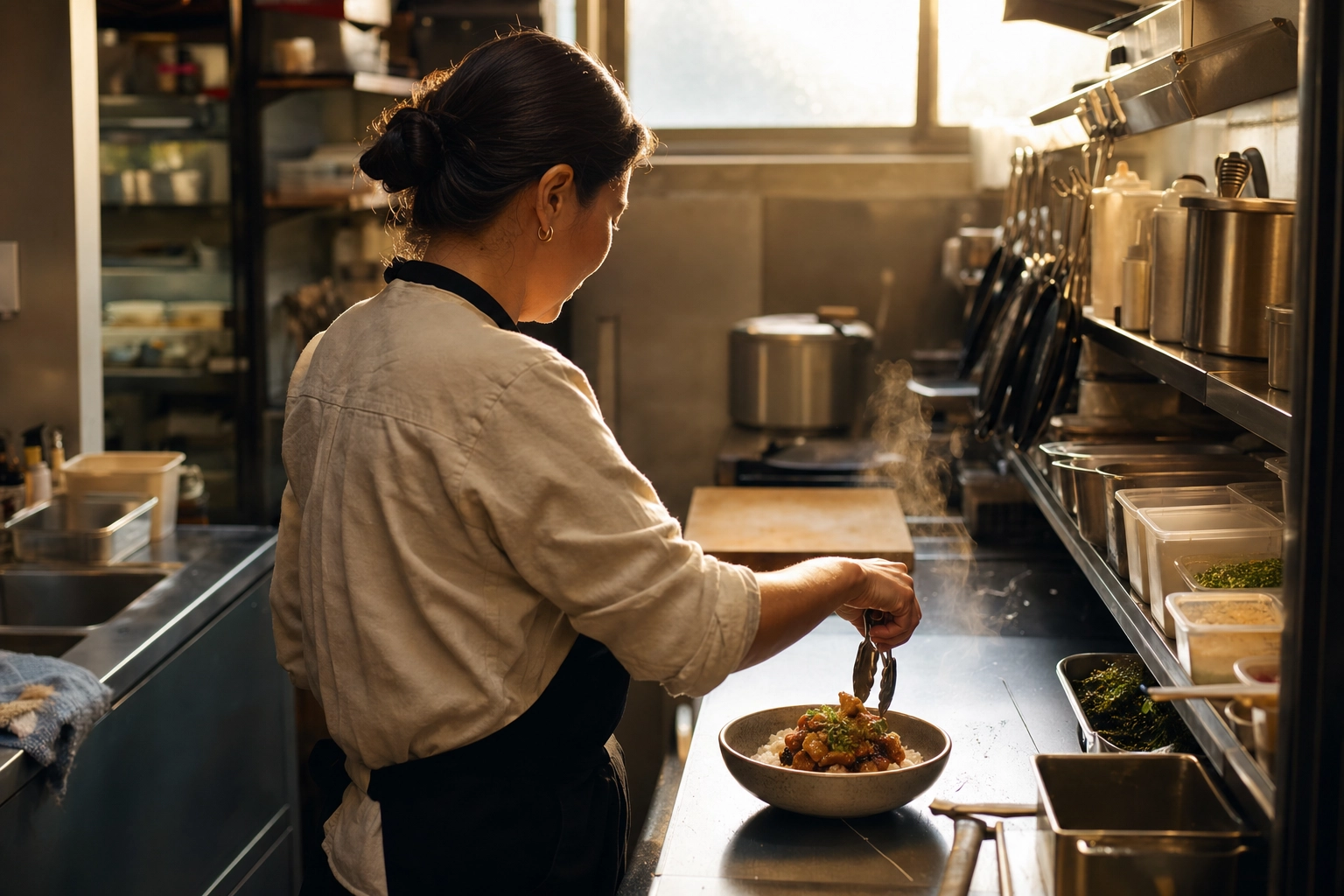 Chef-owner plating a bowl alone in a compact delivery kitchen, the operator profile that succeeds with a ghost kitchen in 2026
Frequently Asked Questions
What is a ghost kitchen in simple terms?
A ghost kitchen is a restaurant with no restaurant. It's a commercial kitchen that only cooks food for delivery and pickup — no dining room, no storefront, no walk-in customers. You find it on a delivery app, order, and a courier brings the food. The kitchen is the only physical part of the business.
What does ghost kitchen mean?
The term describes a kitchen that's invisible to customers — it has no public-facing storefront, so it "haunts" the delivery apps without existing on the street. Merriam-Webster defines a ghost kitchen as a commercial cooking facility used to prepare food consumed off the premises. Cloud kitchen and dark kitchen mean the same thing.
What is the difference between a ghost kitchen and a virtual restaurant?
A ghost kitchen is the physical facility — the actual kitchen space where food is cooked. A virtual restaurant is the brand: the name, menu, and listing customers see on the app. One ghost kitchen can host many virtual restaurants at once. The kitchen is the place; the virtual restaurant is the concept.
Are ghost kitchens legal and safe to order from?
Yes. Ghost kitchens are fully legal and must hold the same health permits, pass the same inspections, and meet the same food safety codes as any commercial kitchen in their jurisdiction. The common complaint isn't safety — it's transparency, since customers often can't tell that the brand they ordered from shares a kitchen with another restaurant.
How much does it cost to start a ghost kitchen?
It depends on the model. Launching a virtual brand from a kitchen you already operate typically runs $5,000–$15,000. Renting a commissary or shared kitchen runs about $20,000–$40,000. A private unit in a managed ghost kitchen facility runs $40,000–$80,000. Compare that to a median $375,500 to open an independent restaurant.
Do ghost kitchens make money?
They can, but the margin structure is unforgiving. You save enormously on real estate and front-of-house staff, then hand back 15–30% of every order in delivery commissions. Well-run businesses — especially virtual restaurants added to an existing kitchen — are profitable. Standalone ghost kitchens with weak listings and no marketing usually aren't.
Can an existing restaurant run a ghost kitchen?
Absolutely, and it's the strongest version of the model. You already have the kitchen, the equipment, the chefs, and the permits. Adding a delivery-only brand monetizes idle capacity — the dead hours between lunch and dinner. Just note that Uber Eats now requires a virtual brand's menu to differ from its parent restaurant by more than half its items.
What food works best for a ghost kitchen?
Food that survives twenty minutes in a bag. Burgers, wings, pizza, bowls, sandwiches, tacos, curries, and most Asian-inspired menus travel well and hold temperature. Avoid anything that goes soggy, wilts, melts unpredictably, or needs tableside finishing. If the dish only works in the first ninety seconds off the pass, it's a dine-in dish.