How Much Do Ghost Kitchens Cost to Rent? $2K-$10K a Month
 Ali Tanis16 min read
How much do ghost kitchens cost to rent? In 2026, a dedicated delivery-only unit runs about $2,000 to $10,000 a month depending on the city, and a shared commissary runs $100 to $1,250 a month in membership fees or $15 to $75 an hour. That's the number every kitchen rental site gives you. The number they skip is the one that decides whether you survive: at 60 orders a day, the delivery apps will take roughly three times what your landlord does.
This guide covers both: ranges by market tier, the four pricing models, upfront money, hidden fees, a 12-month P&L at three volumes, and the break-even math. If you're still deciding what kind of delivery kitchen fits your concept, start there and come back.
Quick Summary: Budget $4,500–$10,000 a month for a ghost kitchen unit in a top-tier city, $3,000–$6,000 in a mid-size metro, and $2,000–$3,500 in a smaller market, plus a deposit of one month's fee up to about $30,000. On our model, a single brand at a $30 average ticket breaks even near 45 orders a day. The commission tier you pick moves that number more than the unit you pick.
The Short Answer: What You'll Pay Each Month
There are three kinds of space sold as a "ghost kitchen," and they're priced very differently:
- Private turnkey unit. A 150–400 sq ft room inside a purpose-built facility, with a hood, fire suppression, a sink line and a courier pickup area already built. You pay a flat monthly fee. This is what most people mean by the term.
- Shared commissary kitchen. A licensed kitchen you book by the hour or through a monthly membership. You share the line with bakers, caterers and food trucks.
- Raw commercial space. An empty or second-generation unit you fit out yourself. It's cheapest per square foot and the most expensive to open.
Location drives the fee more than size does. In the Reddit quote below, doubling the floor added just 11% to the bill, while moving the same kind of unit from a mid-size metro to a top-tier city adds far more. If you haven't settled on the model yet, our guide to how to start a ghost kitchen walks through the full launch sequence, and the dark kitchen guide covers the model itself. This page stays on the money.
How Much Do Ghost Kitchens Cost to Rent by Market Tier?
Published ranges vary wildly because they mix all three kinds of space. Split them by market tier and they get useful.
| Market tier | Example cities | Turnkey unit, a month | Commissary membership | Raw space, 500 sq ft |
|---|---|---|---|---|
| Tier 1 | New York, San Francisco, LA, Boston, Seattle | $4,500–$10,000+ | $750–$1,250 | $2,200+ |
| Tier 2 | Denver, Dallas, Atlanta, Phoenix, Nashville | $3,000–$6,000 | $400–$900 | $1,200–$2,000 |
| Tier 3 | Smaller metros and suburbs | $2,000–$3,500 | $100–$600 | $900–$1,500 |
Where these come from:
- A poster on r/KitchenConfidential described a facility charging $4,600 a month for a 200 sq ft unit and $5,100 for 400 sq ft, with about $30,000 due up front for the space and contract.
- An operator on r/GhostKitchens was quoted around $5,000 a month in Boston plus extras in 2020, and another put San Francisco at $8,000–$10,000 a month all-in, close to $100,000 a year.
- Seattle Commissary lists a $750 monthly minimum. The nonprofit Pikes Peak United Way commissary in Colorado charges $100 a month for a basic membership, $600 for 40 hours and $700 for unlimited use.
- Raw space: 500 sq ft of commercial space has been listed near $900 a month in Pittsburgh and up to $2,200 in Boston.
Tier 2 and Tier 3 figures are our estimates, bracketed by those data points and by the kitchen rental rates operators publish. Purpose-built ghost kitchens are rare outside big metros, so in a Tier 3 location your real choice is often a commissary or a raw unit.
The Four Ways Landlords Price a Ghost Kitchen
When people ask how much do ghost kitchens cost to rent, they usually picture one flat fee. In practice, the pricing model matters as much as the headline number, and rental terms vary from building to building. Here are the four you'll meet.
1. Per Square Foot
Raw and second-generation spaces are priced the way shops are: a yearly figure per square foot, plus a share of taxes and common-area upkeep. The Pittsburgh and Boston listings above work out to roughly $22 and $53 a square foot a year. That's cheap for the floor. You then pay for the hood, fire suppression, grease trap, walk-in and permits yourself, which is why this route turns into a traditional commercial kitchen build.
2. Flat Turnkey Fee
Purpose-built ghost kitchens offer a finished unit for one flat fee each month. Look at what that fee buys. The 200 sq ft unit above costs $23 a square foot every month, while the 400 sq ft unit costs $12.75. Doubling the floor added only 11% to the bill. You aren't paying for space. You're paying for the built-out hood, the permits, the courier flow and the speed to open. So if you need a bigger unit, it's usually cheap to go up a size. Also check whether a separate shared-services fee is added; CloudKitchens-type facilities often bill one on top of the base.
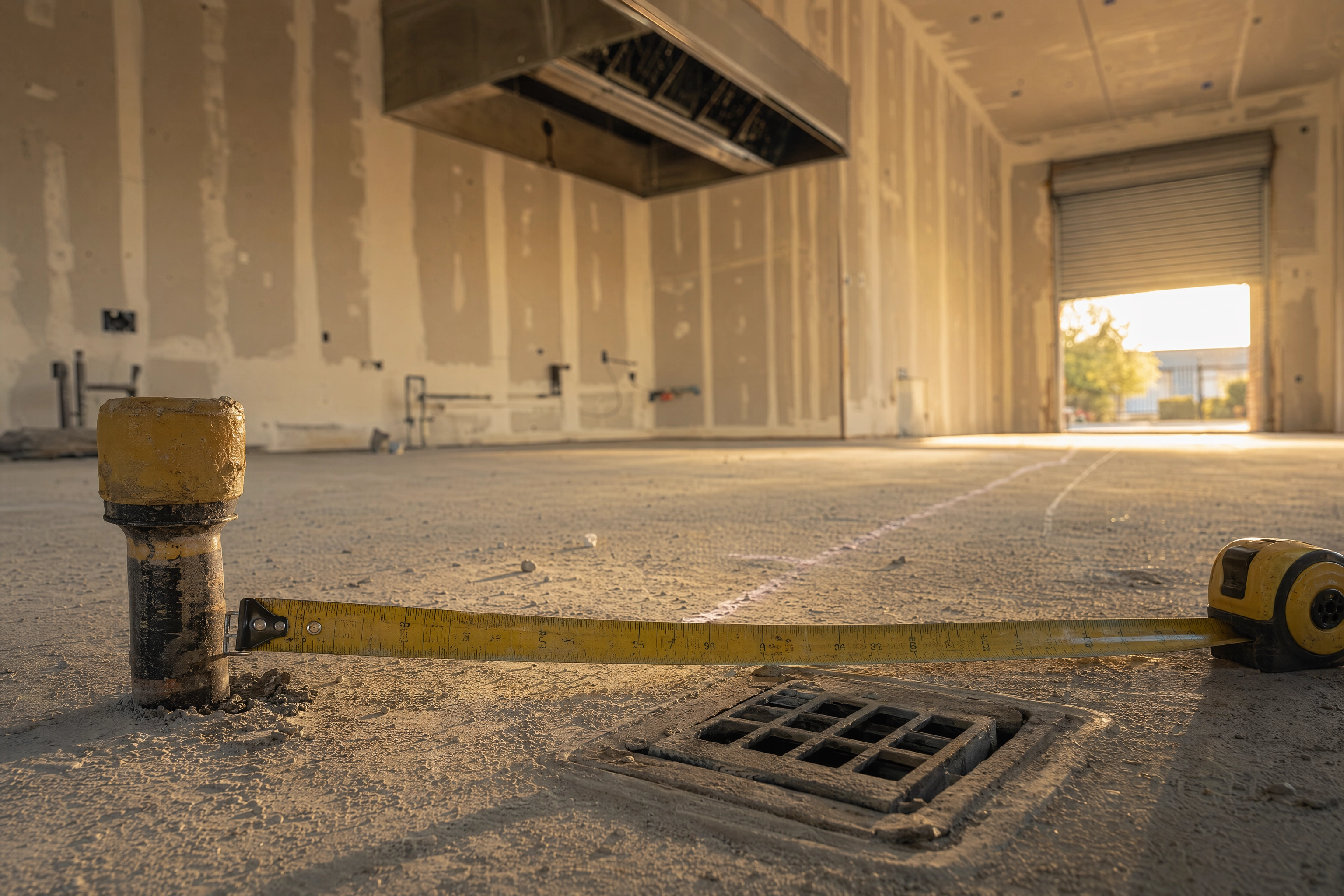 Tape measure across the floor of an empty commercial kitchen shell, the per-square-foot way to rent raw space
3. Hourly or Membership
Commissaries sell time. The national average for hourly rates sits around $20–$35, with major cities at $40–$75, and some offer lower rates for late-night slots. Memberships bundle hours and a storage shelf: one r/Chefit thread cites about $500 for 24 hours a month and $900+ for 60 hours in a mid-size city.
Here's the trap for delivery brands: demand runs at lunch and dinner, seven days a week. That's roughly 300 hours a month. At $25 an hour, that's $7,500, more than a private unit in most cities.
4. Revenue Share
Some landlords take a cut of sales in place of part or all of the fixed fee. Bisnow reported percentage deals for restaurant tenants landing between 5% and 15% of revenue. An ICSC leasing workshop describes the trade: a lower minimum each month in return for a percentage of sales.
A revenue share protects you in a slow first quarter. It costs you once you're busy. At 10% of $54,000 a month, you'd pay $5,400, more than the flat fee in our model below. If a landlord makes this offer, negotiate a cap before you sign.
Upfront Costs: Deposit, Fit-Out and Equipment
The monthly fee isn't your first check. Plan for these one-time costs:
- Security deposit. Commissaries usually ask for one month's fee, and it's refundable if you pay on time and leave the space clean. Turnkey operators can ask for far more; the $30,000 quote above bundled the deposit and contract costs.
- Fit-out. Near zero in a turnkey facility beyond smallwares and shelving. In raw space, a hood alone runs $5,000–$20,000, and a full commercial kitchen build can reach $200,000–$500,000.
- Equipment. Turnkey units include the hood and core lines, but specialty gear is yours: a combi oven, a pizza deck, an extra fryer. Leasing spreads it out. Roughly $20,000 of equipment leases for $450–$500 a month with good credit, and $50,000 for $1,100–$1,200.
- Permits and licenses. Budget $500–$3,000 for health permits, a business license and food handler cards.
- Opening float. First food order, packaging stock and 3–6 months of operating expenses.
All-in, most founders spend $20,000–$60,000 to open inside shared or turnkey spaces. Renting keeps that number low; building your own commercial kitchen pushes it well past $100,000. The SBA's startup cost worksheet is a good place to list yours before you sign.
The Hidden Line Items Nobody Quotes You
The advertised fee is the floor. These are the extra fees and expenses that show up after move-in:
| Line item | Planning range a month | Why it bites |
|---|---|---|
| Extra cold or dry storage | $100–$400 | Included storage is often a single shelf |
| Delivery bags, containers, labels | 3–6% of sales | Scales with every order |
| POS and order-tablet software | $50–$300 | One tablet per app adds up fast |
| Commissary minimums | $500–$750 | You pay it even in a slow month |
| Shared-services or cleaning fee | $200–$800 | Billed apart from the base |
| Utilities, if not included | $1,000–$2,000 | Standalone units under 4,000 sq ft |
| General liability insurance | $40–$170 | $500–$2,000 a year; commissaries want $1M per occurrence |
| Grease trap, pest control, hood cleaning | $100–$300 | Often your job in raw space |
Utilities, insurance and commissary minimums come from published figures; the other rows are our planning estimates, so get real quotes.
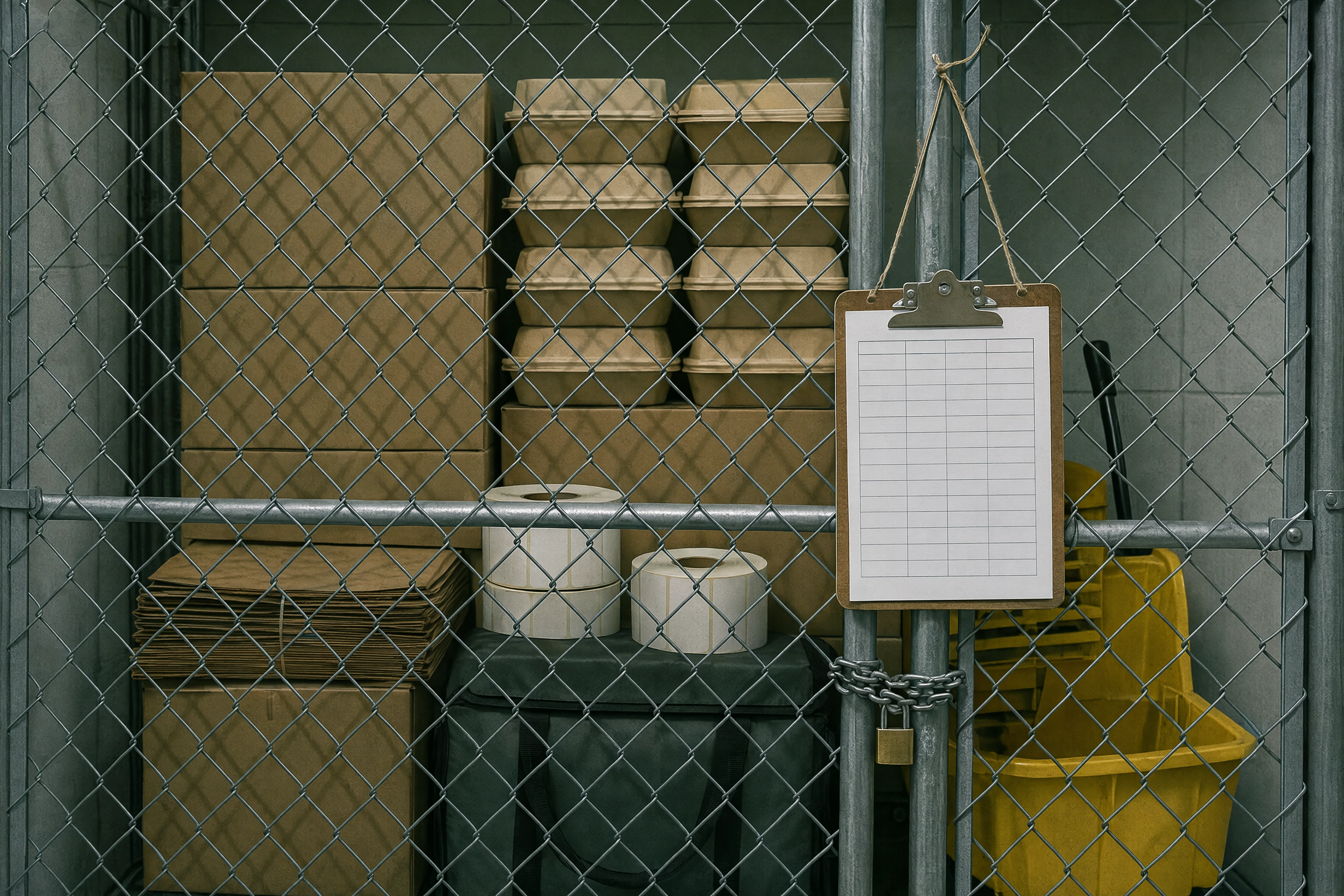 Padlocked tenant storage cage of takeout containers and bags in a shared kitchen, a hidden ghost kitchen fee
Ask for the full list of included services in writing before you sign any kitchen rental agreement. "Utilities included" can mean electricity but not gas. "Storage included" can mean one speed rack. App fees are their own category; our guides to getting more DoorDash orders and more Uber Eats orders cover the promo spend that sits on top.
A 12-Month P&L for One Virtual Brand at Three Volumes
Knowing how much do ghost kitchens cost to rent is only half the answer. The other half is how much you have to sell to cover it. Here's a worked model for one delivery-only brand in a Tier 2 turnkey unit. It uses round, stated assumptions, so you can swap in your own.
Assumptions: $30 average ticket. Blended 25% app commission (DoorDash lists 15%, 25% and 30% for Basic, Plus and Premier; Uber Eats raised its Lite tier to 20% with Plus at 25%). Food at 30%, packaging at 4%, in-app promos at 4%. Commission rates are a percentage of the order subtotal, so they scale with every sale. Fixed overhead of $6,000 a month: a $4,500 unit fee, $700 for utilities and service fees, $250 for insurance, $150 for software, $150 for storage and $250 for an equipment lease. Labor is paid staff, and it steps up with volume.
| 12 months | 30 orders/day | 60 orders/day | 100 orders/day |
|---|---|---|---|
| Sales | $324k | $648k | $1,080k |
| App commission (25%) | –$81k | –$162k | –$270k |
| Food (30%) | –$97k | –$194k | –$324k |
| Packaging and promos (8%) | –$26k | –$52k | –$86k |
| Contribution | $120k | $240k | $400k |
| Labor | –$90k | –$132k | –$198k |
| Unit fee | –$54k | –$54k | –$54k |
| Other overhead | –$18k | –$18k | –$18k |
| Net before owner pay | –$42k | +$36k | +$130k |
| Net margin | –13% | 5.5% | 12% |
Three things jump out.
First, the unit fee falls from 17% of sales to 5% as volume grows. Commission stays at 25% forever. At 60 orders a day, the apps collect $162,000 a year and the landlord collects $54,000.
Second, 30 orders a day loses about $3,500 a month. That's a normal first quarter, which is why you need runway.
Third, the 5–15% margins at the mid and high volumes match published industry figures. One analysis puts the viability line for a ghost kitchen near $650,000–$800,000 in yearly sales, right where our middle column sits. Big-ticket orders help most; a $400 catering tray on DoorDash carries the same unit fee as a $25 lunch.
 Balance scale with a single kitchen key outweighed by a pile of order tickets, rent versus app commission
Break-Even: The Number to Know Before You Sign
Break-even is fixed monthly costs divided by what each order leaves you.
- Contribution per order: $30 × (100% – 25% – 30% – 8%) = $11.10
- Fixed monthly costs: $6,000 overhead + $9,000 base labor = $15,000
- Break-even: $15,000 ÷ $11.10 = 1,352 orders a month, or about 45 orders a day (roughly $40,500 in monthly sales)
Now test what moves it:
- Cut the unit fee by $1,000: break-even drops by 90 orders a month, or 3 a day.
- Move from a 25% plan to a 15% plan: contribution rises to $14.10, and break-even falls to about 35 orders a day. At break-even volume, that's worth roughly $4,000 a month, the same as cutting your fee by $4,000.
- Raise the average ticket from $30 to $34: contribution rises to $12.58, and break-even falls to about 40 a day.
So negotiate the unit fee, but spend more energy on your commission tier, your ticket size, your menu engineering and menu descriptions that sell. The lower-commission plans usually come with a smaller delivery radius, and the higher tiers buy you visibility, so run the numbers on both. Our DoorDash ghost kitchen guide breaks down the tier trade-off order by order.
Ghost Kitchen vs Shared Commissary vs Your Existing Restaurant
| Ghost kitchen unit | Shared commissary | Existing restaurant kitchen | |
|---|---|---|---|
| Space cost a month | $2,000–$10,000 | $100–$1,250 membership or hourly | Near $0 extra |
| Upfront | Deposit up to about $30k | About one month's fee | Menu, packaging, photos |
| Hours | 24/7 access | Booked slots | Off-peak or shared line |
| Courier pickup | Built in | Often not allowed; ask | Your front door |
| Best for | A brand that needs 60+ orders a day | Testing, catering, low volume | Adding a virtual brand to spare capacity |
Shared commissary. It's the lowest-risk way to test recipes, packaging and demand, until you need to be open every lunch and dinner. Many aren't set up for couriers walking in all day, so ask before you list on the apps.
Your existing restaurant. If you already run a kitchen with slow afternoons, adding a virtual brand costs almost nothing in space. The real costs are line time, storage and a second set of listings. It's how many restaurants and caterers test a delivery business without renting anything new. Read the DoorDash virtual brand rules first, because the menu has to be meaningfully different. If you're renting someone else's kitchen during their off-hours, there's no standard rate. Use the local commissary hourly price as your ceiling, since an owner filling dead hours will usually take less.
Dedicated unit. It's the right call when the volume is proven. Compared with a traditional restaurant, you skip the dining room, the build-out and the 12–18 month opening timeline. You pay for that with a fee that's high per square foot. Running several brands from one unit spreads it across more orders (see ghost kitchen brands).
For the wider trade-offs, see ghost kitchen vs food truck and our explainer on what a ghost kitchen is.
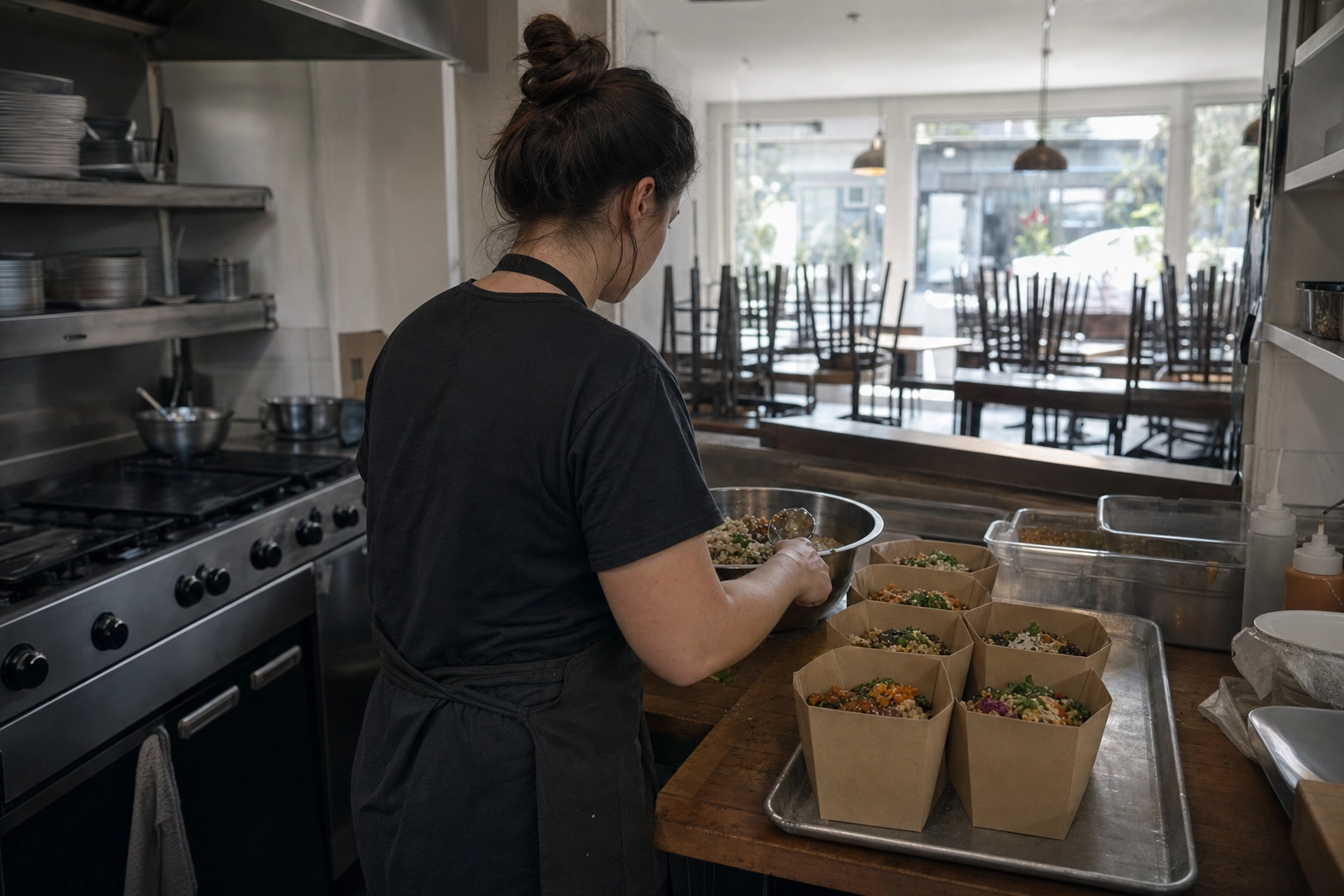 Cook packing delivery bowls in a quiet restaurant kitchen between services, running a virtual brand in spare hours
Launch Checklist: Put Photography on the Budget
A delivery-only brand has no sign, no window and no dining room. The listing photo is the storefront. Treat it as a line item, not an afterthought.
- Unit, deposit and signed terms, with included services listed in writing.
- Permits, insurance certificate and commissary letter, if the space is shared.
- Menu of 15–25 delivery-proof items that travel well. Our ghost kitchen menu planning guide covers the cut.
- Packaging and labels tested on a 20-minute drive.
- App accounts and commission tier chosen with the break-even math above.
- A photo for every item before launch. A pro shoot of 20–40 dishes runs about $1,200–$3,500 at mid-range rates, per our restaurant photography pricing guide; our food photography cost breakdown compares every option. Then check each image against the DoorDash photo requirements, Uber Eats photo guidelines and Grubhub photo specs.
- A launch marketing plan. Start with ghost kitchen marketing tactics and cloud kitchen marketing strategies that don't need a storefront.
For the photo line, FoodShot turns a phone shot of each finished dish into a studio-quality, menu-ready image in about 90 seconds. The Starter plan is $15 a month for 25 credits, which covers a 20-item menu, with a commercial license on paid plans. See how ghost kitchens use it, read our guide to food delivery app photography, or compare FoodShot plans. Budget it before launch, not after.
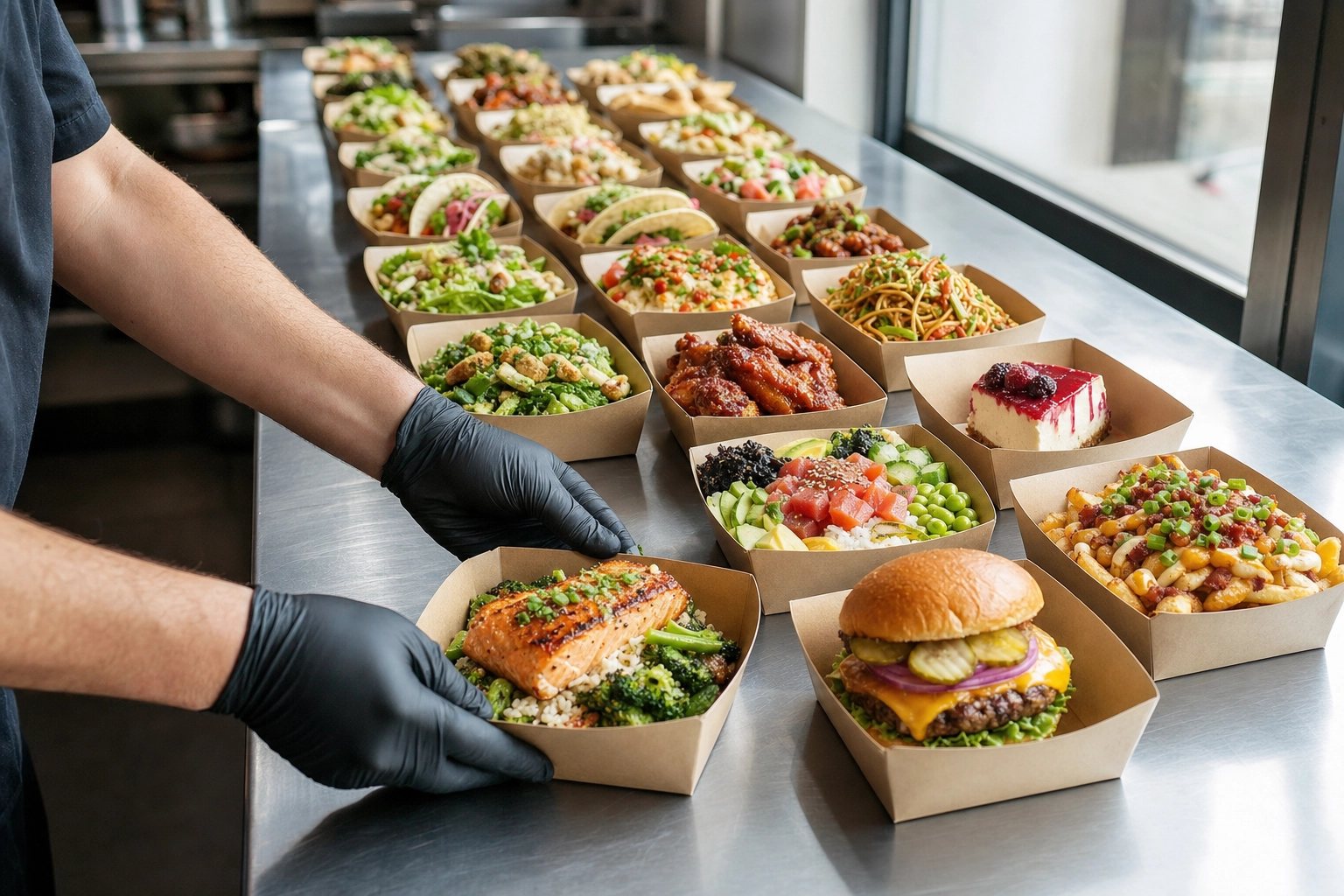 Twenty finished takeout dishes lined up on a steel table, a ghost kitchen menu ready to photograph before launch
Frequently Asked Questions
What is the cheapest way to rent a ghost kitchen?
A shared commissary membership is cheapest, at $100–$750 a month in most markets. It only stays cheap while you need limited hours. Once you're open for lunch and dinner daily, hourly billing can pass the fee for a dedicated unit.
How much is a ghost kitchen per square foot?
Raw commercial space runs roughly $20–$55 a square foot a year before fit-out. Turnkey units work out far higher, $12–$23 a square foot every month in the quotes above, because the fee pays for a built, permitted kitchen and not just the floor.
Are utilities included in ghost kitchen rent?
In most turnkey ghost kitchens and commissaries, yes, at least partly. Standalone spaces usually don't include them, and utilities there typically run $1,000–$2,000 a month. Ask about gas, grease trap service and hood cleaning, which are easy to leave out of a facility quote.
How long are ghost kitchen lease terms?
Commissaries often run month-to-month. Turnkey terms vary by operator, from month-to-month to multi-year, and raw space usually means a multi-year commitment. For a first business, push for the shortest terms you can get, ideally month-to-month or six months, even at a slightly higher fee.
How much do ghost kitchens cost to rent compared with a restaurant?
Less up front and often more per square foot. A ghost kitchen opens for about $20,000–$60,000 in a shared or turnkey setup, while a median independent restaurant costs around $375,500 to open. So how much do ghost kitchens cost to rent next to a traditional restaurant lease each month? The unit fee is smaller, but delivery commission replaces the dining room as your biggest cost after food and labor. Our AI food photos for delivery apps guide covers the listing side once you've signed.