
Home Bakery Insurance: What $299 vs $2,469 a Year Buys
 Ali Tanis11 min read
A market manager asks for your certificate of insurance on Tuesday. Your first booth is Saturday. That is how most bakers meet home bakery insurance — a document somebody else demands, not a decision made calmly.
Short version. Your state almost certainly does not force you to buy home bakery insurance. The people who let you sell — markets, venues, grocers, commissary landlords — usually do. And the published gap between the cheapest real policy and the broadest is roughly eight to one, so the wrong tier is a four-figure mistake either way.
Quick Summary: Home bakery insurance is general liability with product liability attached, sometimes bundled into a business owner's policy. Rates start at $25.92 a month ($299 a year) for specialty food-vendor coverage and reach a published $206-a-month, $2,469-a-year average for a bakery BOP. Your homeowners policy does not fill the gap: standard forms exclude business liability outright.
What home bakery insurance actually is
No carrier underwrites a product literally named home bakery insurance. You are buying one of two shapes.
A specialty food-vendor policy is general liability with completed-operations coverage attached, flat-rated for cottage food sellers and market vendors. Thin, cheap, fast, and it produces the certificate a venue wants.
A business owner's policy — a BOP — adds commercial property and business income, underwritten individually. Broader, slower, several times the price. Most start at shape one and buy shape two when equipment value makes property matter.
Why your homeowners policy will not cover your bakery
The most expensive misunderstanding in the category, and an easy one: the oven is in your house, and your house is insured.
The business-activity exclusion
Standard homeowners forms exclude personal liability and medical payments for injury or damage arising out of a business conducted from the insured location. Courts have upheld it for profit-motive home businesses — daycares, salons, tutoring.
Apply it to your kitchen. A neighbour who trips collecting a free birthday cake is a guest claim, covered. The same neighbour collecting a cake she paid for is a business claim, and the policy is built to decline it. The Insurance Information Institute makes the same point about businesses run from home.
The $2,500 equipment sublimit
The property side is thin too. Standard forms sublimit business personal property to roughly $2,500 on premises and $500 away from it. One commercial mixer, or a proofer and a rack of sheet pans, clears that ceiling.
A home-business endorsement — commonly published at $50 to $150 a year — raises the property number but restores no liability. That is why separate business insurance exists, and it catches everyone who assumed the endorsement was a fix.
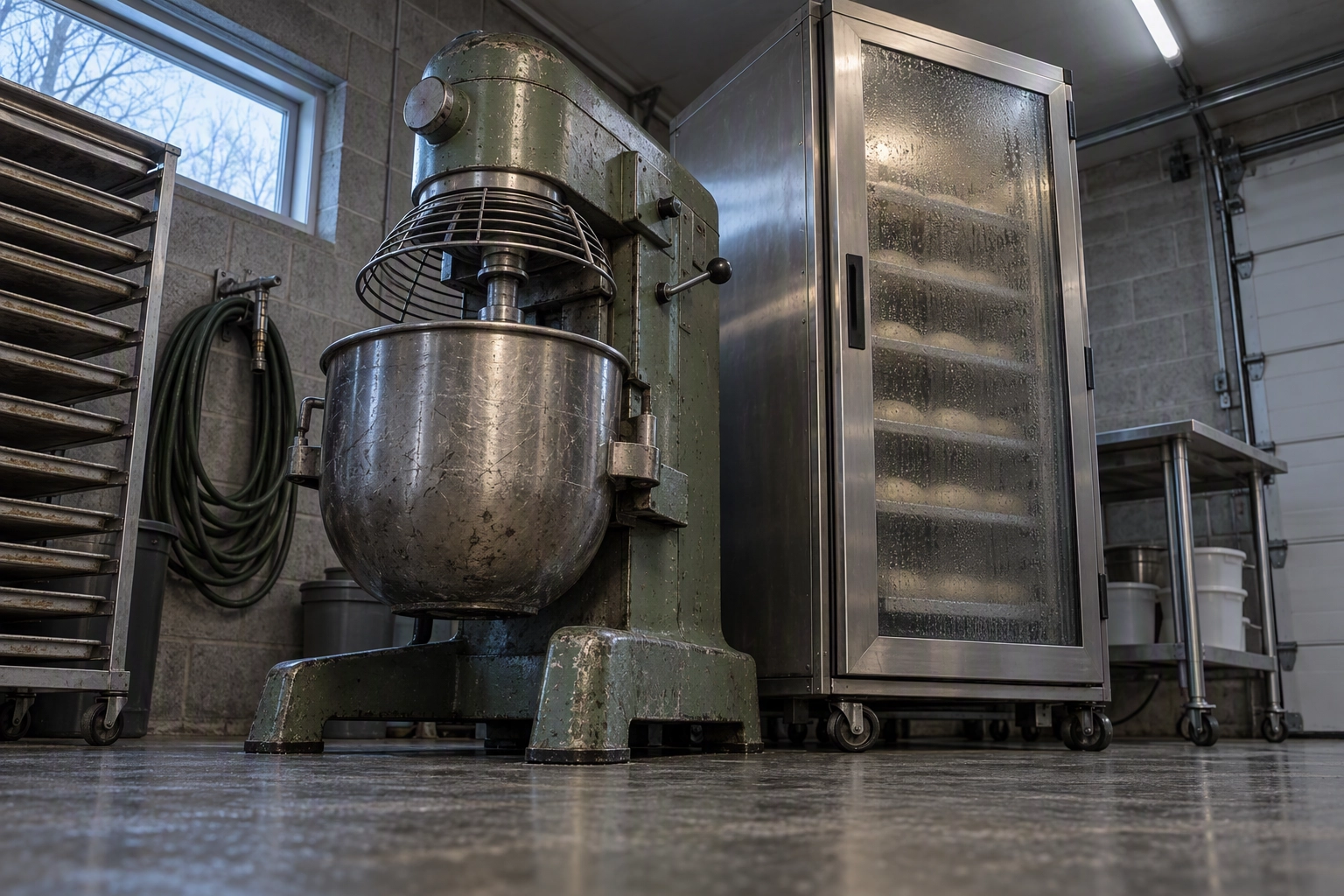 Commercial planetary mixer and stainless proofing cabinet in a converted garage bakery, equipment worth far more than the $2,500 homeowners sublimit
The coverages that actually matter
What each part helps pay for, the limit venues ask for, and how it prices. Published ranges, not quotes; your number moves with state, revenue and menu mix.
| Coverage | What it helps pay for | Typical limit | Price behaviour |
|---|---|---|---|
| General liability | Third-party injury, property damage | $1M occurrence / $2M aggregate | Core of the $299–$600/yr tier |
| Product liability | Illness or allergic reaction from your baked goods | Shares the GL aggregate | Bundled, rarely priced alone |
| Damage to premises rented | Fire in a commissary or booth you rent | $100k sublimit | In most vendor policies |
| Business personal property | Ovens, mixers, display cases | $5k–$50k | Main driver of BOP pricing |
| Business income | Lost profit while you cannot bake | 12 months | BOP only |
| Commercial auto | Delivery crashes personal auto excludes | State minimum | Separate policy |
| Workers' compensation | Employee injury, lost wages | Set by state law | Triggered by your first hire |
General liability: the one every venue asks for
General liability insurance covers third-party bodily injury and property damage — the slip at your pickup door, the scorched countertop at a rented event venue. Venues ask for $1 million per occurrence and $2 million aggregate so consistently that it is the default. What they get is a certificate naming them as additional insured.
Product liability: the one matched to your real risk
This is the part aimed at what you actually do. The classic claim is an allergic reaction to an undeclared ingredient, then foodborne illness. The FDA lists nine major food allergens — milk, eggs, fish, crustacean shellfish, tree nuts, peanuts, wheat, soybeans and sesame, added in 2023 — and the CDC reports that about 6% of US adults and children have a food allergy. A shared kitchen with no allergen segregation is the fact pattern these claims turn on, and this is the coverage that helps protect you when one lands.
One detail nobody checks: it usually shares the general liability aggregate rather than its own limit. A single claim can erode the number your market relies on. Ask.
Property, premises and the rest
Business personal property replaces that $2,500 homeowners sublimit with a real figure. Damage to premises rented — often a $100,000 sublimit — is what a commissary landlord cares about: it helps pay if your burner starts a fire in rented space.
Business income, spoilage, commercial auto and workers' compensation are skippable on day one. Each has a trigger: a freezer of wedding stock, delivery in your own car (personal auto excludes delivery for hire), or a first paid helper, which makes workers' compensation mandatory in most states. The SBA's business insurance guide is a neutral checklist.
What home bakery insurance costs in 2026
| Tier | What you get | Published cost |
|---|---|---|
| Specialty food liability | GL + product liability, $1M/$2M | From $25.92/mo, $299/yr |
| Standalone general liability | Higher limits, more endorsements | Roughly $400–$900/yr |
| Business owner's policy | Liability, property and income | $206/mo, $2,469/yr average |
These are published figures. Specialty programmes such as FLIP and Insurance Canopy advertise entry pricing at $25.92 a month, or $299 a year. The Hartford publishes that its bakery customers working from a residence paid an average of $206 a month, or $2,469 a year, for a BOP. Consumer guides put typical business insurance spend at $17 to $42 a month.
The spread is not a scam — it is a different policy. The cheap one is flat-rated liability insurance with almost no property coverage. The expensive one is underwritten individually and covers oven, stock and income. A domestic range and a stand mixer? BOP money buys protection you already have. $30,000 of commercial equipment in a converted garage? The cheap policy leaves all of it uninsured. Run a quote at both tiers; quotes are free.
 Overhead flat-lay of two unequal coin stacks beside a folded policy document and a pastry box, the eight-to-one home bakery insurance cost spread
When home bakery insurance is actually required
The mandate rarely comes from the state. It comes from whoever stands between you and the customer.
Cottage food laws: usually not the trigger
Most state cottage food laws impose no insurance condition at all — Florida Statute 500.80 is one example. They cap annual revenue and restrict which goods you may sell instead; Institute for Justice research tracks how sharply those caps differ by state.
A bakery licence is no substitute for insurance. Ohio State University's Farm Office frames the state licence as one layer of food-safety protection among several, alongside product liability insurance and an LLC. Passing an inspection does not pay a claim.
Farmers markets and events: the usual first trigger
Established markets commonly require $1 million per occurrence and $2 million aggregate, plus additional-insured status for the market; smaller ones accept $300,000. The USDA's local food directories list markets near you; read vendor rules first.
Check the vendor agreement for a hold-harmless clause. It makes the policy load-bearing: it shifts the market's legal costs to you if someone is hurt at your stall, and your business insurance funds that promise.
Wholesale and retail accounts
The moment a grocer, cafe or gift shop lists your goods, a certificate naming them as additional insured is a precondition of delivery. Published asks climb fast: $2 million for corporate catering contracts, up to $5 million for wholesale distribution. Bakers selling through gift basket businesses, farm stands and CSAs or packaged food brands hit the same wall. Renting a commissary adds a landlord with its own number, stated in the lease — the easy case: buy what the contract says.
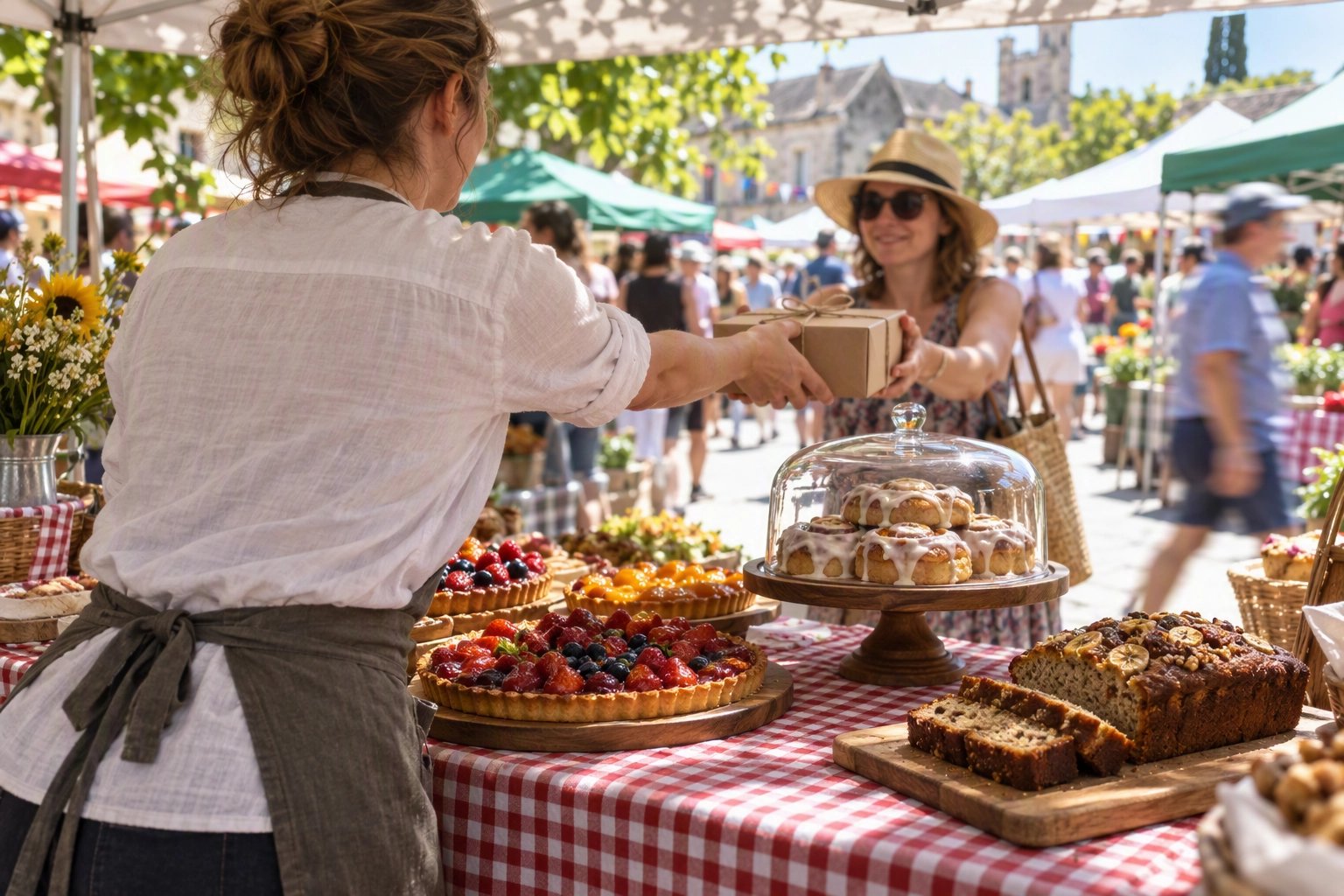 Baker handing a boxed tart across a farmers market stall of cakes and loaves, the venue that first requires general liability insurance
A four-question framework for choosing
No carrier is best for every bakery, and home bakery insurance is not one product. Answer four questions and the tier picks itself.
1. What is the highest limit anyone has asked me for in writing? Not what you imagine — what a contract says. That is your floor. If nobody has asked, the entry tier is rational.
2. What would replacing my equipment cost tomorrow? Under $2,500 and the homeowners sublimit nearly covers it. Over $10,000 and you need real business personal property coverage, which the specialty tier does not sell.
3. Would a two-week shutdown end the business? If baking is your whole income, business income coverage is the argument for a BOP. If it is side revenue, it is not.
4. Does anyone besides me touch the dough? One paid helper triggers workers' compensation in most states, whatever tier you pick.
Getting a useful home bakery insurance quote
Every insurance quote form asks the same six things: business structure, annual revenue, what you bake, where you sell, equipment value, employee count. Write them down once and the rest is easy — fifteen minutes, not a week.
Then ask three questions bakers forget. Is product liability inside or outside the general liability aggregate? Are additional insureds free and unlimited, or billed per certificate? How fast is a certificate reissued when a market asks on a Thursday? Compare quotes on limits, exclusions and turnaround.
The other document buyers ask for
A certificate gets you in the door. Your photos decide whether the buyer lists you, and whether online shoppers order. Nobody warns home bakers about the second gate.
Most shoot on a phone in a domestic kitchen under mixed lighting — the worst possible conditions. FoodShot AI turns those shots into menu-ready images using 200+ styles, with 4K output and a commercial licence on paid plans; see pricing or AI food photography. Our bakery photoshoot guide styles a pastry case properly, and the fundamentals guide helps if you prefer to learn the craft.
Guides by bake: cake, cookie, cupcake, bread, donut, dessert and baking photography. Selling from a price list? Menu photography fits better, packaged goods photography helps on shelves, and what a photographer charges sets the baseline. Bakers moving into wedding and event work or chocolatier ranges face the same ask, as do those building an audience online. Examples: cakes, cookies, cupcakes, bread, desserts.
 Wholesale buyer comparing printed photo sheets of cakes and pastries on a desk, the listing decision that follows the insurance certificate
Frequently Asked Questions
Do I need insurance for a home bakery?
Legally, usually not — most cottage food laws do not demand it. Practically, yes, the moment you sell anywhere but your own doorstep. Markets, event venues, commissary landlords and wholesale accounts all want proof of liability insurance, and homeowners policies exclude business claims.
How much is home bakery insurance per month?
Entry pricing for specialty food-vendor liability starts at $25.92 a month, or $299 a year; consumer guides report most bakers paying $17 to $42. A business owner's policy costs far more — one carrier publishes a $206-a-month average.
Does homeowners insurance cover a home based bakery?
No. Standard forms exclude liability arising out of a business conducted from the residence, and cap business property near $2,500. An endorsement at $50 to $150 a year raises that limit but adds no liability coverage.
What is the difference between general liability and product liability for bakers?
General liability covers injury and property damage around your operation — a customer slipping at pickup, a scorched venue countertop. Product liability answers for harm caused by the baked goods themselves, such as a reaction to an undeclared ingredient. Policies bundle both, but often share one aggregate limit.
Do I need an LLC as well as home bakery insurance?
Different jobs. An LLC separates business debts from personal assets; insurance pays claims and legal defence costs. An LLC with no policy still leaves the business paying the judgment. Complementary layers, not alternatives.