
Food Truck Business Plan: $90,200 Startup, Full Template
 Ali Tanis17 min read
A food truck business plan is eight sections long, and only two of them get read hard: the costed menu and the financial projections. Everything else is context. Lenders, commissary landlords and event bookers all skim to the same place — can this truck sell enough food, at a good enough margin, to cover its payments and pay the person driving it?
So this page does what the template sites don't. You get all eight sections of a food truck business plan with what belongs in each, plus a fully worked model: a $90,200 startup table, a costed six-item menu, a stabilised month P&L, and the break-even number that falls out of it — 35 orders a day. Swap our figures for your city's and you have a plan a loan officer can actually underwrite.
Quick Summary: A food truck business plan needs eight sections — executive summary, concept and menu, market analysis, permits and commissary, the truck and equipment, staffing, marketing, and financials. Our worked model for a mid-size US metro: $90,200 to launch, $24,600 in a stabilised month, 31.7% food cost, and 35 orders a day to break even before the owner takes a wage. Write the financials first; the narrative is easier once the numbers exist.
What a food truck business plan actually has to prove
Three people read this document, and they want different things.
You need it as a decision tool. The honest purpose of planning is to find out, on paper and for free, whether this concept clears its costs — before you wire $46,000 for a used step van.
A lender is underwriting a depreciating vehicle plus a permit you may not get. That's a harder loan than a restaurant with a lease and fixtures. The U.S. Small Business Administration publishes the structure most banks expect, and SBA-backed lenders will want to see personal financials alongside the projections.
A commissary or event organiser reads two things: your permits and your insurance. Nothing else.
Write for all three. A food truck business plan that only sells the dream — and never shows how many customers walk up in a day — gets rejected, and we'll cover exactly why further down. The information each reader wants is different, but it all comes out of the same eight sections.
The food truck business plan template: 8 sections
Here is the template. Each section below says what to write and explains the food-truck-specific trap that sinks it. The order is standard across every food truck business plan a lender has ever read, so don't reinvent it — fill it in better.
1. Executive summary
One page, written last. Concept in a sentence, the service area, the funding ask, and three numbers: startup cost, year-one revenue, and break-even orders per day. Trap: writing it first, so it promises something the financials later contradict.
2. Concept and menu
What you sell, to whom, and what makes the offer unique enough that customers pick you over the truck parked twenty feet away. Include the actual menu with prices and food-cost percentages — see the costed example below. Keep it to 6-10 items; a truck galley can't execute more at lunch-rush speed. If you're still shaping the concept, our food truck menu ideas and the taco truck menu breakdown show how narrow menus get built, and mexican food truck menu ideas covers regional variations. Trap: a menu that reads well but has never been priced. Cost it or cut it.
3. Market analysis
Your service area, not "the US food truck industry." Name the office parks, breweries, campuses and markets you'll work, with foot-traffic estimates and the days each one is worth. Then research who's already there. A useful market analysis section names five competing trucks and explains what each one does badly. Describe your customers too: the weekday lunch crowd and the Saturday market crowd are different people with different tickets. Trap: national market-size statistics. No lender cares that the category is growing; they care whether Tuesday at that brewery sells 60 covers.
4. Permits, licensing and commissary
The section that decides your launch date. List every permit, its cost, and its lead time: mobile food vendor permit, health department plan review, fire suppression inspection, commissary agreement, sales tax registration, and vehicle registration. The spread between cities is brutal — roughly $590 a year all-in in Indianapolis versus $4,800-$9,600 a year in Austin once the commissary is counted, and a capped, waitlisted permit system in New York City where timelines run 8-12 weeks or longer. Most health departments write their rules from the FDA Food Code, so read the mobile-unit and commissary provisions before you design the truck. Trap: no evidence. Attach the application receipt or the commissary letter of intent.
5. The truck and equipment
Make, model, year, mileage, build-out spec and the equipment list with replacement costs. State whether you're buying used, buying new, leasing or converting a trailer. Include the generator, because it's the item that fails first and the one nobody budgets to replace. Trap: no maintenance reserve. Trucks break on the good days, not the slow ones.
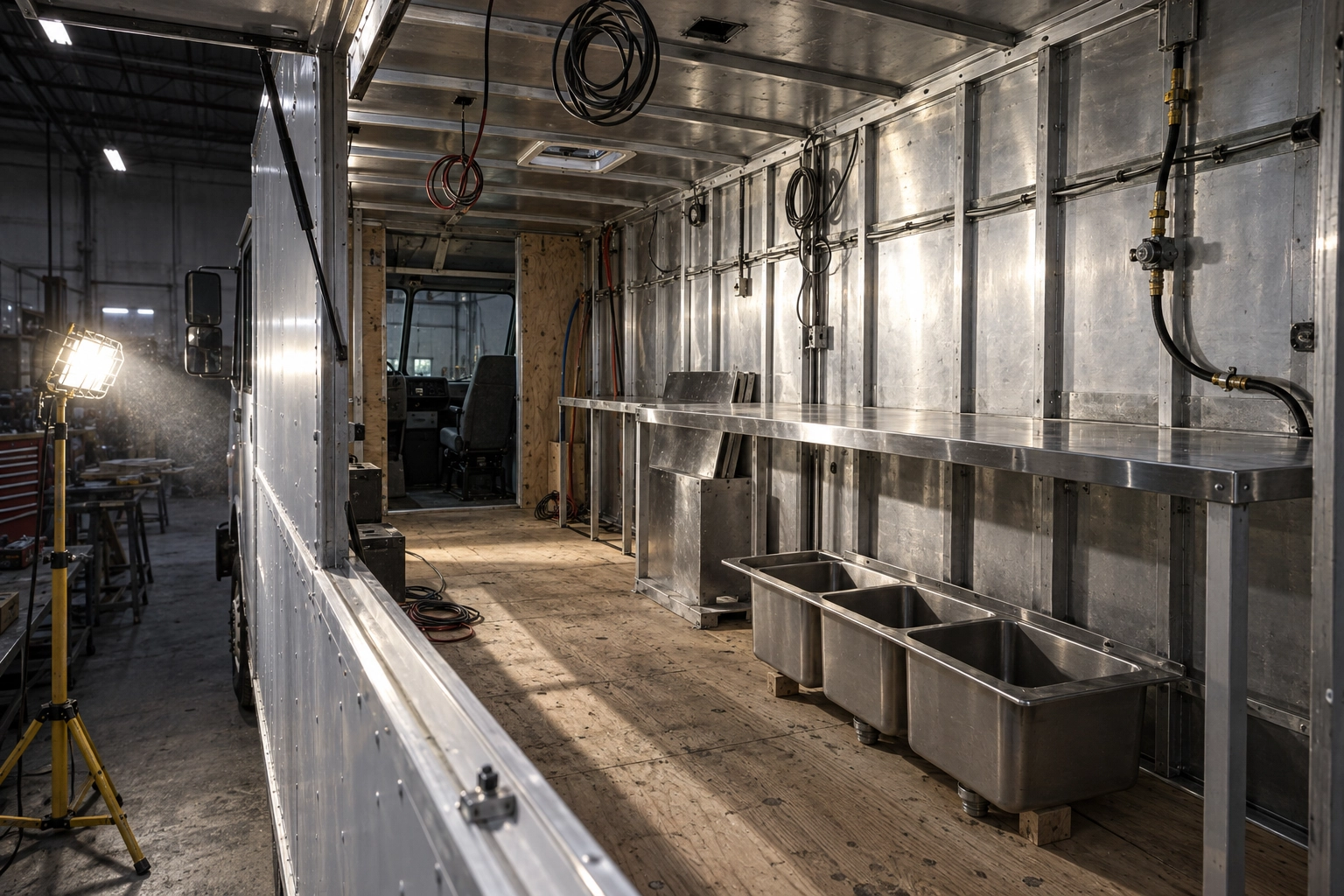 Used step van in a fabrication bay mid build-out with a bare aluminium interior shell, the biggest single line in a food truck startup cost table
6. Staffing and operations
A prep-to-service timeline for one full day, the headcount per shift, and hourly rates including payroll tax. Most first-year trucks run owner plus one. Say who drives, who holds the food handler certificates, and explain what happens when you're sick. If part of your prep will happen in a rented kitchen rather than on board, ghost kitchen menu planning covers how to split a menu between two spaces. Trap: unpaid owner labour. If you don't put a wage in the model, the model isn't real.
7. Marketing plan
How customers find a business with no fixed address. Cover your weekly location schedule and how it's published, your social channels, event and catering bookings, and your delivery-app listings. Catering is usually the highest-margin line on a truck and deserves its own paragraph — it's also the fastest way to grow revenue without adding service days.
Give the photos a line item. Delivery platforms publish their own numbers on this: DoorDash reports that menu items with photos can earn up to 44% more sales and a header image up to 50% more, while Grubhub has cited lifts of up to 30% from photos alone. That's the cheapest conversion work available to a truck, and it applies equally to your own food truck menu board and your listing tiles.
The catch is that truck food is hard to shoot — a cramped galley, harsh midday sun, and no time between orders. That's the workflow FoodShot AI exists for: photograph the dish on your own counter with a phone and turn it into a menu-ready studio shot, rather than booking a $700-$1,400 photo session you can't repeat when the menu changes. Platform rules differ, so check DoorDash photo requirements and Grubhub photo requirements before you upload, and read what AI-enhanced food images delivery apps allow. For the wider plan, see food truck marketing, more food truck marketing ideas, and social media marketing for food trucks. Trap: "we'll use Instagram" as the entire marketing plan.
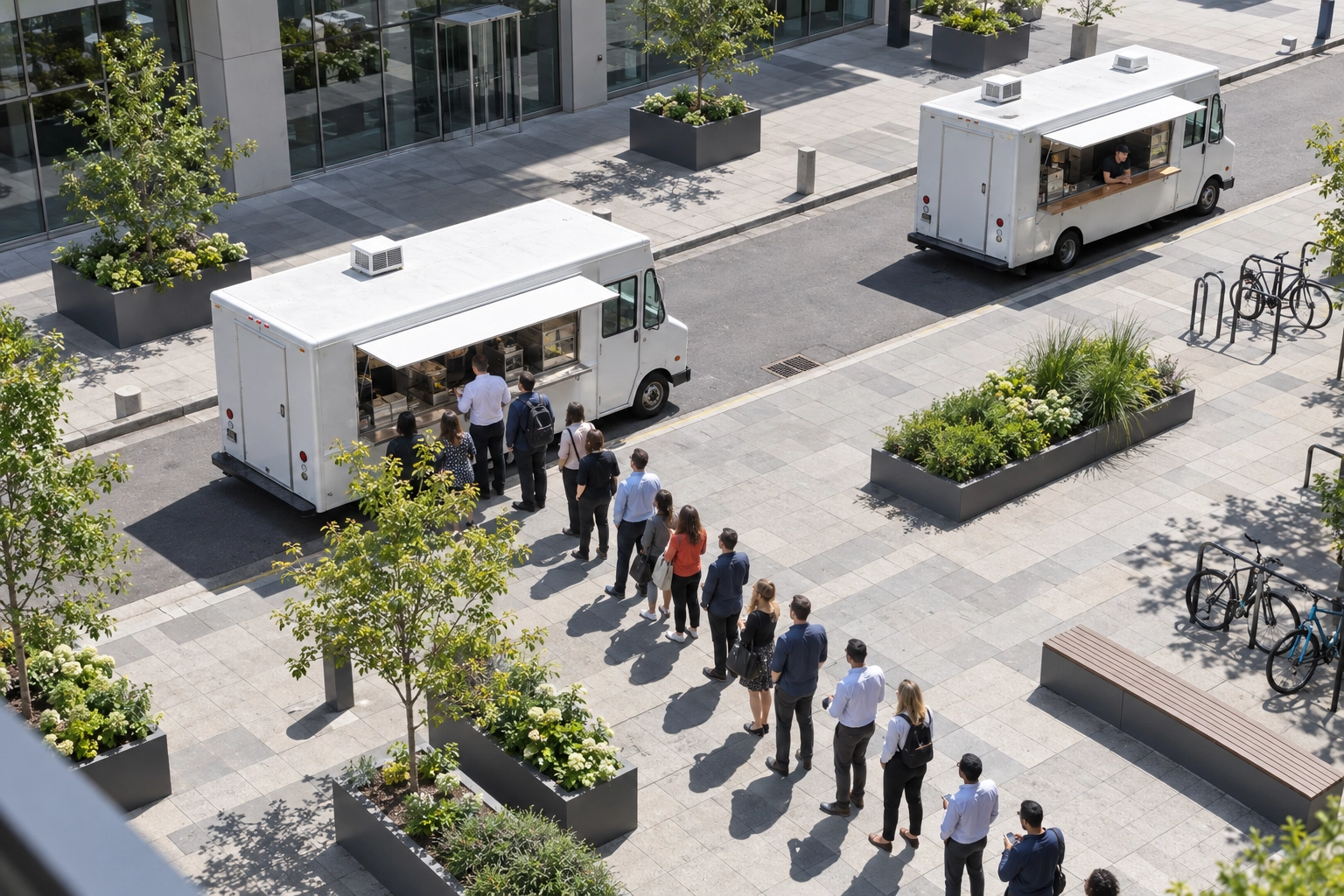 Two food trucks side by side at an office park lunch rush, one with a long queue and one empty, the demand gap a food truck marketing plan has to close
Two trucks on the same kerb, one with a queue and one without, is the clearest argument for writing this section properly. Nothing about the food explains the gap.
8. Financial projections
Startup costs, a 12-month cash-flow, a year-one P&L, and break-even. Build revenue bottom-up from orders per day and average ticket — never top-down from a revenue target. Three years of annual summaries is enough; month-by-month detail only for year one. Trap: a hockey stick with no operational change behind it.
The rest of this page fills that last section in. Food costs, fixed costs and order counts, in that order.
Startup costs: what $90,200 actually buys
Published ranges run from $40,000 to $250,000, which is useless for planning. Here's a specific, buildable version: a used 16-ft step van, owner-operated, mid-size US metro. Starting numbers, not final ones — replace every line with a quote from your own suppliers.
| Line item | Cost |
|---|---|
| Used 16-ft step van, 120k miles | $46,800 |
| Kitchen build-out (hood, fire suppression, gas lines) | $14,500 |
| Cooking equipment (flat-top, fryer, 3 holding units) | $9,200 |
| Refrigeration and prep (under-counter, freezer, sinks) | $5,400 |
| Generator, 7kW inverter | $4,100 |
| POS, card reader, tablet | $650 |
| Wrap and exterior signage | $3,200 |
| Permits, licences, plan review (year one) | $2,150 |
| Insurance (commercial auto + $1M general liability, first year) | $3,400 |
| Smallwares, pans, packaging opening stock | $2,600 |
| Initial food inventory | $1,900 |
| Website, photos, launch marketing | $1,300 |
| Working capital reserve (3 months fixed costs) | $15,000 |
| Total | $90,200 |
Two notes on this table. Working capital is the line almost every first-time operator leaves out of the plan. Food sales are seasonal, and a slow winter with no reserve ends the business faster than any equipment failure — this single line is why month four kills trucks. And permits are the biggest swing between cities; the same truck can carry a $590 or a $9,600 annual compliance bill depending on where it parks, so get a written fee schedule from your health department before starting the build. If a fixed-location model looks safer once you've run these numbers, compare it against ghost kitchen rent costs and the ghost kitchen vs food truck comparison before committing.
The SBA's startup cost worksheet is a reasonable place to keep this table if you want a format lenders recognise.
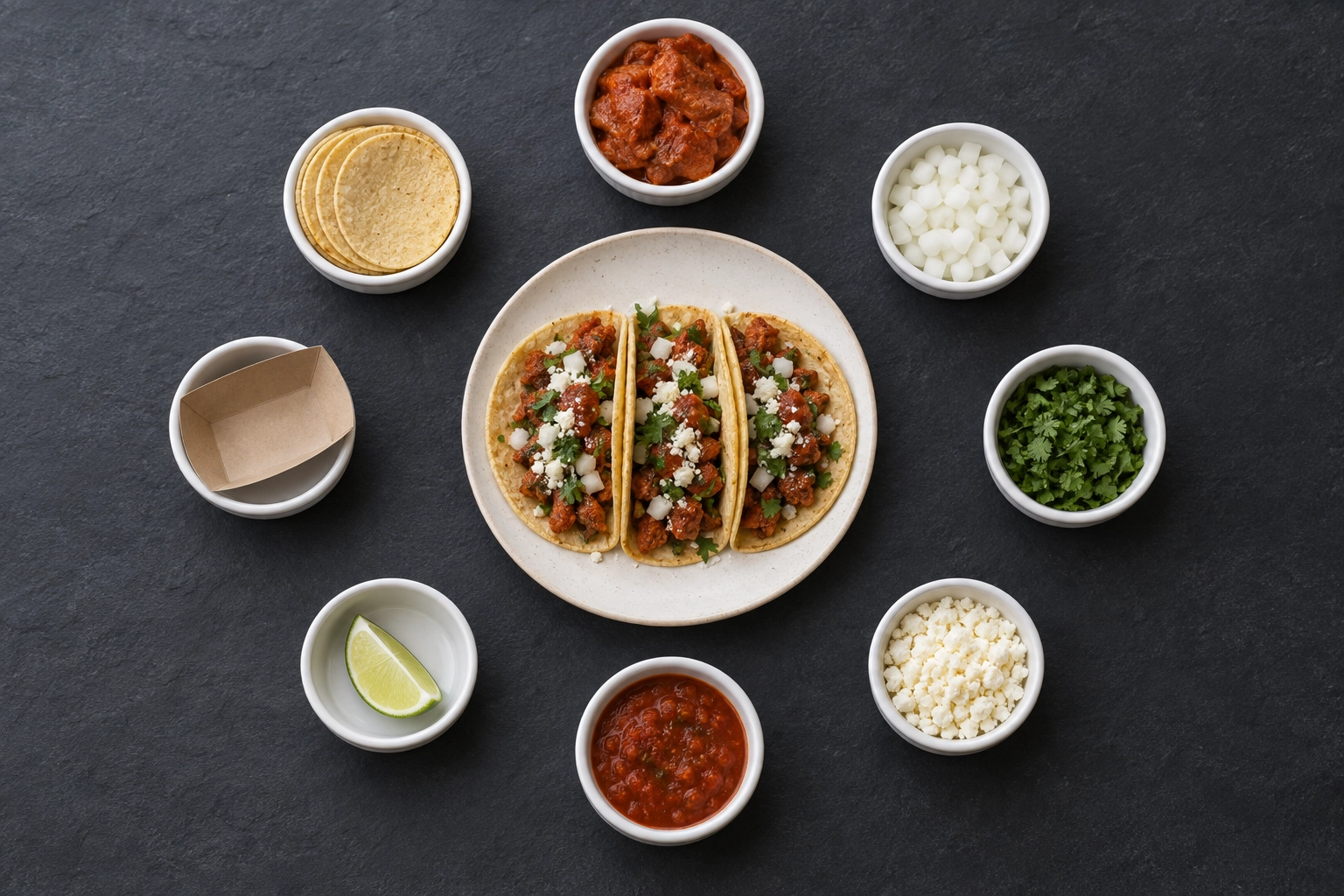 A finished taco plate surrounded by its separated raw ingredient portions in small dishes, the component build-up behind a menu food-cost percentage
A sample menu with food-cost percentages
Six items, priced for a taco-and-bowl concept. Food cost includes packaging, because on a truck it always should.
| Item | Price | Food + packaging cost | Food cost % |
|---|---|---|---|
| Three-taco plate | $13.50 | $4.05 | 30.0% |
| Loaded rice bowl | $14.00 | $4.34 | 31.0% |
| Quesadilla | $11.00 | $3.19 | 29.0% |
| Loaded fries | $9.50 | $2.66 | 28.0% |
| Side of chips and salsa | $4.00 | $0.92 | 23.0% |
| Agua fresca, 16oz | $4.00 | $0.68 | 17.0% |
Blended food cost across the actual sales mix lands at 31.7% — inside the 28-35% band most operators report, and the number our P&L uses. This table is the single most useful piece of information in the whole plan. Food cost percentage is what every other projection is built on.
Read that table sideways and the lesson is obvious: the drink carries the tray. A $4 agua fresca at 17% contributes $3.32; the $13.50 plate contributes $9.45 but takes eight times the labour. Attachment rate on drinks and sides is the cheapest margin lever a truck has, which is why they belong at eye level on the board. Menu engineering explains how to price the mix rather than the item, and menu descriptions that sell covers the wording. If your board is still being designed, food truck menu design is the companion piece, menu board ideas shows the cheap formats that reprice easily, and restaurant menu design software lists what you can lay it out in for under $25 a month.
Sample year-one P&L for a mid-size US city
This is a model, not a survey — internally consistent, built from the table above, and meant to be overwritten with your city's numbers. It shows a stabilised month (roughly months 7-12, after the ramp).
| Line | Amount | % of revenue |
|---|---|---|
| Street service (17 days × 76 orders × $14.60) | $18,864 | 76.7% |
| Catering and events (3 bookings) | $5,736 | 23.3% |
| Total revenue | $24,600 | 100% |
| Food and packaging | $7,798 | 31.7% |
| Labour (1 employee + payroll tax) | $4,920 | 20.0% |
| Fuel and generator propane | $1,150 | 4.7% |
| Commissary rent | $950 | 3.9% |
| Insurance | $425 | 1.7% |
| Permits and licences (amortised) | $180 | 0.7% |
| Vehicle loan payment | $780 | 3.2% |
| Maintenance reserve | $500 | 2.0% |
| Card processing (2.6%) | $640 | 2.6% |
| Marketing, POS, phone, misc | $1,505 | 6.1% |
| Total costs | $18,848 | 76.6% |
| Net before owner's draw | $5,752 | 23.4% |
| Owner's draw | $3,200 | 13.0% |
| Net profit | $2,552 | 10.4% |
Across all twelve months — with a slow ramp, a weak January and a strong summer — this truck grosses roughly $243,600 and returns about $5,900 in retained profit after paying the owner $38,400. That is a realistic good first year, and it sits inside the 6-15% net margin band the industry reports.
Put the owner's draw on its own line, always, and explain the assumption behind it in the plan. Food service lenders see hidden owner labour constantly, and it's the fastest way to lose credibility: a company showing 23.4% net while the operator works 60 unpaid hours isn't profitable, it's a job with the wage buried in the profit line.
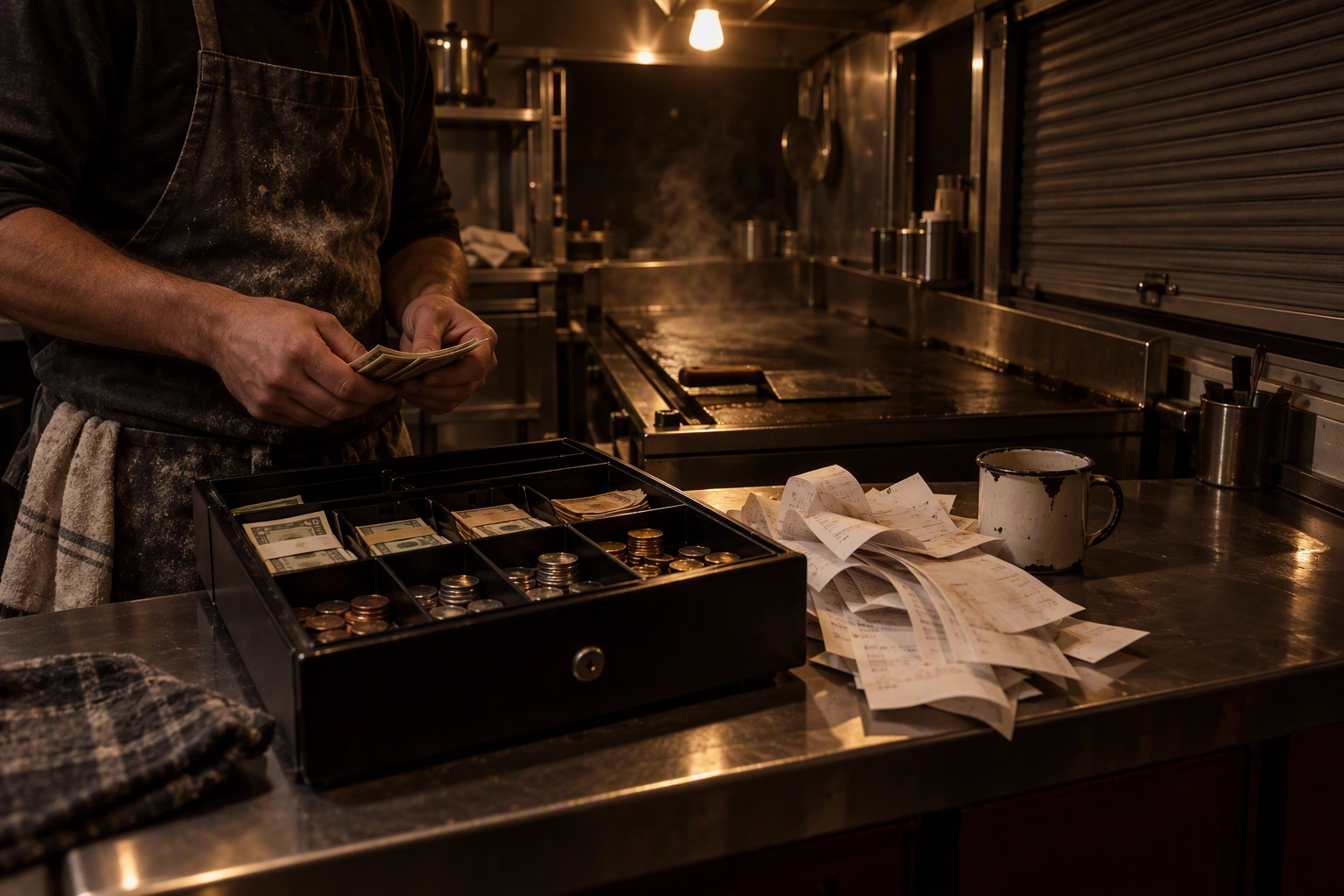 Counting a night of takings on the interior counter of a closed food truck, the monthly revenue line in a food truck profit and loss statement
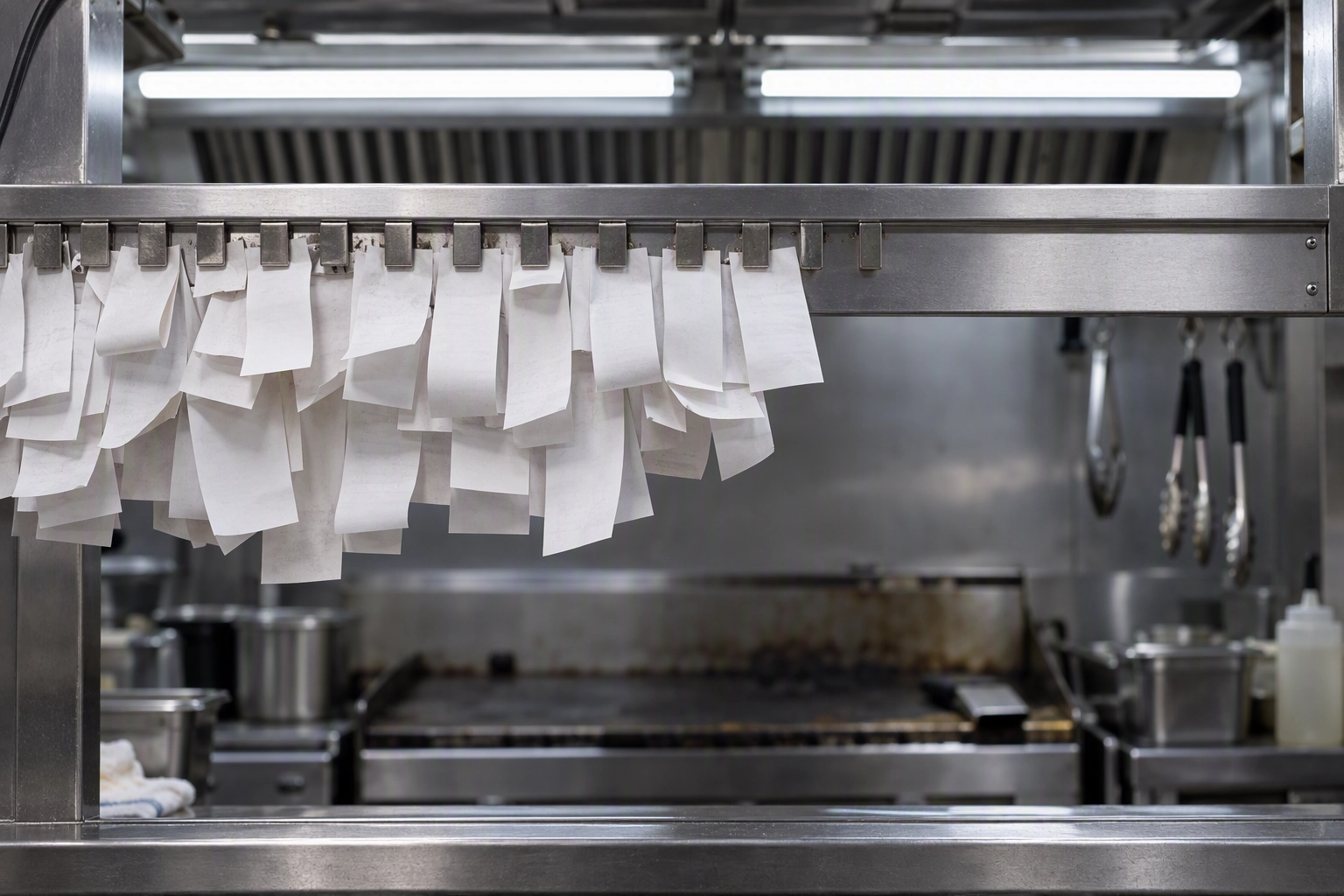 A long rail of order tickets across a food truck pass with a clear gap two thirds along, the daily order count a food truck must clear to break even
Break-even math in three lines
Three lines, and every lender checks them. This is the part of a food truck business plan worth doing twice.
- Fixed costs per month — the lines that don't move with sales: loan $780, commissary $950, insurance $425, permits $180, maintenance $500, marketing and misc $1,505, plus base labour of about $835. Total: $5,175.
- Contribution per order — average ticket $14.60, minus food and packaging at 31.7% ($4.63), minus variable labour, fuel and card fees ($2.57). Contribution: $7.40.
- Break-even — $5,175 ÷ $7.40 = 700 orders a month, or 35 orders a day across 20 service days.
Then the number that matters more: to also cover a $3,200 owner's draw you need $8,375 ÷ $7.40 = 1,132 orders a month — 57 a day. The gap between 35 and 57 is the entire difference between a truck that survives and one that pays you.
At a stabilised 76 orders a day you're clearing both, and the $90,200 of capital pays back in roughly 20 months of trading with nothing drawn against it. Run this same calculation at your own ticket price before you buy anything. If contribution per order comes in under $6, the concept needs repricing, not more marketing.
 A returned food truck loan application file on a bank desk with a paperclipped projections page set aside, the three defects that get a food truck business plan rejected
Three things that get food truck plans rejected
Revenue backed into from a target. If year one is "$250,000" and the orders-per-day figure was reverse-engineered to reach it, an experienced reader spots it in seconds. Build up from orders × ticket, then check the result is physically servable from one hatch.
No permit evidence. Saying you'll get the permit isn't the same as showing the application, the fee receipt and the lead time. In capped-permit cities this is the single biggest execution risk in the whole plan, and an unaddressed one reads as naivety.
No owner wage. Covered above, and it's still the most common defect. The information a lender needs is what the business earns after paying labour — including yours.
A fourth, quieter one: no slow-season plan. Food truck revenue can halve between July and January, so show the winter months honestly and explain how the reserve or a catering push covers them.
Frequently Asked Questions
How long should a food truck business plan be?
15-25 pages, plus appendices. Lenders skim a food truck business plan; the financial projections and the permit evidence carry the weight. A tight 15-page plan with a real P&L beats a 60-page document of industry background every time. If it's purely for your own planning, ten pages is plenty.
Do I need a business plan to get a food truck loan?
For a bank or SBA-backed loan, yes — a full food truck business plan with three-year projections, personal financial statements and collateral detail. Equipment financing against the vehicle itself is more lenient, since the truck is the security. Either way, write it: you'll negotiate better having priced everything, and the exercise will help you spot the weak assumptions before a lender does.
How much money do I need to start a food truck in 2026?
Published ranges run $40,000-$250,000. A realistic first-time budget with a used truck is $85,000-$120,000, and our worked model lands at $90,200 including a $15,000 working capital reserve. A trailer-based build can start near $40,000; a new custom truck passes $150,000 quickly.
Should I use a free food truck business plan template?
Use one for structure — the section order in a food truck business plan is standardised, so there's no value in inventing it. But every free template ships with placeholder financials, and those are the only pages anyone reads carefully. Take the skeleton, then build the numbers yourself from your own menu costs and your own city's permit fees. A template can't research your market for you.
Is a food trailer cheaper than a food truck?
Usually yes, by $20,000-$40,000, because you're not buying an engine or a chassis. The trade-off is a tow vehicle, harder parking, and slower setup at each stop. For high-turn urban lunch service a truck wins on logistics; for weekend markets and festivals a trailer is the better company asset.
How do food truck profit margins compare to restaurants?
Food trucks typically net 6-15%, with tight operators reaching 15-25% and catering-heavy trucks higher still. Brick-and-mortar restaurants commonly run 3-6%. Lower rent and headcount are the reason — but trucks carry weather risk and permit risk a restaurant doesn't. For honest survival data, the Bureau of Labor Statistics Business Employment Dynamics series is a better source than the unattributed failure-rate statistics circulating on vendor blogs.
Run the numbers before you buy the truck
The order in which you build a food truck business plan matters more than the writing. Cost the menu, model the month, find the break-even order count — then write the narrative around whatever those three things tell you. If 35 orders a day looks impossible in your locations, that's the plan doing its job, and it just saved you $90,200. Starting a food business on a spreadsheet is a great deal cheaper than starting one on a forecourt.
When the concept clears, the next job is making it look worth queueing for: the board, the listing tiles and the photos that help a first-time customer choose you. Start with food truck photography and the photo menu guide, pick up the basics in how to take good food photos and the menu photography guide, then work through food delivery app listings once you're live. That's the part of the plan that starts paying back on day one.