How to Start a Coffee Shop: 12 Steps From Idea to Open
 Ali Tanis21 min read
Here's how to start a coffee shop without paying for the expensive lessons twice: choose a format, write the plan, secure the money, and only then sign a lease. Most owners need 6 to 12 months to get from idea to launch day, and the order of the steps matters more than any single decision inside them.
Demand isn't the hard part. In the National Coffee Association's Fall 2026 survey, 66% of American adults drank coffee in the past day, and 38% of them had it away from home, the highest share since January 2020 (Daily Coffee News). New shops trip on sequencing instead: a lease signed before a zoning check, or a launch date announced before the certificate of occupancy.
Below is how to start a coffee shop in 12 steps, in the order that protects your cash, plus a low-cash route.
Quick Summary: Learning how to start a coffee shop comes down to sequence: format and business plan first, money before the lease, health department approval before construction, and a soft opening before day one. Budget 6 to 12 months. If cash is thin, a cart, a pop-up inside another business, or a landlord-backed kiosk gets you serving for a fraction of what a full café needs.
How to Start a Coffee Shop: The 12 Steps at a Glance
Steps overlap, but the dependencies are real. You can't negotiate a serious lease without a loan approval letter, and you can't order equipment until the layout is final.
| Step | Key decision | Typical timing |
|---|---|---|
| 1. Format and concept | Cart, kiosk, drive-thru, or café | Month 1 |
| 2. Business plan | Projections a lender will accept | Months 1–2 |
| 3. Budget and funding | How much, and from whom | Months 2–4 |
| 4. Location and lease | Which site, on what terms | Months 3–5 |
| 5. Licenses and permits | Plan review, building permit, occupancy | Months 4–8 |
| 6. Equipment | Machine, grinders, refrigeration | Order by month 6 |
| 7. Roaster and suppliers | Coffee, milk, pastry, cups | Months 5–7 |
| 8. Menu | Core drinks, prices, photos | Months 6–8 |
| 9. Hiring and training | Headcount and schedule | Final 6 weeks |
| 10. Brand and interior | Name, signage, layout | Months 3–8 |
| 11. Launch marketing | Listings, social, local press | Final 8 weeks |
| 12. Soft launch and first week | Stress test, then go live | Final 2 weeks |
Step 1: Pick Your Format and Concept
Format decides roughly half of what follows: rent, headcount, equipment, hours, even which customers you attract. Every other decision in how to start a coffee shop flows from it, so pick the format before you fall for a storefront.
Five formats, five different businesses
- Coffee cart or trailer. The lowest-capital option for events, markets, and offices. Most areas require a commissary.
- Kiosk. 100 to 300 square feet in a lobby, hospital, or campus. Fast service, tiny menu.
- Drive-thru. In the NCA survey, 55% of people who bought coffee out of home in the past week used a drive-through. Zoning is harder, and your drive-thru menu board does the selling.
- Small café. 500 to 1,000 square feet, a few seats, pastries bought in.
- Café with a kitchen. 1,500 square feet or more, a food program, and far more complexity: a hood, a grease trap, cooks.
Then pick your lane. Owners on Reddit put it bluntly: most coffee shops either sell excellent specialty coffee at a premium or sell a lot of everyday coffee at a thinner margin. Choose one or two things to be known for and let everything else be good enough.
Test the idea before you spend real money
The most repeated advice from owners is also the cheapest: get hired in a busy café first. Six months behind a bar teaches you milk steaming at volume, par levels, and what a Saturday rush does to a team. In an r/Coffee_Shop thread asking what first-time owners wish they'd known, one reply was blunt: home enthusiast, barista, and owner are three very different jobs.
Then validate demand. Count the 8 a.m. line at 10 competing shops, note what they charge, and test your drinks on strangers at a weekend farmers market pop-up. A restaurant consultant can shorten the learning curve, but don't outsource the concept.
Step 2: Write a Business Plan a Lender Will Read
A business plan does two jobs. It forces you to put a number on every assumption, and it gets you funded. The U.S. Small Business Administration's free business plan guide covers the standard format, and it suits anyone figuring out how to start a coffee shop business.
The sections lenders actually read
- Executive summary: format, location type, how much you need, and how you'll repay it.
- Market analysis: local competitors, what they charge, and the gap you fill.
- Menu and pricing: core drinks and your coffee supplier.
- Operations and management: hours, staffing, and your food service experience, which lenders weigh heavily.
- Financial projections and the loan request.
The numbers to model
Model one-time costs, monthly operating costs, revenue (daily transactions times average ticket), a break-even point, and 12 to 36 months of cash flow. We walk through the margin math in are coffee shops profitable. Run it before you commit to a lease, because rent is the number that most often breaks a financial model.
Step 3: Set the Budget and Line Up Funding
The hardest part of how to start a coffee shop is usually the money, mostly because first-time owners underestimate it. Budget the full project, then add a cushion covering at least six months of operating costs. Most shops need months to reach steady revenue.
Total cost ranges by format
| Format | Typical size | Typical total range |
|---|---|---|
| Coffee cart or trailer | Mobile | $10,000–$40,000 |
| Kiosk | 100–300 sq ft | $50,000–$100,000 |
| Drive-thru only | 100–300 sq ft plus a lane | $100,000–$250,000 |
| Small café | 500–1,000 sq ft | $100,000–$200,000 |
| Full café | 1,000–2,000 sq ft | $150,000–$300,000 |
| Café with kitchen | 1,500–3,000 sq ft | $200,000–$400,000+ |
These are summary ranges from 2026 industry guides. The biggest swing factor is the space. Taking over a former café can take $10K to $40K to refit, while starting from a raw shell can run $80K to $150K or more. For line-by-line costs, see our full coffee shop cost breakdown.
Where the money comes from
Most owners stack three or four sources rather than finding one big check.
- Personal savings. Lenders typically expect you to cover 10% to 30% of the project yourself.
- SBA 7(a) loan. The standard route for larger cafés. Expect lenders to want solid credit (often 680+), collateral, and industry experience, and allow 7 to 15 weeks to close.
- SBA microloan. Up to $50,000 through nonprofit intermediaries, with an average of about $13,000 (SBA). A good fit for carts and kiosks.
- Equipment financing or leasing. Preserves cash, at a higher total cost.
- Friends, family, or investors. Put the terms in writing.
- Community pre-sales. Memberships, prepaid cards, or crowdfunding, which doubles as marketing.
Talk to lenders before you tour storefronts; landlords take an approval letter seriously.
Step 4: Find the Location and Negotiate the Lease
Location sets your ceiling. A great operator can't fix a site with no morning traffic or poor visibility. If there's one step in how to start a coffee shop worth slowing down for, it's this one. Judge traffic at the hours you'll sell (6 to 10 a.m. matters more than lunch), nearby competitors, and the condition of the space.
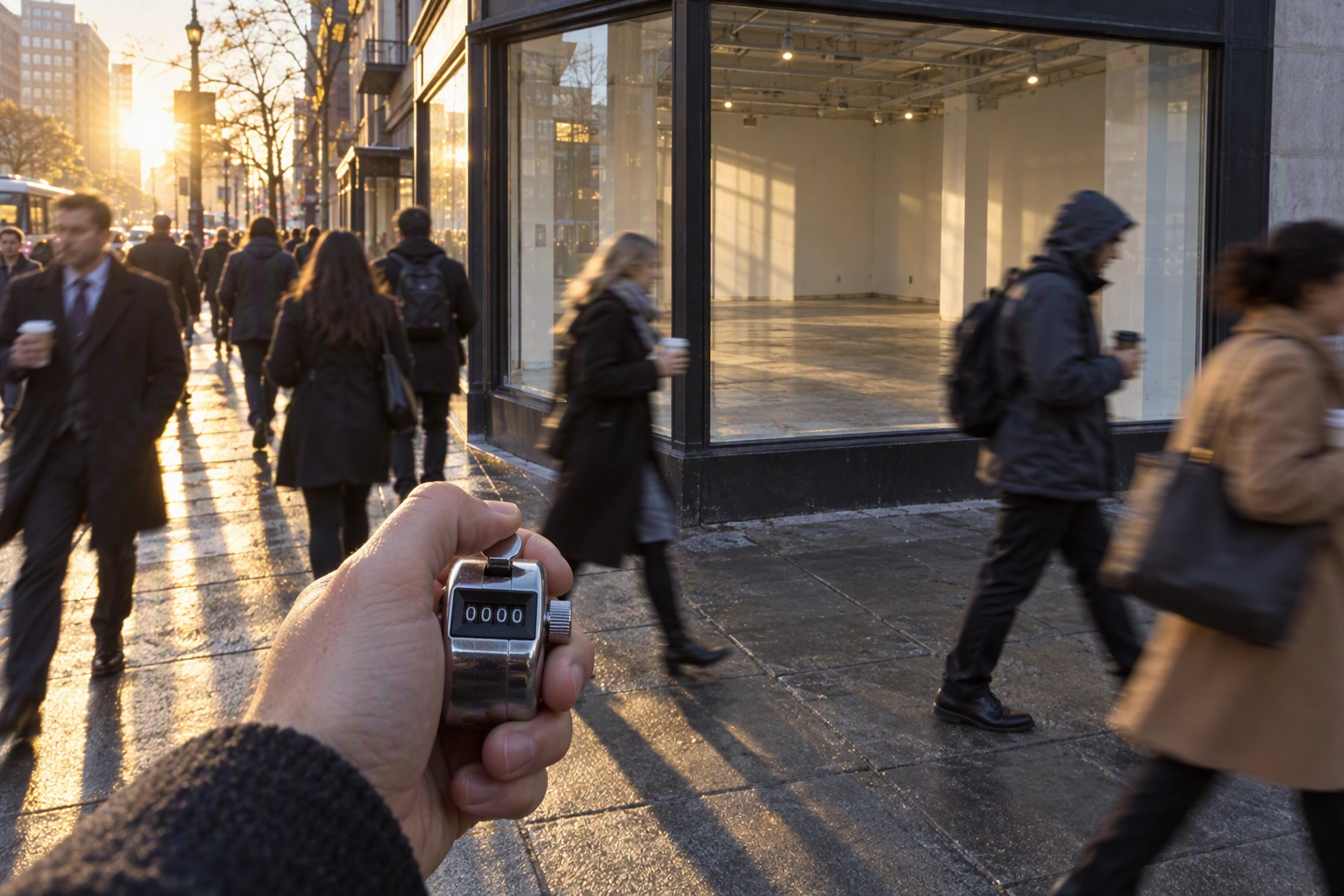 Hand clicking a tally counter to measure morning foot traffic outside a vacant storefront before a coffee shop lease
Check these before you sign anything
- Zoning. Call the city planning department and confirm food service is a permitted use. The call takes 15 minutes and can save you from a lease you can't legally trade under.
- Second-generation space. A former café or restaurant often has plumbing, drains, and electrical in place. Pros quoted by Food & Wine give the same advice: look at former coffee shops first.
- Utilities. Espresso machines and ice makers need heavy electrical service (often 200 amps), water lines, and floor drains.
- Sinks. Health codes typically require hand sinks, a three-compartment sink, and a mop sink. Adding them to a raw shell can cost more than the machine on your counter.
Lease terms worth fighting for
- One to three months of free rent while you fit out the unit
- A tenant improvement allowance, often $10 to $30 per square foot
- An exclusivity clause that keeps a rival coffee concept out of the building
- Renewal options at defined rates, and clear common area maintenance (CAM) costs
- No limits on early operating hours
A common rule of thumb is to keep rent around 10% to 15% of projected monthly sales. If the site only works on an optimistic forecast, walk away.
Step 5: Get Your Licenses and Permits
Permits are where most timelines for how to start a coffee shop slip. Requirements vary by city and state, but nearly every coffee shop needs the same core set. The SBA's licenses and permits guide explains the layers; your county health department matters most.
| Permit | Issued by | When to apply |
|---|---|---|
| Business registration and EIN | State and IRS | Month 1 |
| Business license | City or county | Before you sign the lease |
| Seller's permit for sales tax | State revenue department | Before your first sale |
| Health department plan review | County health department | Before construction |
| Building and sign permits | Building department | After plan approval |
| Food handler and manager certification | State-approved course | During construction |
| Fire inspection | Fire marshal | After construction |
| Certificate of occupancy | Building department | Last, after all inspections |
| Music licensing | ASCAP, BMI, SESAC, or a licensed music service | Before you play music |
The permit order that avoids delays
Two sequencing rules save more time than anything else. First, submit your layout for health department plan review before a contractor touches the space. Inspectors flag sink placement, finishes, and equipment models, and fixing drawings is cheaper than fixing walls. Second, never announce a launch date until the certificate of occupancy is in hand. It's issued last, and inspections slip.
Most state rules are based on the FDA Food Code, which is why milk handling and cold holding get so much attention. Budget 2 to 12 weeks for the whole permit stack.
Step 6: Buy Equipment (With Realistic Price Ranges)
Equipment is the fun part of how to start a coffee shop and the easiest place to overspend. Order early, because lead times of 4 to 8 weeks are common. Figures below are new, US, 2026.
| Equipment | New, typical range | Notes |
|---|---|---|
| Two-group espresso machine | $9,000–$24,000 | Nuova Simonelli Appia Life low, La Marzocco Linea PB high |
| Bar grinder | $1,600–$4,900 | Fiorenzato F64 Evo low, Mahlkönig E65S or Mythos 2 high |
| Brewer plus drip grinder | $2,000–$5,000 | Drip is your fastest drink |
| Water filtration | $700–$4,500 | Cartridge system low, reverse osmosis high |
| Refrigeration and ice machine | $3,000–$15,000 | Size the ice for summer |
| POS hardware | $1,000–$3,000 | Plus monthly software fees |
| Smallwares and furniture | $6,000–$33,000 | Seating is the variable |
All in, expect roughly $20K to $35K for a basic setup and $35K to $55K for a standard café, before a pastry case or kitchen gear.
Where to spend and where to save
Spend on the grinder and the water. A $20K machine on a mediocre grinder and untreated water makes worse coffee than a $9K machine with a great grinder and filtered water. Save on furniture, décor, and anything customers never touch.
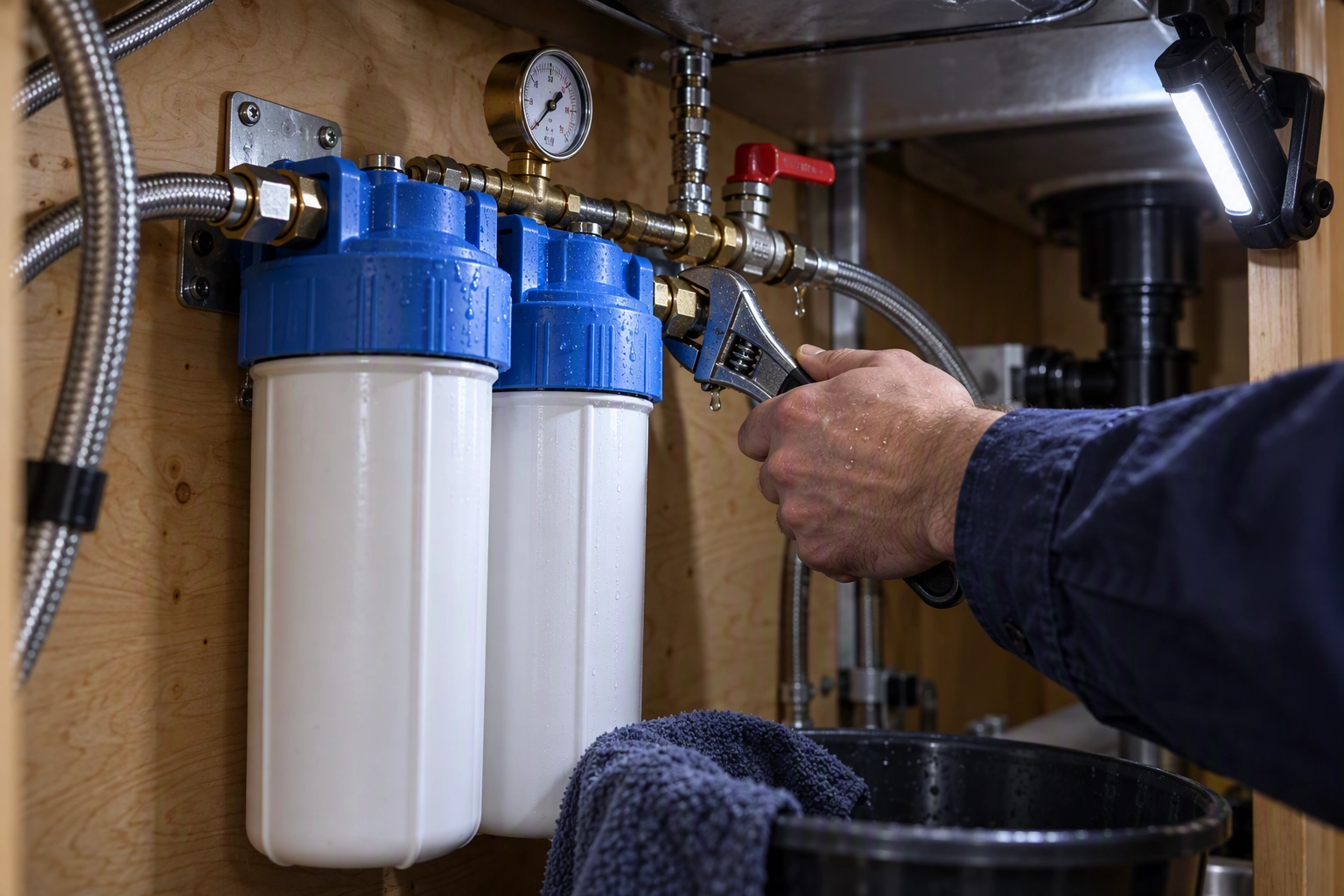 Technician installing cartridge water filtration under a coffee bar, the equipment line new coffee shop owners underbudget
New, used, or financed?
Used gear typically saves 30% to 50%, but have a technician service any machine before you pay. Some wholesale roasters will place or finance a machine if you sign a coffee contract. Read the minimum-volume clause, and find out what happens to the machine if you switch suppliers.
Step 7: Choose Your Roaster and Suppliers
A roaster is the most underused resource for anyone learning how to start a coffee shop. A good one trains your baristas, helps dial in your grinder, and advises on equipment, which is why pros quoted by Food & Wine suggest partnering early. Many wholesale coffee roasters treat new café accounts as long-term partners, so interview three.
Specialty roasters commonly quote cafés around $11 to $13 per pound for wholesale roasted coffee. Arabica futures hit a record near $4.41 per pound in February 2025 and have swung between roughly $2.70 and $3.30 through 2026. Roasted pricing lags the commodity by months, so ask how and when your supplier adjusts.
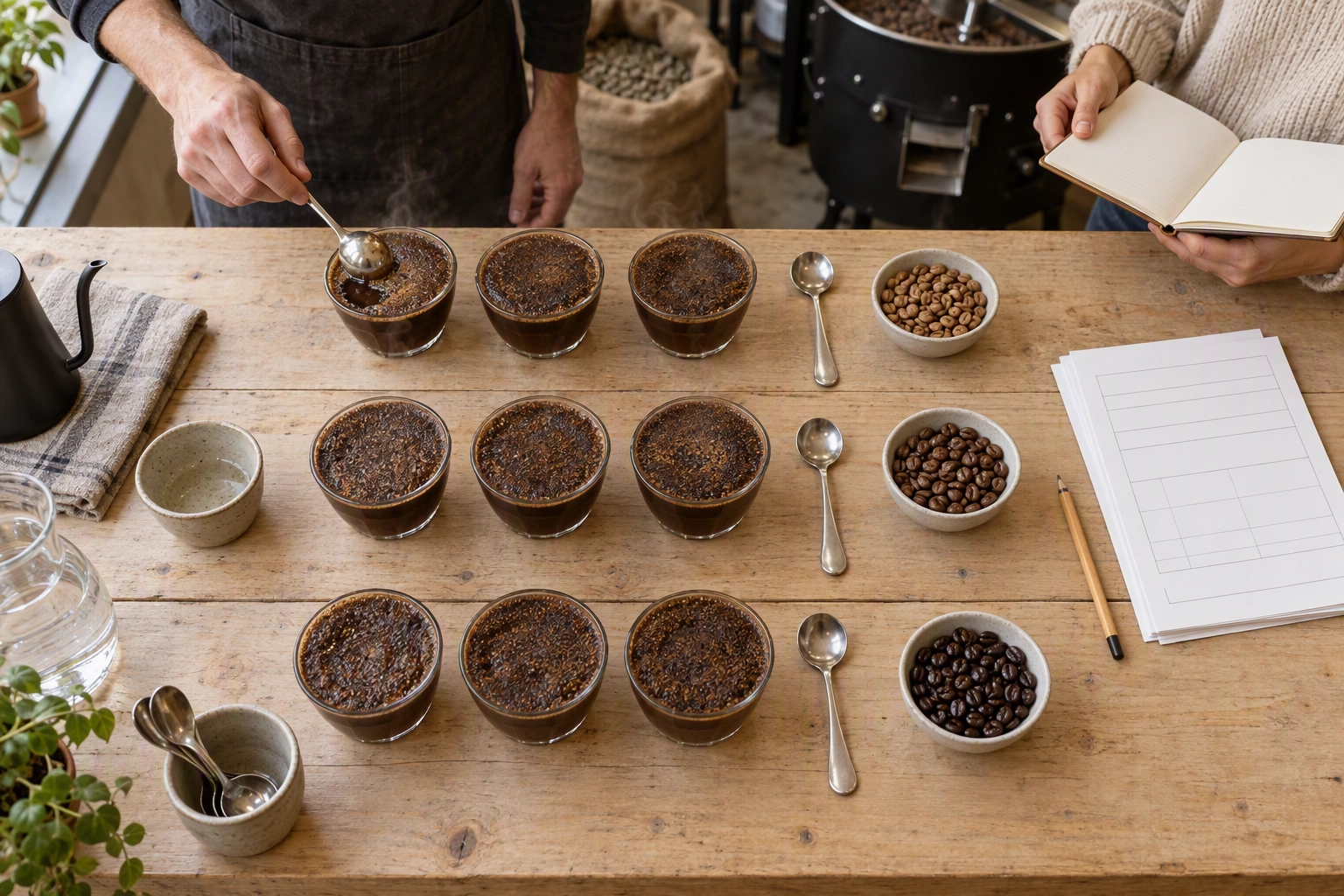 Overhead of a cupping table where a new cafe owner and a coffee roaster taste espresso blend samples before signing
Questions to ask before you sign
- What's the minimum order, and how often do you deliver?
- Do you offer barista training and on-site dial-in?
- Can we lock pricing for 6 to 12 months?
- Can we cup the espresso blend and a decaf before we commit?
The rest of the supply list
- Dairy and alt-milks. Carry at least one non-dairy milk; oat is the common pick.
- Pastries. Wholesale from a local bakery is the fastest way to a strong case without a kitchen.
- Cups and lids. Order branded cups only after you know your volume.
- Syrups, tea, and matcha, plus a restaurant supply account for cleaning chemicals.
Step 8: Build a Short Menu (and Photograph It)
Most guides on how to start a coffee shop treat the menu as a list of drinks. In 2026 it's also a photo grid, and it should be short: short menus serve faster, waste less, and train easier. A sensible starting point is 12 to 15 core drinks plus two or three seasonal specials.
Let the data pick your core drinks
The NCA's Fall 2026 data makes a useful shortlist. Among US adults, past-week consumption hit 20% for espresso, 20% for lattes, 17% for cappuccinos, 13% for mochas, and 10% each for Americanos and macchiatos, with flat whites at 4%. Cold coffee made up 21% of past-day cups in the summer survey. So nail the latte, the cappuccino, a mocha, drip, and a cold program first.
Set each drink's menu price from what goes into it, then check it against local competitors. Menu engineering shows which items to push and which to cut, and menu descriptions that name the origin help justify a premium.
Your menu board and delivery listings sell with pictures
In the same NCA survey, a record 40% of people who bought coffee out of home in the past week ordered through an app. On an app, the photo is the storefront. Create appetizing drink and pastry photos for every core item before launch: a latte with clean art, an iced drink with visible layers, a croissant with visible lamination.
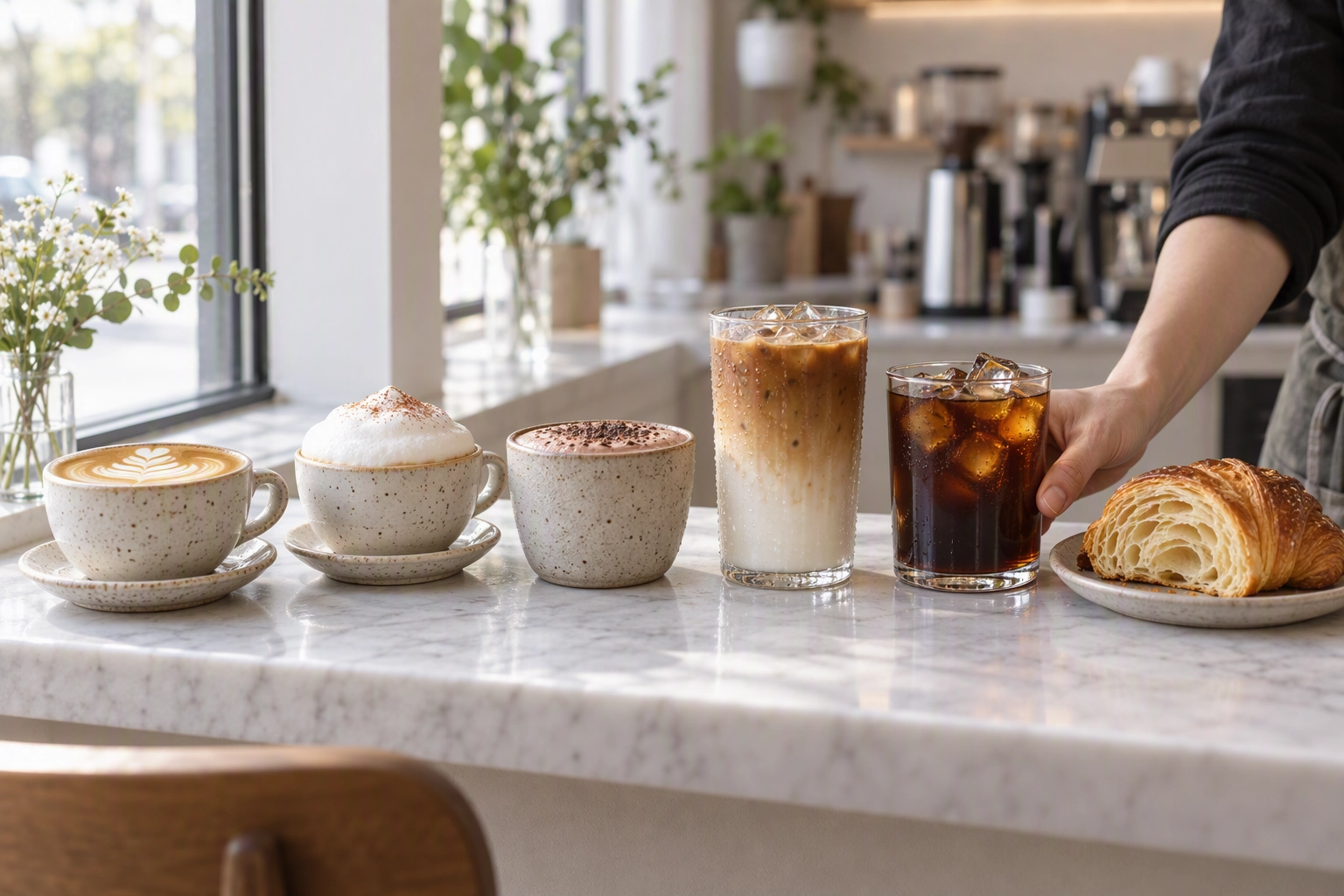 Core coffee shop menu of latte, cappuccino, mocha, iced latte, cold brew and croissant lined up for menu photos
Our coffee photography guide covers latte art and iced drinks on a phone, and window light is all you need for a pastry case shoot. If styling 20 items during launch month isn't realistic, FoodShot turns phone snaps of your drinks and pastries into studio-quality coffee menu photos, the same approach coffee cart operators use for their booking grids.
Check each platform's specs before you upload, since DoorDash photo requirements and Grubhub's differ. For the in-store side, browse these menu board ideas and our guide to digital menu boards.
Step 9: Hire and Train Your First Team
Hiring is the step in how to start a coffee shop that owners leave too late. Staff to your busiest two hours, not your daily average. A small café open seven days, 7 a.m. to 3 p.m., usually runs on four to six part-timers plus the owner, with two on bar and one on the register during the morning rush.
Federal wage data puts the typical barista around $15 an hour before tips (the Bureau of Labor Statistics groups baristas with fast food and counter workers), and big-city shops pay more.
Hire 4 to 6 weeks before launch, then give new baristas two weeks of paid training: roaster-led dial-in, milk texturing, cleaning checklists, and the POS. Hire for attitude, because regulars come back for the person as much as the cortado.
Step 10: Design the Brand and the Room
Branding is where most people's picture of how to start a coffee shop begins, but it belongs in the middle of the timeline. Your brand is the name, the logo, and the sign, and it's also the cup in someone's hand on the sidewalk. Create one simple system (one mark, two colors, one typeface) and use it everywhere. Check name availability with your state and the federal trademark database before you print anything.
Lay out the bar around the line
Customers should move one way: order, pay, pickup, then exit or seat, without crossing the queue. Put the menu board where people read it while they wait, the pastry case at the register, and pickup away from ordering. Behind the bar, keep the grinder, machine, and milk fridge within one step of each other.
Spend on what customers see and touch, and keep the back of house plain. Add outlets if you want the laptop crowd; skip them if you want turnover.
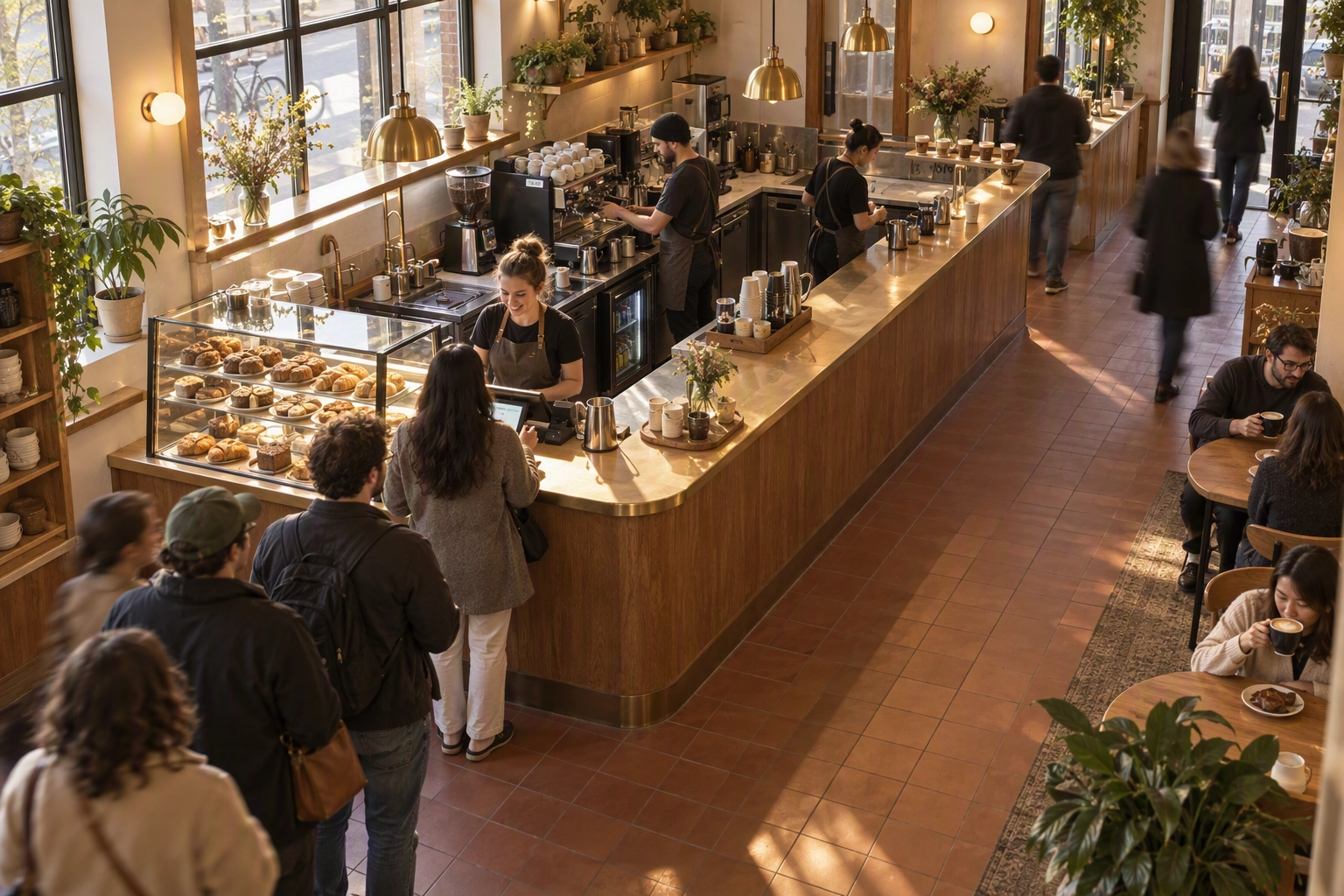 High-angle view of a small coffee shop layout with queue, register and separate pickup counter keeping the line moving
Step 11: Plan the Launch Marketing
An 8-week countdown
- 8 weeks out: Claim your Google Business Profile, Apple Maps, and Yelp listings with accurate hours and photos. Create an Instagram account that documents the fit-out.
- 6 weeks out: Introduce yourself to neighboring businesses and offices, and offer their staff a free first-coffee card.
- 4 weeks out: Pitch local press, food bloggers, and neighborhood newsletters. Print flyers for nearby apartment lobbies and gyms.
- 2 weeks out: Set up the loyalty program in your POS so the first visit counts. Consider small Instagram ads targeted within a mile or two.
- Launch week: Post daily, reply to every review, and thank people by name.
For the content side, our restaurant Instagram marketing routine takes about 100 minutes a week, and seasonal promotions give you a reason to post after the launch buzz fades.
Step 12: Soft Opening, Then Your First Week
How to run the soft opening
A soft opening is the final step in how to start a coffee shop, and it's a rehearsal with real customers. Run two or three short sessions, say 7 to 11 a.m., for friends, family, and neighbors. Charge full price or a flat discount, and time every ticket. You're testing consistency, flow, the POS, and the team under a rush. Fix what breaks, then run it again before starting regular hours.
Make sure the health department has signed off and the certificate of occupancy is in hand first. Serving the public counts, even for free.
What to watch in week one
- Line length at peak. If it's out the door at 8 a.m., add a second person on bar before you add menu items.
- Waste. Track the milk and pastries you throw out every day.
- Par levels. Note what ran out and when.
- Reviews. Respond to each one, good or bad.
Resist deep discounts. A packed first week at 50% off teaches customers your real price is half. Double loyalty stamps build the habit without resetting expectations.
How to Start a Coffee Shop With No Money (or Close to It)
Here's the honest answer: you can't open a traditional café with no money, but you can launch a coffee business with very little and grow into a shop. Most people asking how to start a coffee shop with no money really mean without savings or a big loan. These four paths get you serving for a fraction of a full café.
Path 1: A coffee cart
A used cart or trailer with a commercial machine, grinder, and refrigeration typically lands between $10K and $40K all in, and lean operators report launching for less with used gear. You'll need a mobile vendor permit and, in most places, a commissary agreement. One Reddit owner put it simply: the busiest coffee "shop" in their town is mobile and pays no rent. Our food truck business plan template adapts cleanly to a coffee cart.
Path 2: A pop-up inside someone else's business
Bookshops, bakeries, coworking spaces, and breweries (often empty in the morning) have counters and foot traffic but no coffee program. Offer a revenue share or a flat monthly fee. You're buying equipment and a permit, not construction, which makes this the lowest-risk way to learn how to start a coffee shop on real customers.
 Espresso cart pop-up inside a bookshop, a low-cash way to start a coffee business before signing a lease
Path 3: A kiosk the landlord helps fund
Office towers, hospitals, and campuses want coffee on site. Some landlords will cover much of the fit-out in exchange for a longer lease or a percentage of sales. Ask before you assume the answer is no.
Path 4: Partners who bring equipment or cash
A roaster may place equipment in exchange for a coffee contract, an experienced operator might invest for equity, and an SBA microloan is designed for exactly this stage. Community pre-sales raise cash and build a line of regulars at the same time.
Whatever path you take, keep the business plan, the permits, and food safety standards identical to a full café. Small doesn't mean informal.
Frequently Asked Questions
How much money do you need to open a coffee shop?
From about $10K for a cart to $300K or more for a sit-down café, depending on how much construction the unit needs. Our coffee shop cost guide itemizes every line.
How long does it take to open a coffee shop?
Plan on 6 to 12 months from concept to launch day. The loan process (7 to 15 weeks) and construction are usually the longest phases. Carts and pop-ups can launch in weeks.
Are coffee shops profitable?
They can be, but margins are thinner than the cup price suggests, because labor, rent, and milk costs eat most of it. We break the numbers down in are coffee shops profitable.
Can you learn how to start a coffee shop with no experience?
Yes, but get experience before you sign a lease. Six to twelve months as a barista in a busy café, plus a few weekend pop-ups, teaches you rhythm, waste, and staffing at someone else's expense. Lenders will ask about it too.
What licenses do you need to sell coffee?
At minimum, a business license, a seller's permit, a health department food service permit, food handler or manager certification, and a certificate of occupancy for a fixed location. Carts add a mobile vendor permit and usually a commissary agreement.
How do you run a coffee shop day to day?
Learning how to run a coffee shop is mostly routine. Dial in espresso every morning, check par levels and place orders on a fixed schedule, count waste daily, review sales and labor weekly, and deep-clean the machine and grinders on a set calendar. The owners who last take the numbers as seriously as the coffee.
Where to Go From Here
Pick your format this week. Then book a few shifts behind someone else's bar, call your planning department about zoning, and open a spreadsheet for the business plan. That's how to start a coffee shop without the expensive detours: in order, one step at a time.