
Catering Business Insurance: 6 Policies, $500–$8,000/Yr
 Ali Tanis10 min read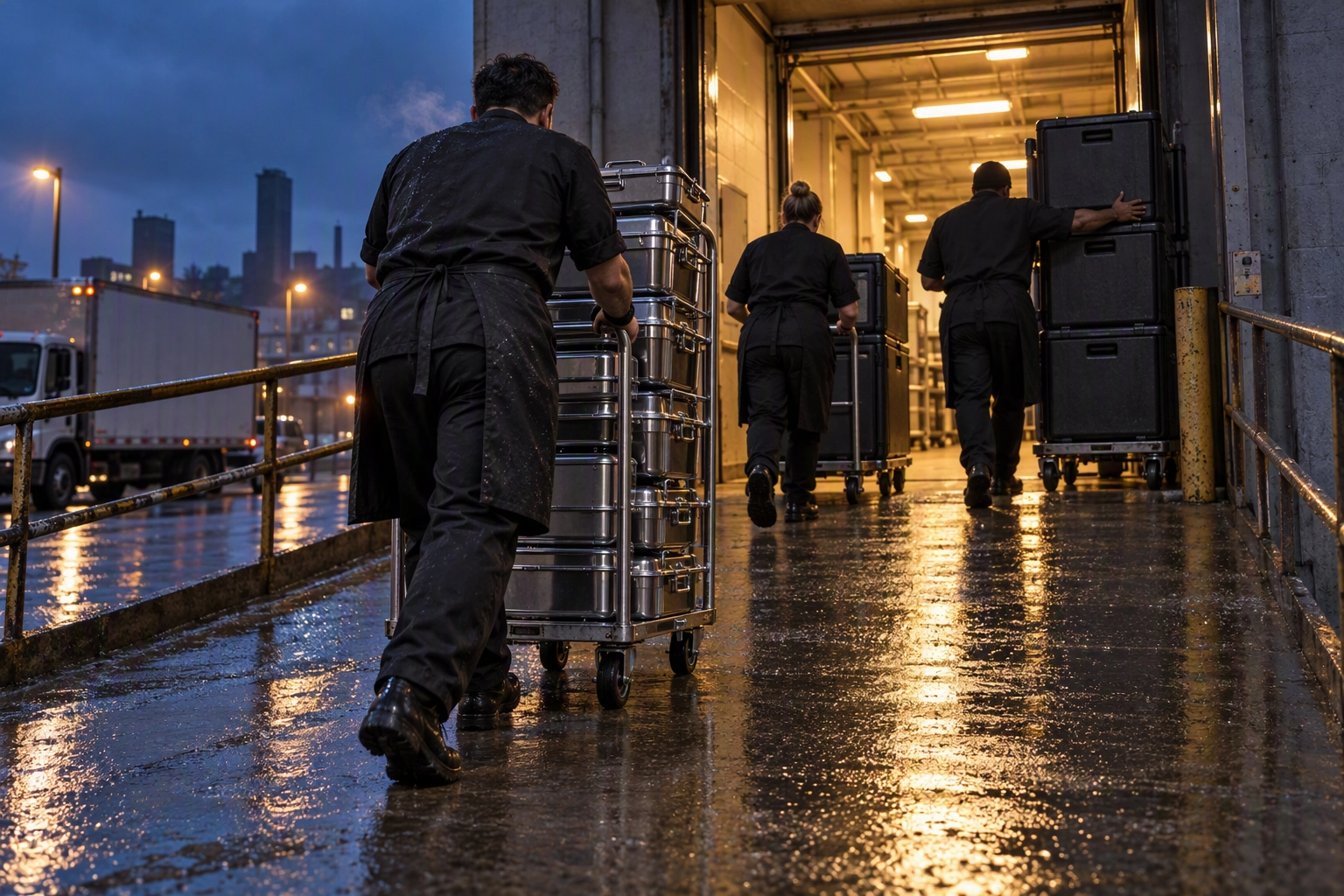
Your biggest exposure as a caterer isn't a bad review. It's the four hours you spend inside a building you don't own, cooking on gear you hauled in, feeding 180 people you've never met. Catering business insurance exists for that window.
The most common catering claim is damage to a rented space, averaging about $4,300 per incident according to figures published by the Food Liability Insurance Program. That is a wedding's entire margin, gone on one scorched sideboard.
Quick Summary: Catering business insurance runs $500–$1,700 a year for general liability alone, and $3,000–$8,000 for a staffed company with a van and a bar. Venues only ask whether your certificate shows $1M/$2M limits and three endorsements.
What Catering Business Insurance Costs in 2026
Published quotes cluster into two bands: what a one-van operator pays, and what a staffed company pays.
| Policy | Typical price | What the coverage answers for |
|---|---|---|
| General liability | $42–$141/mo | Guest injuries, damage to a venue |
| Business owner's policy | $80–$99/mo | Liability bundled with property |
| Workers' compensation | ~$90/mo | Crew injuries, lost wages |
| Liquor liability | ~$65/mo | Harm caused by an intoxicated guest |
| Equipment / inland marine | $25–$75/mo | Chafers, ovens, linens in transit |
Two anchors: a solo drop-off caterer with no alcohol and no staff usually pays $600–$1,500 a year; a full-service company with employees, vehicles and a bar pays $3,000–$8,000.
Why the published numbers disagree so violently
You will see $42 a month on one site and $252 on another for the same trade. Neither is lying.
Insureon publishes the median premium its catering customers actually bought, which skews low because most are micro-operators. MoneyGeek models catering insurance quotes for a standardised two-employee company, which skews high.
One measures what people paid; the other what a defined risk should price at. Treat every published catering business insurance figure — this table included — as an estimate, never a rate. The Small Business Administration's guide to business insurance agrees.
What actually moves your premium
- Alcohol. It raises liquor liability and your general liability rate at once — the biggest single variable for caterers.
- Payroll. Workers' compensation is a class code times payroll, adjusted by your experience modifier. Caterers sit under code 9079 in most states; California added a dedicated caterers code, 9082, in 2024.
- Limits. A $1M/$2M policy prices very differently from the $5M a convention centre demands.
- Claims history. Five clean years is your cheapest discount; delivery mileage is the next lever.
- Bundling. One business owner's policy usually saves 10–15% against buying the same coverage separately.
The Insurance Catering Operations Actually Need
The insurance catering operators actually buy is a stack, not a single product. Six layers do the heavy lifting.
Read them against your own operation. A wedding and event caterer faces different risk from a corporate dining account, a private chef, a meal prep company, a food truck, a mobile bar or a home baker.
General liability
This is the venue gatekeeper. General liability insurance answers for third-party injuries and property damage — a guest tripping over your cable run, a chafing dish scorching a client's sideboard.
Make certain your policy includes products-completed operations. That clause reaches food you have already served, and it helps decide whether illness claims are covered.
 Toppled chafing dish scorching a ballroom parquet floor and linen, the venue property damage general liability pays for
Product liability
Your entire product is food, so this layer isn't optional. Product liability insurance answers for food-related illness, allergic reactions and contamination — a risk the CDC puts at roughly 48 million U.S. illnesses a year.
On most small-business policies that coverage sits inside GL; on some it does not, so ask in writing. The exposure follows anything you hand over, including grazing tables and shipped gift baskets.
Commercial auto
Personal auto policies exclude business use, and the exclusion is enforced. Rear-end someone en route to a reception and a personal policy can decline the claim.
Most states mandate commercial auto on business-owned vehicles. Hired and non-owned auto stretches that coverage over staff driving their own cars.
Liquor liability
If you pour, you are exposed. This coverage answers for injury or property damage caused by a guest your bar over-served, and GL almost always excludes it.
Many venues reject a certificate showing general liability alone when alcohol is on the brief. Price alcohol-related risk in early: roughly $65 a month, more for a bar or lounge operation. Producer permits come from the TTB.
 Mobile bar at a garden marquee reception with a spilled cocktail, the alcohol exposure liquor liability insurance answers for
Workers' compensation
Once you hire, this stops being a choice. The U.S. Department of Labor keeps the state-by-state position; most states require coverage from the first employee.
Kitchens generate burns, knife injuries and lifting injuries, and off-site jobs add stairs and loading docks. Calling your crew contractors does not remove the duty.
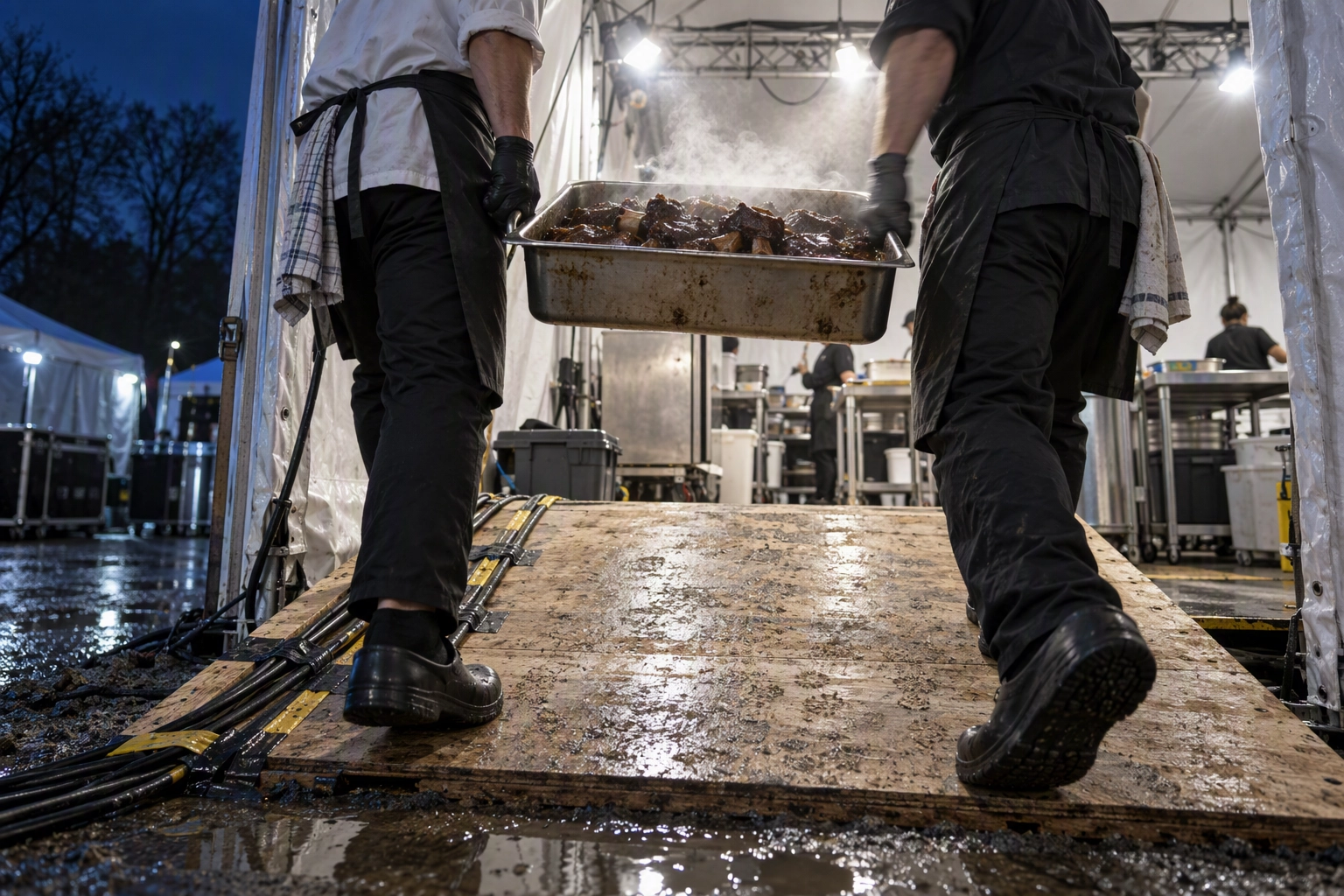 Cooks carrying a steaming hotel pan up a ramp into an event prep tent, the lifting risk workers compensation covers
Equipment and inland marine
Commercial property insurance answers for gear at your own address. Inland marine coverage follows the same equipment into the van, onto a venue floor, or into a rented ghost kitchen overnight.
Schedule it at replacement value. Ovens, chafers and portable refrigeration add up fast, especially once a commissary agreement is involved.
The business owner's policy, and what it leaves out
A BOP bundles general liability with commercial property, near $80–$99 a month for a small caterer — an efficient base layer, not finished catering business insurance.
Auto, employee coverage, liquor liability and off-premises equipment sit outside it. When you request a quote, price the operation you run.
What Venues Require: The Certificate Walk-Through
In the U.S., general liability is usually not mandated by state law for caterers. Auto liability and workers' compensation frequently are.
Everything else is a contract requirement — set by an event venue, a planner or a corporate client, and stricter than statute. Those venue requirements stop jobs. The proof is an ACORD 25 certificate.
Certificate holder is not additional insured
These two get used interchangeably and they are not the same thing.
A certificate holder simply receives proof your policy exists. An additional insured is genuinely protected under it, and their claims sit inside your limit. If a hotel asks for additional insured status and your broker lists a holder instead, a strict venue stops your load-in.
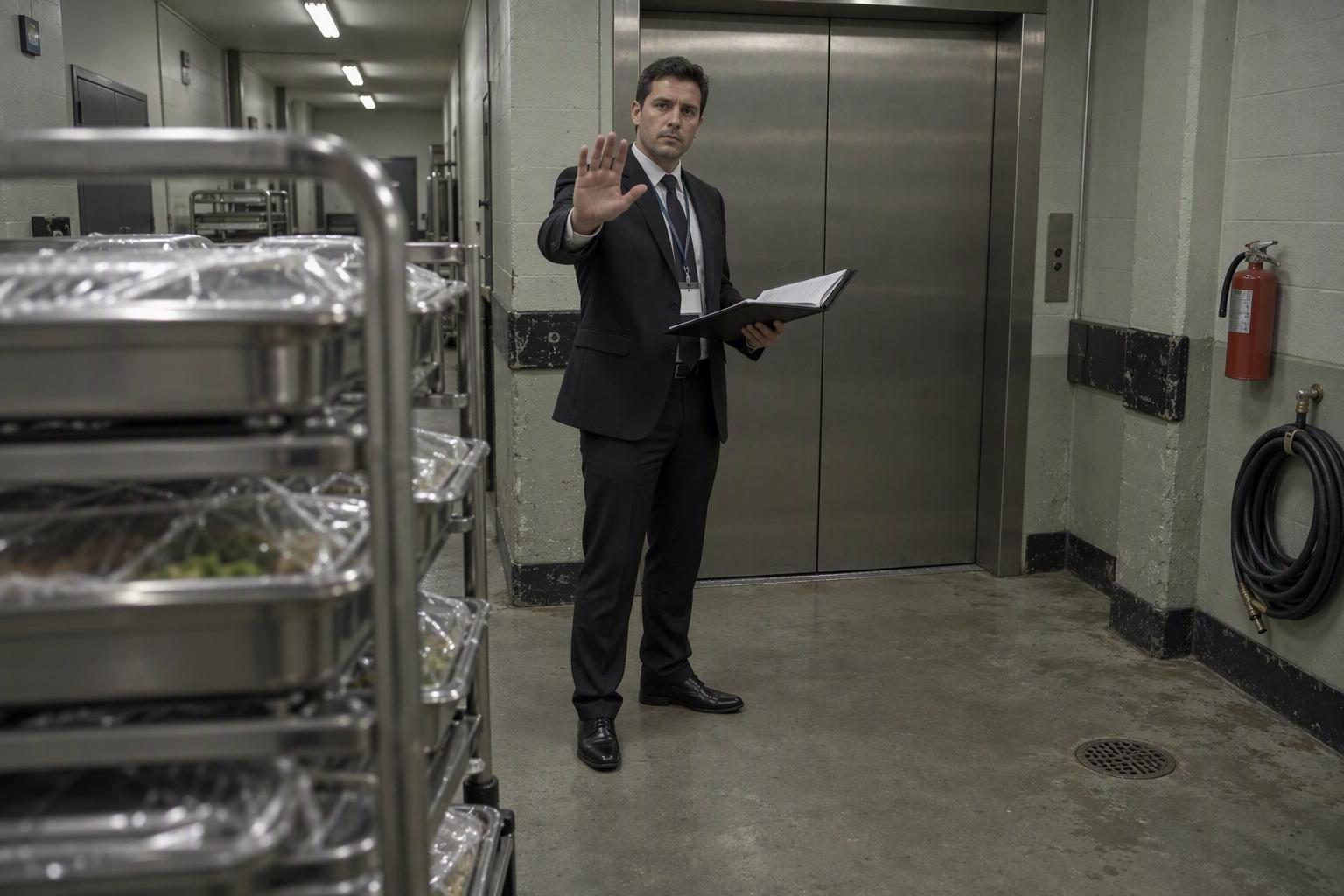 Venue operations manager halting a loaded catering trolley at a freight elevator during a certificate of insurance check
The certificate checklist that clears load-in
- The venue's exact legal entity name, not the trading name on its website.
- Liability coverage matching the contract, commonly $1,000,000 per occurrence / $2,000,000 aggregate for injury and property damage. Hotels and resorts, universities and stadium concessions often demand $2M–$5M.
- An additional insured endorsement for the venue, and often the planner too.
- Primary and non-contributory wording, so their policy does not respond first.
- A waiver of subrogation, now standard on larger sites.
- Dates spanning setup, service and teardown, not just the party hours.
- Liquor liability listed separately whenever alcohol is involved.
- No promise of "30 days cancellation notice" language your carrier will not issue.
Request the certificate the day the contract is signed. Same-day turnaround is normal; 9 p.m. the night before is not.
Licences Are a Separate Gate From Insurance
A licence is the government's permission to trade; insurance is what clients demand before letting you through the door. The phrase "licence for a catering company" hides a stack.
- Business registration and an EIN
- A health department catering permit from your state or county
- An approved commercial kitchen or commissary — home kitchens rarely qualify, as anyone starting a ghost kitchen finds
- Food handler certification for your crew, against the FDA Food Code
- A sales tax permit
- A caterer's alcohol permit wherever you serve
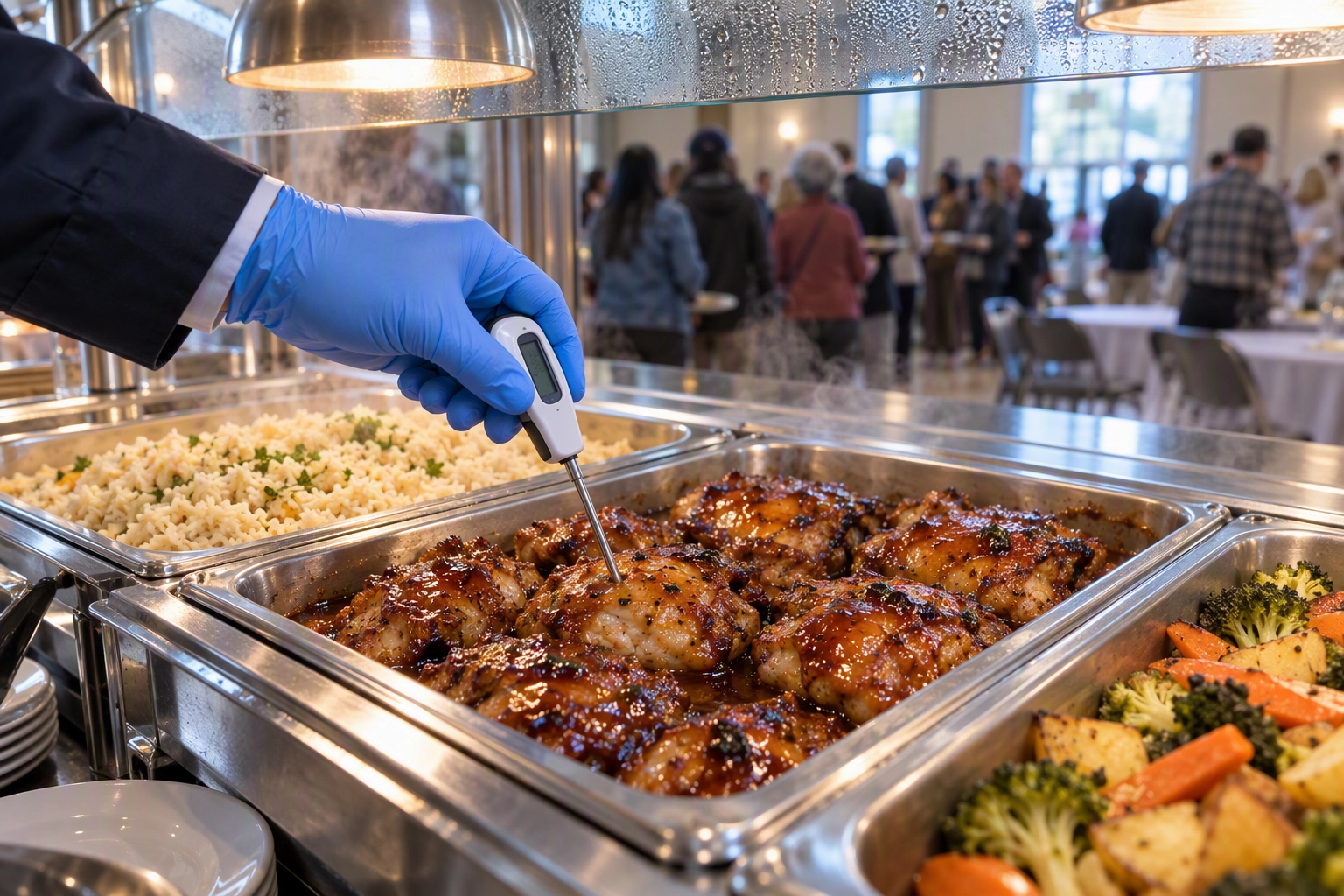 Health inspector probing chicken temperature on a catering buffet line, the permit check behind a catering licence
They interlock. Operating outside your licence conditions — cooking a paid function from an unapproved home kitchen — helps an insurer void the claim, and catering insurance is quoted on the assumption you hold every permit. Healthcare dining and senior living accounts add their own audits.
Annual Policy or Single-Event Insurance?
Single-event policies are inexpensive and produce a certificate naming a venue inside a day. They make sense at three or four functions a year.
They stop making sense quickly. A one-day policy rarely addresses your van, crew or equipment, and exposure does not pause between bookings.
Cater monthly and annual catering business insurance costs less per event. It also helps at tax time — the IRS treats the premium as an ordinary business expense.
Insurance Clears the Load-In. Photographs Win the Booking.
Every caterer on that preferred list carries the same catering business insurance certificate. It is table stakes, not a differentiator.
What separates two compliant bidders is the proposal — catering proposals are won on images a client can picture on their own tables. Immaculate catering business insurance plus six phone snaps under kitchen fluorescents still loses the bid.
A few things that help more than another quote:
- The catering food photography guide for the shot list
- Commercial food photography for the standard buyers expect
- The menu photography guide for tray-level detail
- The catering use case — FoodShot AI turns a phone snap into a 4K menu-ready image in 90 seconds; pricing from $15 a month
- A marketing plan, a catering marketing guide, campaign ideas and a photoshoot plan
Frequently Asked Questions
How much is catering business insurance for a one-person operation?
Published medians put general liability insurance near $42 a month, about $500 a year, for a solo caterer with no alcohol and no staff. Modelled quotes for two employees run nearer $89–$141.
Is catering insurance legally required?
General liability usually is not required by law. Workers' compensation and commercial auto generally are, once you have employees or business vehicles. The binding requirements arrive through venue contracts, which demand more coverage than statute.
What limits do venues ask caterers for?
$1,000,000 per occurrence and $2,000,000 aggregate is the common floor. Hotels, convention centres and municipal sites frequently require $2M–$5M, often naming the planner as an additional insured.
Does general liability insurance include food poisoning claims?
Often, through products-completed operations — but not always. Confirm in writing that food-related illness and allergic-reaction claims are covered inside your limit. Brokers flag this gap more than any other.
Do I need liquor liability if the client supplies the alcohol?
Frequently yes. Many policies treat serving or furnishing alcohol as the trigger, not selling it. If your staff are pouring, ask how your policy defines that exposure. The NAIC consumer hub helps you find your state regulator.
Can single-event insurance replace annual catering insurance?
For three or four functions a year, yes. Beyond that an annual policy costs less per booking and, unlike a single-day certificate, it protects your van, crew and equipment between jobs. Fine dining clients expect continuous liability coverage.
Catering business insurance is the dullest line on your profit and loss statement and the one deciding whether a business survives a bad night. Price the whole operation, not one policy.