How Much Should a Restaurant Spend on Marketing? 3 Budgets
 Ali Tanis15 min read
How much should a restaurant spend on marketing? For an established restaurant, set aside 3–6% of revenue, and expect to run at or above the top of that range in your first year. Every budget guide repeats that number. What they skip is the part you need on a Monday morning: what the money buys, line by line, and whether your margins can carry it.
Below are three worked budgets, for a $500,000 café, a $1.5 million full-service dining room and a $4 million group with three locations. Every benchmark has a named source. Each budget carries a content production line, because photos feed every other channel, and that is the line where an AI workflow for restaurant food photography changes the math most.
Quick Summary: Most established restaurants should budget 3–6% of revenue for marketing, and more in year one. That range fits restaurant margins (a 2.8% median pretax profit for full-service, per the National Restaurant Association) far better than the SBA's 7–8% small-business rule, which assumes 10–12% margins. In our worked budgets, moving dish photos from a photographer to an AI workflow frees $2,320 to $13,812 a year for channels that bring guests back.
How Much Should a Restaurant Spend on Marketing?
A defensible restaurant marketing budget is 3–6% of revenue for established restaurants, 6% or more in the first year, and closer to 3% once repeat guests carry the room. At $1 million a year, that's $30,000 to $60,000, or $2,500 to $5,000 a month. Pick the point in that band from your margin, your age and how crowded your block is.
The 3–6% range is an industry convention. ChowNow, Aaron Allen, business.com and WebFX all quote it, but none of the pages we checked ties it to a published survey, and we couldn't find one either. So instead of treating it as data, check it against the numbers that are measured.
What Restaurants and Chains Actually Spend
Here is every benchmark worth citing, with what it really measures. The spread is wide because the figures measure different things, which is the first trap in most budget guides.
| Benchmark | Figure | Source and year | What it measures |
|---|---|---|---|
| Restaurants' actual ad spend | 1.93% of revenue | SBA blog, citing Small Business Trends (2019) | Advertising only, not all marketing |
| Common restaurant guideline | 3–6% of revenue | ChowNow, Aaron Allen, business.com, WebFX | Total marketing, established spot |
| McDonald's franchise minimum | At least 4% of gross sales | McDonald's franchise agreement (FDD) | Advertising and promotion |
| Domino's U.S. ad fund | 6.0% of store sales | Domino's 10-K (fiscal 2024) | National fund only; local marketing is extra |
| SBA small-business rule | 7–8% of revenue | SBA marketing tool | Firms under $5M with 10–12% margins |
| Large companies, all sectors | 7.8% of revenue | Gartner CMO Spend Survey (2026) | 401 CMOs, mostly $1B+ firms |
Read the franchise rows closely. Franchisors see marketing returns across thousands of stores, and they still require 4–6% from every location, with Domino's stores spending more on local marketing on top. An independent at 3% is not overspending. An independent at 1% is relying almost entirely on word of mouth and foot traffic.
Why Restaurant Margins Cap Your Marketing Budget
Marketing gets paid before profit, so your margin sets the ceiling. In the National Restaurant Association's 2025 Restaurant Operations Data Abstract, built from 900+ restaurants, median income before taxes was 2.8% for full-service and 4.0% for limited-service in 2024.
Now compare that with the SBA's 7–8% rule. The SBA's own planning tool says that figure assumes margins of 10–12%. A full-service room earning the median 2.8 cents on the dollar can't copy a budget built for a business earning four times as much. That gap explains why restaurant guides land on 3–6% instead.
There's a second way to read the NRA number. Every point of sales you move into marketing equals about a third of the median full-service profit. So each line item has to earn its place in extra guests, not in likes. It's also why owners push back on the convention. In an r/restaurateur thread that calls 4–7% "ridiculously high," one commenter argues 2% is "much more of a realistic figure." For a busy, established spot with strong repeat traffic, they may be right.
How to Set Your Restaurant Marketing Budget in 4 Steps
Start from projected revenue, choose a percentage for your stage, convert it into the guests it must bring in, then spread it across the year. The whole process takes an afternoon with last year's P&L.
Step 1: Start From Projected Revenue
Use next year's expected sales, not last year's leftovers. If you plan to raise prices or add catering, include it. Do this planning in Q4, before January, not after a slow February forces the question. A budget built from what's left over after costs always shrinks in a bad month, which is exactly when you need marketing most.
Step 2: Pick Your Percentage by Stage
- Year one (opening to month 18): agency guides range from 6–10% (WebFX) to 8–10% or more (The Forking Group) to 10–15% (Restaurant Growth). You're buying awareness you don't have yet.
- Established and steady: 3–6%. Lean low if most covers are regulars, high if you sit on a crowded block.
- Growth mode (new location, new daypart, delivery launch): add 1–2 points for 3–6 months, tied to a growth target you can count.
- Multi-unit: often toward the low end as a percentage, because one website, one email list and one photo library serve every location.
Step 3: Turn the Budget Into Guests
This is the step most guides skip, and it's the one that makes the number defensible. Divide your monthly budget by the gross margin on one average check:
Extra guests needed per month = monthly marketing budget ÷ (average check × (1 − food cost %))
Take a full-service spot spending $5,000 a month with a $40 average check and a 32% food cost, about where the NRA's 2024 median landed. Each guest leaves $27.20 after food. The budget pays for itself at 184 extra covers a month, roughly 6 a day, before any extra labor. If you can't name the channels that will produce 6 more guests a day, the budget is too big or pointed at the wrong things. Our food cost calculator and menu pricing guide help you pin down both inputs.
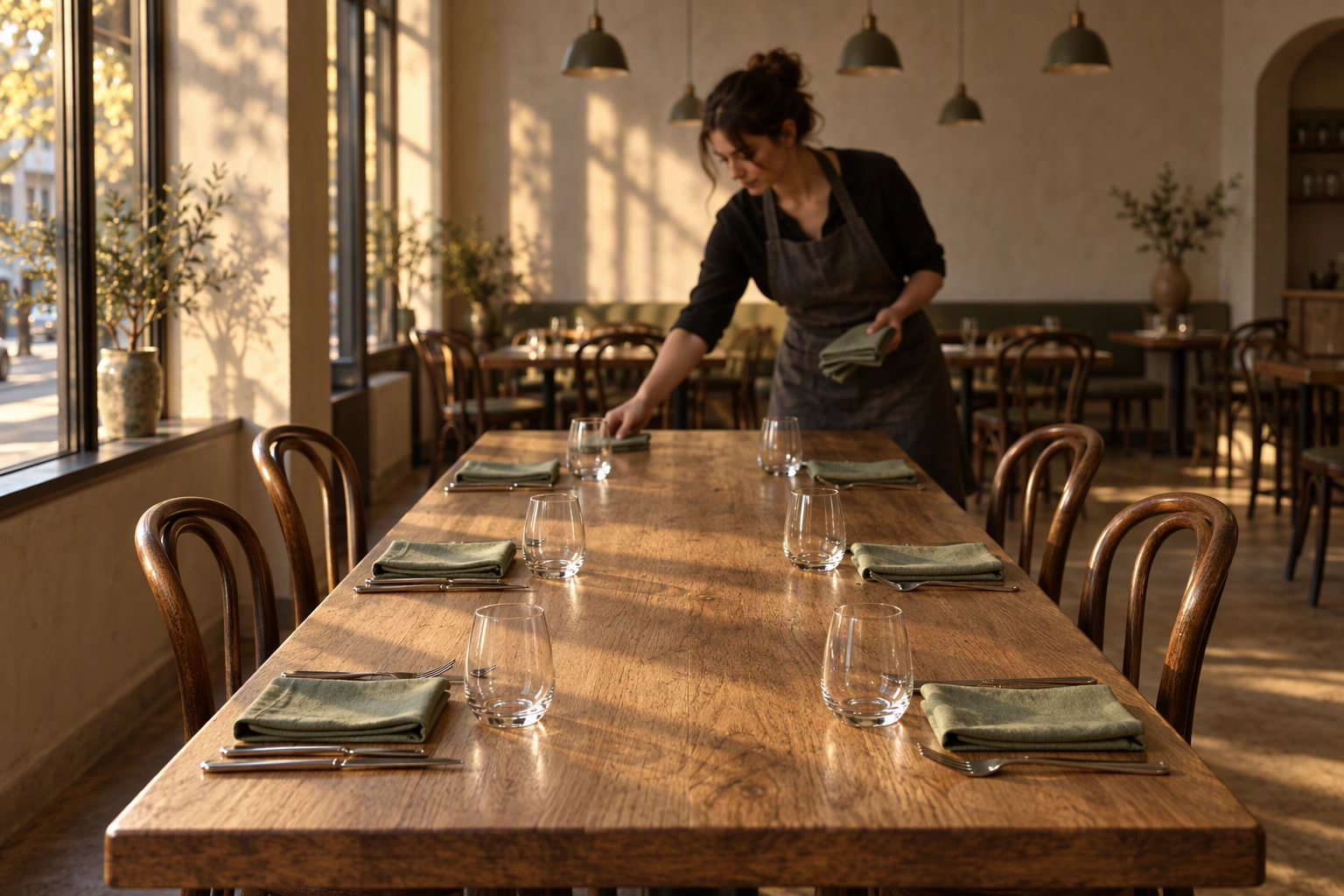 Server laying six extra place settings on a long oak table before dinner service, the daily covers a marketing budget must earn
Step 4: Spread It by Season
Aaron Allen's advice is to spend roughly in proportion to monthly sales: if December brings 11% of your year, give it about 11% of the budget. Keep a separate pot for slow nights, where targeted restaurant promotions work better than brand ads. Q4 is a good test: gift card promotions and fall promotion ideas pull cash forward into the months you'll need it. Good seasonal planning means the money is committed before the rush, not scrambled together during it.
Three Worked Restaurant Marketing Budgets
The table below splits each budget across channels in annual dollars. The café and the full-service room sit at 4%, the middle of the convention. The group sits at 3%, because shared assets spread across three locations. The content production row shows the photographer route; the next section shows what changes with an AI workflow.
| Line item (per year) | Café, $500K at 4% | Full-service, $1.5M at 4% | 3-location group, $4M at 3% |
|---|---|---|---|
| Total marketing budget | $20,000 ($1,667/mo) | $60,000 ($5,000/mo) | $120,000 ($10,000/mo) |
| Paid social (Meta ads) | $4,200 | $12,000 | $22,000 |
| Search, maps and reviews (Google Ads, Business Profile) | $3,000 | $9,000 | $16,000 |
| Delivery and reservation platform promos | $2,400 | $6,000 | $13,000 |
| Email, SMS and loyalty software | $600 | $2,200 | $6,000 |
| Rewards and promos, at food cost | $2,400 | $6,000 | $12,000 |
| Website and ordering page | $400 | $3,000 | $6,000 |
| Community, events and PR | $2,500 | $6,000 | $7,000 |
| Marketing help (freelancer or staff hours) | $0 | $4,800 | $18,000 |
| Content production, photographer route | $2,500 | $8,000 | $15,000 |
| Test reserve | $2,000 | $3,000 | $5,000 |
These are allocations, not quotes. Your rent, block and menu will move them. What they show is the shape of a sensible split: a bit under half on paid reach, about 15% on bringing existing customers back, and a 4–10% reserve you're allowed to waste on experiments.
Café or Counter-Service: $500,000 a Year
At $1,667 a month, the owner does the posting and the money goes to reach. The $4,200 in paid social works out to about $11.50 a day, inside the $5–$30 a day range in our Instagram ads guide. The $600 software line matches Square Plus at $49 per location per month, which bundles loyalty, email and 500 texts. Photos at $2,500 cost more than the whole delivery-promo line, which is the problem the next section solves.
Full-Service Restaurant: $1.5 Million a Year
At $5,000 a month, you can afford help: $400 a month buys a freelancer for posting and a social media strategy you don't have to run yourself. The software line assumes a POS marketing bundle like Toast's, commonly reported at about $185 a month. The photographer route at $8,000 is four quarterly half-day shoots to keep seasonal menus current.
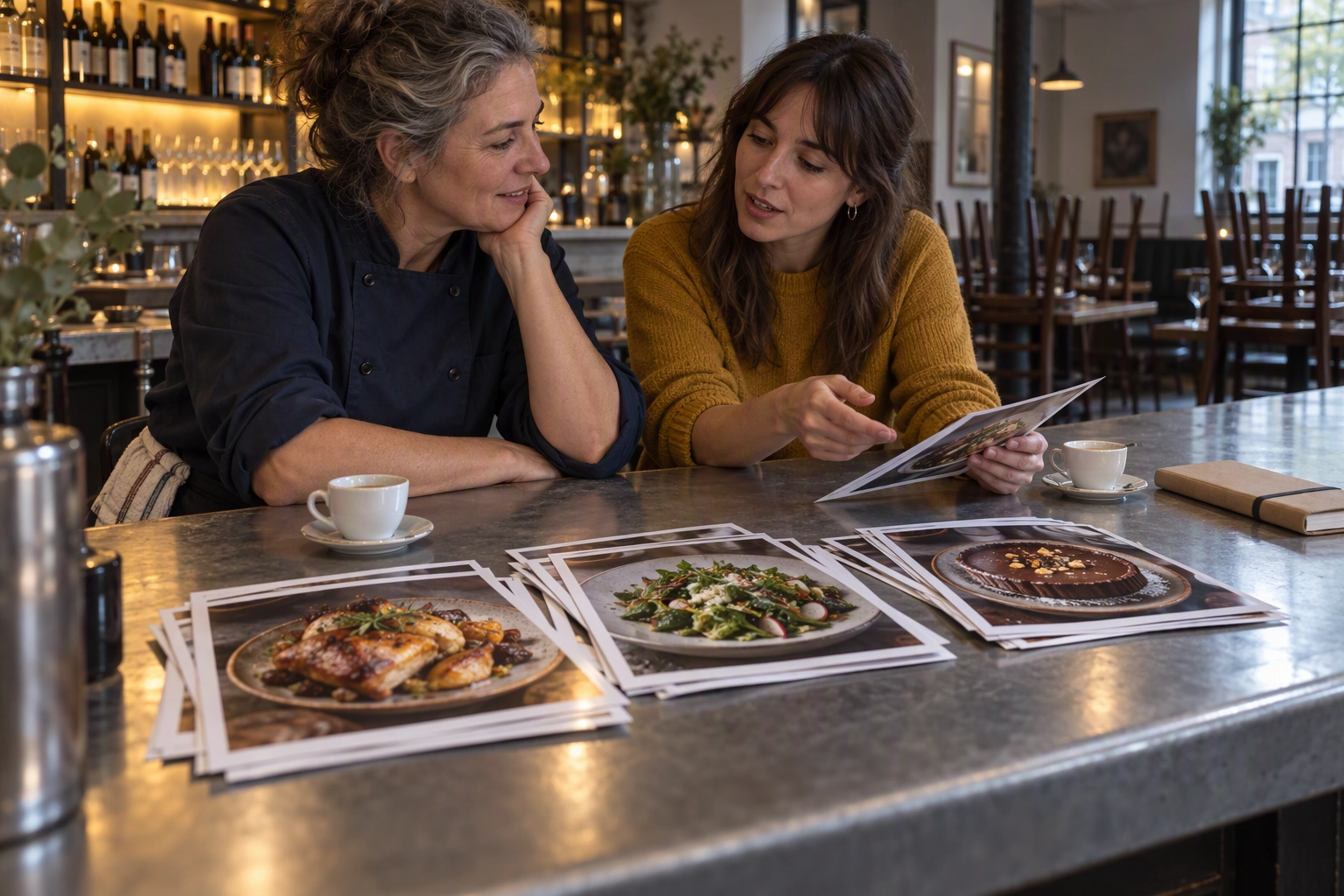 Restaurant owner and freelance marketer sorting printed dish photos into piles at a bar counter, planning a monthly marketing budget
Three-Location Group: $4 Million a Year
At $10,000 a month, the biggest change is a part-time marketing coordinator or a small agency retainer at $1,500 a month. Paid social at $22,000 is about $20 a day per location. The $6,000 website line covers one site with three location pages, plus a tool that keeps hours, menus and review replies in sync. Content runs $15,000 because three menus, three Google profiles and three delivery listings all need current photos.
The Content Production Line: Photographer vs AI Workflow
Photos are the input every other line depends on: ads, Google profiles, delivery listings, email and printed menus. In the three budgets above, the photographer route takes 12.5–13.3% of the whole budget. An AI workflow that starts from your own phone photos brings that line down to about 1%.
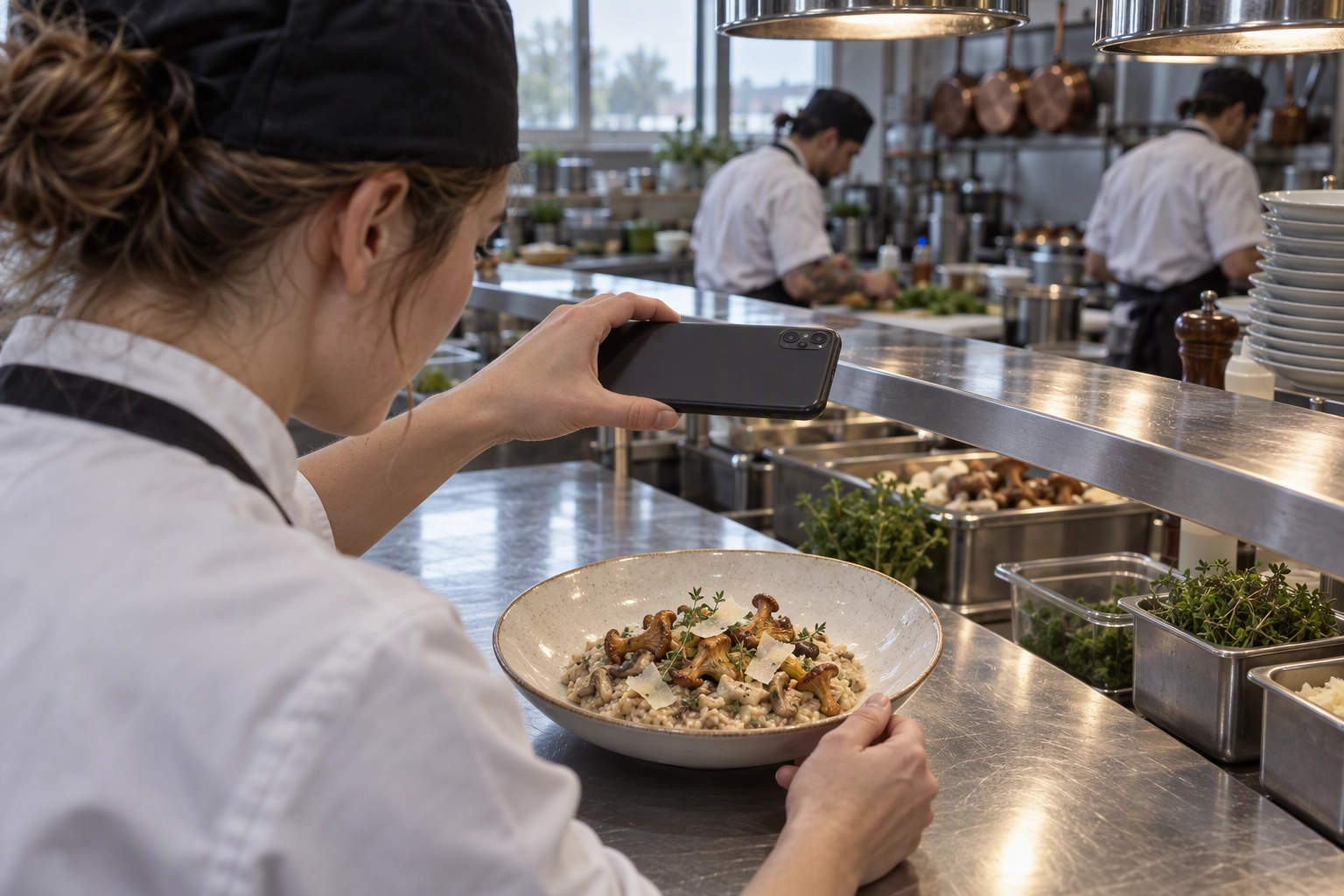 Sous chef photographing a plated mushroom risotto with a phone at the kitchen pass, the in-house content production route
| Content line | Café | Full-service | 3-location group |
|---|---|---|---|
| Photographer route | $2,500: two half-day shoots at about $1,250 all-in | $8,000: four quarterly half-days at about $2,000 with a stylist | $15,000: quarterly shoots at premium big-city rates |
| AI route (FoodShot plans) | Starter, $15/month, 25 photos | Business, $45/month, 100 photos | Scale, $99/month, 250 photos, 5 at once |
| Annual cost (monthly / annual billing) | $180 / $108 | $540 / $324 | $1,188 / $708 |
| Money freed per year (monthly billing) | $2,320 | $7,460 | $13,812 |
| Share of total budget | 12.5% → 0.9% | 13.3% → 0.9% | 12.5% → 1.0% |
What the Photographer Route Buys
The shoot figures come from our restaurant photography pricing guide: half-day sessions run $300–$2,500, standard day rates $1,000–$2,000, and a food stylist adds $500–$1,200 a day. Hidden costs like props, licensing and retouching often add 40–60% to the quote. Quarterly shoots at mid-range rates come to $3,000–$10,000 a year, and premium big-city work to $10,000–$30,000. A good photographer earns that money. If you go this route, our menu photoshoot guide helps you get more usable shots from each day, and our food photography cost guide compares every other way to get images.
What an AI Workflow Costs, and What It Can't Do
With FoodShot, you photograph the real dish on your phone, pick one of 200+ styles, and get a 2K image (2048 px) back in about 2 minutes. Our menu photographer alternative page shows the workflow dish by dish. Paid tiers include a commercial license; the free tier is watermarked and for personal use only. Prices above were checked on our pricing page in October 2026, and annual billing takes 40% off.
Be clear about the limits. It only handles food and drinks, still images only. It won't shoot your dining room, your team or a video. A sensible middle path is a hybrid: one standard photographer day a year ($1,000–$2,000) for interiors and people, plus an AI tier for every dish update. For the full-service budget, that's $1,540–$2,540 instead of $8,000. Delivery apps also have rules on edited photos, covered in our guide to AI food photos on delivery apps.
Where the Freed Money Should Go
Put it where returning guests are made. Toast's 2026 Regulars Report found that 7% of guests can drive up to 50% of a venue's order volume. So the $7,460 the full-service budget frees is better spent on email, SMS and rewards than on more cold reach. Our guide to restaurant loyalty programs prices six formats from $0 to about $500 a month.
Restaurant Marketing Costs Owners Forget to Budget
The overlooked costs are the ones restaurants never receive as a marketing invoice. Add these before you call the budget final:
- Reward food cost. A "buy 9, get the 10th free" latte costs about 3% of what that regular spends, not 10%. Budget rewards at food cost, not menu price, and count every free item your customers redeem.
- Delivery promos. Commissions are a cost of each order. Sponsored listing programs, paid placement and "spend $25, save $5" offers are marketing, so track them on this budget. Our breakdown of DoorDash fees shows the difference on a $30 order.
- Staff time. Five hours a week of a manager's time on social is real money, even if no invoice arrives. A tight routine like our 100-minute Instagram week keeps it in check.
- Menu refresh costs. Every new menu means reprinted menus, table tents and new delivery listing photos.
- Software creep. Overlapping email, review and scheduling tools add up quietly. Audit them twice a year against our lists of restaurant marketing tools and restaurant marketing software.
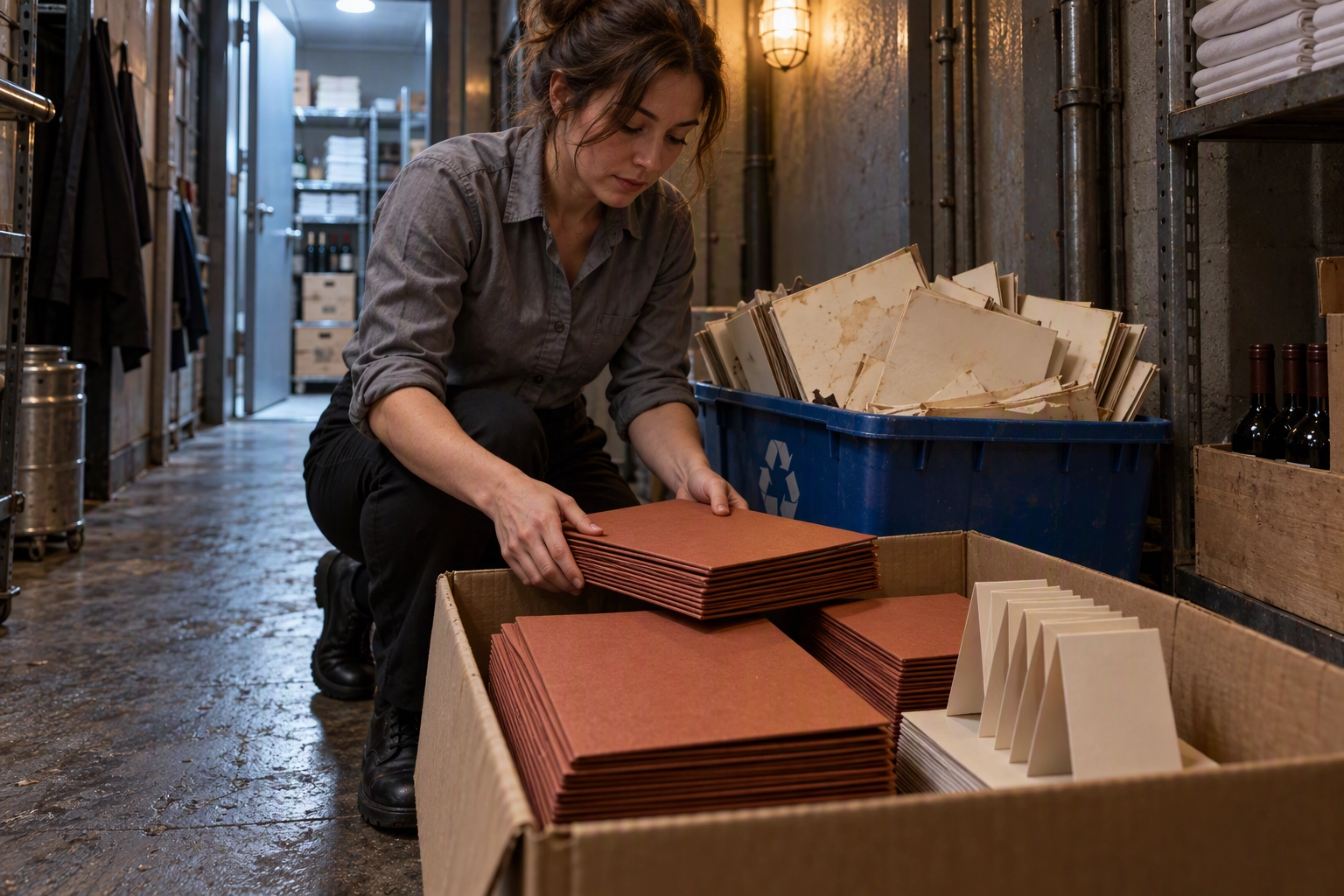 Manager boxing freshly reprinted menus and table tents while old menus fill a recycling crate, a hidden restaurant marketing cost
How to Tell If Your Marketing Budget Is Working
A marketing budget works when covers, repeat visits and average check move, not when likes do. Track three results every month: new customers by channel, repeat-visit rate and cost per new guest (channel spend divided by the new guests it brought in).
You don't need expensive attribution software. An SBA.gov guide keeps it simple: ask new customers how they heard about you, and give each ad its own promo code. Watch your Google Business Profile for calls and direction requests, and watch your reviews: count, average rating and how fast you reply. On a small budget, treat reviews as a channel, not a chore. Then, once a quarter, cut the line item with the weakest results and move its money to the strongest. After a year, your split will look like your customers, not like a template.
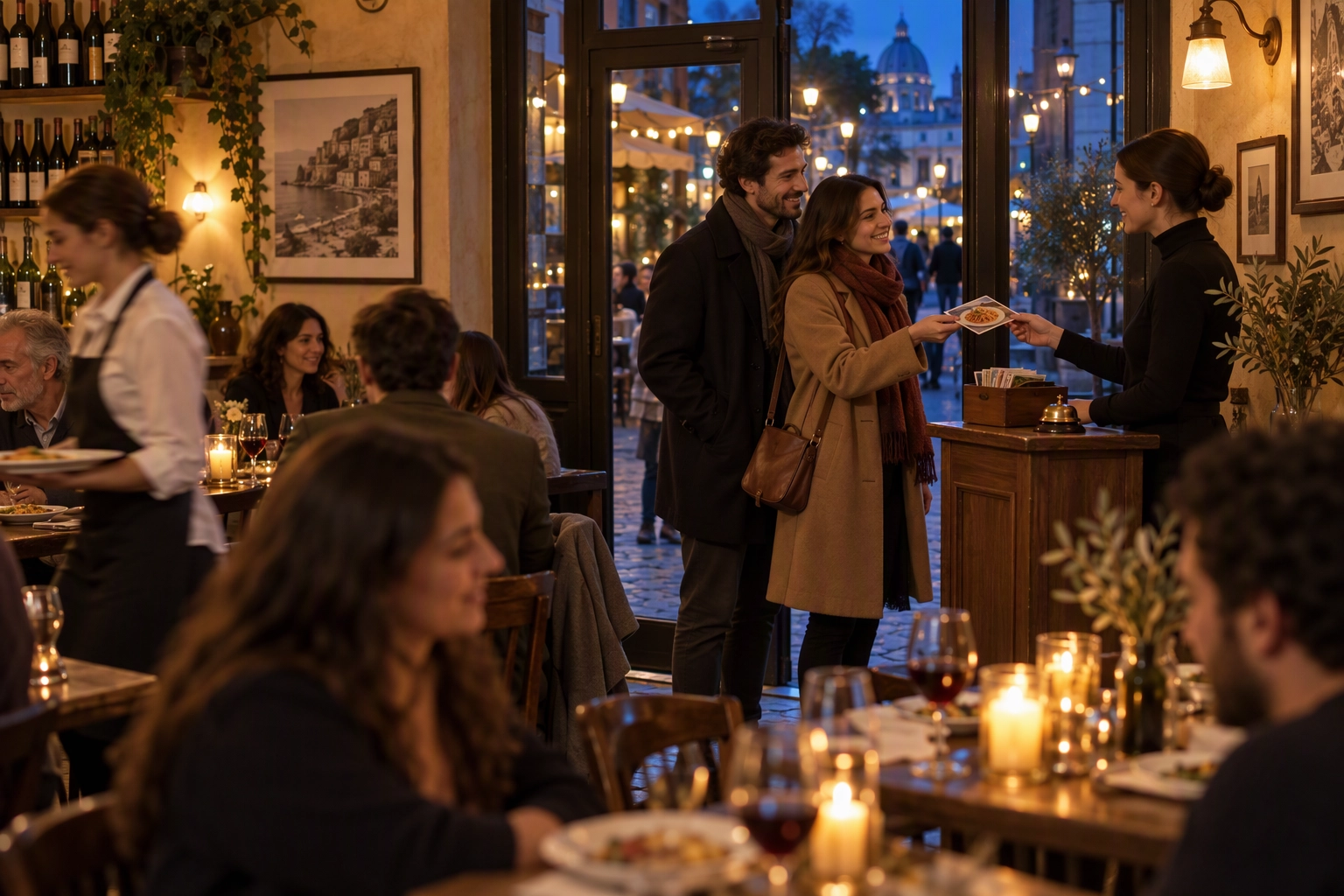 Host taking a promo postcard from arriving guests at a walnut host stand, tracking which marketing channel brought them in
Once the number is set, the hard part is choosing tactics. Our list of restaurant marketing ideas collects 50 that drive revenue, and our best restaurant marketing campaigns shows nine you can run for about $500.
Frequently Asked Questions
What percentage of revenue should a new restaurant spend on marketing?
Agency guides put year one for new restaurants between 6% and 15% of projected revenue, because nobody knows you yet and awareness has to be bought. A practical way to manage it is a fixed launch budget for pre-opening plus the first three months, then a step down toward 3–6% once repeat customers appear in your POS data.
Do delivery app commissions count as marketing costs?
No. Commissions are a per-order cost of selling through the platform. Sponsored listings, paid placement and customer offers do count, because they buy visibility like any other ad. Keep them on separate lines so you can see what each one returns. Strong listing photos help both, as our food delivery app page explains.
Is 2% of revenue enough for restaurant marketing?
It can be for an established spot with a good location, loyal regulars and a steady flow of new reviews. The SBA-cited figure shows restaurants averaging 1.93% of revenue on advertising alone, so 2% for ads is roughly typical, though it leaves little for photos, software or rewards. If covers are flat or falling at 2%, the budget is too small or in the wrong channels.
How much should a small restaurant spend on social media ads?
Start at $5–$30 a day, or $150–$900 a month, on one dish or offer per campaign. The café budget above uses $350 a month. Good food photos matter more than spend at this level, since a weak image wastes every dollar behind it.
Should I cut marketing when business slows?
Cut the lines that don't produce guests, not the whole budget. The same SBA.gov guide warns that cutting marketing as revenue drops can push revenue lower still. Use the slow months to test cheaper channels and refresh your photos, so you're ready when traffic returns.