Best Camera for Food Photography? 9 Picks From $729 (2026)
 Ali Tanis27 min read
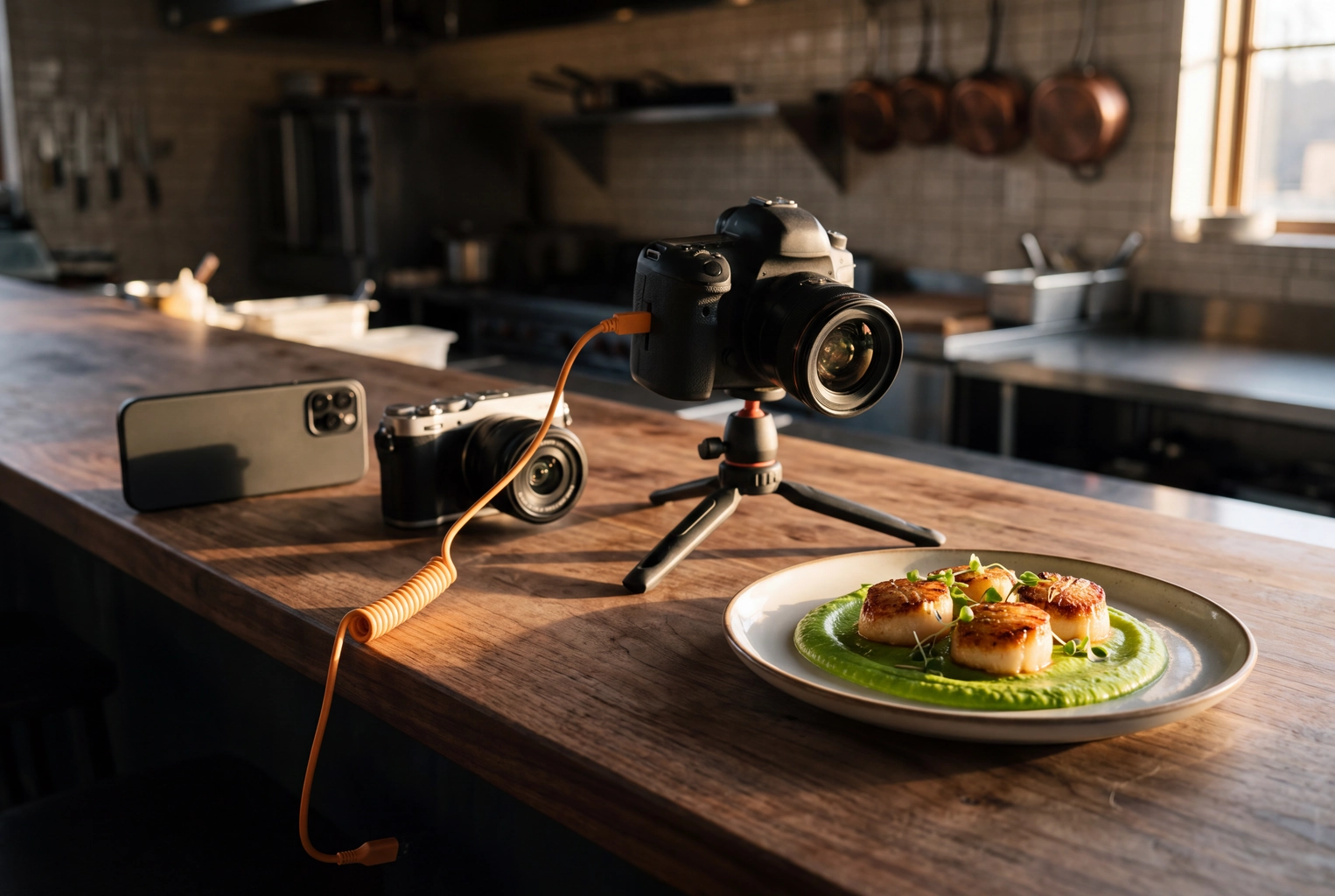
The best camera for food photography depends on the job the photos have to do. For menu and delivery app photos, a recent phone is enough, and a phone plus an AI food photo editor covers most restaurants.
For blog and Instagram work, a $729 Canon EOS R50 with a macro prime is the smartest purchase. For paid client work, print and packaging, a 35mm-format body such as the Canon EOS R6 Mark III still wins, and nothing in a phone replaces it.
Quick Summary: Restaurants that post on Uber Eats and DoorDash rarely need a camera: a recent phone and AI editing cost about $2 to $3 per usable menu photo, owner's time included, against roughly $13 to $17 for a camera kit. Food bloggers get the most for the money from the Canon EOS R50 or Nikon Z50 II with a macro lens. Paid client work and anything printed larger than about 7 inches is where full-frame and medium format cameras earn their price.
Every price below is a US price checked on November 1, 2026, the week Black Friday camera deals start. Prices move weekly, so treat them as a snapshot, not a quote.
There are no affiliate links on this page, and we earn nothing from any camera brand or retailer named here. We do make FoodShot, an AI food photo editor, so weigh what we say about phones with that in mind.
The best camera for food photography by use: the decision table
Pick the column that matches what your photos are for, then read across the row you care about. "Kit with one food lens" means the body plus the single macro we would get first, at today's list price.
| Menu and delivery photos | Blog and Instagram | Paid client work | |
|---|---|---|---|
| Best pick | iPhone 18 Pro, or the recent phone you already own | Canon EOS R50 (or Nikon Z50 II) | Canon EOS R6 Mark III (Nikon Z5II on a tighter budget) |
| Body price | $1,199, or $0 if your phone is from the last 3 years | $729 (R50) / about $950 to $1,000 (Z50 II) | $2,799 (R6 III) / about $1,700 (Z5II) |
| Kit with one food lens | Phone plus a $20 to $40 overhead mount | $1,268 with the RF 35mm f/1.8 Macro ($539) | $4,148 with the RF 100mm f/2.8L Macro ($1,349) |
| Tethering to a laptop | No | Yes on the R50, over slow USB 2.0 | Yes, complete support in EOS Utility and Capture One |
| Video | Up to 120 fps at UHD | UHD at 30 fps (R50) / 60 fps (Z50 II) | 7K open gate, 120 fps UHD |
| Cost per usable menu photo | About $0.42 cash with the phone alone; $0.72 to $1.20 with AI editing | About $6.75 cash for an R50 kit | About $18.75 cash if the kit only covers your own menu |
| Where it falls short | Large prints; no real tethering | No in-body stabilization on either body | Price, and overkill for a delivery app thumbnail |
The cost row comes from a worked example further down: a 40-dish menu, reshot twice a year for three years, which is 240 usable images. Change the inputs and the ranking holds. The gap only narrows if you photograph many hundreds of dishes a year.
9 best cameras for food photography in 2026, compared
These nine cameras cover every price range from a phone you already own to a $5,699 medium format body. All eight dedicated cameras are mirrorless cameras, because that is where nearly all new lenses are released. They sit at four price points: under $1,000, around $1,500, around $3,000, and $4,500 and up.
| # | Camera | Best for | Body price (Nov 1, 2026) | Sensor and resolution | In-body stabilization | Tethering | Top video |
|---|---|---|---|---|---|---|---|
| 1 | iPhone 18 Pro | Menu and delivery photos | $1,199 | Phone, 48MP main | Sensor-shift OIS | No | UHD 120 fps |
| 2 | Canon EOS R50 | Budget blog camera | $729 | APS-C, 24.2MP | No | Yes (USB 2.0) | UHD 30 fps |
| 3 | Nikon Z50 II | Beginner macro | About $950 to $1,000 | APS-C, 20.9MP | No | Partial | UHD 60 fps |
| 4 | Fujifilm X-S20 | Colour straight out of camera | About $1,300 to $1,500 | APS-C, 26.1MP | Yes, up to 7 stops | Yes | 6.2K 30 fps |
| 5 | Nikon Z5II | Value full frame | About $1,700 | Full frame, 24.5MP | Yes, 7.5 stops | Yes | UHD 30 fps, no crop |
| 6 | Canon EOS R6 Mark III | Paid client work | $2,799 | Full frame, 32.5MP | Yes, 8.5 stops | Yes | 7K open gate |
| 7 | Sony a7 V | Video plus stills | $2,898 | Full frame, 33MP | Yes | Yes | UHD 120 fps (crop) |
| 8 | Sony a7R VI | Big prints and crops | $4,499.99 | Full frame, 66.8MP | Yes | Yes | 8K |
| 9 | Fujifilm GFX100S II | Packaging and ads | $5,699 | Medium format, 102MP | Yes | Yes | UHD 30 fps |
1. iPhone 18 Pro: best phone for menu and delivery photos
The iPhone 18 Pro is the best phone for food photography this year because its 48MP main camera now has a real variable aperture, from f/1.48 down to f/4.0. That f/4.0 setting matters on the table: it keeps a whole pizza or a shared board sharp instead of letting the back edge melt into blur.
Apple launched it in September 2026 at $1,199, $100 more than the previous model, according to PCMag. The 2x lens (48mm equivalent) is the one to use for plated dishes, because it avoids the stretched-plate look of the wide view.
You also get 48MP macro, RAW files, manual control of aperture, shutter speed and white balance, and UHD video at up to 120 fps. Our guide to iPhone camera settings for food covers the exact settings.
On Android, the Pixel 11 Pro ($1,099) is the alternative. The Guardian's Pixel 11 Pro review calls it "a great smaller phone with a killer camera".
For a menu, either phone is more than enough. DoorDash asks for at least 1400 × 800 pixels, and a 48MP file is many times that.
- Pick it if: you shoot your own menu, delivery app listings and social posts.
- Skip it if: you need tethered sessions, big prints, or a true 100mm macro look.
2. Canon EOS R50: best budget camera for food bloggers
The Canon EOS R50 is the camera food bloggers should get first: $729 for the body at B&H and the Canon store, a 24.2MP APS-C sensor, and a flip-out screen for overhead images. Canon's refurbished store has listed it as low as $449, the cheapest of the interchangeable-lens cameras here when stock appears.
Pair it with the RF 35mm f/1.8 Macro IS STM ($539). On an APS-C sensor that prime gives the view of a 56mm, close to natural eyesight, and it focuses close enough for crumb and sauce texture at half life size. That kit costs $1,268, about the price of a flagship phone.
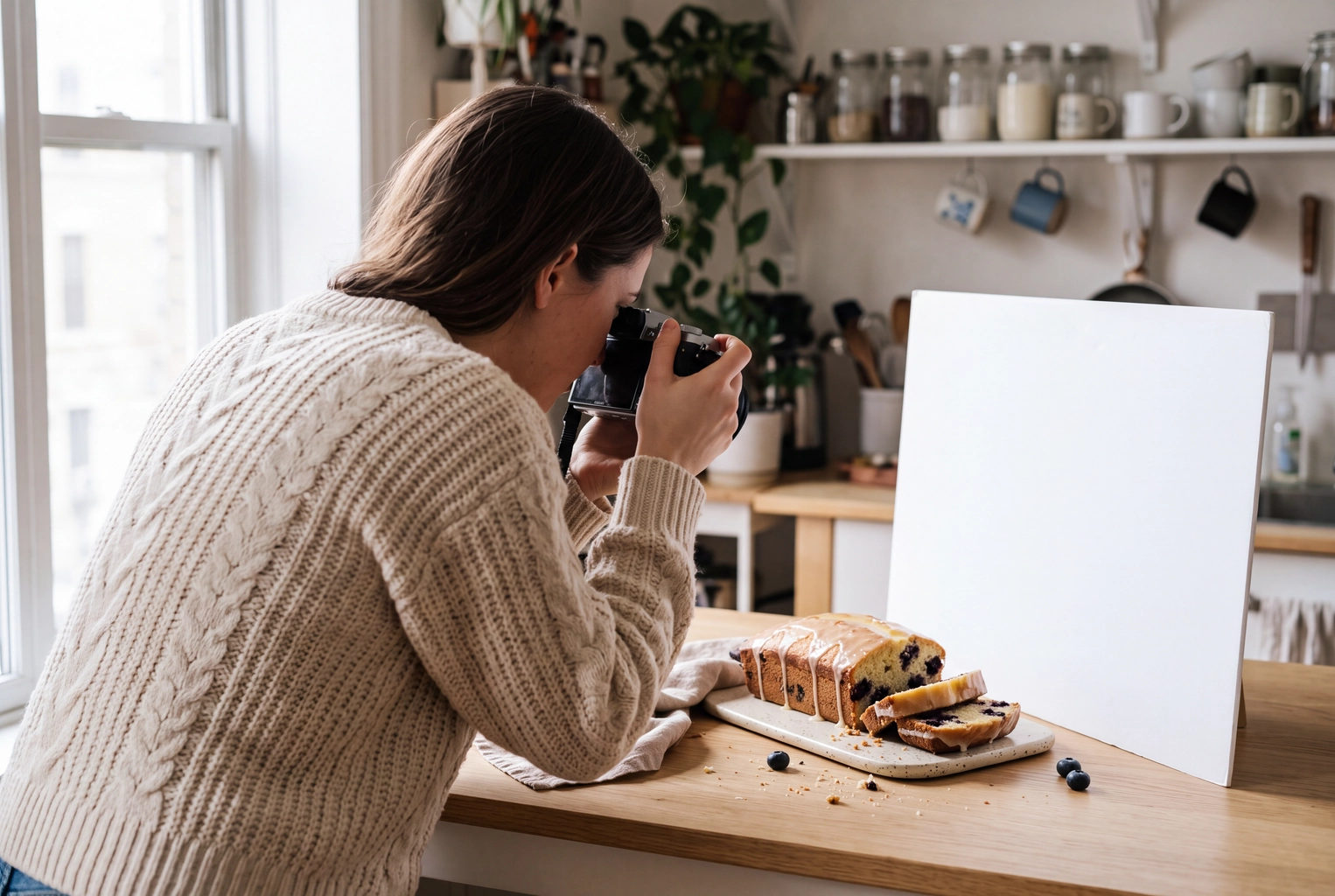 Food blogger photographing a sliced lemon blueberry loaf at 45 degrees with a small APS-C mirrorless camera and macro lens
The R50 handles tethered shooting using Canon's free EOS Utility, and owners in the Canon Community report Capture One recognises it too. The port runs at USB 2.0 speed, so each RAW file takes a beat to land.
UHD video at 30 fps is uncropped, which is plenty for recipe reels. If you run a recipe site, our page for food bloggers shows how the photos fit a publishing week.
- Pick it if: you run a food blog, cook at home, or want to learn manual exposure.
- Skip it if: you shoot handheld in dim restaurants; there is no in-body stabilization.
3. Nikon Z50 II: best beginner camera with a native macro lens
The Nikon Z50 II costs about $950 to $1,000 for the body right now, and its best feature is a lens: the Nikkor Z DX MC 35mm f/1.7. That macro launched at $449 in late 2025, focuses down to 0.16 m (6.3 inches), and gives a 52.5mm-equivalent view on this 20.9MP APS-C sensor.
The camera has 209 focus points, a vari-angle screen, UHD video at 60 fps, and a showcase video mode that pulls focus to whatever you hold up to the lens. Digital Camera World picks it as the best beginner camera for food in its own buying guide.
Tethering is the catch. Nikon only added live view for the Z50 II to its free NX Tether software in the October 13, 2026 update, and it is still not on Nikon's list of bodies that support every NX Tether feature.
Like the R50, it has no in-body stabilization, so you will be using a tripod for the steadying. For close-up technique, see our guide to macro food photography.
- Pick it if: you want the cheapest route to real close-up detail.
- Skip it if: tethered client approvals are part of your plan.
4. Fujifilm X-S20: best colour straight out of camera
The Fujifilm X-S20 is the camera to get if you hate editing. Fujifilm's 19 film simulations give you finished-looking JPEGs in camera, and the 26.1MP X-Trans sensor sits on in-body stabilization rated up to 7 stops.
Expect to pay about $1,300 to $1,500 for the body. Amazon listed it at $1,499 earlier this year, while other dealers sit near $1,299.
We picked the X-S20 over the cheaper X-T30 III for one reason: tethering. Fujifilm added X-S20 support to its free X Acquire software, and its manual covers tethered shooting over USB or Wi-Fi. Owners on Reddit report the X-T30 bodies do not tether at all.
The macro to pair is the XF 30mm f/2.8 R LM WR, which PCMag reviewed at its $599.95 launch price. It reaches true 1:1 magnification and is weather sealed, which helps around steam and splashes. A kit lands around $1,900 to $2,100.
- Pick it if: you post daily and want colours you can publish without an edit.
- Skip it if: you need a larger-sensor look or plan to print big.
5. Nikon Z5II: best value full-frame camera
The Nikon Z5II is the cheapest way in this guide into a 35mm-format digital camera that does everything a working food photographer needs. It launched at about $1,700 in April 2025, according to Wikipedia, and still sits around that price new. Nikon USA has sold refurbished bodies for $1,279.95.
You get a 24.5MP back-illuminated sensor, 7.5 stops of in-body stabilization, autofocus down to -10 EV, and a vari-angle screen. It is on Nikon's list of cameras with complete NX Tether support, and NX Tether hands files straight to Capture One.
Add the Nikkor Z MC 50mm f/2.8, a compact 1:1 macro that its maker pitches for dishes, and the kit comes to roughly $2,350. That is about half the price of the R6 Mark III kit below for most of the image quality.
- Pick it if: you are starting to take paid work and want a bigger sensor without a $4,000 bill.
- Skip it if: you need fast UHD at 60 fps without a crop.
6. Canon EOS R6 Mark III: best all-rounder for paid client work
The Canon EOS R6 Mark III is the one to choose when clients pay the bills. Amazon listed it at $2,799 body only on October 13, 2026, and price trackers show an Amazon low of $2,599. Canon announced it in November 2025.
It pairs a 32.5MP sensor with 8.5 stops of stabilization, 40 fps bursts for pours and drips, dual card slots (CFexpress and SD), 7K open gate video, and UHD at 120 fps. Dual slots matter on a paid job: every file is written twice, so one dead card does not lose a client's session.
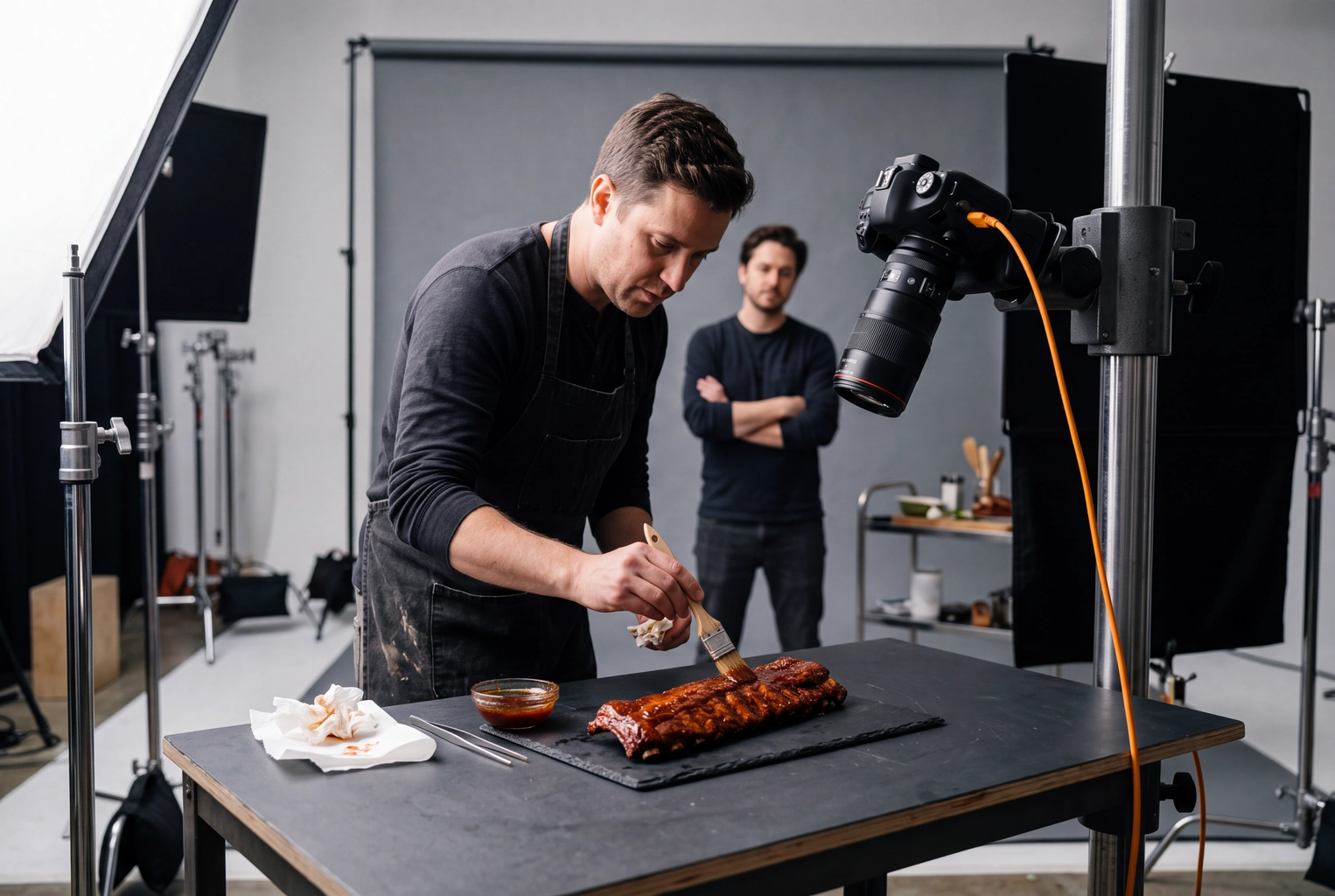 Food stylist glazing barbecue ribs under a tethered full-frame camera with a 100mm macro lens in a commercial studio
The lens to pair is the RF 100mm f/2.8L Macro IS USM at $1,349. It reaches 1.4x magnification and has an SA control ring that changes how soft the out-of-focus areas look, which is useful for plated desserts. The whole kit is $4,148.
Canon's own kitbag story with food photographer Yasmin Albatoul shows a common path. She learned on an entry-level EOS 600D, grew to over 105,000 Instagram followers, and now works on an EOS R5: an entry body first, then the bigger-sensor camera food clients expect once the work is paid.
- Pick it if: you shoot for restaurants, brands or agencies, stills and video.
- Skip it if: your photos only ever appear in delivery apps.
7. Sony a7 V: best for food video and stills together
The Sony a7 V costs $2,898 at B&H against an MSRP of $2,899.99 on Sony's store, and it is the strongest mirrorless hybrid among these cameras for creators who film as much as they photograph. Its 33MP partially stacked sensor runs 30 fps without blackout, and AI-based subject recognition keeps a presenter in focus through a recipe video.
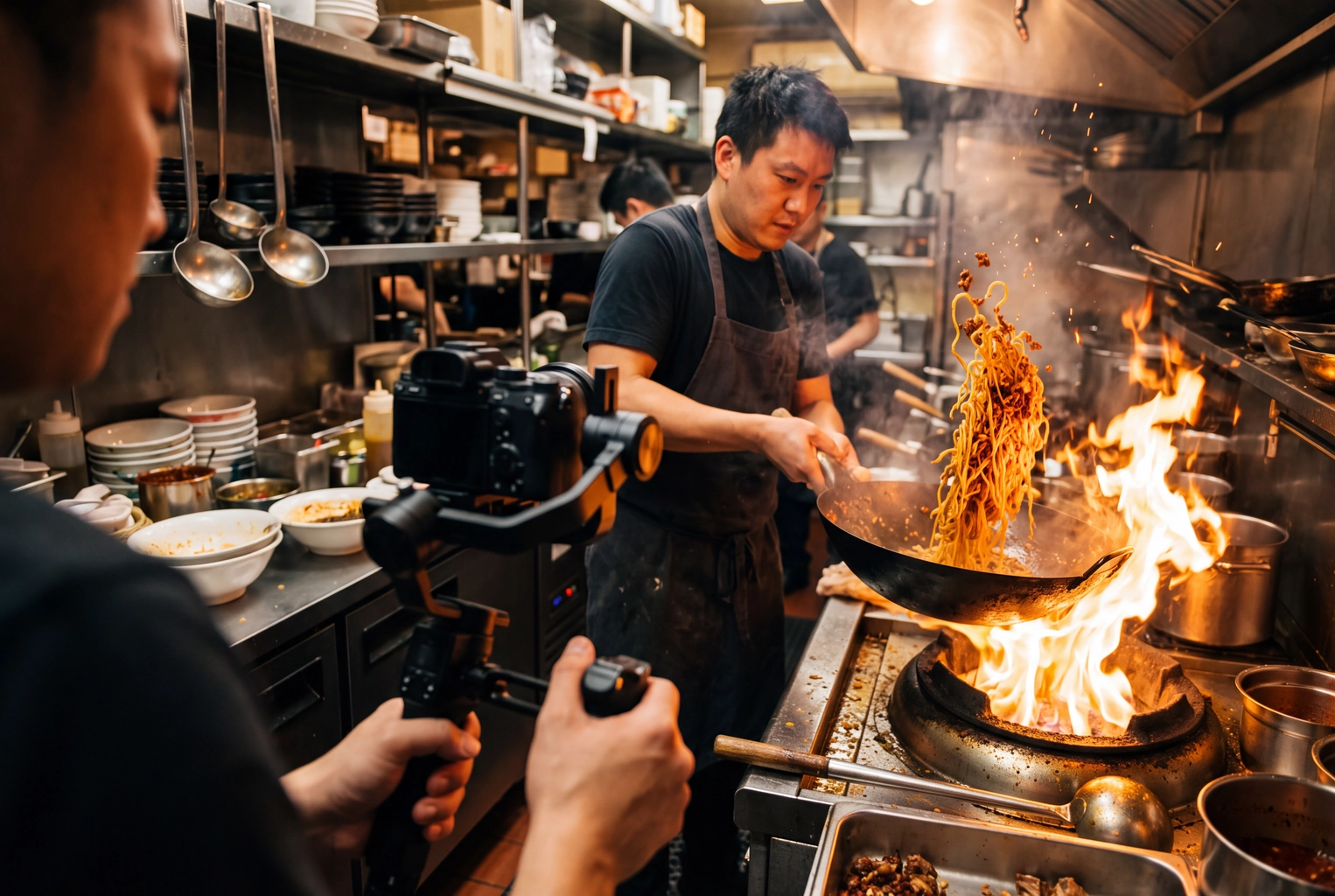 Videographer filming a line cook tossing noodles in a flaming wok with a mirrorless camera on a handheld gimbal
There are limits worth knowing. DPReview's a7 V review notes it lacks the open gate and internal RAW video the Canon R6 III offers, and Sony's own spec page says UHD at 120 fps only works in the APS-C crop mode. For recipe videos and reels, none of that really matters.
Tethering runs through Sony's free Imaging Edge Desktop over USB or Wi-Fi. Pair the body with the FE 90mm f/2.8 Macro G OSS ($1,048), a 1:1 macro with optical stabilization, for a kit near $3,950.
- Pick it if: you run a food channel or shoot recipe video for clients.
- Skip it if: you only shoot stills; the Z5II or R6 III give more for less.
8. Sony a7R VI: best for big prints and heavy crops
The Sony a7R VI is the 35mm-format camera to choose when every pixel matters. Sony announced it on May 13, 2026, with a 66.8MP fully stacked sensor, 30 fps bursts and 8K video. The Verge reported the $4,499.99 price, $600 more than the a7R V cost at launch.
For a menu or cookbook, that resolution gives you two things. First, room to crop one overhead file into a square, a 16:9 delivery banner and a vertical story. Second, enough detail for a menu cover or a window graphic.
Sony lists 759 phase-detection focus points on its a7R VI page, and native ISO runs from 100 to 32,000. Sony also claims up to 16 stops of dynamic range, which helps with glossy sauces next to dark plates.
Two warnings: it uses a new battery that breaks compatibility with older Sony batteries, and 66.8MP RAW images fill cards and laptops fast. With the FE 90mm macro the kit is about $5,550.
- Pick it if: you work on cookbooks, print ads or large menu boards.
- Skip it if: your work lives on Instagram; you will never see the extra pixels.
9. Fujifilm GFX100S II: best medium format for packaging and ads
The Fujifilm GFX100S II launched at $4,999 in 2024, but B&H and Amazon listed it at $5,699 in October 2026. Fujifilm also raised its Japanese price for this body by about 14% on October 1, per CineD. Nobody knows yet whether US prices follow, which is one more reason to rent first.
Its 102MP sensor measures 43.8 × 32.9 mm, about 1.7 times the area of a 35mm-format sensor. That gives the smooth tonal roll-off packaging designers and ad agencies pay for, and files that print at nearly 39 inches wide at 300 ppi. The body weighs 883 g, has in-body stabilization, and tethers to X Acquire and Capture One.
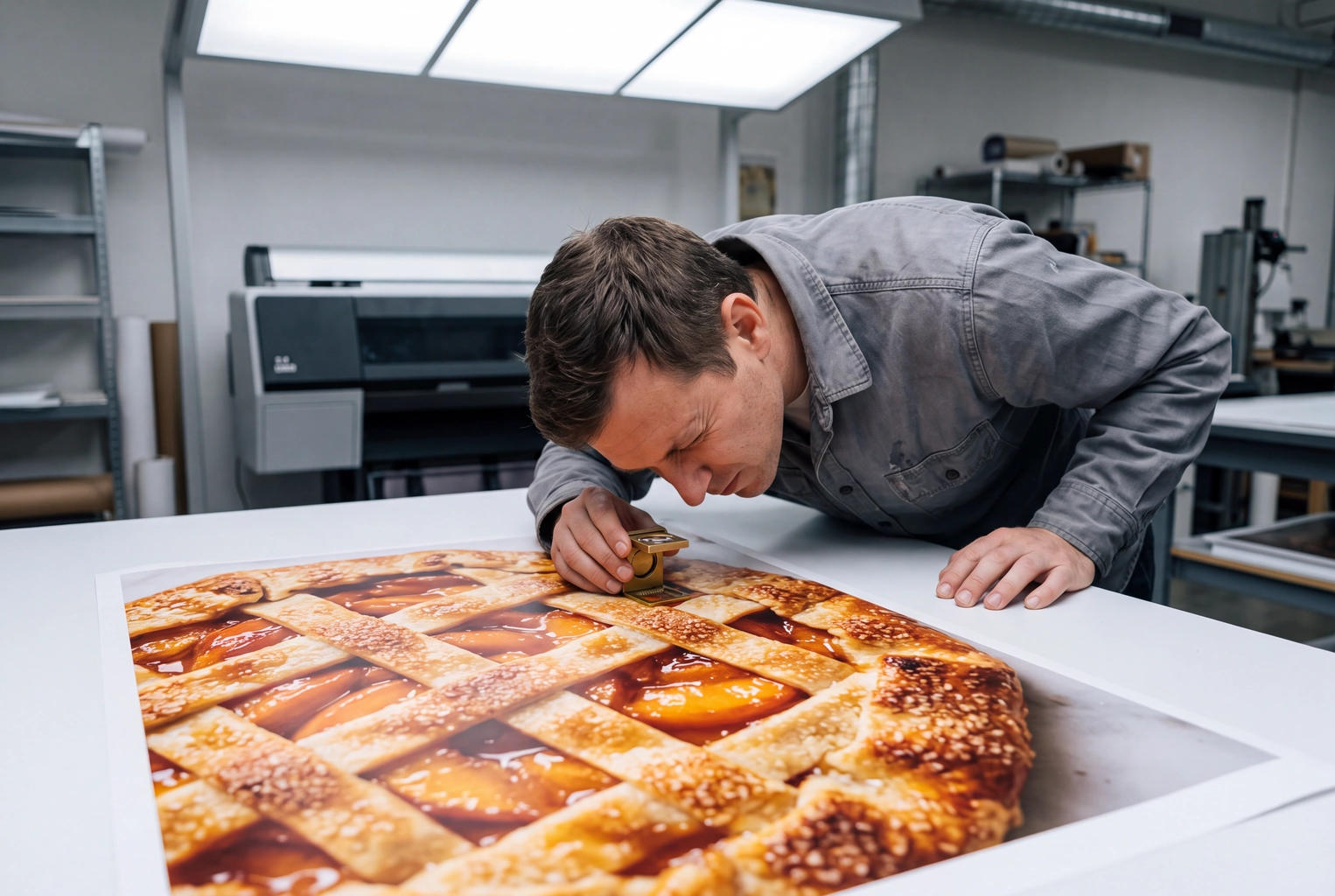 Printmaker inspecting a large print of a peach galette through a brass loupe, the print size where a medium format camera pays off
The classic lens for dishes here is the GF 120mm f/4 Macro, a 95mm equivalent at half life size, which sells new for about $3,000 at today's dealer prices. A kit runs near $8,700.
Photographers who need this camera a few times a year usually rent it. Food photographer Regan Baroni writes about doing the same with a Nikon D850, renting it for special client projects rather than owning one.
- Pick it if: CPG packaging, billboards and national ads are your work.
- Skip it if: you are asking whether you need it. You don't.
What does one usable menu photo cost? Camera kit vs phone vs phone + AI
A usable menu photo costs about $6.75 in cash with a $1,600 camera kit, about $0.42 with a phone you already own, and $0.72 to $1.20 with a phone plus AI editing, in our worked example. Add the owner's time and the gap widens, because a camera session takes the longest per dish.
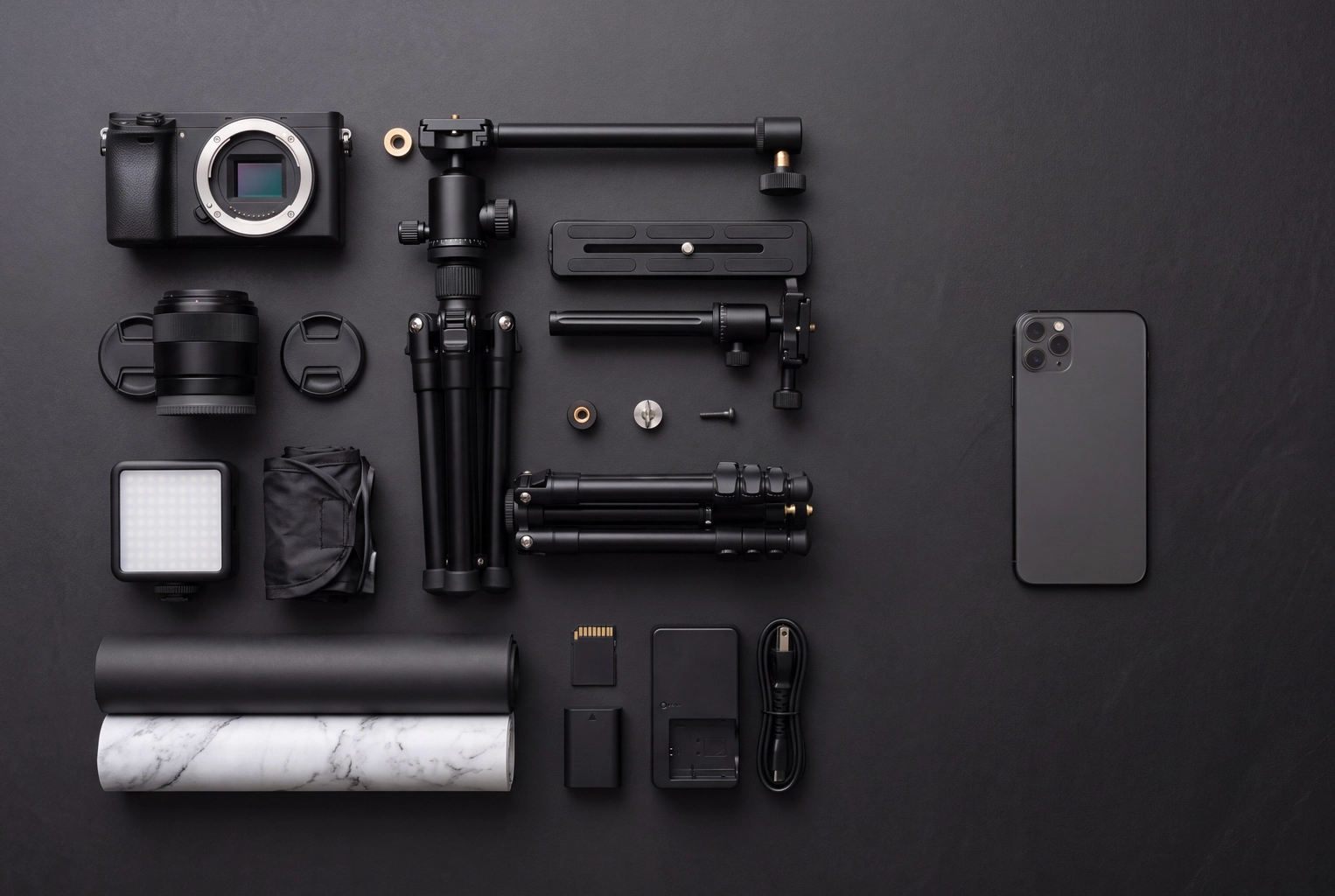 Overhead knolling of a full food photography camera kit beside a single phone, comparing the cost per usable menu photo
Here are the assumptions, so you can swap in your own numbers:
- Menu: 40 dishes, reshot twice a year for seasonal changes, over 3 years = 240 usable images.
- Camera kit: Canon EOS R50 ($729) plus RF 35mm f/1.8 Macro ($539), plus about $350 for a tripod with an overhead arm, one LED panel with a softbox, and two backdrops (one black, one marble). Total about $1,618.
- Phone: a phone you already own, plus about $100 for an overhead phone mount and a small LED panel.
- Phone + AI: the same phone snaps, edited with FoodShot. Plans cost $15 for 25 photos, $45 for 100 or $99 for 250 a month ($9, $27 and $59 a month billed yearly), so one photo costs $0.36 to $0.60. We assume you keep one of every two results.
- Your time: valued at $20 an hour. The minutes per dish are our estimates for an owner working alone, not a measured study.
| Per usable menu photo | Camera kit (R50 + macro + LED) | Recent phone alone | Phone + AI editing |
|---|---|---|---|
| Up-front cash | About $1,618 | About $100 | $0 extra |
| Cash per photo over 240 images | About $6.75 | About $0.42 | $0.72 to $1.20 |
| Hands-on minutes per dish | 20 to 30 (set up, capture, cull, edit RAW) | 10 to 15 (set up, capture, edit) | 3 to 5 (snap, upload, pick) |
| Total with time at $20 an hour | About $13.40 to $16.75 | About $3.75 to $5.40 | About $1.70 to $2.90 |
| Delivery app ready | Yes | Usually, if the setup is good | Yes |
| Prints larger than 7 inches | Yes | Up to the phone's 48MP | No |
The last row is the honest catch. FoodShot works from the photo you upload and returns a 2K file, 2048 pixels on the long side, in about a minute.
That clears DoorDash's 1400 × 800 minimum with room to spare, and our DoorDash photo requirements and Uber Eats photo requirements guides list every spec. At 300 ppi, though, a 2048-pixel file prints only about 6.8 inches wide. A 24MP camera file prints 20 inches wide at the same quality.
For comparison, hiring a photographer runs $500 to $2,500 per session before styling and studio fees, as our food photography cost breakdown shows. DoorDash also offers eligible merchants a free session of up to 20 images, which is worth taking if you qualify.
Photos pay off fast either way. DoorDash says menus with item photos saw up to 44% higher monthly sales.
Do you even need a camera? A 5-question test
Most restaurants do not really need a camera, and most paid food photographers cannot work without one. Answer these five questions honestly and count your yes answers.
- Will any photo be printed larger than about 7 inches? Menu covers, posters, window graphics and packaging need more pixels than a 2K file or a phone's processed image gives cleanly.
- Is someone paying you for the photos? Clients and agencies expect RAW files, consistent rendering across a set, and a backup card in the camera.
- Does someone need to approve images on a big screen while you shoot? Tethering to a laptop is how chefs, art directors and brand managers sign off in real time.
- Do you need a look a phone cannot give? Think a 100mm side angle that compresses a burger stack, true 1:1 macro on a pastry crumb, or shallow depth of field across a whole table.
- Will you film video beyond social clips? Multi-camera recipe shows, Log footage for colour grading and interchangeable lenses are camera territory.
Your score:
- 0 yes answers: keep your phone. For menus and delivery apps, add a phone mount, a window and an AI editor, and spend the camera money on the food.
- 1 or 2 yes answers: get one of the entry cameras (Canon EOS R50, Nikon Z50 II or Fujifilm X-S20), and keep using the phone for daily posts.
- 3 or more yes answers: move up to a bigger sensor (Nikon Z5II, Canon EOS R6 Mark III or Sony a7 V), and rent medium format for the jobs that call for it.
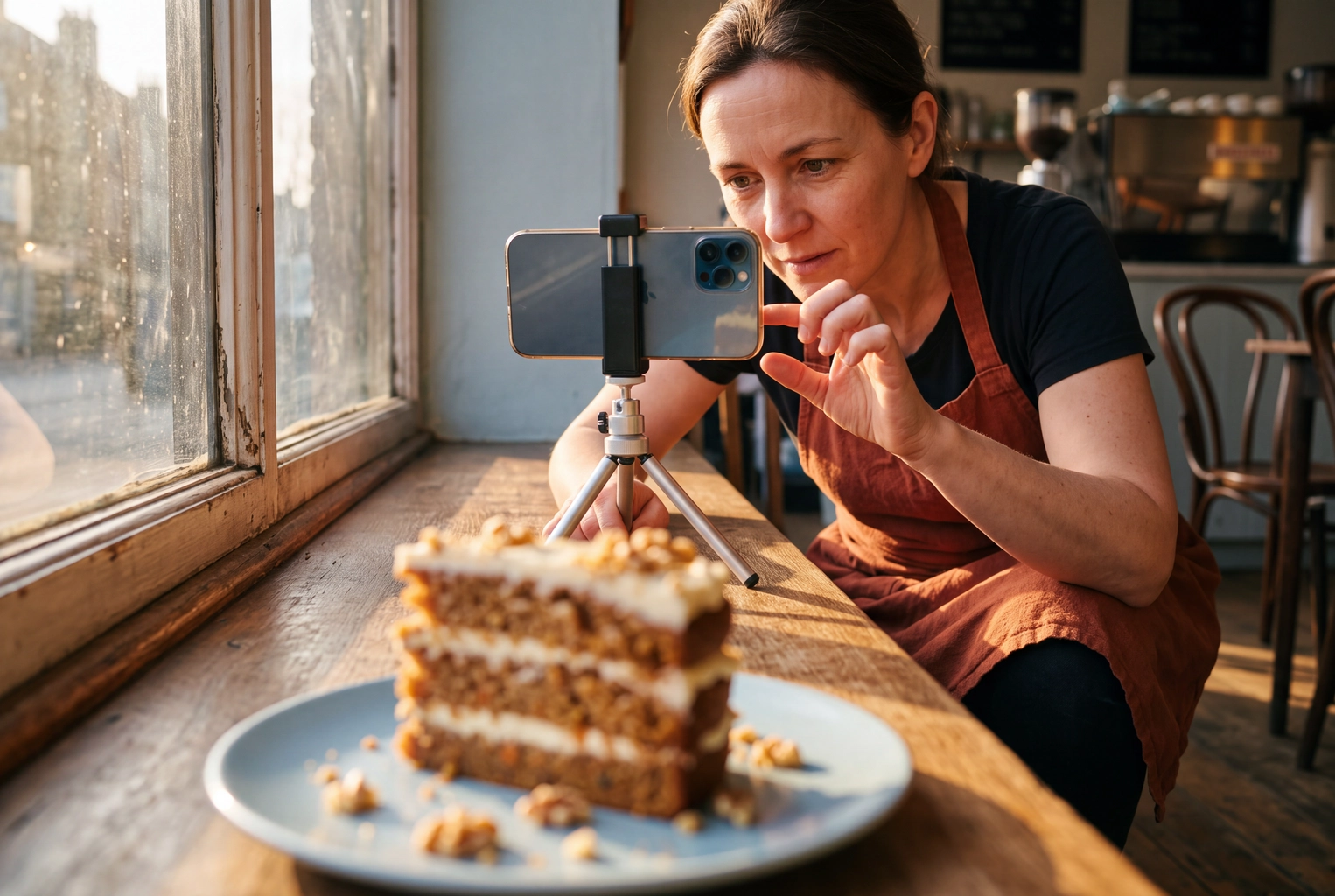 Cafe owner photographing a slice of carrot cake on a window ledge with a phone on a mini tripod instead of a camera
If you scored zero, our hub of the best food photography apps compares the camera and editing apps worth installing first. The step-by-step guide to taking food photos with your phone covers the rest.
How to choose a camera for food photography
The camera body is the least important part of a food photo, after light, lens and styling. Most current cameras take excellent food photos, so the real differences are in workflow. Choose for the features below, in this order, and ignore the spec-sheet race.
Sensor size: APS-C, full frame or medium format
A bigger sensor gives smoother tones and blurrier backgrounds at the same framing, and it costs more. APS-C cameras like the R50, Z50 II and X-S20 are plenty for blog images and Instagram.
Full-frame cameras like the Z5II and R6 Mark III are the standard for paid work. Medium format cameras are for packaging and national ads.
Megapixels: match them to your biggest print
Megapixels only matter for print and cropping. At 300 ppi, a 24MP file prints about 20 inches wide, a 102MP file about 39 inches, and a 2K file about 6.8 inches.
Regan Baroni's rule of thumb is useful here: an 8 × 10 print needs only about 8MP, so most digital cameras are already overqualified for the web.
ISO and low-light performance
ISO is your sensor's sensitivity, and a plate on a tripod rarely needs a high ISO. Most studio work happens at ISO 100 to 400, a range where every camera here is clean.
High-ISO performance only matters if you shoot handheld in dim dining rooms, where a bigger sensor and in-body stabilization help most. Better still, fix the scene: our guides to food photography lighting and natural window light cost far less than a new body.
Focus points, focus peaking and focus bracketing
More focus points let you put focus on a garnish at the edge of the composition instead of the centre, which is why Regan Baroni's buying checklist includes focus points. The Z50 II has 209 focus points and the a7R VI 759, far more than you will use on a plate. Using focus peaking, which highlights the sharp edges in manual focus, is how many food photographers work on a tripod.
Focus bracketing (Canon), focus shift (Nikon) or focus stacking lets you merge several files so a tall burger is sharp from bun to plate. Check the spec sheet before you pay.
Tethering: shooting straight to a laptop
Tethering sends each image to a laptop as you work, so you check focus on a big screen and clients approve on the spot. It is the feature that most separates client cameras from hobby cameras.
Canon, Nikon, Sony and Fujifilm all offer free tethering software, but not for every body, as the X-T30 series shows. Check the support list first.
The screen and overhead images
A vari-angle screen lets you compose an overhead flat lay without standing on a chair. Every interchangeable-lens camera in this guide has one that flips or tilts, and you should not choose a camera without one.
A sturdy tripod for food photography with an overhead arm matters even more than the screen.
Video
Most recipe video lives on Reels and TikTok, where UHD at 30 fps from any camera here is enough. Look for 60 or 120 fps if you want slow-motion pours and cheese pulls, and open gate or RAW video only if you colour grade for clients.
Our guide to food content from photos to video covers the workflow side.
Lenses matter more than the body
Spend on lenses before the body; most food photographers own two or three lenses at most. A 50mm-equivalent macro covers flat lays, 45-degree angles and close detail; a 100mm macro adds compression and working distance for client sets.
Our guide to the best lens for food photography compares the options mount by mount. The food photography equipment guide prices the stands, backdrops and lamps around them.
DSLR or mirrorless for food photography in 2026?
Choose mirrorless if you are buying new. DSLR stands for digital single-lens reflex, and the mirror inside is the part the industry has left behind. Canon, Nikon and Sony have moved new lens development to mirrorless mounts, electronic viewfinders show the exposure before you press the shutter, and tethering software supports mirrorless cameras first.
Used DSLR cameras are still a sensible budget route, with a deep catalog of used lenses behind them. A Reddit thread in r/AskPhotography recommends a used Canon 5D Mark II with a 50mm f/1.8 for exactly this reason: food sits still, so you do not need modern autofocus.
Our page on DSLR food photography covers the settings if you already own one.
Black Friday buying tips for food photographers
Black Friday 2026 follows two years of camera price increases; Fujifilm alone raised prices in 2025 and again in October 2026. A Black Friday discount may only undo a recent increase, so four rules keep you from overpaying.
- Check manufacturer refurbished stores first. Canon's refurbished store has listed the R50 body at $449 and Nikon USA the Z5II at $1,279.95. Refurbished cameras from both come with a manufacturer warranty.
- Get the lens, then the body. A great macro on an entry body beats a kit zoom on a flagship.
- Skip bundle filler. Cheap tripods, filters and off-brand cards inflate a bundle's "value"; get one good card and one good tripod instead.
- Rent before you spend over $2,000. A weekend rental of an R6 Mark III or GFX100S II tells you more than any review.
If you run a restaurant and are still unsure, read the Reddit thread Help deciding between phone or camera for exclusively food photos. It is the same decision this guide is built around.
Frequently Asked Questions
What is the best camera for food photography for beginners?
The Canon EOS R50 ($729) is the best camera for food photography for most beginners, paired with the RF 35mm f/1.8 Macro for $1,268 in total. It is light, has a flip-out screen and records RAW.
The Nikon Z50 II with its 35mm macro is the alternative, and it is the camera food bloggers already invested in Z-mount glass usually start with.
Is an iPhone good enough for food photography?
Yes, for menus, delivery apps, websites and social media. A recent iPhone captures 48MP files, RAW and close-up macro, well above DoorDash's 1400 × 800 minimum.
It falls short for big prints, tethered client sessions and long-lens looks. Our menu photography guide shows what a phone can do for a full menu.
Do I need a full-frame camera for food photography?
Only for paid client work, print or a shallow-focus look on larger scenes. APS-C cameras handle blogs and Instagram well, and a dish on a tripod at ISO 100 removes most of the low-light advantage of a bigger sensor.
What lens should I buy with my first food photography camera?
Macro lenses that give a roughly 50mm view on your sensor are the right first purchase: the RF 35mm f/1.8 Macro on Canon APS-C, the Z DX MC 35mm f/1.7 on Nikon APS-C, or the XF 30mm f/2.8 Macro on Fujifilm.
On a 35mm-format body, a 50mm macro is the starting point and a 100mm macro is the second purchase.
Is a DSLR still worth buying for food photography?
Used, yes, if money is tight. A used digital SLR with a 50mm f/1.8 still makes excellent food photos, because food does not move. New, no: lens and software development has moved to mirrorless cameras.
How many megapixels do I need for menu photos?
Very few. Delivery apps ask for around 1400 × 800 pixels, about 1.1MP. A printed menu photo 4 inches wide needs about 1,200 pixels at 300 ppi. Megapixels start to matter only for large prints and heavy crops.
Can AI editing replace a camera for restaurant photos?
For menu and delivery photos, mostly yes. A phone photo edited with an AI food photo editor such as FoodShot gives a styled, delivery-ready 2K image for $0.72 to $1.20 in cash in our worked example, and every FoodShot plan includes a commercial license.
A camera still wins for print, packaging, tethered client sessions and any job where a client pays for the photos. See FoodShot pricing for plan details, or our comparison of AI vs hiring a food photographer.
The bottom line
Choose the camera by the job, not the spec sheet. Phones win the volume work; cameras win print and clients. If your photos live on Uber Eats, DoorDash and Instagram, a recent phone and an AI editor will give you the most usable images per dollar and per hour.
If you blog, the Canon EOS R50 or Nikon Z50 II with a macro is the best camera for food photography under $1,500. If clients pay you, or the photo goes to print, get the Canon EOS R6 Mark III or Nikon Z5II and rent medium format when a job really demands it.