How to Open a Bakery in 12 Steps, $1,500 to $300K
 Ali Tanis18 min read
Here's how to open a bakery without spending storefront money on a home-baking idea: pick one of three formats (home, wholesale or storefront), prove strangers will pay, then build only what that format needs. A cottage bakery can start for under $6,000 in a few weeks. A storefront usually takes six to twelve months and $80,000 or more.
Most guides cover one of those paths. This one puts all three side by side, then walks through the 12 steps in the order that protects your cash. Coming from restaurants? Our guide on how to open a restaurant covers the full-service version, with far bigger budgets.
Quick Summary: Opening a bakery takes 12 steps, from choosing a format to photographing your products before launch. A home bakery under your state's cottage food law costs roughly $1,500–$6,000 and takes 2–8 weeks; a wholesale bakery working from a shared kitchen runs $12,000–$60,000 and 10–20 weeks; a storefront runs $80,000–$300,000+ and 26–52 weeks.
How to Open a Bakery: Home, Wholesale or Storefront Compared
A home bakery is the cheapest, fastest route. Wholesale swaps a storefront for rented production time, delivery and invoices. A storefront costs the most because you pay for a buildout and a payroll before the first sale. These are our planning ranges, built from the line items under the table.
| Home / cottage bakery | Wholesale-only bakery | Storefront bakery | |
|---|---|---|---|
| Where you bake | Your home kitchen | Shared or commissary kitchen | Your own leased space |
| One-time cost | $1,500–$6,000 | $12,000–$60,000 | $80,000–$300,000+ |
| Monthly fixed cost (before ingredients) | $100–$500 | $2,000–$5,000 | $12,000–$25,000 |
| Weeks to launch | 2–8 | 10–20 | 26–52 |
| Revenue ceiling | Your state's cap | Production hours and delivery | Rent, seats and foot traffic |
| Biggest risk | Outgrowing the cap | One big account paying late | Buildout overruns |
What each number includes:
- Home: registration ($0 in Florida, and in Texas for most baked goods), a food handler course (about $15), better pans, a scale and a stand mixer ($500–$2,500), starter packaging, first-year liability insurance from $299, and opening ingredients.
- Wholesale: licences and label design, a refurbished 60-quart mixer if the space lacks one ($3,000–$6,000), racks and carts, higher insurance limits, and cash to cover 30-day invoices. The monthly figure is mostly rented time: 80 hours at $20–$45 an hour is $1,600–$3,600.
- Storefront: buildout, equipment, permits, deposits and three to six months of operating cash, itemised in the sample budget near the end.
The weeks column follows the permit chain. A Florida home baker can start within days of finishing recipes and labels; a California baker waits on county registration. A storefront waits on plan review, construction and final inspection, which is why its range matches the 6–12 months in our guide on how to start a coffee shop.
Plenty of bakeries pass through all three stages: home baking first, then a shared space for café accounts, then a storefront once the numbers are proven.
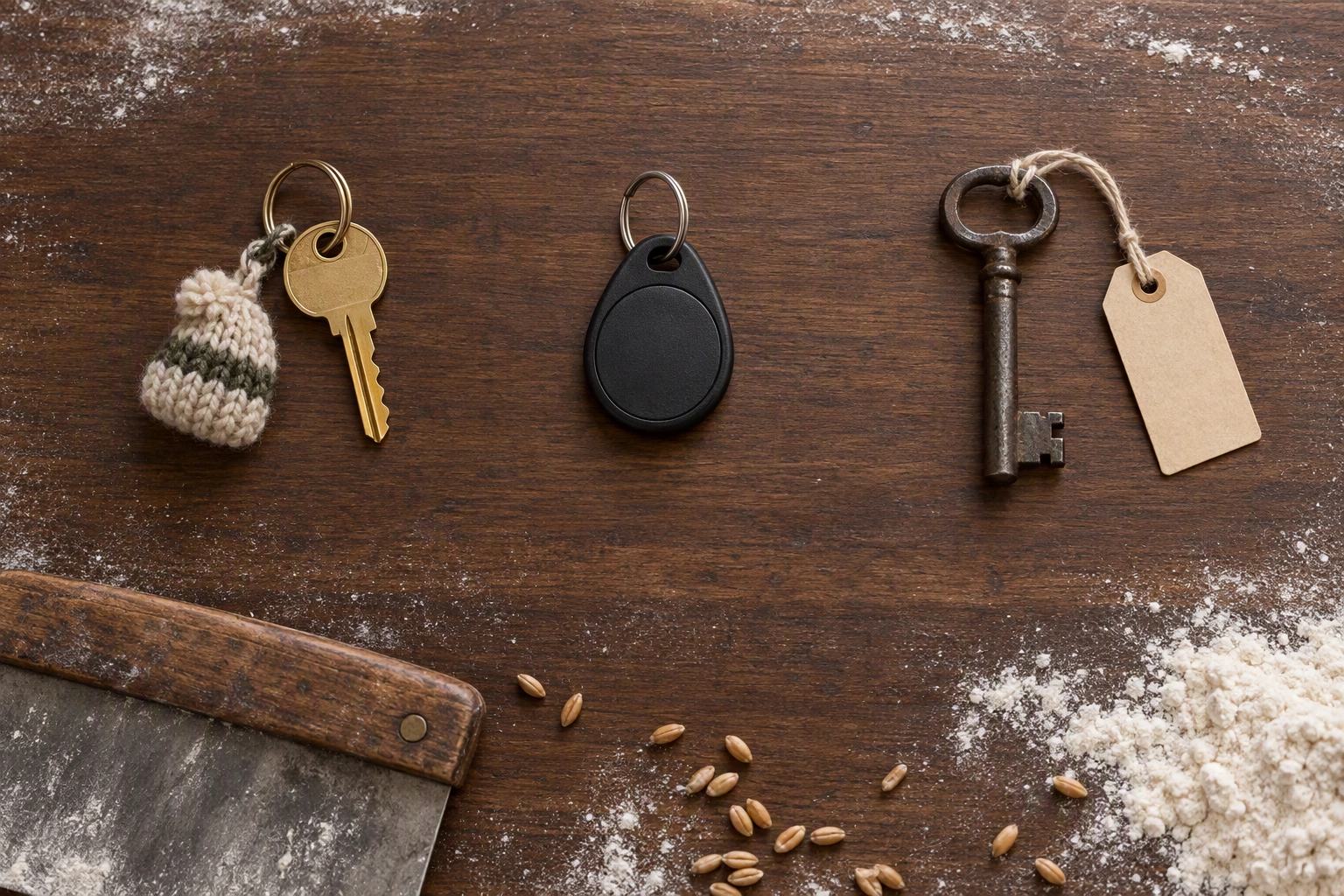 Three keys on a floured bakery worktable: house key, shared kitchen fob and storefront key, the three ways to open a bakery
Step 1: Choose Your Bakery Format
Your format decides your equipment, permits, hours and budget, so choose it before you fall for a storefront. Consider how much money you can risk and how fast you need income, not the bakery you picture in five years.
- Home or cottage bakery. You bake at home under your state's cottage law and trade direct: porch pickup, weekend stalls, pre-order drops. Low cost, low ceiling.
- Wholesale-only bakery. You bake in a licensed shared space and supply cafes, grocers and restaurants. No retail area, but volume targets and delivery runs.
- Storefront bakery. A counter-service bakery or a bakery cafe with coffee and seating. Highest cost, highest ceiling, and the alarm goes off before 4 a.m.
The type of product matters as much as the format. A sourdough microbakery, a custom cake studio and a croissant counter need different ovens, dough handling and baking schedules. Pick one thing to be known for.
Step 2: Test Your Baked Goods on Paying Customers
Praise from friends is not demand. Before you spend real money, offer a fixed batch to strangers at a set price, then track what runs out, what comes home and who orders twice. Four to eight weeks of real orders tells you more than any survey.
One bakery owner in a Reddit r/smallbusiness thread put it bluntly: "Everyone's friends and family will always tell them they can sell their baked goods and open a bakery." Cheap ways to find out:
- Pre-order drops. Post a weekly menu, cap it at 20 or 30 items, and close orders when they're gone.
- Farmers market stall. Watch which items people point at, not just what they buy.
- Pop-ups. A Saturday table inside a café tests retail without a lease.
If the cardamom buns are gone by 10 a.m. and the brownies keep coming home, that's your first menu talking. For trade accounts, bring samples and a price sheet to five local cafes. Two "start next Tuesday" answers beat fifty likes.
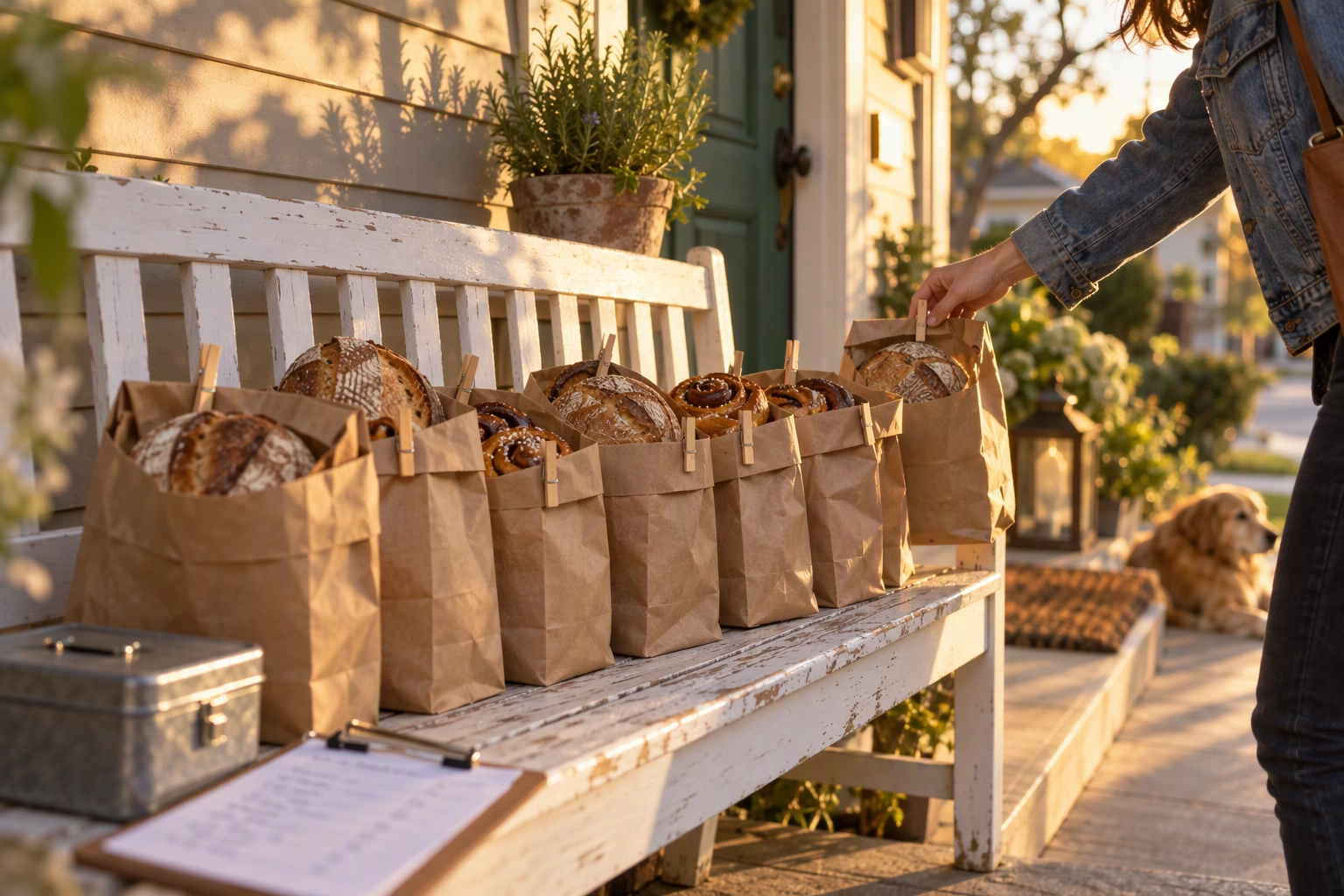 Customer collecting a pre-order sourdough bag from a home baker's porch pickup shelf, a cheap test before opening a bakery
Step 3: Write a Bakery Business Plan
A bakery business plan turns your test results into numbers a lender, landlord or partner can check. Keep it short: concept, customers, menu, pricing, operations, marketing and a 12- to 36-month cash flow.
The U.S. Small Business Administration's business plan guide lays out the format. For a bakery business, lenders read these parts hardest:
- Production math. How many units a baking shift can turn out, and the labour hours that takes.
- Revenue and costs. Daily units times average ticket by weekday, against ingredients, packaging, labour, rent, utilities, insurance, loans and marketing.
- Break-even. The monthly revenue where you stop losing money.
Labour is the line most first plans miss, especially your own. The median baker earned $37,160 a year in May 2025, according to the Bureau of Labor Statistics. If the plan can't pay you something close to that, it isn't finished. Our food truck business plan has a full financial section you can adapt.
Step 4: Check Your State's Cottage Food Law
Cottage food laws let you bake lower-risk products at home and offer them for sale, but each state writes its own rules on what, where and how much. Read your state's official page before you take a single order, and never rely on a summary, including this one.
Four states, from their official sources:
| State | What the official source says |
|---|---|
| California (CDPH) | Class A (direct only) is capped at $88,878 and Class B (direct and indirect) at $177,756 in gross annual sales for 2026; your county registers or permits you |
| Texas (DSHS) | SB 541 raised the annual gross income threshold to $150,000; operators offering time and temperature control for safety (TCS) foods must register with DSHS |
| Florida (FDACS) | Cottage operators can supply consumers directly without a food permit from FDACS; gross sales must not exceed $250,000 a year |
| New York (Ag and Markets) | A Home Processor registration covers certain baked goods; there is currently no fee and no expiration date |
If your state isn't listed, search its agriculture or health department website for "cottage." Planning cheesecakes or cream pies? Check that your state allows them at home; Texas does, with DSHS registration.
Step 5: Register the Business and Get Insured
Register a name, pick a structure and get an EIN before you take money. Most small bakeries start as a sole proprietorship or a single-member LLC, which separates personal assets from business debts.
- EIN. Apply free with the IRS. Banks, payroll and most café accounts ask for it.
- Insurance. Specialty liability starts at $299 a year; a bakery business owner's policy averaged $2,469 a year in published figures. Our home bakery insurance breakdown shows which tier you need.
Trade buyers usually want higher limits and to be named as additional insured on your policy.
Step 6: Price Every Product Before You Scale
Price each item from its real cost, not from what the bakery down the street charges. Add up ingredients and packaging per unit, divide by your target cost percentage, then sanity-check against local prices. Many bakers aim for ingredients at roughly 25–35% of the price.
An example:
- A sourdough loaf uses $1.40 of flour, salt and starter, plus $0.50 for a bag and label: $1.90 per loaf.
- At a 30% target: $1.90 ÷ 0.30 = $6.33. Round up to $6.50.
- Now the time check. If one baking day yields 40 loaves in 8 hours, that's $260 minus $76 in ingredients and packaging: $184, or $23 an hour before rent, insurance and stall fees.
That third line is where many home bakeries quietly fail. Run it for every item with our free food cost calculator, then compare methods in 7 menu pricing formulas. Trade buyers need their own margin, so create a separate wholesale price list that still covers ingredients, packaging, delivery and your hours.
Step 7: Fund the Bakery
Match the money to the format. Home bakeries are usually self-funded from savings or pre-orders. Larger formats stack several sources: savings, an SBA-backed loan or microloan, equipment financing and community pre-sales, with three to six months of operating costs held in reserve.
- SBA microloan. Up to $50,000 through nonprofit intermediaries; the average is about $13,000, according to the SBA. A good fit for used baking equipment.
- SBA 7(a) or bank loan. The usual route for a full storefront buildout.
- Equipment financing. The oven or mixer serves as collateral, preserving cash.
- Community money. Another owner in the same Reddit thread ran a Kickstarter that raised $4,000 from the community for an industrial mixer. Prepaid cards help too; see our gift card promotion ideas.
Step 8: Find Your Kitchen or Storefront Location
Home bakers already have a baking space. Wholesale bakers rent time in a licensed shared facility, typically $20–$45 an hour. Storefront bakers need morning foot traffic, the right zoning, and plumbing and power for commercial ovens; a former bakery or cafe can cut the buildout bill dramatically.
Renting a shared kitchen
Dedicated space runs $600–$2,500 a month and shared time $20–$45 an hour, per the Shared Kitchen Locator directory. Monthly packages can beat the hourly rate: one Colorado facility comes to $15 an hour on a four-shift plan. Before you sign, ask:
- Which oven (deck or convection), what mixer size, and how much dry, cold and freezer storage area?
- Are overnight slots available? Café deliveries usually land before 7 a.m.
- What insurance limits do they require, and will they sign your licence paperwork?
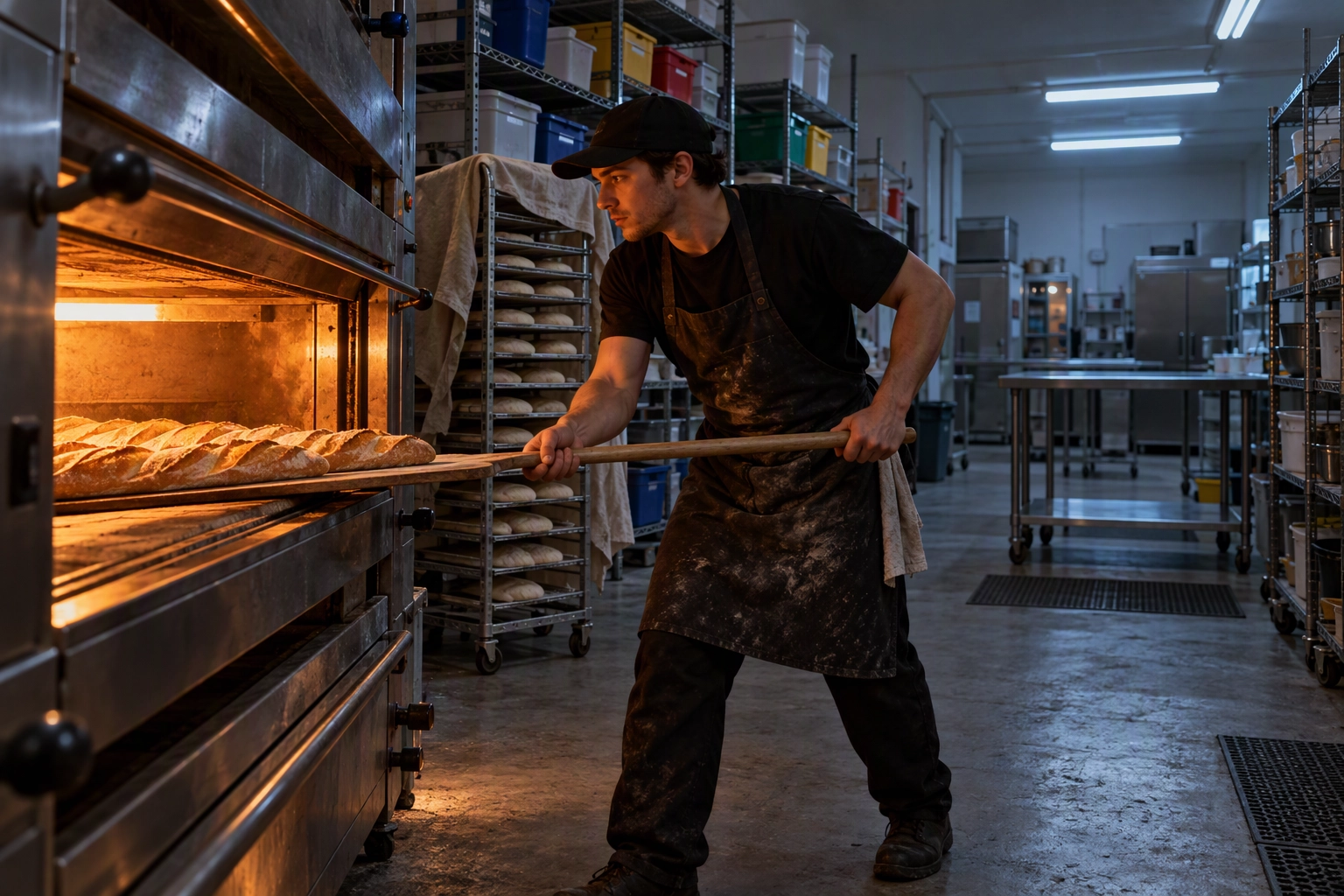 Wholesale baker loading baguettes into a rented deck oven at 3 a.m. in a shared commissary kitchen with labelled storage
Choosing a storefront location
Call the city planning department before you sign anything and confirm a bakery is allowed in that area. Check the electrical panel (commercial deck ovens often need three-phase power), drains, sinks and whether local code requires a hood. Count passers-by between 6 and 10 a.m.; lunch traffic matters less.
In any location, rent is the number that breaks most models. A 1,200 sq ft unit at $30 per square foot a year costs $3,000 a month. Keep rent near the common 10–15% of revenue rule of thumb and that unit needs $20,000–$30,000 a month, or roughly $670–$1,000 every day.
Step 9: Get Licenses, Permits and Inspections
The list depends on your bakery type and city, but the order is similar everywhere: business licence, health department or state approval, then inspections. Storefronts add plan review, building permits and a certificate of occupancy. Wholesale bakeries add a state manufacturer licence and, usually, FDA registration.
| Permit or step | Home | Wholesale | Storefront |
|---|---|---|---|
| Cottage registration (where required) | Yes | No | No |
| Health department or state licence | No | Manufacturer | Retail |
| Plan review before construction | No | Held by the facility | Yes |
| Safety certification | Handler course | Manager certificate | Manager certificate |
| FDA facility registration | No | Yes, if mostly trade accounts | No, if mostly direct |
A bakery counts as a retail establishment, and skips facility registration, when its direct-to-consumer revenue exceeds what it earns from all other buyers (21 CFR 1.227). There's no fee, and registrations renew every October to December of even-numbered years, per the FDA.
Packaged goods raise the nutrition label question. The FDA's small business nutrition labeling exemption covers retailers with no more than $500,000 in annual gross sales and some low-volume products, which need a yearly notice.
The ServSafe Manager online course with a proctored exam costs about $179 through state restaurant associations.
Step 10: Buy Bakery Equipment, New or Used
Buy for the menu you tested, not the one you dream about. A small storefront's core list (oven, 20-quart mixer, proofer, pastry case and refrigeration) runs roughly $25,000–$50,000 new. Consider used equipment from a dealer with service records; it can cut that by 40–60%.
| Equipment type | Storefront choice | Typical new price |
|---|---|---|
| Oven | Deck for bread, convection for pastry | Convection $2,000–$8,000; deck from about $5,000 |
| Mixer | 20-quart to start, 60-quart for bread dough | 20-quart from about $2,000; 60- to 80-quart $5,000–$10,000 |
| Point of sale | Terminal plus software | Hardware $500–$2,500 |
Price ranges come from NuMarket's bakery cost guide and published POS pricing. Home baking gets by with a stand mixer and your own oven; trade bakeries often use whatever the shared facility includes.
One retired baker on Baking Forums warns that salespeople watch for new businesses, and "you'll end up with a basement full of stuff you can't make money with." He once spent over $800 on printed bags and still had two cases left 20 years later.
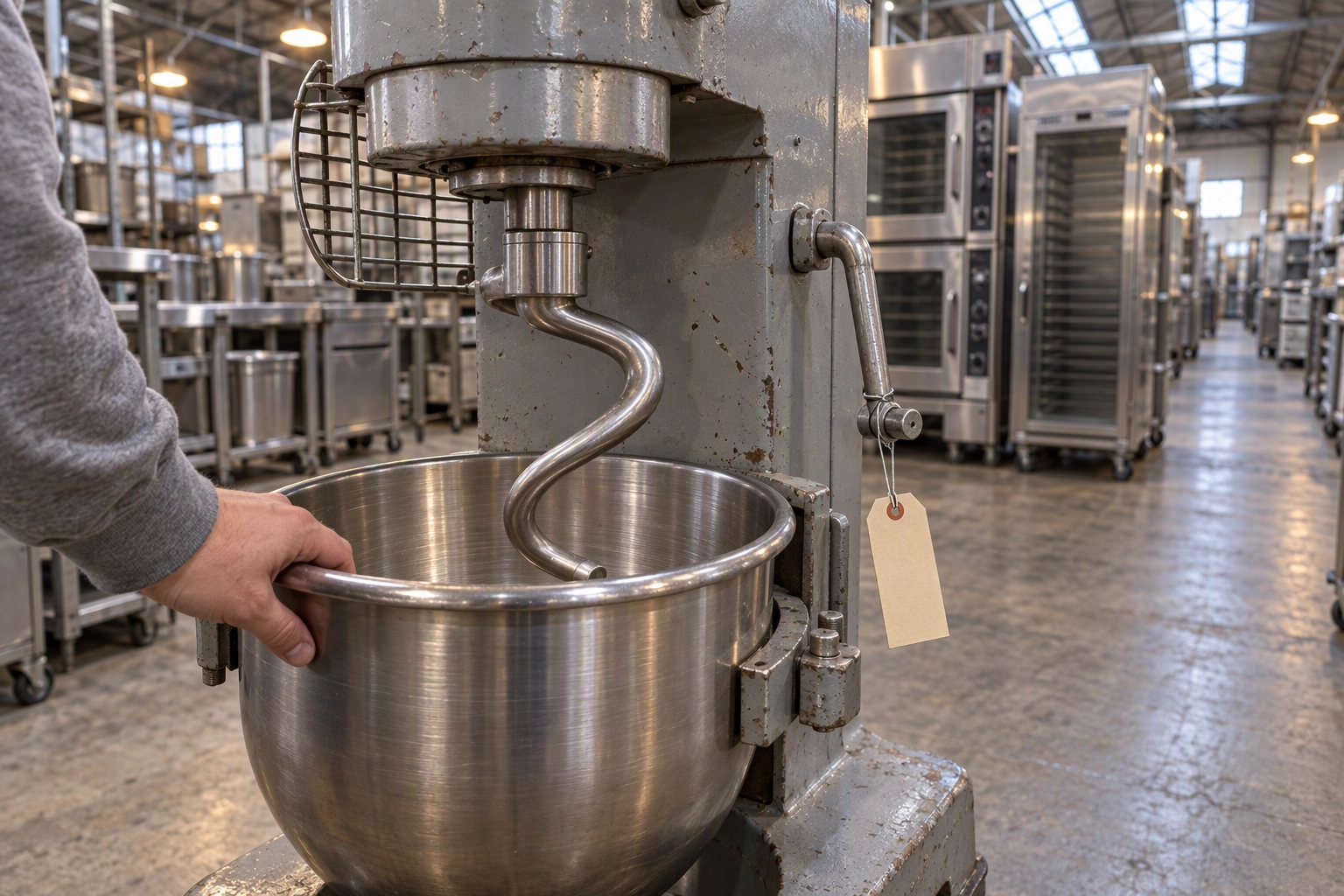 Refurbished 60-quart planetary mixer with dough hook at a used bakery equipment dealer, a cheaper way to equip a bakery
Step 11: Build the Menu, Packaging and Labels
Start with a smaller opening menu than you think. Eight to fifteen items you can make perfectly every day beat forty you make sometimes. Then create packaging and labels that meet your state's rules, declare allergens clearly, and look good on a shelf and in a photo.
- Menu. Build around your best performers from Step 2, plus one rotating special. Our cafe menu ideas with food cost per item list includes many pastry staples, and our tips on menu descriptions help the case cards do their job.
- Allergens. The FDA lists nine major food allergens: milk, eggs, fish, crustacean shellfish, tree nuts, peanuts, wheat, soybeans and sesame. Most bakes include at least three.
- Labels. Cottage bakers should check their state page for required statements. Trade labels typically include the product name, ingredients in order of weight, net quantity, and your name and address.
- Packaging. Kraft boxes and a rubber stamp beat printed bags at the start.
Planning a counter? These menu board ideas run from $15 chalkboards to digital screens.
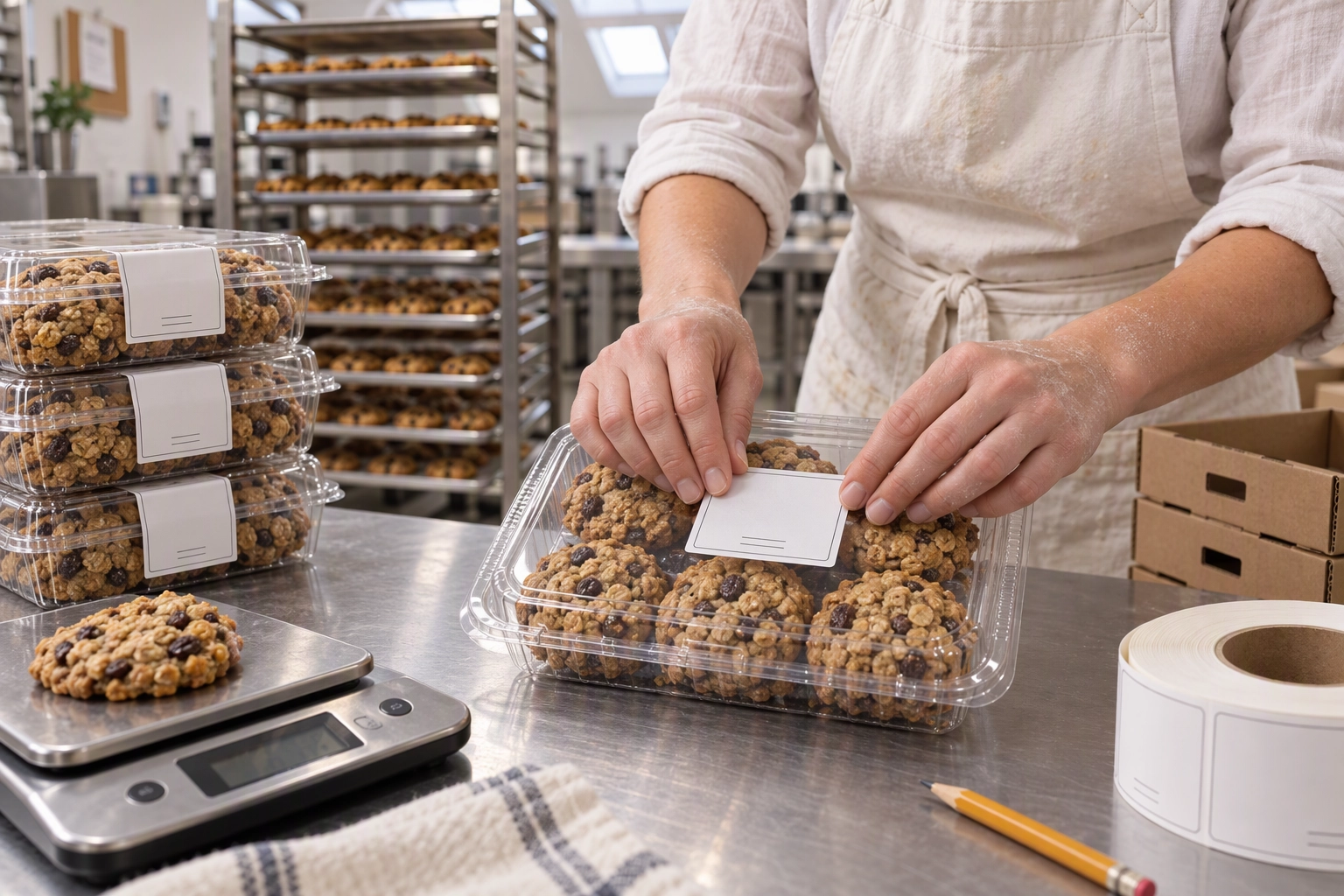 Baker pressing an ingredient and allergen label onto a clear box of oatmeal cookies before the first wholesale delivery
Step 12: Photograph Your Products and Launch
Customers meet your bakery online before they walk in, so product photos are a launch task, not a someday task. Have 15–20 clean shots ready two weeks before opening day for your website, Instagram, Google Business Profile, delivery listings and, for café accounts, a line sheet.
What to shoot before opening day
- Signature items and texture. Your top five, plus close-ups of crumb, pastry lamination and buttercream. Texture is what moves baked goods.
- The lineup. Your full menu in one frame, for pre-order posts.
- Packaging and the space. The box customers carry out, and your case or stall.
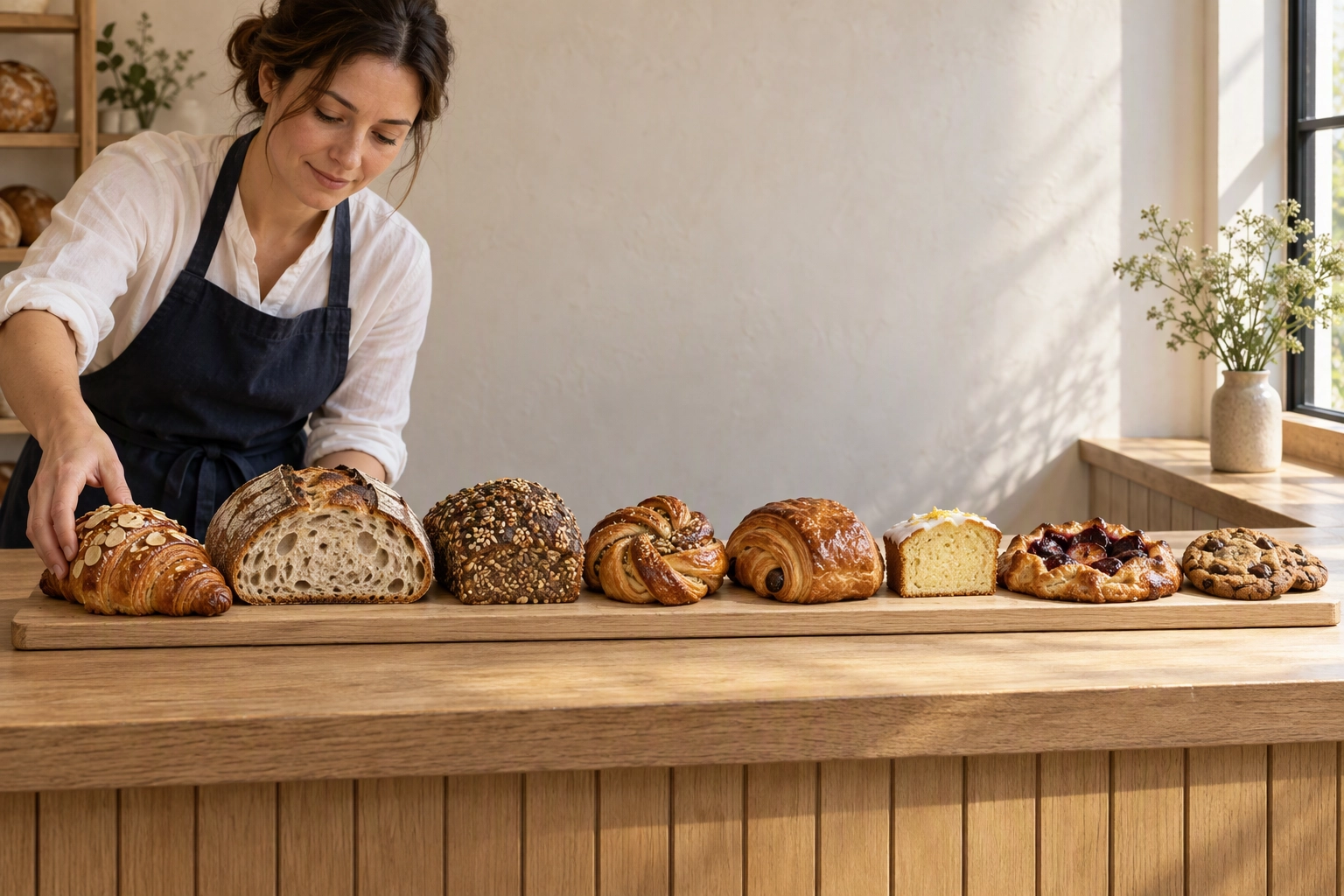 Baker arranging the full opening menu lineup on a long oak board for launch product photos before opening a bakery
Google recommends Business Profile photos as JPG or PNG files between 10 KB and 5 MB at 720 × 720 px, per Google Business Profile Help. Our Google Business Profile photo specs and Instagram food photography guides cover the rest. On delivery apps? Read our Uber Eats and DoorDash menu photo rules.
You have three ways to create the shots. Shoot them yourself by a window with our bakery photoshoot ideas. Hire a photographer at the rates in our food photography cost breakdown. Or restyle your own phone photos with FoodShot, our AI tool, which turns one upload into a studio-style shot in about 2 minutes at 2K resolution; the Starter plan is $15 for 25 photos. See bakery product photography for storefronts and photos for home bakers for cottage sellers.
Soft launch, then the big day
Run a soft launch for a week or two with neighbours and your pre-order list. Fix the 7 a.m. rush and the baking schedule while the stakes are low, then hold the grand opening a few weeks later. Our coffee shop marketing ideas translate almost one for one to bakery marketing at launch.
How Much Does It Cost to Open a Bakery?
Opening a bakery costs from about $1,500 for a home bakery to $300,000 or more for a storefront with a full buildout. The biggest swing is the space itself: a former cafe can need $20,000 of work, while a raw shell can need $50,000–$150,000 before you buy an oven.
A sample budget for a 1,200 sq ft counter-service storefront, with buildout, permit and reserve ranges from NuMarket's cost breakdown:
| Line item | Low | High |
|---|---|---|
| Buildout | $20,000 | $150,000 |
| Equipment | $25,000 | $50,000 |
| Permits and licences | $2,000 | $8,000 |
| Lease deposit and first month ($3,000 rent) | $6,000 | $9,000 |
| POS, furniture, display, smallwares | $5,000 | $20,000 |
| Opening inventory and packaging | $3,000 | $8,000 |
| Operating reserve (3–6 months) | $20,000 | $60,000 |
| Total | $81,000 | $305,000 |
Indeed cites an SBDCNet survey putting bakery startup costs lower, at $10,000–$150,000; the low end assumes a home or minimal setup, not a buildout. Monthly, that storefront also carries rent, payroll, utilities (often $1,000–$2,000 for a bakery, per Toast), insurance and loan payments.
Frequently Asked Questions
How much does it cost to open a bakery?
About $1,500–$6,000 for a home bakery, $12,000–$60,000 for a wholesale bakery in a shared facility, and $80,000–$300,000+ for a storefront.
Can I start a bakery business from home?
In many states, yes, under a cottage food law, but rules differ on products, caps and registration. Florida allows direct sales up to $250,000 a year without a state permit; California caps Class A at $88,878 in 2026.
How long does it take to start a bakery?
Two to eight weeks for a home bakery, 10–20 weeks for wholesale from a shared facility, and six to twelve months for a storefront, where plan review, construction and inspections set the pace.
Do I need a license to sell baked goods?
Usually some registration or licence. Cottage rules range from no state permit (Florida, direct sales) to county registration (California); storefront and trade bakeries need health department or state licences.
Is a bakery business profitable?
It can be, but margins are thin and the work is labour-heavy. Price every item from its ingredient cost, keep the menu short, and track what comes home each week. For many bakeries, custom orders and steady café accounts smooth out slow weekdays.
Do I need culinary school to start a bakery?
No. Culinary or baking school helps with technique, but production experience matters more. A few months in a busy bakery teaches volume, timing and waste control faster than any course.