
AI for Restaurant Marketing: 6 Jobs, 3 Worth Paying For
 Ali Tanis12 min read
Twenty-six percent of US restaurant operators say they use AI in some form. Marketing is the biggest thing they use it for — 19% of all operators, more than forecasting, scheduling or kitchen inventory. AI for restaurant marketing is not hypothetical any more. It is the most common way restaurants touch AI at all, and most operators doing it run one location with no marketing hire.
Quick Summary: AI for restaurant marketing earns its keep on three jobs — photography, review replies and email segmentation — and close to nothing on the other three. One location can cover all three for $15–$35 a month. Suites promising prediction and full automation can wait until you run four restaurants.
This is the AI-specific companion to our 15 best restaurant marketing tools roundup. That piece covers the whole stack; this one takes the six marketing jobs restaurants actually have and asks of each what AI does well, what it does badly, and what it costs.
Where restaurants actually use AI for restaurant marketing in 2026
The National Restaurant Association's 2026 State of the Restaurant Industry report puts adoption at 26% of operators and names marketing as the number one area of use, at 19%.
The second number matters more. In a mid-year 2026 survey of 420-plus operators covering roughly 10,000 sites, 38% said they were not using AI and had no plans to. Adoption across the industry is narrow, and narrow adoption means the advantage is unclaimed.
So the question is not whether to try AI for restaurant marketing. It is which of your six marketing jobs it is good at.
The six marketing jobs, and what AI is worth on each
| Marketing job | AI is good at | Monthly pricing | Verdict |
|---|---|---|---|
| Content production | Captions, photo transformation | $0–$35 | Buy |
| Email and SMS | Segmentation, subject variants | $0–$30 | Buy |
| Review response | Reply drafts in seconds | $0–$200 | Free version only |
| Ad creative testing | Headline and background variants | Free, media extra | Never pay extra |
| Local SEO and listings | Rewriting one description per platform | $0–$100 | Free tier only |
| Loyalty and win-back | Ranking lapsed customers | $45–$185 | Skip this year |
Three of the six are worth money. The rest are worth an hour of attention — the part vendor pages selling AI for restaurant marketing leave out.
Job 1: Content production — captions, social media posts and photography
Caption writing is where AI is genuinely strong. Give it three voice notes about tomorrow's specials and it returns a month of social media drafts in ten minutes. It helps most with shape: hook, detail, call to action, hashtag block.
What it does badly is invent specifics. It does not know the pork shoulder rested fourteen hours or the starter is nine years old. Feed it those facts and it writes well. Withhold them and you get the flat, robotic content operators complain about on every forum.
Photography is the harder half, and the half most guides skip. Google's own Business Profile photo guidance is blunt about how much images matter, and profiles with strong photos are widely reported to draw roughly 42% more direction requests and 35% more clicks to the website. Text AI cannot help here. It has never seen your plate.
Pricing: $0–$20 a month for writing. A professional charges $50–$200 per retouched image and a 30-item menu shoot runs $1,500–$3,500 — see what food photography costs and restaurant photography pricing.
Before and after: one plate, two photos
Take a lamb ragu shot on a phone at 7pm under warm ceiling light. The frame is orange, the pasta looks brown, the table edge cuts the bowl awkwardly.
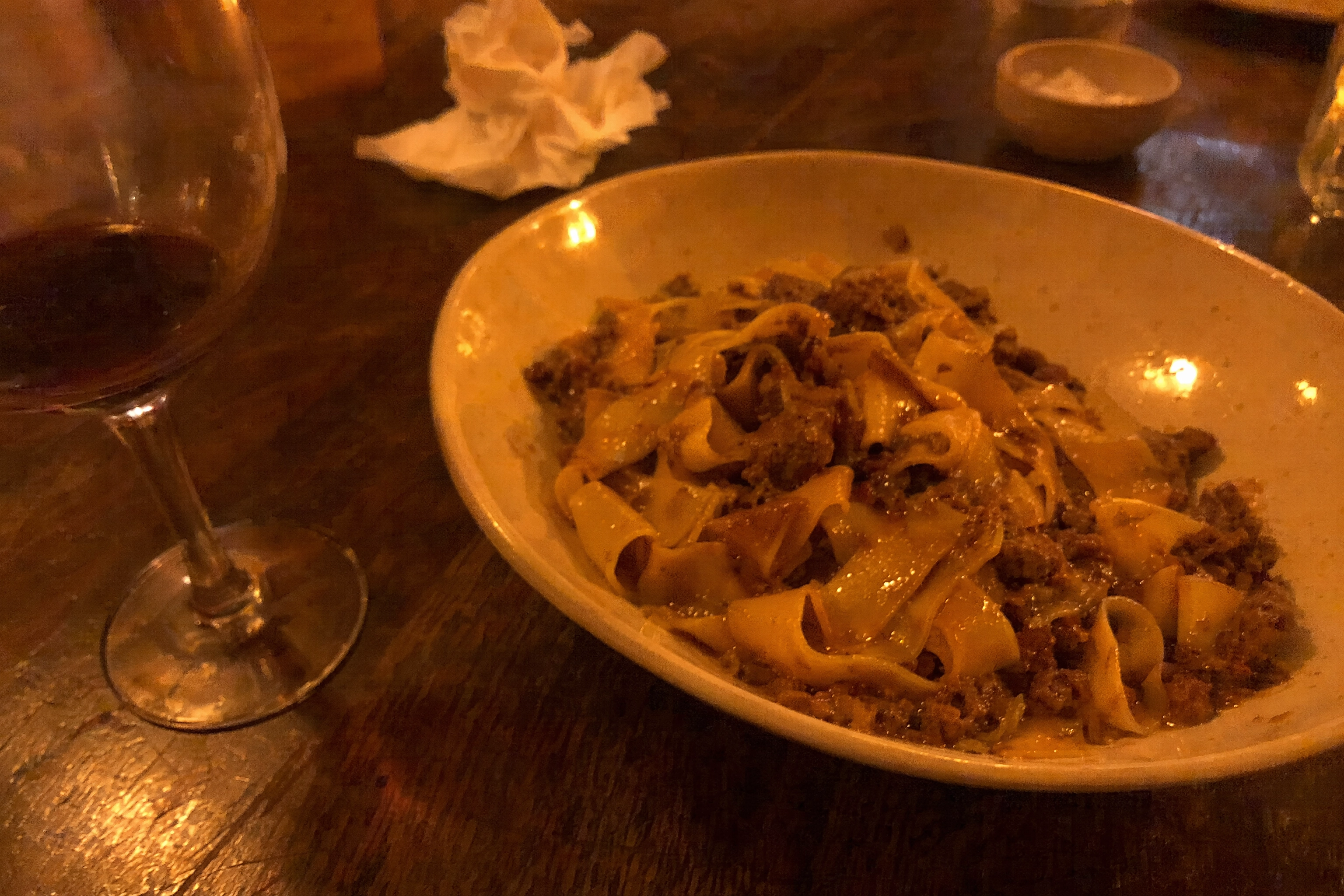 Bowl of pappardelle lamb ragu under a warm ceiling bulb, the orange cast that makes phone food photos read brown
Run that file through a photo transformation tool and four things change: white balance goes neutral so the ragu turns red again, the surface becomes clean dark slate, the angle corrects to a 45-degree three-quarter view, the crop tightens to the bowl. About two minutes, one credit.
The honest limit: this transforms a photo you took. It cannot invent a plate you never made, and any tool claiming otherwise is selling generic stock — a distinction we cover in AI generated food images.
Job 2: Email and SMS segmentation
Email is the second dependable win in AI for restaurant marketing. It helps with two things here. First, slicing a customer list into groups — lapsed 90 days, brunch-only, high average spend — without writing a query. Second, producing six subject line variants when you have written one.
Restaurant email benchmarks sit near a 20–25% open rate with clicks around 1–2%. SMS opens far higher, 90–98% across published data, but the lists reach far fewer customers and every message carries a real opt-out cost. AI changes neither economic reality, only how long segmentation takes.
Where it fails: left alone, it invents offers. Ask for a win-back campaign and it will propose 30% off a menu running on a 22% margin. Put the discount ceiling in the prompt, every occasion.
Pricing: free tiers cover most single restaurants to 500 contacts, then $20–$30 a month at 1,000. Our guide to restaurant marketing software compares platforms properly.
Job 3: Review response
This is the cleanest win in AI for restaurant marketing. A reply that took four minutes of careful wording takes twenty seconds to draft.
It matters commercially. Harvard Business School research on consumer reviews and independent restaurants found a one-star rating increase drove a 5–9% rise in revenue. Reputation management is not a soft metric, and guest feedback is the cheapest customer data a restaurant business owns.
Where AI fails is judgement. It cannot know whether the 45-minute wait happened, whether that staff member has had three similar complaints, or whether the customer is a regular. It will apologise for something you did not do.
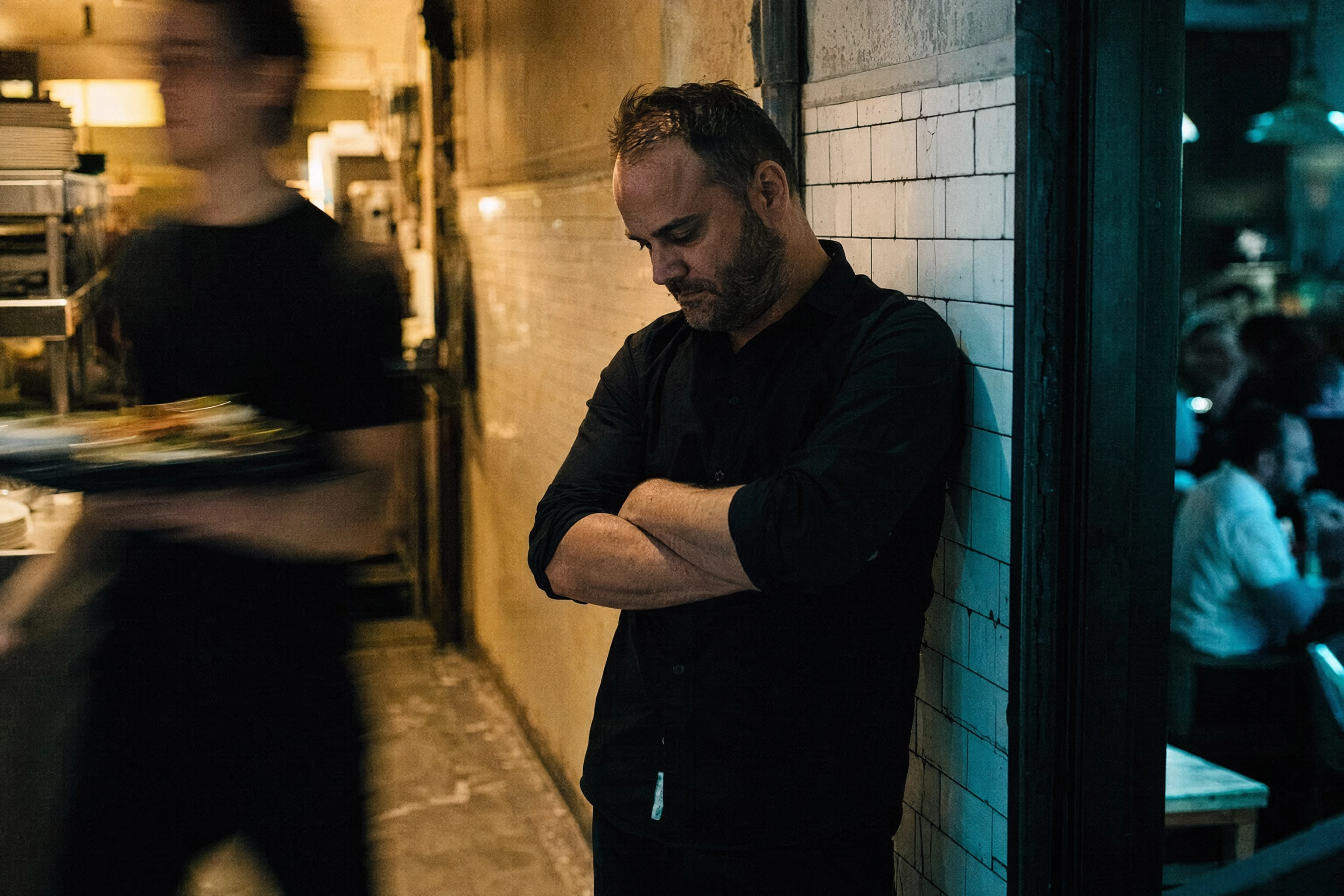 Restaurant manager pausing in the service corridor late at night, the shift knowledge no AI review reply tool has
The rule that holds: AI drafts, a human who worked the service approves. Never auto-post. Batch the week's replies into one 20-minute sitting.
Pricing: free with a general assistant. Reputation management platforms run $50–$200 a month and mostly buy a shared inbox, not better replies.
Job 4: Ad creative and copy testing
Both major social media ad platforms generate headline variants, background fills and aspect-ratio expansions inside the campaign manager. Free, fast, and a wider test matrix than an independent operator would build by hand.
Two cautions. Meta's advertising standards require disclosure of AI-generated or AI-modified creative, and undisclosed AI content is a common rejection reason in 2026. The FTC's endorsement guides apply to what your campaign claims regardless of who wrote it.
The bigger issue is statistical. A single site spending $15 a day never reaches significance across 20 variants, so the analytics show noise and you read insight. Run two campaigns, not twenty. Our guide to social media advertising for restaurants covers budget floors.
Pricing: generation is free, media is not. Below $10–$20 a day your campaign analytics are meaningless.
Job 5: Local SEO and listing management
AI is competent at one listing chore: rewriting a single restaurant description to the character limits and tone of each platform — your website, Google, the delivery marketplaces. It is also good at tedious audits — scanning your name, address and phone data across 15 directories, for example, and flagging the three that disagree.
Where it fails badly is facts. It hallucinates opening hours, invents service attributes and picks the wrong primary category. Every field it touches needs eyes on it, and no analytics dashboard will warn you.
The highest-leverage listing asset is still photography, and no language model takes photos. If delivery sales are weak and repeat customers are not returning, start with DoorDash photo requirements and Uber Eats photo requirements before touching copy — more in more orders on DoorDash and more orders on Uber Eats.
Pricing: free on Google Business Profile. Multi-listing sync tools run $20–$100 a month, hard to justify under three restaurants.
Job 6: Loyalty and win-back
AI ranks lapsed customers by recency and spend accurately enough. That part of the analytics genuinely holds up.
The economics are the problem. A win-back offer sent to someone coming in on Friday anyway is pure lost revenue, and no model can tell you which of the two customers you just discounted. Loyalty management sold as AI is usually rules-based automation wearing a new label — the point several practitioners made bluntly on the discussion threads ranking for this query.
 Folded bill and loose coins on a small brass tray beside an empty coupe glass, the margin a win-back discount gives away
Pricing: usually bundled with a POS loyalty service at $45–$185 a month. Fix your menu engineering first; it moves more margin than a discount engine will.
What a one-location operator should actually adopt first
Vendor blogs never write this section. Three moves, roughly $15–$35 a month, over three months — the whole of AI for restaurant marketing a single site needs.
1. Fix the photos first ($15 a month)
Photography sits upstream of every channel. Ads, listings, your website, email headers and the social media grid pull from one image library, so weak photos tax all six jobs at once.
One evening of phone shots across your twenty top-selling items, run through AI food photography, gives a usable library for the year. That is 25 credits on the $15 Starter plan, commercial license included — full FoodShot AI pricing is public. Weigh it against a shoot using DIY vs pro vs AI.
2. Put review replies on a 48-hour clock (free)
Draft with a general assistant, approve as a human, post within two days. No spend, no new tool, no contract. This habit helps your rating more than any paid reputation management product will in year one.
3. Send one segmented email a month (free to $20)
Segment on last visit date and nothing else at first. One email to the 200 customers who have not been in since April beats four generic blasts. Layer in richer customer data once the habit sticks.
What to skip in your first year
Most of the money wasted on AI for restaurant marketing goes into three categories: predictive demand tools, AI loyalty engines, and anything sold as a complete marketing suite. The pattern on operator forums is consistent: teams buy a $300 business suite to paper over the fact that nobody posts to social media twice a week, and no tool fixes inconsistency. Our 12 AI tools for restaurants with real prices has the teardown, and 50 restaurant marketing ideas covers what to do with the hours you save.
Three things AI still cannot do for your restaurant
It cannot photograph a plate you never made. Every credible food image starts with a real photograph of real food leaving your kitchen.
It cannot know what happened on the floor last night. The apology that lands, the comp that saves a regular, the birthday table — that is your staff and your service. Your team hears feedback the analytics never capture, and small teams carry that knowledge better than a dashboard.
It cannot build a local relationship. Sponsoring the school team, trading window cards with the wine shop next door, getting the neighbourhood to care. None of that is a content problem, and treating it as one is the most expensive mistake in AI for restaurant marketing.
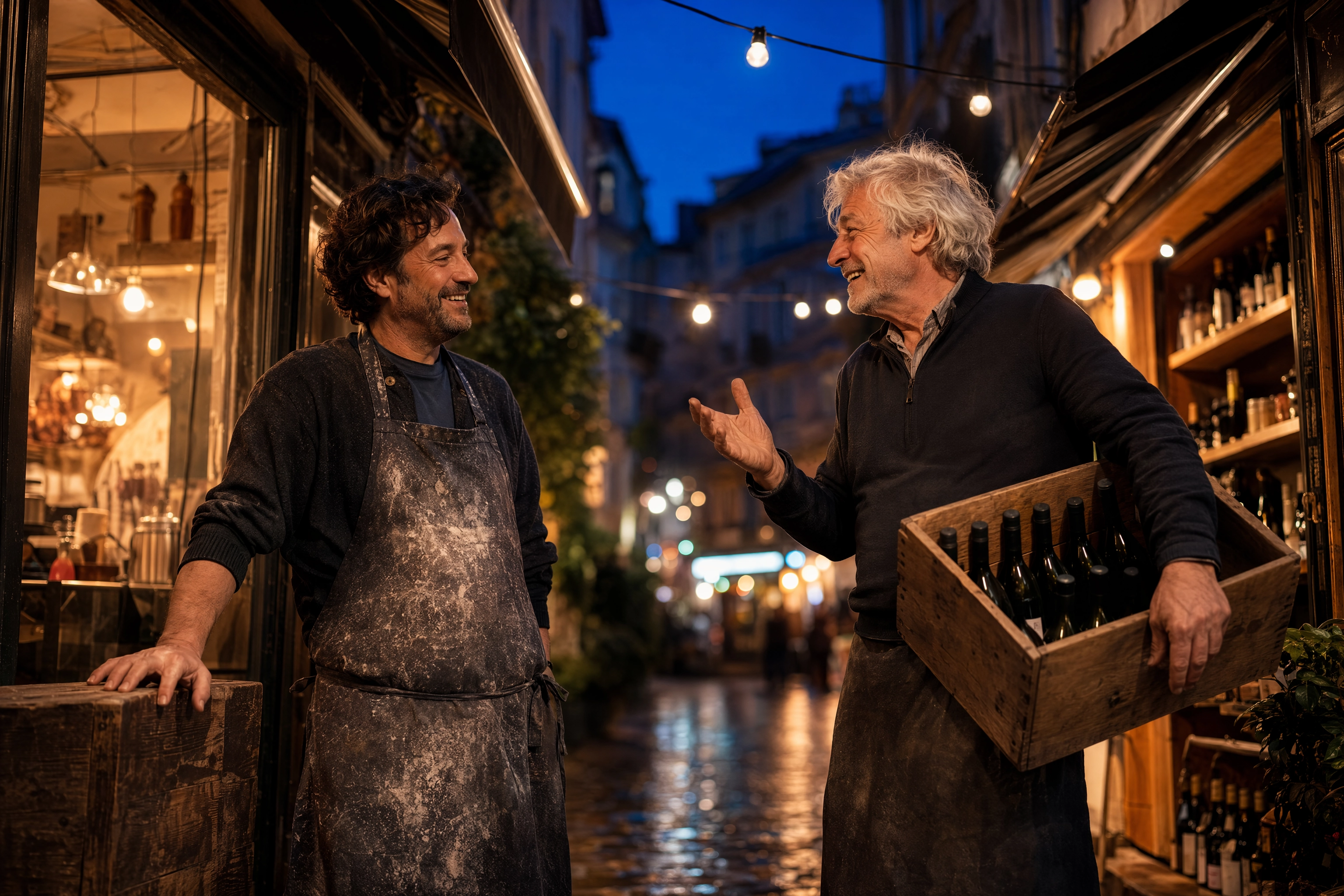 Restaurant owner talking with the neighbouring wine shop owner on the pavement at dusk, local marketing no AI can automate
Plan the human half with restaurant branding, social media marketing for restaurants, restaurant Instagram marketing and food influencer marketing.
Frequently Asked Questions
Is AI for restaurant marketing worth it for a single location?
Yes, on three jobs. Photography, review reply drafting and email segmentation each return more than they cost. Prediction suites, AI loyalty engines and multi-listing management tools do not clear the bar until you run three or four restaurants.
How much does AI restaurant marketing cost per month?
A realistic floor is $15–$35: about $15 for photo transformation and $0–$20 for a general assistant, with review replies and Google Business Profile posts free. Products priced at $200 and up sell bundled management, not better output. At one location, AI for restaurant marketing should cost less than your weekly linen bill.
Can AI write my restaurant's social media captions?
Yes, provided you supply the specifics. Record two minutes of voice notes about the special and let the model shape it. Without your details it produces generic content that sounds like every other restaurant on the timeline — see how to promote your restaurant on social media and which platforms are worth posting on.
Should AI reply to negative reviews?
It should draft the reply, never post it. AI cannot verify what a guest describes or recall the service that night. Use it for structure and tone, then have someone who worked the shift approve it.
Can AI generate food photos without a photo of my dish?
Not honestly. Tools generating food from a text prompt alone produce plausible but fictional plates, a misleading-advertising risk on a menu or delivery listing. Transformation tools start from your own upload — see AI food photo editors compared and menu photography.
Do I have to disclose AI-edited photos in my ads?
On Meta, yes — its ad standards require disclosure of AI-generated or AI-modified creative. Your own website and organic social media posts answer to advertising law rather than platform policy, so the safe rule is simple: never let an edit misrepresent what arrives at the table.