What Is a Virtual Brand on DoorDash? 11 Rules to Pass
 Ali Tanis16 min read
A virtual brand on DoorDash is a delivery-only concept launched from a kitchen you already operate — its own name, its own menu, its own store page in the app, cooked on the same line by the same crew. Ask what is a virtual brand on DoorDash in any operator forum and you get three answers, because DoorDash's own pages use virtual brand, virtual kitchen and virtual restaurant almost interchangeably. They are not the same thing, and which one you are running decides which rulebook applies to you.
That rulebook is the part nobody publishes in one place. Here it is: the eleven published requirements a virtual brand has to clear, what triggers the virtual kitchen badge, how many brands one address can realistically carry, and what the commission does to your margin — the operational answers you cannot assemble from the help centre without reading six articles.
Quick Summary: A virtual brand is a concept, not a building — a second DoorDash listing run out of an existing kitchen. To stay on the platform it needs at least 50% menu separation from every other store at that address, a minimum of eight food items, a 4.0+ lifetime rating, under 5% merchant cancellations, and its own photo on every item. DoorDash caps you at 10 brands per address. The practical ceiling is far lower.
What Is a Virtual Brand on DoorDash?
A virtual brand is a listing. That is the cleanest way to hold it in your head. You keep one lease, one hood, one crew and one health permit, and you add a second name to the app with a menu built for delivery. Nothing physical changes — the whole second business lives online.
DoorDash treats that listing as a full store. It gets its own store page, its own hours, its own ratings, its own commission on its own subtotal, and its own place in search results. Customers ordering from it never see the parent restaurant's name. Your kitchen sees two tickets printing from the same rail.
That is the appeal. A second dining room costs a lease, a build-out, a crew and a full-service floor. A second listing costs a menu, a photo shoot and some prep discipline. The trade is that you are adding covers to a line that is already working, which is an operations problem long before it is a marketing problem.
The model is common enough now that customers have learned to spot it. NBC News found that in some cities, delivery-only listings account for at least one in every five restaurants on the apps. That scale is exactly why DoorDash wrote rules.
Virtual Brand vs Ghost Kitchen vs Virtual Restaurant
Three words, three different meanings. The search results mix them constantly; DoorDash's own merchant explainer on delivery-only restaurants defines a ghost kitchen as a standalone commercial facility and a virtual restaurant as a delivery brand run from an existing restaurant's kitchen.
| Term | What it names | Where food is cooked | Needs new premises? |
|---|---|---|---|
| Virtual brand | The listing and its identity | A kitchen that already exists | No |
| Ghost kitchen | The facility | Production-only site, no dine-in | Yes |
| Virtual restaurant | The umbrella category | Either of the above | Depends |
Cloud kitchens and dark kitchens are often used as regional synonyms for the facility, not for the listing — we break those apart in our dark kitchen guide and our cloud kitchen marketing guide.
A worked example of the test: if the thing you are describing has a door, it is a ghost kitchen. If it has a logo, it is a virtual brand. Ghost kitchens are premises you rent or build; virtual brands are names you launch, and most operators asking this question already hold the keys. Wikipedia's virtual restaurant entry uses the umbrella sense, which is why encyclopaedia definitions feel vague to operators.
Both routes are legitimate, and multiple restaurants run both at once. If you are choosing the facility route rather than the listing route, start with our virtual kitchen guide and our walkthrough of running a ghost kitchen on DoorDash. This page is about the listing.
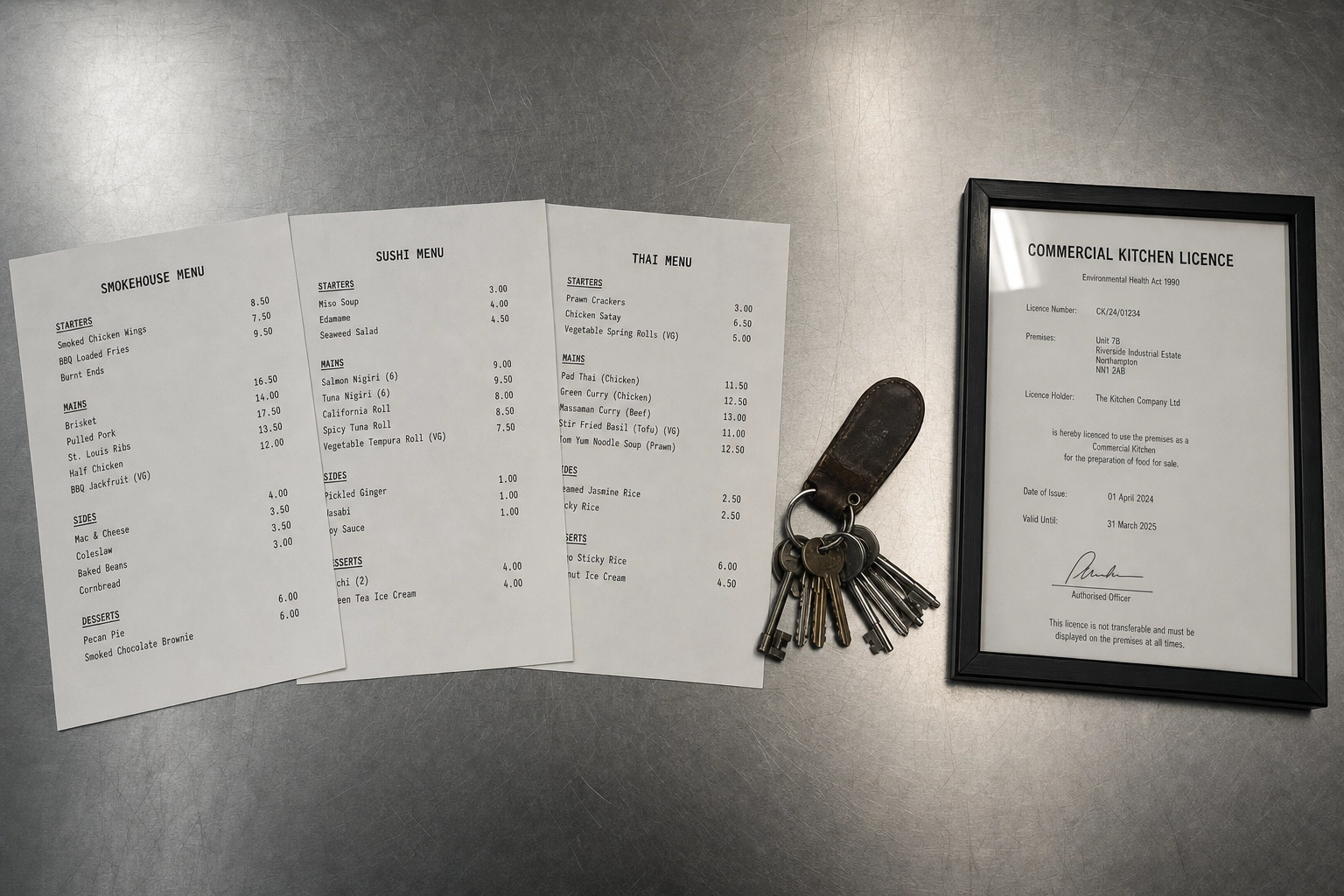 Overhead flat-lay of three separate menu sheets beside one ring of keys and one kitchen licence on steel, three virtual brands one premises
DoorDash's 11 Virtual Brand Quality Requirements
DoorDash publishes a policy called Virtual Brand Quality Requirements, and it is short, blunt and enforced. Brands that miss it "will not be permitted on the platform." Read it as an eligibility checklist, not as guidance.
Rule 1: the 50% menu separation rule
Your virtual brand must carry at least 50% separation in main items from every other restaurant menu on DoorDash at that same address. Sides, drinks, sauces and seasonings do not count toward the calculation — only mains.
Then comes the clause that closes the loophole most operators try first. Brands that sell the same or similar items and simply change the item photos, the names or the prices are not treated as different, and will not be allowed on the platform.
So the wings play, which is the classic first virtual brand, only works if the wings are genuinely a new build. Ten flavours of the same fried wings you already sell under the parent listing is a reskin. A brined, twice-fried wing on a sauce range you do not otherwise offer, with its own rice-and-slaw sides, is a separate proposition. Business Insider reported the rule directly from DoorDash back in 2022, quoting a 50% separation standard on virtual-restaurant menus.
Build the menu against that test before you build the logo. Our ghost kitchen menu planning walkthrough and restaurant menu design guide both start from the same place: what travels, and what you can hold on a line you already run.
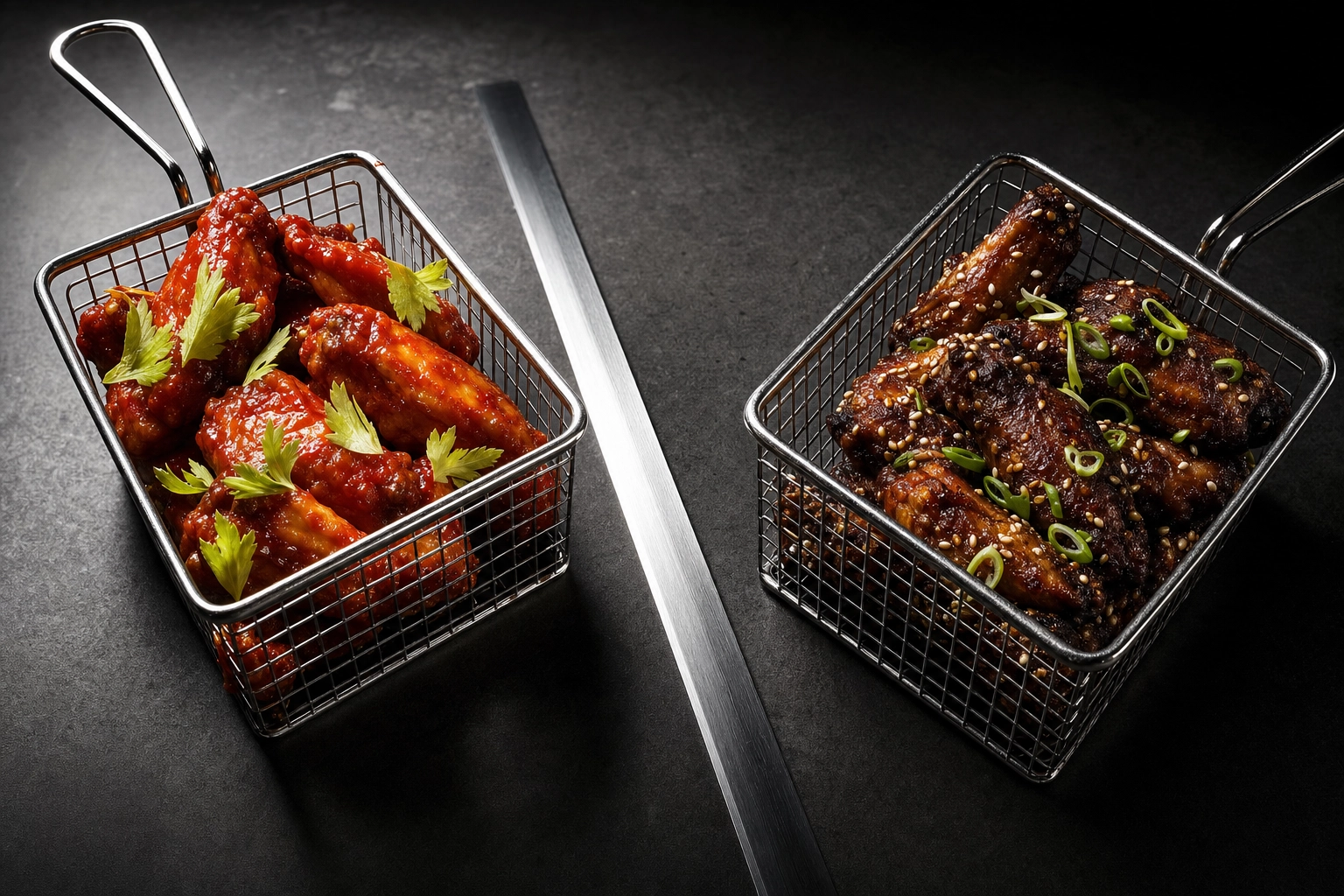 Two baskets of chicken wings with different sauces divided by a steel ruler, illustrating DoorDash 50% menu differentiation for virtual brands
Rules 2-4: menu size, hot food, and a photo on every item
Three hard numbers:
- At least 8 distinct food items. Appetisers and sides count. Drinks and sauces do not.
- At least 50% hot or prepared food. The listing has to read as a meal, not a pantry.
- Every item needs its own distinct, unique photo that accurately represents what arrives.
That third one is not a style note. It is an eligibility gate, and it is where most second concepts stall. We cover the exact specs — resolution, crop, rejection reasons — in our DoorDash photo requirements guide, and the layout side in our photo menu guide.
Rules 5-6: ratings and cancellations
A virtual brand has to hold a lifetime customer rating of 4.0 or higher, and keep merchant-cancelled orders under 5% of the total.
Both metrics are inherited, in practice. The new listing runs on the same line, at the same peak, with the same ticket times as the parent. If your kitchen already stops accepting orders at 7:30pm on Fridays, the second store will carry that cancellation rate from week one. Fix the throughput first, then launch.
Rules 7-8: where you are allowed to cook
Virtual brands must hold the required licences and operate out of a licensed commercial kitchen. Residential kitchens are prohibited outright, including those covered by Cottage Food permits. Brands are also expected to keep documentation showing compliance with local health and safety regulation.
If you do not have commercial space, this route is closed and the facility route opens — a commissary, a shared production kitchen, or a rented bay. That is a separate decision with separate costs.
Rules 9-11: caps, impersonation and refund abuse
No more than 10 virtual brands per store address, with exceptions for established commissary operators or written approval from DoorDash. The exception exists because commissary ghost kitchens legitimately host several unrelated businesses at one address.
Two behaviours trigger immediate deactivation by the fraud team rather than a warning: copying another restaurant's name, logo, menu or assets, and repeated abuse of DoorDash's cancellation, credit or refund policies.
The Virtual Kitchen Badge and What Triggers It
DoorDash labels qualifying stores with a virtual kitchen badge in mobile and web search, so the label follows you everywhere the store appears online. Per the badging policy, a store gets badged if it meets any one of three criteria:
- The brand has no established brick-and-mortar store.
- The store offers no dine-in option for customers.
- The store operates out of a commissary or shared kitchen.
It is an OR test, not an AND test. Almost every virtual brand trips at least one condition — a delivery-only listing with no dining room is the textbook example — so treat the badge as a certainty rather than a risk to manage. DoorDash has been labelling these listings since March 2021 and is, by Business Insider's account, the most transparent of the three big apps about it.
You cannot opt out, and trying to look like something you are not is the one thing that gets you removed. Customers are unforgiving about it: the top organic result for this query is a r/doordash thread celebrating the tag, where the highest-voted comments say they avoid badged stores on the assumption the food is frozen and overpriced. A parallel r/mildlyinfuriating thread calls the format "an expensive way to get food from Denny's."
The badge is not what costs you the order. Looking like a duplicate of the listing directly above you is.
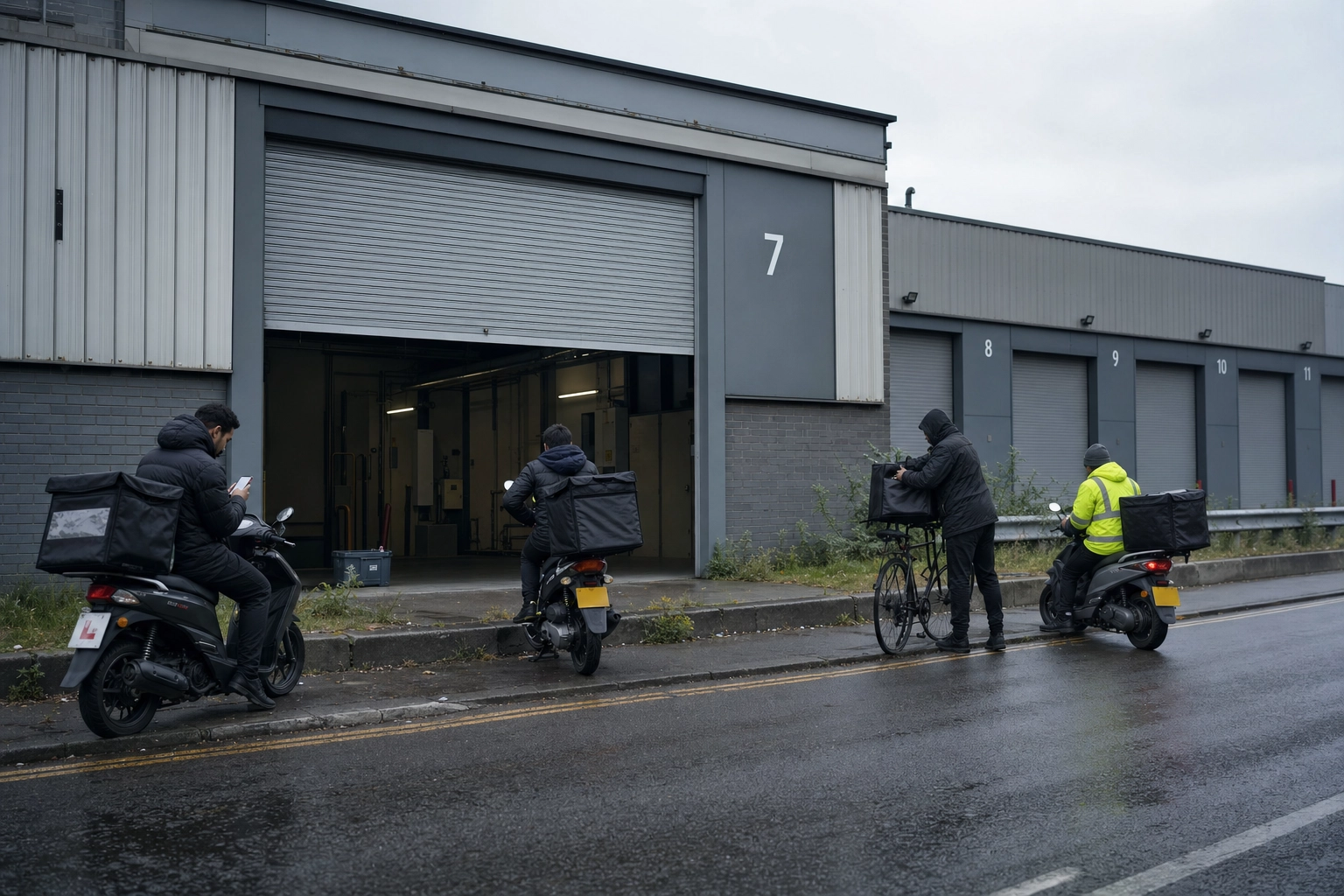 Couriers waiting outside a plain industrial production unit with no dine-in entrance, the setup that triggers the DoorDash virtual kitchen badge
How Many Virtual Brands Can One Kitchen Run?
Policy says 10 per address. The honest answer for a single independent restaurant is two, often three at a stretch.
The 50% separation rule compounds. Brand one has to separate from the parent. Brand two has to separate from the parent and from brand one. By brand four you are inventing cuisines you have no business cooking, and adding SKUs without adding hands — more prep, more storage, more par levels on a line that has not grown.
Then there is the peak. Virtual brands do not bring their own crew; they bring more tickets to the same 90 minutes. If your pass is already at capacity at 7pm, a second store converts a good rating into a bad one. Ghost kitchens with dedicated production bays can push past this. A single restaurant kitchen cannot.
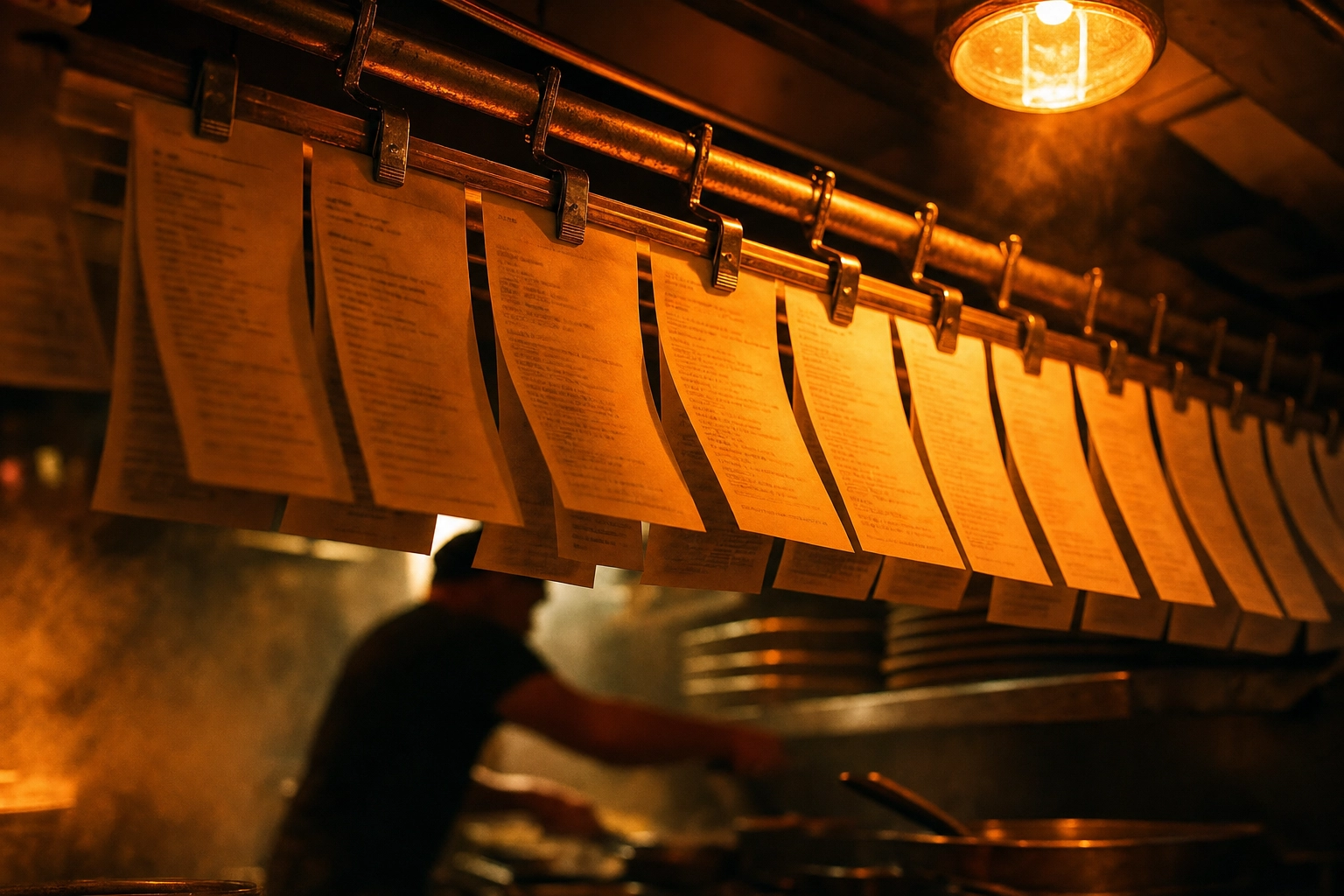 Kitchen ticket rail overloaded with dockets at dinner rush, the throughput limit on how many virtual brands one DoorDash kitchen can run
Operators who ignored both limits got caught. Business Insider documented a San Francisco pizzeria running more than 70 storefronts from one address, and reported that Uber Eats removed roughly 8,000 virtual brands when it tightened its own rules — 3,000 more than it expected — costing one operator $7,000 a month. Customers were already counting: one r/doordash post catalogued a restaurant with six storefronts at a single address.
Two well-photographed listings beat six thin ones. Our ghost kitchen brands breakdown covers how operators running multiple concepts structure it.
What a Virtual Brand Costs on DoorDash
Each virtual brand is a separate store on the service, so it carries commission on its own subtotal. There is no volume discount for running several from one address.
| Plan | Delivery | Pickup | What it adds |
|---|---|---|---|
| Basic | 15% | 6% | Listing and standard delivery radius |
| Plus | 25% | 6% | DashPass, wider delivery area |
| Premier | 30% | 6% | Automatic ads, photoshoot credit, order guarantee |
Those rates come from DoorDash's published merchant pricing, and pickup was cut to 6% across all three tiers when the partnership plans were restructured. Premier adds an order guarantee: accept at least 20 orders in a month or DoorDash refunds that month's commission, conditional on cancelling fewer than five orders and keeping open hours for 90% of your posted hours.
Model it at your real plan rate, not at 15%. A worked example: on the Plus plan, a $14 entrée returns $10.50 before food cost, packaging and the extra labour the ticket created. DoorDash's plan comparison is worth reading against your own mix, because a delivery-only listing has no pickup traffic to average the rate down. If your margin only works at full list price with zero promotion, the idea is not ready.
The Photo Gate That Stops Most Virtual Brands
Photography is the requirement operators discover last and the one that decides whether the listing works.
Two things are true at once. First, a unique image on every item is a stated condition of eligibility — reusing the parent restaurant's shots is the exact pattern the separation rule was written to catch. Second, photos are the single biggest lever on the ordering decision. DoorDash's own figures put it plainly: an estimated 38% of customers use menu photos to choose where to order, and restaurants saw a 44% increase in monthly sales on menus with item photos.
So a second listing needs a second visual identity, not a second folder of the same pictures. A late-night wings brand should look nothing like your bistro: darker surfaces, harder light, tighter crops. A grain-bowl concept from the same kitchen should be bright, overhead, airy. That contrast is what tells a customer these are two kitchens' worth of intent, even when they are not.
The economics used to be brutal here. Eight items minimum, two concepts, plus the parent menu is 30-odd images, and a studio session runs into four figures. DoorDash offers a free photoshoot to eligible merchants plus a $200 credit on Premier, but it covers one shoot, not the reshoot every time you change a sauce.
That is the gap FoodShot AI closes: phone photos of real plates, restyled into distinct 4K looks per listing, so brand two does not inherit brand one's aesthetic. See our food delivery app photography and ghost kitchen photography pages for the workflow, pricing for the numbers, and our menu photography guide plus common delivery photo mistakes before you shoot anything. The same gate exists next door: our Uber Eats photo requirements breakdown and our guide to getting more orders on Uber Eats cover the other big app.
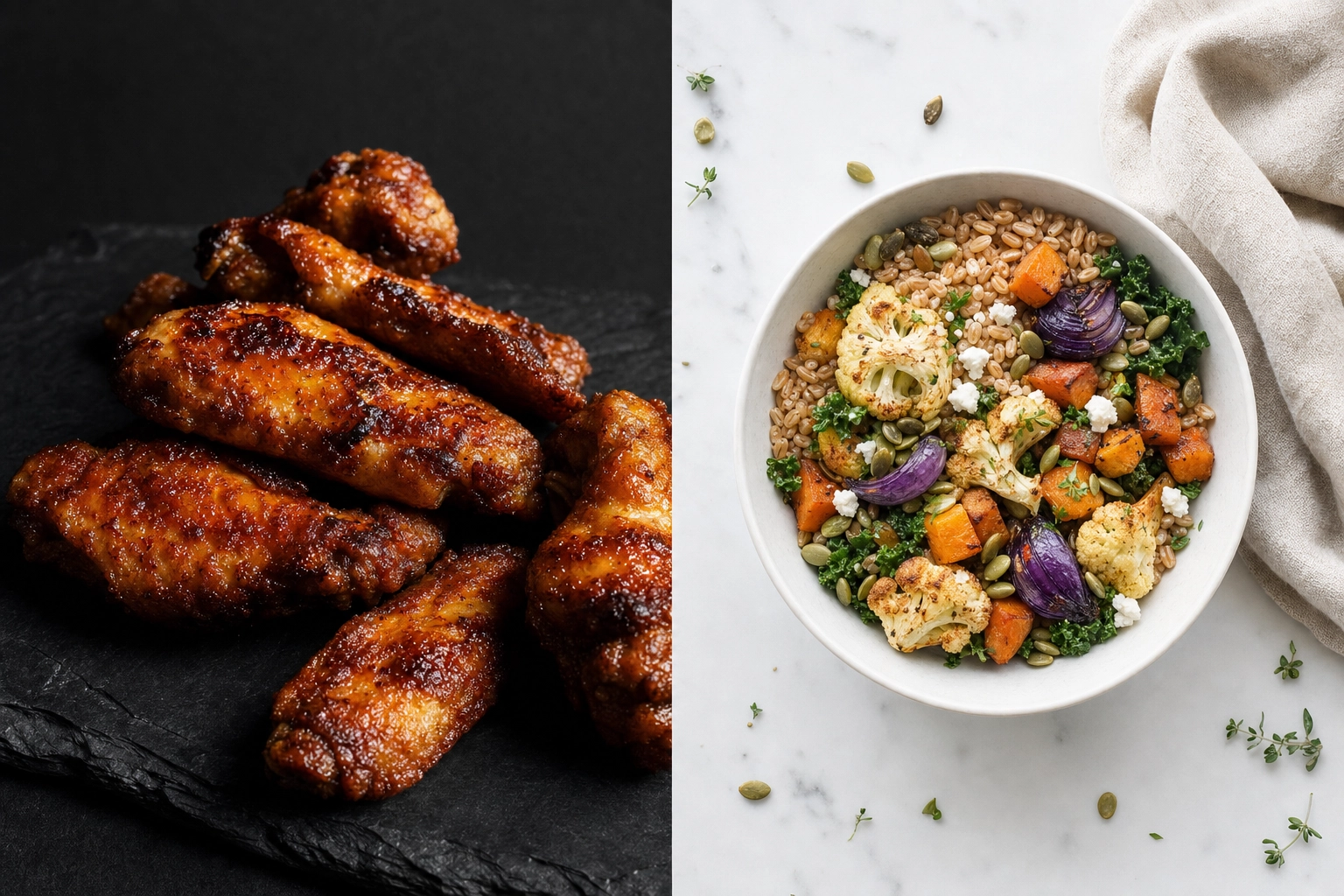 Split frame comparing dark moody wings styling with bright airy grain bowl styling, two distinct photo identities for two virtual brands
When a Virtual Brand Is the Wrong Move
Skip it if your line is already maxed at peak — a second listing multiplies tickets, not hands, and peak times do not stretch. Skip it if the food does not survive 25 minutes in a bag; fried, saucy and delicate items often punish you twice, once on the rating and once on refunds.
Skip it if the idea overlaps your parent listing, because you will split your own demand and fail the separation test at the same time. And skip it if nobody on staff can keep a second photo library current without dropping something else. A listing whose images go stale converts a little worse every month, without ever telling you why.
The upside is real, but it belongs to restaurants with genuine spare capacity, a dish that travels, and the discipline to run the second store as a business rather than a side experiment. Our ghost kitchen marketing guide covers the demand side once the listing is live. DoorDash's own virtual brands blog and its virtual restaurant case studies are worth reading for the successful versions.
Frequently Asked Questions
What does virtual brand mean on DoorDash?
It means a delivery-only concept that appears on DoorDash under its own name but is cooked in an existing kitchen. The name, menu and online store page are separate; the premises, equipment and staff usually are not. DoorDash treats it as its own store for commission, ratings and hours.
Is a virtual brand the same as a ghost kitchen?
No. A ghost kitchen is a physical production facility with no dining space. A virtual brand is a name and a listing, which may run out of a ghost kitchen, a commissary, or the kitchens of ordinary sit-down restaurants. One is premises, the other is branding, and you can run either without the other.
How many virtual brands can one address run on DoorDash?
The published cap is 10 per store address, with exceptions for established commissary operators or written approval from DoorDash. Commissary ghost kitchens are the exception, not the norm. Most independents should stop at two or three, because every new listing must separate from all the menus already at that address.
Does DoorDash tell customers a store is a virtual brand?
Yes. Stores with no brick-and-mortar location, no dine-in option, or operations inside a commissary or shared kitchen get a virtual kitchen badge in search results. Any one of the three triggers it, and there is no way to switch it off.
Can I reuse my main restaurant's photos on a virtual brand?
No. DoorDash requires a distinct, unique photo on every item, and explicitly states that reusing similar items under new images or names does not satisfy the separation rule. Recycled photography is also the fastest way for a customer to recognise a duplicate listing and scroll past it.
How much commission does DoorDash charge a virtual brand?
The same as any other store on the service: 15% on delivery for Basic, 25% for Plus, 30% for Premier, and 6% on pickup across all plans. Each brand pays on its own subtotal, so running several from one kitchen does not reduce the rate on any of them.
The Bottom Line
The definition takes one sentence: a virtual brand is a second delivery listing from a kitchen you already run. Everything that decides whether it works sits downstream of that — a menu that separates by half from everything else at your address, at least eight items, a photo on each one, and the throughput to protect a 4.0 rating during your own dinner rush. Get those right and the badge is irrelevant. Get them wrong and you have built a duplicate of yourself, at 25% commission.